
There’s a very specific kind of cold that hits when you’re camping: not “brr, it’s chilly” cold—more like “everything you touch steals heat” cold. It changes how you cook, how you sleep, how long you want to stay outside, and whether the trip feels adventurous or just… exhausting.
If you’re shopping for a wood burning stove, you’re not just buying heat. You’re buying control. Control over the morning you wake up to frost, control over damp gloves, control over a meal that actually cooks evenly, and control over that one moment every camper remembers: the first time a stove back-puffs smoke when you open the door.
Most guides online do the same shallow loop: list specs, list pipe count, pick a “winner,” call it a day. That’s not how real stoves earn trust. In real life, the decision is made by the friction points you only notice after a few nights: how picky the stove is about wood length, whether the door seal is “quiet” or constantly whispering smoke, how easily the glass soots over, how stable the chimney feels in gusty wind, and whether ash cleanup is a one-minute habit or a messy end-of-trip project.
This guide is written like a field manual—warm, practical, and very honest about what matters. You’ll see 14 standout picks ranging from compact hot-tent heaters to long-burn pellet rigs, from sauna-ready designs to fast-boil rocket stoves for backyard cookouts and emergency kits. I’m going beyond the product page to translate design choices into what you feel at camp: ease, heat, and confidence.
Below, you’ll get a clear way to choose, a quick comparison table, and deep-dive reviews that focus on real ownership: how these stoves behave once the novelty wears off and you’re relying on them at midnight.
In this article
How to Choose the Right Wood Burning Stove for Real-World Camping
A good stove is not the one with the longest feature list. It’s the one that behaves predictably when you’re cold, tired, and doing everything with gloves on. The goal is simple: stable heat, controllable burn, and a setup you can repeat without drama. Here’s the decision framework I use to separate “looks good online” from “feels good at camp.”
1. Start with your true use-case (not your fantasy use-case)
Most people don’t own one stove—they own one situation. Identify yours first, because it instantly narrows what “best” means.
- Hot tent sleeper: You care about controllable heat, reliable draft, and a door that doesn’t leak when you crack it open to refuel.
- Basecamp cook: You want a stable cooktop, side shelves, and enough firebox space to run steady heat while you prep.
- Long winter nights: Burn time matters. Pellet mode or a larger firebox can reduce how often you wake up to feed.
- Sauna/steam user: You care about rock baskets, heat retention, airflow control, and “steam response” when you add water to stones.
- Backyard + emergency: You want fast heat, fast boils, easy fueling, and zero fuss packing.
2. Firebox size is really a wood-length decision
The biggest surprise for first-time stove owners isn’t draft. It’s wood sizing. Many stoves in this guide heat brilliantly—but only if your fuel fits. If the door can’t close on standard camp logs, you’ll either pre-cut wood at home or you’ll be doing “log surgery” every evening.
Use these practical rules:
- If you camp where you buy bundled firewood: favor a larger firebox or expect to cut pieces shorter.
- If you camp where you scavenge sticks and splits: smaller fireboxes can work beautifully (and can be more fuel-efficient).
- If you want steady cooking heat: you want space for coals—coals are what even out temperature and reduce scorching.
Think of firebox size as your “heat battery.” A bigger battery holds more fuel and coals; a smaller battery responds faster but needs more frequent charging.
3. Draft quality is the real “stove personality”
Draft is the engine. Everything you love (clean burn, stable flame, low smoke) comes from the stove pulling air the way it’s designed to. Most smoke problems are not mysterious—they’re repeatable:
- Cold chimney: a cold pipe doesn’t pull well, especially at startup.
- Short stack for your tent height: the stove can’t “pull” enough to dominate wind turbulence.
- Over-damping too early: choking exhaust before the fire is established invites back-puffing.
- Ash blocking airflow: if the grate area clogs, the stove starves and smolders.
Stoves that feel “easy” are usually the ones that create draft quickly and maintain it even when you adjust heat down. That’s why features like dampers, elbow sections, and stable chimney tie-down points matter more than they look.
4. Airtightness is about comfort, not perfection
People hear “airtight” and think it means “zero smoke ever.” Realistically, airtightness means the stove gives you control. A door that closes cleanly, a latch that pulls the door tight, and seams that don’t breathe under heat are what let you:
- hold a steady flame instead of a wild flare,
- reduce the wood-guzzling “blast furnace” mode,
- avoid that annoying thin smoke that creeps out during long burns,
- keep more heat in the tent instead of losing it up the stack.
The best designs pair airtightness with smooth adjustment—because a stove that seals tight but has awkward controls can still be stressful to run.
5. Materials: choose the kind of durability you actually need
Material choice isn’t just “strong vs weak.” It affects weight, heat feel, and how the stove ages.
- Carbon steel / coated steel: common in hot-tent stoves. Strong, affordable, heats fast. Can show paint curing smoke early on, and can warp if over-fired repeatedly.
- Stainless steel: resists rust better and often cleans easier. Can still discolor (normal) and can still warp if pushed hard, but tends to age gracefully with basic care.
- Cast iron-style builds: great for stability and “heat soak” feel. Often heavier, and some portable units labeled as cast iron can vary in actual construction—judge by thickness and rigidity, not marketing.
If you’re moving the stove a lot, weight is part of safety. A stove that’s too heavy for your routine becomes the stove you avoid using.
6. Cooktop reality: flat metal is not the same as usable cooking
Cooking on a stove is about surface behavior, not just surface size. A flat top can still be frustrating if:
- the heat concentrates in one small hot spot (common with narrow fire paths),
- the stove runs too hot to simmer without constant tending,
- pot supports shift or seize after heat cycles,
- there’s no “cool zone” for keeping food warm without burning.
The best cookers in this list usually have either a bigger top, shelves that act like warming zones, or a design that naturally creates a coal bed. Pellet + oven models add an entirely different cooking style: longer, steadier heat with less feeding.
7. Portability is not a single number—think “packing friction”
A stove can be “portable” and still be annoying to transport. What you want is low friction:
- Everything stores inside the body (pipes, tools, spark arrestor).
- Legs fold without wobble and don’t loosen after heat cycles.
- Carry points make sense (handles, racks that double as grips, included bag that actually fits).
- Chimney stability is built-in (hooks, guy-line points, usable stakes/ropes).
8. Maintenance: the “after the fun” factor that decides long-term happiness
This is where ownership gets real. The stoves people keep loving are the ones that make cleanup easy:
- Pull-out ash pans (fastest end-of-night routine).
- Accessible burn grates (so airflow stays consistent).
- Pipes that nest and clean easily (less tar build-up drama).
- Glass that can be cleaned without a full teardown (because soot happens—what matters is how annoying it is).
If you want a stove you’ll use often, pick one that fits your tolerance for “stove chores.” A clean, repeatable routine is the difference between a stove that feels like a luxury and a stove that feels like a project.
Quick Comparison: 14 Wood Burning Stove Picks for Camping, Heat, and Cooking
Use this table to match a stove to your situation fast, then jump into the deep reviews for the details that actually matter: draft behavior, wood-length reality, control feel, and the small annoyances that show up after week three—not day one.
On smaller screens, swipe or scroll sideways to see the full table.
| Model | Stove type | Best for | Real-life strength | Amazon |
|---|---|---|---|---|
| KUNGKA Compact Hot Tent Stove (7-pipe kit) | Hot tent | Most campers who want heat + simple cooking | Strong heat, glass view, good portability, ash tray convenience | Amazon |
| VEVOR Large Firebox Camp Stove (shelves + 8 pipes) | Basecamp | Wall tents, outdoor kitchens, longer stays | Big firebox + generous cooking surface; built like a workhorse | Amazon |
| Ytaoeo 2-in-1 Sauna + Tent Stove (rock box + grill top) | Sauna-ready | Heat + cooking + steam-style sessions | Great heat output with viewing window and flexible pipe setup | Amazon |
| GREEN STOVE Pellet + Oven (Greenstovehori 5) | Pellet + oven | Long nights, less refueling, “set a rhythm” heat | Pellet mode extends burn time; oven adds real cooking options | Amazon |
| Guide Gear Compact Outdoor Stove (5-pipe kit) | Camp/yard | Sheds, greenhouses, small spaces, steady heat | Solid draft reputation for size; simple assembly; reliable warmth | Amazon |
| unho Stainless Tent Stove (chimney kit included) | Hot tent | Smaller tents, quick heat, compact cooking | Sturdy stainless feel, good airflow, surprisingly “confidence” build | Amazon |
| Huskfirm Folding Tent Stove (racks + ash tray) | Hot tent | Drying gear + cozy heat with a compact footprint | Smart rack design for drying/holding items; burns hot and fast | Amazon |
| WillowyBe Sauna Stove (stone basket + controlled airflow) | Sauna specialist | Dry sauna tents + group sessions | Purpose-built airflow path and sauna-focused design details | Amazon |
| YRenZ Airtight Portable Stove (large firebox) | Value hot tent | Budget-friendly heat with better sealing | Strong heat-to-size ratio with efficient burn and simple setup | Amazon |
| AVOFOREST Small Stove (7-pipe + tool kit) | Starter kit | First-time hot tent campers | Simple pack-down, glass window, accessories included for basics | Amazon |
| YRenZ Heat-Control Kit Stove (elbow + adjustable pipe) | Control kit | People who want included dampers and elbow routing | Feature-rich kit; best when you do a careful bolt + fit check | Amazon |
| Guide Gear Large Outdoor Stove (big firebox) | Big heat | Stationary outdoor heat and bigger spaces | High heat potential; heavier build; may need extra “dial-in” effort | Amazon |
| Lineslife Compact Camp Stove (folding, cast-iron-style) | Twig stove | Quick cooking, porches, emergency boils | Sturdy little heater/cooker with better “pan spread” than rockets | Amazon |
| GODSAX Heavy-Duty Rocket Stove (bag + tools) | Rocket | Fast boils, high heat cooking, preparedness | Chimney effect flame power; stable top for heavy cookware | Amazon |
In‑Depth Reviews: 14 Wood Burning Stove Options That Feel Great to Own
Now we go model by model. I’m not going to do the lazy “spec list and crown a winner” routine. Instead, I’ll translate design into ownership: what the stove is like at startup, what it’s like at hour four, what it’s like when you’re refueling in gloves, and what kinds of small tweaks (if any) owners commonly end up doing.
1. KUNGKA Compact Hot Tent Stove – The “Most People Will Love This” Balance

If you want one stove that hits the sweet spot—portable enough for real camping, powerful enough for real cold, and simple enough that you don’t feel like you adopted a second hobby—this is the one I’d point most people to first. The reason is not a single feature. It’s the way the whole kit behaves together: compact body, a workable chimney system, a viewing door that lets you “read the fire,” and airflow control that’s easy to understand without turning into a science experiment.
Real-life feedback on this style of stove tends to be consistent: it heats a tent far better than people expect for the size, and it’s efficient once it’s up to temperature. The key phrase there is once it’s up to temperature. Like many coated steel stoves, the first burn is about curing. Do that cure burn outdoors and push it long enough to burn off the initial smell and smoke, and you start your tent nights with a dramatically cleaner experience.
What makes it feel “best overall” is how it supports a calm routine. You can run it hot to warm the space quickly, then step it down into a steady burn for comfort. If you’re cooking, the top gives you a direct heat zone for boiling water and a workable surface for warming smaller items. It’s not a gourmet cooktop—think “camp practical,” not “slow-simmer perfection”—but it’s genuinely useful.
There are two realities you should accept going in. First: many compact tent stoves burn hot and fast. That’s not a defect; it’s physics. Small boxes respond quickly and don’t hold huge coal beds. Second: standard camp logs can be too long. This is where people either become annoyed or become prepared. If you’re willing to cut wood shorter (or pre-cut at home), the stove rewards you with real heat and a very cozy tent.
Why you’ll like it
- Heat output feels “bigger than it looks” – Great for cold nights when you want fast comfort.
- Easy-to-understand control – Air vent + chimney behavior are intuitive once you do one practice burn.
- Pack-down friendly design – Accessories store neatly and the stove travels well for car camping.
- Ash management is realistic – Cleanup doesn’t feel like a punishment (huge win for frequent use).
Good to know
- Plan a proper first burn outdoors to cure coatings and avoid “paint smoke” surprises.
- Expect to cut wood shorter than standard bundles if you want the door to close cleanly.
- Like many compact stoves, it asks for refueling rhythm on long nights (especially if you run it hot).
Ideal for: most campers who want a dependable hot-tent heater that also lets you boil water, warm food, and enjoy the fire through a glass door—without buying a massive basecamp unit.
2. VEVOR Large Firebox Camp Stove – When Cooking Space Matters as Much as Heat

This VEVOR is not pretending to be a backpacking stove. It’s a basecamp workhorse: bigger body, bigger cooktop vibe, and a “bring it where you can park” personality. If your camping style includes wall tents, longer stays, hunting camps, or an outdoor kitchen setup, this kind of stove makes life easier because it holds more fuel and gives you more usable surface area.
Here’s the expert lens that matters: big firebox changes the whole burn style. Instead of feeding small sticks every few minutes, you can build a coal bed and run a steadier flame. That steadiness is what makes cooking feel less frantic—especially for anything that’s not just boiling water. It also changes your nighttime strategy: you can prioritize a deeper coal base and reduce “temperature rollercoaster” swings.
The shelves are not just “nice extras.” They’re what create a real camp kitchen rhythm. One shelf becomes your warm zone (mugs, pot lids, a kettle that’s not quite boiling), while the top plate becomes your active zone. Owners love this because it feels closer to cooking at home: you can stage food, dry utensils, or keep gloves warm without hovering over the fire.
Now the honest side: size and weight affect everything. You’ll feel it when you load it, you’ll feel it when you reposition it, and you’ll feel it when you’re cleaning ash at the end of a trip. Also, big stoves can be over-fired by enthusiastic first timers. If you run it screaming hot early on, you can invite warping—especially on wide top plates. The smartest way to love a big stove is to run it hard enough to draft clean, but not so hard that you’re turning the entire cooktop into a glow show.
My favorite thing about this stove is how it supports a “minimum fuss” camp: fast setup, big capacity, and a layout that makes sense. If your trip includes cooking real meals, this one earns its keep.
Why it stands out
- Bigger firebox = calmer heat – More coals, less frantic feeding, better for steady cooking.
- Shelves create a real cooking workflow – Warm zone + active zone without juggling pots on the ground.
- Sturdy feel for the category – The build targets durability in cold-weather conditions.
- Great for longer stays – More fuel capacity supports longer heating cycles.
Good to know
- It’s a “carry from the car” stove, not a “walk it into camp” stove.
- Wide cooktops can warp if repeatedly over-fired; steady heat beats maximum heat.
- Plan your ash routine: bigger stove means more ash volume to manage.
Ideal for: basecamp campers who cook often, want longer heat cycles, and prefer a stove that feels like a piece of outdoor kitchen equipment rather than a minimalist heater.
3. Ytaoeo 2-in-1 Sauna + Tent Stove – The “Steam Session + Dinner” All-Rounder
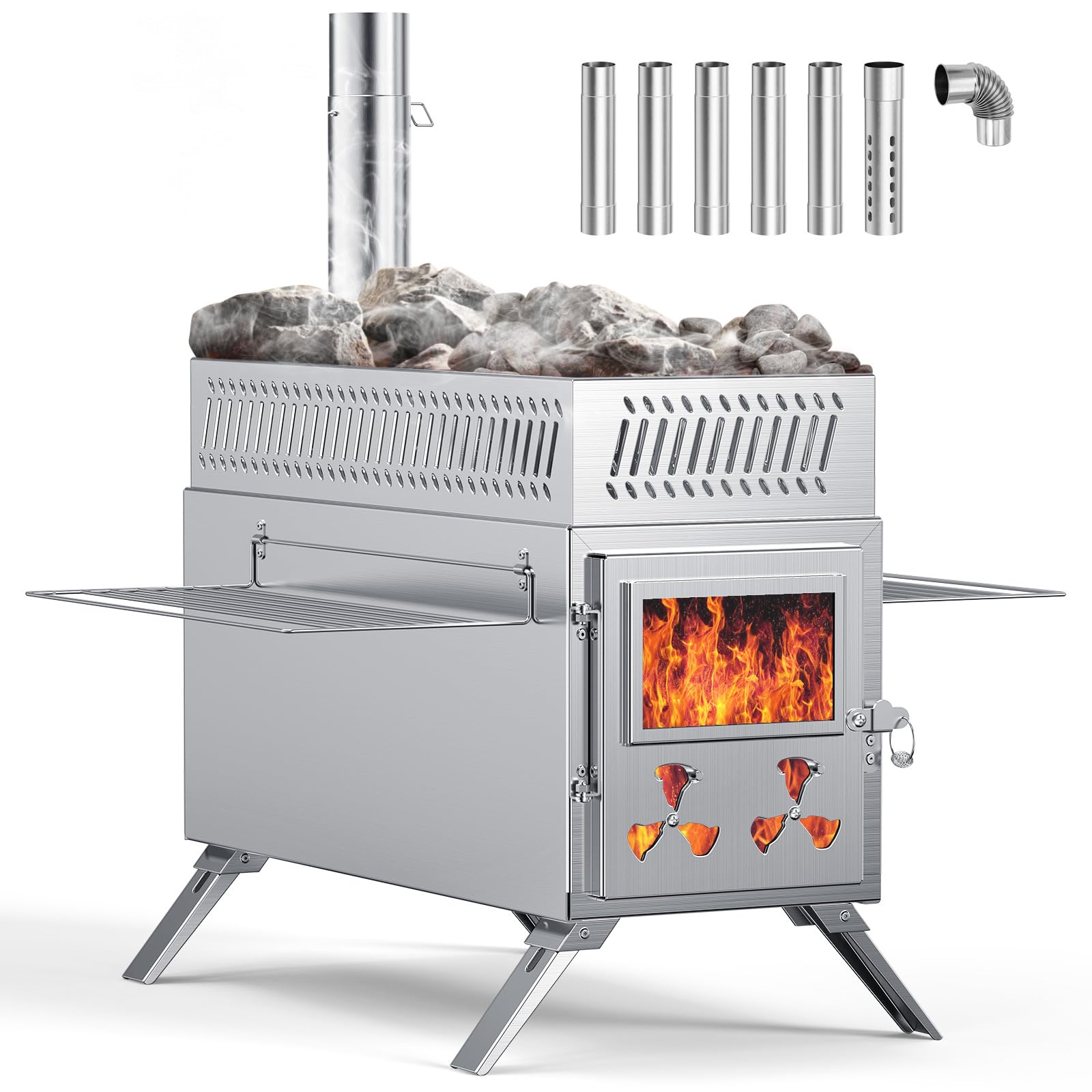
Some stoves are built for heat. Some are built for cooking. This one is built for a specific kind of outdoor happiness: the “we’re warm, we’re fed, and we can even do a steam-style sauna moment” kind. The big differentiator is the rock basket concept—because once you add stones, your stove stops being only a heater and becomes a heat reservoir. That reservoir smooths heat swings and gives you a more satisfying “steam response” when you splash water on the stones.
The smartest way to think about this stove is as a multi-mode tool. In heater mode, it’s about controlled airflow and strong draft. In cooking mode, it’s about stable top heat and usable surfaces. In sauna mode, it’s about building the right kind of fire: not a frantic flame, but a steady heat that saturates the stones without choking the chimney. That’s why adjustable airflow control is more than a gimmick here—it’s the difference between a pleasant steam session and a smoky, over-damped mess.
Owners who love sauna-capable stoves tend to mention two “small but huge” things. First: the window is not just pretty—it’s practical. You can see whether the fire is clean or lazy without opening the door and losing draft. Second: the pipe kit flexibility matters. The included sections and elbow let you adapt to tent height and routing without improvising from day one.
The trade-offs are the predictable ones. More features means more parts, and more parts means you want a pre-trip familiarization session. Do one full assembly at home. Tighten what needs tightening. Learn how the dampers feel. Learn how the latch behaves after heat expansion. Then, at camp, you’re operating—not learning.
One detail I love: stoves like this often give you an “audio cue” when they’re breathing hard. That deeper, more aggressive airflow sound is your sign you’re running hot. It’s not a problem—it’s information. If you want to extend burn time, you step it down. If you want rapid heat, you let it run. That kind of feedback is what makes a stove feel like it’s working with you.
Why it’s a great all-rounder
- Rock basket potential – Adds heat retention and sauna-style steam sessions (with the right stones).
- Flexible chimney setup – The included sections and elbow help match real tent layouts.
- Grilling/cooking versatility – Top surfaces can handle boiling, warming, and basic camp cooking.
- Window adds real control – Monitor burn quality without opening the door and losing draft.
Good to know
- Rocks are not included—choose stones made for high heat and thermal shock resistance.
- Parts and screws need a quick check after first heat cycles (normal stove behavior).
- Sauna mode is about steady heat, not maximum flame—learn the rhythm once and it’s easy.
Ideal for: campers who want one stove that can heat a tent, cook meals, and support sauna-style steam moments without switching setups.
4. GREEN STOVE Pellet + Oven – The “Sleep More, Feed Less” Heat Strategy

If your biggest frustration with compact tent stoves is the refill schedule—wake up, feed, wake up, feed—pellet mode changes the game. This stove’s core promise is burn duration through controlled pellet delivery, plus an oven cavity that expands your cooking options beyond “pan on top.” That’s not a small upgrade; it changes how you plan nights, meals, and effort.
But pellet stoves have a personality. You don’t run them the same way you run a simple box stove. They’re more like a system: hopper, burn chamber, airflow, and exhaust all working in balance. When the balance is right, they feel magical—steady heat, less tending, calmer camp life. When the balance is off, the stove will teach you quickly: ash can clump, airflow can bypass, and you can get smoke where you don’t want it.
Here’s the real-world insight that helps you win: pellets are not all the same in behavior. Some burn cleaner and hotter; some burn cooler and leave more residue. If your pellets burn cooler and dirtier, you can get ash buildup that restricts airflow through the burn basket. Once airflow is blocked, the system tries to draft through the path of least resistance, and that can create smoke in places you didn’t expect. The fix is not complicated, but it is specific: run it hot enough to fully burn the pellets to ash, keep the exhaust open enough to maintain strong pull, and clear the basket when you notice heat output dropping.
The oven is the second reason people buy this. It can toast, bake simple items, and handle camp-style “real food” in a way top-only stoves can’t. The trick is learning its heat curve. Many people discover quickly that the oven can get extremely hot even when the stove is running what feels like a low setting. Once you learn that, you can use it like a fast toaster for bread and a quick-cook chamber for foil-wrapped foods.
Portability is also surprisingly civilized here: accessories store inside, and the stove is designed to travel as a single package. It’s still not a hiking stove, but it’s practical for car camping and basecamp. If your goal is fewer wake-ups and longer steady warmth, this is one of the most compelling strategies on the list.
Why long-night campers love it
- Pellet burn rhythm – Longer heat cycles reduce constant refueling compared with tiny fireboxes.
- Oven expands cooking – Adds toasting and baking-style options beyond top-surface cooking.
- Heat retention mindset – Designed to keep heat in the stove longer instead of sending it straight up the pipe.
- All-in-one packing – Accessories store inside, making transport more organized than many multi-part setups.
Good to know
- Pellet choice matters—some fuels ash/clump more and may require a hotter run or occasional clearing.
- Learning curve is real: do a full “practice run” before relying on it for your first cold night.
- Pellet cage is treated like a consumable part over time; plan for normal wear if you run it hard.
Ideal for: campers who prioritize longer burn cycles and want the bonus of oven-style cooking, especially for winter trips where refueling fatigue is real.
5. Guide Gear Compact Outdoor Stove – Small Footprint, Surprisingly Serious Warmth

This is one of those stoves that earns its reputation through boring competence. It’s not flashy. It’s not trying to be a sauna rig or a gourmet oven. It’s built to do the basics well: burn wood, push heat, and give you a platform that can boil water and warm food while you work or camp. If you want something for a greenhouse, a small shop, a hunting shelter, or a steady outdoor heating setup, this style of stove is a common “workhorse” choice.
The real secret to loving compact stoves like this is draft discipline. Smaller stacks and smaller fireboxes can still draft beautifully if you let them. That means you build a hot, clean starter fire (dry kindling, not damp chunks), you let the chimney warm and begin pulling, and only then do you start adjusting down. People who run into “smoke around the door” issues usually do one of two things: they overload the box too early (smolder city), or they latch things down too tightly and reduce airflow at the wrong time.
Owners who get great results often do a few practical upgrades to their routine, not necessarily the stove itself: they add a small grate approach (so air can come from beneath the fuel), they keep wood pieces sized to the firebox instead of fighting it, and they treat door vent behavior like a control tool rather than an annoyance. Those door vent holes are not decoration; they are part of how this stove breathes.
What makes this model appealing is the combination of weight and function. It’s heavy enough to feel stable, but not so massive that you need a second person to move it. Assembly is typically straightforward, which matters if you’re not trying to spend your first hour at camp doing hardware puzzles. And because many users run it for practical heat (not just “camp vibes”), it has a strong “daily usefulness” personality.
Cooking is very much “camp practical”: boil water, heat soup, fry basics. If you want true simmer control, you’d rather have a larger cooktop, shelves, or a pellet system. But if you want reliable warmth and a usable top surface, this is a solid fit.
Why it works so well
- Compact footprint – Fits smaller spaces without dominating the whole setup.
- Reliable draft potential – When started hot and run correctly, it pulls well for the size.
- Simple assembly – Less time building, more time using.
- Practical cooktop – Enough for boiling, warming, and basic camp food.
Good to know
- Door vent behavior can puff a bit if you overpack wood—build a coal bed instead of stuffing it.
- Like many stoves, it benefits from dry wood and a hot start to establish clean draft.
- If you want long burns overnight, you’ll need a refueling rhythm or a pellet-style alternative.
Ideal for: people who want steady warmth in smaller spaces with basic cooking ability—especially for practical “I’m using this often” setups.
6. unho Stainless Tent Stove – A Compact Heater That Feels More Solid Than Expected

Some stoves are “fine.” This one tends to surprise people with how secure it feels. That matters because hot tenting is not a place where you want flimsy parts, wobbly legs, or a chimney that feels like it’s doing gymnastics in the wind. Stainless builds often give you that extra mental comfort: fewer rust worries, easier wipe-downs, and a finish that can take repeated cycles without feeling fragile.
In real use, this stove’s strengths show up in the middle of the night, not the first photo. It lights up quickly, throws heat hard, and can raise a small tent to “wow” temperatures if you feed it well. The window is more than ambiance—it lets you run the stove with less guesswork. You can see whether you’re burning clean or smoldering without constantly opening the door (opening the door is where many smoke moments happen).
One detail that comes up often with windowed stoves: glass is tough, but it’s not invincible. A common failure mode isn’t “bad glass”—it’s hardware tension. If the glass screws are overtightened, heat expansion can stress the pane. The best habit is to snug, not crush. Let the stove heat-cycle once, recheck fasteners when cool, and you’ll usually get a more stable long-term setup.
This stove is also a strong match for people who like aftermarket add-ons—like a heat-powered fan on top. Small tents can get uneven heat pockets. A fan can improve comfort dramatically by pushing warm air down from the top and smoothing temperature layers. You don’t need it, but if you’re camping in real cold, it turns “hot near the stove, cool near your feet” into “warm everywhere.”
Where this stove fits best is the small-to-mid tent range. It can absolutely heat a bigger space, but you’ll feed it more often and you’ll rely more on airflow management. In a smaller tent, it feels easy and confident—exactly what you want when you’re learning your burn rhythm.
Why it’s a smart pick
- Stainless durability feel – Confidence in repeated use and easier cleanup habits.
- Strong heat output – Can push serious warmth for the size.
- Window improves control – Less door-opening means fewer smoke surprises.
- Compact footprint – Great for smaller tents where space is precious.
Good to know
- Be gentle with window hardware—overtightening can create stress once hot.
- Chimney stability matters in wind; plan solid staking and guy lines.
- Small stoves burn fast when run hot—expect a feeding rhythm on cold nights.
Ideal for: campers who want a compact stainless stove that feels stable, heats hard, and gives better “fire visibility” control than basic door-only units.
7. Huskfirm Folding Tent Stove – The Rack-and-Dry Setup People End Up Loving

This stove wins on a very practical detail that matters more than most people expect: those folding side racks. At first glance, they look like a gimmick. In real camp life, they become your “drying station,” your glove warmer, your mug shelf, and your “keep this food warm while the pan does the main job” zone. That changes comfort massively—especially in wet weather or snow conditions where drying gear is not optional.
Heat output is typically described as strong for the size, and the burn behavior fits the classic compact hot-tent profile: it burns hot and it can burn fast. That’s not a flaw—it’s the default trade for portability. The move that makes this stove feel premium is learning to build a coal bed and then feeding it in a consistent cadence. If you feed it like a rocket (tiny pieces nonstop), it will behave like a rocket (high heat, high consumption). If you feed it like a heater (split pieces sized to the box, spaced for airflow), it becomes calmer and easier.
There’s also a subtle truth: a lot of people “over-adjust” small stoves. They chase the perfect slow burn by choking intake, then the fire gets lazy, smoke increases, the glass soots, and frustration rises. On this style of stove, the easiest happy place is often a slightly more open burn that drafts cleanly. Yes, you’ll refuel more than a giant firebox. But you’ll also get cleaner air and less soot drama.
Owners also highlight something I care about: portability design that actually helps. When the stove stores accessories inside, legs fold, racks become handles—those are not marketing points. They’re “lost-parts prevention.” If you camp in wind, darkness, or cold fingers, you want fewer loose components to misplace.
The glass will soot. That’s normal. What matters is your cleaning habit. A quick daily wipe (when cool) keeps it usable. If you let soot bake for multiple nights, you’ll work harder later. This stove rewards simple maintenance and punishes procrastination—which is honestly true of most stoves, but especially windowed ones.
Why it’s loved in real camps
- Racks are genuinely useful – Dry gear, warm food, stage cookware, and keep essentials off the ground.
- Burns hot and pulls well – Strong heat when you need it fast.
- Portable packing logic – Many parts store inside; less “where did that piece go?” stress.
- Ash tray convenience – Faster cleanup makes frequent use more realistic.
Good to know
- Compact firebox means wood sizing and refuel rhythm—expect it, plan for it.
- Dialing heat down too hard can increase soot and smoke; clean draft often means a slightly more open burn.
- Glass darkening is normal; quick daily maintenance keeps the window functional.
Ideal for: hot tent campers who want heat plus a practical drying/warming station built into the stove—especially in wet or snowy conditions.
8. WillowyBe Sauna Stove – Built for Steam Sessions and Group Comfort
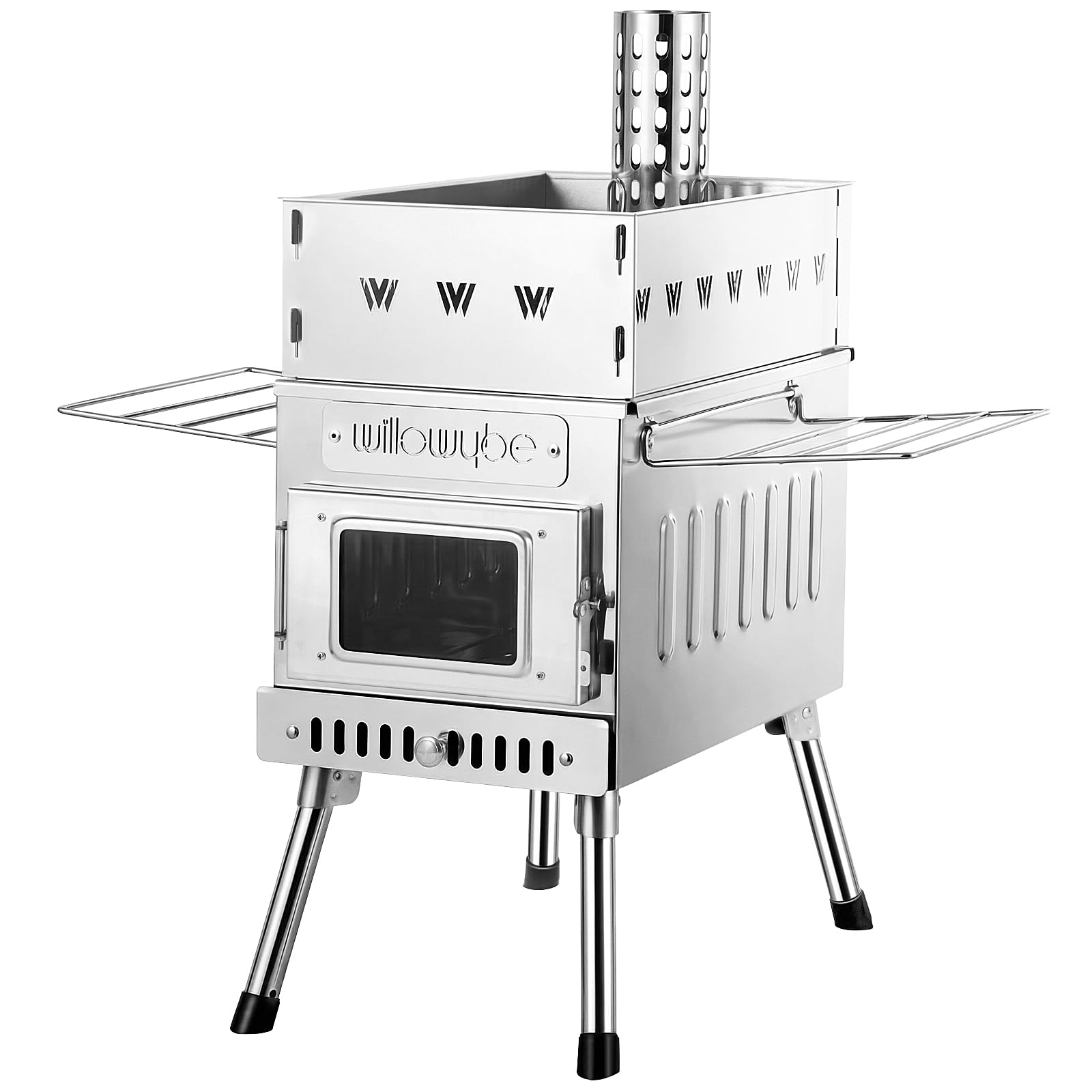
If you’ve ever tried to turn a basic tent stove into a sauna heater, you learn quickly: you can make it hot, but you can’t always make it sauna-good. Sauna heat is about stable saturation, steam response, and airflow that doesn’t fling ash when you’re trying to relax. This stove is purpose-built around that reality: stone basket support, adjustable intake and exhaust control, and an internal flow approach aimed at keeping heat circulating longer.
The difference in ownership shows up in how the stove “holds the room.” When you’re running a sauna tent, temperature swings feel dramatic. A good sauna stove helps you avoid the pattern of “too cool… now too hot… now too cool again.” Stone baskets act like heat buffers—your fire charges the stones, and the stones give you a smoother, more even feel. And when you add water to the stones, the stove’s ability to maintain strong draft determines whether you get clean steam or a smoky hiccup.
Another practical detail: this stove tends to come with a meaningful accessory ecosystem. That matters because sauna setups often involve more than the stove itself: you’re thinking about tent height, chimney clearance, bench height, and safe routing. A well-thought-out stove design reduces how much “DIY fixing” you need before the first session.
Now the honest ownership note: high heat + repeated use demands care. Some users report hardware areas like flanges and top plates can show wear faster if the stove is run extremely hard for weeks without maintenance. That doesn’t mean the stove is “bad.” It means sauna use is a stress test. The best way to extend life is simple and unglamorous: ash out when cool, keep it dry in storage, and avoid shock-cooling the body after a hot session.
In return, you get something special: a stove that can turn a cold night into a social ritual. It’s not just heat. It’s a gathering point, a reset button, and a genuinely fun reason to stay outside longer.
Why sauna users choose it
- Stone basket design – Helps create sauna-style heat retention and smoother temperature behavior.
- Airflow control is the point – Better ability to tune heat output and draft for steam sessions.
- Strong “experience” payoff – Great for group use: warm, social, and genuinely relaxing.
- Versatile utility – Still works for boiling water and basic camp cooking between sessions.
Good to know
- Sauna use stresses stoves—basic maintenance habits matter more here than in casual camping.
- Heat control becomes easier after a few sessions; first-time users should practice without “perfect expectations.”
- Plan safe chimney routing and stable setup; sauna sessions are not the time for wobbly stacks.
Ideal for: people building an outdoor sauna tent setup who want a stove engineered for that purpose, not a basic heater asked to do a new job.
9. YRenZ Airtight Portable Stove – Big Firebox Feel Without a Big Price Vibe
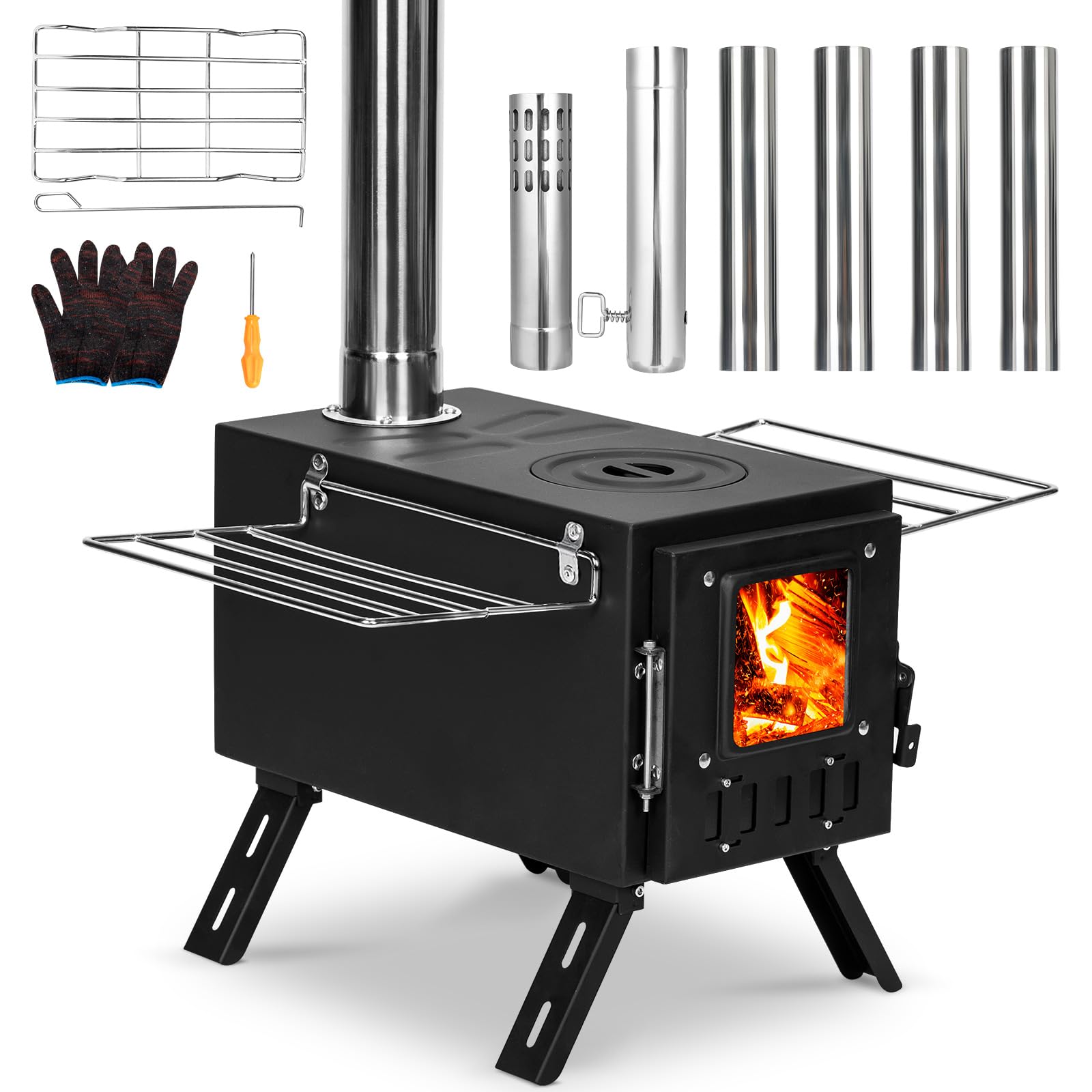
This stove is a strong pick for people who want a straightforward hot-tent heater with a bigger firebox feel, but still want something that packs down and travels without drama. The design emphasis here is airtightness and durable steel—two things that directly affect how pleasant the stove is to run. When a stove seals better, it gives you more “range” in control: you can run it hot, then step down into a steadier burn without it instantly turning into a smoky smolder.
Owners often describe it in the most useful way possible: “durable, affordable, good heat.” That sounds basic, but it’s actually the goal. If you’re new to hot tenting, you don’t need a stove that demands constant micro-adjustments. You need a stove that behaves predictably and lets you learn fire rhythm safely. This one’s larger firebox capacity helps with that because you can load more fuel and build a better coal bed. A coal bed is what helps you cook evenly and extend warmth without opening the door every ten minutes.
Cooking performance is also pleasantly practical. A flat surface that heats evenly is a bigger deal than many people expect. It’s the difference between boiling water on one side while the other side barely warms. This stove tends to work well for breakfast-style cooking (eggs, onions, pancakes), boiling water, and simple simmering if you manage your flame size and coal bed.
Portability is the second win. This stove is not featherlight, but it’s compact enough to travel well, and the included accessories help you get set up without buying a pile of extra parts on day one. It’s also a nice “patio heater” style stove for people who want an outdoor heat source that doubles as a cooking surface in mild conditions.
One thing to expect: like most coated stoves, it benefits from an outdoor first burn to cure paint and remove manufacturing residue. Do that once, and the stove feels more pleasant in every use after.
Why it’s a strong value
- Better sealing feel – More controllable burns and fewer “mystery smoke” moments.
- Larger firebox behavior – Supports a coal bed and longer heat cycles than tiny boxes.
- Practical cooktop – Works well for real camp meals, not just boiling water.
- Portable kit approach – Packs and assembles without a complicated parts puzzle.
Good to know
- First burn curing is important; do it outdoors and let it run long enough to finish the job.
- As with most compact stoves, burn time depends heavily on wood size and dryness.
- Chimney cleaning is part of the deal—stay ahead of soot and it stays easy.
Ideal for: campers who want a solid hot-tent stove that feels more controllable than ultra-budget options, while still staying portable and easy to live with.
10. AVOFOREST Small Stove – A Full Accessory Kit for First-Time Cold-Weather Campers
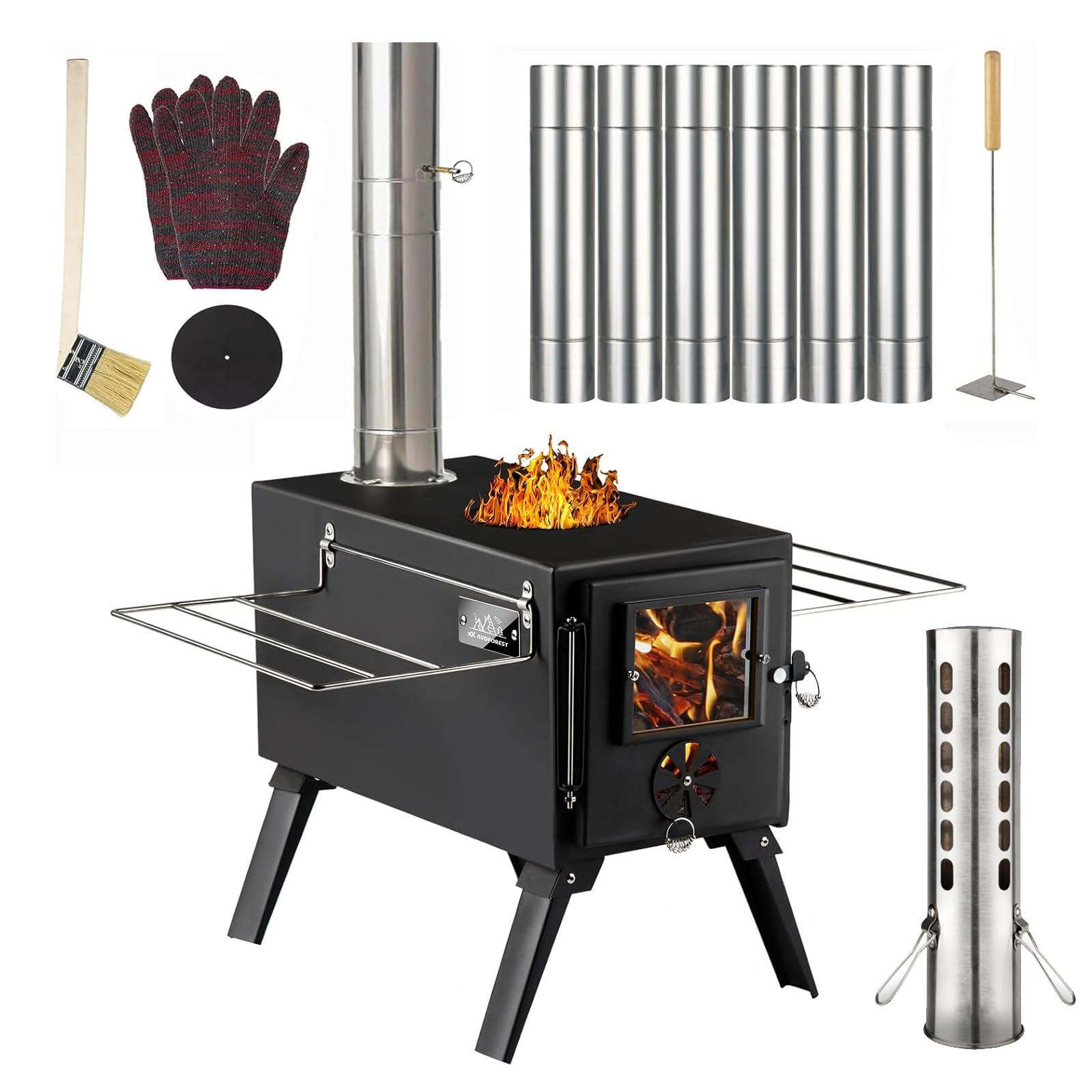
If you’re starting from zero, the most underrated thing you can buy is a kit that helps you operate confidently. That’s what this stove is aiming to do: give you the core stove plus the basic tools that make ownership easier—tongs for safe refueling, brushes for cleanup habits, gloves for assembly and handling. For beginners, those “little” items are often the difference between enjoying the stove and feeling intimidated by it.
Performance-wise, this stove sits in that common compact-hot-tent category: it can heat a tent quickly, it drafts well once established, and it’s very usable for boiling water and simple cooking. The window is a comfort feature with real value. It helps you understand what’s happening inside without opening the door and disrupting airflow. That reduces smoke surprises and makes learning faster.
Now let’s be very practical about what some owners experience with this type of stove: initial odor and smoke during early burns can be intense. That’s not unique to one brand—it’s a common reality of coated metal stoves. The smart move is to do a few outdoor burns, not just one short burn. Heat-cycle it, let it cool, then run it again. By the time you take it into a tent, the stove feels like a tool—not like a chemistry experiment.
Another ownership reality: compact stoves demand wood prep. You’re feeding smaller pieces, and you’re managing airflow more actively. If you’re using wet wood or oversized chunks that don’t burn cleanly, the stove will soot up quickly and draft will get less happy. If you use dry wood, build a coal bed, and keep the chimney warm, the experience is dramatically better.
This is why I call it “starter-friendly” rather than “effort-free.” It’s a good entry point because the kit helps you build good habits. If you’re the kind of person who will actually do the practice burns, tighten bolts when needed, and treat setup as part of the craft, this stove can serve you well.
Why beginners like it
- Accessory kit helps confidence – Tools reduce the “what do I need?” stress.
- Compact and portable – Packs down well for car camping and cold-weather trips.
- Window improves learning – You can see flame quality and refuel timing without constant door opening.
- Good for basic cooking – Boils water fast and handles simple meals well.
Good to know
- Expect multiple curing burns outdoors for the cleanest tent experience.
- Some units in this category can vary in fit/finish; bolt checks and gentle setup habits matter.
- Small firebox = frequent refueling if you run it hot in very cold weather.
Ideal for: first-time hot-tent campers who want a complete starter package and are willing to do the upfront curing and practice that makes ownership smooth.
11. YRenZ Heat-Control Kit Stove – Elbow Pipe + Adjustable Stack for Flexible Setups
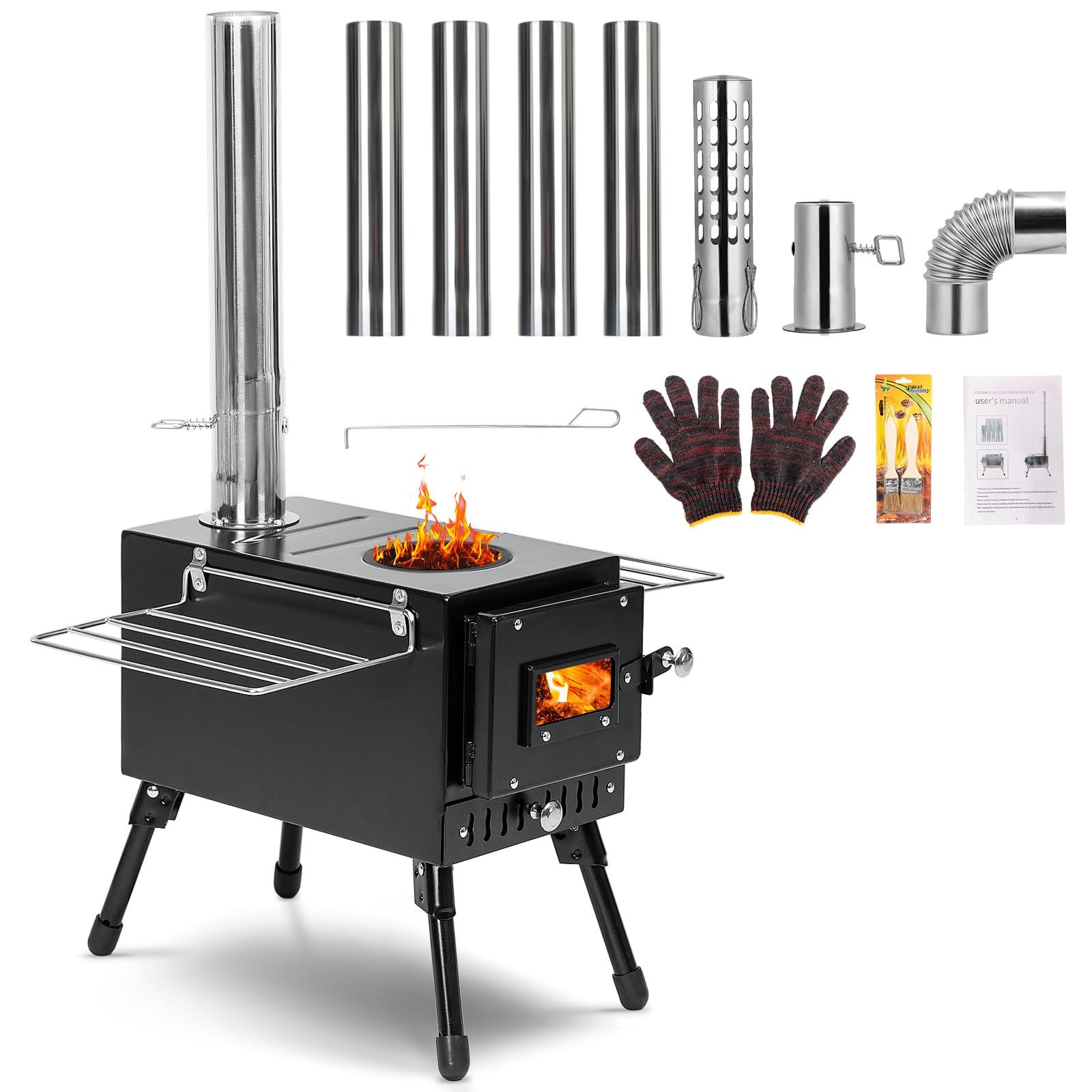
This stove is for people who look at a basic pipe kit and immediately think, “Okay… but what if my tent height is weird, or my jack position forces a bend?” That’s where the included elbow pipe and heat-control stovepipe can be a genuine advantage. It gives you more layout flexibility out of the box, which is useful for teepee-style tents, ice fishing shelters, and setups where straight-up routing isn’t the cleanest option.
The smart way to evaluate it is as a feature-forward kit that asks for a careful setup. Owners who have a great experience often mention the same routine: tighten bolts before first use, heat-cycle it, and commit to regular pipe cleaning. That last part matters because compact stoves that burn hot can also create tar and soot in the chimney, especially if you run damped burns or burn resin-heavy woods. Regular cleaning keeps draft strong and makes the stove feel safer and more predictable.
Heat output can be excellent when the stove is running clean. People cook on it, boil water, and run low-and-slow camp meals once they learn the airflow sweet spot. But the control parts are only useful if they move well and stay stable. Some owners report stiff vents or parts that feel less secure than they want. This is the kind of stove where a simple “pre-flight check” before every trip is worth it: confirm legs are tight, confirm chimney is seated correctly, confirm the glass is snug but not over-tightened, confirm the stack is stabilized with guy lines.
The biggest risk pattern on compact stoves is smoke leakage when the door doesn’t seal well or when draft is disrupted. If you ever notice smoke escaping from seams, treat it like a signal—not something to ignore. Usually the fix is mechanical (tighten, reseat, add gasket material, improve stack stability) or operational (hotter start, less choking, drier fuel). In other words, it’s fixable—but it requires attention.
If you want a stove that’s almost impossible to mess up, choose a simpler model. If you want a kit that gives you layout tools and you don’t mind doing careful setup work, this can be a very useful option—especially for unusual tent geometries.
Why the kit is valuable
- Elbow + adjustable stack included – More flexible routing for real tents and shelters.
- Strong heat when running clean – Good for boiling, cooking, and warming a tent fast.
- Glass window convenience – Easier fire monitoring without constant door opening.
- Packable concept – Many parts store inside, keeping transport organized.
Good to know
- Best results come from bolt checks and careful assembly before the first trip.
- Some units may need minor dialing-in for vent smoothness or sealing feel.
- Plan routine chimney cleaning; small stoves can build soot faster if damped heavily.
Ideal for: campers who need flexible chimney routing (elbow + damper kit) and are comfortable doing careful setup checks to keep the stove running clean.
12. Guide Gear Large Outdoor Stove – High Heat Potential for Stationary Setups

This is the “big stove” energy in the list: larger body, larger firebox, and the kind of heat output that can feel almost ridiculous when it’s running well. People buy this category when they want to replace other heat sources, warm bigger outdoor structures, or run a stove in a more stationary way where weight and bulk are less of a problem. When it’s right, it can absolutely flood a space with warmth.
Here’s the part most guides skip: big output potential doesn’t automatically mean easy ownership. Stoves like this can be more demanding about sealing and draft because the consequences of imperfect design show up faster. If the door latch doesn’t pull tight, if the gasket doesn’t hold, or if the chimney setup isn’t stable and tall enough, you can get front-end smoke behavior that feels frustrating. Some owners treat that as a dealbreaker; others treat it as a “project stove” and dial it in with small improvements.
If you’re the second type (the dial-it-in type), the path is straightforward: you focus on door sealing (gasket integrity, latch tension), you focus on chimney stability (solid connections, proper alignment, reliable draft), and you do a real cure burn before relying on it for comfort. Once you reduce leak points and improve draft pull, big stoves become dramatically more pleasant.
The firebox size helps with longer heat cycles, but don’t confuse that with “set it and forget it.” This is still a live fire. To get the best behavior, you build a coal bed, you feed splits that fit cleanly, and you avoid the temptation to overstuff the box. Overstuffing can create smolder pockets, which are the enemy of clean draft.
Cooking on a larger stove can be great because you can run multiple items and use different heat zones. But you need to learn the top plate’s hot spots. Most large stoves have a “closest to the fire path” zone that runs hotter; use that for boiling and searing, and use edges for warming. Once you learn that map, it becomes a powerful outdoor kitchen tool.
Why big-stove campers choose it
- High heat potential – Can warm bigger setups quickly when running clean.
- Bigger firebox feel – More room for fuel and coal bed building.
- Useful cooking surface – Better multi-pot cooking than tiny stoves.
- Stationary setup friendly – Works best when you don’t need to move it constantly.
Good to know
- Some owners report sealing/draft frustrations; best results come from careful chimney setup and door sealing attention.
- Heavy and bulky—this is not a “carry it far” option.
- Big heat can also mean big fuel appetite if you run it hard; plan wood supply accordingly.
Ideal for: people who want high heat output for a more stationary outdoor setup and are willing to dial in draft and sealing for the best experience.
13. Lineslife Compact Camp Stove – A Sturdy Little Heat Box for Quick Meals

Think of this stove as the “small but mighty” category done with more rigidity than the typical flimsy folding panels. It’s built to be a compact heat box: a contained fire with lots of ventilation points, a real top surface that can support cookware, and a body that feels more stable than ultralight options. People often end up using it for car camping, porch cooking, emergency boils, and even as a mini firepit-style heat source when they don’t want a full campfire.
The most useful real-world advantage over classic rocket stoves is heat spread. Rocket designs concentrate heat in a narrow chimney column. That’s awesome for boiling fast—but it can be annoying for pan cooking because you get one intense hot spot. A compact box stove like this can spread heat more evenly under a pan, which helps with eggs, sautéing, and simmering. You still need to manage soot (it’s wood fire), but you get a more forgiving cooking experience.
Fuel flexibility matters too. Because it can burn different fuels (including charcoal in small amounts), you can choose based on convenience. Wood is free and available, but it can be smoky if damp. Charcoal is more predictable for cooking, but it’s something you have to bring. A stove that gives you both options lets you adapt to the day.
There are two ownership notes to expect. First: heat cycles make moving parts tighter. Pot supports and hinges can stiffen after first use—this is normal. A tiny amount of high-temp-safe lubrication on moving joints (when cool) can make setup feel smoother long-term. Second: doors and openings on compact stoves can be simple. Some users wish for a hinged door that closes fully. That’s not always a dealbreaker—it depends on whether you care more about quick feeding access or controlled sealing. For cooking, quick feeding access is often fine. For tent heating, you typically want a more sealed, draft-focused unit.
If you want an affordable stove that feels sturdy and can handle heavy cookware (including cast iron), this is a very practical choice. It’s not trying to be a hot-tent heater for deep winter nights. It’s trying to be the reliable small stove you actually use often.
Why it’s a great compact option
- Sturdier feel than ultralight fold-ups – Less wobble, more confidence with cookware.
- Better pan cooking behavior – Heat can be less “single hot spot” than a rocket-style flame.
- Fuel flexibility – Works with wood and can handle charcoal in small amounts.
- Portable with bag – Packs down well for car camping and emergency kits.
Good to know
- Compact stoves still require feeding rhythm; don’t expect hours of unattended burn.
- Moving parts can stiffen after heat cycles; basic maintenance keeps it smooth.
- For sealed tent heating, a dedicated hot-tent stove is usually a better match.
Ideal for: campers and homeowners who want a sturdy compact stove for cooking, quick heat, and emergency use—especially when a full tent stove is overkill.
14. GODSAX Heavy-Duty Rocket Stove – When You Want Maximum Flame From Minimal Fuel
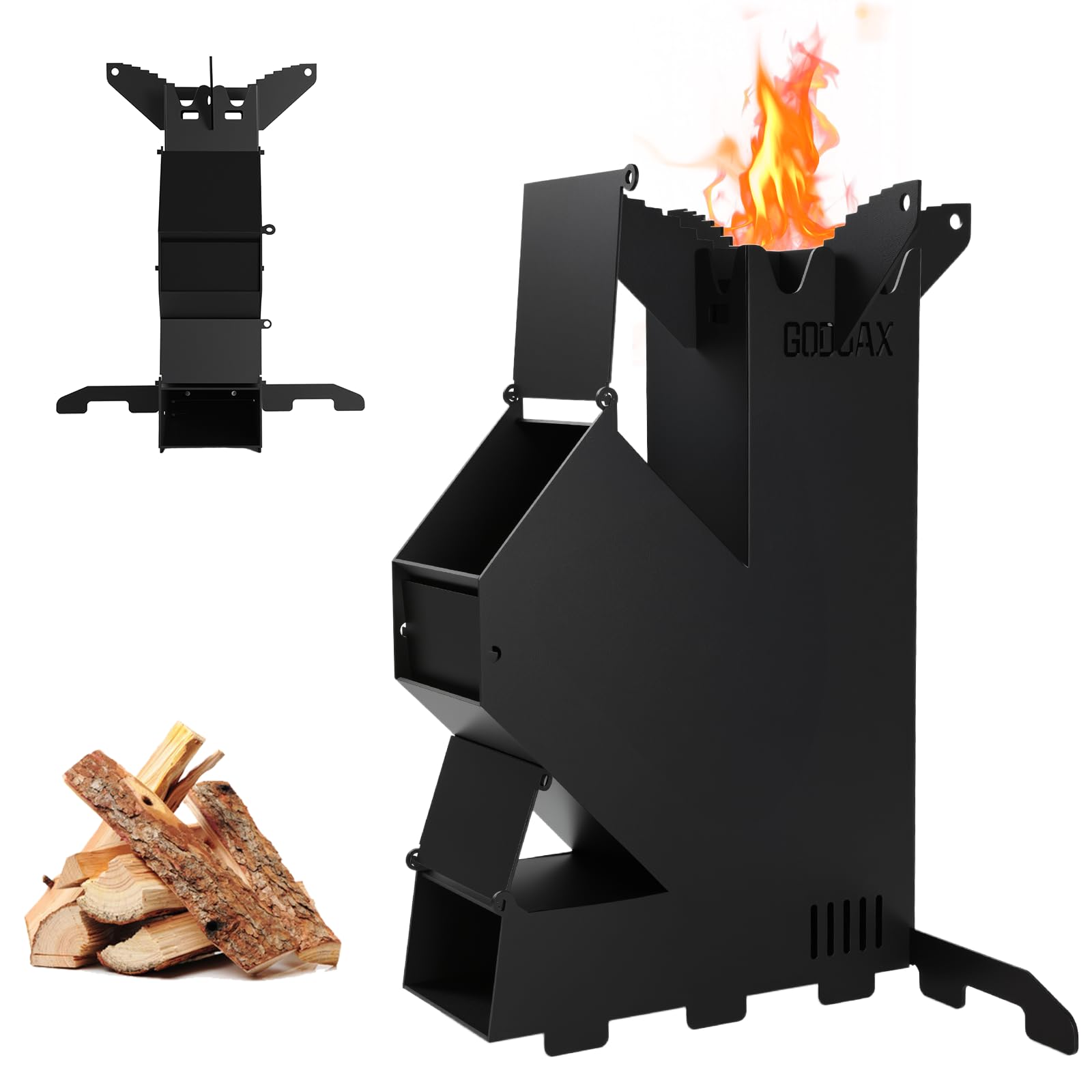
Rocket stoves are the “sports cars” of wood cooking: they’re built to create a chimney effect that pulls air hard, burns hot, and sends flame exactly where you want it—up the chimney and into your pot. If your main goal is fast boils, high heat cooking, and a stove that can run on small pieces of wood you can find almost anywhere, this category is extremely satisfying.
This specific model earns attention for one reason: it’s built like a tool, not like a toy. The body is thick steel for the category, and the top support is designed to handle heavy cookware without feeling sketchy. That matters if you cook with cast iron, big stock pots, or anything heavy enough to make lightweight folding stoves wobble. Owners often describe the first experience as a “wow moment” because water can boil extremely quickly—sometimes faster than expected.
But rockets have a trade: heat control is mostly fuel feed control. You don’t get long, lazy burns. You get intense, focused heat. If you feed too much wood, you can overheat a pot and scorch food. If you feed too little, the flame drops fast. Once you accept that and work with it, rockets become easy. The trick is to treat it like a cooking fire, not like a heater: you feed smaller pieces more consistently, and you use pot choice to manage heat (thicker pots smooth temperature swings).
One of the best usability details here is how the design encourages ash to drop and lets you keep feeding without creating a clogged mess. Rockets can become annoying if ash blocks airflow. This model’s approach (plus included tools like gloves and an ash shovel) helps keep it in the “fun and powerful” zone instead of the “why is this smoking now?” zone.
The best use-cases are clear: backyard cooking, outdoor events, emergency preparedness, and car camping meal prep. It’s not a quiet all-night tent heater, and it’s not a “set it and walk away” stove. It’s a powerful cooking tool that rewards active use—and when you want that kind of control and speed, it’s hard to beat.
Why rocket fans love it
- Fast boils and powerful flame – The chimney effect delivers high-output cooking heat.
- Stable for heavy cookware – Great match for cast iron and big pots.
- Fuel is easy to find – Runs on sticks, twigs, small splits, and common natural fuel.
- Cleanup-friendly design – Ash handling is less annoying than many ultra-cheap rockets.
Good to know
- Heat control is mostly feeding rhythm; rockets require attention during cooking.
- Not built for long unattended burns—this is a high-output cooker, not an overnight heater.
- It’s sturdy, but that sturdiness adds bulk; it’s better for car camping than hiking.
Ideal for: people who want fast cooking heat with a sturdy build—perfect for backyard meal prep, emergency kits, and car camping where boiling speed matters.
How Clean Draft Actually Works (and Why Smoke Problems Repeat)
If you remember one idea from this guide, make it this: smoke is usually not a mystery—it’s a predictable result. Most stoves don’t “randomly smoke.” They smoke when draft is weak, fuel is damp, airflow is blocked, or the stove is being choked too early. Once you understand the patterns, you can fix problems fast—and you can choose stoves that naturally avoid the worst friction.
The 5 most common reasons a stove misbehaves
- Cold stack at startup – A cold chimney doesn’t pull. Your first goal is a hot, clean ignition fire to wake draft up.
- Too much damper too soon – Dampers are powerful, but using them early can trap smoke and create back-puffs.
- Wet or resin-heavy wood – Smolder makes soot; soot reduces draft; reduced draft makes more smolder. It’s a loop.
- Ash blocking airflow – When the grate area clogs, the fire starves and starts producing heavy smoke.
- Unstable chimney – Wind turbulence around the pipe top can interrupt draft and create inconsistent pull.
This is why “first burn curing” matters too. Coatings and oils can create smoke and odor that feels like a draft issue—even when draft is fine. Cure it outdoors, and you remove a huge source of confusion.
The “smoke-free routine” that works with almost any stove
- Start smaller and hotter – Dry kindling first, then add splits once the chimney is pulling.
- Keep exhaust open at startup – Let the stove breathe until flames are stable and the stack is warm.
- Build a coal bed – Coals stabilize heat and reduce the need to open the door constantly.
- Adjust in small steps – A quarter adjustment, wait, observe, then adjust again.
- End-of-night ash habit – Empty or level ash so the stove starts clean the next time.
The goal isn’t “perfect control.” The goal is predictable comfort. Once you can predict what your stove will do next, you stop feeling stressed—and the whole trip feels easier.
FAQ: Buying and Using a Camp Stove Like You’ve Done This Before
What’s the real difference between a rocket stove and a tent stove?
Why do so many stoves “smoke a lot” the first time?
How do I get longer burn time from a compact stove?
My glass door soots up fast—how do I keep it clear?
Do I need extra chimney pipe sections?
What’s the easiest way to avoid smoke when opening the door?
Final Thoughts: Choose the Stove That Makes Cold Camping Feel Easy
A great stove isn’t the one with the most hype. It’s the one that fits your routine so well you stop thinking about it. You light it, it drafts, it warms you, it cooks for you, and it doesn’t punish you with constant fiddling.
Here’s how to turn this guide into one clear decision. Pick the wood burning stove that matches your reality: how you travel, how you cook, how much you want to tend a fire, and whether you’re heating a tent, a camp kitchen, or a sauna setup.
- Want the best overall balance for most campers? Start with the KUNGKA Compact Hot Tent Stove. It’s the easiest “most people will love this” mix of portability, heat output, and usability.
- Want a basecamp cooker with more surface and calmer heat cycles? Go for the VEVOR Large Firebox Camp Stove. It’s made for longer stays, bigger meals, and a more kitchen-like workflow.
- Want sauna potential plus cooking in one setup? The Ytaoeo 2-in-1 Sauna + Tent Stove brings rock-basket flexibility, good heat, and a fun “steam session” upgrade path.
- Want longer burn cycles and oven-style cooking options? Choose the GREEN STOVE Pellet + Oven. It’s a different heat strategy—more system-like, less constant refueling.
- Need a compact practical stove for small spaces and steady warmth? The Guide Gear Compact Outdoor Stove is the kind of simple tool people use often because it just fits into life.
- Prefer stainless durability with a compact tent-friendly footprint? Pick the unho Stainless Tent Stove for a sturdy feel, strong heat, and easy “see the fire” control.
- Want drying racks built into your heat source? The Huskfirm Folding Tent Stove is a great pick for wet weather and snow trips where keeping gear warm matters.
- Building a sauna tent setup with a purpose-built heater? The WillowyBe Sauna Stove is designed for that experience: stone heat, controllable airflow, and sauna-focused utility.
- Want a value-focused tent stove with a bigger firebox feel? Try the YRenZ Airtight Portable Stove for strong heat-to-size performance with a focus on sealing and efficiency.
- Want a full starter kit with included tools? The AVOFOREST Small Stove is a beginner-friendly path if you’re willing to do the cure burns and learn the rhythm.
- Need elbow routing and included heat-control parts? Look at the YRenZ Heat-Control Kit Stove for flexible layouts when straight-up stacks aren’t ideal.
- Want big heat potential for stationary outdoor setups? The Guide Gear Large Outdoor Stove fits the “bigger space” mindset—best when you’re ready to dial in draft and sealing.
- Want a sturdy compact cooker for porches, quick meals, or emergency use? Choose the Lineslife Compact Camp Stove for practical pan cooking and dependable small-stove heat.
- Want maximum flame power and fast boils from small wood fuel? Grab the GODSAX Heavy-Duty Rocket Stove for high-output cooking and preparedness.
Pick your stove like you pick your campsite: based on how you actually live out there. Do that, and the cold becomes part of the fun—not something you endure.
