
A patio can be “beautiful” and still feel unusable the moment the air goes still. That sticky, heavy feeling isn’t just heat. It’s a mix of humidity, trapped warm air under a cover, sun-baked surfaces radiating heat back at you, and—if we’re being honest— mosquitoes throwing a party the second you sit down.
If you’re shopping for wall mount patio fans, you’re already thinking like a strategist: you want real airflow without sacrificing floor space, without dragging cords across walkways, and without turning your outdoor area into a mess of wobbly stands.
Here’s what most “buying guides” get wrong: they talk about size and CFM like you’re picking a toaster. In real life, the winner is the fan that fits your structure, your power setup, and your tolerance for noise—while delivering airflow that actually reaches where people sit. That means paying attention to the stuff you only notice after you install: bracket stability, vibration behavior on a pergola beam, how easy it is to turn oscillation on/off when the fan is mounted high, whether “outdoor rated” really means “covered patio only,” and how a remote behaves when you’re ten feet away with wet hands and a plate of food.
This guide is built around those real-world friction points using patterns that show up again and again in owner feedback: the fans that feel like a “game-changer” for patios, horse barns, and garages; the ones that look incredible but don’t throw much air outside; and the quiet fan-light combos that solve two problems at once when you can’t install a ceiling fan.
Below you’ll find 16 standout wall-mounted options—from weather-resistant high-velocity beasts to sleek fan-and-light units—organized in a way that helps you choose with confidence, not guesswork.
In this article
How to Choose the Right Wall Mount Patio Fans for Your Space
A wall-mounted fan is one of those upgrades that sounds simple—until you realize patios are not bedrooms. Outdoors, air escapes. Sound travels differently. Mounting surfaces vary wildly. And “it works” isn’t the same as “it feels amazing while you’re eating dinner.” This framework is designed to help you pick a fan that will still feel like a win after the novelty fades.
1. Start with the only question that can’t be fixed later
Ask this first: How exposed is your installation spot? This determines whether you should shop a true outdoor-ready fan, a damp/covered fan, or an indoor unit that should never see rain.
- Covered patio / pergola with roof panels: You can often use “damp-rated” style fans, but the closer the fan sits to the edge, the more wind-driven moisture it may see.
- Open deck / fence post / fully exposed wall: You’ll want a fan that’s explicitly built for outdoor moisture resistance and durability. This is where sealed housings and corrosion-resistant builds matter.
- Garage / workshop / barn: Moisture might not be the main enemy—dust and grit are. Sealed motors and sturdy grills matter more than aesthetics.
2. Decide whether you want targeted comfort or whole-space circulation
Here’s the most useful mental model: patio fans either create a comfort lane (air aimed across where people sit) or they create circulation (air movement that keeps the whole area from feeling stagnant). Both are valid—but they require different choices.
- Comfort lane strategy: Choose a fan with solid tilt control and a stable bracket. You’re going to “aim” the breeze like a spotlight: across seating height, not straight down from above. In this setup, quiet low speeds matter because the fan may run during conversation.
- Circulation strategy: Choose a high-velocity fan with real oscillation and stronger airflow. This is how people cool big covered patios, workspaces, and barns—move enough air to change how the entire space feels.
The biggest buyer mistake is mismatching the strategy: a beautiful style fan that doesn’t move enough air outdoors, or a warehouse-level fan pointed directly at the dining table so everyone’s napkins take flight. The “right” fan is the one that matches how you use the space.
3. Learn the three patio fan specs that actually change your experience
Specs aren’t useless. The problem is that shoppers look at the wrong ones. Here are the three that consistently predict real-life satisfaction:
- Throw and reach: Outdoors, you need a fan that can push air to where people sit. This is why many owners love larger, high-velocity units for covered patios and why “looks great” fans can disappoint outside.
- Oscillation behavior: There’s a huge difference between: (1) true motorized oscillation, (2) a separate oscillation knob you can switch on/off, and (3) “oscillating” as a marketing word meaning “you can manually pivot it.” If you want wide coverage, make sure it truly oscillates.
- Noise plus vibration: A fan can be “not too loud” and still drive you crazy if the mounting surface resonates. Patio structures—especially metal pergolas and thinner beams—can amplify vibration. A fan with a heavy bracket and balanced blades tends to feel calmer.
One pro tip that changes everything: if you’re sensitive to noise, prioritize a fan that has a genuinely usable low speed. Many industrial fans have three speeds that feel like “fast, faster, and whoa.” That’s great for heat relief—less great for dinner conversations.
4. Choose control style based on where you will mount it
Wall-mounted fans often get installed high for safety and better airflow. That makes control style a big deal—because “getting up” might mean “getting a ladder.”
- Remote control: The easiest everyday experience, especially for patios. This becomes non-negotiable if your fan is mounted above head height.
- Wired control panel or extended wired remote: A smart middle ground. You get reliability and you can mount the controls lower, which is perfect for barns and workshops.
- Pull chain: Simple and durable, but think ahead: if it’s mounted high, you’ll tug that chain hundreds of times. Some owners solve this with a plug-in remote outlet so they stop touching the chain entirely.
- Dual knobs on the motor: Usually found on more design-focused fans. Looks great, but make sure you can actually reach the oscillation knob once installed.
5. Match the fan to your mounting surface, not your mood
This is the part that separates “good idea” from “I love this fan.” The same fan can feel rock-solid on a stud wall and annoying on a thin beam. Before you buy, identify your surface:
- Stud wall: Great. Use at least two fasteners into studs or use a properly supported mounting board that spans studs.
- Brick or concrete: Excellent for heavier fans, but you’ll need the right anchors and drill bit. Many outdoor industrial fans ship with hardware intended for masonry.
- Wood post or pergola beam: Works well when the beam is thick and stable. Thin beams can amplify vibration unless you reinforce with a mounting board.
- Metal structure: Possible, but resonance risk is higher. Rubber washers and firm tightening often make the difference.
If a fan is heavy (and many high-output patio fans are), you want the mounting surface to behave like part of the building. Several owners report best results when they add a board (like a sturdy plank between studs) and mount the fan to that. It spreads the load and can dramatically reduce vibration.
6. Decide whether you want “comfort extras” or “pure airflow”
Patio fans fall into two worlds:
- Comfort extras: Remote timers, natural wind modes, quiet DC motors, integrated LED lighting, and app controls. These are perfect for patios used like outdoor living rooms.
- Pure airflow: Metal cages, ball-bearing motors, big blades, and high-velocity output. These are perfect for heat relief, workspaces, gyms, greenhouses, barns, and bug control.
Neither is better universally. The right choice is the one that matches your “main job” for the fan: comfortable lounging vs serious air movement.
7. A fast decision shortcut if you’re overwhelmed
If you want one quick shortcut, use this:
- If your priority is quiet comfort + convenience: choose a remote-controlled model with a genuinely gentle low speed.
- If your priority is big airflow for big heat: choose a high-velocity metal fan, ideally with a sealed motor if the environment is dusty or humid.
- If your priority is “I need a fan and a light”: choose a fan-light combo made for wall or ceiling mounting with dimmable lighting.
- If your priority is tight spaces: choose a compact wall fan with a folding arm and strong directional control.
Now let’s make it easy: use the table below to shortlist your top choices, then jump into the deep-dive reviews for the real-world details.
Quick Comparison: 16 Wall Mount Patio Fans That Deserve a Spot on Your Wall
Use this table to match a fan to your space and your “fan personality,” then jump to the full reviews for the real-life stuff: vibration behavior, control convenience, coverage feel, and which models owners call a true upgrade.
On smaller screens, swipe or scroll sideways to see the full table.
| Model | Fan style | Real-world strength | Best match | Amazon |
|---|---|---|---|---|
| FUGOO 20" Outdoor Sealed BLDC Wall Fan | Outdoor powerhouse | Quiet-for-output performance + sealed build + remote convenience | Covered patios and garages where you want “set it and enjoy it” comfort | Amazon |
| Craftmade Bellows I 16" Retro Wall Fan | Design-forward | Retro look + damp-location versatility + knob controls | Outdoor kitchens and covered seating areas where style matters | Amazon |
| KEN BROWN 18" High-Velocity Wall Fan | Industrial airflow | Big airflow + wide oscillation + separate control panel for high mounting | Large covered patios, workshops, and hot climates that need real movement | Amazon |
| Parrot Uncle 10" Folding-Arm Wall Fan | Compact directional | Small footprint + quiet AC motor + precise aiming | Small patios, porch corners, laundry rooms, and targeted airflow zones | Amazon |
| iLiving 18" Weatherproof Wall Fan | Big-space beast | Serious airflow + durable build + mist-kit compatibility | Large patios, barns, dog runs, and “move air or nothing helps” spaces | Amazon |
| Tornado 16" Pro Series Waterproof Wall Fan | Pro-grade build | Tank-like metal construction + strong airflow + reliable oscillation | Home gyms, garages, and covered patios where durability matters | Amazon |
| Fansconce 23" Wall Fan with LED Light | Fan + light | Quiet DC comfort + dimmable light + app/remote control | Porches and patios where you need airflow and lighting together | Amazon |
| Siljoy 21" Wall Fan with LED Light | Quiet comfort | Low-noise airflow + flexible aiming + night-light style convenience | Bedrooms, home gyms, and covered patios that want calmer airflow | Amazon |
| CAMMOO 20" Oscillating Wall Fan 2-Pack | Control-friendly | Wired remote reach + wide oscillation + solid coverage for the money | Shops, barns, outbuildings, and spaces where you want two fans working together | Amazon |
| VEVOR 24" Waterproof Oscillating Wall Fan | Max airflow | Huge air movement + wide coverage + optional misting hookup | Large patios and garages that need serious cooling relief | Amazon |
| Hurricane Pro 20" High Velocity Wall Fan | Workhorse | Strong airflow + classic metal build + simple long-run usage | Garages, gyms, and workshops that run fans for hours daily | Amazon |
| Simple Deluxe 18" Industrial Wall Fan | Value airflow | Strong output for the size + quieter than many competitors when balanced | Covered patios and indoor spaces where you want airflow without overspending | Amazon |
| VEVOR 18" Oscillating Wall Fan 2-Pack | 2-pack coverage | Two-fan circulation strategy + sealed motor approach | Garages and greenhouses where one fan leaves dead zones | Amazon |
| NewAir WindPro18W Wall Fan | Sealed motor | Durable motor design + safe cage + reliable shop-style performance | Coops, barns, garages, and dusty environments needing a safer wall fan | Amazon |
| VEVOR 18" IP44 Water-Resistant Wall Fan | Budget outdoor | Outdoor-minded design + good reach + simple pull-chain control | Covered patios and posts where you want value with real airflow | Amazon |
| Comfort Zone 16" Wall Fan with Remote | Budget comfort | Remote modes + timer + wide oscillation for light-duty cooling | Bedrooms, home offices, and sheltered spaces needing simple convenience | Amazon |
In‑Depth Reviews: 16 Wall Mount Patio Fans That Feel Like a Real Upgrade
Now we go model by model. This isn’t a spec parade. I’ll focus on what you’ll actually notice: how the airflow “feels” in an open space, what the controls are like once the fan is mounted high, and which details keep owners happy months later—especially in heat, humidity, and real outdoor life.
1. FUGOO 20" Outdoor Sealed BLDC Wall Fan – The Easy-Living Choice That Still Moves Serious Air
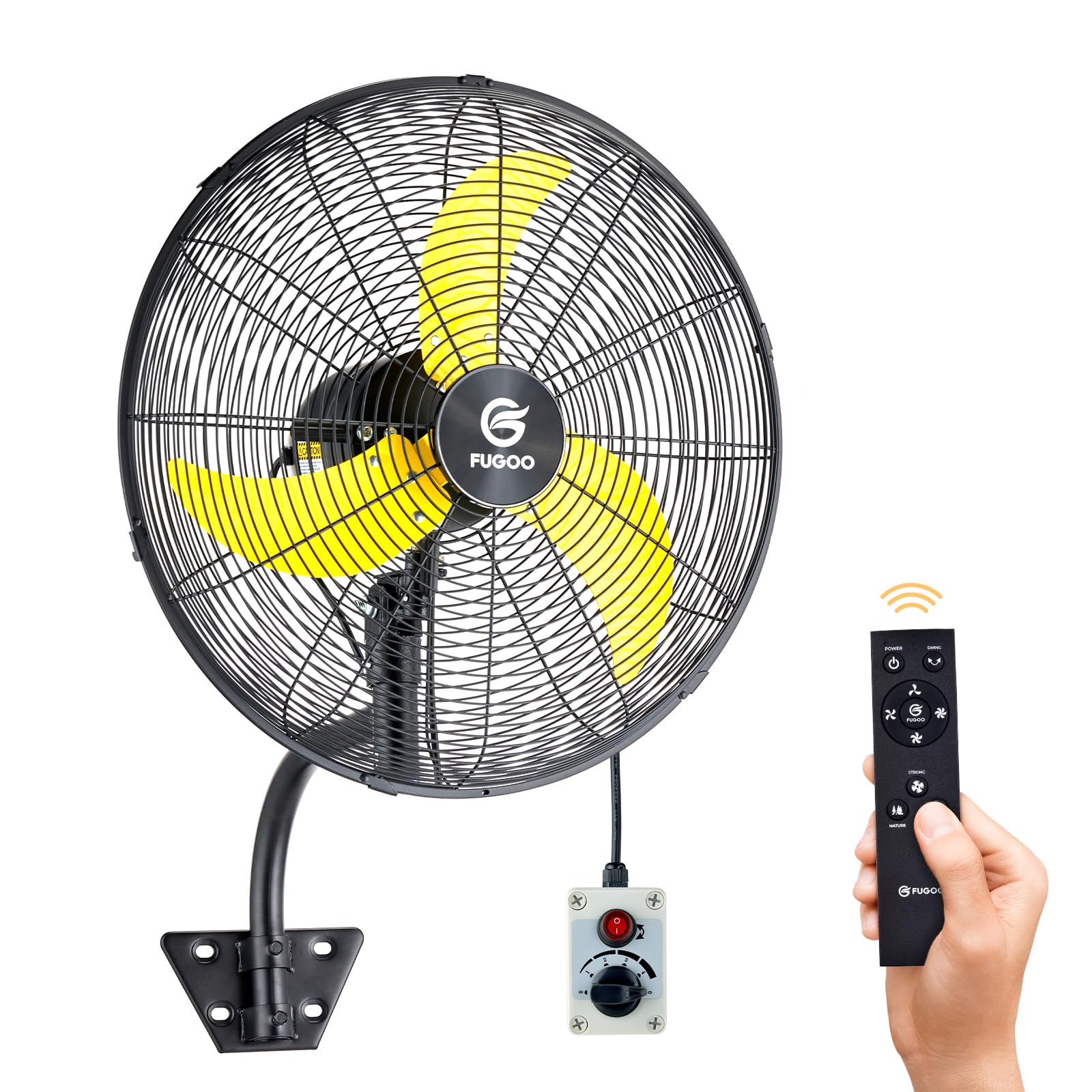
The easiest way to describe the FUGOO is this: it feels like someone designed a serious outdoor fan and then remembered that humans have to live with it. It’s built heavy-duty, it’s sealed for messy environments, and it moves a lot of air—but the real “wow” is that it doesn’t demand constant babysitting. That’s why it earns the top spot for most patios: it hits the sweet spot between comfort and power.
Owner feedback consistently highlights three wins that matter outdoors: quiet output on the lower speeds, smooth oscillation, and reliable control from a distance. A fan that’s mounted high becomes annoying fast if the controls are awkward. Here, you can control power, speed, and oscillation without turning your evening into a ladder situation. And because the motor design is built for efficiency, many people run it for long stretches without that “hot motor smell” vibe you sometimes get from cheaper units.
Where it really shines is the patio “comfort lane.” If you angle it so the airflow travels across seating height instead of blasting downward, it creates that steady, refreshing movement that makes humid nights feel doable. Several owners also mention a side benefit: strong airflow makes it harder for mosquitoes to hover comfortably near you. It’s not a magic shield, but it absolutely changes the vibe of an evening outside.
Why you’ll like it
- Sealed, outdoor-minded build – Handles humid, dusty, and messy environments better than typical indoor wall fans.
- Remote convenience done right – Controls are practical for high mounting and real patio life.
- Quiet on the speeds you actually use – Lower settings are comfortable for conversation; high speed is there when you need it.
- Coverage that feels wide – Oscillation plus strong airflow reduces dead zones in covered outdoor spaces.
Good to know
- It’s heavy, and that’s a good thing—until you mount it. Plan a sturdy surface and consider a helper for installation.
- Like many powerful fans, top speed is audible; most people treat it as a “heat emergency” setting.
- If you mount on a surface that resonates, small rubber washers on mounting points can noticeably reduce vibration.
Ideal for: patios and garages where you want a fan that feels premium, runs for long stretches, and delivers real airflow without daily annoyance.
2. Craftmade Bellows I 16" Retro Wall Fan – When Style Is the Point and Airflow Is the Bonus

The Craftmade Bellows I is the fan you buy when you want your patio to feel curated—not like a warehouse with furniture. It has that retro industrial vibe that looks perfect in outdoor kitchens, covered dining areas, workshops, and transitional spaces where you care how everything fits together. And yes, it moves air. But the real value is that it looks like it belongs.
Here’s the honest truth that helps you buy smart: design-forward fans live in a different world than high-velocity patio beasts. Owners who love this model tend to use it for comfort-level cooling, not “save us from the heat wave” airflow. If your patio is huge and exposed, it may not feel like enough. But if your goal is to keep a covered seating area from feeling stale, it can be genuinely satisfying— especially because oscillation spreads that gentle airflow more evenly than a fixed fan.
The control setup is also a very particular kind of experience: it uses separate knobs for speed and oscillation. That feels charming and straightforward… as long as you can reach it. If you mount it high (as recommended for wall fans), think ahead about whether you’ll actually adjust oscillation regularly. Some owners simply set oscillation how they like it and treat speed as the main daily control.
Why people choose it
- Retro style that upgrades the space – Looks like intentional decor, not just a tool.
- Comfort-focused airflow – Great for covered areas where you want gentle movement while dining or cooking.
- Simple knob controls – No battery remotes, no app drama, no mystery buttons.
- Flexible install approach – Can be plug-in or hardwired depending on your setup.
Good to know
- If you want “serious wind,” this may feel underpowered outdoors compared to high-velocity industrial fans.
- Oscillation performance is a love-it-or-not-it detail in reviews; it’s best when your goal is broad gentle circulation.
- Because it’s heavier and “chunkier,” mounting into a solid surface is non-negotiable for a confident feel.
Ideal for: covered patios, outdoor kitchens, and design-forward spaces where you want a stylish fan that keeps the area feeling fresh—not a hurricane machine.
3. KEN BROWN 18" High-Velocity Wall Fan – The Covered-Patio Air Cannon With Smart Controls
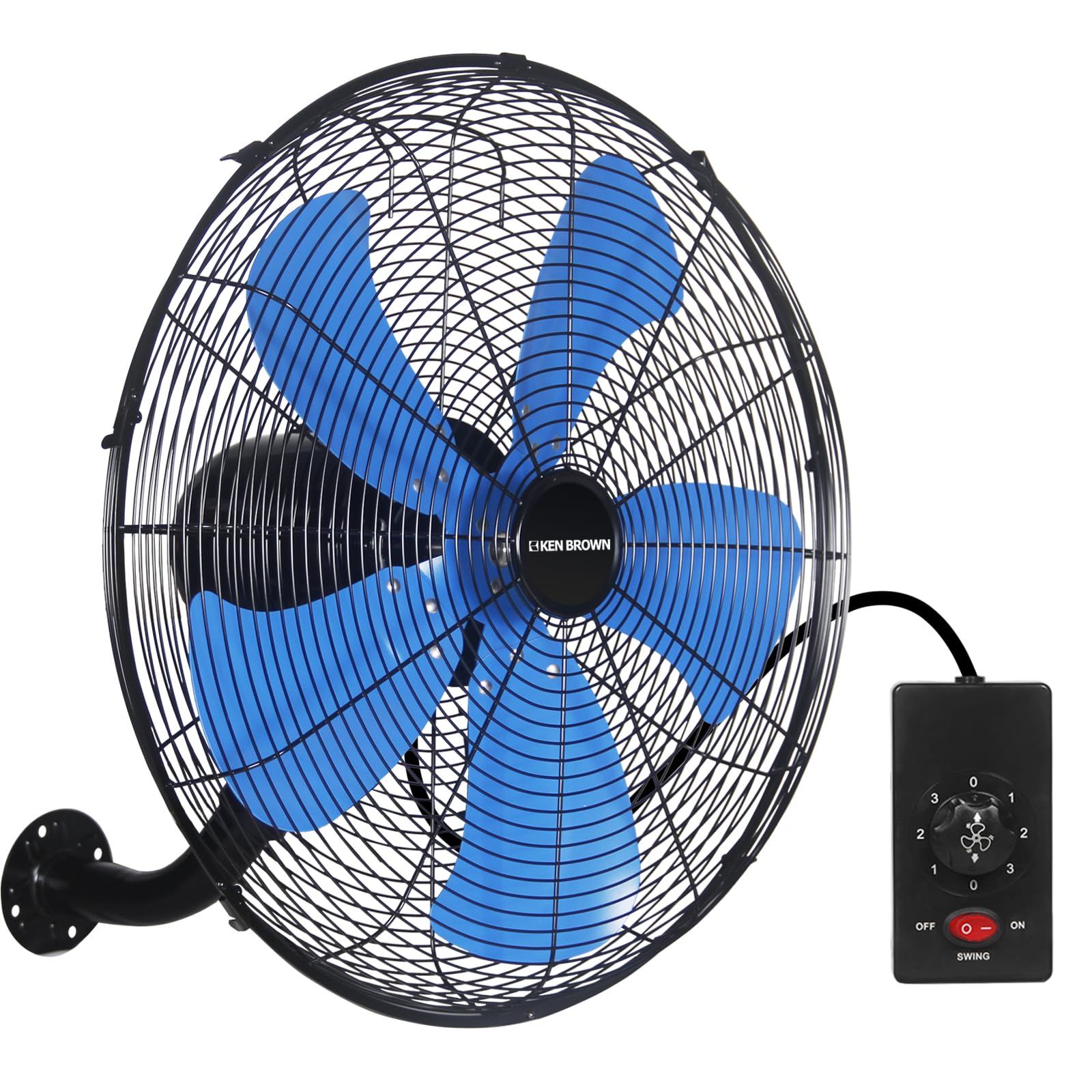
This is one of those fans where owners don’t say “it’s nice,” they say “this changed everything.” The KEN BROWN is built for people who live in real heat—or who have a large covered patio where normal fans feel like they’re just politely whispering at the air. If your patio is the kind where you can still feel sweat sitting in the shade, this is the class of fan that actually flips the script.
The most underrated feature here is the control approach: instead of forcing you to reach the fan body, it uses a separate control panel on a cord. That sounds minor until you mount the fan high (which you should, both for safety and for better airflow travel). Then it becomes a big deal. Owners repeatedly mention how convenient it is to control speed and oscillation without stretching, climbing, or guessing.
Airflow-wise, this fan is about coverage and reach. With high-velocity output and true oscillation, it can push air across a patio depth instead of just cooling the person sitting directly under it. One real-world usage pattern that shows up a lot: multiple units installed along a long covered patio, creating a “moving air corridor” that makes hot evenings feel dramatically more comfortable.
Why it’s a patio favorite in hot climates
- Big airflow that feels real outdoors – Not just “air moving,” but “I can sit out here now” energy.
- Control panel solves high-mount inconvenience – Adjust speed and oscillation without turning life into a reach test.
- Coverage is wide and practical – Oscillation plus tilt helps eliminate dead zones on larger patios.
- Built like a tool – Designed for workshops and covered outdoor use where durability matters.
Good to know
- This is a power-first fan; high speed is louder than “living room quiet,” but it’s the sound of serious airflow.
- Plan for sturdy mounting—bolts into wood or proper anchors into masonry deliver the best long-term stability.
- If you need true exposed-rain installation, confirm your placement keeps it protected or choose a more explicitly weatherproof model.
Ideal for: large covered patios, workshops, and hot climates where you need a wall fan that actually reaches people—not just the nearest chair.
4. Parrot Uncle 10" Folding-Arm Wall Fan – Small Fan, Big “Aim It Exactly There” Control

Not every patio needs an industrial wind machine. Sometimes you need a compact fan to solve a specific problem: a hot porch corner, a small covered balcony, a laundry-room humidity pocket, or a bedside “don’t blow on my partner” situation. That’s where this Parrot Uncle shines. It’s small, sturdy, and built around one feature that matters in real life: directional control.
Owners who love it talk about the same things: it feels solid, it’s quiet, and it points exactly where they want. The folding arm design matters more than you’d think—it lets you tuck the fan closer to the wall when you don’t need full extension, and it helps the fan fit in spaces where a large cage fan would feel visually overwhelming. It’s also the kind of fan people mount for multi-season usefulness: summer cooling, winter heat circulation, and year-round ventilation in stuffy rooms.
One important clarity point: some shoppers expect “oscillation” to mean automatic side-to-side sweeping. In real-world reviews, owners often mention that the “oscillation” language can be misleading—this fan is better thought of as manually aimable. If you want motorized oscillation, pick a different model. If you want a compact fan you can set and forget, this one has a strong “quiet confidence” vibe.
Why it’s surprisingly useful
- Compact but effective – Strong airflow for its size, especially for small patios and targeted zones.
- Quiet daily experience – Great for bedrooms, reading corners, and covered spaces where loud fans ruin the mood.
- Folding arm saves space – Lets you customize extension and airflow direction without a bulky footprint.
- Simple pull-chain control – No remote batteries, no app issues, no learning curve.
Good to know
- Two speeds means less “fine tuning.” Some owners wish for an extra-low setting for ultra-gentle night airflow.
- Don’t buy it expecting true automatic oscillation—this is about manual aiming.
- Because it’s adjustable, mount into a stud or solid surface so repositioning doesn’t loosen the bracket over time.
Ideal for: small covered patios, porch corners, and indoor spaces where you want quiet airflow you can aim precisely—without a big industrial look.
5. iLiving 18" Weatherproof Wall Fan – The “Make Summer Livable” Powerhouse

The iLiving is famous in a very specific way: it’s one of the fans people buy after they’ve tried “regular” fans outdoors and realized they don’t matter. This is the kind of high-output, industrial-grade wall fan that can change an entire patio’s comfort level—especially when the space is large, the air is still, and you need airflow to travel across distance.
A common real-life use case shows up in reviews: porches where insects hover, barns where animals need relief, dog areas where airflow extends outdoor time, and patios where multiple units create a wind tunnel effect that feels shockingly good on hot days. Owners often describe them as powerful enough that they rarely need the highest speed—because even medium can feel like “real wind.” That’s a good sign outdoors: it means you can run the fan at a more comfortable sound level and still get meaningful cooling sensation.
One feature worth understanding before buying: this model is often discussed as mist-kit compatible. Misting can be incredible in dry heat, and less satisfying in high humidity. The fan itself is the core value—strong airflow. Think of misting as a bonus tool you can add if your climate and patio setup can benefit from evaporation. Also: this is a heavy fan. Owners who install it confidently tend to mount it on a sturdy board, joist, or structural surface, not flimsy siding.
Why it earns a “powerhouse” reputation
- Airflow you can feel across a patio – Excellent for large areas where small fans don’t reach.
- Outdoor-minded durability – Built for humidity and tough environments more than typical indoor units.
- Great for insects and stagnant air – Strong movement makes porches feel less “bug friendly.”
- Mist-kit compatible potential – Allows an extra cooling strategy in the right climate and setup.
Good to know
- It’s heavy and powerful; proper mounting is mandatory for safety and long-term stability.
- Pull-chain control is simple, but if you mount high you may want a remote plug solution so you don’t tug the chain daily.
- It’s not a “quiet decor fan.” It’s a comfort tool—expect industrial presence and sound when pushed hard.
Ideal for: large patios, barns, garages, and serious heat zones where you want one fan to actually change the feel of the space.
6. Tornado 16" Pro Series Waterproof Wall Fan – Built Like a Tank, Throws Air Like One Too

The Tornado Pro Series is the fan people buy when they’re tired of “good enough.” It’s metal, it’s solid, and it’s designed to survive heavy use. Owners often use words like “built like a tank” and “moves a crazy amount of air,” and that tracks with what matters for patios and home gyms: a fan that feels stable, not flimsy, and doesn’t wobble itself into annoyance.
One of the biggest reasons this fan wins loyalty is that it stays effective even on lower settings. That’s the secret to a great patio fan: you don’t want to run max speed all the time—you want a low or medium setting that still feels meaningful. Several owners mention that even the first speed throws a lot of air, which is exactly what you want when you’re sitting outside trying to relax without shouting over a motor.
Real-life tip from feedback patterns: assembly matters. Some owners who initially felt disappointed later realized they mounted or oriented the blades incorrectly, and then the fan went from “meh” to “wow.” That sounds silly, but it’s a real lesson: with industrial fans, correct assembly is part of performance. Also note the oscillation control location: if the on/off knob sits on top of the motor and you mount the fan high, you’ll either leave oscillation on permanently or you’ll need a simple method to reach it.
Why it’s a smart durability buy
- Heavy-duty feel – Metal construction and a confident mount reduce the “cheap fan wobble” problem.
- Strong airflow even on low – Lets you run it at a calmer sound level while still feeling the breeze.
- Great for gyms and garages – Built for long, consistent usage where plastic fans don’t hold up.
- Thought-through design – Owners often note the mounting and assembly experience feels intentional.
Good to know
- Oscillation control location can be inconvenient if mounted very high; plan your mounting height with that in mind.
- Like many high-output fans, it’s not silent. It’s “reasonable for the airflow,” which is the right expectation.
- Depending on your wall material, you may need specific mounting hardware beyond what’s in the box.
Ideal for: covered patios, home gyms, and garages where you want a durable metal fan that moves serious air and feels like it will last.
7. Fansconce 23" Wall Fan with LED Light – The Porch Upgrade When You Can’t Install a Ceiling Fan
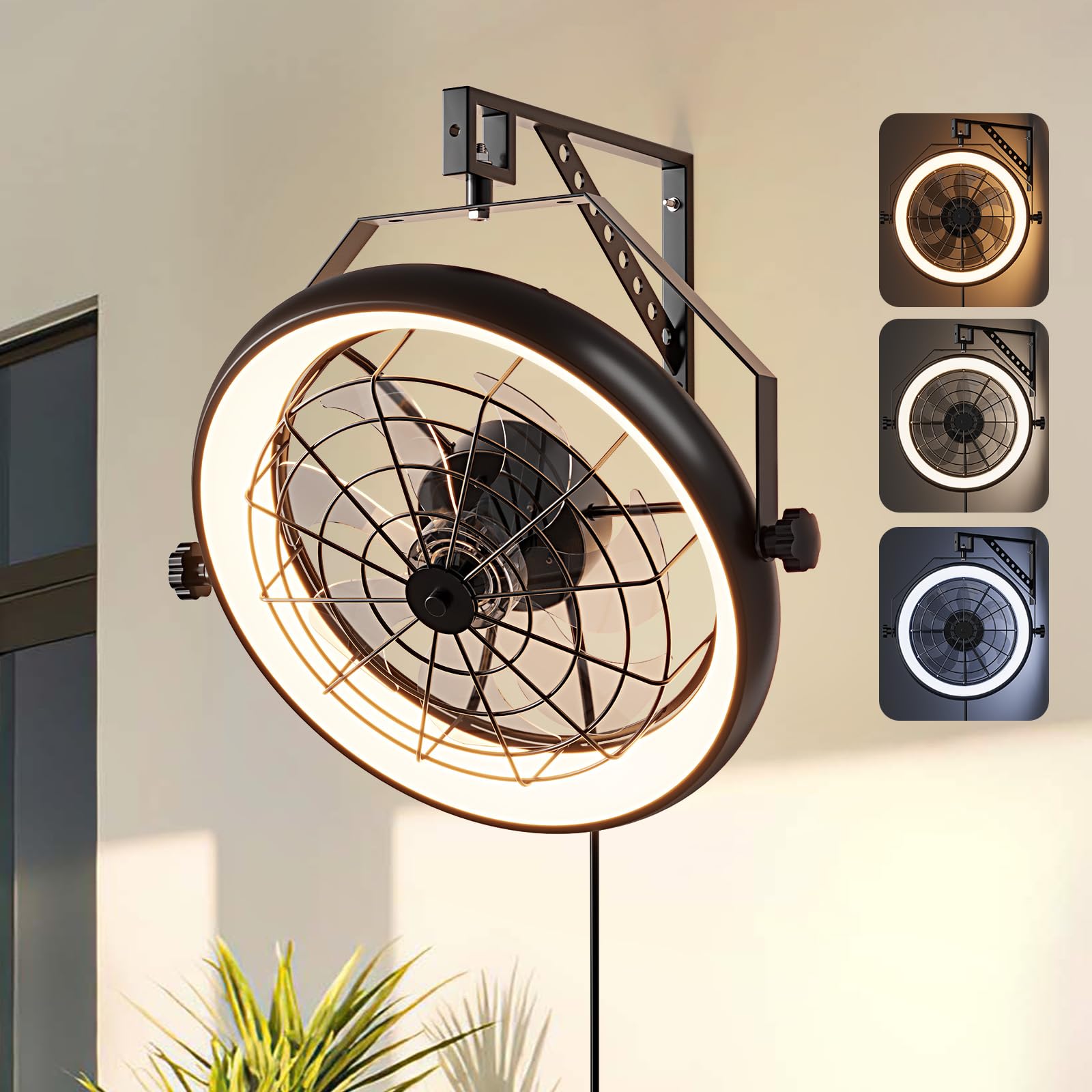
This is the “I want my porch to feel finished” pick. The Fansconce doesn’t just push air—it solves a real patio problem: many porches can’t take a ceiling fan (no wiring, sprinkler systems, structural limitations), but people still want airflow and light. This unit gives you both in a plug-in setup that feels surprisingly polished.
What owners love most is the living-room style usability: multiple fan speeds, quiet operation, and lighting you can actually tune. Dimmable brightness and selectable color temperature sounds like a gimmick until you use it: warm light for relaxing evenings, brighter neutral light for cleaning up after dinner, and a cooler light when you want a crisp look. And because it’s remote/app controlled, you can dial everything in without walking to the wall every time.
Here’s the expert lens that helps you buy smart: this is a comfort system, not an industrial wind cannon. If your patio is huge and exposed, you’ll want a high-velocity metal fan. But if you want quiet airflow that feels pleasant while you talk, eat, or read—and you want lighting integrated into the same footprint—this model can feel like a “why didn’t I do this sooner” upgrade.
Why it’s a porch favorite
- Fan and light together – Solves two problems with one installation, especially on porches without ceiling fan wiring.
- Quiet comfort tuning – Multiple speeds let you pick “gentle breeze” instead of only “blast.”
- Dimmable, adjustable lighting – Helps your patio feel intentional, not just functional.
- Remote/app convenience – Great for daily use when the fan is mounted high or out of reach.
Good to know
- It’s not a heavy-duty outdoor industrial fan; treat it as a covered patio/porch solution rather than exposed-rain equipment.
- Some users report app pairing can be finicky at first; the remote gives you a reliable fallback.
- If your top priority is maximum airflow reach across a large patio, choose a high-velocity metal fan instead.
Ideal for: covered porches and patios where you want quiet comfort, modern lighting, and a clean “one device” upgrade without hardwiring a ceiling fan.
8. Siljoy 21" Wall Fan with LED Light – Calm Airflow and Night-Friendly Lighting in One Unit

The Siljoy sits in the “comfort-first” category: it’s designed to be easy to live with—quiet, adjustable, and flexible enough to work in bedrooms, home gyms, and covered patios where you want airflow without turning the space into a loud workshop. The built-in lighting and night-light mode make it especially appealing for spaces that serve multiple roles.
In real-life feedback, you see a pattern: people buy this because it looks good, installs without hardwiring, and offers a lot of control. Six speed options matter because you can find that sweet spot where the air moves, but conversation still feels natural. The 360° aiming ability also matters more than most shoppers expect: being able to point airflow exactly where it’s needed can make a lower-output fan feel much more effective.
This is also a great example of the “right expectations” principle. If you mount it very high and expect industrial-level throw, you may feel underwhelmed. But if you treat it like a comfortable living-space fan that can handle a covered patio or indoor room beautifully, it can feel like a unique, practical upgrade—especially if you value lighting control and quiet operation.
Why it’s easy to enjoy
- Quiet operation focus – Works well in rooms and covered patios where noise ruins the vibe.
- LED lighting flexibility – Adjustable brightness and color temperature help the space feel “right” at night.
- Remote and app control – Convenient for daily use when mounted out of reach.
- Flexible aiming – Helps you direct airflow where it matters most, which boosts perceived comfort.
Good to know
- This model is best kept protected from direct rain; choose placement accordingly.
- If you need heavy-duty airflow for a large open patio, a high-velocity metal fan will feel more powerful.
- As with many app-capable devices, the remote is the “always works” tool—keep it accessible.
Ideal for: bedrooms, home gyms, and covered patios where you want quieter airflow, adjustable lighting, and a flexible aiming setup.
9. CAMMOO 20" Oscillating Wall Fan 2-Pack – Two Fans, Better Coverage, No Ladder Controls
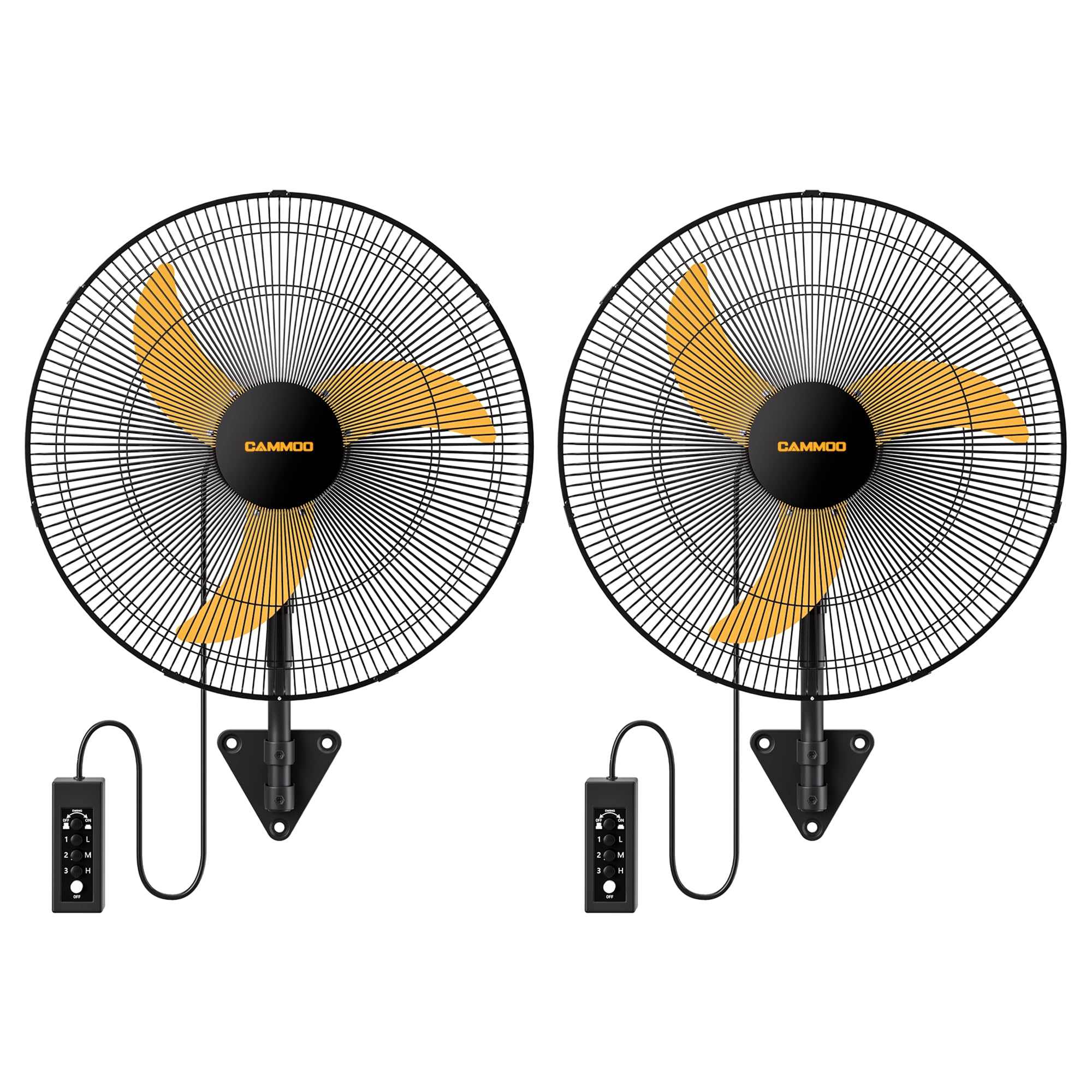
If you’ve ever mounted a fan high and then realized the controls are basically unreachable, you’ll immediately understand why the CAMMOO’s wired remote matters. This set is built around a practical idea: fans often need to be mounted where airflow travels best, but controls need to live where people can reach them. A wired remote that hangs lower solves that mismatch without relying on a tiny wireless remote that disappears into the outdoor chaos.
The second smart angle here is the 2-pack strategy. Many patios, barns, and workshops don’t cool well with one fan in one corner. Air pockets form. Dead zones happen. A pair of fans aimed thoughtfully—either facing each other to create circulation, or set on opposite sides for coverage—often feels more comfortable than a single monster fan blasting one direction. That’s why multi-fan setups show up constantly in owner “success stories,” especially in hot climates.
One honest limitation in feedback: tilt range can be more limited than some people expect. That matters if you mount very high and want the airflow to hit lower seating areas. The best setup is usually mid-high mounting with a slight downward angle—high enough for safety, low enough for comfort. If you can mount them at a smart height, owners frequently describe them as surprisingly quiet for their output.
Why it’s a smart “two-fan” solution
- Wired remote reach – Makes high mounting practical because you can still control speed easily.
- 2-pack coverage – Better circulation and fewer dead zones than “one fan in one corner.”
- Strong airflow feel – Owners often use low settings because even low pushes meaningful air.
- Great for big utility spaces – Works well in outbuildings where airflow is comfort and function.
Good to know
- Tilt-down range may be modest; plan mounting height so airflow hits where you actually sit or work.
- As with any heavier wall fan, mount to a sturdy surface to avoid vibration.
- If your installation is truly exposed to rain, consider a more explicitly weatherproof outdoor fan and mount under cover when possible.
Ideal for: shops, barns, garages, and larger covered outdoor areas where two fans create better comfort than one, and where reachable controls matter.
10. VEVOR 24" Waterproof Oscillating Wall Fan – The Big Patio Solution When Smaller Fans Don’t Matter

A 24-inch wall fan is not subtle—and that’s the point. This VEVOR model is built for people who want a patio to feel dramatically different, not just slightly less warm. If you have a large covered area, a garage that turns into a sauna, or an outdoor seating space in serious heat, this is the type of fan that can change your “usable hours” outside.
Owners who love it usually say some version of: “It’s a beast.” They talk about strong airflow, straightforward installation, and a surprisingly tolerable noise level for the size. The oscillation helps because large fans can otherwise create a narrow blast zone. With sweeping motion, the airflow feels more like a moving breeze across the space instead of a fixed jet.
The misting feature is the wildcard. In dry climates, misting can be an absolute cheat code for comfort. In humid climates, mist can feel less helpful (or even sticky) because evaporation is slower. My advice: buy it for airflow first, then treat misting as a climate-dependent bonus. Also note the practical warning baked into many outdoor fan experiences: “water resistant” does not mean “leave it soaked for days.” Mount under a covered area or where weather exposure is controlled.
Why it’s a big-patio favorite
- Huge airflow – Excellent for large patios and garages where smaller fans don’t reach.
- Oscillation helps coverage – Sweeping motion spreads comfort across more seating space.
- Feels sturdy and industrial – Built like a tool, not a fragile decor item.
- Misting option – Can add a meaningful cooling effect in the right climate and setup.
Good to know
- It’s a large fan and will be heard; expect “shop fan” sound at higher settings.
- Mounting hardware needs to match your wall surface; plan for masonry anchors or solid structural mounting when needed.
- Misting requires basic maintenance and sensible placement to avoid spraying where you don’t want moisture.
Ideal for: large covered patios, garages, and outdoor areas where you need maximum airflow to make the space feel usable in peak heat.
11. Hurricane Pro 20" High Velocity Wall Fan – Built for Everyday Use, Not Occasional Breeze
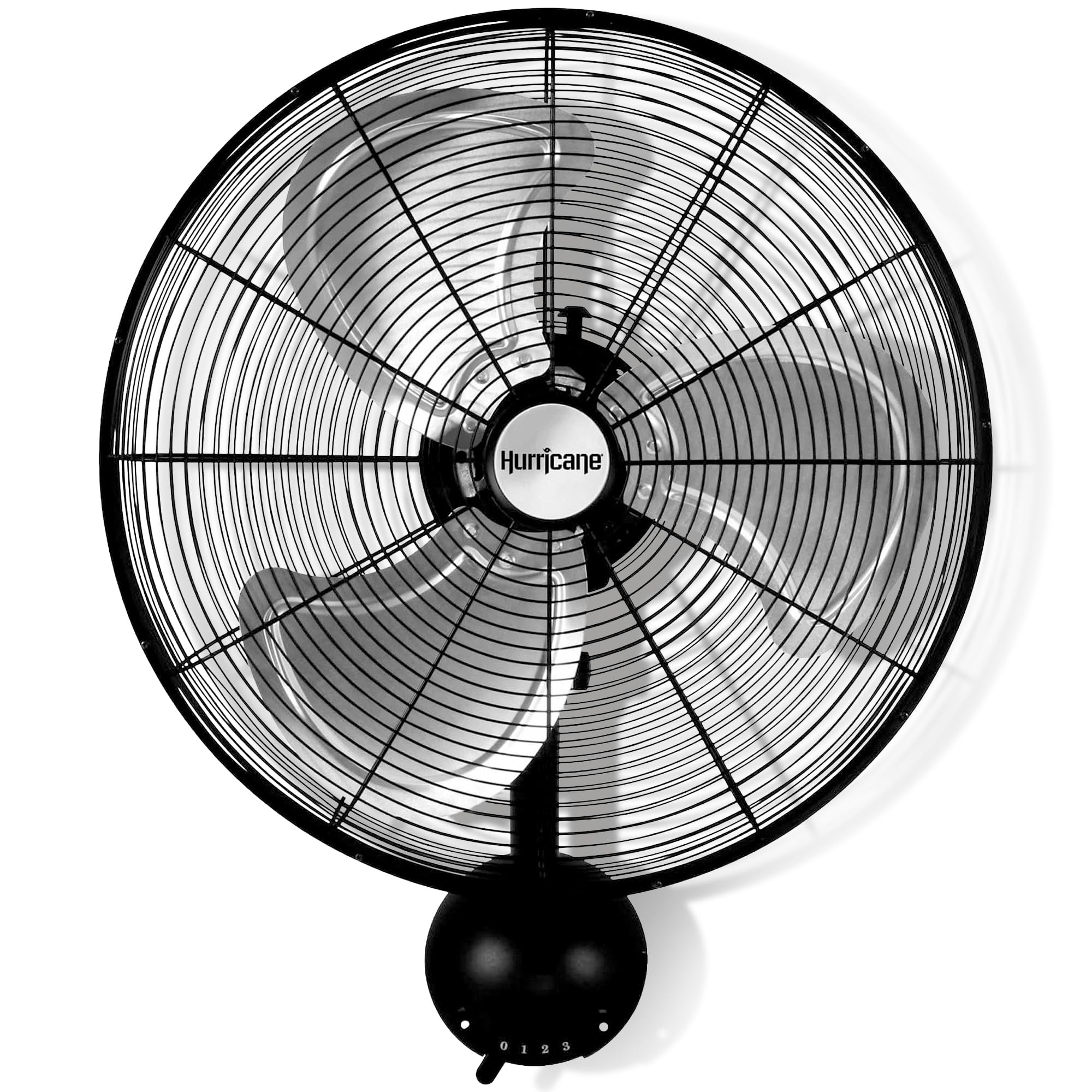
The Hurricane Pro is a classic in the “serious wall fan” category: metal build, strong airflow, and simple controls. It’s popular in the exact situations where people run fans for long hours—garages, workshops, home gyms, and even living spaces that need better circulation. If your fan is going to be on most days, durability and heat management become more important than fancy features.
In owner feedback, the praise tends to be very practical: easy installation, meaningful airflow, and a solid feel for the money. The oscillation feature is often described as a big comfort boost because it prevents the “one cold spot” problem. If you’ve ever had a fan blasting one person while everyone else still sweats, you know why this matters.
The main complaint pattern is also practical: pull chains (or long cords) can feel flimsy and people worry they’ll snap over time. That’s not unique to this fan—it’s a reality of repeated pulling. The smart workaround is simple: mount the fan for the best airflow, then use a switchable outlet or a controlled plug so the chain becomes “backup,” not daily control. Also pay attention to cord routing; some owners dislike cords exiting at the top because it complicates clean cable management.
Why it’s a dependable daily fan
- Strong airflow for the size – Effective in garages and gyms where comfort depends on real air movement.
- All-metal construction – Feels sturdier than plastic alternatives when used frequently.
- Oscillation helps large areas – Spreads airflow instead of creating one “blast zone.”
- Simple long-run functionality – A no-drama choice for people who want a fan to do its job daily.
Good to know
- It’s not whisper quiet; treat it as a utility fan that can still be comfortable at lower settings.
- If you mount it high, the chain becomes inconvenient; many owners prefer a plug-based on/off solution.
- Mounting hardware quality varies by wall type; upgrade anchors if you’re installing into anything other than a solid stud wall.
Ideal for: garages, home gyms, and workshops where the fan runs often and you want a sturdy, oscillating, high-velocity wall fan.
12. Simple Deluxe 18" Industrial Wall Fan – Big Air on a Budget, With One Important Check
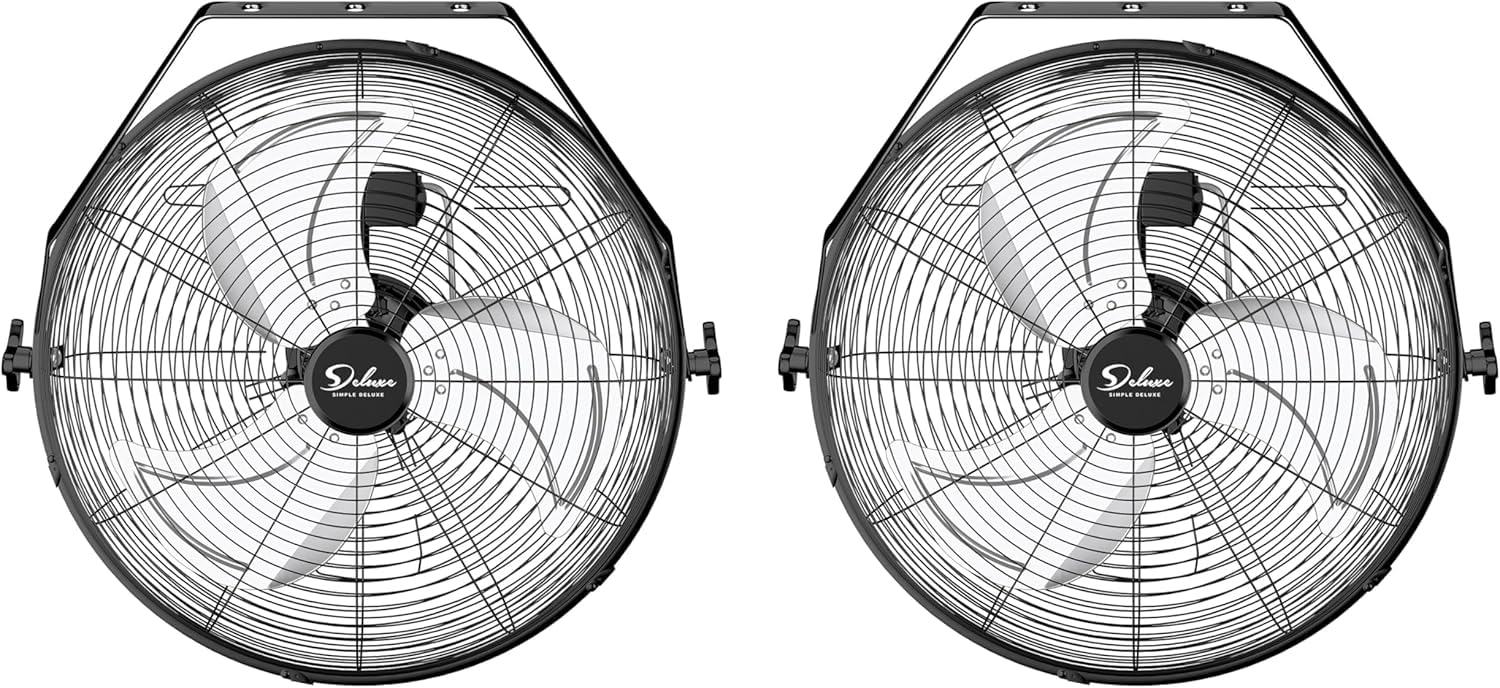
The Simple Deluxe 18-inch fan is one of the most interesting “value” picks because it can feel like a premium experience—if you get a well-balanced unit. When it’s right, owners describe it as quiet for its airflow, effective, and sturdy. When it’s off, they describe vibration that makes it sound like a helicopter. That may sound dramatic, but it’s actually a useful clue: balance and mounting stability matter more than most shoppers realize.
Here’s how smart buyers approach this fan: they treat the first installation as a quick test. Mount it securely, tighten everything down, and run it at each speed while you listen for rhythmic vibration. If it’s smooth, you’ve got a fantastic airflow-to-noise value. If it’s unbalanced, it’s not a “you” problem; it’s a unit issue. That’s why return policy and quality checks matter more here than with some higher-priced models.
In successful setups, this fan is a sweet spot for covered patios and indoor spaces where you want noticeable air movement without paying for luxury features. It’s also a great “multiple fan” strategy pick: using two medium fans to create circulation often feels better than one fan blasting one direction. This model’s tilt flexibility supports that kind of airflow design.
Why it’s a strong value pick
- High airflow for the size – Great for covered patios, shops, and indoor circulation.
- Can be quieter than expected – When balanced, owners often praise the sound level for the output.
- Sturdy metal construction – Feels more durable than many budget plastic wall fans.
- Easy tilt adjustment – Helps you aim airflow where comfort is created.
Good to know
- Balance varies; test it after installation and exchange if vibration is excessive.
- Like most industrial fans, low speed may still feel “strong.” If you want ultra-gentle airflow, choose a comfort-focused model.
- Mounting surface matters: thin beams or hollow walls can amplify vibration—use a sturdy mounting board if needed.
Ideal for: buyers who want strong airflow value for covered patios or shops and are willing to do a quick vibration check after installation.
13. VEVOR 18" Oscillating Wall Fan 2-Pack – The Smart Way to Beat Dead Zones

A lot of patio cooling problems are geometry problems. One fan in one corner creates one strong zone and several weak zones. That’s why two-fan setups are so common in barns, garages, greenhouses, and larger patios: you can design airflow like a system. This VEVOR 2-pack is appealing because it makes that strategy accessible without forcing you into premium pricing.
Owners who buy multi-fan sets typically do one of two things: (1) mount fans on opposite sides so the whole space keeps moving, or (2) angle both fans in the same direction to create a steady flow across seating or working areas. Both approaches work, and oscillation helps because it adds “air sweep” across the space. If you’re cooling an area where people move around—like a workshop or patio party setup—oscillation is a real quality-of-life feature.
This is also a category where mounting advice matters. Many industrial-style wall fans are happiest mounted into concrete, masonry, or very solid wood. If your patio wall is lighter construction, use a reinforced mounting board that spans studs. Done properly, the result is impressive: strong circulation that makes the space feel less stagnant and more comfortable for longer periods.
Why two fans can feel better than one
- Coverage without blasting – Two fans reduce dead zones and create a more comfortable overall feel.
- Oscillation improves circulation – Helps spread airflow across work areas or seating zones.
- Strong airflow value – A practical approach for garages and greenhouses where you want function over aesthetics.
- Space-saving – Wall mounting keeps floors clear, which matters in working spaces and busy patios.
Good to know
- Some listings recommend mounting on concrete or metal structures; if using wood, reinforce properly for long-term stability.
- Industrial fans are rarely whisper quiet; plan to use lower speeds when conversation matters.
- Two fans means two power cords—plan your outlets and cable routing so the installation stays clean and safe.
Ideal for: larger patios, garages, and greenhouses where comfort comes from circulation and you want a practical two-fan setup.
14. NewAir WindPro18W – The Tough “Set It and Run It” Wall Fan for Dusty, Humid Spaces

The NewAir WindPro18W is a practical favorite for one reason: it’s built to work where “normal fans” die. Dusty coops, humid covered runs, garages, workshops—these are places where people want airflow, but they also want peace of mind. Owners often choose this model specifically because it’s designed with durability and safer operation in mind for tougher environments.
The most telling real-world feedback is long-term: people buy one, it performs well, and then they buy a second for another space. That’s usually the strongest compliment a utility fan can get. Another consistent theme is that even low speed moves a surprising amount of air. That matters because a fan you can run on low overnight (in a coop, barn, or covered patio) without it sounding like an airplane is a real win.
Installation tips also show up repeatedly: this fan is not light, and a confident mount makes the experience better. Several owners mount it to a sturdy piece of wood first, then mount that wood to the structure—especially in outdoor or semi-outdoor setups. The goal is stability, vibration reduction, and a mount you never have to second-guess. If you’re building a patio airflow system rather than buying a decorative accessory, this fan fits that mindset.
Why it’s a tough-environment favorite
- Durability-focused build – Designed for workshops, coops, and spaces where dust and humidity are reality.
- Strong airflow on low – Lets you run it longer without living on the loudest setting.
- Safety-minded cage design – A reassuring feature in environments with animals, kids, or busy activity.
- Proven “buy another” pattern – Owners often expand to multiple units once they see it perform.
Good to know
- Pull cord control is simple, but high mounting means you may want a remote plug solution for daily on/off.
- Industrial fans can have tight grille clips and firm hardware; that’s part of keeping the unit stable under vibration.
- If you want a patio fan that blends into decor, this looks more like a tool than furniture.
Ideal for: coops, barns, garages, and covered outdoor spaces where you want a durable wall fan that can run for long periods without drama.
15. VEVOR 18" IP44 Water-Resistant Wall Fan – Great Reach for Covered Patios and Posts

If you want a patio fan that feels like “real airflow” without paying premium pricing, this VEVOR 18-inch model is a strong candidate. It’s a straightforward, industrial-style wall fan with a practical bracket and a focus on reach. Owners often describe it as powerful, sturdy for the cost, and very effective at making garages and covered patios feel less stagnant.
A lot of the love for this model comes from context: people install it in places where a pedestal fan would be in the way, or where a small indoor wall fan wouldn’t make a dent. Mounted at a smart height and tilted properly, it can push air across a seating area rather than just cooling the nearest chair. That’s the real win outdoors—movement across space, not just noise near the wall.
One important mindset: “water-resistant” is not the same as “leave it exposed to days of rain.” Owners who stay happiest are the ones who mount it under cover, on a post, or where weather exposure is controlled. If you treat it as a covered patio workhorse, it tends to deliver excellent comfort per dollar and makes outdoor evenings more usable.
Why it’s a great value patio pick
- Strong airflow for a covered patio – Delivers meaningful movement that changes how the space feels.
- Simple and sturdy – Metal build and practical bracket design suit utility spaces well.
- Good reach – Owners frequently note it pushes air across garages and patios rather than just near the wall.
- Easy to live with – Pull chain control is straightforward and reliable.
Good to know
- It’s a utility fan and will sound like one at higher speeds; use low/medium for conversation zones.
- Best results come from solid mounting surfaces; if your wall is light, use a reinforced board spanning studs.
- For fully exposed installations, choose a fan designed explicitly for direct weather exposure or mount under cover.
Ideal for: covered patios, garages, posts, and utility spaces where you want strong airflow value and straightforward operation.
16. Comfort Zone 16" Wall Fan with Remote – The Simple Comfort Upgrade for Smaller Spaces

The Comfort Zone wall fan is popular because it gives you the features people actually use—remote control, timer, oscillation—at a friendly entry point. It’s not trying to be an industrial monster. It’s trying to make bedrooms, home gyms, and small spaces feel better without taking up floor space. And for that job, it can be a very satisfying buy.
Owner feedback shows two different experiences, and understanding that helps you avoid disappointment. Many people love the airflow for the size, the remote convenience, and the extra modes (sleep/natural). Others mention vibration or “loud for a bedroom” behavior—often tied to installation looseness. A wall fan is only as quiet as the mount. Tighten everything, mount securely, and you’ll get a calmer experience. Treat it like a quick install on a flimsy surface, and you may hear more resonance.
There are also small design quirks that show up repeatedly: cord length and cord exit placement. These aren’t dealbreakers, but they do affect how clean your setup looks. The fix is simple: plan the outlet location, use tidy cable management, and mount with an eye toward where the cord needs to travel. For a sheltered patio or porch, it can be a nice convenience fan—just keep expectations aligned with its comfort-focused category.
Why it’s popular
- Remote control convenience – Adjust speed, oscillation, and modes without getting up.
- Timer and sleep modes – Great for bedrooms and home gyms where you don’t want the fan running forever.
- Wide oscillation – Helps smaller spaces feel evenly cooled rather than “one corner only.”
- Space-saving wall mount – Frees up floor area and keeps the fan out of traffic zones.
Good to know
- Mounting quality heavily affects noise; tighten everything and use a solid surface.
- Not intended for direct outdoor exposure; use it in sheltered or indoor environments.
- Some design choices like cord length may require planning for neat installation.
Ideal for: smaller sheltered spaces where you want remote convenience and wide oscillation without spending for heavy-duty industrial airflow.
How Patio Fan Cooling Actually Works and Why Throw Beats Specs Outdoors
The reason patios feel different from indoor rooms is simple: outdoors, the air doesn’t “stay put.” That means the best patio fan isn’t always the one with the biggest number on paper—it’s the one that creates a consistent, comfortable breeze where people actually sit.
What makes patio airflow feel amazing
- Air speed across skin – The comfort effect is mostly about evaporation and heat exchange at your skin. You want airflow across people, not above them.
- Throw across distance – On a patio, you’re often trying to reach 8–20 feet. High-velocity fans do this better than decor fans.
- Smart angles – A slightly downward angle across seating height usually feels better than straight down, which can feel “harsh” and uneven.
- Wide coverage – Oscillation, multiple fans, or a strategic placement can eliminate dead zones that make patios feel patchy.
- Calm low speed – The best outdoor experience is often a medium or low speed you can run for hours without getting annoyed.
If you remember one thing: you’re not buying “a fan,” you’re building a breeze pattern. That’s why high-velocity models thrive in large spaces and why fan-and-light combos shine in cozy porch setups.
Field-tested placement tips that improve results
- Mount higher than heads, aim across bodies – This reduces direct blast while increasing reach.
- Use the “napkin test” – If napkins fly off the table on your normal speed, the fan is aimed too directly at the dining zone.
- Create cross-breeze – Two fans on opposite sides, slightly angled, often feels more natural than one fan on full blast.
- Control vibration early – Tighten fasteners, use a solid board spanning studs, and add thin rubber washers if you hear resonance.
- Keep cords safe and tidy – Route cords along structure lines and avoid places where pets or kids can snag them.
When you do this well, the patio stops feeling like “outside in summer” and starts feeling like an outdoor room you actually want to use.
FAQ: Wall-Mounted Patio Fans Without the Guesswork
Do wall-mounted fans actually help on patios, or do they just move hot air around?
How many wall fans do I need for my patio?
What’s the biggest mistake people make when mounting patio fans?
Should I choose pull chain, wired controls, or remote control?
Do bigger fans always mean better cooling?
Are fan-and-light combos worth it for patios?
Final Thoughts: Buy the Fan That Matches How You Actually Use Your Patio
The best fan isn’t the one with the most marketing words. It’s the one that makes you sit down outside and think, “Okay… this feels good.”
Here’s the simplest way to translate this guide into a confident purchase:
- Want the best overall blend of comfort, convenience, and real airflow? Start with the FUGOO 20" Outdoor Sealed BLDC Wall Fan. It’s the “easy to live with” choice that still moves enough air to matter outside.
- Want a patio fan that looks like decor, not equipment? Choose the Craftmade Bellows I 16" Retro Wall Fan for covered spaces where style is part of the experience.
- Need serious airflow for a long covered patio or extreme heat? Go for the KEN BROWN 18" High-Velocity Wall Fan or the iLiving 18" Weatherproof Wall Fan if your space needs a fan that can actually reach people.
- Want durable, metal, “built to last” confidence? The Tornado 16" Pro Series is a favorite for garages, gyms, and covered patios where you want serious construction.
- Need airflow and lighting in one clean install? Pick the Fansconce 23" Fan with LED Light or the Siljoy 21" Fan with LED Light for covered porches and indoor-outdoor spaces that want quiet comfort.
- Want a practical multi-fan setup to beat dead zones? The CAMMOO 20" 2-Pack or VEVOR 18" Oscillating 2-Pack lets you create circulation instead of relying on one fan to do everything.
- Want a compact fan for small patios or targeted airflow? The Parrot Uncle 10" Folding-Arm Wall Fan is a clean, quiet option that’s all about direction control.
- Want a budget-friendly covered patio workhorse? The VEVOR 18" IP44 Water-Resistant Wall Fan brings strong airflow value without premium extras.
Pick the wall mount patio fans that match your space and your habits—remote vs pull chain, quiet comfort vs industrial airflow, one fan vs two-fan circulation— and your patio stops being “that place we avoid in summer” and becomes the most-used room you didn’t know you had.
