
Floor cleaning isn’t really about “mopping.” It’s about the feeling you get when you walk barefoot from the kitchen to the hallway and the floor feels clean—no stickiness, no gritty dust, no mystery film that shows up under bright light. The best tools don’t just remove visible crumbs; they remove the invisible stuff that makes floors feel dull: grease haze near the stove, paw-print residue, fine dust that clings to texture, and that one sticky spot you swear you already cleaned yesterday.
If you’re shopping for a steamer for cleaning floors, you’re usually chasing one (or more) of these outcomes: (1) chemical-free cleaning for a kid/pet-heavy home, (2) better “deep clean” results on tile and grout, (3) a faster routine that doesn’t start with sweeping, then vacuuming, then mopping, then re-mopping because the first pass streaked. And here’s the truth: most steam tools can produce hot vapor, but only a handful make the whole workflow feel effortless—heat-up time, glide, pad maintenance, corner reach, and how well they handle real-world debris.
This guide is written from the practical side of cleaning—not the box-spec side. I’m focusing on what consistently shows up in real user experience: which models glide like they’re self-propelled, which ones tend to leave streaks when you move too fast, which designs get overwhelmed by hair, and which machines are “deep clean beasts” but come with a learning curve. You’ll also see a few non-traditional picks (like a wet/dry vacuum-mop) for households where steam isn’t the only answer.
Below, you’ll find 15 standout options—from simple, lightweight steam mops to rotating-pad scrubbers, a true debris-pickup + steam hybrid, multi-surface detachable handheld steam tools, and two canister steam cleaners built for grout lines, crevices, and whole-home detail work.
In this article
- How to choose the right steam cleaner for your floors and your mess style.
- Quick comparison table of 15 standout models.
- In-depth reviews of each option, with practical pros and cons.
- How steam cleaning floors actually works (and why streaks happen).
- Answers to common questions, plus final buying tips.
How to Choose the Right Steamer For Cleaning Floors
A floor steamer is “good” only if it makes you clean more often with less effort—because consistency beats intensity. The most common disappointment isn’t “it didn’t get hot.” It’s: the tank is annoying to refill, the pads are a pain to wash, it streaks unless you move at the speed of a snail, or it can’t handle the everyday debris your household actually produces.
Here’s the decision framework I use to match a machine to a real home. It’s built around floor safety, cleaning physics, and the little friction points that turn a strong machine into a closet ornament.
1. Start with your floor finish, not your wishlist
Steam is heat + moisture. That combo is brilliant for loosening grime, but it’s not universal. Before you pick a model, decide which category your floors fall into:
- Sealed hardwood: Steam can be a fantastic “refresh” tool if you keep moving and use moderate steam. The goal is clean, not soaked.
- Tile / stone / sealed grout: Steam shines here—especially models with scrubbing, brushes, or higher sustained output.
- Laminate / LVP / vinyl: You want controlled steam and fast passes. The risk is pushing moisture into seams, so low steam + clean pads are key.
- Unsealed, waxed, or oil-finished floors: Steam is usually the wrong tool. It can soften finishes, cause haze, or create patchy dulling.
2. Identify your mess profile (this changes everything)
Two homes can have the same floor and need totally different tools. Pick the profile that sounds like your life:
- “Barefoot feel” home: Your main enemy is film—grease haze, fine dust, and sticky spots. You want consistent steam and pads you can swap often.
- “Pets + kids” home: Your enemy is debris (crumbs, litter, hair) plus residue (paw prints). You need either debris pickup, or a routine that pairs vacuum + steam well.
- “Tile + grout stress” home: Your enemy is texture. You want scrubbing action, targeted steam, or canister-style tools with brushes.
- “Quick cleanup” home: You need fast heat-up and simple operation, or you won’t use it regularly.
When people say “steam mops don’t work,” it’s often because the tool doesn’t match the mess. A basic flat-pad steam mop can be amazing at film removal—but it can struggle with heavy crumbs unless you sweep first. A wet/dry vacuum-mop can crush debris—but it won’t give you steam sanitization. Match the tool to the problem.
3. Choose the machine category that fits your routine
These are the main styles in this guide, and each one has a personality:
- Classic flat-pad steam mops: Lightweight, simple, and great for frequent maintenance cleaning. They’re at their best when you vacuum/sweep first and swap pads often. (Examples: Shark S1000, Bissell PowerFresh.)
- Rotating-pad steam scrubbers: Pads spin so you apply less elbow grease, and they tend to reduce streaking because the pads keep “agitating” the film. This style is a sweet spot for many homes—especially kitchens and high-traffic areas. (Examples: Shark Steam & Scrub line.)
- Targeted blast steam mops: You get a “burst” button for stuck-on spots without turning the whole session into a deep-clean. Great for households that have mostly clean floors with occasional disasters. (Example: Shark SteamSpot; Steam Blaster models.)
- Debris-pickup + steam hybrids: Built to reduce the “pre-sweep” step by capturing small debris as you steam. These can be magical for crumbs—less magical for long hair, depending on your household. (Example: Shark Steam Pickup.)
- Detachable handheld multi-tools: You’re buying versatility: floors + grout + windows + high-touch surfaces. The tradeoff is usually smaller tanks and less “industrial” pressure than canister units. (Examples: LABIGO, ScrubWiz, FEPPO, Aspiron, TORDER.)
- Canister steam cleaners: The deep-clean specialists. Bigger tanks, longer runtime, more accessories, stronger detail capability (grout lines, appliances, car interiors). Floors can look incredible—but you’ll do more “wipe-up” work because canisters loosen grime fast. (Examples: McCulloch MC1385, GOATCLEAN.)
- Wet/dry vacuum-mop alternatives: Not steam, but unbeatable for households that want to vacuum and wash at once—especially pet homes. (Example: CrossWave Pet Pro.)
4. Steam control matters more than maximum temperature
Many buyers get trapped chasing the biggest number. In real floor cleaning, control is king:
- Multiple steam modes help you clean delicate floors and still attack stuck-on grime when needed.
- On-demand blast is a game-changer for dried spills because you can focus power without soaking the whole floor.
- Continuous steam is great for big rooms, but you need clean pads to avoid spreading grime.
- Heat-up speed affects how often you use it. If it’s fast, you’ll do more small “maintenance wins,” and those add up.
5. Tank size and cord reach decide whether cleaning feels smooth
A steamer can be powerful and still feel annoying if you’re refilling constantly or changing outlets every few minutes. Consider:
- Small tanks are fine for apartments and quick cleanups (and they keep the unit lighter).
- Larger tanks shine for open-plan homes where you want to do the whole kitchen + living room in one flow.
- Long cords reduce frustration—especially with stairs, hallways, and bathrooms.
A surprising reality: the “best” tank size is the one that matches your cleaning session length. If you hate long sessions and prefer quick resets, a lighter, smaller-tank steam mop can outperform a giant canister simply because you’ll actually use it.
6. Maintenance is the hidden make-or-break factor
Steam cleaning is a loop: steam loosens grime, pads pick it up, and then you have to reset the tool so next time it doesn’t smear. The simplest way to stay happy with any machine is to build a maintenance routine you can tolerate:
- Pad strategy: Have enough pads to swap mid-clean (kitchen first, bathrooms second, entryway last). Dirty pads are the #1 cause of streaks.
- Water strategy: If you have hard water, distilled water is your best friend to reduce mineral buildup.
- Dry-out strategy: Empty tanks and let components air-dry to avoid smells and microbial funk.
- Brush/roller strategy: If your model has a brushroll or rotating pads, plan a 60-second “post-clean reset.” It keeps performance consistent.
7. Decide what you want to be true on your worst cleaning day
Your best buying decision happens when you imagine the hardest version of your routine: a muddy-paw entryway, a sticky kitchen spill, a dog that sheds, a toddler that drops food, and you’re tired. What do you want your tool to do?
- Make scrubbing feel effortless? Go rotating-pad steam scrubber.
- Reduce steps and pick up debris? Consider a pickup + steam hybrid or a wet/dry vacuum-mop.
- Give you “detail power” for grout and crevices? Go canister steam cleaner.
- Give you the simplest, lightest weekly routine? Go classic steam mop.
- Do a bit of everything? Go detachable handheld multi-tool.
Quick Comparison: 15 Steamer For Cleaning Floors Picks
Use this table to find the models that match your floor type and cleaning style, then jump to the full reviews for the real-life details— like streak resistance, hair handling, pad upkeep, and whether the machine feels “pleasant” enough to use every week.
On smaller screens, swipe or scroll sideways to see the full table.
| Model | Category | Signature strength | Best match | Amazon |
|---|---|---|---|---|
| Shark Steam & Scrub w/ Steam Blaster (S8201) | Rotating pads | Targeted steam blast + effortless glide for stuck-on spots | Most homes that want one “do-it-most” steam mop | Amazon |
| McCulloch MC1385 Deluxe Canister Steam Cleaner | Canister | Long runtime + accessories for grout, detail work, and floors | Deep-cleaners who want “whole-home” steam power | Amazon |
| GOATCLEAN Heavy-Duty Steam Cleaner (ST008) | Canister | Big accessory kit + long reach for grout, kitchen grease, upholstery | Homes that want “steam everything” versatility | Amazon |
| Shark Steam Pickup 3-in-1 (SD201) | Pickup + steam | Picks up debris while scrubbing and steaming in one pass | Kitchen/entryway homes that hate pre-sweeping | Amazon |
| BISSELL CrossWave Pet Pro (2306A) | Wet/dry alt | Vacuums and washes together; strong for pet mess routines | Pet-heavy homes that want “one machine” floor resets | Amazon |
| Shark Steam & Scrub (S8001) | Rotating pads | 3 steam modes + headlights + smooth “pads do the work” scrub | Tile and sealed hard floor homes that want easier scrubbing | Amazon |
| Shark Steam & Scrub (S8002BRN) | Rotating pads | Two-mode rotating pads for consistent, low-effort weekly cleaning | Busy homes that want simple scrub power without extras | Amazon |
| Shark SteamSpot w/ Steam Blaster (S2001) | Spot-buster | Targeted blast for sticky spots + lightweight handling | Homes that want quick cleanups with occasional deep hits | Amazon |
| Bissell PowerFresh Steam Mop (1940A) | Classic steam | Flip-down scrubber + simple digital steam levels | Homes that want a proven, straightforward steam mop | Amazon |
| 12-in-1 Steam Mop (Aspiron) | Detachable | Fast heat + large tank for a multi-tool steam routine | Homes that want floors + windows + furniture in one kit | Amazon |
| TORDER High-Temp Steam Mop w/ 13 Accessories | Detachable | Large tank + accessory set for multi-surface deep cleaning | People who want fewer refills and more surface coverage | Amazon |
| Shark Steam Mop (S1000) | Lightweight | Simple, light, quick-start steam cleaning with washable pads | Budget buyers who want a dependable weekly steam routine | Amazon |
| ScrubWiz 10-in-1 Steam Mop (Detachable) | Detachable | Quick heat + useful attachments at a friendly entry level | Apartment homes and “one tool, many jobs” shoppers | Amazon |
| LABIGO 10-in-1 Steam Mop (Detachable) | Detachable | Fast heat + handheld steam for bathrooms and high-touch areas | Homes that want “sanitize touchpoints” plus floor refreshes | Amazon |
| FEPPO Steam Mop & Detachable Handheld (HD-QJ310) | Detachable | Strong steam feel + larger tank for longer sessions | Homes that want less refilling and broad room coverage | Amazon |
In-Depth Reviews: 15 Floor Steam Cleaners That Real Homes Keep Using
Now we’ll go model by model. I’m going to talk like a real cleaner, not a spec sheet: how it behaves on sticky kitchen film, how it handles crumbs and hair, what maintenance actually looks like, and what to expect when you use it weekly—not just once.
1. Shark Steam & Scrub with Steam Blaster Technology (S8201) – The “Most Homes” Sweet Spot

If you want one machine that makes floors feel genuinely “reset” without turning cleaning into a workout, this is the Shark model that checks the most boxes. Rotating pads change the entire experience: instead of you pushing friction across the floor, the mop head does the agitation for you. That matters most on kitchen film, dried footprints, and those high-traffic zones where a basic flat steam mop can start to feel like you’re just smearing warm water around.
The reason the S8201 earns “best overall” is balance. It’s strong enough to improve tile and grout appearance (especially when paired with the right slow passes), but still controllable enough for sealed hard floors where you want steam—not saturation. And that Steam Blaster button is the perfect “spot tool” built into the main tool: hit the dried sauce splatter, then go right back to normal passes without changing attachments.
Real-world use tip: rotating pads are most impressive when you treat them like a “buffer,” not a “pressure tool.” Let the pads do the work, move in overlapping lanes, and swap to a fresh pad when you feel glide resistance increase. If you keep your pads clean, this style tends to reduce streaking and keeps that barefoot-clean feel more consistently than many classic models.
Why you’ll like it
- Effortless glide – Rotating pads take pressure off your wrists and back while still agitating grime.
- Targeted spot power – Steam Blaster is perfect for dried spills without soaking the whole floor.
- Floor-safe control – Multiple steam modes help you clean more surfaces with less “oops, too much.”
- Weekly-clean friendly – The workflow feels pleasant enough that you actually keep up with maintenance.
Good to know
- Like most steam mops, it won’t “pick up” piles of crumbs—pair with a quick vacuum or sweep for debris-heavy days.
- Rotating pads get dirty fast on deep cleans; you’ll want extra pads and a simple rinse/brush routine.
- It won’t wet-mop tight edges perfectly—plan a quick microfiber wipe for baseboards if that drives you nuts.
Ideal for: most households that want a single steam mop that feels easy, cleans deeply, and handles both weekly maintenance and “oops” messes.
2. McCulloch MC1385 Deluxe Canister Steam Cleaner – The “Detail Everything” Machine

A canister steamer is a different mindset than a steam mop. This isn’t “wipe and go.” This is “melt the grime, lift it, wipe it away”— and that difference is exactly why the MC1385 is so loved by people who’ve fought grout lines, textured tile, shower corners, stovetop gunk, and the kind of stuck-on residue that laughs at a normal mop.
What makes this canister style special is sustained steam and accessory versatility. You can go from a floor mop head to a grout brush to an angled nozzle without changing tools entirely. For floors, the biggest win is how well it handles texture: steam penetrates the micro-valleys of tile, then microfiber picks up the loosened grime. For grout, the brushes let you focus on the line instead of soaking the whole tile face.
The “real life” learning curve is moisture management. Canisters can produce a lot of condensation, especially on cooler floors. Your best results come from: working in small zones, loosening grime with steam, then immediately wiping or mopping with clean microfiber. Think of it like detailing, not mopping. If you enjoy that kind of deep-clean satisfaction, the MC1385 is hard to beat.
Why it stands out
- Whole-home versatility – Floors, grout, appliances, bathroom detail work, even car interiors with the right attachments.
- Sustained steam sessions – Built for longer cleans where you don’t want constant refills.
- “Grout respect” design – Brushes and nozzles make targeted cleaning realistic.
- Great reach – Hose + cord reach helps with stairs, bathrooms, and awkward corners.
Good to know
- Not a “quick cleanup” tool—setup, heat-up, and wipe-up make it better for planned deep cleans.
- Some attachments can feel finicky if you force them; gentle, steady handling keeps the workflow smooth.
- For daily kitchen maintenance, a rotating-pad steam mop is faster and simpler.
Ideal for: deep-cleaners, tile-and-grout homes, and anyone who wants steam power for floors plus the rest of the house.
3. GOATCLEAN Heavy-Duty Steam Cleaner (ST008) – Big Kit Energy for Whole-Home Jobs
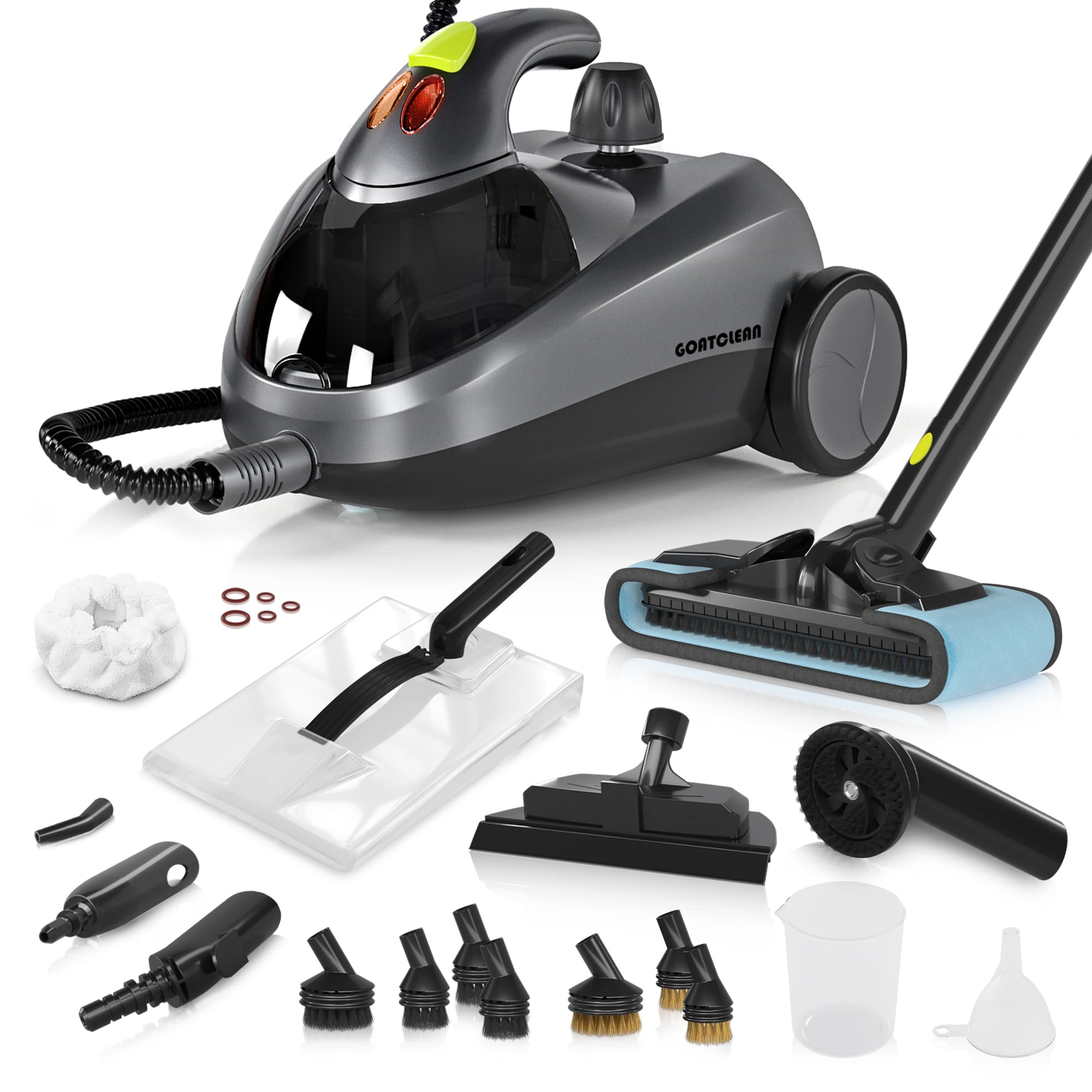
If your dream is one steam tool that can move from floors to grout to kitchen corners to upholstery refresh, GOATCLEAN is designed to be that “all-in-one” workhorse. The canister format gives you the advantages that small steam mops can’t: longer continuous steaming, stronger detail capability, and the ability to treat floors like one part of a bigger deep-clean routine.
For floors, canister steam is at its best on tile, stone, and textured surfaces—places where grime hides. The floor brush + microfiber approach can make tile look brighter and feel less “gritty” because you’re loosening what’s stuck in texture instead of just wiping the top. For grout lines, the brushes and nozzles let you focus steam where you need it, which is often the difference between “better” and “wow.”
The main thing to understand: canister steam cleaning is a two-step dance. Steam loosens and liquefies; microfiber removes. If you try to steam huge areas without swapping cloths or wiping, you can end up pushing dirty moisture around. But if you work in zones—steam, wipe, move—this style gives you the most satisfying deep-clean results in the entire category.
Why you’ll like it
- Versatility without chemical cleaners – Useful for floors, bathrooms, kitchens, and high-touch areas.
- Strong accessory coverage – The kit approach makes it easier to target specific problems (grout, crevices, glass).
- Long reach – Cord + hose reach helps with multi-room cleaning and awkward angles.
- Deep-clean mindset – This is the style that helps you tackle the “I’ve been avoiding that” jobs.
Good to know
- Canister cleaning is more hands-on: you’ll be wiping and swapping cloths to finish clean.
- If you want “grab it for 5 minutes,” a lightweight steam mop is more convenient.
- Some users wish the water level was easier to monitor during partial-tank sessions; a consistent fill routine helps.
Ideal for: households that want floors + grout + appliances + upholstery refreshed with one steam system and a big accessory kit.
4. Shark Steam Pickup 3-in-1 (SD201) – Pick Up Debris While You Steam

This is the model people buy when they’re tired of the cleaning “pre-game.” The headline idea is simple: pick up small debris, scrub, and steam in one pass. In the right home—think: kitchens, dining areas, entryways—this can feel like a small miracle because you’re not doing three separate tools for one floor reset.
The big real-world strength is how it handles crumb reality. Dry bits, wet bits, and stuck-on food splatter are exactly what this is built for. The brushroll adds agitation that a flat pad can’t replicate, and the debris tray approach makes cleanup feel more like emptying a small vacuum compartment than dealing with a gross, overloaded mop pad.
The honest limitation is hair. Many households find it performs best when you treat it as a “finish tool”: vacuum big hair first, then use Steam Pickup to deep-clean and sanitize. In a low-hair home, it can reduce steps dramatically. In a heavy-shed home, it’s still excellent—but it’s not a magic hair vacuum.
Why it’s different
- Reduces steps – Designed to eliminate the “sweep then mop” pattern for many everyday messes.
- Scrubs while steaming – Brushroll agitation helps with stuck-on residue that pads can glide over.
- Maintenance feels cleaner – Debris separation and quick-empty tray reduce the “gross pad” factor.
- Great for kitchens – Especially strong for food zones and entryways where debris is constant.
Good to know
- Long hair can require slower passes or a quick vacuum first to prevent “push around” behavior.
- Tank size and debris tray size mean larger homes may involve a couple of quick resets during deep cleans.
- This is a floor specialist; for grout detail work, canisters still have the edge.
Ideal for: homes that want fewer steps in the kitchen and dining zones and love the idea of “clean and pick up” in one workflow.
5. BISSELL CrossWave Pet Pro (2306A) – Not Steam, But a Game-Changer for Pet Routines
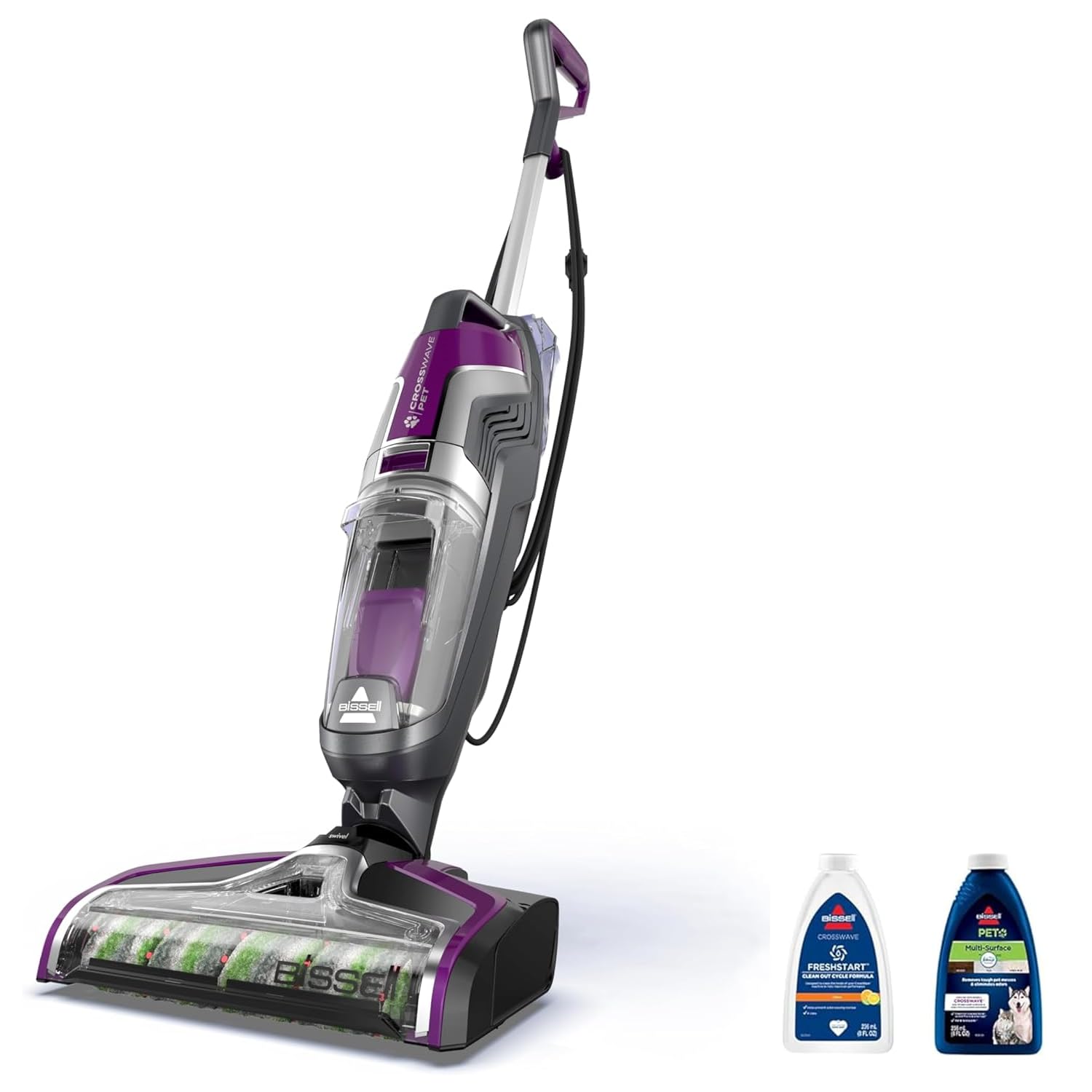
This isn’t a steamer. But it earns a spot in this guide because a lot of people searching for steam are really searching for one thing: a faster way to handle debris + wet mess without doing separate vacuum and mop passes. And in pet homes—where hair, tracked-in grit, and little accidents can show up daily—that workflow can matter more than steam itself.
The CrossWave Pet Pro’s real advantage is the “one pass reset.” It vacuums and washes simultaneously while keeping clean and dirty water separated. That separation is a big deal because it reduces the classic mop problem: pushing dirty water around the floor. When used with the right routine (and cleaned after each session), it can make floors look noticeably better in less time—especially on hard floors and area rugs that get frequent paw traffic.
The real-life truth is that this machine rewards good habits. It works best when you learn the pacing (slow enough to pick up water), and when you treat cleanup as part of the job. If you skip post-clean rinsing, any wet/dry unit can start to smell or clog. But if your household is pet-busy and your floor cleaning is a constant battle, this is a “make life easier” option that steam mops can’t fully replace.
Why people love it
- Vacuums and washes together – Big time saver for pet-heavy floors and daily routines.
- Clean/dirty separation – Helps avoid the “mopped with dirty water” feeling.
- Strong for paw traffic – Great for tracked-in grime, light spills, and quick resets.
- Self-clean cycle – Helpful for keeping the system fresher between uses (when used consistently).
Good to know
- It’s not steam; if you want steam sanitization, pair with a steam mop for periodic deep refreshes.
- You must clean it after use for best performance and to avoid odors.
- Very heavy hair loads can require learning the system and doing simple pre-pickups for big clumps.
Ideal for: pet homes that want the fastest “debris + wash” routine and don’t mind a consistent cleanup habit after each session.
6. Shark Steam & Scrub (S8001) – The “Pads Do the Work” Model That Feels Effortless

If you want the magic of rotating pads without obsessing over extra features, the S8001 is a strong sweet spot. The big benefit is “effortless agitation”: the pads do the scrubbing while you guide. That’s why people often describe this style as feeling almost self-propelled—especially compared to flat pad mops that require you to push friction across the floor.
This model also shines on the “film problem.” Kitchens often develop an invisible layer—tiny oil droplets, dust, and residue that makes floors feel sticky. Rotating pads are excellent at lifting that layer when you keep pads clean and use the right steam mode. The included multiple steam modes help you stay gentle on sensitive floors and still go stronger on tile when you need it.
The practical pro move: treat this as a pad-management machine. If you’re doing a deep clean, swap pads mid-session, especially between the kitchen and bathrooms. That one habit makes results dramatically better and reduces streaks. If you keep a small brush near your laundry sink for a quick pre-rinse, pad maintenance becomes easy—and the machine stays “wow” over time.
Why it’s worth it
- Rotating pads reduce effort – Great for anyone who hates scrubbing or has back/wrist sensitivity.
- Multiple steam modes – Useful control for mixed-floor homes.
- Less streaking for many users – Pads agitate and lift instead of just gliding over residue.
- Daily-life friendly – Easy to maneuver and satisfying on high-traffic zones.
Good to know
- Rotating pads require cleaning attention; they show you how dirty your floors really are.
- Edge cleaning is decent but not perfect; baseboards still benefit from a quick wipe.
- For the most intense stuck-on spots, the Steam Blaster variant has an advantage.
Ideal for: anyone who wants that “effortless scrub” feel for sealed hard floors and tile without stepping into the most feature-heavy version.
7. Shark Steam & Scrub (S8002BRN) – The “Keep It Simple” Rotating-Pad Workhorse
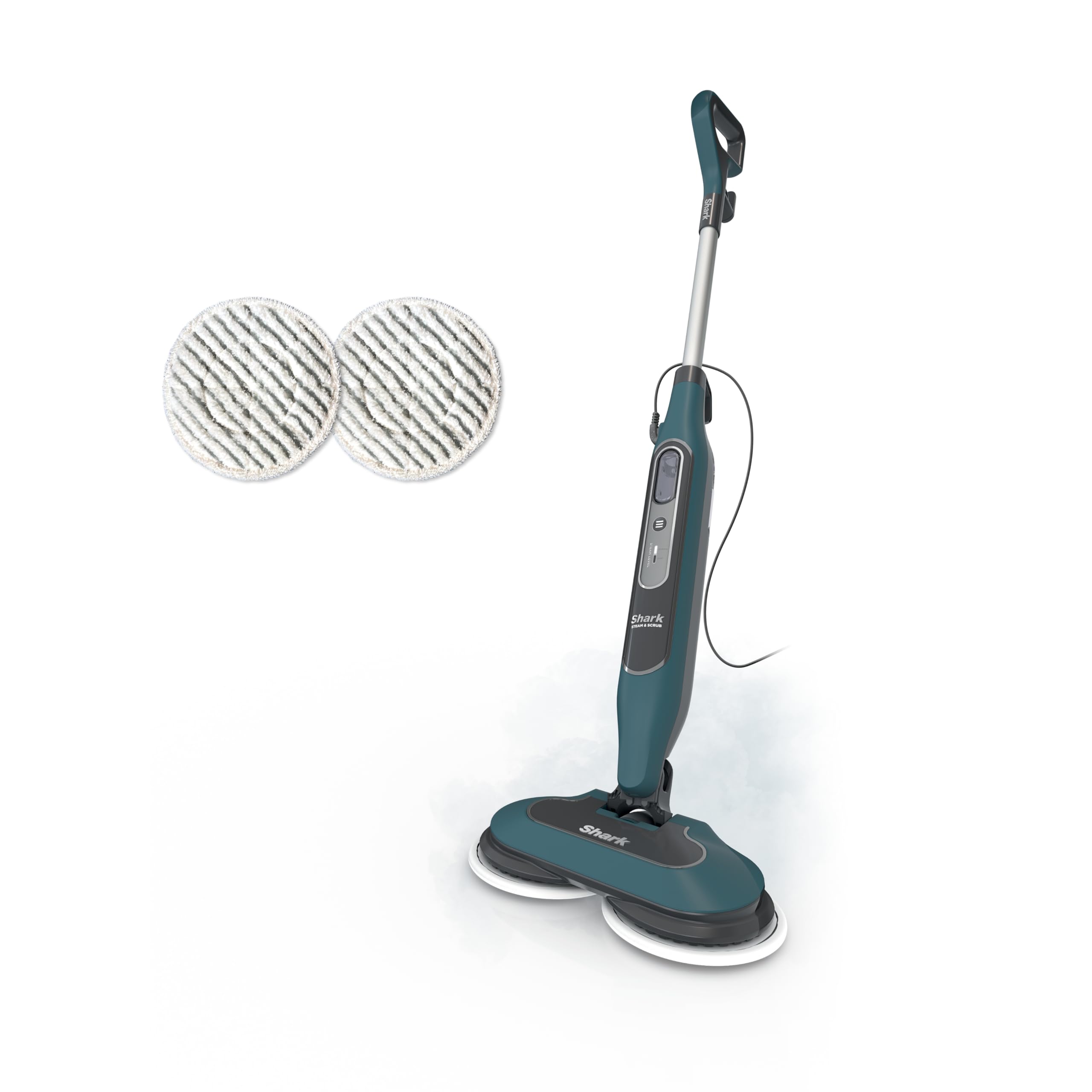
This is the version for people who love the rotating-pad concept but don’t need a long list of modes and extras. You still get the core benefit: pads that scrub for you, a smoother glide, and a consistent “lift” feel that’s especially helpful on kitchen residue and everyday tracked-in grime.
Rotating pads are often the best middle ground between a classic steam mop and a canister system. You get more agitation than a flat pad, but you’re still holding a simple upright tool—not managing a canister hose. For many homes, that’s the difference between “I deep clean twice a year” and “I keep my floors truly clean every week.”
The key to loving this style is understanding pad saturation. Steam + spinning pads means pads can load up with grime quickly on a first deep clean. If your floors haven’t been steamed in a long time, plan to swap pads once mid-session. After that first reset, weekly maintenance gets dramatically easier.
Why it works
- Scrub without strain – Great for high-traffic zones where flat mops feel underpowered.
- Simple controls – Less fiddling, more cleaning.
- Good for mixed homes – Handles sealed hard floors and tile well in weekly routines.
- Washable pads – A sustainable, cost-friendly system when you keep extra pads on hand.
Good to know
- Fewer modes means less fine control than 3-mode versions—still very usable, just less granular.
- Pad washing can take an extra step (a quick brush-out before laundering helps).
- If you want targeted “blast” power, the Steam Blaster model is the upgrade path.
Ideal for: anyone who wants rotating-pad performance in a simpler package for consistent weekly floor resets.
8. Shark SteamSpot with Steam Blaster (S2001) – Quick Cleanups with “Oh No” Power

Some households don’t need a full “scrub system.” They need a lightweight steamer that’s ready fast, easy to maneuver, and powerful when a sticky spot shows up. That’s exactly where SteamSpot fits. The Steam Blaster concept is the big win: a controlled burst you can aim at a stubborn spot instead of cranking everything up and wetting the whole floor.
This style is especially good for maintenance cleaning on sealed hard floors—quick passes, quick dry, and less drama. The three steam modes are practical: light mode for delicate surfaces, normal for daily use, and deep when you need more. Pair that with the right pad (textured for daily, scrub pad for stuck-on mess), and you’ve got a tool that’s genuinely useful week after week.
The expert technique: don’t “camp” on one spot. Steam is hot and wet; even on sealed floors, you want to blast, scrub in a few short passes, and move. If you learn that rhythm, SteamSpot becomes a clean-feeling maintenance machine that’s also capable when life happens.
Why it’s a good buy
- Targeted steam blast – Great for dried spills and sticky spots without over-wetting the floor.
- Lightweight handling – Easier for stairs, tight spaces, and quick sessions.
- Multiple pads included – Nice flexibility for daily vs. stubborn messes.
- Fast routine friendly – Encourages consistent cleaning because it’s not a hassle.
Good to know
- Like most steam mops, debris pickup is limited—sweep/vacuum first for crumb-heavy areas.
- Smaller tanks may need refills on larger open-plan homes during deep cleans.
- For heavy tile/grout detailing, a canister with brushes is more specialized.
Ideal for: homes that want quick, frequent cleanups with a “blast button” for stubborn moments.
9. Bissell PowerFresh Steam Mop (1940A) – The Classic That Still Earns Its Spot
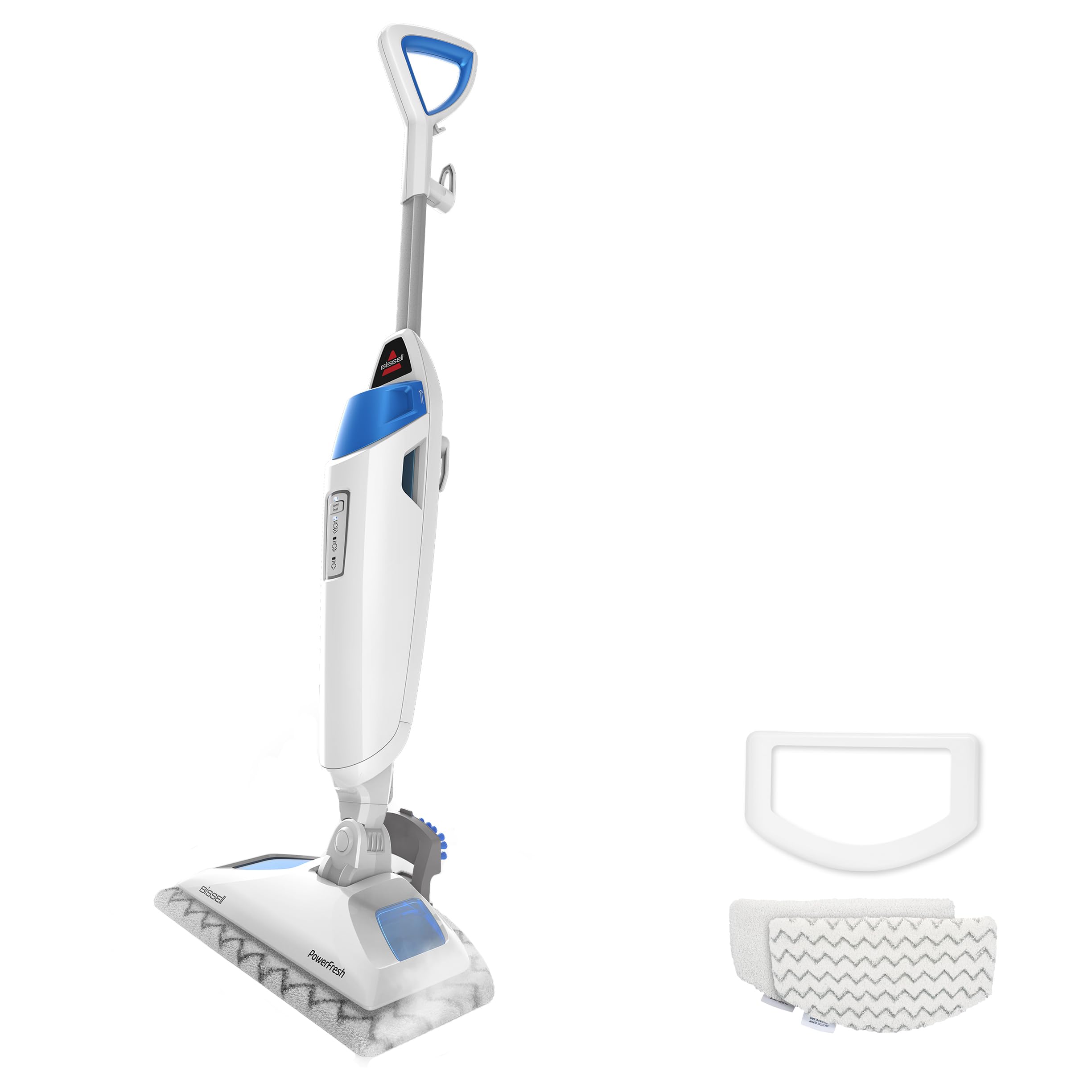
The PowerFresh has stayed popular for years because it nails the fundamentals: strong steam, simple operation, and a scrubber feature that helps when a spot needs actual agitation. This is the kind of machine that becomes a weekly habit in many homes—not because it’s fancy, but because it’s dependable and easy to understand.
Where it shines is mixed flooring and routine cleaning. People often use lower steam for sealed wood and higher steam for tile. The flip-down scrubber is the “save” for dried spots: you don’t have to dig for a separate brush; you just flip, work the spot, and keep going. That kind of integrated practicality matters more than most feature lists.
The thing to get right: pad cleanliness and water quality. A steam mop doesn’t magically make dirt disappear—it transfers it to the pad. Swap pads as needed and avoid overloading one pad for the entire home. If you keep your pads fresh and your routine consistent, the PowerFresh can make floors feel impressively clean with a very straightforward workflow.
Why it’s still a winner
- Strong, simple steam – Does what a steam mop should: loosen grime and refresh floors.
- Flip-down scrubber – Helps when spots need real agitation instead of just heat.
- Easy to operate – A great “first steam mop” if you want something proven.
- Fast routine tool – Quick heat-up encourages more frequent cleaning wins.
Good to know
- Continuous steam means you need clean pads to avoid streaks—plan to own extra pads.
- Some floors (like fussy laminates) can show haze if you over-steam; low steam + movement helps.
- It won’t vacuum debris; sweeping/vacuuming still matters for hair and crumbs.
Ideal for: anyone who wants a proven, straightforward steam mop with a built-in scrub feature for everyday life.
10. 12-in-1 Steam Mop (Aspiron) – The “One Kit” Option for Floors + More
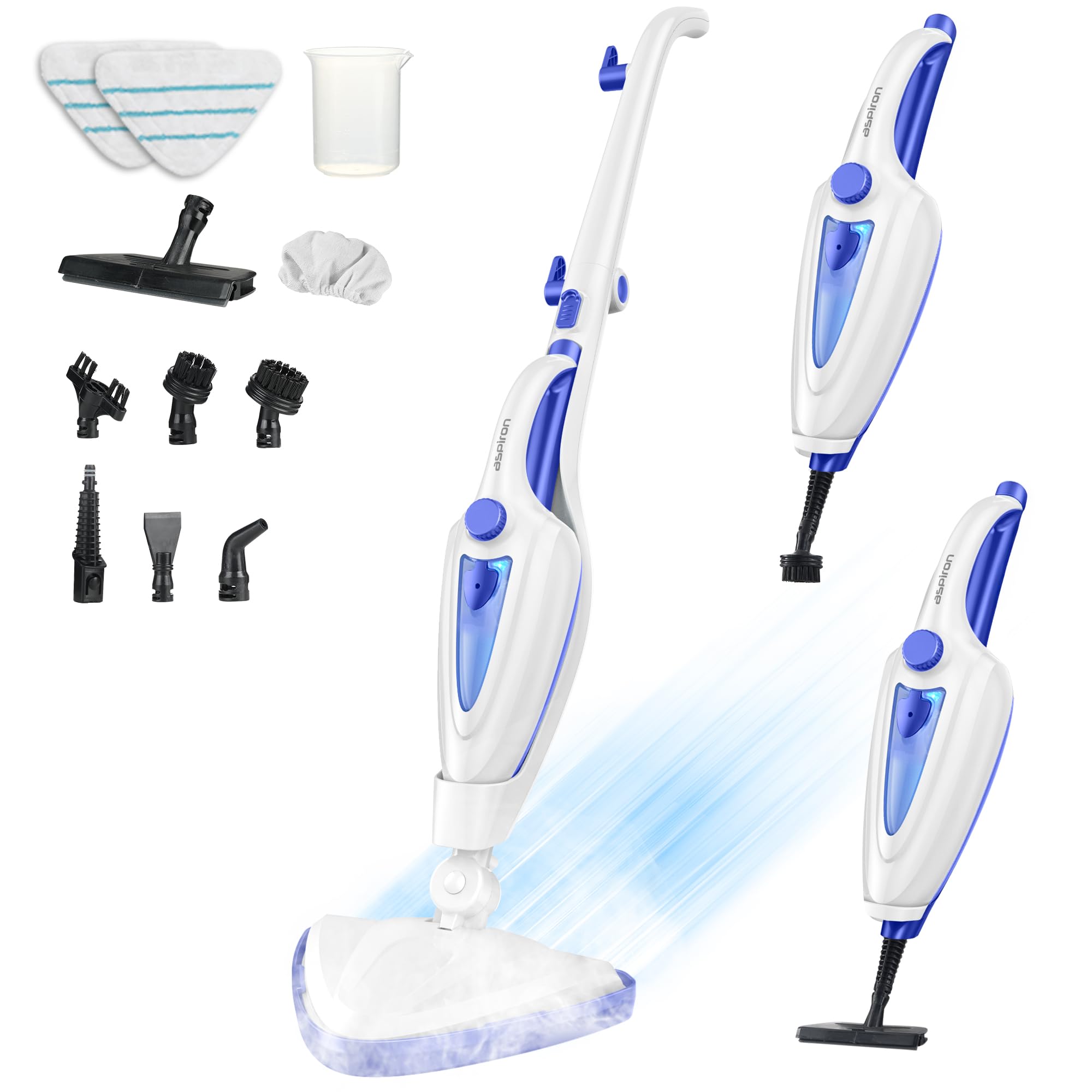
Some people want a steam mop. Others want a “steam system” that can handle floors, corners, windows, and quick refresh jobs without buying separate tools. That’s the lane this 12-in-1 kit is aiming for: fast heat-up, a larger water tank for longer sessions, and a detachable handheld mode that extends usefulness beyond floors.
On floors, the big advantage is flexibility—both in movement and in how you approach different rooms. If you’re cleaning around table legs, under cabinets, or in tight bathroom layouts, a swivel head and a lighter feel can make the routine easier. Owners also tend to appreciate washable pads, because cost and waste add up fast with disposable systems.
Where detachable kits shine is “detail confidence.” Instead of ignoring the baseboard splash zone or the sticky corner behind the trash can, you can convert to handheld and address it. That’s often the difference between “the floor looks cleaner” and “the room feels cleaner.”
Why it’s useful
- Fast start – Quick heat-up makes it easy to do short cleaning sessions (the ones people actually stick with).
- Detachable handheld – Great for corners, grout touch-ups, windows, and hard-to-reach spots.
- Longer sessions – Larger tank helps you finish bigger areas without constant refills.
- Flexible head movement – Helpful around furniture and in tight spaces.
Good to know
- Like many multi-tool steam kits, performance is best when you match the attachment to the job (don’t expect one pad to do everything).
- For heavy grout restoration, canister steam cleaners still provide more “detail authority.”
- Steam cleaning is pad-dependent—own extra pads to keep results streak-free.
Ideal for: households that want a floor steamer plus handheld versatility for windows, corners, and multi-surface cleaning tasks.
11. TORDER High-Temperature Steam Mop (13 Accessories) – Built for Longer Sessions
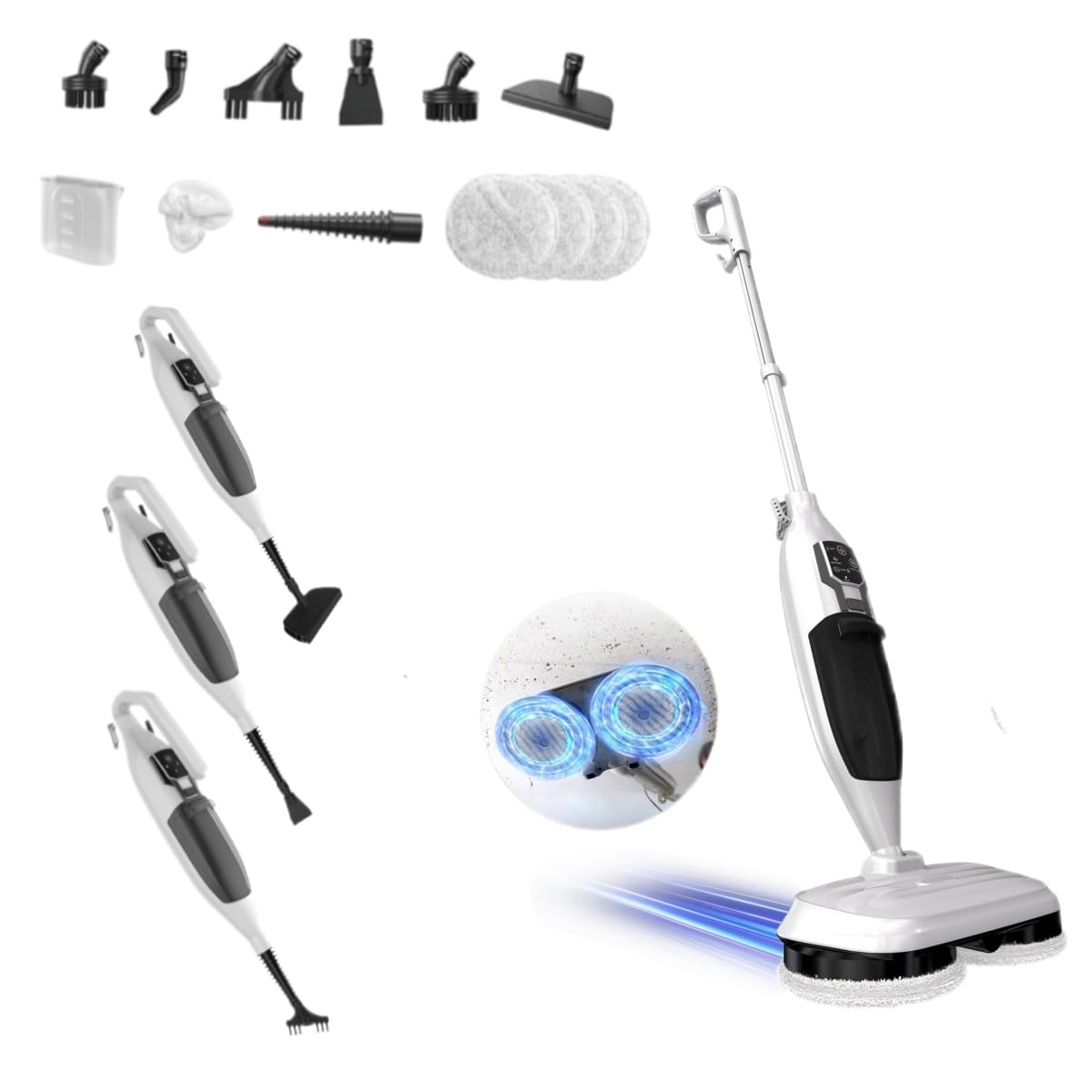
If refilling is your personal cleaning villain, TORDER’s big-tank approach is immediately appealing. The concept is simple: longer continuous steam time, less stopping, and an accessory kit that lets you move beyond “just floors” into grout lines, glass, and hard-to-reach zones. For many homes, that translates into a smoother workflow and fewer excuses to quit halfway through.
On floors, this style is most valuable when you do whole-room sessions: kitchen + hall + living room in one go, or multiple bathrooms back-to-back. A larger tank helps you maintain momentum, which is the real secret to deep cleaning. The washable pad approach also supports an efficient routine: swap pads, keep moving, and let steam do the loosening while microfiber does the lifting.
The best way to use an accessory-rich steam mop is to “tier” your cleaning: floors first (big win), then pick one detail job per session (small win). That keeps the tool fun instead of overwhelming. Over a month, those small wins add up to a noticeably cleaner home without marathon clean days.
Why people choose it
- Longer runtime feel – Fewer interruptions makes deep cleaning easier to finish.
- Accessory versatility – Useful for grout, glass, corners, and multi-surface tasks.
- Simple operation – Friendly for households that want “easy to use” steam cleaning.
- Good for big-room momentum – Helps you stay in flow across multiple areas.
Good to know
- More accessories means more choices; results are best when you match the tool head to the surface.
- Heavier kits can feel less nimble than ultra-light steam mops for quick cleanups.
- For pet hair pickup, you’ll still want a vacuum first—steam mops are cleaners, not hair collectors.
Ideal for: people who want fewer refills, longer sessions, and a steam kit that can help with floors plus detail cleaning.
12. Shark Steam Mop (S1000) – Simple, Lightweight, and Surprisingly Effective

This is the steam mop for people who want clean floors without a complicated relationship. It’s lightweight, quick to heat, and easy to maneuver. In a home where you vacuum regularly and use steam as the “finish clean,” the S1000 can be genuinely satisfying—especially because it doesn’t feel like a heavy appliance you dread pulling out.
Classic steam mops are at their best when you treat them like a maintenance tool: frequent light cleans instead of occasional heroic cleans. On sealed hardwood, vinyl plank, and tile, a simple steam mop can lift that dusty film and leave floors feeling fresher—especially in kitchens, bathrooms, and entryways where residue builds fast.
The biggest quality-of-life factor is pad rotation. If you use one pad for an entire house, you’ll eventually see streaking because the pad can’t hold infinite grime. But if you own a few extra pads and swap when needed, this little lightweight steam mop performs far above its “simple” vibe.
Why it’s a smart pick
- Very lightweight – Easy for stairs, quick sessions, and small homes.
- Simple, effective steam – Great for routine cleaning and floor refreshes.
- Washable pads – Sustainable and cost-friendly over time.
- Beginner-friendly – Low learning curve: fill, heat, clean.
Good to know
- Smaller tanks can mean refills for larger homes during deep cleans.
- It doesn’t scrub like rotating-pad models; stuck spots may take multiple passes.
- For pet hair and crumbs, vacuum first—steam mops aren’t designed as debris collectors.
Ideal for: budget buyers and minimalists who want a lightweight steam mop for consistent weekly maintenance cleaning.
13. ScrubWiz 10-in-1 Steam Mop – A Versatile “Small Home” Steam Kit

ScrubWiz is a strong fit for people who want one tool that can handle floors plus the “small annoying jobs” around the house—grout edges, bathroom corners, window tracks, and little crevices where grime loves to hide. The detachable handheld format is the main appeal because it turns your floor steamer into a detail steamer without buying a second device.
For floor cleaning, this style works best when you treat it as a maintenance cleaner for sealed hard floors and tile. It won’t feel as “effortless” as rotating-pad models, but it can still produce impressive results when you move slowly over high-traffic zones and keep pads fresh. People often love how lightweight it feels and how easy it is to maneuver around furniture.
The practical advice: pick two attachments you’ll actually use and keep them accessible. Many kits include lots of pieces; the best experience comes from a simple routine: mop head for floors, a brush for grout/crevices, and a squeegee/cloth for glass if you do windows. That keeps the tool from becoming “too much.”
Why it’s a good buy
- Detachable handheld flexibility – Great for corners, grout touch-ups, and small detail cleaning.
- Quick heat-up feel – Encourages frequent use for quick refresh sessions.
- Comfortable handling – Adjustable setup can reduce back strain for many users.
- Accessory value – Useful kit for multi-surface steam tasks in one purchase.
Good to know
- Small-tank steam tools often require refills during longer whole-house sessions.
- Floor results depend heavily on pad quality and cleanliness—own extra pads for best outcomes.
- For heavy hair pickup, you’ll still want a vacuum first.
Ideal for: smaller homes, apartments, and anyone who wants a versatile steam kit that covers floors and handheld detail jobs.
14. LABIGO 10-in-1 Steam Mop – Great for Floors, Even Better for Touchpoint “Reset” Cleaning

LABIGO’s appeal is speed and versatility. It’s the kind of steam kit that makes you think, “Wait, I can steam that too?” Floors are the obvious use, but many owners end up using detachable handheld steam even more—for bathrooms, doorknobs, counters, and other high-touch places where you want a chemical-free “reset” without breaking out sprays.
On floors, this style is best for maintenance cleaning: quick sessions on tile, sealed hardwood, and sealed laminate/vinyl when you use appropriate steam levels and keep moving. The carpet glider concept can also be useful for refreshing rugs, especially in homes that want “less odor” and a cleaner feel without bringing out a full carpet machine for small jobs.
The main practical caution is tank management. Detachable kits are often compact; if you’re doing a large floor area, you’ll likely refill. That’s not a flaw—it’s the trade for light weight and multi-use flexibility. If you want fewer refills for large homes, the bigger-tank options in this guide will fit better.
Why it’s useful
- Versatile “whole-home” use – Floors, bathrooms, touchpoints, and small detail cleaning in one kit.
- Fast start – Quick heat-up makes it easy to do short, frequent cleanups.
- Helpful attachments – Brushes and nozzles expand what you can realistically clean with steam.
- Good value feel – A lot of capability in a compact footprint.
Good to know
- Compact tanks mean more refills during larger floor sessions.
- Lower steam settings on some compact units can feel less aggressive; the “right distance” technique matters.
- For heavy grout restoration, canister steam systems are still stronger specialists.
Ideal for: homes that want one steam kit for floors plus high-touch “sanitize and refresh” cleaning around the house.
15. FEPPO Steam Mop & Detachable Handheld – Strong Steam Feel with a Room-Covering Tank
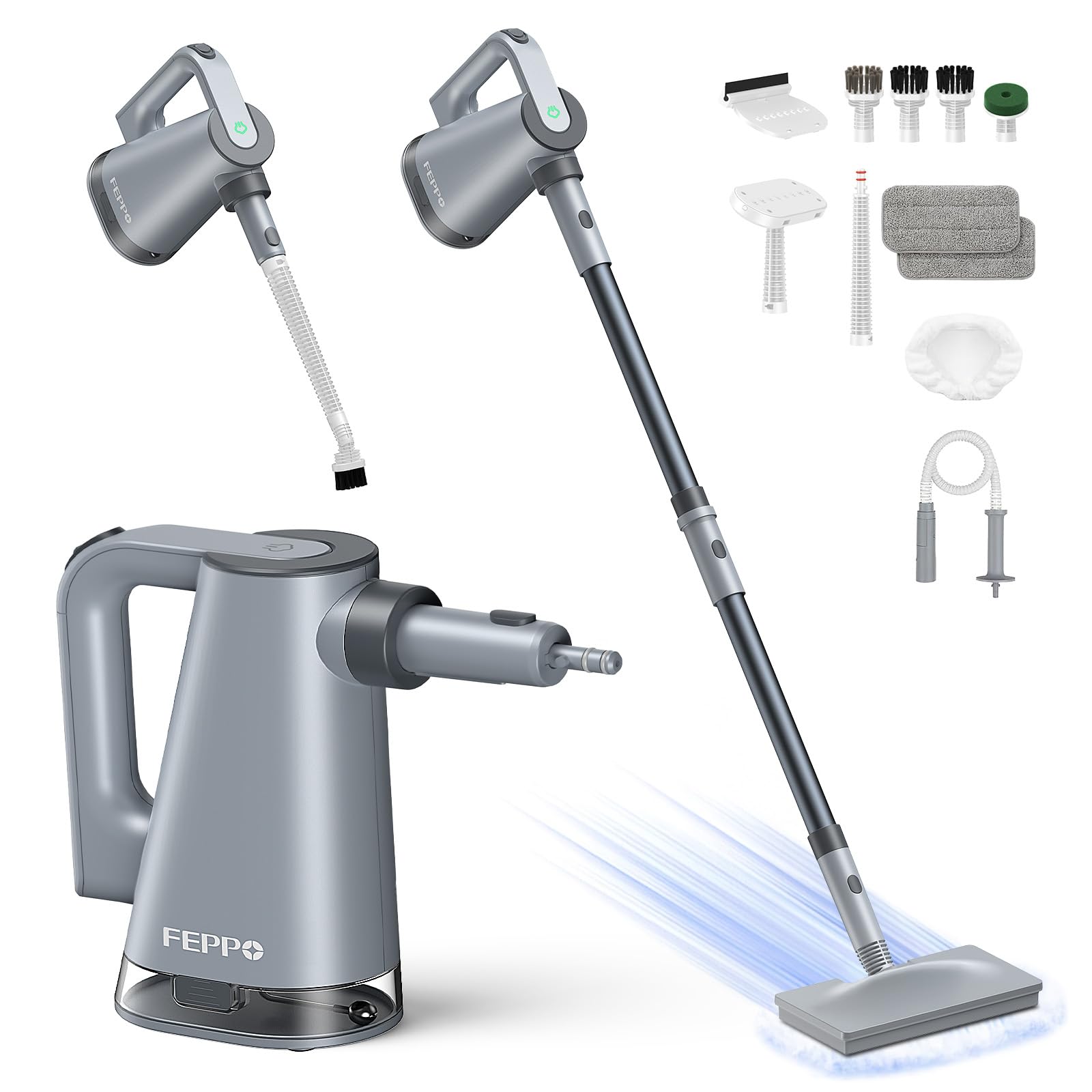
FEPPO sits in a practical niche: it offers the flexibility of a detachable handheld kit, but with a tank size and steam time that can feel more “whole-room capable” than some smaller multi-tools. If you like the idea of steaming floors, then switching to handheld mode for grout edges or kitchen corners, this type of kit makes that workflow convenient.
On floors, these kits are typically most satisfying when you approach cleaning in lanes: slow passes where grime is visible, faster passes where you’re just doing a refresh. The combination of steam and microfiber can make tile feel noticeably cleaner underfoot, especially when you’re consistent and keep pads from getting overloaded. If you’re cleaning a larger space, the bigger tank helps keep momentum, which is often the difference between finishing the job and quitting early.
My favorite way to use detachable kits like this: treat handheld mode as your “edges and corners” tool. Steam the floor, then do a quick pass on the 10% of areas that always look worse (around the toilet base, behind the trash can, near the stove). That creates a visibly cleaner room without needing separate tools.
Why it makes sense
- Detachable flexibility – Floor steaming plus handheld spot/detail capability in one machine.
- Longer session feel – Larger tank helps cover more space without constant refilling.
- Good multi-surface reach – Attachments are useful for grout, corners, and furniture touch-ups.
- Comfortable for routine cleaning – Encourages consistent use because it’s not complicated.
Good to know
- Like all attachment kits, the best results come from using the right tool head (don’t expect the mop pad to do grout lines perfectly).
- Steam is powerful—use caution and keep moving on sensitive floors.
- For the most intense deep cleans, canister steam cleaners still offer more “detail authority.”
Ideal for: households that want detachable handheld flexibility with fewer refills and a smoother “whole-room” cleaning session.
How Steam Cleaning Floors Actually Works (and Why Streaks Happen)
Steam cleaning results feel “magical” when you understand the physics—and frustrating when you don’t. Steam doesn’t replace cleaning technique; it amplifies it. Once you know what the machine is doing, you can predict results and fix the most common problems in minutes.
What steam does (and doesn’t) do on floors
- Steam loosens and liquefies grime – Heat softens greasy residue and helps break the grip of stuck-on messes.
- Microfiber removes – Your pad is the “pickup.” If it’s dirty, you’re just redistributing loosened grime.
- Agitation matters – Rotating pads and scrubbers help lift film and texture-held dirt with less effort.
- Steam is not a vacuum – Most steam mops do not remove debris piles. Some hybrid tools do, and wet/dry vacuum-mops do.
- Steam doesn’t fix finish damage – If a floor has worn finish, wax buildup, or deep discoloration, steam can clean but won’t “restore” a finish.
In other words: steam is the “loosener,” microfiber is the “lifter,” and agitation is the “multiplier.” That’s why rotating-pad mops can feel so much stronger than flat-pad mops on kitchen film—because they add agitation continuously.
The streak & sticky-floor fixes that actually work
- Swap pads sooner than you think – The number one cause of streaks is a saturated pad that can’t hold more grime.
- Slow down on the “suctionless” pass – Steam mops don’t suck up water; they rely on your pad time-on-surface to absorb.
- Use the right steam mode – Too much steam on sensitive floors can push moisture into seams and leave haze.
- Pre-vac hair and grit – Hair and sand can overload pads and create “drag,” which leads to uneven cleaning.
- Do a clean-water reset when needed – If your floor has detergent residue from previous cleaners, one steam session can loosen that film and look streaky. A second pass with a fresh pad often solves it.
When your floor looks streaky after steam, the tool didn’t “fail.” It usually means the pad got dirty fast (which is actually proof the steam lifted grime). Swap pads, adjust steam down, and repeat in a smaller section. Results improve immediately.
FAQ: Floor Steam Cleaning (Without the Confusion)
Do steam cleaners actually sanitize floors?
Can I use steam on hardwood floors?
What about laminate, vinyl plank, or LVP?
Do I need to vacuum or sweep before steaming?
Why do my floors feel sticky after I steam mop?
Should I use distilled water?
Can I add cleaners or essential oils to the water tank?
When is a canister steam cleaner worth it over a steam mop?
Final Thoughts: Pick the Machine You’ll Actually Use Every Week
The best floor cleaner is the one that makes you think, mid-clean, “This is easier than I expected.” If your tool fits your floor type and your mess profile, cleaning stops feeling like punishment and starts feeling like maintenance.
Here’s the simplest way to turn this guide into a confident purchase:
- Want the most balanced “buy once” steam mop for most homes? Start with the Shark Steam & Scrub with Steam Blaster (S8201). It’s the best blend of effortless scrubbing, good control, and spot-busting power.
- Want true deep-clean capability for grout, crevices, and whole-home detail work? Choose the McCulloch MC1385 or the GOATCLEAN Heavy-Duty Steam Cleaner. These are built for the “steam loosens, microfiber lifts” deep-clean style.
- Hate pre-sweeping and want a one-pass concept for kitchen crumbs? Look at the Shark Steam Pickup (SD201). It’s designed to pick up small debris while you scrub and steam.
- Pet home and want vacuum + wash together (even if it’s not steam)? Consider the BISSELL CrossWave Pet Pro. It’s a workflow upgrade for daily pet routines when debris is the main battle.
- Want a proven classic steam mop that just works? The Bissell PowerFresh (1940A) is a dependable “simple and effective” choice with a built-in scrubber for spots.
- Want a lightweight, budget-friendly routine tool? Pick the Shark Steam Mop (S1000) for simple weekly maintenance and easy handling.
- Want detachable handheld versatility in a single kit? Choose one of the multi-tools like the Aspiron 12-in-1, ScrubWiz 10-in-1, LABIGO 10-in-1, or FEPPO Steam Mop if you want floors plus corner/grout/touchpoint steam cleaning without buying multiple devices.
The best results come from the right match: your floor type, your mess type, and the routine you’ll actually stick with. Choose the steamer for cleaning floors that fits how you live, keep a few extra pads on hand, and you’ll get that clean, fresh, barefoot feeling on repeat—without turning cleaning into a full-time job.
