
Buying a drip coffee maker shouldn’t feel like picking a “least bad” option. But if you’ve ever opened a fresh bag of beans, brewed a pot… and still ended up with flat, bitter, or strangely hollow coffee, you already know the truth: the machine matters. Not because of flashy buttons—because of the boring, invisible stuff that actually controls flavor: water temperature stability, how evenly water hits the grounds, and whether the brew path creates tiny frustration points that make you cut corners (hello: overflowing baskets, weak brews, and “why is it dripping down the carafe?” mornings).
If you’re searching for a plastic free drip coffee maker, you’re usually chasing two wins at once: (1) a cleaner material story (less hot-liquid contact with plastics), and (2) a better cup. Those goals are connected more than most people realize. The “plastic question” isn’t just about what your brewer is made of on the outside. It’s about what your water and coffee touch during the hottest part of the brew, how easy it is to keep that path clean, and whether the design encourages good brewing habits instead of rushed shortcuts.
This guide is built like a real buying decision—not a spec dump. We’re going to talk about where plastic usually sneaks into the brew path, what “pod-free” actually changes (and what it doesn’t), why some brewers taste like a café while others taste like “hot water plus regret,” and which machines are genuinely satisfying to live with after the first week.
Below you’ll find 15 standout picks—from SCA-certified precision brewers to heavy-duty, metal-forward commercial pour-over machines that people buy specifically because they’re tired of heated plastic baskets. I’ll call out the small things owners actually complain about (lids that trap condensation, carafes that pour too slowly, baskets that must “click” perfectly or overflow), because that’s what decides whether you love your coffee maker… or replace it again next year.
In this article
How to Choose a Plastic Free Drip Coffee Maker (Without Falling for Buzzwords)
Let’s get one thing straight: “plastic-free” is rarely a clean yes/no in automatic drip machines. Even very premium brewers often use some plastic internally—gaskets, valves, tubing, or brew basket parts—because plastic is durable, moldable, heat-resistant, and cost-effective. So if you try to buy based on a single marketing phrase, you’ll either overspend, under-buy, or end up disappointed.
The smarter approach is to choose the machine that (1) keeps hot-liquid contact with plastic as low as reasonably possible, (2) still extracts coffee at the right temperature and flow profile, and (3) fits your real life so you don’t fight it every morning. Here’s the decision framework that actually produces a satisfying purchase.
1) Define what “plastic-free” means to you (because there are levels)
Most buyers fall into one of these buckets. Identify your bucket first—then choose a machine that was built for it.
- The “hot water path first” buyer: You’re okay with a plastic outer shell, but you want the hottest water and brewed coffee to touch as little plastic as possible.
- The “pod-free & waste-free” buyer: You want to stop using pods and reduce waste, but you still want convenience (multi-serve sizing, timer, fast brews).
- The “thermal carafe loyalist” buyer: You want coffee held hot without a scorching hot plate—and you want that last cup to taste like the first.
- The “glass carafe traditionalist” buyer: You prefer glass for taste/cleaning and you don’t mind (or even like) a warming plate.
- The “commercial simplicity” buyer: You don’t want screens, clocks, and menus. You want a metal-forward brewer that makes hot coffee fast, all day.
2) Map the brew path: the 5 contact points that decide your “plastic exposure” story
If you only remember one part of this guide, make it this. A drip coffee maker is basically a loop:
- Reservoir (cold water sits here)
- Heater & tubing (water heats and travels upward)
- Showerhead (water distribution over grounds)
- Filter basket (grounds and filter sit here)
- Carafe / holding method (glass + hot plate or thermal stainless)
For “plastic-free” decision-making, the most important question is: where is the plastic when the water is hottest? Cold-water reservoirs being plastic is common and usually not the deal-breaker for most buyers. The bigger deal is plastic in:
- The showerhead / dispersion area (hot water hits here first)
- The filter basket walls (hot water and coffee slurry sit here the longest)
- The drip-stop valve (coffee often contacts this repeatedly)
You can’t always eliminate those parts, but you can choose designs that reduce how “soaked” those surfaces get and how long they sit hot. Thermal carafes, quick brew cycles, and easy-to-clean baskets are not just convenience upgrades—they help your machine stay cleaner, fresher, and less likely to hold onto stale coffee oils.
3) Brew quality is non-negotiable: temperature & saturation beat “features” every time
A lot of coffee makers have a long feature list and still make underwhelming coffee because the fundamentals are wrong. To get a cup that tastes complex instead of bitter or watery, your brewer needs three things:
- Stable hot water (not “warm-ish,” not “scalding,” but consistently in the sweet spot)
- Even saturation (a good showerhead prevents dry pockets and channeling)
- Correct contact time (fast enough to avoid harshness, slow enough for full extraction)
This is why brewers with thoughtful showerheads (like OXO’s Rainmaker concept or KitchenAid’s spiral showerhead) often taste better than basic “single drip hole” designs. And it’s why SCA-certified machines are worth considering: they’ve been designed around a brewing standard instead of only around price and convenience.
4) Paper filter vs reusable filter: it’s not just preference—it changes the cup
Here’s the simple truth: filters define the “texture” of your coffee.
- Paper filters usually give a cleaner cup with brighter clarity and less sediment. Great for light roasts and “tasting notes.”
- Gold-tone / metal filters let more oils through, giving a fuller body. Great if you love rich, heavy coffee and don’t mind a little residue.
If you’re buying for the “plastic-free” angle, paper filters can also be a practical tool: they create a barrier so the brewed coffee itself is less likely to cling to basket surfaces the way oily coffee can. That can help with smell retention and cleaning. But it doesn’t magically remove plastic from the hot path— it just changes what happens downstream.
5) Thermal vs glass: your “holding method” decides flavor after the brew
Many people blame the brewer when the real culprit is what happens after brewing.
- Glass carafe + hot plate: convenient, easy to see volume, easy to clean—but the hot plate can “cook” coffee if left too long.
- Thermal carafe: keeps coffee hot without burning it—but some thermal lids pour slowly, and cleaning can be more annoying.
If you’re picky about taste, thermal carafes are often the upgrade that feels like a cheat code. Several owners of thermal Cuisinart models describe the “last cup tastes like the first” benefit as the reason they’ll never go back to glass.
6) The most overlooked deal-breakers: pouring, overflow, condensation, and parts availability
Specs don’t tell you these things, but owners do. Before you buy, think about:
- Carafe pouring behavior: Does it dribble? Does it pour too slowly? Does it require weird angles?
- Basket seating: Some machines require the basket to “click” perfectly or they overflow and make a mess.
- Condensation management: Some lids trap steam and then dump water when you open them—right onto the counter.
- Replacement parts: Glass carafes break. If replacements are hard to find, your “good deal” becomes a re-buy.
7) Maintenance isn’t optional—especially if you care about taste and materials
If you’re serious about flavor and you want your machine to stay “neutral” (no old coffee smell), plan around maintenance:
- Descaling cadence: hard water changes temperature and flow over time—coffee gets flatter or harsher.
- Basket & showerhead cleaning: coffee oils build up where water hits and where coffee drips. That’s where off-flavors start.
- Easy access wins: removable tanks, dishwasher-safe baskets, and simple designs get cleaned more often—because you actually will do it.
Now that you know how to choose, let’s compare the best options and then go model-by-model with the real-life details.
Quick Comparison: 15 Plastic Free Drip Coffee Maker Picks
Use this table to quickly match a brewer to your priorities, then jump to the in-depth reviews for the real-life details— like whether the lid traps condensation, how the carafe pours, and what owners say after months of daily use.
On smaller screens, swipe or scroll sideways to see the full table.
| Model | Brewer style | “Plastic-minimizing” angle | Best match | Amazon |
|---|---|---|---|---|
| OXO Brew 8-Cup Coffee Maker | SCA-style precision | Thermal stainless carafe + paper filters + bloom cycle for clean, café-like extraction | People who want one “buy it and be done” brewer that tastes legit | Amazon |
| Braun MultiServe Plus KF9370SI | Multi-serve | Pod-free single cup to carafe + cold brew/over ice options reduce pod dependence | Households that want one machine for hot, iced, cold brew, and tea water | Amazon |
| Cuisinart Coffee Center SS-21NAS (2-in-1) | Carafe + single | Use reusable single-serve filter to stay pod-light while keeping convenience | Families who want carafe mornings + occasional single cups later | Amazon |
| Fellow Aiden Precision Drip Coffee Maker | Precision auto | Thermal carafe + paper baskets + brew profiles give “manual quality” without manual work | Busy coffee nerds who refuse to compromise on taste | Amazon |
| Aarke Coffee Maker | Design premium | Glass carafe + minimalist workflow + SCA-style focus (with BPA-free components) | People who want countertop beauty and fast, high-quality drip | Amazon |
| SYBO SF-CB-1AA (Thermal Carafe) | Commercial pour-over | Metal-forward, no hot plate, thermal carafe; built for people avoiding heated plastic baskets | “Simple, hot, strong coffee” buyers who hate bells & whistles | Amazon |
| Cuisinart DCC-3400 (Thermal) | Thermal classic | Thermal hold keeps coffee hot without burning; strong “hot coffee” reputation | People who want heat + programmability + consistent daily reliability | Amazon |
| KitchenAid KCM1209 (Spiral Showerhead) | Even saturation | Spiral showerhead + removable tank supports consistent extraction and easy cleaning | Families who want a classic glass carafe with better extraction design | Amazon |
| Braun BrewSense KF7150 | Reliable programmable | Gold-tone filter option + charcoal water filter + tidy footprint | People who want “right amount of features” and dependable daily brewing | Amazon |
| Cuisinart DCC-3200 (14-Cup Glass) | Large batch | Big capacity + brew temperature focus; glass is easy to clean and replace | Households that want big pots and a bold option without complexity | Amazon |
| Kenmore 12-Cup Programmable | Budget + reusable | Reusable gold-tone filter + charcoal filter reduces paper waste | Value shoppers who still want a timer and a solid “daily driver” | Amazon |
| Gevi 14-Cup Programmable | Budget large | Big capacity, simple strong/normal dial, cleaning reminder | People who want an affordable big batch brewer with basics covered | Amazon |
| SYBO SF-CB-2GA (2 Glass Carafes) | Office brewer | Stainless build + dual warmers; ideal for regular/decaf or back-to-back pots | Offices and big households that need two pots ready | Amazon |
| SYBO 3-Carafe Brewer (3 Warmers) | High volume | Three warmers + three carafes for nonstop service; simple pour-over operation | Events, break rooms, and high-demand coffee stations | Amazon |
| HIBREW H10B Espresso Machine | Bonus espresso | Portafilter workflow reduces pod dependence; stainless body + real steam wand | People who want cappuccinos/lattes and prefer “hands-on” control | Amazon |
In‑Depth Reviews: 15 Coffee Makers That Reduce Plastic Friction (and Raise Coffee Quality)
Now we’ll go model by model. I’m not going to talk like a product box—I’m going to talk like someone who cares about taste and daily usability: what feels clean, what feels messy, what stays hot without tasting cooked, and what owners consistently praise (or regret) after the honeymoon phase.
1. OXO Brew 8-Cup Coffee Maker – Café-Like Flavor Without Needing a Coffee Ritual

If you want a brewer that reliably makes coffee that tastes “bigger” than typical drip coffee—more aromatics, more clarity, more dimension—the OXO 8-Cup is one of the most satisfying choices in this entire list. Owners regularly describe the cup as “coffee shop quality,” and the reason isn’t mysterious: it’s built around brewing fundamentals instead of gimmicks.
The first win is extraction engineering. The showerhead design distributes water evenly, and the machine includes a bloom phase so the grounds release trapped gas before full flow begins. In practical terms, this reduces that sour “under-extracted” edge you get when water tunnels through one spot. If you’ve ever brewed a pot that tasted simultaneously bitter and thin, that’s usually uneven extraction—not “bad beans.” This machine is designed to prevent that.
The second win is your daily workflow. It’s compact enough to fit under many cabinets, and it can brew either a full carafe or a direct-to-mug serving (with a clever well cover that elevates short cups or removes for tall travel mugs). That matters if you’re trying to stay pod-free: you get “single cup convenience” without the pod waste and without being locked into a proprietary ecosystem.
The “plastic-free” angle here is practical: coffee goes into a thermal stainless carafe (so it isn’t sitting on a hot plate or in a plastic travel tumbler by default), and it uses paper filters for a clean cup. Some users do mention that the carafe spout can drip if you pour too aggressively or if the lid isn’t seated correctly— that’s not a dealbreaker, but it’s worth knowing if you’re the type who hates wiping counters.
Why you’ll like it
- Consistently “better than drip” taste – Even extraction + bloom cycle produces a more complex cup.
- Thermal carafe holds heat without cooking flavor – The last cup can taste like the first, not like reheated coffee.
- Legit single-serve option – Great for households that don’t always need a full pot.
- Compact, quiet, and easy to live with – It feels like a premium tool, not a fussy gadget.
Good to know
- No “wake up to coffee” programmability—many owners don’t miss it because brew time is fast, but it’s a preference thing.
- Carafe pour technique matters; pour too fast and you may get drips on the carafe body.
- Like any precision brewer, it rewards decent grind and dosing—dial it in once and it becomes effortless.
Ideal for: anyone who wants one dependable brewer that makes genuinely great coffee, stays pod-free, and keeps coffee hot without burning it.
2. Braun MultiServe Plus KF9370SI – One Machine for Hot Coffee, Over-Ice, Cold Brew, and Tea Water

The Braun MultiServe Plus is the machine you buy when your household’s needs change by the hour. One person wants a single mug. Someone else wants a travel mug. Someone wants iced coffee. Someone wants cold brew. Someone wants hot water for tea that doesn’t taste like “tea brewed through coffee.” This brewer is designed to handle all of that without pushing you back into pods.
The core experience is the multi-serve dial: you select the serving size you want, choose a brew mode (gold, bold, over ice, cold brew), and the machine handles the rest. Owners who love it talk about it like a “daily upgrade” because it’s fast, consistent, and doesn’t require complicated steps. A common happy surprise: the cold brew option. Traditional cold brew is a patience sport. A brewer that can produce a smooth cold-brew style carafe quickly changes how often you actually make it.
From a “plastic-free” decision angle, this is a strong pod-free pick. It’s built to make single servings without disposable pods, which is one of the biggest plastic reductions most households can make quickly. It also includes a reusable filter so you can choose paper or not depending on taste. If you’re extremely strict about hot water touching plastic, know that some owners still dislike that the filter basket area is plastic (even when it’s BPA-free). That’s common in this category, and it’s why some “metal-forward” commercial pour-over machines exist—different priorities.
One more real-world point: advanced machines can be a little “stateful.” If someone makes cold brew and doesn’t switch it back, your next brew may not be what you expected. Owners who thrive with this machine tend to develop a simple habit: always glance at the mode/size before pressing start. When you do that, it becomes a very smooth, very capable daily driver.
Why it stands out
- Pod-free single serve – You get convenience without the plastic pod pipeline.
- Over-ice and cold brew modes – Makes iced coffee a real option, not a weekend project.
- Hot water dispenser – Great for tea drinkers who hate coffee-flavored tea.
- Fast brewing and flexible sizes – Handles everything from one mug to a full carafe without drama.
Good to know
- If you want “pure simplicity,” the modes can feel like overkill—this is a versatility machine.
- Some owners prefer avoiding hot plastic in the basket area; if that’s your top priority, look at SYBO-style metal-forward brewers.
- Like any complex brewer, occasional complaints exist about long-term reliability—keeping it clean and descaled matters.
Ideal for: households that want to be pod-free, want multiple brew styles, and want one brewer that adapts instead of forcing compromises.
3. Cuisinart Coffee Center SS-21NAS – Carafe Mornings, Single Cups Later (Without Owning Two Machines)

This Cuisinart is a “real household” machine. Meaning: it’s designed for families where coffee isn’t one consistent ritual, it’s a rotating cast of needs. A full thermal carafe in the morning. A single cup later. Tea or hot chocolate at night. Iced coffee when the weather flips. If you’ve ever owned a separate pod brewer and a separate drip maker, you already know the frustration: two machines, two footprints, two maintenance routines. This one consolidates the chaos.
Owners who love this machine usually talk about two things: heat and workflow. The thermal carafe keeps coffee hot for hours without a hot plate cooking the flavor, and the single-serve side lets you brew a cup size that matches your mug, including taller travel mugs. One review highlights a small design detail that matters more than it sounds: the flip-down shelf for single-serve cups. Older designs sometimes splatter and spit because the cup sits too low. This little shelf fixes the geometry—and it’s exactly the type of “daily annoyance fix” that turns a decent machine into a loved machine.
Now the honest “plastic-free” conversation: a dual brewer like this can be pod-compatible, and pods are plastic. But you don’t have to live in pod mode. If your goal is to reduce plastic waste while keeping convenience, the reusable single-serve filter becomes your best friend. Use fresh grounds most days, keep pods as a backup for guests or hectic weeks, and you’ve still reduced a lot of plastic without sacrificing your routine.
A real-life concern to know: some owners mention leaking if the removable reservoir isn’t seated correctly, or occasionally from unit-to-unit variation. That doesn’t mean the model is “bad”—it means you should do a careful first setup (firm reservoir seating, quick water-only test brew). This is the kind of machine you buy because you want one countertop solution. It rewards a little setup attention.
Why it’s useful
- Two brewers in one footprint – Carafe and single-serve without owning two appliances.
- Thermal carafe keeps heat – Hot for hours, without that “burnt on a plate” taste.
- Mug-friendly single-serve platform – The flip shelf helps reduce splatter and fits taller mugs.
- Flexible “pod-light” strategy – Use the reusable filter for everyday coffee, pods only when truly needed.
Good to know
- Some users wish for a traditional on/off switch; many rely on auto shutoff or unplugging for vacations.
- Reservoir seating matters—if it’s not secure, you can get leaks.
- If you want “minimal parts,” a single-purpose brewer will always feel simpler than a 2-in-1.
Ideal for: families who want one machine that covers full pots, single cups, and iced coffee options—while still allowing a pod-free routine most of the time.
4. Fellow Aiden – “Manual Pour-Over Quality” for People Who Want Their Mornings Back
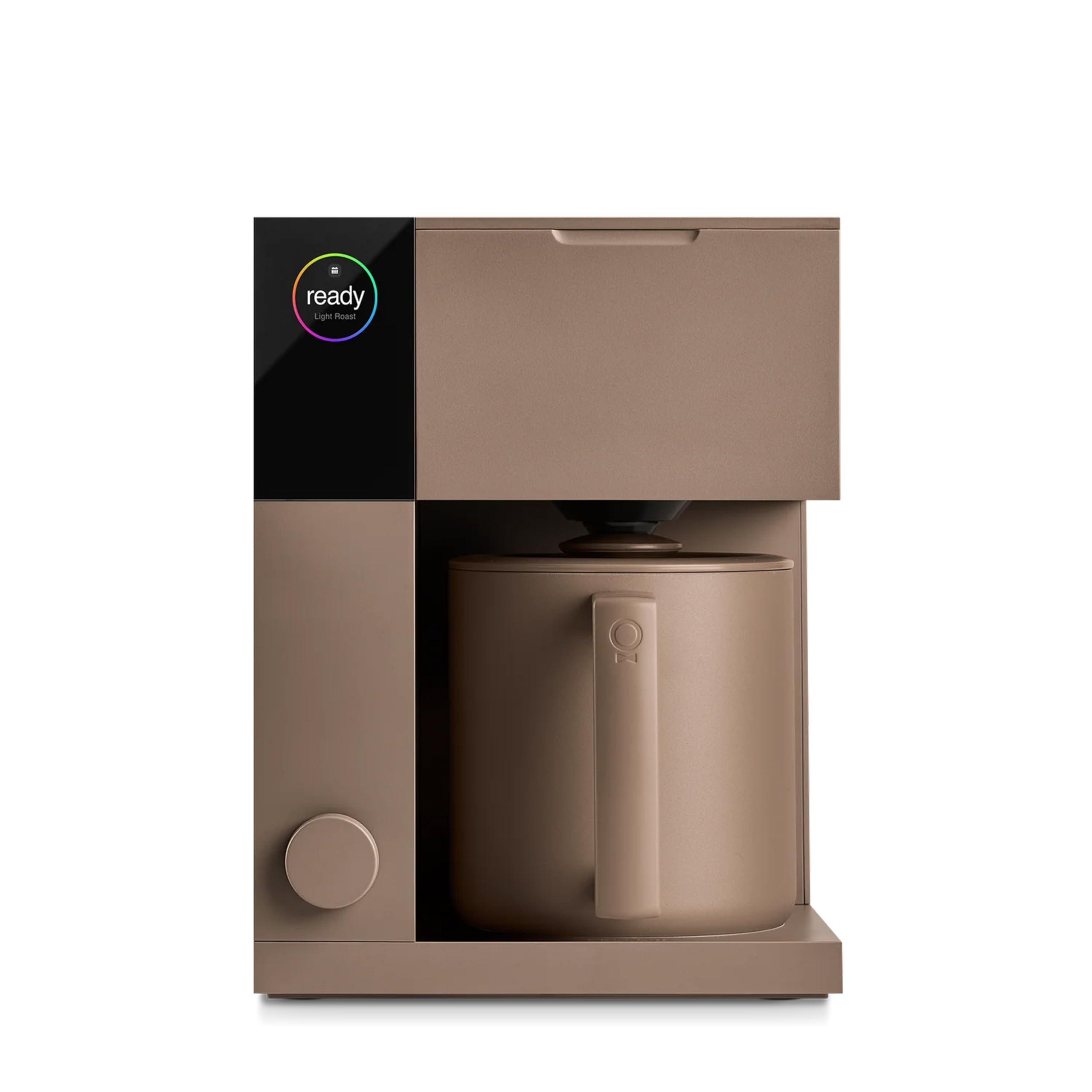
The Fellow Aiden exists for a very specific person: someone who already knows what good coffee tastes like and refuses to downgrade— but also doesn’t want to stand at the counter doing manual pours every single morning. Owners who switch from V60, AeroPress, French press, or hand pour-over methods often describe the Aiden as the first automatic machine that doesn’t feel like a compromise.
Why the praise? The Aiden is built around the “science” that manual brewers are doing by hand: temperature control, coffee-to-water ratios, and a bloom phase to kickstart even extraction. The result is a cup that can keep richness (what French press fans love) while removing the muddy texture and “stewed grounds” flavor that can happen when coffee sits too long in a full-immersion brew.
Where it shines in real life is the workflow. There’s a one-button brew experience when you want it, but also enough guidance and modes that other people in your household can make a good pot without being “the coffee person.” Owners also note it’s quieter than expected, which matters if you brew early. And the thermal carafe is a taste-protection feature: it keeps coffee hot without heat-plate cooking.
From a “plastic-free” viewpoint, the Aiden is a strong modern option because it’s built for paper filters and it holds brewed coffee in a thermal carafe, not a plastic reservoir. The removable tank is convenient for sink filling (less stagnant water sitting in the machine), and the whole system is designed to be cleaned and maintained like a serious tool. If your goal is “reduce plastic contact and dramatically increase coffee quality,” this is a very compelling lane—especially if your alternative was pods.
The trade-off is that it’s a precision machine. It rewards decent beans, decent water, and the simple habit of cleaning on schedule. If you want the most hands-off “whatever grounds, whatever water” approach, a simpler classic brewer may feel easier. But if you care about taste, the Aiden is built to deliver it consistently.
Why coffee people love it
- Precision extraction without manual effort – Strong temperature control and bloom behavior create a more “crafted” cup.
- Single serve to batch – Flexible for solo mornings and hosting without switching machines.
- Thermal carafe protects flavor – Holds heat without scorching and keeps coffee tasting fresh.
- Household-friendly workflow – Guided modes mean you’re not the only person who can make a good brew.
Good to know
- If you love a clock/timer, you’ll appreciate scheduling—just remember to keep the machine clean for consistency.
- Precision machines are honest: bad beans taste like bad beans, not like “magic.”
- It’s a countertop statement; measure your space and plan your brew station layout.
Ideal for: busy coffee enthusiasts who want automatic drip convenience with taste that feels genuinely intentional and “specialty-level.”
5. Aarke Coffee Maker – Minimalist “Press One Button” Brewing That Still Cares About Extraction

Aarke makes appliances that look like they belong in a design studio—and that’s not just vanity. A well-designed brewer is often a well-used brewer, and well-used brewers get cleaned more, maintained more, and stay “neutral” tasting longer. That’s one of the underrated ways design improves coffee: it makes you want to treat the machine like a real daily tool instead of a cluttered gadget.
Owners who love the Aarke tend to describe a “no-fuss, great coffee” experience: fast brewing, a clean look on the counter, and a straightforward workflow that doesn’t require a manual or a learning curve. The machine focuses on the fundamentals: a consistent brew process, even water distribution, and an optional bloom mode that helps extraction feel more like a hand pour-over than a basic drip hole. For many people, that’s the sweet spot: high-quality results without turning coffee into a hobby.
Now the honest side: premium design doesn’t automatically mean “plastic-free inside.” Some critical reviewers claim the internal water-contact parts are more plastic than they expected, and a small number mention reliability frustrations. This is exactly why you should buy based on your priorities: if your top priority is a metal-forward hot-water path, you’ll likely feel more comfortable with commercial pour-over style machines like SYBO. If your top priority is “beautiful, simple, and still brewed well,” the Aarke is exactly in its lane.
The “plastic-minimizing” win here is mostly about the cup experience and workflow: it brews into a glass carafe, it’s built to be simple and quick, and it encourages good habits because it doesn’t punish you with messy complexity. If you want a brewer you’ll be happy to leave on your counter for years, this one is hard to ignore—just go into it knowing it’s a design-forward precision brewer, not a fully metal commercial tank.
Why people buy it
- Beautiful minimalist design – Looks intentional on the counter and feels easy to live with.
- Fast, simple brewing – “Press and go” workflow with better extraction thinking than basic drip.
- Glass carafe experience – Easy to see volume and easy to clean compared with many thermal lids.
- Bloom mode option – Helps coffee taste more balanced and less hollow.
Good to know
- Some users expected more metal in the internal brew path; if that’s your main driver, consider SYBO-style units.
- A few long-term complaints exist about reliability—keep the box during early ownership and register warranty if available.
- Glass carafe life means glass carafe risk; handle like a daily wine glass, not a camping mug.
Ideal for: buyers who want a premium-looking brewer that stays simple and delivers strong coffee without turning the morning into a project.
6. SYBO SF-CB-1AA – The “Hot, Strong, Simple” Brewer People Buy to Escape Heated Plastic

The SYBO SF-CB-1AA is not trying to be cute. It’s not trying to impress you with a touchscreen. It’s trying to make a lot of hot coffee quickly, in a machine that feels more like commercial equipment than a plastic countertop toy. And that’s exactly why people who are serious about reducing hot-water plastic contact end up here.
Owners who love this brewer tend to say the same things in different words: all metal, super easy, very hot coffee, no nonsense. They like the one-button operation. They like that it’s designed around a thermal carafe (no hot plate “burning” flavors). They like that it’s easy to clean and doesn’t come with a bunch of fragile electronic features that fail first. If you’ve ever had a cheap brewer where the warming element melts or warps parts over time, you understand the appeal immediately.
The “plastic-free” vibe is strongest here. Multiple owners explicitly mention buying it because they’re trying to avoid brewing through heated plastic baskets. This is the kind of machine you choose when you’re more worried about the brew path than about having a clock. It’s also the kind of machine you choose when you’re brewing for a group: offices, big families, and people who drink multiple mugs back-to-back.
Real-world trade-offs: this machine is tall. Several owners note it won’t fit under many kitchen cabinets, so you need a dedicated space. And because it’s commercial-style, it doesn’t behave like a typical home drip maker: some models don’t have a “pause and pour” drip-stop. If you pull the carafe mid-brew, you may get drips. Also, some owners dislike the pouring behavior of the thermal carafe, especially when filling the reservoir using the carafe itself—pour slow and controlled or use a separate pitcher for filling.
If your goal is a brewer that feels “built” instead of “manufactured,” and you want a straight-line path to hot coffee without plastic drama, this SYBO is one of the most aligned choices on the list.
Why it’s different
- Commercial simplicity – One button, fast brewing, minimal failure points.
- Metal-forward feel – Purchased specifically by people tired of heated plastic basket designs.
- Thermal hold (no hot plate) – Coffee stays hot without tasting scorched hours later.
- Easy cleaning – Built to be maintained like equipment, not babied like a gadget.
Good to know
- Tall footprint can be a deal-breaker for under-cabinet coffee stations.
- Carafe pouring speed can be slower than you expect; a separate pitcher for filling helps.
- Less “home convenience” features (no timer, fewer alerts) — that’s the point, but know your preferences.
Ideal for: buyers who prioritize a metal-forward brew path, very hot coffee, and a no-frills daily workflow that’s built to last.
7. Cuisinart DCC-3400 PerfecTemp Thermal – Hot Coffee, Strong Flavor, and “Last Cup Still Good” Holding

Some coffee makers win by being fancy. This one wins by being reliably hot and consistently satisfying. The Cuisinart DCC-3400 has a very specific reputation: it makes hotter coffee than many competitors, and it keeps that coffee hot in a thermal carafe long enough that you stop thinking about microwaving your second mug.
Owners who become loyal to this model usually say something like: “I tried other machines. I returned them. I came back to this.” That’s not brand worship—it’s a reflection of how a thermal carafe changes the whole experience. With glass + hot plate, your coffee can degrade as it sits. With thermal hold, the flavor stays stable. If you’re trying to reduce the “plastic story” around hot coffee, thermal also helps because your brewed coffee isn’t sitting on a hot plate under a plastic lid assembly for hours. It’s held in a sealed carafe designed for heat retention.
The daily usability features are actually useful, not decorative: programmable start, brew pause, a “small batch” option so you can make a few cups without the taste going thin, and bold mode for people who like more extraction. It also includes a gold-tone filter and a charcoal water filter, which matters more than people think: tap water quality can flatten coffee dramatically.
The trade-offs are the classic thermal carafe trade-offs. Some owners note the pour speed is slow, and if you try to fill the reservoir using the carafe itself, you can get annoyed quickly. The carafe opening can also be narrow, making deep cleaning more of a “long brush” task than a quick rinse. If you’re the kind of person who wants to toss the carafe in the dishwasher and be done, a glass carafe will feel easier. But if you’re buying for taste and heat retention, this model is a strong “set it and forget it” upgrade.
Why it’s loved
- Hotter coffee reputation – A major win for people who hate lukewarm drip.
- Thermal carafe preserves flavor – Keeps heat without that “burnt on the plate” taste shift.
- Strong everyday feature set – Programmable, bold, small-batch logic, brew pause.
- Water and coffee filtration included – Helps maintain consistent flavor over time.
Good to know
- Thermal carafe pouring can feel slow; most owners adapt, but it’s a real quirk.
- Cleaning the carafe is more manual than glass (narrower opening).
- Like any brewer, descaling matters—especially if you’re buying it because you want “hotter coffee.”
Ideal for: people who want a programmable thermal brewer that holds heat for hours and keeps the cup tasting consistent from first pour to last.
8. KitchenAid KCM1209 – Spiral Showerhead Saturation for Better Extraction (with a Classic Glass Carafe)

If you’re staying in the “classic glass carafe” world but you want better extraction than a basic budget brewer, KitchenAid’s spiral showerhead is the detail that makes this machine worth a look. Even saturation is one of the biggest drivers of better taste in drip coffee. When water hits the grounds evenly, you reduce dry pockets and channeling, and your coffee tastes more balanced instead of randomly sour-bitter.
Owners often praise the coffee flavor and the overall feel: it looks good on the counter, it brews quickly, and the removable water tank is genuinely practical. A removable tank sounds small, but it changes your cleaning and filling behavior. You’re more likely to rinse it, more likely to avoid stale water sitting for days, and less likely to splash water into the grounds basket while filling. Those little “clean workflow” details matter if you care about taste.
Now the real-life friction points. Some owners mention condensation collecting under the lid and dripping onto the counter when opened. If your coffee station is on a wood surface or you hate wiping, that’s worth knowing. Another recurring concern is the glass carafe itself: a handful of people worry about cracking or shattering. The counterpoint is that other owners say the updated carafe pours cleanly and feels improved. This tends to be a “treat it gently” machine rather than “throw it around” durability.
From a “plastic-free” view, this is not a metal-forward commercial brewer. It’s a well-designed home brewer with a glass carafe and a strong extraction approach. If your main goal is reducing pods and getting more consistent taste, it’s a strong candidate. If your main goal is avoiding any hot plastic contact inside the brew basket, you’ll feel more aligned with the SYBO machines. But if you want a stylish, familiar, family-friendly brewer that still respects extraction, this KitchenAid is an easy one to understand and enjoy.
Why it works
- Spiral showerhead saturation – One of the most meaningful “better taste” features in drip coffee.
- Removable water tank – Easier filling, easier cleaning, less splash, fresher daily habits.
- Programmable warming plate – Holds temperature when you actually want glass + hot plate convenience.
- Clean countertop look – KitchenAid design tends to blend well with modern kitchens.
Good to know
- Some owners report condensation dripping when opening the lid—keep a cloth handy.
- Glass carafe durability varies by handling; replacement availability can matter long term.
- If hot plate noise or hot plate “cooking coffee” bothers you, consider a thermal model instead.
Ideal for: glass-carafe households that want more even extraction and a cleaner daily workflow without jumping into ultra-technical machines.
9. Braun BrewSense KF7150 – Dependable Programmable Brewing with a “Tidy, Thoughtful” Design

The BrewSense is a strong “adult” coffee maker. Not because it’s fancy—because it feels designed to behave predictably. Owners who like it often say they were tired of drip machines that leak, have unreliable clocks, or feel flimsy. This one wins by being compact, clean-looking, and consistently functional.
The feature set is genuinely useful: a 24-hour timer that people say works reliably, auto on/auto off for predictable mornings, strength options (bold vs regular), and 1–4 cup functions so smaller batches don’t taste like weak, rushed drips. It also uses a gold-tone filter (which lets coffee oils through for richer body) plus a charcoal water filter that helps keep flavor more neutral. That water filter detail matters if you’re trying to make your brewer taste “invisible” so your beans can shine.
From a “plastic-minimizing” perspective, the biggest practical win is that it can help you stay pod-free while still being easy. If your current routine depends on pods for speed, switching to a programmable brewer that you trust changes everything. Some owners even swap out the included filter piece for a stainless filter—purely preference—but it highlights the type of buyer this machine attracts: people who care about small material details and want control without drama.
The user experience is also tidy: removable filter holder means you’re less likely to dump grounds all over the counter. Anti-drip pause-and-pour means you can grab a cup mid-brew without chaos. And when people say “finally a coffee maker I can trust,” they’re usually describing how those little details keep mornings smooth. If you want a machine that behaves, looks clean, and doesn’t push you into pods, this is a strong mid-list pick.
Why it’s a smart buy
- Reliable timer and clock – Owners highlight “set it and it stays set.”
- Gold-tone + charcoal filtering – Richer body and cleaner water flavor helps your beans taste better.
- Compact footprint – Fits well in real kitchens without taking over the counter.
- Pause & pour + easy cleanup – Less mess, more consistency, fewer “ugh” moments.
Good to know
- It’s a classic glass-carafe system, so taste can drift if coffee sits long on the hot plate.
- If you’re extremely strict about internal plastic, look toward commercial pour-over style machines.
- As with any brewer, descaling keeps temperature and flow consistent over time.
Ideal for: people who want a dependable programmable brewer with a clean design that makes it easy to stay pod-free and consistent.
10. Cuisinart DCC-3200 (14-Cup Glass) – Big Capacity, Bold Option, and a “Brews Hot Enough” Reputation

If your household drinks a lot of coffee and you want a classic glass-carafe machine with real temperature performance, the DCC-3200 is a longtime favorite. Owners often describe it as “solid,” “easy to use,” and surprisingly capable at brewing hot coffee compared with many cheaper drippers. It also has a bold option that slows the brew for stronger extraction—exactly what you want if your coffee usually tastes thin in basic machines.
One big reason people keep buying this model: it feels straightforward. The buttons are clear. Cleanup is simple. The supplied metal cone filter is a bonus for anyone who prefers reusable filters. And the warming plate temperature is adjustable, which is a practical way to reduce the “cooked coffee” problem: you can keep it warm without turning it into bitter stew.
Now the important “real life” warnings owners highlight. First: basket seating. Several users note that if the brew basket isn’t pressed down and clicked fully into place, the valve may not open correctly and you can end up with overflow. That’s not hard to avoid, but you want to know it before your first chaotic morning. Second: longevity. Some long-term owners report that while they love the coffee quality, the machine may not last as long as they wish—often around a couple of years for heavy daily use. That doesn’t mean it’s a bad buy, but it does mean you should choose it for performance and usability, not because you expect “decades of service.”
From a “plastic-free” perspective, this is not the most aligned option—like most home brewers, it uses plastic internally. The glass carafe is the bigger material win: it’s easy to clean, you can see stains, and you can replace it more easily than many specialty thermal lids. If your “plastic-free” goal is mostly “ditch pods, reduce waste, keep my coffee station simple,” this is a solid large-capacity workhorse. If your goal is “reduce hot-water plastic contact as much as possible,” you’ll likely prefer SYBO or thermal-focused models.
Why people stick with it
- Large capacity – Great for families, hosting, and “we need coffee all morning” homes.
- Hot enough brew + bold option – Stronger taste with less watery disappointment.
- Adjustable warming plate – Helps manage temperature without overcooking coffee.
- Simple controls and easy cleanup – A true daily-driver experience.
Good to know
- Basket must seat correctly; if it doesn’t “click,” overflow can happen.
- Some owners report shorter lifespan than expected—descale and treat gently for best odds.
- Glass + hot plate means coffee flavor can drift if left sitting too long.
Ideal for: big-coffee households that want a straightforward, hot-brewing glass carafe machine with a bold option and manageable daily maintenance.
11. Kenmore 12-Cup Programmable – Strong Basics: Timer, Bold Mode, Reusable Filter, and a Big Reservoir

The Kenmore 12-cup brewer is a classic “checks the boxes” machine: timer, auto shutoff, regular/bold brewing, a reusable gold-tone filter, and a charcoal water filter to clean up tap water flavor. For the price-conscious buyer who still cares about a better cup, this is the type of machine that can feel like a win—especially if your current alternative is pods.
Owners who like it typically highlight the practical stuff: it’s easy to program, the controls are intuitive, it doesn’t leak (a surprisingly big compliment in this category), and the permanent filter means you’re not buying paper constantly. The bold behavior is also smart: it slows water flow to steep the grounds a bit longer, which can help the coffee taste fuller without you having to “overdose” grounds.
Here’s the deep buying-guide detail that matters more than it sounds: replacement parts. At least one owner reports cracking the glass carafe and struggling to find an official replacement. That’s not unique to Kenmore—many brands are weak on parts— but it matters a lot if you’re trying to buy once and keep a brewer for years. If you’re the type who breaks carafes (it happens to everyone eventually), you may want to choose a brand with easier replacement availability or consider a thermal-carafe machine that removes the “glass risk.”
From a “plastic-free” view, this machine doesn’t pretend to be metal-forward. It’s a budget-friendly home brewer that helps you reduce waste by using a reusable filter. The charcoal filter can also help reduce the need for bottled water (another hidden plastic habit), because it improves the taste of tap water. If your primary goal is a low-cost move away from pods with good day-to-day convenience, it’s a solid choice—just treat the carafe gently and plan your replacement strategy.
Why it’s a value win
- Timer + easy programming – Wake up to coffee without complicated menus.
- Reusable gold-tone filter – Less waste and a fuller-bodied cup.
- Charcoal water filter – Helps coffee taste better even with average tap water.
- Practical bold mode – Stronger extraction without needing specialty skills.
Good to know
- Replacement glass carafes may be hard to source—handle carefully.
- Finish-brew sound can be loud for some households.
- As a budget brewer, it’s built for “solid basics,” not specialty-level extraction precision.
Ideal for: budget buyers who want programmable convenience, reusable filtering, and a stronger cup without stepping into premium pricing.
12. Gevi 14-Cup Programmable – Large Capacity, Strong/Normal Dial, and Simple Daily Controls
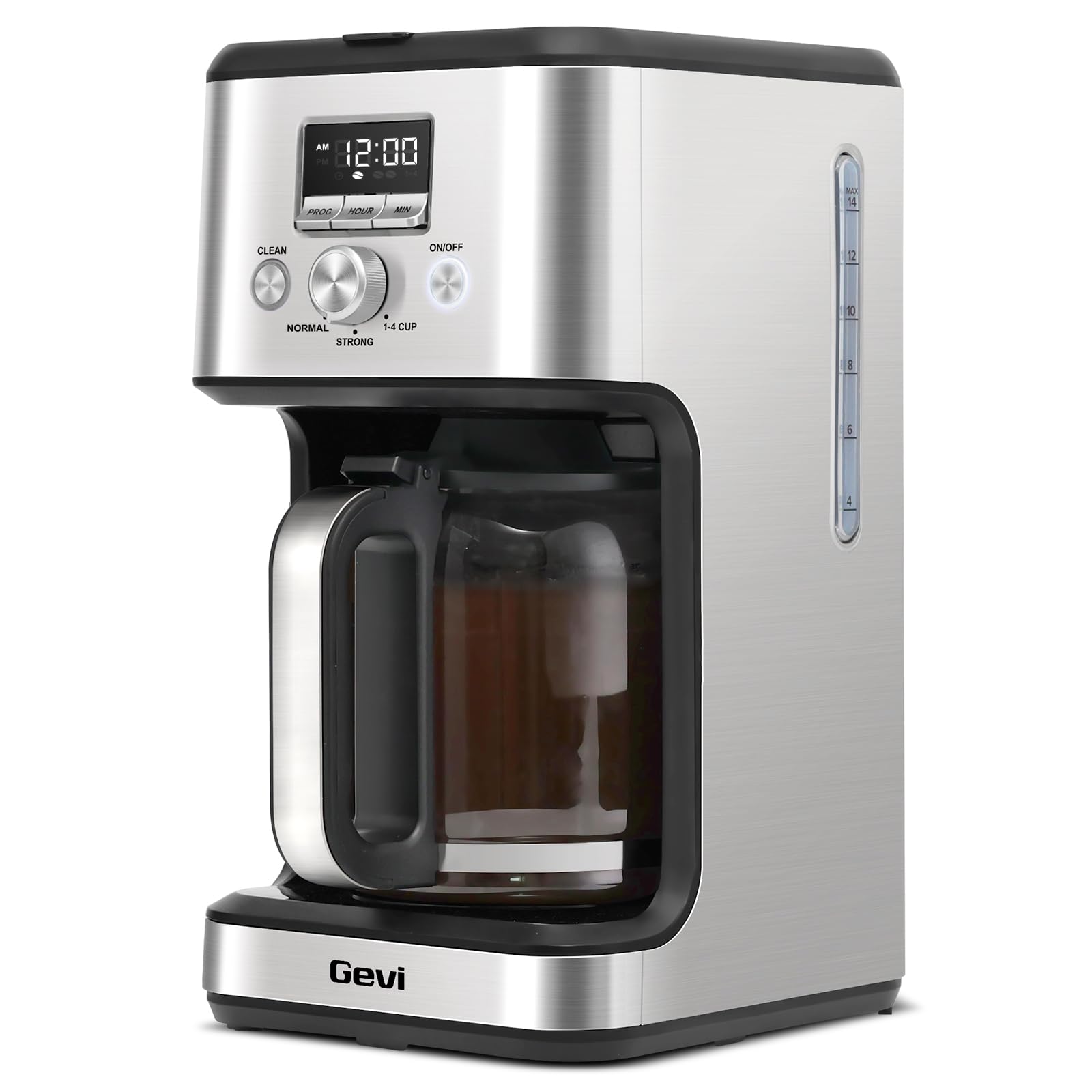
The Gevi 14-cup model is built for one thing: giving you a lot of coffee with minimal hassle. It’s the kind of machine you buy when you’re tired of “small pots” and you want to brew once and be done—especially in family homes, shared apartments, or office corners where multiple people refill throughout the morning.
Owners who like it often emphasize two positives: the coffee comes out hot, and the controls are straightforward. The strong/normal selector is also a practical feature at this level. Instead of relying on vague “bold” marketing, you can choose a stronger extraction mode before brewing, which helps if your coffee tends to taste too light in a big carafe machine. The programmable timer is another big quality-of-life feature: if you’re trying to stop buying coffee on the way to work, waking up to a ready pot can be the difference between “new habit” and “back to the drive-thru.”
Now, real-world notes: budget large-capacity machines sometimes show small “fit and finish” annoyances. One owner mentions the pot getting stuck when sliding in/out and the lid popping off during cleaning—exactly the kind of friction that can make a machine feel cheaper than it is. That doesn’t mean it won’t make good coffee; it means you should decide whether you value “smooth premium feel” or “big coffee for less.” If you want premium build and perfect usability, jump up to OXO, Fellow, Braun MultiServe, or metal-forward SYBO units. If you want a big, simple pot with basic programmability and decent heat, Gevi is trying to give you that.
From a “plastic-free” angle, this is best seen as a “pod-reduction” machine more than a “metal brew-path” machine. It’s a straightforward drip maker that helps you stop relying on pods and convenience coffee. Pair it with paper filters, keep it descaled, and it can be an effective, affordable way to move your routine in a lower-waste direction.
Why it’s appealing
- Large capacity – Great for families, offices, and “brew once” mornings.
- Strong/normal selector – Simple control over extraction strength without complex menus.
- Programmable timer – Helps build a consistent morning routine and reduces “coffee runs.”
- Cleaning reminder – Encourages descaling before performance drops.
Good to know
- Some owners report the carafe fit feels tight and the lid can be annoying during cleaning.
- Like most big glass-carafe machines, coffee taste can degrade if held long on the hot plate.
- It’s a value machine—expect good basics, not specialty-level extraction engineering.
Ideal for: anyone who wants a large-capacity programmable drip maker at a budget level and is comfortable with a few “value-tier” quirks.
13. SYBO SF-CB-2GA – Two Carafes, Two Warmers, and a “Keep Coffee Coming” Commercial Rhythm

If you’ve ever tried to serve coffee to more than a couple people with a standard home drip maker, you know the pain: one carafe finishes, someone pours the last cup, and suddenly you’re stuck waiting for the next brew while everyone hovers. The SYBO SF-CB-2GA solves that by doing what commercial brewers do: keep the pipeline moving. Two carafes, two warmers, and a stainless build that’s meant to be used repeatedly—offices, group homes, gatherings, and busy kitchens.
Owners who are happy with it tend to highlight speed and simplicity: pour water in, add grounds, brew starts, coffee is ready fast. They also like the build quality—“metal, not flimsy plastic”—and the ability to keep one pot warm while brewing a second. This is also a practical way to run “regular” and “decaf” side-by-side without owning two machines.
Now, real-world nuance: commercial-style machines can be fantastic, but they’re not always “set it and forget it.” You’ll want a consistent coffee/water routine and the right filter size for the basket. Some owners report great customer service for replacement parts, while at least one negative experience mentions a frustrating process around troubleshooting and returns. That doesn’t define the model, but it does mean: keep your packaging early on, test it thoroughly during the return window, and treat it like equipment.
From a “plastic-free” angle, this is not fully plastic-free, but it’s a strong “metal-first” vibe in a category where most home machines are heavy plastic. The primary compromise is that it uses warmers (hot plates). That’s great for serving and consistent availability, but it can change coffee taste if it sits too long. If you want “no hot plate ever,” the SYBO thermal carafe model is the better alignment. If you want “coffee always available,” this is the right kind of tool.
Why it’s built for volume
- Two carafes + dual warmers – Keeps coffee service moving without bottlenecks.
- Commercial-style simplicity – Straightforward operation, minimal menu friction.
- Solid stainless build – Feels more like equipment than a plastic countertop appliance.
- Great for regular/decaf setups – An underrated quality-of-life upgrade for groups.
Good to know
- Takes more counter space than a home brewer—measure your station.
- Hot plates keep coffee ready but can shift taste if held too long.
- Early testing is smart: commercial units vary and you want to confirm no leaks or quirks immediately.
Ideal for: offices, group settings, and coffee-heavy households that need two pots flowing and prefer a stainless, commercial-feeling machine.
14. SYBO 3-Carafe Brewer – The Break Room Workhorse for Meetings, Events, and Nonstop Refills

This is the “we serve coffee like a small café” option. If you’re outfitting a break room, a business, a community space, or a high-traffic home coffee station, the SYBO three-carafe setup is designed to keep coffee available constantly: brew one, keep another warm, have a third ready. It’s the kind of machine that makes sense when “coffee demand” is predictable and high.
The appeal is the workflow. There’s no plumbing required, no complicated wiring—just pour water in, brew begins, and the multi-stream spray head saturates grounds for consistent extraction. Owners who buy this style often emphasize durability and simplicity over tech features. They don’t want a smart screen. They want a reliable machine that can produce pot after pot. And in environments like nursing homes, offices, or staff rooms, reliability and ease of use matter more than anything.
The “plastic-free” conversation here is candid. People who choose commercial SYBO brewers sometimes do so because they want to reduce hot plastic contact in their coffee routine. One reviewer even praises the design specifically for minimizing plastic exposure in hot water brewing. Even so, this is still an appliance with mixed materials (as most are), and the bigger “taste” compromise is the warmers: hot plates are fantastic for availability, but they can gradually change flavor if coffee sits too long. If you’re using this in a setting where the pot empties quickly, that’s a non-issue. If you’re using it at home and coffee sits, you’ll taste the difference.
If you want a truly streamlined “coffee service station,” this is one of the most powerful setups you can put on a counter. Just treat it like equipment: choose the right filters, keep it clean, and decide ahead of time how you’ll handle “fresh pot” cadence so coffee stays at its best while still being available.
Why it’s built for service
- Three warmers + three decanters – Designed for nonstop coffee availability.
- Simple pour-over operation – No complex programming for staff or guests to mess up.
- Multi-stream saturation – Better extraction consistency than basic “single drip” commercial units.
- Stainless commercial vibe – Feels like real equipment, not a flimsy home gadget.
Good to know
- This is a large unit—counter space and station planning are mandatory.
- Warmers keep coffee ready but can change taste over time; best for environments where pots empty quickly.
- Commercial rhythm requires habits: filters, cleaning, and consistent dosing make or break results.
Ideal for: offices, events, and high-demand coffee stations that need multiple pots available and want a commercial-grade workflow.
15. HIBREW H10B Espresso Machine – For People Who Want Lattes and Cappuccinos Without Pods

This guide is about drip coffee makers—but I’m including the HIBREW H10B for one reason: a lot of people chasing “plastic-free” coffee are also trying to escape pods. And if your daily coffee is mostly lattes, cappuccinos, or milk drinks, a good entry-level semi-automatic espresso machine can cut pod dependence dramatically while letting you use fresh beans (or pre-ground) with a more traditional workflow.
Owners describe this machine as beginner-friendly in a way that’s actually useful: it heats quickly, the controls make sense, and you can adjust temperature and shot volume without needing a degree in espresso forums. Several reviews highlight an important “first espresso machine” reality: you can start with pressurized baskets and pre-ground coffee, then level up later with a grinder and a bottomless basket when you feel ready. That means the machine can grow with you instead of becoming obsolete once you learn more.
The steam wand is another big reason it makes the list. People consistently mention being able to create microfoam for cappuccinos and latte art. That’s not just aesthetics—good microfoam changes the mouthfeel of milk drinks dramatically. Owners also praise the small footprint and stainless build, plus the pressure gauge as a learning tool: it helps you understand whether your grind and tamp are in the right range.
From a “plastic-free” angle, espresso machines still often have plastic reservoirs and internal parts—so this isn’t a purity play. It’s a “ditch pods, gain control” play. If you’re the person who buys pods because you want milk drinks quickly, this can be a smarter long-term direction: fresh coffee, less pod waste, and a workflow that feels like a real café routine at home.
Why it’s worth considering
- Pod-free milk drinks – Great for people trying to escape plastic pods and syrupy café spending.
- Beginner-friendly workflow – Learn with pressurized baskets, level up later with a grinder.
- Real steam wand – Microfoam changes everything for cappuccinos and lattes.
- Strong support stories – Several owners praise customer service responsiveness.
Good to know
- Espresso is a skill—even easy machines have a learning curve for grind, tamp, and timing.
- It’s a different drink: if you want big pots for groups, drip still wins.
- For best workflow, pull shots before steaming (a common tip owners mention).
Ideal for: anyone whose “coffee habit” is actually milk drinks and who wants to reduce pod dependence while gaining café-level control at home.
The Plastic Free Drip Coffee Maker Reality Check: Where Plastic Actually Matters
If you’ve ever felt confused by “BPA-free,” “pod-free,” “stainless,” and “plastic-free” claims, you’re not alone. Coffee makers are messy because they combine hot water, coffee oils, steam, and repeated cycles. So instead of chasing perfection, the winning move is to focus on the three places that create the biggest difference in real life.
1) Hot water distribution: showerhead + basket
- Even water distribution reduces channeling and improves flavor—this is where machines like OXO and KitchenAid win.
- Easy access cleaning matters because old oils are where “off” smells start living.
- Paper filters can keep the cup cleaner and reduce oily residue buildup in baskets over time.
If your machine has a complicated basket that you hate cleaning, you’ll clean it less. That alone can erase the “better materials” advantage. Convenience is not a luxury—it’s a maintenance strategy.
2) Holding method: thermal vs hot plate
- Thermal carafes protect flavor by removing the “coffee cooks on a hot plate” effect.
- Hot plates are great for service and availability, but taste can drift if coffee sits for long stretches.
- Commercial stations (SYBO 2/3 carafe setups) make sense when pots empty quickly—less sense for slow-sipping homes.
This is why many people who “don’t like drip coffee” suddenly like it when they move to thermal hold. It’s not drip that’s bad—often it’s the holding method.
3) Your easiest “plastic reduction” win: go pod-free, then refine the machine
- Pods are often the biggest plastic footprint in daily coffee routines.
- Pod-free single serve (Braun MultiServe Plus) gives you convenience without disposable pods.
- Reusable single-serve filters (Cuisinart Coffee Center) let you keep flexibility while staying pod-light.
If your current routine uses pods daily, switching to a pod-free brewer is one of the fastest ways to reduce plastic—often faster than trying to find a mythical fully plastic-free automatic drip machine.
A simple checklist that keeps you from buyer’s remorse
- Can I clean the basket and showerhead easily?
- Does the carafe pour cleanly without dribbling?
- Do I want thermal hold (taste) or hot plate hold (availability)?
- Does it fit under my cabinets and in my daily flow?
- Can I get replacement carafes/parts if something breaks?
When those answers are “yes,” you stop shopping and start enjoying your mornings.
FAQ: Plastic-Free Coffee Makers, Real Answers (No Confusion)
Is a truly “plastic-free” automatic drip coffee maker realistic?
What’s the fastest way to reduce plastic in my coffee routine?
Thermal carafe or glass carafe—what’s better for taste?
Paper filters vs reusable filters—what changes in the cup?
Why do some drip machines taste “bitter and weak” at the same time?
How often should I descale my coffee maker?
Final Thoughts: Pick the Plastic Free Drip Coffee Maker That Matches Your Real Morning
A great coffee maker doesn’t just make coffee. It removes friction. It makes you trust your routine again. And when you’re buying with “plastic-free” priorities, the right choice is the machine that aligns with how you actually drink coffee: single cup or full pot, fast weekday or slow weekend, thermal hold or hot plate service, minimalist or feature-rich.
Here’s the easiest way to translate this guide into one confident purchase:
- Want the best “one machine, genuinely great taste” pick? Start with the OXO Brew 8-Cup Coffee Maker. It’s the most balanced mix of extraction quality, thermal hold, and real-life usability.
- Need maximum versatility (hot, iced, cold brew, and sizes) without pods? Choose the Braun MultiServe Plus KF9370SI. It’s built for households with changing needs and strong “pod-free convenience” priorities.
- Want carafe mornings and single cups later without two appliances? Go with the Cuisinart Coffee Center SS-21NAS. Use the reusable single-serve filter to stay pod-light while keeping flexibility.
- Want specialty-style precision with busy-life automation? Look at the Fellow Aiden. It’s a strong fit for people who love coffee quality but don’t want to do manual pour-over every day.
- Want a metal-forward, no-nonsense brewer built to avoid heated plastic “vibes”? Consider the SYBO SF-CB-1AA (Thermal Carafe). It’s simple, hot, and built like equipment.
- Want a strong thermal daily driver with programmability? The Cuisinart DCC-3400 Thermal is a great “hot coffee that stays good” choice.
- Serving a crowd or running an office station? Go commercial with SYBO SF-CB-2GA (two pots) or SYBO 3-Carafe Brewer (three pots) to keep coffee available nonstop.
- Primarily a latte/cappuccino household trying to escape pods? The HIBREW H10B Espresso Machine is a strong “bonus” path if your real habit is milk drinks, not big pots.
At the end of the day, the best purchase is the one that makes you feel calm when you brew: clean workflow, consistent taste, and a setup you’ll actually maintain. Pick the plastic free drip coffee maker that matches your routine—not an imaginary “perfect” machine—and your next cup will taste like the decision you made was the right one.
