
Let’s talk about the moment most buying guides ignore: you’re standing over a hot pot of soup, the kitchen smells incredible, and you’re one wrong move away from launching tomato splatter onto your backsplash like a crime scene.
That’s the real test of an electric hand blender. Not the spec sheet. Not the wattage flex. It’s the “how does it behave when real life happens?” moment: thick soup, shallow saucepan, cramped counter space, tired wrists, and a family that wants dinner now.
I built this guide the way a picky home cook (or a small-batch meal prepper) actually shops: by listening to what owners keep repeating after months of use. The patterns are loud and consistent—some tools feel smooth and controlled, others feel powerful but chaotic, some “all‑in‑one kits” are incredible until the plastic cup cracks, and some premium models cost more because they quietly fix the problems that drive people crazy.
So here’s what you’ll get below: a deeply practical breakdown of 16 standout handheld tools—mostly immersion blenders (stick blenders), plus one high-end hand mixer for the “I bake weekly” crowd (because many shoppers use “hand blender” to mean any handheld mixing machine). You’ll see exactly what each one is best at, the friction points to expect, and which one is the “buy it once and stop thinking about it” choice.
How to Choose the Right Electric Hand Blender
A great handheld blender isn’t “the strongest.” It’s the one that gives you control. Because control is what makes blending feel safe, clean, fast, and repeatable. The fastest way to pick the right tool is to stop thinking in generic categories and instead choose based on the moments you’ll use it.
1. Start with the job, not the brand
Most people buy the wrong tool because they shop for a “good blender,” not for their own top 3 tasks. Identify your real use case:
- Hot soups & sauces: You want a bell-shaped guard that reduces splatter and protects cookware. A long, stable shaft and low-speed control matters.
- Smoothies & protein shakes: You want consistent vortexing in a tall cup and a blade head that doesn’t “stall” in thick mixtures.
- Baby food & purées: You want smooth texture at low speeds, easy cleanup, and a tool you’ll actually reach for daily.
- Small-batch chopping: A chopper attachment (mini processor) can be a game-changer for onions, herbs, nuts, and pesto.
- Whipped cream, eggs, batters: A whisk attachment helps… but if you bake often, a true hand mixer may be the better match.
2. Learn the three control styles (this is where “love it” happens)
Immersion blenders feel wildly different in the hand. Control style is the hidden feature that decides whether you enjoy using it.
- Trigger‑style variable speed: You squeeze for more power. It feels intuitive and responsive, especially when you want to “start gentle” then ramp up.
- Dial + button: You set speed with a dial, then press a button to run. Great for repeatability, but less “instant modulation.”
- Simple two‑button: Usually low/high. It’s fast and simple, but you need technique to prevent splashing.
If you’re blending hot liquids often, you’ll usually prefer either a trigger-style control or a true low-speed option. If you’re blending thick mixtures, you’ll want control that doesn’t force you into “sudden full power” when the mixture catches.
3. Splatter control is not a gimmick—it’s the difference between using it daily and hating it
Splatter comes from two things: air and speed. The moment your blade head breaks the surface of liquid at high speed, you get spray. Good designs reduce both:
- Bell guards that pull ingredients inward and keep the cutting action inside the bell.
- Lower suction so the head doesn’t “stick” to the pot bottom and jump when you move it.
- Cookware-friendly guards that reduce scratching (especially if you use enamel, nonstick, or coated cookware).
A powerful motor without good splash control can feel like driving a sports car with bald tires. It’s fast… until it isn’t.
4. Ignore wattage bragging—look for usable power
Wattage tells you very little about how a blender behaves in thick soup or nut-heavy pesto. Usable power comes from a combination of:
- Blade geometry: More cutting edges can reduce “dead zones” where ingredients spin but don’t break down.
- Head design: How ingredients flow through the bell matters as much as motor strength.
- Torque under load: Some tools maintain speed when mixtures thicken; others bog down or stall.
- Heat management: High power is great, but not if the tool overheats when you blend longer than a few bursts.
This is why some premium models feel “effortless” even at moderate speeds: they’re engineered to keep ingredients moving through the cut zone instead of forcing you to fight the blender with your wrist.
5. Attachments: the ones you’ll actually use (and the ones you won’t)
Attachments can be incredible—if they match your habits. Here’s the honest breakdown:
- Chopper bowl: The most useful add-on for most kitchens. Great for onions, garlic, herbs, nuts, and quick salsa. It replaces “dragging out the big processor.”
- Whisk: Best for cream, eggs, vinaigrettes, and light batters. It’s not a stand mixer replacement for heavy dough, but it’s a daily-life helper.
- Frother: Fun for lattes and matcha. Nice-to-have, not essential.
- Masher: Only worth it if you truly mash often. Many people try it once and never touch it again.
- Food processor attachment (full-size): Fantastic if you want one system to do it all—just know you’ll need storage space.
6. Corded vs cordless: choose based on your kitchen “flow”
Corded models win on consistent power and “it’s always ready.” Cordless models win on freedom—blending at the stove, at the sink, at the island, without chasing outlets or managing cords around hot burners.
Cordless is brilliant if you:
- Blend in multiple spots (stove + sink + counter).
- Make baby food, purées, or drinks multiple times a day.
- Hate cords getting in your way when you’re moving fast.
Corded is often better if you:
- Make thicker blends and want continuous power without worrying about battery life.
- Prefer a tool that’s always “grab and go,” no charging routine needed.
- Blend bigger batches regularly.
7. Durability isn’t just the motor—watch the weak points
In real owner feedback, the most common failure points aren’t dramatic motor blowouts. They’re the boring things:
- Cracked plastic containers (especially with chopper bowls or tall blending cups).
- Loose couplers where attachments connect (usually after lots of twisting on/off).
- Finicky release buttons that feel stiff until you learn the right pressure and angle.
- Markings you can’t read on included cups (sounds small… until you make dressings weekly).
If you want “buy once,” prioritize models with strong warranties, simple construction, and a reputation for staying tight and stable after repeated use.
Quick Comparison: 16 Electric Hand Blender Picks
Use this table to find your “shortlist” fast, then jump to the full reviews for the real-life details—like splatter behavior, attachment usefulness, and whether the tool feels smooth or jumpy when you’re blending thick food.
On smaller screens, swipe or scroll sideways to see the full table.
| Model | Tool type | Real-life strength | Best match | Amazon |
|---|---|---|---|---|
| Vitamix 5-Speed Immersion Blender | Premium immersion | Pro-level blending feel, strong control, cookware-friendly guard | “Buy once” shoppers who want smooth soups and sauces without drama | Amazon |
| Braun MQ9187XL MultiQuick 9 (iMode) | Power + system | Mode-based control + heavy-duty performance + big attachment ecosystem | Meal-prep heavy kitchens that want one tool to replace multiple appliances | Amazon |
| Vitamix 5-Speed 3-Piece Bundle (Whisk + Case) | Premium bundle | Same pro blending + strong whisk + storage case that keeps life organized | People who want premium performance without drawer chaos | Amazon |
| KitchenAid Cordless Variable Speed (KHBBV83) | Cordless kit | Freedom from cords + useful chopper/whisk + clean kitchen workflow | Frequent users (baby food, soups, potatoes) who want cordless ease | Amazon |
| KitchenAid Go Cordless Hand Blender (KHBRV75) | Cordless portable | Removable battery convenience + attachments for everyday versatility | Busy kitchens that blend in multiple spots (stove + sink + counter) | Amazon |
| Breville Handy Mix Scraper (BHM800SIL) | Hand mixer | Quiet scraper beaters + smart speed behavior for baking and mixing | Bakers who want high-end handheld mixing without a stand mixer | Amazon |
| KitchenAid KHBV83BM (Corded + Accessories) | All-in-one corded | Solid feel + whisk/chopper + removable pan guard for cookware care | Big-brand reliability seekers who want one box with “everything” | Amazon |
| Braun MultiQuick 7 (MQ7035) | Smooth control | Trigger-style SmartSpeed + strong anti-splash design + great kit | People who want powerful blending that still feels controlled | Amazon |
| Cuisinart Smart Stick (CSB-179) | Classic kit | Comfort grip + useful chopper/whisk + reputation for daily reliability | Everyday soups, sauces, mayo, and quick chopping without fuss | Amazon |
| SHEANLAH 1000W Brushless (25-Speed) | Wild-card power | Lots of speed steps + heavy-duty vibe + long warranty promise | Power seekers who want dial-based control and aren’t afraid of new brands | Amazon |
| KitchenAid KHBV53 (Empire Red) | Corded core | Quiet, sturdy, and easy for soups/sauces with simple cleanup | People who want “grab it and blend” with a great feel in-hand | Amazon |
| KitchenAid KHBV53 (Contour Silver) | Corded core | Durable, heavy-for-size feel + strong blending for daily prep | Homes that blend sauces, vegetables, and smoothies weekly | Amazon |
| Braun MQ5000 Vario (21-Speed) | Speed control | Lots of control steps + anti-splash head + easy click system | People who love dialing in texture (not just “low/high”) | Amazon |
| KitchenAid KHBV53 (Matte Black) | Value corded | Lightweight feel + quiet blending + jar with lid for storage | Small kitchens and comfort-first shoppers | Amazon |
| Ganiza 5-in-1 (16-Speed + Turbo) | Budget kit | Big accessory bundle + strong performance feel for everyday blends | People who want maximum attachments and quick meal prep versatility | Amazon |
| turelar 5-in-1 (1100W Set) | Lowest-cost all-in | High power on paper + lots of attachments for soups, baby food, drinks | Budget shoppers who want a starter kit and will treat containers gently | Amazon |
In‑Depth Reviews: 16 Electric Hand Blender Picks That People Actually Keep Using
Now we go model by model. I’m going to talk like a real cook, not a brochure: how each tool behaves in thick soup, whether it splashes, whether it feels tiring to hold, and what owners consistently praise (or complain about) after the “new toy” excitement wears off.
1. Vitamix 5-Speed Immersion Blender – The “Smooth, Controlled, No Drama” Daily Driver

If you want the handheld tool that feels the most “professional kitchen” without needing a pile of attachments, this is it. The Vitamix immersion blender has a very specific personality: powerful, steady, and controlled. It doesn’t feel like it’s trying to run away from you. It feels like it wants to do clean work—especially in soups, sauces, purées, and thicker mixtures where cheaper stick blenders tend to stall or splash.
The detail that quietly changes everything is the blade head design. A lot of immersion blenders either create too much suction (they stick to the pot) or too much turbulence (they splash). This one tends to keep ingredients flowing through the guard while protecting cookware. Owners love that they can blend right in a pot without worrying about scratches, and that the head doesn’t feel “grabby” when you move it around. That translates into confidence: you’re more likely to make creamy soups on a weeknight because it’s not a cleanup nightmare.
Another real-life advantage is simplicity. There’s a reason so many people stick with it: fewer parts to lose, fewer plastic bowls to crack, and less “where did I put the chopper lid?” energy. Cleanup is fast because the business end is straightforward—many people do the quick soap-and-water blend-in-a-cup trick, rinse, and you’re done.
The tradeoff is weight. This tool feels substantial. For most cooks, that’s a good sign (stable, durable, not flimsy), but if you’re sensitive to wrist fatigue, you’ll want to use smart technique: pulse in short bursts for thick blends, let the blender do the work, and avoid holding it suspended in air. In a pot or tall cup, it feels beautifully balanced.
Why it’s worth it
- Controlled power – It blends tough ingredients smoothly without feeling chaotic or jumpy.
- Cookware-friendly design – Great for blending directly in pots without stressing about scratches.
- Simple, low-clutter ownership – Fewer pieces means fewer frustrations long-term.
- Fast cleanup – Easy rinse routine makes it more likely you’ll use it often.
Good to know
- It feels heavier than many budget models—use bursts and let the pot support the tool.
- No big accessory kit in the box; it’s a “blend extremely well” tool first.
- You’ll want a tall blending cup (any wide-enough container works) for the cleanest vortex on smoothies.
Ideal for: people who want one premium immersion blender that makes soups, sauces, and purées feel effortless—and stays satisfying after the honeymoon phase.
2. Braun MQ9187XL MultiQuick 9 (iMode) – The “Replace Half Your Appliances” System

This is the pick for people who don’t just want an immersion blender. They want a system. The MultiQuick 9 line is built around two big ideas: (1) make the blender head work harder so you don’t have to, and (2) give you a toolkit that can legitimately replace bulkier machines in daily life.
The iMode concept is more important than it sounds. Instead of “one trigger does everything,” you get controlled power ranges—think of it as guard rails. Low mode keeps you in a gentler zone for soft ingredients and delicate blending. High mode opens the full range for tougher jobs. Pulse mode is fantastic when you want chopped texture without turning ingredients into paste. That’s exactly what owners mean when they say it feels effortless: the tool isn’t just strong, it’s predictable.
Where this model earns its keep is versatility. The included attachments are not “throw-ins.” They’re legitimate: a large processor-style setup, multiple discs for slicing/shredding, and tools that can handle real meal-prep volume. If your counter space is limited but your cooking ambition is not, this kind of kit can be a smart consolidation move.
Here’s the honest reality: owning a big system requires a tiny bit of discipline. You need a home for the parts. You need a “kit mindset” so you don’t lose lids, blades, or discs. Also, the control scheme (mode + trigger) takes a couple uses to feel natural. But once it clicks, this can be one of the most satisfying kitchen upgrades for a household that actually cooks.
Why it’s a beast (in a good way)
- iMode control – Low/high/pulse reduces overprocessing and makes results more repeatable.
- Effort-reducing blending head – Designed to cut efficiently so you don’t fight thick mixtures.
- Attachment ecosystem – Can replace separate choppers, slicers, and sometimes even a full processor for daily tasks.
- Feels like a serious tool – Owners often describe it as powerful, stable, and satisfying to use.
Good to know
- This is a “system” purchase—make sure you have storage space for the accessories.
- The mode + trigger workflow takes a couple sessions to feel intuitive.
- If you only want soups and smoothies, you may not need this much kit.
Ideal for: heavy cooks and meal preppers who want one powerhouse handheld system to tackle blending, chopping, slicing, and more—without dragging out multiple appliances.
3. Vitamix 3-Piece Bundle (Whisk + Storage Case) – Premium Performance, Zero Drawer Chaos

If you love the idea of the Vitamix immersion blender but you also want the “I can whip eggs and keep everything organized” version, this bundle is the sweet spot. The performance base is the same—strong blending, controlled feel, cookware protection—but the extras are chosen with real kitchen psychology in mind.
The whisk is the attachment most people actually use long-term. It’s not about making bakery-level meringue every day. It’s about quick wins: whipped cream in minutes, fluffy scrambled eggs without hand fatigue, vinaigrettes that don’t separate, and batters that blend smoothly without dragging out a full stand mixer setup. When people say it changes their routine, it’s usually because they use it for small, frequent jobs.
And the storage case? That sounds boring until you’ve owned a “kit” product before. Most accessory sets slowly scatter into junk drawers, and then the one piece you need is missing at the exact wrong time. A case keeps the tool in “ready mode.” When it’s easy to grab, you use it more. When you use it more, you get more value. That’s the quiet truth of good design: it makes the best choice the easiest choice.
Same caution as the base model: it’s a substantial tool. But owners who like it usually like that it feels solid and durable. If you want something feather-light, you may prefer a smaller KitchenAid corded model. If you want premium results with clean ownership, this bundle is hard to beat.
Why it’s a smart upgrade
- Premium blending performance – Smooth soups and sauces without the “cheap blender chaos.”
- Whisk you’ll actually use – Great for cream, eggs, dressings, and light batters.
- Storage case – Keeps everything together, which keeps the tool in rotation.
- Cookware protection – Blends in pots confidently without scratching worries.
Good to know
- It’s still a premium, substantial tool—best used supported in a pot or cup, not held suspended.
- If you never whisk, the base Vitamix model may be all you need.
- You’ll get the best smoothie texture in a taller container where you can build a strong vortex.
Ideal for: cooks who want pro-level blending plus a genuinely useful whisk—and who love the idea of a tidy, organized set.
4. KitchenAid Cordless Variable Speed (KHBBV83) – The “Blend Anywhere” Upgrade for Daily Kitchens

Cordless hand blenders are one of those “I didn’t know I needed this” purchases—until you use one for a week. Then going back to cords feels like going back to wired headphones. The KHBBV83 style is designed for people who blend often: baby food, soups, mashed potatoes, sauces, smoothies, and quick kitchen jobs where setting up a full blender feels like overkill.
The biggest benefit is workflow. You can blend at the stove, move to the sink, blend again, rinse, and keep going—without cords dragging across burners or forcing you to work near one specific outlet. Owners who love cordless models usually mention the same feeling: less friction. And less friction means you cook more, experiment more, and clean up faster.
This kit style also wins because the attachments are genuinely useful. The chopper handles quick prep (herbs, nuts, onion, garlic) without hauling out a big processor. The whisk is great for eggs, cream, and emulsions. If you actually use those tasks weekly, it’s a meaningful upgrade.
The only “real” downside is the cordless reality: you’ll recharge. The good news is that most people don’t blend continuously for long stretches. If you blend in bursts (which is also best practice for texture control), battery life tends to feel more than adequate. The key is to treat it like a power tool: keep the battery routine simple, and it becomes second nature.
Why cordless fans love it
- Freedom to blend anywhere – Stove, sink, counter… your kitchen flow gets easier.
- Variable speed control – Better texture control and less splatter risk.
- Useful attachments – Chopper and whisk are the two most practical add-ons for daily cooking.
- Reduces big-blender dependency – Owners often use countertop blenders less after switching.
Good to know
- It’s cordless—so charging is part of life (easy, but real).
- For extremely thick blends, corded models can feel more “always full power.”
- Like any kit, it’s best if you commit to storing the parts together.
Ideal for: frequent cooks who want cordless convenience and a versatile kit that handles everyday blending plus quick chopping and whisking.
5. KitchenAid Go Cordless (KHBRV75) – Removable Battery Convenience for Busy Counters
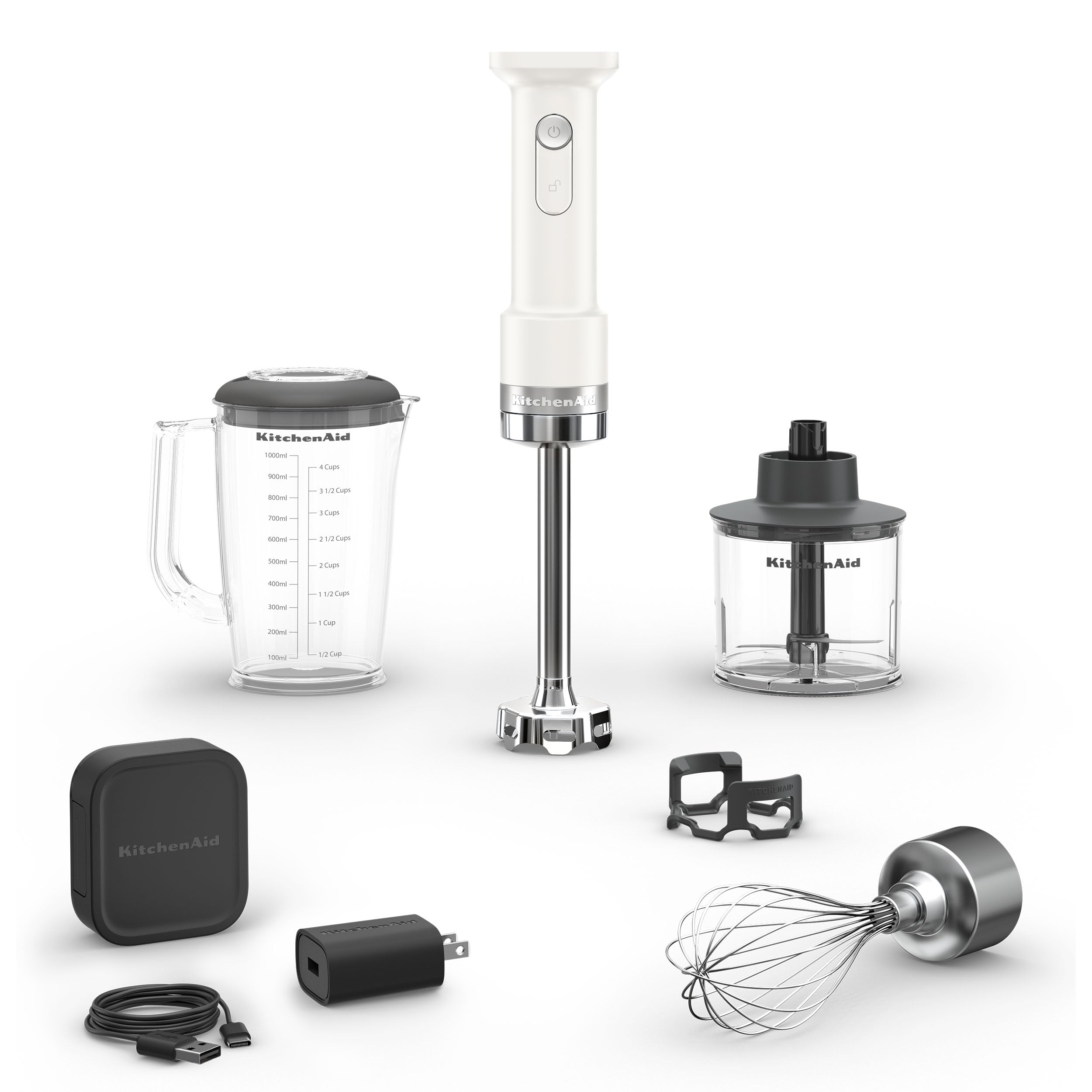
The KitchenAid Go concept is built around a simple promise: mobility without compromise. If you blend in multiple areas of the kitchen—stove to sink to island—cordless convenience isn’t just “nice.” It genuinely changes how quickly you get from idea to finished dish.
Owners who are surprised by how much they like this style usually mention balance first. Many cordless tools look bulky in photos, but in-hand they can feel stable and comfortable. The second highlight is how practical the included accessories are: a pitcher for blending and storage, a chopper for quick prep, and a whisk for fast whipping and emulsifying. This set is especially satisfying for people who do a lot of “small jobs” rather than giant batch cooking.
There’s also a realistic materials note that shows up in feedback on cordless tools in general: they may include more plastic than you expect. That’s often a design choice to keep weight reasonable and improve battery handling. If you’re someone who wants an all-metal “tank,” Vitamix or Braun’s high-end systems may feel more premium. If you want convenience you’ll use daily, this one earns points.
My best advice with cordless sets: don’t buy them to do one extremely heavy job occasionally. Buy them to do many jobs quickly, cleanly, and conveniently. If that matches your kitchen, this is the kind of tool that becomes part of your routine fast.
Why it works in real life
- Removable battery convenience – Designed for movement and quick daily blending.
- Useful set pieces – Pitcher, whisk, and chopper cover the most common household needs.
- Balanced feel – Many owners note it doesn’t feel awkward or overly heavy.
- Great “use it anywhere” workflow – Blending at the stove or sink feels natural and easy.
Good to know
- Some parts may feel less “metal premium” than expected—common with cordless designs.
- Charging time is part of ownership (though battery life is often praised in real use).
- If you want the simplest, smallest tool with no accessories, a basic corded model may be enough.
Ideal for: households that value cordless convenience and want a practical accessory set for everyday blending, chopping, and whisking.
6. Breville Handy Mix Scraper – The High-End Hand Mixer That People Call Their “Forever” Tool

Quick clarity: this isn’t an immersion blender. It’s a hand mixer. But it belongs in this guide because “hand blender” is often used as a catch-all term, and many shoppers actually need a handheld mixer for batters, whipped cream, frosting, cookie dough, and occasional dough work—without a stand mixer.
The Breville Handy Mix Scraper is famous for one reason: it feels like a genuinely upgraded category. Owners don’t just say “it works.” They talk about how quiet it is, how stable it feels under load, and how the scraper beaters reduce the annoying “ingredients stuck to the bowl” problem. That last part matters: a mixer that keeps contact with the bowl means less stopping, less scraping, and better texture consistency—especially in thick batters.
The small premium touches are what create loyalty. A mixing light sounds like marketing until you’ve tried it while making frosting at night or mixing a dark batter. A built-in timer helps with recipes that require specific mixing times. And the storage design (attachments and cord management) is a quiet quality-of-life feature because it makes the tool feel organized, not cluttery.
The main tradeoff is weight. This is not a flimsy, feather-light mixer. It feels like a serious appliance. Most owners consider that a benefit—more stable, less vibration—but if you have grip or shoulder issues, you’ll want to use it in shorter mixing bursts for heavy doughs. For whipping cream, frosting, and most batters, it feels smooth and controlled.
Why bakers adore it
- Quiet scraper beaters – Less clanging, better bowl contact, less “stop and scrape.”
- Smart speed behavior – Designed to match speed response to attachments and load.
- Premium usability touches – Light + timer + easy eject create a surprisingly “luxury” experience.
- Storage is actually smart – Keeping attachments contained makes it easier to use regularly.
Good to know
- This is a mixer, not a soup blender—different tool, different job.
- It’s heavier than bargain mixers, especially noticeable in dense dough work.
- If you only need quick soups and smoothies, an immersion blender makes more sense.
Ideal for: bakers and dessert makers who want a premium handheld mixer with serious build quality and thoughtful features that reduce everyday friction.
7. KitchenAid KHBV83BM – A Practical “Everything You Need” Set from a Staple Brand
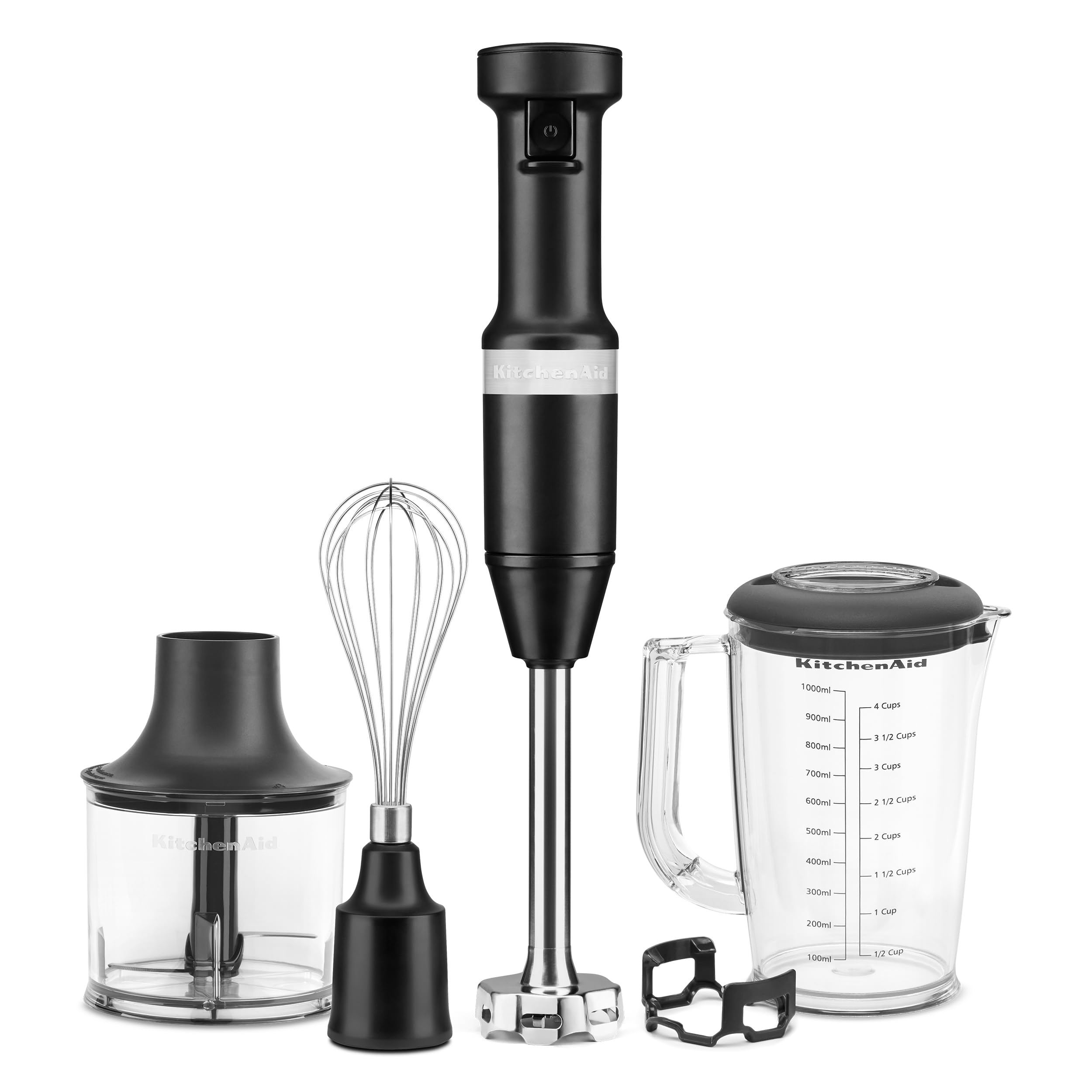
This is the kind of set that works for most kitchens because it covers the basics well and adds the two attachments people actually use: a whisk and a chopper. The blender arm is designed for soups, sauces, smoothies, and hummus-type blends, and the variable-speed trigger gives you the “start slow, ramp up” control that makes handheld blending feel safe and tidy.
One detail that matters more than it should: the removable pan guard. Some cooks love it because it protects nonstick or coated cookware. Others prefer to remove it because they don’t want extra plastic near hot food. The key is that you can choose. That flexibility is a surprisingly big deal for confidence and comfort—especially if you’re blending frequently in your favorite pot.
Owners who like KitchenAid tools tend to praise the “solid but not ridiculous” feel: it’s sturdy, it doesn’t feel cheap, and it doesn’t sound like it’s straining when you blend thicker soups or purees. The included chopper is the quiet hero for weeknight cooking: onion, garlic, herbs, nuts—quick prep without pulling out a full-size appliance.
This set is also a great match for people who want a corded tool (always ready, no charging routine) but still want multi-function flexibility. If you want one box that covers blending + quick chopping + whipping, this is one of the most straightforward picks to live with.
Why it’s a safe buy
- Variable-speed trigger – Easier control for hot soups and splatter-prone recipes.
- Two useful attachments – Whisk + chopper are the add-ons most people actually reach for.
- Pan guard flexibility – Protect cookware when you want, remove it when you don’t.
- Everyday reliability feel – Built like a practical kitchen staple, not a fragile gadget.
Good to know
- Accessory sets take space—plan where the chopper and whisk will live.
- If you only want a minimal blending wand, this may be “more kit” than you need.
- For ultra-premium, pro-level blending smoothness, Vitamix still leads.
Ideal for: cooks who want a well-rounded corded immersion blender set from a trusted brand—strong blending plus practical attachments.
8. Braun MultiQuick 7 (MQ7035) – Smooth, Fast Blending Without the Messy Learning Curve

Braun’s MultiQuick 7 sits in a very satisfying sweet spot: it’s strong enough to feel like a real upgrade, but it’s also designed to reduce the common annoyances that make people abandon stick blenders—splatter, suction, and awkward handling. That’s why the “SmartSpeed” trigger idea lands so well in real kitchens: you squeeze gently for gentle blending, squeeze harder for more power. It feels natural fast.
Owners regularly talk about how quickly it produces smooth results, especially in soups and sauces where texture matters. The splash control head design isn’t just marketing—when you keep the bell submerged, it tends to blend cleanly without spraying. It also feels easier to maneuver because the head doesn’t “grab” the pot bottom as aggressively as some older immersion blender designs. That means less wrist fatigue and fewer “oops” moments.
The included kit is practical: blending beaker, whisk, and a small chopper that behaves like a mini processor. That chopper is a big reason people use the blender more often, because it handles quick jobs that otherwise become “I guess we’re not making pesto tonight.”
If you want a tool that feels powerful but still friendly and controlled, this is one of the safest “value meets performance” picks. It’s not the most premium-feeling option on the page, but it’s one of the most consistently enjoyable ones.
Why it’s easy to love
- SmartSpeed trigger – Intuitive control that reduces splatter risk and improves texture precision.
- Anti-splash design – Great for soups and sauces when used with proper technique.
- Useful attachments – Chopper + whisk cover real daily cooking needs.
- Comfortable handling – Less “grabby suction,” easier movement in pots and cups.
Good to know
- Like most kits, it’s only as good as your storage habits—keep parts together.
- For ultra-thick blends, use bursts to avoid overheating any handheld tool.
- If you want a full food-processor replacement, the MultiQuick 9 kit is the bigger system.
Ideal for: people who want controlled power, low-splatter blending, and a practical accessory set—without stepping into the highest price tier.
9. Cuisinart Smart Stick (CSB-179) – The Reliable “Do Everything I Need” Everyday Tool

Cuisinart’s Smart Stick line has a reputation for being that dependable kitchen friend: not flashy, not fussy, just consistently useful. The CSB-179 version leans into everyday practicality—variable speed control, a comfortable grip, and a set of accessories that cover the most common household jobs.
What owners love most is how naturally it fits into routine cooking. It’s the tool you grab for: pureeing soup directly in the pot, making silky sauces without transferring hot liquid, emulsifying mayo in a tall cup, or quickly chopping herbs and nuts. That “small tool, big convenience” vibe is exactly why immersion blenders beat countertop blenders for many kitchens: less mess, fewer dishes, faster results.
A real-life detail that matters: safety and controls. Some people find the lock/unlock workflow “unconventional” at first. But for families who store tools in drawers or have kids around, that extra step can feel reassuring. Once you build muscle memory, it becomes a quick routine rather than an annoyance.
If you want a proven kit that covers blending + chopping + whisking without demanding a learning curve, this is one of the most common “works well for years, I’d buy it again” types of picks in the category.
Why it stays popular
- Everyday versatility – Soups, sauces, smoothies, mayo, baby food, quick prep chopping.
- Comfort-grip handling – Easy to maneuver for longer blending sessions.
- Useful accessories – Chopper and whisk are practical, not decorative.
- “Kitchen staple” feel – Many owners stick with the brand because it simply works.
Good to know
- The safety/lock workflow may feel odd at first—most people adapt quickly.
- Some parts are easier to hand-wash than dishwash—clean right after use for best results.
- If you want premium “effortless” blending feel, Vitamix still leads.
Ideal for: cooks who want a straightforward, reliable immersion blender kit that covers everyday blending and quick prep without being complicated.
10. SHEANLAH 1000W Brushless (25-Speed) – High Control, Heavy-Duty Energy, Big Warranty Promise

This is the kind of model that attracts a very specific buyer: someone who wants lots of control steps, a powerful feel, and a “built like a tool” vibe, but doesn’t necessarily need a premium brand name stamped on the side. The brushless motor claim and the high number of speed settings point to a design intent: smoother operation, less wear, and more precise control.
In real-life feedback, the praise pattern is strong: powerful blending, surprisingly quiet operation for the output, and a solid feel in-hand. People who do unusual heavy-duty tasks (outside normal cooking) often gravitate to this kind of build because it feels like it can take punishment. That’s a strong signal for kitchen use too—if a tool can handle thick, stubborn mixes, it usually handles soup like a dream.
The smart way to think about high-speed-step blenders is “texture discipline.” When you have many speeds, you can start gently, avoid splatter, and slowly climb until you reach the exact texture you want. That’s the difference between “pureed” and “silky.” It also reduces overprocessing, which matters for emulsions and sauces where texture can break if you blast it too hard.
The honest caution: with newer or less-established brands, long-term accessory availability can be unclear. If you’re the type who wants guaranteed replacement parts in five years, you may prefer Vitamix, Braun, KitchenAid, or Cuisinart. If you want high control and you’re comfortable with a strong “value meets power” play, this one is compelling.
Why it’s interesting
- Lots of speed steps – Easier to dial in texture and avoid sudden splatter.
- Strong power feel – Owners praise quick, efficient blending on stubborn mixes.
- Guard design – Built to reduce splashing and protect containers/pots.
- Warranty confidence – A longer warranty promise can be a big psychological win.
Good to know
- Replacement parts/attachments may be harder to source long-term than major brands.
- Some owners mention cord length preferences—plan your outlet placement.
- Always use bursts for thick blends; “power” doesn’t mean “blend forever nonstop.”
Ideal for: people who want high control and a heavy-duty blending vibe—and are comfortable with a newer brand in exchange for strong performance claims.
11. KitchenAid KHBV53 (Empire Red) – The Quiet, Sturdy “Grab-and-Blend” Favorite

This is the kind of immersion blender people buy because they want daily reliability, and then they end up loving it more than expected. The KHBV53 design is simple: a sturdy motor body, a removable blending arm, a pan guard to protect cookware, and a jar with a lid that’s actually useful for quick blending and storing dressings or sauces.
The control feel is a big reason it wins fans. The variable-speed trigger lets you start gentle, which is exactly what you want for hot soup and sauce work. Owners often mention that it feels solid but not awkward, and that it blends quickly without excessive noise. That “quiet confidence” matters in real life—especially if you blend early in the morning, cook with kids nearby, or just don’t want an appliance that screams.
Where this model really shines is small-batch practicality. It’s great for: soup in the pot, creamy sauces, protein shakes, quick hummus, and even soft-food diets where you need smooth texture without chunking. It’s also a good gift-style blender because it looks sharp and stores easily.
If you want a straightforward, big-brand corded immersion blender that feels dependable and is easy to clean and store, this is one of the strongest “simple wins” on the list.
Why it’s a crowd-pleaser
- Quiet, sturdy feel – Owners consistently describe it as solid and pleasant to use.
- Variable-speed trigger – Better control for hot soups and splatter-prone liquids.
- Useful included jar – Great for dressings and storage (lid matters more than you think).
- Easy cleanup – Detachable arm makes washing simple and quick.
Good to know
- This is a core blender, not a massive “attachment system” (great for simplicity, less for multi-tool lovers).
- The pan guard is useful, but some people find guards fiddly—practice attaching it once.
- For heavy chopping or slicing, choose a kit with a stronger processor attachment.
Ideal for: people who want a simple, reliable corded immersion blender with great real-life handling—especially for soups, sauces, and smoothies.
12. KitchenAid KHBV53 (Contour Silver) – A Workhorse Feel in a Simple, Slim Tool

This is the same core design family as the red and matte black versions, but this variation draws a very specific type of praise: people talk about durability. You’ll see comments about how it feels “heavy for its size” and “built to last.” That’s not just emotional—it often means less vibration, steadier blending, and a tool that feels planted in-hand.
In practical use, that sturdiness is helpful when you’re blending thicker items: pureed vegetables, thicker sauces, even fibrous ingredients that can make weaker blenders feel jumpy. Owners also like it for smoothies and quick juice-style blends (think ginger-heavy mixes), because it tends to power through without sounding stressed.
One subtle advantage of the simpler KHBV53 setup: fewer attachment parts means fewer failure points. A lot of inexpensive multi-kits are fun until a plastic coupling breaks or the chopper bowl cracks. This model keeps ownership simple: blending arm, guard, jar, lid. That simplicity is a form of durability.
If you want a straightforward corded immersion blender with a “tough little machine” vibe—something you can use weekly without babying—it’s a strong pick.
Why people trust it
- Durable feel – Heavier-for-size stability can reduce vibration and improve control.
- Strong blending on thick tasks – Good for vegetable purées and heavier sauces.
- Simple ownership – Fewer parts to lose, fewer accessory failures.
- Easy to clean – Detachable arm keeps cleanup fast and repeatable.
Good to know
- If you want a chopper and whisk in the box, choose the KHBV83 accessory kit instead.
- Pan guards can feel fiddly if you don’t align them—practice once and you’ll be fine.
- For the smoothest, most “effortless” premium blending feel, Vitamix still leads.
Ideal for: people who want a simple, sturdy corded immersion blender that feels built for repeated use—especially for soups, vegetables, and thicker blends.
13. Braun MQ5000 Vario (21-Speed) – For People Who Love Dialing In Texture

Some people don’t want “low/high.” They want control. That’s what the MQ5000 Vario is for. The 21-speed setup isn’t about bragging rights—it’s about being able to start incredibly gently and then step up gradually until the texture is perfect. That’s how you get a soup that’s creamy but not over-aerated, or a sauce that’s smooth without turning into foam.
Braun’s bell-style head design is also built for cleaner blending. When you keep the head submerged, it tends to avoid the violent splash behavior that makes people dread immersion blenders. Owners regularly praise how quickly it blends and how easy it is to clean. It’s also comfortable to hold, which matters more than you expect if you blend for more than a minute at a time.
One real-world complaint shows up occasionally with included mixing jars: markings can be hard to see. That sounds minor until you make smoothies or dressings often and actually use the measurement marks. If you care about that, you can fix it easily (use your own container, or add your own marks), but it’s worth knowing.
If you want a quality immersion blender with lots of control steps—without jumping into premium price territory—this is a strong “texture nerd” pick.
Why it’s satisfying
- 21-speed control – Great for gradual ramp-up and precise texture finishing.
- Clean blending behavior – Designed to reduce splashing when used correctly.
- Comfortable handling – Good grip and balance for longer blending tasks.
- EasyClick swapping – Attachment changes are quick and simple.
Good to know
- Some people dislike faint measurement markings on included jars.
- Dial control is great for repeatability, but trigger-style control can feel more intuitive for some users.
- If you want a full kit with a larger processor, Braun’s higher system models fit better.
Ideal for: cooks who want lots of speed steps and fine control over texture—especially for soups, sauces, and small-batch blending.
14. KitchenAid KHBV53 (Matte Black) – Lightweight, Quiet, and Easy on the Hands

If your top priorities are comfort, simplicity, and “I’ll actually use it,” this version of the KHBV53 is a strong choice. Owners often describe it as lightweight, easy to handle, and easy to clean—exactly what you want for daily or weekly use. A tool that feels comfortable in-hand gets used more. A tool that feels awkward gets ignored.
This model is especially appreciated by people who don’t want to wrestle with heavy appliances or complicated controls. The variable speed trigger is useful for preventing splatter when you blend hot soups or thin sauces, and the pan guard helps protect cookware if you’re blending in enamel, coated pans, or nonstick.
The included blending jar with lid sounds small, but it’s one of those “why doesn’t every tool include this?” features. It makes smoothies and dressings easy, and the lid means you can store what you blended without transferring to another container. Less dishwashing is more cooking.
If you want a straightforward corded immersion blender that feels user-friendly and doesn’t overcomplicate your kitchen, this is a very safe pick.
Why it’s easy to live with
- Comfort-first handling – Lightweight feel and easy control are great for frequent use.
- Quiet blending – Less noisy than many older immersion blender designs.
- Useful jar + lid – Makes smoothies, dressings, and storage easier.
- Simple cleanup – Detachable arm keeps washing fast and low-stress.
Good to know
- If you want lots of attachments, you’ll prefer the KHBV83 set or another kit.
- For ultra-heavy-duty blending, premium models can feel smoother under load.
- Pan guards are helpful, but make sure they’re properly seated before blending.
Ideal for: comfort-first buyers and small kitchens that want a straightforward, easy-to-use immersion blender for soups, sauces, and daily blending.
15. Ganiza 5-in-1 (16-Speed + Turbo) – Big Attachment Value with a Surprisingly “Heavy-Duty” Feel

Ganiza’s 5-in-1 kits are popular for one main reason: people feel like they’re getting a whole mini food-prep station in one box. And unlike some bargain bundles that feel flimsy, this one often gets described as surprisingly sturdy and “heavy-duty” in-hand. That matters because the moment you blend something thick—like potato soup, hummus, or dense sauces—flimsy tools feel unstable.
The control setup is a big part of why this kit works. Multiple speed settings let you start low to avoid splatter, then climb to higher speeds for a smoother finish. Turbo exists for those moments when you want to power through quickly, but the better day-to-day habit is to treat turbo like a short burst tool, not a “hold forever” setting.
The accessories are where it wins on convenience: the beaker is great for soups and smoothies, the chopper is great for onions and nuts (and yes, tear-free onion chopping really is a life upgrade), the whisk helps with eggs and cream, and the frother covers coffee drinks and small finishing touches. If you actually use those tasks, the value is real.
The honest tradeoff with multi-kits is always the same: you’re buying more pieces, which means more storage needs and more parts to treat carefully (especially lids and bowls). If you want minimalism, choose a premium simple tool. If you want maximum versatility per purchase, this is a strong pick.
Why it’s a good bundle buy
- Multi-speed control – Helps reduce splatter and dial in texture more precisely.
- Big accessory value – Chopper, whisk, and frother cover a lot of daily kitchen jobs.
- Sturdy feel – Many owners describe it as well-made for a bundle kit.
- Great for quick meal prep – Chopping and blending become fast, repeatable habits.
Good to know
- Store the parts together—multi-kits only stay convenient if they stay organized.
- Some components (like lids) often prefer hand-washing—check care instructions and avoid dishwashing what isn’t meant for it.
- Turbo power is best used in bursts, not long continuous blending.
Ideal for: people who want a versatile immersion blender bundle with multiple attachments—and who like having “one tool” for blending, chopping, and whisking.
16. turelar 5-in-1 (1100W Set) – Budget-Friendly Versatility (With One Important Reality Check)

If your goal is “get everything in one box and start blending this week,” this kind of kit is appealing. You get a handheld blender plus common attachments—chopper, whisk, frother—and a guard design meant to reduce scratches and splashing. For soups, smoothies, sauces, baby food, and light meal prep, it can do a lot for a very small footprint.
Owners who love it typically mention three things: strong blending performance, easy attachment swapping, and how little space it takes compared to a big blender. That’s the charm of immersion blending: you can make soup right in the pot, rinse the wand, and move on with your life.
Now the reality check: in real long-term use, the most common weakness for budget bundles is not the motor—it’s the containers. One review pattern worth taking seriously is cracked plastic bowls/cups over time. That doesn’t mean the tool is “bad.” It means you should treat containers gently: avoid thermal shock (very hot to very cold), don’t over-tighten lids, and don’t store heavy items stacked inside. If you’re buying for the attachments, treat the accessory pieces like you’d treat any plastic food-prep container.
If you want the lowest cost entry into “immersion blender + attachments” life and you’re okay with being slightly more careful with accessory parts, this is a solid starter kit choice.
Why it’s a strong starter
- All-in-one versatility – Chopper, whisk, and frother cover a lot of kitchen needs.
- Compact storage – Great for small kitchens and apartments.
- Strong blending for daily foods – Soups, smoothies, sauces, and baby food are the sweet spot.
- Easy to clean – Detachable parts make cleanup quick when you wash promptly.
Good to know
- Budget kits can have weaker accessory containers—treat bowls and cups gently.
- Avoid long continuous blending on hard, frozen items; use bursts and follow usage guidance.
- If you want “buy once for a decade” durability, premium models are the safer bet.
Ideal for: budget shoppers who want a starter kit with multiple attachments—and who are comfortable being mindful with the included plastic containers.
How Hand Blending Actually Works (and How to Avoid Splatter Like a Pro)
Most frustration with immersion blenders comes from two mistakes: starting too fast and blending too shallow. The good news? A few simple habits turn almost any decent tool into a clean, controlled experience.
What makes a handheld blender feel “premium” in real life
- Predictable flow through the bell – Ingredients get pulled into the cut zone instead of swirling uselessly.
- Low-suction handling – Less sticking to the pot means smoother movement and less wrist strain.
- Stable power under load – Thick soup doesn’t stall the blade head or cause violent jumpiness.
- Good low-speed control – The ability to start gentle is what prevents “instant splatter.”
- Cookware protection – A head/guard design that doesn’t punish your favorite pots.
This is why premium tools like Vitamix feel different: they’re engineered for controlled flow and confident handling, not just raw power. And it’s why good control systems (trigger style, multi-step speeds, or mode-based ranges) matter more than marketing wattage.
My zero-splatter technique (works for hot soup, sauces, and dressings)
- Start with the head fully submerged – The bell should be below the surface before you press anything.
- Start low, then climb – Use your lowest speed first; texture smoothness comes from time and movement, not just max power.
- Blend in short bursts for thick mixtures – Pulsing gives control and reduces heat build-up in any handheld motor.
- Angle slightly and move slowly – Small circles + gentle up/down movement helps build a vortex without breaking the surface.
- Use a taller container for smoothies – Tall, narrow cups create better vortex action than wide bowls.
- Finish with a “texture pass” – Stop, scrape sides if needed, then blend briefly again to remove the last tiny pockets.
Once you do this a few times, handheld blending becomes one of the cleanest, fastest cooking moves in your entire kitchen.
FAQ: Electric Hand Blenders (Straight Answers, No Confusion)
What’s the difference between an immersion blender and a hand mixer?
Can I blend hot soup directly in the pot?
Do I need a lot of speeds?
Is cordless worth it?
Which attachment is most useful: whisk or chopper?
How do I clean an immersion blender fast?
Final Thoughts: Pick the Tool That Makes You Want to Cook More
A great handheld blender isn’t the one with the loudest marketing. It’s the one that makes you think, halfway through blending a soup in the pot, “Wow… that was clean, fast, and easy.”
Here’s the simplest way to choose confidently:
- Want the best overall “buy once” immersion blender? Go with the Vitamix 5-Speed Immersion Blender. It’s the most consistent blend of control, power, cookware friendliness, and long-term satisfaction.
- Want the most powerful multi-tool system for meal prep? Choose the Braun MQ9187XL MultiQuick 9. It’s built for households that actually cook and want one tool to cover multiple jobs.
- Want premium performance plus a whisk and tidy storage? Pick the Vitamix 3-Piece Bundle. The storage case sounds boring—until you realize how much it keeps your kitchen organized.
- Want cordless convenience for frequent daily use? Start with the KitchenAid Cordless Variable Speed (KHBBV83) or the KitchenAid Go Cordless (KHBRV75). These are built for “blend anywhere” cooking flow.
- Want a big-brand corded kit with whisk + chopper? The KitchenAid KHBV83BM is a practical “everything you need” choice.
- Want controlled power without a premium price jump? Look at the Braun MultiQuick 7 or the Cuisinart Smart Stick CSB-179 for reliable daily blending and useful attachments.
- Want a premium handheld mixer for baking, not soup blending? Choose the Breville Handy Mix Scraper for quiet, smart mixing and serious long-term build quality.
- Want maximum attachments on a tighter budget? Consider the Ganiza 5-in-1 or turelar 5-in-1 set if you like the idea of a complete starter kit.
If you came here searching for an electric hand blender, the real win is choosing the tool that matches your cooking rhythm: soups in the pot, smoothies in a cup, baby food on repeat, or baking every weekend. Match the tool to the life you actually live, and you’ll end up with cleaner counters, fewer dishes, and meals that come together faster—without that “why did I buy this?” regret.
