
A “double” air fryer isn’t just a bigger box on your counter. It’s a workflow tool. It’s the difference between dinner happening in two frustrating batches… and dinner landing as a full plate: hot protein + hot sides, at the same moment, without you playing musical trays.
If you’re searching for a ninja double air fryer, you’re probably chasing one specific upgrade: control. Control over timing. Control over textures. Control over the “one person wants crispy, the other wants saucy” problem. And if you’re buying Ninja, you’re also buying into a very particular kind of design philosophy: powerful airflow, practical presets, and smart syncing features that try to make weeknights feel less chaotic.
This guide is written from the angle most shopping pages avoid: real-life friction. Not “it has six functions” (they all do). I’m talking about the stuff that actually decides whether you’ll love the appliance after the honeymoon week: basket shape versus usable surface area, how the beeps hit your nervous system at 6:12pm, whether the racks are genuinely useful or just “extra pieces,” how the exhaust behaves under cabinets, and why certain foods crisp perfectly in one model but need a small technique shift in another.
Below you’ll find 11 standout Ninja options, organized in an order that matches how people actually shop: first the best all-round dual-basket pick, then space-saving stacked designs, then flexible “one big zone” models, then value-forward renewed options, and finally the counter-top “double oven” alternatives for people who want the same two-meal rhythm in an oven format.
In this article
- How to pick the right Ninja format for your meals, space, and habits.
- Quick comparison table of 11 high-value models.
- In-depth reviews of each product, with practical pros and cons.
- How Smart Finish & Match Cook work (and why results vary by food).
- FAQ + buying tips so you can choose once and be done.
How to Choose the Right Ninja Double Air Fryer for Your Kitchen Rhythm
Here’s the honest truth: most people don’t “need” more presets. They need fewer compromises. A great dual-cook Ninja solves three problems at once: timing (two items finish together), texture (crispy where you want it, tender where you need it), and mental load (you don’t have to babysit). That’s why choosing the right model matters more than grabbing the biggest number on a listing.
1. Start with your most common “two things at once” dinner
This sounds simple, but it’s the single best way to avoid the wrong purchase. Most households repeat the same two-item patterns:
- Protein + fries: chicken thighs + wedges, burgers + frozen fries, salmon + sweet potato cubes.
- Protein + veg: wings + broccoli, sausages + peppers, tofu + green beans.
- Two different diets: meat in one zone, fish or plant-based in the other.
- Kids + adults: nuggets in one drawer, real food in the other (no judgment—this is survival).
- Meal-prep split: batch-cook a protein while reheating leftovers or crisping sides.
2. Decide the format that matches your counter, not your fantasy
Ninja has four main “double” formats. Each feels different in real use:
- Side-by-side dual drawers (classic DualZone): Most intuitive. Great if you want two independent baskets with minimal learning curve. The trade-off is width.
- Stacked drawers (DoubleStack): Designed to save counter width. Great for smaller kitchens that still want volume. The trade-off is technique: racks matter, rotation/shake habits matter, and some foods need a small adjustment.
- Flex basket with divider (MegaZone concept): The “I want one big zone sometimes” option. Great for large proteins or sheet-pan style meals. The trade-off is that two-zone cooking works best when temps/times aren’t wildly different.
- Double-oven countertop models: Two cavities, two controls, often with odor control concepts. Great if you want toast/bake/air-fry in a broader oven-like workflow. The trade-off is footprint depth and accessory management.
3. Understand Smart Finish vs Match Cook (this is where most buyers get fooled)
Ninja’s dual cooking magic usually comes down to two buttons:
- Match Cook: you copy the same settings to both zones. This is the “big batch” mode. It’s perfect when you’re cooking the same thing in both baskets (wings, fries, nuggets). It’s also the mode that reveals basket design quickly—because crowded baskets punish you with soft, steamed texture.
- Smart Finish: you cook two different foods, and the machine syncs the finish time. This is the “full plate” mode. The key detail: Smart Finish doesn’t break physics. If you try to run a thick chicken breast and thin asparagus with the same start time, you’ll either undercook one or overcook the other unless you set the right pairing and use the right technique.
When Smart Finish feels “miraculous,” it’s usually because the foods are compatible: similar thickness, compatible temps, and similar moisture levels. When it feels “meh,” it’s usually because you’re pairing a wet food with a dry food or a fast food with a slow food without adjusting.
4. Basket capacity is not the same as usable crisping space
This is a big one. A basket can be “large” in volume but still feel cramped for crisping because crisping needs airflow. Air fryers crisp best when food is in a single layer or close to it. Two things reduce crisp fast:
- Over-stacking: food steams itself. Fries turn soft. Wings get rubbery skin.
- High-moisture marinades: sugary or wet sauces burn or stay tacky unless you time them correctly.
So what do you do? You choose a basket layout that matches your habits:
- If you cook lots of fries, choose a model with good surface area and commit to a quick shake halfway.
- If you cook big proteins, choose a flex basket or a larger basket style that fits length without bending.
- If you cook “four things at once,” choose DoubleStack and treat racks as the default, not the accessory you ignore.
5. “Cooks fast” is real, but heat management is the hidden cost
Two things can be true at once: these appliances can be faster than a full-size oven, and they can still throw serious heat. If your kitchen runs warm, you’ll care about:
- Exhaust direction: some models vent in ways that are friendlier to backsplashes and cabinet walls when you give them space.
- Cabinet clearance: stacked or oven-style units are tall or deep—measure before you fall in love.
- Summer usage: if you hate heating the whole house, dual cooking can help because you finish faster and avoid back-to-back cooking cycles.
6. Noise isn’t just noise—it’s your kitchen mood
A detail that shows up repeatedly in owner feedback: the “beep personality.” Some models are pleasantly assertive (you hear the finish signal from another room). Some are… aggressively enthusiastic. If you’re sensitive to sound, prioritize:
- Controls that feel intuitive so you don’t spend extra time pressing buttons and hearing confirmation chirps.
- A workflow you can learn quickly so the appliance becomes background, not a performance.
Also: don’t confuse fan sound with “bad.” Convection needs airflow. Most of the time, if a unit is louder, it’s moving more air. The question is whether the beep volume and tone feel reasonable in your home.
7. The real difference between “easy to clean” and “actually gets cleaned”
The best air fryer is the one you’ll keep clean without resenting it. Here’s the hierarchy of cleaning reality:
- Dishwasher-safe baskets & plates: easiest compliance. You’ll actually keep it clean.
- Hand-wash only accessories: fine if you’re disciplined, annoying if you cook daily.
- Crumb trays and racks: oven-style units often add these. They’re amazing when you keep up, frustrating when you forget and everything smells like yesterday.
If you want the simplest lifestyle, prioritize models where the things that get dirty most are the things that can be cleaned fastest. That usually means drawer-style units with removable plates—especially if you cook messy proteins or sticky sauces often.
8. Renewed units can be a smart move—if you know what to inspect
Renewed appliances are often a great way to get into a larger format without paying the “new launch” premium. But you should approach them with a checklist mindset:
- Inspect coatings immediately: baskets and plates should look smooth and consistent.
- Check drawer alignment: they should slide evenly and click into place without forcing.
- Run a short test cycle: you’re listening for abnormal rattles, weird grinding, or error behavior.
- Confirm accessories: make sure the listing’s included parts are actually in the box.
If you do those four steps, renewed can feel like a cheat code. If you skip them, you risk turning “value” into “hassle.”
Quick Comparison: 11 Ninja Double Air Fryer Picks That Make Weeknights Easier
Use this table to shortlist the right format quickly—then jump to the in-depth reviews to understand what each model feels like day-to-day. The goal here isn’t “most features.” It’s “best fit for the way you actually cook.”
On smaller screens, swipe or scroll sideways to see the full table.
| Model | Format | Signature strength | Best match | Amazon |
|---|---|---|---|---|
| Ninja DZ550 Foodi DualZone Smart XL (10-qt) | Dual drawers | Built-in thermometer + Smart Finish for confident proteins and synced sides | Most households that want one “do it all” dual-basket pick | Amazon |
| Ninja SL401 DoubleStack XL (10QT) | Stacked drawers | Big capacity in a slimmer footprint + rack system for “4 foods” cooking | Families who want volume but hate wide appliances | Amazon |
| Ninja DZ201 Foodi DualZone (8QT) | Dual drawers | The classic, highly intuitive two-basket workflow | Families who want the simplest dual-zone learning curve | Amazon |
| Ninja DZ071 FlexBasket MegaZone (7QT) | Flex basket | Divider in or out: two zones or one big zone for large proteins | People who cook roasts, chops, or “one-pan” meals | Amazon |
| Ninja SL201 DoubleStack (8QT) | Stacked drawers | Space-saving stacked design without the XL footprint | Smaller kitchens that still want dual cooking | Amazon |
| Ninja DZ090 DualZone (6QT) | Compact dual | Two small baskets that are perfect for “2-person dinners” | Singles/couples who want two foods without a huge batch machine | Amazon |
| Ninja Foodi XL DualZone (10QT) – Renewed | Renewed | Large dual baskets with a value-first approach | Big-household cooking on a smarter budget | Amazon |
| Ninja DualZone 8-qt – Renewed | Renewed | Classic dual-drawer performance for everyday cooking | Value shoppers who still want real dual-zone convenience | Amazon |
| Ninja French Door Premier FO101 | Oven-style | French-door convenience + PFAS-free surface + fast preheat | People who want air fry + toast + bake in one daily appliance | Amazon |
| Ninja DCT451 Smart Double Oven | Double oven | FlexDoor + FlavorSeal + Smart Finish (two meals, two ways) | Households cooking different foods at different temps daily | Amazon |
| Ninja DCT601 Double Stack XL Countertop Oven | Double oven | Two-oven power with a premium build and big-meal flexibility | Busy households that want a “countertop oven replaces the oven” vibe | Amazon |
In‑Depth Reviews: 11 Ninja Double Air Fryer Options, Explained Like You Actually Cook
Now we go model by model. The aim here is simple: after this section, you should know exactly which one fits your kitchen and why. I’m going to focus on the decisions that matter in real use—timing, texture, cleanup, counter space, learning curve, and the kind of meals each model makes feel effortless.
1. Ninja DZ550 Foodi DualZone Smart XL – The “Confident Protein + Perfect Side” Machine

If you want one dual-drawer Ninja that feels like it “covers everything,” the DZ550 is the smartest place to start. It takes the classic two-basket idea and adds the feature that changes how people cook proteins: the integrated thermometer. That sounds like a small upgrade until you live with it. It moves you from guessing (“is this chicken done?”) to confidence (“it’s done because it hit the target”), which is exactly what busy households need when dinner has to be right on the first try.
Here’s the real advantage: the thermometer doesn’t just prevent undercooking—it prevents overcorrecting. Most home cooks overcook protein because they’re trying to avoid risk. That’s why chicken dries out, pork becomes stiff, and salmon turns from flaky to chalky. With the probe, you can cook to doneness instead of to anxiety. Pair that with Smart Finish, and the appliance starts behaving like a timing assistant: your protein finishes when it should, and your side finishes when it should, without you doing mental math.
Owners who love this style tend to mention the same set of wins: it heats quickly, it’s easy to operate once you understand the button logic, and it produces reliably crispy results without needing much oil. They also often mention the “two baskets” benefit as a lifestyle upgrade—because you stop treating air frying as a single-item event and start treating it like the center of your weeknight cooking rhythm.
The most common surprise is basket perception: some people expect each drawer to feel enormous, then realize that crisping space is about surface area. This isn’t a flaw—it’s just physics. The DZ550 shines when you use it the way air fryers want to be used: don’t pack food tight, shake or flip once, and use the thermometer when protein thickness is variable.
If you’re the kind of cook who wants steak bites, pork chops, salmon fillets, chicken thighs, and “whatever’s in the freezer” to all come out right, this is one of the most dependable “do it once, do it right” options in the whole lineup.
Why you’ll like it
- Probe removes the guesswork – Proteins hit your target doneness without drying out.
- Smart Finish feels genuinely useful – Full plates land hot together with less timing stress.
- Dual drawers change habits – You stop cooking in batches and start building complete meals.
- Easy cleanup rhythm – Nonstick baskets and dishwasher-safe pieces encourage consistency.
Good to know
- Like most dual drawers, crisping results depend on not overcrowding—surface area beats “pile it high.”
- The probe adds one more step (routing and inserting), but it becomes second nature fast.
- If your kitchen is very tight on space, a stacked model may fit your counter better.
Ideal for: households that want one confident, high-capability dual-drawer model for everyday dinners—especially if you cook proteins often and want fewer “dry chicken” nights.
2. Ninja SL401 DoubleStack XL – Big Output, Slim Footprint, Real Meal Prep Energy

The SL401 is for people who want “family capacity” but refuse to surrender their whole counter to a wide appliance. Its stacked layout is the headline, but the real story is how it changes your cooking options: two drawers become four levels when you use the racks properly. That’s not marketing fluff—it’s a legitimate shift in what a weeknight appliance can do.
Here’s how to think about it: classic dual drawers are great for two items. DoubleStack is great when your dinner is two items plus. Protein on the lower level, vegetables on the upper level, and suddenly you’re cooking like a tiny convection kitchen—without firing up the full oven. This is why meal-prep households love it: you can do a “main + two sides” workflow and still have space left to crisp something small for the kids.
Real-life feedback tends to cluster into two camps. Camp one says it’s a game-changer: it cooks evenly when you shake/rotate like you should, it feels sturdy, and it’s easy to clean. Camp two says the instructions don’t teach the stacked method well enough and the beeps can be loud. Both camps can be correct. Stacked cooking has a learning curve because airflow patterns differ from a single top-down heater style. Once you accept that “stacked cooking likes a quick rotation,” it becomes consistent and predictable.
The other detail that matters more than it should: exhaust behavior and placement. Owners frequently notice that vent direction and clearance matter. Give the unit breathing room, and it behaves like a well-designed convection tool. Crowd it against a wall or cabinet, and you’re asking heat to fight itself. If you’re buying this model to save counter space, don’t ruin that win by wedging it into a no-air corner—leave the vent side open.
If you do a lot of “Sunday prep” or you regularly cook for more than a couple of people, the SL401 is one of the best ways to get more output without buying a second appliance. It earns its counter space because it saves time and saves space.
Why it stands out
- Stacked design saves counter width – More capacity without the wide footprint.
- Racks unlock real multi-item meals – “4 foods at once” becomes realistic with good technique.
- Even results with a simple habit – Quick shake/rotation mid-cook keeps crisp consistent.
- Easy cleaning setup – Baskets and plates are straightforward to wash after messy meals.
Good to know
- Expect a short learning curve for stacked cooking; the racks are useful only if you commit to using them.
- Some owners dislike loud startup/finish signals; it’s very “noticeable.”
- Cooking “feels different” than top-heat models; adjust by rotating and not crowding racks.
Ideal for: families and meal-prep cooks who want serious output but have limited counter width—and are willing to learn one or two stacked-cooking habits for consistently crisp results.
3. Ninja DZ201 Foodi DualZone (8QT) – The “It Just Works” Two-Drawer Workhorse

The DZ201 is the model that made “two drawers” feel normal. It’s the classic DualZone layout: two independent baskets, straightforward controls, and the kind of day-to-day reliability that builds loyalty. People buy it, use it constantly, and then wonder why they ever tolerated cooking in batches.
The biggest reason this model stays popular is not a fancy feature—it’s the learning curve. It’s low. Two drawers are side-by-side. Controls are direct. Smart Finish and Match Cook behave exactly how you expect. When you’re tired after work, that matters more than anything. You want dinner to feel automatic, not like you’re operating a machine with “hidden rules.”
Here’s the nuance that separates people who love it from people who feel underwhelmed: the baskets are roomy, but crisping still relies on airflow. Owners who report “perfect fries every time” usually do two things: they don’t overfill, and they shake once. Owners who report “fries are uneven” usually packed the drawer like a deep fryer basket. The fix is simple, but you have to respect it.
Another common long-term compliment is versatility. Air fry, roast, bake, reheat, dehydrate—most households don’t use every mode daily, but they love knowing the option is there. Reheat in particular is underrated: it can bring leftovers back to life in a way microwaves can’t, and it does it without heating the entire kitchen like a full oven.
The trade-offs are predictable: it’s a bulky appliance, and the “quart count” doesn’t automatically translate into “single-layer space” for every food. If your counter is tight, a stacked model may fit better. If you want the most foolproof daily dual-cook machine, the DZ201 is still one of the best.
Why people keep it for years
- Easy, predictable workflow – Two baskets behave the way most people expect.
- Excellent weeknight versatility – From frozen snacks to real meals with minimal effort.
- Smart Finish feels natural – Syncing two foods becomes routine fast.
- Great for groups – Plenty of capacity for family-style cooking when you manage layers.
Good to know
- It’s wide; measure counter space carefully if your kitchen is narrow.
- Best crisping requires not overcrowding; volume and crisp space aren’t the same.
- Some people notice a “new appliance” smell early on; it usually fades with normal use.
Ideal for: anyone who wants the simplest, most intuitive two-drawer experience for daily dinners—especially families who value low-stress controls and repeatable results.
4. Ninja DZ071 FlexBasket MegaZone – When You Want Two Zones… or One Giant One

The DZ071 is for a specific frustration: “My dual baskets are great… until I want to cook something that doesn’t fit.” That could be a larger pork roast, a long cut of salmon, a whole batch of vegetables that you want in one unified space, or a sheet-pan style dinner you’d rather not split into two compartments. This model solves that by giving you a removable divider: cook two smaller zones when you need two foods, or remove it and cook in one MegaZone.
In real kitchens, that flexibility is more valuable than it sounds. Most households don’t cook the same way every day. Some nights are “two quick foods.” Some nights are “one big centerpiece plus a simple side.” The MegaZone approach supports both styles. It also supports a specific texture advantage: large proteins often do better when they aren’t cramped. Crowding creates steam pockets. Steam is the enemy of crisp edges.
The practical limitation: two-zone mode is best when your foods want similar conditions. The divider helps separate space, but it’s not the same as two fully independent heating systems in two separate drawers. If you regularly need wildly different temperatures or timing (for example, delicate vegetables versus thick meat), a true dual-drawer model can feel more effortless. Where the DZ071 shines is when your two items are compatible or when you’re using Smart Finish to get the timing right without fighting the basket layout.
Owners who love this model tend to talk about “full meals” and “big cuts.” They also mention cleanup being straightforward, because you’re still in the drawer-style ecosystem with removable, washable components. If you’re the type who buys appliances for flexibility rather than maximum specialization, the FlexBasket concept can feel like the smartest version of “double cooking.”
If you want your appliance to handle both weeknight split meals and weekend bigger proteins without switching devices, this is one of the most satisfying choices in the lineup.
Why it’s different (in a good way)
- MegaZone solves the “doesn’t fit” problem – Large proteins and one-pan meals become easy.
- Divider gives you two-food flexibility – Still supports weeknight split cooking.
- Great for crisp edges – More room means less steaming when you cook big cuts.
- Drawer-style cleanup stays simple – Practical maintenance for daily use.
Good to know
- Two-zone mode works best when foods aren’t wildly different in temp/time needs.
- If you want fully independent heating behavior in each zone every day, a true dual-drawer model can feel easier.
- Like all air frying, crisp results improve with spacing and a quick mid-cook movement.
Ideal for: cooks who want one appliance that can split into two zones on weekdays but also handle larger “centerpiece” proteins and full-meal cooks in one big basket.
5. Ninja SL201 DoubleStack (8QT) – The Stacked Design for “Normal” Family Dinners

Think of the SL201 as the “stacked idea” in a slightly smaller, more everyday scale. You still get the core advantage—saving counter width—without stepping into the largest stacked footprint. That’s why it appeals to smaller kitchens, apartment setups, and anyone who wants dual cooking but doesn’t want an appliance that dominates the room.
The SL201 works best when you treat the racks as part of the appliance, not a bonus feature. Stacked cooking is about airflow hitting food on multiple levels. If you place food carefully and avoid blocking air circulation, you can cook surprisingly complete meals: protein below, vegetables above, and something small crisping in the other drawer. For households feeding a few people, that’s often more than enough.
The learning curve is similar to the larger stacked model: you’ll get the best results when you adopt two small habits: (1) don’t overload the racks, and (2) rotate or shake once for evenness, especially for foods like fries or small wings. People who do those two things tend to rave about even cooking and the convenience of doing “multiple components” at once. People who don’t do those things often feel like stacked cooking is inconsistent. It’s not inconsistent—it’s just more sensitive to how you load.
Owners also tend to appreciate how it keeps the kitchen moving. When you’re cooking for more than one person, back-to-back cooking is the biggest time thief. A stacked dual-drawer helps you stop cooking in “chapters.” You cook the meal as one event, and that changes how dinner feels.
If your kitchen is narrow or your counter is crowded, this model offers a very specific type of freedom: you gain dual cooking without losing your prep space.
Why it’s a smart fit
- Stacked footprint saves space – Great for narrow counters and small kitchens.
- Enough capacity for real meals – Handles typical family dinners when loaded thoughtfully.
- Racks expand what “two drawers” can do – Multi-level cooking becomes practical.
- Easy to clean – Drawer-style maintenance stays simple compared to oven-style crumb traps.
Good to know
- Stacked models reward good loading habits; crowded racks reduce crisping.
- If you want the most effortless “two completely different foods” workflow, side-by-side drawers feel simpler.
- Be ready to experiment once with rack placement; after that, it becomes routine.
Ideal for: small kitchens that still want dual-zone convenience—especially if you like the idea of cooking multiple components at once in a slimmer footprint.
6. Ninja DZ090 DualZone (6QT) – The “Perfect for Us Two” Daily Driver

The DZ090 is the model that quietly nails a specific reality: most “dual cooking” households aren’t feeding a crowd every night. A lot of people are cooking for one or two, and they still want two foods at once—without buying a massive appliance that feels like overkill. This is where the 6QT two-basket format shines.
Owners who love it tend to use the same language: “perfect for us,” “super efficient,” “versatile,” and “I use it constantly.” That tracks. Two 3-quart baskets are exactly the sweet spot for: a couple’s protein + side, reheating leftovers in one basket while crisping something new in the other, or doing a quick snack in one zone while prepping something small in the other. It’s also a great “reduce kitchen heat” strategy compared to a full oven cycle, because it finishes quickly.
What you should know before buying: compact dual baskets are still dual baskets. That means the appliance can feel sizable on the counter even if each basket is intentionally small. Some owners describe it as “a bit bulky for the capacity,” and they’re not wrong. The trade-off is the convenience of two independent zones. If you have limited storage, you’ll likely leave it on the counter—and you should make sure you’re okay with that.
The other real-world note: small baskets punish overfilling even faster than large ones. The moment you pile food too high, you turn crisping into steaming. The fix is easy: cook in a flatter layer, shake once, and embrace that this model is optimized for smaller meals. If you’re constantly feeding a larger family, you’ll want to step up to a bigger format.
If you want dual-zone convenience without the “giant appliance” lifestyle, this is one of the most satisfying choices you can make. It keeps dinner fast, keeps portions reasonable, and still gives you the freedom to cook two foods two different ways.
Why it’s lovable
- Perfect scale for couples – Two baskets without the “family mega machine” footprint.
- Fast, practical versatility – Snacks, small meals, and reheats feel effortless.
- Dual cooking becomes your default – You stop waiting for batch two.
- Simple cleanup – Nonstick baskets and removable plates keep it easy.
Good to know
- Not ideal for large families; basket size is intentionally “small meal” optimized.
- Can feel bulky relative to capacity—plan to keep it on the counter if you use it often.
- Best results require not overfilling; keep food flatter for real crisp.
Ideal for: singles and couples who want dual-zone cooking for everyday meals, without paying for or accommodating a larger family-size unit.
7. Ninja Foodi XL DualZone (10QT) – Renewed – High Output for Value-First Shoppers

A renewed XL DualZone is one of the smartest “value plays” in the whole category when you want big output but don’t need the newest product launch. The practical appeal is obvious: you get the full dual-basket workflow (two zones, two fans, two heaters) and enough capacity for family meals, without paying for the newest bells and whistles.
What owners tend to love about these larger dual-drawer units is how quickly they become the default cooking device. Once you can do wings in one drawer and fries in the other—or salmon in one and vegetables in the other—you stop reaching for pans. The time savings isn’t just cooking speed; it’s also fewer dishes, fewer “hold this warm” decisions, and less kitchen juggling.
Where renewed units deserve a more thoughtful approach is consistency. Many renewed buyers report their unit arrives looking and functioning like new. Some also point out that button logic can feel confusing at first, especially if you’ve never used DualZone controls before. That’s not a renewed problem; it’s a “new workflow” problem. The solution is to do one intentional practice dinner: use Match Cook with the same food in both baskets once, then use Smart Finish once with a simple pairing (like nuggets + fries). After those two runs, the control layout makes sense and it becomes easy.
The other recurring note: these machines take counter space. That’s not avoidable with large dual drawers. If you’re buying renewed for family cooking, you’re likely buying something you’ll use constantly—so treat it like a permanent counter appliance. Make sure the vent has space, and make sure you can comfortably open drawers without bumping cabinets or appliances beside it.
If you want a large dual-drawer machine and you’re comfortable with a renewed purchase strategy, this can be an excellent “high output without the premium feel-price” choice—especially for larger households.
Why it’s a smart renewed buy
- Big-meal capacity – Designed for family-size cooking and entertaining.
- Dual cooking saves real time – Sides and mains land together without batch cooking.
- Value-forward entry to XL – Great path to large capacity without going “top tier new.”
- Easy to clean – Nonstick components encourage consistent upkeep.
Good to know
- Renewed purchases should be inspected immediately (coating, drawers, accessories).
- Controls can feel unfamiliar for the first couple uses; one practice run fixes most confusion.
- It’s a counter-space commitment—great if you’ll use it often, annoying if you won’t.
Ideal for: families who want large dual-basket capacity and are comfortable buying renewed—especially if you want strong output and everyday convenience without chasing the newest release.
8. Ninja DualZone 8-qt – Renewed – The “Daily Use” Deal That Still Feels Premium

If you want the DualZone lifestyle with a value-first strategy, a renewed 8-quart dual-basket unit is often the sweet spot. It gives you enough capacity for real dinners, keeps the workflow simple, and still delivers the “two foods at once” convenience that makes people fall in love with dual baskets in the first place.
Owners who have good renewed experiences often say the same thing: “it arrived in great shape,” “no dents,” “worked immediately,” and “easy to clean.” That matters because dual drawers become daily appliances. You don’t want an appliance you’re precious about—you want one you can use hard, wash, and use again tomorrow.
The bigger advantage of the renewed route is psychological: you feel freer to use it constantly. You’ll throw in frozen fries, reheat leftovers, crisp wings, roast vegetables, and dehydrate small batches without worrying that you’re “wasting” an expensive purchase. That kind of carefree usage is exactly what turns an appliance into a habit.
The practical caution is the same as any renewed purchase: inspect it like you mean it. Look at the basket coatings under bright light. Make sure the drawers slide smoothly. Confirm the included pieces match the listing. Then do a short air fry test (even something small like a few nuggets). If it behaves normally, you’re good.
If your goal is to get into dual-zone cooking without paying a premium, this is one of the most sensible paths—especially if your meals are typical “weeknight family” size rather than huge entertaining spreads.
Why it’s a strong value choice
- DualZone convenience for less – You get the two-basket lifestyle without chasing the newest model.
- Great everyday size – Big enough for dinners, not absurdly oversized for normal use.
- Easy to use immediately – Two drawers, straightforward controls, predictable results.
- Encourages daily cooking – You’ll use it constantly for snacks, meals, and reheats.
Good to know
- Inspect coatings and drawer movement right away (renewed best practice).
- Capacity works best when you respect airflow—don’t pack baskets tightly.
- If you want built-in thermometer control for proteins, the smart model is a better fit.
Ideal for: shoppers who want DualZone convenience with a renewed strategy—especially for everyday family dinners and repeatable weeknight cooking.
9. Ninja French Door Premier FO101 – Air Fry + Toast + Bake, With a Clean Materials Focus
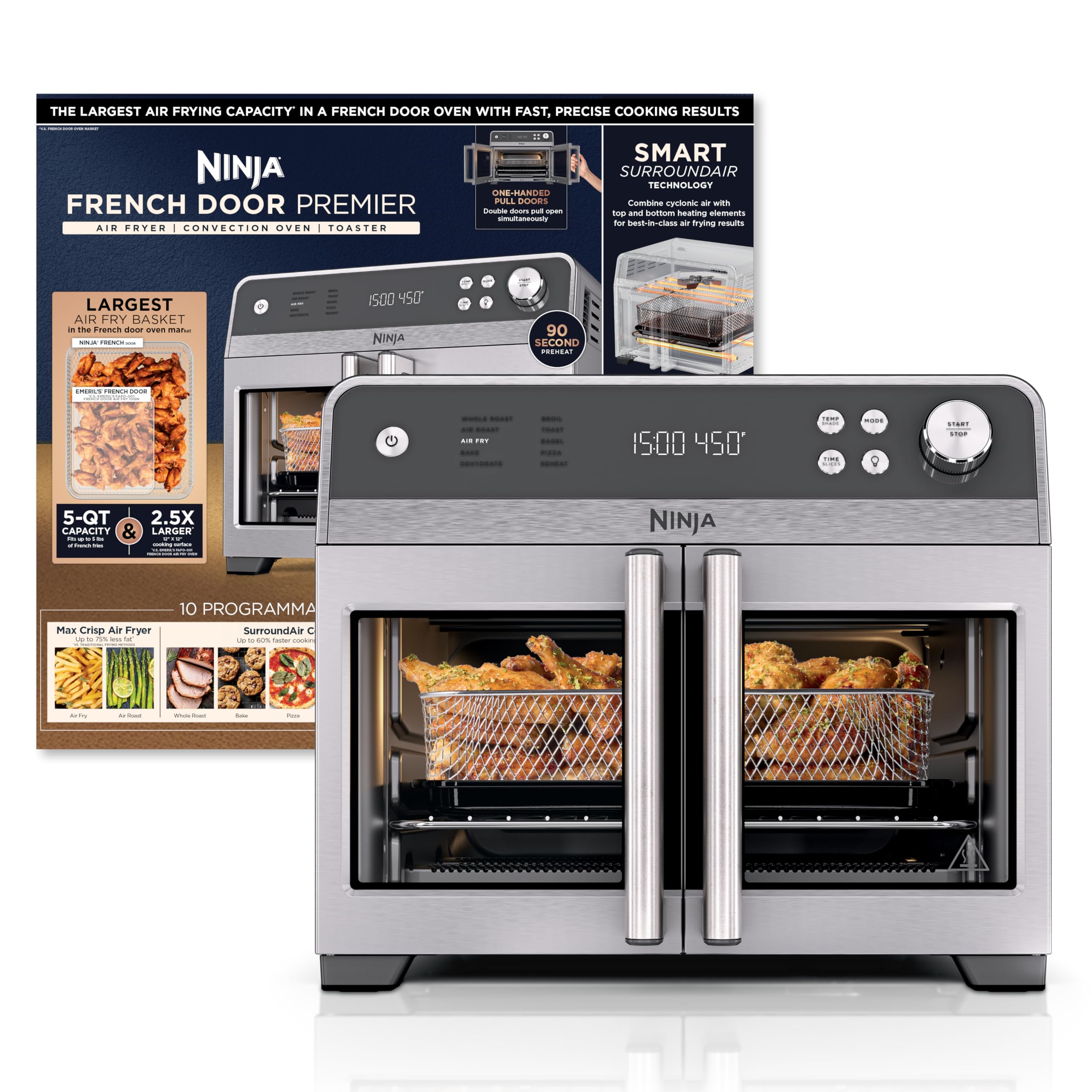
Not everyone wants drawers. Some households want an appliance that feels like a mini oven that just happens to air fry extremely well. That’s where the FO101 shines. It’s designed as a multi-function countertop oven with a French-door approach that makes access feel smooth and “kitchen friendly,” especially when your counter space is tight and you hate fighting a single door that swings wide.
The FO101 is the right kind of “premium” for people who care about the daily experience: quick preheating, even cooking, and a layout that can handle family-sized portions in an oven format. It’s also notable for a materials story many buyers actively prioritize: a PFAS-free cooking surface approach, plus dishwasher-safe accessories that make upkeep realistic. That combination—performance + peace-of-mind materials + manageable cleaning—hits a sweet spot for a lot of modern kitchens.
In real-world reviews, the pattern is consistent: fries and chicken tend to come out crispy and even, and the appliance feels efficient enough that people start using it instead of their full oven for everyday cooking. The “oven style” also makes certain foods easier than drawer models: toast, bagels, sheet-pan style bakes, and foods you’d rather lay flat.
The trade-off is accessory management. Oven-style units often require stacking racks, using trays, and remembering crumb trays. That’s not a dealbreaker—it’s just a different lifestyle. If you want “pull drawer, dump food, push start,” drawers win. If you want “toast in the morning, air fry at lunch, bake at dinner,” the FO101 can feel like one of the most useful appliances you own.
This model makes the most sense when your idea of “air frying” is part of a broader daily cooking routine—not a single-purpose crisp machine. If you want an appliance that can genuinely reduce how often you use a full oven, this is a strong contender.
Why people love the format
- Oven-style versatility – Toast, bake, broil, and air fry in one daily appliance.
- French-door convenience – Easier access and a cleaner counter workflow.
- Efficient cooking – Quick preheat and even results for many everyday foods.
- Easy-clean setup – Dishwasher-safe accessories reduce maintenance friction.
Good to know
- More accessories means more “pieces” to manage compared to drawers.
- Some foods may behave more like broiled convection than deep crisp air frying; technique matters.
- If you only want dual baskets for two foods, drawer units can feel simpler and faster to live with.
Ideal for: households that want an oven-style all-in-one—air fry plus toast and bake—especially if you value daily versatility and an easy-clean accessory ecosystem.
10. Ninja DCT451 Smart Double Oven – Two Meals, Two Ways, Without Flavor Crossover Drama

The DCT451 is not a drawer air fryer. It’s a countertop “two ovens in one” system that happens to air fry—especially in the bottom convection/air fry cavity. And that distinction matters because it changes what the appliance is for: this is for households who want two separate cooking environments at once, often at different temperatures, and who are tired of sacrificing one person’s meal to accommodate the other.
The signature idea is FlexDoor: you can open only the top cavity for quick tasks (toast, reheats, small bakes) or open the full door to access both cavities. In daily life, that becomes a time-saver because you stop “disturbing” one cook to manage the other. Then there’s FlavorSeal: separate cavities designed to reduce smell transfer. If you’ve ever tried to cook fish while someone in the house hates fish (or cook meat while someone avoids it), you already understand why that matters. It’s not just preference—it’s the difference between “we can do this together” and “we need two separate cooking days.”
The Smart Finish concept here is about syncing two ovens so your full meal finishes together. Owners often praise that feeling of efficiency: you spend less time cooking, and you’re not firing up a large oven for everything. They also mention build quality, useful included pans, and an interface that becomes very easy once you’ve used it a few times. The included thermometer system can also reduce doneness anxiety, especially for roasts.
The honest criticisms are the kind you only discover after living with it. Some people wish the top cavity had the same air-fry flexibility as the bottom, because they want to air fry in both zones at once. Others mention accessory quirks like crumb tray management or handle clearance depending on where the oven sits on the counter. These aren’t dealbreakers—they’re “know your habits” details. If your daily use is mostly bottom air fry + top toast/reheat, it’s fantastic. If you want air fry in both cavities constantly, you may feel limited.
This is the model for people who want a countertop appliance to do what a full kitchen often struggles to do: cook two different meals simultaneously without compromise.
Why it’s a standout oven concept
- True dual-cavity cooking – Two separate environments, two controls, less compromise.
- Flavor management matters – Helpful for households cooking very different foods.
- Smart Finish feels powerful – Sync full meals without back-to-back cooking.
- High “daily usefulness” – Toasting, reheats, bakes, and air frying all in one footprint.
Good to know
- Air fry capability differs by cavity; understand which zone does what before you buy.
- Accessories and trays add convenience but also add pieces to clean and manage.
- Counter placement matters for door clearance—plan where it will live.
Ideal for: households that regularly cook different foods at different temps—and want a countertop system that reduces full-oven usage while keeping meals synced and flavors separated.
11. Ninja DCT601 Double Stack XL Countertop Oven – When You Want Your Countertop to Run the Show

The DCT601 is for a specific kind of buyer: someone who doesn’t want a “helpful appliance,” they want a kitchen upgrade. This is a large, premium countertop oven system designed around the idea that you can run two cooking zones at once, sync them, and treat your countertop like a mini cooking station that can handle real meals with less reliance on a wall oven.
What makes this style compelling is the workflow. You can do an entrée in one zone and sides in the other. You can do family meals faster by eliminating back-to-back cooking cycles. You can toast, bake, roast, and air fry in a format that feels more like cooking and less like “drawer management.” For households that cook daily and hate juggling multiple appliances, the consolidation can feel like the biggest win.
Owners who love this kind of double oven often mention two emotional benefits: (1) fewer decisions (“I can do everything here”), and (2) faster routines (“I’m not waiting for the oven to preheat and then cooking in waves”). They also tend to praise build feel and performance—especially for foods like chicken, fries, and everyday baked items. The dual-zone concept helps with “two meals at once” life: kids’ food in one zone, adults’ food in the other.
The trade-offs are the ones you’d expect from a large countertop oven: it’s heavier, it takes more space, and accessories like sheet pans and baskets may require hand washing depending on how you use them. This is the kind of appliance that rewards an organized kitchen routine. If you hate cleaning racks and trays, drawer models feel simpler. If you love the idea of a countertop oven replacing several separate appliances, the DCT601 can feel like a “why didn’t I do this sooner” purchase.
In other words: this isn’t the pick for minimalists. It’s the pick for cooks who want capability, speed, and flexibility in a single countertop centerpiece.
Why it feels like an upgrade
- Two-oven workflow – Cook different foods differently at the same time.
- Versatility is real – Roast, bake, toast, and air fry in one consolidated setup.
- Great for busy households – Kids + adults, entrée + sides, and synced timing.
- Can reduce full-oven reliance – Especially for everyday meals and quick bakes.
Good to know
- It’s a footprint commitment; measure depth and clearance where it will live.
- More accessories mean more cleaning, especially with daily use.
- If you only want two-basket crisping, drawer-style DualZone models feel simpler.
Ideal for: households that cook often and want a premium countertop “two-zone cooking station” that can handle a wide range of meals and reduce reliance on a full-size oven.
How Dual-Zone Timing Actually Works (and Why Some Foods Crisp Better Than Others)
Dual cooking feels magical when it works—and mildly annoying when it doesn’t. The difference is rarely “the machine is bad.” It’s almost always about how air frying behaves with moisture, thickness, and airflow. Once you understand those three variables, you can predict results before you press Start.
Smart Finish: what it’s really doing
Smart Finish is basically a timing coordinator. You set two different programs, and the unit manages start/stop timing so both zones end together. That means you can stop hovering and stop doing mental math. But Smart Finish is not a miracle button—it cannot make a slow food cook as fast as a fast food without consequences.
- Best Smart Finish pairings: wings + fries, salmon + potatoes, sausages + vegetables, nuggets + fries.
- Trickier pairings: thick chicken breast + thin vegetables (one wants time, the other wants gentleness).
- High-risk pairings: wet, sugary sauces + dry crisp foods (the sauce can burn while the crisp food is still perfect).
If you want Smart Finish to feel flawless, pair foods that live in the same “temp neighborhood,” and add sauce late. That one habit solves a surprising number of complaints.
Match Cook: why it’s secretly your best “family mode”
Match Cook copies the same settings to both zones. That’s the mode you use when you want big batches: fries in both baskets, wings in both baskets, nuggets in both baskets, or meal-prep proteins split across drawers. This is where dual baskets earn their keep—because batch cooking stops being a one-hour project.
- Match Cook thrives on spacing. If you layer too tightly, you steam instead of crisp.
- One shake = better texture. Even “hands-off” air frying usually needs one mid-cook movement for best results.
- Use two baskets as a strategy. When one basket is crowded, split the load. That’s literally what you bought the machine for.
Why fries are easy and vegetables can be tricky
Fries are high-starch and designed to crisp. Vegetables are water-heavy, which means they can go from “crispy edges” to “roasted softness” depending on how you cut them and how you load the basket.
- For crisp veg: cut smaller, dry well, use a little oil, and don’t overcrowd.
- For roasted veg: cut larger, accept a softer finish, and aim for caramelization rather than crunch.
- For marinated proteins: pat dry and add sticky sauce late so you don’t burn sugars before the inside is done.
Stacked drawers: why racks help (and when they hurt)
With stacked models, racks can be brilliant because they create “two layers” of airflow. But racks also punish sloppy loading. If you block airflow with a dense pile, the top food steams and the bottom food browns unevenly. A simple rule improves results immediately:
- Think “gap, not pile.” Leave spaces between pieces on racks.
- Rotate once. Mid-cook rotation or shake is your consistency insurance.
- Use racks for the right foods. Wings, veggies, and smaller proteins love racks. Heavy, wet foods need more room and sometimes prefer the base level.
When you treat dual-zone cooking as airflow management instead of “set it and forget it,” your results get consistently better—and dinner stops feeling like a gamble.
FAQ: Dual Air Frying Without the Confusion
Do I actually need two zones, or is this just a fancy upgrade?
Smart Finish or Match Cook—what should I use most?
Why do my fries sometimes come out uneven?
Are stacked models harder to use than side-by-side drawers?
Which style is easiest to clean?
What’s the best model if we cook two different diets in one house?
Should I buy renewed or new?
Final Thoughts: Pick the Model That Makes Dinner Feel Easy
Here’s the simplest way to use this guide: choose the format first, then choose the model. If you pick the format that matches your counter and your habits, the “right” model becomes obvious.
- Want the best all-around dual-drawer pick? Start with the Ninja DZ550 Foodi DualZone Smart XL. The thermometer is the feature that reduces dry proteins and turns “guessing” into “confidence.”
- Need big capacity but your counter is narrow? Choose the Ninja SL401 DoubleStack XL or the smaller Ninja SL201 DoubleStack if you want the stacked footprint and you’re willing to learn the rack rhythm.
- Want the most intuitive “classic two drawers” experience? The Ninja DZ201 Foodi DualZone is still one of the easiest models to own and use daily.
- Cook big proteins and want one big zone sometimes? Grab the Ninja DZ071 FlexBasket MegaZone for the divider-in/divider-out flexibility.
- Cooking mostly for one or two people? The Ninja DZ090 DualZone (6QT) is a practical “two foods at once” solution that fits smaller households.
- Want a value-first approach with serious capacity? Consider the renewed options: Ninja Foodi XL DualZone (Renewed) or Ninja DualZone 8-qt (Renewed). Just do the quick inspection checklist on day one.
- Prefer an oven-style daily appliance? The Ninja French Door Premier FO101 is a great “air fry + toast + bake” centerpiece if you want versatility more than drawers.
- Want two true oven cavities for two different meals? Look at the Ninja DCT451 Smart Double Oven or the more premium Ninja DCT601 Double Stack XL Countertop Oven if you want a bigger “countertop runs the kitchen” upgrade.
The best buy is the one you’ll use constantly without fighting it. Pick the format that matches your counter and your habits, then choose the features that reduce your stress (thermometer, stacked footprint, MegaZone flexibility, or true dual ovens). Do that, and the ninja double air fryer you choose won’t just cook dinner—it’ll make dinner feel manageable.
