
Buying a countertop oven should feel like a simple upgrade. But the moment you search, you get hit with the same recycled advice: “More watts is better,” “bigger is better,” “this one has 15 presets.” And then you bring it home… and toast comes out patchy, air fry turns “crispy” into “dry,” your kitchen smells like yesterday’s wings, and cleaning feels like a chore you didn’t sign up for.
Here’s the truth: a digital air fryer toaster oven isn’t one appliance. It’s a set of competing jobs in one box: toast wants stable radiant heat and consistent browning, air fry wants aggressive airflow and spacing, and bake wants predictable temperature and a cavity that doesn’t create hot spots. When brands “win” at one job, they sometimes compromise another. That’s why the best choice depends on how you actually cook (and what you refuse to clean).
This guide is built to make you confident, not overwhelmed. I’m using real-life friction points pulled from owner feedback: how a French door behaves when your hands are messy, whether a flip-up design actually saves counter space in real kitchens, what happens when grease hits a heating element, how loud fans feel in open-concept homes, why some ovens toast evenly and others don’t, and which accessories you’ll truly use instead of stuffing them in a drawer.
Below you’ll find 15 picks—from budget French-door workhorses to “replace your main oven” beasts, plus a unique steam-and-crisp multicooker that changes the whole weeknight game. Each review goes deeper than the listing page so you can choose once and feel good about it.
In this article
- How to choose the right oven for your cooking style (and your patience).
- Quick comparison table of 15 standout models.
- In-depth reviews of each oven, with real-world pros and cons.
- How air fry + toast + bake really work in one cavity (and why it matters).
- FAQ + final buying tips for the “no-regrets” pick.
How to Choose a Digital Air Fryer Toaster Oven That Actually Fits Your Kitchen
A great countertop oven doesn’t just cook food—it removes friction from your day. The right model feels like you gained time, counter space, and consistency. The wrong model feels like you bought a loud fan with a personality. Here’s the framework that keeps you out of “return box” territory.
1. Start with your real “anchor use,” not the marketing
Most people buy one of these for a specific reason, then discover they want it to do everything. That’s normal. But your anchor use is the job you’ll do most often—and it should drive your decision:
- Toast-first households: You want even browning, predictable shade, and a workflow that doesn’t punish you for making breakfast daily.
- Air-fry-first households: You want aggressive airflow and an air-fry basket that actually crisps without drying, plus easy grease management.
- Bake-first households: You want stable temperatures, space for real pans, and even heat on more than one rack (cookies, casseroles, bread).
- “Replace my oven” households: You want capacity, speed, and reliability—something that can handle real dinners, not just snacks.
2. Understand the 3 different heat systems you’re buying
A lot of buyers assume “air fry” is just “convection.” It’s not. Most countertop combos use a mix of three heat behaviors:
- Radiant heat: Top and bottom heating elements. This is what browns toast and finishes casseroles.
- Convection: A fan moves hot air around for more even cooking and faster bakes.
- Air fry: A stronger fan profile (often higher velocity) designed to drive crisping—especially on surfaces exposed to airflow.
Why it matters: ovens that excel at air fry can sometimes “over-agitate” lightweight foods (think: shredded cheese on toast or parchment lifting). Ovens that excel at baking can sometimes feel “just okay” at air fry because airflow is gentler. The best models balance it.
3. Capacity isn’t just liters or quarts—it’s “usable geometry”
This is where online guides get lazy. What you want isn’t “the biggest number.” You want the cavity to match the shapes you actually cook:
- Pan fit: Can it handle a 9"x13" pan, quarter sheet, loaf pan, or cast iron skillet without awkward angles?
- Height clearance: Can you roast without the top element scorching the surface before the middle cooks?
- Rack positions: Are there enough rack levels to control browning and airflow without guesswork?
- Door ergonomics: Does the door design (French door vs dropdown) make you more likely to check food and adjust—without burning your wrist?
A classic example from real kitchens: some flip-up designs save space brilliantly but trade away interior height. That’s a perfect trade if you’re toast + air fry + reheat heavy. It’s a frustrating trade if you bake tall loaves or roast big cuts.
4. Cleaning is not an afterthought—it’s the deal
When owners complain, it’s rarely “it doesn’t cook.” It’s usually “I’m tired of cleaning it.” Countertop ovens concentrate airflow, which means they also distribute aerosolized oil inside the cavity. If you cook skin-on chicken, bacon, or oily fish often, you’ll see it.
Here’s how to predict cleaning pain before you buy:
- Interior material: Stainless interiors wipe down easier than painted interiors when oil film builds up.
- Crumb tray design: Front-pull trays are easier to empty without spilling. Shallow trays fill quickly.
- Heating element exposure: Exposed elements crisp well but can smoke if drips land on them. Shields reduce splatter but can hold residue.
- Accessory dishwasher safety: Dishwasher-safe baskets and pans reduce friction dramatically—especially for daily air fry users.
5. Controls: Touchscreen vs dial isn’t about “modern”—it’s about speed under pressure
A digital display looks premium. But ease is more important than style. Owners tend to fall into two camps:
- Dial lovers: You want “turn and go” cooking with minimal menu layers. This is especially satisfying for toast and quick reheats.
- Program lovers: You want repeatable presets, precision increments, and features like probes or heater ratio control for pizza and proteins.
Neither is “better.” But the wrong control style for your personality is how a great oven becomes an annoying oven. If you hate fiddly interfaces, choose simpler controls even if it means fewer modes. You’ll use it more.
6. Noise and venting: the reality check most listings hide
Air fry requires airflow. Airflow requires a fan. So yes—many models make noise. The question isn’t “is there noise?” It’s “is the noise annoying in your space?” Open kitchens, studio apartments, RVs, and homes with sleeping kids make this a real factor.
- High-velocity fans: Great crisping, more audible.
- Steam-assisted units: Can vent moisture—needs overhead clearance and breathing room.
- Rear venting: Needs a little space behind the unit, especially for hot exhaust.
If your oven lives under cabinets, look for models described as fitting under standard cabinets (and still be smart: leave breathing room). If your oven lives in a tight corner, prioritize a footprint that doesn’t force you into awkward placements.
7. Use-case cheat sheet (pick your “kitchen persona”)
- Family meal machine: You want big capacity, stable bakes, and true dinner ability. Look at Ninja DT501, Cuisinart TOA-112, Emeril French Door.
- Weeknight speed freak: You want “full meal fast” with less babysitting. Look at Ninja Combi or powerful convection models.
- Small-counter hero: You want real performance without permanent footprint. Look at Ninja SP151/SP101 or compact smart ovens.
- Control nerd / pizza perfectionist: You want heater ratio and precision. Look at NuWave Bravo models.
- Value-first (but still legit): You want real cooking without paying for hype. Look at Midea Flexify, Gourmia, and the better budget large-cavity options.
Once you know your persona, the rest gets easy. Now let’s make it visual.
Quick Comparison: 15 Digital Air Fryer Toaster Oven Picks
Use this table to narrow down your best matches—then jump to the deep reviews for the real-life details like toast behavior, airflow personality, cleaning reality, and “will I love using this daily?”
On smaller screens, swipe or scroll sideways to see the full table.
| Model | Style | Signature strength | Best match | Amazon |
|---|---|---|---|---|
| Ninja French Door Premier FO101 | French door | Fast, even “family-sized” performance + easy-clean accessories | Most households wanting premium everyday cooking without fuss | Amazon |
| Ninja Prestige Smart XL DT501 | XL oven | 2-level even cooking + big batch capacity + fast preheat | Families who bake/roast often and want “main-oven” capability | Amazon |
| Cuisinart TOA-112 (15-in-1 Extra-Large) | Extra-large | Precision probe + 9"x13" pan system + quiet, under-cabinet-friendly profile | “Cook proteins perfectly” buyers + batch meal preppers | Amazon |
| Ninja Combi SFP701 | Steam + crisp | Complete meals fast with HyperSteam + air fry finish | Busy households wanting “dinner in one appliance” speed | Amazon |
| Cuisinart TOA-65 (Digital Display) | Digital pro | Powerful convection + air fry results that owners compare head-to-head | Premium shoppers who want speed and crispness in one box | Amazon |
| NuWave Bravo XL 30-QT (12-in-1) | Smart control | Top/bottom heater ratio control + integrated temperature probe | Pizza tweakers, roast perfectionists, and control lovers | Amazon |
| Emeril Lagasse French Door 26QT | French door | Party-host capacity + lots of presets + rotisserie ecosystem | Families cooking for 4–6 who want one “do-it-all” counter oven | Amazon |
| Midea Flexify French Door 26.4QT | French door | Even heat system + fast air fry workflow + refined knobs/buttons | Value-smart buyers who still want “premium behavior” | Amazon |
| Beelicious Pro 28QT (12-in-1 + Rotisserie) | Big cavity | Three-rack cooking + rotisserie accessories for “real meal” output | Budget-minded families wanting size + versatility | Amazon |
| NuWave Bravo 21-Qt (10-in-1) | Compact smart | Adjust-on-the-fly controls + top/bottom heat tuning | Small kitchens wanting precision without huge footprint | Amazon |
| Ninja Flip SP151 | Flip-up | OvenCrisp + flip-away storage without feeling “tiny” | Small counters, apartments, RVs, and “space is gold” kitchens | Amazon |
| Ninja SP101 (Flip-Up Classic) | Flip-up | Fast preheat + easy deep cleaning access + proven daily performance | People who want a reliable “toast + air fry + bake” staple | Amazon |
| Cuisinart TOA-70NAS (Dial + Grill) | Analog ease | Simple dials + surprisingly quiet air fry + grill/griddle versatility | “I hate menus” buyers who still want crisp results | Amazon |
| Gourmia French Door 25QT | French door | High value capacity + strong everyday versatility with smart tray use | Budget shoppers wanting big capability without drama | Amazon |
| Ninja FT205CO / FT405CO (Renewed) | Renewed deal | Flip-away storage + faster cooking in a renewed package | Value hunters who want flip-up convenience at lower cost | Amazon |
In-Depth Reviews: 15 Digital Ovens That People Actually Keep Using
Now we go model by model. I’m going to talk like a real cook, not a spec sheet: what feels effortless, what feels picky, which features matter after week three, and what owner feedback reveals about long-term happiness.
1. Ninja French Door Premier FO101 – The Premium “Everyday Easy” French Door Win
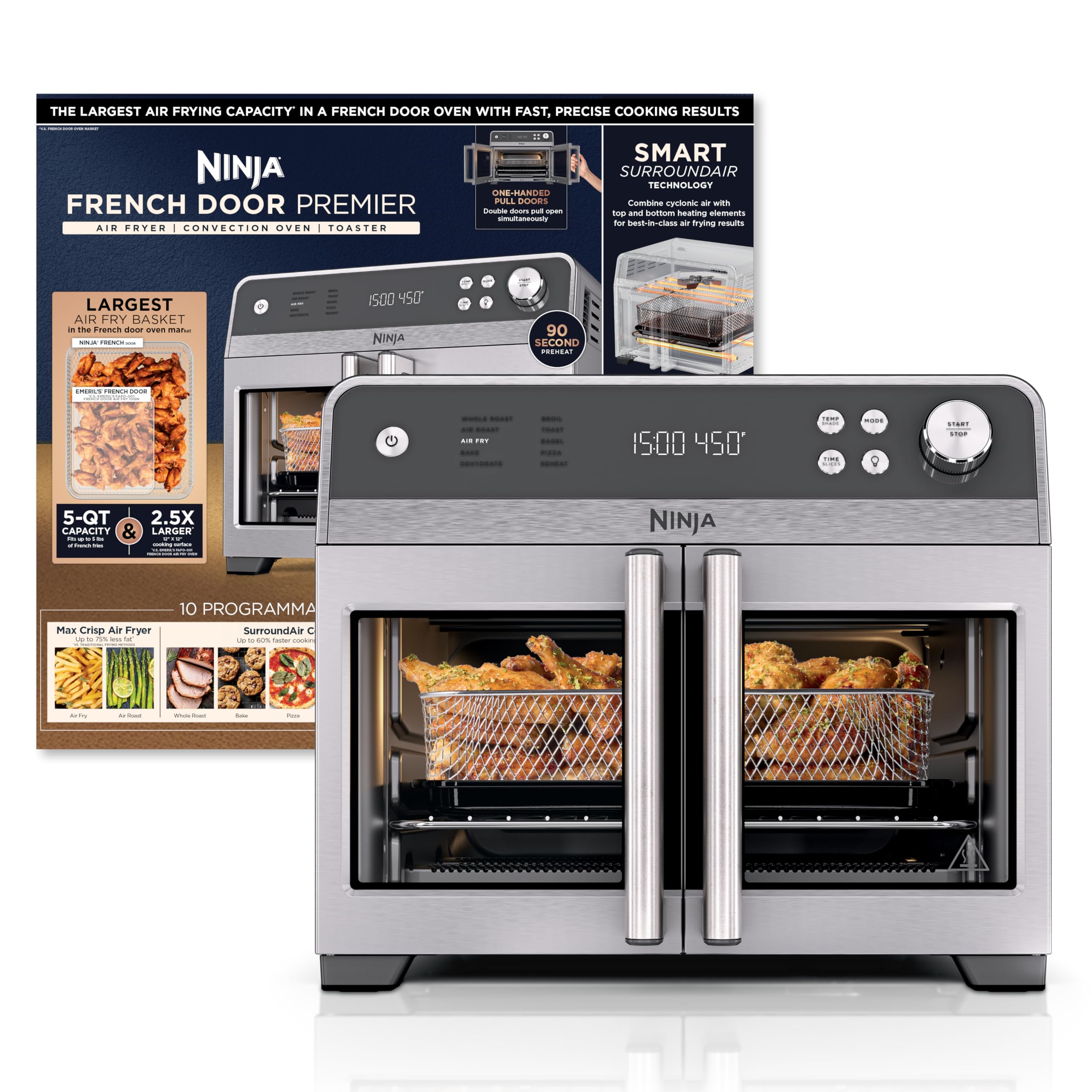
This is the kind of oven you recommend to a friend because it doesn’t require them to become a “countertop oven person.” The FO101 nails the two things most people truly want: it cooks evenly and it doesn’t punish you for using it daily. That second part is bigger than it sounds—because many powerful ovens fall apart emotionally when cleaning becomes annoying.
The French door design is a real usability upgrade when you cook often. One-handed access matters when you’re holding a tray, turning food, or checking doneness without wanting a heavy dropdown door in your way. Owners consistently praise how fast it cooks and how intuitive it feels once you do a few runs—especially for toast, pizza, and air-fry staples.
The secret sauce is the “evenness profile.” In countertop ovens, uneven heat causes weird problems: toast that’s darker on one side, cookies that brown at the back, and chicken that dries on the edges before the center catches up. This model’s design focus is even circulation without constant rotation rituals, which is exactly what makes it feel premium in real life.
And then there’s the cleanup factor: dishwasher-safe accessories and an easy routine make this feel like a tool you keep out, not a gadget you avoid. If you want one oven that’s satisfying for weeknights and still presentable on your counter, this is it.
Why you’ll like it
- Effortless French door workflow – Easy access, less awkward checking, and better tray handling in tight spaces.
- Even cooking personality – Built to reduce hot-spot babysitting and “rotate halfway” fatigue.
- Fast preheat + confident results – Great for real-life cooking where you want dinner started now.
- Cleanup-friendly ecosystem – Dishwasher-safe accessories reduce friction for frequent air fry users.
Good to know
- Like any powerful countertop oven, it still needs breathing room—give it space behind and above for venting.
- French door glass and stainless still get warm; treat it like a real oven and use smart placement.
- If you mainly bake very tall items, confirm interior height is right for your tallest dish.
Ideal for: households that want one premium, easy-to-live-with French-door oven that feels fast, even, and low-drama day after day.
2. Ninja Prestige Smart XL DT501 – When You Want “Main Oven Energy” on the Counter

The DT501 is the “I’m tired of my full-size oven” solution—especially for families who cook a lot but hate long preheats, summer heat, or the inefficiency of firing up a big oven for a simple dinner. Owners regularly describe it as fast, versatile, and big enough to handle real meal workloads: roasting, baking, air frying, reheating leftovers without turning them into cardboard.
What makes this model stand out is the two-level even cooking promise. In many countertop ovens, multi-rack cooking is technically possible but practically annoying: one tray cooks faster, you rotate, you swap shelves, and you still get uneven browning. The DT501 is designed to reduce that ritual so you can run cookies on more than one level without playing tray chess.
Now the honest truth: this is a powerful unit with a real presence. It needs space. It vents. It’s not the tiniest footprint. But if you’re buying it, you’re buying it because you want a countertop oven that behaves like a real oven—without the slow warm-up and wasted energy. This is also a favorite for people who cook protein-heavy meals: wings, drumsticks, steaks, roasted vegetables, and “quick dinner” trays.
One nuance from owner feedback: toasting can be good, but some people still prefer a dedicated pop-up toaster for perfect toast consistency (especially if your household is super picky about shade). If toast is your number-one priority, consider a model known for toast behavior. If dinner and batch cooking are your priority, this is a beast.
Why it wins big kitchens
- True family capacity – Built for “cook real dinner” needs, not just snacks.
- Two-level cooking advantage – Reduces tray swapping, rotation, and uneven frustration.
- Fast preheat – Owners love the speed vs traditional ovens, especially for weeknights.
- Versatile modes – Air fry, bake, roast, dehydrate, pizza—covers a wide household menu.
Good to know
- It’s big and vents from behind—plan counter placement with breathing room.
- Fan noise exists (air fry needs airflow). Most users find it reasonable, but it’s not silent.
- Cleaning is easiest if you adopt a “catch pan” habit early to prevent drips and splatter buildup.
Ideal for: families who bake, roast, and batch cook often—and want a counter oven that feels like a true replacement, not a side gadget.
3. Cuisinart TOA-112 – The “Cook Proteins Perfectly” Extra-Large Digital Workhorse
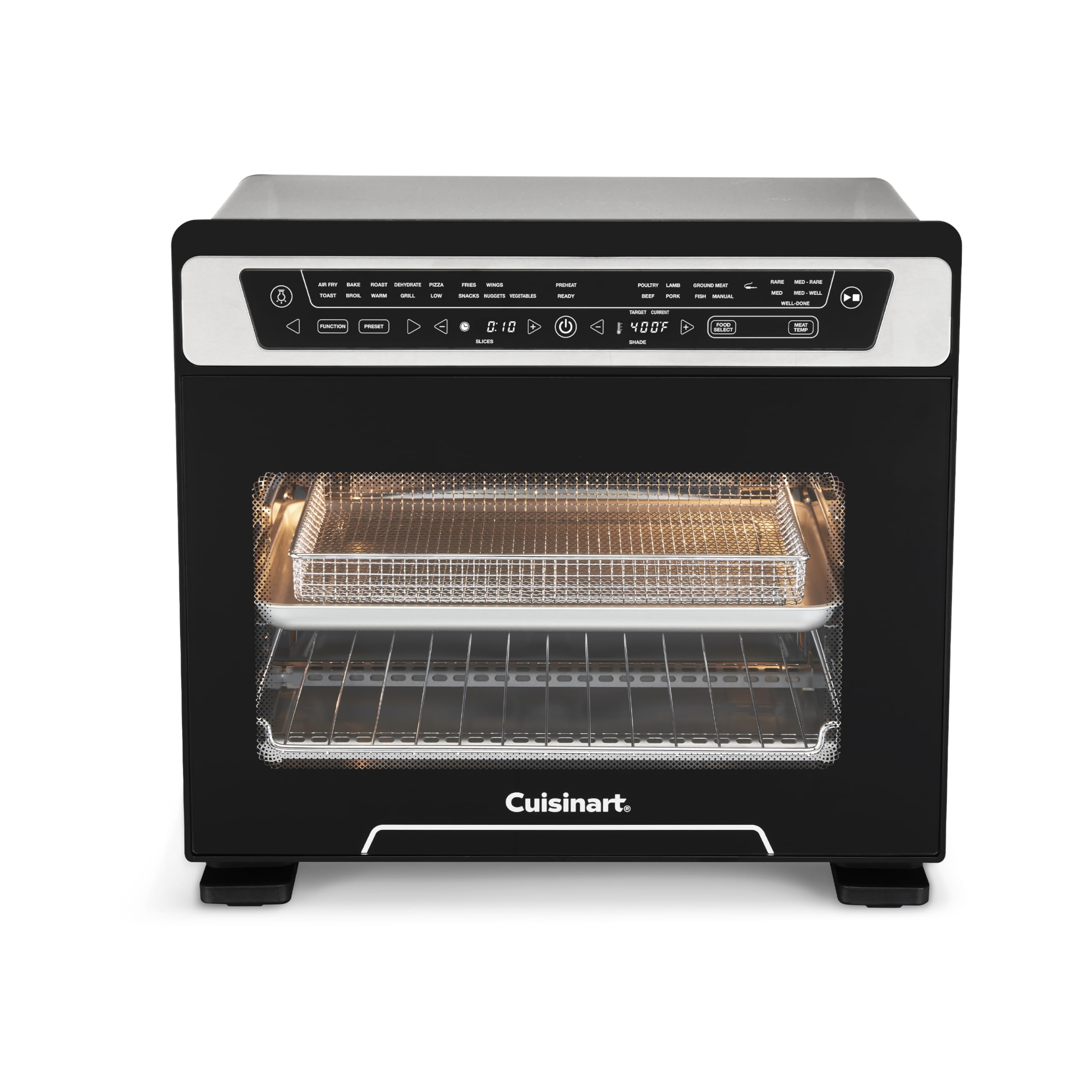
If you’ve ever overcooked chicken because you guessed, or undercooked a roast because the outside looked done, this model’s best feature isn’t the number of functions—it’s the confidence. The IntelliTemp-style probe approach is about repeatability: you want “hit the target internal temperature” without hovering, cutting, or re-guessing every time. For a lot of home cooks, that’s the difference between “I use it daily” and “I only use it for snacks.”
The second thing that makes this oven feel like a serious kitchen tool is the pan ecosystem. A true 9"x13" solution on a countertop changes batch cooking: casseroles, sheet-pan meals, big cookie runs, or splitting foods for picky eaters. Owners specifically mention the convenience of fitting under cabinets and being quieter than expected for its size—small details that matter in real kitchens.
What you should expect with a powerful, extra-large cavity: it cooks faster than many people anticipate. That’s a compliment, but it comes with an adjustment period. The happiest owners are the ones who treat week one like calibration: check early, learn your rack positions, and once you dial in, it becomes incredibly consistent.
The interior being stainless is also not a throwaway feature. Oil film and baked-on residue happen in air fry ovens. Stainless interiors tend to wipe down cleaner and feel less “forever grimy” than painted cavities over time. If you’re the kind of person who wants your appliances to stay looking good, that matters.
Why it’s a “serious cook” pick
- Probe-driven confidence – Perfect for proteins and roasts when you want accuracy, not guesses.
- Real batch capacity – The 9"x13" setup changes the practicality of countertop cooking.
- Stainless interior – Easier long-term wipe-down and less “oil film despair.”
- Quiet, under-cabinet-friendly shape – A big win for kitchens with limited vertical space.
Good to know
- Cooking is fast—plan to check earlier than your old oven until you learn the rhythm.
- Like most powerful ovens, air fry performance is best when food is spaced; overcrowding reduces crispness.
- If you want a “set it and forget it” toast machine, simpler dial models can feel faster for breakfast routines.
Ideal for: cooks who want precision (especially for meat and roasts) plus real batch capacity for family meals and meal prep.
4. Ninja Combi SFP701 – The Steam + Crisp Shortcut That Changes Weeknights

This is not a typical toaster-oven-shaped box—and that’s the point. The Ninja Combi is built around a different promise: cook a full meal with moisture and speed, then finish with crispness. Owners rave about the “how is this possible?” feeling: frozen proteins cooking quickly, steam keeping meat juicy, and an air-fry finish giving texture that doesn’t feel like reheated leftovers.
If you’ve ever tried to do “protein + grains + veg” as a weeknight routine, you know the pain isn’t just cooking—it’s timing. Rice finishes before chicken. Veg gets limp. The Combi approach is designed to synchronize components, which is why people describe it as replacing multiple appliances and saving cleanup. A big real-life advantage: the included pan doubles as a serving dish, which reduces the dish pile.
There is a learning curve (owners say this clearly), but it’s the fun kind: once you understand water ratios, rack placement, and how fast seafood cooks compared to chicken, you start designing meals around it. The “steam and brown” behavior is also fantastic for reheating leftovers without drying them out—something many air fry ovens struggle with.
One important practical note: steam means venting. This appliance needs space overhead and around it. Don’t trap it in a tight cabinet. Treat it like a real cooking machine, because it is. If your anchor use is toast and bagels, buy a toaster-oven style. If your anchor use is fast dinners with less dryness, this is a weeknight cheat code.
Why it’s different (and loved)
- Juicy + crispy combo – Steam protects moisture; air fry adds texture at the end.
- Meal synchronization – Designed for “complete meal” workflows, not just single-item cooking.
- Leftover revival – Reheats meats and casseroles with less dryness than typical convection-only reheats.
- Reduced dish load – Pan-as-serving-dish mindset keeps cleanup manageable.
Good to know
- Steam requires clearance—give it space and don’t crowd it under low cabinets.
- Grains can be picky until you learn your ratios; start with the recipe book to build confidence.
- If you want classic toast performance above all, a dedicated toaster oven style may feel more direct.
Ideal for: busy households who want fast, juicy dinners and better leftovers—especially if “dry chicken” is your weekly enemy.
5. Cuisinart TOA-65 – The Feature-Heavy Digital Oven Some Owners Call the “Head-to-Head Winner”
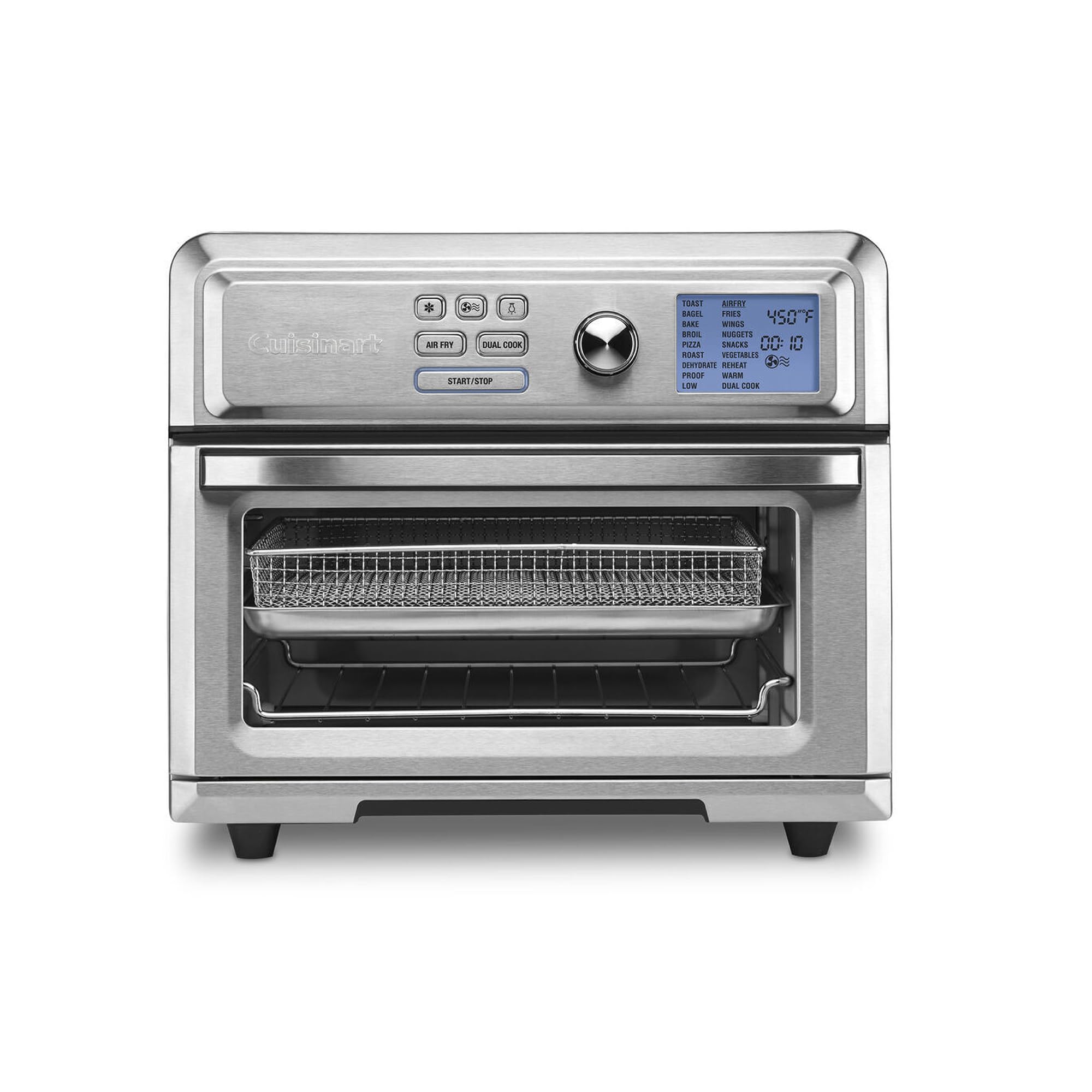
This is the model people buy when they’re done experimenting. It’s often purchased as an “upgrade decision” after living with a smaller toaster oven or a basket-style air fryer. Owners who love it talk about speed and crispness—and the satisfying feeling that it can handle both baking and air frying without feeling like a compromise.
What’s particularly interesting in real-world feedback is how often people describe direct comparisons. When someone cooks the same food in multiple ovens and keeps one, that tells you something: not just that it can crisp, but that it can bake without disappointing. That’s a rarer combination than most listings admit.
This is a power-forward oven. That means two things: it’s fast and it’s hot. You’ll likely need a little calibration time. Many owners end up learning their personal “truth settings” (for example, slightly adjusting temperature or time based on how the unit behaves). Once they do, it becomes a dependable daily driver.
The trade-offs are also real: digital interfaces can be a love/hate thing, and some owners report long-term quirks with the screen/knob system on digital-style ovens (not everyone experiences it, but it’s a theme worth knowing). If you’re the kind of person who wants “forever simple,” analog dials can be less stressful. If you want performance and features, this one’s a compelling choice.
Why people upgrade to it
- Fast, crisp air fry performance – High-velocity airflow can deliver great texture when food is spaced properly.
- Strong bake results – Owners often note it bakes better than some competitors they tested.
- Feature depth – Wide range of modes beyond just air fry + toast, useful for varied households.
- Feels like a “serious” countertop oven – Not toy-like, not flimsy—built for real use.
Good to know
- Expect a learning curve for timing—this cooks faster than many people anticipate.
- Digital interfaces can be divisive; if you prefer dials, consider TOA-70 or similar styles.
- Like many air fry ovens, cleaning is easiest if you prevent grease aerosol buildup with smart tray habits.
Ideal for: buyers who want premium performance and a deep feature set, and who don’t mind spending a few days calibrating cook times for perfect results.
6. NuWave Bravo XL 30-QT – The “Top/Bottom Heat Ratio” Tool for Pizza and Roasts

Most countertop ovens give you a preset and a hope. The Bravo XL gives you control. The standout feature here is the ability to tune the top and bottom heaters independently—this is huge for pizza, bread, and any scenario where you want a crisp bottom without torching the top. Owners who cook a lot love the “there’s no single correct way” flexibility: if the top browns too fast, dial it down. If the bottom needs more punch, dial it up.
The integrated temperature probe is another serious-cook upgrade. Instead of guessing when a roast is done, you set a target temperature and let the oven monitor. This is especially valuable because countertop ovens cook faster and can overrun doneness if you’re not careful. Probe-guided cooking reduces that risk.
Now the real-life nuance: air fry is solid, but owners frequently mention that large-cavity ovens can be slightly less “aggressive” than a dedicated basket air fryer. That doesn’t mean “bad”—it means you get better results when you treat air fry like airflow cooking: use the basket, don’t overcrowd, and give food space. Where this oven shines is being a true oven replacement for smaller households, couples, and anyone who wants to cook more than one thing without heating the whole house.
Long-term feedback tends to split into two groups: many users praise durability and versatility; some mention eventual electronic quirks (beeping/flashing) after heavy use. That’s common across many tech-heavy countertop appliances. If you want maximum reliability simplicity, dials win. If you want precision control, this is the playground.
Why it’s a power-user favorite
- Top/bottom heater control – The easiest path to better pizza and more controlled browning.
- Probe-guided cooking – Confidence for roasts, birds, and thick proteins.
- Large capacity – Handles real meals; fits many common pans comfortably.
- Versatile modes – Bake, roast, toast, reheat, dehydrate, and more without feeling limited.
Good to know
- Air fry performance improves dramatically with spacing; don’t treat it like a “pile everything in” basket fryer.
- It’s a bigger unit—plan counter placement and storage realistically.
- Tech-heavy appliances can develop quirks over time; keep it clean and ventilated to reduce strain.
Ideal for: pizza tweakers, roast perfectionists, and anyone who wants precise heat control rather than “preset roulette.”
7. Emeril Lagasse French Door 26QT – The “Check All the Boxes” Party-Host Oven
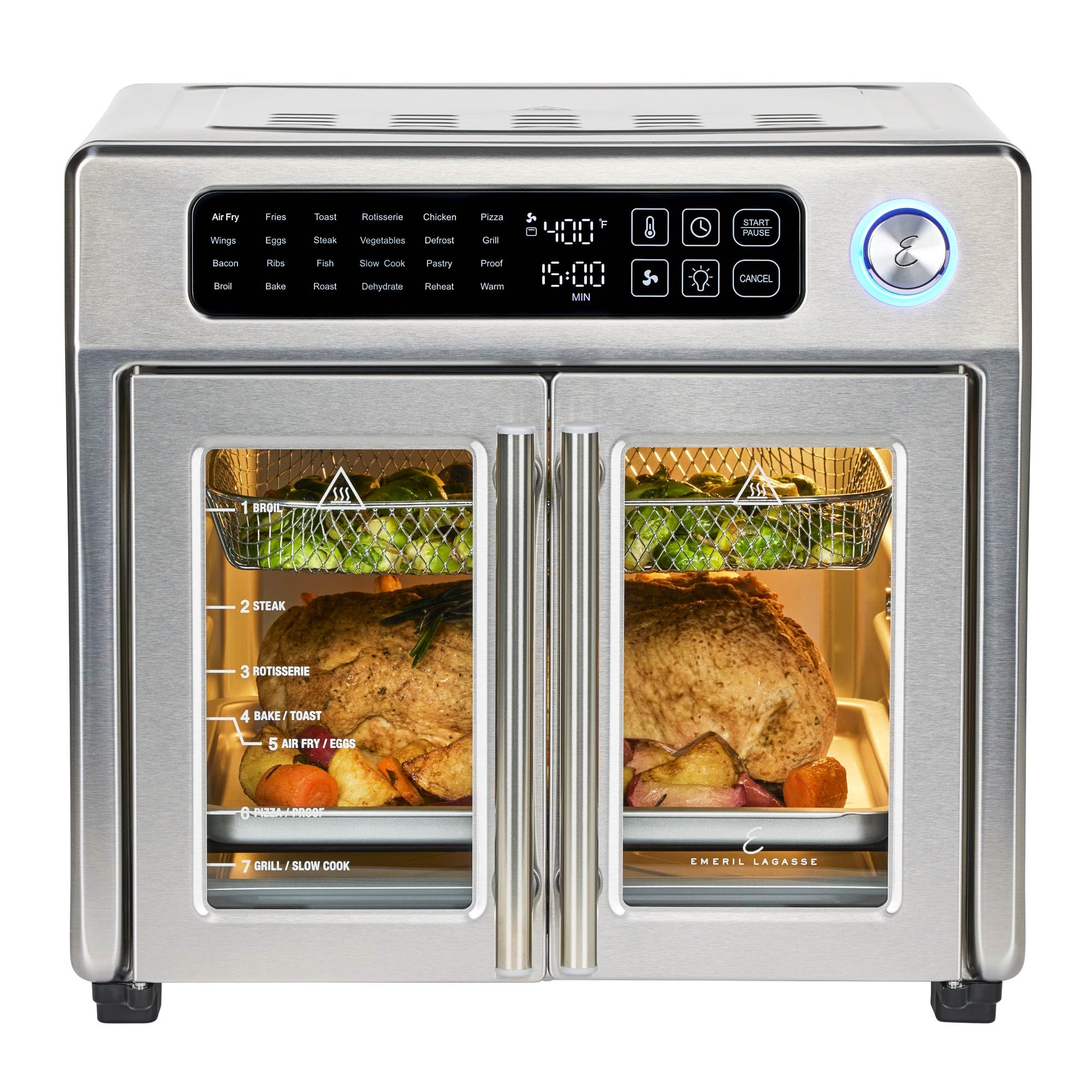
If your kitchen life includes holidays, feeding a crowd, or simply cooking multiple components at once, the Emeril French Door model is built for that reality. Owners describe it as “saved the holiday” when a main oven died—because it can bake, roast, air fry, and handle real pans without feeling like a toy appliance. That’s the core value: it expands what your countertop can do, not just how fast it can reheat.
The French door design is genuinely practical here. When you’re using bigger pans, the last thing you want is a heavy dropdown door taking up space. French doors make “check and rotate” easier and reduce awkwardness when you’re sliding a 9"x13" pan in and out. The built-in light also matters more than people think—monitoring browning without dumping heat is how you keep baking consistent.
Where this oven gets its love is variety. People use it for steak, chicken, potatoes, cookies, taquitos, dehydrating, and more. It’s the kind of appliance that becomes a daily tool because it covers so many meal types. It’s also one of the more “family-sized” French door options without requiring you to learn a complicated interface.
The main owner complaint to note is accessory ergonomics: some users dislike the basket handling and how it rides in tracks. This isn’t a dealbreaker, but it’s important because it affects your daily experience. If you air fry constantly, you want basket handling to feel secure. If you roast/bake a lot and only air fry occasionally, it’s much less of an issue.
Why families love it
- Large-cavity practicality – Handles real pans and real meals, not just snack portions.
- French doors + interior light – Easier checking, safer tray handling, and less heat dumping.
- Preset variety – Lots of functions for households that cook many styles of food.
- “Saved the day” reliability vibe – Often used as a backup or even a primary oven for months.
Good to know
- Some users dislike the basket ergonomics; practice handling and consider using a pan/basket combo for stability.
- Large cavity means you’ll want a regular cleaning routine to avoid oil film buildup.
- If you want precision heater ratio control (pizza nerd level), NuWave is better; if you want variety and volume, this shines.
Ideal for: families and hosts who want a big, versatile French-door oven that can stand in for the main oven when life gets real.
8. Midea Flexify French Door 26.4QT – Even Heat + Practical Controls Without the Premium Tax
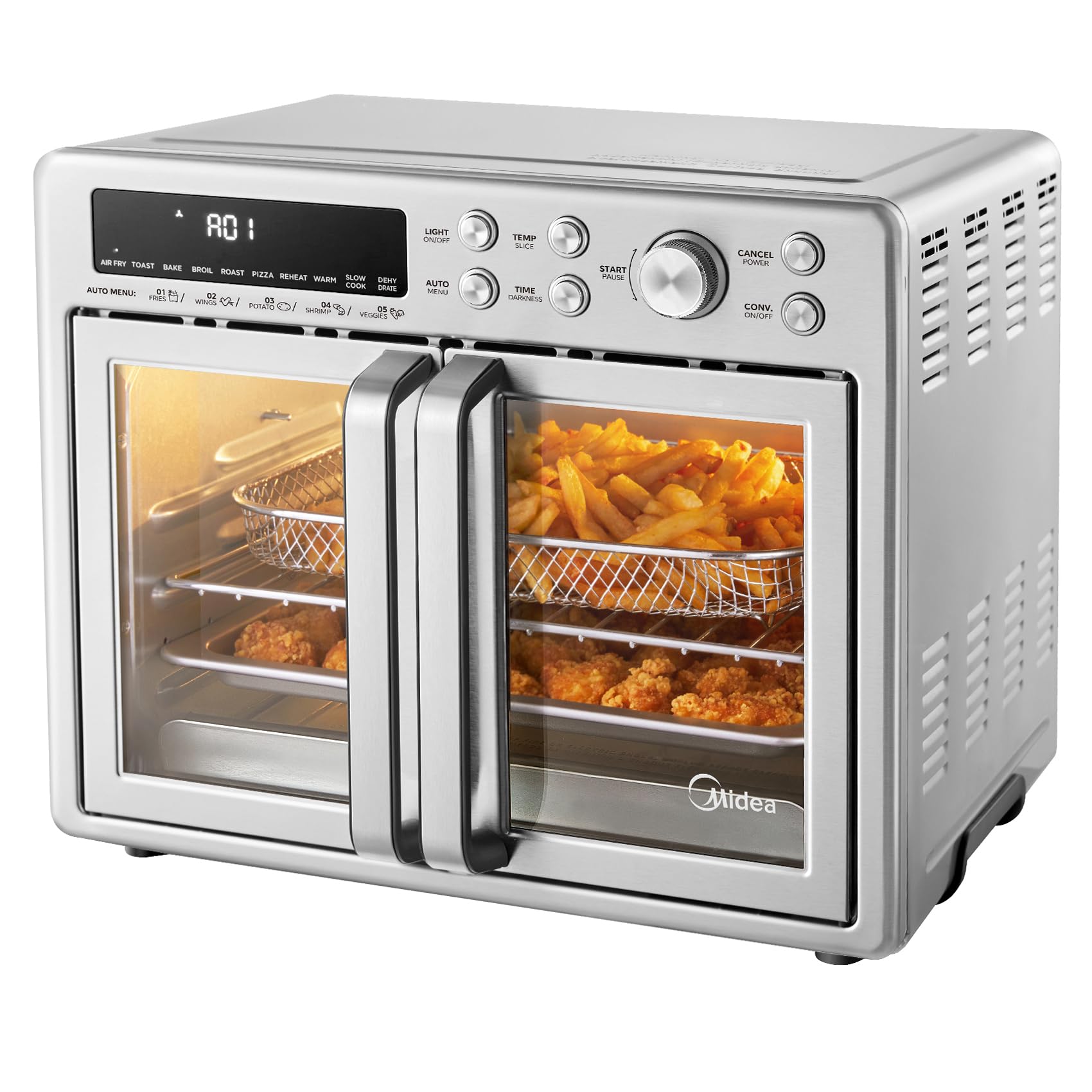
The Midea Flexify is the kind of product that surprises people because it feels more refined than they expected. Owners talk about even cooking, fast heat-up, and real baking ability—like fitting cast iron loaf pans or baking cookies without burnt bottoms. That “no burnt bottoms” comment is not small; it usually means the oven’s heat distribution is balanced enough that you’re not fighting the bottom element.
Controls are a huge part of why this oven works for real families. Many people dislike “touch pad mystery meat” interfaces, especially when you’re busy. The Flexify’s distinct knob + button approach hits a sweet spot: clear, tactile, and still modern. People also mention safety-oriented details like a sturdier plug style and doors that feel solid and functional, not gimmicky.
The best real-world use case is larger family cooking. Owners describe it as cooking bigger portions in one go—wings, ham, mac and cheese, roasted vegetables—without running multiple batches like a small air fryer. This is where French door geometry shines: easy access, less door intrusion, and better “load/unload” behavior for trays.
If there’s a trade-off, it’s the same one all larger countertop ovens have: it takes counter space. But owners who accept that tend to say the same thing: it earns that space back by replacing multiple appliances and keeping the main oven off more often.
Why it’s such a smart buy
- Even baking behavior – Owners report reliable breads and cookies without constant fiddling.
- Practical controls – Buttons/knob feel clear and fast, not menu-heavy.
- French door convenience – Great for tray management and checking food.
- Family-size versatility – Handles larger portions without batch cooking fatigue.
Good to know
- Stainless exterior looks great but still needs normal wipe-down care to stay clean.
- Like most ovens, the door gets hot—treat it like real cooking equipment.
- If you want ultra-compact storage (flip-up), a Ninja flip model may fit your counter lifestyle better.
Ideal for: buyers who want French-door convenience and even cooking without jumping to the highest-priced “premium badge” options.
9. Beelicious Pro 28QT – The “Real Meals, Not Batches” Counter Oven with Rotisserie Gear
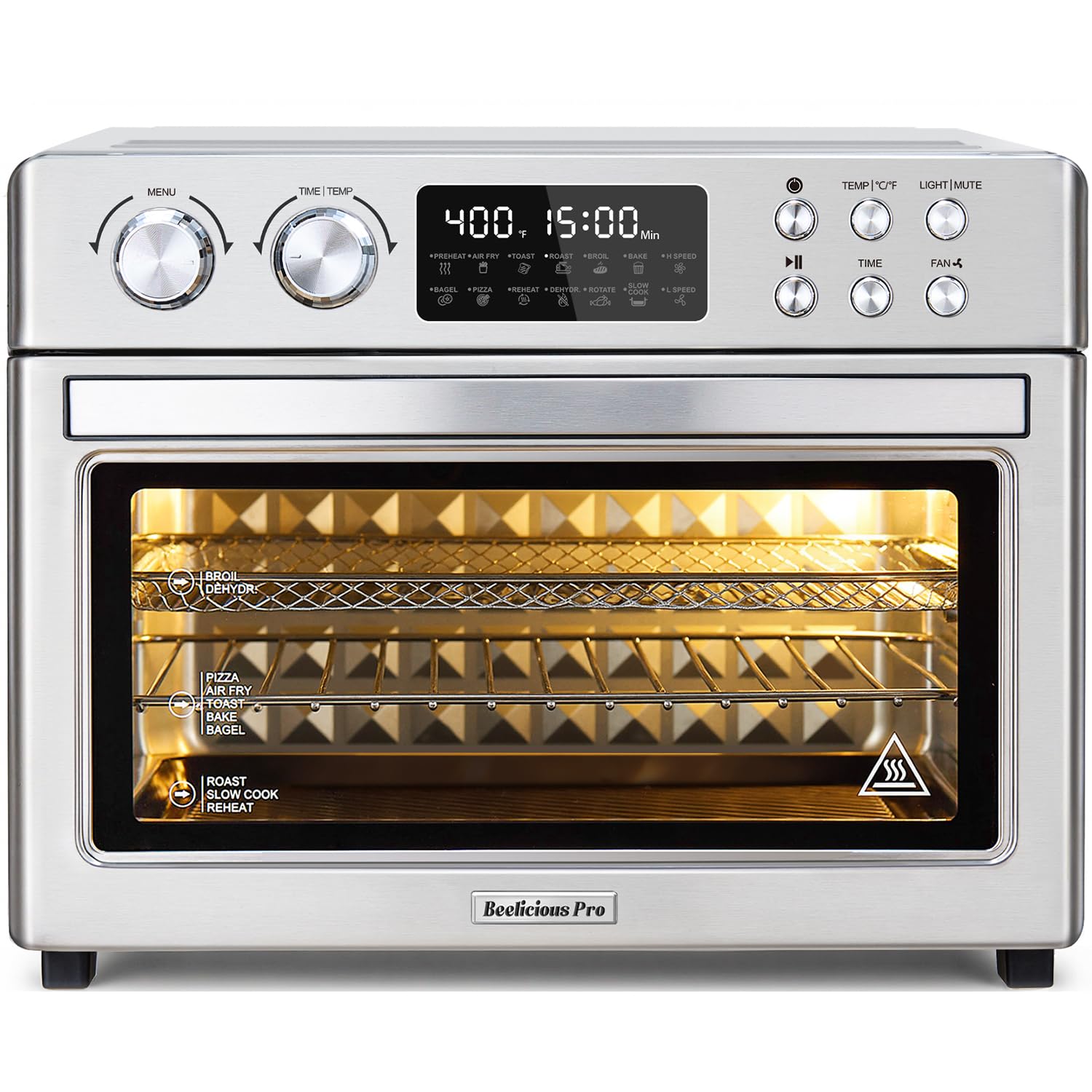
This is a “function over hype” pick that appeals to people who need capacity but don’t want a fragile-feeling budget unit. Owner feedback highlights the same trio: it’s roomy, it’s versatile, and it heats evenly. The three-rack design is the practical win: you can cook multiple components at once without the constant “batch cooking” problem that makes small air fryers feel limiting.
What makes it feel more premium than typical budget ovens is the accessory ecosystem: rotisserie spit and lift, fry basket, bake pan, crumb tray. That matters because accessories aren’t just “extras”— they’re how you unlock the real cooking modes. A rotisserie setup can turn a “just okay” chicken into a crowd-pleaser, and a proper basket improves airflow for crispness.
Owners also love the details that reduce daily friction: an interior light (huge), clear digital temperature control, and simple operation. For people without a full kitchen (or with a broken range), feedback shows this can become a primary cooking appliance. That’s a strong endorsement because it implies reliability, heat power, and consistency.
The key to loving a large-cavity value oven is the same as loving any air fry oven: don’t overload, and use the right rack level. If you stack food, airflow can’t crisp evenly. If you use multiple racks, plan to rotate once until you learn the oven’s hot-zone personality. Once you learn it, it can be a lot of cooking capability for the counter space.
Why it’s a practical winner
- Three-layer cooking – Cook multiple components without “batch cooking” frustration.
- Strong accessory set – Rotisserie + basket + racks make it versatile right away.
- Even heat performance – Owners report reliable results across pizza, wings, fish, and baked items.
- Good for small-kitchen living – Often used as a main appliance when a range isn’t available.
Good to know
- Large cavity means you’ll want a cleaning routine to avoid oil film over time.
- To get peak crispness, avoid overcrowding and give food room in the basket.
- As with most multi-rack ovens, you may still rotate trays occasionally until you learn its hot zones.
Ideal for: families who want a big, versatile countertop oven with rotisserie capability—without paying for a premium badge.
10. NuWave Bravo 21-Qt – Compact, Precise, and Surprisingly Flexible for Small Kitchens

If you like the NuWave “control” philosophy but don’t want a huge unit, the 21-Qt Bravo is a sweet spot: enough capacity to do real cooking, small enough to live on a counter without taking over the room. Owners often mention it preheats fast, cooks quickly, and doesn’t heat the kitchen the way a full oven does—exactly why people buy countertop ovens.
The signature feature is control during the cook. Instead of stopping and restarting, you adjust time and temperature on the fly, and you can tune upper and lower heat behavior. That is a big deal for foods that brown too fast on top or need a stronger bottom crust: pizza, casseroles, breads, and anything baked in a small dish.
A detail from owner feedback that matters: some users say it’s not the absolute best “deep-fry mimic” air fryer they’ve ever owned. That’s normal in oven-style air fryers. The crispness comes from airflow and spacing. If you treat it like an oven that can air fry, you’ll love it. If you expect a tiny basket air fryer punch, you’ll call it “good, not insane.”
There’s also a real-world consideration: racks. Some users note rack sturdiness limitations under heavy weight. That doesn’t mean “don’t buy it.” It means: use the stronger accessory tray for heavy casseroles and keep the lighter rack use for lighter items. That simple habit prevents frustration.
Why it’s a smart small-kitchen pick
- Fast preheat, fast cooking – Great for daily meals without waiting around.
- Top/bottom heater tuning – Helps fix common browning issues in compact ovens.
- Flexible “manual” cooking – Easy to bake, roast, grill, and toast once you learn the basics.
- Doesn’t roast your kitchen – A key benefit for apartments and warm climates.
Good to know
- Air fry is strong, but spacing still matters—overcrowding reduces crispness.
- For heavy casseroles, use the sturdier pan/basket approach rather than relying on the light rack alone.
- It’s a control-heavy oven; if you want “simplest possible,” choose an analog dial model.
Ideal for: small kitchens that want precision and flexibility without buying the biggest oven on the counter.
11. Ninja Flip SP151 – The “Space Is Gold” Oven That Still Feels Like a Real Cooker

Flip-up ovens can sound gimmicky until you live with one in a small kitchen. Then you realize: counter footprint is a daily tax. The SP151’s biggest win is that it gives you legit cooking capability, then gets out of the way. For apartments, RVs, and kitchens where every inch matters, that’s not a bonus—it’s the reason to buy.
Owners love the speed and crisping behavior. The infrared + circulating air approach helps get edge-to-edge results, which is exactly what you want for foods like frozen snacks, roasted vegetables, and quick chicken. It also fits a useful amount of food for its footprint, which is why people describe it as a “game changer” in compact living spaces.
But let’s be honest about the flip-up trade-off: interior height. If you bake tall breads, use big Dutch ovens, or roast very tall items, you’ll feel the limit. If your cooking is mostly flat foods (pizza, toast, wings, sheet-pan dinners, baked items in low pans), you’ll be delighted because it’s fast, easy, and doesn’t eat your counter.
Cleaning is generally manageable, but like all air fry ovens, baskets and heating areas can discolor over time. That’s normal for high-heat, high-airflow cooking. The best owners treat it like a tool: wipe routinely, use a crumb tray strategy, and don’t let grease aerosol become a long-term science experiment.
Why it’s a space saver that works
- Flip-away storage – Real counter space reclaimed, not just “slightly smaller.”
- Fast, even crisping – Great for everyday meals and frozen foods.
- Good capacity for footprint – Feels more capable than it looks.
- Energy-efficient mindset – Great for cooking without heating the whole kitchen.
Good to know
- Interior height is the key limitation—tall bakeware may not fit comfortably.
- High-heat areas can stain; routine cleaning keeps it looking and smelling better.
- If you want big roasts and multi-tray baking, a larger cavity model will feel easier.
Ideal for: small kitchens and RVs that want real air fry + bake power without committing permanent counter space.
12. Ninja SP101 – The Original Flip-Up Staple That People Keep Repurchasing

The SP101 is popular for a reason: it’s fast, it’s convenient, and it saves space in a way that actually changes your kitchen flow. Owners talk about preheat speed like it’s magic—because in daily life, waiting 15–20 minutes for a full oven is a motivation killer. This gets you cooking almost immediately, which means you use it more.
One of the most underrated strengths is cleaning access. The design includes a removable crumb tray and back panel access that makes deep cleaning more realistic than on many toaster ovens. That matters because owners also mention something true: the outside gets hot. A unit that runs hot but is easy to clean and stable to use can still be a fantastic daily tool. A unit that runs hot and is miserable to clean becomes a regret.
This is also an excellent choice for “two foods at once” cooking in smaller households. People use it for broiling, baking, dehydrating, and of course air frying. The consistent advice from experienced owners: adjust baking recipes for convection behavior (often reducing temperature and time). Once you learn that, it becomes predictable.
If you’ve got a tiny kitchen, this model is often a better real-life fit than a huge French door oven—even if the big oven has more capacity—because you’ll actually keep it accessible. And anything you use daily is the better purchase.
Why it’s still a favorite
- Fastest everyday workflow – Quick preheat and fast cooking keeps you using it.
- Flip-up storage – Saves counter space in a meaningful way.
- Cleaning access – Better deep-clean ergonomics than many toaster ovens.
- Great for small households – Handles daily meals without feeling overkill.
Good to know
- Exterior can get very hot; placement and awareness matter (especially with kids).
- Interior height is limited; tall bakeware may not fit well.
- Heavy greasy cooking can create residue near fan/heating areas over time—routine cleaning helps a lot.
Ideal for: small kitchens that want proven performance, fast preheat, and a flip-away design that genuinely saves space.
13. Cuisinart TOA-70NAS – The Dial-Control “No Menu Stress” Oven That Still Crisps

This is the antidote to “smart appliance fatigue.” If you want an oven that feels like turning on a tool—not logging into a device— the TOA-70NAS is a strong fit. Owners love the analog controls because they’re immediate: turn a knob, set a timer, cook food. No UI learning curve. No “press here, then here, then confirm.”
What’s surprising is how often owners describe it as quiet for an air fryer toaster oven—and still effective at crisping. That matters because many people don’t mind fan noise, but they do mind high-pitched, constant whine. A quieter airflow system makes daily use feel calmer.
The included grill/griddle plate is another real-life differentiator. It expands what the oven can do beyond “air fry basket cooking.” You can sear vegetables, do indoor grill behavior, and add texture to foods that don’t crisp well in a basket. For smaller households, this can replace multiple gadgets.
The biggest long-term complaint is cleaning—specifically that oil aerosol can spread throughout interior nooks over time, especially if you cook a lot of skin-on chicken. This isn’t unique to this model; it’s common in air fry ovens. The difference is whether you expect it and build a cleaning routine early. If you do, owners tend to stay happy.
Why it’s so easy to live with
- Analog simplicity – Fast, intuitive controls for daily cooking.
- Quiet, effective crisping – Owners often praise performance without excessive noise.
- Grill/griddle versatility – Adds cooking styles beyond standard air fry.
- Solid stainless feel – Built like a real appliance, not a flimsy gadget.
Good to know
- Cleaning can be more involved if you cook lots of greasy foods; use a catch pan habit to reduce buildup.
- Air fry ovens cook fast—watch early until you learn your timing.
- If you want a temperature probe or precise heater ratio control, step up to a probe-enabled model.
Ideal for: people who want powerful results with simple dials—especially if you hate digital menu systems.
14. Gourmia French Door 25QT – Big Capability at a Friendly Size (With Smart Tray Habits)
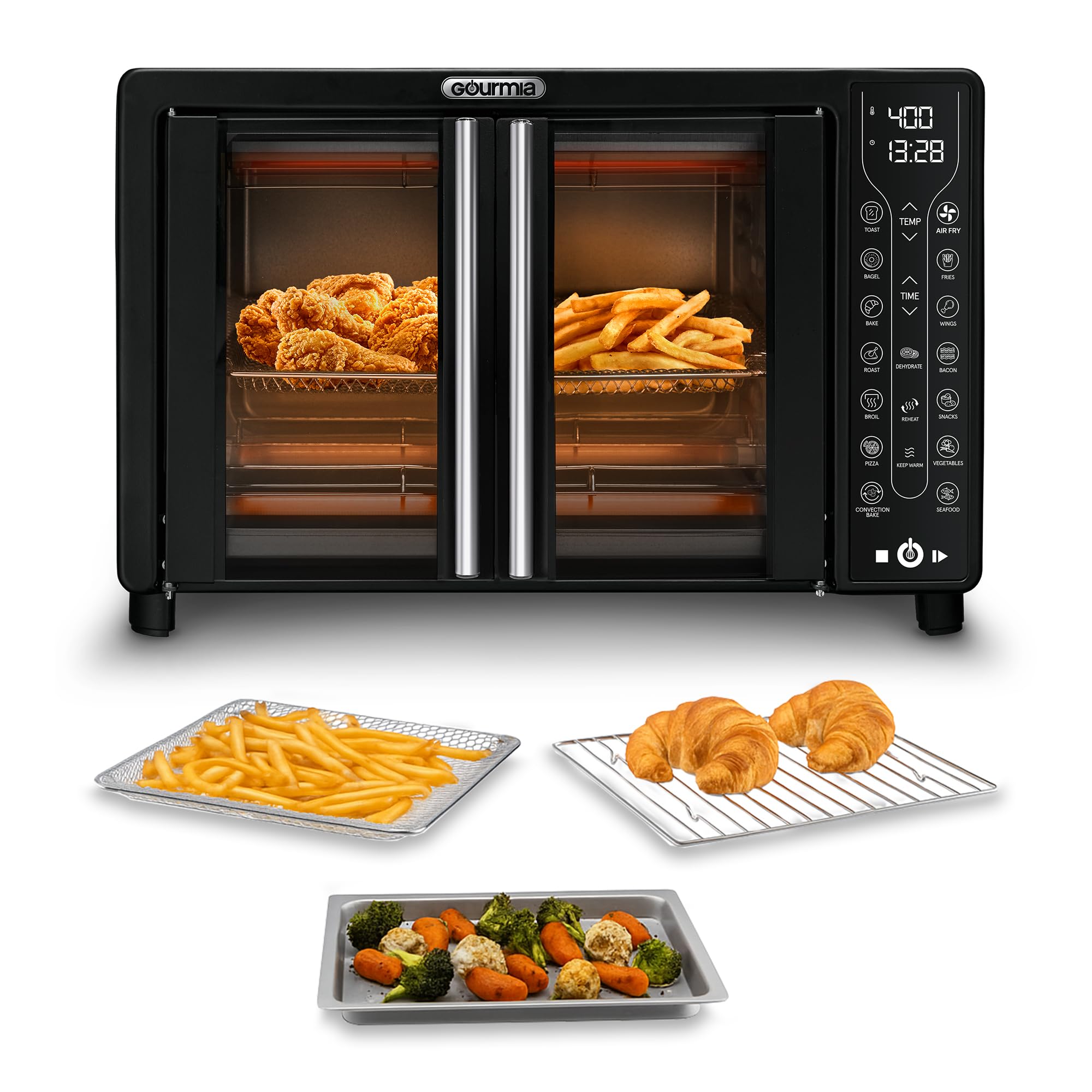
The Gourmia French Door model is a classic “I want the big oven style without paying premium” pick—and it earns its reputation because it genuinely does a lot: air fry, toast, bake, roast, dehydrate. Owners love that it can replace a toaster, handle a pizza, and cook family dinners in one cavity with a clean, counter-friendly look.
Real-life feedback is refreshingly honest: air frying is strong, but not always as turbo-crisp as a dedicated basket air fryer. That’s normal. Where it shines is versatility and space. People cook fries and chicken at the same time, bake muffins beautifully, and use it so often it becomes their main kitchen appliance for small-batch cooking.
The key to loving it long-term is drip management. Like many French-door cavity ovens, if grease drips onto heating elements, you can get smoke. Owners who are happiest use the included pan tray strategically to catch drippings. Once you adopt that habit, the oven feels far more “clean and calm.”
Another real-world point: the glass can get hot. French doors are convenient, but they change how your hands move. Open them fully and treat the glass like a hot surface. When you respect that, the doors become one of the most satisfying design upgrades—easy loading, easy checking, easy access.
Why it’s a value favorite
- French door access – Easy loading and checking, especially with multiple trays.
- Versatile daily cooking – Toast, bake, roast, air fry, dehydrate—covers a lot of meals.
- Good size for real food – Fits pizza and family portions without feeling tiny.
- Strong “main appliance” potential – Many owners use it daily as their primary countertop cooker.
Good to know
- Manage drips with the tray to reduce smoking and keep the interior cleaner.
- Dual-layer cooking can be less even; plan to rotate if you stack racks heavily.
- No built-in light; the window helps, but you may rely on visual checking more carefully.
Ideal for: budget-minded shoppers who want French doors, big versatility, and strong everyday performance with smart tray use.
15. Ninja FT205CO / FT405CO (Renewed) – Flip-Away Convenience for Deal Hunters
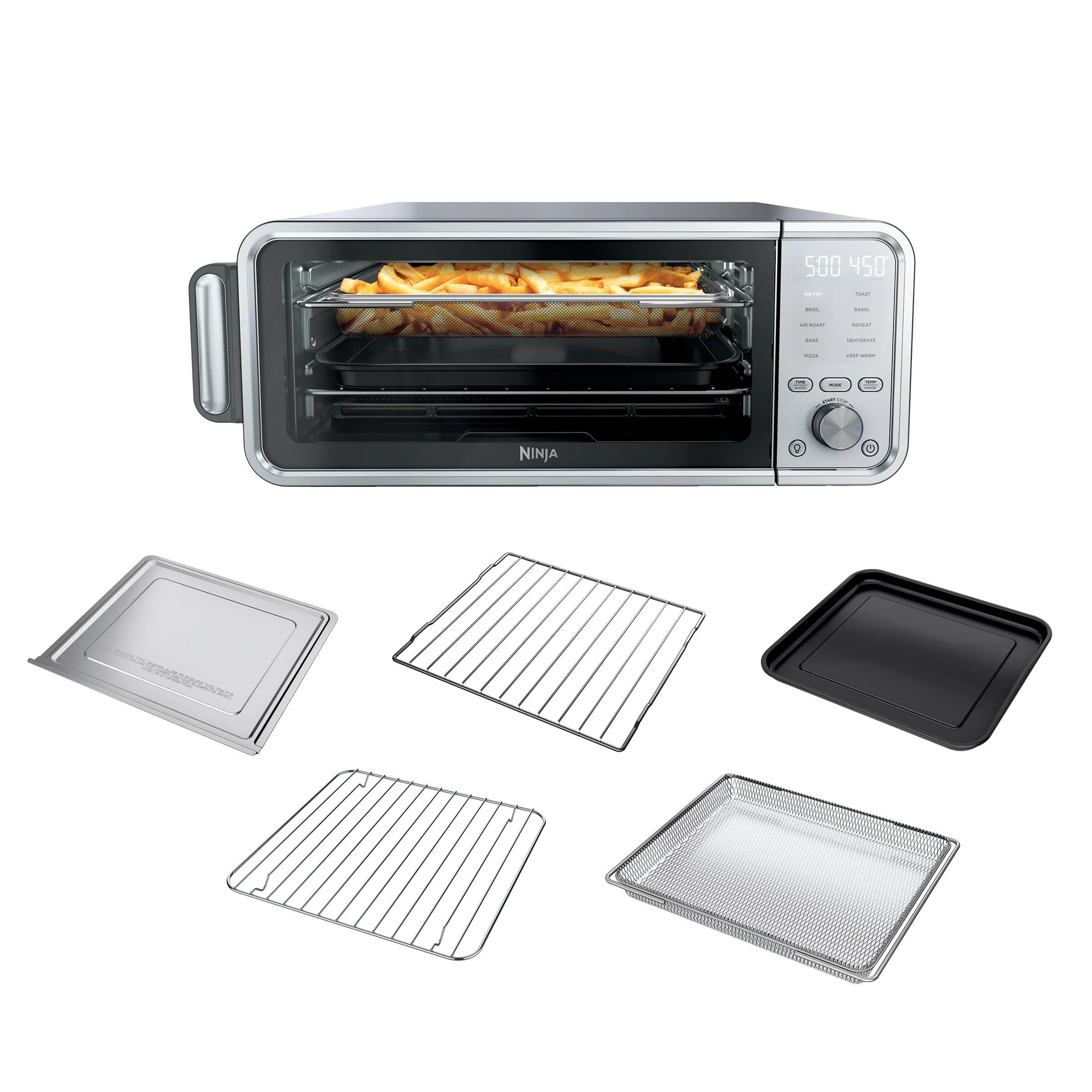
A renewed unit can be a smart play if you want strong cooking capability without paying “new appliance” cost. This Ninja renewed flip-away style appeals to practical buyers who want fast preheat, reliable functions, and the space-saving storage design. Owners who love it talk about using it multiple times a week, getting great toast, crispy air fry results, and fast baking without waiting on a full-size oven.
The biggest “win” is the day-to-day rhythm: fast preheat means you actually cook more at home, and the flip-up storage means you’re not permanently sacrificing counter space. The accessory set and rectangular basket style also help with even airflow—food can be spread in a thin layer, which is how oven-style air fryers get crisp.
The honest reality with renewed (and with any high-airflow oven) is maintenance. Owners who cook lots of greasy foods sometimes report smoke over time and difficulty cleaning near fan/heating zones. That’s not unique to renewed—it’s the nature of compact airflow appliances. If you’re willing to wipe down, use parchment appropriately, and keep drips managed, the value can be excellent.
If you want the “newest” version with the most refined interface, buy new. If you want strong performance and flip-up convenience at a lower entry point, renewed can make sense—especially if you already know you like Ninja’s workflow.
Why it’s a smart value move
- Flip-up storage – Big space saver for everyday kitchens.
- Fast preheat, fast cooking – Owners love how quickly it gets food on the table.
- Rectangular basket advantage – Good food spreading = better airflow crisping.
- Great “second oven” strategy – Useful even if you already have a full-size oven.
Good to know
- Renewed condition varies; inspect accessories and learn the manual (often available online).
- Grease-heavy cooking can lead to residue and smoke if you don’t maintain it.
- If you want maximum interior height, consider a larger French door or XL cavity model instead.
Ideal for: value hunters who want flip-away convenience and fast everyday cooking, and who don’t mind basic maintenance habits.
How Air Fry + Toast + Bake Actually Work Together (and Why Some Ovens Feel “Better”)
Most confusion comes from one myth: that every oven with an “Air Fry” button behaves the same. It doesn’t. Two ovens can have the same wattage and wildly different results because airflow design and cavity geometry change everything. Here’s the practical breakdown that makes you instantly smarter when reading specs and reviews.
What makes crisping actually happen
- Air velocity – Stronger airflow removes surface moisture faster, which is how “crisp” forms.
- Food spacing – If you stack food, air can’t reach surfaces. The top steams the bottom. Crisp dies.
- Basket design – A true basket elevates food so air reaches the underside. A flat tray is more “roast” than “fry.”
- Heat timing – Many ovens crisp best when you finish hotter and shorter rather than lower and longer.
This is why owners so often say “it’s amazing when I don’t overcrowd it.” That’s not user error—it’s physics. Oven-style air fryers can deliver fantastic texture, but they reward spacing and thin layers.
Why toast can be hard in combo ovens
- Toast needs stable radiant heat – It wants consistent top/bottom browning, not just moving air.
- Rack position matters – Too close to top element = burnt tops. Too low = pale toast.
- Airflow can dry bread – Some convection profiles can make toast “crunchy-dry” instead of “golden.”
If toast is your daily anchor, choose an oven known for predictable browning or one that gives you easy rack guidance.
The “even bake” secret: geometry + heater balance
- Back heat sources and high-velocity fans – Great for even baking, faster cookies, and crisping.
- Adjustable top/bottom heat – A superpower for pizza and pies (crisp bottom, controlled top browning).
- Multiple rack positions – Lets you choose browning intensity without changing recipes.
This is why models with heater tuning (NuWave) and models built around even multi-rack cooking (Ninja XL designs) get such loyal followings: they reduce “trial and error fatigue.”
Cleaning reality: why air fry ovens feel different than regular ovens
- Airflow spreads oil – It’s not just drips; it’s airborne residue that coats interior surfaces.
- Use a catch pan – This one habit dramatically reduces smoke and deep-clean effort.
- Wipe routine beats deep clean – 30 seconds after cooling saves you 30 minutes later.
If you cook greasy foods often, prioritize designs with easy-access crumb trays and accessories you’ll actually wash. That’s how you stay in the “I love this thing” zone.
Once you understand these mechanics, choosing stops being confusing. You’re not buying “15 presets.” You’re buying airflow behavior, heater balance, and a cleaning lifestyle you can live with.
FAQ: Digital Air Fryer Toaster Oven Buying Questions (Answered Like a Real Cook)
Will an oven-style air fryer get as crispy as a basket air fryer?
Why do some ovens smoke when air frying?
Do I need French doors, or is it just a style thing?
Touchscreen or dials: which is better?
How do I get consistent baking results in a countertop oven?
What’s the easiest way to keep it clean long-term?
Final Thoughts: Your Digital Air Fryer Toaster Oven Should Make Life Easier
The best countertop oven is the one you’ll use without thinking. The one that makes you cook more at home because it feels fast, predictable, and easy to clean. If you pick based on your anchor use (toast, crisping, baking, or full dinners), you’ll land on a choice that feels right for years.
Here’s a clean way to decide:
- Want the best overall “premium but not pushy” pick? Start with the Ninja French Door Premier FO101. It’s the most balanced blend of ease, evenness, and day-to-day friendliness.
- Need big-family capacity and real multi-tray baking? Choose the Ninja Prestige Smart XL DT501 or the Cuisinart TOA-112 if you want probe-guided precision plus batch pan convenience.
- Want weeknight “complete meal” speed with better moisture? Go for the Ninja Combi SFP701. It’s a different style of appliance, but it’s a true problem-solver for busy households.
- Love control (pizza bottoms, roast doneness, browning balance)? The NuWave Bravo XL 30-QT is a control-lover’s dream because it lets you tune top/bottom heat and use a probe.
- Need small-counter convenience that still performs? Pick the Ninja Flip SP151 or the proven Ninja SP101 if you want the classic flip-up workflow with fast preheat.
- Prefer simple dials and a calmer interface? The Cuisinart TOA-70NAS is an excellent “no menu stress” pick with real cooking power.
- Want French doors and strong value? Look at the Midea Flexify or the budget-friendly Gourmia French Door if you want big capability and are happy to use smart tray habits for drip control.
- Want a deal and love flip-away storage? Consider the renewed Ninja FT205CO / FT405CO (Renewed) for strong performance with a lower entry point.
If you came here for one clear decision, here it is: choose the digital air fryer toaster oven that matches your real anchor use, then buy the model whose cleaning reality you can live with. That combination is what turns an appliance into a daily habit.
