
A dual-basket air fryer sounds like a simple promise: cook two things at once. In real life, the promise is deeper. It’s the end of staggered dinners—the chicken that’s perfect while the fries are still pale, the veggies that go limp while you wait for round two, the “we’ll eat when it’s all done” moment that turns into 9:15 PM.
If you’re shopping for a ninja dual zone air fryer, you’re not really buying an appliance. You’re buying a new rhythm: proteins and sides landing hot together, leftovers turning crisp (not soggy), and weeknights getting a little less chaotic without giving up the “real dinner” feeling.
Here’s where most guides fail: they treat all dual-zone machines like they’re identical, then stack a list of specs and call it advice. But dual-zone cooking is a workflow. The things that matter are the friction points you only notice after a few weeks: how much space the baskets actually give you once you add food that needs airflow, whether the controls feel intuitive when you’re hungry, how loud the beeps are when the kitchen is finally quiet, and whether cleanup feels like a quick rinse or a full negotiation with your sink.
This guide is built around real-world cooking behavior—busy households, picky eaters, meal-prep Sundays, and “I need dinner fast but I want it good” moments. You’ll find the classic side-by-side DualZone models, the vertical DoubleStack designs that save counter space, the FlexBasket that turns into a MegaZone for larger proteins, and even Ninja’s dual-oven countertop setups for people who want two cooking cavities without firing up a full-size oven.
Below, you’ll get an honest comparison of 11 standout Ninja options—what they do brilliantly, what they do “fine,” and who should buy which model so you don’t have to keep scrolling through contradictory reviews.
In this article
How to Choose the Right Ninja Dual Zone Air Fryer for Your Kitchen
A dual-zone machine is only “the best” if it fits the way you cook. Otherwise, you’ll end up with something that’s technically powerful but weirdly annoying—too big for your counter, too small for your portions, or too complicated when you’re already tired. Here’s the decision framework that keeps people happy months later.
1. Choose your dual-zone format first (this is the big fork in the road)
Ninja’s lineup isn’t just “bigger or smaller.” The core difference is how the air and heat move. Pick the format that matches your reality:
- Side-by-side dual baskets (classic DualZone): Two independent drawers. Simple, intuitive, and great when you cook a main + side most nights.
- FlexBasket + divider (MegaZone option): One wide drawer that can split into two zones or become one big zone for larger proteins.
- Vertical DoubleStack: Two drawers stacked on top to save counter width. Great for small kitchens, but it rewards good loading technique.
- Countertop double ovens: Two cooking cavities with separate controls—amazing for households that cook different diets or want toast + air fry simultaneously.
2. Understand “Smart Finish” vs “Match Cook” (and why people confuse them)
These features sound similar, but they solve different problems:
- Smart Finish: You set different temps/times per zone and the machine syncs the ending so both are ready together. This is the “weeknight hero.”
- Match Cook: Copies settings from one zone to the other so you can cook a larger batch of the same thing. This is the “party tray” button.
Here’s the expert-level nuance: Smart Finish is only magical when you give it good inputs. If you load one basket with a thick, wet food and the other with something thin and dry, syncing the time won’t automatically make them equally crispy. The best users treat Smart Finish like an assistant, not a wizard: they plan the “crisping phase” and the “cooking-through phase” deliberately (I’ll show you how in the “How it works” section).
3. Capacity is not just quarts—it’s usable surface area
A lot of buyer regret comes from this: a deep basket can have a large “quart” number but still feel crowded once you spread food for airflow. Crispness comes from hot air touching the surface. That means:
- Shallow-and-wide loads crisp faster than tall piles.
- Wet marinades need space so steam can escape instead of turning into a damp blanket.
- Two smaller baskets can beat one huge basket for crisp foods, because you can keep layers thinner.
So don’t buy by quarts alone. Buy by how you cook: thin layers for wings/fries? Bigger zone for a roast? Separate zones for picky eaters?
4. The “stacked” learning curve is real (but it’s not hard)
DoubleStack models are brilliant for saving counter width, but they work best when you treat them like convection ovens with drawers. A few practical truths:
- Top and bottom can brown differently depending on what you load, because airflow patterns and rack position matter.
- Racks are power tools—they can double your output, but only if you leave space for air to move.
- Shaking is a feature, not a flaw. People who “toss and rotate” get consistent results; people who load and walk away sometimes complain about uneven color.
If that sounds like a dealbreaker, go classic DualZone. If it sounds like a fair trade for a slimmer footprint, DoubleStack is one of the most satisfying upgrades you can make.
5. Thermometer integration changes how you cook meat (in a good way)
Air fryers are fantastic at crisping, but meat has one enemy: overcooking from timing guesses. Ninja’s models with a smart probe let you cook to internal temperature instead of “hope and check,” which is especially valuable for:
- Chicken thighs that you want juicy but safe.
- Salmon that you want flaky, not dry.
- Steaks and pork chops where timing swings are dramatic.
The trade-off is the probe workflow: you need to route the wire, avoid pinching it, and remember it’s hot when you pull food out. If you cook meat often, it’s worth it. If you mostly cook frozen snacks, you won’t use it daily.
6. Heat, vents, and counter placement are the “silent” decision factors
This is the stuff you only learn after the purchase. A few pro rules:
- Give the exhaust room: If your unit vents toward a wall, you’ll eventually notice heat and grease residue (and you’ll hate cleaning it).
- Cabinet clearance matters: Some machines are designed to fit under standard cabinets, but you still want breathing space around vents.
- Noise is personal: Fans are normal. The question is whether the start/finish beeps are adjustable or just… enthusiastic.
If your kitchen is small, choose a model that fits your counter flow and your storage reality. A “perfect” air fryer that lives in a closet becomes a twice-a-month appliance.
7. Cleaning: choose the kind of cleanup you’ll actually do
Real talk: people don’t stop using an air fryer because it cooks badly. They stop because cleanup is annoying. Here’s what matters more than marketing:
- Nonstick quality and durability: Use silicone tools and avoid metal forks on coating if you want baskets to stay smooth long-term.
- Dishwasher-safe parts: Useful, but basket size + dishwasher layout can still make it feel like a hassle.
- Crisper plate geometry: Plates with fewer nooks are faster to rinse. Plates with tight grids can trap sticky sauces.
Quick Comparison: 11 Ninja Dual Zone Air Fryer Picks
Use this table to shortlist the models that match your kitchen reality, then jump to the full reviews for the deep details— like which designs feel effortless on busy nights, which reward “technique,” and which are best when you cook for different people at the same time.
On smaller screens, swipe or scroll sideways to see the full table.
| Model | Appliance type | Real‑world strength | Best match | Amazon |
|---|---|---|---|---|
| Ninja Foodi DZ550 DualZone Smart XL (Thermometer) | Dual baskets | Cook to temperature with the probe + sync zones so dinner lands hot together | Most households who want “buy once, love daily” performance | Amazon |
| Ninja DoubleStack XL SL401 (10‑QT stacked) | Stacked drawers | Big output in a slimmer footprint; racks let you cook multiple foods per drawer | Families who want capacity without losing counter space | Amazon |
| Ninja Foodi DZ201 DualZone (8‑QT classic) | Dual baskets | The “easy to live with” baseline: simple controls, reliable crisping, quick meals | Most families who want straightforward dual‑drawer cooking | Amazon |
| Ninja DoubleStack SL201 (8‑QT stacked) | Stacked drawers | Space saver for smaller kitchens; still does multi‑food cooking with racks | People who want DoubleStack benefits in a more compact size | Amazon |
| Ninja Foodi DZ071 FlexBasket (7‑QT MegaZone) | FlexBasket | Divider in = two zones; divider out = one big zone for larger proteins | People who cook roasts, salmon, or bigger “centerpiece” proteins | Amazon |
| Ninja Foodi DZ090 DualZone (6‑QT) | Dual baskets | Two drawers for small meals and snack timing, without giant-family bulk | Couples, small households, and “quick meal” kitchens | Amazon |
| Ninja Foodi AD300 XL DualZone (Renewed, 10‑QT) | Renewed XL | Big‑family capacity with DualZone convenience in a value-focused listing | Shoppers who want XL output and are open to Renewed | Amazon |
| Ninja Foodi DZ201 / DZ100 DualZone (Renewed, 8‑QT) | Renewed classic | Classic dual baskets with Renewed pricing—often a strong “first dual‑zone” move | Budget-minded shoppers who still want DualZone workflow | Amazon |
| Ninja French Door Premier FO101 | Oven‑style | French-door convenience + air fry basket capacity for family-style trays | People who want air fry + toast + bake in one sleek unit | Amazon |
| Ninja DCT451 Smart Double Oven (FlexDoor) | Double oven | Two separate cavities + flavor separation—great for mixed diets and multitasking | Households cooking different meals at the same time (without crossover) | Amazon |
| Ninja DCT601 Double Stack XL Countertop Oven | Double oven | Premium two‑cavity cooking with Smart Finish + bigger meal flexibility | Busy families and hosts who want “two ovens” on the counter | Amazon |
In‑Depth Reviews: 11 Dual‑Zone Ninja Picks That Make Weeknights Easier
Now we’ll go model by model. This is not a “spec sheet parade.” I’m focusing on what actually changes your day: loading strategy, crispness consistency, timing logic, cleanup friction, and the small design choices that make a product feel either effortless or oddly irritating.
1. Ninja Foodi DZ550 DualZone Smart XL – The “Cook Everything to Perfect Doneness” Daily Driver

If you want one Ninja that can handle real dinners—meat, sides, reheat, crisping, and “please don’t dry out my chicken again” moments—this is the model that most households end up loving long-term. The standout isn’t just the dual drawers. It’s the thermometer-driven mindset: instead of guessing time, you cook to internal temperature and let the machine guide the finish. That one shift is why this feels like an “upgrade,” not just another air fryer.
Here’s what that looks like in practice. You drop seasoned chicken thighs in one basket and vegetables in the other. You set the veg to roast (higher airflow, more browning), then set the chicken to cook by probe doneness. Smart Finish becomes a real tool: it’s not just syncing two timers; it’s syncing two foods with different “done definitions.” That’s how you get a plate where everything lands hot, and the protein doesn’t overshoot into dryness while you wait for the side to catch up.
Owners who cook a lot of meat tend to report the same satisfaction: “I stopped babysitting dinner.” That’s not because the machine is magical—it’s because the workflow removes the biggest failure point in air fryer cooking: guessing when thick food is done. The DZ550 also tends to run in a way people describe as “surprisingly calm” for a powerful machine—fan noise is there, but it feels more like a steady appliance and less like a jet engine. The big trade-off is footprint: dual baskets take counter space. If your kitchen is tight, you might prefer the vertical DoubleStack models.
Now, let’s get nerdy in a useful way: crispness. The DZ550 is at its best when you treat each drawer as a crisping environment. That means thin layers, a little oil on the surface (not a soak), and a mid-cook shake for fries or wings. If you’re cooking something wet—like marinated thighs—use this pattern: start at a slightly lower temp to cook through without scorching sugars, then finish hot for crisp edges. The result tastes “fried” without the greasy heaviness.
Cleaning is the other win. Nonstick drawers mean most mess wipes out while warm. If you do let it sit overnight, a hot-soapy soak usually resets it fast. The thermometer adds one more thing to clean (the probe), but it’s small and straightforward. The bigger “maintenance” advice is simple: avoid metal utensils inside the baskets. The coating lasts longer when you treat it gently, and long-term satisfaction is tied to baskets staying smooth.
Why it earns “best overall”
- Thermometer-driven doneness – Stops the #1 air fryer mistake: overcooked proteins from timing guesses.
- Smart Finish feels truly useful – Syncing is more powerful when one side is “to temp” and the other is “to crisp.”
- Consistent crisping – Great results when you load with airflow in mind and shake once mid-cook.
- Everyday versatility – Air fry, roast, reheat, dehydrate, and broil-style crisping without drama.
Good to know
- Dual drawers mean a wider footprint than single-basket machines; measure your counter flow before committing.
- Probe cooking adds a tiny learning curve (routing the cable, not pinching it), but it becomes second nature quickly.
- Basket capacity is generous, but “usable crisp space” still depends on thin layers—don’t pack like a deep pot.
Ideal for: anyone who wants one dependable dual-drawer Ninja that can cook full meals confidently, especially households that cook meat frequently and want consistent doneness.
2. Ninja DoubleStack XL SL401 – Big Capacity, Smaller Footprint, Real “Family Kitchen” Power

The SL401 is the model you buy when you want dual-drawer power but you don’t want a machine that eats half your countertop width. Its stacked design is the main headline: it’s taller, slimmer, and surprisingly efficient once you learn one simple truth— you are the airflow manager. That’s not a negative. It’s a different kind of ownership. If you like “load it, walk away, perfect every time,” go with classic dual baskets. If you like “I can cook a lot in less space and I don’t mind shaking once,” this is a beast.
Here’s the real-life win: family cooking. You can run a protein in one drawer and a side in the other, or use the stacked meal racks to cook two layers within the same drawer. That’s how people pull off “4 foods at once” without a counter full of appliances. But the racks have rules: don’t smash food against the ceiling of the drawer, don’t stack wet foods under dry foods unless you want steam to rise and soften crispness, and leave breathing room around edges so air can circulate.
One of the most useful design details is exhaust direction. Many owners notice that venting design impacts where you can safely park the unit and what gets heated around it. If you’ve ever seen a backsplash or outlet plate discolor behind a rear-venting appliance, you already understand why this matters. With the DoubleStack approach, placement feels easier in many kitchens—just give the vents space and don’t trap hot exhaust against a wall.
Now the honest “things people complain about” list: sound feedback and documentation. Some users find the start/finish beeps louder than they want, and a few describe the instructions as thinner than the product deserves—especially around stacked racks and syncing logic. The fix is simple: do a two-cook “learning weekend.” First cook: something easy like frozen fries and nuggets, just to learn control flow. Second cook: a real dinner, but pick forgiving foods. By cook three, the SL401 feels intuitive.
Crispness quality is strong—but it’s not passive. The stacked design can cook evenly, but you need to shake and sometimes rotate trays for truly uniform browning. I like this mindset: treat it like a small convection oven with drawers. Midway through, toss fries, flip wings, rotate rack positions if you’re going for perfect color. The payoff is big: huge output, less counter space, and the kind of “why didn’t we do this sooner?” satisfaction when you feed multiple people quickly.
Cleaning is one of the quiet strengths. The baskets are easy to lift and “toss,” and the crisper plates are usually quick to rinse. A practical tip: if you cook sticky sauces, use a finishing glaze approach—cook mostly dry, then toss in sauce for the last few minutes. You get caramelized edges without turning cleanup into archaeology.
Why families love it
- Counter space win – Stacked design gives you dual-drawer cooking without the wide footprint.
- High throughput – Great for family meals, meal prep, and “multiple items at once” workflows.
- Racks unlock multi‑food cooking – Done right, you can cook different textures without juggling appliances.
- Solid build + easy-to-handle baskets – The drawers are designed to be shaken and moved, which helps with even cooking.
Good to know
- Best results require “human input” (shake/rotate) more than classic side-by-side models.
- Some users find the feedback beeps loud; this is a performance-first appliance, not a silent one.
- Instructions can feel brief—plan a short practice run before your first big family dinner.
Ideal for: families or meal-prep cooks who want large capacity in a slimmer footprint and don’t mind a small learning curve to earn consistently great results.
3. Ninja Foodi DZ201 DualZone – The Reliable, No-Drama Workhorse Most People Should Consider

This is the “I just want it to work” pick—the model that nails the DualZone concept without asking you to learn a new cooking style. If the SL401 is a clever space-saving puzzle and the DZ550 is the doneness-precision upgrade, the DZ201 is the balanced baseline: two independent drawers, straightforward programs, and a control panel that most people understand quickly.
The reason the DZ201 earns loyalty is simple: it reduces weeknight friction. You can put a main in one basket, a side in the other, tap Smart Finish, and get a meal that lands together. And because the baskets are independent, you can run different temps without mental math. This matters when you’re cooking for kids who want nuggets and adults who want salmon, or when you want a side that needs higher heat than your protein.
A theme that shows up repeatedly in owner feedback is pleasant surprise at how much it replaces. For a lot of households, the DZ201 becomes the go-to for reheating pizza, crisping leftovers, making frozen foods taste fresh, and cooking simple proteins fast. The fan and heat combination is strong enough to make food taste “real,” not just warmed. It’s also the kind of air fryer that makes you cook more at home because the barrier is low: less time, less mess, less babysitting.
The main “watch out” is capacity expectations. An 8‑quart dual-basket unit sounds huge, but each basket is its own space. If you’re feeding a bigger group, you may still do two rounds for large batches of wings. That’s not a failure of the machine; it’s the physics of crisping. When food is stacked thick, it steams. The trick is to treat each basket like a tray: spread food, leave gaps, shake once. People who do that tend to rave about crispness consistency.
Cleaning is typically easy: baskets and crisper plates are designed to rinse quickly, and many people use the dishwasher for plates. A practical pro tip: if you air fry greasy foods often (bacon, sausages, wings), wipe the drawer corners while warm. That’s where residue builds, and that’s what makes “easy cleanup” turn into “why is this sticky forever.”
If you’re deciding between this and the DZ550: choose DZ201 if you want simplicity and you don’t care about cooking to internal temperature with a probe. Choose DZ550 if you want the “perfect meat” confidence without guessing. Either way, the core experience—two baskets, synced timing, crispy results—stays strong.
Why it’s a safe buy
- Easy learning curve – Most people “get it” quickly and start using both baskets immediately.
- Reliable Smart Finish – Excellent for main + side timing without complicated planning.
- Strong crisping for daily foods – Great for fries, wings, roasted veg, and reheating leftovers.
- Cleanup stays manageable – Nonstick baskets and simple plates keep it from feeling like extra work.
Good to know
- Each basket is smaller than the “total quart” number feels—large families may still batch cook some items.
- Wet, marinated foods need airflow and sometimes a higher-temp finishing phase to get crisp edges.
- If your counter is narrow, the DoubleStack models may fit your space better.
Ideal for: most households who want classic dual baskets and a simple, dependable workflow that makes everyday meals faster and crispier.
4. Ninja DoubleStack SL201 (8‑QT) – The Small‑Kitchen Power Move That Still Feels “Full Meal” Ready

The SL201 is for the kitchen where counter space is a real constraint—apartments, smaller homes, busy counters with coffee machines and mixers, or anyone who simply hates appliances sprawling sideways. It delivers the DoubleStack idea in a slightly more compact output profile, which can be the “sweet spot” for households that want the stacked footprint but don’t always need the XL scale.
The SL201’s superpower is the same as its bigger sibling: vertical efficiency. You’re trading width for height, and you’re getting two independently controlled drawers. That independence is the difference between “I can toast and air fry” and “I can cook two foods with different temps and have them finish together.” Once you start using Smart Finish intentionally, you’ll notice a shift: you stop thinking in batches and start thinking in plates. Protein down low, veg up top. Or crispy snacks in one drawer while a “real food” item cooks in the other.
Here’s the key technique that makes DoubleStack models shine: treat the racks like airflow scaffolding. If you lay food flat on the bottom and add a second layer above, you’ve doubled output—but you must leave space between items. Think of air like water: it needs channels. When you crowd, you block circulation. When you leave gaps, you get even crisping. The SL201 rewards that approach with remarkably consistent results for its footprint.
Now the honest truth: stacked designs ask you to be a little more involved. If you crave “perfectly uniform browning without touching anything,” you might feel more comfortable with a classic side-by-side unit. But if you’re fine with shaking fries once and maybe rotating rack items for uniform color, the SL201 gives you dual-zone power without dominating your counter.
Another real-world note: these stacked models often feel “more professional” in how they fit a kitchen, because they look intentional rather than sprawling. That matters for people who don’t want to store appliances. A product you keep on the counter is the product you actually use—and this one earns that status in many homes.
Cleanup is generally fast, especially if you avoid cooking sugary sauces directly on the crisper plate for long stretches. If you do love sticky foods, cook mostly dry first, then glaze near the end. It keeps flavor high and scrubbing low.
Why it’s a smart choice
- Space-saving footprint – Stacked drawers help smaller kitchens keep counter flow intact.
- Dual-zone flexibility – Different temps, different foods, synced finish without juggling pans.
- Racks increase output – Great for households that want “full meal” power from a compact footprint.
- Encourages better airflow habits – When you load properly, results are impressively crisp and even.
Good to know
- Best browning may require a mid-cook shake or quick rotation—stacked cooking is active cooking.
- If you regularly cook very large batches, the SL401 XL may fit your output needs better.
- Learning the rack strategy is worth it, but plan one practice cook before hosting or meal-prep Sunday.
Ideal for: small-to-medium households that want a dual-drawer machine but need a counter-friendly footprint and don’t mind a tiny technique-based learning curve.
5. Ninja Foodi DZ071 FlexBasket – The MegaZone Trick That Changes “What Fits” in an Air Fryer

The FlexBasket idea is one of those designs that sounds minor until you use it—then you wonder why more air fryers aren’t built this way. Instead of committing you to two separate drawers forever, the DZ071 lets you choose the shape of your cooking space. Divider in? You get two zones for timing different foods. Divider out? You get one wide MegaZone that can handle larger proteins that simply feel awkward in split baskets.
This matters for real dinners. Whole chicken pieces, big salmon portions, a pork roast, a sheet-pan-style pile of vegetables—these foods cook better when they can lay flatter. In a split-basket machine, you sometimes end up folding or stacking food to make it fit, which hurts airflow and browning. The MegaZone solves that by giving you a wide area where food can spread. In other words: you get more usable crisp surface, not just a bigger number on a box.
The divider mode is where it behaves like a dual-zone machine. It’s excellent when you want one side hotter for crisping and the other side gentler for cooking through. The best use case is the “two textures” dinner: crispy potatoes on one side, juicy chicken on the other. Smart Finish helps you land them together, but the FlexBasket shines most when you choose the right basket mode for the meal: MegaZone for big proteins; split mode for mixed items.
What owners tend to love is the flexibility and the “why didn’t I buy this earlier?” feeling when it finally fits the foods they actually cook. What some people need to adjust to is that FlexBasket cooking is not exactly the same as having two completely separate drawers in every scenario. With a single wider basket, airflow and food arrangement matter even more. If you overload the MegaZone, you can still steam your food into softness. The fix is simple: spread food and avoid tall piles.
The DZ071 is also a strong choice for people who hate “decision fatigue.” Instead of asking, “Which basket does this go in? Will it fit? Do I have to cut it in half?” you just choose the configuration that makes sense. That reduces the day-to-day friction of cooking, which is the real reason air fryers become everyday appliances.
Cleanup is usually straightforward because you’re dealing with one main basket shape and a divider piece. The divider is easy to rinse. A practical tip: if you cook fatty proteins in MegaZone, wipe the corners and crisper plate while warm. That keeps the “easy to clean” story true for months, not just week one.
Why it’s different (in a good way)
- MegaZone changes the menu – Larger proteins and flatter layouts cook better and brown more evenly.
- Divider gives dual-zone flexibility – Two foods, two styles, synced timing when you need it.
- Less “fit frustration” – You stop cutting food down just to make it work in split drawers.
- Great for real dinners – Especially proteins and roasted vegetables that benefit from space.
Good to know
- MegaZone still needs airflow—if you pile food, you’ll steam it. Spread it and you’ll love it.
- Split mode is excellent, but if you always cook two completely separate meals, dual drawers can feel simpler.
- Because it’s flexible, it rewards intentional choice: pick divider-in or divider-out based on the meal.
Ideal for: cooks who want dual-zone timing and the ability to cook larger, flatter proteins without wrestling food into two separate baskets.
6. Ninja Foodi DZ090 DualZone (6‑QT) – Small Meals, Big Convenience, Two Drawers That Keep Life Moving

Not everyone needs an XL machine. If you cook for one or two most nights, bigger can actually be worse: more counter space, more “where do I store this,” and more basket area to clean than you used. The DZ090 hits a sweet spot for smaller households because it gives you the dual-drawer advantage—two items at once, synced finish—without pushing you into a giant-family footprint.
In real use, this is the kind of air fryer that becomes a daily helper. You come home late, throw protein in one basket and vegetables in the other, and you’re eating quickly without turning the kitchen into a disaster. Owners who love it tend to describe the experience as “efficient and versatile,” and that’s exactly the right word: it doesn’t demand a complicated relationship. It just makes the routine easier.
The biggest praise is timing convenience. Two baskets means you don’t have to choose between “crispy side” and “hot main.” Smart Finish helps, but even without it, simply having two drawers lets you start items at different times so they land together. That is the hidden luxury: you serve everything hot, at peak texture, without waiting for batch two.
The most common “good to know” theme is capacity reality. A 6‑quart class dual unit can feel “a bit small” if you’re trying to cook for a larger group, or if you want to dump a huge bag of wings in one drawer. But for couples and small meals, it’s often perfect. If you host often or you have a bigger family, the 8‑quart and 10‑quart class models make life easier.
Heat output is another practical consideration. Any air fryer moves serious heat. In smaller spaces, some people prefer to run it where the kitchen stays comfortable and the exhaust has room. If your home runs warm, choose placement carefully and make sure your ventilation isn’t trapped under cabinets with no airflow.
If you want the dual-drawer experience without paying for capacity you’ll never use, the DZ090 is the “right-sized” pick. It’s also a great second air fryer for households that already have a larger appliance but want a smaller daily driver for quick lunches or snacks.
Why small households love it
- Right-sized dual drawers – Two foods at once without a huge-family footprint.
- Fast, efficient cooking – Great for quick meals and “I’m hungry now” cooking.
- Simple controls – Low learning curve and easy daily use.
- Easy cleanup – Nonstick baskets make it a rinse-and-wipe routine for most foods.
Good to know
- Best for 1–2 people; larger families may find basket space limiting for big batches.
- Like many powerful air fryers, it can throw noticeable heat—place it where exhaust has room.
- If you frequently cook large proteins flat, consider FlexBasket MegaZone instead.
Ideal for: couples, small households, and anyone who wants true dual-drawer convenience without buying more capacity than they’ll realistically use.
7. Ninja Foodi AD300 XL DualZone (Renewed) – Big Output for Meal-Prep Households That Want Value

Renewed listings can be an underrated strategy when you want a higher-capacity machine but you’re value-minded. The AD300 XL dual-drawer format gives you the “feed more people” benefit while keeping the core DualZone workflow: two independent zones, Smart Finish for synchronized meals, and Match Cook for larger batches.
In owner experiences, the Renewed appeal usually comes down to one thing: the machine often arrives looking and working “like new,” and then it earns its keep quickly. People who upgrade from an older single-basket unit tend to say the same thing: two baskets change everything. You stop doing back-to-back batches, and your dinner becomes a coordinated landing instead of a staggered timeline.
This model is especially good for meal-prep households because you can run two different items at once—say, chicken in one drawer and roasted vegetables in the other— and then repeat with a second round. That sounds obvious, but the big difference is that you’re not waiting for the machine to cool, reheat, or reset. You’re moving through a meal-prep flow with less downtime.
The most common “watch out” is counter space. XL dual-drawer units are not small. If you have a cramped counter, you may want the DoubleStack vertical models instead. But if you have the room, an XL unit can replace a surprising amount of oven usage, especially in warm months when you don’t want to heat up the whole house.
Controls can feel slightly confusing the first day if you’ve never used a dual-zone model—especially around which zone you’re adjusting. The fix is to practice one simple meal: fries in one basket, nuggets in the other, using Smart Finish. Once you do that once, the control logic becomes intuitive, and you’ll start using it without thinking.
If you’re open to Renewed, this is one of the most practical ways to get into higher-capacity dual-drawer cooking without feeling like you overpaid for your needs. It’s also a great “family expansion” choice—when a household grows, the old single-basket workflow becomes the bottleneck.
Why it’s a strong value play
- XL dual-drawer capacity – Great for families and meal prep without constant batch cooking.
- Smart Finish convenience – Sync two foods so dinner lands together instead of staggered.
- Renewed can be a smart buy – Many buyers report it arrives clean, solid, and ready to work.
- Easy to clean – Nonstick baskets and dishwasher-safe plates keep maintenance manageable.
Good to know
- Footprint is significant—if your kitchen is tight, consider DoubleStack models for a slimmer setup.
- Like most dual-zone machines, the first day can feel “button heavy” until you learn zone selection.
- Capacity is powerful, but crispness still needs airflow—avoid tall piles if you want crispy texture.
Ideal for: families and meal-prep cooks who want XL dual-drawer output and are comfortable buying a Renewed listing for a value-focused upgrade.
8. Ninja Dual Basket (Renewed, 8‑QT class) – The “Try Dual Drawers Without Regret” Entry Point

If you’ve been curious about dual-drawer cooking but you don’t want to commit at full price, this Renewed route can be a smart entry. Many buyers describe the unit arriving in excellent condition—clean, functional, and ready to work—then quickly becoming a daily appliance because of the two-basket workflow.
The day-to-day value of dual drawers is simple: you stop waiting. Fries in one basket, wings in the other. Reheat pizza slices while crisping leftover chicken. Roast vegetables while finishing a protein. Once you experience “two foods, two settings, same finish,” it’s hard to go back to single-basket life. That’s why dual-zone machines often replace multiple countertop gadgets: you don’t need an air fryer plus a toaster oven plus a reheat strategy. You need one workflow that fits your habits.
A recurring theme in Renewed buyer feedback is surprise at how large these units feel on a counter. Even at 8‑quart class, dual-drawer machines have width and presence. That isn’t a flaw; it’s the architecture. But it does mean you should think about storage and placement. If you want a more space-conscious footprint, stacked models exist for that reason.
Performance-wise, this style of dual-drawer Ninja tends to deliver crisp results with minimal effort—especially on foods that like convection: fries, wings, nuggets, roasted veg, and reheating leftovers to “fresh” texture. The main technique rule still applies: don’t crowd. Spread food, shake once, and you’ll get the results people rave about.
This Renewed pick is also great for hesitant buyers who want to learn DualZone cooking first. Once you understand Smart Finish and Match Cook in your own kitchen, you’ll know exactly whether you want to upgrade later to a thermometer model, a DoubleStack, or a MegaZone FlexBasket. In that sense, this is not just a purchase—it’s a “learn the workflow” step.
Why it’s a smart first step
- Dual drawers change dinner – Two foods at once, less waiting, better timing.
- Renewed value potential – Many buyers report excellent condition and strong performance.
- Versatile daily use – Air fry, bake/roast, reheat, and dehydrate-type tasks in one workflow.
- Easy cleanup habits – Nonstick baskets make it a quick rinse for most meals.
Good to know
- Dual-drawer units can feel larger than expected—measure your counter and storage space.
- Like all air fryers, crispness requires airflow; tall piles create steam and softness.
- If you know you want thermometer precision, the DZ550 may be a better “skip the upgrade later” pick.
Ideal for: shoppers who want to experience dual-drawer cooking with a value-focused listing and decide later if they want a premium upgrade.
9. Ninja French Door Premier FO101 – When You Want Air Fry + Toast + Bake Without Owning Three Appliances
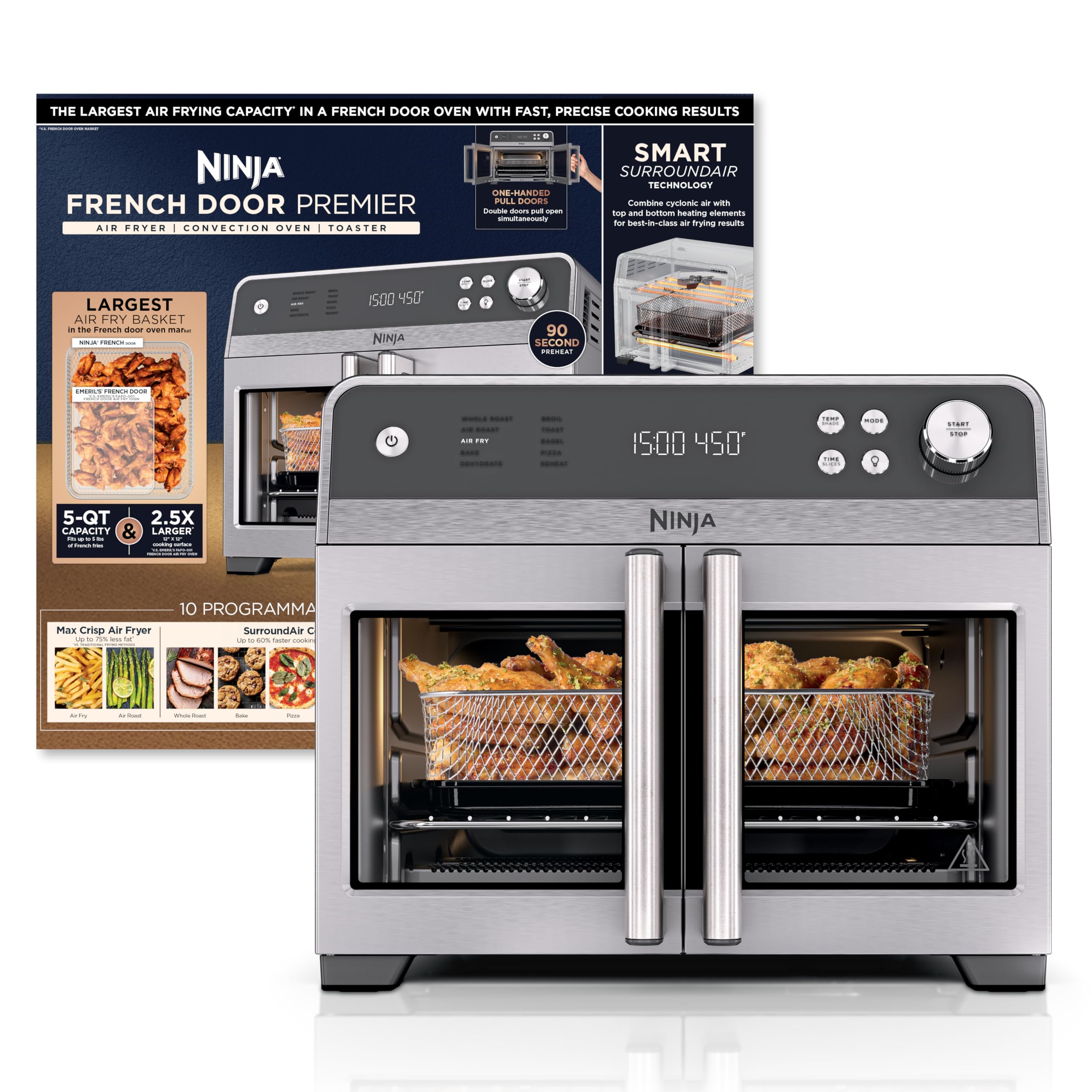
This isn’t a dual-basket drawer unit. It’s an oven-style powerhouse for people who want a single appliance to cover multiple jobs: air fry, toast, bake, broil-style crisping, and “I need a countertop oven that actually cooks evenly.” The FO101 is the kind of product that makes sense when you’re tired of separate gadgets and you want one sleek machine that earns permanent counter space.
The French door design is not just aesthetic. It’s functional. One-handed access feels natural, especially when you’re holding a tray or checking food mid-cook. For busy kitchens, that convenience matters because it reduces small annoyances. Owners who love this style often talk about how it replaces their toaster oven and becomes their default for quick meals, reheating, and smaller bakes.
Where the FO101 shines is “tray cooking.” Drawer air fryers are amazing for baskets of food, but oven-style machines are strong for items you want laid out like a sheet pan: multiple pieces of toast, a spread of vegetables, or a family-sized batch of something that benefits from a wider cooking surface. That’s also why many people choose an oven-style air fryer when they entertain: it feels closer to a real oven, but faster and with less kitchen heat.
The best way to decide if this is your pick is to ask one question: do you love cooking on trays? If you mostly do wings, fries, and quick proteins, drawers are simpler. If you want toast, bagels, pizza-style bakes, and convection-style roasting in one unit, FO101 becomes a daily tool. It’s also a strong choice for downsized kitchens where the main oven is small or where you want to keep your home cooler during cooking.
Cleaning tends to be easier than older toaster ovens because accessories are designed to be removable and washable. The practical tip is to treat the crumb tray like a routine: empty it often, wipe it while warm, and you avoid burnt residue smells. If you do that, this kind of oven stays pleasant to use. If you don’t, any countertop oven eventually starts smelling like “old toast.”
Think of the FO101 as the “kitchen simplifier.” It’s not about dual zones—it’s about replacing multiple tools with one appliance that performs well across tasks. For the right person, it’s the kind of buy that changes your counter forever.
Why it’s a great alternative
- Multi‑appliance replacement – Air fry + toast + bake + reheat in one countertop unit.
- French door convenience – Easy access feels premium and practical in daily use.
- Great for tray cooking – Wide-format cooking is excellent for families and entertaining.
- Cleaner, calmer kitchen routine – Often used instead of firing up a full-size oven for smaller meals.
Good to know
- Not a dual-basket drawer unit—if you want two independent zones, choose a DualZone or DoubleStack model.
- Oven-style cooking benefits from occasional tray rotation for perfect evenness (like any convection setup).
- Crumb tray maintenance is key to keeping it smelling fresh long-term.
Ideal for: people who want a premium countertop oven experience with strong air frying, and who prefer tray-based cooking over dual drawers.
10. Ninja DCT451 Smart Double Oven – The FlexDoor Workhorse for Mixed Diets, Quick Meals, and Real Cooking

The DCT451 is a very specific kind of upgrade: it gives you two cooking cavities on your counter. For the right household, that’s not “nice”—it’s life-changing. Think couples with different diets, families where kids eat one thing and adults eat another, or anyone tired of juggling timing between an oven, a toaster oven, and an air fryer.
FlexDoor is the signature design move. You can open the top cavity for quick tasks—toast, bagels, small reheats—without dumping heat from the bottom cavity. Or open the full door when you’re using both sections. That sounds like a small ergonomic detail, but it affects daily comfort: less bending, less heat blast, and easier “quick snack” access.
FlavorSeal is the other “real life” benefit. People who cook fish and meat at the same time, or who don’t want aromas crossing between meals, often praise the separation. It’s not just about smell—it’s about kitchen harmony. When two foods cook separately, you stop compromising. You cook what you want, not what “works together.”
The built-in thermometer adds confidence, especially for proteins. Owners who use the probe tend to describe the experience as “set it and forget it” in a way that’s rare for countertop ovens. You don’t have to hover. That’s why some buyers say it replaces multiple appliances: it isn’t just an oven; it’s a cooking system that reduces babysitting.
Now the honest notes from real-world use: this machine is big, and placement matters. Some people wish it had two fully separate doors instead of the integrated FlexDoor behavior, because opening the bottom may still affect the top. Others mention small design wishes—like wanting two crumb trays so you don’t move one tray depending on which cavity is used. These aren’t dealbreakers, but they’re the kind of “daily annoyance” details that matter if you’re very particular.
Here’s the best way to decide: if you primarily want dual-zone air fryer baskets, this isn’t that. If you want a countertop appliance that can do real oven jobs while also air frying in the bottom and handling toast up top, it’s incredibly effective. It’s also a strong “small oven replacement” for people who don’t want to heat a whole kitchen for a single meal.
Why it’s a unique powerhouse
- Two cavities, two meals – Separate cooking zones for different diets and different timing needs.
- Flavor separation – Helpful when you cook foods with strong aromas at the same time.
- Thermometer precision – Great for “cook to doneness” proteins with less babysitting.
- Top cavity convenience – Makes quick toast/snacks feel effortless without running the whole unit.
Good to know
- Large footprint—measure your counter and ensure door clearance where you plan to place it.
- Some users wish for small design extras (like a second crumb tray), depending on how they cook.
- If you only want dual drawers, this is more appliance than you need—choose a DualZone drawer model.
Ideal for: households that cook two different meals at once, want aroma separation, and love the idea of “two ovens on the counter” more than two baskets in a drawer system.
11. Ninja DCT601 Double Stack XL Countertop Oven – The “Serious Cooking” Two‑Cavity Setup for Busy Homes

If the DCT451 is the “two cavities solved my household problem” model, the DCT601 is the more premium, more ambitious evolution of that idea: two independent ovens in one countertop unit, designed for people who cook constantly and want to compress cooking time without sacrificing results. It’s the type of appliance that becomes the hub of a kitchen when you use it daily.
The best use case is the busy home with conflicting needs: kids’ meal on one side, adult meal on the other; entrée in one cavity, side in the other; dinner in one, dessert prep in the other. That’s not just convenience. It changes your kitchen flow. You stop waiting for one item to finish before you can start the next, and you stop heating a large wall oven for smaller jobs. For many owners, that’s the real “upgrade feeling.”
In real-world feedback, people often praise how well-built it feels and how quickly it becomes part of the daily routine. The learning curve exists—especially if you want to use every function and understand how the thermometer behavior works—but it’s not the kind of complexity that stays confusing. It’s more like learning a new car: the first week feels button-heavy, then your hands just know where to go.
It’s also a “space consolidation” win. Many people buy it to replace separate countertop appliances: air fryer, toaster oven, broiler-style crisping tool. The trade-off is that it’s larger than a basic toaster oven, and some accessories may be hand-wash recommended depending on how you cook. If your kitchen goal is “one machine, fewer gadgets,” it aligns perfectly with that philosophy.
Where it shines is fast, repeatable cooking. Once you learn your favorite settings—your ideal toast, your go-to air fry temp, your reheat pattern—it becomes a reliable machine that makes meals feel easier. It’s also great for hosts: you can run two different things at once without the “everything tastes like the last thing we cooked” problem.
The bottom line: this is not the entry-level pick. It’s a premium countertop cooking system for people who want two independent cavities, faster meal production, and a kitchen that feels more controlled on busy nights. If that describes your life, it can be one of the most satisfying appliances you’ll own.
Why it’s worth considering
- Two‑cavity efficiency – Real “two ovens on the counter” multitasking for busy homes.
- Meal timing becomes easier – Syncing and independent controls reduce back-to-back cooking.
- Appliance consolidation – Can replace multiple countertop machines for many households.
- Great for hosting – Separate cooking zones help keep flavors distinct and timing coordinated.
Good to know
- It’s a larger countertop unit—plan placement and clearance carefully.
- Expect a short learning curve if you want to maximize features like thermometer and multi-function modes.
- If your main goal is two air fryer baskets, a dual-drawer model is simpler and more direct.
Ideal for: high-frequency cooks, families who multitask meals, and hosts who want a premium two‑cavity countertop system instead of separate appliances.
How Dual‑Zone Cooking Actually Works (and How to Get “Crispy, Not Sad” Results)
Most disappointment with air fryers isn’t about the machine. It’s about the physics. Hot air cooking is brutally honest: if you block airflow, you steam food. If food is wet, it browns slower. If you overload, crispness disappears. Once you understand the rules, you can get restaurant-like texture consistently—and dual-zone cooking becomes a real system instead of a gimmick.
The dual-zone “timing engine” (Smart Finish in plain English)
- Different temps, different times: One drawer can roast vegetables hot while the other cooks protein gentler to stay juicy.
- Synced landing: Smart Finish is basically a coordinator—so you’re not eating one thing hot and one thing lukewarm.
- Better dinner flow: You can start the slow food first, then add the quick food later and still serve together.
Here’s the pro move most people skip: plan your “crisp phase.” For many foods, the best results come from finishing hot. Example: marinated chicken. Cook it through at a moderate temp so it doesn’t burn sticky sugars, then bump heat to crisp the outside for the final minutes. That’s how you get crispy edges without dried-out meat.
The “Match Cook” moment (when one big batch beats two different foods)
- Use Match Cook for parties: wings on both sides, fries on both sides, or large batches of roasted veg.
- Keep layers thin: your results improve more from airflow than from extra minutes.
- Shake once, win always: it’s the simplest upgrade you can make to texture.
Think of it like this: dual zones are either a “two different foods” tool or a “bigger batch” tool. The best owners switch between those modes intentionally.
Stacked models: the “airflow choreography” that makes DoubleStack shine
- Racks are not decoration: they create a second cooking level, but only if you leave air gaps.
- Don’t trap steam: avoid wet foods under a rack of crisp foods unless you want the crisp food to soften.
- Rotate for perfect color: if you care about uniform browning, swap positions or rotate once mid-cook.
The payoff is huge: you cook more in less counter space. But the model works best when you treat it like a small convection oven: active, controlled, and rewarded by technique.
The crispness rules that solve 90% of “my air fryer isn’t crispy” complaints
- Dry the surface: pat moisture off proteins and vegetables before cooking. Water = steam = softness.
- Use a tiny amount of oil: a light coat helps browning and crunch without turning food greasy.
- Give it space: your best results come from single-layer cooking or thin, breathable layers.
- Finish hotter: if food is cooked but not crisp, increase heat briefly at the end.
- Don’t sauce too early: sugary sauces burn and glue themselves to baskets. Glaze at the end.
Once you adopt these habits, dual-zone machines stop feeling like gadgets and start feeling like a reliable cooking system.
FAQ: Dual‑Zone Air Fryers (Answered Like a Real Cook)
Is dual‑zone actually worth it, or is it just marketing?
Why does my food come out uneven or less crispy than I expected?
Do I need to preheat a dual-basket air fryer?
Can I cook raw meat and vegetables at the same time?
What’s the easiest way to keep cleanup fast?
Which is better: side-by-side dual baskets, FlexBasket, or DoubleStack?
Final Thoughts: The Ninja Dual Zone Air Fryer That Fits Your Real Life
The best dual-zone appliance isn’t the one with the longest feature list. It’s the one that makes your weeknights feel smoother: less waiting, more hot-and-crispy timing, and fewer “why is dinner still not ready?” moments.
Here’s the simplest way to turn this guide into a confident purchase:
- Want the best all-around dual-drawer experience with “no more overcooked meat” confidence? Start with the Ninja Foodi DZ550 DualZone Smart XL. The thermometer-driven workflow is the reason this one feels like a true upgrade.
- Need big capacity but don’t want to sacrifice counter space? Choose the Ninja DoubleStack XL SL401. It’s the strongest “family output in a slimmer footprint” option in this lineup.
- Want the classic dual-basket experience with a low learning curve? The Ninja Foodi DZ201 DualZone is the dependable baseline that most people are happy to own for years.
- Small counter, but still want stacked dual-zone power? Look at the Ninja DoubleStack SL201 for a more compact take on the vertical design.
- Cook big proteins and hate “will it fit?” moments? Pick the Ninja Foodi DZ071 FlexBasket. MegaZone cooking is a genuine quality-of-life upgrade for real dinners.
- Cooking mostly for one or two? The Ninja Foodi DZ090 DualZone is right-sized for small meals while still giving you two baskets and synced timing.
- Value-minded and open to Renewed? The Ninja Foodi AD300 XL DualZone (Renewed) and the Renewed dual-basket listing can be smart ways to get dual-drawer convenience with a more value-friendly approach.
- Want a countertop oven that also air fries (tray cooking, toast, bake, reheat)? Consider the Ninja French Door Premier FO101 for a single-cavity “do-it-all” style.
- Need two separate cooking cavities for different meals and flavors? The Ninja DCT451 Smart Double Oven and Ninja DCT601 Double Stack XL Countertop Oven are the “two ovens on the counter” solution for busy, multitasking households.
The goal is simple: pick the ninja dual zone air fryer (or dual-cavity Ninja setup) that matches how you actually cook—busy weeknights, meal prep, family plates, or small-household speed—and you’ll end up with a purchase that feels satisfying every time you press Start.
