
If you’ve fallen in love with chewy crumb, blistered crust and that tangy aroma that makes your whole kitchen smell like a bakery, you already know: good sourdough is a lifestyle, not just a loaf.
What fewer people talk about is how much easier that lifestyle gets once you pair your starter with the right bread machine. The best bread machine for sourdough bread doesn’t replace the magic of fermentation—it handles the boring bits: precise kneading, gentle proofing, and perfectly even baking while you get on with your day.
In this guide, we’ll walk through 18 carefully vetted machines that actually work for sourdough—both true wild-yeast loaves and “cheater” sourdough recipes that combine starter with a touch of commercial yeast for reliability. I’ve combed through long‑term owner reviews, specialist baking forums, and real‑world tests to figure out which models handle sticky, low‑hydration dough, long rises, and repeated bakes without burning out.
Whether you want a fully programmable sourdough workhorse, a compact machine that can just knead and proof while you bake in a Dutch oven, or a big dual‑heater model that can take a 2–3 lb family loaf, you’ll find an option here that can become your go‑to best bread machine for sourdough bread.
In this article
How to Choose the Best Bread Machine for Sourdough Bread
Almost every bread maker can bake a basic yeast loaf. Far fewer are genuinely great at sourdough. Before you fall in love with any single model, it’s worth zooming out and thinking about how you actually like to bake.
1. Decide what “sourdough” means in your kitchen
There are three main ways people use a bread machine for sourdough:
- Full machine sourdough: Starter + flour + water + salt straight into the pan; the machine handles everything (ideal when the machine has a dedicated sourdough or homemade cycle).
- Hybrid “cheater” sourdough: Starter plus a bit of commercial yeast. The flavor is sourdough‑ish, but the timing is closer to a regular loaf, so standard programs work well.
- Mix & proof only: The machine kneads and manages bulk fermentation, then you shape and bake in a Dutch oven or on a stone for peak crust.
If your dream is set‑and‑forget loaves with wild yeast only, look for programmable models (like KitchenArm or KBS) that let you customize each rise. If you’re happy shaping and baking by hand, you mainly need strong kneading, gentle heat and a reliable dough cycle.
2. Look for real control over fermentation
Sourdough lives and dies on timing and temperature. Features that help:
- Custom cycles / “Homemade” mode: Lets you tweak knead, rest, rise and bake times so your starter gets the long, warm proof it needs.
- Dedicated sourdough or starter program: Machines like KitchenArm and Briskind include cycles just for building and maintaining starter.
- Smart temperature sensors: Models with NTC/PID control (especially KBS and Briskind) automatically adjust proofing based on the chamber temperature instead of blindly following a timer.
Most basic machines use short rises aimed at instant yeast. Those can work for hybrid sourdough but are often too fast for pure starter loaves unless you run two dough cycles back‑to‑back or customize timings.
3. Pan shape, material & size actually matter
For sourdough, the pan isn’t just a container—it shapes your crumb and crust.
- Horizontal pans (like West Bend or many KBS models) give you a loaf that looks like store‑bought sandwich bread, with slices that actually fit the toaster.
- Vertical pans (Cuisinart, Amazon Basics, many budget models) make tall loaves. Great for toast, but big bubbles can gather towards the top if the dough is under‑kneaded.
- Ceramic‑coated pans are fantastic if you want PTFE/PFOA‑free surfaces and easier release—handy with slightly stickier high‑hydration sourdough doughs.
For most households, 1.5–2 lb capacity is ideal: big enough for family sourdough, but not so huge that you’re forced to eat the same loaf for a week.
4. Don’t underestimate the motor and heating system
Sourdough dough tends to be either very slack (high hydration) or relatively stiff (sandwich‑style). Both stress weak motors. Look for:
- At least 550–650W power for frequent sourdough use; premium models go to 710W.
- Dual heaters or convection for even baking and deeper crust color without dried‑out crumb.
- Low noise & solid build so the machine doesn’t “walk” across the counter during long kneads.
5. Features that actually help sourdough (and what to ignore)
Particularly useful for sourdough bakers:
- Delay timer to sync your bake with your starter’s peak activity.
- “Rise only” / “Knead only” / “Bake only” modes so you can improvise when your starter runs late or early.
- Nut & seed dispensers if you love seeded sourdough—no more hovering to add mix‑ins at the right moment.
- Good documentation & recipe support (KitchenArm and KBS are standouts here).
Things you can mostly ignore for sourdough: endless cake presets, jam programs you’ll never use, and smartphone apps that look impressive but don’t actually improve the bread.
Quick Comparison: 18 Sourdough‑Friendly Bread Machines
Here’s a bird’s‑eye view of the 18 machines we’ll be reviewing. Use this table to spot which models match your budget, loaf size and control needs, then jump to the full review for the sourdough‑specific details.
On smaller screens, swipe or scroll sideways to see the full table.
| Model | Key strength | Best for | Sourdough friendliness | Amazon |
|---|---|---|---|---|
| KITCHENARM 29‑in‑1 Smart | Fully programmable | Experiment‑heavy bakers | Top‑tier custom sourdough cycles | Amazon |
| KBS 19‑in‑1 (MBF‑016) | Convection + sourdough | Power users, 2 lb loaves | Dedicated sourdough & custom mode | Amazon |
| KBS Pro 710W | High‑power ceramic | Crust lovers & seeded loaves | Great for hybrid & dough‑only sourdough | Amazon |
| KBS Premium Convection | Dual heaters | Even baking, large families | Excellent oven‑style sourdough loaves | Amazon |
| Briskind 19‑in‑1 Ceramic Pan | Horizontal pan | Health‑focused households | Starter mode + quiet proofing | Amazon |
| Briskind Compact 19‑in‑1 | Compact | Couples & small kitchens | Great for dough + Dutch oven baking | Amazon |
| Neretva 20‑in‑1 (Silver) | Dual heater | Quiet all‑rounder | Even heat for tall sourdough loaves | Amazon |
| Neretva 20‑in‑1 (Green) | Style + function | Design lovers | Same dual‑heater sourdough performance | Amazon |
| Neretva 2.2 lb + Nut Dispenser | Big capacity | Seeded & loaded loaves | Great for mix‑ins & larger batches | Amazon |
| CUCKOO CBM‑AAB101S | Fast bake | Busy homes | Good “cheater” sourdough & dough | Amazon |
| Cuisinart CBK‑110 | Compact classic | Set‑and‑forget users | Reliable for hybrid sourdough | Amazon |
| OSIPOTO 17‑in‑1 | Beginner‑friendly | First‑time bakers | Great sourdough dough cycle | Amazon |
| Hamilton Beach 2 lb | Value brand | Budget hybrid loaves | Best used for dough + bake in oven | Amazon |
| Amazon Basics 2 lb | Lowest price | Occasional bakers | Solid for dough & simple loaves | Amazon |
| West Bend Hi‑Rise | Dual paddles | Big 3 lb family loaves | Excellent mixing for wet doughs | Amazon |
| Elite Gourmet EBM8103B | Budget black | Entry‑level users | Good for simple sourdough doughs | Amazon |
| Elite Gourmet EBM8103M | Mint finish | Small homes, fun color | Same internals, good value | Amazon |
| Elite Gourmet EBM8103SS | Stainless body | Budget stainless look | Great for weekly baking | Amazon |
| Elite Gourmet EBM8103B/SS/M group | Family of twins | Pick your colour/finish | All capable of hybrid sourdough | Amazon |
In‑Depth Reviews: 18 Sourdough‑Ready Bread Machines
Now let’s look at each model in detail—how it kneads, how it handles long fermentation, and the small quirks that matter when you’re chasing your personal best bread machine for sourdough bread.
1. KitchenArm 29‑in‑1 Smart Bread Machine – Custom Cycles for Serious Sourdough Nerds

If you want a machine that can genuinely grow with your sourdough skills, the KitchenArm is a standout. It’s one of the few models that treats timing as a starting point, not a prison—its HOME MADE menu lets you adjust each stage (knead, rest, rise, bake) at the minute level, then save up to four fully custom profiles.
Owners regularly talk about sending their favorite online or family recipes to KitchenArm support and getting a customized program back. That’s a huge deal for sourdough, where bakers often want long, warm bulk ferment followed by a shorter proof. Multiple reviewers mention specifically great results with wild‑yeast loaves once hydration and times are dialed in.
Why it’s a sourdough star
- Four fully programmable menus – Rare in this price range; perfect for fine‑tuning sourdough timings and even adjusting mid‑cycle.
- Lots of health‑focused recipes – Built‑in menus for 100% whole wheat, dark rye, sugar‑free and salt‑free loaves, plus well‑tested gluten‑free options.
- Excellent documentation & support – Owners rave about helpful emails from “Tony” and detailed recipe booklets that demystify the process.
- Supports all‑purpose flour sourdough – Many recipes are designed around cheaper AP flour rather than bread flour, which matters if you bake often.
Good to know
- You’ll get the most from it if you’re willing to read the (long) manual and treat the first few loaves as testing rounds.
- The nonstick pan is Teflon‑style rather than ceramic—safe at bread‑baking temps, but not the best pick if you’re strictly PFAS‑free.
- The interface is richer than on cheap machines; total beginners might feel a bit overwhelmed on day one.
Ideal for: bakers who love to tinker, want real control over fermentation and need a single machine that can handle traditional, gluten‑free and true sourdough with custom cycles.
2. KBS 19‑in‑1 Convection Bread Maker (MBF‑016) – Smart Sensors & Dedicated Sourdough Menu

KBS’s newer 19‑in‑1 model is one of the most sourdough‑aware machines on the market. It combines a ceramic nonstick pan (no PTFE/PFOA), a respectable 650W motor and a dedicated sourdough program with a fully programmable mode that can be tuned for longer ferments.
Bakers like that it uses 360° convection heating and a temperature‑aware system to keep dough around 100°F during rises. That’s essentially “Goldilocks” speed for many sourdough cultures, which explains why reviewers praise its consistency even in colder seasons. Several long‑term users mention that once they found their favorite sourdough recipe, they simply saved the timing and hit one button every time afterwards.
Why it works well for sourdough
- True sourdough & custom mode – You’re not hacking a “French” setting; you can actually build a sourdough‑specific program.
- Ceramic pan – Great for sticky, high‑hydration doughs and for anyone avoiding Teflon‑style coatings.
- Even convection bake – The dual‑sensor system does a solid job avoiding pale tops and over‑browned sides.
- Strong customer support – Owners consistently report quick responses, replacement parts and detailed help when tuning recipes.
Good to know
- The interface is button‑based (not glass touch) and slightly more utilitarian than the fancier KBS Pro panels.
- The recipe book is solid but not polished; most users supplement with their own sourdough formulas once they get comfortable.
- At full power it’s not silent—expect a normal “thunk‑thunk” kneading sound, especially with stiff doughs.
Ideal for: home bakers who want a health‑minded, PFAS‑free machine that can do both push‑button sourdough and more advanced custom bakes once they get hooked.
3. KBS Pro 710W Bread Maker – High Power, Auto Nut Dispenser & Cheater Sourdough Hero
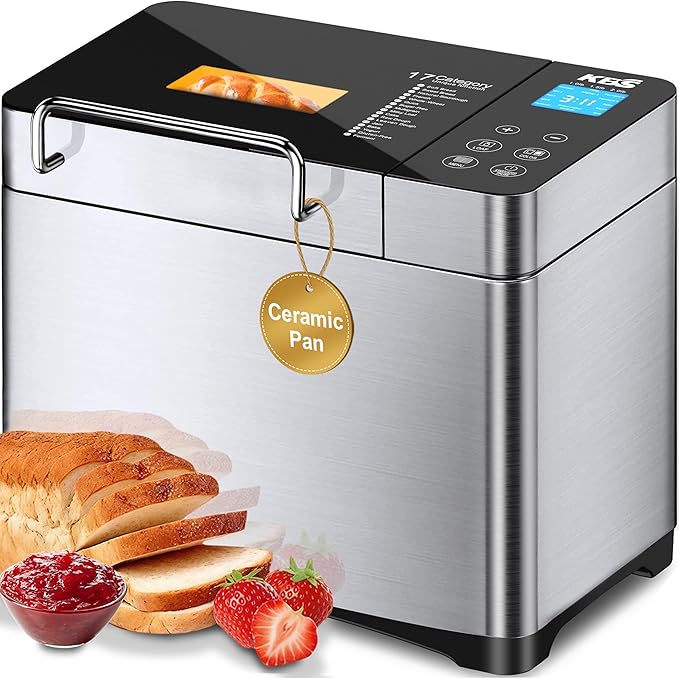
If you lean toward “hybrid” sourdough—using a starter plus a little yeast for reliability—the KBS Pro is incredibly forgiving. Its 710W motor and 360° convection heating mean it can handle denser, seed‑heavy doughs without stalling, and its auto nut dispenser is a dream for seeded sourdough ryes or multigrains.
Reviews are full of people using this primarily for dough, pizza, and “cheater sourdough” loaves with excellent oven spring. Many owners also call out how easy the ceramic pan is to clean and how reliably loaves slide out intact, which matters when you’re working with slightly wetter doughs that might cling to cheaper pans.
Where it shines
- Very strong motor – Handles whole‑grain, enriched or heavily seeded sourdough doughs without smelling hot or bogging down.
- Nut & seed dispenser – Great for timed additions of seeds, grains or dried fruit in your sourdough without babysitting.
- Premium glass touch panel – Looks modern, wipes clean easily and feels more upscale than membrane buttons.
- Ceramic pan again – Protects against chips and scratches better than many Teflon‑style pans when you’re manoeuvring stiff doughs.
Good to know
- The included recipes aren’t all optimized for modern sourdough—many users pull in formulas from blogs or ChatGPT and adapt.
- The touch panel is sensitive; brushing flour off mid‑cycle can accidentally hit buttons if you’re not careful.
- It’s on the heavier side; plan a permanent home on the counter rather than dragging it in and out of cabinets.
Ideal for: bakers who love crunchy seeded sourdough, hybrid loaves and pizza dough, and want a tough, ceramic‑panned machine that can keep up.
4. KBS Premium Convection Bread Maker – Dual Heaters for Bakery‑Style Crust

This is the more “oven‑like” sibling in the KBS family. It uses dual heaters plus convection to keep the entire chamber at a more even temperature, which sourdough absolutely loves. Several reviewers specifically call out consistently domed loaves instead of the common “pale top, overdone sides” problem cheaper machines suffer from.
New bakers highlight how forgiving it is: even imperfectly hydrated doughs bake through evenly. More advanced bakers appreciate the sourdough, dough and proof functions, often using the machine for kneading and bulk ferment before switching to Dutch‑oven baking for ultra‑crusty boules.
Why sourdough bakers like it
- Even top‑to‑bottom browning – Dual heaters and convection fix the classic “sunken pale top” problem.
- Good sourdough menu – Easily handles longer ferments, and many people run the dough cycle then bake in their oven.
- Large window – You can track oven spring and crust color without constantly opening the lid.
- Included recipes are decent – Especially for rye and whole‑wheat hybrids, which can be tricky elsewhere.
Good to know
- The manual could be clearer about which program works best for specific sourdough styles—you’ll likely experiment a bit.
- Some users find the beep tones on the loud side, especially in open‑plan homes.
- A few owners outside North America accidentally bought 110V units; this one is strictly for 120V regions.
Ideal for: anyone who wants machine‑baked sourdough that looks and tastes closer to a small bakery loaf, with less fuss over hot spots.
5. Briskind 19‑Menu Bread Maker with Ceramic Pan – Smart, Starter‑Friendly Design

Briskind’s full‑size machine is one of the nicest blends of design, health‑conscious build and sourdough‑friendly features in this lineup. You get a ceramic nonstick horizontal pan (so your loaf looks more like store bread), a slightly angled glass touch panel that’s easy to see under cabinets, and a wide set of menus including sourdough starter, yogurt and jam.
Experienced bakers in the reviews love how it keeps working even if you open the lid during mixing so you can tweak hydration—a big deal when you’re adjusting a new sourdough formula. They also highlight how quiet and stable the machine is, and how the custom menu plus detailed manual make it easy to remove the paddle before the final rise if you want a cleaner crumb.
Why it’s great for starter‑centric baking
- Dedicated sourdough starter mode – Lets you build and refresh starter with controlled warmth, which many cheaper machines lack.
- Ceramic pan and paddle – No PFAS, and stands up well to regular sourdough use according to long‑term owners.
- Thoughtful panel design – White backlit LCD and angled glass are surprisingly helpful in low‑light kitchens.
- Company responsiveness – People mention quick replies when asking for timing charts and technical details.
Good to know
- The pan locks with a twist that can feel fiddly at first—practice cold before your first hot loaf.
- Some users with very stiff doughs report the motor struggling; stick to sane hydration for all‑machine kneading.
- The tall‑and‑wide loaf shape is generous but can be a bit “blocky” for small toasters.
Ideal for: health‑conscious bakers who want a ceramic, horizontal‑loaf machine that can nurture starter, proof dough and bake attractive sourdough loaves.
6. Briskind Compact 19‑in‑1 – Small, Quiet & Perfect as a Sourdough “Assistant”

If you mostly bake 1–1.5 lb loaves and don’t want a hulking appliance on your counter, this compact Briskind is a gem. The footprint is genuinely small, but you still get 19 programs, including gluten‑free, low carb, sourdough starter, and dough‑only modes with adjustable crust colors.
Owners who bake daily highlight how quiet and reliable it is, and how easy it is to leave on the counter thanks to the built‑in handle and lower weight. Many use it almost exclusively for kneading and proofing sourdough dough, then transfer to a banneton and Dutch oven for baking—saving their arms and still getting that enviable artisan crust.
Why it’s great for small sourdough batches
- Optimized for 1–1.5 lb loaves – Recipes and pan size are tuned so smaller loaves rise and bake evenly.
- Rich manual controls – Knead‑only, rise‑only and bake‑only programs make it easy to intervene mid‑process.
- Quiet and stable – Multiple users mention it doesn’t “walk” and is much quieter than older machines.
- Excellent daily‑use feedback – There are many reviews from people using it every day for dough and bread.
Good to know
- It tops out at 1.5 lb; if you regularly need 2 lb loaves, go for one of the full‑size machines.
- The pan and paddle are nonstick but not advertised as ceramic; if you want ceramic specifically, opt for the larger Briskind or KBS machines.
- No nut dispenser—add seeds and extras by hand when the machine beeps.
Ideal for: 1–3‑person households that want a compact, reliable machine to handle sourdough mixing, proofing and smaller bakes.
7. Neretva 20‑in‑1 (Silver) – Quiet Dual‑Heater Loaves with Ceramic Pan

Neretva’s 20‑in‑1 machine focuses on even heat and low noise. It uses a dual‑heater setup (top and bottom) and a 550W motor, paired with a chemical‑free ceramic pan and stainless steel body. Owners repeatedly mention how surprisingly quiet it is, which is great if you run longer sourdough cycles overnight.
While it doesn’t have as granular control as KitchenArm or KBS, the combination of gluten‑free, whole‑wheat, yogurt and “homemade” style programs gives you enough flexibility to run extended dough cycles, then either bake inside or transfer to your own oven. It’s a strong all‑rounder if you bake more than just sourdough but want it to be sourdough‑capable.
Why it’s worth a look
- Ceramic pan + dual heaters – Great combo for healthier cooking and better top‑to‑bottom crust.
- Low noise – Multiple users say it’s quiet enough to run without disturbing sleep in nearby rooms.
- 20 programs – Includes gluten‑free, whole‑wheat, pizza dough, yogurt and more, so it doesn’t just do bread.
- Nice compact‑yet‑tall footprint – Easier to leave out on the counter in smaller kitchens.
Good to know
- The manual is light on sourdough‑specific guidance; you’ll likely lean on online recipes and trial‑and‑error.
- Some experienced users find a few preset names (like “toast dough”) confusing at first.
- A few owners outside the US mention plug/voltage compatibility issues—stick to 120V regions without a transformer.
Ideal for: families wanting a quiet, ceramic‑panned, dual‑heater machine that bakes all sorts of breads and can handle sourdough with a bit of recipe tweaking.
8. Neretva 20‑in‑1 (Green) – Same Guts, More Style for Daily Sourdough

Functionally, this green Neretva is the same as the silver version above: dual heaters, ceramic pan, low noise, 20 programs. The difference is aesthetic—this one is unapologetically pretty. For many buyers, that turns out to matter more than expected: when a machine looks good, it tends to stay on the counter and actually get used.
User feedback mirrors the silver model: easy operation, strong everyday performance, and consistent loaves as long as you follow the ingredient order. Several reviewers make a small sourdough loaf weekly for themselves and use the dough function for pizza and cinnamon rolls the rest of the time.
Why choose this one
- Same dual‑heater & ceramic benefits – All the performance of the silver model.
- Design‑forward color – Looks intentional next to modern kettles and espresso machines.
- Good value bundle – Includes glove, tools, measuring set and recipes.
- Low noise & stable base – Good for overnight sourdough cycles without walking.
Good to know
- Like the silver version, the instruction book could explain a few program names more clearly.
- Not as programmable as KitchenArm/KBS; best for hybrid sourdough or dough‑only workflows.
- The top sticker with program numbers looks a bit “appliancy” next to the otherwise stylish design.
Ideal for: anyone who wants a capable sourdough‑friendly bread maker that doesn’t look like a boxy office appliance on their countertop.
9. Neretva 2.2 lb Bread Machine with Nut Dispenser – Large, Even‑Baked Sourdough for a Crowd

This Neretva is aimed at households who want big loaves without baby‑sitting mix‑ins. The 2.2 lb capacity, dual heaters and ceramic pan are paired with an automatic fruit & nut dispenser, so you can load up seeded sourdough or fruit‑and‑nut loaves and trust the machine to add toppings at the right moment.
Gluten‑free users in particular call out how well it handles sticky doughs on both the dedicated GF program and custom settings—something that overlaps nicely with gluten‑free sourdough. A few critical reviews mention confusing icons and a loud kneading phase, but overall reliability for daily baking is strong.
Standout points
- 2.2 lb capacity – Great if you’re baking for 6–7 people or like to slice and freeze sourdough.
- Auto nut dispenser – Perfect for multi‑seed sourdough loaves without hovering over the dough.
- Ceramic pan & low‑noise motor – Healthy coating and quieter than many big machines.
- Gluten‑free praise – Good sign for handling difficult sourdough doughs consistently.
Good to know
- The control icons and small display take a little getting used to; some users find the interface less intuitive.
- A few owners report recipes in the manual under‑baking on light crust—plan to start at medium and adjust.
- Larger size and dispenser mean more height; check cabinet clearance before you commit.
Ideal for: big households and serious sourdough fans who want seeded or mix‑in‑heavy loaves without fiddling mid‑cycle.
10. CUCKOO CBM‑AAB101S – Fast, Compact Machine with Auto Mix‑In Dispenser
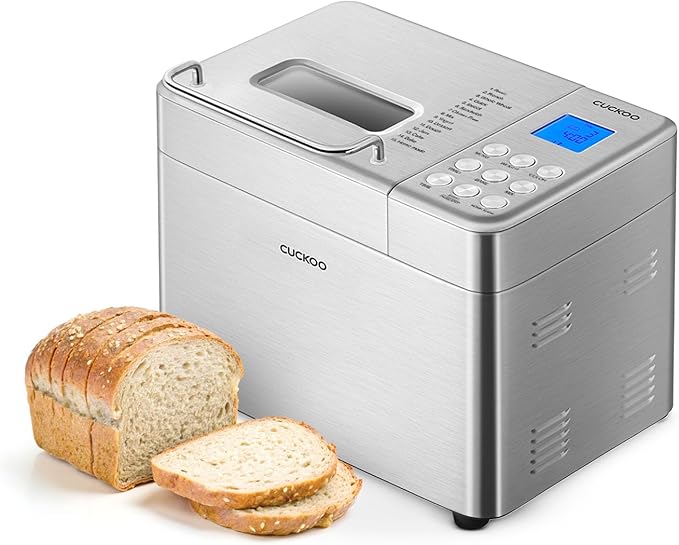
CUCKOO is better known for rice cookers, and this bread maker carries over some of that “set it and forget it” DNA. It’s compact, uses a high‑wattage heater to shave up to 20 minutes off standard bake times, and includes a built‑in nuts & fruit dispenser—a handy bonus for rye or seeded sourdough variations.
Most owners use it heavily for white, whole‑wheat and gluten‑free bread, plus pizza dough and yogurt. For sourdough, it’s best used as a dough + bulk ferment machine: let it mix and knead (using basic or French programs), then transfer the dough to a banneton and bake in a hot Dutch oven for that classic blistered crust.
Why consider it
- Fast bake times – Useful when you’re doing hybrid sourdough that doesn’t need marathon proofing.
- Automatic mix‑in dispenser – Great for nuts, fruit or seeds in rye or multigrain sourdough.
- Compact stainless body – Looks premium yet small enough to tuck away.
- Beginner‑friendly interface – Multiple reviews mention how “foolproof” it feels once you’ve tried one loaf.
Good to know
- A few owners report occasional mechanical faults (like paddles not starting) after several uses—check yours thoroughly within the return window.
- It’s a bit noisy during knead, though some people park it in a laundry room to solve that.
- No dedicated sourdough program, so you’ll improvise using dough/basic cycles and your own timing.
Ideal for: small households who want a compact, fast machine that can handle sourdough dough prep and hybrid loaves without hogging counter space.
11. Cuisinart CBK‑110 – Compact Workhorse for Hybrid Sourdough & Daily Bread

Cuisinart’s CBK‑110 is one of the most reliably praised “classic” bread makers online. It isn’t loaded with high‑tech features, but what it does, it does very well: steady kneading, dependable bakes and a genuinely useful 13‑hour delay timer. The vertical pan turns out tall, square loaves that slice perfectly for toast and sandwiches.
For sourdough, the CBK‑110 is especially good at hybrid loaves—where you use starter plus a bit of yeast—and at dough‑only workflows. Many owners run the dough cycle, then shape and bake in the oven to get that open, irregular sourdough crumb. The 3‑year limited warranty and responsive customer service are nice bonuses if you’re baking multiple times per week.
Why it still earns a spot
- Brand reliability – Lots of “I stopped buying store bread” reviews after months or years of use.
- Consistent kneading – People who bake weekly say the dough comes together beautifully once you learn your flour.
- Great dough cycle – Ideal for sourdough bakers who prefer Dutch‑oven baking but want help with mixing/proofing.
- Compact footprint – Easier to leave out than many bulkier 2 lb machines.
Good to know
- Some users report the machine “dancing” on the counter during knead—set it back from the edge and coil the cord as a “leash.”
- No ceramic pan; it’s a standard nonstick coating.
- The whole‑wheat and gluten‑free presets seem more finicky than basic white—you’ll likely adjust recipes for best results.
Ideal for: bakers who want a widely proven, simple machine from a big brand—and who don’t mind baking sourdough in the oven after the machine handles the labor‑intensive early stages.
12. OSIPOTO 17‑in‑1 Bread Maker – Easy Sour‑Curious Starter Machine

OSIPOTO’s 17‑in‑1 machine leans heavily into “make this easy, please.” The buttons are clear, the programs cover all the basics (including whole wheat, jam, yogurt and gluten‑free), and the 600W motor plus 2 lb capacity give you plenty of room to experiment.
Reviewers repeatedly call out how foolproof it feels for first‑time bakers, and several explicitly describe using it to knead sourdough, then finishing in a Dutch oven. The relatively quiet operation is a nice touch if you’re running longer dough cycles early in the morning or late at night.
Why it’s a nice first sourdough machine
- Very simple operation – Great if you’re intimidated by multi‑page manuals and endless menus.
- 17 programs – Enough to explore dough, French, gluten‑free and more without overcomplicating things.
- Quiet, low‑vibration knead – Reviewers note it doesn’t walk or make washing‑machine‑level noise.
- Value for the price – Feels more premium than many similarly priced competitors.
Good to know
- Documentation is decent but not as comprehensive as KitchenArm or KBS; you may want external sourdough guides.
- No ceramic pan; it’s regular nonstick.
- Temperature control is less sophisticated than PID/NTC systems in high‑end machines, so proofing can be slightly more seasonal.
Ideal for: new bakers who want to dip a toe into sourdough without facing an intimidating wall of settings.
13. Hamilton Beach 2 lb Bread Maker – Affordable Workhorse for Dough‑First Sourdough

Hamilton Beach’s machine is widely available, budget‑friendly and surprisingly capable for the price. You get 14 settings, including French, whole‑grain, gluten‑free and multiple express modes, plus a PFAS‑free nonstick pan and paddle—something many health‑conscious bakers will appreciate.
For sourdough, this machine is best used as a mix & first rise assistant. Several gluten‑free reviewers warn that the dedicated GF program double‑kneads, which is bad news for gluten‑free sourdough. However, many owners happily use the basic or dough programs to knead and proof before moving the dough to a pan or Dutch oven for baking.
What it does well
- Big‑brand reliability – Lots of positive feedback from people who bake weekly and appreciate simple controls.
- PFAS‑free nonstick – A nice reassurance if you’re trying to clean up your kitchen materials.
- Good dough performance – Many users say it mixes thoroughly without leaving flour clumps.
- Fair price point – Especially good if you want to try sourdough workflows without a big upfront cost.
Good to know
- The gluten‑free cycle is widely criticized for over‑kneading; best avoided for GF sourdough.
- The pan is a bit shallow for true 2 lb loaves—anything very tall can hit the lid and underbake at the top.
- The manual doesn’t include detailed cycle breakdowns, which limits advanced customization.
Ideal for: budget‑minded bakers who want a familiar brand and mostly plan to use the machine for mixing and bulk proofing sourdough, not necessarily full in‑machine bakes.
14. Amazon Basics 2 lb – No‑Frills Machine That Nails Dough & Simple Sourdough

This Amazon Basics machine is exactly what it sounds like: straightforward, affordable, and surprisingly competent. It offers 14 programs (including dough and gluten‑free), a 2 lb capacity and a simple LCD panel. It’s not trying to be fancy; it’s trying to be dependable.
Daily users often use it to make one or two loaves a week, praising how reliably the dough comes together and how easy cleanup is. Many treat it as a kneading and proofing station, then bake their sourdough in the oven for better crust. Given the low price, it’s a great way to see whether a best bread machine for sourdough bread style workflow is actually your thing before upgrading later.
Why it can still be the right choice
- Very simple interface – Fewer buttons, fewer ways to get lost in the menu.
- Decent dough & basic loaves – Many reviewers report consistently good whole‑wheat and white bread.
- Lightweight & compact – Easy to store if you don’t want it out all the time.
- Excellent cost‑per‑loaf math – Regular users save noticeably over store‑bought bread prices.
Good to know
- The included recipe for 1.5 lb whole wheat infamously uses too much salt; many users switch to third‑party recipes.
- The machine can “walk” during knead if placed directly on a smooth countertop—keep it back from the edge.
- No ceramic pan or high‑end sensors; it’s a basic, timer‑driven design.
Ideal for: beginners and budget‑conscious bakers who want to automate mixing and kneading, then grow into sourdough techniques without a large initial investment.
15. West Bend Hi‑Rise 3 lb – Dual‑Paddle Beast for Family‑Size Sourdough

If you want loaves that look like they came from a supermarket—only better and fresher—the West Bend Hi‑Rise is a great fit. Its long horizontal pan and dual kneading paddles handle larger batches of dough exceptionally well, and reviewers rave about the tall, evenly risen loaves once they’ve dialed in flour weights and yeast amounts (especially at higher altitudes).
For sourdough, the dual paddles shine when you’re mixing high‑hydration doughs or heavier whole‑grain mixes; the machine simply has more “muscle” to pull everything together. It also offers a custom program that lets you tweak cycle times, making it useful for both hybrid and near‑pure sourdough methods.
Why big‑loaf sourdough bakers love it
- Horizontal 3 lb pan – Produces beautiful sandwich loaves with regular slices, ideal for large families.
- Dual paddles – Better kneading coverage for wet or stiff sourdough doughs.
- Custom cycle (Menu 11) – Lets you adjust knead, rise and bake to suit your own recipes and altitude.
- Lots of real‑world tuning advice – Owners share detailed tips on flour grams and yeast reduction for high‑rise loaves.
Good to know
- The pan can be tricky to insert/remove until you get the hang of the twist‑lock system.
- It’s physically larger than most machines here; check that your counter depth and cupboards can handle it.
- The nonstick coating is standard—not ceramic—so treat it gently and avoid metal tools.
Ideal for: big families and serious bread‑eaters who want wide, traditional loaves and strong kneading for bigger sourdough batches.
16. Elite Gourmet EBM8103 (Black, Mint & Stainless) – Affordable Machines That Punch Above Their Price

Elite Gourmet’s EBM8103 range (black EBM8103B, mint EBM8103M, and stainless EBM8103SS) are essentially the same machine in different outfits: 19 programs, 1–2 lb capacity, and a reputation for delivering much more than you’d expect at this price.
Owners who bake constantly praise the consistent results, the suction‑cup feet that prevent walking, and the thorough recipe booklet that doubles as a troubleshooting guide. Sourdough‑wise, it’s ideal for dough and hybrid loaves: several reviewers mention specifically using it for sourdough or long‑ferment recipes after a little experimentation with hydration and yeast.
Why they’re strong budget picks
- Same guts, different looks – Pick black, mint or stainless to match your kitchen.
- Solid 19‑menu lineup – Includes whole wheat, rye, gluten‑free and quick breads plus jam and yogurt.
- Great manuals – Many users rave about the included recipe and troubleshooting guidance.
- Suction feet – Help prevent the “leaping bread maker” issue during knead.
Good to know
- It’s a timer‑driven machine; you don’t get cycle‑level custom programmability like KitchenArm.
- The pan is standard nonstick rather than ceramic—fine if treated gently.
- Some users outside North America report poor support; stick to Amazon’s return window if you’re overseas.
Ideal for: bakers who want a reliable, inexpensive machine for weekly bread and sourdough dough prep, with color options to suit your style.
17. Elite Gourmet EBM8103B (Black) – Ultra‑Accessible First Sourdough Machine

Among the Elite trio, the black model is usually the lowest priced and blends easily into most kitchens. Owners talk about setting it up, dumping ingredients in, and being genuinely shocked how good the first loaf tastes. For sourdough, it’s again a fantastic dough/pizza/rolls machine—and a decent hybrid sourdough baker once you learn to avoid overfilling the pan and adjust flour if the dough looks too wet.
Why this specific one
- Often the cheapest finish – Great if you want to stay under a tight budget.
- Same 19‑function brain – No compromises in features compared to the mint/stainless versions.
- Quiet and stable – Suction cups and a moderate motor keep things calm.
- Lots of “we ate half the loaf immediately” reviews – Always a promising sign.
Good to know
- The black shell can show flour smudges quickly—nothing a quick wipe can’t fix.
- Long‑term longevity at heavy daily use is less well‑documented than premium brands.
- Non‑backlit screen may be a little hard to read in very dim kitchens.
Ideal for: brand‑new bread machine owners who want the most affordable path into sourdough‑assisted baking without feeling like they bought a toy.
18. Elite Gourmet EBM8103M (Mint) – Fun Color, Serious Bread

Same mechanics, different mood. The mint EBM8103M tends to be a hit in smaller apartments, campers and colorful kitchens where aesthetics matter. Functionally it’s identical to the other Elite models, so everything said above applies: easy recipes, good troubleshooting guidance, and plenty of positive reviews from people baking several times a week.
For sourdough, owners talk about doing light and whole‑wheat variations, often switching to their own flour blends after trying the included recipes. Because the machine handles dough and proofing nicely, it’s a great match if you love the idea of “wake up, hit start, eat fresh bread at lunch.”
Why you might pick mint
- Visually fun – Looks at home in bright, modern or retro kitchens.
- Identical performance – No need to compromise features for color.
- Good for campers/tiny homes – Many reviewers mention using it in RVs and small spaces.
- Great beginner support – The manual practically walks you through your first bakes.
Good to know
- Some long‑term durability complaints exist (dead units with poor after‑sale response) so keep your Amazon return window in mind.
- Like all vertical pans, the loaf has a pronounced “belly button” hole where the paddle bakes into it.
- Recipes are fairly conservative on hydration; you may want to gradually increase water for more open sourdough crumb.
Ideal for: small households that want a cheerful, low‑cost machine to handle the work of kneading and proofing sourdough, with the option of full in‑machine bakes.
How Bread Machines Actually Handle Sourdough (and How to Get Better Results)
Every machine in this guide can help you make sourdough—but how you use it matters even more than which one you buy. Here’s how bread makers interact with wild yeast, and how to coax the best loaves out of them.
1. Understand what the machine does well (and poorly)
- Excellent at: consistent kneading, keeping dough around a stable temperature, and baking to an even internal temp without babysitting.
- So‑so at: the very long, cool ferments traditional country loaves use, and extreme hydration doughs (>80%) that benefit from stretch‑and‑fold instead of classic knead.
- Bad at: “reading” your dough. Timers don’t know if your starter is sluggish today or if your kitchen is colder than usual.
That’s why the best bread machine for sourdough bread setups still involve you peeking in during the first 5–10 minutes of kneading and occasionally pausing programs to extend a rise if your dough needs it.
2. A simple machine‑plus‑Dutch‑oven method
- Use your machine’s dough or sourdough program to mix and knead until you have a smooth, elastic dough.
- Let it rise in the machine for the first bulk ferment; if you can, add 30–60 minutes beyond the default for wild‑yeast doughs.
- Turn the dough out, shape it on a lightly floured surface, and proof in a banneton or bowl.
- Bake in a preheated Dutch oven (or on a stone with steam) for a deep, blistered crust you’ll never get from a bread‑machine lid.
This hybrid method uses the machine as muscle and thermostat, but still gives you that artisan bakery finish.
3. Dial in hydration & flour
- Watch the dough early. In the first 5–10 minutes, open the lid and check: you want a soft, tacky ball that cleans the sides of the pan without slapping hard.
- Adjust with a spoon. Too dry? Add water a tablespoon at a time. Too soupy? Sprinkle in flour gradually.
- Use a scale when you can. Many owners of KitchenArm, KBS and Briskind machines report perfect results when switching from cups to grams.
- Blend flours. For more open sourdough crumb, try mixing bread flour with 20–30% whole wheat or rye.
4. Timing your starter & the delay function
- Peak starter = better rise. Use your starter when it’s domed and bubbly, not collapsed.
- Delay timers are for hybrid loaves. For pure sourdough, long delays can over‑ferment; instead, time the program so kneading starts shortly after your starter peaks.
- Use “rise only” when needed. If your dough looks under‑proofed when the machine wants to bake, pause and give it another 20–40 minutes.
- Cool fully before slicing. Sourdough continues to set as it cools—cutting too early can collapse the crumb and exaggerate gumminess.
Once you’ve made two or three loaves in a given machine, you’ll start to feel its personality—and that’s where your sourdough really levels up.
FAQ: Bread Machines & Sourdough
Can a bread machine make “real” sourdough bread?
Is a programmable model really worth it for sourdough?
What size bread machine is best for sourdough?
Do I need a ceramic pan for sourdough?
Which is better: baking sourdough in the machine or in a Dutch oven?
Final Thoughts: Picking Your Best Bread Machine for Sourdough Bread
The right bread machine doesn’t replace your starter—it gives it a stable, cozy home and takes the heavy lifting off your shoulders. Suddenly, kneading stiff dough or juggling proofing times around work and sleep isn’t such a big deal.
Here’s a quick way to translate this guide into a single confident choice:
- Want maximum control and true wild‑yeast loaves? Start with the deeply programmable KitchenArm 29‑in‑1 or the sourdough‑aware KBS 19‑in‑1.
- Love crust, seeds and “cheater” sourdough? Look at the high‑power, ceramic‑panned KBS Pro 710W or the dual‑heater KBS Premium Convection.
- Short on space but big on sourdough dreams? The ceramic‑panned Briskind 19‑Menu or compact Briskind 19‑in‑1 Compact are lovely daily sourdough assistants.
- Want a stylish, low‑noise all‑rounder? Check the dual‑heater, ceramic‑panned Neretva 20‑in‑1 Green or larger Neretva 2.2 lb with Dispenser.
- On a tight budget but still want sourdough help? Value machines like the Elite Gourmet EBM8103B, Hamilton Beach 2 lb or Amazon Basics 2 lb still mix and proof sourdough dough beautifully.
Whichever path you choose, remember: your starter plus the right machine can give you bakery‑quality loaves on weeknights without the drama. Pick the model that fits your space, budget and appetite for tinkering, and your new best bread machine for sourdough bread will quietly become one of the hardest‑working tools in your kitchen.
