
If you’re gluten free, you already know how fragile your bread situation can feel. Store loaves are tiny, slices crumble if you look at them wrong, and the price tag somehow sneaks toward $7 or more for something that still tastes a bit like cardboard.
A good bread machine changes that. Instead of guessing which gums or preservatives are in your loaf, you control every ingredient: the flours, the starches, the sweetener, even how dark the crust gets. You can shape the crumb for toast, sandwiches, or cinnamon‑swirl weekend treats—and keep everything safely in your own kitchen.
The tricky part is choosing the Best Bread Machine For Gluten Free Bread rather than just any model with a random “GF” button slapped on the control panel. Gluten‑free dough behaves more like thick cake batter than elastic wheat dough, so the machine has to mix, rise, and bake differently or you end up with a gummy brick or a loaf that caves in the middle.
This guide pulls together 13 seriously gluten‑aware bread makers on Amazon—from compact 1‑pound machines that tuck into a small apartment kitchen to big 3‑pound horizontal models that look just like supermarket loaves. I dug through manuals, test results, and hundreds of real‑world reviews to highlight which machines treat gluten‑free dough properly, which ones give you tweakable programs, and which ones are best if you just want to toss the ingredients in and come back to perfect slices.
In this article
- How to choose the right bread machine for gluten‑free baking.
- Quick comparison table of 13 top gluten‑free models.
- In‑depth reviews of each bread maker, with real‑world pros and cons.
- How gluten‑free bread behaves in a machine (and how to get better loaves).
- Answers to common gluten‑free bread machine questions, plus final buying tips.
How to Choose the Best Bread Machine For Gluten Free Bread
Gluten‑free dough is its own little universe. It doesn’t stretch, it doesn’t like being punched down over and over, and it needs more hydration and support than wheat dough. That means not every bread maker that handles regular flour will handle gluten‑free recipes gracefully. A little planning here saves you from a lot of sunken loaves later.
1. Start with who’s actually eating the bread
Think in slices and weeks, not just loaf size numbers on a box:
- 1 person, occasional toast: A compact 1–1.5 lb machine is plenty and costs less to run.
- 1–2 people eating bread most days: A 1.5–2 lb capacity is ideal. You can bake once or twice a week and freeze slices.
- Families of 3–5: Look for 2–2.5 lb loaves or dual‑paddle models that handle bigger batches without tunneling.
- Big households / batch bakers: Oversized 2.2–3 lb horizontal pans (like the West Bend) are your friend.
Gluten‑free bread stales faster than wheat bread, even when it’s made in a machine. If you don’t get through a loaf in three to four days, err on the smaller side and slice‑and‑freeze half so you’re not racing the clock.
2. What actually makes a Best Gluten Free Bread Machine?
A good gluten‑free program is more than just a label on the button. When you’re evaluating machines, look for:
- One strong mix + one rise: Gluten‑free dough doesn’t like being knocked down and reshaped. The best machines use a single, thorough mix and one long rise before baking, instead of several knead‑and‑punch cycles meant for wheat dough.
- Adjustable or custom cycles: Models like KitchenArm and the newer KBS machines let you edit knead, rise and bake times so you can copy your favorite recipe’s timing exactly rather than forcing it into a generic program.
- Even heat, ideally from more than one direction: Dual heaters or convection fans help large gluten‑free loaves bake through to the center without scorching the crust.
- Clear documentation: The manual should spell out which menus to use for gluten‑free bread and how long each stage runs. That makes it much easier to tweak recipes or diagnose issues.
If a machine’s dedicated gluten‑free cycle includes multiple long kneads or a “punch down” mid‑way through, you’ll often get dense, short loaves or collapsed tops. In those cases you’ll either need to switch to a basic/quick program or choose a more gluten‑savvy model.
3. Decide between compact and family‑size machines
Beyond overall capacity, pan shape really changes your day‑to‑day experience:
- Tall, vertical pans (common on compact machines) save counter space but produce taller, smaller slices.
- Horizontal pans (like West Bend’s Hi‑Rise) look just like supermarket loaves and make sandwich‑friendly slices.
- Wide 2.2–3 lb pans are great for families and toast addicts, but gluten‑free loaves that big need solid heating and a well‑designed program to avoid gummy centers.
If you mainly want gluten‑free sandwich bread for one or two people, a 1–1.5 lb compact loaf is easier to bake consistently and wastes less flour. If you’re feeding teens or baking for the freezer, larger horizontal loaves start to make sense.
4. Pan materials, coatings & cleaning
Every bread maker in this guide has a non‑stick pan, but what that means differs:
- Ceramic‑coated pans (KBS models, Neretva, Briskind) are PTFE/PFOA‑free and very easy to clean. They’re great if you prefer to avoid classic Teflon‑style coatings.
- Traditional non‑stick (PTFE) pans (KitchenArm, Elite, Amazon Basics, Hamilton Beach, West Bend) release loaves easily and also clean up quickly as long as you avoid metal tools and abrasive pads.
- Stainless steel bodies are mostly about durability and appearance, but they also tend to stay cooler to the touch and feel more solid on the counter.
Whichever style you choose, the big rule is the same: treat the pan gently. Gluten‑free dough can be sticky; resist the urge to scrape with metal. Soak, use warm water and a soft sponge, and your pan will stay non‑stick for years.
5. When a dedicated Best Gluten Free Bread Maker is worth it
If you’re eating gluten free by choice, you may be happy to use one machine for everything and just wipe it carefully between wheat and gluten‑free cycles. But if someone in your home has celiac disease or a medically diagnosed gluten intolerance, it’s worth thinking about a dedicated appliance.
- Separate paddles and pans help avoid flour dust and crust crumbs carrying over into your gluten‑free loaves.
- Machines that can be fully wiped out (smooth interiors, removable lids or paddles) make cleaning much easier.
- Simple controls matter when multiple family members will be using the “gluten‑free only” machine—fewer chances to hit the wrong cycle by accident.
Always follow your healthcare provider’s or dietitian’s advice on cross‑contamination, but from a practical perspective many households find that a compact dedicated machine for gluten‑free bread plus a larger one for everything else is the least stressful setup.
Quick Comparison: 13 Best Gluten Free Bread Machine Picks
Here’s a bird’s‑eye view of the 13 machines we’ll be reviewing. Use this table to spot which models match your loaf size, pan shape, and gluten‑free priorities, then jump to the full review for the details.
On smaller screens, swipe or scroll sideways to see the full table.
| Model | Gluten‑free strengths | Capacity | Best for | Amazon |
|---|---|---|---|---|
| KitchenArm 29‑in‑1 Smart Bread Machine | Deep GF control | 1, 1.5, 2 lb | Serious GF bakers who want fully programmable cycles | Amazon |
| KBS Premium Convection Bread Maker (Ceramic Pan) | Convection + ceramic | 1, 1.5, 2 lb | Non‑toxic pan, crisp crusts, reliable GF cycle | Amazon |
| KBS 19‑in‑1 Programmable Bread Maker (MBF‑016) | Fully programmable | 1, 1.5, 2 lb | Custom GF timing nerds & sourdough experimenters | Amazon |
| Neretva 15‑in‑1 2.2LB Bread Machine (Auto Nut Dispenser) | Big GF loaves | 1.56, 2.2 lb | Large gluten‑free families & mix‑in heavy recipes | Amazon |
| West Bend Hi‑Rise Bread Maker (3‑lb, Dual Paddle) | Horizontal 3 lb | 2, 2.5, 3 lb | Big, classic sandwich loaves with a GF option | Amazon |
| KBS Pro 710W Bread Maker (Tempered Glass Panel) | Ceramic + nut tray | 1, 1.5, 2 lb | Stylish all‑rounder for GF bread plus pizza dough | Amazon |
| Briskind 19‑in‑1 Compact Bread Maker | 1–1.5 lb GF | 1, 1.5 lb | Smaller households, low‑waste gluten‑free loaves | Amazon |
| Neretva 20‑in‑1 Bread Maker – Retro Green | Stylish GF | 1.65, 2 lb | Design‑focused kitchens that still want real GF performance | Amazon |
| Neretva 20‑in‑1 Bread Maker – Stainless Silver | Slim stainless | 1.65, 2 lb | Neutral‑look alternative with the same GF features | Amazon |
| Elite Gourmet EBM8103SS (Stainless, 19‑Menu) | Beginner‑friendly | 1, 1.5, 2 lb | First‑time bread makers who want a simple GF option | Amazon |
| Elite Gourmet EBM8103M (Mint, 19‑Menu) | Cute + capable | 1, 1.5, 2 lb | Budget machines that still bake solid GF loaves | Amazon |
| Amazon Basics 2‑lb Programmable Bread Maker | Budget GF | Up to 2 lb | Lowest‑cost way to test gluten‑free bread making | Amazon |
| Hamilton Beach 12‑Setting Bread Maker (29982) | Big‑box option | 1, 1.5, 2 lb | Occasional GF bakers willing to tweak programs manually | Amazon |
In‑Depth Reviews: 13 Contenders for the Best Bread Machine For Gluten Free Bread
Now let’s zoom in on what it’s actually like to live with each of these machines: how they handle gluten‑free dough, what owners rave about after months of use, and where you may still need to work around the quirks.
1. KitchenArm 29‑in‑1 Smart Bread Machine – Feature‑Rich, Gluten‑Free Focused

KitchenArm is the sleeper hit you find when you read actual user reviews instead of just staring at brand names. It’s packed with 29 programs, but what matters for gluten‑free bakers is how much control you get: a dedicated gluten‑free menu, support for 100% whole‑grain recipes without added gluten, and a Home Made mode that lets you edit every single stage.
The machine can store four fully customized programs—more than any other bread maker on this list. That means once you’ve dialed in your favorite sandwich loaf, cinnamon‑raisin bread, or dairy‑free recipe, it becomes a one‑button experience: add ingredients, tap start, and the KitchenArm quietly recreates the exact knead, rise, and bake timing you used last time.
Real‑world owners repeatedly highlight two things: consistency and customer support. The accompanying recipe book is unusually thorough, with precisely weighed ingredients and clear guidance for 1, 1.5 and 2 lb loaves. And if you have a recipe you love from elsewhere, KitchenArm will actually help you adapt it to their machine’s timing so your gluten‑free loaves don’t sink or over‑rise. That kind of hand‑holding is rare in this price range.
Why gluten‑free bakers love it
- Four fully custom programs so you can mirror any gluten‑free recipe’s timing instead of forcing it into a rigid cycle.
- Recipes designed for both bread flour and all‑purpose flour, which is handy if you use lower‑gluten blends in mixed households.
- Saved settings turn your favorite GF loaf into a true “1‑press” operation once you’ve dialed it in.
- Detailed documentation and responsive support that actually explains the “why” behind ingredients and timing.
Good to know
- The pan uses a classic PTFE non‑stick coating; if you strongly prefer ceramic, look at the KBS or Neretva machines.
- There’s a learning curve if you want to use the advanced Home Made programming, so expect to spend some quality time with the manual.
- Like most bread makers, it’s happiest when you measure by weight—especially with gluten‑free flours where a few extra grams matter.
Ideal for: gluten‑free households that want one main machine for everything and like the idea of dialing in their own custom programs instead of living with a generic “GF” preset.
2. KBS Premium Convection Bread Maker – Ceramic Pan, Dual Heater, Gluten‑Free Star

If you’d like a machine that feels properly premium without jumping into “luxury brand” pricing, KBS’s Premium Convection model is a standout. It uses a PTFE‑free ceramic pan, a 710‑watt motor and dual heaters with a small convection fan to move heat evenly around the loaf—especially helpful for denser gluten‑free mixtures.
On paper you get 17 functions including gluten‑free, sourdough, yogurt and jam. In practice, what wins people over is how reliably it bakes: loaves release cleanly from the ceramic pan, the gluten‑free program handles the single crucial rise without collapsing the loaf, and the top‑mounted viewing window makes it easy to keep an eye on the dome as it sets.
There’s also a top‑mounted nut and seed dispenser that drops add‑ins at the right moment, which is a nice bonus if you love multigrain or seeded gluten‑free breads. The touchscreen is flat glass, so wiping away stray flour takes seconds, and the overall build feels more “small countertop oven” than toy appliance.
Why gluten‑free bakers should consider it
- Ceramic, PTFE‑free pan that still releases gluten‑free loaves with minimal coaxing.
- Convection and dual heaters help large, dense loaves bake through without gummy centers.
- Dedicated gluten‑free cycle that manages the single rise gently to avoid collapse.
- Automatic nut dispenser so mix‑ins land at the right time without babysitting the machine.
Good to know
- The main recipe booklet is generous but doesn’t always clearly label which program number to use; expect to scribble a few notes.
- The lid hinge is plastic; treat it gently when opening and closing, especially if you’re in the habit of snapping lids shut.
- Some owners find the default crust a bit dark—easy to solve by choosing “light” or manually shortening bake time once you know your preferences.
Ideal for: anyone who wants a non‑toxic pan, bakery‑style crusts and a gluten‑free program that just quietly does the right thing without much tinkering.
3. KBS 19‑in‑1 Programmable Bread Maker – Custom Timing for Gluten‑Free Perfection

Think of this newer KBS model as the “power user” sibling to the Premium. You still get the PTFE‑free ceramic pan, 1–2 lb loaves and a stainless housing, but here the real star is the amount of control you gain over the cycle itself.
The 19 programs include gluten‑free, sourdough and yogurt, but there’s also a fully programmable mode that lets you adjust each stage: autolyse, knead, rest, multiple rises and bake. That makes it especially attractive if you’re working with specific gluten‑free formulas from cookbooks or blogs and want to copy their timing almost exactly.
Owners who’ve upgraded from older machines love the strong, even knead from the redesigned paddle and how the planetary mixing action pulls sticky gluten‑free dough off the corners of the pan. The large viewing window and bright display also make it easy to see how high your dough has risen—handy when you’re pushing the limits with high‑hydration blends.
Where it shines for gluten‑free
- True cycle‑by‑cycle customization so you can shorten kneads, lengthen the single rise or tweak bake time for new recipes.
- Ceramic pan with excellent release even when you’re using sticky, high‑starch gluten‑free mixes.
- Strong 650 W motor and 360° heating that handle heavier dough without straining.
- Responsive customer service that has been quick to replace the rare defective unit and provide extra pans or paddles.
Good to know
- The programmable options are powerful but a bit intimidating on day one; plan on a couple of “test loaves” while you learn.
- Because it’s a relatively new model, there aren’t as many third‑party recipes written specifically for it yet—though you can adapt almost any with the custom mode.
- The beep at the end of the cycle is loud; great if you’re in another room, less great if your kitchen is near bedrooms.
Ideal for: gluten‑free bakers who love to tinker, follow specific recipes or want tight control over knead, rise and bake times through all four seasons.
4. Neretva 15‑in‑1 2.2LB Bread Machine – Large Gluten‑Free Loaves with Auto Nut Dispenser

If your household tears through bread, the Neretva 2.2 lb machine is built for generous gluten‑free loaves. It uses dual heaters above and below the pan plus a 600‑watt motor to bake tall, family‑sized loaves without leaving the center underdone.
There are 15 programs including gluten‑free, whole‑wheat, sugar‑free, jam, yogurt and a fully manual “homemade” mode. An automatic fruit‑and‑nut dispenser drops mix‑ins at the right moment, which is especially helpful if you’re making hearty seeded gluten‑free breads or sweet breakfast loaves and don’t want to hover near the machine.
Owners consistently praise how quiet it runs during kneading and how evenly it bakes, especially considering the loaf size. Most mention using it several times a week for sandwich loaves, then switching to dough‑only programs for pizza or rolls on the weekend.
Why it works well for gluten‑free families
- Big 2.2 lb capacity that can comfortably feed a larger gluten‑free household.
- Dual heaters and 360° baking help thick loaves cook through without gummy cores.
- Ceramic non‑stick pan that’s PTFE‑free and easy to clean, even after sticky dough.
- Automatic mix‑in dispenser that handles nuts, seeds and dried fruit hands‑off.
Good to know
- The smaller 1.56 lb setting is often better for gluten‑free recipes—giant 2.2 lb loaves can be harder to bake evenly unless your recipe is dialed in.
- The display icons are tiny and a bit cryptic; expect to keep the manual nearby for the first few weeks.
- Because the loaf is tall, slices can be oversized for small toasters; you may end up cutting some pieces in half.
Ideal for: gluten‑free families and heavy bread eaters who want larger loaves and built‑in support for nuts, seeds and other mix‑ins.
5. West Bend Hi‑Rise Bread Maker – Big, Store‑Style Gluten‑Free Loaves

Most bread machines make tall, square loaves. West Bend’s Hi‑Rise goes the other way: a long, horizontal pan with two kneading paddles that produces slices very close to supermarket bread. If you’ve missed “normal‑looking” gluten‑free sandwiches, this alone can feel life‑changing.
You can choose 2, 2.5 or 3 lb loaves, and there’s a dedicated gluten‑free setting alongside basics like wheat, French and sweet bread. The dual paddles do a fantastic job of pulling flour out of the corners, which is more important than it sounds when you’re dealing with heavy, sticky gluten‑free doughs that don’t naturally stretch.
Owners who bake frequently appreciate the ability to customize knead and rise times using the custom program, and many report being pleasantly surprised by how evenly such a large loaf bakes once they’ve dialed in their flour and hydration.
Why it’s great for gluten‑free households
- Horizontal pan and dual paddles create tall but wide loaves that slice beautifully for sandwiches.
- Gluten‑free program that can be fine‑tuned using the custom menu if you bake GF regularly.
- Generous 3 lb capacity if you like to bake once and freeze slices for later.
- Good overall value for the size and features compared with other large‑capacity machines.
Good to know
- The pan can be stubborn to remove until you get the hang of the twist‑and‑lift motion.
- Because the loaves are huge, gluten‑free recipes sometimes benefit from slightly reduced yeast or hydration to avoid over‑rising.
- It takes up more counter space front‑to‑back than compact 2 lb machines; measure your spot before you click “buy.”
Ideal for: gluten‑free families who want big, horizontal loaves that look and slice like regular sandwich bread.
6. KBS Pro 710W Bread Maker – Ceramic Pan, Glass Touch Panel, Strong Gluten‑Free Results
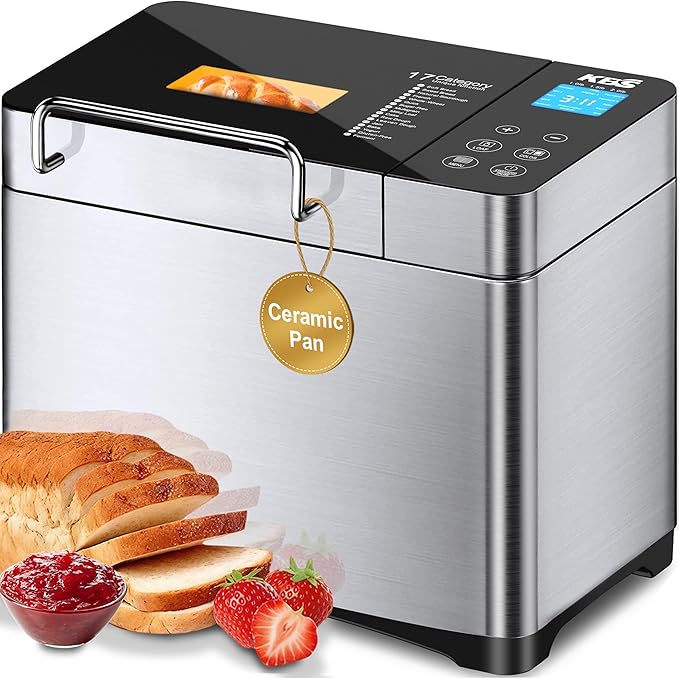
This earlier KBS Pro shares a lot of DNA with the Premium: same 710‑watt motor, same ceramic pan, same 17‑program lineup including gluten‑free, sourdough and yogurt. The biggest differences are cosmetic—a sleek tempered‑glass touch panel—and slightly different default timings.
Many owners bought it originally “just” for pizza dough or basic wheat loaves and then discovered how well it handles gluten‑free recipes with the right flour blends. The ceramic pan releases loaves like a dream, which matters a lot when you’re working with high‑starch mixes that tend to glue themselves to older non‑stick coatings.
The automatic nut dispenser is surprisingly handy if you enjoy adding seeds, nuts or dried fruit to gluten‑free loaves; it drops them in right after the first knead, so they’re evenly distributed instead of clumped in one corner.
Why it’s a safe gluten‑free choice
- Ceramic, PTFE‑free pan that cleans easily and doesn’t hang onto sticky dough.
- Gluten‑free, sourdough and dough programs give you options for both full loaves and oven‑baked rolls.
- Clear glass touch panel that wipes clean and makes it obvious which program you’re using.
- Strong motor that handles heavy batters and enriched doughs without sounding strained.
Good to know
- The supplied recipes are decent but a bit conservative; many people end up using online gluten‑free recipes and the dough/quick bake programs instead.
- Because the panel is flat glass, it doesn’t give much tactile feedback; you’ll want to double‑check you actually pressed “start.”
- No fully custom mode—if you love programming every stage, the 19‑in‑1 KBS or KitchenArm is a better fit.
Ideal for: home bakers who want a stylish, ceramic‑pan machine that does an excellent job with both gluten‑free loaves and everyday doughs.
7. Briskind 19‑in‑1 Compact Bread Maker – Small Loaves, Big Gluten‑Free Performance

The Briskind compact machine is a gem if you’re short on space or don’t eat a ton of bread but still want great gluten‑free results. Instead of chasing 2–3 lb loaves, it focuses on 1 and 1.5 lb sizes, which bake more evenly and are easier to finish before they dry out.
You still get 19 programs including gluten‑free, whole wheat, oatmeal, low‑carb, sourdough starter, jam and yogurt, plus unusually handy knead‑only, rise‑only and bake‑only modes. That trio is gold for gluten‑free bakers who like to mix dough in the machine but bake it in a different pan or shape it into rolls.
Owners love how genuinely compact and light it is—small enough to live on a counter in a studio apartment—and how consistently it turns out well‑shaped 1.5 lb loaves. The carrying handle makes it easy to tuck away in a cabinet between baking sessions.
Why it’s great for gluten‑free singles & couples
- 1–1.5 lb loaves that are ideal for one or two people without wasting expensive gluten‑free flour.
- Dedicated gluten‑free menu plus manual knead/rise/bake settings for advanced recipes.
- Very small footprint and carry handle that make it easy to move or store.
- Good documentation and recipe booklet tailored to the smaller loaf size.
Good to know
- If you regularly bake for more than two people, the smaller capacity will feel limiting—you’ll be running multiple batches.
- There’s no nut dispenser, so you’ll need to be nearby to add mix‑ins when the machine beeps.
- The compact size means slightly more vibration during kneading; make sure it sits on a solid, level surface.
Ideal for: gluten‑free households of one or two, small kitchens, RVs and anyone who prefers smaller loaves baked more often.
8. Neretva 20‑in‑1 Bread Maker (Green) – Retro Looks, Modern Gluten‑Free Features

If you want a bread maker that doesn’t look like a boring white box, the retro‑green Neretva is hard to beat. Under the cute shell it’s the same 20‑program workhorse as the stainless version: gluten‑free, whole‑wheat, sugar‑free, cake, yogurt, pizza dough, even an oddly named “dried meat floss” cycle if you’re feeling adventurous.
For gluten‑free bakers, the big wins are the ceramic pan, dual heaters and the generous program list. The gluten‑free cycle handles the single rise gently, and the 1.65 and 2 lb loaf options are nicely sized for families. There’s also a 15‑hour delay timer and a 1‑hour keep‑warm function if you like waking up to fresh bread.
Users frequently mention how quiet it is during kneading—noticeably softer than some older bread makers—and how easy it is to clean thanks to the smooth ceramic pan and stainless shell.
Why gluten‑free bakers like it
- Ceramic, PTFE‑free pan and dual heaters for even baking.
- Dedicated gluten‑free program plus lots of dough and yogurt options for broader use.
- Attractive design that actually looks nice left out on the counter.
- Low‑noise motor (< 40 dB) that won’t drown out conversation in a small kitchen.
Good to know
- The program names (like “toast dough” or “dessert”) aren’t always self‑explanatory; the manual is your friend here.
- There’s no automatic nut dispenser on this model—mix‑ins are a manual add when the machine beeps.
- Some owners wish the recipe booklet included more gluten‑free formulas; you’ll probably pull recipes from blogs or cookbooks.
Ideal for: gluten‑free bakers who want a capable, ceramic‑pan machine that looks as cheerful as it is useful.
9. Neretva 20‑in‑1 Bread Maker (Silver) – Same Engine, More Neutral Look

Prefer stainless over pastels? This silver Neretva is functionally the same as the green version—same ceramic pan, same dual heaters, same 20 programs including gluten‑free—but wrapped in a more neutral shell that disappears into most modern kitchens.
The loaf options (1.65 and 2 lb) are still ideal for families, and the gluten‑free program produces tall, even loaves when you follow the manual’s order of ingredients and use a good flour blend. Several owners note that they’ve largely stopped buying store‑bought gluten‑free bread after dialing in one or two favorite recipes.
The control panel is laid out clearly along the top, with icons and numbers printed on the lid. Once you know that, say, Program 6 is your gluten‑free setting, it’s easy to select by muscle memory.
Gluten‑free highlights
- Same ceramic pan and dual‑heater design as the green model for even GF baking.
- Clear top‑mounted program list that makes it easy to re‑select your favorite setting.
- Compact rectangular footprint that tucks nicely against a backsplash.
- Good all‑round performance on both gluten‑free bread and regular dough programs.
Good to know
- Like the green version, the recipe booklet is just a starting point—especially for gluten‑free; expect to experiment.
- The terminology in the manual is occasionally clunky due to translation, but the actual operation is straightforward.
- There’s still no nut dispenser, so seeded loaves require you to be near the kitchen for the mix‑in beep.
Ideal for: families who like the Neretva feature set but prefer a more understated stainless finish on the counter.
10. Elite Gourmet EBM8103SS – Affordable, Simple, Gluten‑Free Friendly

Elite Gourmet’s stainless EBM8103SS is a great on‑ramp if you want an inexpensive machine that still offers a true gluten‑free cycle. It supports 1, 1.5 and 2 lb loaves, has 19 programs (including rye, whole‑wheat, rice and gluten‑free), and comes with a surprisingly detailed manual full of troubleshooting tips.
Owners often describe it as “fuss‑free”: add ingredients in the listed order, choose your program and loaf size, and three hours later you have bread. For gluten‑free bakers, the dedicated GF setting paired with the clear recipe guidance in the booklet is what makes it appealing—you don’t have to reverse‑engineer which generic mode might work.
The non‑stick pan releases loaves easily, and the suction‑cup feet keep the machine from “walking” across the counter during vigorous kneading, which can be an issue on cheaper units.
Why it’s a strong budget option
- Dedicated gluten‑free program with recipes that are easy for first‑timers to follow.
- Three loaf sizes so you can scale up or down based on how much bread you’ll eat.
- Compact footprint and light weight, making it easy to move or store.
- Excellent value for the number of menus and features compared with similar‑priced machines.
Good to know
- Build quality is perfectly fine but not luxurious; lots of plastic, though the stainless front dresses it up.
- Some owners outside North America have reported voltage incompatibility; this model is meant for 120V regions.
- Like any budget machine, long‑term durability can vary; treat the pan and paddles gently.
Ideal for: gluten‑free beginners and budget‑conscious households who want a straightforward machine that just works when you follow the manual.
11. Elite Gourmet EBM8103M (Mint) – Same Engine, Softer Color, Gluten‑Free Ready

This mint‑green Elite Gourmet is essentially the same machine as the stainless model above, just with a softer, more playful finish. You still get the 19 programs, the gluten‑free setting, three loaf sizes and the same delay‑start and keep‑warm functions that make fresh bread an easy part of busy weeks.
Owners love how approachable it feels: the manual walks you through your first loaf step by step, troubleshooting tips are built in, and the machine does all the kneading, rising and baking. Several reviews mention buying it specifically to cut preservatives from their family’s bread while still keeping the process low‑effort.
If you want a machine that lives on the counter and blends into a softer, farmhouse‑style kitchen, this version looks less industrial than stainless steel without sacrificing capability.
Why it’s a fun gluten‑free choice
- Same gluten‑free program and recipes as the stainless model at a similar price point.
- Gentle mint color that looks great on open shelves or lighter countertops.
- Easy‑to‑use interface and plenty of guidance for first‑time bread machine users.
- Small footprint that suits apartments and RVs.
Good to know
- The mint finish is still mostly plastic; it looks cute, but it’s not going to feel like a heavy pro appliance.
- Like all non‑stick pans, it’s hand‑wash only—don’t toss it in the dishwasher.
- There’s no ceramic pan option in the Elite line; if that’s a must‑have, look at KBS or Neretva instead.
Ideal for: anyone who wants an inexpensive gluten‑free capable machine that doubles as a genuinely cute countertop appliance.
12. Amazon Basics 2‑lb Bread Maker – Entry‑Level Price, Solid Gluten‑Free Potential

If you want to dip your toes into gluten‑free bread making without spending much, the Amazon Basics machine is a smart place to start. It’s a straightforward 550‑watt, 2 lb bread maker with 14 programs, including gluten‑free, dough, jam and several express options.
The charm here is simplicity: add ingredients, choose your setting, hit start. Many owners use the included recipes as a starting point and then quickly move to better gluten‑free formulas from blogs while keeping the machine on its gluten‑free or basic programs.
There are trade‑offs at this price: the body is lightweight plastic, the kneading motor is noisier than on premium machines and large 2 lb loaves can rise high enough to kiss the lid. But if you stick to 1–1.5 lb recipes and measure carefully, it will happily turn out soft, sliceable gluten‑free bread for a fraction of store‑bought prices.
Why it’s appealing
- Very low price compared with most full‑size bread makers.
- Gluten‑free and dough settings so you can bake in the pan or just mix and bake in your own tins.
- Small, light body that’s easy to move or store when not in use.
- Good basic performance once you switch to better gluten‑free recipes and weigh ingredients.
Good to know
- The included recipe book is limited and has a couple of misprints; treat it as a demo, not the final word.
- Kneading can be loud and energetic—keep it on a stable, non‑slippery surface so it doesn’t “walk.”
- The gluten‑free program isn’t customizable, so very finicky recipes may need a more advanced machine.
Ideal for: budget‑minded buyers who want a starter machine that can absolutely make good gluten‑free bread with the right flour and recipes.
13. Hamilton Beach 29982 – Familiar Brand, Best for Tweaked Gluten‑Free Use

Hamilton Beach is a name a lot of people already trust for slow cookers and mixers, and this bread maker shows up in plenty of big‑box stores. It offers 12–14 programs (depending on revision), including a labeled gluten‑free setting, three loaf sizes and three crust colors. The pan and paddle are PFAS‑free non‑stick, which is a plus.
Where things get nuanced is that the built‑in gluten‑free program uses several mix and knead stages similar to wheat bread. That’s fine for some flour blends, but some gluten‑free bakers find it overworks the dough and creates dense or “brick‑like” loaves unless you experiment with smaller batches or alternative settings.
If you’re willing to spend a bit of time learning how long each stage runs, you can get good results using the basic or quick programs instead (which mix once, rise once and then bake) along with a proven gluten‑free recipe. But if you want a machine that’s “set and forget” on the GF button specifically, one of the more dedicated models above is a better match.
Why you might still pick it
- Widely available replacement parts and support thanks to the big brand name.
- PFAS‑free non‑stick pan that’s dishwasher‑safe on some revisions (check your manual to be sure).
- Simple, clear controls and a straightforward loaf‑size selector.
- Great for regular wheat dough if you also bake for family members who aren’t gluten free.
Good to know for gluten‑free use
- The default gluten‑free program kneads multiple times; many GF bakers get better results using the basic or quick cycles instead.
- The manual doesn’t break down cycle timings in detail, so you’ll need to run test cycles to learn exactly when it mixes, rises and bakes.
- If gluten‑free is your primary focus, the other machines on this list are more purpose‑built.
Ideal for: mixed households where gluten‑free is occasional rather than constant, and where you’re comfortable tinkering with settings instead of relying on the dedicated GF button.
How Bread Machines Actually Bake Gluten‑Free Loaves (and Why Programming Matters)
On the surface, most bread machines look similar: 500–750 watts of power, a single paddle, and temperatures high enough to brown a loaf. But gluten‑free dough changes the rules, and understanding a few basics will help you get better results from whichever machine you choose.
How gluten‑free dough behaves in a machine
- It’s more batter than dough. Most gluten‑free recipes look like thick cake batter, not a tight ball. Don’t panic if it doesn’t “clear the sides” the way wheat dough does.
- It doesn’t like being punched down. With no gluten network to rebuild, every extra knead knocks out what little structure you have.
- It needs support from the pan. Tall loaves rely on the pan walls to hold their shape until the starches set in the heat.
That’s why the best gluten‑free cycles use one strong mix, one rise and then bake. Any program that kneads several times or does a “stir down” right before baking is designed for wheat flour and can easily wreck a gluten‑free loaf.
Small tweaks that make a big difference
- Watch the first 5–10 minutes. Pop the lid open (if your manual allows it) and make sure there are no pockets of dry flour in the corners.
- Adjust hydration gradually. If a loaf is gummy, decrease liquid by 1–2 tablespoons next time; if it’s crumbly and dry, add the same amount.
- Use the right loaf size. Pushing a gluten‑free recipe designed for 1.5 lb into a 2.5–3 lb setting nearly always ends in disappointment.
- Let it cool completely before slicing. Gluten‑free bread finishes setting as it cools; cutting too early makes it seem gummy even if it’s perfectly baked.
- Slice and freeze. Most gluten‑free loaves are at their best day one and two. Slice the rest and freeze with parchment between slices for easy toasting later.
Once you understand how your chosen machine’s gluten‑free or custom cycles behave, you’ll find yourself making small, smart adjustments and getting bakery‑level results on a regular basis.
FAQ: Gluten‑Free Bread Machines, Answered
Do I really need a special machine for gluten‑free bread?
Can I bake regular bread in these machines too?
Why does my gluten‑free bread sink in the middle?
Is ceramic really better than non‑stick for gluten‑free bread?
How often will I actually use a gluten‑free bread machine?
Final Thoughts: Picking the Best Bread Machine For Gluten Free Bread
A good bread machine doesn’t just save you money on gluten‑free loaves—it gives you back the kind of bread you actually want to eat. Toast that crisps instead of crumbles, sandwiches that don’t fall apart, and the smug little joy of knowing exactly what’s in every slice.
Here’s a quick way to turn this guide into a decision you’ll still be happy with next year:
- Want the easiest all‑round recommendation? Start with the KitchenArm 29‑in‑1. It’s flexible enough for beginners yet powerful enough for gluten‑free obsessives.
- Care most about a ceramic pan and crisp crusts? Look at the KBS Premium Convection or KBS 19‑in‑1 Programmable.
- Feeding a bigger gluten‑free family? The Neretva 2.2 lb and West Bend Hi‑Rise excel at larger loaves and family‑size batches.
- Short on space or baking for one or two? The compact Briskind 19‑in‑1 or a 1 lb loaf in the Amazon Basics machine keeps waste (and flour bills) low.
- Watching your budget but still want a dedicated gluten‑free setting? Check out the Elite Gourmet EBM8103SS or its mint twin, EBM8103M.
Any of the 13 machines above can become your personal Best Gluten Free Bread Machine once you match its strengths to your space, your household and your favorite recipes. Measure your counter, decide how big your loaves really need to be, and pick the model that makes it easiest to bake the bread you’ve been missing. The first time you pull a warm, gluten‑free loaf out of your own machine and cut a slice that doesn’t crumble, you’ll know it was worth it.
