
Few things feel more luxurious than waking up to the smell of fresh bread that you didn’t have to knead, proof, or babysit. A good bread machine quietly handles the messy, technical parts while you get on with your day.
That’s why finding the Best Bread Machine For Beginners is such a game‑changer. Instead of worrying about yeast, water temperature, and kneading time, you can load a pan, press a couple of buttons, and come back to a sliceable, golden loaf that actually fits in your toaster.
In this guide we’ll walk through 12 beginner‑friendly bread makers on Amazon—from compact 1 lb machines for tiny kitchens to smart 2 lb workhorses with gluten‑free cycles and ceramic pans. I’ve dug through independent testing, long‑term owner feedback, and real‑world recipes to highlight what actually matters when you’re new: reliability, clear instructions, gentle learning curves, and how forgiving each machine is when you’re not perfect.
In this article
How to Choose the Best Bread Machine For Beginners
Before you fall in love with any single model, it helps to zoom out and picture how a bread maker will actually fit into your life. A little planning now means you buy once, learn quickly, and end up with a machine that earns permanent space on your counter instead of disappearing into a cupboard.
1. Start with who you’re baking for (not just loaf size)
Think in people and slices, not just pounds:
- 1 person or occasional loaves: A 1–1.5 lb machine is perfect for toast, sandwiches, and the odd pizza dough.
- 2–3 people: Look for bread makers that handle both 1 and 1.5–2 lb loaves so you can scale up on busy weeks.
- Families or big appetites: A 2 lb capacity lets you bake once and eat all week—or feed a crew in one go.
If you’re constantly running out of bread now, err on the bigger side. If you live solo or hate food waste, a compact 1 lb or 1.5 lb machine will feel friendlier and produce loaves you can finish while they’re still at their best.
2. Pick the pan style and footprint
Most of the machines in this guide use one of two pan shapes, and they affect both bread shape and storage:
- Horizontal pans make loaves that look more like store‑bought sandwich bread—wide slices, great for toasties.
- Vertical pans save counter space and make tall loaves you slice “portrait style.” Great for small kitchens.
Before you buy, grab a quick tape measure:
- Height under cabinets: Some lids open upward and need a few inches of clearance to see the screen.
- Depth on the counter: Several 2 lb machines are longer front‑to‑back than you’d expect.
- Storage plan: If you’ll store it between uses, lighter, compact designs (like Briskind or Amazon Basics) are easier to move.
3. Decide how “hands‑off” you really want to be
Every bread maker here will mix, knead, rise and bake—but they differ in how much control they offer:
- Set‑and‑forget machines: Models like the Cuisinart CBK‑110, Amazon Basics and Hamilton Beach are designed so you can pour ingredients, pick a program and walk away. Perfect if you just want reliable bread with minimal tinkering.
- Flexible “learn and grow” machines: KitchenArm, KBS and Briskind add manual modes (knead only, rise only, bake only) and lots of programs so you can start simple, then experiment later.
- Highly customizable machines: KitchenArm and some KBS models let you tweak individual knead, rise and bake times. That’s brilliant if you love experimenting—or overkill if you just want white bread and whole wheat on repeat.
For most people buying their very first bread maker, something in the “set‑and‑forget but flexible” middle is ideal: you can ignore the extra options now and grow into them when you’re ready.
4. Look at the interface, not just the features list
On paper, nearly every model offers a mix of basic, whole‑wheat, sweet, and dough programs. What separates the Best Bread Machine For Beginners from a frustrating one is how clearly it tells you what’s happening.
- Good displays show the remaining time and the current phase (knead, rise, bake) at a glance.
- Clear program labels on the lid or front panel save you from flipping through the manual every time.
- Audible beeps for add‑ins (nuts, fruit, chocolate chips) help you avoid sad, un‑studded loaves.
- Backlit screens are underrated—dim displays can be surprisingly annoying in low light.
If possible, choose a model whose control panel you can imagine your future sleepy‑morning self using without caffeine and without pulling the book out every time.
5. Pan material, coating & cleaning
Nearly all bread machines use some kind of nonstick coating, but the details matter—especially if you care about easy cleanup or avoiding certain chemicals:
- Teflon‑style pans: Very common, wonderfully nonstick, and usually last for years if you avoid metal tools. They’re in machines like the Cuisinart, Amazon Basics and many budget models.
- Ceramic‑coated pans: Machines from Neretva, KBS and others use ceramic‑style coatings that are PTFE/PFOA‑free and feel a bit more robust under a spatula.
- Dishwasher vs. hand‑wash: Most brands still recommend hand‑washing the pan and paddle to protect the coating, even when they’re technically dishwasher‑safe.
Whatever you choose, let the pan cool slightly, gently loosen the loaf with a soft spatula if needed, and soak instead of scrubbing if anything sticks. That alone can add years to your machine.
6. Timers, delay start & noise level
The magic of a bread maker is often timing: load it at night, wake up to a fresh loaf. Almost every model here offers:
- Delay start: Commonly up to 13–15 hours—ideal for overnight bakes or coming home to fresh bread.
- Keep‑warm: A 60‑minute warm cycle after baking so your loaf doesn’t cool into a brick before you arrive.
- Power loss memory: Short outages won’t ruin your dough if the machine remembers where it was.
If you live in a small space or plan to run it overnight near a bedroom, prioritize quieter designs and ceramic pans (Neretva, KBS, Briskind, OSIPOTO) which tend to dampen the “thunk‑thunk” sound a bit.
Quick Comparison: 12 Best Bread Machine For Beginners Picks
Here’s a bird’s‑eye view of the 12 bread makers we’ll be reviewing. Use this table to spot which models match your household size, counter space, and comfort level, then jump to the full review for the details.
On smaller screens, swipe or scroll sideways to see the full table.
| Model | Loaf sizes | Best for | Beginner vibe | Amazon |
|---|---|---|---|---|
| Cuisinart CBK‑110 Compact Automatic | 1, 1.5, 2 lb | Everyday sandwich & artisan loaves | Best overall starter | Amazon |
| KitchenArm 29‑in‑1 Smart Bread Machine | 1, 1.5, 2 lb | Healthy & specialty breads | Learn & grow machine | Amazon |
| Amazon Basics 2 lb Programmable | Up to 2 lb | Simple white, wheat & dough | Best budget pick | Amazon |
| Briskind 19‑in‑1 Compact | 1, 1.5 lb | Singles, couples & small kitchens | Space‑saving hero | Amazon |
| Neretva 20‑in‑1 (Silver, Ceramic Pan) | 1.65, 2 lb | Families & quiet kitchens | Dual‑heater midrange | Amazon |
| KBS Premium Convection Dual‑Heater | 1, 1.5, 2 lb | Gluten‑free & serious bakers | Premium performance | Amazon |
| KBS Pro 710W Ceramic Pan | 1, 1.5, 2 lb | Pizza dough & seeded loaves | Ceramic all‑rounder | Amazon |
| Elite Gourmet EBM8103B (Black) | 1, 1.5, 2 lb | Value‑focused families | Feature‑packed budget | Amazon |
| Elite Gourmet EBM8103M (Mint) | 1, 1.5, 2 lb | Budget + cute color | Decor‑friendly value | Amazon |
| Hamilton Beach Automatic (2 lb) | 1, 1.5, 2 lb | Trusted brand basics | Straightforward classic | Amazon |
| OSIPOTO 17‑in‑1 Stainless 2 lb | 1, 1.5, 2 lb | Families wanting easy modes | Beginner‑labeled | Amazon |
| Neretva 20‑in‑1 (Green, Ceramic Pan) | 1.65, 2 lb | Stylish, quiet everyday loaves | Design‑forward pick | Amazon |
In‑Depth Reviews: 12 Friendly Bread Machines for New Bakers
Now let’s zoom in on each machine. Use these reviews to match specific strengths—like loaf shape, noise level, gluten‑free performance or documentation—to what actually matters most in your kitchen as a beginner.
1. Cuisinart CBK‑110 Compact Automatic – Reliable, Well‑Tested Starter Machine

If you want a machine that “just works” for classic sandwich bread and simple specialty loaves, the Cuisinart CBK‑110 is a fantastic place to start. Independent kitchen tests and long‑term owners have called it one of the most consistent, beginner‑friendly machines thanks to its straightforward programs, dependable rise, and compact footprint.
The CBK‑110 uses a tall, vertical pan that bakes up to a 2 lb loaf but still fits easily on most counters. You get 12 programs—basic, French, whole wheat, sweet, rapid, gluten‑free, dough, cake, jam and more—with three crust colors and three loaf sizes. The control panel sits on the front, not the lid, so you can see it even under low cabinets, and the large viewing window lets you peek at the dough without lifting the lid and losing heat.
Why it’s beginner‑friendly
- Proven track record: Frequently recommended by editorial “best bread machine” round‑ups for its steady results and value.
- Clear interface: The front‑mounted LCD shows time remaining and cycle stage so you always know what the machine is doing.
- Good included recipes: The booklet walks you through basic white, wheat, gluten‑free and dough programs with well‑tested ratios.
- 3‑year limited warranty: Longer coverage than most budget machines, reassuring if you’re baking weekly.
Good to know
- The vertical loaf is taller than store bread; you may need to cut slices in half for some toasters.
- During kneading it can “walk” slightly on smooth counters; placing it further from the edge or on a grippy mat is smart.
- The beeps for mix‑ins and paddle removal sound similar—once you learn the timing you’ll know which is which.
Ideal for: Anyone who wants the Best Bread Machine For Beginners feel—set it up, follow the included recipes, and get reliable loaves without digging into advanced settings.
2. KitchenArm 29‑in‑1 Smart Bread Machine – Recipes, Support & Serious Flexibility

KitchenArm feels like it was designed by someone who really bakes at home. You get 21 bread programs (white, sweet, French, whole‑wheat, dark rye, multigrain, brioche, sourdough, keto, salt‑free, sugar‑free and more), plus jam, yogurt, cake and a fully programmable “Home Made” cycle. But what really makes it shine for beginners is the ecosystem around it: a detailed manual, a 60+ page recipe book written specifically for this machine, and friendly support that will even convert your favorite recipe to a custom program.
Unlike many machines that assume bread flour, KitchenArm’s recipes are designed to work with both bread flour and all‑purpose flour, which is cheaper and easier to find. Once you’ve dialed in a recipe, the machine remembers your last settings—menu, loaf size, crust color—so next time you literally just load ingredients and hit Start. That “1‑press” workflow makes it feel more and more effortless as you settle into a few favorite loaves.
Why beginners love it
- Fantastic documentation: The included books explain not only how, but why certain ratios and steps matter, which shortens the learning curve.
- Recipe customization help: KitchenArm’s support will tweak your own recipes for the machine if you email them—very reassuring if you’re new.
- Four programmable menus: You can store up to four completely custom cycle profiles for sourdough, specialty grains or family recipes.
- Consistent results: Owners report fluffy, evenly baked loaves once they start weighing ingredients with a small kitchen scale.
Good to know
- There are a lot of options; it’s worth reading the manual and starting with the basic white‑bread recipe first.
- The pan uses a Teflon‑style nonstick coating—safe at bread‑baking temps, but you’ll want to avoid metal tools to protect it.
- The display and beeps are clear but not flashy; this is more “serious tool” than décor object.
Ideal for: Beginners who want more than just white bread—especially if you care about whole‑grain, low‑salt, gluten‑free or experimental loaves and appreciate lots of hand‑holding from recipes and customer support.
3. Amazon Basics 2 lb Programmable – No‑Frills, Surprisingly Capable Starter

If you’re nervous about spending a lot on your first machine, the Amazon Basics bread maker is a pleasant surprise. It’s one of the cheapest 2 lb models around, yet owners who bake weekly consistently report fluffy sandwich bread, solid whole‑wheat loaves, and reliable dough for pizza and rolls once they settle on a favorite recipe.
You get 14 programs (basic, French, whole wheat, quick, gluten‑free, dough, jam and more), plus three crust colors. The interface is simple: a small LCD, a few buttons and a program list printed on the lid. It’s not fancy, but it’s easy to learn. For busy households, the ExpressBake setting can produce a rapid, slightly denser loaf in under 90 minutes—great for “we’re out of bread” emergencies.
Why it’s a great starter buy
- Very affordable: Often priced lower than many 1 lb machines while still handling full 2 lb loaves.
- Simple controls: One button per function and a clear program list make it hard to get lost.
- Solid basic recipes: The included white‑bread recipe works well; many owners tweak it or swap in popular online recipes.
- Compact and light: Easier to move and store than many stainless‑steel competitors.
Good to know
- The kneading phase is loud; if your kitchen is near bedrooms, avoid overnight cycles at first.
- A few instructions (like salt quantities) in the booklet are mis‑printed—cross‑check with online recipes if something looks odd.
- No backlight on the display, so it can be hard to read in dim light.
Ideal for: Budget‑conscious beginners who mostly want white and wheat sandwich loaves, plus occasional pizza dough and jam, without paying for lots of advanced customization.
4. Briskind 19‑in‑1 Compact – Small, Smart and Perfect for 1–2 People

Briskind’s compact bread maker is a clever solution if you’re baking for one or two and don’t have the room—or appetite— for towering 2 lb loaves. It tops out at 1.5 lb, which is actually a sweet spot for many couples: you get fresh bread more often and waste less. The built‑in carry handle makes it easy to lift in and out of a cupboard if you don’t want it parked on the counter full‑time.
You still get grown‑up features: 19 programs (basic, rapid, whole wheat, oatmeal, rye, multigrain, gluten‑free, low‑carb, sourdough starter, jam, yogurt and more), three crust colors, keep‑warm, and a 15‑hour delay timer. Briskind also includes “knead only,” “rise only,” and “bake only” modes, which are surprisingly useful if you ever want to shape loaves by hand or finish them in your oven.
Why it’s great for beginners
- Truly compact: Smaller and lighter than full‑size 2 lb machines, but still big enough for everyday bread.
- Beginner‑friendly workflow: The menu layout is logical and the recipes are scaled specifically for 1–1.5 lb loaves.
- Manual control options: Knead‑only and rise‑only programs are ideal if you’re curious about shaping boules or rolls.
- Thoughtful safety: Grounded plug, overload and overheat protection, plus a 2‑year warranty.
Good to know
- If you regularly feed 4+ people, the smaller pan means more frequent baking or double batches.
- The paddle leaves a typical “belly button” in the loaf; Briskind includes a tool to pop it out cleanly.
- Vertical loaf shape may not match standard toaster slots perfectly—you might flip slices halfway through for even browning.
Ideal for: Apartment dwellers, empty‑nesters, and beginners who want a capable machine that doesn’t dominate a small kitchen.
5. Neretva 20‑in‑1 (Silver) – Ceramic Pan, Dual Heaters & Low‑Noise Operation

Neretva’s 20‑in‑1 bread maker packs a lot of thoughtful touches into a sleek stainless‑steel shell. The headline feature is its dual‑heater design: instead of just a bottom element, it uses heaters at the top and bottom of the pan to create more even browning and a nicer crust on taller loaves. Paired with a 550 W motor and a nonstick ceramic pan, you get fast, even baking with less chance of pale tops or underdone corners.
The program list is generous—basic, quick, French, sweet, whole‑wheat, gluten‑free, potato, corn, sugar‑less, cake, jam, yogurt and more—plus three crust colors and two loaf sizes. Owners routinely mention how quiet it is in use (Neretva claims under 40 dB) and how easily loaves release from the ceramic pan, even rich, sticky breads. The delay timer, keep‑warm mode and power‑loss recovery make it easy to work fresh bread into a busy schedule.
Why it stands out
- Dual heaters: Top and bottom elements help brown the top of the loaf more evenly than many single‑element designs.
- Ceramic nonstick pan: PTFE/PFOA‑free and very easy to clean—loaves and dough usually slide right out.
- Quiet operation: Owners frequently comment that it’s much quieter than older bread machines.
- Modern look: Brushed metal body and a neat lid window look at home in updated kitchens.
Good to know
- The manual’s recipe section is fairly brief; you may want to rely on online recipes and treat the program list as a toolset.
- Some of the program names (“toast dough,” “meat floss”) are not well explained in the booklet and may confuse true beginners.
- The buttons lock once a program starts; to change anything mid‑cycle you’ll need to hold Start/Stop for a few seconds.
Ideal for: Beginners who want a quieter machine with a ceramic pan and who don’t mind using online recipes while they learn which of the 20 programs best match their favorite breads.
6. KBS Premium Convection Dual‑Heater – Even Baking, Gluten‑Free Superstar

If you or someone in your home eats gluten‑free, or you simply want bakery‑level texture with minimal fuss, the KBS Premium convection model is worth a serious look. It combines a powerful 710 W motor, dual heaters, and a built‑in convection fan that circulates hot air around the loaf. The result: very even color, crisp crusts and fluffy interiors, even on denser whole‑grain or gluten‑free recipes.
The ceramic‑coated pan is PTFE/PFOA‑free and has a reputation for extremely easy release—most owners report that their loaves simply fall out when inverted. You get 17 programs including gluten‑free, sourdough, multigrain, milky loaf, sugar‑free, dough, cake, jam and yogurt, plus three loaf sizes and three crust colors. An automatic nut and fruit dispenser drops mix‑ins at the right moment, so there’s no need to hover waiting for a beep.
Why it’s great for serious beginners
- Excellent gluten‑free results: Many gluten‑free bakers praise the dedicated cycle for producing loaves that don’t collapse and feel close to wheat bread.
- Convection + dual heaters: This combo helps reduce “mushier” sides and pale tops that cheaper machines sometimes produce.
- Auto nut dispenser: Mix‑ins drop automatically so you get evenly distributed nuts, fruit or seeds.
- Ceramic pan & stainless body: Feels sturdy and cleans easily; the pan doesn’t hold onto odors or stains.
Good to know
- The manual and recipe book are helpful but not perfect; you may still end up testing a few online recipes to find your favorites.
- It’s on the heavier, more premium end—great on the counter, slightly less fun to move in and out of storage.
- The lid hinge is plastic; treat it gently when opening and closing.
Ideal for: Households baking several times a week, especially gluten‑free or whole‑grain fans who want very even, repeatable results without manually fine‑tuning every bake.
7. KBS Pro 710W Ceramic Pan – Powerful Kneading, Great Dough & Everyday Loaves
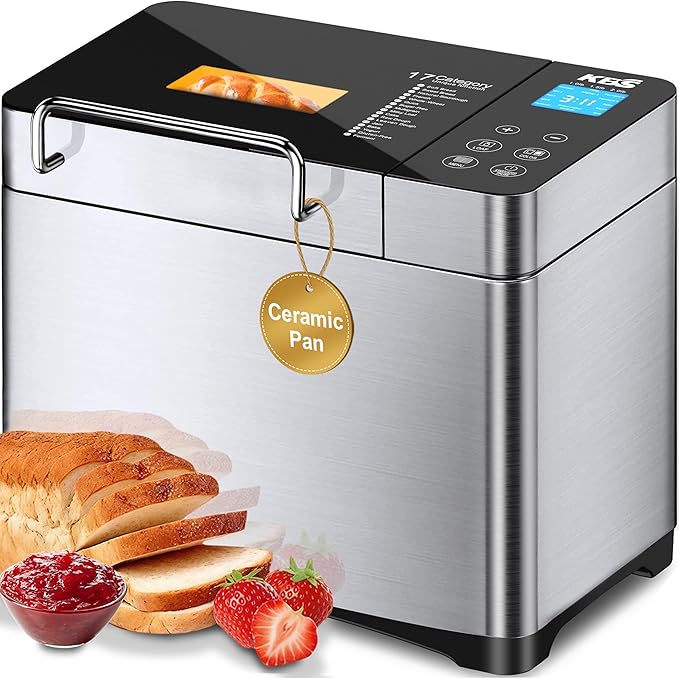
Where the KBS Premium leans into convection, the KBS Pro 710W focuses on strong, quiet kneading and a very durable ceramic pan. The 710 W motor powers a robust paddle that handles everything from basic white dough to heavy pizza and seeded loaves without straining. Owners rave about pizza dough in particular: 20–25 minutes on the dough program yields enough smooth, elastic dough for two large pizzas that bake beautifully in a regular oven.
You get 17 programs including gluten‑free, sourdough, whole‑wheat, multigrain, milky loaf, quick bread, jam, yogurt and dough‑only options. The top‑mounted tempered‑glass touch panel wipes clean easily and gives the machine a modern, appliance‑store look, while the large viewing window lets kids (and adults) watch the dough come together. Like its sibling, this model also uses a ceramic coating that releases bread unusually well and avoids some common nonstick chemicals.
Why you’ll like it
- Excellent dough performance: Smooth, well‑kneaded dough for pizza, rolls and pretzels with minimal oversight.
- Ceramic nonstick pan: Bread almost always drops out cleanly; cleanup is usually a quick rinse and wipe.
- Quiet operation: Quieter than many similarly powerful machines, especially during kneading.
- Auto nut dispenser: Like the Premium model, it can automatically drop nuts and dried fruit at the right time.
Good to know
- The included recipes work, but some bakers prefer third‑party cookbooks or online recipes for more adventurous breads.
- The glossy touch panel can pick up fingerprints—easy to wipe, but worth knowing if you’re picky about smudges.
- It’s not the smallest machine; measure your counter if you have very tight space.
Ideal for: Beginners who are as excited about pizza, focaccia and dough‑based projects as they are about simple sandwich loaves.
8. Elite Gourmet EBM8103B (Black) – Feature‑Packed Value for Busy Households

Elite Gourmet has quietly built a reputation for affordable, no‑nonsense appliances, and the EBM8103B fits that mold nicely. It’s one of the more budget‑friendly 2 lb machines, yet offers 19 programs (basic, quick, sweet, French, whole wheat, rye, gluten‑free, rice, sandwich, pizza dough, jam, yogurt and more), three loaf sizes and three crust colors. You also get a 15‑hour delay timer and a one‑hour keep‑warm cycle.
Owners praise how easy it is to set up—ingredients go in the nonstick pan, you pick loaf size and program, and that’s it. The suction‑cup feet help keep it in place during kneading, and the recipe booklet, while not fancy, has a solid range of starter recipes that lean toward soft, sandwich‑style loaves rather than ultra‑crusty artisan bread. It’s an especially popular pick among people who are baking daily to keep up with bread‑loving kids or roommates.
Why it’s a strong value
- Low price, lots of programs: 19 settings at this price point is generous, especially with gluten‑free and yogurt modes.
- Good basic performance: White and sweet loaves come out soft and fluffy when you follow the recipe ratios.
- Suction‑cup feet: Helps stop the machine “walking” across smooth counters.
- Useful troubleshooting tips: The manual includes guidance on tweaking flour or water if dough looks too wet or dry.
Good to know
- A few recipes in the book lean dense; many owners improve results by weighing flour and slightly reducing amounts.
- The pan coating is nonstick but not ceramic; avoid metal utensils and harsh scrubbers to keep it happy.
- The display isn’t backlit, and the overall look is more functional than fancy.
Ideal for: Families who want an inexpensive machine that can crank out frequent loaves and doughs without fuss, and who don’t mind learning from the manual’s troubleshooting tips.
9. Elite Gourmet EBM8103M (Mint) – Same Machine, Softer Look

Functionally, the mint‑green EBM8103M is the same machine as the black EBM8103B: same pan, same motor, same 19 programs and controls. The big difference is cosmetic. If your kitchen leans light, airy or pastel, the mint finish reads more “intentional décor” and less “appliance box,” which matters if it will live on your counter full‑time.
Everything said above about performance applies here too: it’s an easy, budget‑friendly way to get into bread making, especially if you follow the included recipes closely at first and then branch out. The manuals are identical, the suction‑cup feet still keep it steady, and the delay timer and keep‑warm modes make it simple to line up fresh bread with your meal times.
Why you might choose this one
- All the value of the black model with a softer, more playful color.
- Beginner‑friendly recipes: The included book walks through basics clearly enough for first‑time bakers.
- Compact enough for most counters while still handling 2 lb loaves.
- Good entry point for kids: The fun color and simple controls make it inviting for family baking sessions.
Good to know
- Same limitations as the black model: no backlight, non‑ceramic pan, and basic but serviceable documentation.
- If you care only about function and not color, whichever is cheaper at the moment is the better deal.
- Like most budget machines, the gluten‑free program works best with recipes specifically written for bread makers.
Ideal for: Beginners who like the Elite Gourmet value proposition but want a bread maker that looks cute and intentional on the counter.
10. Hamilton Beach Automatic 2 lb – Straightforward, Big‑Brand Reliability

Hamilton Beach has been making bread machines for decades, and this current digital model sticks to what it does best: reliable, no‑drama loaves with a simple interface. You get a typical spread of programs—basic, French, whole grain, sweet, gluten‑free, three “express” sizes, cake, jam, dough and artisan dough—plus three crust colors and three loaf sizes.
The PFAS‑free nonstick pan and paddle are an appealing touch if you’re trying to avoid certain coatings, and many owners like that the pan can go in the dishwasher (though hand‑washing still extends its life). A well‑timed beep lets you know when to add nuts or fruit, and the display shows remaining time so you can decide whether to start soup or put the kettle on.
Why it’s still a solid pick
- Simple, familiar interface: If you’ve used older Hamilton Beach machines, this will feel immediately intuitive.
- Good for standard loaves: Basic white and wheat breads, plus dough cycles, tend to turn out consistently well.
- PFAS‑free coating: A nice peace‑of‑mind detail compared with older nonstick formulas.
- Reasonable footprint: Lighter and a bit smaller than some stainless competitors, making it easier to store.
Good to know
- The gluten‑free cycle has a mixed reputation; if GF bread is a priority, KBS or KitchenArm are better bets.
- Very full 2 lb loaves can sometimes rise into the lid—many users stick to 1.5 lb recipes for the best shape.
- The recipes included are limited; hanging onto or printing extra bread‑machine recipes is helpful.
Ideal for: Beginners who want a straightforward, big‑brand machine for mostly white, wheat and sweet loaves, and who like the idea of a PFAS‑free nonstick pan.
11. OSIPOTO 17‑in‑1 Stainless 2 lb – Friendly Layout, Strong Everyday Performance

OSIPOTO is a newer brand, but this 17‑in‑1 model has quickly earned praise from owners for being, in their words, “way easier than expected.” The marketing leans hard into being “perfect for beginner,” and in practice that mostly means clear labeling, sane default programs, and a pan that releases loaves without drama. You get three loaf sizes, three crust colors and a familiar lineup of programs: basic, French, whole‑wheat, cake, jam, yogurt, gluten‑free, dough and more.
What stands out in real‑world use is the combination of a 600 W motor and 360° heat distribution. Loaves generally bake evenly, with nicely colored sides and a crust that doesn’t scorch while the crumb finishes. Owners report good success with whole‑wheat recipes, and the dough programs work well for pizza and rolls if you prefer to bake in your oven.
Why it works well for first‑timers
- Clear, modern interface: The digital panel and program list are easy to read at a glance.
- Even baking: Heat seems well‑distributed, with only slightly darker bottoms on some recipes.
- Quiet motor: Owners often mention that it’s quieter than older machines they’ve owned.
- Responsive support: The brand has a reputation for answering questions quickly via email.
Good to know
- The English in the manual is understandable but occasionally clunky; read recipes carefully once before starting.
- The pan uses conventional nonstick rather than ceramic—gentle cleaning is key.
- As a newer brand, there’s less long‑term track record than with Cuisinart or Hamilton Beach.
Ideal for: Beginners who want a shiny stainless machine with a modern look and straightforward layout, and who mostly bake standard white, wheat, or French‑style loaves with occasional pizza dough.
12. Neretva 20‑in‑1 (Green) – Same Dual‑Heater Power, Softer Aesthetic

This light‑green Neretva is functionally the same as the silver version above: dual heaters, 550 W motor, ceramic pan, quiet operation and the same 20‑program lineup. The difference is the look. The soft green finish reads more playful and retro, which can be a fun match for colorful, cottage‑core or Scandinavian‑style kitchens.
Because performance is identical, you can treat the two Neretva models as one pick and simply choose the color you like best—or whichever happens to be cheaper when you shop. Both are especially popular with people who bake at odd hours and want something quiet, or who prefer a ceramic‑coated pan for easier cleanup and peace of mind about coatings.
Why you might pick the green one
- All the strengths of the silver model—dual heaters, quiet motor, ceramic pan—in a more decorative color.
- Easy to live with: Compact enough for most counters, with a clear window and straightforward control panel.
- Good included accessories: Heat‑resistant glove, measuring tools and a paddle hook make first bakes easier.
- Great gift: The color and packaging make it feel special as a house‑warming or holiday present.
Good to know
- Like the silver model, the manual’s recipe explanations are brief; pairing with a bread‑machine cookbook is helpful.
- The 2 lb setting makes fairly wide loaves—be sure your toaster can handle them or plan to cut them in half.
- As with any ceramic pan, avoid sudden temperature shocks (like very cold water in a hot pan).
Ideal for: Beginners who loved everything about the Neretva silver model but want a bread maker that adds a soft, colorful accent to the kitchen instead of disappearing into stainless steel.
How Bread Machines Actually Work (and Why Settings Matter)
On the surface, every bread maker in this guide is doing the same job: mix, knead, rise, bake. Under the hood, though, each program is just a particular recipe of time and temperature for those stages. Understanding that makes the whole category feel much less mysterious—and helps you get better bread, faster.
The basic cycle: knead, rise, bake
- Knead: The paddle mixes ingredients and develops gluten. Too short and bread is dense; too long and dough can over‑tighten.
- Rise (proof): The machine keeps the dough warm so yeast can produce gas and structure. Some programs include two or three rises.
- Punch‑down: Many cycles briefly mix again to redistribute yeast and pop big bubbles.
- Bake: The heaters ramp up to cook the dough and set the crust. Some machines keep the loaf warm afterward.
Standard white‑bread programs typically run 3–4 hours start to finish. “Rapid” or “Express” modes shorten the rise and bake time; they give you bread faster, but it may be a bit denser and less flavorful.
Tips to avoid common beginner mistakes
- Measure precisely: Bread is more sensitive than most stovetop cooking. Using a cheap digital scale for flour and water is the single biggest upgrade you can make.
- Layer ingredients correctly: Most manuals want liquids at the bottom, then dry ingredients, with yeast kept separate from salt until kneading starts.
- Watch the first 5–10 minutes: Peek in and make sure ingredients form a smooth, slightly tacky ball. If it looks dry and shaggy, add a teaspoon of water; if soupy, sprinkle in a little flour.
- Resist opening the lid during rising: A quick check during kneading is fine; repeated peeks during proofing can drop the temperature and affect lift.
- Cool before slicing: Fresh bread smells amazing, but cutting it while hot compresses the crumb and can make it feel gummy. Give it at least 30–45 minutes on a rack.
Once you realise that every program is just a different balance of those stages, the idea of tweaking or trying new recipes becomes much less intimidating. That’s where machines like KitchenArm and KBS—with clear programs and good documentation—really help you grow beyond the first basic loaf.
FAQ: Bread Machines & Beginner Questions
Are bread machines really worth it if I’m a beginner?
What size bread maker should I buy for my first machine?
Can I make gluten‑free bread in any bread machine?
Do I need all these programs, or will I only use one or two?
How long will a bread machine last?
Final Thoughts: Picking the Best Bread Machine For Beginners
A good bread maker doesn’t just give you bread; it gives you a little ritual. Five minutes of measuring, a satisfying button press, and then a kitchen that smells like a bakery while you do literally anything else.
If you’re still torn, here’s a quick way to turn this guide into a decision you feel great about:
- Want the easiest all‑round recommendation? Start with the Cuisinart CBK‑110. It’s compact, well‑tested, and forgiving enough that your very first loaf has a good chance of being a keeper.
- On a tighter budget but still want reliability? Look at the Amazon Basics 2 lb bread maker or the value‑packed Elite Gourmet EBM8103. They’re simple, inexpensive ways to find out how much you truly love home‑baked bread.
- Planning to go deep on healthy or gluten‑free recipes? Consider the KitchenArm 29‑in‑1 for its recipes and support, or the KBS Premium convection for its excellent gluten‑free and multigrain performance.
- Short on space? The compact Briskind 19‑in‑1 and the mint Elite Gourmet EBM8103M stay small on the counter while still handling real‑world loaves.
- Care a lot about quiet operation and ceramic pans? Check out the dual‑heater Neretva 20‑in‑1 (silver) or its stylish green twin, along with the ceramic‑panned KBS Pro 710W.
Any of the 12 machines above can easily become your personal Best Bread Machine For Beginners once you match their strengths to your space, your household and how you like to eat. Measure your counter, be honest about how often you’ll really bake, pick the size and features that fit your life—and then enjoy the feeling of tapping one button and letting your new favorite appliance do the hard work while you plan what to spread on the first warm slice.
