
A dull knife doesn’t just slow you down—it changes the whole feel of cooking. Tomatoes collapse instead of slicing cleanly. Chicken skin tears. Herbs bruise. And the sneaky part? Most people adapt without noticing… until they use a properly sharp knife and go, “Wait—THIS is what my chef’s knife is supposed to feel like?”
Here’s what I’m confident about after digging through real-world feedback, manufacturer specs, and the patterns that show up again and again: the “right” electric sharpener isn’t the fanciest one or the one with the most buttons. It’s the one that matches your knife angles, your knife types, and your patience level—while removing the least steel needed to get the edge back. That’s how you end up with a tool you’ll actually use consistently (and how your favorite knives stay your favorite knives for years).
This guide covers 10 standout electric models on Amazon—from foolproof guided wheel systems to belt sharpeners that build a tough convex edge. I’ll walk you through what matters (and what’s mostly marketing), then give you in-depth, owner‑reality reviews so you can confidently choose the best automatic knife sharpener for your kitchen without needing another guide.
In this article
- How to choose the right electric knife sharpener for your knives.
- Quick comparison table of 10 standout models.
- In-depth reviews of each sharpener, with pros and cons.
- How automatic sharpeners actually create an edge (and how to get better results).
- Answers to common questions, plus final buying tips.
How to Choose the Best Automatic Knife Sharpener for Your Kitchen
Most bad sharpening experiences come from one of three mismatches: the wrong angle for the knife, the wrong abrasive for the blade material, or the wrong expectations about what a machine can do (especially with serrations). Get those three things right, and an electric sharpener becomes one of the most satisfying “why didn’t I do this sooner?” upgrades in a home kitchen.
1. Start with your knives, not the sharpener
Open your knife drawer and be honest about what you actually own and use. A sharpener that’s perfect for sturdy German-style chef knives can be a poor match for thin Japanese edges—or for ceramic blades—if the angle and abrasives don’t line up.
- Mostly Western / German knives: These often live comfortably at more robust edge angles and respond well to guided wheel systems.
- Mostly Japanese / thinner “laser” knives: These feel amazing at narrower angles, but they’re also less forgiving if you use the wrong guide or press too hard.
- Lots of mixed knives: You’ll want either a system that can handle multiple shapes well, or one you’re comfortable using gently and consistently across the board.
- One cherished “nice knife” + a pile of everyday blades: This is where buying behavior matters: do you want a one-button solution, or are you willing to practice a little to keep that special blade pristine?
2. Understand angles (because angles are the whole game)
Sharpening is simply creating two planes that meet at a clean apex. That apex is your cutting edge. The “feel” of your knife—whether it glides through onions or feels wedge-y—comes largely from edge geometry.
- Narrower edges (often ~15° per side) feel surgically sharp and slice with less force, especially on produce and proteins.
- More robust edges (often ~20° per side) are tougher, tend to micro-chip less with rougher use, and tolerate heavier cutting boards and less careful technique.
A big practical point: many guided electric sharpeners are fixed-angle. That’s not “bad”—it’s what makes them easy. But it means you should either choose a model that matches your knives, or accept that you may be changing the edge profile over time (which can remove more steel during the “conversion” period).
3. Pick a sharpening system that matches your comfort level
The 10 models in this guide fall into three “how it sharpens” families. Each family has strengths—and each has a common mistake that shows up in owner reviews.
- Guided rotating wheels (diamond / sapphirite / ceramic): These are the most “appliance-like.” You pull the knife through a slot and the guide holds your angle. Great for consistency. The common mistake is pressing down too hard, which can slow the wheel, create uneven bevels, or increase heat.
- Flexible abrasive discs + honing wheel: Similar convenience to wheel systems, with an emphasis on quick touch-ups and built-in honing. The common mistake is expecting a single fixed angle to perfectly suit every knife style.
- Abrasive belt systems (convex edge): These behave more like a mini power tool. They can create a very strong, durable edge, especially on everyday knives and outdoor tools. The common mistake is rushing the pass speed or “steering” the blade off the guide, which can cause uneven bevels (and sometimes cosmetic scratches).
4. Stage count matters… but not the way most people think
Two-stage and three-stage machines aren’t automatically “better” because they have more stages. What matters is whether the stages do the right jobs:
- Coarse / repair stage: for chips, rolled edges, or when you’re changing the bevel angle.
- Sharpen / refine stage: for bringing back the edge when it’s dull but not destroyed.
- Hone / polish stage: for smoothing the burr, refining bite, and improving the “clean slice” feel.
In real kitchens, the most-used stage should be the final honing/polishing stage. If you find yourself using the coarse slot constantly, you’re likely removing more steel than needed. A good routine is: sharpen only when needed, hone lightly more often, and use the coarse stage only for damage or major dullness.
5. Decide what “compatibility” you truly need
Many electric sharpeners claim they can handle everything. In practice, here’s what to trust most:
- Serrated knives: Most machines can refresh serrations, not rebuild them. Think “better performance,” not “brand new bread knife.”
- Scissors: A dedicated scissors slot can work well, but it’s often smaller than people expect. Large kitchen shears may or may not fit comfortably.
- Ceramic knives: Ceramic is hard and needs diamond abrasives. If your sharpener doesn’t clearly support ceramic, don’t gamble with it.
- Short blades (paring knives): Some machines struggle near the heel/handle area or with very short blades. That’s a design geometry issue, not user error.
6. The two rules that prevent 90% of “this sharpener didn’t work” reviews
Rule #1: Use feather-light pressure.
With electric sharpeners, pressure is not power. Pressure is friction. Too much pressure slows the abrasive, heats the edge faster, and can cause the blade to bounce off the guide. You want the machine to do the cutting.
Rule #2: Keep your pull speed consistent.
Uneven pull speed creates uneven bevels. Many owners who get “wow” results count seconds per pass to stay consistent, especially on longer chef knives. Slow and steady beats fast and sloppy every single time.
Quick Comparison: 10 Best Automatic Knife Sharpener Picks
Use this table to quickly match a sharpener to your knife collection and your comfort level. Then jump into the full review for the details that actually matter in daily use—edge feel, learning curve, mess control, and how forgiving the guides are when you’re sharpening in real life (not in a perfect lab setup).
On smaller screens, swipe or scroll sideways to see the full table.
| Model | Sharpening style | Best for | What to know | Amazon |
|---|---|---|---|---|
| Work Sharp MK2 Knife & Tool Sharpener | Belt system | One machine for kitchen knives + tools | Fast, versatile, needs light practice | Amazon |
| Chef’sChoice 15XV EdgeSelect | 3-stage diamond | High-end knives & 15° style edges | Serious sharpness, follow the manual | Amazon |
| Homly 3-Stage Diamond Electric Sharpener | 3-stage diamond | Mixed kitchen knives (incl. ceramic) | Easy, solid “everyday pro” feel | Amazon |
| Presto 08810 Professional EverSharp | 3-stage wheels | Households with varied blade thickness | Great results with very light pressure | Amazon |
| dskiley 3-Stage 100% Diamond (20°) | 3-stage diamond | Fast restore + polish, tidy cleanup | Magnetic filings collector is clutch | Amazon |
| Ceelpeopar LCD 3-Speed Sharpener | Multi-tool + speed | People who want more control (speed) | Let the machine work—no pushing | Amazon |
| Work Sharp E2 Electric Kitchen Sharpener | Guided discs | Quick, consistent kitchen touch-ups | Fixed-angle approach; very easy use | Amazon |
| Work Sharp WSCMB Combo Sharpener | Belt + hone | Convex edge fans, quick re-shaping | Compact, stable, fixed guide angle | Amazon |
| Presto 08800 EverSharp (2-Stage) | 2-stage wheels | Big knife sets & quick maintenance | Simple and effective; burr control helps | Amazon |
| Narcissus S867 Diamond Sharpener | 2-stage diamond | Compact budget pick + scissors slot | Start with old knives to learn technique | Amazon |
In-Depth Reviews: 10 Standout Electric Knife Sharpeners
Below, I’m not just repeating spec sheets. I’m translating what these sharpeners feel like in real kitchens: how forgiving the guides are, how clean the edge gets, what owners complain about after the honeymoon phase, and who should skip a model even if it has flashy features.
1. Work Sharp MK2 Professional Knife & Tool Sharpener – The “One Machine” Solution

If you want one electric sharpener that can handle the chaos of real life—kitchen knives, pocket knives, garden tools, beat-up “junk drawer” blades—the Work Sharp MK2 is the most complete all-rounder in this list. It’s not a “drop it in a slot and forget it” appliance; it’s closer to a guided belt system that rewards you for being calm and consistent. But that small learning curve is exactly why so many owners describe a before/after moment where dull knives suddenly become genuinely satisfying to use again.
The biggest advantage of a belt system is the type of edge it builds. Instead of creating a flat V-bevel like most slot-style machines, belts naturally create a subtle convex edge. In plain English: the edge tends to be tougher and more durable for daily cooking, and it can feel smoother through food because there’s a little more support behind the cutting apex. That’s a huge reason meat cutters, outdoorsy households, and “I own too many knives” people love this style.
What separates the MK2 from “random belt sharpeners” is repeatability. Owners repeatedly say the guides make it easier to keep the blade exactly where it needs to be. The trick is respecting the machine: light pressure, steady pull speed, and a willingness to do a couple practice passes on a less-loved knife before you touch the good stuff.
Why you’ll like it
- Versatility is the superpower – If your home has kitchen knives, outdoor knives, and tools, this saves you from buying multiple sharpeners.
- Durable convex edge feel – Many users notice edges feel “bitey but strong,” especially on everyday chef knives and utility knives.
- Two-speed control helps – Slower for careful refinement, faster for heavier restoration work (without turning sharpening into a project).
- Repeatability beats raw skill – You don’t need whetstone talent; you need consistent motion, which the guides encourage.
Good to know
- Belt systems can punish rushing—go too fast or drift off the guide and you can unevenly shape the bevel.
- Like most power sharpeners, it’s happiest with very light pressure; pushing can increase heat and reduce control.
- If you want a mirror-polished “show edge,” you may still enjoy finishing with a strop (not required, but satisfying).
Ideal for: households that want one sharpener to rule the kitchen and the garage—plus anyone who values edge durability as much as pure sharpness.
2. Chef’sChoice 15XV EdgeSelect – Ultra-Sharp 15° Edges Without Whetstone Skills
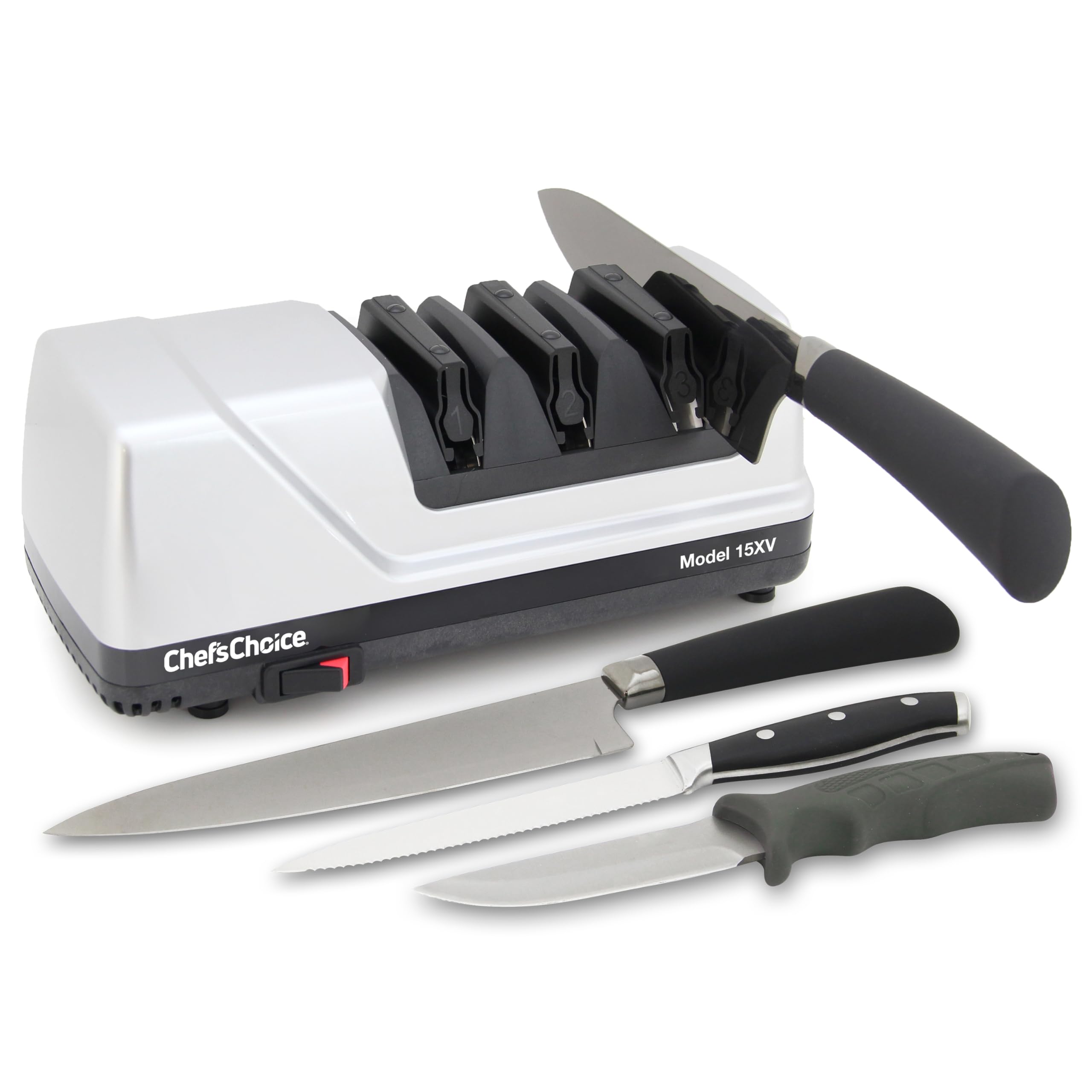
If your goal is that “whoa” sharpness—clean paper slicing, tomato skin surrendering without pressure, effortless onion dicing—the Chef’sChoice 15XV is the closest thing in this guide to a sharpening cheat code. It’s designed to create a 15-degree style edge using a three-stage progression: shaping, refining, then stropping/polishing. The reason owners get such strong results is simple: the machine reduces the two hardest parts of sharpening (holding angle and maintaining consistent abrasive contact) to something repeatable.
What experienced users emphasize is that the 15XV is not a casual toy. It’s powerful enough to do serious work quickly, which is exactly why the instructions matter. People who get the best results treat it like a process: establish the edge (especially if you’re converting from a thicker factory angle), confirm you’ve formed a burr correctly, then move to refinement. Once your knives are “converted,” maintenance becomes fast—often leaning heavily on the final stage for touch-ups.
The most useful “expert” perspective here is this: the machine is excellent at building a consistent edge, but your hands still control cosmetics. If you let the blade ride correctly against the guides, you’ll get clean bevels. If you drift or twist during the pull-through, you can scuff the guide area or create minor cosmetic marks on the blade face. That doesn’t ruin performance, but it matters to people who baby premium knives.
Why it stands out
- Legit high-performance edges – Owners routinely describe “scary sharp” results when they follow the stages correctly.
- Three-stage progression makes sense – Shape, refine, then strop/polish: it’s a full sharpening system, not just a grinder.
- Great for consistent angle control – This is the core advantage over stones for most home cooks.
- Fast maintenance once set – After the initial bevel is established, quick touch-ups become very straightforward.
Good to know
- It rewards careful technique: steady pull speed and letting the guides do their job.
- If you’re extremely protective of blade cosmetics, practice on cheaper knives first until the motion feels natural.
- It’s a dedicated kitchen edge tool—less of a “sharpen everything in the house” platform than belt systems.
Ideal for: cooks who care deeply about sharpness and precision cuts—and want near-pro results without spending weekends learning stones.
3. Homly 3-Stage Diamond Electric Sharpener – Big-Collection Friendly, Surprisingly Polished

The Homly is the kind of sharpener people buy hoping for a simple upgrade… and then they end up sharpening every blade they own in one session. It’s a three-stage diamond system with guided slots, which means the workflow is easy to understand: restore (if needed), sharpen, then polish. The reason it earns a spot this high in the list isn’t because it has the flashiest design—it’s because owner feedback consistently points to two real-world strengths: it’s easy to get good results quickly, and it handles a broad variety of kitchen knives without feeling temperamental.
Here’s the expert angle: the best “everyday” electric sharpener is the one that makes you sharpen earlier. Not when the knife is a disaster. Earlier. That’s how you remove less metal over the life of the blade. The Homly’s guided approach encourages that behavior. Many users describe switching from “I keep meaning to sharpen” to “it takes a couple minutes, so I’ll do it now.” That’s how knives stay consistently pleasant to use.
Another standout detail from real kitchens: people with mixed collections—including ceramic kitchen knives—often struggle to find one machine that does more than one material type. Homly is one of the models in this list that’s commonly used across multiple knife types, which is a practical win if your drawer is a mishmash of sets and hand-me-downs.
Why you’ll like it
- Practical, repeatable results – Owners report a noticeable “back to new” feel on everyday chef knives and slicers.
- Good for mixed collections – If your knives aren’t all the same brand/geometry, this is forgiving for typical home use.
- Three stages = clear workflow – It’s easy to understand what each stage is for, which prevents over-grinding.
- Great for protein knives – Many users specifically love the results on carving and fillet-style kitchen blades.
Good to know
- Some knives may “respond” differently depending on original bevel geometry—use consistent passes and avoid forcing the blade.
- Like most slot systems, it can struggle very close to the handle/heel on certain knife shapes.
- As always, the best edges come from light pressure and a consistent pull speed—don’t rush the passes.
Ideal for: households with a mixed knife drawer that want a reliable, easy three-stage system that feels like a real upgrade.
4. Presto 08810 Professional EverSharp – Adjustable Guides That Actually Matter

The Presto 08810 is one of the most “workhorse practical” sharpeners here—especially if your knives aren’t all the same thickness. That blade thickness selector sounds like a small feature, but in real use it can be the difference between a knife feeling cleanly guided versus feeling like it’s rattling around in a generic slot. For households that have everything from thin paring knives to heavier chef knives (and even sturdier outdoor-style blades), that adjustability is a real advantage.
Owner feedback on this model has a strong theme: the sharpener works extremely well when you don’t fight it. People who press hard sometimes complain about power or performance. People who use a feather-light touch and consistent pull speed often describe genuinely impressive results—even after sharpening dozens of knives. That’s not a coincidence. With guided wheel systems, pressure creates problems. Light contact creates precision.
From an expert point of view, the best thing about the 08810 isn’t that it’s “fast.” It’s that it can be consistent across many knives. When you can reliably get a sharp edge on a range of blade thicknesses, you sharpen earlier and maintain better. That’s where a sharpener pays off long-term.
Why it’s a smart buy
- Thickness selector is genuinely useful – Helps guides fit different knife types more naturally.
- Three stages cover the full cycle – From repair to sharpening to final honing.
- Great “batch sharpening” tool – Owners often sharpen many knives in one session with consistent results.
- Forgiving with the right technique – Light pressure + steady motion = strong performance.
Good to know
- It’s built for North American electrical standards—keep that in mind if you’re outside the region.
- Like most slot systems, it may not perfectly reach the heel on some knife shapes.
- Some users benefit from a quick finishing pass on a honing rod after sharpening to remove any remaining burr.
Ideal for: anyone with a “mixed knife drawer” who wants adjustable guidance and a proven three-stage workflow.
5. dskiley 3-Stage Diamond Sharpener (20°) – Fast Restore + Magnetic Filings Control
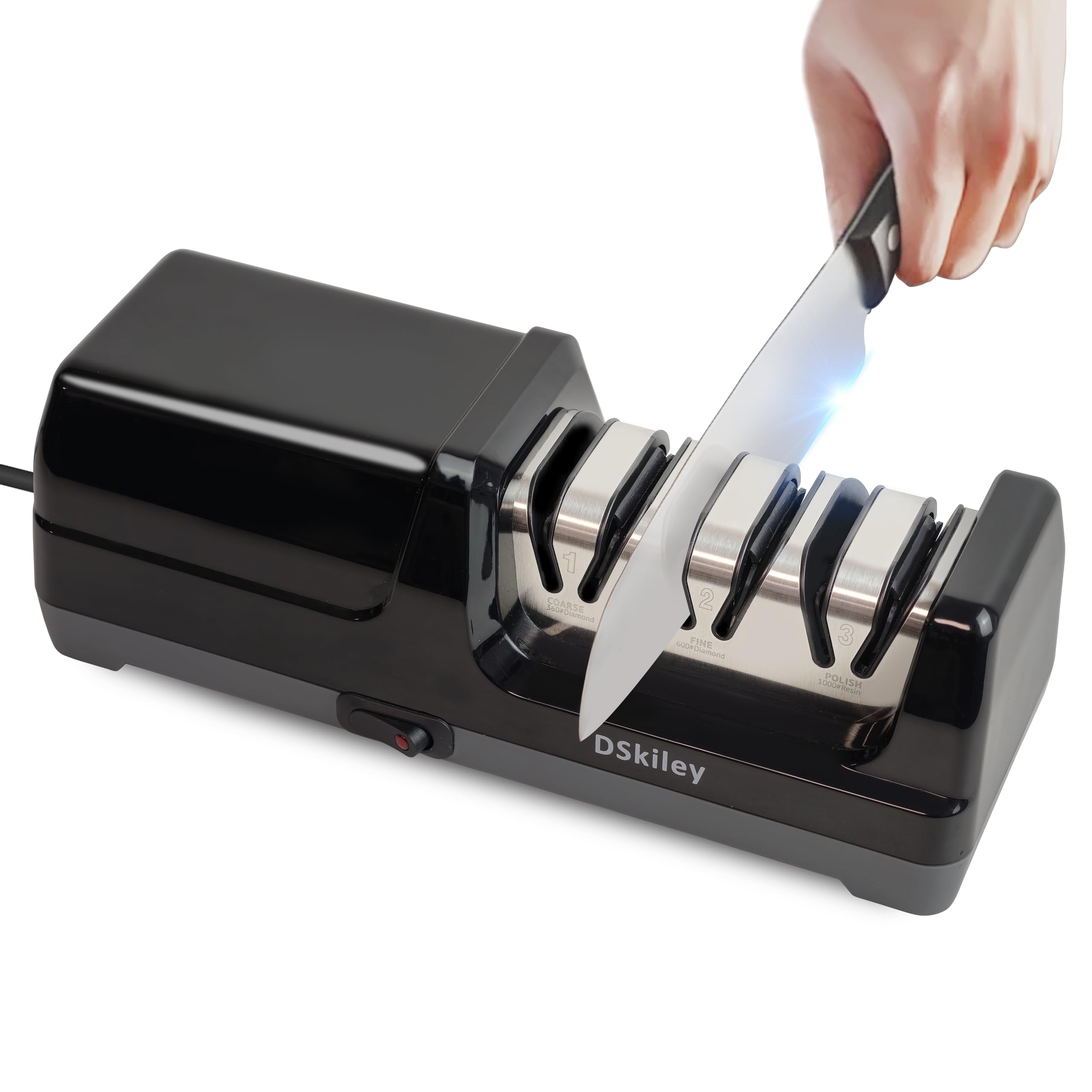
A lot of electric sharpeners do the “sharpening” part fine—but they forget that people live in their kitchens. Metal dust on the counter. Gray smudges near the base. A tray you never empty until it’s gross. That’s why the dskiley model earns points for one simple, underappreciated feature: a built-in magnetic filings collector. It turns cleanup into a quick routine instead of a chore you avoid.
Performance-wise, this sharpener follows the classic three-stage rhythm: repair, sharpen, polish. Where it shines is speed-to-result for typical household knives. Owners commonly describe bringing neglected blades back to “tomato-ready” in a handful of passes. The preset guide angle is designed for straightforward kitchen use, which makes it approachable for newer users who don’t want to think about angles at all.
The expert nuance: “fast” can be a blessing or a curse. Fast means the abrasive is doing real work, which is great when your knives are dull. But it also means you should be disciplined about stage choice. Use the coarse/repair stage only when you truly need it. For routine maintenance, live mostly in the fine and polish stages, and you’ll keep good knives feeling great without over-removing steel.
Why it’s worth a look
- Magnetic shavings collector – Keeps the sharpening mess contained and makes cleanup genuinely quick.
- Clear three-stage workflow – Easy to understand, which prevents over-grinding when you’re new.
- Good “revival” ability – Owners report strong results on knives that haven’t been sharpened in ages.
- Stable, appliance-like feel – Sits well on the counter and feels purpose-built for kitchen routines.
Good to know
- Some narrow blades may be harder to sharpen right up to the heel because of handle clearance.
- As with many guided systems, technique is still important—especially maintaining contact with the guide wall.
- If you’re maintaining premium knives, fewer passes and lighter touch will protect the blade long-term.
Ideal for: anyone who wants fast results but also wants their counters to stay clean, with minimal fuss after sharpening.
6. Ceelpeopar LCD 3-Speed Sharpener – Adjustable Speed for Better “Feel”
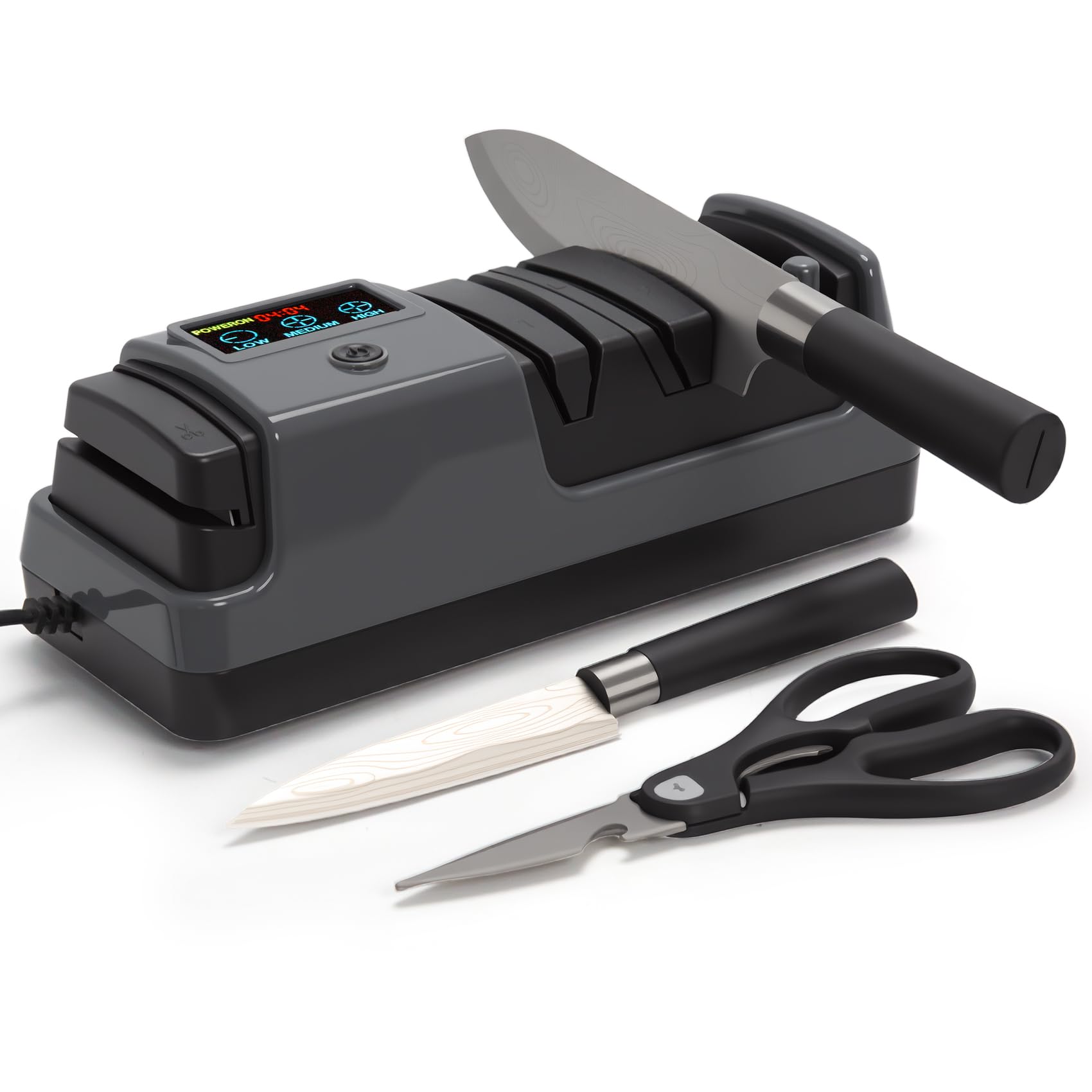
If you like the idea of an electric sharpener but you want a bit more control than “on/off,” this Ceelpeopar model is built around that concept. Adjustable speed is not a gimmick when used correctly. Lower speed can feel more forgiving for nervous first-timers or for lighter maintenance passes, while higher speed can move faster when you’re restoring neglected blades.
Owners who get the best results repeat the same advice: don’t push. Let the machine do the work. When people press down, they can move the blade away from the guide and slow the wheel, which creates uneven bevels. When people keep the blade gently against the guide wall and pull slowly, they report genuinely sharp edges.
From an expert standpoint, speed control also helps with heat and edge refinement. Sharpening is friction. Friction can create heat. The easiest way to reduce heat is light pressure and fewer passes—but speed selection can also help you stay in a “controlled” sharpening zone. That matters most when you’re maintaining knives frequently and you want to preserve steel over time.
Why it’s different
- 3-speed control – Lets you tailor the feel of sharpening for maintenance vs restoration.
- LCD makes it approachable – Clear status/selection helps reduce “am I doing this right?” doubt.
- Multi-tool capability – Useful if you want one station for more than just straight kitchen knives.
- Strong results with proper technique – Many users describe “razor sharp” outcomes when they keep pressure light.
Good to know
- Instructions matter—if you’re new, practice on an inexpensive knife first to lock in the right motion.
- More features can mean more ways to overdo it; discipline in pass count keeps edges cleaner.
- If you want purely foolproof simplicity, fixed-angle two-stage units can feel easier.
Ideal for: people who enjoy a little control and want to tune the sharpening experience rather than using a single fixed speed for everything.
7. Work Sharp E2 Electric Kitchen Sharpener – Quick, Guided, Consistent Touch-Ups

The Work Sharp E2 is built for the person who wants sharpening to feel like making coffee: plug in, follow the guides, done. It’s compact enough to live in a drawer, simple enough to use without a learning curve spiral, and designed around repeatability. Owners routinely describe it as the sharpener that finally got them to stop cooking with dull knives because it’s just so easy to reach for.
The built-in ceramic hone wheel is a practical perk: sharpening is not just grinding metal—it’s also refining and maintaining. The E2’s “maintenance” mindset is what makes it such a good fit for everyday kitchens. Use it before knives get terrible and you’ll spend more time honing and less time doing heavy abrasive work.
The honest expert note: the E2 is a guided system with a defined approach. If your knife collection is wildly mixed or you own very thin, lower-angle blades that you want to keep exactly as-is, a fixed-guidance system can be less ideal. But for typical Western-style kitchen knives, it’s one of the least intimidating ways to get consistently sharp edges.
Why it works in real kitchens
- Very easy to use – Guided sharpening makes this a “no fear” option for people who avoid sharpening.
- Compact storage – Fits easily in many kitchen drawers, so it’s not forced to live on the counter.
- Great for routine maintenance – Built-in honing encourages keeping knives sharp instead of rescuing them from disaster.
- Consistent results – Owners often describe reliable improvement on everyday chef knives, slicers, and utility blades.
Good to know
- Fixed-guidance systems may not perfectly match every knife style—especially if you’re preserving a specific edge geometry.
- Scissors sharpening can be limited by slot size on some guided designs; check fit expectations.
- For “showpiece” sharpening and ultra-fine edges, multi-stage diamond systems may feel more complete.
Ideal for: busy home cooks who want consistent sharpness with minimal learning curve—and prefer a sharpener that stores easily.
8. Work Sharp WSCMB Combo Sharpener – Compact Belt Sharpening for Everyday Knives

The WSCMB Combo Sharpener is the “gateway” belt sharpener in this guide: compact, stable, and surprisingly fast at turning dull knives into very usable cutting tools. It’s built around Work Sharp’s flexible belt approach, which means it naturally creates that slightly convex bevel that many people love for real-world durability.
Owners who struggled with whetstones often describe this as a turning point—because it makes sharpening repeatable and quick. But it’s also where expert expectations matter. The included belts are intentionally aggressive for restoring edges quickly. That’s fantastic for neglected knives and for people who thrift or inherit dull blades. For premium knives you want to baby, you simply want fewer passes, lighter pressure, and (if you’re picky) a little extra refinement with the honing step.
A key “deep guide” tip: use the belt system to get the geometry right, then use the honing rod to stabilize the edge. If your knife feels sharp but slightly “grabby,” that’s often the burr. The honing stage is what turns “it cuts” into “it cuts cleanly.” The WSCMB can absolutely do both—you just have to treat the hone as a real step, not an optional add-on.
Why you might love it
- Very fast sharpening – Great for reviving dull blades without turning it into a hobby.
- Convex edge durability – Many users like how strong the edge feels for everyday cooking and outdoor use.
- Compact and stable – Easy to store, and it tends to sit firmly during sharpening.
- Affordable belt replacements – Many owners recommend grabbing extra belts because you’ll use it more than you expect.
Good to know
- The belts can be aggressive; finishing properly matters if you want smoother, cleaner-cutting edges.
- Fixed guide angle limits customization, though it improves ease and repeatability.
- The built-in honing rod is functional, but enthusiasts may still prefer a separate longer honing solution for comfort.
Ideal for: people who want belt-style strength and speed in a compact format—especially if they often revive neglected knives.
9. Presto 08800 EverSharp – The “Sharpen a Whole Drawer” Classic

The Presto 08800 is the kind of classic, straightforward electric sharpener that earns loyalty because it does the job without drama. Two stages: sharpen, then hone/polish. That’s it. No complicated menus. No “smart” features that confuse guests. Just guided sharpening that can make a very noticeable difference in a very short time—especially if you’ve got a bunch of older knives that have never seen proper maintenance.
One of the most useful insights from owner experiences is how much technique still matters even with a “simple” machine. People who ignore instructions sometimes get mediocre results and assume the sharpener is weak. People who read the directions—pull speed, number of passes, alternating sides—often end up shocked at how sharp their knives become.
From an expert perspective, here’s the big point: two-stage machines can absolutely work well, but burr management becomes more important. Some users notice a lingering burr after sharpening, especially on softer steels. That’s not failure—it’s normal physics. A quick finishing pass on a honing rod (or careful use of the fine stage) can turn “sharp” into “clean sharp,” which is what you feel when slicing ripe tomatoes or trimming chicken.
Why it stays popular
- Very easy to use – Two stages keep decisions simple and repeatable.
- Great for big knife sets – Many owners sharpen lots of kitchen knives quickly with consistent improvement.
- Excellent “first electric sharpener” vibe – Low intimidation, high payoff when used correctly.
- Strong value for everyday blades – Ideal for common stainless and carbon kitchen knives that just need to cut better.
Good to know
- It’s generally not designed for scissors, and serrated support varies—treat serrations as “refresh,” not full rebuild.
- Some knives may benefit from a quick final hone to remove burr and improve slicing smoothness.
- If you’re chasing ultra-refined premium edges, three-stage diamond systems may feel more complete.
Ideal for: home cooks who want simple, effective sharpening for a full set of everyday kitchen knives with minimal learning curve.
10. Narcissus S867 Diamond Sharpener – Small, Handy, and Surprisingly Capable
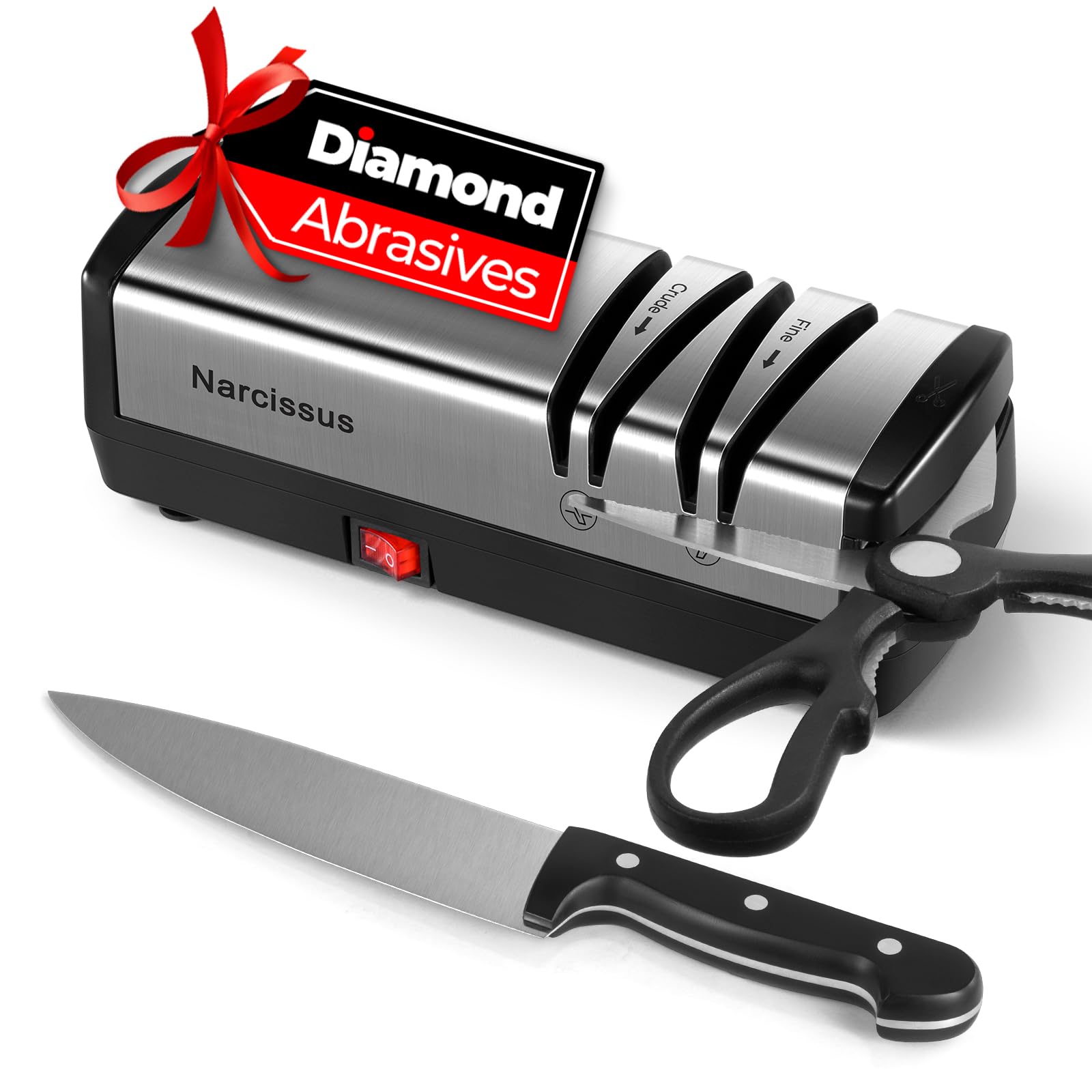
If you want a compact electric sharpener that doesn’t eat counter space—and you like the idea of sharpening scissors as well—the Narcissus S867 is a surprisingly practical option. It focuses on a simple two-stage approach: a coarse/restore slot and a fine/polish slot. That simplicity is the point. It’s designed for quick maintenance and quick improvement, not a multi-hour sharpening ritual.
Owner feedback highlights two truths that experienced sharpeners already know: first, diamond abrasives can sharpen quickly. Second, technique still matters. People who treat it gently and keep the blade aligned tend to be happy. People who rush the motion or insert the knife carelessly can scratch the blade face—especially while learning.
The most helpful “deep” guidance for this model is how to use it safely with knives you care about: start with an older knife to learn the motion, use very light pressure, and do fewer passes than you think you need. Check sharpness, then add one or two more passes if needed. That habit prevents over-sharpening and keeps your better knives looking and performing great.
Why people buy it
- Compact and easy to store – Great for small kitchens or anyone who hates bulky countertop appliances.
- Diamond sharpening speed – Can restore useful sharpness quickly with a few controlled passes.
- Scissors slot included – A practical bonus that many households actually use.
- Cleaner sharpening experience – Built-in dust collection helps keep metal filings contained.
Good to know
- New users should practice technique on a cheaper knife first to avoid cosmetic scratches.
- Very short or narrow knives can be trickier for some compact slot designs.
- If you want maximum refinement or angle-specific sharpening, step up to multi-stage premium systems.
Ideal for: smaller kitchens, first-time buyers, and anyone who wants an affordable, compact sharpener that’s easy to grab and use.
How Automatic Sharpeners Actually Create an Edge (and How to Get Better Results)
Electric sharpeners feel magical when you’re new: a few passes and suddenly your knife glides. But the “magic” is just controlled abrasion. Understanding what’s happening at the edge helps you get better results—and helps your knives last longer.
What’s really happening at the edge
- Abrasives remove steel – Coarse stages remove more steel faster to reset the bevel.
- You’re chasing a clean apex – Sharpening isn’t done when the knife “feels sharp.” It’s done when both bevels meet cleanly.
- Burrs are normal – A burr is a tiny foil of metal that flips from side to side as the edge forms. Good systems help you remove it cleanly.
- Polish changes the bite – A highly polished edge feels smooth and precise; a slightly toothier edge can feel more aggressive on tomato skins.
This is why the final stage matters so much. Many “it doesn’t cut well” complaints are actually “the burr wasn’t fully removed” complaints. The knife is sharp, but the edge is unstable until it’s refined.
Small technique tweaks that make a huge difference
- Count your seconds per pass – Consistent pull speed builds even bevels. Uneven speed builds uneven edges.
- Use light contact only – Pressure reduces control and can heat the edge; let the abrasive do the cutting.
- Alternate sides – If the machine design allows it, alternating passes reduces burr size and improves symmetry.
- Stop early and check – Over-sharpening removes steel without adding performance. Check sharpness, then add passes only if needed.
- Save the coarse stage – Coarse stages are for damage or big dullness. Maintenance usually belongs in fine/polish stages.
If you adopt just two habits—light pressure and consistent pull speed—you’ll get cleaner edges, better slicing feel, and much longer knife life. That’s the difference between “a sharpener” and a real sharpening routine that pays off.
FAQ: Electric Knife Sharpeners, Answered
Do electric knife sharpeners ruin knives?
How often should I sharpen my kitchen knives?
What’s the real difference between 2-stage and 3-stage machines?
Can I sharpen serrated knives and scissors with these?
Why does my knife feel sharp but still crush tomatoes?
Final Thoughts: Picking the Best Automatic Knife Sharpener for You
A sharp knife is one of those upgrades that makes cooking feel calmer. Less pushing. Less slipping. Cleaner prep. And because electric sharpening removes skill barriers, you’re far more likely to keep your knives in that “happy zone” instead of letting them drift into dull frustration.
Here’s a simple way to choose with confidence:
- Want one machine for the kitchen and beyond? Start with the Work Sharp MK2. It’s the most versatile option here and creates tough, durable edges.
- Chasing ultra-sharp precision edges? The Chef’sChoice 15XV is the premium pick for consistent, high-performance sharpness when you follow the stages correctly.
- Want an easy, strong “daily driver” for mixed kitchen knives? Look at the Homly 3-Stage Diamond or the Presto 08810 for a reliable, repeatable workflow.
- Care about clean counters and easy cleanup? The dskiley 3-Stage Diamond makes the after-part quick thanks to its shavings control.
- Short on space and want something simple? The compact Work Sharp E2 or Narcissus S867 are easy to store and easy to use.
Once you match your knife types and your habits, the best automatic knife sharpener becomes the kind of tool you reach for without thinking—and that’s the whole win. Pick a system you’ll actually use, keep your pressure light, stay consistent with your passes, and enjoy what sharp knives are supposed to feel like.
