
A kettle feels like a “simple” purchase—until you live with one every day. Because the real job of a kettle isn’t just getting water hot. It’s protecting your morning rhythm: no weird tastes, no drips on your counter, no lid that fights you, no spout that spits steam at your knuckles, and no mystery puddle on the base when you wake up.
If you’re searching for a yellow electric tea kettle, you’re usually balancing two very real needs: (1) a kettle that performs like a dependable tool, and (2) a kettle you actually enjoy seeing on your counter. That’s not shallow—it’s practical. A kitchen is where habits get built, and color can be the “tiny cue” that makes you look forward to the ritual.
Here’s what most buying guides get wrong: they act like kettles are just wattage and capacity. But real owners don’t return kettles because “it’s 0.1 liters smaller.” They return kettles because the lid is annoying, the body gets hotter than expected, the handle feels awkward once it’s full, the thermometer dial looks cute but doesn’t help, or the kettle develops an off smell after months. Those are the friction points that matter—and those are exactly what this guide is built around.
Below are 12 standout yellow-forward kettles: eight electric options (from one-button boilers to temperature-control “tea nerd” machines), plus four stovetop alternatives for people who love the look and want the whistle-and-flame experience. I’ll walk you through how to choose based on your real life, then go deep on each pick with the kind of practical detail you usually only learn after you’ve already bought the “wrong” one.
In this article
- How to choose the right kettle for your routine (tea, coffee, family, or solo).
- Quick comparison table of 12 standout models.
- In-depth reviews of each kettle, with pros and cons.
- How kettles really behave in daily use (taste, scale, and “drip” reality).
- FAQ answers, plus final “buy it with confidence” tips.
How to Choose the Right Yellow Electric Tea Kettle
A kettle is one of those appliances that either disappears into your routine (the best outcome) or quietly irritates you every single day. So instead of treating this like a spec sheet contest, we’ll pick based on the moments you actually live through: early mornings, rushed refills, half-awake pours, and the occasional “why is this lid stuck again?” episode.
1. Start with your “hot water personality”
Most people fall into a few patterns. Choose your pattern first, and your kettle choice gets dramatically easier.
- The “tea purist”: You brew green tea, white tea, oolong, or specialty teas and you care about hitting the right temperature. You’ll benefit from temperature presets or a reliable thermometer approach.
- The “coffee ritual”: You do pour-over and you care about controlled flow. A gooseneck spout (electric or stovetop) will feel like an upgrade you notice every day.
- The “family kettle”: You re-boil multiple times a day for multiple people. Capacity, speed, and easy cleaning matter more than fancy dials.
- The “small kitchen / small batch”: You want something compact that doesn’t dominate your counter, yet still feels premium and safe.
- The “safety-first household”: Kids in the kitchen, distracted mornings, or just a preference for peace-of-mind features. Prioritize auto shut-off, boil-dry protection, and cooler-touch surfaces.
2. Understand the three “temperature systems” (and what they really mean)
This is where the kettle world gets confusing, because brands use similar language for very different experiences. Here’s the practical breakdown:
- One-button boil: The kettle heats to boiling, shuts off, and that’s it. This is perfect if you mainly brew black tea, herbal tea, instant coffee, ramen, oatmeal, or you just want simplicity. It’s also ideal if you don’t want a screen, apps, or extra controls to fail.
- Thermometer dial kettles (analog): These are often retro-styled and look fantastic on the counter. In real life, the dial usually helps as a “range indicator,” not a laboratory instrument. The dial can still be useful if you learn your own cues: when it sits around the green-tea range, when it nears coffee range, and when it’s truly boiling. The important question isn’t “is it pretty?”—it’s “does it stay readable and does it still work smoothly months later?”
- True temperature control (presets + hold): This is the “set it and forget it” experience. You tap a preset (like green tea, coffee, baby formula, boil), and the kettle controls heat to that target. The best ones add a keep-warm function so you don’t keep re-boiling all morning. If you make multiple cups across a work session, this can feel like a real upgrade.
What to watch for: useful temperature control is only valuable if it’s fast and intuitive. If a kettle makes you scroll through menus or guess what a flashing icon means, you’ll stop using the feature and revert to boiling anyway. That’s why I’m picky about control layouts in the reviews below.
3. Decide how you feel about “plastic contact” (and be honest)
A lot of shoppers start with one simple preference: “I want stainless steel inside.” That’s understandable. A fully stainless interior reduces worry about taste transfer, staining, and long-term wear in high-heat water contact areas. It also tends to clean more predictably.
That said, many excellent kettles use small non-metal components in smart ways: a BPA-free water window for visibility, a gasket that never touches the water, or a lid mechanism designed to keep steam from blasting your hand. What matters is not marketing—it’s where the material is, and what it’s doing.
- If you want zero plastic contact: prioritize “all stainless interior” designs (including spout and lid underside), and avoid kettles with large internal water windows.
- If you’re okay with BPA-free components: prioritize ease of use and safety, because the best daily kettle is the one you don’t fight.
4. Spout behavior is the most underrated “quality signal”
Spout design tells you a lot about the thinking behind the kettle. A good spout pours in a clean stream, doesn’t dribble down the body, and doesn’t “gush” unpredictably when the kettle is full. A great spout also keeps steam away from your knuckles when you tilt to pour.
Two spout types matter here:
- Standard spout: best for fast filling of mugs and pots. Look for “drip-free” shaping and a good angle that doesn’t splatter.
- Gooseneck spout: best for pour-over coffee and controlled tea brewing. It’s slower by design—and that’s the point. You’re trading speed for control, consistency, and a calmer pour.
5. Lid design is a daily-life dealbreaker
You touch the lid constantly: filling, cleaning, occasionally peeking at the boil. In reviews, “lid annoyance” is one of the most common reasons people stop loving a kettle they otherwise liked.
Here’s how to choose:
- Detachable lid: easiest to deep clean, usually easiest to fill, but it must fit securely so it doesn’t wobble during pour.
- Hinged lid: convenient for quick refills, but can trap scale and be harder to scrub around the hinge area.
- Snap-on / tight lid: can feel premium and safe during pour, but if it’s too tight, you’ll regret it when it’s hot.
6. “Keep warm” can be a blessing—or a waste
Keep-warm is not for everyone. But when it fits your lifestyle, it feels like a cheat code. Here’s when it’s worth prioritizing:
- Work-from-home days: you make multiple cups across a morning and hate re-boiling.
- Family mornings: you want ready hot water for several people without running the kettle repeatedly.
- Baby bottle prep: you want a target temperature ready without guesswork.
When it’s not worth it: if you boil once, pour once, and you’re done. In that case, you’ll likely prefer a simpler kettle with fewer controls and fewer parts that can fail.
7. Hard water reality: filters, scale, and cleaning habits
If you have hard water, limescale is inevitable. The “best” kettle in a hard-water home is the one that stays easy to clean. This is where seemingly small features matter:
- Wide opening: lets you reach in for a wipe-down without awkward angles.
- Removable filter: helpful, but check whether the filter itself is stainless or includes plastic components if that matters to you.
- Flat, concealed heating plate: easier to wipe than exposed coil styles.
- Spout mesh: keeps flakes out of your cup, but needs occasional rinsing.
A kettle can boil fast and still feel “old” quickly if scale builds up and you avoid cleaning because it’s annoying. In the reviews, I’ll point out which kettles are friendlier for real-world maintenance.
8. Choose your “safety posture” (especially with kids)
Electric kettles are often chosen for safety and convenience because they shut off automatically and don’t require an open flame. But not all are equal in daily safety feel.
- Auto shut-off + boil-dry protection: the baseline you should expect for electric models.
- Cool-touch or double-wall bodies: a big deal if kids brush past the counter, or if you’re simply cautious with hot surfaces.
- Stay-cool handles: important on both electric and stovetop kettles (and not something you should assume without real-world feedback).
- Stable base + clean cord storage: reduces the chance of accidental pulls or awkward counter placement.
For stovetop kettles, your safety posture becomes: handle heat management, whistle audibility, and choosing the right burner size/heat level. Stovetop can be wonderful—just more “hands-on.”
9. Finally: choose your shade of yellow like a designer (because you are)
Yellow can read modern, retro, cozy, or bold depending on finish and tone. Here’s the quick style guide:
- Butter / mellow yellow (soft): pairs beautifully with white kitchens, light woods, and warm neutrals.
- Glossy bright yellow (bold): a statement piece—looks amazing against dark countertops or black hardware.
- Yellow with art print: “functional decor” energy—perfect for coffee/tea stations you actually want to show off.
If you’re buying yellow on purpose, own that choice. A kettle you love seeing is a kettle you’ll actually use.
Quick Comparison: 12 Yellow Electric Tea Kettle Picks
Use this table to find the models that match your routine, then jump into the reviews for the deep, real-life details— like lid comfort, spout behavior, cleaning practicality, and the “tiny annoyances” owners only notice after months.
On smaller screens, swipe or scroll sideways to see the full table.
| Model | Kettle type | Standout strength | Best match | Amazon |
|---|---|---|---|---|
| Harriet Retro Electric Kettle (1.8L) – Yellow | Electric | Balanced daily usability: fast boil, readable dial, easy filling, clean counter footprint | Most households who want a simple, stylish “use it every day” kettle | Amazon |
| BUYDEEM K740 Temp Control (1.7L) – Mellow Yellow | Temp + keep warm | True presets + long keep-warm for tea variety, baby prep, and all-morning sipping | Tea lovers who actually use different temperatures (not just “boil”) | Amazon |
| Chantal Oslo Cordless Electric Kettle – Butter Yellow | Electric | Scandinavian countertop style + simple controls + easy water visibility | Minimalists who want a “design-first” kettle with everyday function | Amazon |
| SUSTEAS Retro Electric Kettle (1.7L) – Retro Yellow | Electric | Retro charm + thermometer + quick boiling with a clean, controlled pour | Style-focused buyers who still want a practical daily kettle | Amazon |
| Hazel Quinn x Eduardo Recife (1.7L) – Floral Art Kettle | Art + function | All-stainless interior + dial + “functional art” look that elevates a tea/coffee station | People who want a showpiece that still performs daily | Amazon |
| BUYDEEM K640 Stainless Electric Kettle (1.7L) – Mellow Yellow | Electric | Retro look + durable build + filter approach many owners like for scale management | Families who want a classic “boils fast, looks cute” kettle | Amazon |
| Hazel Quinn x Eduardo Recife (1L) – Compact Gooseneck | Compact | Small footprint + double-wall safety + gooseneck control for pour-over | Solo drinkers and small counters (coffee + tea focused) | Amazon |
| Digital Temp Kettle (Yellow Gradient) – 5 Presets | Budget temp | Presets + display + cool-touch body in a fun, compact design | Budget shoppers who want presets and don’t need luxury finishes | Amazon |
| harriet Whistling Stovetop Kettle (2.5QT) – Yellow Glossy | Stovetop | Big capacity + loud whistle + spout lever that helps prevent steam surprises | People who want “whistle + flame” but still want modern handling | Amazon |
| Harriet Dolphin-Handle Whistling Kettle (2.5QT) – Yellow | Statement stovetop | Unique handle design + loud whistle + included glove/mat bundle | Style-forward kitchens that still want practical capacity | Amazon |
| Harriet Stovetop Gooseneck (37oz) – Yellow | Gooseneck | Controlled pour + dial + compact “coffee corner” footprint | Pour-over people who prefer stovetop simplicity | Amazon |
| Hauce Radio Whistling Stovetop Teapot (2.5QT) – Yellow | Stovetop | Lightweight feel + simple whistle + easy handling for casual tea rounds | Budget-friendly stovetop buyers who want a cheerful kitchen accent | Amazon |
In‑Depth Reviews: 12 Yellow Kettles People Actually Keep Using
Now we’ll go model by model. I’m going to talk like a real daily user, not a product box: how it feels to fill, how it pours, what annoyances owners report, what makes certain kettles feel “premium,” and which one is likely to fit your specific routine.
1. Harriet Electric Kettle (1.8L) – The Most “Use-It-Every-Day” Balance
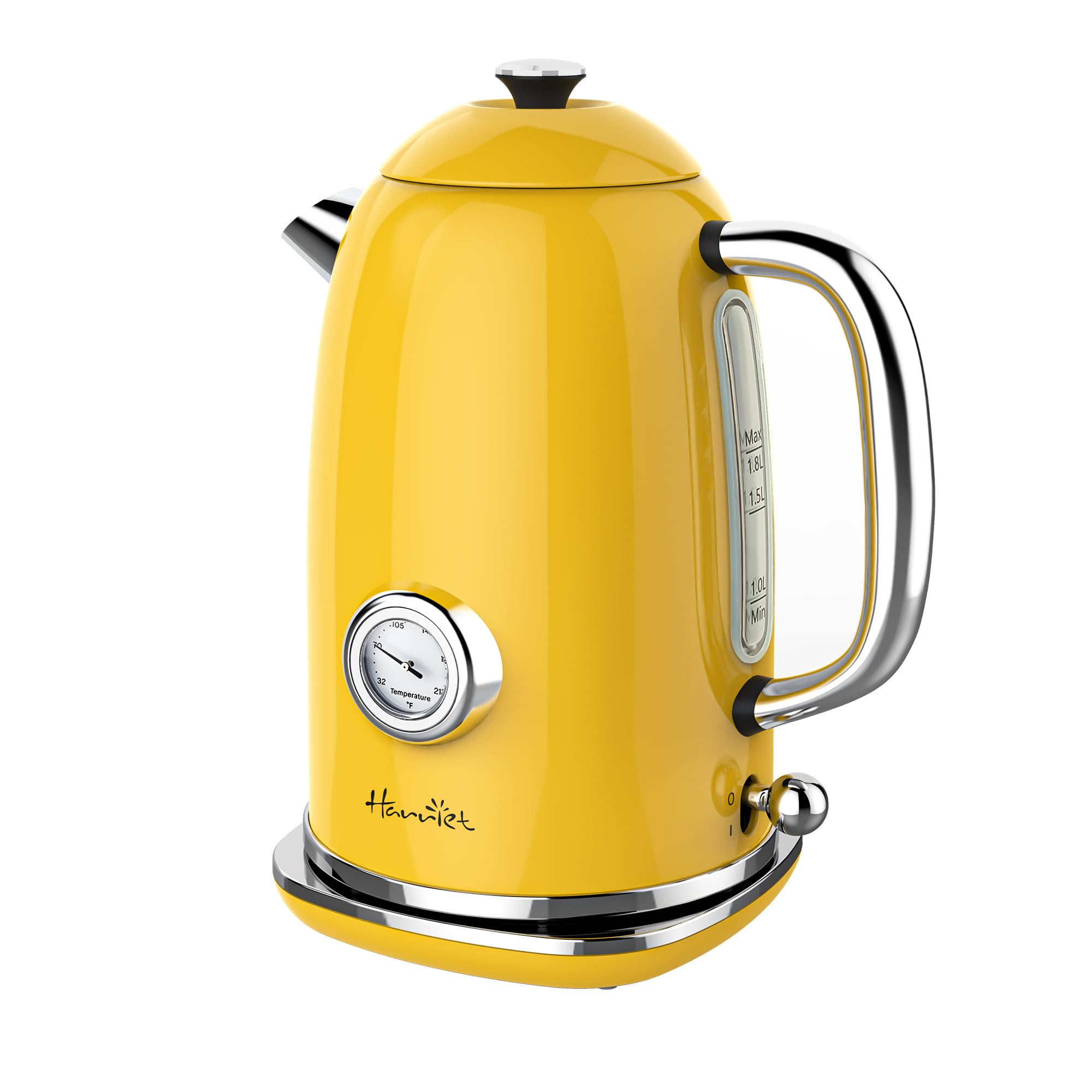
This is the kettle I point most people to first because it hits the sweet spot: it looks intentionally retro without feeling fussy, it boils fast enough to feel like a true convenience upgrade, and it doesn’t demand that you become a “kettle manager” just to make tea. It’s the kind of appliance that quietly earns its spot on the counter.
What owners consistently respond to is the overall happiness factor—not in a fluffy way, in a practical way. They like that the kettle feels lighter than some chunky metal options, that it shuts itself off when it’s done, and that the on/off light gives you a quick “yes, it’s actually heating” confirmation from across the kitchen. That tiny reassurance matters on busy mornings when you’re doing three things at once.
Now, let’s talk about the thermometer dial honestly. On retro kettles, the dial is often best treated as a guide, not gospel. Some users love it because it helps them stop heating early for certain drinks; others admit it’s more of a decorative feature. Here’s the expert way to make it useful: use it to learn your kettle’s behavior. Notice where the dial sits when you hear the first simmer, where it sits right before a rolling boil, and how that aligns with your tea preferences. In other words: the dial becomes a training wheel for consistency.
The built-in water window is another daily-life win. A full stainless interior is a priority for many people, but a well-placed window reduces overfilling, reduces “oops I boiled too little,” and makes refills faster. If you’re a multi-cup household, that visibility can genuinely improve the experience.
Why you’ll like it
- Feels easy without feeling cheap – The controls and workflow stay simple, which is what most daily users actually want.
- Strong “counter footprint” design – Looks stylish, but still fits real kitchens that can’t spare endless space.
- Helpful visibility cues – Window + switch light reduce the small mistakes that create morning friction.
- Safety basics are built in – Auto shut-off and boil-dry protection support a calmer routine.
Good to know
- The dial is best used as a guide; if you want precise presets, a true temperature-control kettle will feel more “set and forget.”
- Like most painted retro kettles, the outside can get warm—use the handle and avoid touching the body mid-boil.
- If you live in very hard-water areas, plan a simple descaling habit so the window and interior stay fresh.
Ideal for: most households who want a friendly, attractive electric kettle that feels simple, reliable, and pleasant to use daily—without turning temperature control into homework.
2. BUYDEEM K740 – The “Tea Variety” Kettle That Replaces Re-Boiling

If you’re the kind of person who drinks different teas (or coffee) throughout the day, this is where a kettle stops being a convenience and starts being a system. The K740 is built around presets and a long keep-warm function—meaning you can heat water to a target, then keep it ready instead of constantly boiling from scratch.
That matters more than people think. Re-boiling isn’t “wrong,” but it adds friction: waiting again, hearing the kettle again, resetting again. A good keep-warm routine feels like your kitchen is working with you. It’s especially helpful if your mornings look like: green tea first, then coffee later, then another cup mid-call, then a quick refill for oatmeal.
What owners tend to love is the confidence of selecting a mode and letting the kettle handle the rest. No hovering. No guesswork. No “did I stop it in time?” And if you’re preparing baby bottles or want repeatable temperature for specific brewing styles, this kind of control feels genuinely empowering.
Now, the honest owner-level detail: some users note that pouring every last drop can take a little patience. That usually comes down to internal geometry and spout placement—some kettles drain perfectly, others require a second tilt. This isn’t a dealbreaker, but it’s the kind of “real life nuance” that separates a kettle you admire from a kettle you love. If you’re someone who hates leftover water sitting inside, you’ll want to build a habit of a deliberate final pour.
Why it’s worth it
- Preset temperatures feel truly useful – Not just a gimmick: it supports tea variety and repeatable brewing.
- Keep-warm changes your routine – The kettle becomes a ready resource, not a repeated task.
- Filter design that prioritizes clean pours – Helpful for hard-water homes where scale flakes can show up in cups.
- Retro style without “toy” vibes – It looks like a real appliance, not a novelty decoration.
Good to know
- It’s a feature-forward kettle; if you only ever boil once a day, you may not use its best strengths.
- Some owners report it takes a couple of tilts to fully drain—fine for most, annoying for perfectionists.
- Like any temp-control kettle, it rewards you for reading the control labels once so it becomes muscle memory.
Ideal for: tea lovers and multi-cup households who want temperature presets and keep-warm convenience that meaningfully reduces daily re-boiling.
3. Chantal Oslo (Butter Yellow) – Minimalist Style with Real Daily Comfort

The Oslo is for the person who wants their kettle to blend into a calm, modern kitchen—soft color, clean geometry, and a handle that looks like warm wood. It’s one of those “design makes me happy” purchases, and owners often say that’s exactly why they chose it.
In daily use, the Oslo’s appeal is straightforward: it’s a one-button boil kettle that doesn’t try to do too much. That simplicity is a strength if you don’t care about presets and you want fewer electronics to overcomplicate your routine. The visible water level window is also genuinely useful—you can see what you’re working with without popping the lid, which makes the kettle feel faster to live with.
Now, the real-world note that matters: some owners report waking up to water on the base or counter, suggesting leakage from the bottom area. When that happens, it’s frustrating because it breaks the “simple and calm” promise of the appliance. If you’re considering this kettle, treat it like you would any water-holding device: do an early-life check. Fill it, boil it, let it sit, then look for moisture under the kettle. If it stays dry, you’ll likely love it. If it doesn’t, you’ll know immediately that it’s not your match.
When it behaves as intended, the Oslo is one of the most aesthetically satisfying options on this list. It’s also a kettle that people tend to keep on the counter full-time because it looks like it belongs there. That’s not trivial. A kettle you hide is a kettle you use less.
Why it feels great
- Scandinavian styling is genuinely strong – Soft yellow + clean lines + wood-look handle looks intentional, not trendy.
- Simple control = low friction – A true “just boil the water” workflow that most people stick with.
- Window helps prevent overfilling – A small feature that avoids messy spills and steam surprises.
- Comfortable grip – Owners often mention the handle feels good in the hand during pour.
Good to know
- Some users report leakage; do an early check so you can confidently commit (or move on quickly).
- It’s not a temperature preset kettle; tea variety drinkers may prefer a more control-focused model.
- Like most kettles, the body can get hot—handle use is key.
Ideal for: design-forward kitchens that want a minimalist, easy-to-use kettle—especially if you value aesthetics as much as boiling performance.
4. SUSTEAS Retro Electric Kettle (1.7L) – The “Pretty Kettle That Works” Sweet Spot

Let’s be honest: this is one of those kettles many people buy because it looks amazing. And that’s not a bad reason—because a kettle is a visual object you’ll see daily. The real question is whether it earns its place beyond aesthetics. For many owners, it does. They describe fast boiling, a controlled pour that doesn’t drip all over the counter, and a dial thermometer that adds “old-world charm” while staying readable.
One detail I appreciate in real-world feedback is the attitude shift: people often say the kettle isn’t overly complicated. That’s a compliment. A kettle should feel like a tool, not a gadget. The removable lid and relatively wide access also make cleaning and filling less annoying than some tight-lid retro designs. When you can rinse, wipe, and move on, you’re more likely to keep the kettle fresh—especially in hard-water areas.
The exterior can get hot (that’s common in metal-bodied kettles), so the “safety language” here is: trust the handle, respect the body. The LED indicator helps with that because it gives you a visual cue that the kettle is actively heating. Owners also often comment that there’s no weird smell or taste—a big win, because taste issues are what ruin the joy of a kettle faster than anything.
If you want a retro kettle that looks high-end, boils reliably, and doesn’t demand a learning curve, this one is a very safe style-meets-function bet. It’s a “kitchen personality” kettle that still behaves like a daily appliance.
Why people love it
- Looks like a statement piece – Retro lines + dial + color make it feel curated on the counter.
- Boils quickly and pours cleanly – Owners highlight practical performance, not just looks.
- Easy to understand controls – One-touch operation, clear indicator light, no menu maze.
- Cleaning access is friendly – Wide opening + removable lid helps real maintenance habits.
Good to know
- Many retro kettles run hot on the exterior—use the handle and avoid touching the body during or right after boil.
- The dial is best treated as a guide; if you want precise targets and holding, choose a true temp-control model.
- Electroplated painted exteriors stay prettier longer if you wipe gently instead of scrubbing abrasively.
Ideal for: buyers who want a retro yellow kettle that looks fantastic, boils fast, and stays simple—especially if you value “pretty and practical” over advanced presets.
5. Hazel Quinn x Eduardo Recife (1.7L) – The Kettle That Upgrades Your Coffee/Tea Corner

Some kettles disappear into the background. This one doesn’t—and that’s the point. Owners describe it less like an appliance and more like a piece of decor that also happens to boil water quickly and quietly. If you’re building a coffee/tea station you actually want to photograph (or just enjoy looking at), this is one of the strongest “style payoff” options.
But a pretty kettle is not enough. The reason this model earns its spot in a serious buyer guide is that the day-to-day handling gets real praise: a balanced handle, a smooth pour, and a build that feels more solid than you’d expect from a decorative exterior. It’s the combination of looks + tactile quality that makes people keep using it instead of treating it like a novelty piece.
For many shoppers, the all-stainless interior is the deciding factor. “Nothing plastic touches water” is a recurring theme in why people choose this style of kettle. In real life, that preference often ties to taste: people want clean water flavor, less worry about lingering odors, and a surface that’s easy to rinse and keep fresh. This kettle fits that mindset well.
The dial thermometer here is similar to other retro kettles: helpful as a visual guide, not a lab-grade instrument. Where it shines is rhythm—when you brew often, you learn the dial’s “zones” and your morning becomes repeatable. When a kettle makes your routine feel calmer, you notice.
Why it stands out
- It elevates a space – The design reads curated and intentional, not mass-produced.
- Owners praise daily feel – Quiet boil, smooth pour, comfortable handling.
- All-stainless interior appeal – A major win for taste-sensitive buyers.
- Simple, intuitive operation – You don’t need a manual to make it part of your day.
Good to know
- Decorative finishes stay nicer with gentle cleaning—avoid abrasive pads that can dull or scratch the design.
- If you want exact temperature presets, a preset kettle will feel more precise than an analog dial.
- As with any kettle, scale management matters; rinse and occasional descaling keeps the interior tasting clean.
Ideal for: anyone who wants a kettle that feels like functional decor—especially if you care about all-stainless water contact and you love a styled tea/coffee corner.
6. BUYDEEM K640 (1.7L) – The Cute Daily Boiler with a Loyal Fan Base

The K640 is one of those kettles people tend to use daily for years when it matches their style and routine. The most common owner vibe is: “it’s cute, it boils fast, and it’s easy enough to clean that I don’t dread maintaining it.” That’s the trio that keeps a kettle in the “loved” category long term.
A subtle strength here is the “grown-up appliance” feel. Some retro kettles look charming but feel flimsy in the lid or handle. This one tends to feel more stable—especially during pour—because of its shape and handle design. It also includes a scale-filter approach that many people appreciate, particularly in hard-water homes where mineral bits can show up in your cup.
The most important real-world note: several owners mention the lid can be difficult to open. This is a double-edged thing. A tight lid can feel secure and safe while pouring (no wobble, no accidental pop-off), but if it’s too tight, it becomes annoying when hot or when you’re trying to refill quickly. My advice: treat this kettle like a “two-hand lid” kettle. If you’re okay with that, you’ll likely be happy. If you know you want one-hand convenience, choose a different model.
Some users also mention they removed certain filter components to reduce plastic inside the kettle. That tells you something important: this kettle is popular with people who care about interior materials, and it’s “tinker-friendly.” If that kind of customization matters to you, it’s a plus.
Why it earns loyalty
- Boils quickly for daily use – Owners frequently describe it as a dependable everyday kettle.
- Retro aesthetic feels cohesive – Especially if you like matching appliance “sets.”
- Filter helps with hard-water reality – Useful for cleaner cups without frequent straining.
- Easy enough to clean – A big reason people keep using it instead of replacing it.
Good to know
- Many owners say the lid is tight—secure during pour, but not always easy during refill.
- It’s more of a “daily boil” kettle than a precision temp-control tool.
- If you’re very sensitive about internal non-metal parts, verify the filter setup matches your preference.
Ideal for: families and daily tea drinkers who want a retro yellow kettle that boils reliably, looks cohesive on the counter, and handles hard water gracefully.
7. Hazel Quinn x Eduardo Recife (1L) – Small, Safe, and Perfect for One or Two Cups

If you make tea for one (maybe two) and you’re tired of giant kettles taking over your counter, this is the compact solution that still feels premium. It’s small by design, which makes it faster to “live with”: quick fills, quick boils, easy storage, and a footprint that suits apartments and coffee corners.
The gooseneck spout is the real win. For pour-over coffee, it gives you controlled flow so you can saturate grounds evenly instead of flooding them. For tea, it gives you calmer pours and fewer splashes—especially into smaller cups or teapots. People who switch from a standard spout to gooseneck often describe it as a surprisingly satisfying upgrade, because it changes how “in control” you feel.
The double-wall design is also a serious everyday benefit. It keeps the outside cooler to the touch than single-wall metal bodies, which matters if your kitchen is busy or you’re simply cautious. It also tends to hold heat a bit longer, so you have a more forgiving window between “done boiling” and “ready to pour.”
Owner nuance that’s worth knowing: some people experience leakage at first—often because the lid wasn’t fully seated. This is one of those kettles where you want a firm, confident lid press. Once you learn that fit, most users report smooth operation. Another small gripe some mention is cord storage awkwardness. That’s not unusual in compact base designs, but if you obsess over a perfectly hidden cord, you’ll notice it.
Why it’s a gem
- Perfect size for real life – Great for one or two cups without wasted water or counter bulk.
- Gooseneck pour control – A meaningful upgrade for coffee rituals and neat tea pours.
- Cooler-touch feel – Double-wall design supports safety and comfort.
- All-stainless interior appeal – A big plus for taste-sensitive buyers.
Good to know
- Lid fit matters—press it down firmly so it seals correctly.
- Cord storage may feel clunky if you want ultra-minimal cable management.
- It’s designed for small batches; big family tea rounds will feel too frequent.
Ideal for: small kitchens, solo tea drinkers, and pour-over coffee lovers who want compact size, cool-touch comfort, and controlled pouring.
8. Digital Temp Kettle (Yellow Gradient) – Presets and Cool-Touch on a Budget
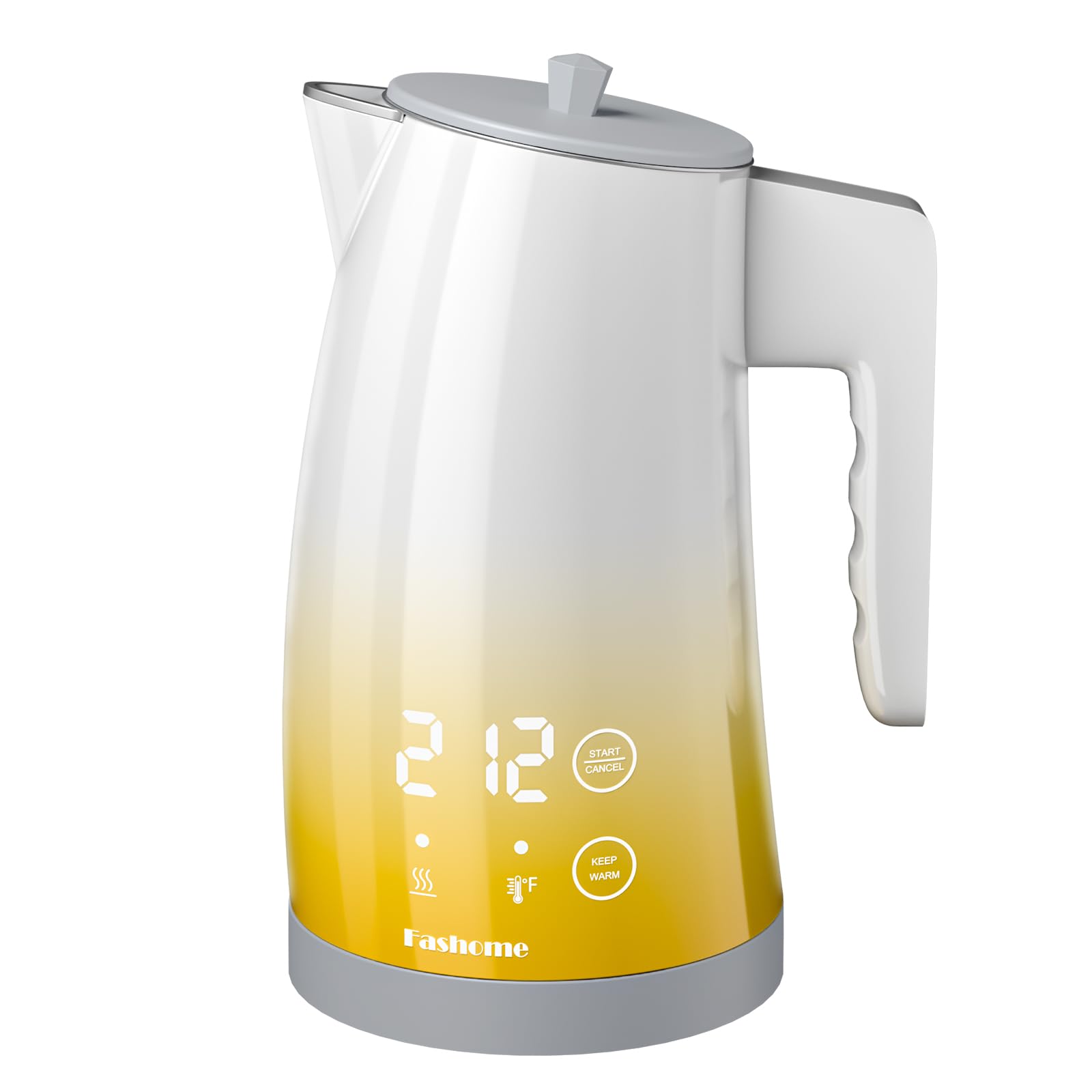
This is the kind of kettle that targets a very specific buyer: you want temperature presets and a visible digital display, you like a playful design, and you want the body to stay cooler to the touch. On paper (and for many owners early on), it delivers: quick heating, easy operation, and a stable temperature display that makes it feel more “modern.”
The practical upside is obvious: you can choose a preset for lower-temperature brews and avoid the “I boiled it too hot” problem. For people who brew green tea regularly, that can improve taste immediately. And the cool-touch body is an everyday comfort feature that tends to matter more than people expect, especially in busy kitchens.
Now the critical real-world note: some owners report that after months of use, the boiled water started to smell like burnt plastic. That is not something to ignore. Any time you smell an off odor from an appliance that heats water, it’s a hard stop moment. This is why I’m placing this model as a budget pick rather than a top recommendation: it offers attractive features, but the long-term consistency reports are mixed.
If you choose this kettle, treat the first weeks as a trial for your own home: boil water, smell the steam, taste plain hot water, and make sure it stays clean. When it’s working well, it can be a genuinely convenient preset kettle for the money. But if you’re a “buy once, keep forever” shopper, you may prefer a more established, sturdier-feeling model higher in this list.
Why it can work
- Presets + display reduce guesswork – Especially helpful for green tea drinkers.
- Cool-touch design – More comfortable and safer in busy kitchens.
- Compact footprint – Doesn’t dominate the counter.
- Easy cleaning access – Detachable lid helps maintenance.
Good to know
- Long-term odor reports are mixed; if you ever notice a burnt smell, don’t “push through it.”
- Some users find the lid harder to remove than expected.
- Finish and long-term durability may not match premium kettles higher on this list.
Ideal for: budget-focused shoppers who want presets and a cool-touch body, and who are comfortable monitoring early performance to ensure it stays clean and consistent.
9. harriet Whistling Stovetop Kettle (2.5QT) – Big, Bold, and Built for Tea Rounds

Not everyone wants electric—and if you love the ritual of stovetop boiling (or you want a backup for storms, camping, or just a simpler setup), this kettle is one of the stronger modern stovetop picks in the yellow category. The big capacity makes it feel “family ready,” and the whistle is designed to be noticeable, not timid.
What makes this model feel more modern than old-school whistling kettles is the handling: many owners love the spout lever/button concept because it reduces the “steam surprise” moment where you lift a hot spout cap and get blasted. If you’ve ever burned your knuckles on a whistling kettle, you already understand why this matters. It turns the kettle into a more controlled, user-friendly tool.
There’s also strong praise for the overall build feel and the fact that the kettle is designed to keep water contact surfaces stainless. That matters for taste and for long-term maintenance. And aesthetically, the yellow glossy finish is the kind of cheerful kitchen accent that can make even a simple stovetop setup feel intentional.
Owner reality check: some people still report the handle gets warm (especially over gas burners or higher heat). This is true for many stovetop kettles: heat management is part of the experience. If you want the best stovetop outcome, use the right burner size, keep the flame from licking up the sides, and stick to medium heat. You’ll get a safer handle temperature and you’ll protect the finish long term.
Why stovetop fans love it
- Large capacity – Great for family tea rounds and entertaining.
- Whistle is attention-grabbing – Helps prevent “forgot it on the stove” moments.
- Spout lever reduces steam risk – A real handling upgrade over old-school caps.
- Stylish “modern kettle” look – Feels decorative without losing function.
Good to know
- Handle warmth depends on heat source and burner habits; gas + high heat will raise handle temp.
- Stovetop requires attention—this is hands-on boiling, not “set it and walk away.”
- Whistling works best when you don’t overfill; leave space for steam pressure to build properly.
Ideal for: stovetop lovers who want a modern, large-capacity yellow whistle kettle with a more controlled, less “steam surprise” user experience.
10. Harriet Dolphin-Handle Whistling Kettle (2.5QT) – A Showpiece with Real Capacity
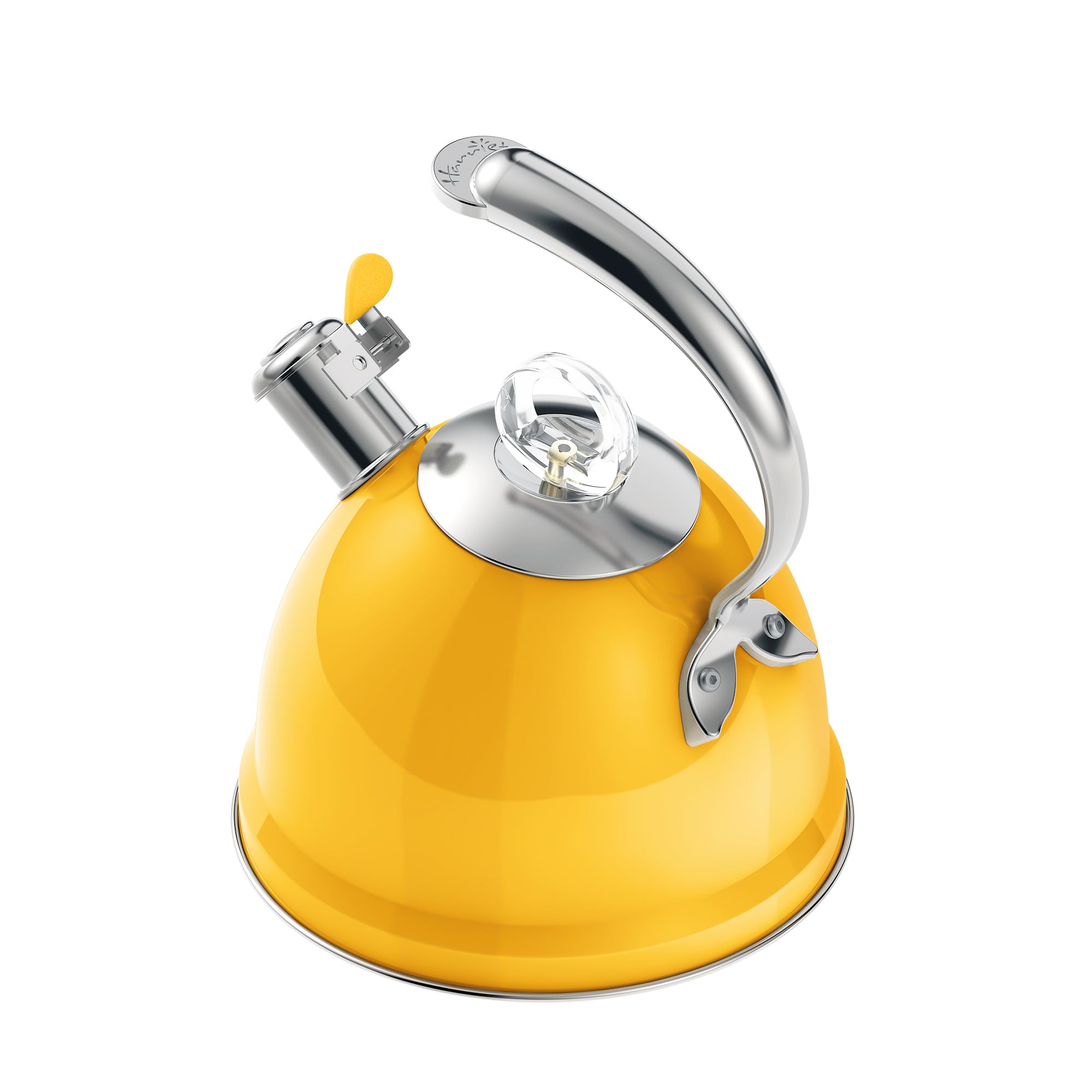
This kettle is for the person who wants their stovetop kettle to be the centerpiece—not an afterthought. The dolphin-inspired ergonomic handle design is genuinely distinctive, and in many kitchens it becomes “the thing people notice.” That’s a real kind of value if you care about aesthetics and want functional decor.
But a statement kettle still has to perform. In daily use, owners love the loud whistle and the fact that the kettle holds enough water for family tea rounds. The included accessories (like a heat-resistant holder and counter mat) are also a thoughtful touch, because they acknowledge the truth: stovetop kettles get hot, and practical extras reduce stress.
Now, here’s the important nuance from real owner feedback: handle heat and durability reports vary. Some people are pleasantly surprised that the handle stays cool on certain stovetops (especially induction or controlled heat). Others report the handle gets very hot in gas-stove setups, and at least one unhappy owner notes a handle-related failure over time. This is why I classify it as a statement pick rather than the “safe for everyone” choice.
If you want this kettle, the best strategy is to treat it like a premium stovetop object: use medium or low heat, avoid oversized flames, and rely on the included heat protection when needed. That approach tends to deliver the experience the design is aiming for: beauty, audibility, and controlled, comfortable handling.
Why it’s special
- Truly unique handle design – A visual centerpiece, not a generic kettle silhouette.
- Family-friendly capacity – Handles daily tea routines and hosting without constant refills.
- Loud whistle – Helps prevent “forgot it on the burner” mistakes.
- Useful extras included – Heat protection accessories reduce daily friction.
Good to know
- Handle heat depends heavily on stove type and heat level—gas users should plan for heat protection.
- Some durability feedback is mixed; if you want the simplest long-term bet, choose the more classic stovetop option above.
- Like all whistling kettles, proper fill level matters for whistle performance.
Ideal for: design-forward kitchens that want a standout stovetop kettle with real capacity—especially if you’re willing to use controlled heat for the best experience.
11. Harriet Gooseneck Stovetop Kettle (37oz) – Precision Pouring without Plugging In

For pour-over coffee, spout control is everything. A gooseneck kettle lets you control flow rate and where water lands, which improves consistency and makes your brew feel intentional instead of chaotic. If you love the pour-over ritual but prefer stovetop simplicity, this kettle is built for that exact niche.
Owners often praise the balance and handling—especially people who want a smaller kettle that doesn’t feel heavy or awkward to tilt. That matters because pour-over is a slow pour by design. A kettle can have the perfect spout shape and still be annoying if the handle angle hurts your wrist. This one tends to land well with people who value comfort and control.
The dial thermometer is a practical add-on for coffee drinkers. You don’t need perfect accuracy to benefit; you need repeatability. If you learn where your preferred “coffee zone” sits on the dial, you can stop heating before the water goes fully rolling boil (which can be useful for certain coffee styles). It also helps prevent endless reheating—you’re not guessing, you’re seeing.
Real-world caution: some owners have reported thermometer/knob issues over time. That’s the trade-off with kettles that integrate a dial into the lid assembly. If you’re extremely hard on your gear, or you want “zero moving parts,” a plain gooseneck without a dial can be more durable. But if the dial helps your ritual—and you treat the lid gently—it can be a meaningful daily upgrade.
Why coffee lovers like it
- Gooseneck control – Cleaner extraction and calmer pours for pour-over.
- Comfortable, balanced handling – Important for slow, deliberate pouring.
- Dial supports repeatable brewing – Helps you learn “your” temperature zone without guessing.
- Compact footprint – Fits coffee corners and small kitchens beautifully.
Good to know
- Some durability feedback around the thermometer assembly exists; treat the lid gently and avoid forcing it.
- Stovetop brewing is hands-on—this is a ritual tool, not an automatic appliance.
- If you brew for groups, the small capacity may feel limiting.
Ideal for: pour-over coffee people who want stovetop simplicity, controlled flow, and a compact kettle that feels like a real brew tool.
12. Hauce Radio Whistling Teapot (2.5QT) – Light, Cheerful, and Easy to Handle

This kettle earns its spot because it fits a very real need: a stovetop kettle that feels easy to lift and pour. Not everyone wants a heavy, thick-walled kettle—especially if you’re dealing with wrist fatigue, arthritis, or you simply prefer lighter kitchen tools. Owners often describe this style as cute, easy to handle, and simple to use.
The faux wood handle look is also popular because it adds warmth without making the kettle feel old-fashioned. And a whistle that’s “just loud enough” can actually be ideal in small homes where you don’t want an aggressive scream—just a clear signal.
However, this is one of those products where you should pay attention to interior condition over time. At least one reviewer reported concerns about internal coating flaking. Even if that’s uncommon, it’s the kind of feedback you should treat seriously because it affects water contact surfaces. The practical approach is simple: inspect the interior regularly, especially after descaling or heavy use, and if you ever see interior deterioration, stop using it.
When it’s performing normally, it’s a friendly, lightweight stovetop option that looks great in yellow and feels easy to operate. If you want a stovetop kettle mostly for casual tea, occasional use, or as a cheerful kitchen accent, it can fit well—just keep an eye on the interior like you should with any stovetop kettle.
Why it’s a good fit
- Lighter handling feel – Easier for everyday lifting and pouring.
- Cheerful, stylish look – Yellow + warm handle styling makes it feel inviting on the stove.
- Simple whistle reminder – Helps prevent forgetful boiling moments.
- Wide appeal for casual use – Works well as an occasional kettle or backup.
Good to know
- Interior condition matters; inspect for any signs of wear over time.
- Stovetop requires attention and heat management, especially on gas.
- Whistle performance can weaken if overfilled—leave headroom for steam pressure.
Ideal for: buyers who want a lighter stovetop yellow kettle for simple tea rounds, casual use, and easy handling—especially if you prefer a kettle that doesn’t feel heavy when full.
How Kettles Really Behave in Daily Life (Taste, Scale, and “Drip” Reality)
Most kettle regret comes from “small realities,” not big features. You don’t regret a kettle because it’s 1 inch taller. You regret it because the spout dribbles, the lid is annoying, the water tastes off, or scale builds up and you dread cleaning it. Here’s what’s actually going on—and how to predict your best match.
What makes a kettle feel “premium” after 3 months
- Clean taste stability – Good stainless interiors and stable heating systems don’t add smells or flavors over time.
- No-drip pouring – Spout geometry matters: a clean stream, minimal dribble, and less steam-in-hand exposure.
- Lid doesn’t fight you – Secure is good; stubborn is not. Easy filling and easy cleaning keep you happy long term.
- Easy scale management – Wide openings, removable filters, and simple wipe-down access keep hard-water homes sane.
- Clear signals – Indicator lights, readable windows, and intuitive controls reduce half-awake mistakes.
This is why retro kettles that “just feel good” often win hearts even without advanced tech. And it’s why true preset kettles win for tea variety drinkers: they reduce repeated steps and make your routine feel smoother.
My 5-minute “keep it or return it” checklist
- First boil test – Boil water once, dump it, then boil again and smell/ taste plain hot water. If it’s clean, you’re off to a good start.
- Pour test – Pour into a mug slowly, then faster. Watch for dribble down the body. A good spout stays neat.
- Lid test – Open it when cool, then again after a boil (carefully). If it’s already annoying, it won’t improve over time.
- Counter test – After boiling, set it back on the base and check for moisture later. A dry base is a happy base.
- Cleaning reality – Look inside. Can you reach where scale will build? If not, descaling becomes a chore.
If you do these tests early, you don’t have to “hope” your kettle works for your life—you’ll know. And that confidence is the difference between a purchase that feels risky and a purchase that feels inevitable.
FAQ: Yellow Kettles, Electric vs Stovetop, and Buying Without Regret
Do I actually need temperature control for tea?
Why do some kettles “taste weird” after a few months?
Is an electric kettle safer than a stovetop kettle?
How often should I descale my kettle?
Gooseneck vs standard spout: what will I notice?
Should I choose a kettle with a water window?
I love yellow, but I don’t want my kitchen to feel “too loud.” What should I pick?
Final Thoughts: Pick the Yellow Electric Tea Kettle That Feels Effortless
A great kettle isn’t the one with the most “features.” It’s the one that quietly makes your day easier: clean taste, neat pours, easy filling, and a look that makes you happy every time you walk into the kitchen.
Here’s the simplest way to translate this guide into a confident buy:
- Want the most balanced, easy daily pick? Start with the Harriet Electric Kettle (1.8L). It’s a strong blend of fast boiling feel, friendly usability, and retro style that doesn’t demand extra effort.
- Drink multiple teas and actually use different temperatures? Choose the BUYDEEM K740 for presets + keep-warm convenience that reduces repeated re-boiling and keeps your routine smoother.
- Want a minimalist “designer counter” look? The Chantal Oslo is the calm, Scandinavian-styled option that many people choose specifically because it belongs in the room aesthetically.
- Want retro charm with straightforward daily function? Go with the SUSTEAS Retro Electric Kettle for a stylish kettle that still behaves like a simple, practical appliance.
- Want “functional art” and an all-stainless interior vibe? The Hazel Quinn x Eduardo Recife (1.7L) is a showpiece that owners still love using every day because it feels solid and pours smoothly.
- Want a classic retro daily boiler with loyal fans? The BUYDEEM K640 is a popular “boils fast, looks cute, works daily” option—especially if you’re okay with a tighter lid.
- Need compact size and pour-over control? Choose the Hazel Quinn (1L) compact gooseneck for small counters, one-cup routines, and a calmer pour.
- Want budget-friendly presets and a cool-touch body? Try the Digital Temp Kettle (Yellow Gradient), especially if you want a visible temperature display—but keep your standards high for clean smell and long-term consistency.
- Prefer stovetop style and a loud whistle? Start with the harriet Whistling Stovetop Kettle (2.5QT) for modern handling and big capacity.
- Want a true statement stovetop kettle? The Harriet Dolphin-Handle Whistling Kettle is the “people will comment on it” option—best with controlled heat habits.
- Do pour-over but want stovetop simplicity? The Harriet Stovetop Gooseneck is a compact brew tool with controlled flow.
- Want a lighter stovetop option for casual tea? The Hauce Radio Whistling Teapot fits the “easy handling, cheerful look” niche.
The best purchase is the one that feels calm on your busiest morning. Pick the yellow electric tea kettle that matches how you actually live— single-cup ritual or family rounds, pour-over control or simple boiling—and you’ll end up with a kettle that doesn’t just heat water… it improves your day.
