
Tabletop grilling sounds simple… until you’re actually doing it. One minute you’re picturing perfect grill marks and a breezy patio dinner. The next minute you’re battling a gusty campsite, juggling a tiny propane bottle that’s frosting up, and realizing your “portable” grill still needs a smart setup to cook evenly and clean up fast.
If you’re shopping for a table top outdoor grill, you’re not just buying a heat source—you’re buying a whole experience: how quickly it preheats, whether it stays lit in wind, how annoying the grease situation is, and whether it feels like a clever tool or a messy project you regret hauling around.
Most buying guides stop at surface-level specs (BTUs, cooking area, “stainless steel!”) and call it a day. This guide is different. I’m going to talk like someone who actually cooks on these things: how burners behave when you open the lid, which designs naturally create useful “zones,” why some ignitions feel foolproof and others feel fussy, and what owners keep praising (or complaining about) after months of real use.
You’ll also notice something else: I’m not forcing one definition of “grill.” Some people want classic grate grilling. Some people want a flat-top griddle because smash burgers, pancakes, and fajitas are the goal. Some need electric because propane is banned on their balcony. And some want pellet flavor in a footprint that fits a travel trailer. Real life isn’t one-size-fits-all—so this guide isn’t either.
Below are 16 standout picks, organized in an order that makes sense for how people actually shop: the “do-it-all” crowd-pleasers first, then specialty solutions (electric, pellet, marine), then strong mid-range workhorses, and finally the compact value options that can still deliver excellent results when you know their sweet spot.
In this article
- How to choose the right tabletop grill for your space, fuel, and cooking style.
- Quick comparison table of 16 standout models.
- In-depth reviews of each grill/griddle, with practical pros and cons.
- How tabletop grills really cook (heat zones, wind, lids, and metal behavior).
- FAQ: safety, balcony rules, cleaning, fuel tips, and buying shortcuts.
How to Choose the Right Table Top Outdoor Grill for Your Kind of Weekend
A tabletop setup is “small,” but the decision is not. The wrong pick can feel underpowered, smoky, wobbly, or just annoying to clean. The right pick feels like a cheat code: fast heat, predictable cooking, easy transport, and a cleanup routine that takes minutes—not a full mood reset. Here’s the framework I use when I’m helping people choose a grill they’ll still love after the first messy cookout.
1. Start with your cooking identity: grill marks, flat-top, or smoke flavor?
Before you compare models, decide what “success” looks like on your plate. This single step eliminates most regret.
- Classic grilling (grates): You want steak sear, burgers, hot dogs, skewers, and veggies with char. Prioritize strong preheat, sturdy grates, and a lid that traps heat.
- Flat-top griddling: You want smash burgers, breakfast, fajitas, stir-fry, and “nothing falls through.” Prioritize grease management, seasoning-friendly steel, and true multi-zone control.
- Set-and-forget smoke flavor: You want ribs, chicken, and that wood-fired profile—without babysitting. Prioritize digital temp control and a design that actually holds steady heat.
- Balcony-safe convenience: You need electric power, low drama, and consistent performance in a small footprint—often with strict building rules.
2. Don’t fall for BTU worship—look at heat behavior instead
BTUs matter… but they don’t tell the whole story. On compact grills, the real question is: How does heat behave when you cook like a human? Three factors decide whether a tabletop unit feels powerful or frustrating:
- Thermal mass: Heavy grates (cast iron or thick stainless) store heat, recover faster after you flip food, and feel more “restaurant-like.” Thin parts cool instantly.
- Burner layout: Two burners give you real zones. One burner can still work, but you’ll often get a hot lane and a cooler lane—so you need to like “move-and-manage” cooking.
- Lid design: A lid isn’t just a cover—it’s a heat engine. Taller lids cook thicker foods better. Tight-fitting lids help in wind and reduce temperature swings.
This is why a smaller-looking grill with better metal and smarter burner geometry can cook circles around a “bigger BTU” unit that loses heat every time you open it.
3. Wind is the hidden boss fight (and most people underestimate it)
Wind doesn’t just cool food—it messes with flame stability. If you tailgate, camp, cook on a beach, or live in a breezy area, choose a model that naturally resists wind. Signs of a wind-friendlier design:
- Deeper firebox walls that shield the flame area.
- Heavier lid and tight closure that traps heat and stabilizes airflow.
- Burner protection (flame shields, diffusers, or designs that keep drips from hitting flame directly).
- Cast aluminum bodies (great heat retention and corrosion resistance) or high-quality stainless builds (less flex, fewer rattles).
And yes—some grills simply need a wind screen to stay happy. That’s not a failure; it’s just reality. If you know you’ll cook in gusts, plan your setup like you plan your menu.
4. Portability is more than “has a handle”
The best portable grill is the one you’ll actually bring. Two grills can have the same weight, but one feels easy because the center of gravity is right, the lid latch is trustworthy, and the legs don’t wobble like a baby giraffe.
- Lid latch confidence: If the lid doesn’t stay shut, transport becomes stressful and greasy.
- Leg design: Folding legs are great—unless they don’t lock. For tailgates, the “stable platform” matters more than you think.
- Carry strategy: A wide front handle is nice. A slim side handle can be awkward. If you’ll carry it far, ergonomics matter.
- Packability: If you store it in an RV bin or a trunk, look at the true “box shape” and protruding knobs/regulators.
5. Fuel planning: 1 lb bottles, full tanks, pellets, and outlets
A lot of tabletop frustration comes from fuel logistics—not cooking.
- 1 lb propane bottles: Convenient, widely available, and great for short cooks. But they can feel limiting for longer sessions, and cold weather can reduce performance.
- 20 lb propane tanks: Longer runtime and better long-session confidence. Many tabletop grills accept a hose adapter, but you want a clean routing setup so the hose doesn’t feel like a tripping hazard.
- Pellet grills: The flavor is amazing and temp control can be beautifully stable, but you’ll need power for the auger and you’ll pack pellets like you pack fuel.
- Electric grills: Perfect for restricted spaces—but you must respect outlet requirements. If your patio circuit is shared with lights or appliances, plan for trips and resets.
Pick the fuel style that matches your “where will I cook most?” reality—not your “maybe someday” fantasy.
6. Cleanup is a feature (and it decides whether you cook more often)
If you want to use your grill weekly, you need a cleanup routine you can do even when you’re tired. Look for:
- Removable grease trays that slide out without a disassembly puzzle.
- Water-pan systems that make grease cleanup less “scrub” and more “dump and wipe.”
- Rear grease management that funnels mess into a cup (excellent for flat-tops).
- Dishwasher-friendly parts (rare, but magical when done right).
Also: decide whether you’re okay with seasoning. Flat-top griddles often need it. The payoff is a nonstick-like surface and incredible cooking versatility—but it’s a relationship, not a fling.
7. Reputation matters: not just the grill, but the support reality
Here’s the uncomfortable truth: with portable gear, shipping happens. Small parts go missing. Igniters can arrive finicky. A great warranty is only great if support is responsive.
That’s why I highlight “confidence brands” in this guide (Coleman, Weber, Blackstone, Cuisinart, Pit Boss) and I’m extra honest about newer or less-proven names. You can still get a great grill from a newer brand—just treat it like you would a new restaurant: try it, test it, and don’t plan your biggest party around it on day one.
Quick Comparison: 16 Table Top Outdoor Grill Picks That Make Buying Easy
Use this table to find the “shape” of the grill you want (classic grate, flat-top, pellet, electric, stand-up), then jump into the reviews for the real-life details: wind behavior, cleanup routines, ignition quirks, and the little design cues that separate “love it” from “why did I buy this.”
On smaller screens, swipe or scroll sideways to see the full table.
| Model | Type | What it nails | Best match | Amazon |
|---|---|---|---|---|
| Coleman RoadTrip 225 (Tabletop) | Propane grill | Ridiculously easy cleanup + practical cooking zones that feel “bigger” than the footprint | Most families who want a do-it-all tailgate/camp grill | Amazon |
| Coleman RoadTrip 285 (Stand-Up) | Stand-up | More cooking control for groups + roll-it-anywhere convenience | Tailgates, campsite crews, and people who host outdoors | Amazon |
| Weber Lumin Electric Grill | Electric | High-heat sear + steam/smoke versatility for balcony life | Apartments/condos where propane isn’t allowed | Amazon |
| Pit Boss PB150PPG Tabletop Pellet Grill | Pellet | “Set it and forget it” cooking + direct-flame searing option | Campers who want real smoke flavor in a compact rig | Amazon |
| Magma A10-803 ChefsMate | Marine | 304 stainless durability + boat/RV mounting ecosystem confidence | Boats, RVs, salt-air environments, long-term owners | Amazon |
| Cuisinart Chef’s Style CGG-306 | Propane grill | Two-burner zone control + stainless build that’s easy to maintain | People who want “real grill feel” in tabletop size | Amazon |
| Royal Gourmet PD1305H Grill + Griddle + Pot | Combo | Multi-cook versatility with big heat and a side burner | Camp breakfasts + dinner setups for bigger groups | Amazon |
| Blackstone 1666 22” Tabletop Griddle | Flat-top | Big batch cooking + iconic rear grease management | Smash burgers, breakfast spreads, meal-prep outdoors | Amazon |
| Blackstone 1814 17” Griddle (with hood) | Flat-top | Compact griddle versatility + easy travel footprint | Small families who want griddle cooking on the go | Amazon |
| Nexgrill 1-Burner Cast Aluminum (820-BC002) | Propane grill | Cast aluminum heat retention + cast iron sear confidence | Windy campsites, steak lovers, “small but serious” buyers | Amazon |
| Masterbuilt MB20030819 Tabletop Grill | Propane grill | Large cooking surface + stainless box build for travel days | Campers who want simple grilling with room to cook | Amazon |
| Megamaster 2-Burner (820-0033M) | Propane grill | Compact two-zone cooking + travel-friendly form factor | RV bins, trunk storage, simple weeknight grilling | Amazon |
| Royal Gourmet GT1001 | Propane grill | Warming rack + sturdy portable design for classic tailgate foods | People who want simple, stable, and easy to pack | Amazon |
| Bestfire 2-Burner Tabletop Grill | Propane grill | Two-burner power and a surprisingly “grown-up” feature set | Budget buyers who still want real zone control | Amazon |
| Cuisinart Grillster (CGG-059A) | Compact | Ultra-fast setup + easy cleanup in a tiny footprint | Porches, small trips, “just give me a hot grill” buyers | Amazon |
| Megamaster 1-Burner (820-0065C) | Large surface | Big cooking space in a simple, budget-friendly package | Hot dogs, burgers, and big batches with smart heat management | Amazon |
In‑Depth Reviews: 16 Portable Grills & Griddles That Feel Great to Own
Now we go model by model. I’ll cover what matters in real life: how these cook when you open the lid, what owners say after months of use, which quirks are “one-time learning curves,” and which ones are true dealbreakers depending on your setup.
1. Coleman RoadTrip 225 (Tabletop) – The “Cleanest Grill You’ll Actually Use Often”

The RoadTrip 225 is the grill I recommend when someone says: “I want great food, but I don’t want a whole cleanup ritual.” It’s designed around a simple idea—make grease management so easy that you’ll cook more often. Owners rave about exactly that: the inside “moat-style” water pan catches drippings, lifts out easily, and turns cleanup into a quick dump-and-wipe instead of a scraping marathon.
But the bigger win is how practical the cooking surface feels. The grate design gives you a stable platform that cooks like a bigger grill, and it does something subtly smart: it helps keep drips from constantly hitting flame. That matters because fewer flare-ups means calmer cooking (and calmer cooking is how you get better food). You’ll also see people mention that it heats fast, the controls feel predictable, and the whole “pack it up” routine is surprisingly tidy if you remove the regulator and store it separately.
The only thing to know is that tabletop grills often have slightly cooler edges than the center—this one is no exception. The secret is to treat that as a feature: center for sear, edge for holding, buns, and gentle finishing. Once you cook with that mindset, the 225 feels like a small grill with big control.
Why you’ll like it
- Easy cleanup that’s actually realistic – The water-pan concept makes post-cook cleanup fast and low-stress.
- Practical heat control – Two-burner control gives you real zones for sear + finish.
- Great for travel routines – Packs cleanly when you cool it, lift the pan, and store the regulator smartly.
- Feels “designed,” not generic – Owners consistently describe it as thoughtfully engineered.
Good to know
- Like most compact grills, edges can run cooler—use that as a holding/warming zone.
- Enamel-coated parts prefer non-metal tools; silicone/wood keeps them looking better longer.
- If you cook in strong wind, plan a sheltered placement or a simple wind block.
Ideal for: most families who want a portable grill that feels easy to own—especially if “cleanup dread” is what keeps you from grilling more often.
2. Coleman RoadTrip 285 (Stand-Up) – Tailgate Power Without the “Hauling Nightmare”

If the RoadTrip 225 is the “easy everyday” pick, the RoadTrip 285 is the “we’re feeding people” upgrade—without jumping to a full-size backyard beast. The stand-up format matters more than you’d think. When you can roll it, fold it, and park it where you want, you’re far more likely to bring it to tailgates, campgrounds, and big patio hangs. Owners consistently love it for that mix of “big enough to cook real meals” and “still genuinely portable.”
The 285’s three-burner layout is the real secret sauce. With tabletop grills, temperature control is often “hot or not.” With three burners, you can build a true cook line: sear lane, medium lane, low lane. That’s how you grill steaks and veggies at the same time without playing panic-Tetris. And because the RoadTrip ecosystem supports interchangeable cooking surfaces, a lot of long-term owners end up with a setup that feels like a mini outdoor kitchen.
Here’s the expert-level note: long-term ownership sometimes means burner maintenance. People who cook on these frequently mention that after years of heavy use, burner ports can clog with residue and need a deep clean. That’s not unique to Coleman—it’s normal for portable gas appliances used hard. The difference is whether you’re the kind of person who doesn’t mind occasional deep maintenance for a grill you love.
Why it’s a tailgate hero
- Three burners = real control – Makes small-footprint cooking feel organized, not chaotic.
- Rolls and folds easily – The “bring it with you” factor is legitimately high.
- Great for mixed menus – Grill one thing while warming/holding another without burning it.
- Built for frequent use – Owners often keep using it at home between trips because it’s just convenient.
Good to know
- Adapters for larger tanks can be finicky depending on your setup—test at home before a trip.
- Long-term heavy use may require burner cleaning to keep flame ports flowing evenly.
- It’s portable, but it’s still a substantial piece of gear—plan your trunk/RV storage space.
Ideal for: tailgate crews, camping groups, and anyone who wants portable grilling with “host energy” capacity and better temperature control than typical tabletop units.
3. Weber Lumin Electric – Balcony-Safe Grilling That Still Gets a Real Sear

If you live somewhere propane is restricted, most “electric grills” feel like compromise machines: weak heat, sad sear, and a taste that screams “indoor appliance.” The Weber Lumin is the rare exception because it’s built to run hot—hot enough that owners regularly talk about legit browning and real grill marks. It also does something most people don’t expect from electric: it leans into versatility with modes for searing, steaming, smoking, and keeping food warm. That turns it from “allowed by the rules” into “actually fun to cook on.”
The Lumin’s superpower is consistency. When it’s preheated, it holds temperature well for an electric unit, and it’s predictable in a way that makes weeknight cooking easy. A lot of people use it for steaks and chicken specifically because they finally get results that feel like a real outdoor grill—without hauling fuel tanks or dealing with flare-ups the way some gas grills can.
The honest downsides are practical: preheat takes time (plan on it), and if you cook fatty foods, smoke can be a bigger deal than you expect because fat isn’t burning off the same way it does over flame. Also, power matters. Some patios don’t have a dedicated circuit, and owners report tripping breakers if other devices share the line. If you treat it like a serious appliance (because it is), it’s fantastic.
Why it’s worth it
- Real searing capability – Owners consistently highlight surprisingly strong browning for an electric grill.
- Versatile cooking modes – Steam, smoke, warm, and sear expand what “balcony grilling” can be.
- Easy grease handling – Front-access grease tray makes basic cleanup painless.
- Space-friendly design – Works beautifully for patios, balconies, and small outdoor kitchens.
Good to know
- Preheat is part of the deal—plan 10–15 minutes so it performs at its best.
- Smoke management matters with fatty foods; keeping it clean helps reduce smoke.
- Outlet/circuit limitations can be real; avoid long lightweight extension cords and overloaded breakers.
Ideal for: apartment and condo dwellers who want the closest thing to “real grilling” without propane—and who care about performance, not just permission.
4. Pit Boss PB150PPG – “Set It, Forget It” Smoke Flavor with a Sear Switch
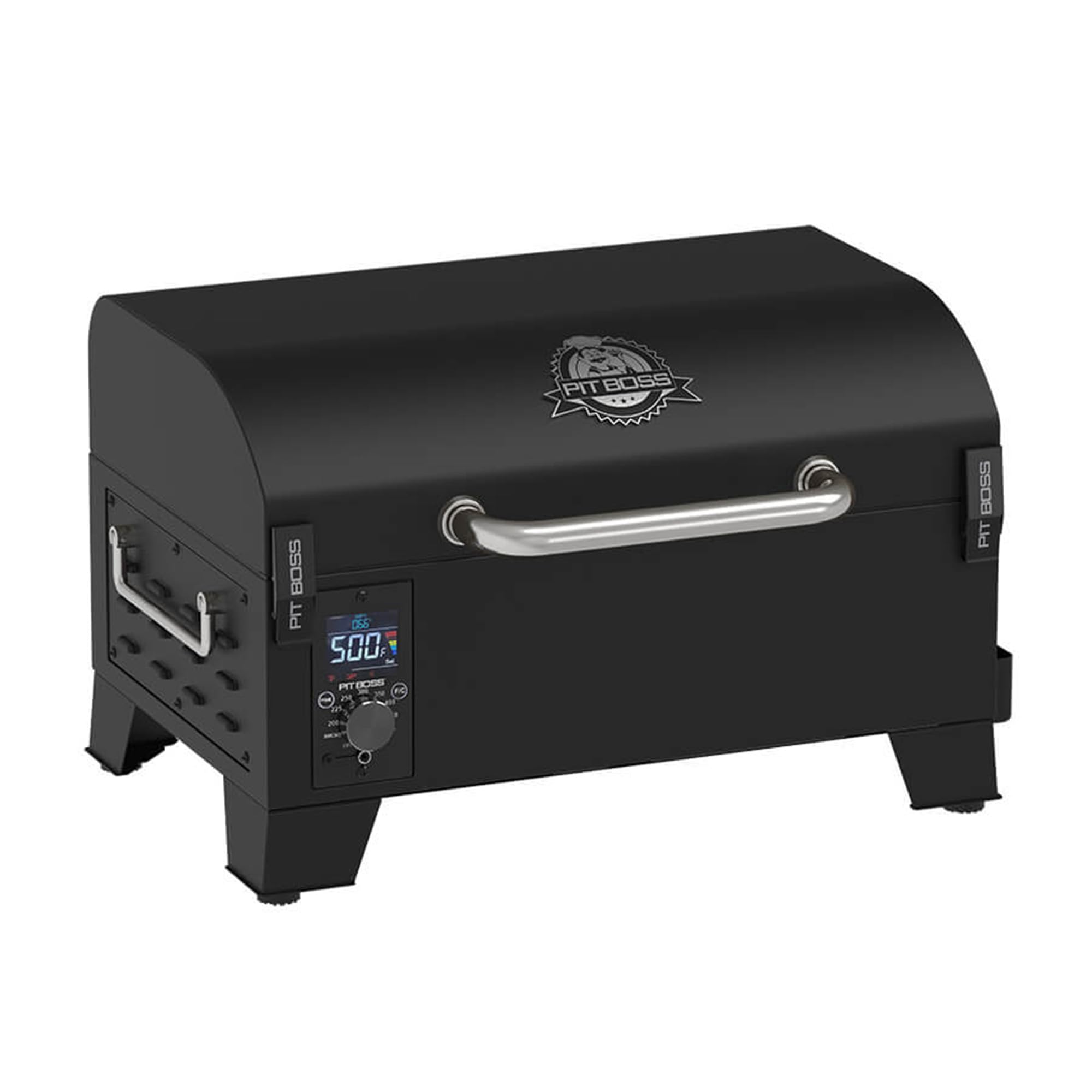
Pellet grills hit a sweet spot that gas can’t quite copy: wood-fired flavor plus thermostat-style control. The Pit Boss PB150PPG brings that vibe to a tabletop footprint, and owners who’ve used pellet rigs for years often describe being surprised by how capable it is. The reason is simple: it behaves like a “real” pellet cooker—automatic start-up, steady temperature holding, convection-style cooking—without needing a permanent backyard setup.
What makes this one stand out in a compact class is that it’s not only for low-and-slow. The Flame Broiler concept gives you the option to introduce direct flame for searing—so you can smoke something and still finish with a satisfying crust. For campers and RV travelers, this is huge because it turns one device into multiple tools: weekday burgers, weekend ribs, and “we’re cooking chicken tonight, don’t babysit it” convenience.
The key to loving a tabletop pellet grill is understanding the travel reality: you’re packing pellets and you need power for the auger. If your campsite has outlets or your setup includes a power solution, you’ll love the experience. If your trips are ultra-minimal and off-grid, propane will feel simpler. For everyone else, this is one of the most “chef-like” ways to cook outdoors in a compact size.
Why it’s a game-changer
- True pellet flavor – Smoked results with less babysitting than charcoal or stick burners.
- Stable temperature behavior – Owners consistently praise steady holding once it’s running.
- Direct-flame searing option – Lets you finish with a crust instead of “smoke-only” texture.
- Travel-friendly footprint – Many people store it in a tote and bring it campsite to campsite.
Good to know
- You need power for the auger and fan—plan your campsite/electric setup.
- Pellets are part of your packing list; bring enough for longer cooks.
- Like all pellet grills, cleanup is easiest when you stay consistent: empty grease, manage ash, and don’t let it build up.
Ideal for: travelers who want wood-fired flavor with “set it and cook” simplicity—and who like the idea of smoking and searing from the same compact unit.
5. Magma A10-803 ChefsMate – Marine-Grade Stainless That’s Built to Live Outside

The Magma ChefsMate isn’t just “a grill made of stainless.” It’s a grill designed for harsh environments—salt air, wet storage, boat decks, and the kind of exposure that would destroy most cheap “stainless-look” units. Owners who’ve had these for years (even well over a decade) keep saying the same thing: if you treat it right—especially rinsing after salty use—it holds up beautifully and keeps cooking like a champ.
Performance-wise, people regularly mention surprisingly even cooking for the size, including grilling in wind on the water. That’s the real point: it’s engineered to behave like a serious grill in an environment where flimsy burners and thin lids get bullied. The fold-away legs make it legitimately practical for shore picnics too, and the mounting ecosystem is a major reason it’s such a marine favorite: you can set it up to feel stable and “part of the boat” rather than a loose box sliding around.
One very real learning curve is regulator behavior when connecting to larger tanks or certain onboard systems. Owners sometimes discover that the order you open valves and set the control can affect whether it hits high heat. Once you learn the routine, it’s solid—but it’s not the kind of unit you want to “figure out” during your first big cookout. Treat it like long-term gear, not disposable gear, and it rewards you.
Why it’s special
- True marine-grade durability – Built to resist corrosion when cared for properly.
- Even cooking for the footprint – Owners report real grilling capability, not “hot dog only.”
- Mounting options – Stability is a huge deal on boats and RV setups.
- Easy-clean design – Snap-out radiant plate makes cleanup far less annoying.
Good to know
- Long-term shine requires care—rinse and clean after salty use to keep it looking great.
- Fuel/regulator habits matter; practice your lighting routine before relying on it for a party.
- Cooking surface is compact; it’s built for efficiency, not crowd catering.
Ideal for: boaters, RV owners, and anyone who wants a portable grill that’s built to survive outdoors for years—not just a season.
6. Cuisinart Chef’s Style CGG-306 – Two Burners, Real Zones, and “Grown-Up” Build

The CGG-306 is what you buy when you want a tabletop grill that doesn’t feel like a toy. It has the look and behavior of a “real grill” shrunk into a portable form: two independent burners, a lid that actually helps cooking (not just covers it), and stainless grates that distribute heat in a way that feels steady and controllable. Owners commonly describe it as well made, easy to move, easy to clean, and surprisingly capable even when cooking a full load of food.
One of the most useful real-world notes owners share: the ignition can look “invisible” in daylight. The burner may be lit even if you don’t see a dramatic flame, which can confuse first-time users until they learn the feel. Once you understand the ignition workflow, it’s very reliable, and people often praise that it lights quickly and consistently.
Where this grill can struggle is wind. In a breezy campsite, any exposed flame system can relight repeatedly if gusts disrupt the burner area. Some owners solve this with smarter placement (turning it sideways, using the vehicle as a windbreak, or adding a simple guard). If your cooking environment is usually calm—or you’re willing to cook smart in wind—this is one of the best “classic grilling” experiences you can get in tabletop form.
Why it’s a top pick
- Two burners = true zones – Sear on one side, finish on the other like you would on a big grill.
- Stainless build that holds up – Owners love the durability and easy-maintenance feel.
- Even heat distribution – Feels steady when cooking a full grill of burgers or chicken.
- Cleanup can be simple – Many people describe it as “hose it out” easy when used thoughtfully.
Good to know
- Wind can cause relighting frustration; sheltered placement helps a lot.
- Some edges can be sharp inside—gloves make cleaning and handling more comfortable.
- Legs are portable-friendly, but some people wish they locked more securely for travel.
Ideal for: anyone who wants a classic grill experience—real zones, real heat control—in a portable stainless package that feels more premium than typical tabletop grills.
7. Royal Gourmet PD1305H – Griddle + Grill + Pot Rack for “One Setup, Many Meals”

Some outdoor cooks want a grill. Others want a full campsite kitchen that can do breakfast, dinner, and “heat a pot of something” without juggling multiple devices. That’s exactly what this Royal Gourmet combo is built for: a griddle top for the morning rush, a grill section for classic BBQ, and a pot rack/side burner setup for sauces, beans, coffee water, or anything that makes camp meals feel complete.
Owners who love it tend to love it hard—especially people who cook for groups. You’ll see comments like “chef-approved functionality,” “easy to assemble,” and “works awesome,” because once it’s set up, it’s a very capable platform. Heat-up is fast, and the side shelf/lid design can help reduce wind frustration when using the burner. That’s a big practical detail for campsites where wind ruins your mood.
The honest limitation is “lid cooking.” Not every grill section here is designed for deep-lid roasting like a backyard kettle. If your signature move is thick steaks or tall roasts that demand a dome, a dedicated grill might fit better. This is the better pick for people who want variety and volume—especially breakfast and flat-top meals—more than “perfect closed-lid steakhouse technique.”
Why it’s worth considering
- True multi-cook flexibility – Griddle, grill, and pot cooking in one portable station.
- Great for groups – Big surface and multiple heat options make it feel like a campsite kitchen.
- Fast heat-up – Gets cooking quickly, which matters when feeding hungry people outdoors.
- Wind-aware design touches – Side shelf and lid setup can help block wind in real use.
Good to know
- Some owners wish it included a built-in thermometer; many add their own.
- Not every meal can be “closed-lid roasted” the way a tall-lid grill allows.
- Portability is good, but it’s not ultra-light—plan transport and storage space.
Ideal for: campers and outdoor hosts who want one device that can handle breakfast spreads, burger nights, and pot cooking without swapping gear.
8. Blackstone 1666 22” Griddle – The “Cook Everything, Nothing Falls Through” Legend

The reason Blackstone griddles have a cult following is simple: they make outdoor cooking feel effortless and creative. On a flat-top, you’re not limited to “grill foods.” You can do breakfast, stir-fry, quesadillas, smash burgers, veggies, and meal prep in a way that feels fast and satisfying. The 22” size is a sweet spot because it’s big enough to cook for a small group, but still portable enough to bring camping or set on a patio prep table.
The big ownership skill with a flat-top is heat mapping. Two-burner griddles don’t heat like a stovetop pan. You’ll usually get hotter zones closer to burners and cooler zones toward the center or edges depending on the burner layout. Owners mention this in different ways (“my middle browns faster” vs “my middle is cooler”), and both can be true depending on what you’re cooking and how you’re running the burners. Once you learn your griddle’s zones, you stop fighting it and start using it like a pro: sear zone, sauté zone, warming zone.
Blackstone’s rear grease management system is a big reason people stick with the brand. It channels grease away from the cooktop and into a cup, which makes cleanup feel controlled instead of chaotic. If you season the surface properly and keep up with a simple post-cook routine, this can be the kind of gear you keep for years.
Why people love it
- Versatility is unmatched – Breakfast, burgers, veggies, and meal prep all feel natural.
- Big cooking space – Handles multiple foods at once without feeling cramped.
- Grease management works – Rear channel + cup simplifies cleanup.
- Zone cooking potential – Two burners let you build heat lanes like a diner grill.
Good to know
- Seasoning is part of ownership; skip it and you’ll fight sticking and rust.
- Heat zones take a cook or two to learn—your first session is a “map the surface” session.
- Wind can cool a griddle faster than a lidded grill; sheltered placement helps in breezy spots.
Ideal for: anyone who wants maximum cooking versatility in a portable footprint—and loves the idea of “diner-style” outdoor cooking.
9. Blackstone 1814 17” Griddle – The Travel-Friendly Flat-Top for Small Families

If you love the flat-top lifestyle but don’t want to haul a bigger unit, the 17” Blackstone is a smart “sweet spot” size. Owners consistently say the same things: it heats hot enough for serious cooking, it’s portable enough for camping and RV use, and once seasoned, it becomes a nonstick-feeling cooking surface that’s wildly satisfying for smash burgers, breakfast, and quick dinners.
The hood version is especially helpful for travel because it adds a bit of wind blocking and protects the surface between cooks. It’s not the same as a tall roasting dome, but it’s useful in real life—especially when you’re cooking in open-air conditions. Like most compact griddles, the very edges and corners can run a little cooler than the center. That’s not a defect; it’s your built-in “holding lane.” If you plan your cook like a line cook, it performs beautifully.
One thing to respect: flat-tops are not “use it once and ignore it” gear. Owners who stay happy long-term follow a simple routine: season it well, scrape while warm, wipe with a thin oil coat, and store protected. Do that, and this becomes one of those tools you reach for constantly—because it makes outdoor cooking fast, fun, and low-mess.
Why it works
- Perfect size for 2–4 people – Enough surface for real meals without huge bulk.
- Heats hot for searing – Owners consistently mention strong heat for smash burgers and browning.
- Easy to clean (with the right routine) – Scrape + wipe while warm becomes second nature.
- Great travel form – Fits RV storage and camping setups without taking over your packing space.
Good to know
- You must season and protect the surface to prevent rust—this is non-negotiable.
- Corners can be cooler; treat them as warming lanes, not cooking lanes.
- It’s sturdy (and can feel heavy); plan a carry bag or a dedicated storage spot.
Ideal for: small families and campers who want flat-top versatility without committing to a larger griddle footprint.
10. Nexgrill 1-Burner Cast Aluminum – The “Small Grill That Cooks Like a Serious One”

Here’s a portable-grill truth: if you want a great sear, you need heat retention—not just heat output. That’s why cast aluminum bodies paired with cast iron grates can feel so good in real cooking. This Nexgrill is built like that: a sturdy cast aluminum firebox that holds heat, plus cast iron grates that deliver excellent browning and texture. Owners who buy it for camping often mention being pleasantly surprised by how evenly it heats and how well it performs even with a breeze.
This grill is also a “grown-up” choice for people who hate flimsy stainless. Stainless can be great, but thin stainless can warp, flex, and feel disposable. Cast aluminum resists rust and doesn’t care as much about weather as painted steel, which is why people who keep it in campers or semi-covered areas often feel confident about the build quality.
The trade-off is weight and setup effort. You’re getting a sturdier body, which means it’s not the lightest. And because it’s a more “engineered” shape, assembly can take a bit longer than the super-simple suitcase grills. If you want a compact grill that behaves confidently—especially for steaks and chops—this one is a smart, satisfying pick.
Why it stands out
- Excellent heat retention – Cast aluminum + cast iron helps it recover after flipping food.
- Strong sear performance – Owners rave about steak results and control.
- Wind-friendly behavior – Many users report stable cooking even with breezy campsite conditions.
- Durable materials – Feels built to last with fewer “thin metal” compromises.
Good to know
- Heavier than ultra-light tabletop grills—plan your carry and storage.
- Some users wish for additional heat-diffusing parts; preheat and zone cooking help.
- Cast iron grates reward basic care (light oiling) to prevent surface rust.
Ideal for: steak lovers, windy-campsite cooks, and anyone who wants a compact grill that feels stable, sturdy, and genuinely capable.
11. Masterbuilt MB20030819 – Big Cooking Space, Simple Layout, Real Travel Convenience

Masterbuilt is known for outdoor cooking gear that leans practical, and this tabletop grill fits that vibe: a roomy cooking surface, a straightforward burner layout, and a portable design that locks up nicely for travel. Owners who get a good unit often describe it as sturdy, powerful, and easy to clean—especially for weekends where you want a real grill experience without hauling a full-size setup.
Here’s the honest “expert” note: this is one of those grills where ignition quality can vary by unit and shipping luck. Some owners report igniters that are weak or inconsistent and mention that support can be frustrating. That’s not a reason to avoid it if you like the form factor— it’s a reason to treat your first cook as a “test run” at home. If your igniter is finicky, many people solve it with simple troubleshooting: checking electrode position, ensuring proper gas flow, and learning the correct ignition rhythm so propane doesn’t pool before lighting.
When dialed in, it can run hot and cook fast, which is what you want for burgers and steaks on the go. The design also packs well: folding legs, locking lid, and a carry handle that makes campsite movement easier. If you want a larger grilling surface than many suitcase-style grills offer, this is a strong contender—just be smart about testing it early.
Why it’s a good fit
- Roomy cooking area – Great for cooking multiple burgers, chicken pieces, or veggies at once.
- Travel-friendly build – Locking lid and folding legs simplify packing and transport.
- Strong heat potential – When running correctly, it can get impressively hot for searing.
- Simple layout – Easy to understand and easy to use once you’ve practiced once.
Good to know
- Igniter reliability reports are mixed; test early so you’re not troubleshooting at the campsite.
- Support experiences vary—document issues quickly if something arrives damaged.
- Like many tabletop grills, it cooks best when you preheat with the lid closed to stabilize heat.
Ideal for: campers and tailgaters who want a roomy tabletop grill and don’t mind doing a quick “home test cook” to confirm everything works smoothly.
12. Megamaster 2-Burner (820-0033M) – Two-Zone Cooking in a Trunk-Friendly Shape

The Megamaster 2-burner is a strong pick for people who want “real cooking control” but still need something that stores easily in a camper box or trunk. The two independent burners are the feature that matters most: you can run one side hotter for searing and the other side lower for finishing, or keep one side as a safe warming zone so you’re not overcooking food while the next batch goes on.
Owners often praise the overall build quality for the category—stainless parts, solid feel, and a compact footprint that’s easy to live with. A common theme is: “I replaced a bigger, more annoying setup with this and I’m happier.” That’s exactly the type of praise that matters for a portable grill. People also point out a very real learning curve with small grills: they can run hot fast, and opening the lid drops temperature quickly. If you cook with a “lid down as much as possible” mindset and use lower flame settings than you think, results improve dramatically.
The main “watch-out” is transport confidence. Some owners complain about latch design and recommend carrying it carefully rather than trusting the latch with all your faith. That’s the kind of small annoyance that’s easy to manage once you know it—but it’s worth knowing before you buy, especially if you move your grill frequently.
Why it’s a smart buy
- Two-zone control – Makes real cooking easier than single-burner suitcase grills.
- Compact and portable – Fits storage compartments and travels well.
- Heats quickly – Great for weeknight-style cooking at camp or on patios.
- Feels well made for the class – Owners often mention being pleasantly surprised by materials.
Good to know
- Lid latch confidence varies; carry it thoughtfully if you move it often.
- No built-in thermometer on many setups; a small probe thermometer improves results.
- Small grills lose heat fast when the lid opens—cook with “lid down” discipline.
Ideal for: people who want two-burner control in a truly portable footprint—especially RV and trunk-storage shoppers.
13. Royal Gourmet GT1001 – Locking Lid, Warming Rack, and No-Nonsense Portability

This is the kind of grill people buy for tailgates and camping because they want something that feels stable, closes securely, and cooks familiar foods well. Owners often mention that it heats quickly, feels solid in construction, and is genuinely portable thanks to the latching lid and carry-friendly shape. The added warming rack is also more useful than it sounds: it gives you a place to hold buns, finish thicker cuts gently, or keep cooked food warm while you cook the next batch.
The biggest reality check is heat expectations with the lid open. Some owners say it doesn’t feel powerful enough for certain tasks if you cook with the lid open for long periods. But that’s also a “small grill physics” lesson: with compact burners, you usually need the lid closed to build heat and maintain it. Owners who get the best results tend to preheat with the lid closed, cook with minimal lid opening, and treat the warming rack as a tool for control, not just a bonus shelf.
The other factor is support expectations. Some users complain about replacement parts and customer service responsiveness. That doesn’t mean the grill can’t be great—it means you should double-check your hardware in the box and do a quick assembly inspection before your first big outing.
Why it works well
- Portable and stable – Folding legs and a latch system make it easy to move and store.
- Warming rack utility – Helps with buns, holding, and gentle finishing.
- Quick heat-up – Owners often mention fast preheat and easy control.
- Good footprint for camping – Fits small vehicles and travel storage nicely.
Good to know
- Performs best with lid-closed cooking; lid-open cooking can feel weaker.
- Support experiences vary—inspect parts early so issues don’t ruin a trip.
- If you want extremely high heat for open-lid searing, a two-burner unit may feel easier.
Ideal for: tailgaters and campers who want a straightforward, portable grill with a useful warming rack and a “classic grilling” feel.
14. Bestfire 2-Burner Tabletop Grill – Big Heat Potential for Value-Focused Buyers
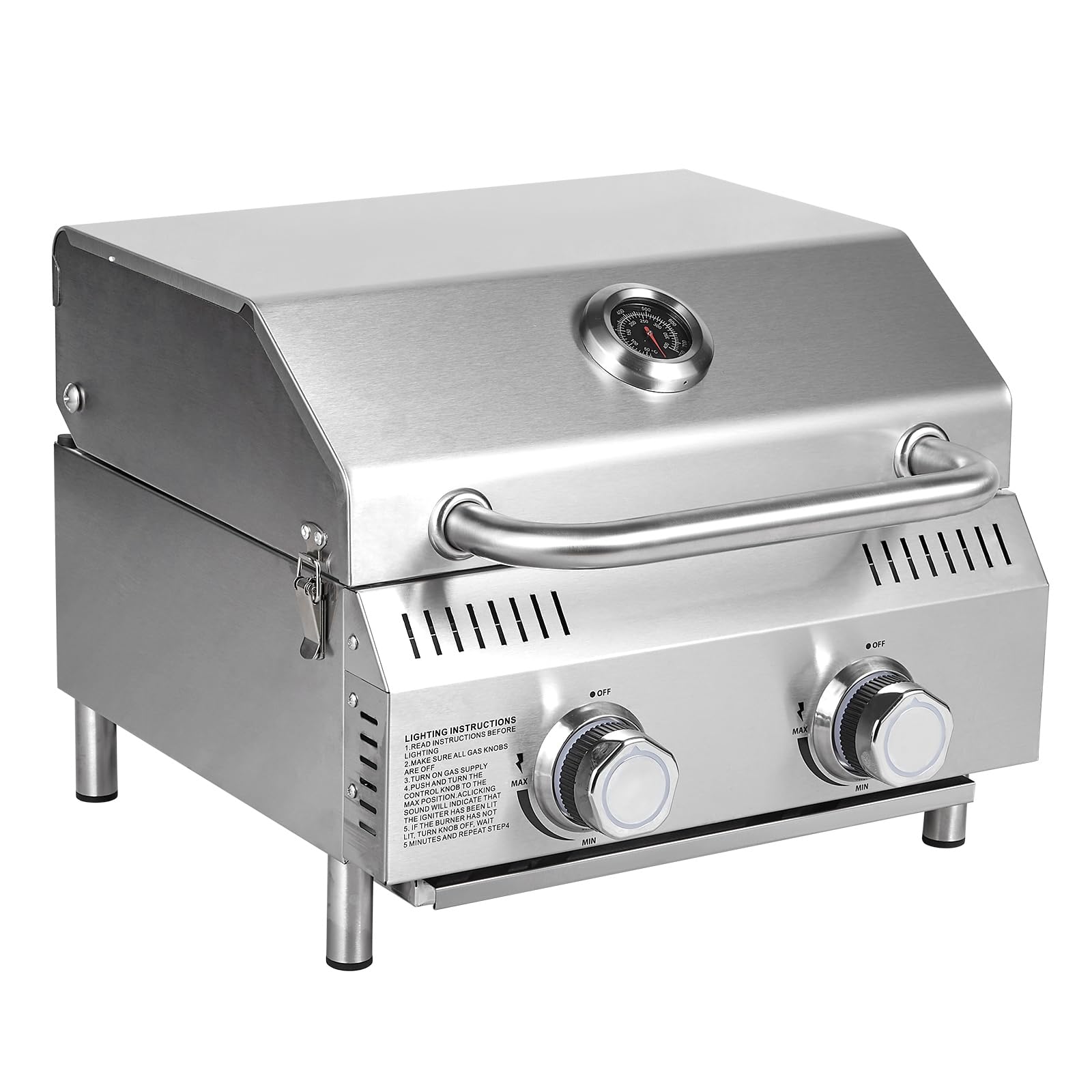
If your goal is two-burner zone cooking without paying “premium brand tax,” this Bestfire model is interesting. On paper, it checks the boxes people actually want: two burners, a lid that helps create an oven-like environment for thicker foods, a built-in thermometer, quick ignition, and a portable design with legs and a locking lid for transport.
What makes or breaks value grills is whether the basics are done right: flame control that actually changes heat, grates that don’t warp, and a grease system that doesn’t turn into a messy surprise. Owners who like this one often praise exactly those fundamentals: they talk about easy assembly, surprisingly strong flame control (from low simmer to high sear), and a grease tray that slides out cleanly. That’s the kind of feedback you want to hear because it means the grill is doing the unglamorous work well.
The expert advice with newer/less-proven brands is simple: treat the first cook as a “validation cook.” Open the box, check fittings and alignment, do a quick leak test (basic soapy water check on connections), and run a burn-off. If you do that, you can enjoy the upside: two-burner versatility in a portable package that’s easy to carry and store.
Why it can be a great value
- Two-burner zone cooking – Lets you sear and finish like you would on a larger grill.
- Fast setup – Owners describe “minutes to grilling,” which matters for real trips.
- Built-in thermometer – Useful for learning heat behavior and managing thicker foods.
- Portable design – Legs + locking lid make transport more manageable.
Good to know
- Less long-term “brand history” than legacy names—inspect and test early.
- Portable legs are convenient, but always place on a stable, heat-safe surface.
- As with most compact grills, wind can affect performance; sheltered placement helps.
Ideal for: shoppers who want two-burner flexibility on a budget and are willing to do a smart first-time setup check to ensure everything is dialed in.
15. Cuisinart Grillster (CGG-059A) – The “Tiny Grill That Still Gets Hot”

If you want the smallest “real grill” that you can set up in minutes, the Grillster is a strong contender. Owners love it for campers, small porches, and quick trips because it doesn’t demand assembly or a long setup ritual. It’s the kind of grill you can bring along almost as an afterthought—and that’s exactly why people use it often.
Performance-wise, it surprises people. Owners mention it gets hot enough for steaks and burgers, heats relatively evenly, and cleans up easily. The dishwasher-safe grate is a rare and genuinely helpful feature in this category, especially if you’re the type who wants everything cleaned and packed quickly after a weekend trip. The footprint also makes it apartment-friendly in terms of storage—many people buy it because they can tuck it away easily.
The limitation is capacity and “grill feel.” The cooking area is compact, so it’s best for 2–4 diners, not a big party. Some owners also wish it had a built-in thermometer, and a few mention wanting a dedicated carry case or cover to keep everything tidy. If your priority is speed, simplicity, and a small footprint you’ll actually use, it’s an easy win.
Why it’s lovable
- Fastest setup style – Minimal fuss; great for spontaneous grilling.
- Gets genuinely hot – Strong performance for its size.
- Easy to clean – Dishwasher-friendly grate is a big quality-of-life upgrade.
- Stores easily – Perfect for condos, small patios, and compact travel.
Good to know
- Cooking surface is small; it’s not built for large gatherings.
- No built-in thermometer; a small probe thermometer helps.
- If you cook in heavy wind, smaller burners can be more sensitive—use a sheltered spot.
Ideal for: small households, campers, and anyone who wants a compact grill that’s easy to store, quick to start, and hot enough to actually satisfy.
16. Megamaster 1-Burner (820-0065C) – Huge Cooking Space If You Cook Smart

The headline here is simple: a lot of cooking space without a complicated build. If you’re cooking hot dogs, burgers, chicken pieces, or a spread of veggies—and you want room to work—this Megamaster can be surprisingly useful. Owners like the portability features (locking lid, foldable legs, grease tray) and often describe it as a strong option for small gatherings when you don’t want a full-size backyard grill.
The “expert reality” is that single-burner grills with big surfaces require smarter heat management. You don’t get true left/right zones; you get hot lanes and cooler lanes. That means you grill like a line cook: start items in the hot lane, slide them to the cooler lane to finish, and use the lid strategically to build heat. Owners who struggle often describe slow cooking and uneven results—usually because they open the lid frequently or expect full-surface uniformity. Owners who love it tend to adapt quickly and keep the lid closed more often.
Also: transport confidence matters. Some owners complain about latching systems on portable grills in general. So if you move it a lot, carry it like a careful adult, not like a suitcase you trust with your passport. Do that, and you get a lot of usable grilling real estate for the footprint.
Why it’s a smart pick
- Large cooking space – Great for batch cooking and spreading food out.
- Simple to operate – One burner, straightforward control, easy learning curve for basics.
- Portable design – Locking lid and foldable legs help with storage and travel.
- Quick cleanup – Removable grease tray makes post-cook maintenance simpler.
Good to know
- Single burner means uneven zones; you must cook by moving food across lanes.
- Best results come from lid-closed cooking and fewer lid openings.
- If you want truly independent heat zones, a two-burner model will feel easier.
Ideal for: budget-focused buyers who want a lot of cooking space and don’t mind cooking with “hot lane / cool lane” strategy instead of true dual-zone control.
How Tabletop Grills Really Cook (and Why Your Results Change in Wind)
The biggest difference between “I love this grill” and “this thing is annoying” usually isn’t the brand—it’s the mental model. Tabletop grills cook differently than full-size backyard rigs because they have less metal mass, tighter burner space, and more exposure to wind. Once you cook with the right expectations, even small units can produce ridiculously good food.
What “good heat” looks like on a tabletop grill
- Preheat is non-negotiable – Small grills need time to heat the grates and lid, not just the air.
- Zone cooking beats chasing uniformity – Two burners create a real sear lane and a finish lane. One burner creates hot/cool lanes you must use intentionally.
- Lid discipline matters – Every lid opening dumps heat. On compact rigs, that dump is dramatic.
- Metal matters more than BTUs – Cast iron and thicker stainless store heat; thin metal swings hard and can feel “moody.”
- Grease design affects flame stability – Systems that keep drips away from burners reduce flare-ups and keep heat more consistent.
If you want “less thinking,” choose a two-burner grill (like the Cuisinart CGG-306 or RoadTrip 225) or a flat-top griddle where zones are obvious. If you want “maximum portability,” choose compact and accept that you’ll manage heat by moving food.
Wind-proof habits that immediately improve results
- Cook sideways to the wind – Turn the grill so the lid hinge or body blocks airflow into the burner area.
- Use a smart windbreak – A vehicle, a cooler, or a dedicated screen can transform performance (without touching the grill).
- Preheat longer in cold weather – Cold air + cold metal = slower recovery. Give it time.
- Don’t chase max flame – High flame with frequent lid opening often leads to uneven results. Preheat high, then cook medium-high.
- Keep the grease system clean – Overflow grease causes flare-ups and smoke, especially on compact units.
A final pro move: keep a small instant-read thermometer in your grill kit. With tabletop grills, it’s the fastest way to stop guessing and start cooking with confidence.
FAQ: Tabletop Grilling Without the Stress
Is it safe to use a tabletop grill on a balcony or patio?
Do I need a 2-burner grill, or is 1 burner enough?
How do I connect a tabletop grill to a bigger propane tank?
Why does my portable grill feel underpowered when I open the lid?
Do flat-top griddles really need seasoning?
What’s the fastest way to choose the right model from this list?
Final Thoughts: Pick Your Table Top Outdoor Grill Once, Then Just Cook
A great portable grill isn’t the one with the most hype—it’s the one that fits your life so well you stop overthinking it. When you choose the right fuel type, the right cooking style, and the right cleanup routine, outdoor cooking becomes something you do often, not something you “plan” like a major event.
Here’s the simplest way to translate this guide into a confident purchase:
- Want the best overall “do it all” portable grill? Start with the Coleman RoadTrip 225. It’s the easiest to clean, cooks predictably, and feels thoughtfully designed for real use.
- Cooking for bigger groups or tailgates? Choose the Coleman RoadTrip 285 for more cooking control and a roll-and-go setup that makes bringing a real grill feel easy.
- Need balcony-safe grilling without weak performance? The Weber Lumin Electric is one of the few electric grills that owners say delivers legit searing and versatility.
- Want “set and forget” wood-fired cooking in a compact rig? Go with the Pit Boss PB150PPG for pellet convenience plus a direct-flame finish option.
- Boats, RVs, and salt-air environments? The Magma A10-803 ChefsMate is built for long-term outdoor exposure and mountable stability.
- Want classic grilling with true two-zone control in stainless? Pick the Cuisinart CGG-306 for a tabletop experience that feels “real grill,” not “portable compromise.”
- Want flat-top versatility? Choose the Blackstone 22” griddle for bigger batches or the Blackstone 17” griddle for a smaller travel footprint.
The last piece of advice is the one that saves people the most money: buy for your hardest day. That’s the windy campsite, the crowded tailgate, the tiny balcony outlet, the “we have 10 hungry people” weekend. Pick the table top outdoor grill that makes your hardest day feel easy—and every other cook becomes pure enjoyment.
