
A tabletop grill looks simple… until you actually live with one. Real life is messy: a gusty campsite, a tiny condo balcony, a tailgate parking lot where everything is windy and rushed, or an RV trip where you want big flavor without hauling a full-size rig.
If you’re shopping for a table top bbq, you’re not trying to “upgrade” your cooking—you’re trying to remove friction. You want the kind of grill that can go from stored to searing fast, that doesn’t punish you with flare-ups or stubborn cleanup, and that feels predictable when you’re hungry and everyone’s hovering.
Here’s the truth most buying guides skip: in the tabletop category, the *little design decisions* are everything. Burner-to-grate distance decides whether you get an honest sear or constant flare-ups. Lid shape decides whether you can roast a chicken or you’re stuck doing open-lid hot dogs. Grease management decides whether “quick dinner” turns into a smoky, greasy cleanup session. And portability is not “does it have a handle?”—it’s whether it locks, packs, stores, and sets up without you doing a full engineering project.
This guide is built for people who want a confident purchase, not a confusing spreadsheet. I’m going deep into what actually matters: heat recovery after you lift the lid, wind behavior, multi-zone control, how grates clean when they’re still warm, and which grills owners keep using after the honeymoon phase ends.
Below are 15 standout picks—propane, electric, and pellet—organized in a “premium-to-practical” order that mirrors how people actually shop: start with the best long-term setups, then move into smart value and ultra-compact options.
How to Choose the Right Table Top BBQ for Your Space & Cooking Style
A tabletop grill isn’t “good” because it has more buzzwords. It’s good because it makes your cooking feel easy in the places tabletop grills actually get used: balconies, campsites, RV pads, tailgates, tiny patios, and quick weeknight setups. Here’s the decision framework I use when I want someone to buy once—and still love it next season.
1. Start with your rules: what fuels are even allowed?
This single step prevents 80% of bad purchases.
- If your building restricts open flame: you’re in electric territory. A high-performance electric grill can be genuinely excellent, but power availability becomes your “fuel.”
- If you camp, tailgate, or RV often: propane is the king of convenience. It’s fast, widely available, and easy to control once you understand your grill’s personality.
- If you care deeply about smoke flavor: pellet grills are the cheat code. They’re also heavier and need electricity—so they’re amazing for “portable basecamp,” not “carry it a mile.”
2. Decide what kind of cook you are (not what kind of shopper you are)
A lot of people accidentally buy for “future fantasy cooking” instead of real habits. Pick the grill that matches how you actually cook.
- The weeknight sprinter: burgers, chicken thighs, sausages, quick veggies. You need fast preheat and predictable heat recovery.
- The sear hunter: steaks, chops, char. You need high heat and grates with enough thermal mass to brand food quickly.
- The breakfast & brunch person: you want a griddle surface (or a hybrid grill/griddle). Pancakes, bacon, eggs, fajitas, toasted buns.
- The “feed a crowd” host: you need surface area plus multi-zone control so you can cook different foods without turning everything into one burnt pile.
- The smoke flavor addict: you want wood-driven flavor with less babysitting—pellet grills shine here.
3. Burners are not just “more = better” (but they matter)
On a full-size grill, burner count is nice. On a tabletop grill, burner count changes your entire control strategy.
- One burner: simplest, often most compact. But you’ll rely on technique—moving food, using the edges, and managing flare-ups.
- Two burners: the sweet spot for most people. You can run “hot + medium” zones, or create a real indirect area for thicker foods.
- Three burners: best for multi-zone cooking in a tabletop footprint. Great for hosting—if the build quality is solid.
If you cook steaks and chicken at the same time, or you want to hold food warm while finishing the next batch, two or three burners can feel like a superpower.
4. The hidden killer: wind and “lid recovery”
Wind is the tabletop grill’s natural predator. It can:
- blow out burners on lighter designs,
- steal heat the moment you open the lid,
- turn “10-minute meal” into “why is this taking forever?”
You want a grill that either (a) shields the burner well, (b) has enough thermal mass to recover heat quickly, or (c) is designed to be stable on a cart/stand so you can position it out of the wind.
5. Grease management decides whether you’ll actually keep using it
Most people quit using their tabletop grill for one reason: cleanup fatigue. Pay attention to how grease is handled:
- Front-access grease trays are gold because you can dump and go.
- Water-pan “moat” designs can dramatically reduce flare-ups and make cleaning surprisingly fast.
- Small drip cups are fine, but you have to remember to empty them before they overflow.
If a grill is easy to clean while it’s still warm (not hot), you’ll use it more. If it requires full disassembly every time, you’ll “take a break” from grilling… and that break becomes permanent.
6. Portability is a system, not a handle
Ask these questions:
- Does the lid lock for transport? A bad latch turns carrying into a two-hand stress event.
- Do the legs fold or detach? Folding legs are fast; detachable legs store flatter.
- Can you run 1 lb and 20 lb propane? 1 lb is convenient. 20 lb is calmer for long weekends.
- Is it heavy on purpose? Some “heavy” grills are heavy because they’re built like tanks (good). Others are heavy because they’re awkward (less good).
7. Don’t overpay for “features” you won’t use—pay for stability
A built-in thermometer sounds fancy. But if the lid leaks heat, the thermometer becomes a mood ring. What matters more:
- stable heat control knobs you can fine-tune,
- grates that hold heat,
- construction that doesn’t flex, warp, or rattle,
- and a design that stays predictable when real wind and real grease show up.
Quick Comparison: 15 Table Top BBQ Picks That Cover Every Real-Life Use Case
Use this table to narrow your shortlist fast, then jump to the in-depth reviews for the “real life” details— like which grills are easiest to clean, which ones handle wind better, and which designs make multi-zone cooking feel natural.
On smaller screens, swipe or scroll sideways to see the full table.
| Model | Fuel / style | Signature strength | Best match | Amazon |
|---|---|---|---|---|
| Napoleon TravelQ PRO285X | Premium propane | Two-burner control + high-top lid + scissor cart = “full grill feel” in a portable setup | Tailgaters, RV owners, and patio cooks who want the most complete portable experience | Amazon |
| Weber Lumin Electric Grill (Ice Blue) | Electric | High heat + steam/smoke modes + balcony-friendly grilling where propane is restricted | Apartment/condo cooks who want real sear without open flame | Amazon |
| Traeger Ranger Pellet Grill & Smoker | Pellet + electric | Set-and-hold temperature control + legit smoke flavor + griddle versatility | Flavor chasers who want “portable basecamp” smoking and grilling | Amazon |
| Coleman RoadTrip 225 | Modular propane | Water pan grease control + easy cleanup + swap-top cooking options | Campers and tailgaters who want simple control and low mess | Amazon |
| Onlyfire GS307 3-Burner Tabletop Grill | 3 burners | High-output multi-zone cooking with stainless build and foldable legs | RV & patio cooks who want true “zones” without a full-size grill | Amazon |
| Bestfire 3-Burner Tabletop Gas Grill (30,000 BTU) | High output | Three independent burners + thickened grates for strong sear and hosting flexibility | People who want a powerful tabletop grill for bigger batches | Amazon |
| Cuisinart Chef’s Style CGG-306 (2 Burner) | All stainless | 20,000 BTU split burners + fast setup + strong “hose it out” durability vibe | Campers and backyard cooks who want sturdy stainless performance | Amazon |
| Royal Gourmet PD1305H Grill + Griddle Combo | 3-in-1 | Griddle + grill + side burner = maximum meal variety in one unit | Breakfast lovers and campsite cooks who want a multi-cooker | Amazon |
| Masterbuilt MB20030819 Portable Propane Grill | Big surface | Roomy cook space + warming rack in a classic stainless “travel box” form | RV and weekend-trip cooks who want more grill area in a compact footprint | Amazon |
| Royal Gourmet GT1001 Stainless Portable Grill | Portable | Solid single-burner simplicity + warming rack + tidy lockable-lid transport | Tailgaters and campers who want a dependable, compact stainless grill | Amazon |
| Bestfire 2-Burner Tabletop Gas Grill (20,000 BTU) | Value 2-burner | Two-burner zones + high lid + quick ignition in a simple stainless build | People upgrading from a tiny one-burner to real zone control | Amazon |
| Cuisinart Grillster CGG-059A | Ultra-compact | Small footprint + fast setup + easy cleanup for 2–4 people | Condo patios, small campers, quick trips, and “minimal gear” cooks | Amazon |
| Char-Broil 1-Burner Portable Gas Grill (465640214) | Brand-name basic | Simple push-button ignition + porcelain-coated grates for easy maintenance | People who want straightforward grilling with a familiar brand | Amazon |
| Megamaster 1-Burner Portable Gas Grill (820-0065C) | Big grate | Large cook area in a compact body with foldable legs for storage | Couples or small groups who want more surface without a full-size grill | Amazon |
| Char-Broil Portable Convective Gas Grill (465133010) | Shoestring | Cheap, compact, and good enough for “use it hard” camping trips | Occasional use, backup grill, or trips where you don’t want to baby gear | Amazon |
In-Depth Reviews: 15 Tabletop Grills That People Actually Keep Using
Now we’ll go model by model. I’m going to talk like a real cook (not a spec sheet): what feels predictable, what feels fussy, where these grills shine, and the hidden “gotchas” that only show up after your tenth cook—not your first.
1. Napoleon TravelQ PRO285X – The “Full Grill Feel” Portable Setup

If you want one portable grill that feels the least like “portable compromise,” this is the one. The PRO285X isn’t just a tabletop box—it’s a complete system: stable cart, real lid height, two-burner control, and the kind of build that feels engineered to be used hard and cleaned often.
The secret sauce is how the whole grill behaves under real conditions. When you close the lid, it holds heat well, and it recovers heat quickly after you flip food. That’s the difference between “I can roast and finish properly” and “everything takes forever the moment I open the lid.” Two burners also matter more than most people think: you can run a hot side for searing and a gentler side for finishing, melting cheese, or holding food without drying it out.
The high-top lid is also a genuine upgrade for tabletop cooking. You get more “oven-like” headroom for thicker foods, and that makes the grill feel more versatile: burgers, sausages, chicken pieces, veggies—then the occasional bigger cut when you want to flex.
The trade-off is that this is not the lightest, tiniest grill. It’s portable in the “roll it, fold it, store it cleanly” way, not the “carry it one-handed for long distances” way. But if you’re tailgating, RV-ing, or grilling on a patio where you want a stable, comfortable workflow, the cart is exactly what makes it feel premium.
Why you’ll love it
- Two-burner control that actually feels useful – Real hot/medium zones for smarter cooking.
- High-top lid versatility – Makes roasting and thicker foods easier in a tabletop footprint.
- Cart system changes the experience – Stable, comfortable height, and less “where do I set this?” chaos.
- Premium construction vibe – Feels like a grill you’ll still be using years from now.
Good to know
- It’s not a minimalist carry-and-go grill; it’s a “portable setup” with real structure.
- Cast grates can demand a smarter cleaning routine (warm brush + light oil) to stay happy.
- If you want smoke flavor, you’ll add technique/accessories—or choose a pellet unit instead.
Ideal for: people who want the most complete portable grilling setup for tailgates, RV trips, and patios—without stepping up to a full-size backyard grill.
2. Weber Lumin Electric Grill – High Heat Grilling Where Propane Isn’t Allowed

The Weber Lumin exists for a very specific pain point: “I want to grill like a normal person… but I live somewhere that treats propane like contraband.” And unlike most basic electric grills, the Lumin is built to go hot enough to make the food taste grilled—real sear marks, real browning, and the kind of heat that doesn’t feel like you’re cooking on a warm tray.
What makes it special is versatility that’s actually practical. The control layout is designed around multiple modes (sear, smoke, steam, warm), which turns the Lumin into more than a burger machine. It’s genuinely good for apartment cooking patterns: quick steaks or chicken thighs on high, vegetables and fish when you want gentler heat, and “keep warm” when you’re hosting and don’t want the first batch to go cold while the second batch finishes.
Owners also tend to love the “grill from frozen” concept. That isn’t magic—it’s a workflow. You can steam/thaw while the unit heats, then flip to the searing side to finish. It’s the kind of feature that sounds gimmicky until you’re tired on a Tuesday, your freezer is full, and you still want a good dinner.
Now for the honest reality check: electric means you’re trading fuel logistics for power logistics. If your patio outlet is on a sensitive circuit, heavy draw can trip it—especially if other appliances share that breaker. And electric grills can still produce smoke (especially when cooking fatty foods). The difference is that the smoke comes from drippings, not flame—so cleaning routines matter. If you keep the interior and grease path clean, it behaves much better.
Why it works
- High heat that feels real – Delivers the browning and sear electric grills often miss.
- Multiple cook modes – Sear, smoke, steam, and keep-warm are genuinely useful for small-space living.
- Urban-friendly grilling – Great when your building bans propane or charcoal.
- Front-access grease tray – Easier cleanup means you’ll use it more often.
Good to know
- Power draw can be real—make sure your outdoor outlet setup is solid.
- Fatty cooks can still create smoke; clean between uses to keep it manageable.
- If you’re the “deep clean after every cook” type, some interior cleaning steps can feel more involved than propane.
Ideal for: condo and apartment cooks who want true grilling results without open flame—plus versatile modes for weeknights and small gatherings.
3. Traeger Ranger – Portable Pellet Smoking With “Set It and Cook” Control

The Ranger is for people who care about flavor enough to bring electronics and pellets into the conversation. It’s a tabletop pellet grill and smoker designed to give you one thing propane can’t fake: steady wood-smoke flavor with controlled temperature behavior.
Here’s what you’re actually buying: consistency. Pellet units shine when you want “hold a temperature and cook through,” not “blast heat and hope.” That’s why the Ranger feels so good for ribs, thicker chicken, roasts, and even weirdly satisfying camp cooking like meatloaf, baked potatoes, or “smoke-then-finish” weekend meals. The included meat probe is part of that calm workflow—monitor doneness without lifting the lid every five minutes and dumping your heat.
The cast iron griddle is another real value point. It turns the Ranger into a breakfast machine: pancakes, eggs, bacon, toasted buns, smash burgers. And because pellet grills are essentially controlled ovens with smoke, the Ranger can also handle things like nachos or roasted vegetables in a way that feels “set, check, serve.”
But pellet tabletop cooking has trade-offs you must accept: it’s heavier than most propane tabletop grills, and it needs power. So think of it as a “portable basecamp” tool—tailgates, RV sites, cabins, or patios where you can plug in. Also: pellet grills often won’t sear exactly like a dedicated high-output propane setup. You can still cook great steak—just use a smarter approach (like cooking low to your target internal temperature, then finishing hot on grates or the griddle for surface browning).
Why flavor lovers buy it
- Legit smoke flavor – Wood pellets deliver a different result than propane “smoke tricks.”
- Digital control workflow – Steady cooking behavior that feels calm and predictable.
- Meat probe included – Less lid-lifting, better doneness control.
- Griddle versatility – Breakfast, smash burgers, and “camp kitchen” flexibility.
Good to know
- It’s heavy for true carry-and-go; best when you can transport it easily (RV, car, tailgate setup).
- Needs electricity—plan your power access like you plan your fuel.
- If your main goal is hard sear at max heat, a dedicated propane sear machine may feel easier.
Ideal for: people who want real smoke flavor in a portable package and prefer controlled, “cook it right” temperature behavior over raw high-heat speed.
4. Coleman RoadTrip 225 – The “Low Mess” Tabletop Grill That Campsites Love

The RoadTrip 225 is one of those grills that wins not by being flashy—but by being practical in the exact places people use tabletop grills: campgrounds, tailgates, and “we just want to eat and relax” weekends.
The standout design element is grease management. The water pan approach catches drippings in a controlled way, which can reduce flare-ups and make cleanup feel surprisingly doable. That matters because flare-ups are often what people hate most about small grills: the burner is close, the chamber is small, and fat can turn into drama fast. With a better grease strategy, cooking feels calmer.
Two burners add real control. You can create a hotter middle zone and a cooler edge, or run one side for cooking and keep the other for holding food. That’s a very “camp cook” way to grill: get the burgers done, slide them to warmth, then finish the dogs and veggies without burning anything.
The RoadTrip line is also attractive for people who like options: interchangeable cooktops give you an upgrade path. Start as a grill, then add a griddle-style surface later if your camping breakfasts become a tradition.
The key thing to understand is capacity and heat pattern. Like most compact grills, you’ll learn where it runs hottest and where it runs gentler. Once you do, it becomes easy. And because it’s designed to be portable and easy to clean, it tends to become the grill people actually pack, instead of the grill that stays home “because it’s too annoying.”
Why it’s a campsite favorite
- Smart grease control – Helps reduce flare-ups and makes cleanup more pleasant.
- Two-burner flexibility – Easier multi-zone cooking than a single burner grill.
- Portable, ready-to-use mindset – Designed for travel and quick weekend cooking.
- Expandable cooking options – Swap-top compatibility if you want more meal styles later.
Good to know
- Compact grills still have hotter and cooler areas—learn your zones for best results.
- Like any water-pan system, you’ll want to dump and wipe after use to keep things fresh.
- If you want the heaviest “tank build,” stainless systems may feel more premium.
Ideal for: campers and tailgaters who want easier cleanup, fewer flare-ups, and two-burner control without overcomplicating the cooking experience.
5. Onlyfire GS307 (3 Burners) – Multi-Zone Tabletop Grilling Done the Right Way

If you’ve ever tried to cook a full meal on a tiny one-burner tabletop grill, you already know the pain: everything is “hot,” nothing is “controlled,” and you end up cooking in stressful waves. That’s why a good three-burner tabletop grill can feel like leveling up your entire outdoor cooking life.
The GS307 is built around a simple promise: give you real zone control in a portable footprint. Three burners let you run a searing lane, a medium lane, and a gentle lane—so you can do steaks on one side, vegetables on another, and keep finished food warm without drying it out. That’s the kind of practical flexibility that makes you *host better* because you’re not stuck racing the grill.
Stainless construction helps the “use it hard” story. RV and camping grills get moved, bumped, packed, and exposed to weather. A grill that cleans easily and resists the “rusty sadness” cycle is a big quality-of-life win. Another underrated detail is propane flexibility: being able to run on small cylinders for quick trips and a larger tank for longer weekends makes the grill adapt to your plans.
Now for the honest part: three-burner tabletop grills are usually heavier and more “equipment-like.” You want a stable surface, you want a calm setup routine, and you want to respect the fact that high-output tabletop grills can cook extremely hot. That’s not a negative—it’s power—but it means you cook smarter: preheat, oil grates properly, and don’t treat “high” like the only setting.
Why it earns its spot
- True multi-zone cooking – Three burners make a tabletop grill feel like a real kitchen tool.
- Strong high-heat capability – Great for searing and fast cooking when you want speed.
- Portable design features – Foldable legs and a locking lid help for travel and storage.
- Stainless build vibe – Tends to handle outdoor life better than thin painted bodies.
Good to know
- High output means you need a little technique—especially for fatty foods.
- Heavier than ultra-compact grills; it’s better for RV, car camping, and patios than “carry it far.”
- Assembly and setup are part of the experience; do a quick dry run before your first trip.
Ideal for: RV owners, patio cooks, and campers who want real heat-zone control and enough power to cook a full meal efficiently.
6. Bestfire 3-Burner (30,000 BTU) – The “Feed More People” Tabletop Upgrade
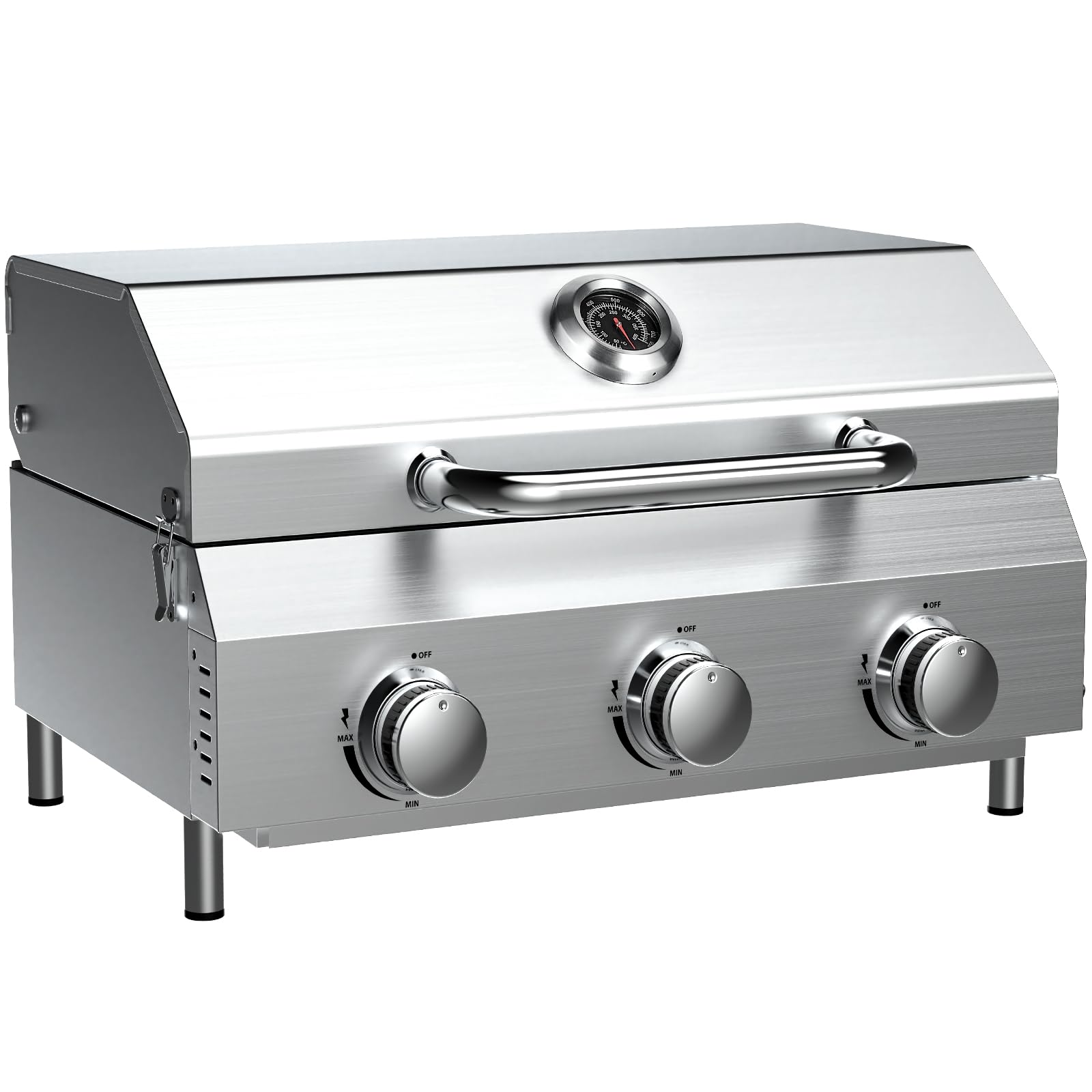
This is the style of tabletop grill people move to after they get tired of cooking in batches. Three burners plus a wider cooking surface changes the experience: you stop “waiting on the grill” and start cooking like a host.
The biggest practical advantage is zone discipline. With three independent burners, you can keep one side ripping hot for fast browning, use the center as your steady cook zone, and reserve the last burner as a holding lane. That’s a pro move for meals where timing matters—burgers and buns, chicken and vegetables, sausages and peppers— because not everything finishes at the same second.
Another underrated tabletop factor is grate strength. Thicker, sturdier grates tend to warp less and support heavy cookware better. That’s useful when you throw a cast iron pan on for onions, mushrooms, or sauce, or when you want a stable surface for a bigger cut.
Detachable legs are a storage win. Folding legs are fast; detachable legs go flatter. If you’re packing an RV storage bay or a trunk with a lot of gear, that “flat pack” advantage matters more than you’d think.
The best way to enjoy a high-output tabletop grill is to treat it like a real grill: preheat longer than you think, oil grates lightly (not heavily), and keep a calm eye on grease. High heat is incredible for sear, but it’s also the setting that turns drippings into flare-ups if you ignore it.
Why it’s a strong upgrade
- Three burners = real control – Cook different foods at different heats without stress.
- Built for bigger batches – Great for families, tailgates, and backyard gatherings.
- Sturdy grates – Better support and heat retention than thin “budget wire” grates.
- Detachable legs for flat storage – Helpful for RV bays and packed vehicles.
Good to know
- More burners means a slightly longer “learn your zones” phase—worth it once you do.
- High output demands good grease habits (clean tray, avoid heavy marinades on max heat).
- Not as compact as one-burner grills; it’s a “bring the grill” choice, not a minimalist choice.
Ideal for: anyone who cooks for more than two people regularly and wants a tabletop grill that feels closer to a full-size grilling workflow.
7. Cuisinart Chef’s Style CGG-306 – Two-Burner Stainless Performance Without Fuss

The CGG-306 is one of the most straightforward “buy it, use it, don’t overthink it” stainless tabletop grills. It’s built for quick setup, predictable cooking, and the kind of durability that matters when your grill lives outside, goes in and out of a camper, or gets used in salty air near the coast.
Two independent burners are the headline. This is where tabletop cooking starts to feel calm. You can create a hot side and a cooler side, which means you can: sear on one burner, finish on the other, toast buns without burning them, and rescue food that’s cooking too fast. That’s the difference between “everything’s ready at once” and “we’re eating in weird waves.”
Stainless grates are a love-it feature for many people because they clean up easily and don’t feel as fragile as thin coated grates. The overall “hose it out” vibe—wipe, dump grease, go—can make this grill feel like it fits camping life perfectly.
Now, here’s the real-world advice: wind matters. Like many tabletop designs, if you’re cooking in strong wind, you’ll want to position it smartly—use a cart as a windbreak, face it away from gusts, or tuck it near a vehicle in a safe, ventilated way. Once you learn that, the grill can be remarkably consistent. Also, respect the fact that stainless edges can be sharp on some grills—basic gloves during deep cleaning is a simple “why didn’t I do this sooner?” move.
Why it’s so popular
- Two burners for real zone cooking – Easier timing, better results, less stress.
- Stainless build and grates – Durable feel and easy cleanup for travel life.
- Fast setup – Designed to get grilling quickly without tool drama.
- Even, predictable performance – Great for burgers, dogs, chicken, and vegetables.
Good to know
- Strong wind can be annoying—plan your placement so the grill can hold steady heat.
- Some cleaning areas can have sharp edges; gloves make deep cleaning more comfortable.
- Hose storage is something you’ll likely manage yourself (strap/clip) if you transport often.
Ideal for: campers, tailgaters, and backyard cooks who want a sturdy stainless two-burner grill that’s quick to set up and easy to live with.
8. Royal Gourmet PD1305H – The “One Box Outdoor Kitchen” for Variety Cooking

If your dream outdoor cooking isn’t just “grill meat,” this combo is a very smart direction. A grill + griddle hybrid changes what tabletop cooking can be: breakfast spreads, fajitas, smash burgers, bacon and eggs, toasted buns, stir-fry-style veggies, plus classic grilled items—all from one portable unit.
The best way to think about this model is “meal variety per square inch.” The griddle surface gives you consistency (no flare-ups, predictable browning), while the grill side gives you that open-grate char and fast cooking on proteins. The side burner is the bonus lane: heat a sauce, boil water, warm beans, or keep something hot while you grill. That’s how you feed people efficiently at a campsite without running back to a stove.
There are two realities to accept with hybrid units: (1) they’re more equipment-like than a tiny portable grill, and (2) you may not get the same “covered roasting” experience as a full-size lidded grill on every cook. In other words, it’s incredible for griddle-style cooking and quick grilling, and it’s less about “low and slow under a dome.”
If you buy this kind of unit, your happiness comes from using it like a portable outdoor kitchen: prep ingredients first, run zones intentionally, and treat cleanup as part of the routine. Grease cups and removable parts help, but griddle cooking produces residue—you’ll want a scraper, a towel, and a simple wipe-down habit. Do that, and this becomes a “we use it constantly” piece of gear.
Why it’s a fun pick
- Maximum meal variety – Grill + griddle + side burner expands what you can cook outdoors.
- Great for breakfast – A major win for camping and RV life.
- Smart for group cooking – Multiple surfaces help you feed people efficiently.
- Practical wind help – Lid/shelf design can improve outdoor usability depending on setup.
Good to know
- It’s bulkier than a standard tabletop grill; plan storage and transport accordingly.
- Hybrid units are “versatility first,” not “perfect lid-roasting performance” first.
- Griddle cooking needs a cleanup routine (scrape + wipe) to keep it enjoyable.
Ideal for: campers, RV owners, and backyard cooks who want a portable cooking station—not just a grill—and love griddle-style meals.
9. Masterbuilt MB20030819 – Classic Stainless “Travel Box” With Room to Cook

This style of grill is popular for one reason: it gives you a surprisingly roomy cooking area in a compact, packable body. If you’re doing RV weekends, beach trips, or “we want a grill we can put away cleanly,” the stainless box form factor makes sense.
The cooking workflow is straightforward: preheat, cook, use the warming rack as your “hold lane,” and keep dinner moving. That warming rack is underrated—especially for tabletop grills—because it creates a buffer. You can pull food off the hottest zone, keep it warm, and avoid overcooking while the next batch finishes. That makes the grill feel bigger than it is.
The U-shaped burner style is also a quiet advantage. It’s designed to spread heat across a wider footprint, which can reduce the “one central blast furnace” effect that some small grills have. When it’s dialed in, you can get strong heat and good cooking results on everyday foods.
Now, the expert advice: this is the kind of grill where a quick “first-weekend tune-up mindset” helps. Small propane grills sometimes ship with igniters that feel finicky or need minor adjustment, and some owners end up learning their unit’s quirks (like how aggressively it runs hot, or how the air intake collar should be set). If you’re comfortable doing a basic learning curve—and you like the stainless, roomy footprint—this becomes a very practical travel companion. If you want perfection out of the box with zero tinkering, you may prefer a different pick.
Why people choose it
- Roomy cook surface – Great for feeding a small group without constant batching.
- Warming rack helps timing – Makes tabletop cooking calmer and more organized.
- Packable design – Folding legs and a locking lid support travel and storage.
- Stainless construction – Durable feel for RV and outdoor living.
Good to know
- Some units may have a learning curve with ignition/heat behavior—do a test run before a big trip.
- Like many compact grills, it can run hot; technique (and a thermometer) improves results.
- If you cook in heavy wind often, placement/wind-shielding matters for consistent heat.
Ideal for: RV and weekend-trip cooks who want more cooking space in a portable stainless design and don’t mind a short “get to know it” phase.
10. Royal Gourmet GT1001 – Simple, Solid, and Travel-Friendly for Tailgates

This is a classic “portable stainless grill” done in a way that makes sense for real travel: folding legs, a lid that latches, a handle that feels secure, and enough cooking space to feed a small group. If you’re tailgating, car camping, or cooking on a deck where you want a compact grill that still feels like a real tool, the GT1001 fits the job.
The feature that matters most here is balance. A portable grill that feels stable when you set it down, and stable when you open/close the lid, is a grill you trust. That trust is what lets you cook better—because you stop babying it. The warming rack adds a lot of practical usefulness too: toast buns, keep food warm, or hold delicate items while you finish searing.
Heat output is plenty for standard grilling, but like many single-burner units, it’s not the same as having two burners for true zones. That’s not a dealbreaker—especially if your cooking style is burgers, hot dogs, chicken pieces, veggies, and quick meals. You just cook in a rhythm: sear in the hotter center, move food out, finish gently.
If you’re the type who wants smoke flavor, this model isn’t a smoker out of the box. But it’s a good “clean base” to build your own technique on: use indirect-ish placement, add a small smoker box if you’re experienced, and focus on controlling heat rather than chasing gimmicks.
Why it’s a practical pick
- Portable design that makes sense – Folding legs and a locking lid help travel and storage.
- Stainless build feel – Durable for outdoor life and easier to wipe down.
- Warming rack advantage – Helps timing, bun toasting, and “hold lane” cooking.
- Good size for real meals – Enough surface for small groups without hauling a big grill.
Good to know
- Single-burner cooking requires zone technique (hot center, gentler edges).
- If you frequently cook in strong wind, placement matters for heat consistency.
- Some travelers prefer a carry case; you may add your own storage solution.
Ideal for: tailgaters and campers who want a compact, stainless, easy-to-store grill that cooks real meals without complicated setup.
11. Bestfire 2-Burner (20,000 BTU) – The Easiest Step Up From “Tiny Grill Life”
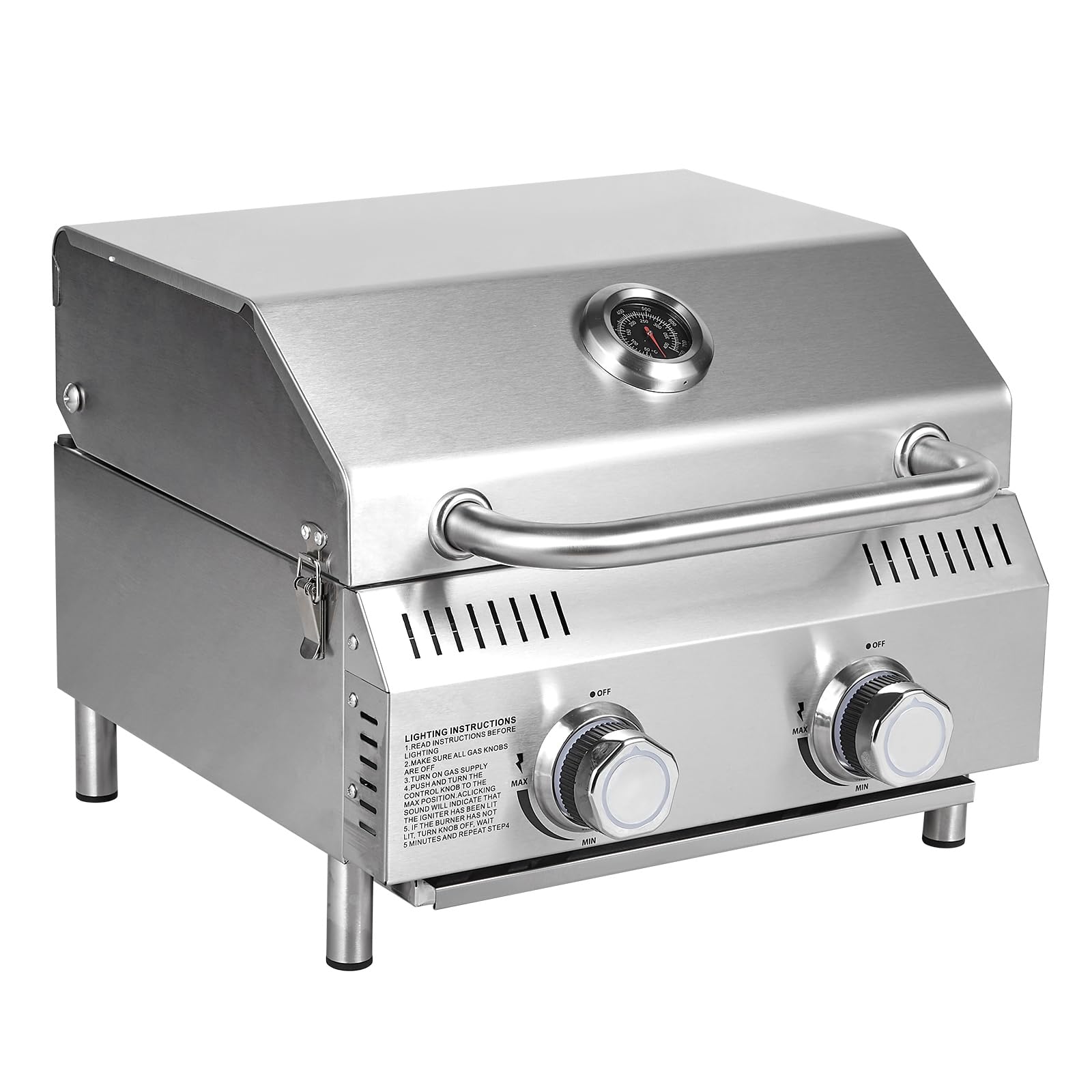
A good two-burner tabletop grill is often the best “quality of life” upgrade in the whole category. Why? Because it instantly makes cooking feel organized. Instead of fighting one burner and hoping the food cooperates, you start cooking with intention.
This model is designed around practical fundamentals: a lid tall enough to behave more like an oven, two burners that let you create separate heat zones, quick ignition, and a built-in thermometer so you can stop guessing whether you’re cooking hot enough (or too hot). It’s the kind of setup that works well for weekend cooking: steaks and veggies, chicken and corn, sausages and peppers—without everything finishing at different times.
Removable legs make it easier to pack and store flat. That seems minor until you’re trying to fit a grill into a trunk already full of chairs, coolers, and bags. If you travel with your grill often, “flat storage” is one of those features you’ll appreciate every single trip.
The best way to get the most out of this style of grill is to use a simple zone strategy: preheat with both burners, sear with both, then turn one down and finish thicker items gently. It’s how you avoid burning the outside of chicken while the inside stays underdone. Once you learn that rhythm, a two-burner tabletop grill starts producing “wow, that tastes like real grilling” results consistently.
Why it’s a smart step up
- Two burners = better timing – Real zones for sear/finish/hold.
- High lid helps versatility – Better for thicker foods than low-profile units.
- Thermometer included – Helps you cook with confidence, especially early on.
- Removable legs for storage – Packs flatter for RV or trunk travel.
Good to know
- Like any high-output tabletop grill, it rewards preheating and good grease habits.
- If you want “true hosting” capacity, three-burner units may feel more spacious.
- Consider an accessory plan (brush, scraper, small thermometer) to keep cooking effortless.
Ideal for: anyone moving from a tiny one-burner grill to a more controlled, versatile setup that still packs and stores easily.
12. Cuisinart Grillster CGG-059A – Tiny Footprint, Surprisingly Real Grilling

The Grillster is for people who want maximum convenience in minimum space. If you’re grilling for two (sometimes four), and you want a unit that stores easily in a condo, a tiny camper, or a crowded garage, this is exactly the kind of grill that makes sense.
Its strength is speed and simplicity. You don’t want to assemble a cart, connect complicated parts, and baby the setup. You want: open, connect propane, ignite, cook. And the locking lid means you can actually transport it without worrying about it popping open or becoming a greasy mess in your trunk.
The cooking surface is compact, so the Grillster isn’t your “host a party” tool. It’s your “weekend getaway grill,” your “porch dinner grill,” your “we’re camping and want burgers without the drama” grill. When you treat it that way, it delivers: hot enough for good browning, simple enough that you don’t dread using it.
Because it’s small, technique matters. Here’s the pro move: preheat a little longer than you think, then cook with fewer lid openings. Small grills lose heat fast when you lift the lid, and they take longer to recover than big backyard grills. If you keep the lid closed between flips, you get better heat stability and better food. Also: if you care about exact doneness, use a meat thermometer (tabletop thermometers are fine, but internal meat temp is king).
Why minimalists love it
- Very compact – Stores easily in small living spaces and travel setups.
- Locking lid for transport – Makes it less stressful to pack and carry.
- Fast setup – Great for quick meals and short trips.
- Simple cleanup – Designed for basic wipe-and-go maintenance.
Good to know
- Cooking surface is smaller—best for 2–4 people, not big gatherings.
- No built-in “big grill thermal mass,” so lid discipline matters for best results.
- If wind is strong, you’ll want to position it thoughtfully to protect the flame.
Ideal for: condo patios, small campers, and anyone who wants a compact, travel-friendly propane grill for small-group cooking.
13. Char-Broil 1-Burner Portable (465640214) – Straightforward Grilling, Familiar Brand
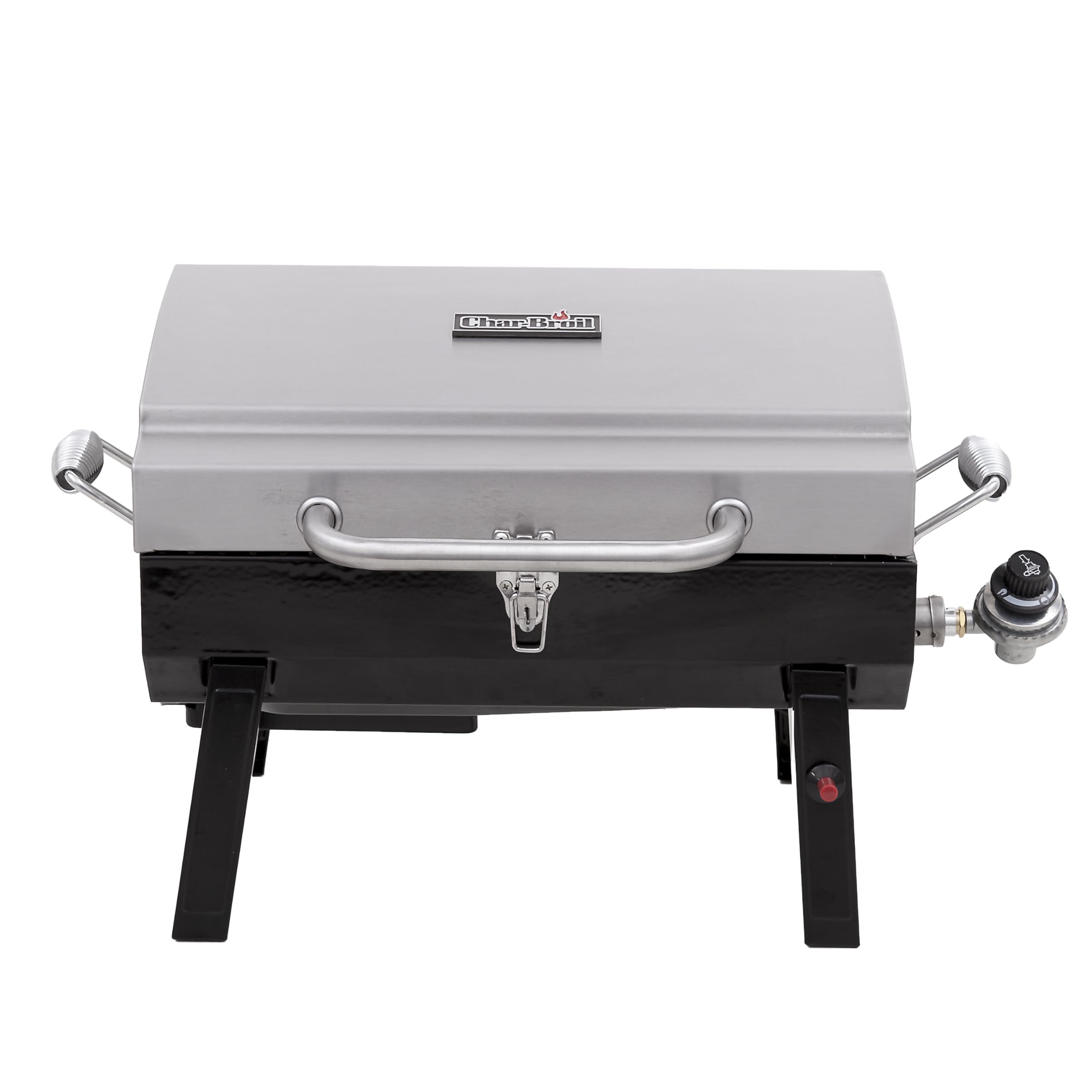
This Char-Broil is a clean “keep it simple” choice: compact size, straightforward ignition, and a basic cooking system that does what it’s supposed to do. It’s the kind of grill people buy when they want something portable for camping and tailgating, but they also want a familiar brand name and a design that doesn’t feel experimental.
Porcelain-coated grates are a practical plus. They’re typically easier to clean than raw cast iron, and they help resist rust when the grill gets stored in imperfect conditions. This matters because portable grills rarely get stored in perfect conditions. They live in garages, RV bays, car trunks, and “we’ll clean it later” closets.
The key thing to understand is flame behavior. On compact grills, the burner and heat diffuser can sit close to the grate, which can increase the chance of flare-ups—especially with fatty foods. That doesn’t mean the grill is “bad.” It means you cook smarter: trim excess fat on very fatty cuts, keep the grill clean, and don’t blast max heat when you’re cooking something greasy. When you do that, cooking becomes easy and predictable.
If you want a lid thermometer, you may add one yourself or rely on a probe thermometer. Many experienced grillers prefer a probe thermometer anyway, because it measures what actually matters: the internal temperature of your food.
Why it’s a safe pick
- Simple, familiar cooking system – Easy to understand and easy to operate.
- Push-button ignition convenience – No matches needed in most conditions.
- Porcelain-coated grates – Easier cleaning and rust resistance.
- Good portable footprint – Works well for camping, beach trips, and tailgating.
Good to know
- Compact burner/grate spacing can increase flare-up risk; grease management matters.
- Leg design may not be the most “pack-flat” style for every trunk setup.
- If you want multi-zone control, a two-burner grill will feel more flexible.
Ideal for: people who want a simple portable grill from a familiar brand and are happy to use basic technique to manage flare-ups on fatty cooks.
14. Megamaster 1-Burner (820-0065C) – A Lot of Cooking Space in a Compact Body

The Megamaster appeals to a very specific buyer: someone who wants more cooking surface than most compact one-burners, but still wants something portable and easy to store. If you’re a couple who cooks a full meal outside—protein + vegetables, maybe some extra for leftovers—the bigger cook area is genuinely useful.
Here’s the real-world advantage: you’re less cramped. On tiny grills, you’re forced to stack food close together, which can reduce browning and make it harder to manage doneness. More space gives you the ability to separate foods, move items to cooler corners, and cook in a calmer rhythm. That alone can make your results better.
Foldable legs and a locking lid support the “pack it up” lifestyle. And because tabletop grills often get stored in tight spaces, anything that folds and locks tends to get used more. If it’s annoying to store, you’ll use it less—even if it cooks well.
Because it’s still a compact, high-heat environment, remember the tabletop rule: lid discipline matters. When you open the lid, you dump heat and moisture escapes quickly. If you open constantly, you extend cook time and risk uneven cooking. The best workflow is: preheat, cook with minimal lid opening, and rotate food based on your hot spots. A basic meat thermometer is also a big upgrade here if your grill doesn’t have a lid gauge you trust.
Why it makes sense
- Large cooking area for the size – Better spacing, calmer cooking, easier meal management.
- Portable features – Foldable legs and a locking lid help storage and travel.
- Fast heat – Great for weeknight grilling when you want speed.
- Good for small gatherings – More surface means fewer batches than tiny one-burners.
Good to know
- Compact grills lose heat quickly when opened—cook with fewer lid openings for best results.
- Assembly is part of ownership; set it up calmly once rather than rushing before a trip.
- If you want true zone cooking, a two-burner model may feel more controllable.
Ideal for: couples and small families who want more cooking area without going full-size—and want a portable grill that stores easily.
15. Char-Broil Portable Convective (465133010) – The “Cheap, Works, Bring It Anywhere” Grill
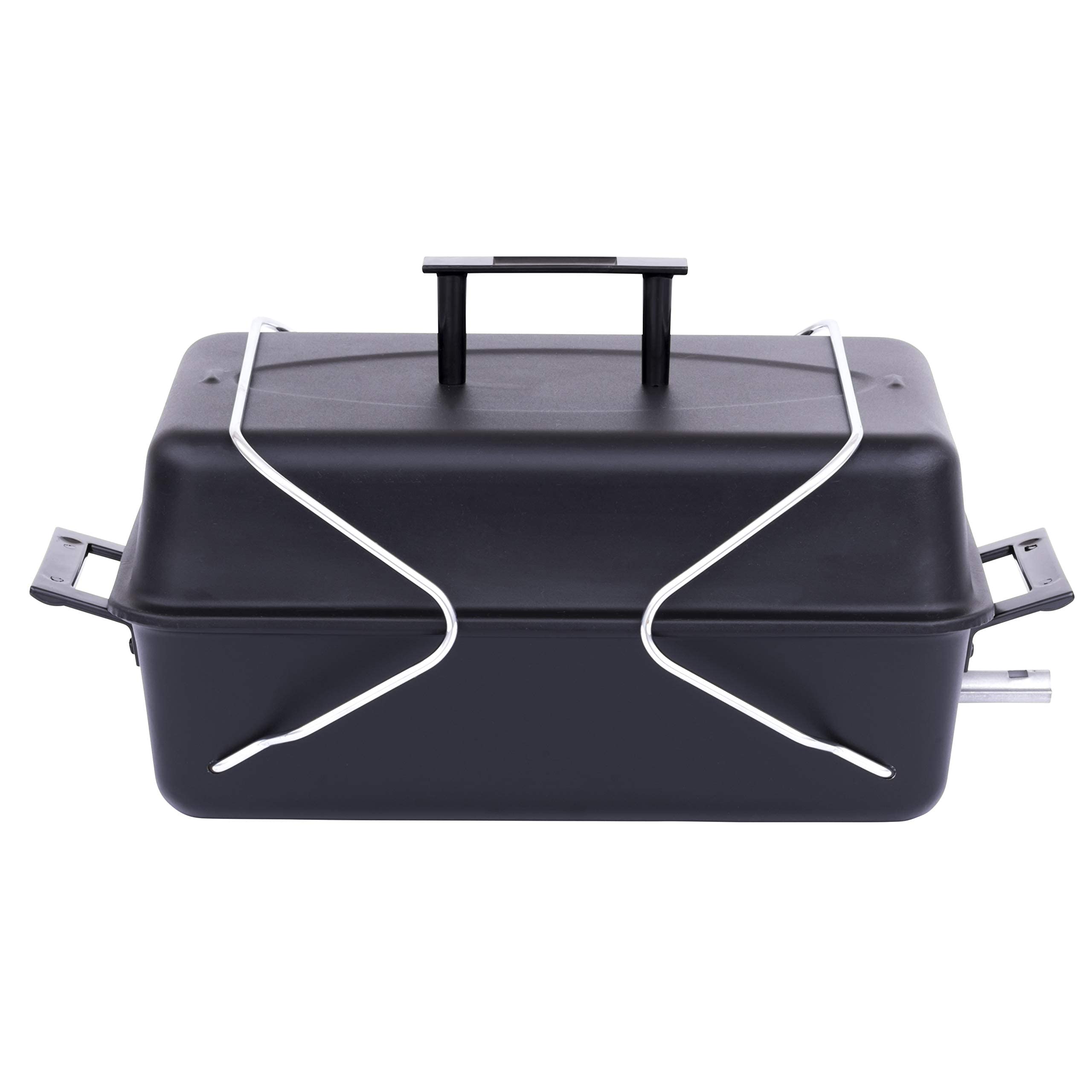
This is the “I need a grill for this trip” pick—the one you buy when the goal is simple: cook food legally and safely at a campsite, on a quick tailgate, or on a trip where you don’t want to worry about your gear getting scratched or stolen. It’s basic, portable, and built around the essentials.
The design is straightforward: propane heat, compact cooking space, and fold-over legs that lock the lid for transport. That locking-lid transport feature is a big reason people pick these simpler grills for travel. A grill that can be carried without flopping open is a grill you’ll actually pack.
Performance is what you’d expect in a budget portable grill: it does the job, and you’ll learn its hot spots. That’s not a negative—hot spots are normal in small grills. The way to win is to cook like a traveler: keep the lid closed for most of the cook, rotate food based on color, and use the “cooler edge” for gentle finishing. If you’re cooking chicken or thicker cuts, a basic thermometer turns this into a much more confident experience.
If you want a “forever grill,” this is not that personality. If you want a “reliable trip grill” that can take abuse and still feed you well, this is exactly that personality.
Why it’s worth considering
- Simple and portable – Great for camping and tailgating basics.
- Locking transport design – Fold-over legs secure the lid for carry and storage.
- Gets the job done – Solid for burgers, sausages, chicken pieces, and quick meals.
- Good “backup grill” strategy – Useful to keep as a spare or travel-only unit.
Good to know
- Expect hot spots and a learning curve—rotate food and cook with the lid closed.
- Not built for luxury feel or premium multi-zone control.
- Basic design means you supply some “chef skill” for best results.
Ideal for: occasional grilling trips, budget buyers, or anyone who wants a dedicated travel grill they won’t worry about babying.
How Tabletop Grilling Actually Works (and Why Lid + Wind Matter)
Most tabletop grill disappointment comes from one mismatch: people expect “full-size grill behavior” from a small, high-intensity heat box. When you understand the physics, you can predict which grill will feel easy—and which one will feel frustrating.
What makes a tabletop grill feel “powerful” (beyond BTUs)
- Thermal mass in the grates – Heavier grates store heat and deliver better sear when food hits the surface.
- Lid height and seal – A taller lid creates a more stable convection zone; a leaky lid bleeds heat and slows cooking.
- Heat recovery after lid opening – Small grills lose heat fast. The best designs recover fast too.
- Burner placement and diffuser design – Good designs spread heat; bad designs concentrate it into one burn zone.
- Grease control – Better grease management means fewer flare-ups, less smoke, and more confidence cooking fatty cuts.
This is why premium designs can feel “effortless”: they’re not just hotter—they’re more stable. They behave predictably, and predictable heat is what produces consistent food.
Field-proven tactics that make any tabletop grill cook better
- Preheat longer than you think – A rushed preheat is the #1 reason food sticks and browns unevenly.
- Use a two-stage plan – Sear hot, then finish gentler (or move food to edges). This prevents burnt outside / raw inside problems.
- Keep the lid closed between flips – Every lid opening dumps heat; fewer openings = better cooking.
- Cook with zones even on one burner – Center hot, edges cooler. Use that intentionally.
- Clean while warm, not cold – A quick brush and wipe while warm prevents “scrub day” later.
Tabletop grilling rewards calm technique. When you cook like the grill is small (instead of pretending it’s big), your results jump dramatically.
FAQ: Tabletop Grilling (Without the Guesswork)
What’s the best fuel type for a portable grill: propane, electric, or pellet?
How do I avoid flare-ups on tabletop grills?
Do I need two burners, or is one enough?
Should I use 1 lb propane bottles or a 20 lb tank?
Why does my tabletop grill take forever when it’s windy?
What’s the one accessory that improves results the most?
Final Thoughts: Choose the Setup That Makes You Grill More Often
A tabletop grill is a lifestyle tool. The best one isn’t the one with the most marketing—it’s the one that fits your rules, your space, and your cooking habits so well that using it feels automatic.
Here’s the fastest way to turn this guide into a confident decision:
- Want the best overall portable grilling setup? Start with the Napoleon TravelQ PRO285X. It’s the most “complete system” feel: two burners, stable cart, and versatility that doesn’t feel like a compromise.
- Live in a condo/apartment where open flame is restricted? The Weber Lumin Electric Grill is the high-performance electric answer that still gives you real sear and useful cooking modes.
- Chasing real smoke flavor in a portable format? Choose the Traeger Ranger for controlled pellet cooking, a built-in probe workflow, and griddle versatility.
- Want easy cleanup and fewer flare-up headaches? Look at the Coleman RoadTrip 225 for practical grease control and camp-friendly cooking behavior.
- Want true multi-zone propane cooking on a tabletop? The Onlyfire GS307 and Bestfire 3-Burner deliver the zone control that makes hosting and full meals feel effortless.
- Prefer a rugged stainless two-burner grill that’s quick to deploy? Go with the Cuisinart CGG-306 for a sturdy, straightforward, travel-friendly cooking workflow.
- Want maximum meal variety (breakfast + grill + side burner)? The Royal Gourmet PD1305H is the “portable outdoor kitchen” choice.
- Need compact practicality for small trips and small groups? The Cuisinart Grillster keeps things simple, packable, and easy.
The right table top bbq is the one that matches how you actually live: balcony rules or open tailgates, quick weeknights or slow weekend hangs, minimalist packing or “bring the whole setup.” Pick the grill that fits your real constraints—and you’ll grill more, waste less food, and enjoy the kind of outdoor cooking that feels satisfying instead of stressful.
