
A kitchen trash can isn’t “just a bin.” It’s a daily‑use tool you interact with when your hands are messy, your brain is busy, and the last thing you want is a lid that slams, a bag that slips, or a can that skates away when you tap the pedal.
If you’re shopping for stainless steel garbage cans for kitchen, you’re usually trying to solve one (or more) of the real problems that Amazon photos can’t show: the onion-and-chicken smell that creeps into the room, the dog that learns how to nose a lid open, the fingerprints that make a “new” can look old in a week, and the bag change that turns into a wrestling match because the liner keeps collapsing.
Most buying guides stop at capacity and “soft close.” That’s surface-level. The truth is: the best can for you depends on how you cook, how you manage recyclables, how often you take trash out, and whether you need “kid-proof,” “pet-proof,” or “I don’t want to touch anything” convenience.
This guide is built differently. I’m pulling on the friction points that show up again and again in real owner feedback: which lids truly seal, which dual bins actually fit normal bags, which pedals feel smooth after months, what causes dents during shipping, and what tiny design details (like internal hinges, bag rings, liner rims, and bag-tuck slots) separate “fine” from “why didn’t I buy this sooner?”
Below you’ll find 15 standout options—from premium, built-to-last step cans to dual-compartment sorters that make recycling painless, to a budget touchless model for people who want hands-free without paying premium-brand prices.
How to Choose the Right Stainless Steel Garbage Cans For Kitchen
A kitchen trash can is “good” when it disappears into your routine—in the best way. You open it without thinking, it closes quietly, it doesn’t leak smell into the room, the bag change takes seconds, and the outside doesn’t look like a fingerprint crime scene. Here’s the decision framework I use to predict that outcome before you click “buy.”
1. Start with your waste reality (not the label on the box)
Capacity is a starting point—not a decision. What matters is your trash rhythm: how often you cook, how often you empty, whether you compost, and whether recycling is “a separate bin somewhere else” or part of the main station.
- Cooking-heavy household: You generate wet, smelly waste. Prioritize a tight lid seal, quick bag changes, and a system that makes it easy to take trash out before it gets gross.
- Takeout-heavy household: You generate bulky packaging. Prioritize a wider opening, a stable lid that stays open for loading, and a can that doesn’t “pinch” bags when you pull them out.
- Compost + recycle household: Dual-compartment cans shine—if the compartments fit your actual split (usually more trash than recycling in many homes).
- Small apartment / single person: A compact can can be better. The wrong “big” can becomes a smell storage locker because it doesn’t fill fast enough.
2. Understand what “stainless steel” does (and doesn’t do)
Stainless steel is an exterior experience: it looks cleaner, wipes down faster, and usually feels more “finished” than plastic. But stainless steel does not automatically mean:
- Odor control (that’s lid seal + airflow + how you manage wet waste).
- Durability (that’s pedal mechanism quality, hinge design, and the thickness/engineering of stress points).
- No dents (stainless can dent; better packaging helps, but design and thickness matter too).
So the real goal is: stainless steel plus the right mechanics. That’s where the winners on this list separate themselves.
3. The lid mechanism decides whether you’ll love or hate the can
The lid is the “interaction.” Here are the three common types and what they’re best for:
- Step pedal + soft-close: The everyday favorite. It’s reliable, quiet, and doesn’t require batteries. Look for a pedal built for high step cycles and a lid that seals without slamming.
- Manual lift / split lid: Surprisingly good for some dual-compartment systems. It can reduce mechanical failure points, but you lose “hands-free” convenience.
- Touchless motion sensor: Amazing when it works—especially for messy cooking. But battery life, sensor calibration, and long-term reliability vary wildly by brand and price tier.
The secret: a “soft-close” lid isn’t just a nicety. It reduces stress on hinges and screw points, which can mean fewer cracks and less loosening over time.
4. Bag management is the hidden feature that matters most
Nearly every trash-can regret story is actually a bag story: the bag slips into the can, the liner collapses, the bag tears when you pull it, or the bag sticks because the liner shape fights the bag shape. You want at least one of these “bag wins”:
- Removable inner bucket: Lift the bucket out, change the bag, drop it back in. This is especially forgiving for beginners and for dual compartments.
- Liner rim / bag ring: A rim that hides the bag edge and grips it—faster changes, cleaner look.
- Bag tuck slots / holes: A small cutout that lets you tuck extra bag material or anchor drawstrings so they don’t block the lid.
- Built-in bag storage: Sounds small, but when you change a bag with one hand, having liners right there is genuinely “premium life.”
If you’ve ever fought a bag, prioritize this section above everything else. Stainless steel is the wrapper. Bag management is the experience.
5. Odor control: what actually works in a real kitchen
Odor control isn’t one feature. It’s a system:
- Seal quality: A lid that closes flush and doesn’t bounce back open.
- Time-to-empty: Bigger isn’t always better if wet waste sits longer.
- Optional filters / deodorizers: Helpful, but only when the lid seals well. Otherwise, you’re filtering an “open door.”
- Smell behavior: Some cans are great at containing odor until you open the lid (normal). Others leak odor constantly (that’s poor seal or poor fit).
If your kitchen produces strong smells (fish, meat packaging, onion skins), choose a can that closes tightly and is easy enough to empty that you’ll actually do it.
6. Pet-proofing and kid-proofing are about geometry
Here’s what actually deters dogs and curious kids:
- Heavier lids + strong hinge return (a lid that doesn’t “float” open).
- Pedal placement and resistance (too easy can be a dog training tool).
- Rim-hidden liners (dogs love grabbing bag edges; hidden edges reduce temptation).
- Stay-open features that lock intentionally (useful during cooking, but you want it to lock with intention—not accidentally).
7. A quick checklist before you buy
- Measure height clearance: Especially if your can lives under a counter overhang or near a drawer.
- Decide on “trash station” design: Single can + separate recycling, or dual compartment in one footprint?
- Pick your bag plan: Standard kitchen bags, custom-fit liners, or a mix? (Some premium cans work best with custom liners, but many accept standard bags fine.)
- Be honest about your patience: If you hate fiddly things, choose the can with the simplest bag-change workflow—even if it costs more.
Quick Comparison: 15 Stainless Steel Garbage Cans For Kitchen Picks
Use this table to quickly find the models that match your “kitchen reality,” then jump to the deep reviews for the details that actually matter— like bag-fit behavior, odor seal quality, pedal feel, and which designs stay looking clean with minimal effort.
On smaller screens, swipe or scroll sideways to see the full table.
| Model | Can type | Best for | Real-life standout | Amazon |
|---|---|---|---|---|
| EKO EcoCasa II 60L Dual (36L+24L) | Dual compartment | Most households who want one “trash + recycle” station | Color-coded inner bins + quiet close + deodorizer compartment in a sleek footprint | Amazon |
| simplehuman 50L Rectangular Step (Brushed) | Premium step | People who want “buy once, keep forever” build | Lid-shox soft close + hidden liner system + sturdy pedal feel that stays smooth | Amazon |
| simplehuman 60L Semi‑Round Step (Brushed) | Premium step | Busy kitchens that need space but want flat-back placement | Large capacity with a wall-friendly footprint + liner rim that hides bag edges | Amazon |
| SIMPLI‑MAGIC 60L Dual Compartment Step | Dual compartment | Sorting + odor-control focused homes | Color-coded liners + filter-focused design + practical “stays put” feel | Amazon |
| Amazon Basics 60L Dual Compartment (Manual Lift) | Dual compartment | Clean look + dual bins without premium pricing | Two removable buckets, soft-close lid feel, minimal space footprint for two streams | Amazon |
| EKO Hudson 75L / 20 Gallon Step | Extra capacity | Large families and heavy cooks | Big volume + rear bag storage compartment + quiet close + easy wipe exterior | Amazon |
| simplehuman 45L Rectangular Step with Liner Pocket | Premium step | Fast, clean bag changes with built-in liner storage | Liner pocket dispensers + no inner bucket for more usable space | Amazon |
| Glad 20 Gallon Stainless Step (Pewter) | Extra capacity | Fewer bag changes + odor-focused homes | Odor protection approach + bag storage + tidy bag ring system that hides edges | Amazon |
| SIMPLI‑MAGIC 50L Step with Built-In Filter | Single step | People who want a single can with odor filter help | Quiet close + liner bucket + filter-focused lid design in a sleek rectangle | Amazon |
| EKO Madison 50L Step (Brushed) | Single step | Step-can lovers who want a polished, upscale look | Deodorizer compartment + stay-open lock + “feels fancy” pedal experience | Amazon |
| DUMOS Dual 2×8 Gallon Step (16 Gallon total) | Dual compartment | Compact kitchens that still want sorting | Two removable buckets + soft close + dog-resistant lid geometry with dual pedals | Amazon |
| EKO Madison 50L Step (Matte) | Single step | Smudge-hiding stainless look on a practical footprint | Matte finish is forgiving + soft close + stay-open lock for cooking sessions | Amazon |
| Amazon Basics 50L Soft-Close Rectangular Step | Single step | Budget-friendly “looks good, works” daily use | Soft-close lid + removable bucket + easy fit for standard kitchen bag routines | Amazon |
| Amazon Basics 30L Soft-Close Rectangular Step | Compact | Small kitchens, apartments, or “secondary” kitchen stations | Small footprint + soft-close + removable bucket for quick, tidy changes | Amazon |
| BestOffice 13 Gallon Touchless Automatic (Oval) | Touchless | Hands-free cooking cleanup on a budget | Motion sensor lid + manual buttons + odor-holding lid behavior when closed | Amazon |
In‑Depth Reviews: 15 Kitchen Trash Cans That Feel Like a Daily Upgrade
Now we’ll go model by model. I’m not going to “spec-sheet” you. I’m going to talk about what you actually feel at home: how the lid behaves when your hands are messy, whether the bag change makes you sigh, how well odors stay contained, and what owners praise (or complain about) after months of real kitchen life.
1. EKO EcoCasa II 60L Dual – The “Finally, Recycling Is Easy” Kitchen Station
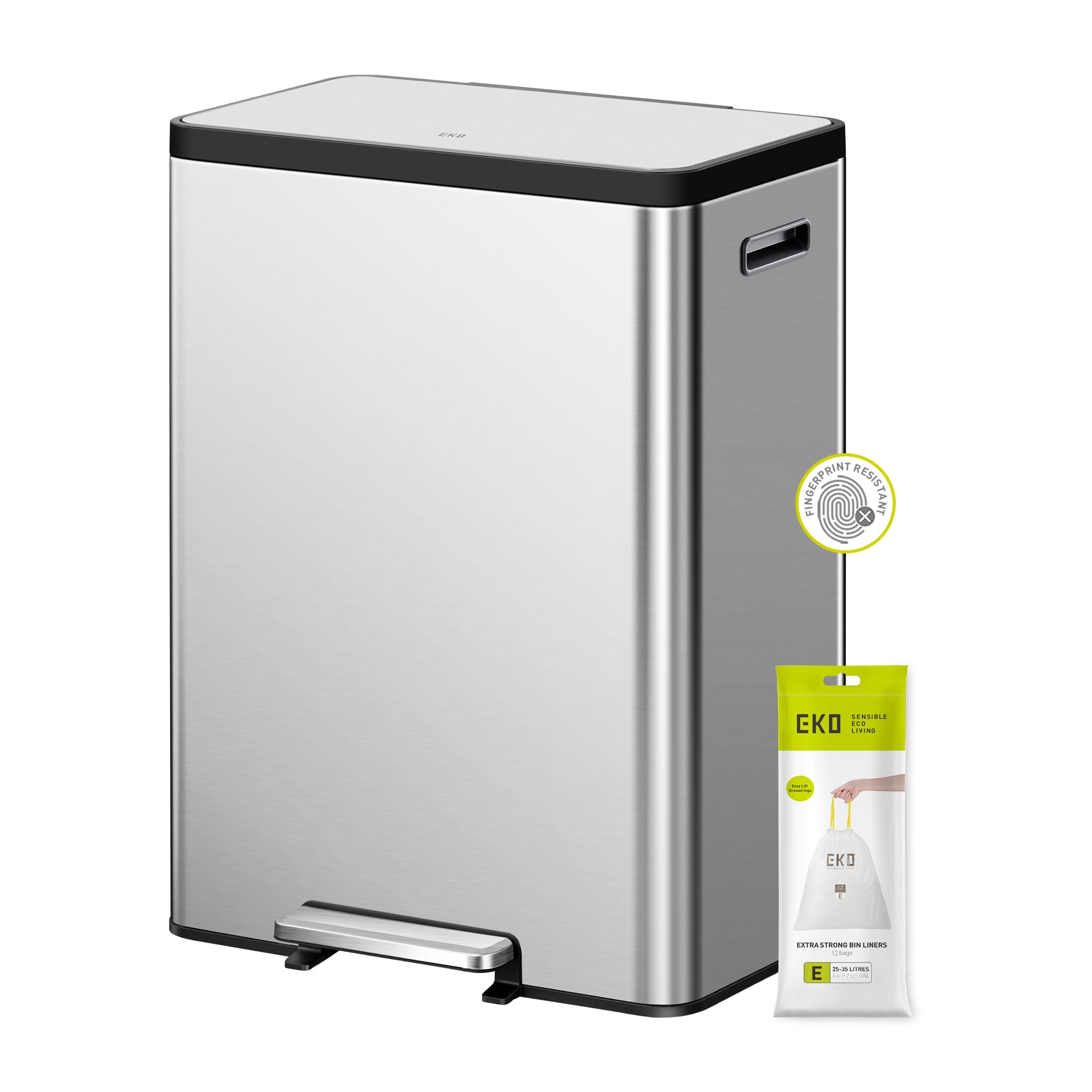
If you want one bin that instantly makes your kitchen feel more organized, the EcoCasa II is the kind of purchase that changes your day in a subtle way: you stop “thinking about trash” as a problem you solve repeatedly, and it becomes a simple routine—trash on one side, recycling on the other, no second bin drifting around the room.
Here’s why it earns “best overall” in real life: the split is practical. Many dual bins look good, but the compartments don’t match how people actually generate waste. This one gives the trash side the bigger share, which tends to feel more natural for most kitchens. Owners consistently describe the lid action as smooth and quiet, and the removable buckets make the bag change a proper “lift, swap, drop” workflow rather than a tug-of-war.
Now the honest, expert-level detail: bag fit is the make-or-break moment on dual bins. Several owners love the can but wish bag sizing was clearer. The winning strategy is to treat each compartment as its own world: pick liners that fit the buckets well, and don’t assume one universal bag size makes everyone happy. Once you dial that in, the “bag tuck” design details (the places where you secure or tuck extra material) become a small but powerful quality-of-life upgrade.
The other real-world win is odor behavior. Dual lids with a soft close can reduce odor leakage because they tend to settle closed consistently. Add the deodorizer compartment and you get an extra “odor-smoothing” layer for households that cook often. If your kitchen has a dog that thinks the trash is a buffet, the pedal-open approach also helps because the lid stays shut unless you intentionally step.
Why it feels like an upgrade
- Dual sorting that’s actually convenient – One footprint, two streams, and a practical size split that fits how most kitchens work.
- Quiet close that stays calm – Soft close isn’t just “nice”; it reduces stress on hinges and keeps the kitchen from sounding like a drum.
- Removable buckets = easier cleaning – Spills and leaks are less scary when you can lift the liner out and wipe it down properly.
- Smudge-resistant stainless look – The “stays cleaner longer” vibe matters when the can sits in the open near your island.
Good to know before buying
- Bag sizing isn’t as “one size fits all” as many people assume—dial in the right liners early and you’ll love it more.
- As with many dual-lid designs, the hinge area carries stress; treat the pedal gently and avoid slamming to maximize long-term life.
- If your recycling volume is huge (lots of boxes daily), you may want a separate dedicated recycling bin—or choose a larger-capacity single can for trash and keep recycling elsewhere.
Ideal for: most homes that want a cleaner-looking kitchen, easier recycling, and a dual bin that behaves like a real household tool—not a fussy showpiece.
2. simplehuman 50L Rectangular Step – The Gold Standard for “Feels Expensive, Stays Smooth”

There are trash cans that do the job, and then there are trash cans that make you understand why people say, “I can’t believe I care about this.” The simplehuman 50L rectangular step can is in that second category. It feels engineered—like someone obsessed over the pedal resistance, the way the lid returns, how the bag edge disappears, and how the whole unit stays planted when you step.
Owners who upgrade from cheaper cans tend to describe the same “aha” moment: the can stops sliding, the lid doesn’t slap shut, and the bag is finally invisible. That last part sounds cosmetic, but it changes the visual noise of your kitchen. When the bag edge is hidden, the can looks like an appliance instead of a trash can—and that’s why these are the ones guests notice.
The real pro detail is the way it handles repeated use. Cheap cans often fail in one of three places: pedal loosening, hinge wobble, or lid alignment drifting. This design philosophy is the opposite: a sturdy pedal engineered for huge step cycles and a soft-close system that prevents impact stress. If you cook a lot, you’ll also appreciate the “stay-open” behavior for longer tasks. A lid that stays open when you need it (and stays closed when you don’t) is a small daily win.
Bag strategy is the only “decision.” This can is built around custom-fit liners (and many people love them because they don’t bunch or slip), but plenty of owners also use standard bags with a bit of technique: seat the bag evenly, avoid overfilling to the rim, and keep the top edge tidy so the liner rim closes cleanly. If you want the fastest, least-fiddly experience, custom-fit liners are the smoothest path—but the can can still work well with standard bags if you’re not aiming for perfection.
Why it’s worth the upgrade
- Pedal feel stays “solid” – The can doesn’t feel delicate; it feels like it was built for constant daily use.
- Quiet close that feels refined – No slam, no bounce, no “lid wobble” after you step.
- Hidden bag edge – Makes the whole kitchen look cleaner, even when the can is in plain sight.
- Easy-to-clean design logic – The interior bucket system catches messes and makes wipe-downs less annoying.
Good to know
- It’s an investment-level can; you’re paying for engineering, durability, and daily “feel.”
- To keep it looking pristine, wipe with a soft cloth—stainless still benefits from gentle care.
- If you’re extremely bag-price sensitive, you may prefer a can designed around standard bags (EKO Madison, Amazon Basics) even if the finish isn’t as “luxury.”
Ideal for: people who use their kitchen hard and want a can that feels stable, quiet, and premium every single day—without turning bag changes into a chore.
3. simplehuman 60L Semi‑Round Step – Big Capacity, Wall-Friendly Shape, No “Giant Box” Look
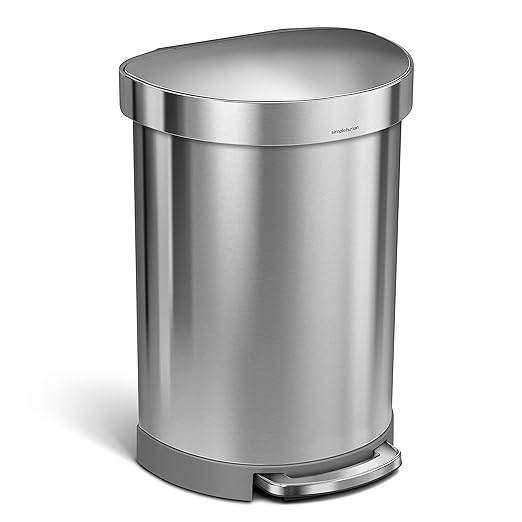
If your household is busy enough that you’re constantly taking the trash out “because it’s full again,” a larger can can be sanity— but only if it doesn’t eat your kitchen. That’s where the semi-round shape is surprisingly smart: you get the volume without a bulky box protruding into walking space. The flat back lets it sit against the wall neatly, and the rounded front can feel less intrusive in tighter layouts.
This is also one of those cans people call “the perfect trash can” with a straight face, because the experience is consistent: step, open, drop, close—quietly. It’s a small thing, but in shared spaces (open kitchen/living layouts, sleeping babies, late-night cleanup), a silent close is part of “peace.” And the liner rim design matters more than you think: it secures the bag and hides the edges so the can stays visually clean.
Odor behavior is another reason owners stay loyal. A lid that closes tightly and predictably keeps kitchen smells from “leaking out slowly all day.” You’ll still smell garbage when you open it (normal), but the can shouldn’t perfume your kitchen with leftovers while closed. In multi-cook households, that’s a real quality-of-life upgrade.
The practical tip: bigger cans can tempt you to keep trash longer. If you cook a lot of wet waste, you still want to empty on a schedule that matches odor reality—especially in warm climates. The advantage here is you can choose to empty when it’s convenient, not only when it’s overflowing.
Why families love it
- Large capacity without feeling clunky – The semi-round shape + flat back placement is space-savvy.
- Quiet, controlled lid action – No slam, no jump, no jitter when it closes.
- Neat bag concealment – The liner rim keeps the kitchen looking cleaner, even if the can is visible.
- Stays put – A stable can is underrated until you’ve owned one that slides with every step.
Good to know
- This is a larger unit; measure drawer/door clearance so it doesn’t block traffic or bump cabinetry.
- Big capacity is great, but don’t let wet waste sit longer than your kitchen can handle.
- If you want built-in sorting, you’ll prefer a dual-compartment model instead of pure volume.
Ideal for: larger households and cooking-heavy kitchens that want fewer bag changes, a tidy look against the wall, and a premium “quiet close” experience.
4. SIMPLI‑MAGIC 60L Dual Compartment – Practical Sorting with a “Smell Matters” Mindset
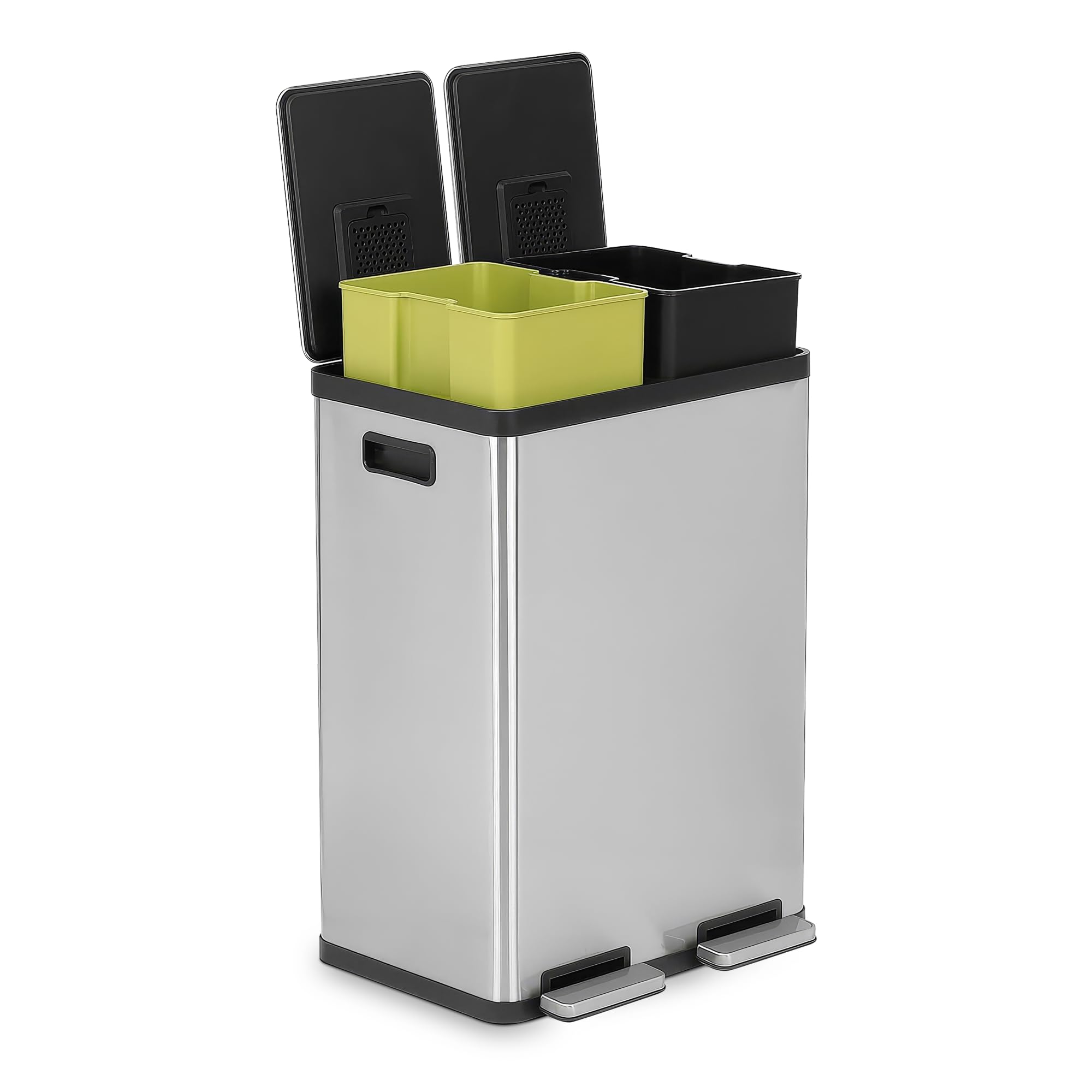
A lot of dual-compartment cans focus on “two bins” as the main feature. This one is more lifestyle-practical: it’s trying to help you manage odor and routine while still giving you the organization win of a combined trash + recycling station. That matters because the moment you add recycling into the main footprint, your trash stream often becomes “wetter” (more food waste) and needs better odor discipline.
What owners consistently like is the day-to-day usability: it stays put, the lids open easily with pedals, and it closes quietly. That quiet close isn’t cosmetic—it’s a long-term durability and sanity feature. And the removable containers make the biggest annoyance of dual bins—bag changes—much simpler. You can lift a liner out, reset the bag cleanly, and put it back without scraping your knuckles or dealing with a bag slipping down into the void.
Now the expert nuance: the compartments in dual bins are rarely “huge.” That’s normal, because you’re splitting volume. This is a good thing if it keeps you emptying trash more frequently (less smell), but it can be a surprise if your household generates lots of packaging. If you’re a heavy recycler, you may find one side fills faster than the other. The trick is to assign each side based on your reality: some families put trash on the larger side, others put recycling there because their trash is mostly composted.
If odor is your priority, this model’s design philosophy makes sense: the lid closure behavior, the seal feel, and the filter concept work together. It’s not a magic “no smell ever” promise—it’s a set of small design decisions that reduce the constant background stink many people get from looser lids.
Why it’s a smart dual bin
- Sorting that feels natural – Color-coded liners help reduce “which side is which?” friction for guests and kids.
- Quiet close keeps kitchens calmer – Especially in open layouts and households with different schedules.
- Stays put – A dual bin should not wander when you step; stability changes the entire feel.
- Odor-aware design – Built-in filter concept + tighter closure feel can noticeably reduce “kitchen smells like trash” moments.
Good to know
- Each compartment is naturally smaller than a single-can setup—great for odor control, but you may empty more often.
- Bag technique matters: anchor drawstrings or tuck excess so bags don’t block the lid and prevent full closure.
- Dual bins look clean when maintained, but they reward routine—quick wipe-downs keep the stainless looking sharp.
Ideal for: households that want one clean “sorting station” and care about odor control enough to value a filter-aware, quiet-close design.
5. Amazon Basics 60L Dual Compartment – The “Two Cans in One” Look Without Premium Pricing

This is the dual bin for people who want the organization of a two-stream setup (trash + recycling) but don’t want to pay premium-brand pricing for it. And in real kitchens, that is a completely rational goal—because a trash can should be reliable, not a financial event.
The big win here is the footprint efficiency: it can replace two separate bins and still look tidy. Owners often describe it as sturdy and good-looking, with a “classy” stainless vibe that blends into modern kitchens. The removable liner buckets are the practical heart of the system: they let you lift and dump cleanly, rather than pulling a bag out while it rubs against the can walls. If you’ve ever had a bag tear on the way out and drip inside the can, you already understand why removable liners are a grown-up feature.
The real-world nuance: dual bins can introduce “bag fiddling,” especially if a bucket handle or rim shape interferes with how you like to attach bags. The fix is almost always technique, not frustration. Use drawstring bags (they anchor easily), tuck excess into any bag-fixer slots, and avoid leaving bag material standing up near the lid. Once you get the bag routine, it becomes second nature.
This is also a great choice for people who want a dual bin but don’t trust pedals long-term—or just prefer simpler mechanics. Less moving hardware can mean fewer failure points. The trade is you give up one of the joys of step cans: hands-free opening. If that’s not a dealbreaker, this model is a very clean-looking way to keep your kitchen organized.
Why it works well
- Minimal space for two streams – Replaces two bins without doubling clutter.
- Removable buckets – Makes bag changes and cleaning far less annoying.
- Soft-close feel – Keeps noise low and closure more controlled than cheap flip lids.
- Clean stainless look – Blends well with appliances and modern kitchens.
Good to know
- Dual compartments are smaller than a single big can; match the split to your household’s real waste streams.
- Bag attachment can take a few tries—once you learn the method, it’s easy.
- If you want true hands-free, pick a pedal dual bin instead (EKO EcoCasa II, SIMPLI‑MAGIC 60L Dual, DUMOS Dual).
Ideal for: people who want a tidy, dual-compartment setup that looks modern and keeps trash and recycling organized without premium pricing.
6. EKO Hudson 75L / 20 Gallon – The “Stop Taking the Trash Out Constantly” Solution

If you’re emptying your kitchen can every single day (or worse, twice a day), you don’t need a “nicer trash can.” You need a bigger, better system. The Hudson is built for exactly that: bigger capacity, a stable step mechanism, and quality-of-life details like rear bag storage so you’re not hunting for liners when the can is full at the worst possible time.
In real-world feedback, people tend to rave about three things: it looks great, it holds odors well when closed, and it genuinely reduces how often they have to change bags. That last part is more important than it sounds. When a can is always full, you overpack it. When you overpack it, bags rip, liquid leaks, and the bottom gets gross. A little more headroom can reduce those problems simply because you’re not fighting overflow every day.
The rear bag storage is also one of those features you don’t value until you have it. When you can pull a fresh liner right from the can, bag changes become fast and clean. That reduces procrastination—meaning you’re more likely to change the bag before the smell becomes a kitchen problem. That’s how a trash can becomes a “kitchen hygiene tool” instead of just a container.
One honest detail: larger cans can invite you to keep trash longer. If your household produces wet waste, you still want a rhythm that prevents stink. The best way to use a big can is to let it reduce emergency changes—not to store wet trash for too many days. Used that way, it’s a true upgrade.
Why it’s great for big households
- Massive capacity feels freeing – Great for families, meal-prep households, and anyone tired of constant bag changes.
- Rear bag storage is a real-life win – Faster changes, less mess, and fewer “where are the bags?” moments.
- Quiet close + stable pedal – Helps keep the kitchen calm and keeps the can feeling “premium” over time.
- Easy wipe exterior – Matte stainless styles tend to be forgiving with fingerprints and smudges.
Good to know
- Big can = big footprint. Measure where it will live so it doesn’t block drawers or walkways.
- Bag storage compartments vary in usability depending on how bags are packed (rolled vs folded); experiment once and you’ll find the sweet spot.
- Large cans can tempt you to “wait longer” to empty—keep a trash rhythm if odor is a concern.
Ideal for: larger families, heavy cooks, or anyone who wants fewer bag changes and a more efficient “trash station” without sacrificing a clean stainless look.
7. simplehuman 45L Liner Pocket – The “Bag Change in 10 Seconds” Convenience Machine

If you’ve ever delayed changing the trash bag because it’s annoying, this is the can that fixes that. The liner pocket concept is simple: store liners inside the can and dispense them one at a time. In practice, it turns bag changes into a quick, clean motion: pull a liner, drop it in, close the rim, done.
The “no inner bucket” design is another underrated feature. Many cans use an inner bucket to keep things tidy (and that can be great), but buckets also steal space. This can design philosophy gives you more usable interior room, which means you can often fit more waste without needing a larger footprint. It’s a smart way to get “more capacity” without going bigger.
Owners who love this style often say the same thing: it looks neat, it stays neat, and it’s easy. That ease matters because a trash can is a high-frequency object. If the can makes bag changes simple, you keep the kitchen cleaner almost automatically. You’re more likely to swap a bag early, wipe down the rim quickly, and keep odor under control—because the system isn’t annoying.
One honest note: some step cans can shift slightly on smooth floors depending on your stepping style and where the can sits. If you notice sliding, a small non-slip mat or repositioning it so the back is supported can solve it. The goal is to keep the lid from bumping counters or islands during open. Once placed correctly, the daily experience is “premium smooth.”
Why it’s a daily-life hero
- Liner pocket convenience – The fastest bag changes in this guide when you use the designed liner system.
- No inner bucket = more usable space – Great for moderate households that want capacity without a huge can.
- Neat bag concealment – Keeps the kitchen looking cleaner because the liner edge stays hidden.
- Quiet close step experience – The lid doesn’t slam, which keeps mechanics happier over time.
Good to know
- Built-in liner systems work best when you commit to the matching liners (though some people still use standard bags with a stretch fit).
- If your floor is very slick, consider an anti-slip pad to prevent any drift over time.
- If you need built-in sorting, this is a single-stream can; pair with a separate recycling solution if needed.
Ideal for: people who value speed and cleanliness—especially households that want bag changes to be effortless so the kitchen stays fresh by default.
8. Glad 20 Gallon Stainless Step – A Big, Practical Can That’s Built for Real Kitchens

The Glad 20 gallon can is for people who want one thing above all: fewer bag changes—without buying a fussy, delicate can that feels like it can’t handle family life. This model’s reputation is built on being sturdy, roomy, and genuinely usable in a busy kitchen.
One of its most “quietly brilliant” features is bag management: systems like bag rings and tidy liner hiding can make the can look cleaner and behave better. When bags are held firmly, you avoid that annoying moment when the bag slips down into the can after you toss something heavy. And when the bag edge is tucked and hidden, you reduce the temptation for pets to grab and pull.
Odor protection is another reason people gravitate toward this line. In the real world, odor control is less about fancy filters and more about the lid seal and closure consistency. A can that closes softly and fully is less likely to stay slightly open (a surprising source of constant smell leaks). If your household produces strong food odors, this style of can can make the kitchen feel fresher between emptying.
A practical note for big cans: bag sizes can be confusing. Many owners use larger bags (like “big household” bags) because they’re easier to tie off and remove. That’s not a flaw—it’s a workflow choice. The goal is: easy in, easy out, no ripping, no leaks.
Why it’s a strong everyday pick
- Big capacity for real households – Great for families and anyone tired of constant trash runs.
- Sturdy build feel – A can that feels stable tends to stay in place and survive daily use better.
- Odor-aware closure behavior – Tight, consistent closure is a major odor control upgrade.
- Bag management design – Systems that hold and hide liners reduce mess and keep the can looking tidy.
Good to know
- Large capacity means you should measure placement so it doesn’t crowd the kitchen.
- Shipping dents can happen with many stainless cans—check the can when it arrives and place it so any minor blemish faces a wall if needed.
- If you need built-in trash + recycling separation, choose a dual compartment model instead.
Ideal for: households that want a sturdy, large-capacity step can with strong everyday usability and an odor-conscious lid system.
9. SIMPLI‑MAGIC 50L Step with Filter – A Straightforward Can That Takes Smell Seriously

If your main pain point is “my kitchen smells like trash,” you don’t necessarily need a fancy smart can. You need a can that closes well, seals decently, and adds a little odor management support. That’s exactly what a filter-focused step can is trying to do—and why this SIMPLI‑MAGIC model can be such a satisfying mid-tier choice.
Owners tend to describe it as sturdy and sleek, with a smooth pedal action and a lid that closes quietly. That quiet close is part of the smell story: lids that slam can bounce and settle imperfectly, while controlled closures tend to land shut the same way every time. The removable plastic liner is also key for odor management because it makes cleaning doable. If you’ve ever had “mystery smell” that turned out to be a drip at the bottom of the can, you already know why removable liners matter.
One subtle “real kitchen” benefit: the shape. Rectangular cans with flush features can slide into tighter spaces against cabinets or walls. That means you can place it where it’s convenient (near prep space) without it jutting into traffic. Convenient placement increases usage—meaning people actually use the can instead of leaving waste on counters “for later.” That sounds silly, but it’s one of the ways a trash can improves kitchen habits.
If you’re shopping for a dorm, apartment, or a household that wants a single can that feels modern and helps with odor, this is a strong “balanced” pick. It’s not trying to be a designer showpiece. It’s trying to be a daily tool with a little extra smell control.
Why it’s a smart mid-tier pick
- Filter-focused design – Helpful for households sensitive to kitchen odors.
- Quiet close lid – Reduces noise and helps closure feel more consistent.
- Removable liner makes cleaning easier – A big deal for long-term odor control.
- Space-saving rectangle – Easy to place against a wall or cabinet without awkward protrusion.
Good to know
- Color/finish can look different in various lighting—focus on function, not stock-photo perfection.
- Like many stainless cans, minor cosmetic details (logos, hinge visibility) can surprise some buyers—check product photos and placement angle.
- Filter systems help most when the lid seal is good; keep the rim area clean so the lid closes fully.
Ideal for: people who want a single stainless step can with odor support, quiet close, and easy cleaning—without paying premium-brand pricing.
10. EKO Madison 50L (Brushed) – The “Guests Notice Your Trash Can” Upgrade

The EKO Madison is the sweet spot for people who want a step can that feels polished and “premium” without going full luxury-brand pricing. This is the kind of can that people weirdly compliment because it looks like it belongs with stainless appliances instead of being an afterthought.
From real owner feedback, the standout features are incredibly consistent: the lid closes quietly (soft-close done right), the pedal feels solid, and the lid can lock open for longer tasks. That lock-open detail is a quietly brilliant kitchen feature: if you’re prepping a big meal, cleaning the fridge, or doing a cooking session with lots of scraps, you don’t want to repeatedly step the pedal every 10 seconds. You want the lid to stay open on purpose—and then close securely when you’re done.
The deodorizer compartment is also more useful than it sounds, especially if your household cooks strong-smelling food. But here’s the expert truth: the compartment isn’t a magic spell. It’s a “polish layer.” The real odor win comes from the lid closing fully and the bag being changed before it goes nuclear. The compartment just helps smooth out the in-between days.
The one common practical note: liner + bag behavior can vary depending on how full the bag is and how “tight” your bag size is. Some owners mention that rectangular liners can make round bags feel snug when removing. This isn’t a dealbreaker; it’s a workflow. Don’t overstuff. If you regularly create heavy bags, lift the inner bucket and carry it out—then pull the bag free with less friction. That small technique turns a minor annoyance into a non-issue.
Why it’s loved
- Elegant, appliance-like look – Brushed stainless blends well and looks “intentional” in a kitchen.
- Soft-close done right – Quiet, controlled closure improves daily life (and reduces hinge stress).
- Lock-open lid for cooking sessions – One of the most practical “premium” features for home cooks.
- Inner liner bucket – Easier bag changes and easier cleanup when accidents happen.
Good to know
- Rectangular liners can make some round bags feel tight on removal if overfilled—avoid overstuffing and consider lifting the liner out first.
- Some households notice slight sliding on smooth floors; placement against a wall or a small non-slip pad can fix it.
- If you need built-in recycling sorting, this is a single can—pair it with a separate recycling bin or choose a dual-compartment model.
Ideal for: people who want a stylish, quiet, lock-open step can that looks great in the kitchen and feels like a real upgrade over big-box-store basics.
11. DUMOS Dual 2×8 Gallon – A Small-Footprint Sorting System That Still Looks High-End

Some kitchens want sorting—but don’t have the footprint for a huge dual station. This is where a 2×8 gallon style can shines: it keeps trash and recycling (or compostables) separated without dominating the room. It’s also a great fit for smaller households who don’t want a giant can that sits half-empty long enough to become a smell problem.
Owners consistently praise the “functional polish”: it looks modern, the lids close softly, and the removable buckets make emptying clean and simple. That bucket removal matters a lot on compact bins because smaller bags can be lighter and easier to carry, and you’re less likely to overpack and tear them. A compact dual bin can quietly improve hygiene because it encourages more frequent emptying.
Now the real-world nuance: bag fit. Some people use standard kitchen bags and find the buckets feel a bit deep for the “perfect drape,” which can lead to bag edges sticking up and interfering with the lid if you don’t tuck them properly. The fix is simple and oddly satisfying once you learn it: fold the top edge cleanly, anchor drawstrings if possible, and tuck excess into any bag holes/slots so nothing stands up into lid space. A few owners even place a small filler object at the bottom to adjust height if they prefer.
Another underrated benefit is pet behavior. Dual bins with tight lids and pedal access can discourage dogs because there’s no bag edge to grab and the lids often sit in a way that’s harder to pry. If your dog is determined, no can is perfect—but design geometry helps more than people think.
Why it’s a great compact sorter
- Two streams in a small footprint – Great for apartments and smaller kitchens that still want sorting.
- Soft-close lids – Quiet, controlled closure improves daily feel and reduces slamming wear.
- Removable buckets – Easier emptying and faster cleanup if a bag ever leaks.
- Looks modern next to stainless appliances – A clean finish that blends into contemporary kitchens.
Good to know
- Bag technique matters more on smaller buckets; tuck excess bag material so it doesn’t block the lid.
- Each side is smaller than a standard single can—great for odor control, but you may empty more often.
- If you generate lots of bulky packaging, you may want a larger dedicated recycling bin.
Ideal for: smaller kitchens that still want a clean-looking sorting station and appreciate the practicality of removable buckets and quiet lids.
12. EKO Madison 50L (Matte) – The “Looks Clean Even When Life Is Messy” Pick

If the reason you’re leaving your current trash can is “it always looks dirty,” a matte stainless finish can be a genuine cheat code. It’s simply more forgiving in real kitchens—especially if you have kids, roommates, or anyone who touches everything after cooking. This Madison matte version keeps the same practical design logic (soft-close, step pedal, stay-open capability) but adds that “smudges don’t scream” benefit.
Owners often describe the Madison line as feeling upscale and solid, especially for the price tier. The soft close is a favorite because it quiets the kitchen and reduces the jarring slam that cheaper cans can develop over time. The pedal tends to feel smooth and responsive, and the lid lock feature is still one of the most useful “premium” touches for home cooks.
The removable liner bucket is the other quality-of-life feature that helps this can stay looking and smelling better. If a bag leaks, you can lift the liner out and clean it properly. And if you overload a bag, you can carry the liner out and pull the bag free with less friction. That’s how you prevent the “gross bottom” problem that makes many people replace cans even when the outside still looks fine.
In daily use, this model shines when your priority is “low drama.” It’s not trying to be a tech gadget. It’s trying to be a clean-looking, easy-to-use step can that behaves predictably—and that predictability is what makes you stop thinking about it.
Why it’s a smart choice
- Matte finish hides smudges – Looks cleaner day-to-day with less wiping.
- Soft-close lid – Quiet and controlled, which feels premium and can extend hinge life.
- Stay-open lock – Incredibly useful for cooking sessions, fridge cleanouts, and big chores.
- Removable liner bucket – Makes cleaning and bag changes easier and less messy.
Good to know
- If you want built-in recycling separation, this is a single stream—pair it with a separate recycling bin.
- Rectangular liners can grip round bags if overfilled; lift the liner first when removing heavy bags.
- As with most stainless cans, placement matters—keep it from rubbing against hard surfaces to avoid cosmetic scuffs.
Ideal for: people who want a reliable, quiet step can with a forgiving finish that looks “clean” even in a busy, hands-on kitchen.
13. Amazon Basics 50L – The “Looks Good, Works Well, No Drama” Everyday Can

Not every kitchen needs a premium engineering masterpiece. Sometimes you just want a good-looking stainless step can that works as expected, fits standard kitchen bags, and doesn’t make a racket when it closes. That’s why the Amazon Basics 50L is a consistent “budget workhorse” option.
Owners tend to praise the same fundamentals: it looks sleek, the soft-close lid feels quiet, and the pedal makes it hands-free for daily cooking cleanup. The removable inner bucket is also a major plus at this price tier because it makes bag changes straightforward and makes cleaning far easier if anything spills inside. That removable bucket is one of the reasons people upgrade from cheaper plastic bins—because it removes the “bag collapsed into the can” frustration.
The expert note here is expectations and placement. Stainless cans at more affordable tiers can be lighter and more susceptible to cosmetic dents, especially if shipping is rough. That doesn’t mean they’re bad. It means you place it intelligently: against a wall or cabinet side, where it looks clean and stays out of high-impact traffic. Once it’s placed and used normally, many households find it does exactly what they need: quiet, clean-looking, and convenient.
If you’re choosing between “cheapest possible” and “premium forever,” this is often the middle ground people actually enjoy. It doesn’t demand special habits. It just works—especially if your kitchen uses standard liners and you don’t abuse the pedal like a workout machine.
Why it’s a strong value
- Soft-close lid – Quiet and feels more refined than basic flip lids.
- Removable bucket – Simplifies bag changes and cleanup.
- Standard-bag friendly – Works well with common kitchen liners for most households.
- Sleek look – The stainless aesthetic fits modern kitchens without trying too hard.
Good to know
- Affordable stainless can be more susceptible to cosmetic dents; inspect on arrival and place smartly.
- Long-term durability can vary by household use intensity—gentle pedal use tends to preserve the mechanism.
- If odor control is your top priority, choose a can with tighter sealing + filter options (SIMPLI‑MAGIC) or a premium seal system (simplehuman).
Ideal for: people who want a straightforward, good-looking stainless step can with soft close and an easy bag-change system—without paying premium-brand prices.
14. Amazon Basics 30L – The Compact Can That Keeps Small Kitchens Feeling Uncluttered

A compact trash can is not “lesser.” In many kitchens, it’s smarter. If you live alone, live in a small apartment, or simply don’t generate huge amounts of waste, a smaller can can reduce odor because you empty it more often. It also keeps your kitchen from looking crowded—especially if the can is in a visible corner.
This model keeps the same core advantages as the larger Amazon Basics option: a soft-close lid for quiet daily use, a foot pedal for hands-free opening, and a removable bucket for easy bag changes. Those three features are the backbone of “good trash can design,” and they matter even more in small spaces, where you don’t want the can to feel like a clunky object you’re constantly bumping into.
Owners often buy this size for offices or bathrooms and then realize it also works beautifully in a compact kitchen, especially when paired with a separate recycling solution (or a recycling bag system). It’s also a great “secondary station” can: one near a coffee bar, one near a prep area, or one near a mudroom entry if you do a lot of unpacking.
The key to loving a small can is choosing it intentionally—not as a compromise. If you’re not filling a big can quickly, a smaller can can actually keep your home fresher because waste doesn’t sit as long.
Why it’s a great compact choice
- Smaller footprint – Keeps kitchens feeling open and uncluttered.
- Soft-close lid – Quiet, controlled closure that feels more premium than the price suggests.
- Removable bucket – Makes bag changes quick and reduces mess.
- Encourages frequent emptying – Often improves odor control simply by reducing “trash sit time.”
Good to know
- If your household generates bulky packaging, you may find it fills quickly—especially during big cooking days.
- As with most stainless bins, avoid harsh scrubbers to keep the finish looking clean.
- If you want an all-in-one sorting system, a compact dual bin may serve you better (DUMOS Dual 2×8).
Ideal for: small kitchens, apartments, and households that want a compact stainless step can that still feels quiet, tidy, and easy to live with.
15. BestOffice Touchless 13 Gallon – Hands‑Free Convenience for Messy Cooking (Without Premium Cost)

Touchless cans can feel like a luxury until you’re making a messy meal and you realize you’ve been living like a caveman, touching lids with gross hands. If that’s your pain point, a motion sensor lid can be a real quality-of-life upgrade—especially for families, frequent cooks, and households with kids who are learning to throw things away without smearing everything.
What owners like about this particular model is that it delivers the hands-free experience at a budget-friendly level, and it often does a surprisingly good job containing odor when the lid is closed. The oval shape can also fit in tighter corners, and the stainless look is modern enough to blend into many kitchens. The manual open/close buttons are another practical win because they give you a backup for times when you want the lid open longer (big cleanup, party prep, etc.).
Now the honest expert take: touchless performance is all about sensor reliability over time. Budget sensor cans can be slightly inconsistent—sometimes you wave twice, sometimes it reacts instantly, and battery changes matter. That doesn’t make it a bad buy; it just means you should choose it for the right reason: you want hands-free convenience and you’re okay with the reality that sensor tech can be a little temperamental compared to a simple pedal.
Bag fit is also important with oval designs. Some owners note standard bags “work,” but they prefer sizing up slightly for a cleaner fit, especially if the can shape doesn’t match standard rectangular liner geometry. The best approach is to load a bag cleanly so no excess material blocks the lid’s closure path. When the lid closes fully, odor containment improves dramatically.
Why it’s worth considering
- Hands-free hygiene – Great for messy cooking, kids, and anyone who hates touching lids.
- Modern look – Stainless exterior and oval shape can fit many kitchens nicely.
- Manual buttons + sensor – Flexibility for long tasks and quick tosses.
- Odor containment when closed – Many users notice less smell escape compared to loose manual lids.
Good to know
- Touchless sensors can become less responsive over time; batteries and placement (cool, dry area) matter.
- Oval shapes sometimes prefer slightly larger bag sizing for a clean fit—test your standard bag and adjust if needed.
- If you want “no tech fuss,” step cans are usually more reliable long-term than budget sensor models.
Ideal for: people who want hands-free convenience for cooking and family life, and are comfortable with the normal quirks of sensor-based lids.
What Makes a Kitchen Trash Can Feel “Premium” (and Why the Details Matter)
A trash can becomes a “great” trash can when it removes friction from your day. The difference isn’t the stainless. It’s the tiny mechanical and workflow details that keep it quiet, clean-looking, and easy to live with. Here’s what actually separates “fine” from “I love this thing.”
The 6 design details that change everything
- Lid behavior – A good lid closes fully, consistently, and quietly. Soft close reduces noise and reduces hinge stress.
- Internal hinge / wall placement logic – Cans that sit close to a wall without scraping it or requiring extra clearance feel more “designed.”
- Bag concealment – Liner rims and bag rings hide messy edges, reduce visual clutter, and discourage pets from grabbing bags.
- Bag-change workflow – Removable buckets and liner pockets turn a frustrating task into a 10–30 second routine.
- Stability – A can that doesn’t slide when you step feels better every single day. Rubber pads, weight distribution, and base design matter.
- Odor system thinking – Tight closure is the foundation. Filters and deodorizer compartments are the bonus layer, not the core solution.
This is why premium brands and well-designed mid-tier options feel so satisfying: they make the “trash moment” calm and predictable. You don’t need to think. You just use it.
Make any trash can work better: real-life tips
- Use drawstring bags for most liners – They anchor more easily and remove cleaner, especially in dual buckets.
- Don’t overfill to the rim – Overstuffed bags tear and stick. Stop earlier; change faster; smell less.
- Control wet waste – Drain packaging liquids, wrap meat scraps, and use a small compost container if you generate a lot of food waste.
- Wipe the rim weekly – Odor often comes from residue on the rim and lid edge, not the bag itself.
- Prevent sliding – If your can drifts, add a thin non-slip mat or place it where the back is supported.
- Protect stainless finishes – Soft cloth wipes beat abrasive scrubbing. A gentle wipe routine keeps the “new” look longer.
When you pair a good can with a smart routine, your kitchen stays fresher and cleaner with less effort—and that’s the entire point.
FAQ: Choosing a Kitchen Trash Can Without Guesswork
What size kitchen trash can do most households actually need?
Is a dual-compartment trash can actually worth it?
Do I need to buy custom-fit trash bags?
Touchless vs step pedal: which is better?
How do I keep my kitchen from smelling like the trash can?
Why does my trash can slide every time I step on the pedal?
Final Thoughts: Choosing Stainless Steel Garbage Cans For Kitchen That Actually Fit Your Life
The right trash can makes your kitchen feel cleaner, calmer, and more organized—without you thinking about it. That’s the goal: a tool that disappears into your routine because it simply works.
Here’s the simplest way to turn this guide into the right purchase:
- Want the best all-around “trash + recycle” station for most homes? Start with the EKO EcoCasa II Dual 60L. It’s the most balanced blend of organization, quiet close lids, and real-life usability.
- Want a premium can that feels engineered and lasts? Pick the simplehuman 50L Rectangular Step or, for bigger households, the simplehuman 60L Semi‑Round. These are the “quiet, stable, premium feel” leaders.
- Need big capacity so you stop changing bags constantly? Choose the EKO Hudson 75L / 20 Gallon or the Glad 20 Gallon Stainless Step for fewer bag changes and a more relaxed daily routine.
- Want dual sorting but don’t want premium pricing? Look at the Amazon Basics 60L Dual Compartment or the SIMPLI‑MAGIC 60L Dual if you want more odor-focused design thinking.
- Obsessed with fast, clean bag changes? The simplehuman 45L Liner Pocket is built to make bag swaps almost stupidly easy.
- Want a single-can step option that looks upscale and cooks will appreciate? The EKO Madison 50L (Brushed) or EKO Madison 50L (Matte) deliver the soft-close + stay-open lock experience that makes meal prep smoother.
- Want an odor-helping single can without premium pricing? Choose the SIMPLI‑MAGIC 50L with Filter for a simple, practical stainless step can with smell-conscious features.
- Need compact stainless convenience? Go with the Amazon Basics 30L or, for compact sorting, the DUMOS Dual 2×8.
- Want hands-free on a budget? Try the BestOffice Touchless 13 Gallon for motion-sensor convenience without premium-brand cost.
The best purchase is the one you’ll still feel good about when you’re cooking, cleaning, and moving fast. Pick the stainless steel garbage cans for kitchen that match how you actually live—single stream or sorting, big family or compact space, step pedal simplicity or touchless convenience—and you’ll stop thinking about trash as a daily irritation and start treating it as a solved problem.
