
Over‑the‑range microwaves are the most misunderstood “simple upgrade” in a kitchen. Most people shop them like a countertop microwave: pick a brand, pick a size, call it a day. And then the real-life stuff shows up: the fan that can’t keep up with searing, the lighting that feels like a nightlight, the cabinet depth that forces a last‑minute bump‑out, the “air fry” mode that’s technically there but oddly meh unless you use it the right way.
So this guide is built for the real job an OTR microwave is hired to do: reclaim counter space, handle daily reheats without hot spots, brown and crisp when you need it, and vent the cooktop enough that your kitchen doesn’t smell like last night’s onions. I’m going to talk in practical terms—install friction points, control panel logic, cleaning rituals that actually stick, and the “tiny annoyances” that turn into a big deal after month three.
If you’re searching for Over The Range Microwaves With Air Fryer, here’s the promise: by the end, you’ll know exactly which model fits your cooking style, your venting reality (ducted vs recirc), and your patience level for learning a new control layout. We’ll cover 7 standout options: true over‑the‑range microwaves, plus a few built‑in and specialty alternatives that solve the same “save space + cook more” problem when a standard OTR setup isn’t the right match.
And yes—this is the kind of guide that tells you what Amazon listings don’t: which features matter daily, how “air fry” differs between brands, what to measure so you don’t end up drilling twice, and the small habits that make these machines feel premium, even if you didn’t buy the most premium model.
In this article
- How to choose the right over‑the‑range microwave for your kitchen and cooking style.
- Quick comparison table of 7 standout picks.
- In‑depth reviews of each model, with pros and cons.
- How “air fry,” convection, and venting actually behave in real life.
- FAQ + final buying tips (so you can choose once and be done).
How to Choose Over The Range Microwaves With Air Fryer (Without Regretting It Later)
A great OTR microwave isn’t “the one with the most features.” It’s the one that fits your cabinet reality, vents the way your cooking needs, and stays pleasant to use when you’re hungry, distracted, and pressing buttons with a wet hand. Here’s the decision framework I use when I’m helping people pick a model they’ll still like after the honeymoon phase.
1. First, decide what problem you’re solving
Over‑the‑range microwaves are usually bought for one (or more) of these reasons. Your “main job” matters because it determines which features are non‑negotiable.
- Space rescue: You want your counters back. That’s valid—and it often means you should prioritize a wide viewing window, bright lighting, and easy daily cleaning.
- Everyday microwave performance: You want fast reheats without “lava outside, ice inside.” Sensor cooking, consistent power delivery, and smart rack usage matter here.
- Replace a hood + add cooking modes: You want the fan to actually move steam and odors. This is where CFM, vent path setup, and filter access become the real story.
- Get “second oven” behavior: Convection bake/roast and a good rack system can make an OTR microwave feel like a mini oven—great for weeknights and holidays.
- Small batch crisping: Air fry can be genuinely useful, but only if you treat it like a specific tool (not a full air fryer replacement).
2. Measure like a pro (because install pain is the #1 regret)
Most “bad microwave” reviews are actually “bad fit” reviews. Here’s the checklist that prevents the classic problems:
- Cabinet width: Most OTR microwaves are designed for a standard 30″ opening. You’re checking the cabinet, not just the appliance width.
- Cabinet depth + bump-out risk: Deep cabinets can push the microwave too far back or force awkward vent alignment. If your previous unit used a bump‑out, plan for it again.
- Back wall + vent path: Decide if you’re venting out the top, out the back, or recirculating (front vent). Your duct route changes the install.
- Outlet location: OTR microwaves typically plug into a cabinet outlet above the unit. If the outlet is too far, you don’t “just use an extension cord.” You fix the outlet.
- Weight + helper plan: These are heavy. Plan two people minimum and a stable support (some installers use a temporary support board).
One more practical detail: if you’re replacing a microwave that lasted a decade, the easiest install is often “same brand family” because brackets and templates can be closer. Switching brands can be totally fine—just assume the mounting plate will change and you’ll drill new holes.
3. Understand venting like a grown-up (because CFM is not the whole story)
Venting is a system, not a number. Two models can both claim “300 CFM” and still feel different because:
- Ducted vs recirc: Ducted venting removes air from the house; recirc filters and returns it. Ducted is usually more effective for heavy cooking.
- Capture area: If the microwave bottom is shallow relative to your burners, smoke can escape before the fan grabs it.
- Filters and maintenance: Grease filters clog, charcoal filters saturate, and performance quietly drops. Easy-access filters get changed more often—so they perform better long-term.
- Noise profile: A fan can be powerful and still annoying if the sound is whiny. The “tone” of the fan matters as much as the loudness.
If your range is high-output gas and you love searing, be honest: a dedicated hood will usually outperform an OTR microwave. But if your cooking is mostly sautéing, simmering, and boiling (plus the occasional smoky moment), a strong OTR model can be totally satisfying—especially with good filter habits.
4. Air fry + convection: what matters (and what’s marketing)
Most people think air fry is a button that turns a microwave into a countertop air fryer. That’s not how it feels in real life. Over‑the‑range air fry is best for:
- Frozen snacks (fries, nuggets, wings) in smaller batches.
- Crisping leftovers that hate microwaves (pizza, fried foods, pastries).
- When you want “good crunch” without pulling out another appliance.
Air fry disappoints when you overcrowd, skip preheating, or expect it to cook like a full-size basket fryer. The winning pattern is: preheat when the model supports it, use the correct rack/tray, spread food out, and flip halfway. If your goal is “feed a crowd with air fry,” you still want a dedicated countertop air fryer. If your goal is “crisp dinner for two on a Tuesday,” OTR air fry can be a secret weapon.
5. Controls, lighting, and “daily friction” matter more than spec sheets
Here’s the stuff that makes you love (or hate) your microwave:
- Control logic: Dials can be fast and satisfying—or confusing. Touch panels can be clean and modern—or slow when you’re in a hurry. The best one is the one your household uses correctly.
- Cooktop lighting: You’ll use this daily. Bright, well-placed LEDs make the whole kitchen feel better.
- Door feel + handle design: A sturdy door that closes cleanly is surprisingly important. Wobbly doors feel “cheap” even if everything else works.
- Interior cleaning: Stainless interiors wipe differently than coated interiors. Steam-clean style modes can be genuinely helpful if you use them weekly.
- Rack storage: Convection and air fry often include racks. If there’s no easy place to keep them, they’ll live in a drawer… and get ignored.
6. Decide how “smart” you really want to be
Smart features can be cool—remote monitoring, scan‑to‑cook, syncing the light and vent with a matching range. But the best “smart” feature is the one that saves time without creating a new habit you don’t keep. If you love frozen meal convenience or you’re building a coordinated smart kitchen, app features are great. If you just want to hit “30 seconds” and move on, prioritize a clean interface and reliable sensor cooking.
Quick Comparison: 7 Over The Range Microwaves With Air Fryer at a Glance
Use this table to match your kitchen reality to the right model, then jump into the full reviews for the “real life” details— like vent behavior, install surprises, and what the air fry mode is actually good for.
On smaller screens, swipe or scroll sideways to see the full table.
| Model | Type | Standout strength | Best match | Amazon |
|---|---|---|---|---|
| Frigidaire Professional PMOS1980A/AF | OTR + Air Fry | Stronger ventilation system + odor/filter convenience + roomy interior | People who cook “real food” daily and care about venting | Amazon |
| BLACK+DECKER EC942K6CE-SS | OTR + Multi-mode | 6-in-1 cooking modes for small kitchens that want “microwave + mini oven” | Value-focused upgrades that still want convection + air fry options | Amazon |
| Commercial Chef CHMRC17GS | OTR + Convection | Big feature list with true convection power on a budget | Shoppers who want capability and accept a learning curve | Amazon |
| AAOBOSI 24″ Built‑In Combo (10 modes) | Built‑in combo | Built-in clean look + replaces multiple appliances (microwave/air fry/convection) | Remodels that want a sleek wall-mount “mini kitchen” unit | Amazon |
| AAOBOSI 24″ Built‑In Combo (12 modes, upgraded) | Built‑in combo | More modes + better accessory kit for multi-level cooking | Home cooks who want “one unit that does everything” | Amazon |
| KoolMore 30″ Built‑In KM‑CWO30‑SS | Built‑in combo | Large built-in format with convection + air fry for cabinet installs | Modern kitchens that want a built-in “speed oven” feel | Amazon |
| Midea 4-in-1 Steam Oven (Countertop) | Countertop | Steam + air fry + microwave + oven in a compact “mini combi” box | People who want steam cooking and don’t want installation | Amazon |
In‑Depth Reviews: 7 Picks That Feel Good to Use Every Day
Now we’ll go model by model. I’m not going to waste your time repeating the same features in different words. Instead, I’ll focus on what matters when you’re actually living with the microwave: how it behaves with steam and smoke, how the controls feel at breakfast speed, how the air fry mode performs when you want real crunch, and what to watch for during install so you don’t end up doing cabinet surgery mid‑project.
1. Frigidaire Professional PMOS1980A/AF – For People Who Actually Cook

This is the pick for the person who reads “over‑the‑range microwave” and immediately asks: “Okay, but can it actually deal with steam, smoke, and onion smell?” Because that’s the real challenge. A lot of OTR units are fine microwaves with an “okay” fan. The Frigidaire Professional leans into the ventilation side harder—and that changes what daily life feels like.
What makes it feel different is not just the fan. It’s the whole “filter workflow.” A filter system only helps if you actually maintain it, and maintenance only happens if access is simple. This model’s push-to-open filter door and filter indicator behavior are small features with huge long-term impact: they remove the friction that causes people to ignore filters until the kitchen smells like a diner.
Cooking modes are also thoughtfully placed. Convection bake (when you use it like a small oven) is great for golden-brown results on things like reheated pastries, small casseroles, and crisping foods that microwave poorly. And air fry, again, is about small batch crispness. The trick is using the right rack, giving airflow space, and treating it like a “crisp station,” not a crowd-feeder.
Where this unit shines most is in “daily cooking households”: people who boil pasta, steam vegetables, pan-fry, and sauté most nights. That’s when the fan runs daily and you start noticing whether it’s pulling its weight. If your previous microwave left lingering odors even on medium fan speed, this is the kind of upgrade that feels instantly more mature.
One thing to be honest about: even strong OTR venting can’t rewrite physics. If your duct path is long, has sharp bends, or is undersized, performance will drop. So the unit matters—but your vent path matters too. If you’re ducting outside, keep the path as short and smooth as possible. If you’re recirculating, accept that you’re filtering, not removing, and prioritize filter maintenance.
Why cooks love it
- Venting-focused personality – Built for real daily cooking, not just occasional reheats.
- Filter access reduces long-term laziness – Easy filter swaps make better performance more likely over time.
- Convection + air fry are practical – Great for browning and crisping when you treat them as “small oven tools.”
- Polished, professional feel – The design tends to match “serious kitchen” appliance suites nicely.
Good to know
- If your kitchen is heavy on high-heat searing, a dedicated hood may still be the dream. This is a strong OTR option, not a commercial hood.
- Air fry is best for smaller batches; crowding reduces crispness fast.
- Venting performance depends on duct path quality if you vent outside.
Ideal for: households who cook frequently, care about odor and steam management, and want an OTR microwave that feels designed around “kitchen reality,” not just reheating.
2. BLACK+DECKER EC942K6CE-SS – The Space-Saver That Tries to Do It All
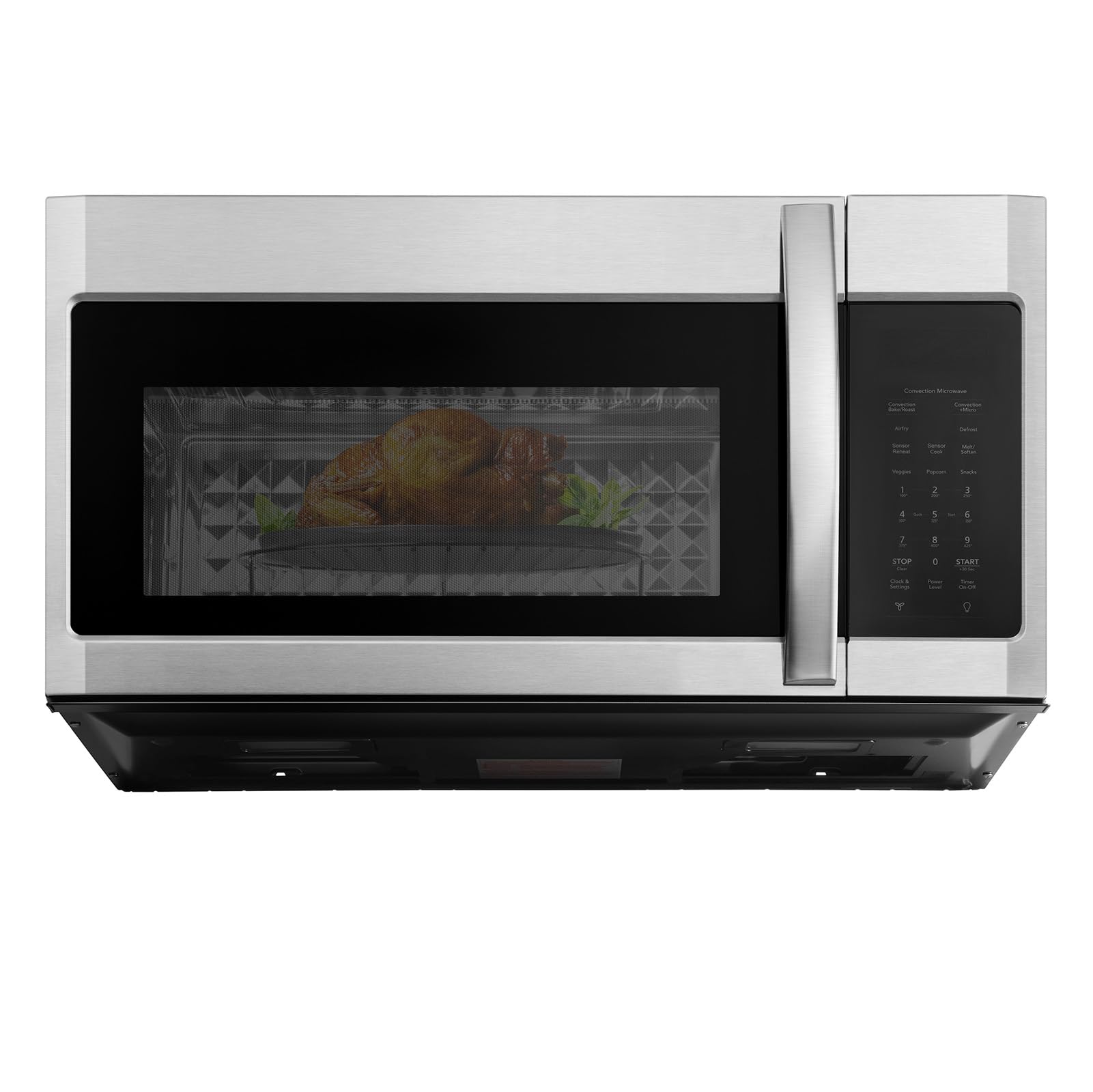
This BLACK+DECKER is a very specific kind of buyer’s pick: you want maximum cooking modes without turning your kitchen into an appliance showroom. It’s the “one box that tries to cover multiple jobs” choice—and when you understand what it’s best at, it can be a surprisingly satisfying upgrade.
The main advantage is flexibility. Microwave for the obvious stuff, plus convection/bake/roast/grill style modes for “small oven” tasks. That’s perfect for smaller kitchens or households that constantly wish they had a second oven during busy cooking days. It’s also perfect for people who want to crisp and brown without relying on a separate countertop air fryer.
Here’s the expert reality check: combo modes don’t magically replace dedicated appliances. Air fry performance in an OTR microwave is usually “good when treated correctly.” That means using the right tray or rack, spreading food out, and accepting that you may need to flip for even crisping. If you do that, it’s fantastic for quick snacks and sides. If you don’t, you’ll feel like it’s underwhelming.
Heat management matters on this unit too. When you run bake or air fry modes, the top and surrounding area can get hot—because that’s what heating elements do. So give it breathing room and avoid leaving heat-sensitive items on top surfaces. Also, if you have guests or family members who are used to “pull handle, door opens,” some models with lock features can confuse first-time users. That’s not a dealbreaker—just something to know so you don’t get someone tugging the door like it owes them money.
Venting is aimed at the normal household cooking routine, not pro-level smoke handling. If your cooking is mostly simmering, boiling, and light sautéing, it’s fine. If you regularly cook smoky foods, you’ll want to either vent outside (if possible) and keep filters maintained, or consider a model with a more vent-forward personality.
Why it’s a strong value
- Multi-mode flexibility – Great for “I want a second oven but I don’t have the space.”
- Good for small-batch crisping – Air fry works best when you treat it like a crisping station and don’t overcrowd.
- Everyday microwave behavior is straightforward – It still does the main job well: fast reheats and simple cooking.
- Space-saving logic – Helps reduce countertop clutter by consolidating functions.
Good to know
- Air fry won’t match a dedicated basket fryer for large batches; it’s a “small batch” solution.
- Bake/air fry modes create real heat—plan placement and airflow so the area doesn’t feel trapped.
- More presets can mean more learning; do a few “practice cooks” before hosting people who expect instant mastery.
Ideal for: smaller kitchens and value-focused households that want microwave convenience plus real “mini oven” flexibility in one installed unit.
3. Commercial Chef CHMRC17GS – Big Capability, With a Realistic Mindset
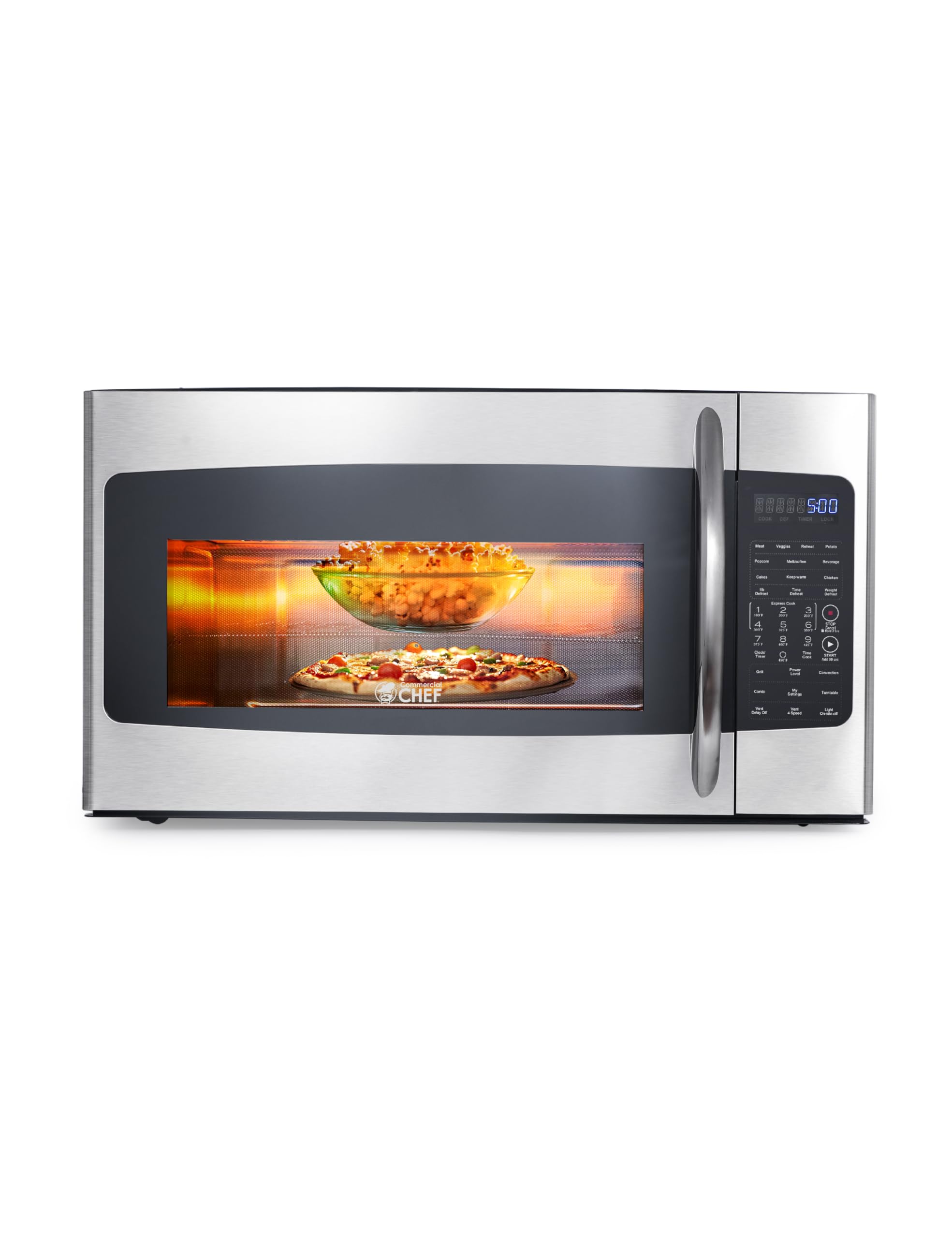
Commercial Chef is the kind of product people find when they’re trying to solve a very specific puzzle: “I want convection and air fry features, I want over‑the‑range installation, but I don’t want to pay premium-brand money.” And that’s a valid shopping intention—as long as you buy with the right expectations.
The capability list is strong: full-size OTR footprint, multiple power levels, convection heating, and an air fry kit. That means you can do more than just reheat. You can brown, bake smaller items, and crisp in ways a basic microwave can’t. For families who like quick frozen foods, or who want a “backup oven” during big cooking days, that’s a genuine value story.
Here’s the expert viewpoint: with a budget feature stack, the main risk is not performance on day one—it’s long-term consistency and interface satisfaction. Some customers love the convenience and say it becomes an everyday hero. Others report frustrations like uneven convection outcomes, control panel wear, or the feeling that the learning curve is steeper than expected. That doesn’t mean “don’t buy it.” It means this model is best for a buyer who is comfortable learning the unit’s quirks and using technique to get the best results.
Air fry technique matters more than usual here: use the air fry kit properly, don’t overload it, and flip when possible. Also, treat air fry as a crisping mode, not a replacement for an outdoor grill or a high-end countertop air fryer. If you do, you’ll be pleasantly surprised. If you expect it to behave like a premium basket fryer, you’ll be disappointed.
One more practical note: if you buy this for convection baking, test it early. Bake something simple you can judge easily (cookies, toaster-style items, frozen pizza slices). You’ll quickly learn whether the heat distribution matches your expectations. If it does, great. If it doesn’t, you’ll know before the return window is a memory.
Why it can be a smart buy
- Strong feature set for the category – Convection + air fry makes it more than a reheat machine.
- Great for “second oven” tasks – Helps during holidays or multi-dish meals when the main oven is busy.
- Works best for technique-driven cooks – If you’re willing to preheat, flip, and space food, results improve dramatically.
- Space-saving upgrade – Replaces countertop clutter with installed capability.
Good to know
- Budget models can have a wider range of owner experiences—test early and learn the unit’s personality.
- Convection outcomes depend heavily on rack placement and spacing; crowding is the enemy.
- If you want “premium feel” and ultra-consistent results with minimal learning, consider stepping up to a major-brand flagship.
Ideal for: value-focused buyers who want convection + air fry capability in an OTR install and are comfortable learning technique to get the best results.
4. AAOBOSI 24″ Built‑In Combo (10 Modes) – For Remodels That Hate Counter Clutter
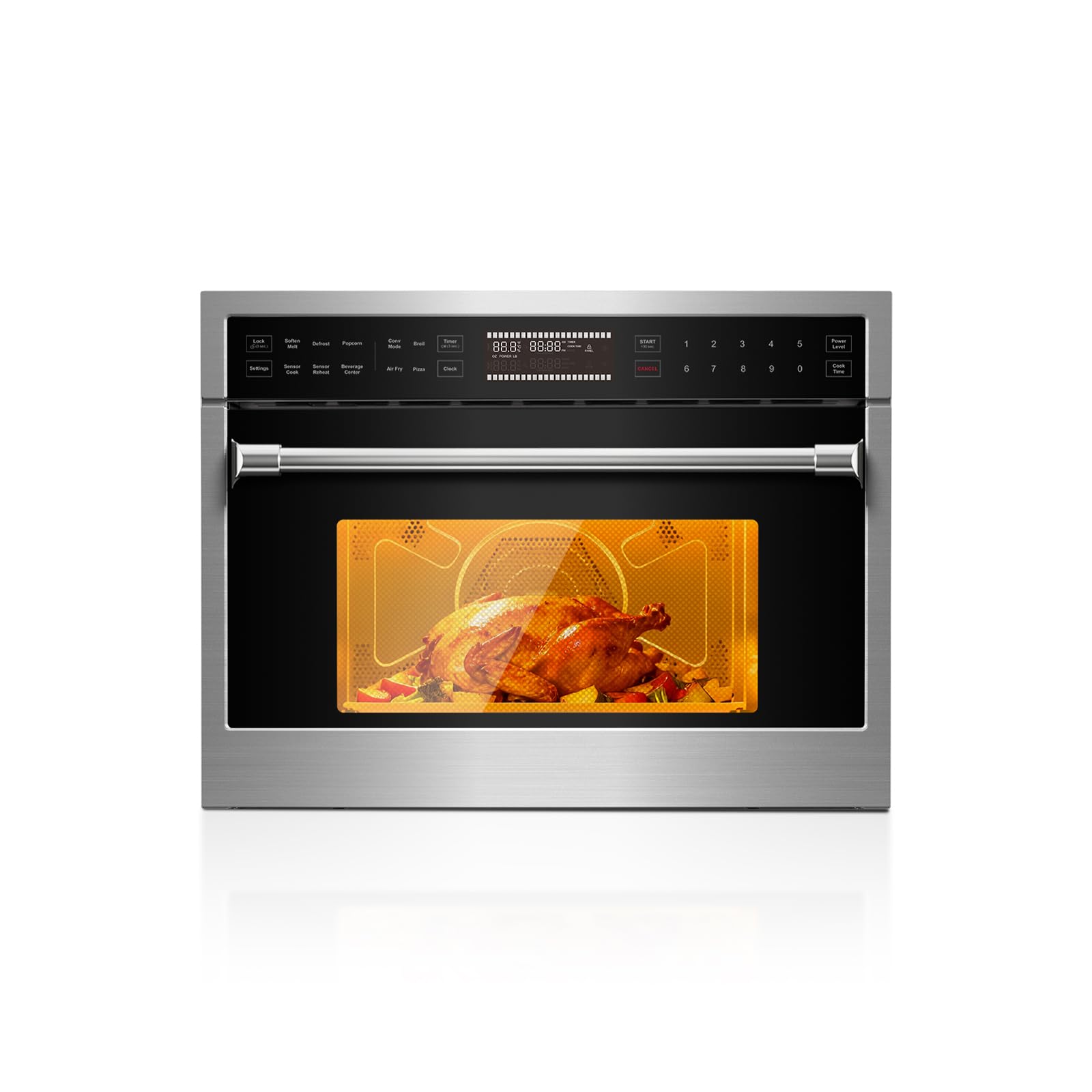
Let’s get one thing clear: this AAOBOSI is not an over‑the‑range microwave. It’s a built‑in wall unit built for people who want the clean, seamless “integrated appliance” look. I’m including it because many shoppers searching OTR microwaves are actually solving the broader problem: “how do I save space and add cooking capability without stacking appliances everywhere?” And a built‑in combo like this can be the best answer—if your kitchen layout supports it.
This model’s reputation is built on one big win: it replaces multiple appliances. Microwave for speed, convection for actual baking/roasting behavior, and air fry for crisping. Owners often describe the “instant kitchen upgrade” feeling: the built-in look makes the whole space feel more organized and higher-end, and the countertop clutter reduction is real. It’s the kind of unit that can make a small kitchen feel bigger because the counters are finally usable again.
What I like most from an expert standpoint is that the control system is designed to be approachable: preset modes for common foods, sensor cooking, and a layout that doesn’t feel like you need an engineering degree. That matters in a family kitchen where multiple people will use it. If only one person can operate your microwave, it’s not a good “daily life” appliance—no matter how fancy it looks.
Now the reality check: built-in combo units are heavy and installation is not a casual weekend task unless you already have the correct cutout and electrical setup. Plan two people for lifting, confirm your cabinet dimensions, and make sure you have the right outlet/power requirements in place. A lot of people love the unit, but several also mention the “this is heavy” moment during install—because it is.
Air fry behavior is similar to other combo units: it’s fantastic for small batches and crisping, and it works best when you follow airflow rules. The “swap racks for different modes” annoyance is real, but it’s also the price of having multiple cooking styles in one cavity. If you accept that as the trade, the versatility payoff is huge.
Why it shines in remodels
- Built-in look upgrades the whole kitchen – It feels “custom” when installed cleanly.
- Replaces multiple appliances – Microwave + convection + air fry reduces countertop clutter dramatically.
- Family-friendly controls – Presets and sensor behavior can make daily use easier for everyone.
- Easy-to-wipe surfaces – Stainless styling and clean lines make maintenance feel less annoying.
Good to know
- Not an OTR unit—no cooktop venting. You need separate ventilation if placing it near a range.
- Installation is a real project: confirm cutout size, clearance, and electrical requirements before purchase.
- Air fry is best when you treat it as “small batch crisping,” not a high-volume fryer replacement.
Ideal for: remodels and space-focused kitchens that want an integrated built-in combo unit to replace multiple countertop appliances and create a cleaner, more premium look.
5. AAOBOSI 24″ Built‑In Combo (Upgraded) – For People Who Actually Use the Extra Modes
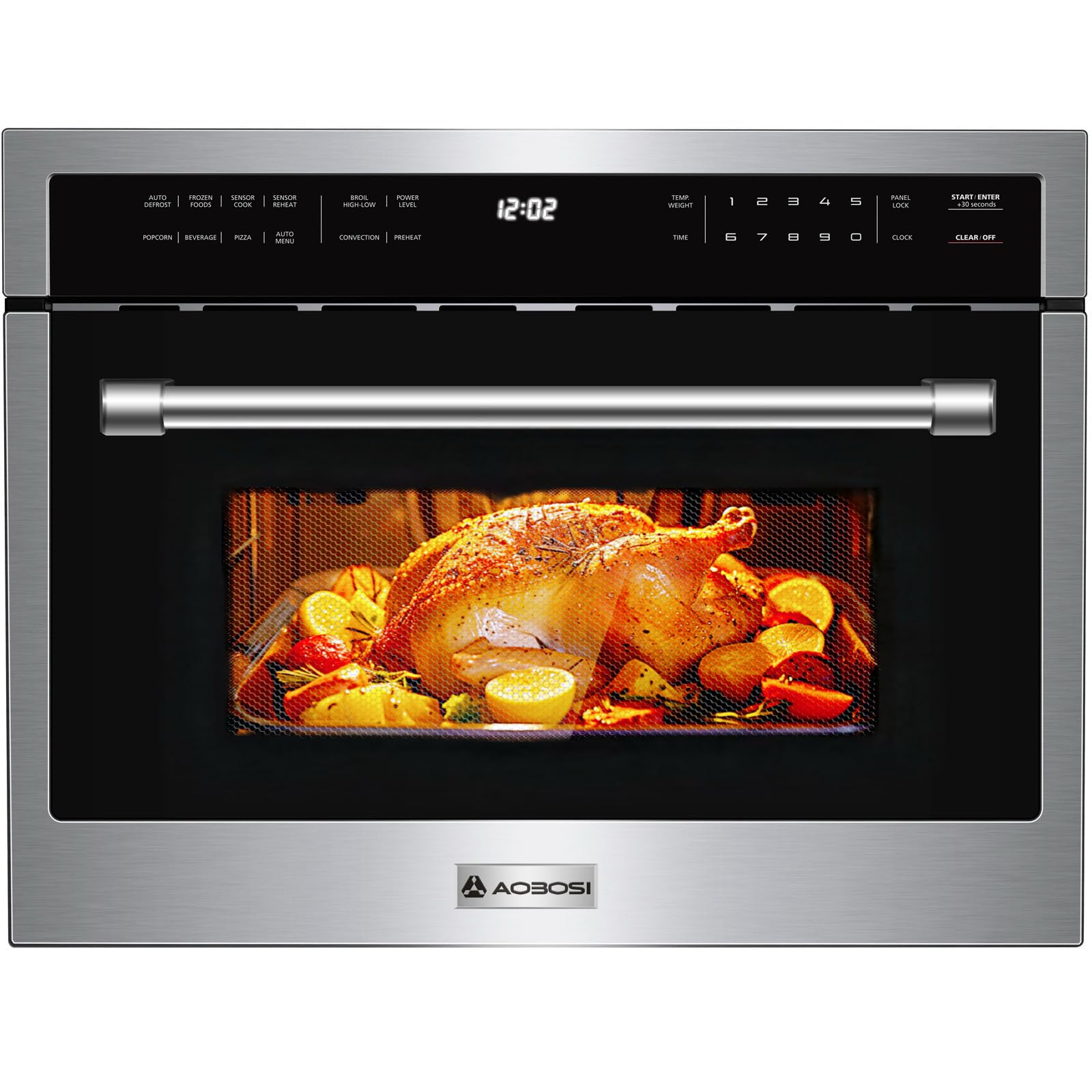
This upgraded AAOBOSI is for a very particular shopper: you’re not buying built-in for looks alone. You’re buying it because you actually plan to use the convection, broil, and air fry modes regularly. You want a true “multi-tool” appliance—something that can heat, bake, crisp, and cook in different ways without making you feel like you need three separate machines.
The accessory set matters here more than people think. Extra racks and trays aren’t “nice-to-have” when you’re cooking with convection and air fry. They determine airflow, heat circulation, and whether you can cook two things at once. A unit that includes a purposeful accessory kit tends to get used more because it feels capable, not improvised. This is where many built-in combos either shine or disappoint: if the accessories feel thoughtful, you use the modes. If they feel like an afterthought, the unit becomes a fancy reheat box.
Owner feedback often highlights the “modern built-in” vibe: stainless finish, LED lighting, and a clean interface. It’s the kind of unit that pairs well with stainless appliance suites and looks like it belongs in a remodeled kitchen. But the more interesting feedback is about versatility: people love being able to cook many types of foods without switching devices. That’s the real win. The look is the bonus.
Now, the honest friction points: some users note the cavity can feel a bit smaller than expected compared to the external size. That’s normal for units that pack in multiple heating systems and insulation. The solution is simple: assume it’s best at “family plates and medium bakeware,” not giant roaster pans. If you want huge oven behavior, you still need a real oven. If you want “everyday cooking and crisping plus microwave speed,” this nails it.
Also watch electrical and install realities. This is not a plug-and-play countertop microwave. It’s a built-in appliance that may require a more modern outlet setup and proper cabinet ventilation. Do the boring homework first, and you’ll love the unit later. Skip the homework, and you’ll spend your weekend wishing you had measured twice.
Why it’s the “power user” version
- Accessory kit increases real cooking success – Better racks and trays make convection and air fry modes more usable.
- Multi-mode versatility – Great for homes that truly want microwave + mini oven behavior in one cavity.
- Modern built-in look – Clean finish and interface help a remodel feel cohesive.
- Sensor + auto options reduce guesswork – Helpful for everyday family cooking when you don’t want to babysit timing.
Good to know
- Built-in means planning: cabinet cutout, clearance, and electrical setup matter.
- Interior capacity is best for medium dishes, not oversized bakeware.
- Some users perceive lower “microwave punch” compared to standalone countertop units—plan for slightly different timing habits.
Ideal for: remodel-focused buyers who want a built-in combo they’ll actually cook with—especially if you’re excited about convection, broil, and air fry modes, not just reheating.
6. KoolMore KM‑CWO30‑SS – The Built‑In “Speed Oven” Style for Modern Kitchens

KoolMore is one of those brands that surprises people: it shows up as a “reasonable price for a big built-in combo,” and then owners often say, “Wait, this actually looks amazing installed.” That’s the value proposition in one sentence: a built-in convection + air fry microwave that delivers the modern, seamless look without making you feel like you bought a luxury brand only for the badge.
This unit is best thought of as a built-in “speed oven style” tool. You get microwave speed, plus convection for browning and baking, plus an air fry mode for crispness. In real kitchens, that means it becomes a holiday helper, a weeknight shortcut, and a countertop declutter move—especially if you were previously running a microwave plus a toaster oven plus an air fryer all competing for space.
Where owners often land is: “It works well, it looks sleek, and it’s easy to use.” That matters. A built-in combo can be powerful and still be a pain if the controls are confusing. KoolMore’s appeal is that it aims for straightforward controls and a modern aesthetic that fits renovated kitchens.
Now, the reality you should not skip: built-in units need cabinet airflow and correct cutout sizing. If you install a heat-producing appliance into a sealed box, you create a long-term problem. Some owners mention that ventilation around the installation cavity matters and can be a surprise if you’re not expecting it. So before you buy: confirm the cutout specs, confirm clearance, and make sure the cabinet design isn’t trapping heat. That’s not fear—just responsible installation planning.
Air fry performance is often described as effective but sometimes slower than dedicated air fryers. That’s normal for combo units: the cavity and airflow design isn’t identical to a basket fryer. You still get crispy food—just don’t assume identical timing. The win is that you can crisp food without dragging out another appliance.
Why it’s a solid built-in pick
- Looks excellent installed – The built-in aesthetic can make a kitchen feel instantly more modern.
- Versatility in one cavity – Microwave + convection + air fry covers a lot of daily cooking jobs.
- Easy-to-learn controls – The “everyone can use it” factor matters more than people think.
- Great for meal volume moments – Holiday cooking and hosting become easier when you have a second oven-like zone.
Good to know
- Built-in installs need proper cabinet cutout and airflow planning.
- Air fry can take longer than a dedicated countertop fryer—still crispy, just different pacing.
- If your top priority is cooktop venting, remember: this is built-in, not over-the-range.
Ideal for: modern remodels that want a built-in combo unit to reduce countertop clutter and add real convection + crisping capability—without the premium brand price positioning.
7. Midea 4‑in‑1 Microwave Steam Oven – The “Mini Combi Oven” For Health‑First Cooking

This Midea is the wildcard in the guide, and it’s here for one reason: steam changes what “good results” look like. If you’re the kind of cook who values moisture retention, gentle cooking, and “healthy convenience” more than maximum crispness, a steam‑capable multi-oven can be a better daily tool than a traditional over‑the‑range microwave.
The Midea’s core identity is: steam + microwave + air fry + oven behavior in one countertop unit. That means you can steam vegetables quickly, do steam-assisted cooking that helps prevent dryness, and still crisp foods when needed. If your current cooking pattern is “I microwave it, it dries out, then I’m disappointed,” steam is the antidote.
However—this is important—the Midea is not designed to be a “hit one button and dinner is done” microwave for everyone. With a large menu system and multiple modes, it rewards practice. Some owners love the depth and variety; others feel it’s not built for quick meals because you have to learn the cooking logic. So this is a personality match product: if you like learning modes and you enjoy cooking as a process, you’ll love it. If you want speed and simplicity, you may find it frustrating.
Air fry results are also a classic combo-oven story: it can crisp, but dedicated air fryers are still better at brute-force crunch. So if your primary goal is “crispiest fries on earth,” keep a dedicated air fryer. If your goal is “one appliance that can steam, microwave, and crisp without extra clutter,” this becomes a very compelling little kitchen.
The biggest reason people choose this instead of an OTR microwave is installation avoidance. No mounting plates, no cabinet drilling, no lifting heavy appliances. You place it, plug it in, and start learning. If you rent, move often, or simply don’t want to install an over‑the‑range unit, that’s a legitimate advantage.
Why it’s unique
- Steam capability changes results – Helps food stay moist and flavorful, especially vegetables and reheats.
- Multi-oven flexibility – One unit can cover steaming, microwaving, baking/roasting behavior, and crisping.
- No installation project – Great for renters, small kitchens, and people who don’t want cabinet drilling.
- Deep cleaning modes – Built-in cleaning functions are helpful when you actually use multiple cooking modes.
Good to know
- Not a “zero learning curve” product—expect to practice modes and presets to get your best results.
- Air fry won’t match a dedicated basket fryer for peak crispness or large batches.
- Countertop footprint is real; it’s saving you appliances, but it still needs space.
Ideal for: people who value steam cooking and want a multi-oven countertop solution without installing an over‑the‑range microwave—especially if you enjoy learning cooking modes.
How “Air Fry,” Convection, and Venting Actually Work (So You Get the Results You Expected)
Most disappointment comes from one mismatch: people expect over‑the‑range microwaves to behave like three separate appliances. But an OTR unit is always a compromise machine: it’s a microwave first, with convection/air fry layered in, and a fan that’s shaped by the need to fit above a range. When you understand the trade-offs, you can choose the right model and use it in a way that feels genuinely satisfying.
Why OTR air fry sometimes feels “meh” (and how to fix it)
- Airflow is everything: Air fry needs space. Overcrowding is the #1 reason crisping fails.
- Use the correct rack/tray: If the model includes an air fry rack or tray, it’s not optional—it’s how the mode works.
- Flip once: Most OTR air fry modes benefit from a quick flip midway for even browning.
- Preheat when available: A warm cavity gives you faster surface crisping and less soggy time.
- Think “small batch”: OTR air fry is amazing for dinner-for-two crisping, not party-size frying.
Here’s the cheat code: treat air fry as a finishing tool. Microwave to warm, then air fry to crisp. That combo gives you the best of both worlds: fast heat + crunchy texture. Once you use it this way, the feature stops feeling like marketing and starts feeling like a daily convenience.
Convection: the feature that becomes your “second oven”
- Convection browns: It’s for golden tops, crisp edges, and baking smaller items without firing up the main oven.
- Rack placement matters: Convection needs air circulation around the food—don’t block airflow with oversized dishes.
- Fast Cook is a superpower: On models that combine microwave + convection, you can reduce cooking time while still browning.
- Best use cases: Reheating pastries, crisping pizza, baking small casseroles, roasting quick sides.
- Expect different timing: Convection in a microwave cavity is not identical to a full-size oven—use a few test cooks to learn it.
If you’ve never had convection in a microwave before, you’ll underestimate how often you use it. It’s not for big roasts. It’s for the “I want this browned, not soggy” moments that happen constantly in real kitchens.
Venting: how to make an OTR fan feel stronger than it is
- Start the fan early: Turn it on before the steam/smoke begins. It captures better when airflow is already moving.
- Use the right speed: Medium is often quieter but too weak for frying. High is for the messy jobs.
- Maintain filters: Grease filters clog quietly. Charcoal filters saturate. Performance drops slowly, then suddenly feels “bad.”
- Keep duct runs smooth: If venting outside, fewer bends and shorter runs improve performance dramatically.
- Accept the hood truth: If you’re a high-heat sear person, a dedicated hood is the long-term best solution.
The models with better filter access and reminders tend to perform better long-term because they’re easier to maintain. That’s why “filter workflow” is secretly one of the most important features in this category.
Cleaning: the weekly ritual that makes your microwave feel premium
- Do a quick steam loosen: Even without a special mode, a bowl of water + a few minutes softens splatter so wiping is easy.
- Wipe the underside weekly: This is where grease accumulates and where stainless starts looking tired.
- Wash grease filters regularly: Many mesh filters are washable. Clean filters = better venting + less odor.
- Keep racks clean: Air fry racks get sticky; sticky racks reduce airflow and worsen results.
- Don’t let “one big spill” become crust: The longer splatter sits, the harder it becomes to remove.
The best part: the difference between a “gross microwave” and a “nice kitchen tool” is usually 4 minutes a week. Do that, and your appliance stays enjoyable.
FAQ: Over‑the‑Range Microwaves (Answered Like You’re Actually Using One)
Do I really need air fry in an over‑the‑range microwave?
Should I vent outside or recirculate?
What’s the biggest mistake people make when buying?
Is convection worth it, or is it just a feature I’ll never use?
How do I get better air fry results in an OTR microwave?
What if I want a clean look but don’t want an OTR unit?
Final Thoughts: Buy the Microwave That Matches Your Real Kitchen
The perfect microwave is not the one with the fanciest marketing. It’s the one that fits your cabinet and cooking reality, vents the way you need it to, and makes you feel like dinner is easier—not like you adopted a complicated new hobby.
Here’s how to choose quickly using this guide:
- Cook often and care about venting and odor management? Go with the Frigidaire Professional PMOS1980A/AF. It’s built for real cooking routines and better long-term filter behavior.
- Want a value-friendly multi-mode unit with a “mini oven” vibe? Look at the BLACK+DECKER EC942K6CE-SS or the Commercial Chef CHMRC17GS. Great for small-batch crisping and backup-oven tasks when you learn the unit’s technique.
- Not actually an OTR situation—more of a remodel or wall install? Then built-in combos can be smarter: AAOBOSI (10 modes), AAOBOSI (upgraded), or KoolMore 30″ built-in. They’re built for clean aesthetics and multi-mode cooking, not cooktop venting.
- Want multi-oven capability without an install project? The Midea 4-in-1 Steam Oven is the countertop “mini combi oven” option for steam-first cooking and renters.
The best decision is the one that matches how you actually cook—not how a product page imagines you cook. Pick the Over The Range Microwaves With Air Fryer option that fits your venting setup, your daily habits, and your patience for learning new modes, and you’ll end up with an upgrade that feels like a kitchen improvement every single day.
