
Outdoor cooking has a funny way of being both simple and chaotic. Simple because it’s “just heat + a pot.” Chaotic because wind shows up, the regulator behaves differently than you expected, the pot wobbles, and suddenly your “quick boil” turns into a whole performance.
If you’re shopping for an outdoor propane gas burner, you’re not really buying “BTUs.” You’re buying confidence: the feeling that your boil will stay steady, your flame won’t sputter, your stockpot won’t rock, and your cooking setup won’t make you babysit it every second.
Most buying guides stop at surface-level specs. That’s not helpful. What actually matters is how a burner behaves in real life:
- Flame shape: does it spread wide and evenly, or punch the center like a jet?
- Control: can you hold a stable simmer, or is it basically “off / blast furnace”?
- Stability: will it stay planted under a full stockpot, wok tossing, or a heavy cast iron griddle?
- Wind behavior: does it blow out easily, or does the frame and burner design help protect the flame?
- Setup friction: do knobs drift, do parts arrive missing, do edges bite your hands, does it store easily?
This guide is built for the “real cook” moments: seafood boils that need sustained rolling heat, wok stir-fries that demand focused flame, canning sessions where a burner must hold output for hours, and backyard frying where you want strong heat without overheating the hose area. You’ll get a fast comparison table, then deep reviews of 18 burners—based on real owner feedback patterns and the practical engineering details that most people never talk about.
How to Choose the Right Outdoor Propane Gas Burner
Here’s the truth: two burners can share similar “max output” numbers and still cook wildly differently. One will feel smooth and controlled. The other will feel like it’s trying to launch your pot into orbit. The difference is not just “more power.” It’s burner geometry, air mixing, valve design, and frame stability. This section will save you from buying the wrong style—and then fighting it for the next five years.
1. Start with your primary job (don’t shop for your fantasy meal)
Most people buy a burner thinking about one big event—then use it for totally different tasks. Identify your real “weekly job,” then pick around it:
- Seafood boils / stockpots: you want a wide, stable flame that spreads heat across the pot base and holds output without drama.
- Turkey frying / deep frying: you want serious heat, but also control (because oil doesn’t forgive). Heat shields and hose clearance matter here.
- Wok stir-fry: you want focused heat that hugs the wok shape and recovers fast after you add cold ingredients.
- Home brewing / canning: you want long-session reliability and a burner that won’t “wander” as you dial it in.
- Everyday outdoor cooking: a 2-burner stand can replace your kitchen range during remodels or for “keep smells outside” cooking.
2. Learn the burner head “personalities” (this is where most guides fail)
Different burner heads create different flame behavior. Here’s what matters in real cooking:
- Jet / multi-nozzle burners: punchy, fast response, great for high-heat wok work. The trade-off is they can concentrate heat in the center, so you move food faster and learn your heat zones.
- Banjo / ring-style burners: typically spread flame wider and can feel more even under large pots. Great for boils and big batches when you want less “hot spot drama.”
- Vortex / wok-focused burners: designed to wrap heat around a wok and drive “wok hei.” This is less about raw BTU and more about flame path and how it hugs the metal.
- Multi-burner cooktops: the win is workflow—two or three independent burners means you can boil, sauté, and keep sauces warm simultaneously.
You don’t need to memorize designs. You just need to match the flame pattern to the cookware you use most. A wide stockpot loves wide flame. A round-bottom wok loves focused, directional heat.
3. Control is not a bonus feature—it’s the whole game
High-pressure burners often use a regulator with an adjustment dial, and sometimes burner-mounted knobs too. The best setups separate “coarse control” from “fine control”:
- Coarse control: set your tank valve and regulator to get into the right heat neighborhood.
- Fine control: use a stable knob on the burner body (when available) to hold a precise working flame.
When a setup forces you to do all control at the regulator by the tank, it can still work brilliantly—but it’s less convenient, especially when you’re cooking for a crowd and adjusting frequently.
4. Frame stability and height matter more than most people admit
A burner can be powerful and still be a bad purchase if it’s unstable under load. Look for:
- Wide stance + strong welds: reduces rocking with heavy pots.
- Pot support spacing: if the grate spacing is wide, small cookware can tip unless you add a support plate.
- Comfort height: waist-high burners are a joy for long sessions; low “ground burners” can be tough on your back during brewing/canning.
Also: mobility is underrated. Wheels and shelves can turn a burner from “special occasion tool” into “weekly outdoor kitchen.”
5. Don’t ignore “ownership friction” (the stuff you’ll feel every time)
Real owner feedback tends to cluster around a few repeat themes:
- Sharp edges: some metal frames arrive with edges that deserve a quick deburr for comfort.
- Regulator weak points: a burner can be excellent, but a low-quality regulator can ruin the experience.
- Missing hardware: a minority of units arrive missing screws or knobs—annoying, but solvable if you check immediately.
- Ignition style: auto-ignition is convenient; manual ignition is reliable and simple—but you need a long lighter.
A burner you actually love is the one that feels predictable: it lights easily, holds a setting, and doesn’t surprise you mid-cook.
Quick Comparison: 18 Outdoor Propane Gas Burner Picks
Use this table to shortlist quickly. Then jump into the reviews for the “real life” details—like flame behavior in wind, how control actually feels, and which models owners keep using weekly instead of storing forever.
On smaller screens, swipe or scroll sideways to see the full table.
| Model | Setup | Signature strength | Best match | Amazon |
|---|---|---|---|---|
| GasOne 200K BTU Single Burner | Single | Powerhouse boil/fry performance with heavy-duty stability | Most people who want one “do everything” high-heat burner | Amazon |
| Concord Professional Vortex Wok Range | Wok station | Vortex flame geometry designed for true wok hei | Serious stir-fry cooks who want restaurant-style results | Amazon |
| ROVSUN 3 Burner Stove + Griddle | 3 burner | Cooktop + griddle workflow with shelves and mobility | Backyard “outdoor kitchen” setups and big-family cooks | Amazon |
| Concord Triple Burner Stand | 3 burner | Three-pot capacity with strong flame and proven sturdiness | Batch cooking, community meals, and multi-pot prep | Amazon |
| Barton Rolling Triple-Burner Station | 3 burner | Wheels + side tables for a true “moveable cook line” | Camping groups, backyard cooks who want mobility | Amazon |
| Gas One Double Burner w/ Windscreen | 2 burner | Dual burners + windscreen + removable legs for outdoor reliability | Boils + sides at once; windy patios; big-pot cooking | Amazon |
| Bestfire 2 Burner w/ Auto Ignition | 2 burner | Comfort-height outdoor “range replacement” with shelves | Kitchen remodels, electric-only homes, patio cooking | Amazon |
| ROVSUN 2 Burner Stand Cooker | 2 burner | Strong heat with a simple, lightweight detachable-leg frame | Tailgating, backyard boils, “easy setup” shoppers | Amazon |
| ADREAK 2 Burner High-Pressure Stove | 2 burner | Two independent burners with simple portable build | Outdoor kitchens, event cooking, quick multi-dish prep | Amazon |
| Vivicreate 2 Burner High-Pressure Stove | 2 burner | Heavy-pot support with a tall, party-ready frame | Outdoor events, family cooks, big-pot comfort height | Amazon |
| OuterMust Wok + Burner Kit | Wok kit | All-in-one wok station starter set with adjustable legs | Beginner wok cooks who want an instant setup | Amazon |
| GasOne Stainless Single Burner (B-5200K) | Single | Compact stainless frame with wide adjustment range | Crab boils, shrimp boils, “keep smells outside” cooking | Amazon |
| GasOne Single Burner w/ Heat Guard (Stainless) | Single | Heat shield + guard designed to protect hose connection area | Frying-focused cooks who want extra heat management | Amazon |
| GasOne Compact High-Pressure Single w/ Heat Guard | Single | Small footprint with steady flame and protective guard design | Emergency backup cooking, balcony-friendly setups | Amazon |
| GasOne Height-Adjustable Single Burner | Single | Comfort-height options to save your back in long sessions | Brewing, canning, tamales, long outdoor cooks | Amazon |
| ARC 55,000 BTU Portable Burner | Single | Lightweight frame with wind guards for stable cooking | Camping, tailgating, quick boils and small-batch frying | Amazon |
| COOKAMP SA1100 High-Pressure Cooker | Single | 0–20 PSI regulator range with sturdy pot support | Holiday boils and dependable backyard batch cooking | Amazon |
| Concord 12″ The Block Burner | Single | Compact, tough frame with strong heat for its footprint | Portability-first shoppers who still want real output | Amazon |
In‑Depth Reviews: 18 Outdoor Burners That People Actually Keep Using
Now we’ll go model by model. I’ll focus on the stuff you only learn after real use: how the flame behaves with big cookware, what control feels like when you’re trying to hold a steady simmer, how stable the frame feels under load, and the little annoyances (or joys) that show up every weekend.
1. GasOne 200K BTU Propane Burner – The “One Burner” Workhorse for Boils, Frying, and Brewing
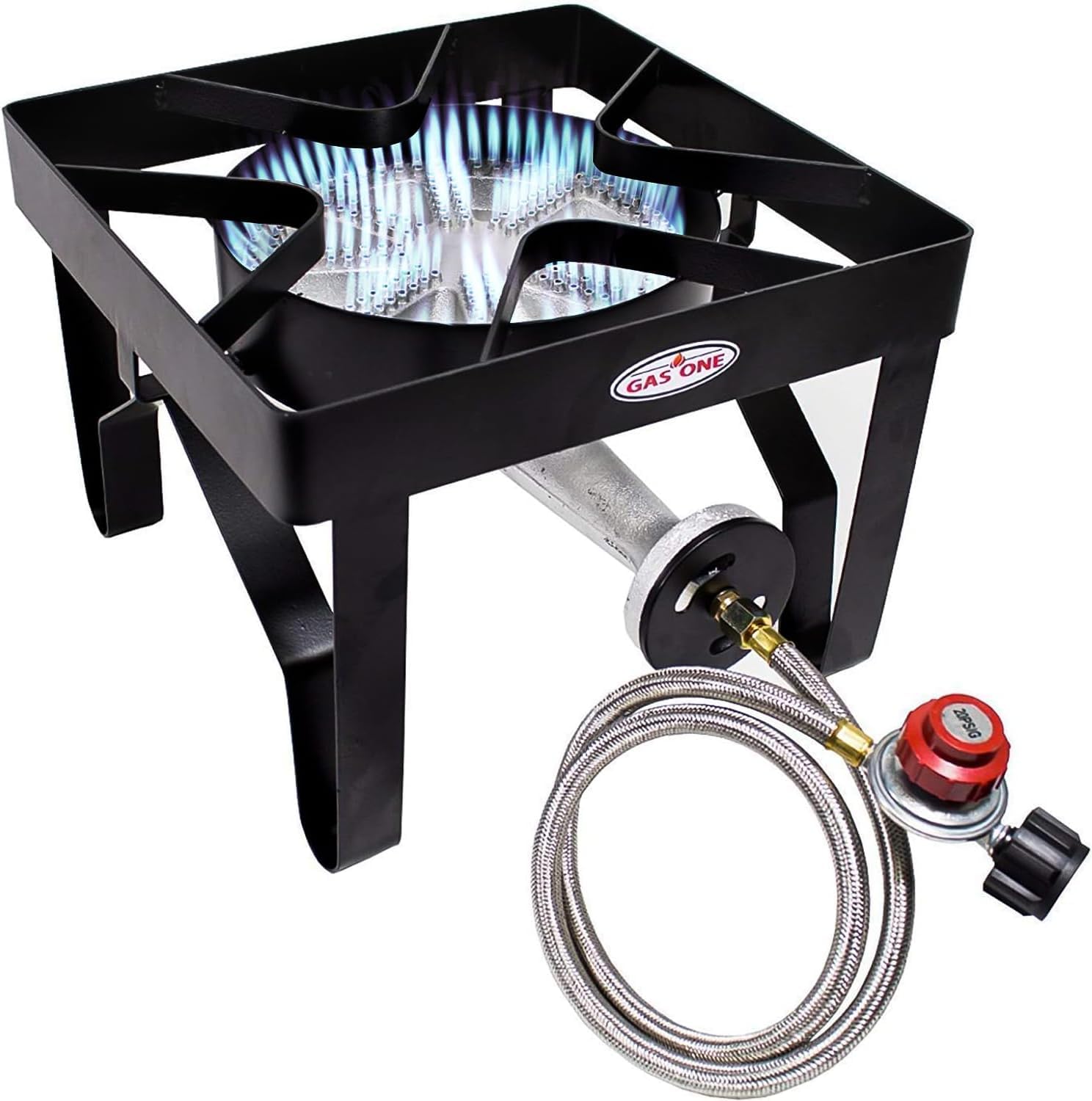
If you want one burner that can handle the “big jobs” without feeling fragile, this is the one I’d start with. Owners consistently describe it the same way: fast heat, sturdy frame, and the kind of output that makes stockpots and fry oil respond quickly. The secret sauce isn’t just peak power—it’s that the frame and burner head combination feels stable and confident under heavy cookware.
Where this model really wins is in “heat recovery.” Add cold water, dump in seafood, drop in a batch of chicken—this burner bounces back with authority. That’s exactly what you want for outdoor frying and boiling, where waiting for the heat to return is the difference between crisp food and soggy food. It’s also why home brewers love it: it’s built for big pots and long sessions.
The main trade-off is control ergonomics. Like many high-output singles, a lot of your fine-tuning happens via the regulator rather than a big, friendly front knob. That’s not a dealbreaker—once you learn your “coarse set then micro-adjust” rhythm, it feels predictable. But it’s worth knowing before you buy.
Why it’s a real-life favorite
- Big-pot confidence – The frame feels planted under heavy stockpots and large cookware.
- Fast heat recovery – Great for boils and frying where temperature rebound matters.
- Simple, rugged design – Fewer gimmicks, more “works every weekend” energy.
- Versatility – Handles brewing, canning, frying, and batch cooking without needing a second setup.
Good to know
- Fine control often lives at the regulator; practice your “set-and-hold” routine once before your first big cook.
- High output means you cook faster—especially with oil—so treat it like a serious tool, not a camp stove.
- If you want waist-high comfort, pair it with a stand/table or choose a taller burner design.
Ideal for: anyone who wants a single burner that feels like a dependable outdoor “engine” for boiling, frying, and brewing—without paying for a full cook station.
2. Concord Professional Vortex Wok Range – The “Wok Hei Machine” Built Like an Outdoor Kitchen Appliance

This is not a “propane burner.” This is a purpose-built wok station—meaning the flame design, wok ring, and frame are engineered around the motion and heat demands of real stir-fry. Owners who compare it to cheaper burners tend to say the same thing: the build is rock-solid, the heat is concentrated where it should be, and it delivers that fast “restaurant sizzle” that indoor ranges can’t touch.
The signature detail is the vortex-style flame behavior. Instead of heat splashing randomly, it’s shaped to centralize and hug the wok area, which is exactly how you get wok hei without needing absurd, uncontrolled blast. That said, this burner teaches you speed: if you’re used to indoor burners where heat climbs the sides of the wok slowly, this can feel like a shock at first. You move quicker, stir more actively, and learn to “ride the knob.”
Real-life usability is strong too: stainless surfaces wipe down easily, the integrated shelf is genuinely useful for sauces and tools, and the wok ring feels secure for tossing. Manual ignition is the one “old school” piece—bring a long lighter and you’re set.
Why it’s special
- Flame geometry made for woks – This isn’t random heat; it’s shaped for stir-fry performance.
- Stability for tossing – The wok ring holds steady when you’re flipping food aggressively.
- Outdoor-kitchen durability – Stainless frame feels permanent, not disposable.
- Control that stays put – Owners love that settings don’t “drift” once dialed in.
Good to know
- Heat is intense and focused—practice with simpler stir-fries first so you learn your timing.
- Manual ignition means you’ll want a dedicated lighter in your cooking kit.
- This is a wok specialist; if you mostly boil stockpots, a wide-flame burner can feel more natural.
Ideal for: stir-fry lovers who want true wok performance, a stable station for tossing, and a premium build that feels like part of an outdoor kitchen.
3. ROVSUN 3 Burner Stove + Griddle – The “Backyard Range + Flat Top” All‑In‑One Workflow Upgrade
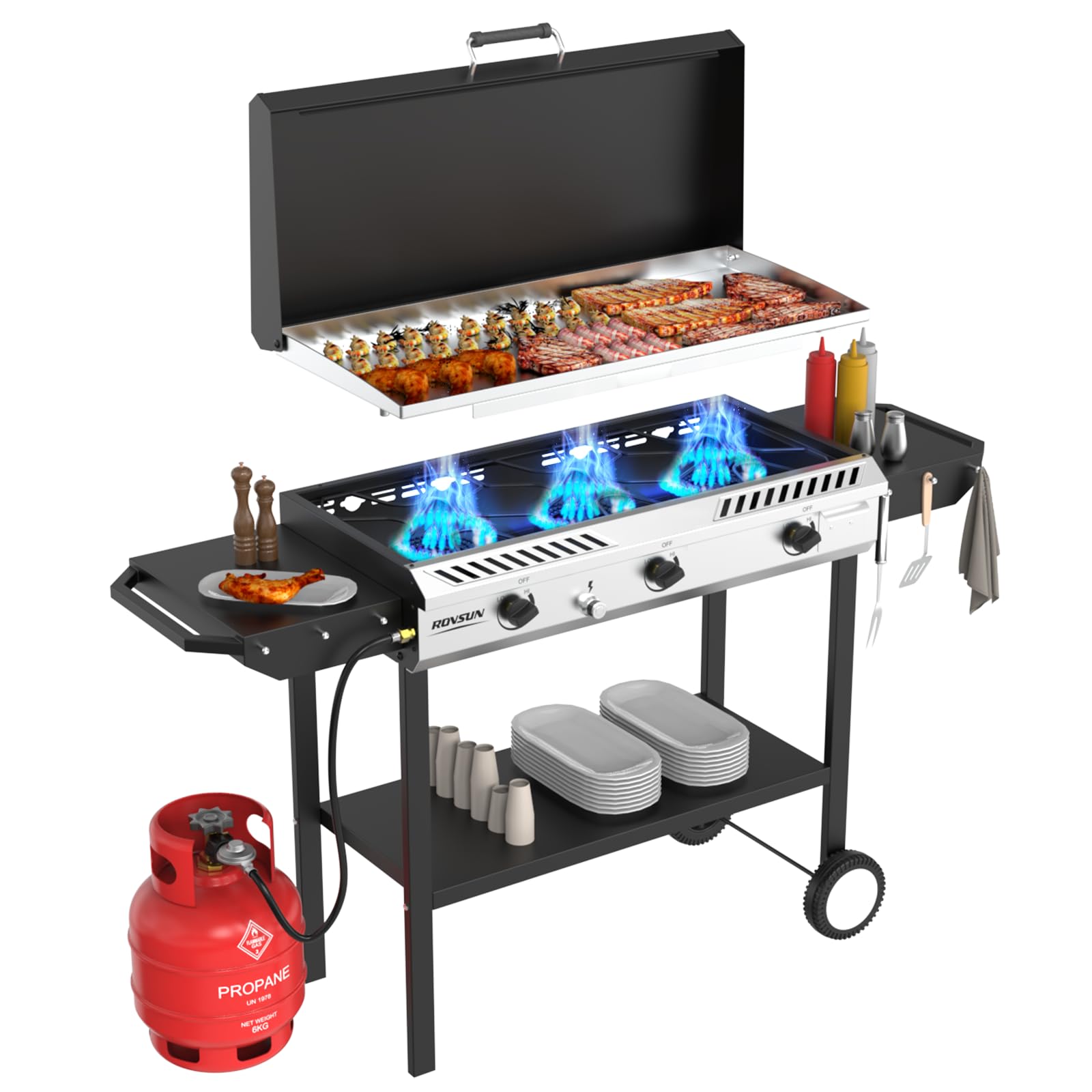
This is the kind of setup that quietly replaces a lot of gear. You’re not just buying burners—you’re buying workflow: a cooktop for pots and pans plus a griddle surface for breakfast runs, burgers, fajitas, stir-fries, and batch cooking. Owners love the versatility because it changes what “outdoor cooking” looks like: you can run multiple dishes at once without juggling separate appliances.
In real use, the win is organization. Side shelves and storage space mean your spices, tools, and trays have a home. That sounds small until you’re cooking for friends and realize you’re no longer balancing everything on a folding chair. Auto ignition adds convenience (especially when you’re lighting multiple burners repeatedly).
The main practical note is heat control at the low end. Several owners mention that simmering can be tricky on very high-output burners— not because it can’t go lower, but because the control range is “compressed.” If your cooking style is sauce-heavy and low-temp delicate, practice your knob positions and consider using smaller cookware to reduce heat load.
Why it’s a backyard game-changer
- Two cooking modes in one footprint – Cooktop + griddle means fewer separate tools.
- Multi-dish speed – Run pots, pans, and griddle food at the same time.
- Ergonomic station feel – Shelves and storage reduce chaos during big cooks.
- Convenient ignition – Push-button lighting makes repeat cooking sessions smoother.
Good to know
- Very high-output burners can make ultra-low simmering less “lazy-easy” until you learn the sweet spot.
- Assembly matters—take your time so shelves and frame align cleanly and stay stable long-term.
- It’s a station, not a tiny camp stove—choose it if you’ll actually use the surface area.
Ideal for: families who cook outdoors often and want a true “patio range” that can do breakfast, dinner, and big-batch events without switching equipment.
4. Concord Triple Burner Stand – The “Cook Three Things at Once” Beast for Big Prep Days
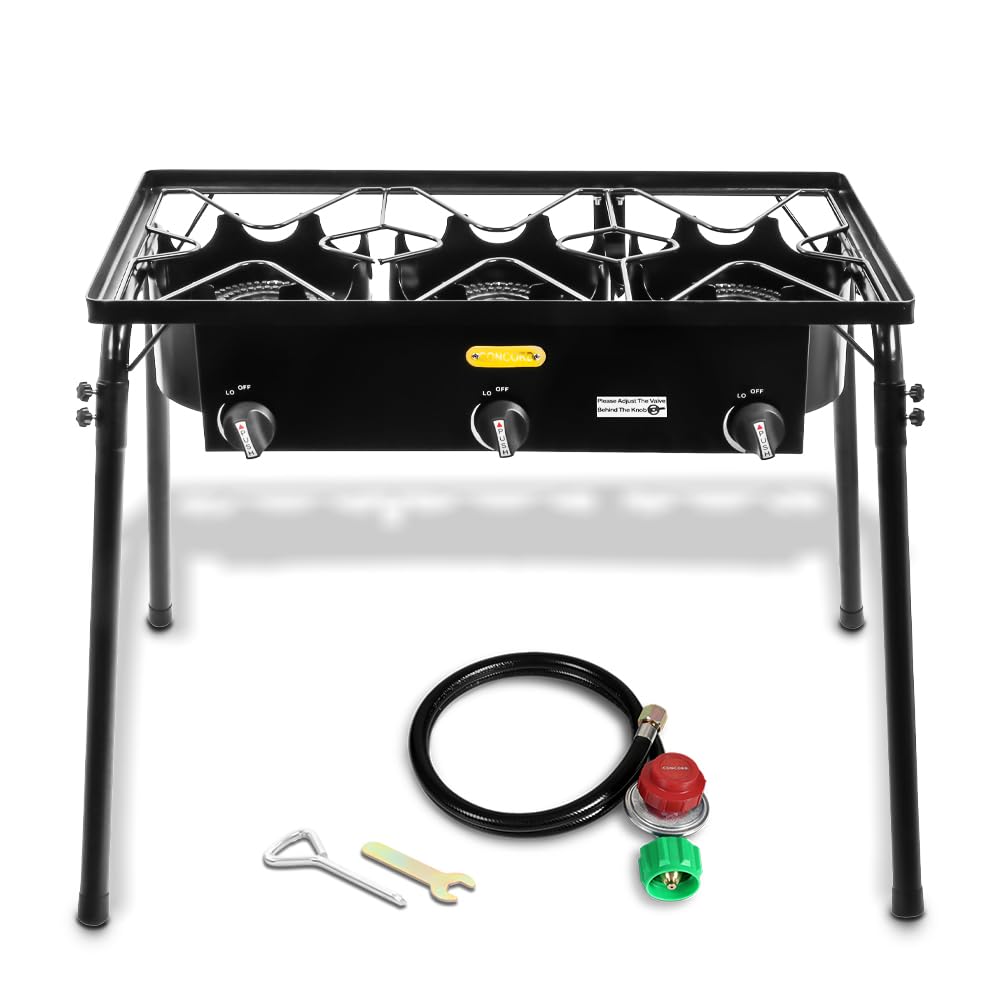
If you’ve ever tried to host a big cookout with one burner, you already know the pain: boil is done, but you still need sides, and the sauce has nowhere to live. This triple burner is built for that reality. Owners love it for batch cooking because it turns “one big pot” into an actual cooking line—boil on one, sauté on another, keep a third for simmering or warm holding.
The best part is how sturdy it feels under load. Multiple users describe strong flame output and stable supports for large pots. The nuance is control: once you learn the valve behavior, you can get both high flame and surprisingly low flame with a delicate touch. That learning curve is normal for high-output outdoor burners—your first session is discovery, your second session is confidence.
One of the most useful real-world notes is wind and flame stability. Owners mention that understanding the valve controls and dialing in the gas/air balance can dramatically improve performance in breezy conditions. Translation: this burner rewards a little “setup knowledge,” then becomes a weekly workhorse.
Why big-cook people love it
- True three-pot workflow – Cook multiple dishes without waiting for burner space.
- Strong, stable frame – Handles big pots without feeling wobbly.
- Wind-tolerant once dialed in – Owners report better results after learning valve positions.
- Portability-friendly design – Detachable legs help storage and transport for events.
Good to know
- Manual ignition means you’ll want a long lighter and a consistent lighting routine.
- Some units benefit from checking fittings on arrival (a quick tighten can solve small leaks).
- It’s built for volume—if you only ever cook one pot, a simpler burner may fit your life better.
Ideal for: batch cooks, big families, and outdoor hosts who want three burners available at once—without building a full outdoor kitchen.
5. Barton Rolling Triple-Burner Station – The “Move the Kitchen Where the Party Is” Setup

A rolling cook station sounds like a gimmick until you’ve cooked for a crowd and realized you’re doing 10,000 steps back and forth for trays, utensils, and pots. This Barton-style station is built around one big idea: make the cook line mobile, with side tables for staging and wheels for repositioning. For camping groups, backyard gatherings, and “keep the heat outside” households, that mobility is a real quality-of-life upgrade.
When this style works well, it feels like you’re running a mini catering setup: three burners available, tables for prep, hooks for tools, and the ability to roll it into storage when you’re done. Owners who love it talk about cooking multiple dishes at once and keeping the house cooler and less smelly.
The honest thing to watch is small-part durability. A recurring complaint across some rolling stations is knob and control hardware quality—especially if plastic components take repeated heat cycles. The smart move is to assemble carefully, avoid overtightening controls, and treat knobs like precision parts (because they are).
Why people choose the cart style
- Mobility – Wheels make it easy to reposition and store without heavy lifting.
- Staging space – Side tables reduce chaos and keep tools within reach.
- Three burners on tap – Great for parties, camping groups, and batch prep.
- Outdoor comfort – Keeps heat and strong smells out of the house.
Good to know
- Control hardware durability can vary; inspect knobs and connections early so issues don’t surprise you later.
- Rolling stations are larger—pick it if you have storage space or an outdoor “home base.”
- If you need “tank-like” knobs, a heavier-duty fixed-frame stove may feel more confidence-inspiring.
Ideal for: backyard hosts and camping groups who want a moveable cooking station with staging space—more like a patio kitchen than a standalone burner.
6. Gas One Double Burner w/ Windscreen – Two Burners, Real Output, and Better Wind Manners

This is the sweet spot for a lot of households: two burners means you can boil and cook sides at the same time, or fry while you keep something warm, or run a brew kettle while a second pot handles sanitizing water. Owners describe it as a “workhorse” because it doesn’t feel like a fragile camp stove—it feels like a purpose-built outdoor cooker.
The windscreen is more valuable than people expect. Wind isn’t just about flames blowing out—it’s about heat being stolen from your pot, causing longer boil times and inconsistent cooking. Even partial shielding can make your heat feel more predictable. That predictability is what turns an outdoor cook from “fussy” into “fun.”
One realistic note from ownership: control can vary slightly side-to-side. Some users report one flame dial feeling looser than the other. That doesn’t mean it can’t cook—it means you’ll learn each burner’s personality. If you want symmetrical perfection, it’s worth knowing up front.
Why it earns repeat use
- Two-burner flexibility – Cook two dishes without juggling cookware and timing.
- Wind help built in – Less heat theft and fewer flame issues in breezy conditions.
- Portable structure – Removable legs make transport and storage more practical.
- High-output capability – Handles big pots and batch cooking without feeling underpowered.
Good to know
- Some users report minor differences in dial “feel” between burners; it’s a learnable quirk, not usually a dealbreaker.
- Like any high-output burner, it rewards a careful first setup (tighten hardware, check fittings).
- If you want counter-height comfort, confirm the stand height works for your body and your cookware.
Ideal for: people who want a serious two-burner outdoor cooker with better wind behavior and real output—great for weekly backyard cooking.
7. Bestfire 2 Burner w/ Auto Ignition – A Patio Cooktop That Can Carry a Kitchen Remodel

Some burners are “event tools.” This one is more like a second kitchen. Owners talk about using it daily on patios and sun porches, especially in electric-only homes or during kitchen remodels, because it gives them back the feel of gas cooking outdoors. Two strong burners at a comfortable height is a simple formula—but when it’s done right, it’s genuinely liberating.
The practical wins are obvious in real use: side shelves keep tools and seasonings close, and wheels make it easy to move into position and back into storage. Auto ignition is also a quality-of-life upgrade if you’re cooking often—you don’t want to hunt for a lighter every time.
The ownership reality: packaging and completeness matters. A small number of buyers report missing hardware or cosmetic dents on arrival. That’s not unique to this model, but it’s a reminder to do a “parts check” right when it lands. Once assembled correctly, people describe it as sturdy and satisfying to cook on.
Why it fits everyday life
- Feels like an outdoor range – Two burners at a comfortable height for daily cooking.
- Auto ignition convenience – Faster start-up for frequent cooks.
- Great staging space – Shelves keep your tools and ingredients organized.
- Mobility – Wheels make storage and positioning much easier.
Good to know
- Check hardware immediately on arrival so missing parts don’t slow your setup.
- Very strong burners can make ultra-low simmering more sensitive—learn your knob positions.
- For tight storage spaces, confirm the footprint works before committing.
Ideal for: patio cooks, electric-home households, and remodel situations where you want a reliable two-burner “outside cooktop” that feels genuinely usable.
8. ROVSUN 2 Burner Stand Cooker – Lightweight, Hot, and Easy to Set Up for Big Pots

This is a classic “does the job” two-burner: strong flames, simple assembly, and a frame that’s easy to move around. Owners who love it tend to highlight the same trio: powerful heat, easy setup, and a surprisingly sturdy feel for the size. It’s a popular choice for backyard boils, frying, steaming seafood, and feeding a crowd without using the indoor kitchen.
The design is friendly for real life. Detachable legs make it easier to transport and store, and front knobs make adjustments less annoying than tank-side-only control. When you’re boiling corn, running a crab pot, or doing batch frying, those small ergonomic wins add up fast.
The recurring caution is the regulator: some users report regulator issues over time (especially if the burner sees frequent use). That doesn’t mean it’s a bad buy—it means you should treat the regulator as a key part of the system, keep it protected from weather, and consider that long-term ownership sometimes includes replacing a regulator on high-pressure rigs.
Why it’s popular
- Strong two-burner output – Great for big pots and multi-dish cooks.
- Easy setup – Detachable legs and straightforward assembly suit events and tailgates.
- Front knob convenience – Adjustments feel more natural than regulator-only control.
- Portable footprint – Practical for storage and transport compared with full cook stations.
Good to know
- Some owners report regulator longevity issues; keeping components dry and protected helps.
- Small cookware can be less stable on wider grates—use appropriately sized pots or add a support plate.
- Like many high-output burners, it rewards a careful “dial-in” session before your first party.
Ideal for: anyone who wants a hot, easy-to-own two-burner setup for backyard boils, tailgating, and big-pot cooking—without buying a full station.
9. ADREAK 2 Burner High-Pressure Stove – Easy Assembly and Strong Heat for Fast Multi-Dish Cooking
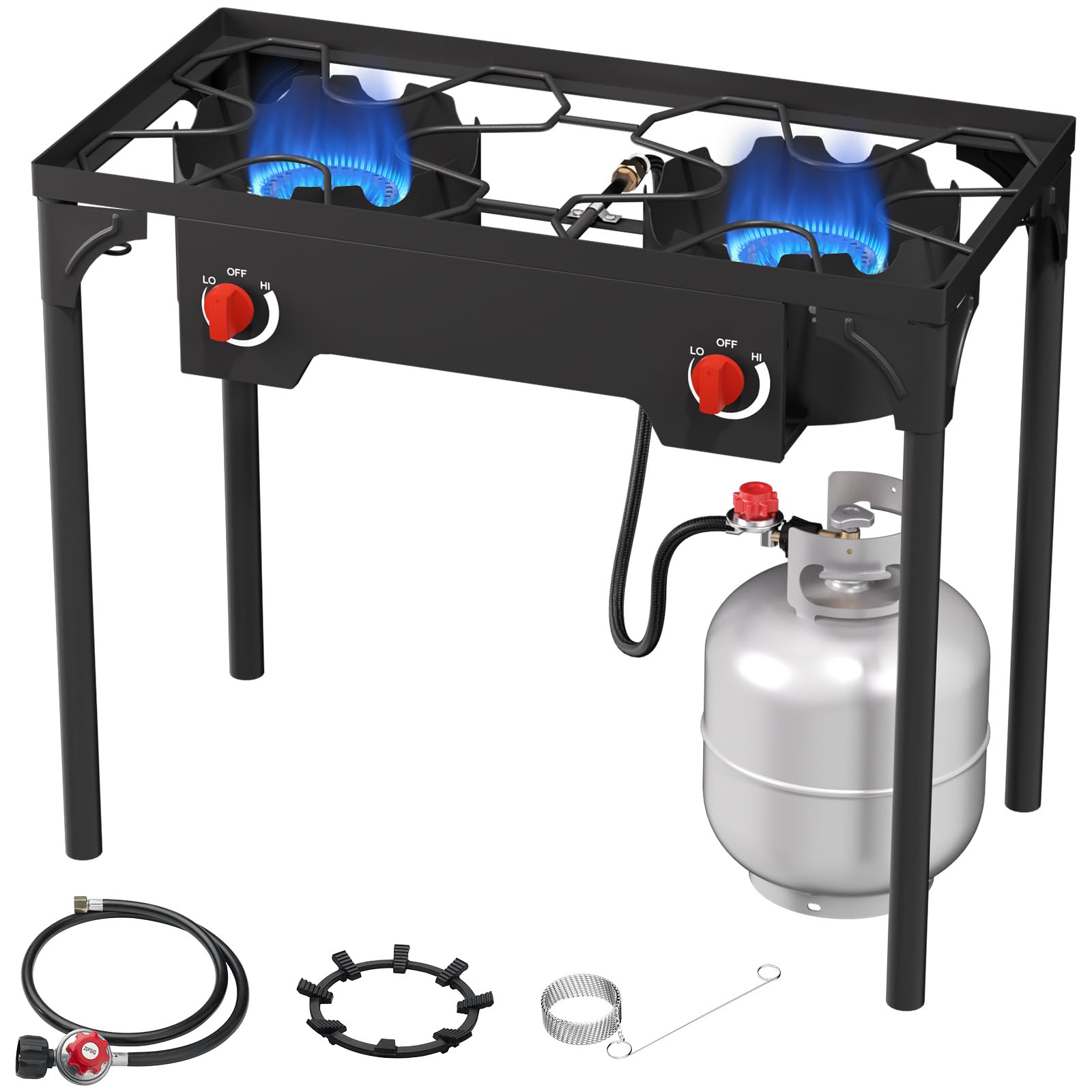
ADREAK’s two-burner format is aimed at the practical outdoor cook: set it up quickly, run two dishes at once, and get real heat for frying and boiling. Owners who like it emphasize the heat output and the convenience of independent knobs—because being able to run “hot fry” on one side and “gentle hold” on the other is how outdoor cooking stops feeling like a one-task-only operation.
This design also fits well into semi-permanent setups. Several people use stoves like this in outdoor kitchens where they want high heat plus adjustable control at the front of the unit. That’s a big deal: controlling heat from the burner body is more natural than crouching at the tank every time.
The build feedback is mixed in a very specific way: the stove body is often described as solid, while some smaller parts (legs or control components) can feel lighter. If you’re buying it for frequent heavy use, assemble carefully, keep bolts tight, and avoid treating it like a “throw it in the truck loose” tool.
Why it’s worth considering
- Independent heat zones – Run two dishes at different flame levels without compromise.
- Quick setup – Tool-free leg assembly helps for events and outdoor gatherings.
- Great for frying control – Owners note it can hold a working temp across longer fry sessions.
- Outdoor kitchen friendly – Easy to integrate into a patio setup.
Good to know
- Some users feel legs and knobs are lighter-duty than the main body; assemble carefully and avoid rough handling.
- As with other high-output burners, small cookware may need a support plate to prevent tipping.
- Do a first-use “dial-in” to learn your low and medium sweet spots before cooking for guests.
Ideal for: outdoor cooks who want two burners with independent control for frying + boiling, and who value fast setup and simple operation.
10. Vivicreate 2 Burner High-Pressure Stove – Tall, Strong, and Built for Big Outdoor Meals

This stove’s appeal is straightforward: two burners, a tall working height, and a frame designed to hold heavy cookware with confidence. Owners who love it often use it for cultural cooking, outdoor events, and big family meals where you need strong heat and room to work. The tall stance is underrated—standing comfortably changes everything when you’re cooking for an hour instead of ten minutes.
In real use, this kind of two-burner shines when you’re running large pots and wide pans. If your outdoor menu includes big batches (stews, seafood boils, frying, or party prep), having two high-output zones lets you keep production moving. That means less “waiting for the pot,” and more “food coming out in waves.”
The key to loving it long-term is setup and storage care. High-pressure stoves do best when the regulator and hose aren’t left exposed to weather, and when the legs are tightened and checked occasionally. Treat it like a tool you maintain—then it stays reliable.
Why it fits big cooks
- Comfort height – A taller stance helps long sessions feel easier on your back.
- Two strong burners – Great for large-pot workflow and big family meals.
- Heavy-pot support – Built to carry serious cookware weight outdoors.
- Event-friendly – Compact enough to move, strong enough to feed a crowd.
Good to know
- As with all high-pressure systems, protect the regulator/hose from rain and long-term sun exposure.
- Very small cookware can be less stable; this shines best with pots and pans sized for the grate.
- If you need built-in wind protection, consider a model with an integrated windscreen.
Ideal for: big-batch outdoor cooks who want a comfortable-height two-burner that can support heavy pots and keep production moving during parties.
11. OuterMust Wok + Burner Kit – The Fastest Way to Start Outdoor Wok Cooking

This is the “I just want to cook outside tonight” option. You get the stand, the burner, and a wok in one bundle, which removes the most common beginner friction: buying a burner that doesn’t match the wok size or stability needs. Owners often praise the stand as sturdy and the heat as strong enough for fast cooking and frying.
The reality with bundled woks is usually the same: the burner and stand can be excellent, while the included wok can be “good enough” rather than premium. That’s not a bad thing. For many buyers, the included wok is a starter tool—use it, learn on it, and upgrade later if you fall in love with wok cooking. The real value is that the system gets you cooking immediately, without compatibility guessing.
Another practical win is adjustability. Adjustable legs and stable foot pads help on patios and uneven outdoor surfaces. That means less wobble and fewer “why is my pot rocking?” moments—especially important when frying or cooking fast.
Why beginners like it
- All-in-one setup – Stand + burner + wok means you can start cooking immediately.
- Good heat for real cooking – Strong enough for frying, sautéing, and batch stir-fry.
- Stable ring support – Designed to hold a wok securely for safer tossing and stirring.
- Easy assembly – Owners often describe it as straightforward to put together.
Good to know
- Included woks in bundles can be basic; many cooks eventually upgrade to carbon steel for performance.
- Temperature control can take a little practice—high heat arrives fast, so learn your medium setting early.
- If your goal is “restaurant wok hei,” a dedicated wok station burner may outperform a general kit.
Ideal for: first-time wok cooks who want a full outdoor setup delivered in one box—great for family gatherings, quick stir-fries, and outdoor frying.
12. GasOne Stainless Single Burner (B‑5200K) – Compact, Adjustable, and Built for “Keep the Smell Outside” Cooking

This is the kind of burner people buy for one job—then keep using for everything. Crab boils, shrimp boils, frying, power outages, and “I’m not cooking that inside.” Owners like the compact size because it travels well in a car and stores more easily than the giant square-frame burners. But the surprise is how capable it feels once it’s lit: wide flame behavior, lots of adjustability, and enough structure to handle real cookware.
Stainless frames are also a quiet win for humid and rainy climates. They can still discolor and pick up “outdoor patina,” but they tend to resist the worst rust problems that cheap painted steel can develop. This is why buyers in coastal or wet regions often prefer stainless even when it costs a bit more.
One repeated owner note: some units arrive with sharp metal edges. That’s not rare in outdoor metal products, and it’s easy to solve with a quick deburr, but it’s worth anticipating so you don’t learn the hard way mid-assembly. Once assembled, users describe it as sturdy and satisfying to operate.
Why it’s so usable
- Compact and portable – Easy to store, easy to transport, still feels capable.
- Wide adjustment range – Works with a griddle, a big pot, or a steady boil with knob tuning.
- Stainless frame advantage – Better rust resistance for outdoor storage realities.
- Great “smell control” tool – Keeps seafood and frying odors outside where they belong.
Good to know
- Check and smooth sharp edges during assembly for comfort and safety.
- Wind management is decent, but in heavy wind you may still want additional shielding.
- As with all high-output burners, start low and climb—full blast can be more than you ever need.
Ideal for: anyone who wants a compact, travel-friendly single burner with strong output—perfect for seafood boils, frying, and emergency backup cooking.
13. GasOne Stainless Single w/ Heat Shield & Guard – A Safer-Feeling Choice for Frying Sessions
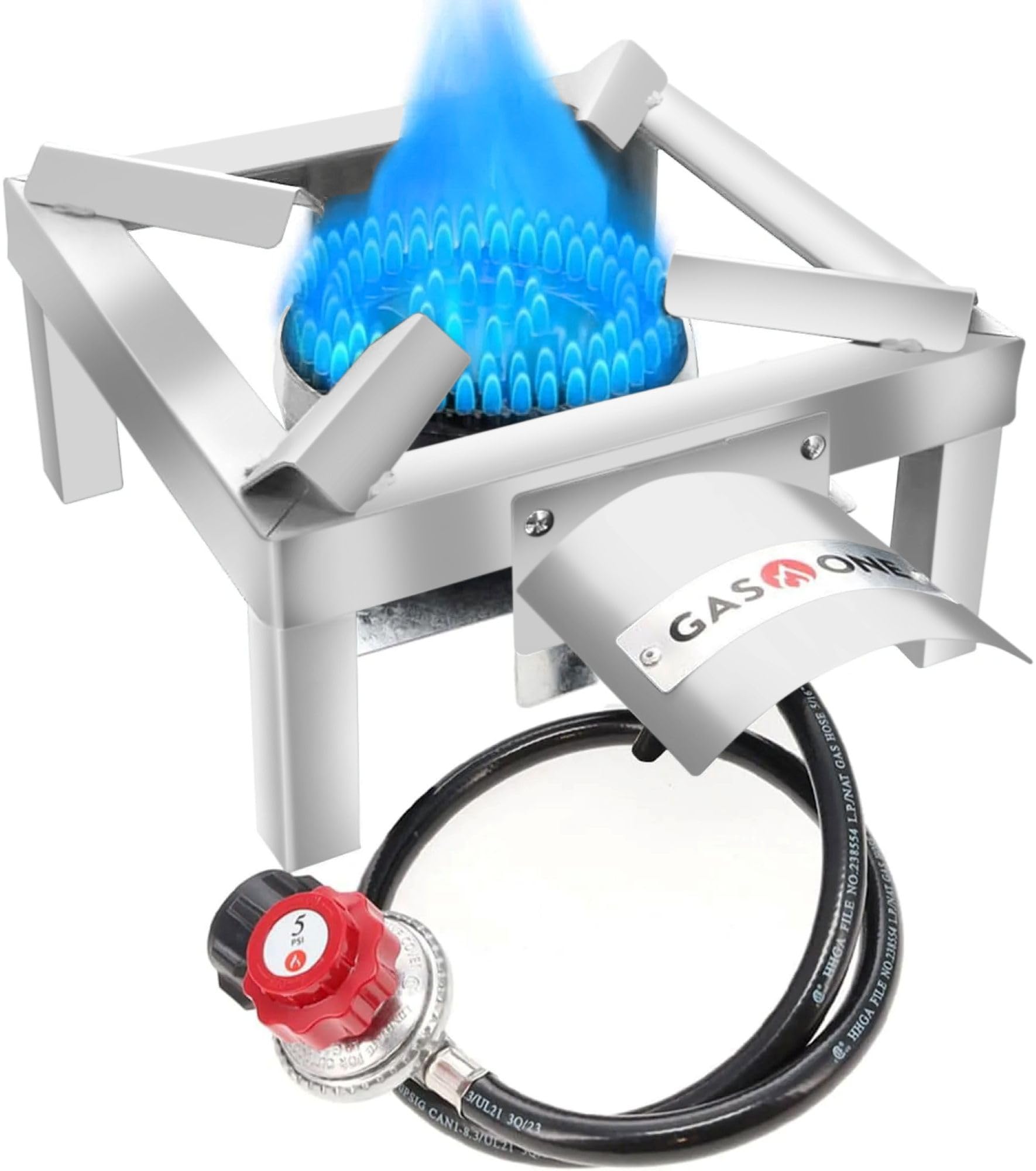
If your main outdoor job is frying—fish fries, wings, turkey parts, anything oil-heavy—this burner’s design choices make a lot of sense. The standout feature is the heat guard / shield approach: it’s meant to help protect the hose connection area from excessive heat and splatter. That’s not “marketing fluff.” Heat management around hoses and fittings is one of the practical safety priorities with outdoor burners.
Owners often describe this type of burner as “simple but strong”—easy to set up, steady flame, and capable output. It’s also a good fit for cookware that wants more even distribution, like wide pans and big cast iron, because the flame pattern is designed to be steady rather than spiky. That can make outdoor cooking feel less finicky, especially if you’re cooking in changing weather.
A realistic note from user experiences on compact metal burners: assembly finish can vary. Pay attention to frame edges during setup and do a quick fitting check before your first cook. Once it’s dialed in, users typically treat it as a reliable “bring it out when we fry” tool.
Why it’s smart for frying
- Heat guard concept – Designed to reduce heat exposure near the hose connection zone.
- Steady flame behavior – Helpful for holding a working oil temperature.
- Durable build – Intended for repeat outdoor use across seasons.
- Simple setup – A practical “grab it and cook” burner for backyard sessions.
Good to know
- Some compact burners ship with sharper metal edges—check during assembly and smooth if needed.
- High output means you should start low and climb to avoid overshooting oil temps.
- If you need counter-height comfort, pair it with a stable surface or choose a taller model.
Ideal for: outdoor fry cooks who want a compact stainless burner with a safety-minded heat guard concept and a steady, controllable flame.
14. GasOne Compact High-Pressure Single (Heat Guard) – Small Footprint, Strong Flame, Easy Storage

This is the burner for people who value footprint. Apartment balconies, small patios, emergency backup kits, and “keep it in the garage” storage all benefit from a low-profile design that still supports real cookware. Users like compact burners like this because setup is fast and the flame can still be strong enough for boiling and frying when your indoor stove is weak or unavailable.
The low-profile frame has a practical advantage: stability on imperfect surfaces. If you’ve ever cooked outdoors on a patio with slight unevenness, you know how much a wobbly stand can ruin your mood. A lower center of gravity makes the system feel calmer—especially with heavier pots.
Like the stainless heat-guard model above, the “guard” approach is meant to help manage heat and splatter around vulnerable connection areas. For oil cooking and long boils, that safety-minded design can add peace of mind—especially for households that use the burner frequently.
Why it’s easy to live with
- Compact storage – Fits small spaces and “backup burner” lifestyles.
- Stable low profile – Less top-heavy feel, especially on uneven surfaces.
- Strong flame potential – Capable enough for boiling and frying tasks.
- Practical heat management – Guard design focuses on protecting key areas during cooking.
Good to know
- Small footprint means less stand height—plan a safe surface to work at a comfortable level.
- For very large stockpots, a bigger frame can feel more confidence-inspiring.
- In strong wind, compact burners may need extra shielding to reduce heat loss.
Ideal for: small-space cooks and emergency-prep households who want a compact burner that still performs like a serious outdoor cooker.
15. GasOne Height-Adjustable Single Burner – The Back-Saving Choice for Brewing, Canning, and Long Cooks

If you’ve ever brewed beer, canned jars, or cooked a big stew outside, you know the hidden pain: you’re standing there for a long time. That’s why height matters. This GasOne design gives you options: a taller stance when you want comfort, and a shorter stance when you want compact stability. Owners specifically praise the “no back pain” benefit because it changes whether you actually enjoy long outdoor cooks.
Performance-wise, it’s built for real heat with a regulator designed for adjustments. People use it for tamales, big pots, brewing, and cooking tasks that need high output and consistent burn. Once you learn how the regulator responds, it becomes very easy to repeat settings reliably across sessions.
This burner shines when you treat it like a “primary tool” rather than a novelty. Keep it clean, keep the hose stored properly, and it becomes the kind of gear your family asks for every time there’s a big cook planned.
Why people keep it
- Comfort height options – Taller setup reduces fatigue during long cooking sessions.
- Strong output – Capable for brewing, canning, boiling, and big-pot cooking.
- Portable design – Legs detach for storage and transport.
- Good adjustability – Regulator control lets you dial heat for different cooking jobs.
Good to know
- As with other high-pressure burners, your first “dial-in” session sets you up for effortless repeats later.
- If you cook with small pots, consider a support plate to improve stability on the grate.
- Store the regulator/hose carefully to extend lifespan and keep performance consistent.
Ideal for: brewers, canners, and long-session outdoor cooks who want a burner that doesn’t punish your back while still delivering serious heat.
16. ARC 55,000 BTU Portable Burner – Light, Wind-Aware, and Easy to Bring to Campsites

Not everyone wants a heavy square-frame burner. If you camp, tailgate, or just want something easy to move around the yard, a lighter portable burner can be the right call. This ARC model is popular because it balances portability with practical cooking features—especially the windshields, which help keep the flame from getting bullied by breezes.
In real use, this is a “do the basics really well” burner: boil water, fry food, cook in a wok or pot, and set up quickly. Owners often mention ease of handling and simple assembly, which matters when you’re doing setup in a driveway, campsite, or picnic table area. It’s also a good match for people who want a second burner rather than replacing their entire outdoor cooking setup.
Because this class of burner is more compact, it’s best with cookware that matches the frame size. If you’re running massive stockpots weekly, a larger, heavier frame can feel safer. But for most portable cooking jobs, this hits a very comfortable balance.
Why it’s a practical portable
- Easy to carry – Lighter frame works better for camping and transport.
- Windshields help – Improves flame stability and reduces heat loss outdoors.
- Quick assembly – Simple leg setup means faster start-to-cook time.
- Versatile cookware – Works for boiling, frying, and simple outdoor meals.
Good to know
- Compact frames are best with cookware that matches their support footprint.
- Manual lighting means you’ll want a reliable long lighter in your kit.
- For long, high-volume canning sessions, heavier “workhorse frames” can feel more confidence-inspiring.
Ideal for: campers and tailgaters who want a portable burner with better-than-average wind behavior and straightforward setup.
17. COOKAMP SA1100 – Simple, Sturdy, and Built for Big-Pot Holiday Traditions

Some burners become “holiday equipment.” Crab boils, crawfish boils, big family seafood days—this COOKAMP-style cooker is exactly that type of tool. Owners describe it as sturdy, easy to hook up, and dependable under large canning or boiling pots. The frame design is clearly meant to support real cookware weight, not just small camping pans.
Where it feels especially useful is repeatability. You’re not buying it to experiment—you’re buying it so your family tradition runs smoothly without tying up the kitchen and without smelling up the house. Users often mention steady performance even when conditions are not perfect (windy days, busy backyard setups).
The main “expert tip” for burners like this: learn your regulator’s response curve. High-pressure systems can go from “not much” to “a lot” quickly, so start low, climb gradually, and you’ll find a stable working zone that repeats every time.
Why it earns loyalty
- Sturdy pot support – Built to hold large cookware without feeling sketchy.
- Great for traditions – Ideal for regular holiday boils and big-family cook days.
- Easy hookup – Straightforward connection and setup for backyard use.
- Versatile cooking jobs – Works for boiling, steaming, frying, and big-batch meals.
Good to know
- High-pressure control takes a quick learning session—then becomes easy and repeatable.
- Like other outdoor burners, it performs best with some wind shielding and stable placement.
- If you need multi-dish cooking, consider a two-burner or three-burner station instead.
Ideal for: families who do big seafood boils and holiday outdoor cooking, and want a dependable single burner that supports large pots confidently.
18. Concord 12″ The Block Burner – Small, Tough, and Shockingly Capable for Its Size

This is the burner people buy because it looks simple—and then keep because it’s genuinely useful. It’s compact, has a carry handle, and is built around a sturdy welded frame concept that’s meant to survive real outdoor life: tailgating, camping, backyard cooks, and being moved around constantly. Owners often describe it as lightweight for the output class and easy to set up fast.
Where it shines is “high heat without high drama.” It gets hot quickly, works well with woks and pots, and feels like a practical alternative when your indoor stove can’t maintain a rolling boil or you want to keep cooking odors outside. It’s also a solid emergency backup because it stores easily and doesn’t demand a big footprint.
The main ownership watch-out is the regulator. Some owners love the burner but report the regulator being the weak link over time. That’s not unique to this model—regulators are consumable parts in outdoor cooking—but it’s worth knowing so you’re not surprised.
Why it’s so easy to own
- Compact portability – Carry handle + small footprint makes storage and transport simple.
- Fast heat – Gets hot quickly for boiling and high-heat cooking jobs.
- Tough frame concept – Welded structure feels built for real use, not delicate handling.
- Great backup tool – Useful for power outages, weak indoor stoves, and outdoor cooking routines.
Good to know
- Regulator longevity can vary; treat it carefully and store it protected from weather.
- Manual ignition requires a long lighter (simple, reliable, and consistent).
- For very large stockpots, you may prefer a bigger support footprint for maximum stability.
Ideal for: portability-first shoppers who still want real heat—great for tailgating, camping, backyard cooking, and emergency backup use.
How High‑Pressure Propane Burners Actually Behave Outdoors (and How to Master Them)
High-pressure burners are incredible… once you understand what they’re doing. Most frustration comes from expecting them to behave like an indoor stove. They don’t. Indoor stoves are designed for tight control at lower output in a sheltered environment. Outdoor burners are designed for fast energy delivery in open air—where wind, cold cookware, and large volumes steal heat constantly.
Why “max heat” isn’t the real goal
- Boiling: your goal is sustained rolling boil, not maximum flame height. If you overshoot, you waste fuel and create unnecessary turbulence.
- Frying: your goal is stable oil temperature. A burner that spikes hard can overshoot quickly, then force you to “chase” the temp.
- Wok cooking: your goal is heat recovery and focused energy. You want fast response when ingredients hit the pan, not random flame everywhere.
A practical approach: treat your first cook as calibration. Find your “working zones”: low (simmer/hold), medium (steady boil), high (fast recovery / sear), and blast (rarely needed). Once you know those zones, outdoor cooking becomes repeatable instead of chaotic.
How to get cleaner flame behavior
- Start low, then rise: lighting on low reduces flare-ups and helps you avoid sudden overshoot.
- Adjust air mix when available: many burners include an air shutter. A cleaner, bluer flame typically indicates better combustion.
- Use cookware that matches flame: a massive flame under a tiny pot wastes heat and can feel unstable.
- Shield from wind: wind doesn’t just blow flames out—it steals heat from your pot walls and extends cook time.
That’s why built-in windscreens (or even simple staging behind a windbreak) can make a burner feel dramatically “stronger” without changing the burner at all.
The control trick most owners discover later
- Use the tank valve for “ballpark”: open the tank enough for steady flow (don’t micro-adjust constantly at the tank).
- Use the regulator for coarse output: set it to your general heat range.
- Use burner knobs for fine control (when present): the best setups give you a stable knob on the burner body, which is easier to manage while cooking.
This three-step method is why some burners feel “effortless” and others feel “touchy.” If a burner forces all control through the regulator only, it can still work great—but you’ll feel it more during active cooking.
Stability and safety habits that make everything better
- Place on a stable surface: patios and decks can flex; choose a location that feels solid and level.
- Use a quick leak check routine: a simple soapy-water check on connections helps spot issues early.
- Keep hose routing clean: avoid hose contact with hot surfaces and keep it away from foot traffic.
- Respect oil cooking: the stronger your burner, the faster things happen—temperature moves quickly, so your attention matters.
The best outdoor setups aren’t just powerful—they’re calm. Stable frame, predictable control, and a repeatable cooking rhythm. That’s what turns a burner into something you actually enjoy using.
FAQ: Outdoor Burners (Clear Answers, No Confusion)
Do I need a super high BTU burner for seafood boils?
Why do some burners feel impossible to simmer on?
Is stainless steel always better than painted steel?
Which burner type is best for wok cooking?
What should I check right after unboxing?
Can I use these burners during a power outage?
Final Thoughts: Pick the Burner That Matches Your Real Cooking Life
Here’s the simplest way to make a confident decision: buy the burner that solves your most common cooking problem. Not your “once a year” fantasy cook. Your weekly reality.
If you want my fastest “shortcut” recommendations, here they are:
- Want the best all-around single burner for most people? Start with the GasOne 200K BTU Propane Burner. It’s the right blend of power, stability, and versatility for boils, frying, and brewing.
- Want true stir-fry performance with wok-focused engineering? Go for the Concord Professional Vortex Wok Range. It’s built around flame geometry and wok motion, not generic “outdoor stove” design.
- Want the most versatile backyard station (cooktop + griddle)? Choose the ROVSUN 3 Burner Stove + Griddle for a patio workflow that feels like an outdoor kitchen upgrade.
- Want multi-pot capacity for big prep days? The Concord Triple Burner Stand is a classic “cook three things at once” tool for serious batch cooking.
- Want a mobile cook line with staging space? Look at the Barton Rolling Triple-Burner Station if your cooking style benefits from wheels and side tables.
- Want a strong two-burner that behaves better in wind? The Gas One Double Burner w/ Windscreen is a great “boil + sides” setup that feels built for outdoor conditions.
- Want a ready-to-go wok kit (no compatibility guessing)? The OuterMust Wok + Burner Kit is the fastest way to start cooking outdoors with a full setup in one box.
- Want compact portability for tailgates, camping, or backup cooking? Consider the Concord 12″ The Block Burner or the ARC 55,000 BTU Portable Burner for easy storage and fast setup.
At the end of the day, the “best” purchase is the one that feels calm under pressure: stable frame, predictable control, and the right flame pattern for your cookware. Pick the outdoor propane gas burner that matches how you actually cook—and your next boil, fry, or stir-fry won’t feel like a project. It’ll feel like fun.
