
An “air fryer” isn’t just a crispy‑fries gadget anymore. It’s the appliance you reach for when you want dinner fast, the kitchen cooler, and cleanup that doesn’t feel like a second job. And when you’re shopping Ninja, you’re not choosing between “good” and “bad” — you’re choosing between workflows: double ovens that cook two meals at once, flip-up ovens that give your counter back, steam‑and‑crisp systems that rescue leftovers, and dual baskets that keep wings and veggies finishing together.
If you’re shopping for a ninja stainless steel air fryer, you’re probably trying to solve one of these real problems: your full-size oven is slow (and makes the house hot), your current air fryer is too small (or messy), your food comes out uneven unless you babysit it, or you’re ready to replace three appliances with one that you’ll actually use every day.
This guide is built around the stuff that determines whether you’ll love your purchase six months from now: how the controls behave when you’re in a hurry, whether the trays clean up without drama, what “crispy” really looks like with wet marinades, how much clearance you need under cabinets, and why some Ninja models toast like a dream while others are better treated as “an oven first.”
Below are 11 standout Ninja picks — from premium double‑stack ovens to space‑saving flip designs and one classic dual‑basket workhorse. You’ll get a quick comparison table, then deep reviews that focus on real-life ownership: the learning curve, the cleanup rhythm, and the cooking habits each model rewards.
In this article
- How to choose the right Ninja model for your kitchen and your cooking style.
- Quick comparison table of 11 standout Ninja picks.
- In‑depth reviews of each model, with real-life pros and cons.
- How to get crisp, even results (without guessing or constant shaking).
- FAQ + final buying advice so you can pick confidently.
How to Choose the Right Ninja Stainless Steel Air Fryer
A Ninja air fryer is “worth it” when it matches your reality: your counter space, your typical portions, your patience for cleanup, and whether you want one appliance to replace your oven (or just make weeknights easier). Here’s the framework I use to help people pick the model they’ll still be excited to use after the honeymoon phase.
1. Pick your form factor first — it decides everything
Ninja sells multiple “air fry” styles, and they cook differently because the airflow geometry is different. Start here — it’ll save you from buying the right brand in the wrong shape.
- Double‑oven countertop systems: Two independent cooking zones in one body. Best when you want a full meal (protein + side) finishing together, or you’re cooking for different diets in the same house.
- Air fry ovens (toaster‑oven style): One cavity, usually multiple rack positions. Best for pizza, sheet‑pan style cooking, and “I want one appliance to handle everything.”
- Flip‑up ovens: Same air‑fry‑oven concept, but designed to store vertically to reclaim space. Best for small kitchens, RV life, or anyone who hates counter clutter.
- Dual‑basket air fryers: Two drawers, two fans, two timers. Best for maximum crisp and speed, especially for fries/wings/veg, without heating an oven cavity.
- Steam + crisp combi ovens: Uses steam to keep food juicy, then blasts air to finish crisp. Best for fast “full meals” and reheating proteins without drying them out.
2. Understand the “crispy equation” (and stop blaming yourself)
Most “my air fryer isn’t crispy” complaints have nothing to do with the brand and everything to do with physics: air fryers crisp by driving moisture off the surface while hot air circulates. Four things control crispness:
- Surface moisture: Wet marinades and saucy coatings need a two-stage approach (dry first, glaze later) if you want real crunch.
- Air exposure: Food needs space. Overcrowding turns “air fry” into “steam.”
- Heat intensity near the surface: Rack height matters — closer to the top element browns faster, but can burn if you don’t adjust time.
- Fat delivery: A light oil mist often crisps better than “no oil at all,” especially for vegetables and breaded foods.
This is why some Ninja models earn a fanbase: they make the crispness equation easier to win by pushing more air, heating faster, and giving you rack positions that let you “choose your browning.”
3. Don’t shop by function count — shop by what you’ll use weekly
“12-in-1” and “14-in-1” sound great, but the best model is the one that nails your actual weekly rotation. Ask yourself which of these is your real life:
- Toast and breakfast daily? Prioritize models known for consistent toast and easy crumb management.
- Pizza and big batches? Prioritize cavity width, rack stability, and even convection.
- Protein doneness anxiety? Prioritize a thermometer system that makes “rare to well done” less of a guessing game.
- Meal prep and family dinners? Prioritize capacity and two-level cooking, not tiny accessories.
- Small kitchen / clutter sensitivity? Prioritize flip‑up storage or a smaller footprint design.
4. Probe systems: the underrated feature that changes confidence
If you’ve ever overcooked chicken because you didn’t want it underdone, a temperature probe isn’t “extra.” It’s a daily stress remover. Ninja’s probe-equipped models shine when you cook:
- Chicken breasts (the easiest to dry out).
- Thick pork chops or tenderloin.
- Steak when you care about doneness.
- Whole birds or roasts where timing varies wildly by thickness and starting temp.
The bigger benefit isn’t the thermometer itself — it’s the way it changes your workflow. You can cook sides without hovering, because the protein is being monitored and you’re not relying on “minutes per pound” math.
5. Countertop reality: heat, clearance, and where the vents go
A lot of disappointment comes from buying a “perfect” oven and then realizing it needs breathing room. Before you buy, plan for:
- Back clearance: Many oven-style units vent from behind. Give them space so heat can escape and the fan can do its job.
- Upper cabinet clearance: Some models run hot on top or release steam. If you’re tight under cabinets, choose accordingly or keep the unit pulled forward during use.
- Door clearance: Double-oven designs and larger drop-down doors need room to open fully without forcing awkward hand positions.
- Noise tolerance: Most high-convection appliances use audible fans. The question is whether the sound will bother you or blend into normal kitchen life.
6. Cleaning is the “hidden spec” that decides whether you’ll use it daily
You don’t need an air fryer that’s technically powerful if it becomes a pain to clean. Look for these practical wins:
- Crumb tray access: Easy removal means you’ll actually empty it weekly, which reduces smoke and burnt smells.
- Dishwasher-safe accessories: Not every tray should be dishwashed — but when key parts can be, it changes your weeknight rhythm.
- Smooth interior surfaces: Less texture means less grease grip.
- Smart “mess capture” habits: Using parchment (trimmed so it doesn’t lift into heating elements) and a catch tray prevents baked-on splatter that becomes a weekend project.
7. Decide if you want an “oven replacement” or an “air fryer upgrade”
This is the final decision that simplifies everything:
- Oven replacement mindset: Choose larger oven-style models (or double ovens) that can bake, roast, toast, and air fry without feeling cramped.
- Air fryer upgrade mindset: Choose basket-style dual zones for peak crisp and speed, or a flip-up oven for space efficiency.
Once you know which mindset is yours, the right model becomes obvious — and you stop paying for features that look cool but don’t fit your life.
Quick Comparison: 11 Ninja Stainless Steel Air Fryer Picks
Use this table to match a model to your lifestyle fast — then jump to the in-depth reviews for the “ownership” details, like cleanup rhythm, cabinet clearance, and which designs feel effortless when you’re cooking two things at once.
On smaller screens, swipe or scroll sideways to see the full table.
| Model | Style | Signature strength | Best match | Amazon |
|---|---|---|---|---|
| Ninja Double Stack XL (DCT601) | Double oven | Two independent ovens + FlavorSeal separation + synced finish timing | Families who want full meals done together without back‑to‑back cooking | Amazon |
| Ninja Double Stack XL Pro Cook (DCT651) | Double oven | Everything in DCT601 + Pro Cook thermometer “doneness” workflow | Serious home cooks who want precision proteins with two‑zone meal speed | Amazon |
| Ninja Foodi Dual Heat (SP351) | Flip oven | Heated sear plate + high-airflow crisp for “restaurant-style” browning | Steak lovers, pizza fans, and small households who crave fast browning | Amazon |
| Ninja Smart Double Oven (DCT451) | Double oven | Two cavities, smart finish timing, thermometer, and daily versatility | Households cooking different foods at once (and tired of big-oven waste) | Amazon |
| Ninja Prestige Smart XL Pro Cook (DT551) | Air fry oven | Smart Surround Convection + probe system for doneness without babysitting | “One appliance does most things” shoppers who want reliable proteins | Amazon |
| Ninja Combi (SFP701) | Steam + crisp | HyperSteam + air fry for fast full meals and reheats that stay juicy | Busy cooks who want “frozen-to-table” speed and better leftovers | Amazon |
| Ninja Prestige Smart XL (DT501) | Air fry oven | Big capacity, two-level even cooking, fast preheat, clean interface | Batch cooks and families who want oven versatility without the probe | Amazon |
| Ninja Foodi Digital Air Fry Oven (SP101) | Flip oven | Ultra-fast preheat + flip-up storage + strong everyday versatility | Small kitchens, RV users, and anyone who wants power without bulk | Amazon |
| Ninja French Door Premier (FO101) | French door | One-handed doors + dishwasher-safe accessories + clean, premium workflow | Hosts and daily cooks who want easy access and easy cleanup | Amazon |
| Ninja Foodi DualZone (DZ201) | Dual basket | Two independent drawers with synced finish timing for peak crisp | Fries + wings + veggies households who want max crisp, zero flipping drama | Amazon |
| Ninja Flip OvenCrisp (SP151) | Flip oven | Infrared + convection crisping with a smaller footprint and vertical storage | Space-first kitchens that still want real air-fry power | Amazon |
In‑Depth Reviews: 11 Ninja Stainless Steel Air Fryer Models That Actually Feel Different
Now we go model by model — not like a spec sheet, but like someone who wants you to win weeknights. I’ll focus on what you’ll notice after the first month: how fast it really feels, how it handles messy foods, whether cleanup stays easy, and which cooking habits each design rewards.
1. Ninja Double Stack XL (DCT601) – The Two‑Meal Workhorse That Makes Dinner Feel Organized

If you cook more than one thing most nights — or you cook for people who don’t eat the same — the DCT601 is the model that makes you feel like your kitchen runs on rails. Its superpower isn’t “more functions.” It’s parallel cooking: two independent ovens that can run different modes, temps, and times — and then sync so both finish together. That sounds simple until you’ve lived it: steak in one zone, roasted vegetables in the other; kids’ nuggets up top while dinner roasts below; entrée and dessert without waiting for a single cavity to free up.
Real-life owners tend to describe the same “aha” moment: meal production gets faster because you stop doing back‑to‑back cycles. Even better, the FlavorSeal concept (keeping smells separate) matters more than you’d think. People who cook fish and meat in the same evening often notice less flavor crossover than in a single-cavity oven, which makes the appliance feel genuinely smarter than a typical toaster-oven air fryer.
The second reason I like it as a best-overall pick is the learning curve. You’ll still want a few practice runs — every multi-zone machine has its own rhythm — but the controls are designed for quick setup, and once you “get” how Smart Finish works, it becomes muscle memory. Owners also frequently mention that the unit looks premium on the counter in stainless, and the two-door layout feels modern and intentional rather than gimmicky.
Now the honest part: this is a big, powerful countertop appliance. It uses real airflow, so fan noise is part of the deal — not obnoxious to most households, but not silent either. And because it’s a double system, you’re dealing with multiple trays and racks. If you’re the kind of cook who hates handwashing larger accessories, plan your cleanup strategy early (more on that below).
The best way to “win” with this model is to treat it like a mini kitchen system: keep one zone as your default “main,” and the other as your default “support.” Your weeknight brain loves defaults. Example: bottom zone for air fry/roast proteins, top zone for toast/reheat sides. Once you adopt defaults, you stop feeling like you’re managing a machine — you feel like you’re running a routine.
Why you’ll love it
- Two meals, one finish line – Smart Finish is the difference between “staggered chaos” and “everything hits the table together.”
- Smell separation is real-life useful – FlavorSeal helps when you cook fish, spicy foods, or mixed diets in the same night.
- Built for busy kitchens – This model rewards meal planners and “cook protein + side” households immediately.
- Premium feel on the counter – The stainless look and dual-door layout feel intentional and modern.
Good to know
- It’s not small — measure your space and plan cabinet clearance before you commit.
- Fan noise exists (it’s a high-airflow machine); most people adjust quickly, but it won’t disappear.
- Large trays often prefer handwashing; building a simple cleanup routine matters.
Ideal for: families and busy households who want a true “two‑meal at once” countertop system that makes dinner faster, cleaner, and less mentally tiring.
2. Ninja Double Stack XL Pro Cook (DCT651) – Precision Proteins + Two‑Zone Speed

Think of the DCT651 as the “grown-up” version of the Double Stack idea: it keeps the two-zone workflow, but adds a doneness system that reduces your biggest protein risk — overcooking because you were trying to be safe, or undercooking because you didn’t want to dry it out. If you cook a lot of chicken, pork, or steak, a probe system becomes a daily confidence feature. It lets you focus on sides and timing while the machine monitors the internal temperature for you.
This matters more in a dual-oven design than in a single cavity. Why? Because a two-zone system encourages parallel cooking, and parallel cooking is where mistakes happen: you’re adjusting two foods, two timers, two trays, and suddenly you’re guessing whether the chicken is done. The probe workflow removes that guess — and the result is a calmer kitchen.
Owners who buy the probe-equipped version often mention a short learning curve, but they also describe it as “fun” once they get the hang of it. That’s the right word: when a machine makes doneness predictable, you cook more confidently — and you try more foods. People also like that the unit can replace separate appliances, because the air-fry portion is strong enough for crisp snacks while the oven modes handle real cooking.
Just like the non-probe version, this is a substantial countertop unit. The best way to avoid frustration is to plan your placement: give it breathing room behind and above, and don’t tuck it into a tight corner where door movement becomes awkward. A lot of households also add a simple “heat buffer” habit (like keeping a board on top when not cooking, and pulling the unit forward when cooking) to protect cabinets and make airflow easier.
Where it really shines is “full course cooking.” Example routine: probe a thick protein in one cavity, then use the second cavity to roast vegetables and crisp potatoes. Smart Finish syncs your timing, so you’re not staring at a clock. It’s not just speed — it’s the feeling that dinner is under control.
Why it’s special
- Probe system reduces doneness stress – Great for chicken breast, pork, steak, and roasts where timing varies.
- Two-zone speed without two-zone chaos – Smart Finish + monitored protein is an elite combo for weeknights.
- High “appliance replacement” potential – Many households retire separate air fryers/toasters after adapting.
- Confidence for entertaining – You can run multiple dishes without hovering or constantly opening doors.
Good to know
- Big footprint and real airflow: plan space and accept that fans are part of performance.
- Probe systems reward practice — do a couple “easy wins” (like chicken thighs) before you rely on it for a big meal.
- Like most premium ovens, accessories and racks still need a consistent cleaning rhythm to stay pleasant.
Ideal for: home cooks who want the fastest “protein + side” workflow and love the idea of precision doneness without babysitting two separate dishes.
3. Ninja Foodi Dual Heat (SP351) – The “SearPlate” Model for People Who Want Browning, Not Just Crisp

Most air fry appliances are great at crisping the outside of breaded foods, but “real browning” on proteins can still feel elusive. The SP351 exists for people who care about that difference — the cast-iron-style surface contact, the quicker browning on steaks and burgers, and the kind of pizza finish where the edge crisps instead of staying pale.
The signature feature here is Dual Heat: rapid circulating hot air plus a directly heated plate. That combination changes what the appliance is good at. It’s not just “air frying” — it’s a browning tool. People who buy this model often talk about how quickly it preheats, how strongly it performs for pizza and reheat, and how it replaces their daily use of the big oven because it’s simply faster and less wasteful for small-to-medium meals.
The flip-away storage is also a legitimate quality-of-life upgrade when it fits your kitchen. In many homes, it takes up about the footprint of a toaster when stored vertically, which means you can keep it out and still feel like you have counter space. That said, storage only feels amazing if the cord placement and your outlet layout cooperate. If your outlet sits directly behind the unit, the plug and cord can influence how close you can push it back. In a small kitchen, that detail matters.
The “expert” way to use this model is to treat rack position as your browning dial. The SP351 can cook fast and brown aggressively near the top elements. That’s a win — as long as you adjust. If you’re coming from a conventional oven, start with a slightly lower time than you think, use the light, and build your personal presets. Owners regularly mention a learning curve with convection timing, but also mention that once you learn it, results are wildly consistent.
Cleaning is the trade-off. This isn’t a “never wipe it” appliance. It rewards weekly crumb removal, quick wipe-downs, and being realistic about splatter. If you cook greasy proteins and never clean, you’ll eventually get smoke and residue — and you’ll feel annoyed at the design. If you clean as you go, it stays enjoyable.
Why it stands out
- Browning power – The heated plate concept is a real advantage for steaks, burgers, and crisp-edged pizza.
- Fast daily use – Many people stop using their full-size oven for weeknight meals.
- Flip-away storage – Huge space win if your cabinet height and outlet placement support it.
- Thermometer confidence – Great for avoiding dry chicken and “is this done?” anxiety.
Good to know
- Outlet/cord positioning can affect how neatly it stores; plan your placement.
- High heat means you need a cleaning habit — crumbs and splatter build up if ignored.
- Rack position is powerful but can burn food if you don’t adjust for convection speed.
Ideal for: cooks who care about real browning and want a compact, powerful daily oven that can sear, crisp, and reheat with “restaurant-ish” results.
4. Ninja Smart Double Oven (DCT451) – Two Zones for Two Diets (Without Heating the Whole House)

The DCT451 is a real solution for a specific household problem: “We don’t eat the same… but we still want dinner at the same time.” Owners who love this model tend to describe exactly that scenario — one person cooking fish, another cooking meat; one person needing quick toast and reheat, the other roasting a main dish. The two-cavity setup makes that feel simple instead of like a negotiation.
A big reason this model earns love is that it helps people stop firing up the big oven for small meals — especially in warm months. In real-life feedback, people often mention that it’s fast, it cooks per instructions with fewer adjustments than some ovens, and it’s satisfying to use daily. The controls are separate for each cavity, which keeps the mental load lower than you’d expect. You’re not doing “math oven.” You’re doing two straightforward presets.
There are also small design details owners call out: an interior light (huge for learning convection timing without opening the door), included trays that feel more substantial than flimsy accessories, and the feeling that the outside doesn’t become dangerously hot the way some budget countertop ovens can. That combination matters if you have kids, pets, or just a busy kitchen where people brush past the counter.
Now the honest trade-offs — because this is where people get surprised. First, the top cavity is designed for rapid oven tasks like toast and reheat, but it doesn’t offer every mode you might wish for. Some households want air fry everywhere, and this model is more “specialized zones” than “two identical ovens.” Second, door mechanics and handle clearance can matter depending on where you place it. If you push it far back under cabinets, you may find the door interaction less comfortable. That’s not a defect — it’s a placement issue. But it’s real.
The pro move: decide early which foods belong in which cavity and stick to it. This model rewards routines. For example: top cavity for toast/bagel/reheat and small sheet-pan snacks; bottom cavity for air frying, convection baking, and roasting. When you use it that way, it feels like two appliances that cooperate — not two ovens competing for your attention.
Why it wins homes
- Two‑diet friendly – Great for households that cook different foods at the same time (fish vs meat, spicy vs mild, etc.).
- Fast daily cooking – Helps you stop using the big oven for small meals and snacks.
- Thoughtful usability – Interior light and separate controls reduce “guess and check” cooking.
- Accessory quality feels solid – Many owners notice heavier trays and a more premium feel.
Good to know
- The top and bottom zones aren’t identical in function — plan your zone roles.
- Placement matters for door clearance and comfort; don’t wedge it in a corner and expect elegance.
- Some households choose to add a second crumb tray for convenience if they use both cavities heavily.
Ideal for: couples and families with different eating preferences who want “two foods, two ways” without turning the kitchen into a heat box.
5. Ninja Prestige Smart XL Pro Cook (DT551) – Big Oven Energy on a Countertop (With Doneness Confidence)

The DT551 is the model you buy when you want a countertop oven that behaves like a serious oven — not a “tiny box that sometimes air fries.” It’s built for big capacity, fast preheat, and all-around convection that reduces the need to rotate trays constantly. That “even cooking without babysitting” is the main reason people pick the Prestige line.
Where the DT551 separates itself is the Pro Cook system. If you cook proteins often, it’s hard to overstate how much mental load a probe removes. Instead of watching the clock and hoping your chicken is done, you watch doneness and let time become secondary. Owners who like this approach often describe cooking as faster and less stressful — especially for roasts, whole birds, and thick cuts where timing varies by thickness.
Another detail people love is the interface design. The display and guidance cues reduce the “which rack height should I use?” question. That might sound minor, but it’s the difference between an appliance that feels intuitive and one that feels like you need a chart taped to the wall. If you’re feeding a family and cooking often, intuitive matters. It reduces errors and makes the appliance feel like a tool, not a project.
Now for the real-life honesty: this is a powerful convection oven. It has a fan. It moves air aggressively. That means noise exists and the unit can run hot in places — because that’s what high convection does. It also means you should treat early cooks as calibration. Your usual oven times won’t always match. You’ll often reduce time, and sometimes reduce temperature slightly, especially for baked goods. Once you calibrate, the unit becomes consistent — but you need that short “learning window.”
There’s also a practical point many owners discover: toasting is good, but it may not replace a pop-up toaster for every household. If you’re extremely picky about toast consistency or you only toast one or two slices daily, you may still like a cheap slim toaster alongside this oven. That doesn’t make the DT551 worse — it just means its real superpower is being a countertop oven that can roast, bake, air fry, and handle meal-sized jobs confidently.
Why it earns loyalty
- Probe-driven doneness – Removes the biggest stress point in home cooking: “is it done yet?”
- Big capacity, real oven behavior – Great for batch cooking, roasts, and multi-rack meals.
- Even convection workflow – Less rotating and flipping compared to many countertop ovens.
- Interface helps you cook smarter – Rack guidance and clear controls reduce mistakes and speed up routines.
Good to know
- Strong convection means fan sound and airflow heat are part of performance — plan placement and expectations.
- Expect a calibration period for baking times; it often cooks faster than you think.
- If toast is your #1 priority, you might still prefer a small pop-up toaster for daily simplicity.
Ideal for: cooks who want one countertop oven for big meals and reliable proteins — and who love the idea of doneness guidance instead of timer guessing.
6. Ninja Combi (SFP701) – Steam + Crisp Cooking That Makes Leftovers Taste “New”

The Ninja Combi isn’t trying to be “another toaster oven air fryer.” It’s a different strategy: use super-heated steam to cook fast and keep food juicy, then use rapid air to crisp the outside. That steam-first approach changes what the appliance is best at — and it’s why people who fall in love with it often sound genuinely obsessed.
Here’s what it does exceptionally well in real kitchens: reheating proteins without drying them out, cooking rice/pasta and a main dish in one workflow, and turning frozen ingredients into a legit meal without defrosting drama. If you’ve ever reheated chicken and ended up with a sad, dry texture, steam changes that. It brings moisture back while heating evenly — then the crisp finish restores the surface so it doesn’t taste “microwaved.”
This is also one of the better “weeknight confidence” machines for families because it rewards a simple pattern: protein + veg + starch, cooked together. Owners who get good results tend to treat it like a meal system, not a random-mode appliance. They learn a handful of combi combinations — and then they stop thinking about dinner as a complex project.
The most important “good to know” is steam management. This unit releases steam. That means you don’t want it trapped under very low cabinets or jammed into a sealed shelf. Give it overhead space and let it breathe. When you do, it’s fantastic. When you don’t, it can feel like the appliance is fighting your kitchen layout.
There’s also a learning curve — not because it’s hard, but because steam cooking changes timing instincts. For example, grains behave differently depending on which setting you use and how evenly you spread the contents. The best way to learn is to start with forgiving meals: chicken thighs or salmon on the tray, vegetables alongside, and a simple rice/pasta base. Once you get those wins, you can get fancy.
Why it’s a game changer
- Leftovers upgrade – Steam-first reheating keeps meats moist, then restores texture with crisp finish.
- Full meals feel easier – Built for protein + veg + starch routines that reduce weeknight effort.
- Frozen-to-table confidence – Great when you forgot to defrost and still want a real dinner.
- Cleanup can be simple – Accessories and “one-pan meal” habits reduce dish pileups.
Good to know
- Steam needs space — plan overhead clearance and don’t trap it in a tight cabinet nook.
- Grains can take practice; spreading evenly and measuring liquid accurately makes a big difference.
- This is a meal system more than a toaster replacement; buy it for dinners and reheats, not just snacks.
Ideal for: busy cooks who want faster full meals, better leftovers, and a steam‑plus‑crisp workflow that keeps food juicy instead of dried out.
7. Ninja Prestige Smart XL (DT501) – The “Big Batch” Countertop Oven That’s Easy to Learn

The DT501 is for people who want a serious countertop oven — but don’t necessarily need the temperature probe workflow. It’s the model that makes sense when your top priorities are capacity, speed, and “I can cook on two levels without constantly rotating trays.” That’s what Smart Surround Convection is trying to give you: evenness without babysitting.
In real-world use, this becomes a kitchen centerpiece because it’s fast to preheat and versatile enough to replace a lot of big-oven tasks. It’s the kind of unit families use for reheat, pizza, roast vegetables, bake cookies, air fry snacks, and do “oven jobs” without heating the entire kitchen. People who love it often describe it as their most-used appliance because it reduces friction — it’s simply easier than using a full-size oven for everyday meals.
One smart detail on this line is the way the unit guides rack placement and locks settings when the door opens, which prevents accidental changes while you’re moving trays. That sounds small, but it’s exactly the kind of “I didn’t know I needed this” design that makes the appliance feel polished and dependable. If you’ve ever bumped a dial mid-cook and ruined a meal, you’ll appreciate this kind of stability.
The biggest “expectation setter” is toast performance. Many countertop ovens toast well, but not all toast like a dedicated toaster. If you regularly toast small amounts and want perfect, predictable browning every single time, you might still keep a slim toaster. But if you want to toast a lot of bread at once (family breakfasts, entertaining), oven-style toasting becomes a strength: more capacity, more flexibility.
To get the best results, use the appliance like a convection oven: start slightly conservative on time, use the light, and learn your favorite rack positions. Once you lock in a handful of presets (wings at this temp/time, salmon at that temp/time), it becomes effortless. That’s the real value of this model — not “new modes,” but a stable platform for routines that taste good.
Why it’s a strong choice
- Big batch flexibility – Great for families, meal prep, and cooking multiple trays with less rotation.
- Fast daily use – Quick preheat and strong convection reduce total “time-to-food.”
- Easy to learn – Clear controls and rack guidance help you build reliable routines quickly.
- Versatility without complexity – Enough modes for daily life, without feeling like a gadget overload.
Good to know
- If toast perfection is your main goal, a slim toaster can still be a nice companion.
- Strong convection means you’ll often reduce time vs traditional oven recipes.
- Like all ovens, it rewards regular crumb and grease management to prevent smoke later.
Ideal for: households that want a large, easy-to-learn countertop oven for batch cooking, weekly meal routines, and faster “oven jobs” without the probe feature.
8. Ninja Foodi Digital Air Fry Oven (SP101) – The Flip‑Up Classic That Preheats Like a Rocket

The SP101 is a legend for a reason: it hits that rare combination of speed, versatility, and space efficiency. The flip-up storage isn’t a gimmick when it fits your kitchen — it’s the difference between “I use this daily” and “this lives in a cabinet because it hogs the counter.” People buy it for small kitchens, RV use, and anyone who wants a serious countertop oven that doesn’t permanently consume their workspace.
The love story is usually the same: unbelievably fast preheat, strong air-fry performance for snacks and quick meals, and enough capacity to handle real cooking, not just tiny portions. Many owners also praise how accessible cleaning feels compared with some ovens, especially because you can reach areas that are usually annoying in toaster ovens. That matters long-term. If cleaning feels possible, you keep the appliance in “daily driver” territory.
The big reality check: the exterior can get hot during use. That’s not rare in compact high-heat ovens, but it matters if you have small kids or crowded counter traffic. The solution is simple — choose a safe placement, keep plastic items away, and teach “hot zone” awareness. This is the kind of appliance that rewards a little respect.
Cooking-wise, the SP101 is convection-forward. It cooks fast, which is a gift and a trap. If you’re coming from a conventional oven, your first batch of muffins might teach you humility. The fix is easy: reduce temperature slightly and shorten time until you learn how your recipes translate. Once you calibrate, it becomes extremely consistent, and you’ll start using it for way more than you expected: broiling, baking, reheating, crisping leftovers, and dehydrating.
One more real-life detail: because the unit stores vertically, crumbs can migrate if you’re not proactive. The best habit is a quick empty-and-wipe routine once or twice a week. Do that, and the flip-up design stays magical. Skip it, and you might eventually deal with smoke or residue you wish you’d prevented.
Why people keep it for years
- Flip-up storage is a real counter win – Ideal for small kitchens that still want a powerful oven.
- Very fast preheat – Makes cooking feel instant and encourages daily use.
- Versatile enough for real meals – Air fry, bake, broil, toast, and more without feeling cramped.
- Cleaning can feel doable – Better access than many toaster ovens, especially with consistent habits.
Good to know
- The outside can get hot; placement and awareness matter in busy households.
- Convection timing is fast — expect an adjustment period for baking recipes.
- Vertical storage rewards proactive crumb management to avoid future smoke.
Ideal for: small kitchens, RV owners, and anyone who wants a powerful countertop oven that stores out of the way and feels fast enough to use every day.
9. Ninja French Door Premier (FO101) – The Easy‑Access Oven That Makes Cooking Feel Cleaner
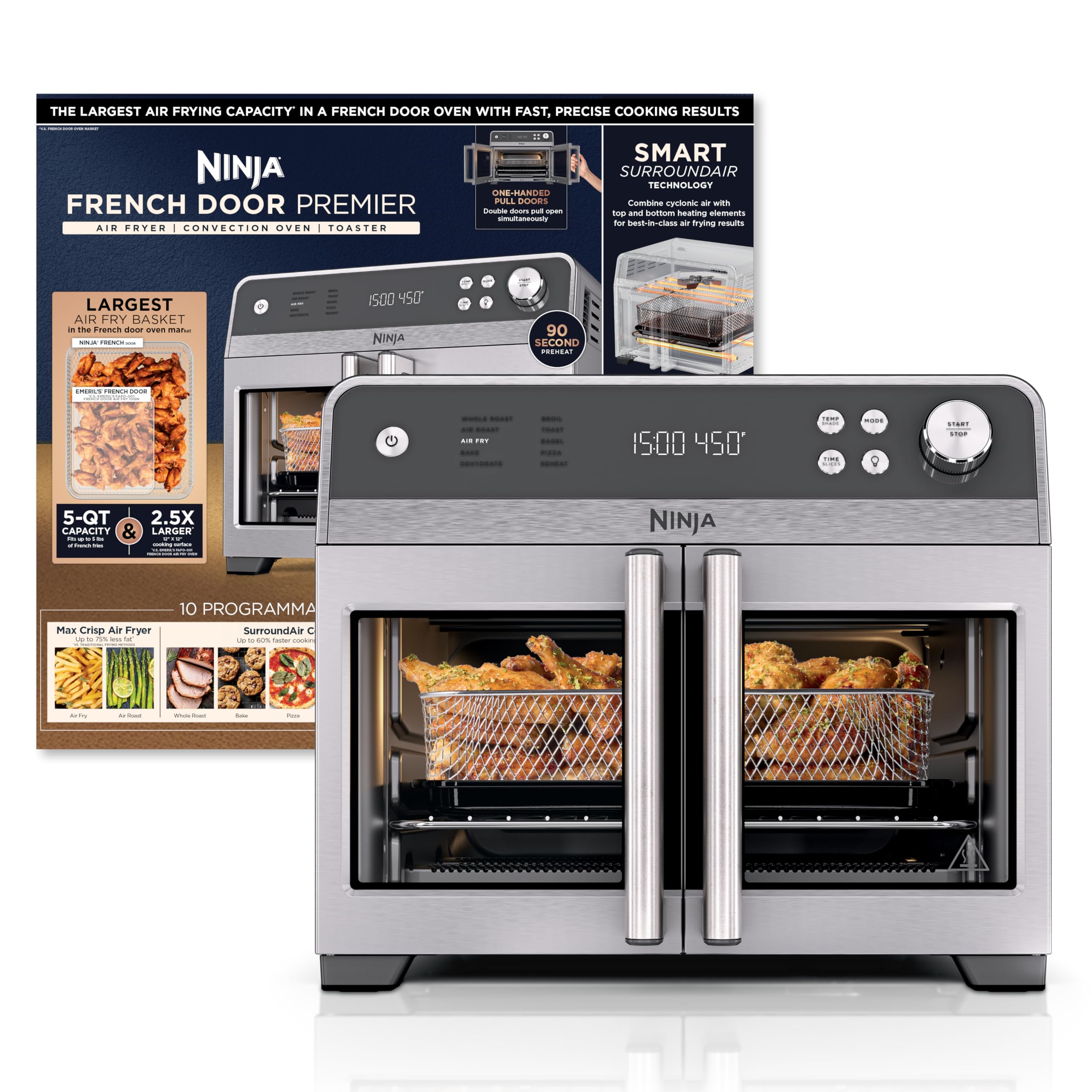
French doors aren’t just “pretty.” They change access. If you cook often, pull trays in and out constantly, or hate the awkward “one hand holding a tray while the other holds a door” dance, the FO101’s door design is genuinely convenient. It feels premium in a way you notice daily — especially when you’re juggling food, timing, and space on the counter.
The performance focus here is fast, even cooking with strong airflow. This model is built to air fry, roast, bake, toast, and reheat with less rotation and less fuss. Owners who like it tend to describe it as intuitive, well-designed, and surprisingly fast — especially compared with cheaper multipurpose ovens that heat unevenly. The appliance’s “clean workflow” vibe is real: doors, trays, and accessories feel designed for daily handling, not occasional use.
One big practical win is cleanup. When the key accessories can go in the dishwasher, you remove a major barrier to consistent use. That doesn’t mean you never handwash — greasy cooks still benefit from quick wipes — but dishwasher-safe components make the difference between “ugh” and “done.” If you’re someone who cooks daily and hates scrubbing, that matters more than an extra mode on a dial.
This model also fits a certain kitchen aesthetic. The stainless finish looks good, but it will show fingerprints if you have a busy house. That’s not a dealbreaker — it wipes clean easily — but it’s worth knowing if you care about a spotless look. The flip side is that it can look like it belongs next to other stainless appliances instead of looking like a temporary gadget.
The main reason I don’t rank it as the best overall is simple: it’s not the most “two-meal timing” focused model in the lineup. If your biggest pain is juggling a main and side simultaneously, the double ovens or dual baskets might fit better. But if your biggest pain is access + cleanup + daily usability, the FO101 is a very satisfying choice.
Why it feels premium
- French door access – Easier tray handling, especially when cooking frequently or in tighter spaces.
- Cleanup-friendly workflow – Dishwasher-safe accessories reduce friction and encourage daily use.
- Strong airflow, even cooking – Great for roasting, baking, and air frying without constant rotation.
- Looks like a “real appliance” – Stainless styling that fits kitchens where aesthetics matter.
Good to know
- Stainless looks great but can show fingerprints; plan quick wipe-downs if that bothers you.
- It’s a single-cavity system — if you want true parallel cooking, double ovens or dual baskets may fit better.
- As with any oven-style air fryer, airflow means you’ll often reduce cooking time vs traditional ovens.
Ideal for: daily cooks who value easy access, easier cleanup, and a premium countertop experience — especially if you bake, roast, and reheat often.
10. Ninja Foodi DualZone (DZ201) – The Two‑Drawer Classic That Nails “Crisp + Timing”

The DZ201 is the “I just want it crispy” pick. Basket-style air fryers are brutally good at one thing: high airflow around food in a smaller chamber. That often translates to better crispness on fries, wings, breaded snacks, and quick vegetables — with less fuss than oven-style systems. The DualZone design adds the feature that matters most in real life: two independent drawers with synchronized finish options.
This is why the DZ201 lives on so many countertops: you can cook protein in one basket and a side in the other, and Smart Finish helps them land together. Or you can Match Cook when you want full capacity for one food. In busy households, that “two baskets, one finish time” concept changes dinner flow. You stop doing back-to-back batches, and you stop negotiating which food gets eaten hot.
Owners who love it talk about ease: intuitive controls, fast results, and cleanup that doesn’t feel like a chore. Nonstick baskets and removable plates make it realistic to wipe down quickly — and dishwasher-safe parts help when you’ve cooked something sticky. People also often mention it feels quieter than they expected for the performance, basically a steady fan sound rather than a harsh mechanical tone.
The most common expectation gap is basket size. Two baskets sound huge — and the total capacity is generous — but each drawer is its own cooking space. If you’re cooking for a big family and want one giant flat layer of wings, you may still need batches or you’ll stack food and lose crisp. The “expert move” is to treat it as a two‑food machine, not necessarily a one‑food mega machine.
If you don’t care about toast, baking, or pizza — and you mainly want weeknight crisp and speed — this model can outperform bigger ovens in the thing most people buy air fryers for: texture. It’s also a great “second appliance” even if you own an oven-style unit, because it handles fries/wings/veg with almost no thinking.
Why people swear by it
- Peak crisp for classic air fryer foods – Fries, wings, nuggets, and veggies often shine in basket airflow.
- Two drawers reduce back‑to‑back cooking – Smart Finish makes meals land together.
- Easy cleanup rhythm – Nonstick baskets and removable plates keep maintenance realistic.
- Great for busy weeknights – Fast, repeatable routines without “oven math.”
Good to know
- Each basket is smaller than “one big tray”; overcrowding reduces crisp, so plan portions accordingly.
- No toast/pizza/baking the way an oven-style unit offers; it’s a crisp-first machine.
- If you want to cook large flat batches, you may still do multiple rounds to keep texture excellent.
Ideal for: households that want maximum crisp, two-food timing, and fast weeknight cooking — especially if you don’t need toaster-oven functions.
11. Ninja Flip OvenCrisp (SP151) – Compact, Fast, and Built for “No-Counter-Space” Kitchens

If your biggest constraint is counter space, the SP151 is the model that respects that reality. It’s designed to flip up and store vertically, which is a massive psychological win in small kitchens: you can own a real air fry oven without feeling like you sacrificed your workspace. And unlike some “compact” appliances that feel underpowered, this one is built to cook fast — especially for the foods people actually air fry daily.
The OvenCrisp approach (infrared heat plus rapid circulating air) is meant to give you edge-to-edge results without waiting forever. In real use, owners praise the speed and the “all-in-one” convenience: toast, bake, air fry, broil, pizza, and more in a footprint that doesn’t dominate the counter. It’s also a strong pick for RV setups because it delivers oven-like versatility without the heat load and slow preheat of a traditional oven.
Here’s the honest ownership detail: compact oven-style air fryers tend to concentrate heat. That’s great for speed, but it can make splatter more noticeable and heating elements more prone to getting dirty if you cook greasy foods without a catch strategy. The best way to keep this model enjoyable is simple: use the included trays, use parchment correctly (trimmed to fit), and wipe down regularly. When you do, it stays quick, clean, and satisfying.
Also, recognize what this model is built for: quick meals for one to four people, fast snacks, and everyday convenience. If you’re feeding a large family nightly and want massive capacity, you’ll be happier with larger countertop ovens or double ovens. But if you want a tool that makes daily cooking easier without taking over your kitchen, this one hits the sweet spot.
One underrated benefit is energy behavior. Smaller cavities heat faster and often feel more efficient for small meals. That means fewer “I’ll just order out” nights, because you can go from “hungry” to “food” without a 20-minute preheat and a hot kitchen. For many households, that’s the real value — not fancy modes, but friction reduction.
Why it’s a smart buy
- Space-first design – Flip-up storage gives you your counter back in small kitchens.
- Fast everyday versatility – A strong “daily driver” for toast, snacks, quick meals, and crisping.
- Great for small households – Feels built for real-life portions instead of oversized “theoretical” capacity.
- Encourages more home cooking – Quick preheat and small-cavity speed reduce weeknight resistance.
Good to know
- Compact heat can mean faster splatter buildup; regular wipe-downs keep it pleasant long-term.
- Not the pick for huge batch cooking — it’s best for small-to-medium portions.
- As with most convection ovens, you’ll likely reduce cook time vs traditional recipes.
Ideal for: small kitchens and space-conscious cooks who want a real air fry oven that stores out of the way and still cooks fast enough to replace the big oven for daily meals.
How to Get Crisp, Even Results From Any Ninja Air Fryer (Without Guessing)
Most “air fryer disappointment” comes from two things: moisture management and airflow management. Once you control those, almost every model on this list can produce shockingly good results — and your food stops coming out “kind of crispy” and starts coming out actually satisfying.
What makes results better instantly
- Preheat like you mean it – A true hot cavity (or hot basket) improves browning and reduces sogginess.
- Use a thin oil mist strategically – Especially for vegetables and breaded foods, a little oil helps texture dramatically.
- Give food breathing room – One layer beats two layers. If you must stack, accept that you’ll shake/flip and cook longer.
- Dry wet food first – Pat chicken skin dry, drain marinated foods, and glaze late if you want crisp.
- Pick the right surface – Mesh baskets crisp better; trays are better for saucy foods and baking.
If you remember one rule: moisture must escape. Don’t trap it under crowded food, parchment that blocks airflow, or a sauce that never gets a chance to set.
Habits that prevent smoke and “burnt smell” later
- Empty the crumb tray weekly – Crumbs are the hidden source of smoke and burnt odors.
- Catch the splatter – If you roast bacon or cook greasy foods, use a catch tray under the food when possible.
- Wipe while warm – A warm wipe-down is easier than a cold scrub-down.
- Trim parchment correctly – Never let parchment lift into heating elements; cut it to fit the tray surface.
- Don’t ignore the back area – Some ovens accumulate residue near the rear airflow path. A quick periodic clean prevents future fan funk.
The goal is simple: keep grease from becoming a permanent resident. The payoff is a cleaner taste, less smoke, and an appliance you’ll actually want to use.
FAQ: Ninja Air Fryers, Countertop Ovens, and Real-Life Buying Questions
Which Ninja model is best if I want one appliance to replace several?
Why do some foods turn out less crispy, even in a powerful air fryer?
Do I really need a model with a thermometer/probe system?
Should I pick a flip-up oven or a standard countertop oven?
Will I still need a toaster if I buy a Ninja air fry oven?
How do I keep my air fryer from smelling like old food over time?
Final Thoughts: Choose the Model That Makes Cooking Feel Easier
A great Ninja isn’t the one with the most buttons. It’s the one that makes you cook more at home because it removes friction: less waiting, less heat, less mess, less guesswork — and better texture.
Here’s the simplest way to translate this guide into one confident choice:
- Want the best overall “two meals at once” experience? Start with the Ninja Double Stack XL (DCT601). It’s the sweet spot of parallel cooking, versatility, and everyday usability.
- Want that same double-oven workflow, but with protein precision? Go with the Ninja Double Stack XL Pro Cook (DCT651). It’s a premium upgrade for people who care about doneness without hovering.
- Care about browning and “sear energy” as much as crisp? Pick the Ninja Foodi Dual Heat (SP351) for its heated plate concept and fast daily performance.
- Want a powerful oven-style centerpiece (with doneness confidence)? The Ninja Prestige Smart XL Pro Cook (DT551) is the pick when you want big capacity and less guesswork for proteins.
- Want the best “leftovers taste new” and fast meal system? The Ninja Combi (SFP701) is built for steam + crisp cooking that keeps food juicy and speeds up dinners.
- Need maximum crisp and two foods finishing together (no oven functions)? Choose the Ninja Foodi DualZone (DZ201) for peak crisp results and synced timing across drawers.
- Need counter space more than anything? Go with a flip-up model like the Ninja Foodi Digital Air Fry Oven (SP101) or the Ninja Flip OvenCrisp (SP151) depending on the size and style you prefer.
The right choice is the one that fits your kitchen and your habits — not the one with the flashiest feature list. Pick the ninja stainless steel air fryer that matches how you actually cook (two‑dish dinners, crispy snacks, big batch baking, or steam‑and‑crisp meals), and you’ll end up with the rare appliance that doesn’t get shoved into a cabinet after the first month.
