
A stick blender looks simple. Then you use one in real life and realize it’s not “just blending” — it’s a chain of tiny, high-impact moments: you’re trying to purée soup without repainting the backsplash, you want a smoothie that doesn’t taste like “berry gravel,” you’re emulsifying a mayo that can break in five seconds, or you’re turning roasted vegetables into something silky without dragging out a countertop blender.
If you’re shopping for a handheld immersion blender, you’re already thinking like a smart cook: you want speed, control, and fewer dishes. But here’s what most buying guides miss (and it’s why people end up returning blenders): the “best” unit on paper is not the one you love on Tuesday night. The one you love is the blender that behaves well when conditions aren’t perfect — hot liquids, thick mixtures, narrow containers, slippery hands, kids asking questions, and a pot that you really don’t want scratched.
This guide is built around friction points I see repeated in real owner feedback: suction that yanks the wand down, speed controls that feel jumpy, attachments that click in “almost” but not quite, containers that crack when you store them wrong, and motors that are powerful in bursts but need better pulse discipline for longevity. I’ll also show you how to read between the lines of spec sheets so you can predict how a blender will feel in your hand — not just how it looks in a product photo.
Below, you’ll find 15 standout picks — from pro-grade “buy it once” machines to family-friendly multi-attachment kits and a few budget sets that are honestly impressive (with clear boundaries so you don’t burn them out). If you read this once, you should walk away with a calm, confident decision — not a guess.
How to Choose the Right Handheld Immersion Blender
A good stick blender isn’t “good” because it has more speeds printed on the box. It’s good because it makes the most common tasks feel effortless — and it stays predictable when you’re blending hot soup, thick purées, or sticky sauces. Here’s the framework I use when I’m helping someone buy a blender they’ll still like after the honeymoon phase.
1. Start with the texture you’re chasing (not the attachments)
Most people buy based on accessories, then get disappointed because the core blending feel wasn’t right. Flip that. Decide your “main texture goal” and work backward:
- Silky soups and purées: You want a bell design that reduces suction, a guard that minimizes splatter, and enough torque to keep speed steady in thick soup.
- Daily smoothies (especially with fibrous add-ins): You want consistent vortex formation, a blade head that pulls ingredients down, and a container that’s wide enough to move the wand around.
- Mayo, dressings, and vinaigrettes: Control matters more than peak power. A smooth ramp-up and stable low speed makes emulsions easier to “lock in.”
- Whipped cream and egg whites: A strong whisk attachment and comfortable grip matter — your hand is doing a lot of work here.
- Chopping onions, herbs, nuts: The chopper bowl design matters more than the motor. A stable lid, easy release, and usable bowl size are the difference between “quick” and “annoying.”
2. Understand control styles: trigger, dial, or “two-speed”
Control is the quiet superpower of a great blender. It’s also the reason some people swear by one brand and can’t stand another. There are three broad control personalities:
- Variable trigger control: You squeeze harder for more speed. This is brilliant for hot soup because you can “feather” the start and avoid splashing. It also feels intuitive if you cook by instinct. The trade-off: your finger is doing the work the whole time, which can tire some hands during long blends.
- Dial-based speed selection + press-to-run: You pick a speed on a dial, then hold a power button. This is great if you want repeatability (“speed 3 is my soup speed”), and it’s often easier on the hand during longer runs. The trade-off: it can feel less “instant” if you constantly change textures.
- Simple low/high buttons: This can be surprisingly effective if the motor and bell design are solid. It’s also the least mentally demanding. The trade-off: less fine control for delicate emulsions or splash-prone blends.
What most guides don’t tell you: speed count isn’t the point — the smoothness of the ramp is. A blender with fewer speeds can feel better if it transitions smoothly, doesn’t surge, and holds torque when the mixture gets thick.
3. “Suction” is the enemy — learn what causes it
That aggressive pulling sensation (when the blender tries to glue itself to the bottom of the pot) usually comes from a bell shape that creates a strong vacuum, combined with thick ingredients. High suction causes three problems:
- Jerky movement: You lose the ability to sweep through the pot smoothly, so you get uneven texture.
- Overheating risk: When the blade head can’t circulate ingredients, the motor works harder than it needs to.
- Splatter bursts: The moment the vacuum releases, you get a “pop” of liquid — and your shirt pays the price.
Anti-suction designs (ribbed bells, shaped guards, wider domes) are not marketing fluff. They change the feel of blending more than another 200 watts ever will. If soups are your main use, prioritize bell engineering first.
4. Motor “watts” can mislead — focus on torque behavior
Here’s the reality: two blenders can have the same watt rating and behave wildly differently in thick soup. What you actually feel is torque management: does the blender keep spinning smoothly, or does it bog down and force you into awkward stop-start pulses?
A few practical cues for torque (without lab gear):
- Heavier motor housing (within reason): Often signals a more robust build and better internal stability.
- Blade head that draws food inward: Helps you form a vortex so you’re not “pushing” ingredients around.
- Realistic instructions about ice/frozen foods: Brands that give clear limits tend to be more trustworthy than “it can do everything” claims.
If you blend thick mixtures often (beans, carrots, potatoes, dense sauces), torque consistency beats “maximum speed” every time.
5. Cookware protection: guards, coatings, and the “plastic in hot food” dilemma
Many blenders include a pan guard or a nylon blade guard to prevent scratches. That’s great for nonstick pots and enameled cookware. But some cooks prefer not to introduce plastic near hot foods — especially if they’re blending piping-hot soup for long periods.
What I recommend:
- Stainless/cast iron cookware users: You can often skip the guard if your pot can handle it (but still blend carefully to avoid clanking).
- Nonstick users: A guard can be a lifesaver. Scratches aren’t just cosmetic — they shorten cookware life.
- High-heat blending: Favor designs that minimize splatter so you can keep the head submerged and avoid repeated “out-of-liquid” bursts.
6. Attachments: only pay for what you’ll actually use
Attachments can be amazing — or they can be clutter that lives in a drawer. Here’s what tends to be genuinely useful:
- Chopper bowl: Best for onions, herbs, nuts, quick salsa base, and small batches. The best ones are easy to open when your hands are wet and don’t leak at the lid.
- Whisk: Great for whipped cream, vinaigrettes, pancakes, eggs, and quick sauces. Also surprisingly useful for smoothing out gravy.
- Milk frother: Nice for coffee drinks, but for most people it’s the least essential.
- Masher: If you make mashed potatoes often, a good masher attachment is a legit time saver — but only if it’s designed for that job (not just a gimmick).
The hidden attachment factor: replacement parts. Established brands tend to offer better long-term part availability. Off-brand kits can be incredible value but sometimes become “all or nothing” purchases if a container cracks or a whisk bends.
7. Cleanability is a buying feature (not an afterthought)
If a blender is annoying to clean, you will quietly stop using it. Here are the real cleanability signals:
- Detachable shaft: Easier to wash thoroughly and safer to rinse without water near the motor housing.
- Simple geometry near the blade: Fewer crevices = fewer trapped onion bits.
- Dishwasher-safe parts: Great, but always confirm which parts are actually safe (often the chopper lid is not).
- Quick-clean technique support: The best blenders can be “self-rinsed” by blending warm soapy water in a cup for 10 seconds.
When you’re done reading this guide, you should be able to pick the right tool for your cooking personality — not someone else’s.
Quick Comparison: 15 Handheld Immersion Blender Picks
Use this table to find the models that match your style, then jump into the full reviews for the details that actually matter — like anti-suction feel, real control smoothness, and what owners praise (or complain about) after months of use.
On smaller screens, swipe or scroll sideways to see the full table.
| Model | Build style | Control feel | Best match | Amazon |
|---|---|---|---|---|
| Vitamix 5-Speed Immersion Blender | Pro-grade wand | 5 speeds, predictable torque | “Buy once” blending for soups, sauces, and tough mixes | Amazon |
| Breville BSB510XL Control Grip | Premium kit | Ergonomic trigger + anti-suction style bell | Soup lovers who want control, minimal splatter, and great accessories | Amazon |
| KitchenAid KHBV83ER (with accessories) | Major-brand kit | Variable trigger + whisk + chopper | Families who want one reliable multitask tool from a trusted brand | Amazon |
| Ninja CI201GY (Dark Gray) | Power + whisk | 4 speeds + “stays strong” mixing feel | Thick blends and frequent use with easy cleanup | Amazon |
| Cuisinart CSB-179 Smart Stick | Classic workhorse | Variable slide control + continuous run | Simple, durable everyday blending with strong accessory set | Amazon |
| Braun MultiQuick 5 Vario MQ5027 | Control-first kit | 21 speeds + turbo, one-hand dial | People who want fine control + a genuinely useful accessory bundle | Amazon |
| KitchenAid KHBV53 (Onyx Black) | Simple wand | Variable trigger, minimal extras | Quick soups, sauces, smoothies — easy to store and use | Amazon |
| KitchenAid KHBV53 (Empire Red) | Color pick | Same tool, statement look | Gift-worthy pick with a sturdy feel and pot guard | Amazon |
| KitchenAid KHBV53 (Contour Silver) | Clean look | Same tool, pro aesthetic | Minimalist kitchens and frequent counter use | Amazon |
| Ninja CI201ND (Deep Navy) | Color pick | Same performance, different finish | People who want the Ninja feel in a bold color | Amazon |
| SHEANLAH 1000W Brushless (25-speed) | Heavy-duty wand | Dial + turbo, wide speed range | Power shoppers who want lots of control and a long warranty feel | Amazon |
| Ganiza 6-in-1 (15-speed) | Big bundle | Speed dial + turbo | Max accessories for small kitchens (if you follow pulse limits) | Amazon |
| Ganiza 5-in-1 (16-speed) | Value kit | 16 speeds + turbo | People who want a sturdy feel + chopper/whisk/frother | Amazon |
| turelar 1100W 5-in-1 Set | Budget kit | Trigger control, quick swaps | Starter set for soups, baby food, smoothies (within limits) | Amazon |
| ZKBHOME 1100W 3-in-1 Set | Compact set | Trigger control + whisk/frother | Small kitchens and quick drinks/soups without clutter | Amazon |
In‑Depth Reviews: 15 Stick Blenders That People Actually Enjoy Using
Now we’ll go model by model. I’m going to talk like a real cook — not like a spec sheet: how the bell feels in the pot, how the controls behave under pressure, how annoying (or easy) the cleanup is, and what kinds of “surprises” show up after a few months of regular use.
1. Vitamix 5‑Speed Immersion Blender – Pro‑Grade Texture Without the Countertop Blender Hassle

If you want the “why didn’t I buy this sooner” feeling — the one where your soup turns velvety in seconds and you stop dragging out a full blender — this Vitamix is the closest thing to a professional wand experience that still feels simple. It’s not trying to be a kitchen gadget collection. It’s trying to be the tool you reach for daily because it just works, blends evenly, and doesn’t flinch when the mixture is thick.
The most important difference you’ll feel: torque steadiness. In real kitchens, the hard blends aren’t frozen margaritas — they’re beans, carrots, dense tomato soup, and thick sauces that want to bog down cheaper motors. Owners routinely describe this as “powerful but controlled,” meaning it creates a strong vortex without the jumpy surge that causes splatter. That’s exactly what you want for hot liquids: predictable startup, stable spin, and smooth texture control.
I also love the minimalism here. There’s less to crack, less to misplace, and less to “almost attach.” If you’ve ever fought an accessory system mid-recipe, you know how valuable simple can be. And for small-batch work (a single glass of smoothie, a jar of dressing, a small pot of soup), the wand format is faster and calmer than a countertop blender.
Why it earns “best overall”
- Professional texture results – Great for soups, sauces, purees, and dense mixtures that expose weak motors.
- Predictable control – Speeds feel usable, not gimmicky; you can ramp up without splash drama.
- Low clutter, high reliability – Fewer parts means fewer failure points and easier long-term ownership.
- Comfortable for real cooking – Ergonomics and build feel designed for frequent use, not occasional novelty.
Good to know
- If you want a chopper/whisk/frother bundle, this “wand-first” approach may feel too minimal — you’d add tools separately.
- It’s built like a serious machine, so it doesn’t feel featherlight in the hand (most people see that as “sturdy,” but it’s worth knowing).
- You’ll get the best smoothie results with a container you can move around in — narrow glasses limit wand motion and can leave texture behind.
Ideal for: anyone who wants a “buy once” wand that nails soups, sauces, dressings, and thick blends — and prefers reliability over extra accessories.
2. Breville BSB510XL Control Grip – Anti‑Suction Control That Makes Hot Soup Feel Easy

This Breville is for the person who makes soup and thinks, “I want this smoother, but I do not want chaos.” The signature here is control: the trigger grip keeps your wrist in a natural position, and the bell design aims to reduce that annoying suction that can make blending feel like a tug-of-war. In practice, that means you get more graceful movement through the pot — less sticking, less popping, less splatter.
What owners tend to love (especially people blending for dietary needs or texture-sensitive households) is how fast it turns “chunky” into “uniform.” That matters if you need truly smooth soup — not “mostly blended.” And the included jug is genuinely well thought-out: handle comfort, stability while blending, and a shape that encourages circulation so you’re not just spinning liquid in place.
This is also one of those bundles where the accessories feel like they belong — not like afterthought plastic. The whisk is strong for whipped cream and eggs, and the chopper attachment can replace the “mini processor” role in a lot of kitchens. The end result is a setup that doesn’t just blend soup; it can become your everyday prep tool when you don’t want to clean a bigger appliance.
Why soup lovers swear by it
- Anti-suction behavior – Helps the wand glide instead of sticking, especially in thicker pot blends.
- Trigger grip comfort – Makes longer blending sessions feel steadier and less fatiguing.
- Accessory kit that actually gets used – Jug, whisk, and chopper cover real daily tasks.
- Low mess blending feel – When used correctly, it behaves well in hot liquids without surprise splashes.
Good to know
- It’s a premium-feeling kit, so storage planning matters — you’ll want a drawer/bin strategy for attachments.
- If you have very small hands, the grip can feel “bigger” than minimal wands; comfort is personal here.
- For heavy ice-crushing style jobs, a countertop blender is still the better tool — this shines in soups, sauces, and controlled blends.
Ideal for: people who blend hot soups frequently and want the smoothest results with the least drama — plus a genuinely useful accessory ecosystem.
3. KitchenAid KHBV83ER – The “One Tool, Many Jobs” Pick That Still Feels Premium

If you want a dependable brand, a real accessory set, and a blender you’ll reach for multiple times a week, this KitchenAid bundle makes a lot of sense. The variable trigger control is the headline feature for real cooking: you can start slow, build speed as the mixture loosens, and stop instantly without overshooting into splatter territory.
What separates this kit from “random accessory bundles” is how well the pieces match common kitchen rhythms. The chopper is sized for daily prep (herbs, nuts, garlic, onions, quick salsa), the whisk covers cream/eggs/batters, and the blending pitcher encourages better circulation than a narrow cup. In owner feedback, people consistently describe this as a reliable workhorse — not necessarily the most aggressive blender on earth, but one that does the jobs people actually do, smoothly and predictably.
There’s also an underrated advantage here: you’re buying into a brand that tends to have better long-term support. That matters if you keep tools for years. If you’re the type who hates replacing appliances, that “support reality” can be worth more than a few extra speed levels.
Why it’s a “smart household” pick
- Great all-around accessory kit – Whisk + chopper + pitcher cover most daily blending needs.
- Trigger control helps prevent splatter – Start gentle, ramp up once ingredients circulate.
- Durable feel without being overly heavy – Many owners describe it as balanced for frequent use.
- Easy cleaning workflow – Detachable parts make the “rinse + quick-soapy-blend” method simple.
Good to know
- If you’re extremely sensitive about plastic near hot foods, you’ll want to decide whether to use the pot guard based on your cookware and comfort level.
- Accessory bundles are convenient, but they still need storage — plan one drawer/bin so pieces don’t get lost.
- For ultra-thick nut-butter style blends, you’ll do better with short pulses and a wider container (this is true for most wands).
Ideal for: families and frequent cooks who want one reliable brand-name kit to cover soups, smoothies, dressings, whipped cream, and chopping without cluttering the counter.
4. Ninja CI201GY (Dark Gray) – Speed Consistency for Thick Mixtures + A Seriously Fast Whisk

Ninja tends to build products that feel “ready to work,” and this immersion blender follows that pattern. The real story here is not the number of speeds — it’s the way the unit tries to maintain momentum in thicker mixtures so you don’t feel that bog-down-and-stall behavior. That’s the moment where cheap blenders start smelling hot and you start doing awkward micro-pulses.
For real kitchens, the included SplatterShield and PanProtect approach is a huge quality-of-life boost. Most splatter isn’t caused by “too much speed.” It’s caused by air pockets, shallow liquid levels, or lifting the head above the surface for a second. A guard system that keeps the head stable and reduces suction makes it easier to do the right thing — keep the bell submerged, move slowly, and let circulation develop.
The whisk is also a standout for people who make whipped cream, meringue, pancake batter, or quick emulsions. If you want one device that blends soup and also replaces a hand whisk for certain tasks, this Ninja setup is a strong option — especially if you like a brand that leans “sturdy and practical.”
Why people love the Ninja feel
- Strong in thicker mixtures – Designed to keep speed from dropping when the blend gets dense.
- Splatter management – Shield + guard system helps keep mess down and cookware protected.
- Rapid whisk is genuinely useful – Great for cream, eggs, batters, and quick emulsions.
- Easy cleanup rhythm – Dishwasher-safe parts make everyday use feel less “I’ll do it later.”
Good to know
- The body is not ultra-light; that sturdiness is part of the “Ninja feel,” but it’s worth knowing if you have wrist fatigue issues.
- Four speeds is plenty for most people, but if you want very fine incremental control, a dial-based 15–25 speed unit can feel more precise.
- Like any wand, you’ll get best results with a container wide enough to move the head around — don’t trap it in a narrow glass.
Ideal for: cooks who blend thick soups, sauces, and smoothies regularly and want a strong whisk attachment with a cleaner, more protected blending experience.
5. Cuisinart CSB‑179 Smart Stick – Comfortable Control + A Truly Useful Accessory Set

If you want something that feels familiar, stable, and built for years of normal cooking, the Cuisinart Smart Stick is a strong candidate. It’s the kind of blender that doesn’t try to impress you with a complicated interface. Instead, it focuses on a comfortable grip, easy-to-understand controls, and the accessory trio most people actually use: blending cup, chopper/grinder, and whisk.
The real strength here is workflow. The variable speed slide lets you start slow, then move up without changing grip position, and the continuous action style is helpful when you’re doing bigger soup pots or longer blends. Owners often mention they like being able to avoid transferring hot liquids to a countertop blender — and that’s exactly the “stick blender win” that makes these tools beloved.
I also like that Cuisinart tends to be realistic about what these tools are for: soups, sauces, smoothies, dips, mayo, baby food — not industrial ice pulverizing. Used within that lane (and with good technique), it’s a reliable daily driver that covers a lot of tasks without becoming annoying.
Why it’s a staple
- Comfortable, intuitive control – Easy to start low and build speed without sudden jumps.
- Accessory set covers real needs – Chopper + whisk + cup make it feel like multiple tools in one.
- Good for hot soups – Blend right in the pot and control texture without transferring liquids.
- Built for regular use – Owners often keep these for years; it’s a “kitchen staple” category product.
Good to know
- Some people need a couple of uses to get used to the safety/lock behavior — normal for this category.
- Chopper bowls are great, but they’re not full food processors; think “small prep,” not “all-day chopping.”
- If you want ultra-quiet blending, your technique matters: keep the bell submerged and avoid banging the pot.
Ideal for: cooks who want a trusted, straightforward tool with a complete accessory set — without paying for premium-only branding.
6. Braun MultiQuick 5 Vario MQ5027 – Fine Control, Low Splatter, and Attachments You’ll Actually Use

Braun’s MultiQuick line is famous for one thing that matters more than marketing makes it sound: it’s designed to reduce the “mess tax.” The bell design and splash control approach aim to keep food moving inward instead of launching outward — which is exactly what you want when you’re puréeing soup or blending sauces in a pot that’s almost full.
Owners who switch to Braun often mention the same satisfaction points: attachments click on solidly, the control feels natural, and the motor feels powerful without being obnoxiously loud. The “Vario” concept (a lot of usable speed steps) matters most when you do delicate work: you can start a soup blend on a gentle speed, then climb to higher power once the texture is already moving. That reduces splatter and also reduces the stress of blending hot foods.
This bundle shines for daily cooking because the included tools match real tasks: the whisk covers eggs and cream, the chopper handles onions/herbs quickly, and the masher attachment can seriously cut time for potatoes (especially if you like rustic mash with good control). The one recurring complaint in long-term feedback is that some people wish the chopper bowl were larger — which is basically the “good problem” of using it enough to want more capacity.
Why it feels so “easy” in use
- Low-splatter bell behavior – Helps keep soups and sauces in the pot, not on the counter.
- Fine speed control – Lots of usable steps means you can match texture without guesswork.
- Attachments feel solid – Easy click-on/off makes you more likely to use the whisk/chopper/masher often.
- Great for multi-task cooks – This is a true “prep helper,” not just a soup blender.
Good to know
- If you want a big-capacity chopper, you may eventually want a separate mini processor — this one focuses on quick daily tasks.
- High control can tempt you to blend too long; thick mixtures still benefit from short pulses and small breaks to protect the motor.
- Storage is best with a simple bin/drawer organizer so the accessories stay together and don’t become “random parts.”
Ideal for: people who care about clean blending, fine speed control, and a real-world accessory set that supports daily cooking (not just occasional use).
7. KitchenAid KHBV53 (Onyx Black) – Minimal Setup, Great Daily Blending, Easy Storage

Not everyone wants a drawer full of attachments. Sometimes you want a simple, sturdy wand that blends soup, sauces, smoothies, and purées — and you want it to store easily, clean quickly, and look good on the counter. That’s the KHBV53 personality: it’s a straightforward corded blender with variable trigger control and a removable blending arm.
Owners tend to praise this model for “everyday ease”: it’s quick to set up, quick to clean, and it blends surprisingly efficiently for the size. The pot guard is a practical bonus if you use nonstick cookware, and the included blending jar covers small jobs like dressings or single servings. If you’re coming from a bulky blender, the main benefit is psychological: you’ll actually use this because it doesn’t feel like a project.
My expert note: this is a great choice for people who want “one reliable wand” and already have a stand mixer or food processor for big jobs. In that setup, the KHBV53 becomes the fast tool — the one that solves dinner problems in 60 seconds.
Why it’s easy to live with
- Minimal parts, fast setup – Great for weeknight cooking when you want fewer steps.
- Trigger control feels natural – Helps ramp up gently for soups and sauces.
- Pot guard included – Helpful for protecting nonstick and keeping the bell stable.
- Stores neatly – A low-profile tool that doesn’t demand counter real estate.
Good to know
- This is the “wand-only” version — if you want whisk/chopper convenience, the KHBV83 bundle is the better fit.
- Some users mention the guard can feel a little fiddly until you learn the best fit angle; once set, it’s fine.
- For very thick blends (like heavy mashed potatoes), use short pulses and move the wand steadily to keep circulation strong.
Ideal for: cooks who want a straightforward, brand-name wand blender that performs well for soups and sauces — without committing to a big accessory ecosystem.
8. KitchenAid KHBV53ER (Empire Red) – The Same Great Wand, With “Kitchen Icon” Energy

Functionally, this is the same KHBV53 platform — but color matters in real life. If a tool looks good on your counter, you’re more likely to leave it accessible, and if it’s accessible, you’re more likely to use it. That’s not vanity — it’s behavior. The Empire Red version has that classic KitchenAid vibe that makes it feel like a “proper kitchen tool,” not a random gadget.
Performance-wise, this model is beloved for one big reason: it blends well without turning cleanup into a job. Owners often describe it as sturdy, smooth, and powerful enough for soups and sauces, and they appreciate being able to tuck it in a drawer. It also shows up in feedback from people who need soft-food diets, because it can purée cooked meals into smoother textures without a countertop blender.
My practical tip: if you’re buying as a gift, this is the kind of color that feels special. And if you’re buying for yourself, it’s a small “joy upgrade” that can make cooking feel a little more fun — while still getting the job done.
Why this color version sells so well
- Looks like a premium appliance – Encourages “leave it out, use it often” behavior.
- Reliable daily blending – Great for soups, sauces, smoothies, and quick purées.
- Comfortable grip + control – Easy to modulate speed and avoid splatter when starting.
- Easy cleaning routine – Detach, rinse, or quick-soapy-blend in a cup and you’re done.
Good to know
- As with any corded tool, cord length and outlet placement can matter; a dedicated prep spot makes it feel effortless.
- The pan guard is great for nonstick, but if you primarily use stainless or cast iron, you may not use it much.
- If you want whisking and chopping built-in, step up to the KHBV83 accessory bundle.
Ideal for: people who want the KHBV53 performance in a statement color, especially as a gift or for a kitchen where aesthetics matter.
9. KitchenAid KHBV53 (Contour Silver) – Clean, Professional Aesthetic With the Same Simple Performance

If you like tools that look “restaurant clean” on the counter, the Contour Silver version is a great pick. It’s the same core KHBV53 design (variable trigger, removable arm, pot guard, blending jar), but the finish feels especially at home in stainless-heavy kitchens and more modern spaces.
A theme you’ll see in owner feedback is durability: people often describe KitchenAid hand blenders as heavy enough to feel stable, without being awkward to maneuver. That weight can actually help in blending because it reduces chatter and keeps the head planted. If you blend a lot of vegetables (carrots, ginger, cooked squash) you’ll appreciate a tool that doesn’t feel “toy-like” when the mixture fights back.
This is also a strong pick for people who do frequent small blends — smoothies, protein shakes, quick sauces — and want a tool that can live on the counter without looking like clutter. In other words: the blender you’ll actually use.
Why it fits modern kitchens
- Professional-looking finish – Pairs well with stainless cookware and minimalist counters.
- Stable blending feel – Slight heft helps keep the wand controlled in thicker mixtures.
- Simple daily utility – Great for soups, sauces, smoothies, and small-batch prep.
- Cookware-friendly guard – Protects pots and helps reduce clanking/scratching risk.
Good to know
- If you want a “one box does everything” experience, the KHBV83 or an accessory-heavy brand may fit better.
- Like most wands, it performs best when you keep the bell submerged and move slowly to encourage circulation.
- If you travel internationally, always confirm plug/voltage compatibility before buying any corded model.
Ideal for: cooks who want the simple KHBV53 performance in a sleek, modern finish — especially for frequent counter use and daily blending.
10. Ninja CI201ND (Deep Navy) – Same Strong Performance, In a Color That Hides Kitchen “Wear”

Performance-wise, this is the same “PowerBase + whisk + guard” Ninja experience as the Dark Gray version — which is good news: you’re choosing on aesthetic and availability, not on “one color is weaker.” The Deep Navy finish is a practical choice for real kitchens because it tends to hide scuffs, smudges, and everyday fingerprints better than lighter finishes.
If you cook often, that matters. Tools that look beat-up quickly tend to get pushed into drawers. Tools that still look good keep living in your easy-reach zone — and those are the tools that change your cooking habits.
If you liked the Ninja value proposition — steady blending feel in thicker mixtures, splatter management, and a fast whisk — this is simply the same package in a more statement color.
Why this colorway is practical
- Same strong performance – You’re not trading function for aesthetics here.
- Great for frequent use – Dark finish hides everyday wear and stays “clean-looking.”
- Splatter control + cookware protection – A real quality-of-life feature for soups and sauces.
- Whisk attachment earns its keep – Great for cream, eggs, and fast batters.
Good to know
- If you want ultra-fine speed steps, a 15–25 speed dial model may feel more precise for delicate emulsions.
- For best results, use a deeper container and keep the head submerged — even the best splatter shield can’t fix “bell above liquid.”
- As with any multi-part kit, store pieces together so you don’t lose the whisk and accidentally “downgrade” the tool over time.
Ideal for: anyone who wants the Ninja blending feel and accessory set, but prefers a bold finish that stays looking good with heavy use.
11. SHEANLAH 1000W Brushless (25‑Speed) – Heavy‑Duty Feel With Lots of Precision Steps

This is the blender you look at if you love the idea of fine control — the ability to pick a “just right” speed instead of toggling between a few presets. The 25-step dial approach can be genuinely useful for delicate jobs (dressings, light sauces, smoothing out gravy) and for slow starts in hot soup. It also tends to appeal to people who use stick blenders for non-traditional tasks (yes, some owners use them for hobbies like mixing glazes) because it gives you more control over agitation without violent surges.
The “brushless motor” marketing is appealing because brushless designs often aim for efficient power delivery and long life. But my expert lens here is simple: what matters is whether the blender feels stable at medium speeds and whether the bell guard design keeps splashes down. From owner feedback, people often describe this as quiet, powerful, and “built like a tool,” with a head that’s protected and less splash-prone.
Where this type of blender shines is when you want precision plus muscle — and you don’t necessarily care about having five attachments. If you want one heavy-duty wand that can handle thick mixes fast (with the discipline to pulse and rest when needed), it’s a compelling option.
Why it’s a precision pick
- Lots of usable speed steps – Makes it easy to dial in texture without “jumping” too far.
- Turbo on demand – Useful for short bursts when you hit a stubborn chunk or want faster circulation.
- Protected blade head – Helps reduce splashing and protects cookware in everyday use.
- Long-warranty vibe – Many buyers like the confidence of a longer support promise (especially on a heavy-use tool).
Good to know
- Off-brand tools can be harder to source replacement parts for — treat it like a “tool,” not a forever accessory ecosystem.
- Be skeptical of “crush anything” habits: even powerful motors benefit from pulses and short breaks in thick or frozen mixes.
- If you want whisk/chopper convenience in the same box, a bundled kit (KitchenAid KHBV83, Braun, Ganiza) may fit better.
Ideal for: cooks who want lots of control steps and a heavy-duty feel, especially for thick soups, sauces, and precision blending where “too fast too soon” is the enemy.
12. Ganiza 6‑in‑1 (15‑Speed) – Big Capability, Small-Kitchen Friendly, If You Blend Smart
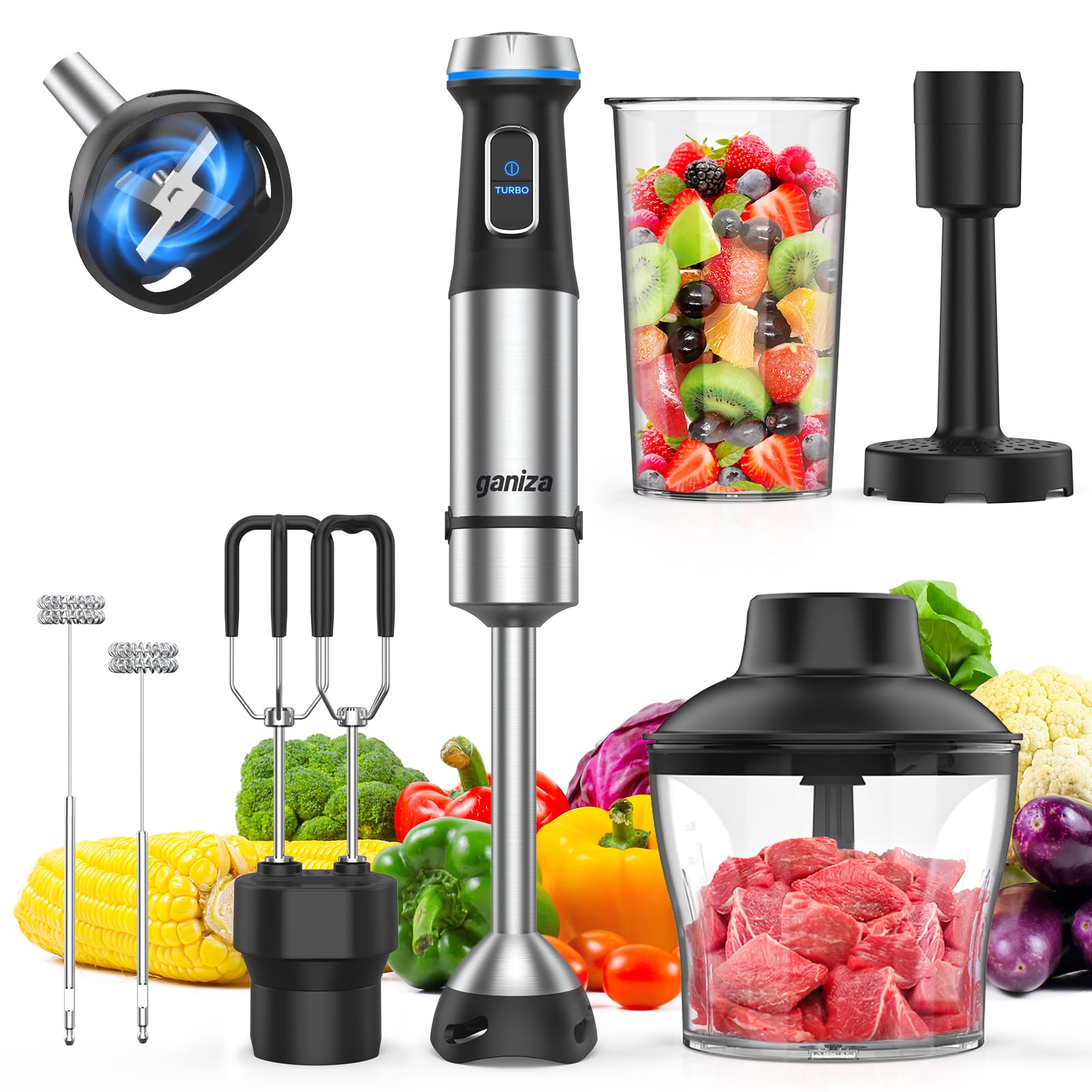
Ganiza has become popular for one reason: it packs a lot of functionality into a kit that still feels manageable for small kitchens. This 6-in-1 set covers nearly everything a weeknight cook wants: blending wand, chopper, whisk, frother, masher, and a beaker. If you’re building a kitchen from scratch (or replacing a few tired tools), this type of bundle can be a major convenience upgrade.
In real owner feedback, you’ll see a consistent theme: it feels powerful, it blends quickly, and it’s easy to clean — as long as you use it like a stick blender, not like an industrial grinder. The best advice is already baked into the reviews: follow pulse timing, give the motor short rests between heavy blends, and you’ll get a tool that feels way more expensive than it looks.
What I like most is the versatility-to-space ratio. If you don’t have room for a blender, a mini food processor, and a frother, a kit like this can legitimately replace multiple appliances — especially for soups, smoothies, dips, and quick prep.
Why it’s a small-kitchen hero
- Wide coverage kit – You can blend, chop, whisk, froth, and mash without extra appliances.
- Lots of speed control – Fine steps help you avoid splatter and dial in texture.
- Sturdy feel for the category – Owners often describe it as “not junk,” with a confident motor housing.
- Easy cleaning routine – Detachable parts make rinse/soapy-blend quick and realistic.
Good to know
- Protect the motor: thick blends should be pulsed, not held at high speed for long stretches.
- Some parts (often chopper lids) typically shouldn’t go in the dishwasher — keep that rule to extend life.
- If you want guaranteed long-term replacement parts, established brands can be easier to support over many years.
Ideal for: busy households that want one compact kit to cover many tasks — especially if you’re disciplined about pulsing and giving the motor micro-breaks.
13. Ganiza 5‑in‑1 (16‑Speed) – Strong Daily Blending With a “Mini Food Prep” Bonus

This 5-in-1 Ganiza set is the “sweet spot” version for a lot of people: you get a powerful-feeling wand plus the attachments most households actually use (chopper, whisk, frother, beaker) without pushing into the biggest bundle territory. If you want the benefits of a prep system — but you don’t want to store a countertop blender and a separate mini chopper — this kind of kit makes daily cooking easier.
Owner feedback is remarkably consistent on the positives: it blends quickly, it feels sturdy, and it’s easy to clean compared with a big blender. The chopper is a major win for onion dicing and quick herb work, especially if you cook often but don’t want the tears (or the cutting board cleanup). The whisk and frother cover a surprising number of “tiny tasks” that otherwise steal time.
The expert key is usage discipline. The moment you treat any stick blender like a continuous ice-crushing machine, you shorten its life. But used for its real strengths — soups, sauces, smoothies, whipped mixes, small chopping — this can be a high-satisfaction purchase that saves time every week.
Why it’s great value in real kitchens
- Fast, smooth blending – Great for soups and smoothies when you want quick texture changes.
- Mini prep convenience – Chopper makes onions/herbs/nuts a fast, low-mess job.
- Lots of usable speeds – Helps start gently and reduce splatter risk.
- Feels sturdier than many budget kits – Owners often comment on the “solid” build in-hand.
Good to know
- Heavier feel than ultra-basic wands — great for stability, but it’s not the lightest option.
- Turbo is powerful; use it as a short burst tool, not a default setting.
- Store accessories together so you don’t lose the chopper parts and reduce the kit’s value over time.
Ideal for: cooks who want a strong wand plus practical extras, especially for soups, smoothies, and quick chopping without pulling out bigger appliances.
14. turelar 1100W 5‑in‑1 – Big Power Claims, Simple Use, and Surprisingly Handy Accessories

This is the kind of kit people buy when they want maximum function with minimal spending — and honestly, it can be a great “starter” if you use it within sensible boundaries. The trigger control style is the highlight: you can squeeze gently to start, then ramp up fast once ingredients are moving. That alone reduces a lot of beginner splatter mistakes.
Owners tend to praise the same things: it’s powerful for the size, it blends smoothly, the attachments are easy to swap, and it doesn’t take up much space. That’s exactly what a lot of people need — especially in apartments or small kitchens where counter appliances are annoying. The kit also covers the usual lineup (chopper, whisk, frother), so you can make soups, smoothies, baby food, sauces, and coffee foam without buying extra tools.
The one red-flag theme in budget kits is always durability of plastic accessories. In real feedback, some buyers report containers cracking or leaking over time. That doesn’t mean “don’t buy it.” It means: treat the containers gently, don’t torque lids aggressively, don’t store heavy items inside them, and don’t run ultra-long blends that warm plastics and stress seams.
Why it’s a good starter
- Easy trigger control – Beginner-friendly for hot soup and splash-prone blends.
- Accessory coverage – Chopper, whisk, and frother cover a lot of daily kitchen jobs.
- Compact and easy to store – Great for small kitchens and quick meal prep.
- Quick cleaning – Detachable parts make rinse-and-go realistic.
Good to know
- Plastic accessories may not have the same long-life feel as premium brands; treat bowls/cups gently for longevity.
- Follow “don’t overwork the motor” rules: thick blends benefit from short pulses and breaks.
- Not the best choice for hard frozen fruit/large ice; use realistic blending habits to avoid damage.
Ideal for: first-time buyers who want a compact kit for soups, smoothies, sauces, and baby food — and are willing to treat accessories with a little care.
15. ZKBHOME 1100W 3‑in‑1 – Simple, Small, Surprisingly Useful for Drinks, Soups, and Quick Whisking

This is a clean “small kit” option: blending wand + whisk + frother, with trigger speed control for splash prevention. If you don’t want a chopper bowl (or you already have one), this kind of set is appealing because it’s less clutter, less storage, and fewer parts to wash — while still covering a surprising amount of daily cooking.
Owners often describe it as powerful for the size and very convenient for quick smoothies, soups, purees, and coffee drinks. That tracks: the biggest advantage of an immersion blender is speed-to-cleanup ratio. When your tool lives in a drawer and washes fast, you use it more often — and that changes how you cook.
Here’s my expert guidance: this is at its best when you treat it like a daily helper — not a “blend everything, including hard frozen blocks” machine. Use it for cooked foods, liquids, and normal smoothie ingredients, and it can be a highly satisfying, space-saving purchase.
Why it’s a great minimalist pick
- Very compact – Small kitchens love this; it doesn’t dominate a drawer or counter.
- Trigger speed control – Helps you start gently and avoid splashes.
- Whisk + frother add daily value – Useful for eggs, cream, lattes, and quick emulsions.
- Easy cleanup – Detach, rinse, and you’re done in minutes.
Good to know
- It’s a compact set, not a full prep ecosystem — if you want chopping convenience, choose a kit with a chopper bowl.
- Use smart technique for smoothies: add enough liquid, start low, and move the wand to build circulation before going high.
- Like most budget tools, long life is improved by pulsing and avoiding very hard frozen ingredients.
Ideal for: anyone who wants a small, simple set for soups, smoothies, dressings, eggs, and coffee foam — without the bulk of a full attachment system.
How to Blend Like a Pro (and Why Technique Beats Raw Power)
Most “bad immersion blender experiences” aren’t actually caused by the blender. They’re caused by technique mismatches: starting too fast, using a container that’s too narrow, lifting the bell above the liquid, or expecting a wand to do a countertop blender’s job. Fix the technique, and even mid-range blenders feel dramatically better.
Zero-splatter soup blending (the calm method)
- Start with enough depth – If your soup is shallow, tilt the pot slightly or use a taller container so the bell stays submerged.
- Begin at low speed – Let the vortex form before increasing speed. High speed + air pockets = splatter.
- Move slowly, not wildly – Sweep the wand in small circles and gentle up/down motion inside the liquid (never above it).
- Break up big chunks first – If there are large solids, pulse a few times in one area before trying to “blend everything at once.”
- Let it rest for thick soups – If the mixture is very dense, blend in short bursts. Heat + density is the real motor stress combo.
If soups are your main thing, this is also why bell design matters so much. Anti-suction shapes help you glide, which makes correct technique easier when you’re tired and hungry.
How to get smoother smoothies with a stick blender
- Liquid first – Add enough liquid to let ingredients circulate; stick blenders don’t “pull down” the way big blenders do.
- Use a wide container – A jar or pitcher that gives you room to move the wand improves texture immediately.
- Start low, then climb – The first 5 seconds are about circulation, not speed.
- Chop fibrous add-ins – Big kale stems and thick carrot chunks can survive a wand. Pre-chop if you want truly smooth results.
- Don’t force ice – Small cubes can work in some setups, but huge hard ice blocks are where wands suffer. Use realistic inputs.
Once you do this, you stop judging your blender by “how loud it is” and start judging it by “how quickly it gives me the texture I want.” That’s the metric that matters.
Emulsions (mayo, dressings) that don’t break
- Use a tall cup – Emulsions love narrow containers because the blade stays in contact with the mixture.
- Hold steady for 10–15 seconds – Don’t wave the wand around immediately; let the emulsion form at the bottom first.
- Then lift slowly – Once it thickens, raise the wand gradually to pull oil down and finish the emulsion.
- Speed control is everything – This is where smooth ramp-up beats “highest power.”
If emulsions are your main use, prioritize a blender with gentle control and a stable low-speed feel.
Fast cleaning (so you actually use it tomorrow)
- Rinse immediately – Even 60 seconds matters. Dried-on sauce turns easy cleanup into a scrub session.
- Do the “soapy water blend” – Warm water + a drop of soap in a cup, blend for 5–10 seconds, rinse.
- Detach and wash the shaft – Keep water away from the motor housing. Detachable shafts make this painless.
- Dry upright – Let water drain from crevices so nothing smells weird next time.
The easiest blender to clean becomes the blender you use most — and that’s how you get real value from your purchase.
FAQ: Stick Blender Questions People Actually Ask
Can an immersion blender replace a countertop blender?
Why does my stick blender splatter even on low speed?
Is “more watts” always better?
Do I actually need a whisk attachment?
Can I blend hot soup directly in the pot?
How do I keep a budget kit from burning out?
Final Thoughts: Choosing Your Handheld Immersion Blender
Here’s the truth: the “best” blender is the one that makes you cook more because it removes friction. Less mess. Less cleanup. Less drama. More soups, sauces, smoothies, and quick meals that feel like you actually had time.
If you want the simplest way to translate this guide into a confident buy, use this shortlist:
- Want the best overall blend feel and pro-level texture? Start with the Vitamix 5-Speed Immersion Blender. It’s the “buy once” wand choice for people who care about texture and torque.
- Soups are your main love and you want maximum control with accessories? Go with the Breville Control Grip BSB510XL. It’s built around smoother, calmer pot blending and practical add-ons.
- Want a trusted brand bundle that covers most household jobs? Choose the KitchenAid KHBV83ER for whisking, chopping, and blending in one box.
- Want strong thick-mixture performance with splatter management and a fast whisk? Pick the Ninja in your preferred color: Dark Gray CI201GY or Deep Navy CI201ND.
- Want a classic, comfortable daily workhorse with a great accessory set? The Cuisinart CSB-179 Smart Stick is a reliable “kitchen staple” choice.
- Want fine control and low-splatter blending with a strong bundle? Look at the Braun MultiQuick 5 Vario MQ5027. It’s built to make daily cooking feel cleaner and easier.
- Want a simple KitchenAid wand (and you already have other appliances)? Pick the color you’ll actually leave within reach: Onyx Black, Empire Red, or Contour Silver.
- Want a heavy-duty dial tool with lots of speed steps? Try the SHEANLAH 25-speed brushless if you love precision and strong bursts.
- Want maximum accessories without a bulky kitchen footprint? Choose the Ganiza 6-in-1 or the Ganiza 5-in-1 and follow smart pulse habits for longevity.
- Want a budget-friendly starter kit for real cooking tasks? Start with the turelar 5-in-1 or the compact ZKBHOME 3-in-1 if you mainly want drinks, soups, and quick whisking.
When you pick the tool that matches how you actually cook — and you use the calm blending techniques above — you stop “shopping for a gadget” and start owning a kitchen advantage. The right handheld immersion blender is the one that makes you think, mid-recipe, “Wow… this is easy.”
