
Buying a countertop oven should feel like a simple upgrade. Instead, most people end up in “analysis paralysis” for one annoying reason: product pages talk about functions, but real life is about friction. Smoke. Splatter. Uneven browning. Loud fans. A timer that’s either too basic or weirdly overcomplicated. A door that doesn’t feel confident. A crumb tray that’s easy to forget until it becomes a problem.
So this guide is built differently. If you’re shopping for a cuisinart air fryer convection oven, you’re not just shopping for air fry baskets and wattage. You’re shopping for a daily rhythm: breakfast toast that hits your shade every time, weeknight “chicken + veg” that finishes fast without heating the house, and that satisfying, crunchy reheat that makes leftover pizza taste like it wasn’t a compromise.
To make this the last guide you ever need on the topic, I approached each model the way experienced owners do—by reading patterns: what people cook first, what surprises them in week two, what they praise after months, what breaks their patience, and which small habits turn “this oven is messy” into “this oven is easy.”
Below are six standout Cuisinart picks that cover the spectrum: compact apartment-friendly air fry ovens, big family workhorses, a probe-driven upgrade for precision proteins, a classic convection toaster oven for people who want pure bake/toast excellence, and a dial-based grill model that people buy specifically to avoid menu-diving.
You’ll get a decision framework first (so you don’t buy the wrong size for your counter or your habits), a quick comparison table, and then deep, no-fluff reviews that focus on real use: airflow behavior, crisping quirks, cleanup reality, and the “tiny things” that separate a great countertop oven from one that slowly becomes a guilt object on your counter.
In this article
How to Choose a Cuisinart Air Fryer Convection Oven (Without Regretting It Later)
The best countertop oven is the one that matches your default behavior. Not your “dream self” who meal-preps every Sunday. Your default self: the person who reheats, bakes a few staples, wants food to taste better, and doesn’t want to scrub an appliance like it’s a full-size oven. Here’s the decision framework that stops regret purchases.
1. Start with a brutally honest kitchen fit check
Counter ovens don’t just take space—they change how you move in your kitchen. Before you fall in love with a feature list, answer:
- Do you have under-cabinet clearance? Height matters more than most people think, especially if you need to pull the unit forward to vent heat.
- Can you open the door fully? A drop-down door needs “landing room” on the counter so you can slide pans out safely.
- Where will the heat vent? Some models blow heat out the sides/back; give them breathing space so you don’t roast your backsplash or cords.
- Do you want it to stay out permanently? If yes, pick a model that looks and feels like part of your kitchen—because you’ll see it every day.
2. Decide your control personality: knobs vs digital
This is not about being “modern.” It’s about how your brain cooks when you’re tired.
- Knob people want instant action: turn, click, go. It’s fast, forgiving, and you can change course mid-cook without navigating menus.
- Digital people want precision and repeatability: exact time/temperature, guided settings, preheat cues, and more “program-like” cooking.
Here’s the real-life twist: some folks love digital… until the day an interface becomes finicky, or power-cycling becomes part of the routine. If you want “forever simple,” dials tend to feel emotionally safer. If you want “set it exactly,” digital can be a joy—especially for longer cooks and multi-stage recipes.
3. Understand what “air fry” means in a toaster oven
A basket air fryer is basically a small, intense hot-air chamber. An air fry toaster oven is a bigger cavity with a powerful top fan and heating approach. That means:
- More capacity and flexibility (you can cook multiple items, use real pans, roast larger proteins).
- Less “instant blast” crisping than a tiny basket unit, unless you use the right rack position and airflow strategy.
- More grease aerosol when you air fry fatty foods (because there’s more air movement and more surfaces to collect vaporized oil).
This is why some owners say “it’s messy” and others say “it’s easy.” They’re using different habits. I’ll show you the habits later—because they matter more than the product spec sheet.
4. Choose the capacity for your real meals, not your fantasy meals
Capacity isn’t just “bigger is better.” Bigger means more surfaces to clean and more energy to heat. Pick based on what you cook most often:
- Singles/couples, small kitchens: compact models are fast, efficient, and don’t dominate the counter.
- Everyday family cooking: a mid-size air fry toaster oven is the sweet spot for wings, pizza, sheet-pan style dinners, and reheats.
- Batch cooks and entertainers: extra-large models shine when you want real oven replacement power, multi-rack cooking, and bigger proteins.
5. Pay attention to cleanup design (this is where love fades or grows)
Most “AI guide” lists will say “easy to clean!” and move on. That’s useless. The right question is: what kind of mess do you create most?
- Grease aerosol mess: happens when air frying skin-on chicken, burgers, bacon-style foods, wings, and sausages. The fan atomizes fat and spreads it.
- Crumb mess: happens when toasting daily, reheating bread, and making frozen snacks. This is crumb tray life.
- Sauce/bubble-over mess: happens with cheesy bakes, saucy casseroles, and pizzas that overflow at high heat.
Choose a model with the interior materials and accessibility you’ll actually maintain. Because the truth is simple: a countertop oven you keep clean gets used constantly; one you dread cleaning gets “skipped” until it becomes a bigger problem.
6. Focus on the features that change results (not just options)
Some features truly change outcomes:
- Interior light + viewing window: reduces the “open the door and dump heat” habit.
- Temperature probe: turns chicken and roasts into confident, repeatable wins (especially if you fear dry meat).
- Convection modes: can massively improve browning and cook speed when tuned correctly.
- Rack positions + included baskets: determine whether “air fry” becomes crisp or just “hot baked.”
- Long timers: matter for slow cooking, proofing dough, and all-day braises (digital models often shine here).
If you want the “one oven that replaces multiple appliances,” aim for a model that matches your habits and has the few high-impact features that you’ll use weekly—not a menu of modes you’ll try once.
Quick Comparison: 6 Cuisinart Air Fryer Convection Oven Picks
Use this table to match the oven to your life fast. Then jump to the in-depth reviews where we get into the real-world stuff: how fast it heats, how “crisp” the air fry feels, what cleanup actually looks like, and what owners love (or complain about) after the honeymoon phase.
On smaller screens, swipe or scroll sideways to see the full table.
| Model | Best for | Signature strength | What to watch | Amazon |
|---|---|---|---|---|
| Cuisinart TOA-112 (15-in-1 Extra-Large Digital) | Best overall | Probe-driven precision + big-meal capacity + modern workflow | Needs a short “learn your speed” phase (it cooks fast) | Amazon |
| Cuisinart TOA-95NAS (Extra-Large Digital Air Fryer Toaster Oven) | Power user | Huge function set (proof/slow cook/dehydrate) + spacious interior | Digital interface learning curve; some owners dislike “electronics near heat” feel | Amazon |
| Cuisinart CTOA-122 (6-in-1 Airfryer Combo) | Daily driver | Air fry + convection bake/broil + simple “do everything” countertop flow | Measure your counter; full-size footprint is real | Amazon |
| Cuisinart TOB-135N (Deluxe Convection Toaster Oven Broiler) | Toast/bake lovers | Exact Heat-style temperature steadiness + consistent toast shading | No dedicated air fry mode; this is convection-first, not “air fryer replacement” | Amazon |
| Cuisinart TOA-70BKS (Air Fryer Toaster Oven with Grill) | Knob lovers | Dial simplicity + grill/griddle plate + strong air fry fan | Grease can spread; cleaning routine matters if you cook fatty foods often | Amazon |
| Cuisinart TOA-26 (Compact Air Fryer Toaster Oven) | Small kitchens | Compact efficiency + quick heat-up + surprisingly strong crisping | Door “safety pin” sensitivity on some units; inspect alignment early | Amazon |
In‑Depth Reviews: 6 Cuisinart Air Fryer Convection Oven Picks (Real-World Pros & Cons)
This is the part that usually gets skipped online: what these ovens feel like after the box is recycled. We’re going model by model, focusing on what matters in real kitchens: heat personality, crisping reality, workflow speed, cleanup patterns, and the tiny “daily friction points” that decide whether an appliance becomes your go-to or your regret.
1. Cuisinart TOA-112 (15-in-1 Extra‑Large Digital) – The “Cook Like a Grown‑Up” Countertop Upgrade
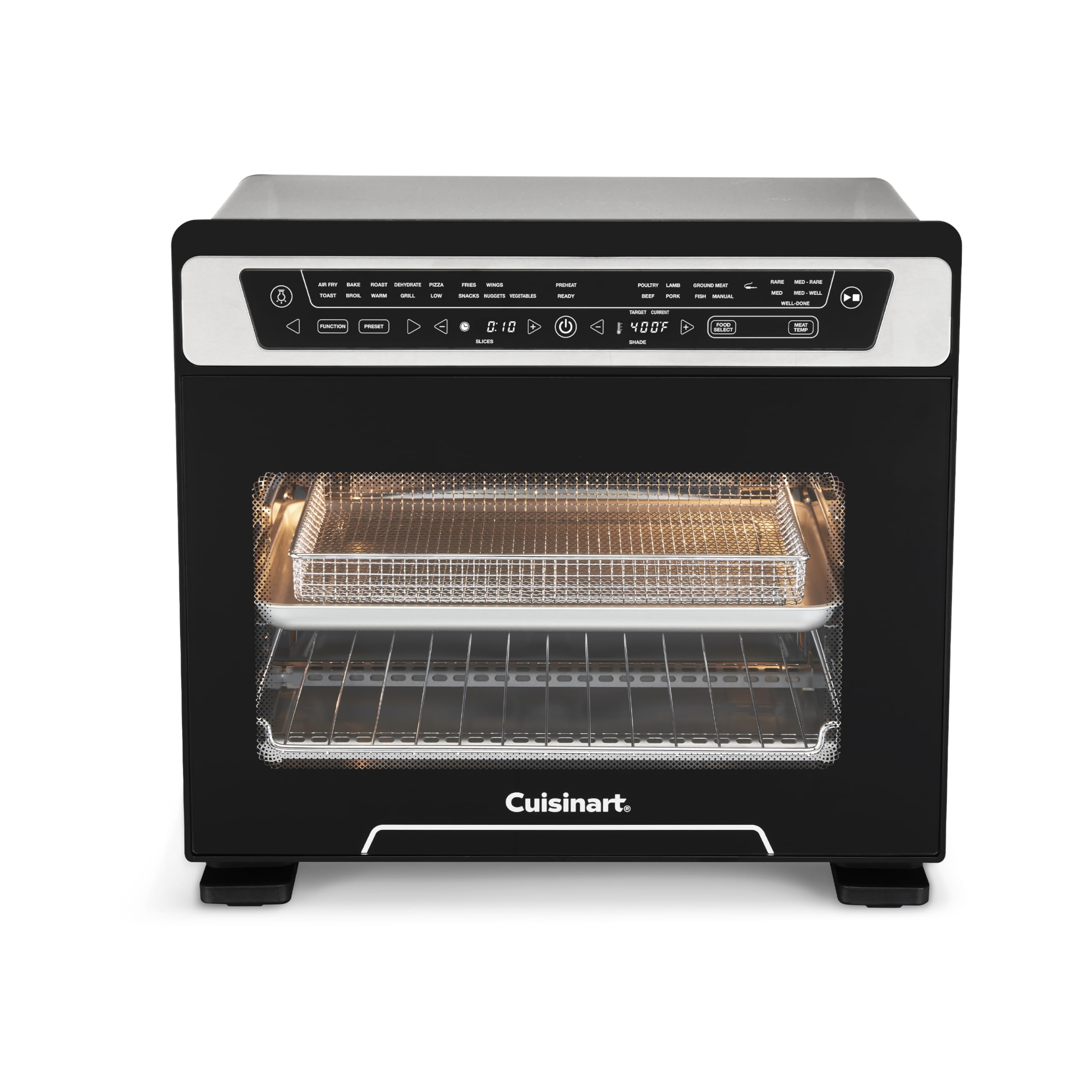
If you want one Cuisinart countertop oven that feels like a genuine “kitchen upgrade,” the TOA‑112 is the pick that most reliably delivers. Not because it has the longest mode list (though it’s packed), but because it solves the biggest hidden problem in countertop cooking: confidence with proteins.
A lot of people can air fry fries. The moment you try to cook chicken breast without drying it out, or roast a bigger bird without playing “cut-and-peek,” you discover why some owners become obsessed with probe-based cooking. A temperature probe doesn’t just feel fancy—it changes the emotional experience. Instead of hovering, you get a calm, repeatable “that’s done” result. And for families, that turns a countertop oven into an actual everyday workhorse.
What owners tend to love (the patterns that repeat)
The strongest theme around the TOA‑112 is speed with surprisingly even results. People talk about it cooking faster than expected and needing some adjustment to old cook times. That’s not a flaw; it’s a personality. It’s what happens when you combine a strong fan-driven environment with a hot, responsive cavity. Once you accept “this thing is quicker,” you stop overcooking and start winning.
Another consistent praise: the unit feels “built for real meals,” not just snacks. The included pan and divider concept is more than a gimmick if you cook for two different preferences (spicy vs mild, vegetarian vs meat, kid-friendly vs adult). It’s not about splitting a tiny basket—it’s about getting two foods done together without running two appliances.
The expert angle: why the probe matters more than you think
The quickest way to level up in a countertop oven is to cook by doneness, not by time. Time-based cooking assumes the same starting temperature, thickness, pan material, and airflow every time—which is rarely true. A probe lets you treat the oven as a controlled environment and treat the food as the variable.
- Chicken breast: you stop guessing and stop drying it out “just to be safe.”
- Whole chicken / roast: you can cook to a target internal temperature and still get the exterior browning you want.
- Reheat without rubber: you learn quickly which foods need lower heat + fan, and which need high heat + short time.
If you’re the kind of cook who wants reliable results more than flashy settings, this is the feature that pays you back weekly.
What catches people off guard (and how to fix it)
The most common “surprise” isn’t that it cooks fast—it’s how fast. The fix is simple:
- Start with a conservative time and add minutes, especially for frozen foods.
- Use the window + light to check progress instead of opening the door repeatedly.
- Learn your top rack heat (the top area can brown aggressively). Great for crisping; risky for sugar-heavy foods if you’re not watching.
Pro tips for results that feel “restaurant crisp”
- Preheat like you mean it: A short preheat makes crisping dramatically better because the metal surfaces are already hot.
- Don’t crowd the air fry basket: Single-layer wins. If you pile, you’re steaming with a fan.
- Use the right tool for the job: Air fry basket for crisping. Pan for saucy bakes. Grill plate when you want aggressive heat retention.
- Rotate once on bigger loads: Even good fans have hot zones. A mid-cook rotate is the “pro move.”
Why you’ll like it
- Probe-driven confidence – A game-changer for chicken, roasts, and “I don’t want it dry” cooking.
- Big-meal energy – Feels like a true main-oven helper, not a snack-only gadget.
- Fast, responsive heat – Once you adjust timing, results feel efficient and consistent.
- Modern workflow – Window, light, and digital guidance reduce “open the door, lose heat” habits.
Good to know
- Expect a short learning phase where you reduce old cook times; this oven runs “quick.”
- Because it’s a larger cavity, your cleanup routine matters—especially after fatty air fry cooks.
- If you only cook tiny portions, a compact model may feel faster and less “appliance presence.”
Ideal for: families, serious home cooks, and anyone who wants their countertop oven to feel like a reliable second oven—with precision that makes weeknight proteins easier.
2. Cuisinart TOA-95NAS – The Extra‑Large “Do Everything” Digital Oven (For People Who Actually Use the Extras)

The TOA‑95NAS is for a very specific kind of buyer: the person who wants their countertop oven to replace multiple tools and is willing to learn the interface so they can cash in on the depth. This is not just “air fry + toast.” This is the model people choose when they want proofing, dehydrating, low-and-slow, reheat that doesn’t murder leftovers, and a big enough cavity to handle real pans.
Here’s the honest truth: most buyers think they want a giant feature list. Only some people actually use it. If you’re one of them—if you bake dough, like slow-cooked textures, want dehydration for snacks, or love cooking in stages—this oven feels like a control center.
The real strength: it behaves like a “programmed oven,” not a toaster
Owners who love the TOA‑95 often describe an arc: week one is “wow, there’s a lot here,” and week two becomes “okay… now I get it.” Once you learn your preferred presets and how the oven behaves with your common foods, it becomes a repeatable tool.
The “dual cook” idea is especially powerful for home cooks who want more control than a single temperature can offer. Think: gently warm something through, then finish with high-heat browning. Or roast a protein in a controlled way, then crisp the exterior without guessing. That’s the kind of workflow that makes food taste intentional, not accidental.
Where it can frustrate people (and who should avoid it)
Digital models can be polarizing for one reason: they demand a relationship. If you want to twist a dial and walk away, this is not the emotional vibe. Some owners specifically dislike the idea of electronics living close to high heat. Others simply don’t want an appliance that expects “clock-style” engagement.
If your cooking is mostly toast, frozen snacks, and quick reheats, you’re paying for complexity you won’t use. In that case, you’ll be happier with the CTOA‑122 or TOA‑70. But if you’re the kind of cook who enjoys settings and repeatability, TOA‑95 becomes a “why didn’t I do this sooner?” purchase.
The expert benefit: it rewards meal-prep and batch cooking
Because the cavity is extra-large and the functions go beyond “hot and fast,” this model shines when you’re cooking in batches:
- Dehydrate for fruit, jerky-style snacks, or crunchy garnishes (great if you hate food waste).
- Slow cook for tender textures and hands-off dinners.
- Proof for consistent rise, especially in cold homes.
- Roast + air fry finish when you want juicy inside + crisp outside without deep frying.
How to get the best “air fry” results in a larger cavity
Bigger ovens can tempt you to load everything at once. That’s where crisping dies. Treat air fry like airflow engineering:
- Use the basket so air can hit the underside; flat pans trap moisture.
- Leave gaps between items (yes, even when you can fit more).
- Flip or shake once on thicker foods to expose new surfaces to airflow.
- Use “convection bake” strategically for items that need gentler airflow but still want browning.
Why you’ll like it
- Serious versatility – Proof, dehydrate, low, slow cook, dual cook: this goes beyond “snacks.”
- Extra-large interior – Works with real pans and larger family-sized cooks.
- Repeatability – Once learned, it becomes a “set it right and it behaves” tool.
- Excellent for batch cooks – Great for people who cook once and eat twice.
Good to know
- Digital workflow is a love-it-or-hate-it experience; knob lovers should pick the TOA-70 instead.
- If you only use basic functions, you’ll get more joy from a simpler model.
- Air fry performance improves dramatically when you avoid overcrowding and use the basket properly.
Ideal for: power users, bakers, meal-preppers, and anyone who genuinely wants proof/slow cook/dehydrate features in a countertop format.
3. Cuisinart CTOA-122 (6‑in‑1 Airfryer Combo) – The “I Use This Every Day” Kitchen Workhorse

The CTOA‑122 is the “most people should start here” option if your goal is simple: better food, less hassle, and an appliance you’ll actually use daily. It’s the model that tends to replace the toaster, handle weeknight bakes, and make air-fried snacks taste genuinely crisp—without demanding a hobbyist mindset.
Across owner feedback, you see the same story: it becomes the default oven because it heats fast, doesn’t blast the kitchen with heat the way a full-size oven can, and makes reheats taste like “fresh food,” not “sad leftovers.” People air fry wings and fries, roast vegetables, and get that satisfying crisp on foods that used to go limp in the microwave.
The under-rated strength: reheat quality
A lot of buyers focus on air frying. But the daily win is often reheating: pizza that crisps the crust again, fries that recover, chicken that doesn’t get rubbery, and pastries that warm without becoming soggy. That’s where a convection-capable toaster oven quietly outperforms half your kitchen. Once you get used to reheating with hot air and a rack instead of a flat plate, you stop “settling” for microwave texture.
What you must do before buying: measure your counter
This is a full-size countertop unit. Owners love it… but only if it fits their space. The most common “wish I knew” comment isn’t about performance—it’s footprint. If you’re tight on counter space, the TOA‑26 compact exists for a reason. If you have the room, the CTOA‑122 rewards you with capacity and versatility that feels like “real oven power.”
Real-world performance notes: strong convection means you adjust cook habits
Many owners say it runs hot or fast compared to what they’re used to. That’s not unusual in a powerful countertop convection environment. The “pro” move is to treat your first week like calibration:
- Reduce time first (then adjust temperature if needed).
- Check earlier than the package says for frozen foods.
- Use the light/window if available so you don’t dump heat repeatedly.
The one friction point to know: fan noise can happen
Any convection/air-fry oven uses a fan, and a fan can be heard. Most people find it normal. Occasionally, owners report a sudden loud noise, often described like something rubbing or hitting. When that happens, the practical guidance is simple: stop using it and address it immediately. On a day-to-day level, most users describe performance as strong and consistent once they learn timing.
How to make this model feel “effortless”
- Build a default routine: Toast in the morning, reheat on a rack at lunch, air fry snacks at dinner. Consistency makes the controls intuitive.
- Keep the crumb tray honest: Empty it regularly. That one habit reduces smell, smoke, and “mystery burning.”
- Use a drip tray approach for fatty foods: Catch grease early instead of letting it aerosolize and coat the interior.
- Accept that “air fry” is a technique: Single layer, space between food, and one shake/flip is the difference between crisp and steamed.
Why you’ll like it
- Everyday versatility – Toast, bake, broil, convection, and air fry cover most home cooking needs.
- Reheat tastes better – A major quality-of-life upgrade versus microwave texture.
- Strong convection performance – Great roasting, crisping, and fast cooking once you calibrate timing.
- “Lives on the counter” convenience – Owners often use it more than their main oven.
Good to know
- Measure your counter space; it’s a full-size unit and wants breathing room.
- Expect a learning curve on cook time—many people reduce time for frozen foods.
- Like any fan appliance, sound exists; rare “loud noise” reports are a stop-and-check situation.
Ideal for: most households that want one reliable countertop oven to toast, bake, roast, air fry, and reheat better—without getting lost in niche modes.
4. Cuisinart TOB-135N Deluxe Convection Toaster Oven – The “Consistent Toast, Steady Bake” Specialist

Let’s address the elephant in the room: the TOB‑135N is not an “air fryer toaster oven.” It’s a convection toaster oven broiler that focuses on doing core oven things exceptionally well. And that matters, because a lot of people shopping “air fry” don’t actually need a dedicated air fry mode. They need a countertop oven that bakes evenly, toasts consistently, reheats pizza beautifully, and doesn’t require preheating a full-size oven for small meals.
This model earns loyalty from people who treat it like their primary daily oven—especially in warm months when the main oven feels like a space heater. Owners often describe using it multiple times per day for years. That’s the real endorsement: not “wow, cool feature,” but “this became part of our routine.”
Why it feels different: steadier, more predictable heat behavior
A classic complaint with many countertop ovens is temperature drift and uneven results. The TOB‑135N’s appeal is its reputation for “predictable” outcomes—especially on toast shade consistency and convection baking. When an oven is consistent, you stop babysitting it. And that’s the entire point of a countertop appliance: speed, convenience, and reliable results.
Real owner reality: it’s powerful—and you should treat it like a real oven
Owners regularly mention how quickly it preheats compared to a main oven. That’s wonderful… and it means you can overcook if you use old habits. The smarter approach:
- Preheat briefly (it gets there fast).
- Start checking early on the first few runs of a new recipe.
- Use shelf positions intentionally (top browns fast, lower is gentler).
The “little warnings” that save headaches
Owners sometimes note the exterior can get hot in specific areas and that the back wants clearance. That’s normal for many toaster ovens, but it becomes critical in tight spaces. Give it air behind and around it, and be mindful of cord placement so nothing touches hot surfaces.
Another common “first-day moment”: the new-appliance smell. This isn’t unique to Cuisinart—many new appliances need a burn-in run to off-gas manufacturing residues. Run it empty, ventilate well, and the smell usually fades quickly.
Who should choose this over an air-fry model?
Choose the TOB‑135N when:
- You care more about toast quality and baking predictability than about max-crisp air fry.
- You want a countertop oven that feels “boringly reliable” for everyday heating and baking tasks.
- You’d rather have a strong convection oven than a feature-heavy interface.
If your goal is primarily wings, fries, and “air fryer crunch,” you’ll be happier with TOA‑70, CTOA‑122, TOA‑95, or TOA‑112. But if your goal is a countertop oven you trust daily for bread, pizzas, pastries, and small bakes, this model has the right personality.
Why you’ll like it
- Reliable toast consistency – A “set it and trust it” vibe that makes mornings easier.
- Fast preheat – Big convenience win vs a full-size oven.
- Convection baking strength – Great for small roasts, potatoes, pastries, and frozen foods.
- Long-term daily use reputation – Many owners run it constantly for years.
Good to know
- No dedicated air fry mode; this is convection-first.
- Give it clearance—some areas can get hot, especially if counter space is tight.
- Like many ovens, it rewards learning shelf positions for different foods.
Ideal for: toast and bake lovers who want a dependable convection toaster oven that can replace “small oven tasks” without turning cooking into a project.
5. Cuisinart TOA-70BKS (Air Fryer Toaster Oven with Grill) – The “Turn a Dial, Eat Better” Favorite

The TOA‑70BKS is the model people buy when they’re done with fussy gadgets. It’s the “I want it to work when I turn the knob” personality—and that’s not small. In real kitchens, simplicity is a feature. A good dial-based oven reduces mental load, which means you cook more at home.
This is also one of the most beloved “replace multiple appliances” picks because it does the core set well: air fry, toast, convection bake, broil, warm… plus a grill/griddle plate that changes what you can do on a weeknight. If you’ve ever wanted to sear-style cook indoors without dragging out another appliance, that plate is not fluff. It’s a real tool.
Why this model feels crisp (when used correctly)
Air frying in a toaster-oven format works best when heat and airflow hit food directly. This model’s design is built around top fan/heater airflow, so it can produce genuinely crispy results—especially on wings, fries, and vegetables. But here’s the expert nuance: the crisp depends on using the basket/rack and not smothering it in a deep pile.
The biggest reality check: grease management is part of ownership
Owners who cook a lot of fatty foods sometimes report that grease vapor can spread inside the oven, creating a “film” that needs routine cleaning. That’s not a defect—it’s physics. Fast airflow + hot fat = aerosol. You can either accept it and build a routine, or you can choose a different cooking style. Here’s how you make it easy:
- Use a drip strategy: put the baking pan underneath the air fry basket to catch fat before it hits the bottom surfaces.
- Wipe while warm (not hot): a quick wipe after cooling slightly is easier than a deep scrub weeks later.
- Don’t let grease bake on: one neglected week becomes a “why is it smoking?” week.
Why people fall in love with it anyway
Because the results are satisfying and the workflow is frictionless. Many owners mention it becomes their daily oven: it toasts efficiently, reheats like a champion, and makes quick dinners feel possible. Some also like that it doesn’t get dangerously hot on the outside compared to some toaster ovens—though like any hot appliance, you still want clearance and common-sense handling.
How to use the grill plate like a pro
- Preheat the plate when you want sear-style results (veggies, burgers, chicken thighs).
- Dry the surface of proteins before grilling—moisture kills browning.
- Finish with air fry if you want crisp edges after grilling (especially on thicker cuts).
This “grill then crisp” workflow is one of the most underrated reasons to buy this model. It produces that “done properly” texture people crave.
Why you’ll like it
- Dial simplicity – Fast, intuitive, no menu-diving.
- Great crisping potential – Strong airflow makes fries, wings, and veg satisfying when you avoid crowding.
- Grill/griddle plate utility – Adds a second “cooking style” without another appliance.
- Excellent everyday replacement – Many owners use it more than their main oven.
Good to know
- Grease aerosol is real if you cook lots of fatty foods; simple routines prevent smoke and buildup.
- Air fry toaster ovens reward technique: spacing, basket use, and a mid-cook shake/flip.
- Interior light behavior can be a small annoyance for some; the window and timing become your workflow.
Ideal for: people who want an air fry toaster oven that feels simple, reliable, and satisfying—especially if you love dials and want a grill/griddle option.
6. Cuisinart TOA-26 Compact Air Fryer Toaster Oven – Tiny Counter, Big Crisp (With One Important Inspection)

If you live in a small kitchen, apartment, RV setup, or just refuse to donate half your counter to an appliance, the TOA‑26 is the model that makes sense. It’s compact, quick to heat, and—this surprises many buyers—can crisp extremely well because the smaller cavity concentrates heat and airflow. In other words: less space to heat can translate into a more intense cooking environment.
This is where “compact” becomes a performance advantage. Many owners describe it as efficient and fast, especially for small batches. If your cooking is mostly for one or two people, or you want a daily toaster replacement that can also air fry snacks and roast vegetables, this model hits the sweet spot.
The one important inspection (do this early)
Some owners report a door/safety-switch sensitivity: the oven relies on a door-closed mechanism, and if the door alignment is off, the unit can shut off mid-cook because the safety pin disengages. If you buy this model, do this within your first few uses:
- Close the door firmly and check that it sits flush.
- Run a short cook and watch whether it stays engaged without you touching it.
- Gently wiggle the door while running (not forcefully) to see if it’s sensitive.
If your unit is solid, you’re golden. If it’s finicky, address it immediately rather than living with a trivet jammed against the door.
What people love: “does it all” without feeling huge
Owners who choose this model tend to be practical: they want air fry and toast, maybe convection bake for small bakes, and a warm setting for gentle heating. They also tend to like that it’s easier to live with on the counter—especially compared with larger models that demand a permanent parking spot.
The expert tip: make compact air fry taste like a basket air fryer
You can get genuinely impressive crisp in this unit if you treat airflow like the boss:
- Keep food in a single layer and leave gaps; compact doesn’t mean “stack it.”
- Use the basket for airflow underneath; the underside crisp matters more than people think.
- Flip once for thicker foods; compact heat is intense and you want even exposure.
Cleanup reality: easier when you choose your battles
Compact ovens can feel easier to clean simply because there’s less interior surface area. But they’re not magic. If you cook oily foods, use a drip approach and wipe routinely. If you mostly toast and bake, the crumb tray and quick wipe become simple maintenance.
Why you’ll like it
- Compact efficiency – Great for small counters and small-batch cooking.
- Fast, punchy heat – Smaller cavity can crisp impressively when used correctly.
- Simple daily use – Perfect for toast, snacks, and quick dinners for one or two.
- Less “appliance takeover” – You get versatility without sacrificing your whole kitchen layout.
Good to know
- Inspect door alignment early; some units show safety-switch sensitivity if the door doesn’t sit firmly.
- No interior light; you’ll rely on timing and quick checks.
- If you regularly cook for a family, you’ll want a larger cavity (CTOA-122, TOA-70, TOA-95, or TOA-112).
Ideal for: small kitchens, singles/couples, RV/camper setups, and anyone who wants strong crisping potential without a full-size footprint.
How “Air Fry” in a Countertop Oven Actually Works (and How to Get the Crunch You Want)
Most disappointment with air fry toaster ovens comes from a mismatch of expectations. A basket air fryer is a tight, high-velocity environment by design. A toaster-oven air fryer is a larger chamber with fan-driven heat—more versatile, often more spacious, and sometimes more “technique-dependent.” Once you understand the mechanics, you can make any of these ovens deliver the crisp you’re chasing.
The three levers that create crisp
- Surface dryness: Crisp starts when moisture leaves the surface. Pat food dry, avoid wet batters, and don’t crowd.
- Airflow exposure: Food needs air to hit multiple sides. That’s why baskets and racks matter.
- Heat intensity: Higher heat browns faster, but can also burn sugar-based foods. You want the right intensity for the food.
The “crowding myth” that ruins air fry
Most people load an oven like a baking tray: full and efficient. Air fry is the opposite. If you crowd, you trap steam. Steam is the enemy of crisp. That’s why air fry instructions often say “shake” or “flip”—you’re exposing new surfaces to dry hot air.
When to use air fry vs convection bake
- Air fry: best for crisping and browning (wings, fries, nuggets, roasted veg, reheated pizza slices).
- Convection bake: best for more even heat with gentler airflow (cookies, pastries, casseroles, baked pasta).
- Broil/grill: best for top browning and finishing (melts, gratins, crisping the top after cooking through).
Why countertop ovens often cook faster than your main oven
- Less air volume means faster preheat and faster recovery when you open the door.
- Fan-driven heat moves energy onto food surfaces more aggressively.
- Food is closer to the elements compared to a big oven cavity.
That speed is a gift… but it forces a mindset shift: don’t blindly follow full-oven cooking times. Start early checks and adjust.
The “smoke and smell” problem—what actually causes it
- Grease aerosol: hot fat gets blown around and bakes onto surfaces.
- Dirty crumb tray: crumbs burn and smell worse over time.
- Overflow: cheese, sauce, and sugars drip and carbonize.
The solution is not “never air fry.” It’s smarter workflow: use a catch pan, wipe interior surfaces regularly, and keep crumbs under control. When you do that, these ovens stay enjoyable instead of becoming smoky.
The “one habit” that upgrades results instantly
Preheat. Even a short preheat makes the metal hot and stabilizes the environment. That’s how you get better browning and more reliable timing.
FAQ: The Questions Real Buyers Ask (Before They Choose Wrong)
Which model is the best “buy once, use forever” option?
Will an air fry toaster oven replace a basket air fryer?
Why do some people say these ovens cook faster than expected?
How do I reduce smoke and smell when air frying greasy foods?
Knobs or digital: which is better for most people?
I have very limited counter space. What’s the smartest pick?
What if I mostly want toast, bake, and reheat—air fry is optional?
Final Thoughts: Pick the Oven That Matches Your Real Life (Not a Spec Sheet)
Here’s the quiet truth: most people don’t need “the best oven.” They need the best match. The one that fits their counter, their cooking style, and their patience level. If you choose that, you’ll use it daily—and that’s where the value actually lives.
If you came here searching for a cuisinart air fryer convection oven, use this fast decision shortcut:
- Want the best all-around upgrade that feels confident and modern? Start with the Cuisinart TOA-112. It’s the most “complete” experience for most kitchens: precision, capacity, and fast everyday performance.
- Want maximum function depth (proof, slow cook, dehydrate, dual cooking) and you’ll actually use it? Choose the Cuisinart TOA-95NAS. This is the power-user pick that rewards people who like settings and repeatability.
- Want the best “everyday workhorse” balance of air fry + convection without getting too fancy? Go with the Cuisinart CTOA-122. For many households, this becomes the most-used appliance in the kitchen.
- Want consistent toast and steady baking more than air fry crunch? Pick the Cuisinart TOB-135N. This is for people who want a reliable convection toaster oven they can trust daily.
- Want simple dials, strong crisp potential, and a grill/griddle option? Choose the Cuisinart TOA-70BKS. It’s the “turn a knob and eat better” model that dial-lovers swear by.
- Need compact power for a small counter (but still want real crisping)? Grab the Cuisinart TOA-26. It’s efficient, fast, and a smart daily driver for smaller households.
Once you choose the model that matches your habits—and adopt a simple crumb/grease routine—these ovens stop being “another appliance” and start being the thing that makes your meals easier, faster, and genuinely better.
