
A big air fryer doesn’t just cook more food. It changes how dinner feels. Suddenly you’re not running back‑to‑back batches, reheating sides, or doing the “wings first, fries later” shuffle while everyone stares at you like you’re the kitchen DJ.
If you’re shopping for a 12 qt air fryer, you’re usually after one thing: less friction. You want one appliance that can handle a real family meal (protein + veg + something crispy) without turning it into a 90‑minute production. And here’s the truth most guides dodge: the winner isn’t the model with the longest preset list—it’s the one that matches your cooking rhythm, your counter space, and how patient you are with controls.
This guide is built around the stuff that actually decides whether you’ll love your air fryer three months from now: how evenly it browns without babysitting, whether the basket shape makes shaking easy or awkward, how the door/basket design affects mess, whether “dishwasher safe” really means easy to live with, and the little design decisions that either save your weeknights… or quietly annoy you forever.
Below are 16 standout big-capacity picks—dual baskets, flex baskets, vertical stackers, and oven-style units with rotisserie. Some are “set it and forget it” simple. Others are powerful multitaskers that replace multiple appliances. I’ll help you pick the one that fits your life, not just your spec sheet.
In this article
- How to choose the right size, style, and features for how you actually cook.
- Quick comparison table of 16 standout models.
- In-depth reviews of each pick (with real-world pros and cons).
- How crisping really works (and how to get better results fast).
- FAQ + final buying tips to lock in the right choice.
How to Choose the Right 12 Qt Air Fryer for Your Kitchen
A big-capacity air fryer is only “better” if it makes your meals faster and easier without creating new annoyances—awkward shaking, hard-to-clean hinges, confusing dual-zone controls, or baskets that feel big but don’t actually hold food in a single layer. Here’s the decision framework I use when I’m helping someone pick a model they’ll still love after the honeymoon phase.
1. Start with your real cooking pattern (not your fantasy cooking pattern)
Most buyers fall into one of these day-to-day patterns. Pick yours first—then choose a style that supports it.
- The “protein + side” weeknight cook: You want two zones so chicken can cook in one basket while fries/veg cook in the other, timed to finish together.
- The “big batch” family cook: You want one large cavity (or a flex basket) to spread food out for crisping—wings, nuggets, potatoes, and meal prep portions.
- The “I want an oven replacement” cook: You want racks, a door, and multi-level cooking for pizza, toast, roasting, dehydrating, and rotisserie.
- The “tiny counter / RV” cook: You want vertical stacking or a compact footprint, even if it means a slightly smaller usable layer.
- The “I hate babysitting food” cook: You want strong airflow, good browning, and (ideally) a thermometer or a reliable finish behavior.
2. Dual baskets vs oven-style: which one actually fits your life?
This is the biggest fork in the road, and most guides oversimplify it. Here’s the real trade:
- Dual-basket drawers win when you want two different foods cooked with two different settings and finished together. They’re also the easiest to load and unload fast (especially for frozen foods, wings, and meal prep).
- Oven-style air fryer ovens win when you want surface area and multi-level cooking—toast, pizza, roasting, dehydrating, rotisserie chicken, and cooking multiple trays at once. They’re also great when you hate shaking baskets and prefer turning trays.
Here’s the sneaky truth: a “12–14 qt oven-style unit” often gives you more usable crisping area than a “12 qt drawer unit” if you cook on trays in a single layer. But dual baskets can still win for weeknights because you’re cooking two different foods with sync finish—no waiting, no reheating.
3. Capacity is not volume. Capacity is surface area.
If you remember one line from this guide, make it this: crisping is a surface-area sport. A basket can be “big” in volume, but if the bottom is narrow or rounded, you end up stacking food—and stacked food steams.
When comparing large models, ask:
- Can I spread wings or fries in one layer? (This is the difference between crisp and “soft but hot.”)
- Is the basket shape square-ish or tapered? Tapered baskets look big until you try to lay food flat.
- Does the unit support two levels well? In ovens, racks can double your surface area if airflow is strong and heat is even.
4. Dual-zone controls: the hidden “love it or hate it” factor
Dual-zone cooking sounds simple, but the control design can make it effortless… or weirdly frustrating. The most common pain point in owner feedback is not cooking performance—it’s accidentally changing the wrong basket mid-setup, or turning one zone off while setting the other.
What makes dual-zone controls feel easy:
- Clear left/right selection that is obvious at a glance.
- Sync Finish and Sync Settings that work consistently (finish together vs copy settings).
- Auto-pause that resumes cleanly when you pull a basket to shake.
- Feedback you can trust—beeps, indicators, and a UI that doesn’t hide what’s happening.
If you’re buying for someone who doesn’t love tech, prioritize the simplest control logic—even if it has fewer “modes.” The easiest air fryer is the one that gets used.
5. Cleaning reality: door hinges, drip trays, and basket coatings
Almost every product claims “easy clean.” Here’s what actually decides how cleaning feels:
- Drawer units: look for sturdy nonstick coatings, removable crisper plates, and baskets that don’t have annoying “escape holes” that drop fries underneath.
- Oven-style units: look for a drip tray that actually catches grease and a door/hinge design that doesn’t trap crumbs where you can’t reach.
- Accessories: dishwasher-safe racks help, but a quick soak + wipe is often faster than running a whole dishwasher load.
Paper liners can reduce mess, but they can also reduce airflow if you use them like a blanket. The best approach is to treat liners as a tool: use them for saucy foods and sticky marinades, not for everything.
6. Performance isn’t just “hotter”—it’s airflow, heat placement, and timing
Two big-capacity units can both hit the same temperature but cook very differently. Why? Airflow path and heat placement.
- Top-heavy heat can brown fast but needs flipping for evenness.
- Balanced convection tends to give “set it and forget it” results.
- Dual-zone power sharing can mean each basket heats slightly differently when both zones run at max—some brands handle this better than others.
If you cook a lot of meat, a built-in thermometer (or a high-quality temperature probe strategy) can be the single biggest upgrade. It’s not just about “safety”—it’s about consistency. You stop guessing, and your chicken stops drying out.
7. Counter space and ergonomics: the part you notice every day
A large-capacity air fryer can be wide (dual drawers) or tall (stacked/vertical). This matters more than people expect:
- Wide units can dominate the counter but are easy to load and shake.
- Vertical units save counter width but can be taller than listings suggest—measure your cabinet clearance.
- Drop-down doors can be convenient but can also become a crumb “landing zone.”
If your kitchen is tight, look at the vertical stackers and compact oven-style units in this guide. They can deliver big cooking capacity without the “my counter is gone now” feeling.
Quick Comparison: 16 12 Qt Air Fryer Picks for Big‑Batch Cooking
Use this table to shortlist the styles that match how you cook, then jump to the full reviews for the details that decide whether you’ll love the unit long-term—like control logic, cleanup friction, and how reliably it crisps without babysitting.
On smaller screens, swipe or scroll sideways to see the full table.
| Model | Format | Standout strength | Best match | Amazon |
|---|---|---|---|---|
| Cuisinart Dual Basket Air Fryer (ADZ-112) | Dual basket | Brand-level build + versatile functions + strong “finish together” workflow | Most families who want a reliable dual-zone daily driver | Amazon |
| Ninja DZ550 Foodi DualZone Smart XL | Dual basket | Smart thermometer + confident doneness control for meat | People who want steak/chicken “perfect every time” results | Amazon |
| Cuisinart Dual Basket Air Fryer (ADZ-110) | Dual basket | Simpler function set + strong everyday cooking flow | Families who want dual baskets without extra complexity | Amazon |
| Zavor Crunch 12 Qt Air Fryer Dehydrator Combo | Air fryer oven | 7-in-1 replacement energy: rotisserie, trays, door, easy wipe-down cooking | “Replace the oven/toaster” cooks who want one countertop hub | Amazon |
| DoubleStack Dual Basket Air Fryer (12.6QT) | Vertical stack | Big-capacity cooking in a smaller footprint + sync finish for real meals | Busy family kitchens that need counter space back | Amazon |
| COSORI 11-in-1 Air Fryer Oven (13Qt) | Air fryer oven | Compact oven feel + rotisserie + strong “small kitchen” footprint strategy | People who want toast/pizza/roast in one tight package | Amazon |
| CHEFMAN ExacTemp 12 Quart (Smart Thermometer) | Air fryer oven | Integrated thermometer + window + “finish crisp” mindset | Meat cooks who want doneness confidence without guesswork | Amazon |
| Chefman 12‑Quart 6‑in‑1 Air Fryer Oven | Air fryer oven | Three rack levels for real surface area + Hi-Fry finish for crunch | Meal preppers and “cook on trays, not baskets” people | Amazon |
| West Bend 12.6 Qt Air Fryer Oven (AFWB12BK13) | Air fryer oven | Old-school dependable oven-style workflow + rotisserie + strong daily use feel | People who want a “tiny oven” they’ll use constantly | Amazon |
| Elite Gourmet Dual Zone Air Fryer Oven (11QT) | Dual basket | PFAS-free positioning + sync finish + “easy teen meals” capacity | Simple, practical dual-zone cooking (including RV use) | Amazon |
| 12QT Large Dual Air Fryer (2×6QT, window) | Dual basket | Viewing window + sync cook + “two dishes at once” confidence | Families who want dual drawers + easy monitoring | Amazon |
| HoninJoy 12QT Dual Basket (Flex Basket + Liners) | Flex basket | Switch between one big basket or two zones + included liners | Hosts and meal preppers who bounce between “big batch” and “two foods” | Amazon |
| TOPZEE 11‑QT Flex Basket Air Fryer | Flex basket | One big basket or two halves + sync cook + straightforward cooking set | People who want flexibility without oven-style racks | Amazon |
| 12QT Dual Layer Vertical Air Fryer Oven | Vertical stack | Top/bottom drawers save counter space + surprisingly quiet cooking | Small kitchens that still need two-zone meal timing | Amazon |
| HoninJoy 12QT Dual Basket (10‑in‑1, window) | Dual basket | Simple dual-zone cooking + window + “watch without heat loss” | Busy weeknights when you want less checking and more crisping | Amazon |
| Gourmia 14 Qt All‑in‑One Air Fryer Oven | Air fryer oven | Massive function-per-dollar energy + trays + rotisserie kit | People who want big capacity and features without overthinking it | Amazon |
In‑Depth Reviews: 16 Big‑Capacity Air Fryers People Actually Keep Using
Now we’ll go model by model. I’m going to talk like someone who cooks on real weeknights—not like a spec sheet: what feels smooth, what feels fiddly, what owners love after daily use, and what you should know before committing.
1. Cuisinart Dual Basket Air Fryer (ADZ‑112) – The “Two Foods, One Finish” Daily Driver
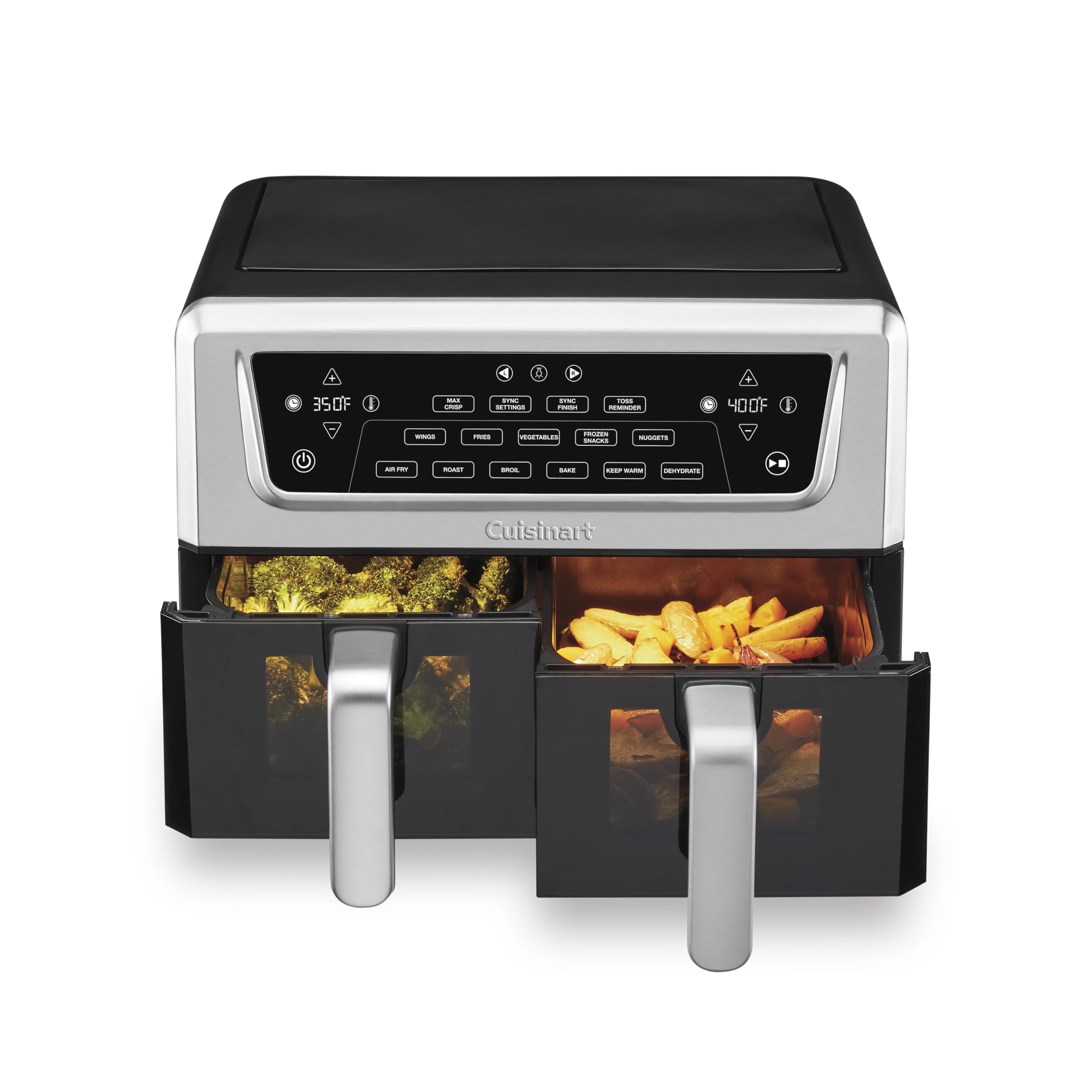
This is the kind of air fryer that earns its spot on the counter because it solves a very specific family problem: getting a full meal hot at the same time without extra thinking. Cuisinart’s dual-basket approach is less about gimmicks and more about rhythm— start the slower food first, set the faster food second, hit Sync Finish, and suddenly you’re not serving “hot chicken, sad cold fries.”
What separates the ADZ‑112 from many off-brand dual drawers is the “grown-up appliance” feel. The baskets feel sturdy, the cooking results are generally consistent, and the overall design is built for frequent use. That matters because the best air fryer isn’t the one with the fanciest preset list—it’s the one you trust enough to use on autopilot.
Here’s the expert detail most people miss: dual baskets only feel magical if the control flow is predictable. Once you learn the left/right selection logic and get comfortable with Sync Settings (copy the same cook to both sides), this becomes a “cook without thinking” machine. The learning curve is real for some users, but after a week it tends to click— especially if you keep your top 3–4 use cases consistent (wings, fries, veggies, reheat).
Crisp performance is strong when you cook in a single layer and use the toss reminder as your “don’t forget” anchor. If someone complains about uneven browning, it’s almost always a layering issue (too much food piled in) or not shaking/turning once mid-cook.
Why you’ll like it
- Meal timing feels effortless – Sync Finish is the difference between “two baskets” and a real dinner workflow.
- Reliable everyday performance – Strong crisping when you respect airflow and use single-layer cooking.
- Solid build feel – Feels like a serious kitchen appliance, not a disposable gadget.
- Easy cleanup routine – Nonstick baskets + crisper plates that clean fast with a soak-and-wipe rhythm.
Good to know
- The control learning curve can feel confusing at first—especially when setting both baskets with different temps/times.
- Basket shape matters: if you prefer perfectly square baskets, this style can take a day to adjust to.
- Like all dual drawers, results improve when you don’t overload—single layer beats “big pile” every time.
Ideal for: most families who want a dependable dual-zone air fryer that makes weeknight meals faster and less chaotic.
2. Ninja DZ550 Foodi DualZone Smart XL – The “Stop Guessing Meat” Power Move

If you’re the kind of cook who wants chicken to be juicy, salmon to be perfect, and steak to land exactly where you planned without “cut-and-peek panic,” the DZ550 is built for you. The integrated Smart Cook thermometer changes the entire relationship you have with air frying: instead of cooking to time, you cook to doneness. That’s not a small upgrade—it’s the difference between confident cooking and constant second-guessing.
Owners who love this model almost always mention the same trio: dual baskets for real meal timing, surprisingly quiet fan behavior, and consistently great crisp results without drying food out. The “Smart Finish” / “Match Cook” logic is also one of the best-executed versions of dual-zone cooking: it feels like the unit was designed around real dinners, not just frozen snacks.
Here’s the expert detail: the thermometer isn’t just for steak. It’s a weekly-life tool for chicken thighs, pork chops, and even reheating thicker leftovers without blasting them into dryness. You can run one basket with a probe-driven cook and run the second basket for fries or veg—then let Smart Finish bring them home together. That’s the workflow that makes this feel premium.
The most common “downside” reported is basket size expectations. Dual baskets can sound huge on paper, but if you’re feeding a larger crowd, you may still do occasional batches for wings or fries—because crowd-sized crisping is surface-area limited. The upside: the results are so consistent that batches feel less annoying.
Why it’s worth the upgrade
- Smart thermometer = consistent doneness – You cook meat to temperature, not vibes.
- Dual baskets done right – Smart Finish and Match Cook are genuinely practical for real meals.
- Fast, crisp results – Strong airflow makes frozen-to-crispy cooking feel effortless.
- Easy cleanup – Nonstick baskets clean quickly, especially if you don’t let grease sit overnight.
Good to know
- Some people wish the baskets were larger for big parties; you may still cook wings in batches for maximum crisp.
- It’s a countertop commitment—measure your space and plan a permanent spot if possible.
- The thermometer is amazing, but you’ll want to store it carefully so it doesn’t get bent or snagged in a drawer.
Ideal for: anyone who cooks a lot of meat and wants consistent results without guesswork—especially busy families who value “perfect and repeatable.”
3. Cuisinart Dual Basket Air Fryer (ADZ‑110) – The Cleaner, Simpler Dual‑Zone Choice
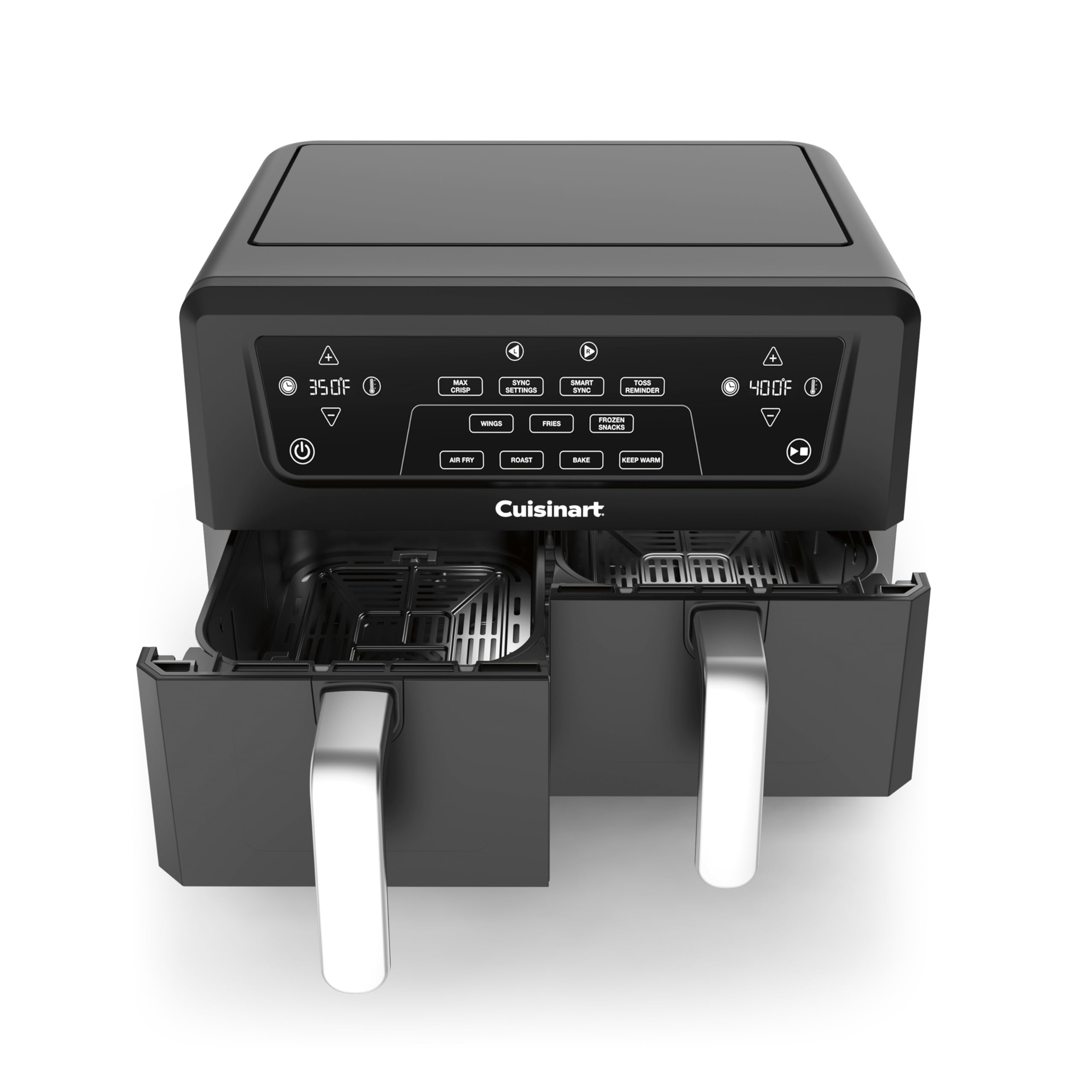
This model is for the person who wants dual baskets—because dual baskets are genuinely life-changing for weeknights— but doesn’t want a million modes, sub-menus, or “what did I just set?” moments. The ADZ‑110 keeps the function set tight: air fry, roast, bake, and keep warm—plus the dual-zone tools that actually matter (sync finish, sync settings, toss reminder, auto-pause).
In real owner feedback, two themes show up repeatedly: the cooking performance is excellent, and the unit feels like a premium countertop appliance when left out. That second point is underrated. If you like how something looks and feels, you’re more likely to use it daily. And in a family kitchen, daily use is the whole point of a dual basket unit.
The biggest learning moment with this air fryer is the shared control panel logic (a common issue with many dual drawer designs). The good news is that once you build a routine—set left basket, set right basket, then sync finish—the workflow becomes automatic. The other good news: the unit tends to heat quickly and hold temperature steadily, which is why owners describe “even cooking” and consistent results.
An expert tip: use this model like a two-part meal machine. Put the longer cook (protein) in one basket and run veggies or frozen sides in the other. Once you have a repeatable rhythm (for example: chicken first, then fries), the air fryer starts feeling like a meal system instead of a snack machine.
Why it’s a smart pick
- Simpler mode set – Less decision fatigue, faster day-to-day use.
- Excellent “keep warm” behavior – Helpful for family schedules and staggered dinner times.
- Good cooking consistency – Quick heat + steady temps make results predictable.
- Looks good on the counter – Sounds small, but it’s why many owners use it constantly.
Good to know
- Controls can feel confusing for the first few days; practice with simple foods first.
- If you want dehydrating or broiling in the same unit, the ADZ‑112 may fit better.
- It’s a bit heavy; if you store it away, moving it often can be annoying.
Ideal for: families who want dual-basket life, great cooking, and a simpler feature set that gets used every day.
4. Zavor Crunch 12 Qt – The “Seven Appliances in One” Countertop Workhorse

The Zavor Crunch is the pick for people who don’t just want an air fryer—they want a countertop oven replacement that can air fry, bake, roast, grill, dehydrate, and do rotisserie without heating the entire kitchen. Owners who love it talk about it like a daily appliance, not a sometimes gadget: reheat pizza, roast salmon, cook potatoes, and then do a rotisserie chicken that comes out shockingly good.
What makes this unit feel special is the “oven workflow.” Instead of shaking a basket, you’re sliding trays, flipping once if needed, and letting convection do the heavy lifting. For many cooks, that is simply a more natural way to cook—especially if you’re used to ovens and sheet pans. It also helps you get more real crisping area, because trays encourage single-layer cooking (the secret sauce of crisp results).
Owner feedback consistently highlights ease of use and easy cleanup, but with a real-world caveat: the door hinge area can trap crumbs. That’s not rare in oven-style designs, but it matters because it’s one of those small annoyances that shows up weekly. The fix is simple—wipe the hinge area while the unit is cool, and don’t let crumbs build up—but it’s worth knowing before you buy.
The accessory set is genuinely useful (rotisserie basket, drip tray, trays), and people mention that the nonstick surfaces clean easily with a soft sponge. If you hate scrubbing, you’ll appreciate that. One more expert note: rotisserie performance is often what separates “fun” air fryer ovens from serious ones. The Crunch tends to get strong reviews for rotisserie chicken—crisp skin, juicy inside—especially if you pat dry and season well.
Why it’s a countertop hero
- Oven-style versatility – Air fry + bake + roast + rotisserie + dehydrate in one.
- Great for real meals – Trays make proteins + sides feel easier than basket juggling.
- Strong rotisserie reputation – A legit reason owners use it daily.
- Easy wipe-down interior – Many owners love how quickly it cleans versus a full oven.
Good to know
- Crumbs can collect in the door hinge area; plan a quick wipe routine.
- Rotating basket setup can take a couple tries to feel natural—practice once before hosting.
- As with most air fryer ovens, flipping/rotating trays once improves even browning.
Ideal for: cooks who want an oven-style unit that replaces multiple appliances and handles everything from toast to rotisserie.
5. DoubleStack 12.6QT Dual Basket – Big Meals in a Surprisingly Small Footprint
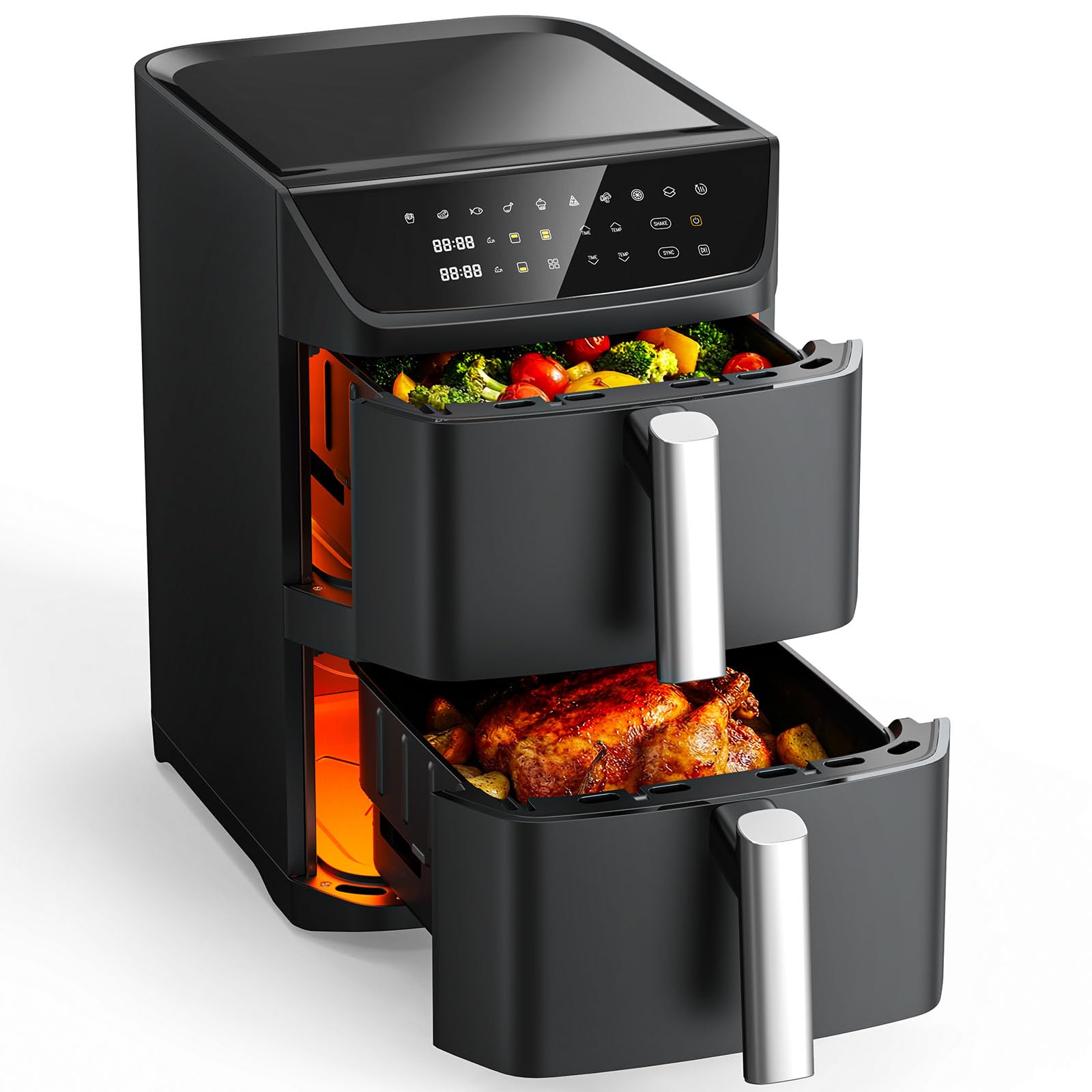
This is the model for the kitchen where counter space is precious, but dinner still needs to happen fast. The vertical “top-and-bottom” basket design is the headline: you get two cooking zones without the super-wide footprint that makes some dual-drawer units feel like they swallowed your counter.
Owners who love this style usually describe the same scenario: they can finally cook the main and the side at once. Vegetables up top, protein down below, SyncFinish to land them together, and suddenly weeknight dinner stops being a two-round process. That timing advantage is real—especially in family homes where kids are hungry now, not “after the second batch.”
An expert detail to understand with stacked designs: airflow and heat behavior can differ slightly between top and bottom zones. That’s not necessarily bad—it just means you want to learn your unit’s personality. If your top basket browns a little faster, use it for foods that benefit from stronger top heat (fries, nuggets, roasted veg) and use the lower basket for proteins. After a week, most people find a rhythm that makes this feel effortless.
The controls are generally described as approachable, which matters because some dual-zone units get criticized for UI confusion. Cleanup is also a win here: dishwasher-safe baskets mean “weeknight reset” is fast. And because the unit is tall rather than wide, it often fits better in smaller kitchens—just measure cabinet clearance before you commit.
Why it works so well
- Counter-space friendly – Vertical stacking gives you two zones without a massive footprint.
- Great real-meal workflow – Protein + side finishing together is the whole point, and it delivers.
- Strong family capacity feel – Built for the “feed several people fast” reality.
- Easy cleanup – Dishwasher-safe baskets make daily use much more realistic.
Good to know
- Top and bottom zones may brown slightly differently; you’ll learn which foods each zone likes best.
- Taller units need cabinet clearance; measure where it will live.
- If you prefer shaking wide, shallow baskets, stacked drawers can feel different at first.
Ideal for: families who want dual-zone cooking but need their counter space back.
6. COSORI 13Qt 11‑in‑1 Air Fryer Oven – Small Footprint, Big “Do Everything” Energy

COSORI built this unit for people who want an “oven-like” experience without dedicating half the countertop to a toaster oven. The pitch is simple: a compact footprint, a surprising amount of function, and an easy-to-use control panel that makes you want to cook more often. And based on real owner feedback, that’s exactly what happens—especially for empty nesters, small households, and anyone tired of preheating a full-size oven.
The daily-use wins owners highlight are practical: toast that browns evenly and crisps nicely, fast reheating that doesn’t turn leftovers rubbery, and baking small pans without heating the house. That last one is huge in warm months. When a countertop oven can handle cornbread, potatoes, and roasted veggies without turning your kitchen into a sauna, it becomes a habit—not an occasional tool.
Now for the deeper reality: oven-style air fryers live and die by airflow and tray strategy. If you want consistently great results, treat it like a convection oven: leave space around food, avoid stacking, and use the rack positions intentionally. A common pro move is placing a solid tray under a perforated tray to catch drips and keep cleanup fast. That one small habit can make the unit feel “easy” instead of messy.
Some owners mention they would prefer all-stainless accessories instead of coated trays. Whether that matters to you is personal, but it’s worth noting if you’re very particular about cookware surfaces. Performance-wise, this unit can absolutely deliver crispy results—especially when you use the rotisserie basket for fries or small items and give food room to breathe.
Why it’s a great fit
- Compact footprint – Big feature set without taking over the counter.
- Excellent for toast + reheat – Owners rave about better-than-toaster results.
- Two-level cooking – Great when you learn rack position strategy.
- Easy daily cooking – Fast heat-up means you actually use it, not just store it.
Good to know
- Like most air fryer ovens, tray rotation can improve browning uniformity.
- If you’re extremely surface-conscious, double-check accessory materials and consider swapping in your preferred racks.
- Toast settings can be powerful—start lighter and adjust after your first run.
Ideal for: small kitchens and “oven replacement” shoppers who want a compact unit that still covers toast, roast, bake, and rotisserie.
7. CHEFMAN ExacTemp 12 Quart – The “Built‑In Thermometer” Cheat Code for Better Results

This model is built around one idea that instantly improves your cooking: stop cooking meat by time. When you cook by time, you live in fear of undercooking—or you overcook to be “safe,” and dinner turns dry. When you cook by internal temperature, results get consistent fast. That’s why owners who love this unit describe the thermometer as a “life saver.”
Beyond the thermometer, the ExacTemp is strong because it behaves like a compact convection oven with a crisping finish. The rack system makes it easy to cook multiple foods at once, and the window + interior light lets you check progress without constantly opening the door (and dumping heat). For foods like fries, wings, and breaded chicken, that visibility matters more than people think: less door-opening equals better crisping and more consistent cooking.
Real-world feedback is also refreshingly grounded: people love how easy the trays are to clean in the dishwasher, how accessible the door design feels, and how quickly it cooks. A few users wish for a dedicated “quick reheat” preset, but in practice, reheating is usually a simple manual routine once you learn your preferred time/temp.
Here’s the expert move that makes this unit shine: use the thermometer for proteins, and use the last two minutes of higher heat (the “finish crisp” mindset) for crunchy texture. That combination—doneness + crisp finish—is what turns “pretty good air fryer food” into “why is this so good?” results.
Why it’s a standout
- Built-in thermometer – Makes meat doneness consistent and removes guessing.
- Window + light – You monitor browning without heat loss.
- Easy cleanup – Dishwasher-safe racks and a simple wipe-down interior routine.
- Fast cooking feel – Owners consistently describe “quick and crispy” performance.
Good to know
- Some foods (like fish) may need a little longer than basket-style air fryers; learn your timing once and you’re set.
- Rack cooking can brown unevenly if you overcrowd—space your food and rotate once for best results.
- As with all units with probes, treat the thermometer gently for long-term reliability.
Ideal for: cooks who want doneness confidence (especially for chicken and steak) without spending time guessing or overcooking.
8. Chefman 12‑Quart 6‑in‑1 – The “Three Shelf” Meal Prep Machine

This unit is for people who want to cook on racks—because racks are how you unlock real surface area. If you’re meal prepping, feeding multiple people, or you simply hate the “shake the basket” lifestyle, a three-shelf oven-style air fryer can feel like the best version of convection cooking: faster than your oven, crispier than a toaster oven, and more flexible than a single drawer.
Owners who love it describe it as a “tiny oven” they use constantly—sometimes more than their microwave. That’s a strong signal of practical value. It handles everything from bacon to baked oatmeal to salmon and roasted vegetables. And because it’s tall rather than wide, many people find it fits better on the counter than big dual-drawer units.
The best feature for crisp lovers is the Hi-Fry finish behavior. That last-minute blast of extra heat is exactly how you get that final crunch on fries, breaded foods, and chicken tenders without drying out the inside. In practice, you run your normal cook, then hit the crisp finish at the end. That’s a professional kitchen trick in button form.
Now the real-life details: venting placement matters. Some users report that if the unit is too close to the wall, it can shut down during high-heat cooking. The fix is simple—give it more breathing room than the minimum. Another theme is temperature distribution: like many oven-style air fryers, one side can run hotter. If you rotate trays once mid-cook, the results become consistently excellent.
Why it’s great for real cooking
- Three rack levels – This is how you cook more food without stacking.
- Hi-Fry finish – A practical way to add crunch at the end of cooking.
- Excellent reheat ability – Owners consistently praise leftovers that taste “fresh,” not microwaved.
- Counter-space strategy – Tall footprint often fits better than wide dual drawers.
Good to know
- Give it extra clearance behind the unit to prevent overheating shutdowns during high-heat cooks.
- Rotate trays once for the most even browning.
- The outside material may not feel as premium as stainless-heavy units, but performance is strong.
Ideal for: meal preppers and “sheet-pan style” cooks who want multi-rack capacity and crisp finishing power.
9. West Bend 12.6 Qt Air Fryer Oven – The “Tiny Oven You’ll Use Every Day” Pick

West Bend’s oven-style unit is beloved by a very specific kind of user: someone who wants a countertop oven that behaves predictably, cooks fast, and handles daily life without drama. Owners describe using it constantly—sometimes replacing microwave use— because it reheats better, cooks faster than a full oven, and crisps food in a way that feels “restaurant adjacent.”
The practical wins are clear: multiple cooking modes (air fry, bake, roast, rotisserie, dehydrate, reheat), a familiar rack workflow, and a drip tray that makes cleanup feel manageable. People who hate basket-style air fryers often land here because racks feel more natural. And the rotating basket/rotisserie accessories are genuinely fun once you learn them—homemade fries in a rotating basket can come out surprisingly evenly crisp.
There is one real-world design quirk to know: the drop-down door. Some owners love it because it feels accessible and makes rack loading easy. Others find it turns into a crumb/grease landing zone, which means you’ll wipe the door more often. If you’re tidy and you do quick cleanups after cooking, it’s a non-issue. If you prefer ignoring mess until the weekend, you’ll notice it.
This is one of those units where simple habits make it feel premium: line the drip tray if you want easy disposal, wipe the interior while it’s cool, and soak racks briefly so they wipe clean. Do that, and it becomes a very easy daily driver.
Why owners stick with it
- “Tiny oven” practicality – Great for daily meals without running the full-size oven.
- Versatile cooking modes – Rotisserie and dehydrate add real utility, not just marketing.
- Strong cooking performance – Fast heat + crisp results make it feel powerful.
- Easy interior cleanup – Drip tray + wipe-down routine works well.
Good to know
- The drop-down door can collect crumbs/grease; you’ll wipe it more than side-swing doors.
- Like many air fryer ovens, rack position and tray rotation can affect browning evenness.
- Accessory storage can be a hassle—plan a drawer or bin for the rotisserie tools.
Ideal for: people who want a dependable oven-style air fryer that fits daily life and feels like a real cooking appliance.
10. Elite Gourmet Dual Zone 11QT – The Practical, Family-Friendly “Two Foods at Once” Option

This is the air fryer for the household that wants dual-zone cooking without making it a whole “tech project.” Owners talk about it like a simple win: cook different foods in each side, finish together, eat faster, clean up quickly. It’s also one of the few options in this list where PFAS-free positioning is part of the core appeal—important for shoppers who prioritize that.
In real-world use, the dual-zone design shines for what I call “teen meals” and “busy parent meals.” Nuggets and fries. Chicken and veggies. Frozen snacks and reheat. The unit doesn’t need to be fancy to be life-changing— it just needs to be consistent, easy to operate, and big enough that you don’t cook three rounds.
There are also some surprisingly specific use cases owners mention: RV life and smaller spaces. If you’re cooking in a compact kitchen, having a dual-zone unit that feels straightforward (and doesn’t require you to decode a complex menu system) is a big deal. A lot of people never clean inside because they don’t know how; if you’re that person, look for models with clear interior access and make a simple routine: wipe, rinse baskets, done.
One real-world caution: if you buy “used like new,” some shoppers report receiving a unit that needs a thorough wash. That’s not unique to this brand—it’s a used-item reality—but it’s worth knowing. The good news: owners say it’s easy to clean and performs well once it’s set up.
Why it fits family life
- Dual baskets that actually help – Two foods, two settings, one finish is the weeknight win.
- Easy to operate – Simple enough that multiple family members can use it.
- Large cooking feel – Great for wings, snacks, and quick meals without multiple rounds.
- Cleanup-friendly – Dishwasher-safe parts make daily use realistic.
Good to know
- Some owners want clearer guidance for cleaning the interior; plan a quick wipe routine after cooking.
- If your household is large and you cook huge batches daily, you may still prefer a larger or rack-based oven model.
- As with many dual-zone units, you’ll get best crisping by not overcrowding each side.
Ideal for: families and RV/small-kitchen users who want straightforward dual-zone cooking with a clean-materials angle.
11. 12QT Large Dual Air Fryer (2×6QT) – Easy Monitoring + Practical Weeknight Speed

This dual-basket unit is built around two features that matter more than people admit: two zones and visibility. When you can monitor browning through a window, you stop “checking” by opening the basket—which is basically heat sabotage. That one design choice can improve consistency, especially for foods that go from “not brown” to “too brown” quickly.
Owners describe it as a weeknight game-changer: cook the main and side together without flavor transfer, get crisp results with less oil, and keep dinner moving. The control panel is often described as intuitive enough for beginners, which is important because dual-zone units can be confusing when they’re poorly designed.
The expert way to use this kind of fryer is to treat each basket as a purpose-built zone. Use one side for foods that need shaking (fries, nuggets, wings), and use the other for foods that can sit (salmon, veggies, reheats). Then leverage sync cook or sync finish depending on whether you want identical settings or different settings that finish together. When you do that, the unit stops feeling like “two baskets” and starts feeling like a meal strategy.
Cleanup is a major part of why people keep using it. Nonstick baskets and dishwasher-safe components turn “ugh, cleanup” into a quick reset. That’s not glamorous, but it’s why an air fryer becomes a daily habit.
Why it’s practical
- Windows + light reduce checking – Better browning with less heat loss.
- True two-zone cooking – Two different foods, two settings, one dinner.
- Beginner-friendly UI – Owners often mention it’s easy to learn.
- Easy cleanup – Nonstick + dishwasher-safe parts support daily use.
Good to know
- As with most drawer air fryers, crisping depends heavily on not overfilling each basket.
- If you cook very wet foods, liners help—but don’t block airflow completely.
- Dual-zone cooking gets easier after one practice meal; don’t learn it during a party.
Ideal for: families who want dual baskets plus the confidence of being able to see food browning without interrupting cooking.
12. HoninJoy 12QT Flex Basket – One Big Basket When You Need It, Two Zones When You Don’t
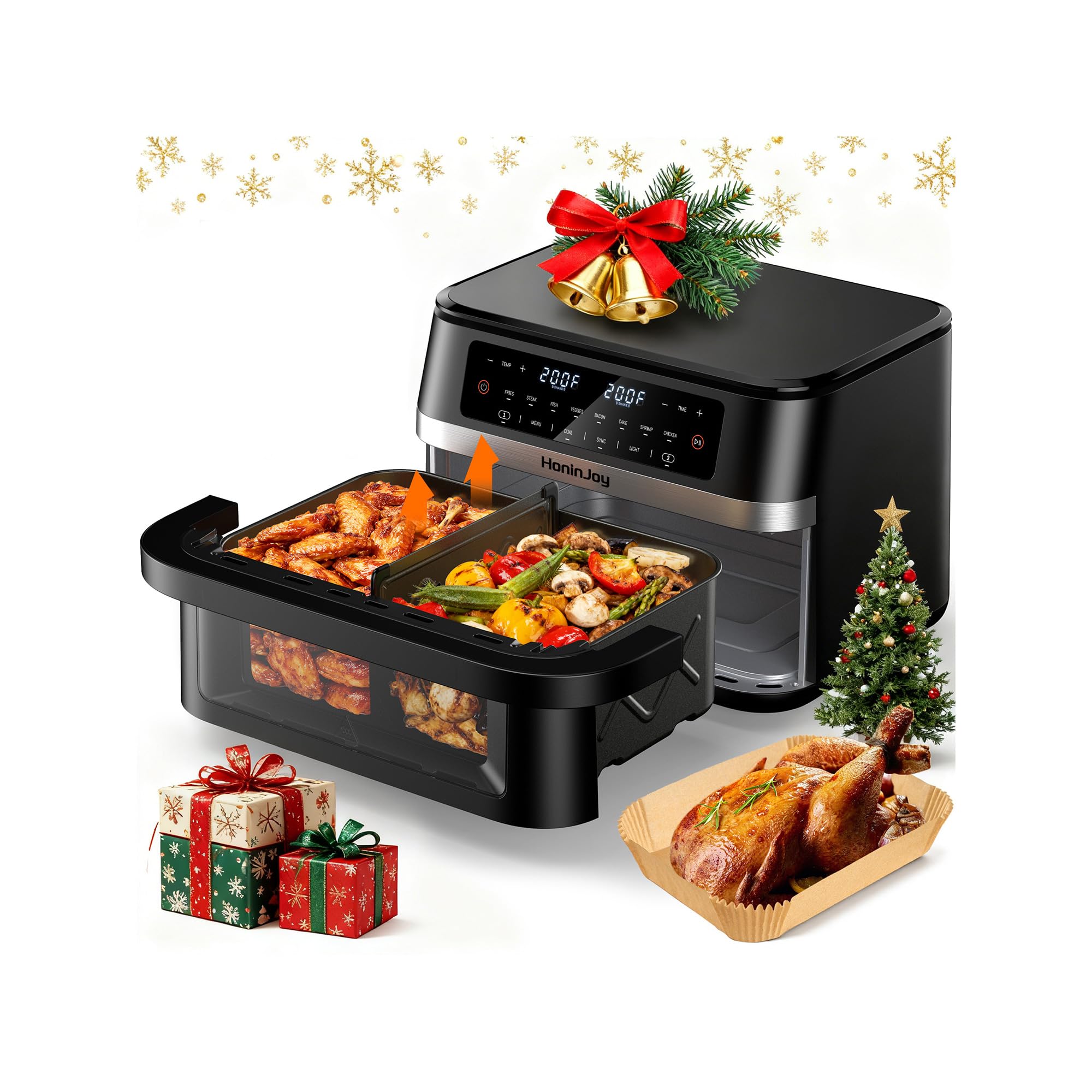
A flex-basket design is the underrated sweet spot for many households. Why? Because real life isn’t consistent. Sometimes you want two zones (protein + side). Other times you want one large cavity for a party batch of wings or a big pile of fries. A removable divider lets you shift between those worlds without owning two different appliances.
Owners who love this model highlight the practicality: larger capacity than smaller air fryers they used before, faster reheating (pizza is a recurring test food), and a modern control panel that’s easy to navigate. The viewing window is a real quality-of-life feature—especially for baked goods and foods that brown quickly— because you can check progress without dumping heat.
The included paper liners are a clever bonus, but here’s the expert take: liners are best used selectively. They’re perfect for sticky marinades, saucy wings, or foods that drip. But for fries and anything where crisp is the goal, a bare basket with good airflow usually wins. If you use a liner, make sure it’s weighed down by food so it doesn’t lift and block airflow.
This model also shines for households that share cooking duties. Auto-pause on basket removal and clear presets make it easier for someone who isn’t “the main cook” to use it successfully. And that matters—because the more people can use it confidently, the more value you get from it.
Why it’s a smart flex pick
- Flex basket versatility – Switch between one large basket or two cooking zones.
- Window + light – Better monitoring without heat loss.
- Included liners – Helpful for messy foods and quick cleanup routines.
- Convenience features – Auto-pause and easy controls support daily use.
Good to know
- For maximum crisp, avoid liners on fries and breaded foods unless needed for cleanup.
- As with any divider system, the “two-zone” halves are smaller than a dedicated dual-basket unit.
- Best results come from a single layer—use the big-basket mode when you want spread-out cooking.
Ideal for: households that alternate between big-batch cooking and two-zone weeknight meals, and want one appliance that adapts.
13. TOPZEE 11‑QT Flex Basket – The Straightforward “Big Basket or Split Basket” Choice

TOPZEE’s design hits a practical middle ground: one big basket for family-size batches, or a divider for two foods at once. If you like the idea of dual cooking but don’t want a wide dual-drawer footprint, this style can feel like the best of both worlds. Owners regularly highlight the freedom to cook two different foods at different temps/times—a huge win for real meals.
From a usability standpoint, there are two realities to know. First: controls can take a minute to learn, because you’re cycling through left/right settings rather than having two completely separate panels. Once you “get” it, it’s fine. Second: like many new air fryers, some owners report an initial chemical smell that fades with use. A first-run burn-in (empty run at high heat, then wipe down) usually handles it.
Performance-wise, this kind of unit shines for sausage, wings, nuggets, roasted vegetables, and small batch baking. The larger full-basket mode is especially useful when you want a flatter layer—because crisping loves flat layers. If you find fries falling through large holes in the crisper plate, that’s a design preference issue: some people love aggressive airflow plates, others find them annoying for thin fries. If you cook lots of skinny fries, consider using a mesh tray or slightly larger-cut fries.
Customer service experiences vary across brands in this category, but some owners report surprisingly responsive support and replacement units, which can make a big difference if something fails. The honest truth with newer brands is that support quality matters almost as much as cooking performance.
Why it’s useful
- Flexible cooking modes – One big basket or split basket depending on the meal.
- Good for family-size portions – Less batch cooking when you use the full-basket mode.
- Versatile functions – Air fry, roast, bake, reheat, dehydrate, and more in one.
- Easy cleanup – Dishwasher-safe components support frequent use.
Good to know
- Controls take a few meals to feel effortless; start with simple foods first.
- Some owners report early-life odor; a burn-in run usually clears it.
- Long-term reliability feedback can be mixed in this category; support responsiveness matters.
Ideal for: people who want the flexibility of “big basket sometimes, split basket other times” without switching to an oven-style unit.
14. 12QT Dual Layer Vertical Air Fryer – Quiet Cooking + Stacked Drawers (With a Learning Curve)
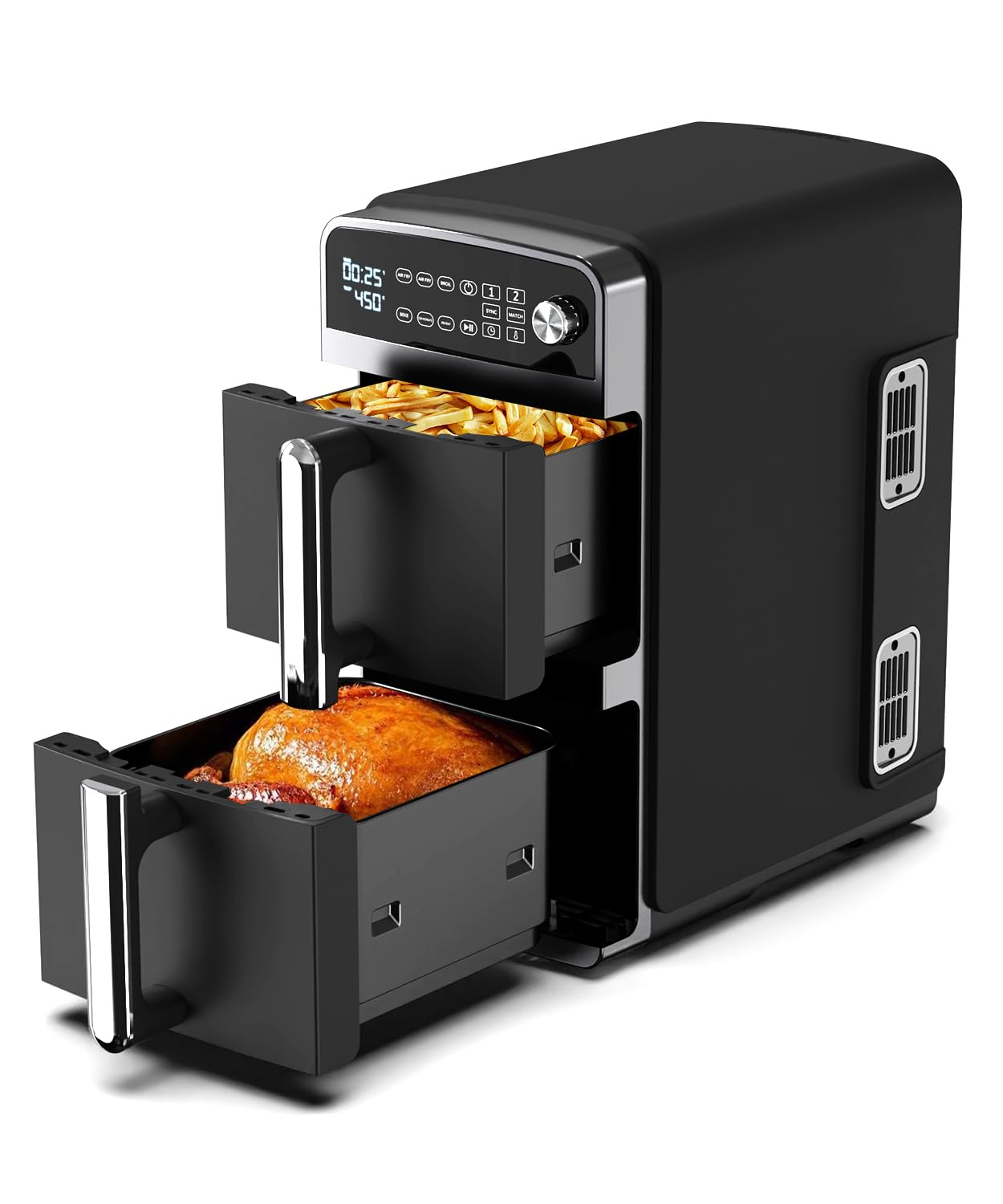
If your #1 problem is counter space, this stacked design can be a genuine solution. You get two independent drawers (top and bottom) without the wide footprint that makes many dual-basket air fryers feel like furniture. And owners who love it often mention two standout traits: it’s quiet, and it browns food nicely even at standard high heat. Quiet matters more than people think—especially in open-plan homes where the kitchen is basically the living room.
Now the honest part: this model has a learning curve. Some owners report that the manual isn’t very clear, and the “switching between baskets” logic can be confusing on day one. The good news is that after a few trial runs, it tends to click. If you buy it, do yourself a favor: practice with simple foods (fries in one drawer, nuggets in the other) before you try a complicated dinner.
There are also occasional consistency notes in owner feedback—like listed dimensions not matching reality or the temperature range not aligning with expectations. This is exactly why I recommend measuring your space and testing your unit’s max temp behavior early. If higher heat is mission-critical for you, confirm what the unit actually reaches in your kitchen with a simple test run and adjust your cooking times accordingly.
When it’s working smoothly, the stacked design is brilliant for meal timing: veg up top, protein down below, both finishing together without crowding your counter. If you’re willing to learn the controls once, the space savings are real.
Why people buy it
- Stacked drawers save space – Big capacity without a wide footprint.
- Surprisingly quiet – A standout benefit in shared living spaces.
- Good browning performance – Owners often mention strong crisping results.
- Two-zone meal timing – Real dinners become easier when you can run two drawers.
Good to know
- The control/selection workflow can be confusing at first; plan a practice run.
- Double-check real-world dimensions and clearance before committing.
- If your unit doesn’t behave as expected out of the box, verify settings early while returns/support are simple.
Ideal for: small kitchens that need two cooking zones but can’t spare the counter width of a traditional dual-drawer unit.
15. HoninJoy 12QT Dual Basket (10‑in‑1) – Window + Sync Finish for Busy Kitchens
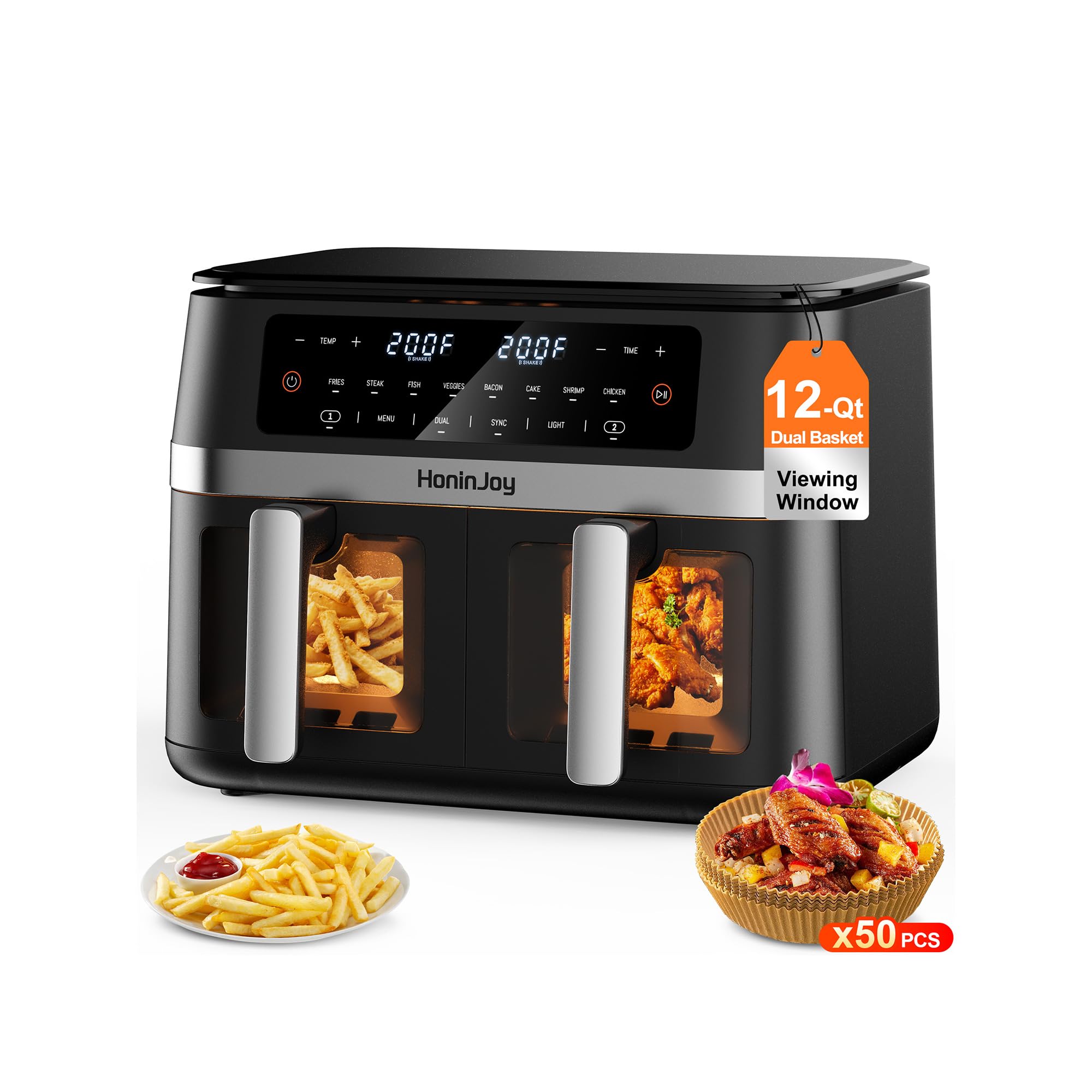
This model is a strong fit for people who want dual-zone cooking with a bit less anxiety. The viewing window solves a very real behavior problem: most people open baskets too often. Every time you open a drawer, you dump heat and disrupt airflow. With a window, you can check browning and crisping without interrupting the cook, which leads to better consistency—especially for foods that brown quickly.
Owners often describe it as fast, even, and surprisingly easy to clean—particularly when the baskets are genuinely nonstick and the trays are dishwasher-safe. The “two foods, two settings” value is the obvious win, but the less obvious win is the workflow: set the baskets, let them run, shake once when reminded, and serve a full meal with less chaos.
The expert tip for this model (and most dual-drawer units): decide which basket is your “messy zone.” Use one side for saucier foods or meats that drip, and use the other side for dryer foods like fries and roasted veg. That simple habit keeps cleanup easier and helps reduce flavor transfer. It also makes your results more repeatable because you’re not constantly switching food types between baskets.
If you’re moving from a single basket air fryer, this feels like a true upgrade because you stop doing back-to-back rounds. And if you’re upgrading from a slower oven, the time savings feel immediate.
Why it’s a strong pick
- Window monitoring – Less opening, better crisping consistency.
- Dual-zone flexibility – Different foods, different settings, finished together.
- Easy cleanup – Nonstick baskets + dishwasher-safe trays support daily cooking.
- Fast weeknight workflow – Quick meals with less batch cooking.
Good to know
- Dual-zone cooking still benefits from a short “practice meal” to learn the controls.
- Like all dual baskets, you’ll get the best results by not overfilling each side.
- Windows help, but don’t skip shaking for fries—airflow still needs cooperation.
Ideal for: busy households that want dual baskets with better monitoring and a smooth “set, shake, serve” routine.
16. Gourmia 14 Qt All‑in‑One – The “Ridiculously Capable for the Money” Crowd‑Feeder

If you want maximum function and capacity without overthinking it, Gourmia’s 14-quart all-in-one oven-style unit is a strong contender. It’s the kind of product that surprises people: air fry, bake, roast, broil, dehydrate, rotisserie—plus a generous interior that can handle a whole chicken or a family-size pizza. For many households, that’s the “one appliance” answer.
Owners praise how easy it is to use and how much it can do at once—especially people upgrading from smaller basket units that forced them into one-item cooking. The tray setup and multiple racks mean you can cook wings and fries together, or roast vegetables on one level while heating protein on another. That multi-rack behavior is what makes oven-style air fryers feel like a real kitchen upgrade.
There are a couple of real-world design notes to take seriously. Some owners report the control panel area can feel warm after long cooks. That’s not uncommon in compact countertop ovens, but it’s worth knowing if you have kids who like to touch everything. Another note is stability: a few people mention the unit can feel top-heavy when opening the door. If that’s a concern in your home, place it on a stable surface and avoid pulling hard on the handle.
The expert tip with this kind of unit: don’t stack food and expect miracles. Spread food out, use the mesh trays when you want airflow, and lean into the turn reminder function when cooking thicker items. When you do that, you’ll get crisp, even results that feel far above what you’d expect from a “big function list” appliance.
Why it’s a steal
- Huge versatility – Air fry, bake, roast, broil, dehydrate, rotisserie in one box.
- Big interior – More usable cooking area than most people expect.
- Helpful prompts – Turn reminders reduce babysitting.
- Easy cleanup – Stainless interior + dishwasher-safe accessories simplify maintenance.
Good to know
- Some users report the panel area can get warm during extended cooks.
- Door design can feel top-heavy; keep it on a stable surface and open gently.
- Multi-rack cooking works best when you rotate trays once for evenness.
Ideal for: shoppers who want a big-capacity oven-style air fryer with lots of functions and strong everyday utility.
How Crisping Actually Works (and Why “Capacity” Can Mislead You)
The biggest reason people get “meh” results is not the air fryer brand—it’s airflow physics. Crisp food happens when hot air can hit the surface, carry moisture away, and keep moving. When food is stacked, crowded, or sitting in pooled moisture, you get steaming instead of crisping.
What makes an air fryer feel powerful in real life
- Usable surface area – One flat layer beats a bigger basket filled to the top.
- Strong airflow path – Better convection means better browning and fewer “soft spots.”
- Smart timing features – Sync Finish, toss reminders, and auto-pause reduce mistakes.
- Heat placement – Top-heavy heat browns fast; balanced heat browns evenly.
- Visibility – Windows and lights reduce door-opening, which keeps cooking stable.
If you want an immediate upgrade in results, commit to two habits: single-layer cooking and one mid-cook shake/turn. Those two moves fix 80% of “not crispy” complaints.
Crisp hacks that work across almost every model
- Dry first – Pat wings, chicken, and veggies dry before cooking. Moisture is the enemy of crisp.
- Use oil strategically – A light spritz helps browning; you don’t need to drown food.
- Don’t “blanket” with liners – Liners are great for messy foods, but they can block airflow if used incorrectly.
- Preheat when it matters – For fries and breaded foods, preheating often improves crisp speed and color.
- Finish hot – A short high-heat finish (or Hi-Fry style option) gives that final crunch without drying the inside.
Once you understand that crisping is airflow + surface area + moisture control, big-capacity units become much easier to choose. You’ll stop shopping by marketing and start shopping by how you actually cook.
The Real Capacity Test: What Actually Fits (Without Ruining Crisp)
Let’s clear something up right now: “12 quarts” does not mean “12 quarts of crispy food.” It means interior volume. And volume is not the same thing as usable surface area. If you care about golden fries instead of steamed fries, this section matters.
Here’s how I evaluate a large-capacity air fryer in real kitchens—not in marketing photos.
Step 1: The Single-Layer Rule
Crisping is an airflow sport. The moment food stacks, it steams. So the real question becomes: how much food can you cook in a single layer?
- Dual 6QT baskets: Usually handle about 1.5–2 lbs of wings per basket in a true single layer (depending on size). That means roughly 3–4 lbs total without stacking.
- Flex basket (full 11–12QT mode): Can often hold more wings in one layer than split mode—but only if the base is wide and flat. If it tapers, the outer edges lose usable space.
- Oven-style (multi-rack): Two racks can double usable surface area—but only if you rotate trays once mid-cook. Otherwise, the top rack usually browns faster.
- Vertical stacked drawers: Similar single-layer capacity to dual baskets, but airflow behavior may differ slightly top vs bottom.
If a unit forces you to pile fries on top of each other, that’s not “large capacity” in practice. That’s just deep capacity.
Step 2: The “Wings + Fries” Dinner Test
This is the most honest real-world scenario: can you cook wings and fries at the same time, both crispy, both hot, no reheating?
- Dual-basket units: Best at this. One zone for wings (longer cook), one for fries (shorter cook), Sync Finish brings them home together.
- Flex basket in split mode: Similar behavior to dual baskets, but each half may feel slightly smaller.
- Oven-style units: Can do it, but you’ll usually need one tray per food and rotate once for even browning.
- Single-cavity “big” units: You may have to cook one item first or compromise crisp by stacking.
If your weeknights revolve around two different foods finishing together, dual-zone wins the real capacity test—even if the raw quart number is smaller.
Step 3: The “Full Family” Batch Test
Here’s where volume matters more than zones. Can the air fryer handle:
- A whole chicken (4–6 lb)
- 30+ wings in one round
- A 9-inch pizza
- Two trays of vegetables
Oven-style models often win this test because racks create more horizontal space. Flex baskets (divider removed) come in second. Dual 6QT drawers may require two rounds for very large gatherings—but are more precise for mixed meals.
Step 4: The “Mess Reality” Test
True usable capacity also means: can you cook that much food without creating a grease disaster?
- Drawer baskets contain splatter better.
- Oven-style doors require drip tray management.
- Wide crisper plates with large holes can drop thin fries underneath.
- Liners reduce cleanup but can reduce airflow if misused.
If you dread cleanup, you won’t use the full capacity anyway.
The Bottom Line on Capacity
Here’s the truth:
- A 10QT dual-zone can outperform a 14QT oven if your priority is cooking two foods perfectly timed.
- A 13QT oven-style can feel “bigger” than a 12QT drawer if your priority is flat, spread-out cooking.
- Depth does not equal crisp. Width and airflow do.
So when you’re comparing large models, don’t ask “How many quarts?” Ask:
- How much can I cook in a single layer?
- Can I finish two foods together?
- Will I actually use the extra space?
That’s the real capacity test—and once you understand it, you’ll never shop by quart number alone again.
FAQ: 12 Qt Air Fryer Questions (Without the Confusion)
Should I buy dual baskets or an oven-style air fryer?
Why do some “big” air fryers still feel small?
Do paper liners ruin crisping?
Do I need to preheat a large air fryer?
My food cooks unevenly. What’s the fastest fix?
What’s the best feature for meat (chicken, steak, pork)?
How do I keep cleanup from becoming a weekly nightmare?
Final Thoughts: Buy the Air Fryer That Makes Dinner Feel Easy
The best large-capacity air fryer isn’t the one with the most presets. It’s the one that matches your kitchen and your habits. When the workflow feels smooth—load, set, shake/turn once, eat—an air fryer becomes a daily tool, not a shelf decoration.
Here’s the simplest way to translate this guide into the right purchase:
- Want the best overall dual-zone daily driver? Start with the Cuisinart Dual Basket Air Fryer (ADZ‑112). It’s the most balanced blend of real-meal timing, dependable performance, and brand-level build.
- Want the most confidence cooking meat? Choose the Ninja DZ550 for smart thermometer doneness control, or the CHEFMAN ExacTemp if you prefer an oven-style unit with a built-in probe.
- Want an oven replacement with rotisserie? Get the Zavor Crunch or the compact COSORI 13Qt for toast, trays, pizza-style cooking, and multi-function flexibility.
- Need dual-zone cooking but want your counter space back? Pick the DoubleStack 12.6QT for a vertical footprint that still handles real family meals.
- Want flexible “one big basket or two zones” behavior? Go with the HoninJoy Flex Basket or TOPZEE 11‑QT if you want the flexibility without switching to an oven-style model.
- Want a strong “tiny oven” daily-use feel? The West Bend 12.6 Qt is a consistent oven-style pick that many owners use constantly.
If you want the fastest path to satisfaction, pick the model that matches how you cook (dual baskets vs racks) and commit to the two habits that guarantee better results: single-layer cooking and one mid-cook shake/turn. Do that, and the right 12 qt air fryer will feel less like an appliance and more like a weeknight superpower.
