
A good “mobile coop” isn’t just cute backyard décor. It’s a daily operating system: move, lock, feed, collect, clean—repeat. And when it’s done right, it doesn’t just make chicken keeping easier… it makes it healthier for your birds and calmer for you.
If you’re shopping for a chicken tractor with coop, you’re really shopping for three things at once: mobility (fresh ground without back pain), security (predators don’t negotiate), and maintenance flow (the difference between “I can do this every day” and “why did I choose this hobby?”).
Most buying guides stop at surface-level checkboxes: “has wheels,” “has a nest box,” “has a tray.” That’s not how these products succeed or fail in real life. Real life is: doors that swell in heat, latches that raccoons outsmart, mesh that’s fine for daylight but not for night, wheels that roll on pavement but sink in grass, and roofs that technically “cover” but still funnel water inside during a sideways storm.
This guide is built around the stuff that actually matters when you own one: the weak points that show up again and again in owner feedback, the upgrades that turn “pretty good” into “solid,” and the decision shortcuts that keep you from buying a setup you’ll regret the first time you try to move it after rain.
Below, you’ll find 15 standouts: full tractors with built-in coops, big walk-in runs for creating a modular tractor-style setup, compact pens for grow-outs or quarantine, and one mobility kit that can turn a heavy DIY build into something you can move with a foot pedal.
In this article
- How to choose the right setup for your flock, yard, and predator pressure.
- Quick comparison table of 15 standout options.
- In‑depth reviews of each pick, with real-world pros and cons.
- How mobility actually works (and why most “wheels” disappoint).
- FAQ: sizing, moving frequency, predator-proofing, and maintenance shortcuts.
How to Choose the Right Chicken Tractor With Coop
Here’s the blunt truth: the best-looking coop is often the worst daily experience. The right choice is the one that stays functional in the conditions you actually have—wet grass, summer heat, uneven ground, and predators that test your setup like they’re earning a degree in engineering.
1) Start with your “movement story,” not the product photos
Before you compare models, answer one question: How are you really going to move this? Most people picture a smooth roll across a perfect lawn. Real yards have dips, ruts, wet spots, and corners. Your movement story usually fits one of these:
- Daily movers: You move often for fresh grazing (common for broilers, or anyone trying to keep grass alive and manure spread out).
- Every-few-days movers: You rotate when the ground looks “worked” or when the run starts to smell.
- Seasonal movers: You reposition for shade/sun and leave it for a while.
- “It’s not really moving” setups: You want a stable home base, but you like the idea of relocating occasionally.
2) Decide if you need a true tractor… or a modular “run + coop” system
There are two winning approaches:
- All-in-one tractor coops: Coop + run + wheels. Fast setup, great for small flocks, but mobility is only as good as the wheel size and frame stiffness.
- Walk‑in run that your coop sits inside: Bigger space, easier human access, and often stronger predator resistance—especially when you reinforce the lower perimeter.
If you have more than a handful of birds or you want to walk in comfortably, the “run + coop inside” approach is often the most satisfying long-term. If you have a small flock and want the simplest daily routine, a compact tractor can be perfect.
3) Predator resistance isn’t about “wire”—it’s about the weak points
Predators almost never break through the biggest panels first. They exploit the small mistakes: a door gap, a flimsy latch, a corner you can lift, or mesh that a raccoon can reach through. When you evaluate any unit, look for these friction points:
- Door gaps: If you can fit fingers through, a predator can often work it. Many owners solve this with extra hardware cloth strips and longer fasteners.
- Latches: “Simple slide latches” are easy for clever predators. The best daily upgrade is a carabiner or secondary lock.
- Bottom edge: The ground perimeter is where digging starts. A “skirt/apron” (hardware cloth laid outward) is one of the highest ROI upgrades you can do.
- Mesh type: Chicken wire is a containment tool, not a true predator barrier. It’s fine for daytime supervision, but it’s not a night solution without reinforcement.
4) Weatherproofing = roof design + overhang + where water goes
A “waterproof roof” claim means nothing if rain runs off the edge and straight into your run or nest boxes. The best real-life weather setups have:
- Roof pitch or dome shape to shed water and light snow.
- Overhang/extended covers that keep rain from blowing in from the sides.
- Nest box protection (a lip, cover strip, or lid design that doesn’t become a drip line).
- Ventilation that doesn’t become a leak—screened vents under eaves are the sweet spot.
5) Cleaning flow is a bigger deal than you think
If cleaning is annoying, it doesn’t happen often enough. That’s how smell, flies, and mite pressure ramp up. You want to think in terms of “seconds per day,” not “minutes per week.” Key features that change your daily experience:
- Pull‑out trays that slide smoothly and are actually big enough to catch droppings from roosts.
- Human access doors that let you reach corners without contorting.
- Roost placement that keeps sleeping birds over a tray (not over a ramp or nest box area).
- Egg collection that doesn’t require opening the whole coop and spooking birds.
6) Capacity claims are optimistic—use “comfort math” instead
This is where most buyers get burned. A product might claim “6–8” but owners report it feels best at 3–5 standard hens. Why the mismatch? Because capacity depends on:
- Breed size: large fowl vs bantams isn’t a small difference.
- Daily free‑range time: birds that only sleep inside can use tighter night quarters than birds living inside 24/7.
- Climate: in hot areas, you need extra space for airflow and to avoid crowding.
When in doubt, choose the next size up—or choose a walk-in run and put the coop inside. Space is the one upgrade you never regret.
Quick Comparison: 15 Chicken Tractor With Coop Picks
Use this table to narrow down the styles that fit your yard and flock size, then jump into the deep reviews for the “real life” details— like door gap reality, whether wheels move in actual grass, and which units owners say need sealing before the first storm.
On smaller screens, swipe or scroll sideways to see the full table.
| Model | Style | Standout strength | Best match | Amazon |
|---|---|---|---|---|
| Suumerpety Chicken Tractor (All‑Metal Frame) | Mobile tractor | Metal-run structure + lots of access doors for daily chores | Small-to-medium flocks who want a true “tractor lifestyle” feel | Amazon |
| GUTINNEEN Mobile Coop (Super Large Wheels) | Mobile tractor | Big wheels + multiple nest boxes + pull‑out tray cleaning | Families who want “premium mobility” and fast egg access | Amazon |
| Quictent 12×9 Walk‑In Run (Hardware Cloth) | Walk‑in run | Small-hole hardware cloth approach + roomy stand-up height | Best if you already have a coop and want a serious run upgrade | Amazon |
| Aoxun 10×20 Walk‑In Run (Spire Roof) | Walk‑in run | Big footprint + simple access + good “people space” | Backyards that want more roaming room without a full build | Amazon |
| VEVOR 13.1×9.8 Walk‑In Run (Dome Roof) | Walk‑in run | Great “starter walk-in” with lots of usable square footage | Budget-focused buyers who still want a tall run | Amazon |
| UDPATIO 12×10 Walk‑In Run (Double Door) | Walk‑in run | Two-door workflow + feeding port idea for fewer escapes | Families who want easy daily access and “group project” assembly | Amazon |
| TIMHAKA 95″ A‑Frame Tractor Coop | Mobile tractor | A-frame stability + good footprint efficiency | Small yards that want more “run space” in a compact shape | Amazon |
| Aivituvin 80″ Mobile Coop (Wheels + Nest Box) | Mobile tractor | Easy-to-move “transition coop” with lots of access points | Chicks-to-pullets grow‑out, hospital pen, or 2–3 bird lifestyle | Amazon |
| MEDEHOO Red Mobile Coop (Leak‑Proof Tray) | Mobile coop | Fast assembly + solid “starter” layout for daily maintenance | New chicken keepers who want a small, movable setup | Amazon |
| MEDEHOO Black Mobile Coop (Compact) | Mobile coop | Small footprint + multi‑use for rabbits/ducks + easy tray cleaning | Small backyard pets and “move to shade” routines | Amazon |
| PawGiant 130″ Portable Metal Pen (Cover) | Portable pen | Large, foldable-style enclosure concept for supervised outdoor time | Grow‑outs, quail, rabbits, or “add-on space” inside a fenced area | Amazon |
| VEVOR 3.3×6.6 Small Run (Double Door) | Mini run | Compact add‑on run you can pair with a coop or use as a pen | Quarantine, introductions, small spaces, or “garden protection” | Amazon |
| Ketive Sloping Roof Tractor (Grey) | Mini tractor | Quick shelter + simple nest box + tray maintenance | Broody hens, small breeds, or short-term separation setups | Amazon |
| Ketive Sloping Roof Tractor (Red) | Mini tractor | Same platform as grey: simple, functional, easy daily chores | Single-hen care, chick grow‑outs, or “temporary but tidy” housing | Amazon |
| Belinova Chicken Coop Wheels Kit (Lift System) | Upgrade kit | Turns a heavy coop into a movable one using a pedal lift idea | DIY builders or anyone who wants mobility without rebuilding | Amazon |
In‑Depth Reviews: 15 Setups That Actually Work in Real Backyards
Now we go model by model. I’m not going to waste your time re-listing obvious features. Instead, I’ll focus on what you can’t see in product photos: how the weak points behave after a month outside, what owners end up modifying, and how each design fits different flock realities.
1. Suumerpety Chicken Tractor (Upgraded All‑Metal Frame) – A Real “Daily Routine” Tractor, With Honest Capacity Expectations
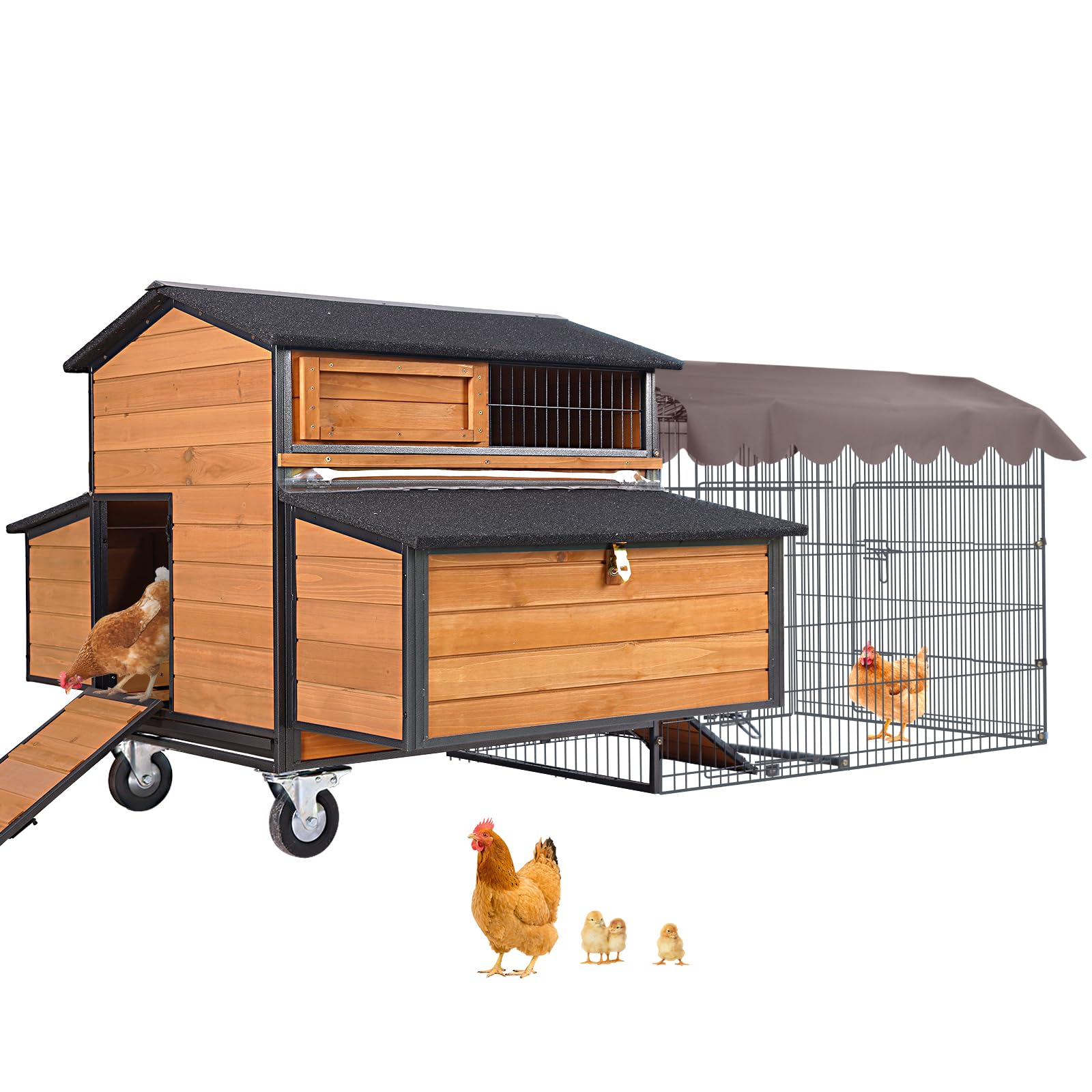
This is the kind of tractor that makes sense if you want a repeatable daily flow: feed, water, check birds, collect eggs, quick clean, move if needed. The standout advantage is how “serviceable” it is. A lot of small tractor coops fail not because chickens hate them, but because humans hate using them. More doors and viewing access means less stress for you and less chaos for your birds—especially if you ever need to isolate one hen, treat a minor injury, or do a quick health check.
Now the part most guides won’t say clearly: treat capacity claims as breed-dependent marketing. Owners commonly say it feels smaller than expected. That doesn’t mean it’s bad. It means you should buy it with the right mental model: 3 large hens can be comfortable if they have daily roam time; 6–8 is realistic only for smaller breeds or a “sleep here, range elsewhere” lifestyle. If your birds will spend all day inside, pick a bigger run or choose a walk-in run model and place a coop inside.
Where this tractor can genuinely shine is as a “home base” you can reposition. The all‑metal run concept gives it a stronger cage feel than many wood-only tractors, and the weatherproof roof coating is designed for outdoor use. But if you want it to last season after season, do the smart owner moves: tighten everything after the first week, upgrade latches with a secondary clip, and add reinforcement on any areas where the run meets the coop if you notice flex.
Why it earns “best overall”
- Daily-access design – Multiple doors and windows reduce chore friction and make bird checks easier.
- Metal-run confidence – Feels more “cage-like” and structured than many thin-wood tractors.
- Good workflow for egg + cleaning – Built around routine use, not just occasional access.
- Mobility without DIY – Oversized wheels can make repositioning more realistic than tiny casters.
- Strong starter tractor for learning – Teaches you what features you truly value before you build bigger.
Good to know (real-life truth)
- It may feel smaller than the photos – Plan your flock size accordingly so you don’t feel cramped immediately.
- Like many prefabs, it benefits from a wood-safe sealant/paint routine for longevity in harsh weather.
- Any “smart predator” area needs latch upgrades—carabiners are the simplest fix.
- If your ground is uneven, you may need two people to move it without twisting the frame.
- Best used as a tractor, not as the only space for a large full-time flock.
Ideal for: small-to-medium flocks who want a true tractor experience with easy daily access, and who prefer honest “comfort capacity” over marketing numbers.
2. GUTINNEEN Mobile Coop (Super Large Wheels) – The “Move It Like You Mean It” Upgrade Pick
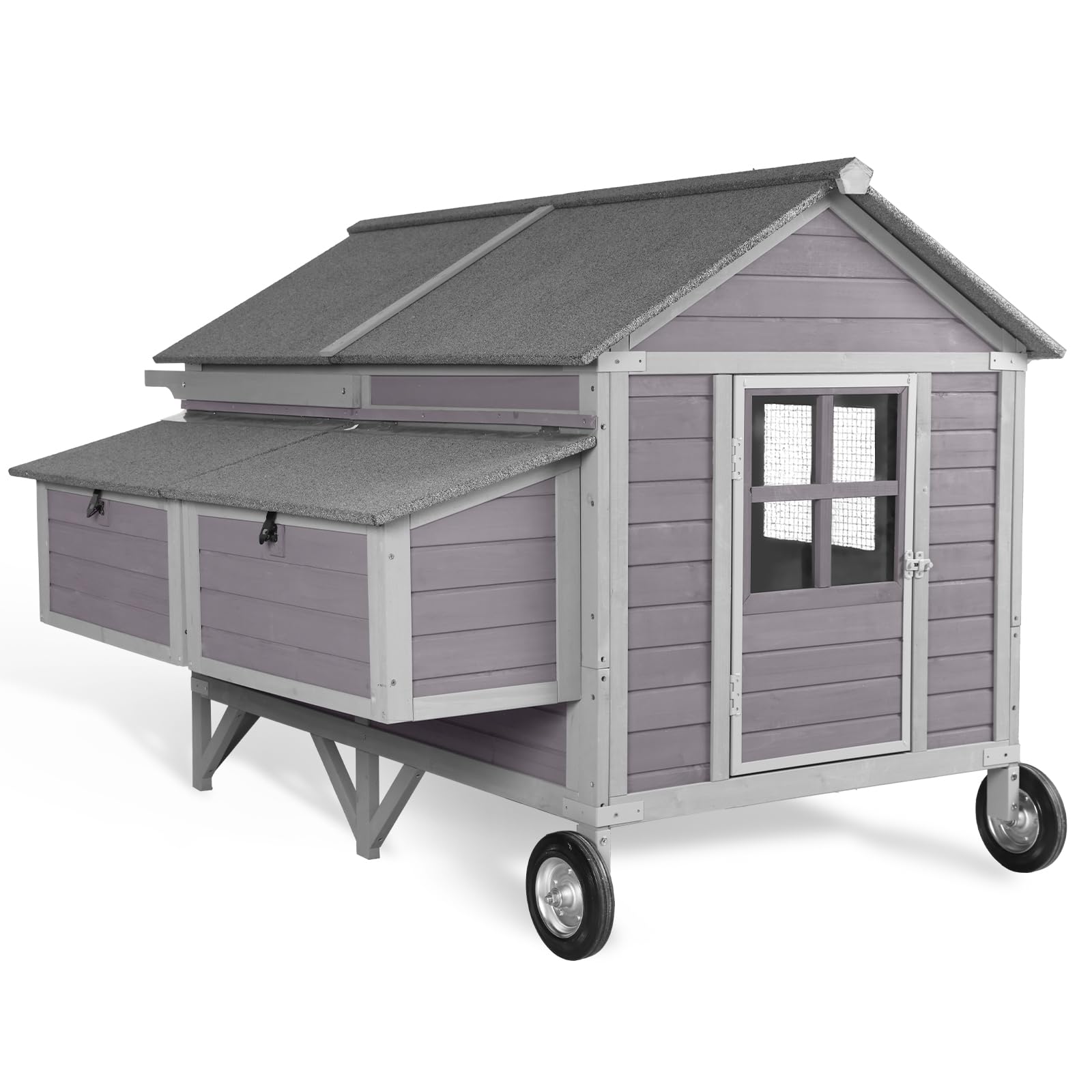
If you’ve ever bought a “mobile” coop and then realized the wheels are basically decorative, you’ll understand why this design matters. Wheel diameter and axle geometry decide whether your coop moves across grass or just digs trenches. The GUTINNEEN’s “super large wheel” approach is the kind of choice that’s aimed at real yards, not showroom floors. Owners who love it tend to talk about the same things: it’s cute, it feels thoughtfully designed, and it functions like an actual chicken home—nest access, ventilation, and cleaning built in.
What I like most is that it leans into two daily pain points: egg collection and cleaning. Multiple nesting boxes are only valuable when the lids are easy to open and don’t become water funnels. The design includes flaps/coverage around egg access areas, which is the difference between “nest boxes stay dry” and “why are my eggs dirty after every storm?” Add in pull-out trays and you get a coop that can be kept fresh without a full teardown.
Now the real talk: owners also commonly say it’s smaller than the maximum bird count suggested. That’s not unique—nearly every prefab stretches the numbers. The best way to love this coop is to use it like a premium “sleep + lay” unit and provide additional daytime space. If you’re rotating it on pasture, that can be the run area plus supervised free range time. If you’re placing it inside a fenced yard, that fencing becomes the “real run.”
Why it’s worth the step-up
- Mobility that feels real – Larger wheels generally handle grass and small bumps far better than tiny casters.
- Egg workflow – Multiple nest boxes and accessible lids can reduce daily hassle.
- Cleaning shortcuts – Pull-out trays encourage frequent cleanups, which keeps odor and flies down.
- Ventilation focus – Screened windows support airflow (crucial for summer comfort).
- Design feels considered – Little flaps and covers can prevent “rain finds a way” problems.
Good to know
- Assembly is easier with two people and a drill—plan a build session, not a rushed evening.
- Like many wood coops, sealing/painting before (or immediately after) assembly improves long-term durability.
- Capacity is happiest when you don’t push the top end of the “suggested” number for standard hens.
- If your birds insist on sleeping in nest boxes, you may need to adjust roost height/placement to retrain them.
- Predator upgrades still matter: secure latches + a perimeter strategy are key in high-pressure areas.
Ideal for: families who prioritize mobility, want more built-in egg/cleaning convenience, and prefer a “premium daily driver” tractor approach.
3. Quictent 12×9 Walk‑In Run (Hardware Cloth) – The “Put Your Coop Inside and Relax” Space Upgrade
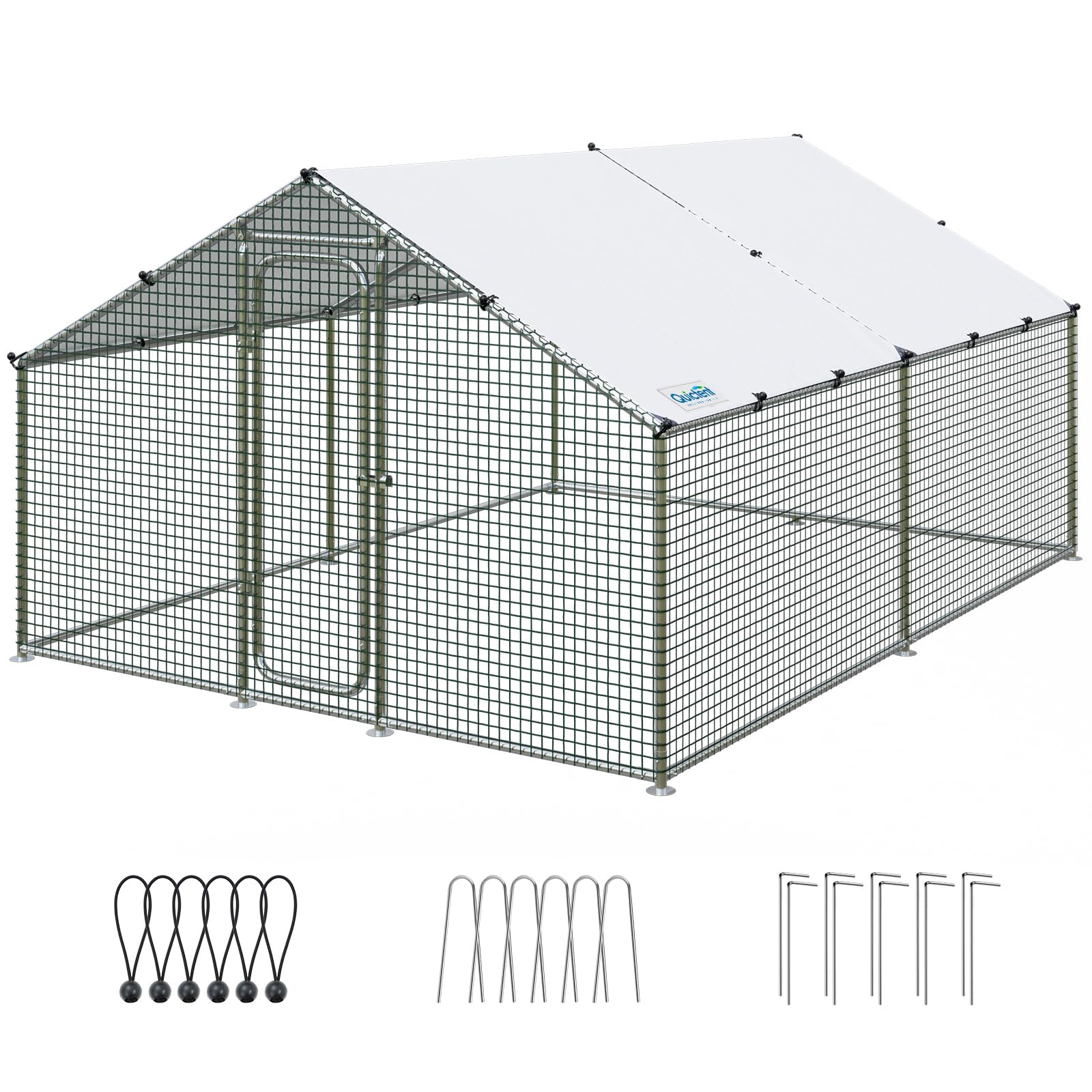
If your goal is a setup that feels “real farm functional,” this is where many experienced keepers land: a sturdy walk-in run with your coop placed inside it. That strategy is powerful because it fixes the two biggest prefab coop weaknesses: space and human usability. You can stand up, you can clean without crawling, and you can scale your setup by adding shade tarps, hanging feeders, and enrichment without fighting tiny doors.
The standout here is the hardware-cloth approach and the roof cover system. Owners describe it as surprisingly sturdy once assembled and upgraded, with plenty of mesh and a tarp that actually feels substantial. You’ll also see a consistent theme that sounds “minor” but is actually huge: parts are well marked and assembly is straightforward—meaning you’re more likely to build it square, and a square run means the door behaves better long-term.
Now the “expert parent” advice: almost every run like this becomes excellent when you do three small upgrades. (1) Use longer zip ties or wire where needed so the mesh stays tight. (2) Add a bottom perimeter strategy (hardware cloth apron or buried edge) if digging predators exist. (3) Improve anchoring beyond the included stakes if you deal with real wind. Owners specifically mention that extra anchoring is the difference between “great purchase” and “I watched it turn into a kite.”
Why it’s a favorite “run-first” solution
- Walk-in comfort – Standing height changes your willingness to clean and adjust things.
- Easy to expand the system – Put your coop inside and upgrade over time instead of replacing everything.
- Better daily workflow – Feeding, watering, and chores are calmer when you can move inside the run.
- Mesh strategy is stronger than basic chicken wire – Smaller holes and heavier feel can deter casual predator reach-through.
- Tarp coverage helps with weather – Shade and rain protection reduce stress on birds and bedding.
Good to know
- Expect to use extra zip ties or wire for a cleaner, tighter finish.
- Stake-only anchoring may not be enough in high winds—plan a stronger anchor method.
- Door gaps and latch confidence vary by assembly squareness; build on level ground and re-check bolts.
- For true predator pressure, reinforce the bottom perimeter and any “reach-through” areas.
- This is a run, not a coop—your coop choice inside it matters just as much.
Ideal for: keepers who want more space, easier human access, and a modular system that grows—especially if you already have (or plan to buy) a separate coop.
4. Aoxun 10×20 Walk‑In Run – Big Roaming Space Without a Full DIY Build
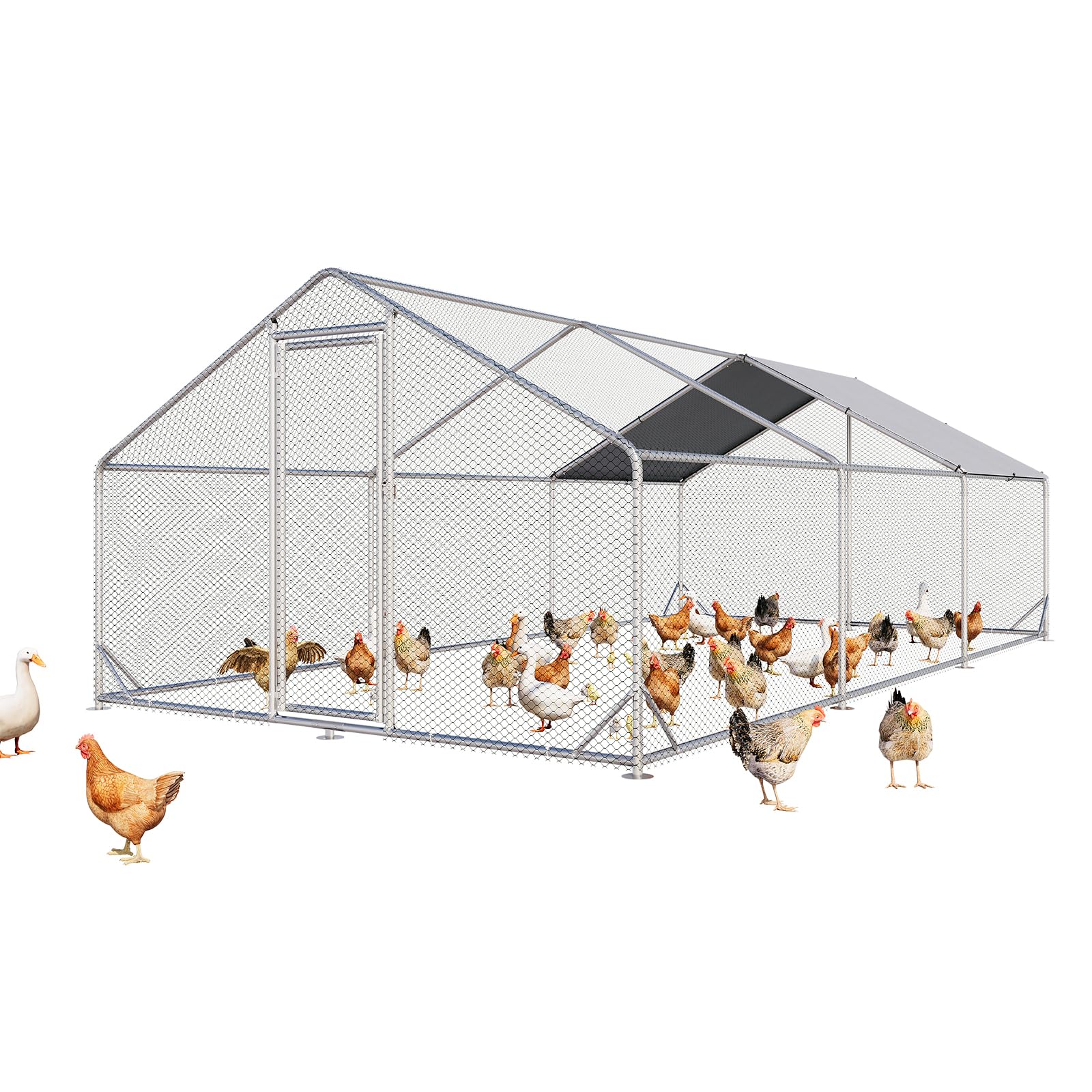
If your biggest frustration is “my birds need more space,” a larger walk-in run is often the cleanest upgrade. This style isn’t about being fancy—it’s about giving your flock room to behave like chickens: scratch, dust-bathe, and spread out so the pecking order drama calms down. A 10×20 footprint also changes your daily experience because you can create zones: shade zone, feeding zone, a dry litter zone, and a “mess zone” where they do their chicken thing without turning the whole area into soup.
What owners tend to like with this type of run is the straightforward assembly concept and the walk-in convenience. The spire/peak roof shape helps with water shedding, and the cover is meant to provide sun and rain protection. The key is treating it like a framework you “finish” to match your predator pressure: add your preferred bottom perimeter strategy, add extra fastening, and think about where rain runs during storms. A big run is only as good as its weakest seam.
The most common “gotcha” with walk-in kits is that the included wire and ties are sometimes “starter level” and owners end up reinforcing for peace of mind. That’s not a failure; it’s a normal part of making a kit behave like a permanent structure. If you treat the frame as the value—and the reinforcement as your customization—this becomes a smart way to get big space without building from scratch.
Why big runs feel like a life upgrade
- Space solves problems – More room reduces stress behaviors and makes enrichment easier.
- Walk-in access – Feeding, cleaning, and catching birds becomes less chaotic.
- Peak roof geometry – Helps shed water and light snow rather than pooling.
- Flexible layout – You can place a coop inside, add shade cloth, and hang feeders cleanly.
- Great for multi-animal households – Works for ducks/rabbits as a containment zone too.
Good to know
- Reinforcement is normal: extra ties, heavier mesh at the bottom, and improved latches if needed.
- Plan a rain strategy—covers should overhang, or you’ll get “water runs inside” during storms.
- Build it square and on level ground so the door closes cleanly and stays aligned.
- For digging predators, a perimeter apron is non-negotiable.
- This is a run—your coop choice inside it still determines roost comfort and egg cleanliness.
Ideal for: larger backyards that want real roaming room and a modular “coop inside” system without spending weeks building a custom enclosure.
5. VEVOR 13.1×9.8 Walk‑In Run (Dome Roof) – The “Big Space, Smart Upgrades” Choice
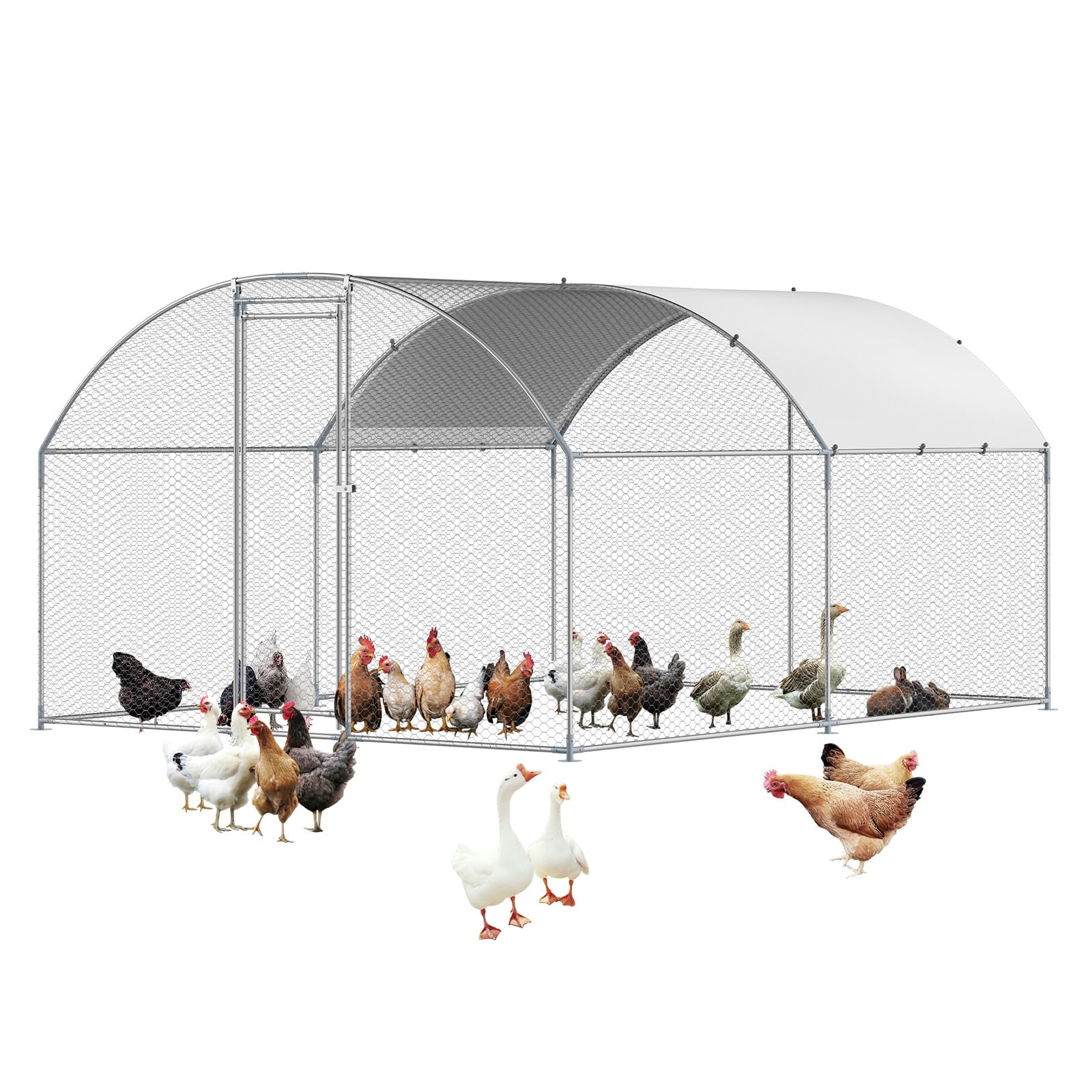
VEVOR’s walk-in runs are popular for one simple reason: they’re an efficient shortcut to “more space now.” Owners often describe them as easy to assemble for the size, with a frame that feels sturdy enough once tightened and anchored properly. The dome roof design is a meaningful detail too—curves shed water and debris more naturally than flat covers, which reduces maintenance.
Here’s the expert way to think about a kit like this: the frame is the product, and the mesh/tie finish is your job. Multiple owners report needing more zip ties than expected, and many prefer to “sew” seams with wire for a cleaner, tighter finish. That’s not a negative if you go in knowing it—because a tight mesh job is what transforms a “pen” into a “run you trust.” A lot of people also extend cover coverage with an extra tarp when they want full top protection.
The other real-world detail is the door. A door can be “fine” if the frame is square and tightened evenly, and annoying if it’s slightly out of true. If you build on uneven ground and force it together, the door becomes the first place you feel it. So: assemble on flat ground, tighten in stages, and re-check after the first windy week. The payoff is huge: a walk-in space that makes chicken keeping feel organized instead of improvised.
Why it’s such a strong value
- Fast path to big space – The footprint changes flock comfort immediately.
- Dome roof drainage – Reduces pooling and makes cover performance more forgiving.
- Modular upgrade potential – Easy to add extra tarp coverage, shade cloth, and reinforcements.
- Good for integration – Many owners use it to extend an existing run or protect a coop area.
- Simple daily access – Walk-in access reduces chore hassle dramatically.
Good to know
- Expect extra ties or wire; the cleanest builds always add reinforcement.
- Cover overlap may not be enough for sideways rain—add an extra tarp if you want full dryness.
- Some setups require drilling or extra effort on door alignment—build square to avoid frustration.
- For serious predators, reinforce the lower perimeter and latch system.
- It’s big enough that moving it is a project; treat it as a run, not a rolling tractor.
Ideal for: anyone who wants a walk-in run quickly and plans to “finish it right” with smart reinforcement—especially to extend an existing coop setup.
6. UDPATIO 12×10 Walk‑In Run (Double Door) – The “Less Escapes, More Control” Family-Friendly Layout
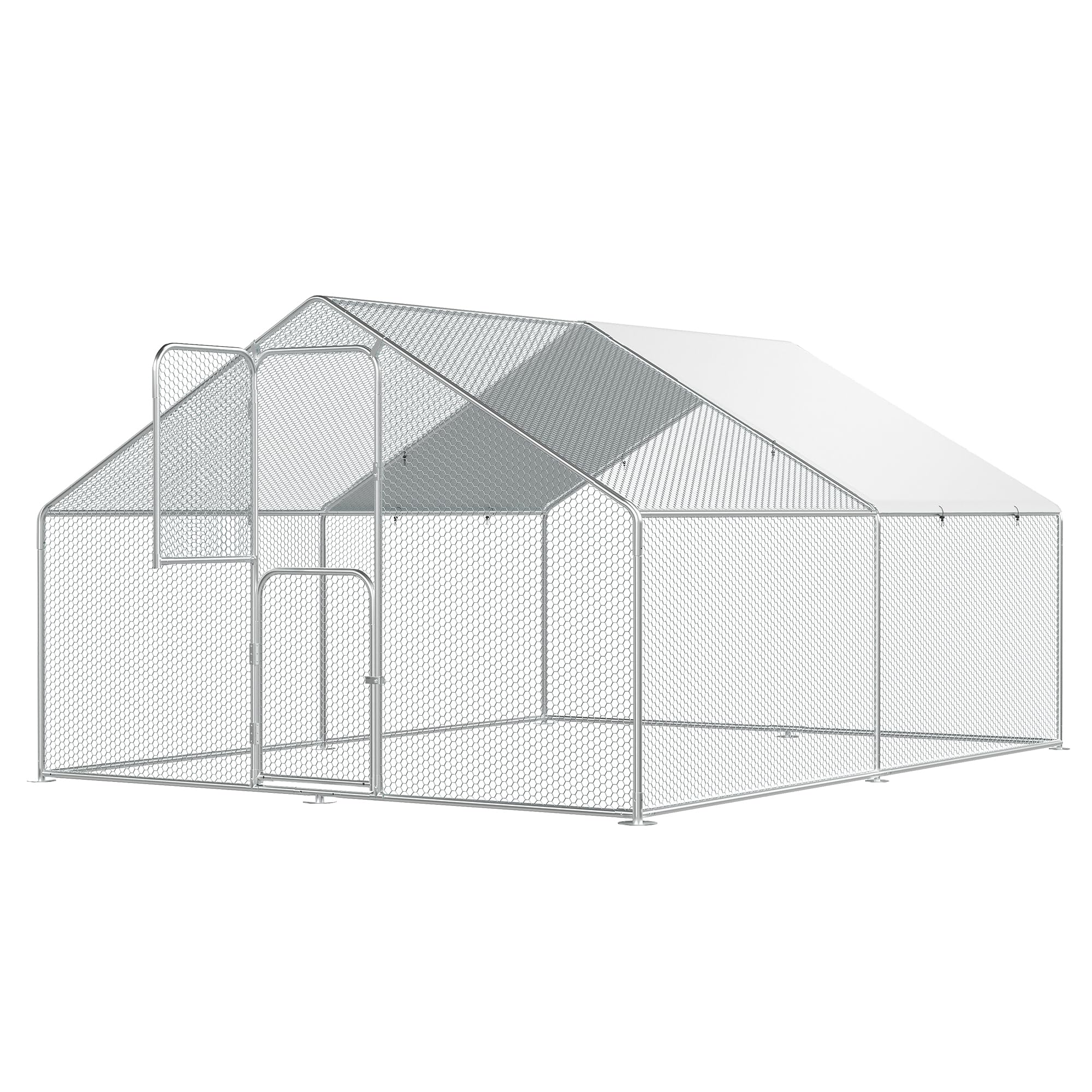
This run’s biggest advantage is the “human workflow.” A lot of walk-in runs have one door, and that door becomes a choke point: you open it to feed and three birds try to slip out because chickens are basically feathered opportunists. A two-door approach with a feeding port idea is meant to reduce escape moments and make the run more usable for kids, older adults, or anyone who doesn’t want a daily wrestling match.
Owners talk about assembly being manageable with two people, and a consistent reality shows up here (and in almost every walk-in kit): you will likely want extra zip ties for a clean, secure mesh job. Think of zip ties and wire as your “stitching kit.” Your goal is to remove gaps, reduce flex, and make sure the mesh is tight enough that nothing can push it inward. If you’ve ever seen a raccoon reach through loose mesh like it’s grabbing a snack from a vending machine, you know why tightness matters.
What makes this a strong family pick is also what makes it a strong “project” pick: it’s a framework you can customize. Add a coop inside, add a dry litter zone under the roof cover, hang your feeders so they don’t get knocked over, and build a calmer routine. And because it’s roomy, you can do those upgrades without turning your run into a cluttered obstacle course.
Why it’s a smart “workflow” run
- Two-door convenience – Daily access feels calmer and can reduce escape chaos.
- Large capacity – Plenty of space for a coop + movement area inside.
- Good for families – The layout is friendlier for multiple caretakers (kids, partners, grandparents).
- Customizable – Easy to place a coop inside and build a zone-based run.
- Versatile housing – Works for multiple small animals or as a garden protection structure too.
Good to know
- Plan on extra ties/wire for a tight build; it’s normal and worth it.
- Door hardware can require self-tapping screws or a drill in some builds—have basic tools ready.
- Roof covers are often the first thing to wear; many owners treat them as replaceable consumables.
- In high predator areas, reinforce the lower perimeter and add secondary locks.
- This is not a rolling tractor; it’s a stable run that can be customized into a tractor-style system.
Ideal for: families who want easy daily access, fewer escapes, and a roomy run that becomes the foundation for a stable long-term backyard setup.
7. TIMHAKA 95″ A‑Frame Tractor Coop – Stable Shape, Great Footprint, but Build Quality Depends on Assembly Skill
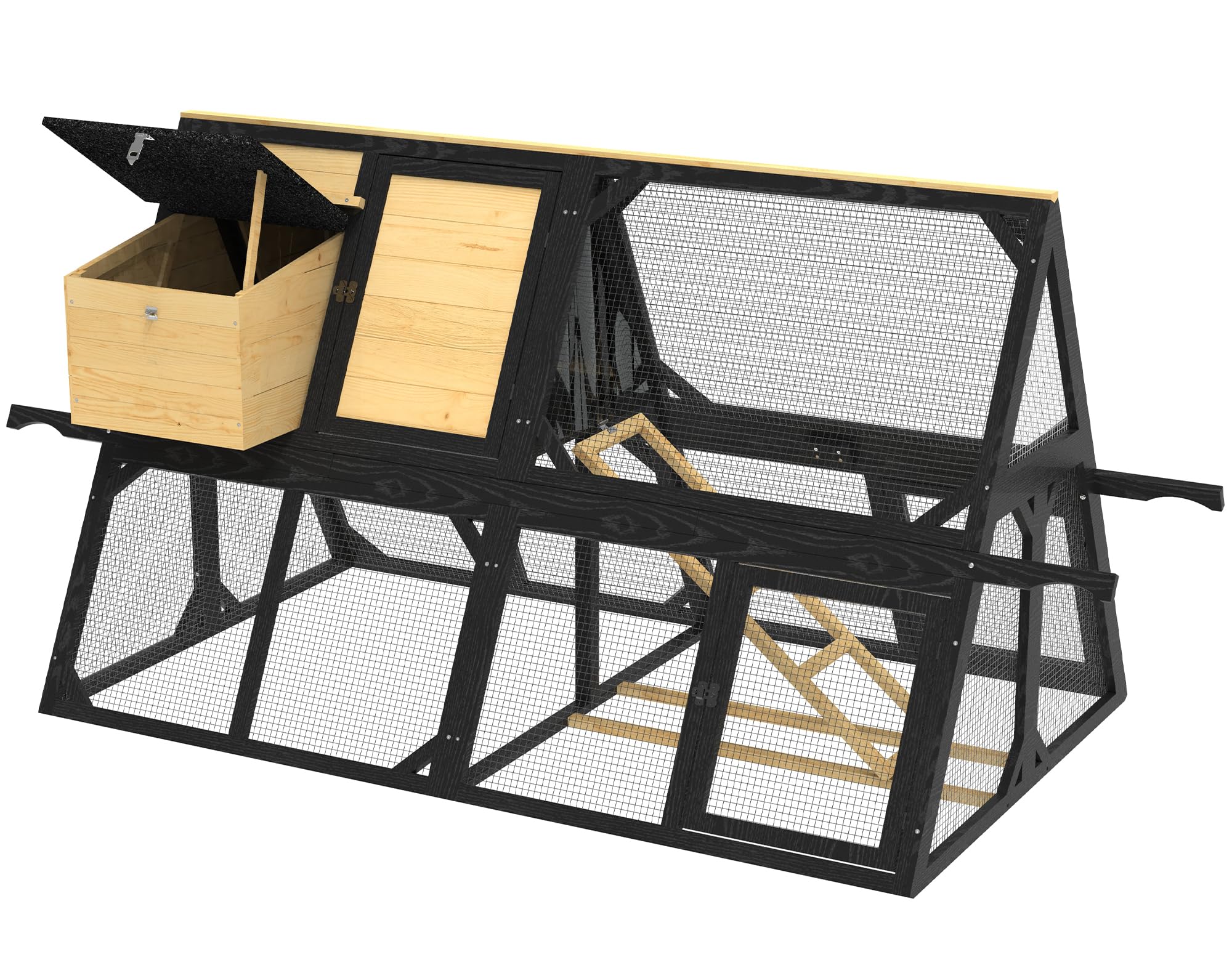
A‑frame coops are popular for a reason: the triangle shape is naturally stable, sheds weather well, and uses space efficiently. You get usable run area without needing a huge rectangular footprint, which is perfect for modern backyards. And when you’re trying to rotate your birds across patches of grass, an A-frame can be easier to “pivot” than a wide box—especially if you have a narrow side yard.
Owners who love this type of coop tend to talk about two things: it’s the right size for their small flock, and it looks good while doing a real job. Owners who dislike it usually point at build issues: missing pilot holes, parts splitting, joints that don’t align perfectly, or needing extra screws and glue to get everything tight. That’s the reality of many prefabs: the design can be good, but the build experience depends on how comfortable you are compensating for imperfect carpentry.
Here’s the expert approach if you choose this style: treat it like a “kit that needs finishing.” Pre-seal the panels if you can. Use a drill to avoid splitting wood. Tighten gradually and check alignment constantly so you don’t “force-fit” a skew that becomes a door gap later. And once it’s built, reinforce the handles/wheel points (if present) because those joints take the most stress when you move the coop. Do that, and you get a stable, attractive tractor coop that’s practical for day-to-day chicken life.
Why the A‑frame design works
- Stable geometry – The triangular frame resists wobble better than many boxy small coops.
- Efficient footprint – Good run area without dominating your yard.
- Weather shedding – Angled roof lines help water move off rather than pool.
- Good “starter tractor” feel – Teaches you rotation, cleaning, and run management in a manageable size.
- Nice daily visibility – Windows/doors let you check birds without opening everything.
Good to know
- Build quality can be inconsistent; a drill, extra screws, and wood-safe adhesive can save the day.
- Seal/paint is a smart longevity move—thin factory coating often isn’t enough for harsh weather.
- Handle stability may need reinforcement if you plan frequent moves.
- Capacity depends on breed size and whether birds spend all day inside.
- Predator-proofing still matters: treat latches and lower mesh as upgrade areas.
Ideal for: backyard keepers who love the A-frame footprint and don’t mind doing a little “builder finishing” to get a tighter, longer-lasting result.
8. Aivituvin 80″ Mobile Coop – Excellent “Second Coop” for Grow‑Outs, Isolation, or a Tiny Flock
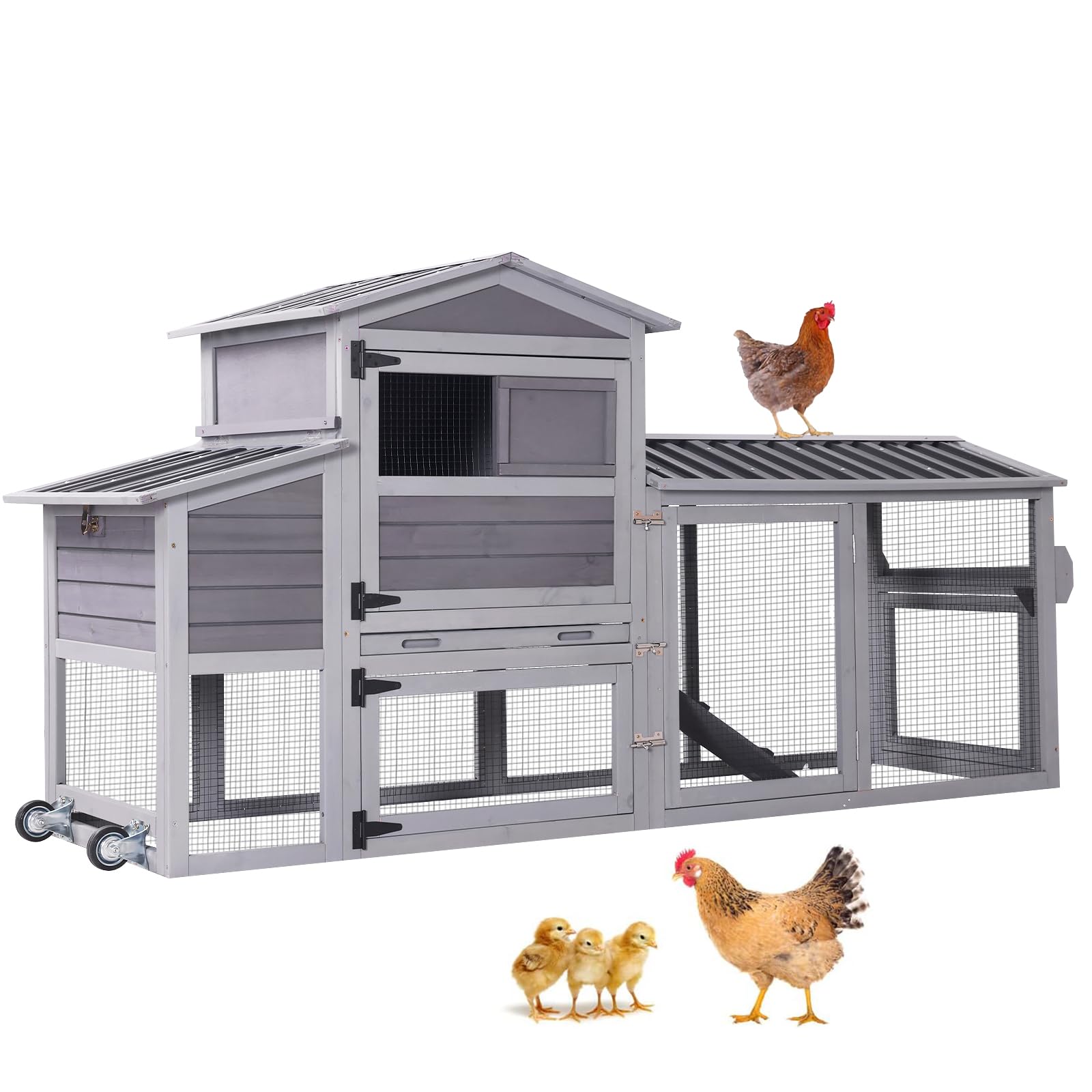
This is one of those products that shines when you use it for the right job. As a “main coop” for a big flock, it’s too small. But as a second coop—it can be fantastic. Owners often buy it for exactly that: chicks leaving the brooder, new birds being integrated, a broody hen needing peace, or a “chicken hospital” setup where you can monitor one bird’s food/water and recovery without flock interference.
The design is thoughtfully laid out for accessibility: multiple doors, easy egg access, and a mobility concept that works well on cultivated yards. Many people say assembly is straightforward with clearly marked parts, and they appreciate the wheels for repositioning. However, several owners also point out the build materials can be thin and the factory finish may not be weatherproof enough on its own. That’s a normal prefab reality: if you want it to last, add your own weather seal and expect to replace or upgrade small hardware over time.
Here’s what “expert use” looks like with this coop: don’t force it to be what it’s not. Use it for 2–3 hens (or small breeds), and give those hens daytime roam time. Clean the tray frequently (small coops get dirty faster because the droppings concentrate). Upgrade the latches if predators are clever in your area. If you do those simple steps, this becomes an incredibly useful tool in your chicken-keeping toolkit—one you’ll keep even if you upgrade your main coop later.
Why it’s a smart “second coop”
- Perfect for transitions – Grow-outs, quarantine, and integration are where it really excels.
- Easy access doors – Makes daily monitoring and quick catches far less stressful.
- Mobility helps management – Moving to shade or fresh ground is doable in the right yard conditions.
- Well-designed nest access – Egg retrieval is simple without disturbing the whole coop.
- Beginner-friendly assembly – Clear parts labeling is a big win in prefab land.
Good to know
- Best for small flocks; it’s not a “full-time big flock” home.
- Sealing/painting is strongly recommended for outdoor longevity.
- Hardware (latches/hinges) may feel light-duty—upgrade if you want long-term confidence.
- Wheels work best on smoother yards; thick grass can be a struggle.
- Tray depth may require more frequent cleaning than you’d expect—plan a routine.
Ideal for: anyone who wants a reliable second coop for management situations—chicks, recovery, integration, or a tiny backyard flock.
9. MEDEHOO Red Mobile Coop – Quick Assembly, Solid Layout, and a Great “Learn What You Like” Starter
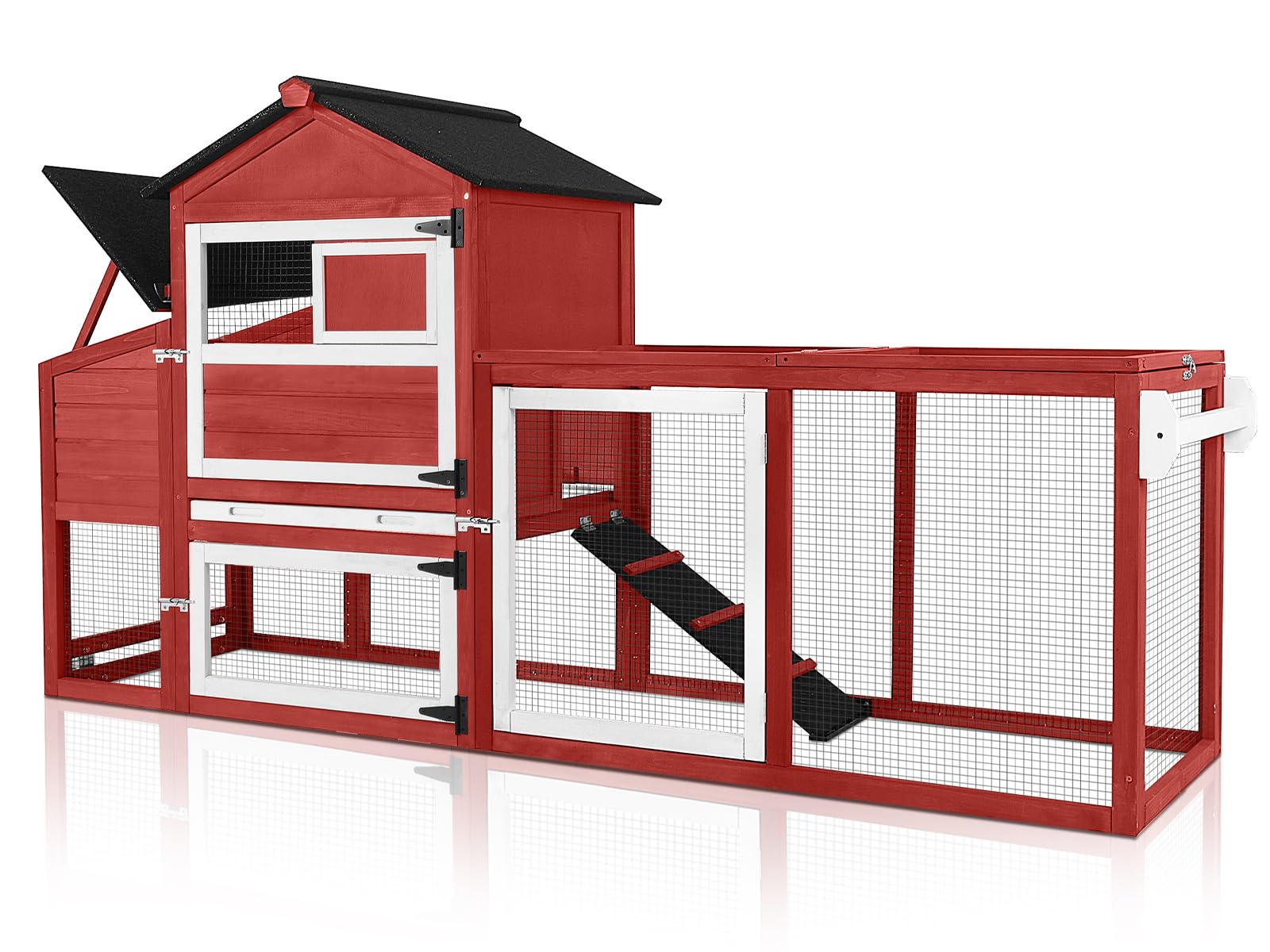
This is a great “starter mobile coop” because it’s built around the basics that matter: a sheltered sleep area, nest access, ventilation, and a cleaning tray you can actually pull out. Owners often describe it as easy to assemble (especially with two people and a drill), and they like that it’s lightweight enough to move around a yard. That’s a real win for beginners—because the hardest part of chicken keeping is not buying the coop; it’s building a routine you can maintain.
The most valuable detail in owner feedback is also the most honest: it’s best for two standard hens to be comfortable. Many product listings will suggest more, but experienced keepers know comfort matters. If you overstock a small coop, you get stress, poop concentration, and “why are they so noisy?” energy. Used correctly—two hens, or a broody hen + chicks—this coop can be a very satisfying solution.
The trade-offs are predictable: doors can swell in heat, small hardware can rust, and basic latches are rarely predator-proof enough on their own. That’s not a dealbreaker if you build your setup like a pro: add a secondary lock, seal any exposed wood edges, and avoid dragging it over rocks or uneven terrain (that’s where lightweight coops feel flimsy). When treated as a movable shelter in a reasonably managed yard, it does its job well.
Why beginners like it
- Quick setup – Assembly time is realistic for most homeowners.
- Good layout – Sleep + lay + run areas are simple and functional.
- Cleaning tray – Encourages frequent cleaning without a full teardown.
- Mobility helps comfort – You can move to shade or away from mud patches.
- Solid “starter value” – Great for learning what features you’ll want in your next upgrade.
Good to know
- Comfort capacity is small for standard hens—best with two (or small breeds).
- Doors can swell in heat; keep hinges aligned and don’t force latches.
- Small hardware can rust; a quick protective spray and regular checks help.
- Movement is easiest on smooth ground; rocks and ruts can twist lightweight builds.
- Add secondary locks if predators are clever in your area.
Ideal for: new keepers with a small flock who want a simple movable coop and are willing to add small upgrades (locks, sealing) for long-term satisfaction.
10. MEDEHOO Black Mobile Coop – A Compact “Move-to-Shade” Shelter for Chickens or Small Animals
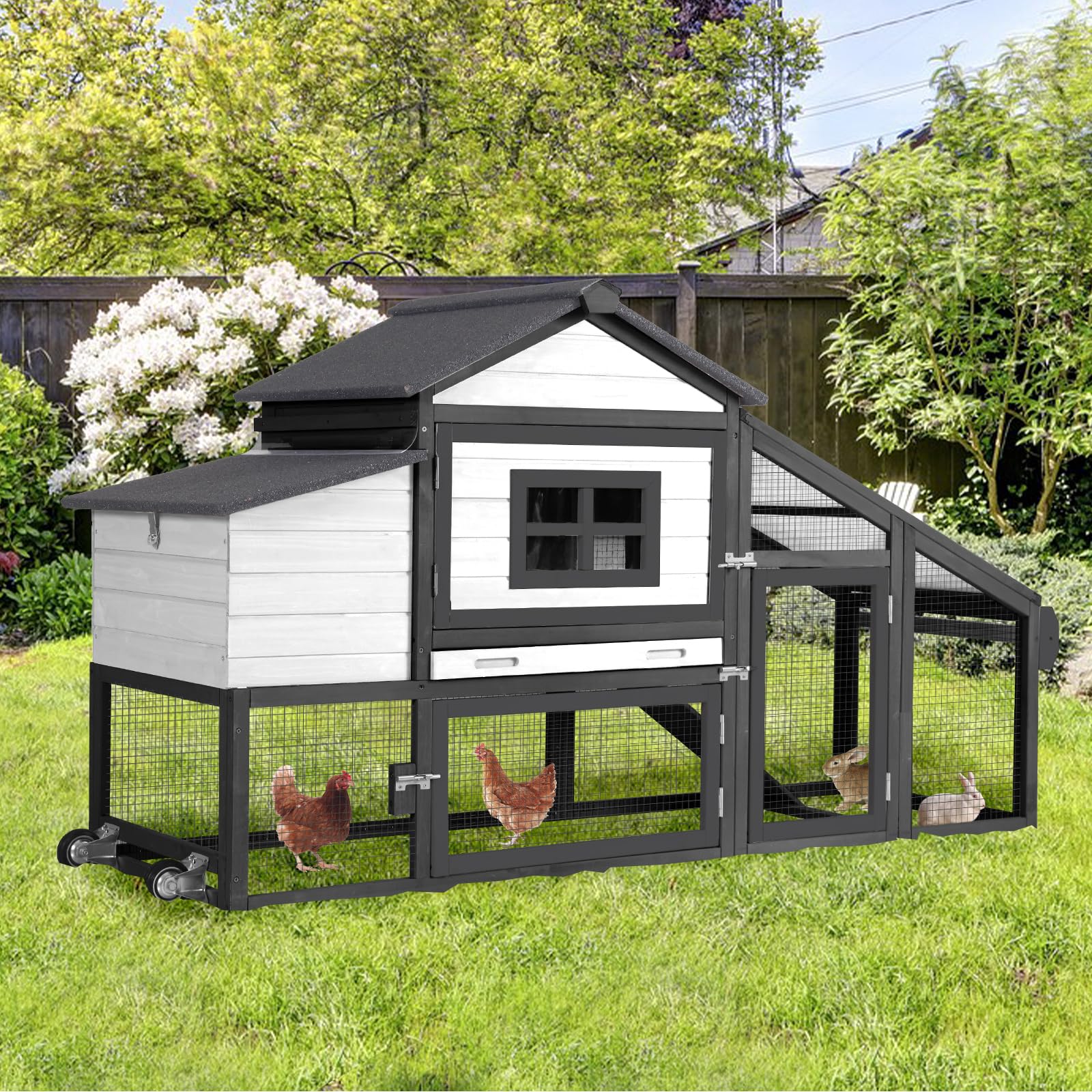
Compact mobile coops are a niche that a lot of buyers misunderstand. They’re not meant to be “everything” for a full-time flock. They’re meant to be a movable shelter that gives your animals a safe, dry place to retreat—while you control their larger environment. That might be a fenced yard, a supervised grazing pen, or a protected patio-style space for rabbits and ducks. In that role, a compact unit can be incredibly useful.
Owners of this style typically praise the convenience: it can be moved, it has a tray for quick cleanouts, and it provides a neat “home base.” The biggest complaints are also classic prefab issues: instructions can be frustrating, labeling can be hard to see, and wheels may be too small for thick grass. That’s why your decision should be tied to your yard: if you have smooth ground or a prepared path, it can be satisfying. If you want to roll it through tall, damp lawn, you’ll likely want to upgrade the wheels or shift to a larger-wheel tractor model.
What I like to see with compact coops is owner creativity: connecting an additional run, placing it in a fenced area, and using it as part of a larger system. That’s the “expert mindset”: the coop is a tool, not the entire habitat. Use it for shade, shelter, and routine—and let your larger enclosure provide the real roaming space.
Why it fits the right lifestyle
- Compact and manageable – Easy to place in small yards and reposition for shade.
- Quick cleaning – Pull-out tray reduces daily chore time.
- Multi‑use – Works for rabbits/ducks/small animals as well as small chicken setups.
- Good for add‑on runs – Pairs well with an attached pen or fenced space.
- Simple daily shelter – Provides a clear “safe home base” for animals.
Good to know
- Wheels may not roll well in thick grass; plan a path or consider wheel upgrades.
- Assembly instructions/labels can be frustrating—build slowly and lay parts out first.
- Best for small flocks or supervised use, not a full-time crowded habitat.
- As with most coops, latch upgrades are smart for predator confidence.
- Seal/paint improves longevity, especially on edges and joints.
Ideal for: small spaces, multi‑pet households, and anyone who wants a compact shelter as part of a larger fenced or supervised outdoor system.
11. PawGiant 130″ Portable Metal Pen – Great “Extra Space” Tool, Not a Standalone Night Coop

This is a “know what it is” product. It’s basically a portable enclosure concept—like a heavy-duty playpen for outdoor animals. And used correctly, it can be incredibly helpful: grow-outs, supervised grazing time, temporary separation inside a larger run, or creating a safe zone for rabbits and quail when you’re nearby. Owners often describe it as easy to assemble and genuinely useful for transitions and extra space.
The mistake is treating it like a standalone predator-proof night solution. The spacing and metal thickness in portable pens often means small birds can squeeze through, and determined predators can reach in or pry. That’s why experienced owners often add hardware cloth lining (especially if using it for quail or small chicks) and reinforce door areas. If you do that, you get a flexible tool that can live inside your larger chicken setup and solve a lot of management problems.
The door system is also worth discussing: multiple doors are great for access, but doors are where portability products feel weakest. If you plan to use it around predators, make sure every access point closes tightly and consider adding secondary clips. When used inside a fenced yard or inside a larger run, it becomes an excellent “extra room” expansion without building a new structure.
Where it shines
- Fast extra space – Great for transitions, introductions, and supervised outdoor time.
- Multi‑animal use – Rabbits, quail, ducks, chicks—very flexible.
- Multiple doors – Easier access than single-door pens.
- Cover helps comfort – Adds shade and some weather protection.
- Lightweight-ish portability – Easier to move than a built run structure.
Good to know
- Not a standalone predator-proof night solution without reinforcement.
- Small birds can squeeze through larger openings; hardware cloth lining fixes this.
- Door areas are the weak point—add secondary clips for confidence.
- Best used inside a fenced area or bigger run for layered protection.
- Think of it as a management tool, not your entire chicken infrastructure.
Ideal for: growers, hobby keepers, and multi-animal households who want a flexible enclosure tool for transitions and supervised outdoor time.
12. VEVOR 3.3×6.6 Small Run – The Perfect “Quarantine & Introductions” Cage You’ll Use Forever
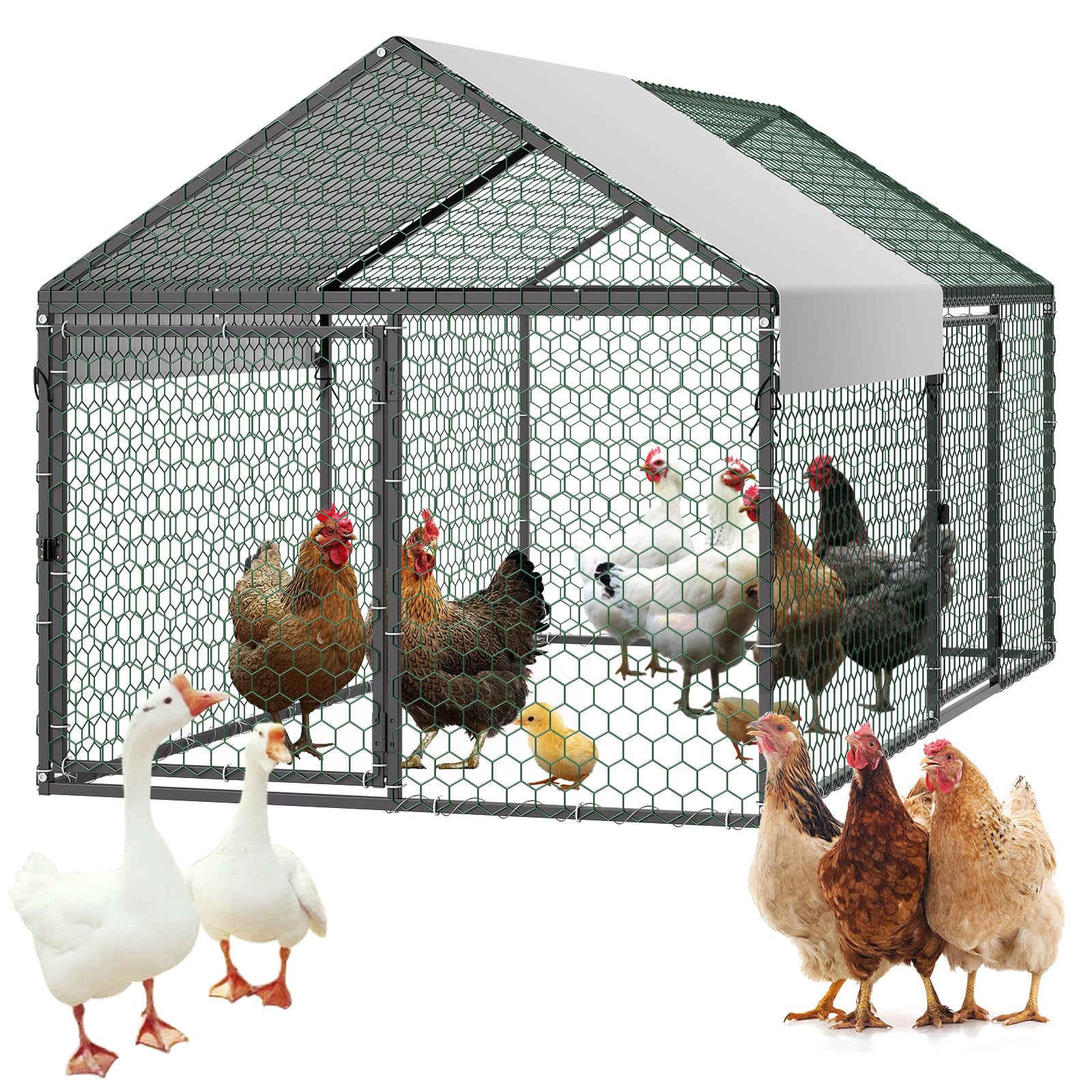
If you keep chickens long enough, you eventually need a “small safe space.” Maybe you introduce new birds, isolate a bully, quarantine a return from a swap, or protect a patch of garden. That’s where a compact run like this becomes one of the most useful pieces of gear you own—even if it’s not glamorous.
The best use case is pairing it with an existing coop or using it as a small pen inside a larger protected area. Double doors matter more than you think because small enclosures get cluttered quickly with a feeder and waterer. Two access points makes cleaning and handling birds far easier. And the cover (even if it’s just partial) can be a big comfort improvement for shade and light rain.
Here’s the expert move: treat this as a “base layer” you can reinforce depending on what you’re housing. For bantams or chicks, line it with smaller-gauge hardware cloth so nobody squeezes out. For predator pressure, reinforce the bottom edge and use secure latches. A small run doesn’t need to be perfect out of the box—it needs to be useful, easy to set up, and easy to customize. This is that kind of product.
Why it’s a forever-tool
- Perfect for quarantine – A small space is essential for healthy flock management.
- Great for introductions – Lets new birds be seen/smelled safely before full integration.
- Double doors – Makes feeding and cleaning easier in a tight space.
- Pairs with coops – Works as an add-on run or a protected pen zone.
- Easy to customize – Reinforce mesh, add shade, add a bottom perimeter strategy.
Good to know
- Too small for long-term living for standard hens; it’s a tool, not a full habitat.
- Expect to reinforce for small birds and predator pressure.
- Cover may not fully protect from sideways rain; add a tarp if needed.
- Ground stakes and anchoring still matter—light frames shift if not secured.
- Plan for ventilation; don’t wrap it fully airtight in cold weather.
Ideal for: flock managers who want a dedicated quarantine/intro pen and anyone who likes having a compact, flexible enclosure for backyard projects.
13. Ketive Sloping Roof Tractor (Grey) – A Useful Small Shelter When You Don’t Pretend It’s Bigger Than It Is

This is a perfect example of a product that can make you happy or furious depending on your expectations. If you buy it thinking “this will house my whole flock,” you’ll be disappointed. If you buy it thinking “I need a small, tidy shelter for a specific purpose,” it can be a great tool. Owners frequently point out that it’s smaller than it looks in photos and best suited for very small numbers of birds or short-term use.
Where it actually works well: a broody hen and chicks, a recovering hen who needs monitoring, a pair of bantams, or a temporary pen during construction or yard work. The pull-out tray and nest access can make daily care easy, and the basic sloping roof does a good job shedding rain. A lot of owners like the “it cleans up nicely” feeling once it’s assembled and in place.
The “expert upgrade” list is predictable: improve predator resistance at the bottom edge, upgrade latches, and consider sealing the wood. Also, think about wheels realistically. Small tractor coops can be moved, but “moved daily across thick grass” is usually a fantasy unless the wheels are big and the ground is smooth. If you treat it as a small shelter you reposition occasionally, it’s much easier to love.
Why it’s useful (when used right)
- Great for single-hen care – Perfect for monitoring and recovery situations.
- Simple daily cleaning – Pull-out tray and access doors help chores stay quick.
- Weather-shedding roof – Sloped roof helps keep interior drier than flat roofs.
- Easy assembly for many owners – A manageable project when you go step-by-step.
- Small footprint – Fits tight backyards and temporary setups.
Good to know
- It’s small—plan for 1–2 standard hens (or small breeds) for comfort.
- Not a high-pressure predator solution without reinforcement.
- Wheels are best on smooth ground; thick grass makes movement harder.
- Like many prefabs, sealing wood edges is smart for long-term outdoor use.
- Best as a specialty tool, not a “forever home” for a big flock.
Ideal for: broody hens, recovery care, small breeds, and anyone who needs a compact, tidy, temporary housing solution that’s easy to clean.
14. Ketive Sloping Roof Tractor (Red) – Same Platform, Same Strengths: Best as a Purpose-Built Small Pen

This is essentially the same concept as the grey sloping roof version—just a different presentation. So the advice is the same: it shines when you use it as a small, controlled housing tool. A lot of owners end up loving these small tractors for exactly one scenario: a broody hen that needs her own space to hatch and raise chicks without flock interference. In that role, a compact pen is a lifesaver.
Because it’s small, you can place it strategically: near the house for monitoring, under partial shade, or in a protected yard. The pull-out tray and nest access simplify daily care, and the basic run gives chicks a safe, contained place to explore. If you’ve ever tried to manage chicks in a chaotic main coop, you know why a separate “nursery pen” changes everything.
The key is not to ask it to be an armored fortress or a full-time condo for a large flock. Upgrade latches if predators exist, reinforce the lower edge if diggers exist, and seal wood edges for weather. Do those simple steps and it becomes a reliable small pen you’ll keep using for years—because chicken keepers always need a second space eventually.
Why it’s a great “specialist” coop
- Ideal broody-hen nursery – Keeps chicks safe and reduces flock conflict.
- Easy daily access – Quick cleaning and easy monitoring near the house.
- Good for temporary separation – Bully time-outs, recovery care, and introductions.
- Simple shelter + run – Enough structure to be useful without being overly complex.
- Small footprint flexibility – Fits tight yards and “temporary project” needs.
Good to know
- Not comfortable for many standard hens long-term—keep expectations realistic.
- Predator resistance depends on reinforcement and latch upgrades.
- Movement across grass can be limited by wheel size and ground conditions.
- Sealant/paint improves durability in wet climates.
- Best used as part of a bigger backyard system, not the whole system.
Ideal for: broody hens and chick-rearing setups, temporary separation needs, and anyone who wants a compact, tidy pen for specific chicken-management situations.
15. Belinova Chicken Coop Wheels Kit – A Pedal‑Lift Idea That Can Save Your Back (If Your Ground Cooperates)
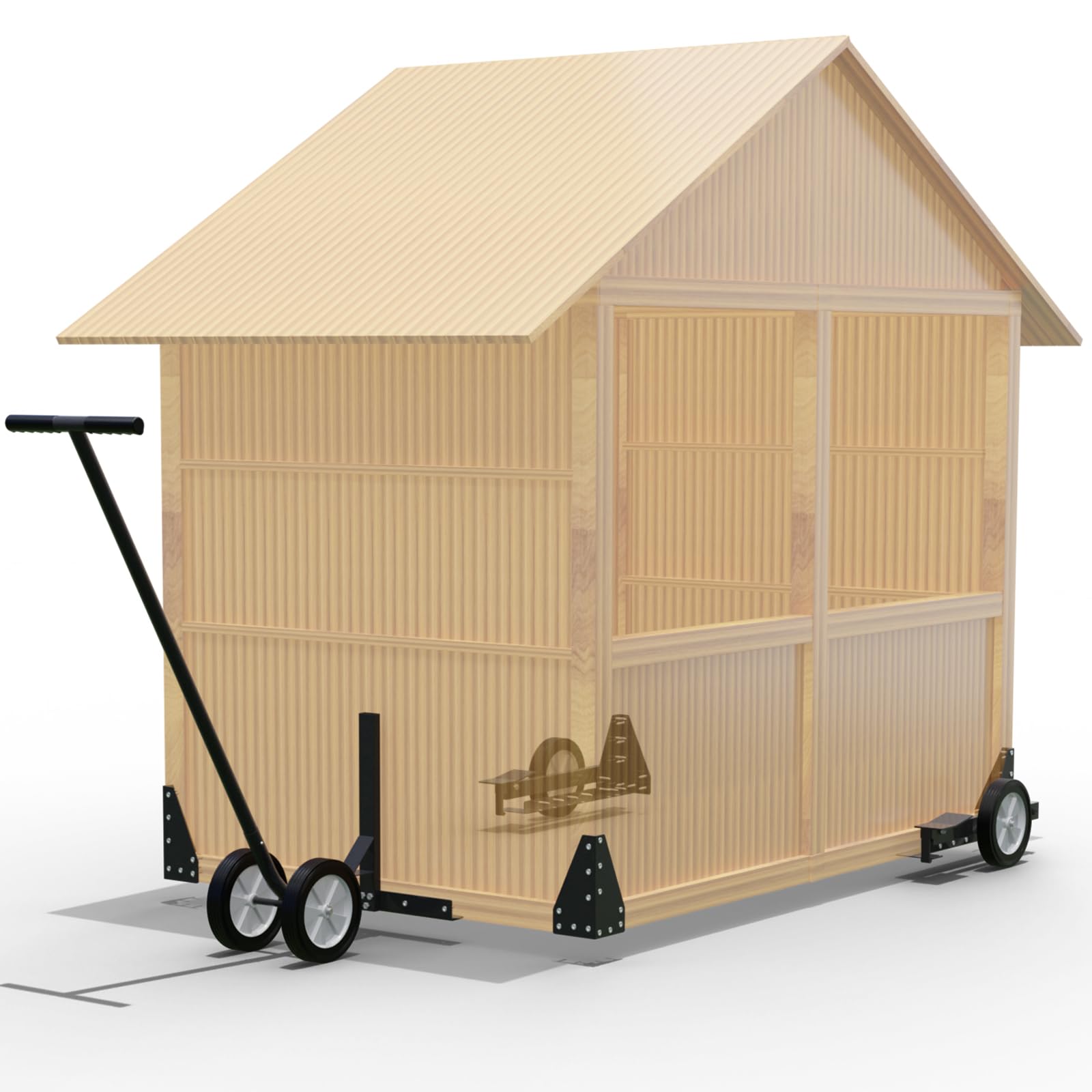
If you already have a coop (or you’re building one) and you’re thinking, “I love it, but I cannot move this thing,” a wheel/lift kit can be a game changer. The reason is simple: you don’t need your coop to roll like a stroller— you need to lift it cleanly off the ground and move it without wrecking your back. A pedal-lift approach can turn “two-person shove” into “one-person move,” which is a big deal if you’re managing chores alone.
Owner feedback around kits like this tends to split into two camps: (1) “Where was this a year ago?” (it solves a real problem), and (2) “It wasn’t strong enough for my build.” Both can be true. Your success depends on your coop’s weight distribution, frame material, and—this is huge—your ground. Thin wheels sink in soft soil. Wet pasture turns into a rut factory. That doesn’t make the kit useless; it means you should be honest about conditions. Flat, firm ground makes these kits feel brilliant. Soft, uneven ground makes them feel like work.
Here’s the pro move: mount the kit on a coop that has solid framing at the attachment points, and plan a “move path” (a mowed strip or a firm lane). If your coop is at the upper end of weight, consider reinforcing mounting points so the kit isn’t taking stress on weak wood. When installed thoughtfully, this kind of mobility upgrade can extend the life of your current coop by making it usable in a rotational routine.
Why it’s a smart upgrade
- Saves your back – A lift system turns heavy moves into a manageable routine.
- Works with many coops – Great for DIY builds and existing coops that need mobility.
- Fast installation concept – Designed to be installed with basic tools.
- Encourages rotation – If moving is easy, you do it more often (better for ground and hygiene).
- Cost-effective upgrade – Can be cheaper than replacing an entire coop.
Good to know
- Ground matters: soft soil can make thin wheels sink and feel frustrating.
- Weight matters: very heavy coops may need stronger kits or reinforced mounting points.
- Works best when your coop has solid framing where you attach the hardware.
- Flat ground improves results dramatically; uneven ground can twist and bind movement.
- Test the pedal workflow before you “commit” to a new rotation routine.
Ideal for: DIY builders and existing coop owners who want mobility without rebuilding, and who can provide a reasonably firm path for rolling moves.
How Mobility Actually Works (and Why Most “Wheels” Disappoint)
Mobility is not a feature. It’s a system. And the system has three enemies: soft ground, twist, and weight distribution. Once you understand these, you can predict whether a “mobile” setup will feel effortless or feel like a daily fight.
The three mobility tests that matter
- The wet‑grass test: If you can’t move it the day after rain, you won’t move it consistently.
- The bump test: If a small bump twists the frame, doors will misalign and latches will start to fail over time.
- The pivot test: If you can’t turn it in tight spaces, you’ll stop rotating and it becomes a stationary coop anyway.
Large wheels generally beat small casters. Handles should feel rigid (no flex). And any “tractor” that requires you to lift too high is going to become a once-a-week move. That’s why many keepers end up loving either (a) big‑wheel tractors, or (b) walk‑in runs with coops inside—because those don’t rely on perfect rolling conditions.
My favorite “no-drama” move strategy
- Make a move lane: mow a strip or create a firm path so wheels don’t sink.
- Move in small increments: a few feet is enough to get fresh ground and avoid ruts.
- Move before the ground is destroyed: rotate early, not after it turns to mud.
- Use “shade thinking”: in summer, move for shade; in winter, move for dryness and wind protection.
Predator-proofing upgrades that pay off fast
- Upgrade every latch: add a carabiner or secondary clip on every door and nest lid.
- Reinforce door gaps: hardware cloth strips + screws can close those “oops” spaces.
- Add a bottom perimeter plan: a hardware cloth apron or buried edge stops digging attempts.
- Tighten the mesh: loose mesh is “reach-through friendly.” Tight mesh is harder to exploit.
- Anchor for wind: light structures need better anchoring than the included stakes in many yards.
Ventilation that keeps birds comfortable
- High vents beat low drafts: you want air exchange without cold wind blowing directly on roosting birds.
- Shade is a health feature: add shade cloth or extended cover if your run gets full sun.
- Dry bedding wins: keep at least one zone protected from rain so birds can get off wet ground.
When you solve mobility and predator weak points, your setup stops feeling like a constant “fix it” project and starts feeling like a routine you can trust.
FAQ: Chicken Tractors, Mobile Coops, and Walk‑In Runs (Without the Confusion)
What’s the biggest mistake people make when buying a mobile coop?
How often should I move a tractor-style setup?
Do I need hardware cloth, or is chicken wire okay?
Is a walk‑in run better than a small tractor?
How do I stop eggs from getting wet or dirty in nesting boxes?
Should I seal or paint a prefab wooden coop?
My coop says it holds 6–8 chickens. How many should I actually keep in it?
Final Thoughts: Picking a Chicken Tractor With Coop You’ll Still Love in Month 3
The best setup is the one you’ll use consistently—because consistency is what keeps birds healthy, eggs clean, and your yard from turning into a muddy mess. And the secret isn’t finding a “perfect” product. It’s choosing a design that matches your real life, then doing the small upgrades that remove stress.
Here’s a decision shortcut that works shockingly well: buy for your hardest week. That’s the week with rain, heat, or schedule chaos—when you still have to feed, still have to lock up, still have to clean. If your setup works then, it works always.
- Want a true daily-routine tractor with lots of access points? Start with the Suumerpety Chicken Tractor (All‑Metal Frame). Just keep comfort capacity realistic for standard hens and you’ll love the workflow.
- Want “premium mobility” and a more convenience-focused layout? Consider the GUTINNEEN Mobile Coop for big wheels, nest access, and cleaning shortcuts that make daily life easier.
- Already have a coop (or plan to buy one) and want a serious walk-in run? The Quictent 12×9 Walk‑In Run is a strong “put your coop inside” option—especially if you reinforce anchoring and seams for your yard.
- Need maximum roaming room without building from scratch? Look at the Aoxun 10×20 Walk‑In Run or the VEVOR Dome‑Roof Walk‑In Run, then customize with reinforcement and cover strategy.
- Want a small coop for transitions, isolation, or a tiny flock? The Aivituvin 80″ Mobile Coop is one of the most practical “second coop” buys you can make.
- Want a quick beginner-friendly movable coop? The MEDEHOO Red Mobile Coop is a solid starter when you keep flock size realistic and add simple latch upgrades.
- Need a compact management pen or quarantine run? Grab the VEVOR Small Run or the PawGiant Portable Pen and reinforce based on what you’re housing.
- Already have a heavy coop and just want mobility? The Belinova Wheels Kit can be a back-saving upgrade if your ground is firm and your mounting points are solid.
Choose the chicken tractor with coop that matches your yard and your routine, do the small “make it yours” upgrades (latches, perimeter, sealing), and you’ll get what everyone actually wants: a flock that’s safe, comfortable, and easy to manage—without your coop becoming a full-time construction project.
