
Camping food has a “moment.” It’s not just dinner — it’s the end-of-day reward when you finally stop unpacking, stop driving, stop setting up, and everyone’s mood flips the second something smells incredible.
That’s why a camping pellet grill feels like cheating in the best way. You get real wood flavor without playing fire-tender for hours. You set a temperature, let the controller manage the feed and airflow, and you spend your time doing the fun parts: seasoning, glazing, slicing, and hearing that quiet “mmhmm” from the first bite.
But here’s what most “portable pellet grill” guides get completely wrong: camping isn’t a backyard. At camp, power can be limited, wind is a real opponent, surfaces aren’t always level, and you don’t have your full cleaning setup. A unit that’s amazing on a patio can feel annoying in the wild if it’s awkward to carry, messy to clean, picky about pellets, or too delicate for travel life.
So this guide is built around real-life friction points — the stuff that determines whether you actually use your grill: How fast it stabilizes after you open the lid. Whether the hopper lasts through a long cook without babysitting. How easy it is to vacuum ash without getting greasy hands. Whether it can truly sear (not just “brown”). How it behaves when the wind kicks up. And how forgiving it is when you’re cooking in dim light with hungry people hovering.
Below, you’ll find 14 picks that make sense for different camping styles — from tiny tabletop pellet rigs that travel in a tote, to foldable-leg tailgaters that feed a crew, to “plug-in and go” woodfire grills that are campground and balcony friendly, plus one charcoal wildcard for campers who want a no-electricity backup.
How to Choose the Right Camping Pellet Grill for Real Camp Life
A portable grill is “good” when it makes your trip easier, not when it looks impressive in a product photo. For camping, there are four deal-breakers that quietly decide whether you love your purchase: power, portability, temperature control, and cleanup. Once you understand those, the right choice becomes obvious — and you stop overpaying for features you won’t use.
1. Start with the power plan (this is where most people choose wrong)
If you remember only one thing from this guide, make it this: a “portable” grill isn’t portable if you can’t power it where you camp. Before you fall in love with a model, answer these questions:
- Are you camping with hookups? If yes, 120V plug-in units can be amazingly convenient.
- Are you boondocking/off-grid? Then you either need a true 12V/120V-capable grill (built for vehicle power), or a realistic inverter/generator plan.
- Are you tailgating from a vehicle? You’ll often have the easiest time with foldable-leg pellet grills or tabletop units that sit on a sturdy surface.
- Are you apartment/balcony + occasional camping? Electric “woodfire flavor” grills can be the best compromise because you don’t need big bags of pellets as fuel.
2. Decide what “portable” means for you (tabletop vs foldable legs vs cart life)
“Portable” is not one category — it’s three.
- Tabletop pellet grills: They’re the easiest to store, often the fastest to get going, and they fit in RV bays and totes. They’re perfect for couples and small families, but you need a stable surface.
- Foldable-leg tailgaters: These give you a more “real grill” work height and capacity. They’re great for groups, but they can be heavier and more awkward to load/unload.
- Cart-style portable grills: Some units are technically movable, but they’re really “backyard grills that can travel” if you have a truck and don’t mind bulk.
Now add the camping reality: you’ll carry this thing with other gear. So look for practical portability features — lock-tight latches, solid handles, feet that don’t wobble, and a shape that stacks well. If you’re constantly playing Tetris in your storage bay, a slightly smaller unit that fits beautifully can be worth more than a larger grill that forces messy compromises.
3. Temperature stability isn’t just a bragging point — it’s your sleep
The real promise of pellet cooking is “set it and forget it.” At camp, that becomes “set it and actually relax.” What gives you that feeling?
- PID-style control: You’ll see this on several Z GRILLS models. In plain language, it aims for smoother temperature control with less swing. That matters on long cooks and windy nights.
- Fast recovery: When you open the lid to spritz ribs or flip chicken, a good unit rebounds quickly instead of sagging for 15 minutes.
- Probe workflow: Built-in probes can be genuinely helpful — but the best setup is when you trust them and they’re easy to read in daylight.
A lot of camping cooks fail because the pit temp and the meat temp drift into chaos. If you choose a grill that holds a steady pit temp, you suddenly feel like a pro — even if you’re a beginner.
4. Searing is where portable grills separate into “two different personalities”
Most portable pellet smokers cook like outdoor ovens. That’s a compliment — even heat, forgiving results, less burning. But searing is another game.
- True direct-flame systems: Some designs (like Pit Boss’s Flame Broiler concept) can expose food to real flame for aggressive crust.
- Sear zones / sear grates: Some compact units include a dedicated sear area that can surprise you — but it still depends on preheat and technique.
- Cast iron griddle strategies: A griddle (like the one included with the Traeger Ranger) can be a cheat code for camping breakfasts and high-surface-area sear.
If you want steakhouse crust in the woods, prioritize a grill that has a credible searing solution. If you mostly want smoky chicken, ribs, burgers, sausages, and roasted veggies — a “pellet oven” style unit can be perfect.
5. Hopper behavior matters more than hopper size
You’ll hear a lot of talk about hopper capacity. That’s not the whole story. What really matters is:
- How cleanly pellets feed: Some hoppers flow smoothly; others can bridge if pellets are dusty or humid.
- How easy it is to change pellets: At camp, you might not care. At home, switching from hickory to apple can be fun — but some designs make it annoying.
- How long it runs in the real world: A steady, efficient unit can surprise you by sipping pellets. A less efficient unit can feel like it’s constantly asking for refills.
Camp strategy: bring pellets in a sealed container, not the original open bag. Humidity is a pellet grill’s sneakiest enemy. Damp pellets lead to inconsistent feed and weird temperature behavior — and that’s how “easy cooking” turns into a troubleshooting session.
6. Cleanup is the difference between “we grill again tomorrow” and “nope”
Camping cleanup is not backyard cleanup. You might not have a hose. You might not have a big trash bin. And you definitely don’t want greasy ash blowing around your campsite.
The best camp-friendly grills have one or more of these traits:
- Simple ash access: You can vacuum out ash quickly without dismantling greasy parts like it’s a puzzle.
- Smart grease routing: A tray or bucket that’s easy to empty and doesn’t drip everywhere in transport.
- Foil-friendly design: If the heat deflector/drip tray is shaped for foil lining, you can pack out a neat mess instead of scrubbing at camp.
If you hate cleaning at home, you’ll really hate it at camp — so treat cleanup design like a core feature, not a bonus.
7. Weather isn’t a “maybe” — it’s the default outdoors
Wind, cold, and moisture make any grill work harder. Your best defenses:
- Heat retention: Thicker metal, better lid fit, fewer air leaks — you’ll notice these on cold mornings.
- Electronics protection: Rain happens. Heavy dew happens. If the control area looks exposed, store the unit under cover and avoid leaving it out all night.
- Wind planning: Put the grill where wind won’t blast directly into vents. A small windbreak (even your vehicle) can make a huge difference.
8. Pick your “camp personality” — then buy for that
Most campers fall into one of these styles. Choose yours first:
- The RV / hookup camper: Wants plug-in convenience, fast meals, and minimal pellet hauling.
- The overlander / off-grid traveler: Needs 12V power compatibility and rugged, repeatable performance.
- The tailgater / group host: Wants capacity, stability, and food that feeds a crew without multiple batches.
- The minimalist weekender: Wants a compact tabletop unit that stores cleanly and cooks reliably for a few people.
- The “I want real fire” purist: Might be happiest with charcoal — especially when power is uncertain.
Now let’s match you to the right grill — quickly — and then we’ll go deep on the details so you buy once and feel good about it.
Quick Comparison: 14 Camping Pellet Grill Picks That Make Sense Outdoors
Use this table to spot the models that match your camping style — then jump into the deep reviews for the “real life” details (setup, stability, cleanup, searing reality, and what owners actually say after repeated cooks).
On smaller screens, swipe or scroll sideways to see the full table.
| Model | Type | Camp advantage | Best match | Amazon |
|---|---|---|---|---|
| Pit Boss PB150PPG Tabletop Pellet Grill | Tabletop pellet | Direct-flame searing option + travel latches + “small but serious” build | Most campers who want one compact grill that can smoke and truly sear | Amazon |
| Ninja Woodfire Pro XL (OG850) | Electric woodfire | Huge versatility + minimal pellet hauling (pellets used for flavor) | Hookup campers + balcony users who want smoke + air fry in one box | Amazon |
| Traeger Ranger (TFT18KLD) | Premium tabletop | Rock-solid “pellet oven” performance + included cast iron griddle | RV travelers who want premium consistency and campsite breakfasts | Amazon |
| GMG Trek Prime 2.0 WiFi | 12V + WiFi | Off-grid flexibility + app monitoring for long cooks | Overlanders, hunters, and “set it and relax” campers | Amazon |
| Freedom Stoves Portable Electric Smoker Grill | 12V / 120V | Dual-power practicality + quiet run + dual probes | Road trips, truck camping, and simple “always works” grilling | Amazon |
| Traeger Tailgater 20 (TFB30KLF) | Foldable legs | More cooking space with a tailgate-friendly footprint | Groups and families who want “real grill” capacity on trips | Amazon |
| Z GRILLS 450E | Backyard-to-camp | Big cooking area + modern controller + rain cover | Campers who also want a main grill at home (truck-friendly travel) | Amazon |
| KingChii Foldable-Leg Pellet Grill | Large portable | Big cooking area + foldable storage + beginner-friendly learning curve | Families who want capacity without feeling “too complicated” | Amazon |
| Cuisinart CPG-256 Portable Pellet Grill | Tabletop pellet | Integrated sear zone + compact footprint + strong “value performance” vibes | Camp cooks who want smoke + sear in a small footprint | Amazon |
| Z GRILLS 2026 200A (PID V3.0) | Compact PID | Steady temps + probes + “small family” cook capacity | Apartment patios, RV bays, and no-fuss tabletop smoking | Amazon |
| Z GRILLS ZPG-200APro | Tabletop pellet | Solid performance for the size (with a few “RV life” quirks) | Campers who want dependable results and don’t mind simple maintenance | Amazon |
| Ninja Woodfire (OG701) | Electric woodfire | Small-space friendly + fast cooks + real smoky boost without fuel pellets | Quick camping meals, patios, and “weeknight outdoors” cooking | Amazon |
| Onlyfire GS314 Tabletop Pellet Grill | 2-tier tabletop | Two-tier cooking + strong feature set for compact rigs | Campers who want more food space without a bigger footprint | Amazon |
| Oklahoma Joe’s Rambler Tabletop Charcoal Grill | Charcoal wildcard | No electricity needed + real fire control + cast iron sear | Off-grid campers who want a compact “real coals” setup | Amazon |
In-Depth Reviews: 14 Camp-Ready Grills That People Actually Enjoy Using
Now we go model by model. This isn’t a brochure recap — it’s the “what it feels like at camp” view: startup rhythm, stability, smoke flavor reality, searing capability, cleanup pain (or lack of it), and which type of camper each grill is built for.
1. Pit Boss PB150PPG Tabletop Pellet Grill – Small Footprint, Big “Camp Win” Energy
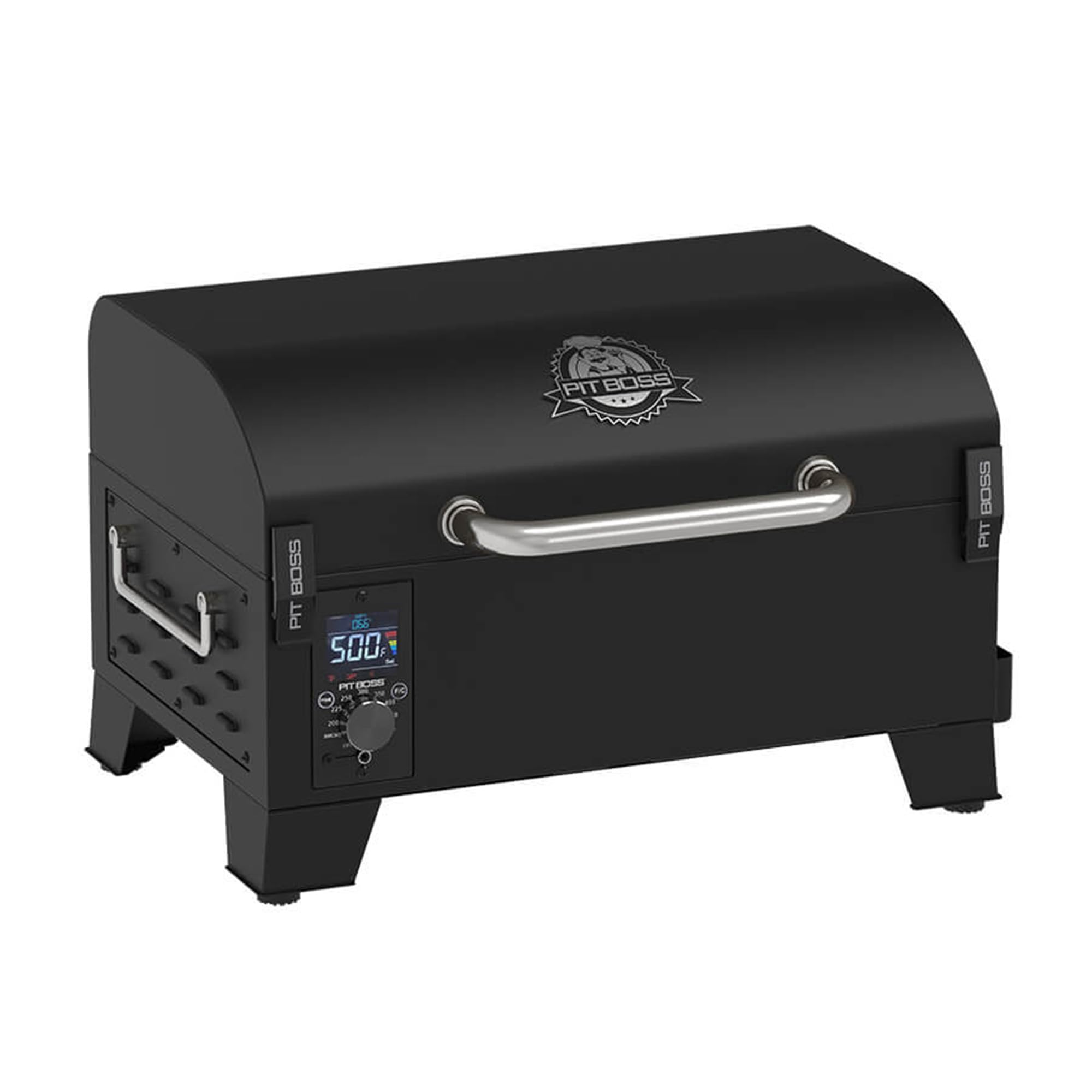
This Pit Boss tabletop is the kind of grill that earns trust fast because it behaves like it was designed by people who actually cook outdoors. It’s compact enough to fit in RV storage and vehicle setups, but it doesn’t feel “toy-ish.” It feels like a real pellet cooker that just happens to be travel-sized.
Where it really separates itself is the personality split: it can do low-and-slow smoking like you expect — and it has a direct-flame searing approach that makes it far more satisfying for steaks and burgers than many compact pellet rigs. That matters at camp, because a lot of people don’t want “soft grilled” food. They want crust. They want char. They want that first-bite snap that feels like a reward.
Owners who buy this expecting “good enough” often end up surprised in a very specific way: they talk about how steady it holds temp and how easy it is to use once you learn its rhythm. That’s exactly what you want on a trip. The best camping gear is the gear that makes you feel calm. You set it, you cook, you eat, you move on with your evening.
The portability touches are legit too — latches that keep it shut while traveling, a body that feels sturdy, and a size that cooks for a small group without turning into a production. It’s not a festival-crowd cooker, but for couples, small families, and “camp friends who eat in waves,” it’s a sweet spot.
Why you’ll love it at camp
- Direct-flame searing option – You can actually chase a real crust instead of settling for “pellet-browned.”
- Set-it-and-relax stability – Small cook chamber + solid control means it reaches temp quickly and tends to stay there.
- Travel-friendly build – Locking latches and a stout body make it feel designed for movement, not just patios.
- Great “two to six people” cooker – Enough room to feed a crew without hauling a full-size grill.
Good to know before you buy
- Like most pellet rigs, it needs a reliable power source — plan your cord/generator setup before your trip.
- Compact size means smart batch cooking: you’ll do better with “cook protein first, then sides” rather than trying to cook everything at once.
- Grease management is easy when you keep up with it; ignore cleanup and any grill can become a flare-up party.
Ideal for: campers who want one compact pellet grill that can smoke, grill, and actually satisfy the “I want a sear” crowd — without turning camp dinner into work.
2. Ninja Woodfire Pro XL (OG850) – The “Camp Kitchen in One Box” Option

Let’s be clear about what the OG850 is — and what it isn’t — because that’s how you avoid disappointment. This isn’t a traditional pellet grill where pellets are the main fuel source. It’s an electric outdoor cooker that uses wood pellets to infuse flavor. That sounds like marketing until you experience it at camp: you get smoky character without hauling big pellet bags, and you get multiple cooking modes that genuinely replace other appliances.
If you camp at places with hookups (or you’re using it on a deck/balcony), this “electric + woodfire flavor” style can be a total lifestyle upgrade. Why? Because it collapses your meal plan. You can grill burgers, smoke chicken, air fry wings or fries outside (keeping smells and heat out of your RV), and even bake/roast like an outdoor oven.
Owners consistently highlight two things that matter at camp: it’s remarkably foolproof, and the thermometer/probe setup helps you stop guessing. At camp, guessing ruins timing. Timing ruins moods. A probe that tells you when dinner is actually done is not a luxury feature — it’s a “keep the trip fun” feature.
Now for the honest camp realities: plug-in units often have shorter power cords than you’d like, and you want to place the grill where it’s safe, stable, and not under awnings that can trap heat. Also, if you’re a hardcore smoke purist who wants heavy, deep smoke like a big barrel smoker, this style is a gentler smoke profile. The flavor is real — but the experience is more “clean, controlled, consistent” than “wild pitmaster.”
Why it’s awesome for campers
- Multi-mode flexibility – Grill, smoke, air fry, bake/roast… it’s a full outdoor kitchen in one footprint.
- Minimal pellet hauling – Pellets are used for flavor, so you’re not burning through bags like a fuel-based pellet smoker.
- Built-in thermometer workflow – Helps you nail doneness without opening lids and losing heat.
- Great “keep the RV cool” strategy – You can cook mains and sides outdoors without heating your inside space.
Good to know
- This is a plug-in unit: it shines with hookups or a solid power plan, not “random off-grid” power.
- It’s incredibly capable, but you’ll cook best when you focus on internal temperature over “time settings.”
- Expect a “woodfire boost” flavor profile — not the same heavy smoke punch as a large, fuel-burning smoker.
Ideal for: campers with reliable power who want maximum versatility and minimal mess — especially families who want to cook mains and sides outdoors without juggling multiple appliances.
3. Traeger Ranger – The “Portable Pellet Oven” That Makes Camp Meals Taste Expensive

The Traeger Ranger earns its reputation in one specific way: it makes camp cooking feel controlled. Not “hope and pray,” not “babysit the fire,” but controlled — like you brought a tiny outdoor oven that just happens to run on hardwood pellets.
That’s why RV travelers love it. You can do breakfast on the cast iron griddle, then switch to a roast or chicken at a steady temperature, and the results feel shockingly close to what you’d get from a much larger backyard setup. Owners talk about cooking everything from steaks to roasts to pancakes and even simple baked-style meals — and the common theme is consistency.
Here’s the Ranger’s real “expert value”: it teaches you a smarter camp workflow. Instead of trying to force steakhouse sear out of a small pellet grill, you cook like a pro: smoke/roast low until the meat is nearly done, then finish on the griddle or high heat for surface color. This reverse-sear style is forgiving, repeatable, and ridiculously effective when you’re outdoors and you want dinner to be predictable.
The trade-off is weight. This unit is built like it expects to travel, but you feel it when you lift it. It’s portable in the “load it in the RV bay, set it on a table, and you’re done” sense — not in the “carry it down a trail” sense. If you camp from a vehicle, that’s usually fine. If you’re imagining long carries, it’s not the right match.
Why it’s a camp favorite
- Very consistent cooking behavior – The “set temp and relax” feel is why people keep using it daily.
- Griddle included – Huge for breakfasts, smash burgers, fajitas, and quick high-surface-area searing.
- Keep-warm mode – Underrated for camping when people eat in waves or you’re timing sides.
- Easy to live with – Owners often describe it as simple, intuitive, and rewarding once you learn the button rhythm.
Good to know
- It’s heavy for a tabletop unit — portable, yes, but not “light.”
- Like many pellet cookers, high-heat grilling produces less smoke flavor; use low-temp time for smoke and finish hot for crust.
- Give it time to cool before moving — camp dinner gets easier when you respect the cooldown cycle.
Ideal for: RV and tailgate campers who want premium, consistent results and love the idea of a cast-iron breakfast + smoker combo in one compact unit.
4. GMG Trek Prime 2.0 WiFi – For Off-Grid Cooks Who Still Want Push-Button Control

If you’re the kind of camper who plans meals like a mission — hunting camp, deer camp, lake trips, truck resets, long road travel — the GMG Trek Prime 2.0 is built for your world. This is a small pellet grill with “serious cooker” DNA, and it’s designed around flexibility: it can run on common power setups and it gives you WiFi monitoring for longer cooks.
The Trek has a reputation for steady temperature control relative to its size, and owners often describe it as solidly built — not flimsy, not delicate. That matters outdoors. A grill that feels stable on a table, doesn’t wobble, and doesn’t scream “handle me gently” is the kind of gear you actually bring.
Now let’s talk honestly about WiFi in the real world: app control can be amazing, but camping WiFi behavior is different than home WiFi. Some owners note that you may need to stay connected to the grill’s network for control, which can feel clunky if you’re expecting “walk anywhere and it just works.” If you treat WiFi as a bonus (not a requirement), you’ll be happier. The true win is that you can monitor temps without hovering like a anxious parent.
One more “expert reality”: small pellet grills can leak smoke around the lid more than bigger units. It’s not necessarily a problem — it’s a shape + airflow thing. But if you’re a tinkerer, gasket mods and smart vent positioning can tighten the experience. If you’re not a tinkerer, it still cooks well — just don’t expect a perfectly sealed, zero-leak box.
Why it’s great for travel cooks
- Off-grid friendly mindset – Built for travel use cases where power options matter.
- WiFi monitoring – Helps you cook smarter (especially overnight or long smokes) without constant lid-checking.
- Solid, stable feel – Owners often praise build quality and “it holds temp” confidence.
- Accessory ecosystem – Compatibility with a mature accessory world can be a big advantage for racks, covers, and upgrades.
Good to know
- WiFi behavior can require a little patience — treat it as helpful, not magical.
- Smoke leakage around lids is common in compact pellet grills; it usually doesn’t hurt food, but it can surprise first-time owners.
- Always do a seasoning/burn-in cycle before your first camp cook. It’s the fastest way to avoid weird flavors and startup surprises.
Ideal for: overlanders, hunters, and road travelers who want a small, capable pellet grill with app monitoring and a build that feels meant to leave home.
5. Freedom Stoves Portable Pellet Grill – The “Bring It Anywhere” Dual-Power Workhorse
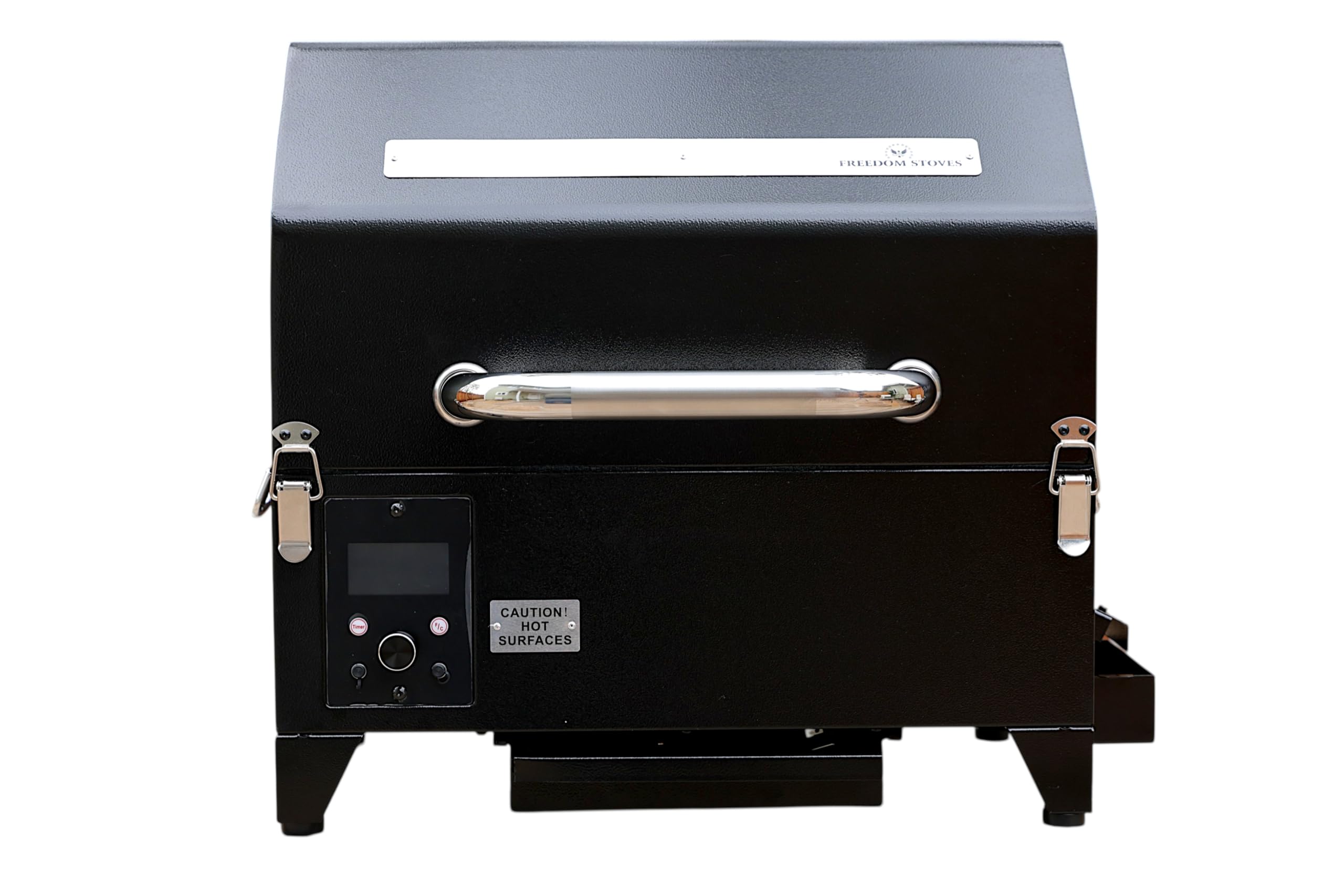
Some grills are about features. This one is about freedom — literally. The biggest advantage here is the dual-power reality: you can run it from a wall outlet or from a vehicle-style power setup. For certain campers, that’s the entire decision. When power is uncertain, a cooker that’s designed with vehicle travel in mind can eliminate a huge category of stress.
Owners often talk about “even heat across the grill surface,” quiet operation compared to other pellet grills, and an overall sturdy feel. That’s the exact trio you want in a camping cooker. Even heat means fewer hot-spot surprises. Quiet operation matters more than people think — it keeps the campsite vibe calm instead of sounding like a machine is fighting for its life. And sturdy matters because travel gear gets bumped, slid, and loaded in a hurry.
I also love the dual probe setup for camping. It’s not flashy — it’s practical. Two probes means you can cook two proteins with different targets (chicken thighs and sausages, salmon and a pork loin, etc.) or you can double-check a thick cut from two angles without opening the lid and dumping heat. That “don’t open the lid” discipline is one of the fastest ways to level up your outdoor cooking results.
A note from a “real camp” perspective: display brightness matters in sun and in twilight. Some users wish the display were brighter. That’s not a dealbreaker — it’s just a reminder to think about how you actually cook at camp: glare, headlamps, and quick glances. If you want maximum readability, plan your grill placement so the screen isn’t facing direct sun.
Why campers like it
- Dual power options – A massive advantage for road trips, overlanding, and camps with unreliable hookups.
- Even cooking behavior – People often describe consistent heat across the surface, which makes food timing easier.
- Dual probes – Lets you cook smarter, not harder (and keeps you from constantly opening the lid).
- Quiet run – Underrated “quality of life” feature in a campsite environment.
Good to know
- As with any pellet cooker, pellets must stay dry — travel with sealed storage if you want consistent feeding.
- Screen visibility can depend on sun angle; smart placement helps more than people expect.
- Compact footprint means you’ll do your best work with good sequencing (protein first, sides after).
Ideal for: campers who prioritize power flexibility and want a travel-focused pellet cooker that behaves predictably without feeling delicate.
6. Traeger Tailgater 20 – When You Want “Real Grill” Capacity in a Travel Form

The Tailgater 20 is for a very specific camper: the one who refuses to cook in tiny batches. If you routinely camp with friends, family, or a “food crew,” a tabletop unit can start to feel like you’re running a restaurant. The Tailgater solves that by giving you more cooking area and a more natural work height — without jumping to a full backyard monster.
When it’s working properly, owners love the basic experience: it holds heat well, it’s easy to use once assembled, and it delivers the classic pellet-grill benefit — steady heat and wood flavor without constant fire management. That’s the dream at a tailgate or at a lake campsite when people are snacking all day.
Now the honest side: portable grills with folding legs sometimes require a two-person mindset. Some users mention it’s easier with help when folding/unfolding, and that’s not shocking — you’re dealing with weight and moving parts. If you camp solo a lot, a tabletop unit might be emotionally easier to handle. If you camp with others, the Tailgater’s capacity payoff is worth it.
One more reality that matters: electronics are the “modern grill tax.” Any pellet grill can have the occasional dud control board or sensor issue. A few owners report frustrations when a unit doesn’t power on or throws errors. The way to protect your trip is simple: do a full test cook at home well before departure. Don’t wait until you’re hungry at camp to discover a problem.
Why it shines for groups
- Capacity upgrade – More cooking area means fewer batches and less standing over the grill all evening.
- Tailgate-friendly footprint – Foldable-leg design helps it travel more easily than full backyard units.
- Classic pellet versatility – Grill, smoke, roast, bake-style cooks — it covers the real camping menu well.
- Good “set and serve” energy – Great when people eat in waves and you don’t want to micromanage heat.
Good to know
- Leg folding/unfolding can be easier with two people — plan accordingly if you camp solo.
- Test at home first. If anything is going to be quirky, you want to discover it in your driveway, not on a trip.
- Pellet grills do best with good airflow planning — avoid wind blasting directly into vents at camp.
Ideal for: families and tailgaters who want a travel-friendly pellet grill that cooks like a “real grill,” not a tiny appetizer station.
7. Z GRILLS 450E – Big Cooking Area with a “Don’t Overthink It” Controller Style

The Z GRILLS 450E sits in a sweet spot for a certain type of buyer: you want a “real” pellet grill for home, but you also want something you can bring along for longer trips if you have the vehicle space. This is not a tiny tabletop unit — it’s a bigger cooking platform that makes sense when you cook for families, friends, and hungry campers.
The appeal is straightforward: a modern controller approach, a roomy cooking surface, and enough quality-of-life features (like probes and easy monitoring) to keep cooks predictable. When you’re camping, predictability is everything — especially when you’re running sides, managing kids, or timing meals around daylight. A larger grill also gives you something that small units can’t: true multi-zone staging. You can keep finished food warm on one side while you finish the next batch.
The reality check with most pellet grills in this style is searing. Many can hit grilling temps, but pellet grills often behave like convection ovens — great for even cooking, less ideal for a screaming-hot steakhouse crust. The best workaround is also the simplest: pack a small cast iron pan or griddle plate and use it as your “sear engine.” You’ll be amazed how much that upgrades your results.
Camping practicality: if you travel with this type of grill, think through loading and unloading. Bigger grills are “portable” in the sense that they move on wheels, but they still require planning and space. If you have a truck or trailer, it’s easy. If you have a small SUV packed tight, a tabletop unit may make more sense.
Why it’s a strong crossover pick
- More room for real meals – Great for ribs, chicken, burgers, and sides without constant batch cooking.
- Controller confidence – The goal is steadier temps with less babysitting.
- Probe monitoring – Helps you time meals well (especially thick cuts at camp).
- Works as a main grill at home – A practical “one grill for home + trips” strategy if you have space.
Good to know
- Not the best match for ultra-minimalists — it’s bigger and wants vehicle space.
- Plan your searing strategy (cast iron or griddle) if steak crust is important to you.
- Like any pellet grill, consistent pellets + basic cleaning habits make everything feel smoother.
Ideal for: campers who cook for groups and also want a primary pellet grill at home — especially if you travel with a truck, trailer, or roomy setup.
8. KingChii Foldable-Leg Pellet Grill – A Spacious Cooker That’s Still Travel-Minded

The KingChii is one of those grills that appeals to a very common buyer: you want enough space to cook like you mean it, but you don’t want a complicated, fragile-feeling setup that scares you off from using it. The foldable legs and wheel setup aim at exactly that: capacity without turning into a backyard-only beast.
In real-world feedback, people often describe it as a strong “beginner pellet grill” — and that’s a compliment. Beginner-friendly doesn’t mean basic food. It means the workflow is understandable: startup, set temp, cook, shutdown, clean. That matters at camp because you’re already juggling a lot. A grill that demands constant fiddling is the last thing you need.
Now for the important nuance: large grills in this class can vary in how confidently they handle very large, long cooks. Some users note that big roasts can test temperature regulation, and that’s not surprising in the portable-ish pellet category. Wind, cold, and repeated lid opening exaggerate any weaknesses. If you want to love this grill at camp, cook smarter: keep the lid closed, use a probe, and think “steady heat” rather than constantly adjusting.
Here’s an expert move that makes this style of grill feel premium: bring a small, accurate instant-read thermometer as a backup and use it to verify doneness near the end. Pellet grills are excellent at holding a steady environment, but the last 10% of cooking is where you want certainty. When you nail that, your results feel like you’ve been doing this for years.
Why campers choose it
- More cooking space – Great when you’re feeding families and don’t want endless batches.
- Foldable travel mindset – Designed to store and move more easily than full backyard units.
- Beginner-friendly workflow – Owners often describe it as easy to use once you learn startup.
- Great for everyday grilling + smoking – A good “one grill” approach if you cook often.
Good to know
- Long cooks are where technique matters most: minimize lid opening and use probes to keep things predictable.
- If you’re a steak-sear purist, plan a cast-iron finish approach since pellet grills in this class aren’t built for extreme sear.
- Always do a full home test before a trip — it’s the easiest way to avoid learning under pressure.
Ideal for: campers who want generous cooking space in a travel-aware design, and who like the idea of a pellet grill that feels approachable rather than technical.
9. Cuisinart CPG-256 – Compact Pellet Cooking with a Legit Sear-Zone Personality

This Cuisinart is a strong example of why camping grill shopping can’t be reduced to specs. On paper, it’s an “8-in-1 portable pellet grill.” In real life, its personality is more specific: it’s a compact unit that can put down serious smoke flavor and give you a meaningful sear when you use it correctly. That’s exactly what many camp cooks want — not a giant smoker, not a tiny toy, but a “does it all well enough” unit.
Owners who love it often compare its feel and food results to more expensive brands — especially in terms of how it cooks. Pulled pork is one of the most revealing tests because it exposes temperature stability over long time. Many users report strong end results, even if the grill’s displayed temperature can swing. That’s an important nuance: the display may not always reflect what’s happening at grate level, especially at lower settings. Experienced cooks solve this the right way: they use a separate grate thermometer or a trusted probe to confirm the real cooking zone.
The camping trade-off is hopper behavior. Compact units often have smaller hoppers, which means you may need to top up during long smokes. That’s not a dealbreaker if your camping style is “hang at the site, relax, add pellets when you check the food.” But if your style is “set it and go hiking for half a day,” you’ll prefer a design that runs longer without refilling.
Here’s the expert move for this grill: treat it like a compact pit with a sear finish. Smoke/roast your protein until it’s close, then use the sear zone for fast crust. That technique helps you get the best of both worlds without fighting the physics of compact pellet cooking.
Why it’s a smart camping pick
- Compact “do it all” footprint – A great size for RV bays and tailgate tables.
- Sear zone capability – Can actually finish meat with satisfying crust when preheated properly.
- Strong smoke flavor output – Owners often note it produces a good amount of smoke for its size.
- Probe included – Helps you time doneness with less lid-lifting.
Good to know
- Some users report temperature readout quirks, especially on low settings — use a trusted probe for confidence.
- Long smokes may require pellet top-ups depending on your temperature choice and conditions.
- Like all compact grills, it rewards “lid discipline” — opening frequently slows cooks and exaggerates swings.
Ideal for: campers who want a compact pellet grill with a real searing finish option — and who don’t mind using a probe to cook like a confident pro.
10. Z GRILLS 2026 200A – Surprisingly “Set-It-and-Sleep” Friendly for a Tabletop

If you want a compact pellet grill that feels “grown-up” in temperature control, this is where Z GRILLS tends to win people over. The reason is simple: when a controller holds steady, everything else gets easier — your timing, your texture, your confidence. And on camping trips, confidence is half the experience.
Real owners often describe long cooks where the pit temperature stays impressively close to target — especially once the grill has stabilized. That’s a big deal. The “stabilize” phase is where some pellet grills feel chaotic: overshoot, undershoot, bounce around. A steady-running tabletop makes camping feel luxurious because you can stop hovering. You can hang out by the fire. You can put the kids to bed. You can actually enjoy the trip.
Two practical details from real use matter a lot: First, cleaning access. When a grill is designed so you can remove grates and trays without a fight, you’re more likely to clean it after each trip. Second, probe management. Built-in probes and a clear screen reduce your need to open the lid — which keeps temps steady and smoke in.
If you’re choosing between this and a more “premium brand name” tabletop, here’s the real question: do you want a luxury finish and ecosystem, or do you want a steady cook platform that just does the job and does it well? A lot of campers choose the second — and then wonder why they ever overcomplicated it.
Why it earns loyal fans
- Confidence-building temperature control – Stable heat is the core reason people love pellet cooking.
- Compact and travel-friendly – Fits RVs and small setups without feeling underpowered.
- Probe support – Helps you stop guessing and cook based on real internal temps.
- Practical maintenance rhythm – When cleanup is manageable, you keep using it instead of dreading it.
Good to know
- Give it time to stabilize before judging temperature behavior — most pellet grills settle into their groove after the warm-up phase.
- As with many tabletop units, pellet changes are easiest when you plan your cooks (finish one pellet flavor before switching).
- Wind can exaggerate temperature behavior — shield your grill and you’ll cook happier.
Ideal for: campers who want a compact tabletop pellet grill that feels steady and dependable — the kind of unit that turns “smoke a brisket at camp” into a realistic plan.
11. Z GRILLS ZPG-200APro – Great Food, With a Few “Portable Pellet Reality” Quirks
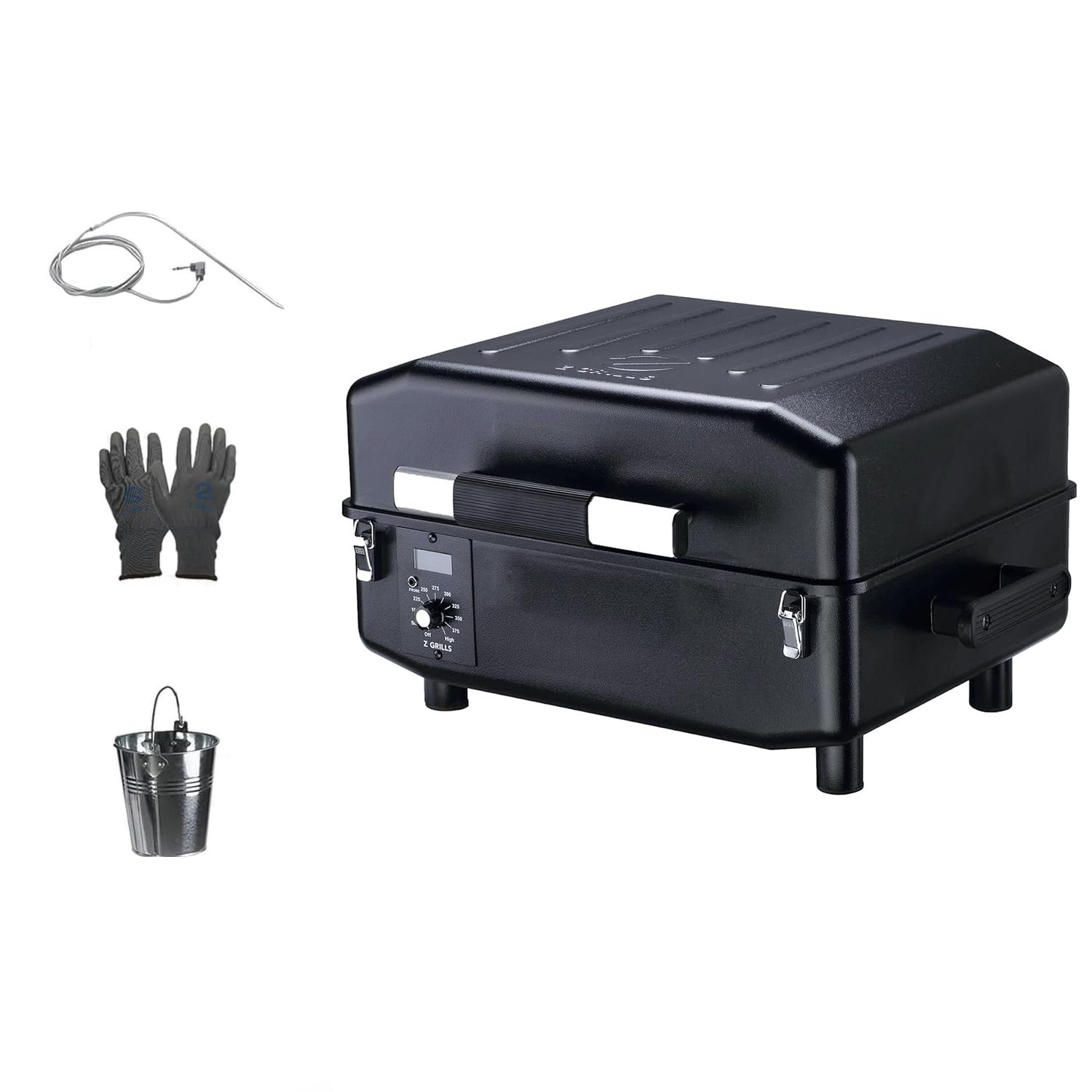
This is a classic “it cooks better than you expect” tabletop pellet grill — and that’s why so many RVers keep it. People smoke brisket, turkey, ham, jerky, burgers, and steaks on it and come away impressed with the core promise: set the temperature, get tasty results, don’t babysit a fire.
But the reason I placed it here (instead of at the top) is honesty: portable pellet grills can have quirks, and this model surfaces a few common ones. The big one is ash cleanup access. Some owners note that the burn cup area requires more disassembly than they’d love — and that’s a real camping annoyance. At home, you tolerate it. At camp, you feel it.
There’s also the pellet-change reality. With many small pellet grills, you don’t easily “purge” pellets on demand. If you switch from hickory to apple frequently, it can be a bit of a hassle. The smartest way to use a grill like this is to commit to a pellet flavor for a trip: bring one primary pellet type and cook everything with it. You’ll reduce fuss, reduce mess, and you’ll enjoy your time more.
Despite those quirks, the core cooking experience is strong. Owners often highlight good smoke output and solid heat performance. And the best thing you can do to make it even easier: line your drip/deflector surfaces with foil, vacuum ash regularly, and store the unit somewhere dry. Those habits turn a “quirky but good” portable pellet grill into a dependable travel tool.
Why it’s worth considering
- Delivers legit smoke flavor – People consistently report tasty results across many foods.
- Solid performance for the size – Heats up, stabilizes, and cooks predictably when maintained.
- Good high-heat capability – Enough heat for satisfying burgers and steak finishing techniques.
- Great for RV and small outdoor kitchens – Compact footprint with real cooking power.
Good to know
- Ash cleanup can require removing greasy components — plan to vacuum while the grill is cool and relatively clean.
- Pellet switching isn’t instant; it’s easier to “pick a pellet and commit” for a trip.
- Be gentle with harsh cleaners on painted surfaces — portable grills live a harder life and need sensible maintenance.
Ideal for: RVers and campers who want great-tasting pellet food and don’t mind a straightforward maintenance routine to keep it running happy.
12. Ninja Woodfire (OG701) – Fast, Flavorful Outdoor Cooking for Small Crews

The OG701 is the “smaller sibling” concept: it’s built for people who want smoky outdoor flavor and multiple cooking modes without committing to a traditional fuel-burning pellet smoker. For camping, that makes it appealing in two situations: you camp with hookups, or you want a patio/deck grill that can also travel.
Owners often rave about how easy it is to use and how quickly it produces satisfying results. That matters at camp because the best meal is often the one that happens before everyone gets too hungry. Another interesting theme is cook times: multiple users say the included guide can run long, and real cooking finishes faster. That’s normal when you shift from “ideal test conditions” to real food thickness and real heat behavior. The fix is simple: cook by internal temperature, not by the clock.
What makes this unit particularly fun for camping is the “smoke + crisp” combo. You can smoke wings or chicken, then switch to a crisping mode to finish texture. That’s a trick that’s harder to do on many pellet grills without extra gear. And if you’re cooking outdoors in warm months, keeping that entire process outside keeps your indoor space cooler and less smoky.
The important reality: like the OG850, this is not a full-size stick-burner substitute. It’s a controlled, convenient woodfire flavor system. If you accept it for what it is, it becomes incredibly lovable: fast, flexible, easy, and surprisingly rewarding for the effort.
Why campers enjoy it
- Fast and beginner-friendly – Great for quick camping meals without complex fire management.
- Multi-function cooking – Grill + smoke + crisp-style finishing in one compact unit.
- Small footprint – Easy to store and fits well in small outdoor spaces or travel setups.
- Real smoky boost – Adds wood flavor without requiring fuel-pellet logistics.
Good to know
- Cook by internal temperature rather than trusting generic time charts — you’ll get more consistent results.
- Pellets used for flavor still need to stay dry; store them sealed for consistent smoke output.
- This style is about convenience and control, not “heavy smoke for hours.”
Ideal for: campers who want a compact plug-in outdoor cooker with real smoky flavor and fast results — especially great for couples, small families, and patio campers.
13. Onlyfire GS314 – Two-Tier Cooking in a Compact Pellet Smoker Format

The Onlyfire GS314 is a smart pick for a very specific person: you like the tabletop pellet grill format, but you keep running out of room. The two-tier setup solves that in a practical way — you can stage food, keep items warm, and cook more efficiently without upsizing your footprint. For camping, footprint matters because storage is always the bottleneck.
Owners frequently describe it as heavy-duty and well-made (with the expected caveat that “portable” doesn’t always mean “light”). Some people choose to place it on a cart rather than lifting it often, which is a great camping move: you reduce strain and make setup faster. If you’re camping from an RV or trailer, a small rolling cart can turn any tabletop grill into a much more enjoyable experience.
Temperature behavior on portable pellet grills is always influenced by the environment. Users often mention normal swings, especially in wind, and that’s true across the category. The best way to make this grill feel premium is to use it like a pro: preheat properly, avoid repeated lid opening, and treat the built-in probe as your “doneness coach” instead of guessing.
One practical note: shipping happens. A few owners mention dents or box damage on arrival but still report that the unit runs fine. If you buy a tabletop pellet grill for travel, inspect it early. Open the lid, make sure hinges move smoothly, and run a quick test cycle before your first trip. That one habit prevents “first cook disappointment.”
Why it’s useful at camp
- Two-tier cooking – More practical space without stepping up to a bigger, harder-to-store unit.
- Built-in probe – Helps you stay confident and reduces lid opening.
- Good tabletop footprint – Fits RV and tailgate setups while still feeding a small crew.
- Solid feel – Many users describe it as sturdy and “built to cook.”
Good to know
- It’s not ultralight; consider a cart strategy if you move it often.
- Wind affects all compact grills — shield it and you’ll see better stability.
- Inspect early after delivery so your first trip isn’t your first test.
Ideal for: campers who want the convenience of a tabletop pellet grill but need more usable cooking space for real meals.
14. Oklahoma Joe’s Rambler – For Campers Who Want Real Coals (and No Power Worries)
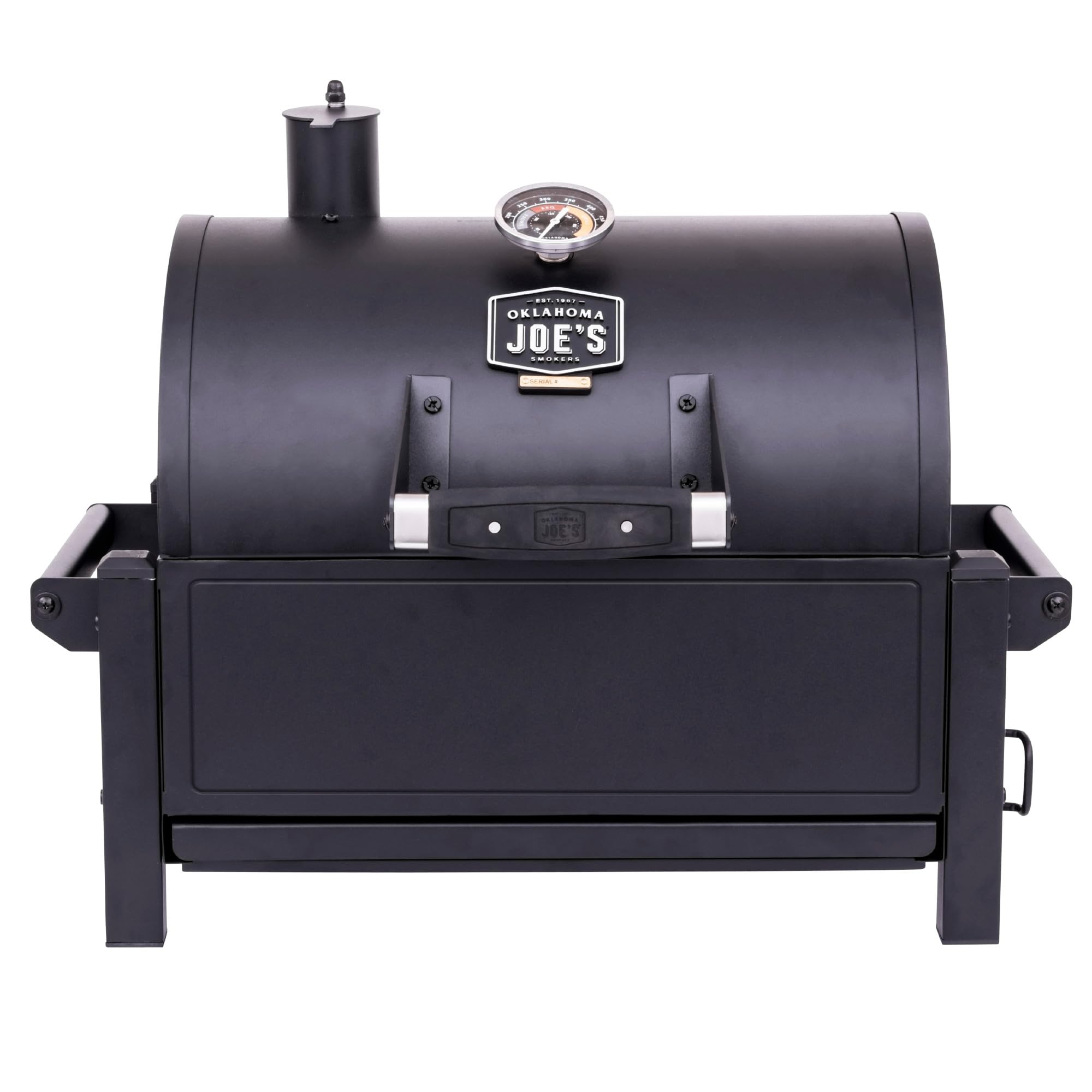
I’m including the Rambler for one reason: some camping situations make electric-powered pellet cooking annoying. Maybe you’re deep off-grid. Maybe your power plan is uncertain. Maybe you just want the simplicity of real coals and the satisfaction of manual control. In those moments, a compact charcoal grill that’s built well can be the best “portable grilling decision” you make.
This grill has the kind of design that makes experienced grillers smile: heavy-duty build, cast iron grates, and an adjustable charcoal tray that gives you real heat control. That adjustable tray is the secret sauce — it lets you move from searing heat to calmer cooking without doing a full coal rearrangement every time. For campers, that means better steak, better chops, better burgers, and less drama.
Where it gets interesting is smoking. With smart vent control and a two-zone setup (coals on one side, meat on the other), you can absolutely do slow, smoky cooks for smaller cuts. Many experienced users treat it like a “mini smoker” when sealed and dialed in. It’s not a pellet “set and forget” experience — it’s hands-on. But it’s deeply satisfying if you enjoy the process.
The biggest downside for travel is weight. This thing is built like a tank — which is why it holds heat so well and cooks so efficiently — but you’ll feel it when you move it. If you’re camping from a vehicle, that’s fine. If you’re hiking gear in, it’s not the right tool.
Why it belongs in this guide
- No electricity required – The ultimate off-grid cooking option.
- Real searing power – Cast iron grates + coal control deliver the crust pellet grills often struggle to match.
- Adjustable charcoal tray – Makes temperature control far more precise than typical small charcoal grills.
- Can double as a “mini smoker” – With the right setup, it can slow-cook and smoke smaller cuts beautifully.
Good to know
- Heavier than many “portable” charcoal grills — excellent performance, but plan your carrying strategy.
- Charcoal is more hands-on than pellets: you trade convenience for control and fire flavor.
- To smoke well, you’ll want to learn vent control and heat-zone setup (worth it if you enjoy the craft).
Ideal for: off-grid campers who want a no-power grill that can sear like a champion and still handle low-and-slow cooking in small batches.
Camp Reality: Power, Pellets, Wind, and How to Cook Smarter Outdoors
When people say “pellet grills are easy,” they’re usually describing backyard conditions: stable power, stable surfaces, mild weather, and a full cleaning setup. Camping is different — but the good news is, once you understand the real variables, pellet cooking becomes just as reliable at camp as it is at home.
Power: what to plan so your cook doesn’t get derailed
- Know your power source – Hookups are simplest. Off-grid requires a serious plan (dual-power grills, inverters, or generators).
- Expect higher draw at startup – Ignition cycles can pull more power than steady running. Give your setup margin.
- Use a real extension cord – Outdoors + heat appliances demand a good cord. Thin cords can cause voltage drop and weird behavior.
- Keep the plug connection protected – Dew and light rain happen. Keep connections off the ground and under cover when possible.
If you camp off-grid often, this is why dual-power designs (and travel-minded pellet cookers) are so valuable: they remove “power anxiety” from your trip.
Pellets: your smoke flavor (and your most common failure point)
- Keep pellets dry – Moist pellets swell, crumble, and feed inconsistently. Store them sealed.
- Pick one pellet flavor per trip – Pellet changing is easiest when you plan ahead. Bring one primary pellet and commit.
- Use smoke time intentionally – Most smoke flavor is built at lower temps. Get your smoke early, then finish hotter for crust.
- Don’t expect heavy smoke at high heat – Pellet grills act more like ovens when grilling hot. That’s normal.
Campers who “hate pellet grills” often had one bad pellet experience — usually humidity. Solve pellet storage and you solve most frustration.
Wind and cold: the invisible opponents
- Shield the grill – Put it behind your vehicle or a windbreak if the wind is aggressive.
- Preheat longer – Cold metal takes time. Give the grill a proper warm-up and your temps will stabilize sooner.
- Keep the lid closed – Every lid opening is a reset. Use probes and trust your process.
- Cook to temperature, not time – Weather changes timing. Internal temperature never lies.
A surprisingly effective camp move: place your grill so wind isn’t blowing directly into vents or seams. Small changes in positioning can improve stability dramatically.
Searing on a pellet grill: the simple pro method
- Reverse sear – Cook low until almost done, then finish hot for crust.
- Pack a cast iron pan – A pan turns “okay sear” into “wow sear” on almost any grill.
- Dry the surface – Pat steaks dry before searing. Moisture is the enemy of crust.
- Use the grill’s strengths – Pellet grills excel at even cooking. Let them do that job, then sear at the end.
If you apply this method, you stop fighting the physics and start getting consistently impressive food — even in a campsite parking pad.
FAQ: Portable Pellet Grilling for Camping (The Stuff People Actually Ask)
Do pellet grills make sense for camping, or is charcoal still better?
Can I run a pellet grill off a car battery?
How do I keep pellets from getting ruined at camp?
Why does my pellet grill have less smoke flavor when grilling hot?
What’s the easiest way to get a great sear while camping?
What should I pack with my portable grill to make camp cooking easier?
How do I avoid messy cleanup at camp?
Final Thoughts: Pick a Camping Pellet Grill That Matches How You Actually Travel
The right grill doesn’t just improve your meals — it improves your trip. When you choose well, dinner stops being a “project” and becomes a moment you look forward to.
Here’s the simplest way to turn this guide into a confident purchase:
- Want the best overall “camp-friendly” pellet experience (smoke + real sear potential)? Start with the Pit Boss PB150PPG. It’s compact, travel-minded, and it doesn’t force you to accept “no crust” cooking.
- Want maximum versatility with minimal pellet hauling (great for hookups and patios)? Choose the Ninja Woodfire Pro XL (OG850) for the “outdoor kitchen in one box” experience.
- Want a premium tabletop with a griddle for breakfasts and high-control cooking? The Traeger Ranger is the steady, satisfying option for RV travelers who cook often.
- Need off-grid flexibility and like the idea of app monitoring? Look at the GMG Trek Prime 2.0 for travel-first pellet cooking with monitoring control.
- Want a dual-power travel tool that’s built around “bring it anywhere” practicality? The Freedom Stoves Portable Pellet Grill is a smart match for road trips and vehicle-based camping.
- Camping with a bigger group and want more cooking space in a travel format? Pick the Traeger Tailgater 20 or the Z GRILLS 450E if you have the space to travel with a larger grill.
- Want compact pellet cooking with a sear-zone personality? The Cuisinart CPG-256 is a great “small footprint, real results” option when you cook with a probe mindset.
- Want compact PID-style stability in tabletop form? Consider the Z GRILLS 2026 200A or the Z GRILLS ZPG-200APro for steady tabletop smoking.
- Want a smaller plug-in woodfire cooker for quick camping meals? The Ninja Woodfire OG701 is a fun, fast solution for small crews.
- Need a two-tier tabletop layout without upsizing your footprint? Try the Onlyfire GS314.
- Camping off-grid and want a no-power backup with real searing capability? Go charcoal with the Oklahoma Joe’s Rambler.
At the end of the day, the best camping pellet grill isn’t the one with the most buzzwords — it’s the one that fits your power plan, packs cleanly, cooks predictably, and makes you excited to cook outdoors again tomorrow. Pick the model that matches how you actually travel, and you’ll stop shopping… and start eating very, very well.
