
Let’s be honest: most “mixer guides” are just a wattage parade. They list bowl sizes, copy the product bullet points, and call it a day. That’s not how you end up with dough that feels silky, elastic, and alive—especially if you bake often.
If you’re shopping for a bread mixer machine, you’re not just buying a countertop appliance. You’re buying fewer sore wrists, fewer failed loaves, and a faster path from “I hope this works” to “I can do this every week.” The problem is: two mixers can look similar on a listing and behave wildly differently once you load them with real dough. One will knead smoothly and stay steady. The other will thump, warm the dough too fast, smear ingredients up the sides, and make you babysit it like a toddler near a puddle.
This guide is built around the stuff that actually decides whether you love your mixer after month three: how it handles sticky hydration without climbing the hook, how quickly it warms dough (yes, that matters), whether it “puzzles” flour into the bottom or leaves a dry ring you have to scrape, how easy the bowl is to clean when you’re tired, and what owners consistently praise—or complain about—after dozens of bakes.
I pulled together the most helpful patterns I could find across manuals, product specs, and real-world owner feedback, then organized these picks the way people actually shop: start with the “lifetime” choices, move into smart mid-range options, and finish with smaller, simpler machines that still get the job done if you bake in a compact kitchen.
Below you’ll find 15 standout options—planetary stand mixers, dough-only knead-and-proof machines, and one “kitchen machine” style system that tries to replace half your appliances.
In this article
How to Choose the Right Bread Mixer Machine (Without Getting Tricked)
The best mixer for bread isn’t the one with the flashiest feature list. It’s the one that develops gluten reliably, stays stable under load, and fits the way you actually bake. To make that decision crystal clear, I want you to think like a dough scientist for two minutes—then shop like a normal human again.
1. First, decide what kind of “bread person” you are
This matters more than brand names. Pick the pattern that sounds like your real life:
- The weekly loaf baker: You do one or two loaves at a time, and you want a mixer that’s easy, consistent, and not annoying to clean.
- The sourdough regular: You care about dough temperature, longer fermentation, and handling sticky, higher-hydration dough without fighting the machine.
- The batch baker: You do big dough days—multiple loaves, pizza parties, holidays, gifting—and you want a mixer that won’t feel stressed.
- The “I hate kneading” baker: You want a machine that mixes and proofs automatically so you can walk away.
- The small-kitchen baker: You need compact storage and lighter weight, even if that means smaller batches.
2. Know the three “real” metrics: torque, geometry, and heat
Here’s the part almost no guides explain. Bread dough is not cake batter. It fights back. So three things decide your experience:
- Torque (the “does it bog down?” factor): A mixer can be loud and fast yet still struggle when the dough tightens. Strong dough performance is about controlled power, not just top speed.
- Geometry (the “does it actually knead?” factor): Bowl shape, hook shape, and how the dough travels around the bowl matters. Some machines knead evenly. Some just spin the dough like a lazy carousel.
- Heat (the “did it over-ferment?” factor): Kneading warms dough. Some machines warm it a lot. That can be a perk for quick yeasted dough—but it can also push sourdough faster than you wanted.
If you remember nothing else: when people say a mixer is a “workhorse,” they’re almost always praising torque + geometry. When people complain about dough “getting weird,” they’re often talking about heat.
3. Choose a mixer style that matches your priorities
Most machines in this list fall into one of three categories:
- Planetary stand mixers (classic style): The attachment spins while orbiting the bowl. Great for versatility—cookies, cakes, whipped cream, and bread—especially in small to medium batches.
- Bottom-drive “kitchen machines” and heavy-duty systems: These are designed to handle larger loads with a different power delivery style. They often excel at big dough days and can feel less fragile under strain.
- Dough-only knead-and-proof machines: These mimic intermittent hand kneading, then hold dough at a controlled temperature for fermentation. They’re not usually for creaming butter or whipping meringue—but for bread, they can be a joy.
4. Don’t get fooled by “bowl size” alone
Big bowls are fantastic—until you’re mixing a smaller batch and the hook can’t “catch” the dough properly. On the flip side, small bowls are cozy—until you overflow. The best setup is the one that matches your common batch size.
- If you mostly bake 1 loaf at a time: mid-size bowls and good hook geometry matter more than ultra-large capacity.
- If you bake 2–4 loaves at a time: capacity and torque matter, but so does stability (a walking mixer is miserable).
- If you bake huge batches: look for a system that owners consistently use for multi-loaf dough days without overheating.
5. Look for “friction reducers” that make you bake more often
The secret to becoming a consistent baker is removing friction. Features that sound small often matter the most:
- Stable base: suction feet or real weight so it doesn’t “walk.”
- Easy scrape behavior: flex-edge beaters or bowl designs that don’t leave a stubborn flour ring.
- Thoughtful lid/splash control: especially for dough makers and high-hydration mixing.
- Simple cleaning: if cleanup is annoying, you bake less. Period.
- Clear speed guidance: especially for bread—some mixers are designed to knead at a specific speed for longevity.
6. My “buy once” decision shortcut
If you want a shortcut that still leads to a good decision:
- Pick your category: versatile stand mixer vs. dedicated dough maker vs. heavy-duty system.
- Pick your batch size: what you bake most weeks, not your dream “someday.”
- Pick your tolerance for babysitting: some machines are set-and-forget; others want you to stop and scrape.
- Pick your future: do you want attachments like pasta makers and grinders, or do you want pure bread performance?
Now let’s get practical: here are the 15 models worth your attention and exactly what each does well.
Quick Comparison: 15 Bread Mixer Machine Picks (Organized by Real-World Needs)
Use this table to shortlist fast. Then jump to the full reviews—because the “feel” details (dough travel, stability, cleanup, and heat behavior) are where the right decision lives.
On smaller screens, swipe or scroll sideways to see the full table.
| Model | Machine type | Bread strength | Best match | Amazon |
|---|---|---|---|---|
| KitchenAid Classic Series 4.5 Qt (K45SS) | Planetary stand mixer | Reliable for weekly loaves + huge attachment ecosystem | Most home bakers who want a trusted “do-everything” mixer | Amazon |
| Bosch Universal Plus + NutriMill Extender Bundle | Bottom-drive system | Big batch dough power + proven longevity + high torque feel | Serious bread bakers and “multi-loaf day” households | Amazon |
| 8.45 QT All Metal Stand Mixer (Camic) | High-capacity stand mixer | Large bowl + sturdy body for big batches (with a few quirks) | Families who bake large batches and want modern controls | Amazon |
| VIVOHOME 6-in-1 Stand Mixer (8.5 Qt) | Kitchen machine | Mix + grind + blend + pasta: one base, many jobs | New kitchens or “replace multiple appliances” shoppers | Amazon |
| VIVOHOME Stand Mixer with Fermentation (6 Qt) | Smart stand mixer | Proofing mode + presets for less babysitting | Bakers who want dough + proof control without a separate proofer | Amazon |
| Joydeem Dough Maker JD-HMJ7L (7.4 Qt) | Dough + proof machine | Intermittent knead + controlled fermentation for repeatable results | Hands-off bread makers, sourdough routines, arthritis-friendly baking | Amazon |
| Dough Maker 7.4 Qt with Ferment (HaiiuzHi) | Dough + proof machine | Big capacity + simple set-and-go workflow | Weekly bread bakers who want a dedicated dough station | Amazon |
| YUCHANLUCK 7L Dough Mixer (Black) | Dough + proof machine | Large bowl + add-in window + fermentation mode | Busy bakers who want consistent dough with minimal effort | Amazon |
| YUCHANLUCK 7L Dough Mixer (Grey) | Dough + proof machine | Same workflow as the black version—alternate finish | Same buyers as above; pick the look you prefer | Amazon |
| CEBORY 3-in-1 Stand Mixer (6.5 Qt) | Value stand mixer | Strong everyday mixing + good bowl size + stable base | Home cooks who want bread capability without a premium brand price | Amazon |
| 800W Stand Mixer (EQTLVFH) 5.3 Qt | Compact power | Strong motor-to-size ratio for dough and batters | Smaller kitchens that still want real kneading power | Amazon |
| VIVOHOME Stand Mixer 6 Qt (10 Speed, Tilt-Head) | Value stand mixer | Solid basics + stable suction feet + simple controls | New bakers building a capable setup on a sensible budget | Amazon |
| Hamilton Beach 4 Qt Stand Mixer (7 Speed) | Compact classic | Surprisingly capable for basics, with an easy-carry handle | Occasional bread bakers and small-batch households | Amazon |
| Joydeem Dough Maker HMJ-A501 (5.3 Qt) | Compact dough maker | Hands-off knead + ferment in a smaller footprint | Single-loaf routines and joint-friendly pizza nights | Amazon |
| Kitchen in the box Mini Stand Mixer (3.2 Qt) | Tiny kitchen pick | Great for small mixes; limited for true bread batches | Couples, apartments, and “I bake small but often” kitchens | Amazon |
In‑Depth Reviews: 15 Bread Mixer Machine Options (What They’re Really Like to Own)
Now we go model by model. I’m not going to re-list the obvious bullet points you can read on a product page. Instead, I’ll focus on what changes the outcome of your dough and the feel of your baking routine: mixing behavior, stability, cleanup, noise, dough heat, and the quirks you should know before you commit.
1. KitchenAid Classic Series (K45SS) – The Trusted “Do Everything” Mixer That Still Makes Great Bread

If you want one mixer that covers almost everything in a home kitchen—bread, cookies, cake, whipped cream, shredded meat, and a long list of add-on attachments—the KitchenAid Classic is still the cleanest “buy once and stop thinking” answer for most people. It’s not a niche bread-only beast. It’s the dependable daily-driver that happens to make good dough when you treat it the way it was designed to be treated.
Here’s the “expert” part that saves you headaches: bread performance with this mixer is less about raw power and more about technique and restraint. KitchenAid’s guidance for yeast dough is famously conservative for a reason—kneading at the intended speed keeps the gearbox happy and the motor from heating up during longer kneads. In practice, owners who love their Classic long-term tend to follow a simple rhythm: mix until everything comes together, knead until it looks smooth, then stop. No “let’s run it forever and see what happens.” The result is dough that’s developed but not overheated, and a machine that lasts.
The biggest day-to-day joy is the workflow. Tilt-head access makes ingredient adds easy, and for non-bread tasks the Classic is genuinely excellent—especially for creaming, whipping, and general mixing. And if you’re the kind of cook who wants one motor base that can also power pasta rolling, grinding, shredding, and more, the KitchenAid ecosystem is a massive advantage that budget brands simply don’t match.
Why it’s “best overall”
- Reliable weekly bread performance when you keep batches reasonable and kneading time sensible.
- Versatility is unmatched – it’s a mixer today, a pasta station tomorrow, a grinder next month.
- Predictable mixing geometry – the planetary action is consistent and easy to learn.
- Long-term ownership culture – you’ll find a huge amount of community knowledge, tips, and accessory options.
Good to know
- It’s not the best choice for frequent huge dough batches or very dense, high-volume whole-grain routines.
- The bowl is sturdy, but some bakers wish it had a handle for easier pours and cleanups.
- For sticky dough, you may pause once to scrape the bowl—normal for many planetary mixers.
Ideal for: the majority of home bakers who want a proven, versatile mixer that can do bread well and everything else even better—without building a separate “bread-only” station.
2. Bosch Universal Plus – The Big‑Batch Workhorse That Turns Bread Day Into a Routine

There’s a specific moment in bread baking where a “normal” stand mixer starts to feel like it’s arguing with you: the dough tightens, the hook struggles to keep it moving, and the machine sounds strained. The Bosch Universal Plus is built for that moment. It’s designed to keep kneading when the dough is heavy, and to do it in larger quantities without you feeling like you’re abusing the motor.
The design is different from typical tilt-head mixers. This style of system is about efficient torque delivery and stable handling of larger dough volumes. Owners who bake regularly talk about it like a lifestyle upgrade: you stop doing “one loaf and a prayer,” and start doing “a batch for the week.” And it’s not only bread—people use it for large cookie batches, shredding, and other heavy kitchen tasks—but bread is where it earns its reputation.
Now the expert caveat that helps you master it: this machine can warm dough quickly during longer kneads. For some bakers, that’s a feature—warm dough moves faster. For sourdough bakers who want slower fermentation control, it’s something to manage with technique: cooler water, shorter knead windows, or a rest-based development approach. Once you learn that, the Bosch becomes incredibly consistent.
Why bread bakers love it
- Big-batch confidence – it’s built for multi-loaf routines and heavy dough days.
- Torque-forward feel – the machine is less likely to feel “stressed” when dough tightens.
- Stable base – suction feet and a workhorse reputation that many owners trust long-term.
- Cleaner big-batch workflow – designed for volume without flour storms and constant babysitting.
Good to know
- Dough warming can happen during longer kneads; adjust water temperature if you want slower fermentation.
- The learning curve is real—this isn’t a “first mixer” for everyone, but it becomes second nature quickly.
- It’s larger than typical mixers; plan a dedicated spot or a smart storage routine.
Ideal for: serious home bread bakers who do bigger batches, bake often, and want a system that feels built for dough rather than merely “capable of dough.”
3. Camic 8.45 QT All‑Metal Stand Mixer – High Capacity, Modern Controls, and “Real Weight” Stability
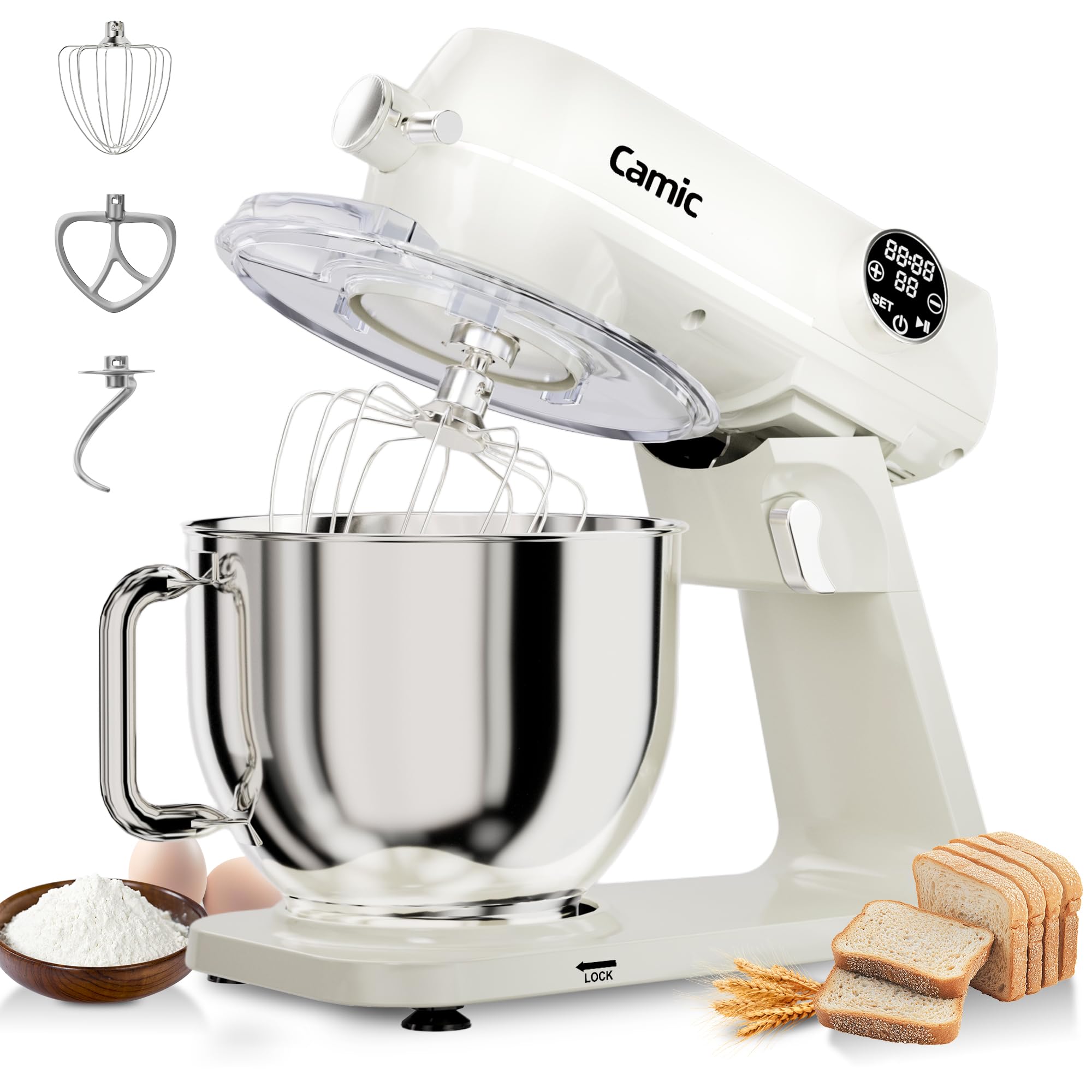
This is the kind of mixer that appeals to a very specific buyer: you want a big bowl, a machine that feels heavy and stable, and you like modern touches like a digital timer. If you bake for a family or you’re the friend who always shows up with bread, cookies, and “just one more batch,” a large-capacity all-metal build can feel like relief. It’s not just about volume—it’s about how calm your counter feels when dough gets thick.
In owner feedback, two themes show up consistently: stability and capacity. People like that it doesn’t feel like a toy, and that the suction and weight help keep it planted. They also like the included attachments and the ability to switch from gentle mixing to more aggressive kneading without drama. The digital timer seems “extra” until you’re juggling multiple things—then it becomes a quiet little advantage.
The important nuance is bowl geometry and real usable capacity. With very large bowls, some users notice the head and attachment depth affects how much you can comfortably fill without the mix area feeling crowded. That’s normal—big bowl does not mean “fill to the brim.” The winning move is to treat it like a high-capacity tool for comfortable big batches, not like a bucket you max out every time.
Why it’s compelling
- Large-batch comfort – big bowl and sturdy frame for family-size mixing sessions.
- Counter stability – weight + suction helps reduce “walking” under load.
- Timer-based control – useful for consistency and multitasking during bread and baking routines.
- Strong attachment set – covers bread dough, batter, and whipping without needing add-ons.
Good to know
- Big machines take space; it’s happiest with a semi-permanent spot on the counter.
- Some users note small fit/finish quirks (like display or accessory fit) that don’t stop performance but are worth knowing.
- Very large bowls can require occasional scraping for smaller batches—common in this capacity class.
Ideal for: bakers who want a large, stable stand mixer with modern controls, and who regularly mix bigger batches of dough or batter.
4. VIVOHOME 6‑in‑1 (8.5 Qt) – The “One Base, Many Tools” Setup for Busy Kitchens
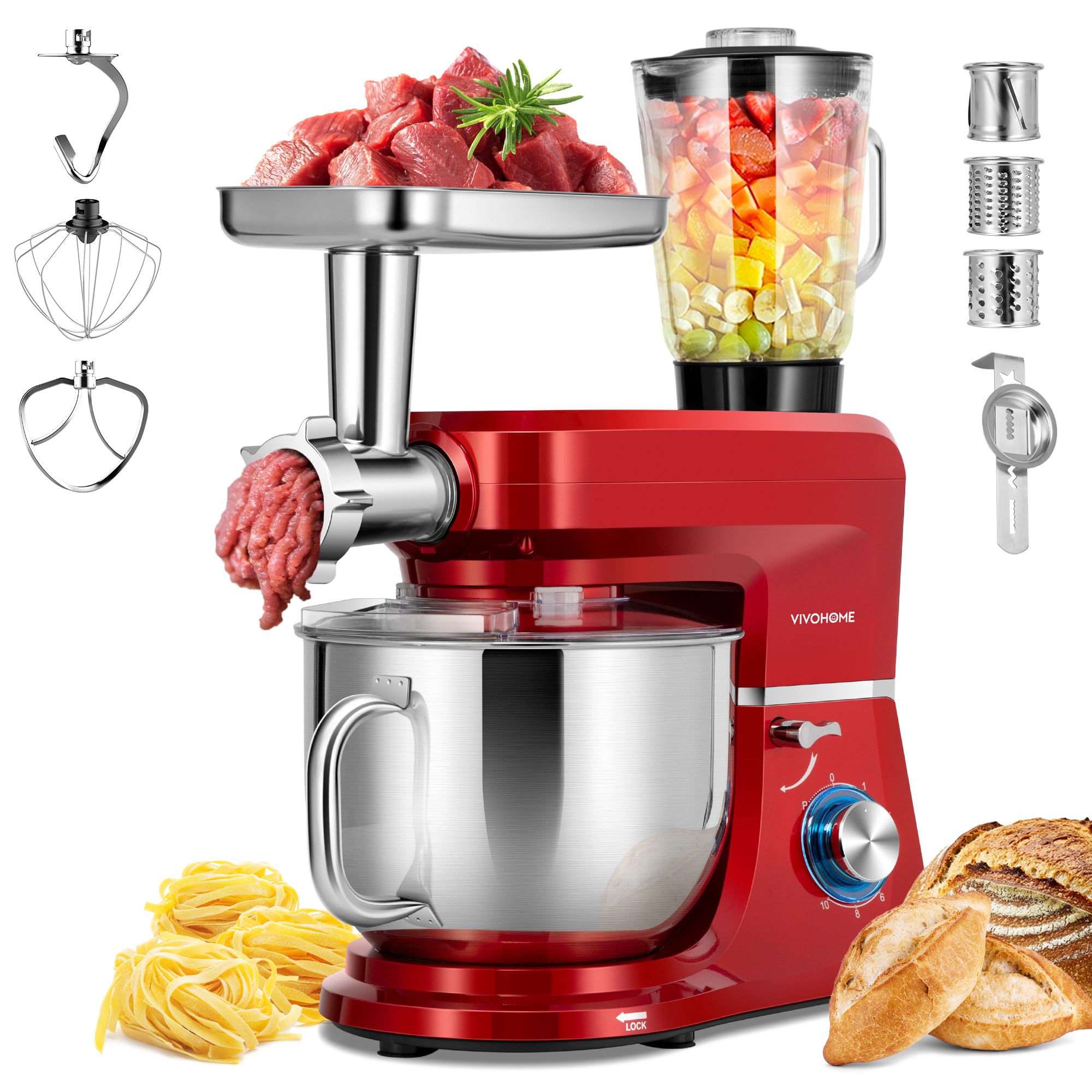
Some people don’t want “a stand mixer.” They want a kitchen command center. That’s what the 6‑in‑1 systems are trying to be: a mixer plus a meat grinder plus a blender plus slicers and pasta-making options—one motor base, multiple jobs. If you’re setting up a new kitchen or you’re trying to reduce appliance clutter, this style can be extremely attractive.
The real win here is not just versatility—it’s momentum. When one machine covers your bread dough, your meat prep, and your smoothie/juice needs, you actually use it more. And when you use a tool more, you get better at it. That leads to better bread, because you stop treating dough as a “special event” and start treating it as normal dinner planning.
The honest trade-off is that multi-tool systems often come with more cleanup and more “where do I store these parts?” thinking. Owners who love these systems usually have one habit: they set up a simple storage solution (a bin, a drawer, or one dedicated shelf) so the accessories don’t become a clutter tax. If you do that, the machine becomes a convenience engine instead of a cabinet nightmare.
Why it’s a smart kitchen buy
- Multi-appliance replacement – ideal for kitchens trying to consolidate tools.
- Large bowl capacity – comfortable for bigger dough and batter sessions.
- Flexible speed control – useful across bread, whipped tasks, and general mixing.
- High perceived value – many owners like that it “does a lot” without needing separate machines.
Good to know
- Accessory storage is the hidden cost—plan it, and you’ll love the system more.
- Some users note they still need to stop and scrape for certain batters; this is common in many stand mixers.
- If your only goal is elite bread performance, a bread-focused system may feel more “purpose-built.”
Ideal for: kitchens that want one core machine to cover multiple cooking tasks—especially if you like making bread and also want grinding/blending/pasta capabilities.
5. VIVOHOME Stand Mixer with Fermentation – Proofing Built In (So Bread Feels Easier)
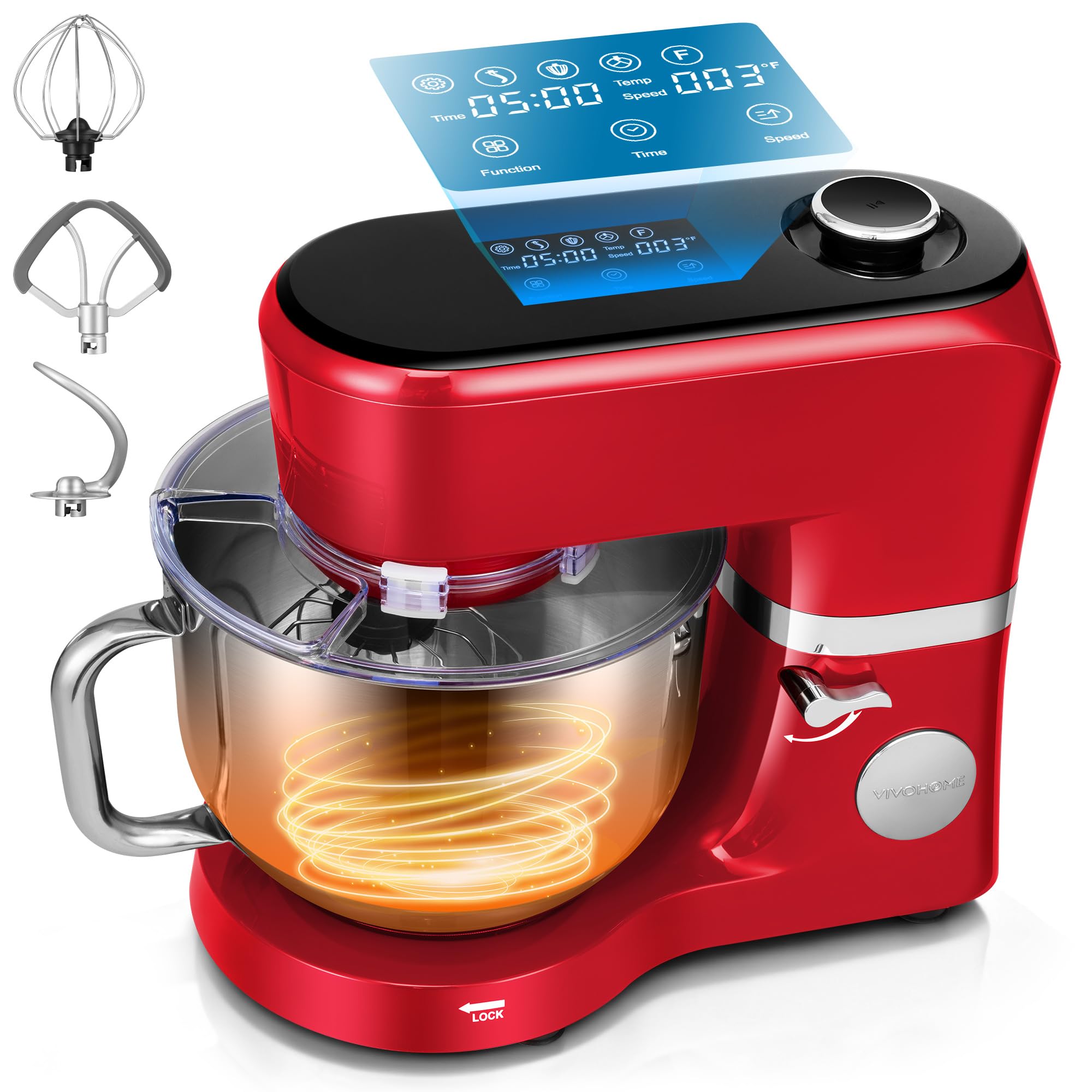
A lot of people don’t quit bread because kneading is hard. They quit bread because timing is annoying. They don’t want to find a warm spot. They don’t want to guess whether the kitchen is too cold. They don’t want to babysit a bowl for an hour while life happens. That’s why a stand mixer with a fermentation mode is such a big idea: it turns proofing into a button.
This model’s appeal is the workflow: you mix, you knead, and then you let the machine hold a controlled environment for rise—without transferring dough to another container. That reduces dishes and reduces the “did I cover it correctly?” micro-stress that makes new bakers feel clumsy. The one-touch presets are also a nice confidence boost for beginners, and a flex-edge beater can be a quiet hero for batters and general mixing because it reduces scrape stops.
Here’s the expert tip: treat fermentation modes as “controlled comfort,” not magic. You still want to watch your dough, not the clock. A warmer proof can speed up fermentation more than you expect—great for fast bread nights, but for sourdough you might shorten proof time or use cooler ingredients. Once you understand that, built-in proofing becomes one of the most motivating features a home baker can own.
Why it’s a bread routine booster
- Proofing built in – fewer containers, fewer steps, and easier scheduling.
- Preset workflows – helpful structure when you’re building confidence.
- Flex-edge scraping – reduces the stop-and-scrape cycle for many batters.
- Stability features – suction and safety design help keep the mixer planted.
Good to know
- Proofing warmth can speed fermentation; adjust time based on dough behavior, not just the timer.
- Some bowl designs can trap a bit of water during washing—dry thoroughly before using any heating/proofing function.
- It’s a great “bread helper,” but dough-only machines can feel even more hands-off for fermentation workflows.
Ideal for: bakers who want bread to feel simpler and more repeatable—especially if “proofing logistics” is the part that currently blocks you.
6. Joydeem JD‑HMJ7L (7.4 Qt) – The “Dough Machine” That Makes Bread Feel Automatic

If your goal is bread, not baking “in general,” a dedicated dough maker can be a cheat code. The Joydeem JD‑HMJ7L is designed to do two things exceptionally well: knead dough in a way that mimics hand development (often with intermittent motion), and then manage fermentation in a controlled environment. That’s why so many bread-focused owners talk about it like a breakthrough: it removes the most physical part of baking and makes the timing more predictable.
The unique strength of this style of machine is consistency. You load ingredients, pick your program or timing, and the machine cycles kneading in a way that’s less likely to overheat the dough compared with a continuous, aggressive knead. For pizza dough, sandwich loaves, rolls, and everyday bread, that consistency turns into confidence. You stop guessing and start repeating. It also shines for bakers with arthritis or anyone who wants to keep baking as they get older—because it removes the “my hands can’t do this” barrier.
The trade-off is versatility. This is not the machine you buy to cream butter and sugar, whip delicate meringues, or make glossy buttercream the way a classic stand mixer does. It’s a bread station. That’s the point. If bread is your priority and you want a calmer routine, this is one of the most satisfying categories you can buy into.
Why bread people get obsessed
- Intermittent kneading behavior that many bakers find closer to hand development.
- Controlled fermentation so you’re not hunting for a warm spot in winter.
- Large capacity for a home dough machine – comfortable for multi-loaf routines.
- Cleanup is straightforward because the bowl and mixing components are designed for dough workflow.
Good to know
- Not a full stand mixer replacement for cakes/whipping-heavy baking.
- Because it’s controlled by programs/timers, you’ll love it most after you learn your preferred timings.
- As with all proofing-assisted machines, watch the dough: warm fermentation can move faster than you expect.
Ideal for: bread-first households who want a hands-off knead + proof workflow and care more about consistent dough than multi-dessert versatility.
7. HaiiuzHi 7.4 Qt Dough Maker – Simple, Big Capacity, and Built Around Bread (Not Cake)
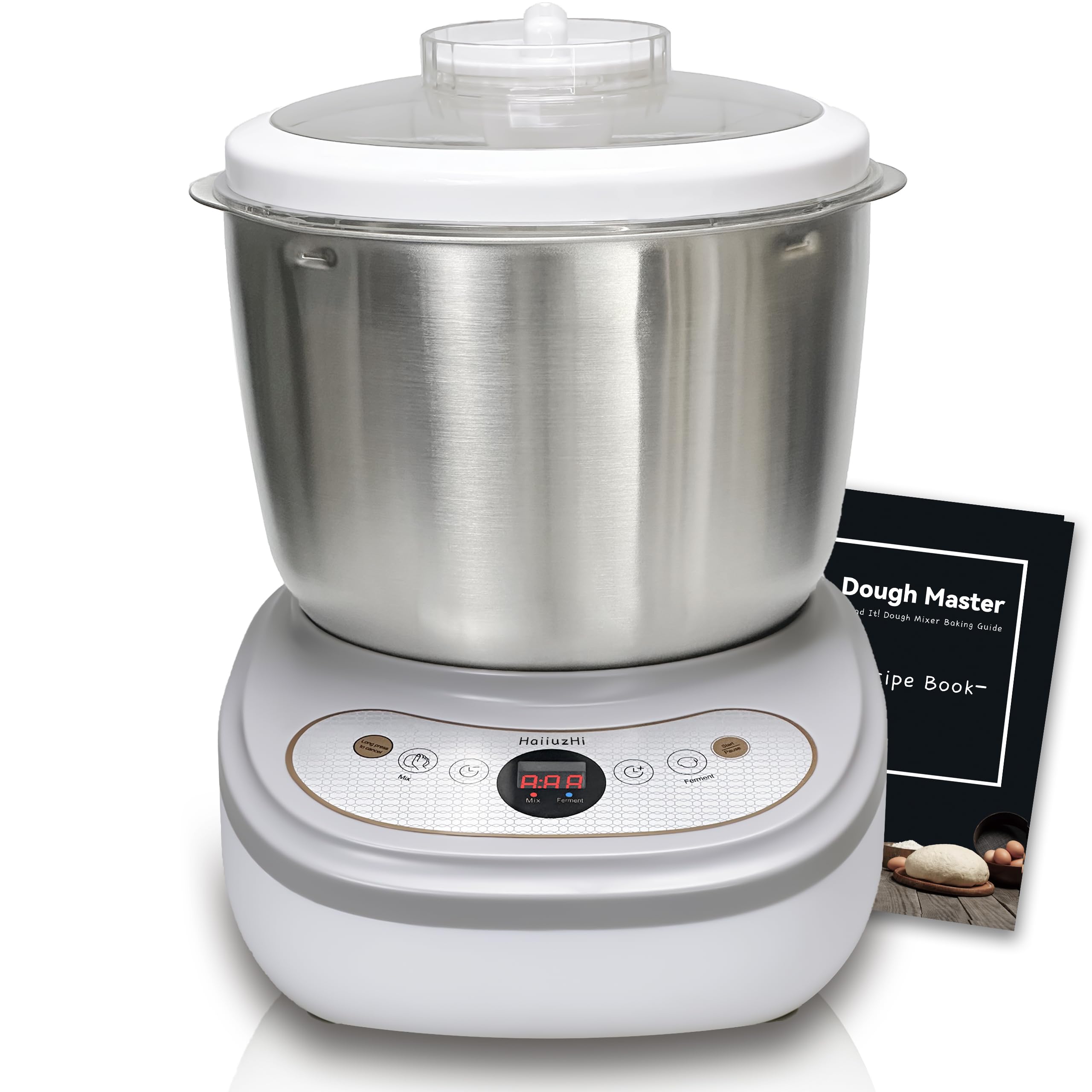
This machine sits in the same “dough maker” universe as the Joydeem: it’s designed to knead, rest, and ferment dough in a controlled way—without trying to be a fancy dessert mixer. And that focus is exactly why people who bake a lot of bread often love these units. They don’t need 10 different whisking speeds. They need reliable dough development and predictable fermentation.
The most useful real-world feedback here is about workflow: owners like the simplicity, the large capacity for multi-loaf routines, and the easy cleanup. The intermittent operation (the machine turning and pausing) isn’t a flaw—it’s part of how this style of kneading helps prevent dough from overheating and helps ingredients incorporate without constant high stress. It’s the “slow is smooth, smooth is fast” philosophy in machine form.
Noise is the one theme to take seriously. Some users describe the sound as intense during the mix cycles, especially if the unit is on a resonant surface. The fix is usually practical: place it on a stable counter, keep it level, and let the suction do its job. If you’re extremely noise-sensitive, a classic planetary stand mixer may feel gentler—though it may also be less hands-off for bread.
Why it works so well for bread
- Bread-first design – built around kneading and fermentation instead of general dessert mixing.
- Large flour handling window for family baking and weekly batch routines.
- Simple controls – fewer “features” to manage, more consistency.
- Easy cleanup – detachable stainless bowl helps keep bread-making sustainable.
Good to know
- Mixing cycles can be noisy for some users; placement and surface choice matter.
- Not meant to replace a stand mixer for whipped cream, frosting, and cake-centric tasks.
- Instructions can be light; once you learn it, the machine is very straightforward.
Ideal for: weekly bread bakers who want a dedicated dough station that kneads and proofs with minimal fuss, and who don’t need a full dessert-focused mixer.
8. YUCHANLUCK 7L Dough Mixer (Black) – Big Bowl, Add‑In Window, and Proofing Without Drama

This is one of those products that makes sense the moment you understand what it’s for: not beating egg whites, not making frosting—making dough. If you want a machine that kneads bread and pizza dough and then proofs it at a controlled temperature, this category is designed to simplify your life. The YUCHANLUCK model leans into that simplicity with a large bowl and a top window so you can add water or seasonings without stopping the cycle.
That little window sounds minor. It’s not. It removes a big annoyance: the moment you realize your dough needs a splash more water or you forgot the salt. On a classic stand mixer, you’d pause, tilt, add, restart, scrape. Here, you adjust smoothly. This is exactly the kind of small convenience that turns “I make bread sometimes” into “I make bread regularly.”
The feedback patterns on this type of dough maker are consistent: people love the easy cleanup, the fact that it’s designed to handle dough without moving around, and the repeatability of results. The machine’s intermittent kneading approach also helps keep dough from overheating too quickly compared with continuous high-intensity kneading. It’s a calm, consistent rhythm that’s very friendly for weekly bread routines.
Why it’s a strong pick
- Large capacity bowl for multi-loaf or pizza-night dough.
- Top add-in window for on-the-fly hydration and seasoning adjustments.
- Built-in fermentation for consistent rise without separate proofing gear.
- Easy ownership – fewer steps, fewer dishes, less babysitting.
Good to know
- These machines excel at dough, not delicate whipping or dessert-centric mixing.
- Fermentation control is powerful; always watch dough behavior if you’re doing long sourdough timelines.
- As with any dough maker, you’ll get best results once you learn your go-to hydration ratios.
Ideal for: busy households that want consistent bread and pizza dough without turning baking into a multi-hour “project.”
9. YUCHANLUCK 7L Dough Mixer (Grey) – The Same Workflow, a Cleaner Look for Some Kitchens

This is essentially the same “set it and walk away” dough maker concept as the black version—just in a different finish. And that’s not a throwaway detail. Appliances that live on your counter become part of your kitchen’s visual rhythm. If you’re building a calmer-looking space or you prefer a softer, more neutral palette, the grey option can be the one you’re more likely to leave out—and therefore use more often.
Functionally, what matters is the workflow: load ingredients, let the machine knead with its designed rhythm, then use fermentation mode to create a predictable rise environment. The top add-in window remains one of the best little conveniences in this category, especially for new bread bakers who are still learning how flour and hydration behave.
If you’re debating between the two, don’t overthink it. Choose based on which one you’ll actually keep in your routine. The best machine is the one you use consistently, because consistency is how bread becomes easy.
Why it’s worth considering
- Same dough + proof benefits as the black model, with a different finish.
- Counter-friendly design for people who don’t want a loud “appliance look.”
- Convenient add-in window keeps dough adjustment smooth.
- Great for repeatability if you bake weekly and want minimal friction.
Good to know
- Pick based on style and your kitchen setup; performance expectations are the same category-wise.
- Like all dough makers, it’s not designed to replace a full-feature stand mixer for desserts.
- Watching dough behavior is still smarter than trusting the clock blindly.
Ideal for: anyone who wants the dough maker workflow but prefers a different countertop aesthetic.
10. CEBORY 3‑in‑1 (6.5 Qt) – A Strong “Bread Capable” Stand Mixer for Real Kitchens

This is a good example of the “smart mid-range” category: you want a real stand mixer that can handle bread dough, but you’re not trying to pay for a legacy brand name or a premium ecosystem. In owner feedback, the love usually comes down to three things: it feels easy to use, it stays put thanks to suction, and it handles bread dough without turning the kitchen into a wrestling match.
The bowl size hits a sweet spot. It’s big enough for family baking but not so huge that small batches feel lost. And because it’s a classic stand mixer design with multiple speeds and standard attachments, it’s far more versatile than dough-only machines. You can knead, mix, whip, and generally cover most home baking needs. That’s why this style works well for “mostly bread, but also everything else.”
The common critique is a classic stand mixer issue: reaching the edges of the bowl perfectly. A lot of non-premium mixers require a stop-and-scrape moment for certain batters. That’s not a disaster—it’s just a reality of the category. If you’re okay with a brief pause to scrape down, you get a lot of functional mixing for a very reasonable ownership experience.
Why it earns a spot
- Great bowl size balance – comfortable for bread and everyday baking.
- Stable base feel – suction helps reduce counter drift during kneading.
- Versatile attachments – covers bread dough, batters, and whipping tasks.
- User-friendly learning curve – a good “first serious stand mixer” for many kitchens.
Good to know
- May require occasional scraping for perfect bowl coverage, depending on recipe and batch size.
- Not built for extreme multi-loaf whole-grain marathons the way heavy-duty systems are.
- As with most stand mixers, dough feel improves when you start with a well-measured hydration ratio.
Ideal for: home cooks who want a capable stand mixer that can knead bread confidently and still handle cakes, cookies, and daily mixing with ease.
11. EQTLVFH 800W (5.3 Qt) – Compact Footprint, Confident Kneading, and a Surprisingly Serious Motor

This is the kind of mixer that makes sense when you want real power but don’t want a massive appliance. A strong motor paired with a mid-size bowl can be a great match for households that bake regularly but don’t do gigantic batches. It’s also appealing if your counter space is limited and you don’t want a tall, heavy machine that dominates the kitchen.
Owners often talk about two practical wins: stability and versatility. A non-slip base matters more than you think when dough starts pulling. And a tilt-head design makes ingredient adds and attachment swaps feel simple. This category also tends to be popular with people who do mixed cooking tasks—not just bread, but also things like dumpling wrappers, noodle dough, and other heavier mixing jobs that punish weak machines.
Here’s the “smart owner” approach: treat this as a strong mid-size mixer, not as a commercial dough beast. Don’t overload the bowl. Let the machine work at a reasonable pace. If you do that, you get excellent daily performance without needing a monster footprint.
Why it’s a practical pick
- Strong motor-to-size ratio – capable for bread dough without needing a giant machine.
- Good versatility with standard whisk/beater/hook attachments.
- Stable base behavior – helps reduce wobble and counter movement.
- Simple tilt-head workflow – easier ingredient additions and quick cleanup access.
Good to know
- Like many mixers, you may still stop once to scrape the bowl for certain batters.
- Not all parts are always dishwasher-friendly—check your comfort level with hand washing.
- Best results come from respecting batch size and letting the dough develop without forcing overloads.
Ideal for: bakers who want a compact stand mixer that still feels confident on dough, especially if you make bread regularly but don’t need huge batch capacity.
12. VIVOHOME 6 Qt Tilt‑Head – A Budget-Friendly Stand Mixer That Gets the Core Job Done
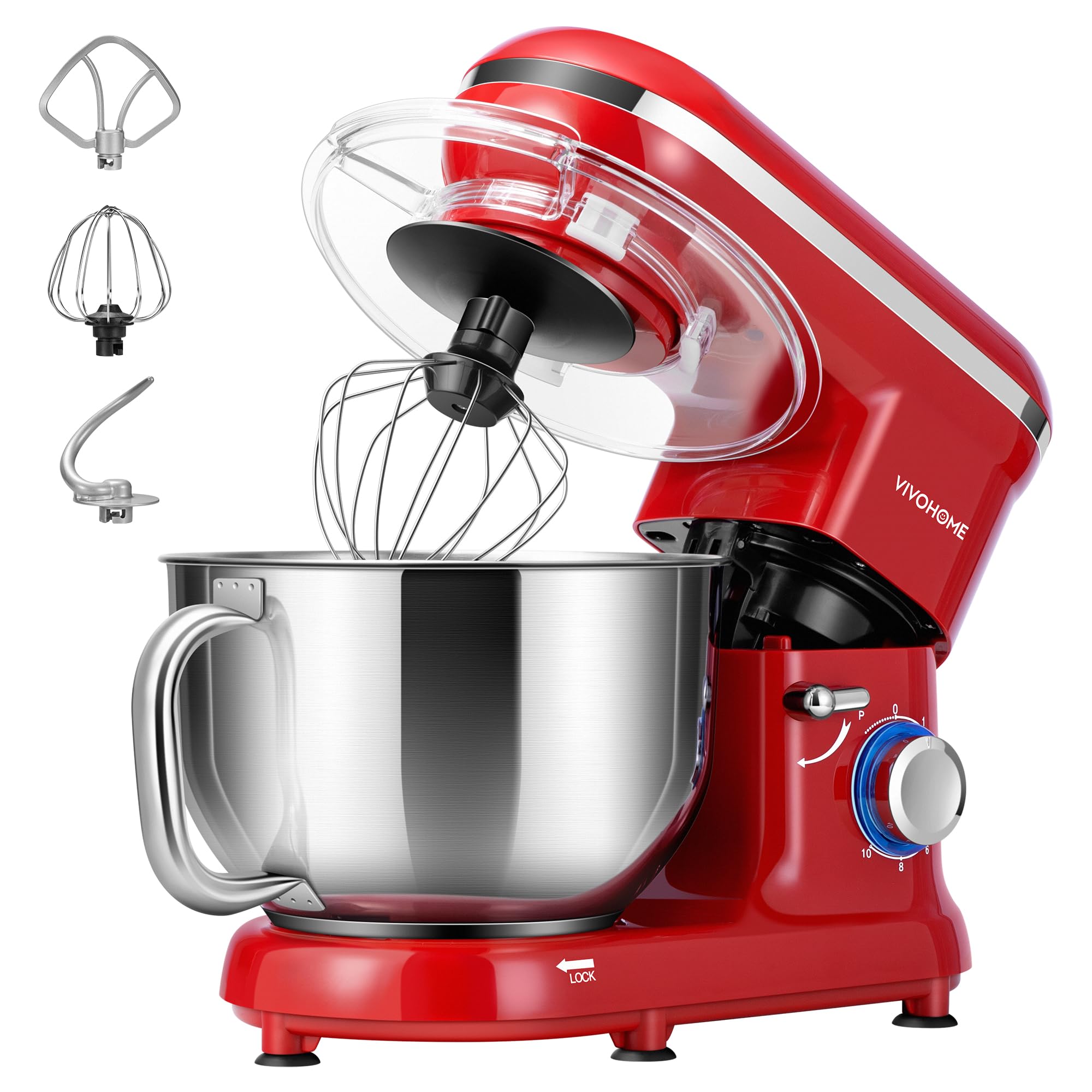
If you want a stand mixer that covers the basics—knead, mix, whip—without turning into a premium-brand purchase, this VIVOHOME model is a familiar “strong value” type of pick. Owners often describe it as better than they expected for the category, especially for dough tasks and general mixing. The suction cups are a standout detail because stability is where many budget mixers fail.
In real usage, this sort of mixer works best when you treat it like a smart helper rather than a commercial kneader. Do normal household batch sizes. Use the right attachment. Let the dough hook work, then finish with short rests if needed. For most home bread recipes, that’s plenty. And because it’s a standard stand mixer design, you still get the everyday versatility that dough-only machines don’t offer.
One recurring theme in owner feedback for budget stand mixers is “side scrape behavior.” Some batters or doughs need a quick scrape down. That’s normal. If you want a machine that almost never needs that, you typically pay more or you choose a specialized system. But for everyday baking, this is a strong “entry to real mixing” choice.
Why it’s a good value
- Strong basics – bread dough, cookie dough, batters, and whipping tasks are covered.
- Stable suction base – reduces counter movement compared with many cheap mixers.
- Easy tilt-head access – ingredient adds and attachment swaps feel simple.
- Budget-friendly entry into stand mixer life without feeling disposable.
Good to know
- Some users note minor quirks (like occasional motor smell or accessory preferences) typical of value mixers.
- May require scraping for certain mixtures depending on batch size and hydration.
- If you’re doing constant heavy dough marathons, a dough-only machine or heavy-duty system may suit better.
Ideal for: new bakers and value-focused households that want a capable stand mixer for bread plus general baking, without paying for premium branding.
13. Hamilton Beach 4 Qt (7 Speed) – The “I Want Bread Help, Not a Giant Appliance” Pick

This mixer is popular for one reason: it’s approachable. Not everyone wants a heavy, premium stand mixer sitting on the counter like a monument. Some people just want a reliable machine that handles cookies, cake, and the occasional bread dough without costing them counter space or emotional energy.
The Hamilton Beach design leans into practical usability: a mixing guide, a slower first speed that helps reduce flour explosions, and a built-in handle that makes it easy to move. For small kitchens and occasional bread bakers, those details matter. You’re more likely to use a mixer you can actually lift and store comfortably.
For bread specifically, the key is expectation management. A smaller bowl and a lighter machine can still knead dough, but it’s happiest with moderate batches. If you do one loaf at a time or you mostly do softer doughs (like sandwich bread, enriched dough, or pizza dough in reasonable quantities), it can be a very satisfying choice. If you want multi-loaf, high-tension dough days, jump up to a bigger system.
Why people keep buying it
- Compact and easy to move – the carry handle is genuinely useful.
- Beginner-friendly speeds – slow start helps reduce splatter and stress.
- Includes the basics – bowl, whisk, hook, beater, and splash control.
- Great for occasional bread in smaller batches and everyday baking tasks.
Good to know
- Not built for constant heavy dough marathons; keep batches moderate.
- Some users note shaking at higher speeds—common for lighter mixers.
- If you bake bread weekly in large volume, you’ll warn out of this category faster.
Ideal for: small kitchens and occasional bread bakers who want a practical stand mixer that’s easy to live with and easy to store.
14. Joydeem HMJ‑A501 (5.3 Qt) – Hands‑Off Dough for People Who Want Bread Without the Workout
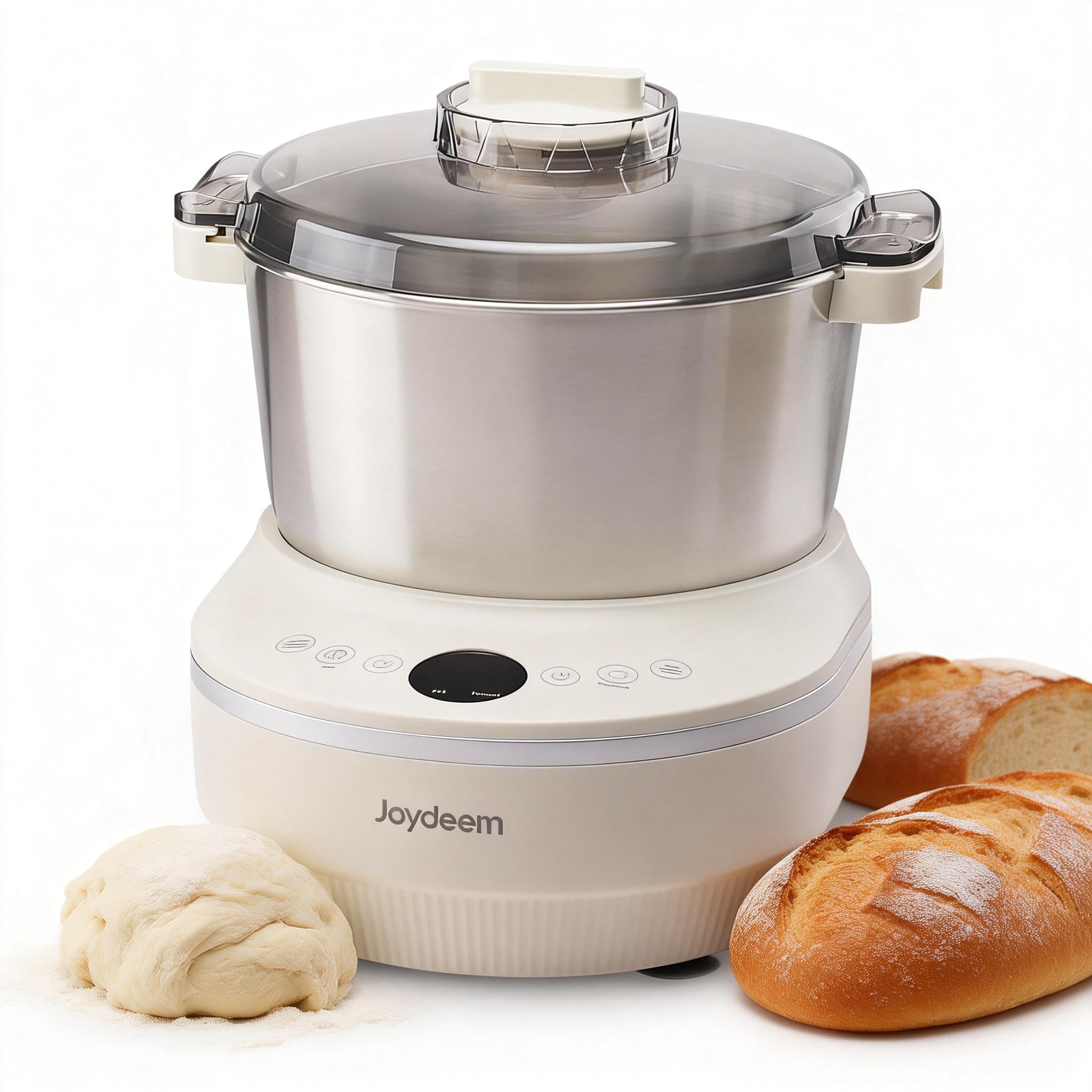
This is a smaller, more compact version of the “dough-first” concept—and that makes it perfect for a lot of real households. Not everyone needs a huge bowl. Many people want one reliable loaf at a time, a couple of pizza doughs on Friday night, or an easy way to make rolls without kneading by hand. This is exactly where a compact dough maker shines.
Owners who love this category tend to describe the same emotional benefit: freedom. They add ingredients, hit start, and let the machine do the physically demanding part. That matters a lot for bakers with joint pain, anyone recovering from injuries, or just busy people who want bread without turning it into a gym session. The fermentation function is the second half of the appeal: you can create a controlled rise environment even when your kitchen is cold.
The main “adjustment” you’ll make as an owner is learning your timing and batch size sweet spot. Smaller machines sometimes feel strained if you overload them with very stiff dough. When you keep to reasonable quantities, they’re wonderfully consistent. And because the bowl and mixing parts are dough-focused, cleanup tends to be easier than you expect.
Why it’s lovable
- Hands-off kneading – perfect for bakers who want bread without physical strain.
- Compact footprint – easier to store than large stand mixers or big dough machines.
- Fermentation support – helps you keep bread-making consistent year-round.
- Great for pizza nights – consistent dough without the mess and effort of hand kneading.
Good to know
- Best for small to moderate batches; avoid overloading with extremely stiff dough.
- Not a full dessert mixer replacement; it’s a bread and dough specialist.
- Some users wish for finer time adjustments; you’ll adapt once you learn your routine.
Ideal for: small-batch bread and pizza bakers who want a dough-first machine that saves effort and keeps bread-making consistent, especially in colder kitchens.
15. Kitchen in the box 3.2 Qt – The Small Mixer That Makes Sense When Space (and Batch Size) Is Small

Not every kitchen has space for a full-size stand mixer. And not every household needs giant batches. This compact mixer is designed for exactly that reality: small kitchens, couples, and people who want help with everyday mixing jobs without committing to a heavy appliance.
The most important thing to understand is usable capacity. Smaller bowls often have a “theoretical” capacity, but the practical working capacity for messy ingredients is lower. Owners who love this mixer tend to use it for pancake batter, cake mixes, small cookie batches, whipped cream, and small-scale mixing where convenience matters more than raw power. Some people even use it for niche tasks (like mixing creams, lotions, or other non-food projects), which speaks to the fact that it’s easy to move and store.
For bread dough: think “small and occasional,” not “weekly sourdough project.” Soft doughs in small quantities can work, but if bread is your main goal, a larger bowl and stronger kneading platform will make you happier long-term. Where this mixer wins is simple: it helps you bake when your kitchen size would otherwise stop you.
Why small-kitchen bakers like it
- Compact and light – easy to store, easy to move, easy to live with.
- Great for everyday batters – pancakes, cakes, small cookie batches, and whipping.
- Stable suction cups help keep it from drifting on the counter.
- Simple attachments cover the basics without complexity.
Good to know
- Small bowl means smaller practical batches—plan around that, and you’ll be happier.
- Not the best match for frequent bread dough kneading; bread-focused bakers should go larger.
- High-volume or commercial-style use can overwork compact machines; treat it as a daily helper, not a production tool.
Ideal for: apartments, small households, and bakers who want a compact mixer for everyday tasks—and only occasionally tackle small dough batches.
How Dough Mixing Actually Works (and Why Most People Buy the Wrong Machine)
Bread dough is a living system: flour absorbs water, gluten forms, fermentation creates structure, and temperature quietly decides how fast everything happens. A mixer is not just a “stirring device.” It’s a gluten-developer and a heat generator. Once you understand that, you can predict which machine will match your baking style.
The 4 “dough realities” that decide whether your mixer feels amazing
- Gluten develops through stretch, not speed – aggressive mixing isn’t automatically better. Smooth, consistent development wins.
- Hydration changes everything – higher hydration doughs can climb hooks or smear; the best machines keep dough moving instead of just spinning it.
- Heat is a hidden ingredient – mixing warms dough. Some machines warm it quickly, which speeds fermentation. That’s either helpful or frustrating depending on your goals.
- Stability matters more than people admit – if the machine walks, rattles, or wobbles, you’ll use it less and enjoy baking less.
This is why dough-only machines are so loved by bread-first bakers: they’re designed around dough’s reality, not dessert versatility. And it’s why heavy-duty systems like the Bosch feel “calm” during big batches—because they’re engineered for torque and load handling.
The “expert routine” that upgrades any machine you buy
- Use measured hydration – random flour adds create inconsistent dough. Start with a known ratio and adjust in small steps.
- Stop when the dough is ready – you’re looking for smoothness, elasticity, and clean bowl behavior. More mixing is not always more better.
- Rest is a tool – short rests (autolyse, pause, fold cycles) can build structure without overheating the dough.
- Control temperature – if your machine warms dough fast, use cooler water. If your kitchen is cold, proofing modes can be your best friend.
- Choose the right tool for the job – if bread is your life, a dough maker might beat a stand mixer. If baking is broad, a stand mixer might beat a dough maker.
When you match the machine to your baking rhythm—and you use a few small “pro habits”—bread stops being unpredictable. It becomes repeatable, satisfying, and honestly… fun.
FAQ: Bread Mixers (The Questions People Actually Mean)
Do I need a stand mixer, or should I buy a dedicated dough maker?
Why do some dough machines start and stop while kneading?
Is a bigger bowl always better for bread?
What’s the biggest mistake people make after buying a bread-capable mixer?
How do I know if I need a heavy-duty system like the Bosch?
I’m new to bread. Which type will help me succeed fastest?
Final Thoughts: Pick the Machine That Makes You Bake More Often
The best mixer isn’t the one that looks the most impressive on paper. It’s the one that quietly turns bread from “a weekend project” into “a normal thing we do.”
Here’s the fastest way to choose from this guide:
- Want the most trusted all-around stand mixer experience? Start with the KitchenAid Classic Series. It’s versatile, proven, and covers bread plus nearly everything else.
- Want the best “serious bread” power for big batches? Go for the Bosch Universal Plus. It’s built for volume and dough confidence.
- Want a big bowl and modern controls in a sturdy build? Look at the Camic 8.45 QT all-metal stand mixer, especially if you bake for a family and like timer-based consistency.
- Want one machine that does mixing plus grinding/blending/pasta? Choose the VIVOHOME 6‑in‑1 system if you love the idea of consolidating appliances.
- Want proofing built in so bread feels easier? The VIVOHOME stand mixer with fermentation is a great “confidence builder” for consistent dough routines.
- Want the most hands-off bread workflow (knead + proof in one machine)? Pick the Joydeem JD‑HMJ7L or the HaiiuzHi 7.4 Qt dough maker if bread is your priority and you want maximum simplicity.
- Want a smart mid-range stand mixer that still kneads confidently? The CEBORY 6.5 Qt is a strong value option for “bread plus everything else.”
- Want compact power without going tiny? Try the EQTLVFH 800W 5.3 Qt for a smaller footprint with real kneading confidence.
- Want a budget stand mixer that covers the basics well? The VIVOHOME 6 Qt tilt-head or the Hamilton Beach 4 Qt are practical, approachable picks for everyday baking.
- Need something truly small for an apartment kitchen? The Kitchen in the box 3.2 Qt is the tiny-kitchen answer—best for small mixes and occasional small dough batches.
If you take one thing from this guide, let it be this: the best results come from matching the machine to your routine. Choose the bread mixer machine that fits how you bake—weekly loaf, big batch day, sourdough rhythm, or pure set-and-go convenience— and you’ll end up with the only outcome that matters: bread that keeps showing up in your life because it finally feels easy.
