
A beverage fridge isn’t a “nice-to-have” once you’ve owned one. It’s a daily-life shortcut: fewer kitchen-fridge pileups, faster hosting, less rummaging, and a weirdly satisfying feeling when everything is neatly lined up behind a glass door. But buying one online can feel like a gamble—because the stuff that matters most rarely shows up in a spec list.
If you’re searching for a best rated beverage fridge, you’re not really chasing cold air. You’re chasing a fridge that feels easy in real life: it cools evenly, doesn’t turn your room into a humming soundtrack, doesn’t randomly pop open, doesn’t fog up every time the weather changes, and doesn’t force you to play Tetris with shelves that won’t hold the drinks you actually buy.
This guide is built around the real friction points owners talk about after the honeymoon phase: shelf wobble, door seal “almost closed” moments, compressor cycle sounds vs. sharp popping noises, temperature gradients (top warmer than bottom), and the big one most people miss— placement. Put a freestanding unit in a tight cabinet without airflow and even a great model can struggle. Put a built‑in, front‑vented unit where it can breathe and suddenly it feels like a premium appliance.
Below are 15 standout beverage coolers—from compact countertop units to serious under‑counter built‑ins and one commercial merchandiser. I’ll tell you what each one is actually like to live with, who it fits best, and how to avoid the most common “I wish I knew that earlier” mistakes.
In this article
How to Choose the Right Best Rated Beverage Fridge for Your Space
Most guides treat beverage fridges like they’re all the same: pick a can count, pick a finish, done. That’s exactly how you end up disappointed. A beverage fridge is a little ecosystem—airflow, insulation, compressor cycling, shelf layout, door seal, and where you place it in your home. When those pieces work together, the fridge feels effortless. When they don’t, you notice it every day.
1. Start with your “drink reality,” not the marketing can count
The biggest mismatch comes from this: “holds 120 cans” sounds precise, but your drinks aren’t uniform. Tall cans, glass bottles, sports bottles, mixers, wine bottles, protein shakes—those shapes change the usable volume more than people realize. Ask yourself:
- Are you a “12‑pack stocker”? You buy cases and want easy, flat stacking.
- Are you a “variety host”? You want labels visible, categories separated, and quick grabbing.
- Are you a “wine + cans” mixer? You need shelf spacing that can handle bottle height and keep things stable.
- Are you a “water bottle household”? You’ll care about shelves that don’t bow and bottoms that don’t turn into bowling pins.
A practical trick: imagine your fridge stocked on its busiest day (party, game night, family weekend). That’s the layout you should buy for.
2. Choose the correct “installation truth”: built‑in vs freestanding
This matters more than brand. Freestanding units typically need open space around the sides/back so the compressor can dump heat. Built‑in units are designed to vent from the front, so they can live under a counter without overheating.
- If you’re sliding it under a counter: prioritize a true front‑vented, under‑counter model (especially for kitchens and bars).
- If it’s going in a bedroom/office: freestanding is fine—just give it breathing room and keep it away from direct sun or heater vents.
- If it’s going in a garage: consider ambient temperature swings; some rooms push beverage coolers harder than people expect.
A fridge can be “great” and still fail your setup if it can’t breathe. Placement is performance.
3. Temperature control: precision matters when you care about taste
A surprising number of owners buy a beverage fridge for one reason: they want predictable drinks. Not “sort of cold,” but consistently cold—and cold enough without accidental freezing. Here’s what to look for in the controls:
- Digital thermostat with simple buttons (fast adjustments you’ll actually use).
- Small increments if you’re picky (some models let you step by 1°F).
- Easy-to-read display if it will sit low on the floor.
- Memory after power loss if you live in an area with flickers or storms.
Translation: if the panel is annoying, you’ll stop using it. If you stop using it, your fridge becomes “fine” instead of “perfect.”
4. The real definition of “quiet” (and what to do if yours isn’t)
Owners describe two different kinds of sounds:
- Low hum (compressor running): usually steady and easy to ignore.
- Sharp pops / cracks (materials expanding/contracting during cooling cycles): brief but attention-grabbing.
If noise sensitivity is your top priority (bedroom, nursery, office calls), treat “quiet” like a system:
- Level the feet so the cabinet isn’t twisting while it runs.
- Add grip pads under the feet if it’s on slick flooring (helps with vibration and door tug).
- Don’t wedge it tight against walls or cabinets where vibration can amplify.
- Expect a louder first day while it pulls everything down to temperature.
A lot of “this is loud” feedback disappears when the fridge is leveled, filled, and allowed to settle into its normal cycle.
5. Shelves decide whether you love it or tolerate it
Shelf complaints aren’t petty. Shelves are your interface with the fridge. Wire shelves often allow airflow, but bottles can wobble and skinny items can tip. Glass shelves feel premium and stable, but sometimes reduce airflow if packed too tight. Here’s the real-world strategy:
- If you store bottles upright: consider adding a thin shelf liner or an acrylic sheet on wire shelves.
- If you store wine: make sure at least one level can hold bottles without forcing labels to scrape.
- If you store tall cans: you need enough vertical spacing, not just “more shelves.”
- If you store heavy cases: watch for shelves that bow under load; spread weight across more support points.
6. Glass door details: fog, seal, and “look but don’t open” convenience
A glass door is not just aesthetics. It’s the reason many people save energy and stop “door peeking.” If you can see what’s inside, you open the door less. If you open the door less, your temperature stays stable. But the door also introduces real-life concerns:
- Seal strength: a slightly weak seal can turn into “door didn’t fully close” moments.
- Condensation: humidity + frequent opens can fog glass on some units (especially in warm rooms).
- Reversible hinges: helpful, but only if the door lines up perfectly after the swap.
If you’re the type who rearranges furniture or changes room layout often, a reversible door is a small feature that becomes a big quality-of-life upgrade.
7. A quick “buying checklist” before you commit
- Measure twice: depth with door clearance, not just cabinet width.
- Plan airflow: even great fridges struggle if trapped in hot pockets.
- Think about your nightly environment: bright LEDs can feel like a nightlight—good for kitchens, annoying for bedrooms.
- Decide if you need a lock: helpful for shared spaces, offices, or curious kids.
- Expect a settling period: after delivery, many owners let units rest upright before first power-up.
Quick Comparison: 15 Best Rated Beverage Fridge Picks
Use this table to narrow down your shortlist fast—then jump into the full reviews for the real-life details like noise character, shelf behavior, and which models feel truly “set-and-forget” once installed.
On smaller screens, swipe or scroll sideways to see the full table.
| Model | Type | Real-life strength | Best match | Amazon |
|---|---|---|---|---|
| hOmeLabs 120-Can Beverage Refrigerator | Freestanding | Balanced “daily driver” feel: solid cooling, dependable controls, proven long-term satisfaction | Most homes that want one fridge that just works | Amazon |
| EUHOMY 24" Under-Counter 180-Can Cooler | Built-in | Front-vented under-counter design + big capacity + “bar upgrade” vibes | Kitchens, bars, cabinetry installs | Amazon |
| Koolmore 18" Beverage Merchandiser (KM-BR32SS) | Merchandiser | Commercial-style build + strong display look + efficient cooling for a home bar wall | Home remodels, bar walls, bonus rooms | Amazon |
| EUHOMY 4.5 Cu.Ft 145-Can Beverage Cooler | Built-in | More interior breathing room + glass shelves + quiet compressor personality | Entertainers who stock variety | Amazon |
| FEELFUNN 4.5 Cu.Ft 145-Can Beverage Refrigerator | Freestanding | Big capacity in a home-friendly footprint; quiet enough for shared spaces | Families who want “more drinks, less kitchen clutter” | Amazon |
| Honeywell 116-Can Beverage Cooler | Freestanding | Insulation-forward door + steady cooling feel; a “known name” option | Bedrooms/offices where stable cold matters | Amazon |
| EUHOMY 130-Can Beverage Refrigerator (3.2 Cu.Ft) | Freestanding | Precise temp steps + modern touch panel + owners praise consistent cooling | People who fine-tune temps by taste | Amazon |
| Electactic 130-Can Beverage Cooler (3.2 Cu.Ft) | Undercounter | Great “home office upgrade” energy: quiet, convenient, surprisingly roomy | Desk/office, man cave, small bar corners | Amazon |
| Tehanld 3.2 Cu.Ft Beverage Refrigerator | Freestanding | Wide temp range + mode switch (°F/°C) + strong “kid room/rec room” appeal | Bedrooms, rec rooms, mixed drinks + snacks use | Amazon |
| Icyglee 126-Can Beverage Refrigerator (3.2 Cu.Ft) | Undercounter | Whisper-quiet reputation in home offices + attractive display lighting | Work-from-home setups that hate noise | Amazon |
| Electactic 2.6 Cu.Ft Wine & Beverage Cooler | Compact | Wine-friendly temps + flexible shelves; a tidy “small space bar” solution | Apartments, offices, wine + cans mix | Amazon |
| Antarctic Star 3.2 Cu.Ft Wine & Beverage Cabinet | Freestanding | Classic “blue light bar fridge” feel; popular for pantries and living rooms | People who want simple, stylish beverage storage | Amazon |
| Antarctic Star 68-Can Mini Beverage Fridge (1.7 Cu.Ft) | Compact | Small footprint, solid cold for drinks, easy “counter/cabinet fit” option | Bedrooms, salons, small snack bars | Amazon |
| Antarctic Star 12-Bottle Wine Cooler (1.3 Cu.Ft) | Wine-first | Tight, tidy wine storage with a glass door; great for small pantries | Wine sippers, tiny spaces, countertop/pantry use | Amazon |
| PremiumLevella 7.1 Cu.Ft Glass Door Merchandiser | Commercial | Big vertical storage + wheels + “mini shop fridge” display presence | Retail, studios, serious home bars | Amazon |
In‑Depth Reviews: 15 Beverage Fridges That Feel Great to Own
Now we’ll go model by model. This is not a feature dump. I’m focusing on the real stuff: what the fridge feels like in a bedroom, a home bar, an office, or under a counter— and what owners tend to praise (or wish they knew) after weeks and months of use.
1. hOmeLabs 120-Can Beverage Refrigerator – The “Buy It and Stop Thinking About It” Choice

If you want a beverage fridge that feels like a legitimate appliance—not a “random online mini fridge gamble”—this is the kind of model that earns trust fast. Owners consistently talk about it like a dependable tool: it chills quickly, holds its temperature without drama, and doesn’t require a ritual of fiddling to keep it happy. That’s the core reason it lands as a best overall pick: it reduces mental load.
The strongest real-life signal is longevity. People describe running it for years without issues, which is exactly what you want from a fridge that’s going to live in a corner and quietly do its job every day. It also wins points for shipping protection and setup simplicity—two areas where online appliance purchases can go sideways. When owners mention “arrived pristine and cooled fast,” that’s not a small detail; it’s the difference between excitement and a return headache.
Here’s the practical nuance: this model behaves best when you treat it like a beverage fridge (not a food fridge) and set it to a sensible temperature for drinks. If you set any beverage cooler too low in a warm room, you can get occasional freezing near the back wall where cold air concentrates. Most owners who mention accidental freezing solved it by nudging the setting slightly warmer—easy fix, and a sign the unit is actually capable of strong cooling.
Why you’ll like it
- “Set it and forget it” personality – It behaves predictably once dialed in, which is the real luxury.
- Solid long-term confidence – Owners often describe multi-year reliability, not just first-week excitement.
- Fast chill + steady holding – Great for restocking before guests arrive without temperature yo‑yo.
- Clean, modern display – Glass door + interior light makes it easy to see what’s low before you open it.
Good to know
- Like most beverage coolers, the light is typically manual—great for ambience, but not “auto on” by default.
- It can take a little time to feel “fully cold” when brand new; that’s normal during early cycles and initial loading.
- If you’re extremely noise-sensitive, you’ll still want to level it carefully to keep the run sound as calm as possible.
Ideal for: most households that want a reliable, clean-looking beverage fridge that feels easy from day one and stays easy long-term.
2. EUHOMY 24" Under‑Counter 180‑Can Cooler – The “Home Bar Renovation” Level Step-Up
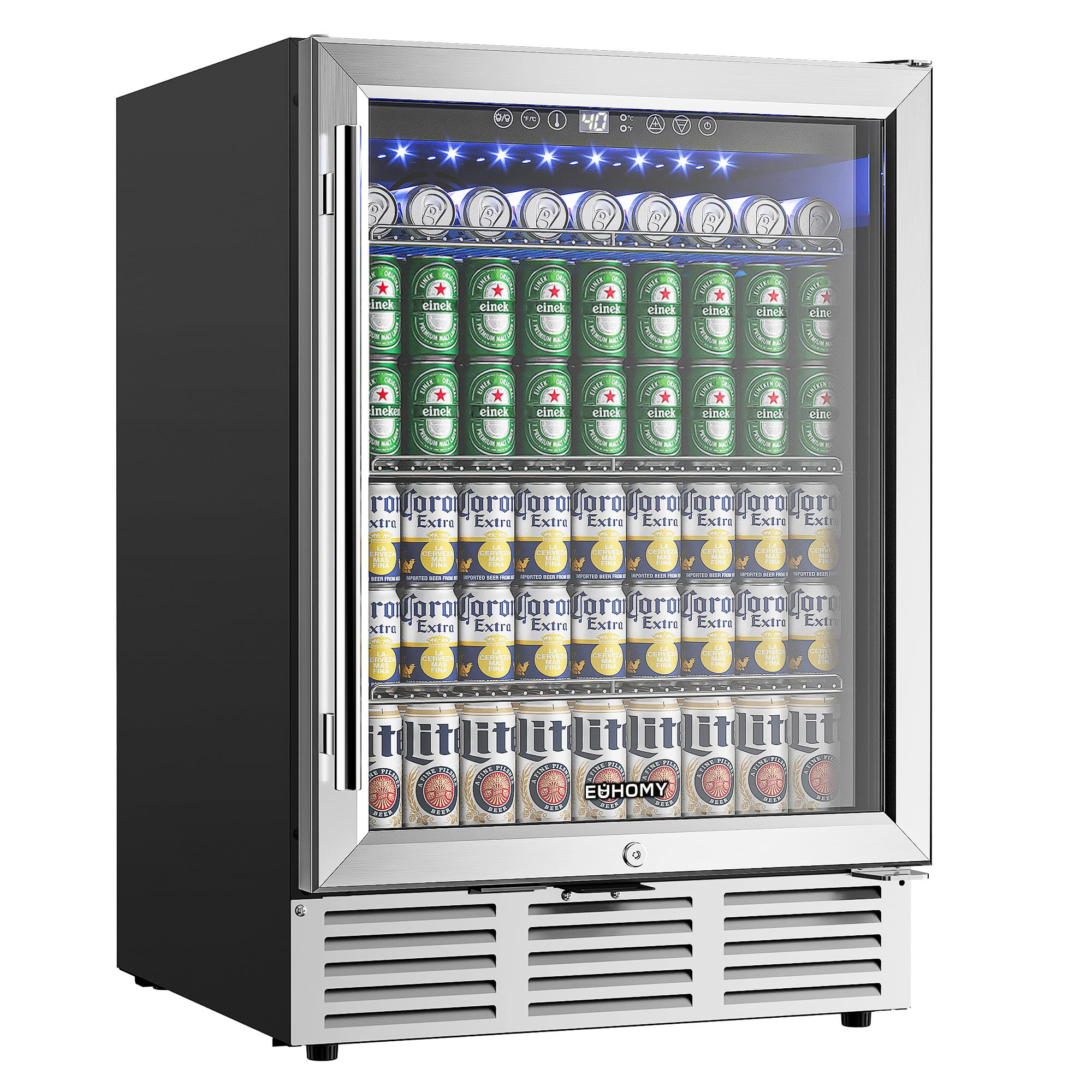
This is the kind of cooler you buy when you’re done playing “shuffle cans around the kitchen fridge” and you want a real under‑counter solution. The key advantage here isn’t just capacity—it’s integration. A true under‑counter drink fridge changes your space: it feels built-in, intentional, and always ready for hosting.
What owners love most about this tier is the stable, “grown-up appliance” feel: pull-out shelves for easier access, consistent cooling across the cabinet, and the quality-of-life features that matter in shared homes—like a lock and a door that feels solid when it closes. It’s also the kind of unit that lets you run two different drink zones in your home (for example: one fridge for everyday cold drinks, another for wine at a gentler setting). That flexibility is what separates a “cooler” from a “bar tool.”
Expert tip: under‑counter fridges are only as good as their airflow plan. If you’re buying this for a cabinet run, measure not just the cutout, but also how the front ventilation can breathe. When the heat dumps cleanly, the compressor cycles feel smoother, the temperature holds tighter, and the fridge feels quieter. That’s the hidden advantage of doing this level of upgrade the right way.
Why it stands out
- Under‑counter “built-in” presence – Makes a kitchen, bar, or office nook feel more premium instantly.
- Big storage without chaos – Pull-out shelving helps you actually use the space instead of forgetting what’s in the back.
- Stable temperature behavior – Built to keep drinks consistently ready, not “cold sometimes.”
- Lock + sensor lighting options – Great for shared spaces, guests, and keeping the vibe clean and controlled.
Good to know
- It’s a heavier, more serious appliance—plan your delivery path and placement before it arrives.
- Wire shelves are airflow-friendly, but some people prefer glass; a shelf liner can add stability for skinny bottles.
- If you’re sensitive to blue lighting, check whether the light can be toggled or set to sensor mode in your preferred style.
Ideal for: anyone building a home bar, finishing a basement, upgrading a kitchen, or installing a true under‑counter beverage station.
3. Koolmore 18" Beverage Merchandiser – A Bar-Perfect Fridge That Looks Expensive
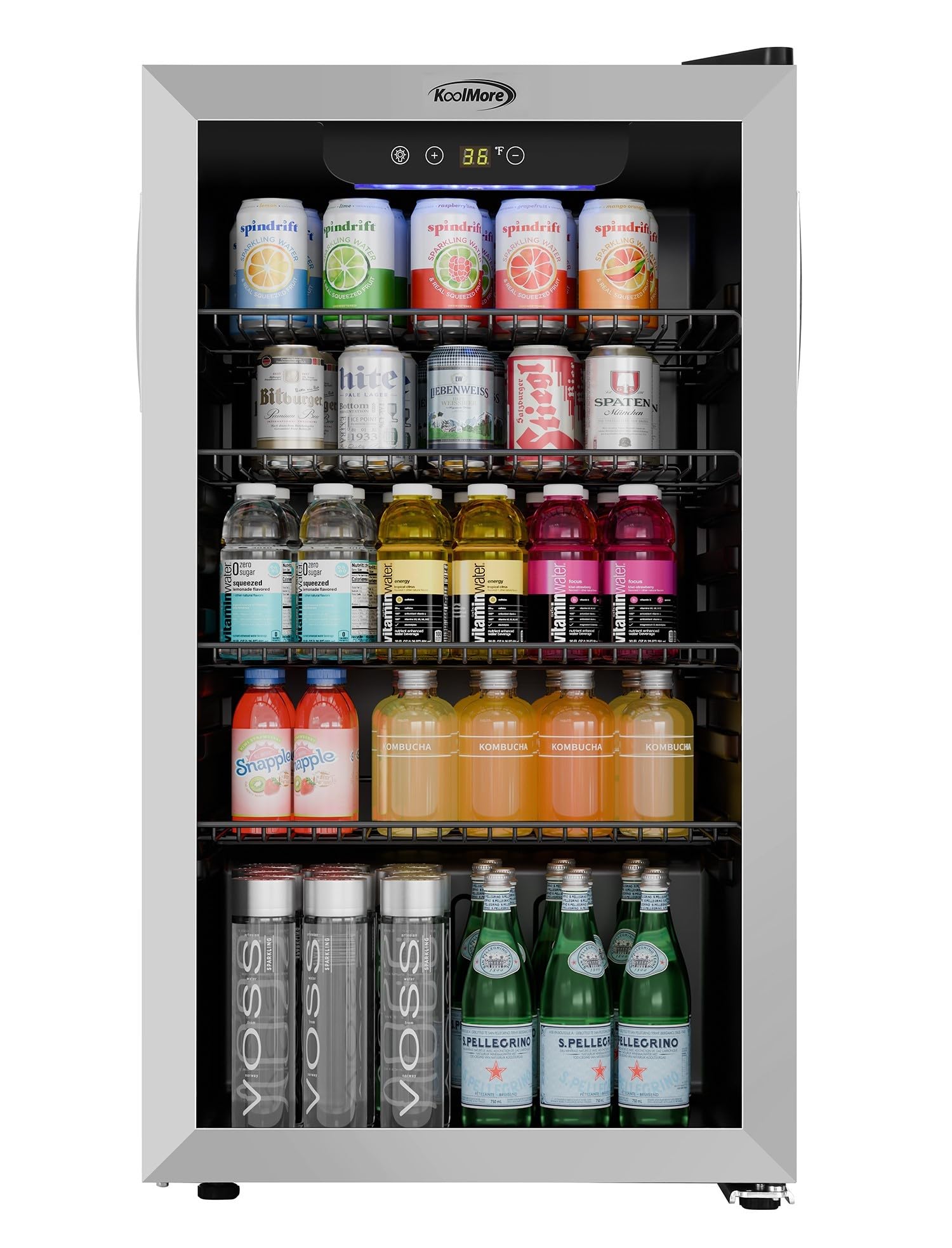
Some beverage fridges are purely functional. This one is also a piece of the room. If you’re building a bar wall, remodeling an open kitchen, or designing a “drink zone” between entertaining spaces, the Koolmore merchandiser style hits a specific vibe: glass door, bold interior lighting, clean trim, and a look that reads upscale even when it’s off.
In real-life use, merchandiser-style fridges excel at one thing: visibility. You see what you have. You see what you need. And you stop opening the door just to check. That small behavior change is what keeps temperatures steadier and makes the fridge feel “stronger” than you’d expect. Owners also describe these units as surprisingly efficient at cooling even when packed full, which matters when you’re using it as overflow for a busy household.
This model is also an underrated option for people who want a secondary refrigeration zone that isn’t limited to beverages. Some owners use merchandisers for extra refrigerated items during remodels or tight kitchen layouts—because when a fridge cools evenly and predictably, it becomes the place you stash everything you want within reach.
Why it’s a favorite
- High-impact aesthetics – Makes a space feel intentional (home bar energy without building custom cabinets).
- Strong visibility = fewer door opens – You grab faster and keep temps more stable.
- Roomy for the footprint – Great “secondary fridge” effect without taking over the room.
- Cooling that holds up when stocked – Useful when you’re prepping for guests or stocking cases.
Good to know
- Blue LEDs look awesome in bars, but can feel bright at night; placement matters if it’s near bedrooms.
- Like many glass-door units, you’ll get the best performance when you leave some airflow gap behind/around the cabinet.
- Wire shelves are common in this style; adding a liner can make slim bottles feel more stable.
Ideal for: home bars, remodeled living spaces, and anyone who wants a beverage fridge that doubles as a display feature.
4. EUHOMY 4.5 Cu.Ft 145‑Can Cooler – More Space, Less “Shelf Tetris”
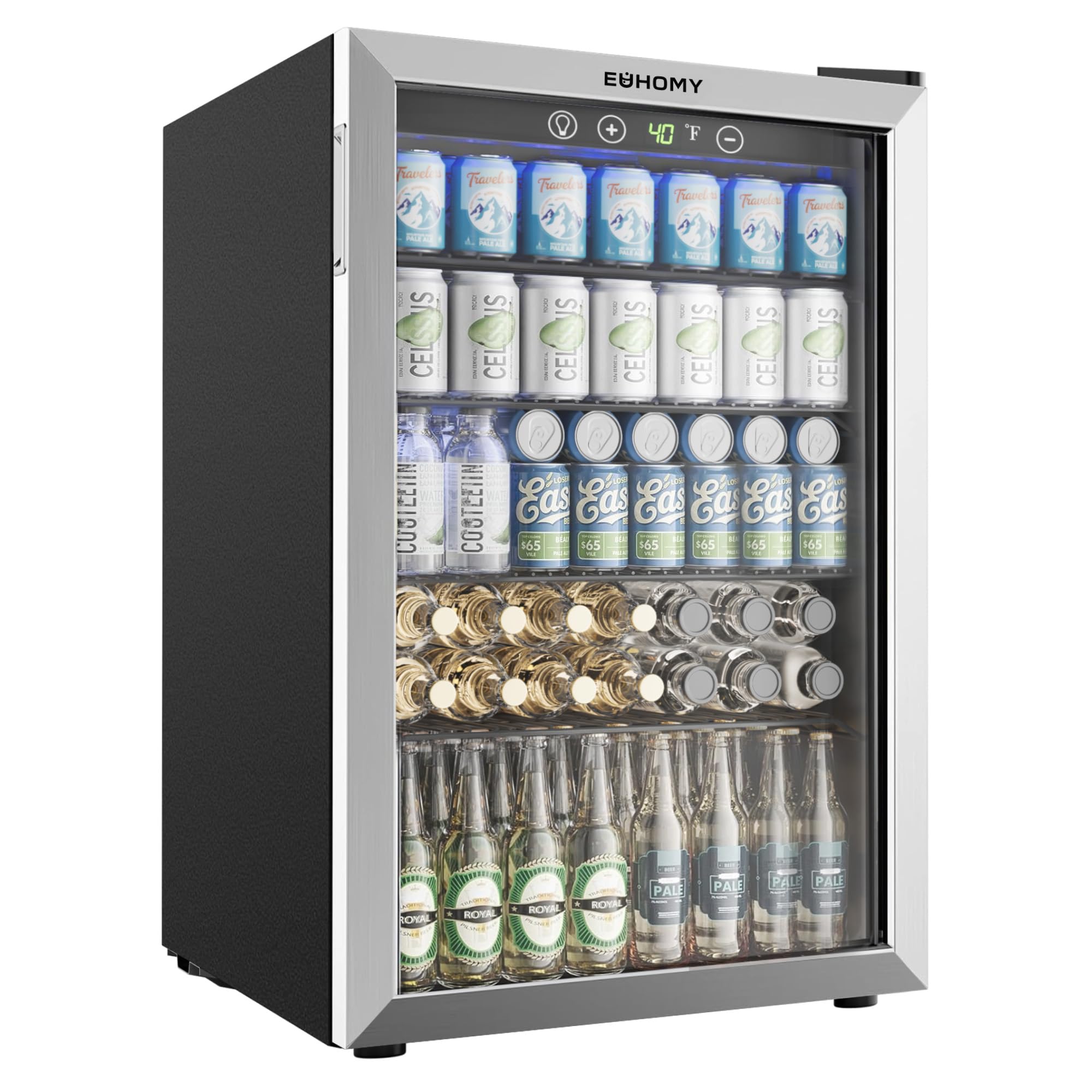
This is the beverage fridge you buy when you’re tired of “almost enough room.” The jump to a 4.5 cu.ft class cabinet changes how the fridge feels day-to-day: you can keep variety without crushing cans, you can store bottles without sacrificing an entire shelf, and you can restock without needing to reorganize everything like a puzzle. That’s the real benefit of capacity—less friction.
Owners tend to describe these EUHOMY units with the same three themes: modern controls, strong cooling, and a quiet, non-obtrusive presence. In other words: it behaves like a premium appliance without demanding attention. That makes it a great fit for open concept homes, offices, and entertainment spaces where you can’t “hide” the fridge behind a door.
The under‑counter/built‑in angle matters here too. If you’re sliding this into a finished space, the goal is a clean look and reliable performance. Just plan your layout like a pro: measure ventilation needs, keep the door swing comfortable, and decide whether you want the hinges to open left or right before you install. When the setup is right, the fridge becomes part of the room rather than a bulky appliance you work around.
Why it earns its spot
- Space that feels usable – The extra volume reduces daily rearranging and makes variety easy.
- Even cooling personality – Designed to circulate air so you don’t get one “cold corner” and one “warm shelf.”
- Quiet enough for real homes – A common compliment is that it doesn’t dominate the room acoustically.
- Flexible shelves – Helps you store wine bottles, tall cans, and odd shapes without sacrificing the whole layout.
Good to know
- Bigger cabinets can tempt overpacking; leave small airflow gaps so the back wall can circulate cold air properly.
- Door reversal is a win, but do it slowly—alignment matters for a strong seal.
- If you want ultra-sleek “in-cabinet” installation, compare with true front-vent models designed specifically for that job.
Ideal for: entertainers and busy households who want a larger beverage fridge that stays quiet and feels easy to organize.
5. FEELFUNN 4.5 Cu.Ft 145‑Can Refrigerator – The “Load It Up and It Still Cools” Crowd Pleaser

If your household drinks are a constant rotation—water, soda, energy drinks, sparkling water, kids’ drinks—capacity becomes a form of peace. This FEELFUNN model hits a sweet spot: large enough to feel like a real beverage station, but still shaped for normal homes rather than commercial spaces. Owners often describe it as “quiet, cold, and roomy,” which is exactly the trifecta you want when it’s placed where people gather.
The real-world behavior that matters most is cooling under load. Many fridges cool great when empty, then struggle when you fill them with warm cans. This one gets praise for chilling quickly and holding a cold setpoint even when packed—meaning it works for hosting and for restocking days. That’s a big deal if you buy cases and want them ready without waiting forever.
There are two small, practical details worth caring about. One: display visibility. If the fridge is placed low, a top-mounted control panel can be harder to read without bending or stepping back. Two: shelf stiffness. Heavy 12‑pack stacking can make some shelves bow slightly over time. If your family is heavy on cases, spread weight across shelves rather than creating a single “brick wall” layer. The fridge will cool better and your shelves will live a happier life.
Why it works
- Big capacity without feeling commercial – Looks right in kitchens, basements, and bonus rooms.
- Strong cooling performance – Chills quickly and holds steady even when stocked heavily.
- Quiet enough for shared spaces – Owners often compare it favorably to much pricier units for noise.
- Door reversal is doable – Helpful for rooms where layout forces a certain swing direction.
Good to know
- Very bright lighting or display can feel intense at night; placement solves most of that.
- Water bottles can tip if the bottom is overloaded; using bins or organizing by shape helps.
- Like any larger fridge, it benefits from being leveled carefully so the door closes confidently every time.
Ideal for: families and entertainers who want a roomy fridge that cools hard, stays reasonably quiet, and frees up the kitchen fridge immediately.
6. Honeywell 116‑Can Beverage Cooler – Steady Cooling with a “Known Brand” Feel
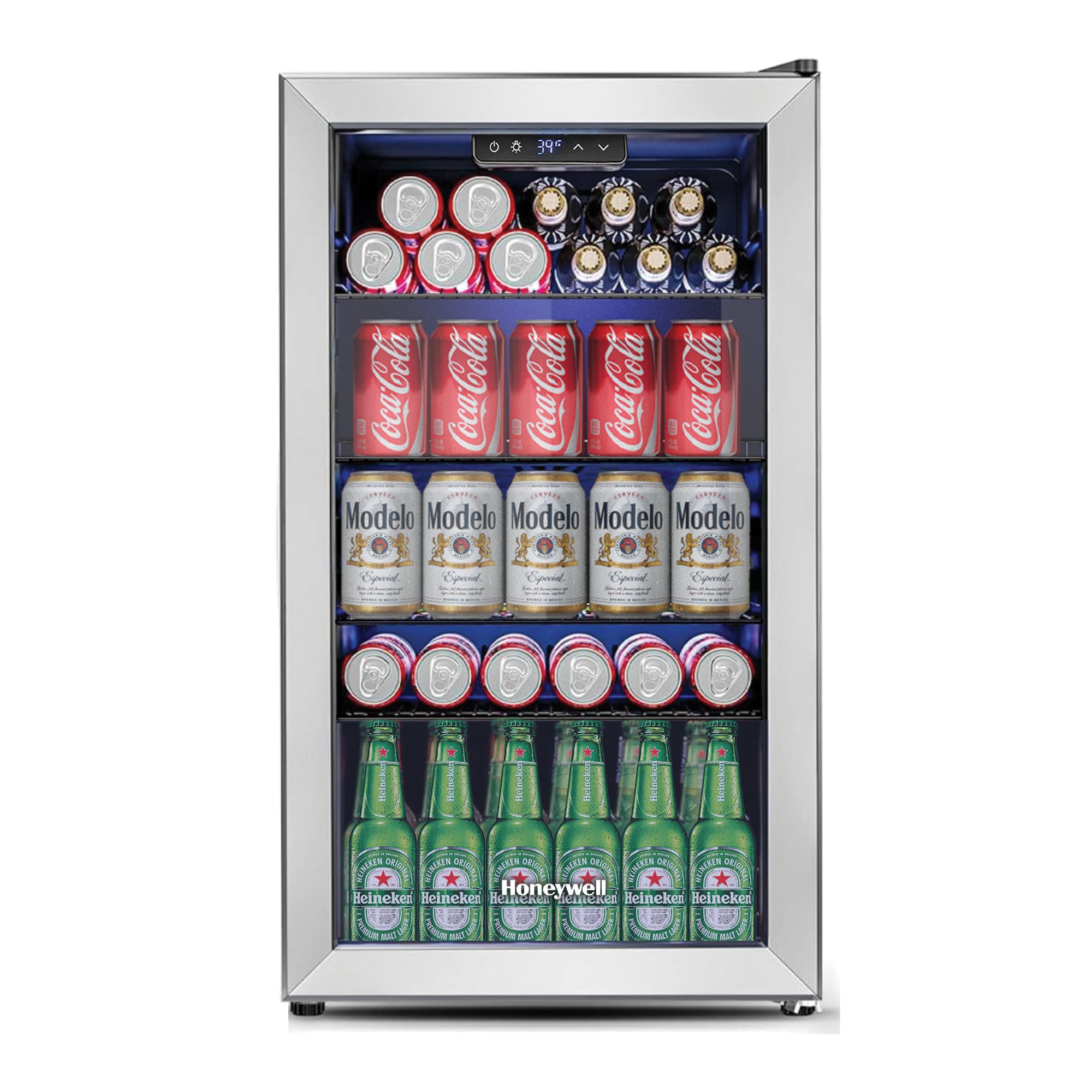
Honeywell is the kind of name people buy when they want the purchase to feel “safe.” And in the beverage fridge world, that often translates into one thing: predictable performance in normal homes. Owners praise this model for keeping drinks consistently cold and running quietly enough that you forget it’s even there—exactly what you want in a bedroom, office, or lounge.
Where this unit shines in real life is steady, even cooling across the cabinet—especially when you organize with airflow in mind. Some owners note that certain shelves have built‑in limitations because of internal components (common in this category). The smart way to treat that is to designate zones: bottom for cans, middle for bottles, top for lighter items. When you work with the fridge’s interior geometry instead of fighting it, it feels more spacious than it looks.
A very practical tip from experienced owners: put grip pads under the feet if your floor is slick. This prevents the fridge from sliding when you open the door and helps maintain a better “seal confidence” feel over time. It’s a tiny upgrade that makes the daily experience feel calmer—especially if your fridge lives on tile, laminate, or polished concrete.
Why people trust it
- Quiet presence – A common theme is that it doesn’t take over the room.
- Consistent cold – Owners praise steady temperature holding rather than dramatic swings.
- Reversible door + adjustable legs – Useful for awkward room layouts and uneven floors.
- Great packaging reputation – Important for appliances shipped to your door.
Good to know
- Some interior space is naturally “blocked” by cooling components; plan shelf usage rather than expecting perfect rectangles.
- If you want ultra-low temperatures, remember many beverage coolers prioritize drink ranges, not deep-chill freezer behavior.
- Wire shelves can feel slightly wobbly; a thin liner makes bottles feel much more planted.
Ideal for: buyers who want a trusted-name beverage cooler that runs quietly, looks clean, and keeps drinks reliably cold in everyday home spaces.
7. EUHOMY 130‑Can Cooler – For People Who Actually Use the Temperature Buttons

This EUHOMY model is for a very specific type of owner: the person who wants to dial in the fridge like it’s a tool. Not “cold-ish.” Exactly how you like it. The precise touch panel control is a standout because it turns temperature into a real preference rather than a vague setting you never touch again. If you care about how beer tastes at different temps or you want sparkling water at a certain crispness, you’ll appreciate that control.
Owners love the cooling consistency and the sleek look—especially the glass door and interior lighting that lets you see stock at a glance. This matters more than it sounds: people open the fridge less when they can see what’s inside, which helps maintain stability. There’s also a strong “quiet enough for living spaces” theme in feedback—meaning it fits well in offices and bedrooms where you don’t want a constant appliance soundtrack.
The one nuance you should understand is sound character. Some units are quiet but can make occasional “pop” noises when temperature cycles change (often the cabinet materials expanding/contracting). That’s not always a defect—it’s a personality trait of the build and environment. If you’re extremely sensitive, place it on a stable surface, level it, and avoid tight enclosures where sound reflects. When set up well, most owners report it fades into the background and simply does its job.
Why it’s a great pick
- Precise temperature steps – Perfect for people who fine-tune rather than “set and forget.”
- Even cooling feel – Air circulation design helps reduce hot/cold zones when loaded sensibly.
- Quiet enough for daily life – Commonly described as unobtrusive in homes and offices.
- Good “visibility workflow” – Glass door + LED light supports quick grabbing and less door-opening.
Good to know
- Some owners mention occasional popping sounds during cycles; placement and leveling often reduce it.
- Like most beverage coolers, it prefers stable ambient temperatures; very hot rooms can increase cycling noise.
- Controls are inside the cabinet area on many models; you’ll open the door briefly to adjust.
Ideal for: people who want precise control, clean design, and a quiet-enough cooler for home offices, bedrooms, and entertaining spaces.
8. Electactic 130‑Can Beverage Refrigerator – The “Quiet Convenience” Desk‑Side Favorite

Some beverage fridges win because they look fancy. This one wins because it makes everyday life easier in a very specific way: you stop going to the kitchen. Owners describe placing it under a desk or in a home office and realizing it’s one of those “quiet upgrades” that improves focus and convenience daily. That’s a real value—especially if you work from home or spend long hours in one room.
The design hits a sweet spot: roomy enough to store a real selection, but compact enough to tuck into smaller spaces without dominating the room. It’s also frequently praised for low noise output relative to its cooling strength—meaning it can sit in an office, bedroom corner, or lounge without constantly announcing itself. The glass door and lighting make it feel premium and practical at the same time: you can see what’s inside, grab fast, and close quickly.
Here’s the “expert reality” with under‑desk and tight-space placement: give it a little breathing room, even if it’s marketed as under‑counter. If you suffocate airflow, you increase cycling intensity and noise. And if you’re installing it right away after delivery, many owners follow the common-sense routine: keep it upright, let it settle, then power it on. That one simple step tends to prevent a lot of early cooling complaints.
Why it’s loved
- Excellent for home offices – Quiet, compact, and convenient for desk-side hydration and snacks.
- Strong cooling consistency – Owners mention stable cold without dramatic temperature swings.
- Looks premium in small spaces – Glass door + lighting give it a “mini bar” feel without bulk.
- Adjustable racks – Helpful if you mix cans, bottles, and occasional wine.
Good to know
- Wire shelves can let bottles shift; adding a liner makes the interior feel more upscale and stable.
- Initial cool-down can take longer if you load warm drinks immediately; pre-chilling a few helps speed the first cycle.
- Handle installation and protective film removal are part of the “first day” routine—simple, but don’t skip it.
Ideal for: home office workers, small apartments, and anyone who wants a quiet, compact beverage fridge that feels like a daily convenience win.
9. Tehanld 3.2 Cu.Ft Beverage Fridge – Great When You Want Modes, Lighting, and Flexibility

This is the kind of beverage fridge that feels designed for modern “multi-room life.” People use it in bedrooms, rec rooms, barns, offices, and even as a specialty storage fridge for non-traditional uses because it offers a wide temperature range and a simple touch workflow. The appeal is straightforward: it looks sleek, fits in many spaces, and gives you the control features people usually pay more for.
Owners who love it describe a familiar pattern: easy setup, surprising capacity, quick cooling, and a quiet run that doesn’t disturb sleep. They also mention the lighting as a genuine vibe feature—bright enough to see your drinks, soft enough to function like a nightlight in a kid’s room or hallway. That might sound like fluff, but it’s actually a placement advantage: if your fridge lives in a shared space, the interior light becomes part of the room.
The real-world caution with this model (and many in this category) is quality control variance. Some buyers report perfect performance; a smaller number report arrival damage or early cooling issues. That doesn’t automatically mean “avoid it,” but it does mean you should do a proper first-day check: inspect the unit, make sure it’s level, let it settle upright, then give it time to pull down to temperature before judging it. When it’s good, it’s genuinely a strong value.
Why it can be a great buy
- Wide temperature flexibility – Useful for people who store more than just soda cans.
- Looks clean and modern – Glass door + lighting makes it feel like a real beverage station.
- Fits smaller rooms – Good “high capacity without massive footprint” feel.
- Adjustable shelves – Helps customize storage for cans, bottles, and taller drinks.
Good to know
- Shipping damage can happen with appliances; inspect immediately and keep packaging until you’re satisfied.
- If it’s not cooling after a short initial run, give it more time—first-day cycles can be misleading.
- Some people find the lighting a bit bold at night; choose placement accordingly.
Ideal for: buyers who want feature-rich control and a modern look at a value-friendly tier—especially for bedrooms, rec rooms, and home offices.
10. Icyglee 126‑Can Beverage Fridge – The “Whisper Quiet” Work‑From‑Home Companion

This is a strong pick for one very specific type of buyer: the person who values quiet more than anything. Owners often describe putting it next to a desk, in a home office, or in a kitchen corner and loving that it simply fades into the background. That’s the real test of a good beverage fridge: when you don’t think about it because it’s not annoying you.
What people praise most is the combination of compact footprint and real storage. It doesn’t take much floor space, yet it can hold a surprisingly useful amount of drinks—and because it has a glass door, you can “shop your own fridge” without opening it and dumping cold air. It’s also one of those fridges owners describe as “a little luxury”: it makes the room feel more complete and reduces those tiny daily trips that break your flow.
The main real-life watch-out is door seal behavior. Some owners mention the door doesn’t always “suction shut” as aggressively as they’d like, which can lead to occasional not-fully-closed moments if you don’t give it a gentle push. The fix is practical: level the fridge, make sure the door alignment is correct, and build the habit of a final “tap close.” If your unit seals well, it’s an easy, satisfying fridge to own.
Why it’s a great daily-use pick
- Quiet operation – Great for offices, calls, and focused work environments.
- Compact but useful capacity – Fits small spaces without feeling like a toy fridge.
- Attractive design – Looks clean and intentional next to a desk or in a kitchen nook.
- Flexible shelf setup – Easy to customize for your specific drink mix.
Good to know
- Door seal strength can vary; leveling and alignment improve the close feel.
- Manual defrost models benefit from occasional quick maintenance if frost appears.
- If you store tall bottles upright, use a shelf liner so items don’t shift on wire racks.
Ideal for: noise-sensitive homes and work-from-home setups that want a clean-looking, quiet beverage fridge with solid everyday convenience.
11. Electactic 2.6 Cu.Ft Wine & Beverage Cooler – Small Space, Big Utility

This model is a great example of what a compact beverage cooler should be: it doesn’t pretend to replace a full-size fridge, but it does give you a clean, controlled place for your “personal bar” drinks—wine, beer, soda, sparkling water—without taking up much room. Owners often describe it as sleek, modern, and surprisingly roomy for the footprint.
The key advantage is flexibility. With adjustable shelving, you can lean more wine-forward or more can-forward depending on the week. This is the kind of fridge that fits naturally in apartments, offices, bedrooms, and small home bars where a taller 3.2 cu.ft unit feels bulky. It’s also popular for people who want to keep wine at a gentler serving temperature without shoving bottles into a kitchen fridge that runs colder than ideal.
A practical honesty point: marketing can counts can be optimistic on compact units, especially if you’re storing standard cans and want them arranged in a tidy way. In real life, “usable capacity” matters more than the printed number. The win here is that even with realistic loading, it holds enough to feel like a genuine upgrade—and it cools fast enough to be satisfying when you restock. If the interior light feels too bright for your space, many owners simply keep it off unless they’re hosting.
Why it’s a smart compact buy
- Great apartment/office size – Adds real convenience without consuming the room.
- Wine + beverage flexibility – Shelves can be adjusted for bottles and cans as your needs change.
- Quick chill behavior – Owners often note it reaches a drink-ready temperature without endless waiting.
- Sleek glass-door design – Feels modern and tidy in living spaces.
Good to know
- Some users find the unit a bit noisy during initial pull-down, then calmer once stabilized.
- Touch controls can have a slight delay; it’s not a dealbreaker, just a “learn the rhythm” detail.
- If you need maximum can stacking, a 3.2 cu.ft unit will feel easier for pure soda/beer households.
Ideal for: small spaces, wine-and-can households, and anyone who wants a compact cooler that looks great and keeps drinks at a controlled temperature.
12. Antarctic Star 3.2 Cu.Ft Beverage & Wine Cabinet – Popular, Stylish, and Simple

This is one of those “classic” style beverage cabinets people buy because it looks right immediately: glass door, blue interior glow, compact stature, and enough shelf flexibility to handle wine bottles plus cans. Owners often describe it as a strong-looking unit for living rooms, pantries, and small bars—something that feels more stylish than a plain mini fridge.
Where this fridge can feel surprisingly premium is in the door feel. A heavier door tends to close more confidently and gives the impression of better insulation—especially when the unit is leveled well. Many people also like the lighting: it’s not just for seeing drinks, it becomes part of the room ambiance during hosting. If you’re building a “help yourself” drink area, that matters.
The most important practical detail is the reversible door process. Owners who reverse the hinge often note you need to be patient and precise: line up the door, don’t overtighten too early, and confirm the seal is perfect before you lock everything down. That’s not unique to this model—it’s the reality of reversible doors. When done correctly, it’s a huge win. When rushed, you can end up with a slightly imperfect seal that makes the fridge work harder (and potentially louder).
Why people keep buying it
- Stylish, recognizable look – Glass door + blue lighting is a popular “mini bar” aesthetic.
- Quiet for many owners – Once stabilized, it often fades into the background.
- Flexible for wine + cans – Good for mixed drink households rather than just soda stacks.
- Compact placement – Fits pantries, corners, and small bar nooks well.
Good to know
- Some owners report popping or humming sounds early on; many note it calms down after a week of normal cycling.
- Door reversal can scratch trim or stress small covers if rushed—take your time during the swap.
- Temperature can vary slightly by shelf; organize by “cold preference” (cans low, wine mid).
Ideal for: buyers who want a stylish, simple beverage cabinet for a living room, pantry, or home bar corner—especially if you store both wine and cans.
13. Antarctic Star 68‑Can Mini Beverage Fridge – Compact, Cold, and Surprisingly Useful

Not everyone needs a tall 120‑can tower. For many people, the dream is simpler: a compact fridge that fits under cabinets, on counters, or in a small corner—and keeps drinks reliably cold without taking over the room. That’s exactly what this model does well. Owners describe it as “looks more expensive than expected” and appreciate the blue interior light and glass door for a modern feel.
Real-world usefulness shows up in creative placements. People use compact beverage fridges in salons, basements, pet areas, and small snack bars because the footprint is easy to live with. It also earns points for fast cooling relative to its size: smaller cabinets can pull down to temperature quickly when airflow is good. If you want a “secondary cold zone” without the commitment of a big unit, this is the type that makes sense.
Two practical realities: first, minimum temperature expectations. Many compact beverage coolers are designed to chill drinks, not to run like a deep-cold refrigerator. Second, noise character. Most owners call it quiet, but if you’re placing it in a silent basement or bedroom, you will notice it when the compressor runs. That’s not a defect—it’s physics. If you’re a light sleeper, put it in a hallway, office, or kitchen instead.
Why it’s a great compact pick
- Small footprint, real usefulness – Fits where full-size beverage fridges can’t.
- Fast cooling for drinks – Great for keeping cans and bottles consistently chilled.
- Modern look – Glass door + blue light makes it feel like a mini bar feature.
- Adjustable shelving – Enough flexibility for different bottle shapes.
Good to know
- In very quiet rooms, you may notice compressor run cycles; placement solves most of this.
- Compact units often have a limited “deep cold” range—perfect for beverages, not a full replacement fridge.
- If you want perfectly stable upright bottle storage, add a liner to glass/wire shelves for better grip.
Ideal for: small rooms, counters, salons, snack bars, and anyone who wants a compact beverage fridge that looks great and chills reliably.
14. Antarctic Star 12‑Bottle Wine Cooler – The “Small Pantry Luxury” for Wine Sippers

If you mainly want a small wine zone—something that looks clean, sits quietly in a pantry or corner, and keeps bottles at a sensible serving temperature— this style of compact wine-first cooler is a great fit. It’s for people who don’t want cases of soda; they want a neat glass-door cabinet that protects and chills wine without drama.
The real advantage of a small unit like this is placement flexibility. It can live where larger fridges cannot: under shelves, in pantry nooks, on counters in a bar corner, or in a small apartment kitchen. That makes it a “lifestyle” purchase as much as an appliance purchase. Owners often describe this type of cooler as a tidy upgrade that keeps wine available without sacrificing kitchen fridge space.
The practical expectations are important: compact coolers can be very quiet, but they’re still cooling machines. They work best in stable indoor temperatures with a little breathing room. If you treat it like a small, focused wine cabinet, it performs like one. If you expect it to behave like a full-size refrigerator, you’ll be asking it to do a job it wasn’t built for.
Why it’s worth it
- Fits tiny spaces – Great for pantries, countertops, and small bar areas.
- Wine-friendly temperature range – Keeps bottles in a sensible serving zone.
- Glass door visibility – You see what you have without opening constantly.
- Simple, stylish design – Feels like an intentional upgrade, not clutter.
Good to know
- Capacity is for a small collection; it’s a “curated” wine fridge, not bulk storage.
- In very quiet rooms, you may notice run cycles; pantries and kitchens are ideal placements.
- Manual defrost styles may need occasional upkeep depending on humidity and usage.
Ideal for: wine sippers with limited space who want a tidy, glass-door cabinet that keeps bottles ready without taking over the kitchen.
15. PremiumLevella 7.1 Cu.Ft Merchandiser – When You Want “Mini Shop Fridge” Capacity

This is not a “cute home mini fridge.” It’s a merchandiser-style cooler built for capacity and visibility. If you want the feel of a small retail drink fridge—tall glass door, lots of vertical storage, and a display that makes restocking and grabbing effortless—this is the tier. It’s also the kind of fridge that makes sense in studios, garages, workshops, small shops, and serious home bars where volume matters.
Owners often describe it as attractive, spacious, and capable once it’s in place. And that “once it’s in place” is the key phrase. Large merchandisers can experience shipping abuse more than small fridges simply because they’re heavy and awkward. That doesn’t mean you shouldn’t buy it—it means you should plan like a pro: choose where it will live, confirm doorway clearance, and inspect the unit carefully on arrival. When the unit arrives in good condition, it can feel like a game changer for drink storage and display.
From an expert perspective, the main difference you’ll feel is usability at scale. You can sort by drink type, label-face a selection for guests, or stock a workspace with grab-and-go drinks without cramming. Wheels are also underrated—being able to pull the unit out for cleaning or repositioning is a real advantage in shops and garages. If you’re the type of buyer who wants “one fridge to solve the problem completely,” this is that energy.
Why it’s worth considering
- Massive vertical capacity – Great for stocking lots of drinks without stacking chaos.
- Merchandiser visibility – Perfect for display and fast grabbing in busy spaces.
- Wheels – Makes cleaning and repositioning far easier than most large fridges.
- Strong “shop fridge” presence – Looks intentional in retail, studios, and serious home bars.
Good to know
- Shipping and handling are the biggest risk factor; inspect carefully and plan delivery logistics.
- Large units are rarely silent; expect a noticeable but manageable appliance presence.
- If you only need a personal drink fridge, a 3.2–4.5 cu.ft model is usually more home-friendly.
Ideal for: small retail shops, studios, garages, and serious home bars that want a merchandiser-style fridge with big capacity and easy mobility.
Best Rated Beverage Fridge Reality Check: Cooling, Noise & Placement
A beverage fridge looks simple from the outside—glass door, shelves, temperature buttons. But the inside is an airflow machine, and understanding that airflow is the difference between “my drinks are perfect” and “why is the top warm?” Here’s what’s actually happening and how to get the best performance from any cooler in this guide.
Why some shelves feel colder than others
- Cold air drops – Many units naturally feel colder near the bottom.
- The back wall can be the coldest point – especially during strong cooling cycles.
- Fans help, but don’t create magic – a fan reduces gradients, but loading and airflow gaps still matter.
- Overpacking blocks circulation – the fridge can be “cold” but not “even” if air can’t move.
Expert move: organize by “cold preference.” Put cans and water low, keep wine and delicate drinks mid-level, and avoid pressing glass bottles tight against the back wall if you’re running colder settings. That one habit reduces accidental freezing and creates a smoother “everything feels right” experience.
Why “full fridges feel better”
- Thermal mass stabilizes – more drinks = more stored cold = fewer aggressive cycles.
- Less frequent cycling can mean less noise – a calmer compressor schedule feels quieter.
- Door opening becomes less disruptive – the interior doesn’t spike warm instantly.
If you’re new to beverage fridges, this is the surprise: a lightly stocked fridge often runs harder than a full one. So don’t judge a unit when it’s empty—judge it when it’s living its normal life.
The two sounds people confuse (and how to reduce both)
- Compressor hum: a low, steady run sound. Reduce it by leveling the fridge and giving it airflow.
- Popping/cracking: quick noises during temperature transitions. Reduce by avoiding tight enclosures and keeping the cabinet stable.
If you’re placing a fridge in a bedroom or office, do three things: (1) level it precisely, (2) keep it off walls by a small gap, and (3) avoid placing it on hollow furniture that can amplify vibration. Those small setup moves make a bigger difference than most people expect.
Placement rules that protect performance
- Avoid direct sun – glass doors look amazing, but sun turns the fridge into a heat fight.
- Keep it away from ovens/heaters – ambient heat increases cycling and noise.
- Respect ventilation needs – freestanding units need breathing room; built-in units need clear front vent paths.
- Use stable flooring – a wobble adds vibration and can weaken the door-close feel.
Do this once and your fridge becomes the quiet, reliable background appliance you wanted. Skip it and you’ll spend months wondering if the fridge is “bad” when it’s actually just uncomfortable in your setup.
FAQ: Buying and Owning a Beverage Fridge (Without Regrets)
What size should I buy if I’m not sure?
Why does my beverage fridge make popping noises?
Can I place a freestanding beverage fridge under a counter?
Why is the top warmer than the bottom?
Do beverage fridges really need time to “settle” after delivery?
How do I stop bottles and slim cans from tipping on wire shelves?
Which model is best for bedrooms or ultra-quiet offices?
Final Thoughts: Pick the Fridge That Makes Your Home Feel Effortless
The right beverage fridge does one thing incredibly well: it removes small daily friction. Less kitchen clutter. Faster hosting. Better organization. Drinks that feel consistently “ready.”
Here’s how to translate this guide into the right buy—quickly and confidently:
- Want the best all-around choice for most homes? Start with the hOmeLabs 120‑Can Beverage Refrigerator. It’s the balanced, proven “daily driver” that most people end up loving long-term.
- Building a true under‑counter bar or kitchen install? Choose the EUHOMY 24" 180‑Can Under‑Counter Cooler for a clean built-in look and a serious beverage station feel.
- Want the most “expensive-looking” display vibe? The Koolmore 18" Beverage Merchandiser turns your drinks into a feature of the room.
- Need bigger capacity without going full commercial? Look at the EUHOMY 4.5 Cu.Ft 145‑Can Cooler or the FEELFUNN 4.5 Cu.Ft Beverage Refrigerator for more space and less shelf juggling.
- Want a compact fridge for a desk, office, or small bar corner? The Electactic 3.2 Cu.Ft 130‑Can Cooler and Icyglee 126‑Can Beverage Fridge are popular for quiet convenience near workspaces.
- Want a small wine-first setup that fits anywhere? Choose the Antarctic Star 12‑Bottle Wine Cooler for a tiny, tidy wine zone.
- Need a merchandiser for serious volume or a shop/studio? The PremiumLevella 7.1 Cu.Ft Merchandiser is the “big display capacity” move when you want a mini retail-style fridge.
Pick the best rated beverage fridge that matches your space and your habits—not just the can count. When you choose based on real-life usage (noise tolerance, shelf needs, placement, and cooling consistency), you end up with a fridge that feels like a permanent upgrade instead of a temporary gadget. That’s the difference between a purchase you tolerate and a best rated beverage fridge you genuinely enjoy owning.
