
There’s a reason coffee can taste flat even when you buy good beans: most of the flavor lives in what happens in the minute between grinding and brewing. When grind size is uneven (dust + boulders in the same batch), water over-extracts the fine bits (bitter) and under-extracts the big bits (sour). That’s how you end up with a cup that feels confusing— strong, yet somehow weak.
A grind-and-brew machine with a real burr grinder can fix that whole story in one move: fresh grounds, consistent extraction, and a pot that’s actually ready when your brain is still in “don’t talk to me” mode. The goal isn’t to chase fancy buttons—it’s to land on a best burr grinder coffee maker that fits your mornings, your counter space, and your tolerance for cleaning.
In this guide, I’m not going to insult you with “this one is bigger, so it’s better.” Instead, I’m going deep into the real-life stuff that decides whether you’ll love a machine for years: grinder clogs, chute design, brew strength that’s actually controllable, carafes that drip, water reservoirs that are awkward under cabinets, and the tiny habits that keep a built-in burr grinder running smoothly.
Below you’ll find 10 standout machines—from classic 10–12 cup drip brewers with conical burrs to an espresso-first all-in-one for latte lovers. Each review is written like you’re buying with a picky coffee friend standing next to you saying, “Okay, but what’s it like on a Monday?”
In this article
How to Choose the Best Burr Grinder Coffee Maker for Your Kitchen
Buying a grind-and-brew machine is different from buying a basic drip coffee maker. You’re not just choosing a brewer; you’re choosing a grinder, a dosing system, and a cleaning routine—packaged as one appliance. If you match those three things to how you actually live, the right machine feels like a cheat code. If you don’t, you get weak coffee, messy counters, and a grinder that slowly “mysteriously” starts acting up.
1. Start with your real routine (quiet mornings vs. crowd mode)
Before specs, answer two questions:
- How many cups do you drink most days? If it’s two mugs total, you’ll care more about small-batch strength and fast cleanup than a huge hopper.
- Do you drink the whole pot quickly or sip over time? That one detail decides whether you should prioritize a thermal carafe or a warming plate.
Here’s the practical translation:
- Fast drinkers / multiple people: Big 10–12 cup brewers shine because you’ll empty the carafe while the coffee is still at its best.
- Slow sippers: Thermal carafes keep coffee drinkable without “cooking” it on a hot plate. If your pot lasts hours, this matters a lot.
- Office / guests: 12-cup machines with larger hoppers and simple controls reduce chaos. You want “push button, get coffee,” not a science project.
2. Understand what the grinder is actually responsible for
A built-in burr grinder does three jobs, and all three affect taste:
- Particle consistency: the closer your grounds are to “same size,” the more your coffee tastes clear instead of muddy.
- Dosing repeatability: your “Strong” setting should taste like the same Strong every time, not roulette.
- Flow reliability: grounds must travel from grinder to basket without sticking, clumping, or clogging.
This is why I care so much about the path the grounds take. A machine can have a decent burr set and still brew weak coffee if the chute clogs or the trap door sticks. Some owners describe machines that grind loudly and then… barely dispense anything. That’s not a “bad bean day.” That’s mechanics.
3. Cup selectors can be sneaky: dose and water aren’t always linked
This is one of the biggest real-world causes of disappointment, so let’s make it crystal clear:
So if you fill the tank to “10 cups” and choose “4 cups,” you often get a thin, watery pot. The fix is simple: always fill the reservoir with the amount of water you actually want to brew (or learn how your machine’s logic works and adjust intentionally). A great machine makes this easy. A frustrating one makes you feel like you’re doing math at 6:40 AM.
4. Carafe type is a flavor decision, not a convenience decision
Coffee flavor changes when it sits hot. Your carafe system decides how it stays warm:
- Glass + warming plate: convenient, easy to see volume, but can push coffee toward “stewed” flavors if left too long.
- Thermal carafe: keeps coffee warm without cooking it; your last cup often tastes closer to your first cup.
My practical rule: if your pot lasts longer than ~45–60 minutes on most days, seriously consider a thermal carafe model. If you crush the pot quickly, a warming plate is totally fine—and sometimes simpler.
5. The clean-up reality check (aka: will you still love this in week 8?)
The best-tasting grind-and-brew coffee makers are often the ones that ask you to do two small things consistently:
- Daily: empty and rinse the filter basket area; wipe any stray grounds; leave lids open to dry.
- Weekly: brush the burr area or the chute access point (if your model allows it), and wipe the hopper lip.
- Monthly-ish: descale (especially if you have hard water) and deep clean the brew basket area.
What makes machines fail early in real kitchens is usually not “bad luck.” It’s moisture + coffee oils + fine grinds collecting in hidden places. Dark, oily beans are delicious—but they can be harder on built-in grinders. If you love dark roast, you’ll want a machine with a smoother ground path and you’ll want to be more consistent about brushing.
6. Features that truly matter (and the ones you can ignore)
Here are the features that change your day-to-day:
- Grind-off mode: lets you use pre-ground coffee when you want a small batch, decaf, or faster prep.
- Programmable delay brew: worth it if your mornings are predictable. Otherwise, it’s a “nice to have.”
- Keep-warm customization: especially useful for households where people grab coffee at different times.
- Pre-brew / blooming: a legit flavor feature when done well—helps with aroma and smoother extraction.
- Easy-access cleaning points: the unsung hero that decides whether your grinder stays happy.
What you can usually ignore: a dozen gimmicky presets you won’t use, overly complicated menus, or “one-touch” promises that skip the basics (clean flow path + consistent dosing).
Quick Comparison: 10 Best Burr Grinder Coffee Maker Picks
Use this table to quickly match each machine to a household type and brewing goal—then jump to the full review for the real-life details (noise, quirks, cleaning, and how to get the best cup from each one).
On smaller screens, swipe or scroll sideways to see the full table.
| Model | Brew style | Capacity | Best match | Amazon |
|---|---|---|---|---|
| Capresso 465 CoffeeTeam TS | Drip + conical burr | 10 cups | Best all-around flavor + thermal-style “sip over time” living | Amazon |
| Cuisinart DGB-800 Bundle + Protection | Drip + burr | 12 cups | Big households or office pots, extra peace of mind | Amazon |
| Melitta Aroma Fresh Plus | Drip + conical burr | 10 cups | Simple daily brewing with a clean, compact footprint | Amazon |
| Capresso 464.05 CoffeeTeam GS | Drip + conical burr | 10 cups | Classic glass-carafe grind & brew with strong aroma control | Amazon |
| Gevi 10-Cup Touchscreen (4 Styles) | Drip + burr | 4–10 cups | Iced option + modern touch control, flexible keep-warm | Amazon |
| Gevi 10-Cup (Blooming / Pre-Brew) | Drip + burr | 2–10 cups | Flavor tinkerers who want pre-infusion style richness | Amazon |
| Gevi 10-Cup Black (Buttons) | Drip + burr | 2–10 cups | Strong customization with a simpler, button-based interface | Amazon |
| Gourmia 10-Cup Grind & Brew | Drip + burr | 10 cups | Budget-friendly grind & brew (best for diligent cleaners) | Amazon |
| Cuisinart DGB-800 (Machine Only) | Drip + burr | 12 cups | Best “learn the settings” bargain for big-batch brewing | Amazon |
| AIRMSEN Espresso Machine + Burr Grinder | Espresso + grinder | Single / double shots | Latte & cappuccino people who want a home “mini café” | Amazon |
In-Depth Reviews: 10 Burr-Grinder Coffee Makers That Actually Make Sense
Below are the real-world reviews—written around the stuff that matters after the unboxing glow fades: whether the grinder stays consistent, how easy it is to keep the chute clean, how forgiving the brew settings are, and what kinds of mistakes usually lead to “why is my coffee weak?”
1. Capresso 465 CoffeeTeam TS – The “Great Coffee First” Grind & Brew

If you want a machine that’s built around one simple promise—make a genuinely excellent pot—the Capresso 465 is the kind of grind-and-brew that earns loyalty. People who’ve owned a long line of grind-and-brew machines often describe this one as the “finally” upgrade: better aroma, richer taste, and fewer daily headaches once you learn its rhythm.
The reason it wins “best overall” in a real kitchen is the balance. It’s not trying to turn your countertop into a touchscreen control tower. It’s focused on the three things that decide whether a built-in grinder machine feels premium: a consistent conical burr grind, predictable strength settings, and a brew system that doesn’t make you babysit every pot. Pair that with a thermal-style carafe experience (great for people who pour multiple cups over time), and it lands right in the sweet spot for most homes.
Here’s the expert reality, though: Capresso’s grind-and-brew machines tend to reward owners who treat them like small machines—not magic boxes. If you switch beans constantly (regular to decaf, light to oily dark roasts) or you ignore the hidden corners where grounds can collect, you can trigger the #1 grind-and-brew failure mode: grounds stop transferring smoothly from grinder to brew basket. The 465 is better than many at resisting this, but it’s not immune. The good news: a short, consistent cleaning routine usually prevents 90% of those problems.
Why you’ll like it
- Flavor-first performance – When dialed in, it produces a pot that tastes “coffee shop fresh” without needing fancy rituals.
- Thermal-style drinking experience – Excellent if you sip over time and hate that scorched “hot plate” taste.
- Strong customization – Enough control over strength and batch size to satisfy picky drinkers without turning into a menu maze.
- Cleaner grind path than many rivals – Owners often mention less daily drama compared to older grind-and-brew designs.
Good to know
- Water visibility can be annoying – Some users wish for a clearer sight window; measuring water carefully matters for consistent strength.
- Bean switching takes intention – If you frequently jump between caffeinated and decaf, you’ll want a “grind-off” strategy or a purge routine.
- Like most built-ins, it needs gentle maintenance – A quick brush and wipe habit is the difference between “workhorse” and “why is it acting weird?”
Ideal for: people who want a dependable, great-tasting daily pot and prefer a “set it up right once” machine over a gadgety one.
2. Cuisinart DGB-800 Bundle + Protection – Big Pots, Strong Features, Extra Coverage
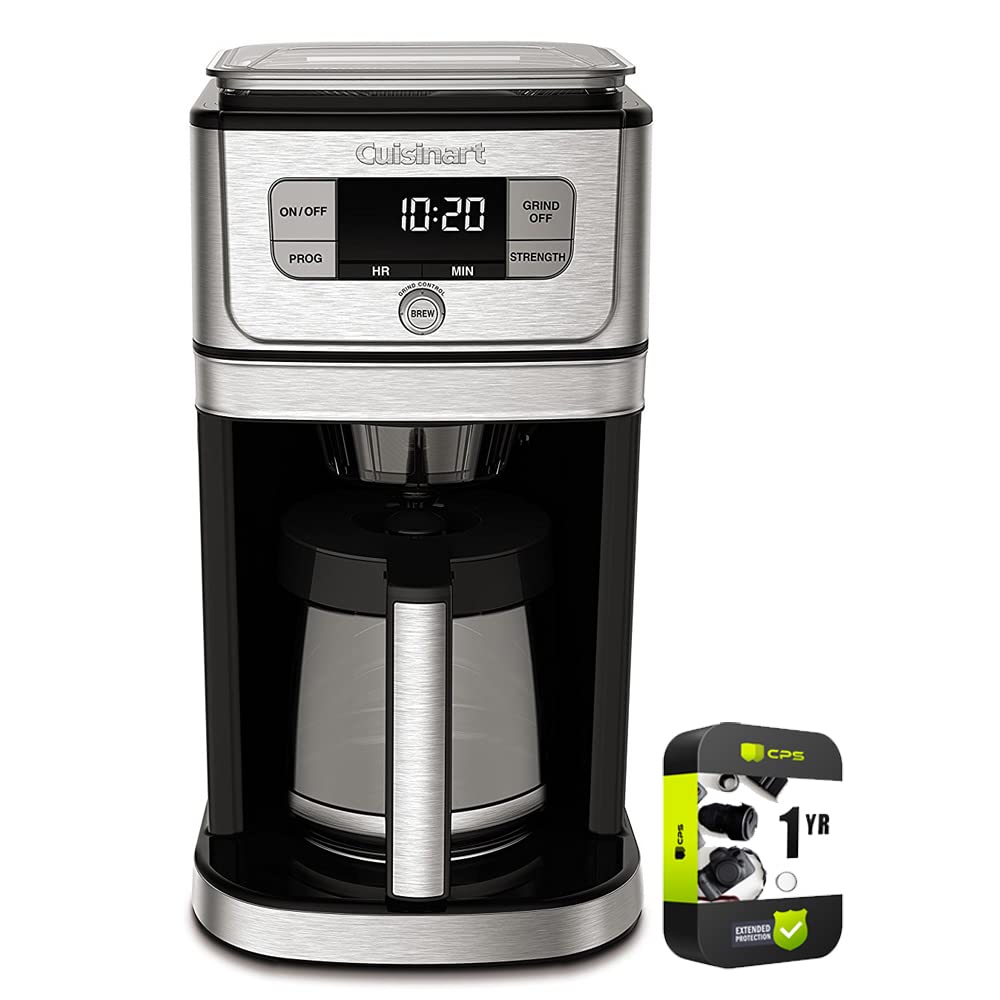
Cuisinart’s DGB-800 is a “kitchen workhorse” style grind-and-brew: big glass carafe, large bean hopper, and the kind of feature set that’s built for households that make coffee every single day without treating it like a hobby. The standout features here are practical: a DirectFlow grind path that drops grounds straight into the brew basket, plus an AutoRinse feature designed to push leftover grounds through so you’re not constantly disassembling grinder parts.
This bundle version is especially interesting for a real buyer because it’s aimed at the exact anxiety people have with built-in grinders: “What if the grinder acts up?” Extra protection can be a comfort if you’re buying a machine that you expect to carry the daily load in a busy home or office kitchen.
Now for the honest, expert part: the DGB-800 tends to make the most sense when you brew in its comfort zone. It’s built around family-size batches. Several owners love the coffee quality but dislike one specific limitation: you typically can’t truly “micro-brew” using the grinder. If you’re a two-cups-only household, this can feel like wasted beans unless you get smart about using the grind-off mode with pre-ground coffee for small batches.
The other real-world point is the glass carafe. Cuisinart carafes are functional, but they’re not always the cleanest pour on the market. If you’re the type who pours coffee half-asleep at a steep angle, you’ll want to use a slow pour and consider removing the lid as the pot gets low. That tiny habit solves most “why did it dribble?” complaints.
Why it stands out
- Built for big-batch living – A true 12-cup machine for families, guests, and “one pot for everyone” mornings.
- Smart core features – DirectFlow + AutoRinse are designed to reduce grind retention and daily mess.
- Strength + grind controls – Three strength options and programmable batch sizing help you dial flavor without guesswork.
- Great as an “office coffee” machine – Simple, familiar drip behavior with the upgrade of fresh grinding.
Good to know
- Not ideal for tiny batches – If you only want one or two cups, you’ll often be happier using pre-ground with grind-off.
- Carafe pour technique matters – Some users need a slower pour as the carafe empties to avoid drips.
- Grinder reliability varies by user habits – Keeping the hopper clean and avoiding sticky oil buildup helps a lot.
Ideal for: households that regularly brew larger pots and want a feature-rich grind-and-brew—especially if extra protection coverage helps you buy with confidence.
3. Melitta Aroma Fresh Plus – Clean Design, Smooth Routine, Easy Morning Coffee
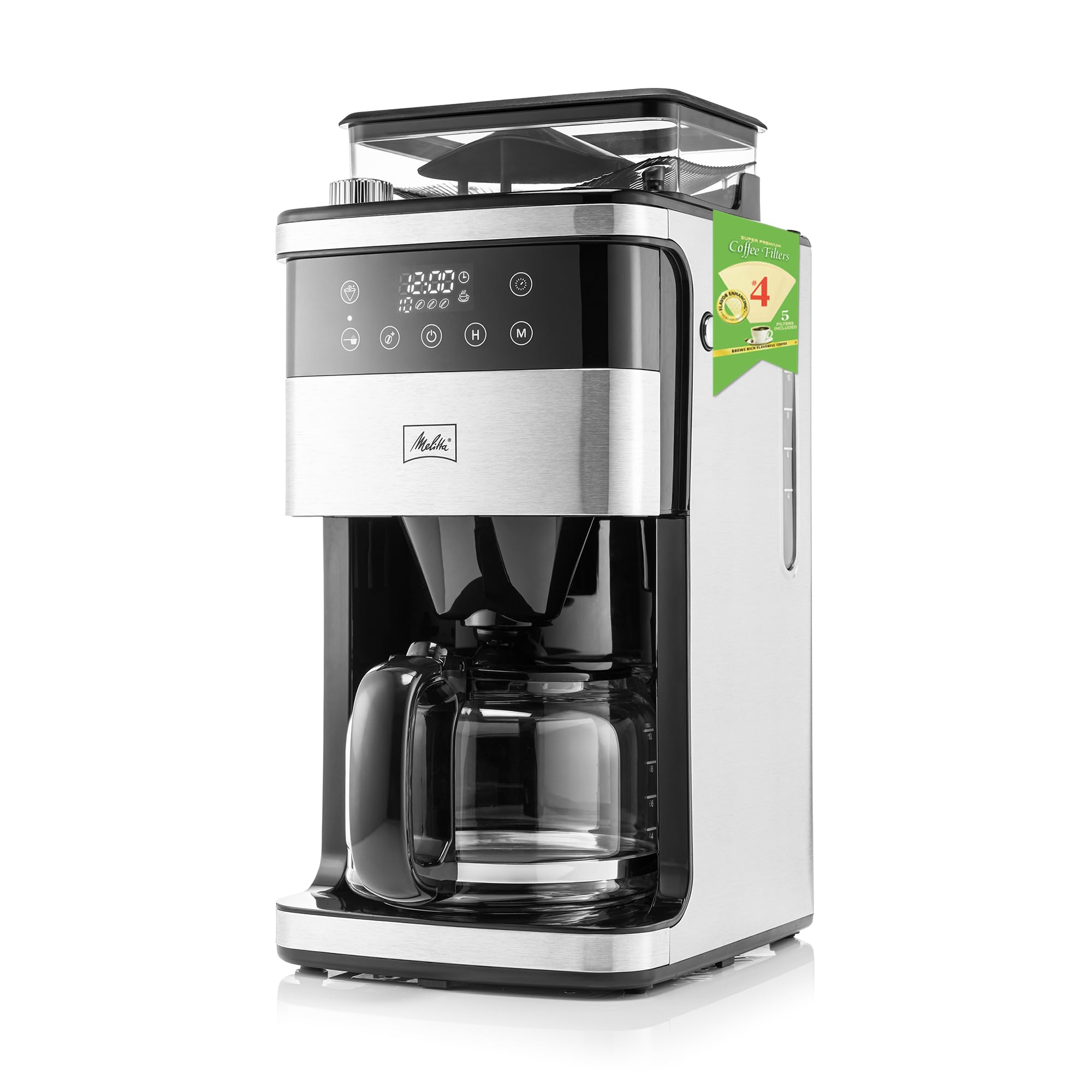
Melitta is one of those brands that coffee people quietly respect because it’s been about good extraction for decades. The Aroma Fresh Plus is a modern “set it and enjoy it” interpretation of that idea: built-in conical burr grinder, a clear bean hopper, grind adjustment from fine to coarse, and multiple strength settings so you can push your coffee toward bright and clean or deeper and bolder.
Where this machine tends to win in real homes is simplicity that doesn’t feel cheap. It looks tidy on the counter, doesn’t scream for attention, and focuses on straightforward brewing. For many people, that’s the dream: choose a grind, choose a strength, set a timer, and wake up to coffee that smells like you just opened the bag.
The biggest “expert tip” with the Melitta is how you handle first-week flavor. A lot of new machines (from any brand) benefit from a rinse cycle to remove manufacturing odors. Owners who do a proper clean-and-flush early tend to report a much smoother experience. After that, the most important improvement you can make is to treat the strength setting as a fine-tuner and treat the water level as your main lever. If you want a fuller cup, slightly reduce water and use the stronger setting—don’t just push everything to “max” and hope. That’s how grounds get pushed around, and mess follows.
One more real-world note: if you pack the filter basket too aggressively (very fine grind + high dose + full pot), some machines can get messy where water meets coffee. If you brew strong coffee daily, consider using a paper filter (even if a reusable filter is included) because it simplifies cleanup and can improve cup clarity. Paper filters are basically a cheap “taste upgrade” and a cleanup upgrade in one.
Why you’ll like it
- Morning-friendly design – Clean layout, straightforward controls, and a workflow that feels natural.
- Grind + strength flexibility – Enough adjustment to satisfy picky drinkers without becoming complicated.
- Compact footprint for a 10-cup unit – A solid choice when you want full-size capacity without a bulky look.
- Great “everyday coffee” personality – Balanced flavor that works with a wide range of beans.
Good to know
- If you crave ultra-heavy, espresso-like body, you may need to brew fewer cups or use a finer grind to push extraction.
- The last bit of coffee can require a more deliberate pour (a common carafe quirk across many drip machines).
- Like all built-in grinders, it benefits from consistent brushing and keeping moisture away from the hopper.
Ideal for: households that want a smooth, reliable daily routine with a respected coffee brand vibe and enough control to dial flavor without overthinking it.
4. Capresso 464.05 CoffeeTeam GS – Steel Burrs, Slow Grinding, Big Aroma

The CoffeeTeam GS is the “classic Capresso” approach: robust steel conical burrs, slower grinding that generates less heat, and a brew process designed to preserve aroma rather than rush it. If you’re the kind of person who can taste the difference between “fresh ground” and “sat in a bag for a week,” this machine is designed for you.
One of the smartest things about the CoffeeTeam GS style is how it treats grinding like part of brewing, not a separate event. The goal is consistency: the machine grinds what it needs for the amount you selected, then moves smoothly into brewing. When machines get this transition right, coffee tastes sweeter and cleaner, because you’re not getting those random “weak pot” days caused by inconsistent dosing.
The most important real-life skill with this model is water discipline. The cup settings are helpful, but they don’t replace your judgment. If you want a strong 6-cup pot, fill for 6 cups—not “a little extra because why not.” A tiny extra splash of water can soften your coffee more than you’d expect, because burr-ground coffee is consistent enough that your ratio becomes the main driver of flavor. That’s great news: once you learn your preferred ratio, you can hit your perfect pot repeatedly.
Owners who love Capresso tend to say the same thing: if you keep the grinder path clean, this style of machine can feel like it “just works.” Owners who get frustrated often run into two issues: switching beans constantly (especially oily beans) and letting fine grounds build up where the grinder feeds. Neither is complicated to manage—you just need a two-minute habit.
Why it’s a strong pick
- Excellent aroma preservation – Slower, cooler grinding helps keep coffee smelling and tasting fresh.
- Dialable strength – Once you learn your water-to-coffee preferences, it becomes very repeatable.
- Classic drip convenience – A familiar workflow that’s easy for family members and guests to use.
- Solid long-term reputation – Many buyers see it as a serious upgrade from entry-level grind-and-brew units.
Good to know
- Switching between caffeinated and decaf can be fussy—purging or using pre-ground can be easier for frequent switching.
- Some users report occasional feed issues over time if grounds build up—weekly brushing prevents most of it.
- Glass-carafe systems can develop “hot plate taste” if coffee sits too long—brew smaller batches if you sip slowly.
Ideal for: people who want classic drip convenience with a grinder that takes aroma seriously—and who don’t mind a simple maintenance routine to keep it performing at its best.
5. Gevi 10-Cup Touchscreen (4 Brew Styles) – Great If You Love Options (Especially Iced)

The Gevi touchscreen model is built for people who like their coffee routine to feel modern: big responsive touch panel, programmable brewing, adjustable keep-warm time, and multiple brew styles so you’re not stuck with “one personality” coffee every day.
Let’s talk about the iced feature, because it’s one of the best reasons to consider this machine. A true iced setting isn’t just “brew hot coffee and dump it on ice.” Done well, it brews a stronger, more concentrated coffee so that when it hits ice, it lands balanced instead of watery. If you enjoy iced coffee but don’t want to do separate concentrate recipes, this kind of machine can be a real quality-of-life upgrade.
Now the expert reality: touchscreen machines are only as good as their workflow. Some users love the convenience and say it grinds fast and brews a flavorful pot. Others report two common frustrations:
- Cleaning access: if you don’t keep the grinder area dry and brushed, fine grounds can accumulate and performance can drift.
- Programming quirks: delay brew features are fantastic when intuitive, but frustrating if the interface logic isn’t immediately obvious.
The best way to win with this Gevi is to set it up like a routine: keep your beans dry, don’t overload the hopper, and brush the grinder exit weekly. Then use the brew styles the way they’re intended: Classic as your baseline, Rich/Intense when you want deeper flavor, and Ice when you’re brewing specifically to chill.
Why you’ll like it
- Touchscreen convenience – Easy to adjust settings quickly, even when you’re half awake.
- Multiple brew styles – Great if you rotate between bold mornings and lighter, smoother cups.
- Iced mode – A standout feature for warm climates and iced-coffee households.
- Custom keep-warm time – Helpful when people grab coffee at staggered times.
Good to know
- Some users find cleaning less convenient than simpler machines; built-in grinders reward consistent upkeep.
- If you struggle with programming, a quick manual deep-read is worth it—this isn’t a “guess and go” interface.
- Water reservoirs on many modern machines are plastic and can feel smaller than expected—measure and fill intentionally.
Ideal for: people who want modern control, iced coffee capability, and flexible settings—especially if you enjoy experimenting with different coffee “moods.”
6. Gevi 10-Cup (Blooming / Pre-Brew) – A Hidden Feature That Can Make Coffee Taste “Smoother”
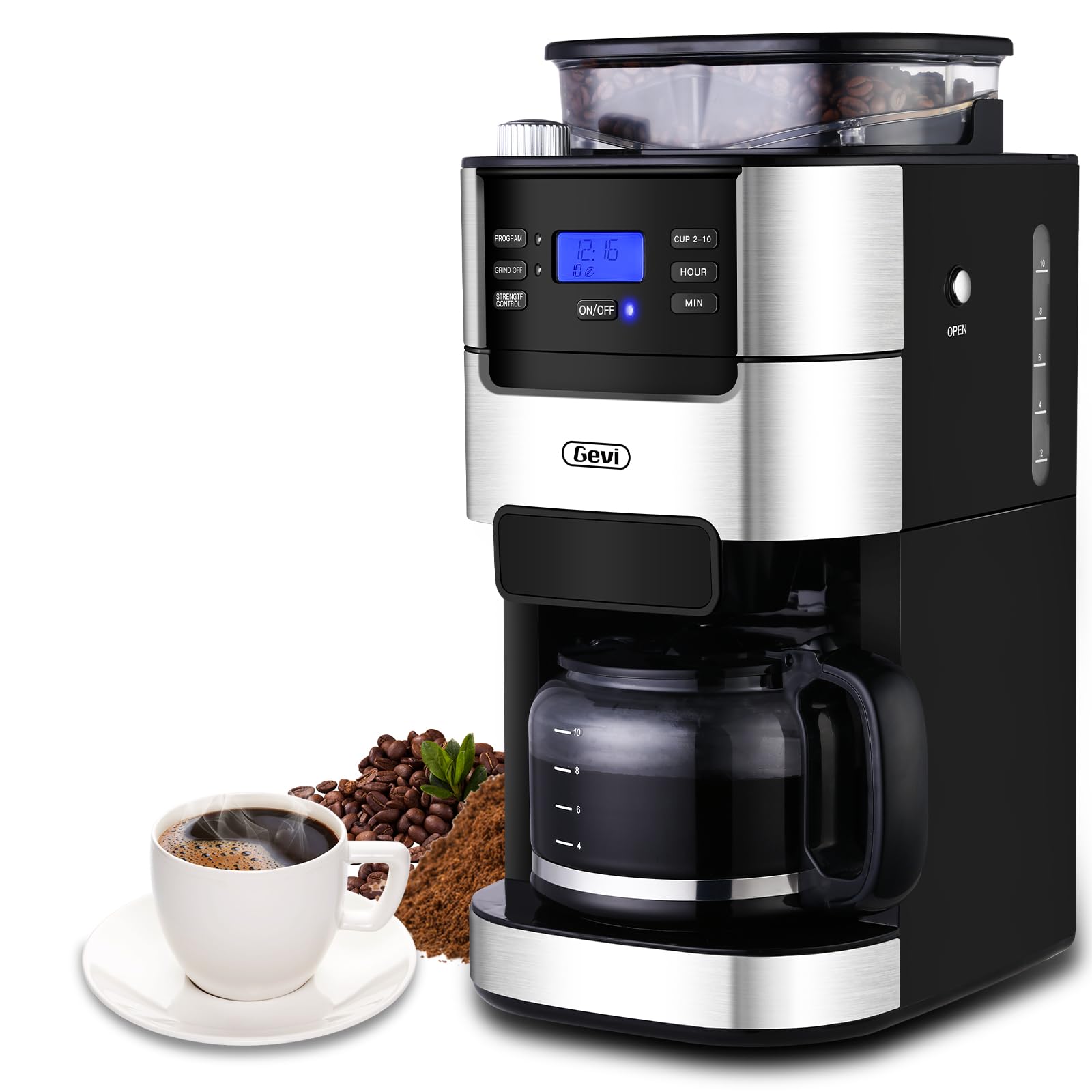
If you’ve ever watched a pour-over brew bloom—where the first splash of water wets the grounds and they puff up as gas releases—you already understand why pre-brew features matter. This Gevi model includes a pre-brew / blooming style setting that, when used correctly, can push your coffee toward a smoother, richer extraction without needing you to stand there stirring.
Here’s what that means in human terms: coffee can taste harsh when water rushes through dry grounds unevenly. A short pre-wet step helps the bed extract more evenly, especially with fresh beans that still contain lots of CO₂. The result often tastes “rounder” and less sharp—particularly at stronger settings.
The biggest win with this Gevi is that it gives you meaningful control: multiple strength levels, multiple grind settings, and the ability to choose 2–10 cups. But this machine also highlights one of the most common grind-and-brew mistakes: people assume the machine will “know” how much water to use. In practice, you still have to fill the reservoir for the amount you want to brew. If you love strong coffee, don’t just select “strong”—brew fewer cups (less water) or use a slightly finer grind and keep the batch smaller.
Owners who love this model often say it replaced older machines that were inconsistent or annoying to clean. Owners who get frustrated typically report two things: awkward water filling (rear tank + cabinet clearance) and occasional quality control quirks (like leaks). The expert move is simple: when it arrives, do a water-only test cycle and check for any seeping before you commit to loading beans. After that, keep the machine on a stable counter, and fill water carefully to avoid splashing into seams and vents.
Why it’s interesting
- Pre-brew/blooming can upgrade flavor – A legit technique baked into an automatic workflow.
- Strong customization – Multiple grind and strength settings give you real control over taste.
- Good “replace my old grind-and-brew” candidate – Many users move to this after years of grinding separately.
- Reusable filter included – Works out of the box, and you can still use paper filters if you prefer easier cleanup.
Good to know
- The pre-brew setting can be easy to miss; reading the manual pays off here.
- Rear water tanks can be awkward under cabinets; you may need to slide it forward to fill.
- Some users prefer paper filters because permanent filters can be annoying to scrub clean.
Ideal for: people who want more control over flavor than a basic grind-and-brew offers—and who like the idea of “pour-over style” smoothness without manual brewing.
7. Gevi 10-Cup Black (Buttons) – Great Coffee When It’s Dialed In, Watch the Water Tank
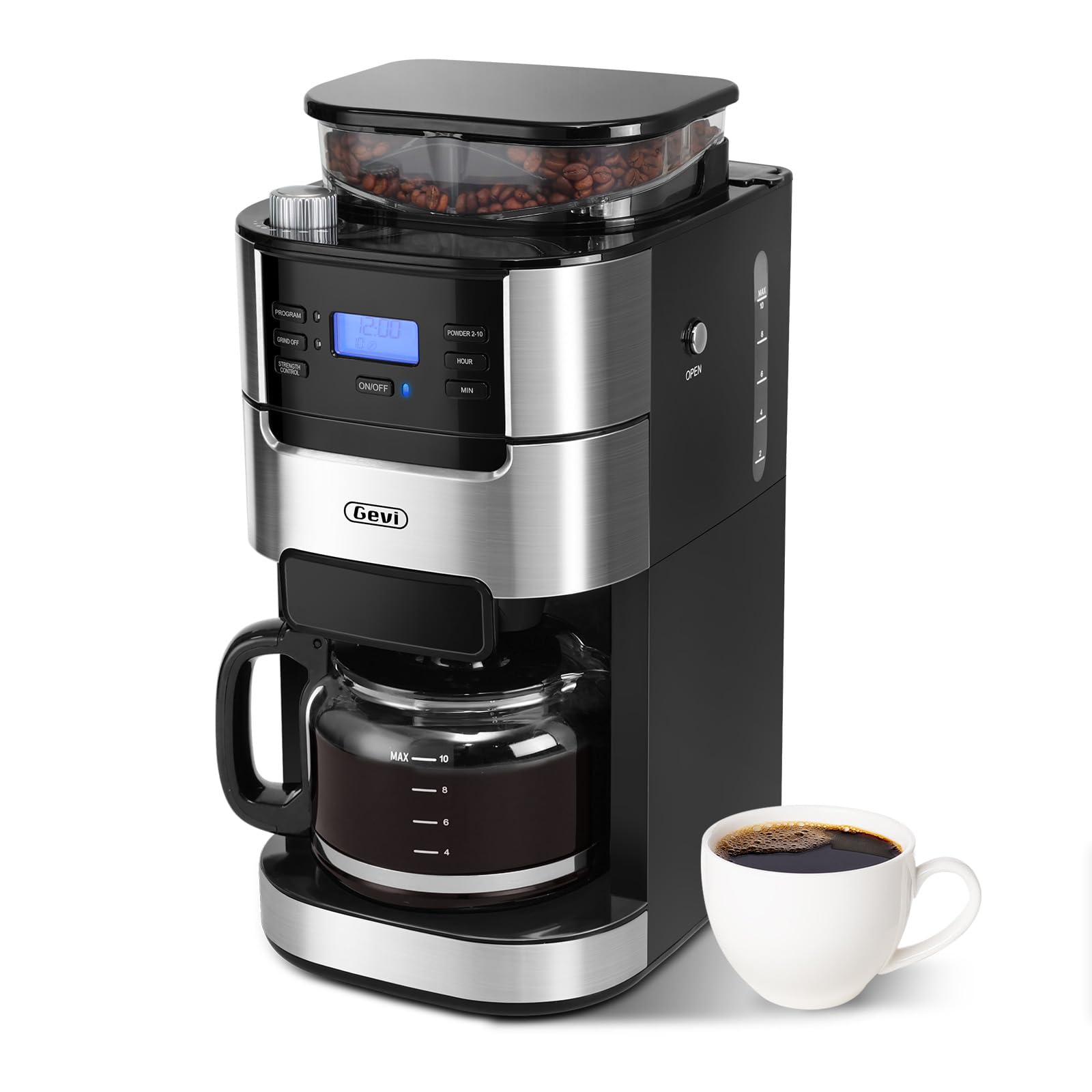
This Gevi version is the “buttons instead of touchscreen” take on the same overall idea: built-in burr grinder, programmable timer, adjustable keep-warm time, and multiple grind/strength options so you can tailor the pot. For a lot of kitchens, buttons are a feature—not a downgrade—because they’re simpler when multiple people use the machine.
When owners love this model, they describe it in a very specific way: better tasting than their old big-brand grind-and-brew, quieter than expected, and easy enough that it becomes a daily ritual. The grinder is the highlight because fresh grounds right before brewing often makes coffee taste instantly more aromatic and “alive.”
When owners hate it, the complaints are also very specific: the water reservoir can be a weak point on some units, and a few users report sudden leaking that makes the machine unusable. That doesn’t mean it’s guaranteed to happen, but it does mean you should treat the first month like a proving period: do water-only tests, place it on a stable surface, and avoid overfilling or splashing water into seams.
Flavor-wise, this machine rewards two smart habits:
- Use the strongest setting with intention – it often increases the dose, so match water carefully instead of “topping off.”
- Consider a paper filter – even if you like the reusable filter, paper makes cleanup easier and can smooth out the cup.
If you keep the grinder path clean and you treat water filling like a deliberate step, this Gevi can produce a pot that feels like a real upgrade from pre-ground coffee—without needing a separate grinder on the counter.
Why it can be a great buy
- Buttons are easy for everyone – Great for shared kitchens and households with multiple coffee drinkers.
- Strong grind/strength control – Lots of room to dial taste, from mellow to bold.
- Freshness upgrade – Built-in grinding can make even “everyday beans” taste noticeably better.
- Programmable morning convenience – Great for people who want coffee ready without thinking.
Good to know
- Water tank design can be a pain point for some users—check for leaks early and fill carefully.
- Rear filling can require moving the machine if it sits under cabinets.
- Built-in grinders need brushing; neglect can lead to drift in grind performance over time.
Ideal for: people who want customization and fresh grinding but prefer a simple, button-based interface—and who will do a quick early test to confirm the water tank behaves properly.
8. Gourmia 10-Cup Grind & Brew – Great Idea, Best for People Who Actually Clean

The Gourmia grind-and-brew is appealing for a simple reason: it offers the “fresh grind + programmable pot” lifestyle without forcing you into premium-brand pricing. And when it works well, people describe exactly what you’d hope: more flavorful coffee than pre-ground, easy strength adjustment, and a kitchen routine that feels more put together.
But here’s the expert truth that matters: budget grind-and-brew machines tend to live or die on one design detail— how well the grinder and chute handle fine particles. Multiple user reports describe clogs between grinder and filter, shutdowns mid-brew, and messy resets that require disassembly and reprogramming. That doesn’t mean every unit behaves that way, but it does mean this is not the best choice for someone who wants to “never think about maintenance.”
If you buy this model, treat it like a machine that needs a small routine:
- Don’t grind too fine – finer grinds can clump and stick in budget chutes, especially with oily beans.
- Brush regularly – a quick weekly brush can prevent that slow buildup that becomes a clog.
- Keep beans dry – humidity + oils are the enemies of smooth grinder flow.
Also, learn the power/keep-warm behavior early. Some machines interpret “power” as “start brewing again,” which can be annoying if you just want the warming plate off. The easiest win is to use the built-in auto shutoff and let the machine finish its cycle cleanly before you press anything else.
Why it’s worth considering
- Fresh grind flavor boost – When operating smoothly, it delivers a noticeable upgrade over pre-ground coffee.
- Programmable convenience – Set a brew time, wake up to a pot, and keep it warm for your morning flow.
- Simple concept – A straightforward grind-and-brew layout that many people find easy once learned.
- Good for casual coffee households – If you don’t need perfection, it can be a strong value.
Good to know
- Some users report grinder clogs and shutdowns; this is not the best “maintenance-free” choice.
- Interface behavior can be unintuitive (especially around turning the warmer off).
- Consistency often depends on bean type and grind settings—medium grinds usually behave best.
Ideal for: budget-minded buyers who want fresh-ground coffee and are willing to do a little upkeep to prevent clogs and keep performance consistent.
9. Cuisinart DGB-800 (Machine Only) – Big Capacity, Big Payoff If You Learn the Settings

Think of this listing as the “straight to the point” version of the DGB-800: the machine itself, without the bundle extras. And if you’re someone who likes getting strong performance without paying for bells and whistles, this can be a smart way to get a true 12-cup grind-and-brew into your kitchen.
But here’s what separates happy owners from frustrated owners: you have to understand what the machine is doing with its settings. The DGB-800 is built around 4–12 cup grinding logic, and it expects you to match water to your intent. If you want a 6–8 cup pot, fill the reservoir to that level and use the grind and strength settings as your fine-tune. If you want a very strong pot, don’t just use “extra bold” and keep the water maxed—brew fewer cups or reduce water.
An expert dialing approach that works well on machines like this:
- Pick a baseline: choose “regular” strength and a mid-size brew (like 6–8 cups) to learn the machine.
- Adjust one thing at a time: if it’s weak, either brew less water or increase strength—not both at once.
- Use grind-off strategically: for small batches, decaf nights, or when you want to bypass the built-in grinder entirely.
Cleaning is another big factor. The DGB-800 includes features meant to reduce leftover grounds, but you still want to keep the filter area clean and wipe any stray grounds before moisture turns them into sticky paste. If you do that, this machine can feel like a very “grown-up” upgrade: real burr grinding without needing a separate grinder, and enough capacity to serve a household smoothly.
Why it’s a smart buy
- True 12-cup capacity – Great for families, guests, and anyone who brews big batches regularly.
- Strength + grind logic – Lets you tune coffee once you understand how the machine doses.
- Grind-off flexibility – Makes small-batch brewing and decaf switching easier.
- “Learn it once, love it for years” potential – Owners who dial it in tend to stick with it.
Good to know
- Not ideal for true 1–2 cup grinding; small batches are often best with grind-off + pre-ground coffee.
- Glass carafes can drip if poured aggressively—slow, steady pouring helps.
- Some users report grinder issues over time; consistent cleaning habits reduce risk.
Ideal for: big-batch coffee drinkers who want a strong value and don’t mind spending a few days learning the machine’s “strength + water” relationship.
10. AIRMSEN Espresso Machine + Burr Grinder – The Home Latte Path (With Practice)
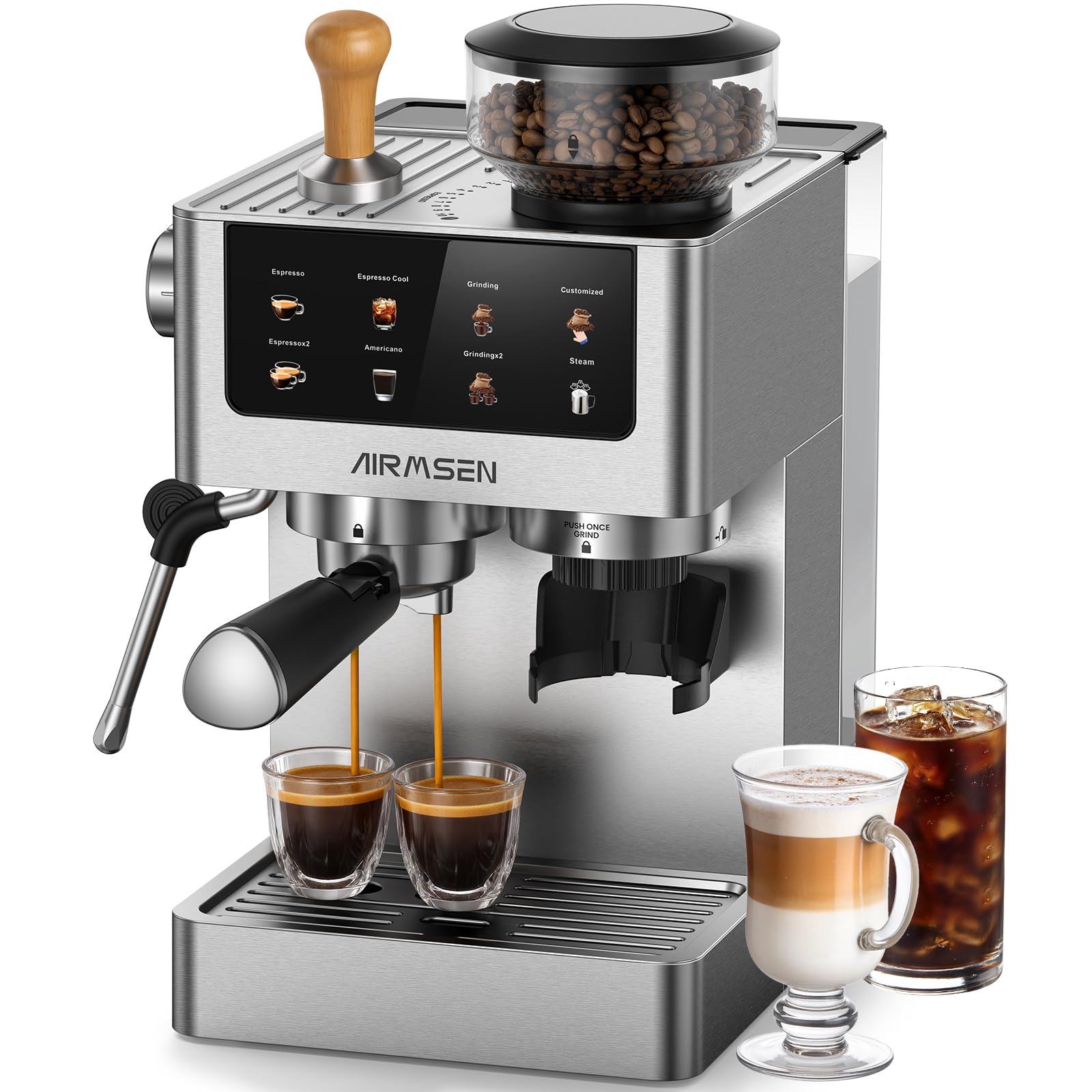
This one is different from the rest of the list—and that’s exactly why it’s here. If your “best coffee” is a cappuccino, latte, or americano (not a drip pot), a drip grind-and-brew will never fully scratch that itch. An espresso machine with a built-in burr grinder is the path to café-style drinks without leaving your kitchen.
The AIRMSEN is an all-in-one concept: built-in conical burr grinder with multiple grind settings, touchscreen control, high-pressure extraction, and a manual steam wand for milk texturing. When users love it, they describe it as a genuine “coffeehouse at home” upgrade: rich crema, strong espresso, creamy foam, and the convenience of grinding fresh for every shot.
Now the expert reality: espresso is a skill. A drip machine forgives sloppy ratios; espresso exposes them. If you buy this machine, the first week should be about dialing:
- Start with fresh beans and a medium roast (too oily can be messy; too light can be hard to extract).
- Adjust grind slowly—one step at a time—and aim for a shot that tastes balanced (not harsh, not watery).
- Use the steam wand intentionally: purge it before and after, and wipe immediately so milk doesn’t bake onto the metal.
Also be realistic about mess. Espresso grinders can be static-y, and some users report grounds scattering. That’s not a dealbreaker, but it does mean you’ll want a small brush nearby and a quick wipe routine. In exchange, you get something a drip machine can’t deliver: a shot-based drink system that can do lattes, cappuccinos, americanos, and iced coffee styles from the same compact machine.
Why it’s exciting
- Espresso + grinder in one – No separate grinder required to start pulling fresh shots.
- Milk frothing wand – Makes real cappuccinos and lattes, not just “coffee with warm milk.”
- Great for variety drinkers – Espresso, americano, iced styles, and milk drinks in one setup.
- Feels like a home upgrade – A strong choice if you want to level up beyond drip coffee.
Good to know
- There’s a learning curve—expect a dialing-in phase to find your best grind and shot style.
- Some users report messy grinding or finicky touch controls; keep a brush nearby and be patient.
- If you only want a set-and-forget pot, a drip grind-and-brew will suit you better.
Ideal for: latte and cappuccino lovers who want café-style drinks at home and are willing to practice for a week to dial espresso flavor and milk texture.
How Burr-Grinder Coffee Makers Actually Build Flavor (and What to Tweak First)
Once you buy a machine with a built-in burr grinder, you’re stepping into “small decisions matter” territory—in a good way. The coffee usually gets better fast, but only if you know which levers actually change taste.
What really changes flavor in a grind-and-brew machine
- Grind consistency – Burr grinders produce more uniform grounds, which makes extraction more even and flavor more predictable.
- Ratio (coffee to water) – The simplest truth: more water = weaker taste, less water = stronger taste (assuming grind is reasonable).
- Contact time – Longer brew times can extract more (sometimes better, sometimes bitter). Some machines brew slower by design.
- Pre-wet / blooming – Pre-infusion can reduce harshness by helping grounds extract evenly, especially with fresh beans.
- Heat management – Warming plates can “cook” flavor over time; thermal-style holding keeps taste closer to the first cup.
The reason built-in grinders sometimes disappoint is not “burr grinders are bad”—it’s usually one of three things: the grind is set too fine (clumping/clogging), the water is overfilled for the selected dose (weak coffee), or old grounds and oils are building up and interfering with flow.
Fast fixes that improve results immediately
- If coffee tastes weak: brew fewer cups (less water) before you crank “strength” to maximum.
- If coffee tastes bitter: go slightly coarser, or brew fewer minutes (if your machine allows time control).
- If coffee tastes sour/sharp: go slightly finer or choose a stronger setting; also make sure water is hot and you’re not under-dosing.
- If your grinder clogs: move the grind coarser and brush the chute weekly—fine dust + oils is the clog recipe.
- If your last cup tastes “off”: shorten keep-warm time, or switch to a thermal-style carafe model.
- If you hate cleaning: use paper filters even when a permanent filter is included—cleaner basket, cleaner cup, less sludge.
If you do just two things—measure your brew water carefully and keep the grinder path clean—you’ll unlock most of the benefit of a burr grinder coffee maker with almost zero ongoing effort.
FAQ: Burr Grinder Coffee Makers, Answered
Is a built-in burr grinder really better than using pre-ground coffee?
Why does my coffee taste weak even on the “Strong” setting?
Should I leave beans in the hopper?
How do I prevent grinder clogs and “grounds not dispensing” problems?
Can I use pre-ground coffee in these machines?
Final Thoughts: Choose the Right Machine Once, Enjoy Better Coffee Daily
A burr-grinder coffee maker can be the most practical “quality upgrade” you make in your kitchen—because it improves coffee without adding steps. The key is matching the machine to your actual routine: batch size, sipping speed, and your willingness to do a tiny bit of weekly maintenance.
Here’s a quick, confident way to decide:
- Want the most balanced, flavor-first choice for most homes? Start with the Capresso 465 CoffeeTeam TS. It’s the best blend of taste, practicality, and everyday satisfaction.
- Brewing for a crowd (family, guests, office kitchen)? Go 12-cup with the Cuisinart DGB-800 Bundle (or the machine-only listing if you prefer a simpler purchase). Big capacity wins when you brew big pots consistently.
- Want a clean, simple daily routine with solid control? The Melitta Aroma Fresh Plus is a smooth “daily driver” option that suits a wide range of beans and drinkers.
- Love iced coffee or want modern touch control? The Gevi 10-Cup Touchscreen is the one built for variety and flexibility—especially if you actually use those brew styles.
- Want café-style milk drinks at home? Skip drip and go espresso with the AIRMSEN Espresso Machine + Burr Grinder. Just expect a short learning curve while you dial shots and steam milk.
Any of these can become your best burr grinder coffee maker once you match capacity to your household, choose the right carafe style for how you drink coffee, and commit to one small habit: keep the grinder path clean and dry. Do that, and you’ll stop thinking about the machine—and start enjoying coffee that tastes like you finally leveled up.
