
Specs are compiled from manufacturer listings and verified buyer reviews and can change over time — please confirm the key details on the product page before buying.
If you are building or upgrading a solar setup, the battery is the part that decides whether your panels actually pay off at night and through cloudy stretches. The short answer: lithium iron phosphate (LiFePO4) packs give you far more usable power for the same space, while sealed lead-acid (SLA/AGM) remains the cheapest entry point if you rarely deep-discharge. This guide breaks down eight real options so you can match chemistry, capacity, and build to how you actually use your system.
I’m Mohammad Maruf — the founder and writer behind KitchPrep. This guide is built by comparing the manufacturers’ published specifications and the patterns across verified customer reviews, so you get each pick’s real strengths and trade-offs instead of marketing spin.
You will see how amp-hour ratings, cycle life, and battery management systems (the electronic guard that stops a battery from overcharging or draining too far) translate into nights of real runtime. By the end you will know exactly which battery for 12v solar panel fits your panels, your space, and your budget.
Our Picks at a Glance


How To Choose The Best Battery for 12V Solar Panel
A solar panel makes power only when the sun is out, so the battery is what carries you through the dark. Picking right depends on three things: the chemistry inside the case, how much energy it truly delivers, and whether its protections match your climate and how hard you cycle it.
Chemistry first: lithium versus lead-acid
A LiFePO4 battery (a lithium iron phosphate pack) can be drained deeply and still bounce back thousands of times, and it weighs far less for the same capacity. A sealed lead-acid battery costs less upfront and is simple to live with, but it is heavier and wants shallower discharges to last. If your system cycles every single day, lithium usually wins on usable power per pound; if it mostly sits in standby, lead-acid can be the smarter spend.
Match capacity to your nightly load
Amp-hours (Ah) measure how much charge a battery holds, and voltage (V) is the push behind it — multiply the two for watt-hours (Wh), the real energy you can draw. Add up what runs overnight — lights, a fridge, a router, a pump — then size the bank so you are not draining it to empty every night. A deeper discharge on a lithium pack is fine; on lead-acid, plan to use only about half so you do not cook the plates.
Charging and cold-weather protection
Your panels feed the battery through a charge controller (the device that regulates the incoming current), and a matching lithium or AGM profile keeps the pack healthy. In freezing weather, low-temperature cut-off matters: a BMS (battery management system — the built-in electronic guard) will stop charging a cold lithium battery before the chemistry is harmed, and the same guard blocks overcharge, over-discharge, and short circuits.
Quick Comparison
| Model | Best For | Capacity | Chemistry | Weight | Amazon |
|---|---|---|---|---|---|
| MARSENERGY 12V 100Ah LiFePO4★ Best Overall | All-round solar storage | 100 Ah | LiFePO4 | 21 lb | Amazon |
| GOLDENMATE 12V 20Ah LiFePO4Compact Pick | Small off-grid gadgets | 20 Ah | LiFePO4 | 5.95 lb | Amazon |
| WEIZE 12V 100Ah Deep CycleBudget Champion | Budget cabin and RV backup | 100 Ah | Sealed Lead Acid | 60 lb | Amazon |
| yeagulch 12V 150Ah LiFePO4 | Big banks in tight spaces | 150 Ah | LiFePO4 | 41 lb | Amazon |
| LiTime 12V 50Ah LiFePO4 | Bluetooth monitoring and trolling | 50 Ah | LiFePO4 | 11.3 lb | Amazon |
| Interstate 12V 110Ah SLA/AGM | Heavy-demand deep cycling | 110 Ah | Sealed Lead Acid (AGM) | 71.5 lb | Amazon |
| GRNOE 2-Pack 12V 100Ah LiFePO4 | Building a 200Ah bank | 100 Ah each | LiFePO4 | 22.4 lb each | Amazon |
| VMAX SLR125 12V 125Ah (Qty 2) | Long-life AGM solar banks | 125 Ah each | AGM | 60 lb each | Amazon |
In‑Depth Reviews
1. MARSENERGY 12V 100Ah LiFePO4 Battery, BCI Group 24, 100A BMS
Our pick — over 4.5★ from 250+ verified ratings; the strongest balance of quality and price.
The 100Ah lithium pack that drops straight into a Group 24 lead-acid box.
Here is the number that decides it for most solar owners: 100 amp-hours of usable storage in a case that runs 10.16 x 6.54 x 8.64 inches and weighs just 21 pounds. That is light enough for one person to lift onto a shelf or into a battery box without a helper, and the size matches the BCI Group 24 standard — so if you already have a Group 24 lead-acid box, this is a straight swap. It also fits larger Group 27 or 31 trays, which gives you room to grow.
Want the battery to still be working years from now? MARSENERGY rates the cells for 4,500 deep cycles at 100% depth of discharge — meaning you can drain it flat repeatedly, unlike a lead-acid pack that wants to stay half full. At lighter 80% and 60% depths those ratings climb to 8,000 and 15,000 cycles. Compare that to the 300-500 cycles a typical lead-acid battery delivers, and you can see where the long-term value sits. The integrated 100A battery management system (BMS — the built-in guard that cuts power if something goes wrong) adds overcharge, over-discharge, short-circuit, and temperature protection, and the cells carry low-temperature additives so they handle cold better than standard lithium.
For real-world proof, buyers report it lasted a full day of use while only drawing half its charge — “Excellent product, lasted all day only used half a charge. Definitely worth the money.” Others have used it to power an 80-watt transmitter and a 60-watt laptop at the same time, and one described how much weight it shaved off an RV’s tongue load. The one limitation to know: the BMS cuts off discharge at -4°F and charging at 32°F, so in hard freezes you should not expect it to accept a charge until it warms up.
What earns the top spot
- 100Ah of storage in a 21 lb case — one-person liftable
- Fits standard Group 24 boxes, plus larger 27 and 31 trays
- 15,000 cycles at 60% depth of discharge, far beyond lead-acid
- 100A BMS with temperature and short-circuit protection
Where it asks more of you
- Charging stops at 32°F — cold-climate owners need warming
- Terminals sit raised, so check your cable reach before install
Your best match: Anyone replacing a Group 24 lead-acid battery in an RV, cabin, or off-grid array who wants far more cycles for less weight.
Think twice if: You park your system in a spot that stays below freezing for weeks at a time — the BMS will refuse a charge there.
2. GOLDENMATE 12V 20Ah LiFePO4 Battery, IP67 Waterproof
A 5.95-pound workhorse for fish finders, LEDs, and small solar trickle setups.
Small solar systems do not need a 100Ah brick, and the GOLDENMATE 20Ah proves it. At 5.95 pounds and measuring 2.99 x 7.13 x 6.61 inches, it is a fraction of the size of the big Group 24 packs — that is a 3.4x difference in footprint compared to the MARSENERGY 100Ah above, so it disappears into a tackle bag or a tight RV compartment. The lithium iron phosphate chemistry still supports more than 5,000 charge cycles, and the built-in 20A BMS guards against overcharge, over-discharge, over-current, and short circuits.
The IP67 rating (fully sealed against dust and able to survive being dunked in water) is the detail that matters most for outdoor use. Mount it on a kayak, a boat, or a shed panel and rain or spray is not going to kill it. The low self-discharge rate holds a charge for up to a year in storage, so you can leave it in the garage through winter and pull it out for a camping trip. It supports continuous discharge up to 10A and recharges at up to 10A through a compatible lithium charger, an MPPT solar panel, or a generator.
Where it earns its keep is in the pattern buyers describe: two of these wired in parallel into a 40Ah bank on a fishing kayak, running a fish finder, navigation lights, and a GoPro USB port through four-day camping trips with no recharging needed. One reviewer noted the setup “lasts ~1 year, still perfect” with all-day use on the water. The recurring caveat is physical: the case is thin and the aluminum terminal posts will strip if you overtighten them, so snug the bolts rather than cranking them down.
The power-to-size read: You get a genuinely sealed, cycling-capable 20Ah pack that parallels up to four units for up to 51.2V 80Ah when you outgrow a single battery.
Fit note: Its 10A continuous discharge ceiling rules out high-draw tools and bigger inverters — this is a gadget and small-solar battery, not a whole-system one.
Reach for this if: You are powering a fish finder, LED strips, a 12V router, or a small solar trickle system that lives outdoors.
Look elsewhere if: You need to run a fridge or a large inverter — the 10A output limit caps what it can feed.
3. WEIZE 12V 100Ah Deep Cycle Battery, Group Size 31
The familiar big-box lead-acid, minus the maintenance.
If you want solar storage without a lithium price tag, the WEIZE 100Ah is the sealed lead-acid (SLA) option that sidesteps the worst part of old-school flooded batteries: no adding water. It arrives maintenance-free and spill-proof, sized at 12.99 x 6.73 x 8.34 inches to replace common 100Ah units, with a 3% self-discharge rate so it holds a charge through idle stretches. It also handles up to a 1150A max discharge current, which is far more surge than most solar systems will ever ask for.
Buyers have leaned on it hard in off-grid builds. Two of these AGM batteries ran a 700W inverter for 120V appliances on a two-year off-grid RV setup, and the pair arrived charged at 12.3V with a float of 13.8V and cyclic charge of 14.4V. In a home-backup setup, four in parallel with a 2000W inverter built a 4.8kWh bank that powered 120V outlets, fans, and garage openers. A recurring theme in the reviews is the absence of fluid checks — owners like that they can leave it sealed and forget it.
Here is the honest trade-off you need to plan around: this pack weighs in at 60 pounds. That is a substantial lift and near impossible to move around a crawl space or a tight battery bay without help, so decide on the final location before it lands. It is also a lead-acid battery, so treat it gently — pairing it with a trickle or smart charger keeps it topped up on standby, and using only about half its capacity per cycle is how you stretch its service life. Unlike the MARSENERGY lithium above, its cycle count is far lower, so daily deep cycling will wear it faster.
Why budget buyers stick with it: A maintenance-free sealed design, 1150A max discharge for surge loads, and 3% self-discharge make it an easy set-and-monitor bank for cabins, garages, and standby power.
Where it costs you: At 60 pounds it wants a permanent home, and roughly half its capacity is usable per draw if you want the plates to survive long-term.
Skill level and setup: Ideal for a cabin or RV owner building a mid-size bank on a budget who does not want to fuss with battery water.
Where it falls short: A long-lived daily deep-cycling routine — lead-acid will not outlast the lithium options here under that load.
4. yeagulch 12V 150Ah LiFePO4 Battery, 100A BMS
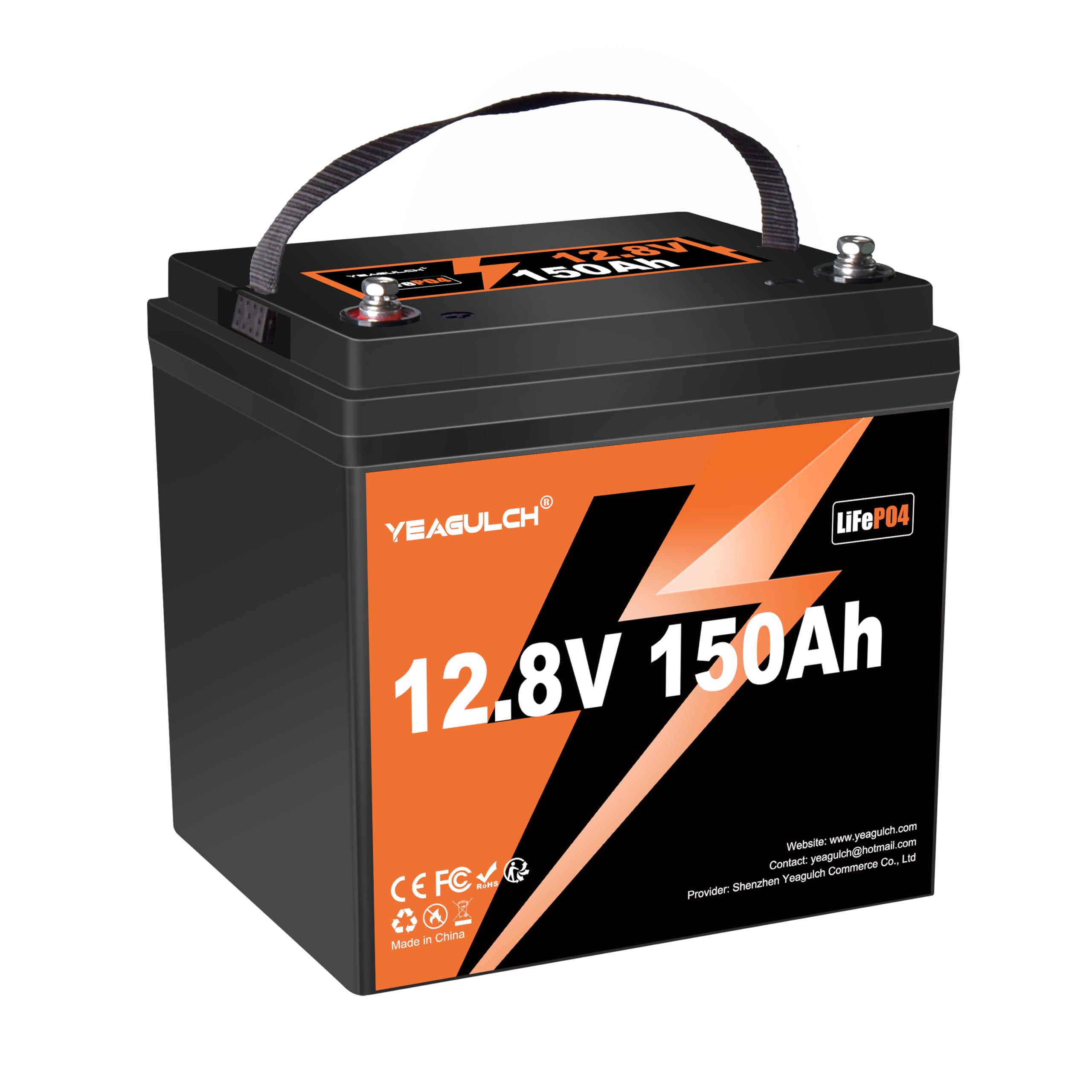
150 amp-hours of lithium storage that still tucks into tighter bays.
When 100Ah is not enough but a pair of batteries will not fit, the yeagulch 150Ah is the middle path. It packs 1290Wh into a case measuring 10.01 x 7.68 x 9.84 inches and weighing 41 pounds — the extra capacity sits in a body closer to a single-battery footprint than a multi-pack. The 100A BMS adds low-temperature cut-off, stopping the charge at 32°F to protect the cells, and a high-temperature cut-off at 149°F. It also allows up to 15,000 cycles at a 60% depth of discharge, and you can chain four units in series for a 51.2V system or four in parallel for 600Ah total.
Owners running solar stations have pushed this hard and gotten results. One buyer mentioned it fully charged off panels in about half a day and was still holding full power after six months. Another ran it on a trolling motor all day with only a third of capacity used, then recharged it in under 20 minutes. The BMS here has no Bluetooth — you monitor it through a separate shunt or through the voltage readout on your solar controller, which is a small extra step if you like phone-based tracking.
What owners flag honestly is battery life. Amazon’s own consensus reflects a mixed picture: some packs hold their charge well over time, while others report quicker drain. If that gives you pause, note that reliability still earns the top score from buyers overall. The important caveat is charging: the pack needs a lithium charge profile and should be topped up once every six months even when idle, and it will not start a gasoline engine, run a golf cart, or power a jack. It is for storage and cycling, not cranking.
What it gives you
- 1290Wh in a 41 lb, 10.01 x 7.68 x 9.84 inch case
- 15,000 cycles at 60% depth of discharge
- Low-temp cut-off at 32°F and high-temp cut-off at 149°F
- Scalable to 600Ah parallel or 51.2V series
What to plan around
- No Bluetooth — monitoring needs a shunt or your charge controller
- Not made for engine starting or golf carts
Made for: Off-grid and RV owners who want more capacity per battery and do not mind checking power through a controller.
Not your pick if: You expect a phone app to show live status — this pack keeps it wired.
5. LiTime 12V 50Ah LiFePO4 Battery for Trolling Motors
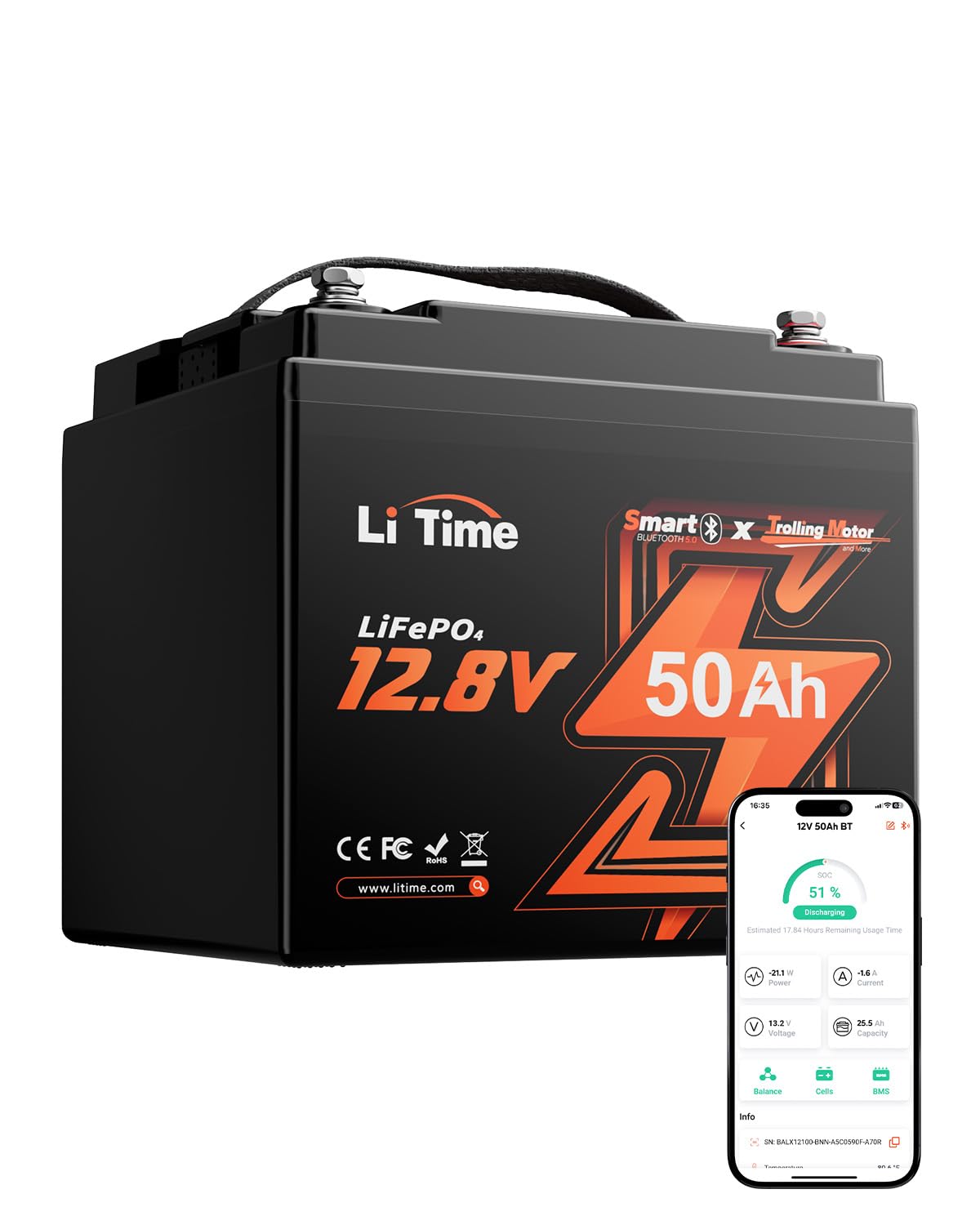
A featherweight 50Ah pack that lets you watch its charge from your phone.
Solar owners who also run a trolling motor will recognize the appeal: 50Ah of LiFePO4 storage in a battery weighing only 11.27 pounds. That is roughly one-sixth the weight of a 12V 100Ah lead-acid unit, so moving it between a boat, a trailer, and a garage shelf is a one-hand job. Its dimensions of 7.68 x 6.54 x 6.77 inches make it compact enough for tight compartments, but the shape is boxy — owners note a fat50 ammo can is about the smallest container it drops into.
The headline feature is Bluetooth 5.0. Pair it with the LiTime app and you can see the battery’s status live on your phone — no separate monitor, no wiring. The 50A BMS handles the usual overcharge, over-discharge, over-current, and short-circuit protections, and it includes low-temperature cut-off so cold charging does not damage the cells. The 1.2C continuous discharge rate gives you 60A for 30 minutes when your motor needs peak thrust, and the pack carries an IP65 water-resistance rating for spray and rain exposure.
The reviews point to durability under abuse: owners mention 8% loss over five months of storage, 37% charge left after two days of fishing at varied speeds and wind, and enough staying power to run a 12V 55lb trolling motor all day. One summarizes it plainly — “Excellent Battery that lasts and is durable getting bounced around in boat. It can handle Fishfinder and all interior lights. Charges fast.” The honest catch is the occasional unit that shows up unresponsive; LiTime has replaced those and issued return labels, so buy with the brand’s five-year after-service in mind rather than assuming every pack is perfect.
Why owners like it: App-based monitoring plus low weight makes it an easy go-anywhere pack for solar, kayaks, and small trolling setups.
What to watch: The boxy square dimensions are hard to match to a standard battery box, and it prefers a lithium-activation charger the first time you wake it up.
Great for: Trolling-motor owners and small-system builders who want live phone monitoring and a pack they can lift without strain.
skip it if: You need higher amp-hour storage in a single unit — this one is built for lighter cycling loads.
6. Interstate Batteries 12V 110Ah SLA/AGM Deep Cycle (DCM0100)

A sealed AGM workhorse built for long, steady discharge cycles.
Interstate’s DCM0100 is a professional-grade sealed lead-acid (SLA) battery that uses AGM and VRLA technology — that is a glass-mat design with a valve that seals in the gas, so there is nothing to spill and nothing to top off. It offers 110Ah of storage sized at 12.99 x 6.81 x 8.35 inches with insert-style terminals, and it is built for deep discharge use in scooters, wheelchairs, and backup systems. This is not a golf cart battery, so set that expectation before you buy.
Long service is where this battery earns its keep. A Nationa Luna dual-battery owner ran one across 45 states on six-month trips for five years, still powering a 60W fridge for more than six hours a night without charging. Another got around 20 hours of runtime per charge in a sump-pump backup setup. A buyer who replaced a dead factory Ryobi mower battery with four of these was back to mowing two acres on a charge. It arrives charged and takes a standard AGM charge profile, holding its state well in standby use.
The one thing to be realistic about is variability. Some customers note the battery goes bad after a year and a half, and at least one arrived dead on arrival — Interstate’s consensus reflects that mixed reliability alongside the long-service stories. That does not mean it is a bad choice; it means buying from a seller with easy returns and registering the one-year manufacturer warranty is smart. At 71.5 pounds, this is also the heaviest battery on this list, so plan where it lives and get help moving it.
The dependable read: Proven AGM construction for deep discharge, with real-world examples of five and six years of service in RV and backup duty.
The honest caveat: Reliability has slipped in some buyers’ experience, and it carries a one-year warranty — returns support matters here.
A solid choice for: Owners of wheelchairs, scooters, and heavy-duty backup systems who want a sealed, spill-proof AGM they can mostly forget.
Look past it if: You want a battery that feels light or easy to relocate — 71.5 pounds is a committed installation.
7. GRNOE 2-Pack 12V 100Ah LiFePO4 Battery, Group 31
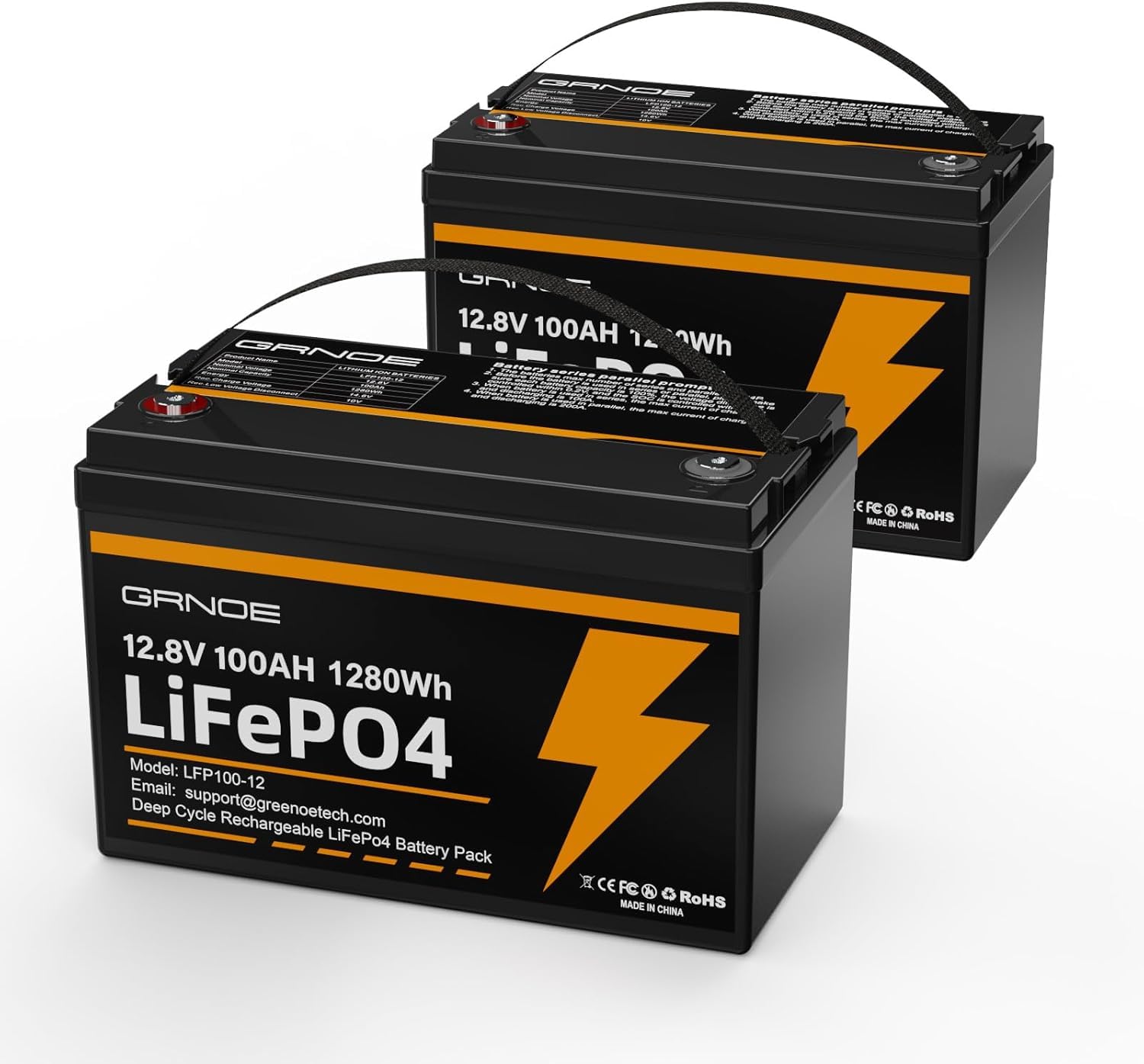
Two 100Ah lithium packs that jump-start a serious solar bank.
If you are building a 200Ah bank in one purchase, the GRNOE two-pack gets you there without hunting for a matching second battery. Each pack runs 12.9 x 6.7 x 8.6 inches and weighs 22.48 pounds, giving you an energy density of 57 Wh/Lbs and a footprint close to a standard lead-acid replacement. The built-in 100A BMS protects against overheat, overcurrent, overcharge, over-discharge, and short circuits, and the cells carry UL/UN38.3 certification.
Cold-weather performance is handled with a smart low-temperature cut-off: discharge can go down to -4°F, and when temperatures drop below 32°F the BMS stops charging to protect the chemistry. The pack also allows a max discharge current of 300A for three seconds, enough for a 12V 36-55lb trolling motor, and it carries an IP65 water-resistance rating for wet environments. Expect real results in solar service — owners who built two PV setups with these batteries reported solid, lightweight storage that held energy longer when off-grid, and one wired a full travel trailer onto them and dry camped three nights with plenty of power left for the fan, lights, and chargers.
Two honest notes before you commit. First, the BMS can block charging below 34°F, which is normal for cold lithium protection but worth planning around if you camp in winter. Second, this battery needs a proper lithium profile — a standard 12V charger will not fully charge it, so you need one that delivers 14.6V, and the cells want a top-up charge every two or three months to stay healthy. On battery life and reliability, the picture is mixed: most reviewers point out long, steady performance, while a small number describe failures within six months. Sizing your build with a reputable seller and warranty in place is the smart move here.
The case for the two-pack
- Instant 200Ah bank with matched cells from one order
- 22.48 lb each — far easier to position than 60 lb lead-acid
- 100A BMS with -4°F discharge and 32°F charge cut-off
- IP65 water resistance for boats and outdoor enclosures
The catches worth knowing
- Needs a 14.6V lithium charger, not a standard 12V unit
- Batteries ship in separate boxes and may arrive on different days
Who this suits: Builders assembling a mid-size solar bank who want matched capacity and low weight from the start.
Who should keep looking: Anyone running a single small panel — a two-pack is more storage than that setup can feed.
8. VMAX SLR125 12V 125Ah AGM Deep Cycle Battery (Qty 2)

A pair of 125Ah AGM tanks built for solar banks that run for years.
VMAX builds this pair of SLR125 batteries for one thing: long, patient solar storage. Each one holds 125Ah of AGM deep-cycle capacity with marine terminals, sized at 12.9 x 6.8 x 8.7 inches and weighing 60 pounds. They are designed for a float service life of 8 to 10 years and carry a 99% recombination rating — that means the gas is recombined internally instead of vented, so there are no dangerous fumes or gases to worry about in a cabin or enclosed space.
The real-world track record backs the design. Owners describe batteries still strong after seven years in a van camper, and a well-used set serving nearly eight years across overcharged, cold-charged abuse. One buyer who started a solar system with these built up to twelve wired into 24V with a Victron charger and rode through a cloudy, off-grid winter powering a fridge, TV, Playstation, lights, and a fan. Another used these as an upgrade bank for a Goal Zero Yeti and ran a fridge, freezer, 24″ TV, and computers for three days of emergency power. They replace stock AGM batteries in Winnebago campers and fit the factory carriers directly.
The flip side of that durability is weight and care. At 60 pounds each, this is a stationary bank, and the two units together are a serious commitment — plan a sturdy shelf or floor location and a proper battery box, since owners note needing a group 29 box and tray plus heavy 1/0 AWG cables. There is also the occasional set that stops holding a charge early; VMAX did replace those after direct contact, but the initial seller response can be slow. And unlike the LiFePO4 options here, this chemistry wants shallower discharges to reach its long service life — treat it kindly and it rewards you with years of cycles.
Why solar builders trust it: Rated for 8 to 10 years of float service with 99% recombination — no fumes, no mess, and years of deep-cycle history in RVs and vans.
The practical limit: At 60 pounds each, you are committing real space and strength; and one-year warranty coverage means buying from a reliable seller is wise.
Built for: Off-grid and RV owners building a stationary solar bank who value longevity and a fume-free sealed design.
Not for you if: You need to carry the battery around — this pair is meant to stay put.
Understanding the Specs
Amp-Hours and Usable Capacity
Amp-hours (Ah) tell you how much charge a battery holds, but usable capacity is what actually powers your gear. A 100Ah LiFePO4 battery can be discharged to roughly 80-100% depth without harming the cells, so nearly the full 100Ah is available each night. A 100Ah sealed lead-acid battery should only be discharged to about 50%, so roughly 50Ah is safely usable. Size the bank so its usable amp-hours exceed your nightly load by about 20%.
BMS and Low-Temperature Cut-Off
A battery management system (BMS) is the built-in electronics that protect the pack. It stops overcharging, over-discharging, over-current, and short circuits, and many packs add temperature limits. Low-temperature cut-off pauses charging when the pack gets too cold — around 32°F on most of these units — because forcing current into a frozen lithium cell can damage it. If your system runs through winter, look for a battery with that protection and plan to warm it before charging.
FAQ
How many amp-hours do I need for my 12V solar setup?
Is LiFePO4 better than AGM for solar storage?
Why does my battery stop charging when it is cold?
What size charge controller do I need for a 100Ah battery?
How long will a 100Ah battery run a fridge?
Can I connect solar batteries in series or parallel?
Do I need a special charger for a lithium solar battery?
How long do solar batteries last before I replace them?
Can I use a solar storage battery to start an engine?
Final Thoughts: The Verdict
For most solar owners, the winner is the MARSENERGY 12V 100Ah LiFePO4 because it pairs a Group 24 drop-in fit and a 21-pound build with up to 15,000 cycles at 60% depth of discharge. If you want maximum capacity in a single case, grab the yeagulch 12V 150Ah LiFePO4, which gives you 1290Wh and a low-temp cut-off. For a cheaper lead-acid bank that takes a trickle charger and holds up on standby, the WEIZE 12V 100Ah is the one to reach for. And if you want to build a bigger bank in one order, the GRNOE 2-Pack gets you to 200Ah with matched cells. Whichever you choose, match the chemistry to how hard your system cycles and you will get the runtime your panels were meant to deliver.
How We Picked
We do not accept paid placement. Every pick is matched to a real buyer and a real use-case; we do not hands-on test units.
Sources & Methodology
Specifications: manufacturer listings and product documentation. Review insights: verified customer reviews, as of September 2026. Pricing: not shown on this page (it changes often); check the current price via the retailer link.
As an Amazon Associate, KitchPrep earns from qualifying purchases. This does not affect which products we feature.
Related Guides
