
Specs are compiled from manufacturer listings and verified buyer reviews and can change over time — please confirm the key details on the product page before buying.
If your counter has a 20-inch gap, the cooktop you buy has to match the hole you cut, not the word on the box. Almost every model sold as “20-inch” is really a 20- or 21-inch unit, and its cutout (the rectangular hole your countertop fabricator cuts to receive the cooktop) lands close to that number rather than exactly on it. Get the cutout wrong and the whole install stalls. Three gas cooktops here are built around a compact footprint: a slide-in propane rangetop for camper and van builds, a built-in four-burner workhorse with a natural gas and propane conversion kit, and a drop-in two-burner made for tight RV counters. For each one you get the real burner output, the actual cutout and surface measurements, and where owners say daily use holds up or gets annoying.
I’m Mohammad Maruf — the founder and writer behind KitchPrep. This guide is built by comparing the manufacturers’ published specifications and the patterns across verified customer reviews, so you get each pick’s real strengths and trade-offs instead of marketing spin.
Before you scroll: a note on fit. These picks use flexible matching for 20-inch width — meaning the nearest sold size of the same product type is included, such as a 21-inch surface, because exact 20-inch gas cooktops are rare. None of these jump to a 30-inch unit, so the compact scale is preserved, but always measure your cutout before ordering. If that sounds fair, here is the shortlist of the best 20-inch gas cooktop options for tight kitchens, vans, and outdoor counters.
Our Picks at a Glance
How To Choose The Best 20-Inch Gas Cooktop
On a full-size range, you buy for oven size and burner count. On a compact cooktop, the decision flips: fit and fuel come first, and everything else is secondary. Get those two wrong and no burner layout will save the install.
Measure the cutout, not the counter
The number that decides whether your install works is the cutout — the rectangular hole you or your countertop fabricator cuts to receive the cooktop. A maker may sell a unit as “20 inches wide” while the surface plate is a little larger and the cutout is a little smaller than both. So measure your existing opening and compare it against the published cutout, not against the word “20-inch.” The built-in four-burner pick here lists a cutout of 22″W x 20 1/2″H, so it will not drop into the same hole as a small two-burner drop-in.
Decide your fuel before you buy
Natural gas and propane need different jet sizes — the small brass nozzles that meter gas into each burner. Many compact cooktops ship set up for one fuel and include a conversion kit for the other, and this is where most first-week frustration comes from. If you run propane through natural gas jets, the flame comes out small and lazy. Swap in the correct jets and the same burner throws a bigger, hotter flame. Mismatched jets explain a large share of the low-star reviews on compact cooktops.
Match burner count to your counter, not your ambition
Three burners give you the range to run a pot of pasta and a pan of sauce at once without fighting for space. Two burners suit a van galley or a small outdoor kitchen where you rarely cook three things together. Four burners on a compact chassis means each one is smaller. Look at the individual BTU figures rather than the total, because a big total spread across four small burners still means no single burner gets truly hot.
Prize the safety shutoff if you cook in a tight space
A thermocouple or flame-failure system watches for the flame at each burner and cuts the gas automatically if it goes out. In a van, camper, or boat cabin, that is the difference between an inconvenience and a genuine hazard. All three picks below include this style of protection, which is why they are worth shortlisting for mobile and enclosed installs.
Quick Comparison
| Model | Best For | Burners | Total BTU | Install Type | Amazon |
|---|---|---|---|---|---|
| CAMPLUX Elite RV Stove 3 Burners★ Best Overall | Van and camper galley cooks | 3 | 21,000 BTU | Slide-In | Amazon |
| 22″x20″ Built in Gas Cooktop 4 Burners (forimo) | Fixed counters and outdoor kitchens | 4 | 26,614 BTU | Built-In | Amazon |
| Ramblewood GC2-37P | RV and off-grid two-burner setups | 2 | — | Drop-In | Amazon |
In‑Depth Reviews
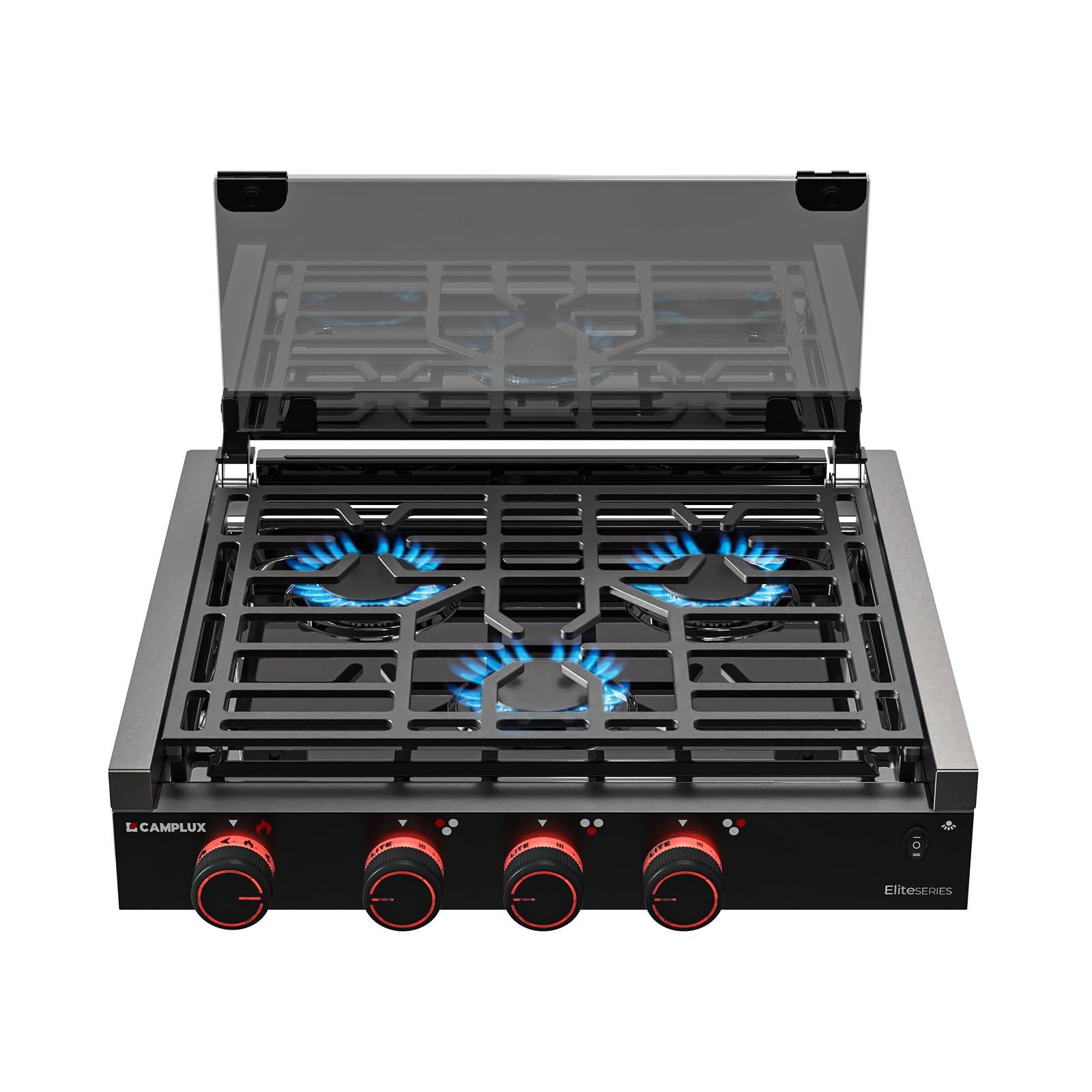
1. CAMPLUX Elite RV Stove 3 Burners, 21,000 BTU Propane Cooktop with Tempered Glass Cover & Flame Failure Protection, 21-Inch Slide-In Gas Rangetop
Our pick — over 4.5★ from 100+ verified ratings; the strongest balance of quality and price.
Three burners that live where the counter ends and the road starts
In a van build, a camper galley, or a boat cabin, counter space is what you do not have — and this is the pick built around that. The CAMPLUX Elite fits 3 high-efficiency burners onto a 21.45″W x 21.14″D surface that stands just 4.72 inches tall. That low height is what lets it slide under a cabinet lip or a closed lid, so it suits a 3-burner cooktop slot in a moving kitchen better than anything built for a fixed one.
Slide-in is the key word. This unit drops into the gap between countertop and cabinetry as one piece, which is how mobile kitchens usually get built. Fire it with the rotary piezoelectric ignition, and note the power requirement: the ignition needs 12V DC at 1A or less, so your van or camper electrical system has to feed it. Add the tempered glass cover that flips down over the burners, and you get splash protection plus a flat work surface when the cooking is done. The cast iron grates lift off and are dishwasher-safe for cleaning.
Buyers report it installs in minutes and performs better than expected in a van or camper galley. A big-name camper owner in the review pages sums it up: “This is a nice unit. I upgraded from my old 2000 oven combo in my Lance camper. Works great, easy to install.” Compared with the built-in four-burner pick further down, this one holds 21,000 total BTU to that unit’s 26,614 BTU, a real gap if you run a large pot hard.
Two things to weigh. First, the glass cover is a genuine weak point — review pages carry cases of it shattering months after install. Notably, owners who contacted CAMPLUX got a replacement glass shipped fast, while one owner who did not get a reply simply laid a cutting board over the stove. Second, one long-term owner reports the unit going inoperable after roughly six months, then receiving a prompt replacement from CAMPLUX. Neither is widespread, but both are worth knowing.
Where It Delivers
- 3 burners, 21,000 BTU total — enough for two pans plus a simmer at once in a tiny galley
- 4.72-inch height — the shortest profile here, so it slots under a lid or cabinet as a slide-in
- Tempered glass cover plus backlit knobs — splash protection and a work surface when closed
- Flame failure protection, CSA-certified — the gas shuts off if the flame dies, which matters in an enclosed cabin
- Dishwasher-safe cast iron grates — one of the few cleanup wins in a mobile kitchen
The Fine Print
- Glass cover can shatter — the recurring gripe in the reviews; treat it as the fragile part
- Needs 12V DC power for the ignition, so no standalone battery-light setup
- Heavier at 27.3 pounds — noticeably more than the 18.1-pound built-in four-burner below
- At 21.45″W, 21.14″D it is the larger-footprint pick — confirm your counter opening first
Reach for this if: you are outfitting a van, camper, motorhome, or boat galley and want three burners in a low, slide-in chassis with a flame shutoff for safety.
Look elsewhere if: your heart is set on a glass-covered unit and you would rather not risk the cover — the stainless drop-in and built-in picks below skip it entirely.
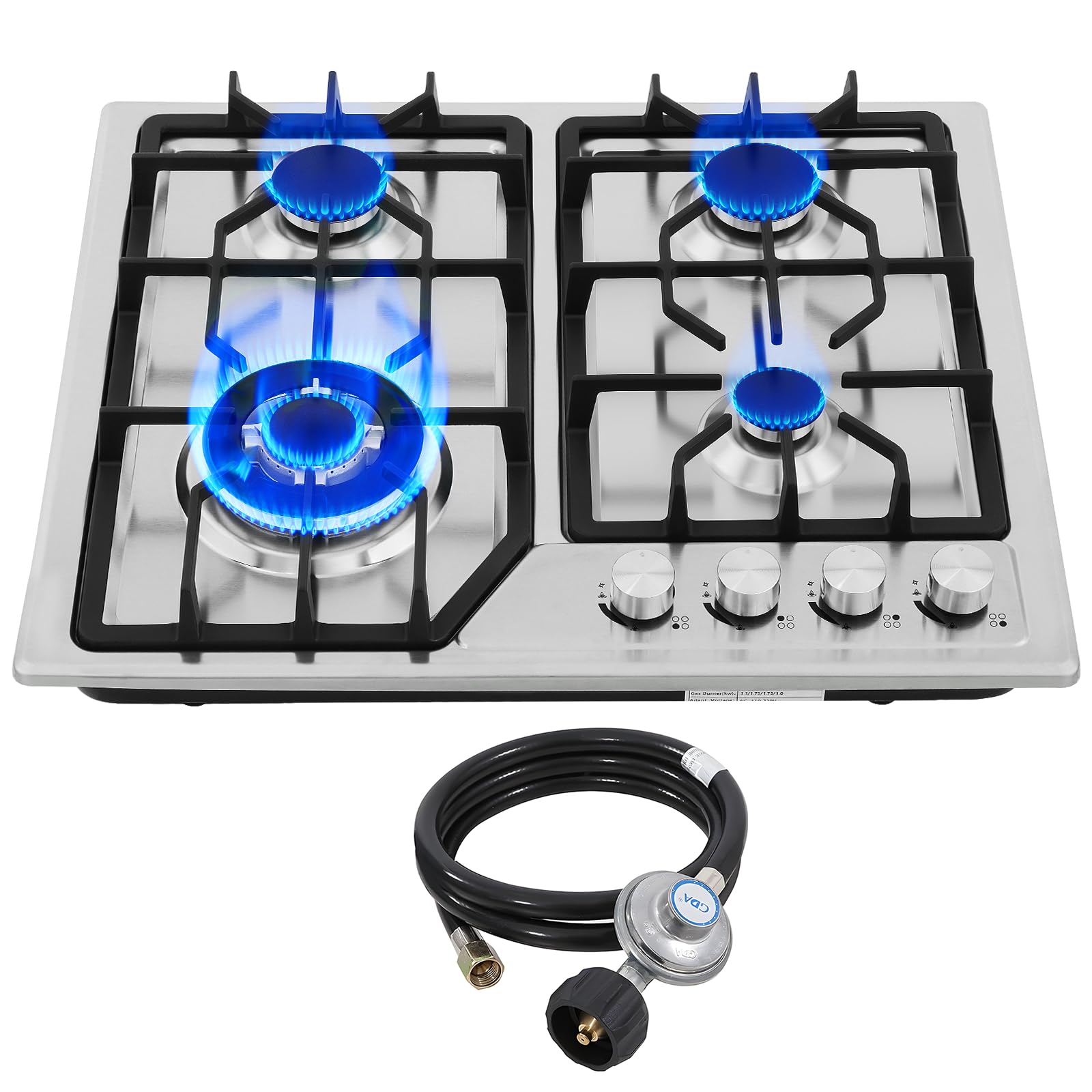
2. 22″x20″ Built in Gas Cooktop 4 Burners Stainless Steel Stove with NG/LPG Conversion Kit, Thermocouple Protection (forimo)
Four burners and a conversion kit in among the most compact built-in frames around
Start with the spec that settles the fit question: 26,614 BTU of total output, split across four burners. A 130mm triple-ring wok burner handles 11,260 BTU, two 75mm semi-rapid burners handle 5,971 BTU each, and a 55mm auxiliary burner handles 3,412 BTU. That is a real wok ring, not a decorative one, and four individual flames sit on one compact stainless plate.
Now the counter dimensions, because those are what actually decide the install. The surface is 20″W and 22.4 inches deep, and the published cutout is 22″W x 20 1/2″H — a shallow, wide opening rather than a tight square. That depth is roughly double the drop-in pick below, so this is not a slot for a narrow RV countertop. Treat it as a fixed-kitchen or outdoor-kitchen unit, and it delivers.
Owners install it in minutes and keep finding new uses for it. It shows up in outdoor kitchens specifically to keep the heat out of the house in summer, and more than one owner has used it to replace an old range. Fire it electronically, cook on the cast iron grates, and wipe down the stainless top. And heed the review warning behind most of the low-star noise: it ships with natural gas jets, so a propane run needs the included larger jets swapped in. The review pages record it plainly: “With stock jets flame was small; after swapping, flame much brighter/bigger.” The thermocouple failsafe (a sensor that cuts the gas if the flame goes out) protects you, and the enclosed chassis keeps airflow from disturbing the flame while you cook.
Weigh it against the others and the personality is clear. You get 26,614 total BTU versus the CAMPLUX’s 21,000 BTU — more raw heat and one extra burner — but you lose the low 4.72-inch camper body and the slide-in form. And at 18.1 pounds it is about two-thirds the weight of the 27.3-pound CAMPLUX, which makes one person handling it during install far easier. This is the pick for a real counter, not a road-built galley.
The standout number: 26,614 BTU total across four burners with a genuine 11,260 BTU triple-ring wok burner up front.
Room to plan around: the 22.4-inch depth needs a deep cutout, and a propane setup means swapping in the larger jets on day one.
Buy it if you have a standard or outdoor counter and want the most burner capacity and heat per square inch of plate.
skip it if you are fitting a narrow van counter — the depth rules it out, and the two-burner drop-in below is the tighter fit.
3. Ramblewood GC2-37P (LPG/Propane Gas) High Efficiency 2 Burner Gas Cooktop, ETL Safety Certified

The lean two-burner that keeps cooking when the power does not
For a two-burner counter, the dimensions go the other way from the built-in four-burner above. This unit’s depth measures 11.4 inches against that unit’s 22.4-inch depth — half the depth — while both settle around a 20-inch width. That shallow body is why it works as a drop-in for a narrow RV or van surface where a deep cooktop will not seat.
Its defining trick is the off-grid angle: the electric ignition runs on 1.5V DC (low-voltage battery power), and if the power goes out during a storm, you can light each burner with a match. It ships set for LPG/propane and includes a natural gas conversion orifice kit, so both fuel paths are covered. Two sealed burners sit under a stainless surface with a heavy cast iron pot stand, the gas pipe inlet takes a 1/2-inch threaded connector, and a thermal couple flame-out detector (a sensor that shuts the gas off automatically when a flame dies) adds a safety layer.
Owners use it in RVs, outdoor kitchens, and rental units. It shows up in RVs as a swap that ends generator use for cooking, and in outdoor kitchens and rental units. Owners agree on one strength: the burner rings wrap the whole pan rather than heating one spot, and the rear burner runs so hot on low it nearly overcooks bacon. The recurring gripe is different: the grates and burner heads can shift or come loose on rough roads, so an RV owner has to stow the top pieces between drives. Know that going in and it is a simple daily routine rather than a defect.
One install note worth flagging: the included regulator is not intended for standard 20-pound propane tanks, so many owners use a regular grill regulator or an adjustable high-pressure one instead. Reviews split on value: most call it well-built and easy to install in minutes, while a minority consider it overpriced for two burners. If you need off-grid ignition and a tight drop-in depth, two burners are the whole point.
What you are paying for: a 1.5V DC ignition you can override with a match during a power outage, plus a 1/2-inch gas inlet on an 11.4-inch-deep drop-in body.
The honest caveat: on rough roads the grates and burner heads travel, and the stock regulator wants an adapter for a standard 20-pound tank.
Pick this if you are replacing an electric RV or van cooktop and want two sealed burners, a shallow drop-in fit, and manual light capability when the grid is down.
Look past it if you cook for a crowd or need three or four simultaneous burners — the built-in four-burner covers that better.
Understanding the Specs
BTU and Burner Output
BTU measures how much heat a burner produces, and it is the number that decides whether your pan actually sears or just simmers. Total BTU tells you the combined power of every burner; split it across the burners and you get the real per-burner figure. A common mistake is shopping total BTU alone — a large total spread across four small burners still leaves you without a single hot burner. Look for a dedicated high-output ring, like a triple-ring wok burner, and read each burner’s individual figure beside the total.
Cutout, Depth, and Install Type
Install type decides how the cooktop meets your counter. A slide-in drops into the gap between counter and cabinetry, a built-in seats into a cutout in the surface, and a drop-in lowers into a rectangular opening. Depth matters most in mobile kitchens: a shallow body slides into a narrow RV counter where a deep one will not seat. Before ordering any compact cooktop, measure your actual opening and compare it against the published cutout, not the advertised width. A width is a shelf label; a cutout is the fit.
FAQ
Will a 20-inch gas cooktop fit my existing cutout?
Can I use a gas cooktop with propane instead of natural gas?
What does flame failure protection actually do?
How many BTUs do I need on a compact cooktop?
Is a two-burner cooktop enough for a van or RV?
Do these cooktops need electricity to work?
How do I clean a compact gas cooktop with cast iron grates?
Can I install a compact gas cooktop outdoors?
What is the difference between a drop-in, slide-in, and built-in cooktop?
Why is my new gas burner flame so small?
Final Thoughts: The Verdict
For most people building a compact kitchen, the winner is the CAMPLUX Elite RV Stove 3 Burners. It pairs a low 4.72-inch slide-in body with three burners, 21,000 BTU, a dishwasher-safe cast iron grate setup, and flame failure protection — the combination that fits a van, camper, or boat galley without fuss. If you want maximum burner capacity and heat on a fixed or outdoor counter, the forimo 22″x20″ Built-in Gas Cooktop gives you four burners and 26,614 BTU with a real wok ring. And for the tightest RV or off-grid spot, where you want two burners, a shallow 11.4-inch drop-in depth, and ignition you can override with a match, the Ramblewood GC2-37P is the one to reach for. Whatever you choose, measure your cutout and confirm your fuel first — those two steps decide everything else.
How We Picked
We do not accept paid placement. Every pick is matched to a real buyer and a real use-case; we do not hands-on test units.
Sources & Methodology
Specifications: manufacturer listings and product documentation. Review insights: verified customer reviews, as of September 2026. Pricing: not shown on this page (it changes often); check the current price via the retailer link.
As an Amazon Associate, KitchPrep earns from qualifying purchases. This does not affect which products we feature.
Related Guides
