
Specs are compiled from manufacturer listings and verified buyer reviews and can change over time — please confirm the key details on the product page before buying.
When the grid drops, the fridge, the router, and the medical devices in your home don’t care how sleek a battery looks — they care whether the power holds. A home battery bank is simply a big rechargeable power station you keep charged indoors and plug your essentials into during an outage or a camping trip. Most buyers get this wrong by fixating on one huge capacity number while ignoring the two specs that actually decide whether the unit survives a real blackout: the battery chemistry (the material inside that determines lifespan) and the transfer time (how many milliseconds it takes to kick in before your electronics notice).
I’m Mohammad Maruf — the founder and writer behind KitchPrep. This guide is built by comparing the manufacturers’ published specifications and the patterns across verified customer reviews, so you get each pick’s real strengths and trade-offs instead of marketing spin.
You will see capacity, output wattage, battery chemistry, recharge time, and real buyer experience side by side so you can match a unit to your own home. Whether you are prepping for storm season or powering a camper, the right battery bank for home depends on matching capacity and output to what you actually run. The 4.7-star EF ECOFLOW DELTA 3 Max anchors this list.
Our Picks at a Glance
How To Choose The Best Battery Bank for Home
Buying a home battery bank is a multi-year decision, so the goal is not the biggest number on the box — it is the unit whose capacity, output, and chemistry match how you actually live through an outage.
Start With Capacity (Wh) And What It Runs
Capacity is measured in watt-hours, which is simply how much total energy the battery holds. A 1024Wh unit like the BLUETTI Elite 100 V2 suits a small essentials plan, while a 3014Wh station such as the BLUETTI Elite 300 is built to keep a fridge, router, and lights going for far longer. Work backward from your must-run appliances and their wattage before you compare anything else.
Output Wattage And Peak Surge
Continuous output in watts is the steady power the unit can supply, and peak surge is the short burst it handles when a motor first starts. A fridge compressor pulls a large surge at kick-on, so look for a station whose surge rating clears your heaviest motorized appliance — the Jackery HomePower 3000 handles 7200W surge, for example, which is roomy for household motors.
Chemistry: LiFePO4 Vs Older Lithium
The chemistry inside decides how many times you can recharge the battery before it fades. LiFePO4 (lithium iron phosphate, a safer and longer-lived lithium formula) is the current standard for home backup — the BLUETTI Elite 300 rates its cells for 6000+ cycles, and the Anker SOLIX S2000 uses 314Ah LFP cells for a rated 10,000-cycle life. Older lithium-ion formulas cycle far fewer times, so the chemistry is the single biggest durability lever.
Recharge Speed And Solar Input
How fast the bank refills between outages matters as much as capacity. Turbo charging from a wall outlet can take a big station from empty to full in about 70 minutes on the BLUETTI Elite 100 V2, while solar input lets you refill off-grid — the Anker SOLIX S2000 accepts up to 400W of solar. If you plan to charge from panels, check the solar wattage ceiling and voltage limit before buying.
Portability, Weight, And Wheeled Designs
Weight is the trade-off nobody mentions until the first blackout. Compact 1kWh units like the BLUETTI Elite 100 V2 sit around 25 lbs and carry one-handed, while a 3kWh class station runs far heavier and may need two people or a set of wheels. The Jackery HomePower 3600 Plus adds a telescopic handle and wheels for exactly this reason.
Quick Comparison
| Model | Best For | Capacity | Output / Surge | Battery Type | Amazon |
|---|---|---|---|---|---|
| EF ECOFLOW DELTA 3 Max★ Best Overall | Balanced home backup and RV use | 2048Wh | 2400W / 3400W X-Boost | LiFePO4 | Amazon |
| EBL 2400W Portable Power StationBudget Champion | Budget multi-device backup | 1843.2Wh | 2400W | LiFePO4 | Amazon |
| Anker SOLIX S2000Most Compact | Quiet fridge and network backup | 2,010Wh | 1,500W / 3,000W peak | LFP | Amazon |
| BLUETTI Elite 100 V2 | Camping and small essentials | 1024Wh | 1800W / 3600W surge | LiFePO4 | Amazon |
| Jackery HomePower 3000 | Whole-house essentials and RV | 3072Wh | 3600W / 7200W surge | LiFePO4 | Amazon |
| BLUETTI Elite 300 | RV power and compact home backup | 3014Wh | 2400W / 4800W surge | LiFePO4 | Amazon |
| Jackery HomePower 3600 Plus | Expandable whole-home backup | 3584Wh (expandable) | 3600W / 7200W parallel | LiFePO4 | Amazon |
| ECO-WORTHY Cubix100 48V 200Ah | Server-rack solar storage | 100Ah per battery | — | LiFePO4 | Amazon |
| EF ECOFLOW DELTA Pro | Expandable 3.6kWh home backup | 3600Wh | 3600W / 4500W X-Boost | LFP | Amazon |
| Anker SOLIX F3800 | Dual-voltage whole-home and EV | 3,840Wh | 6,000W / 12,000W paired | EV-class LFP | Amazon |
In‑Depth Reviews
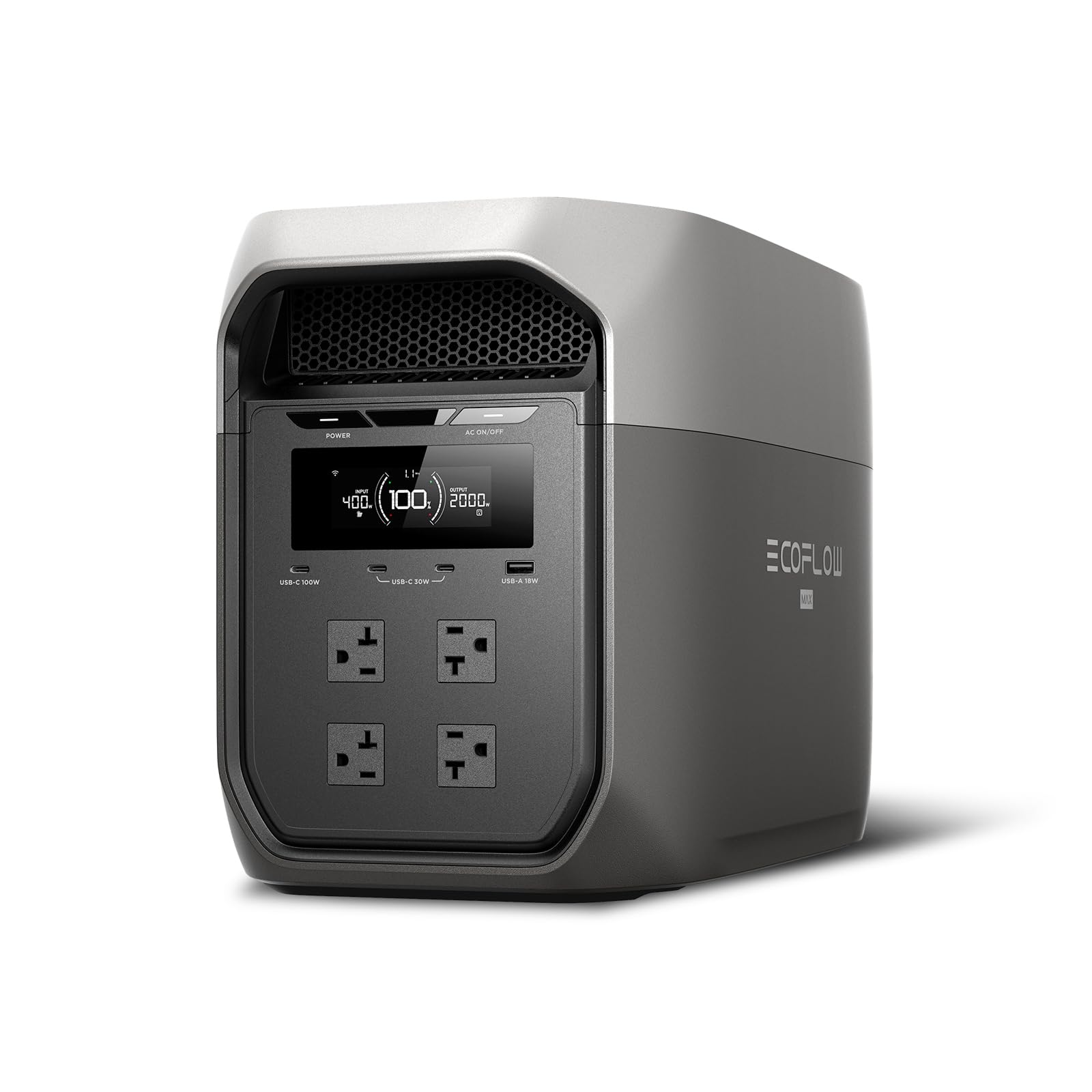
1. EF ECOFLOW DELTA 3 Max Portable Power Station, 2048Wh LFP Battery, 2400W
Our pick — over 4.5★ from 550+ verified ratings; the strongest balance of quality and price.
The every-household pick that refills to 80% before your coffee finishes brewing.
If you want one battery bank that handles a blackout, a road trip, and a campsite without feeling like a compromise, this is the unit to beat. Its headline trick is speed: X-Stream technology takes it from empty to 80% in just 1.13 hours, so a short heads-up about a storm is enough to get it topped up. The 2048Wh capacity holds a real charge cushion, and that matters when a fridge or a space heater is the thing you refuse to lose.
The output is the part that surprises people. Rated at 2400W with a 3400W X-Boost mode, it runs high-demand appliances like fridges, microwaves, and even power tools — the kind of gear that trips weaker 1kWh boxes. It also switches to backup in under 10ms, which is faster than a light flicker, so sensitive electronics like a desktop computer or a router ride straight through an outage. Capacity-wise it edges the EBL 2400W, holding 2048Wh against the EBL’s 1843.2Wh.
What wins people over is the sheer value packed into that capacity and recharge speed, and it shows: buyers report scenes like running a TV for about 12 hours on a single fill, with the phrase “the battery life is amazing” showing up time and again. Its LiFePO4 battery is rated for roughly 10 years of daily use, backed by a 5-year warranty. The app adds real-time energy monitoring and charging schedules. The honest catch is weight — this is a 2048Wh station, so moving it around is a two-hand job — but that is the trade for the capacity. At 4.7 stars across 500+ ratings, it is the safest all-rounder here.
What earns the top slot
- 0–80% recharge in just 1.13 hours via X-Stream
- 3400W X-Boost runs fridges, microwaves, and power tools
- Under 10ms transfer keeps computers and routers alive
- LiFePO4 chemistry rated for about 10 years of daily use
Where it asks you to compromise
- At 2048Wh it is heavy to carry up stairs
- Full solar charging needs optional panels you buy separately
- The 12V car plug sits on the back, which takes getting used to
The smart default: reach for this if you want one station that covers outages, RV trips, and job sites without a learning curve.
Think twice if: you need to haul the battery up and down stairs weekly — its capacity makes it a heavy lift.
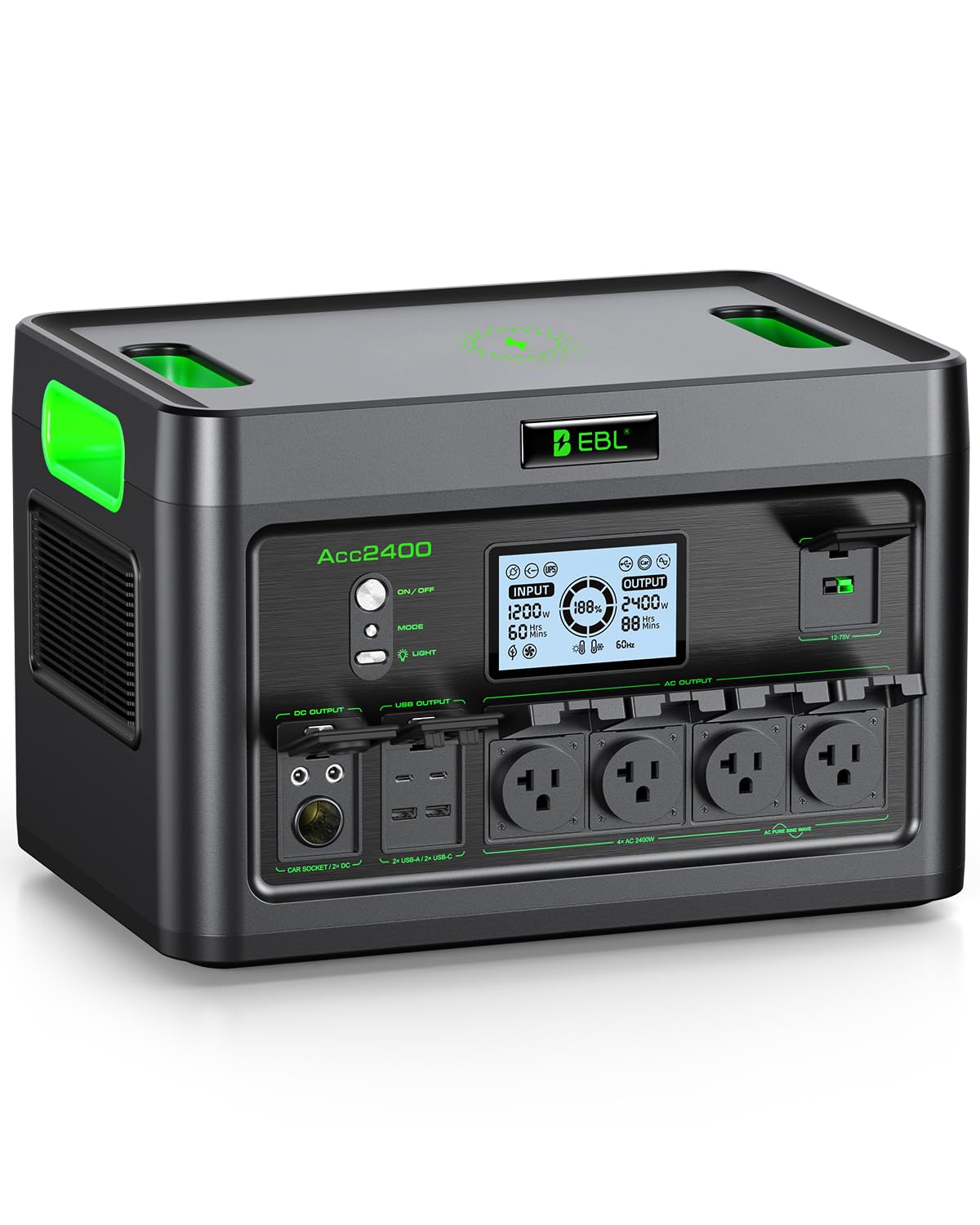
2. EBL 2400W Portable Power Station LiFePO4 Battery for Home Use
A value-tier station that plugs in your kettles, tools, and phones all at once.
For the buyer who wants real home backup without the premium tag, the EBL Acc2400 delivers a lot of usable power for the money. Its 1843.2Wh capacity and 2400W output are built to run group gear — rice cookers, small TVs, electric kettles, hair dryers, even power tools — and it refuses to overload or trip the way weaker units can. The standout spec is the port count: 12 devices charged simultaneously across 4 AC ports, 2 USB-A, 2 fast-charging USB-C, a car port, 2 DC ports, and a wireless charging panel. That is genuine group-camping and multi-appliance flexibility.
What buyers value most here is build quality — the durable ABS shell, shock-resistant and flame-retardant design, and general solidity of the unit earn the loudest praise. Its LiFePO4 battery is rated for 3500+ cycles and a stated 10+ year life, with protection against overcharging, over-discharging, shorts, and heat. Owners mention practical wins, including one who powered a paper shredder for three hours until the shredder itself overheated while the battery barely dropped a single percentage point and stayed cool.
Two honest notes before you commit. Battery life and size both draw mixed feedback — some find the real runtime shorter than the label suggests, and others find the unit larger than expected. And it weighs 55 pounds, so this is a set-it-down-and-leave-it station rather than a grab-and-go one. If a dependable budget workhorse with more ports than anything near its tier matters more to you than featherweight portability, it earns its 4.2 stars across 400+ ratings.
Why it belongs on the shortlist
- 12 devices charged at once across every major port type
- 3500+ cycle LiFePO4 battery with a stated 10+ year lifespan
- 0.1-second emergency switchover protects computers from data loss
- 4-mode LED light built in for camping and blackout lighting
Reasons some buyers pause
- Battery life and size draw mixed feedback in the reviews
- At 55 pounds, it is a leave-in-place unit
- Included solar support can lag with certain third-party panels
Buy it if: you want maximum ports and a long-cycle battery on a value-tier budget for home and travel use.
Pass if: portability tops your list — the 55-pound frame is best parked near your appliances.
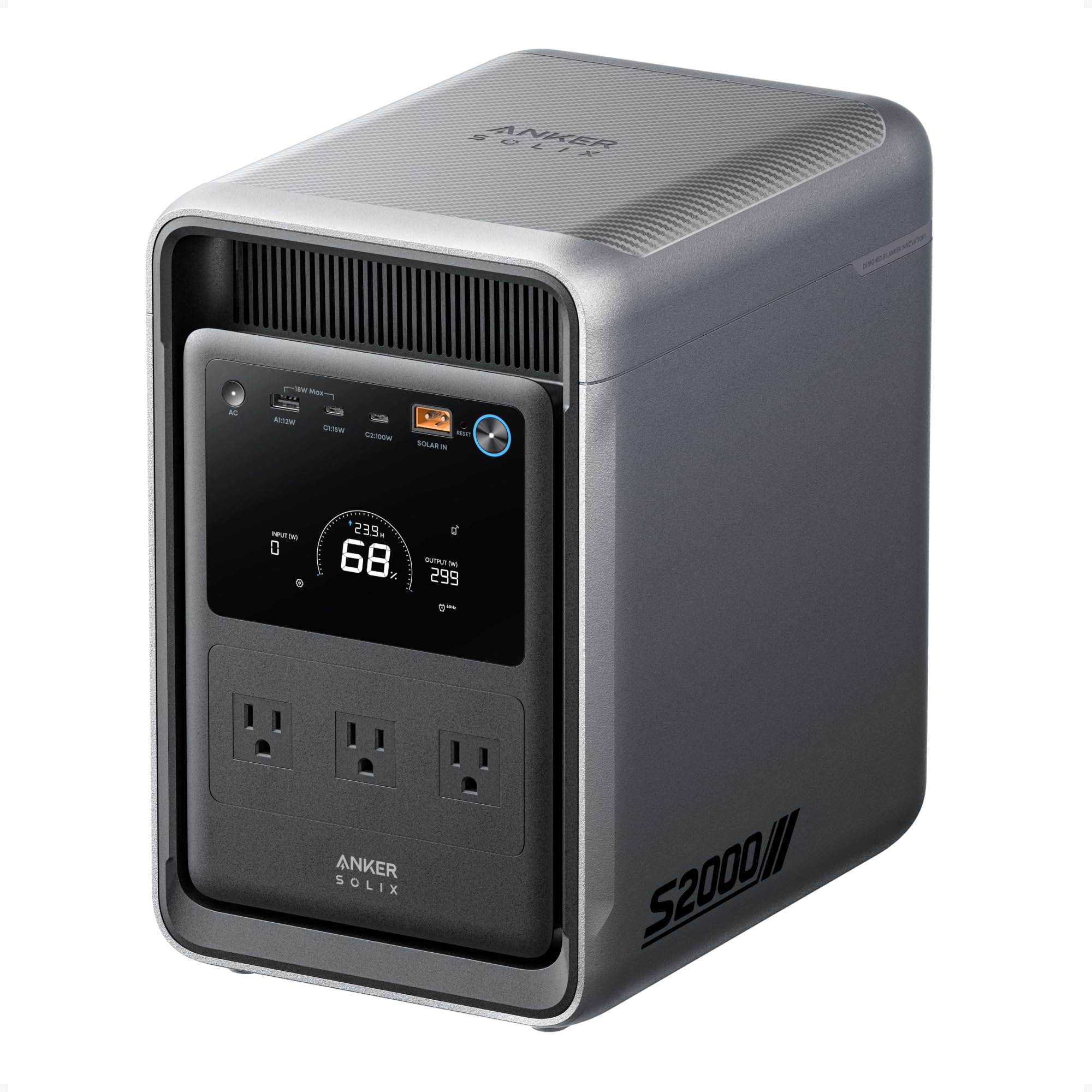
3. Anker SOLIX S2000 Portable Power Station, 2,010Wh, 3,000W Peak, Home Backup
A 2kWh powerhouse that hides in a space most stations can’t fit.
The figure that sells the S2000 is not its capacity — it is its footprint. At 8.2 × 11.1 × 12.7 inches and 35.7 pounds, it is 30% smaller and 25% lighter than the industry average for a 2kWh unit, so it slips into a garage corner or a closet shelf without eating your floor. For anyone who has tried to relocate a full-size station, that compactness is the entire reason to look here. Its 314Ah LFP cells are rated for 10,000 cycles — roughly 15 years of use.
Where it leads the pack is quiet efficiency. With a 6W idle draw and the maker claiming 10% higher efficiency than comparable units, it runs a fridge for up to 35 hours — the standout proof point owners rave about, and the reason it beats smaller backups on real runtime. The maker also claims it runs 20% longer than other 2kWh systems. On the power side it puts out 1,500W continuous with a 3,000W peak, enough for nearly every essential appliance, and it accepts up to 400W of solar input across six recharge paths. For a network rack or a home office, customers note using it smoothly as an uninterrupted power supply, with one running a rack for 13 hours through a 24-hour outage.
The give-and-take is in the noise. Some owners find it whisper-quiet and others find the fan noticeable, so your tolerance for a little whirring during heavy draw decides it. Power output also draws mixed notes — a 1,500W continuous ceiling will not run every large appliance. For a compact 2kWh station, though, the 4.7-star score across 200+ ratings reflects a lot of satisfied buyers.
Standout proof: the 35-hour fridge backup and 10,000-cycle LFP cells deliver a rated 15-year lifespan in a body 30% smaller than its peers.
Where to temper expectations: the fan noise splits opinions, and 1,500W continuous output is not enough for every heavy appliance.
Its balance: buyers short on floor space who want genuine 2kWh runtime for a fridge and a network rack.
Look further if: you need to run high-wattage appliances at full stretch — the power ceiling here is the limit.
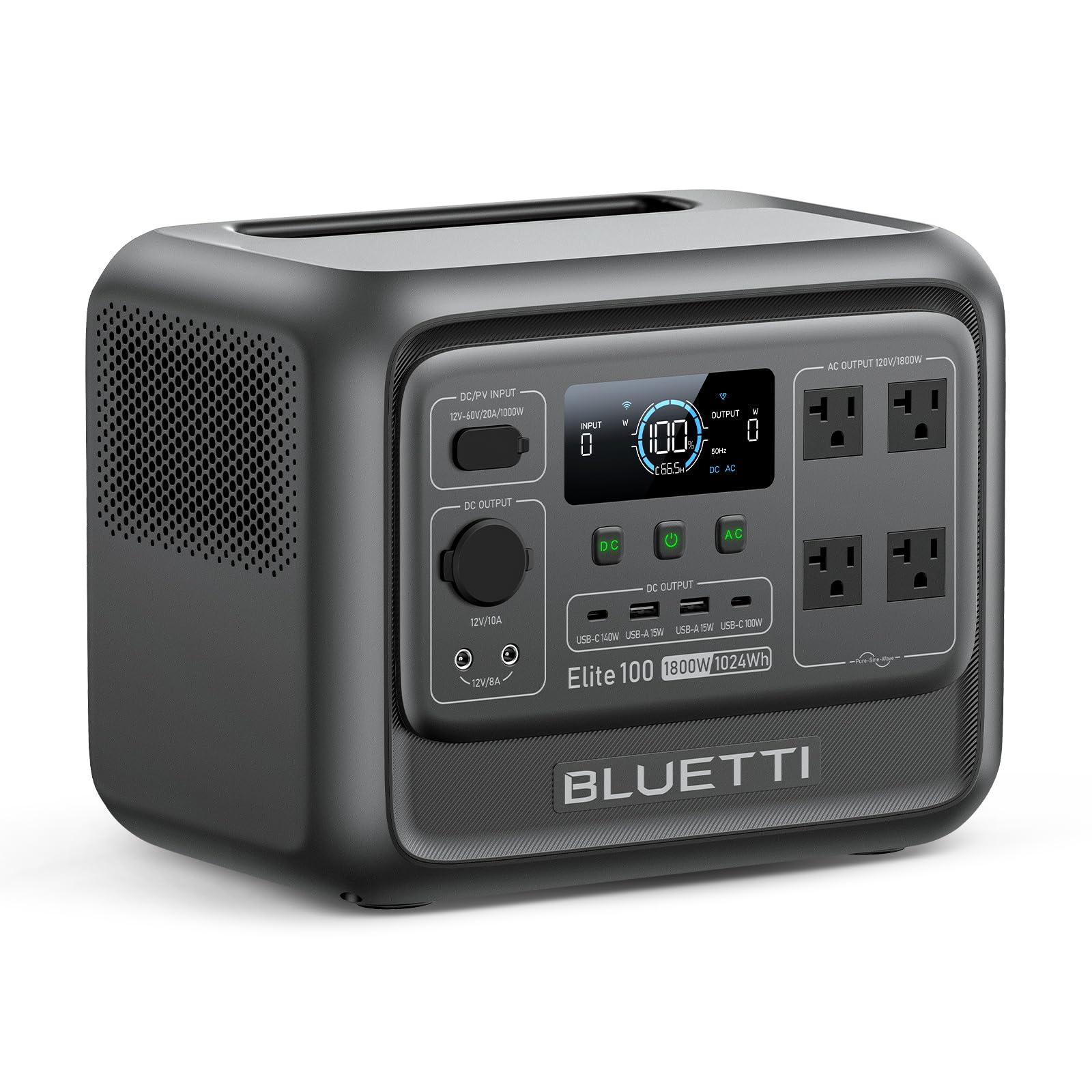
4. BLUETTI Elite 100 V2 Portable Power Station for Camping 1024Wh 1800W
The one-hand grab-and-go that fully refills in about seventy minutes.
For campers, apartment dwellers, and anyone who wants backup that does not live on a hand truck, the Elite 100 V2 hits a rare note. It holds 1024Wh, puts out 1800W rated with a hefty 3600W surge, and still weighs only 25 pounds thanks to a compact 17L build with a hidden handle you can lift one-handed. The 35% smaller and 30% lighter design is what separates it from the moment you try to move it. It carries a 3600W surge, which is enough for many motorized appliances to start.
The recharge numbers are where it flexes. With 1200W TurboBoost AC charging or up to 1000W solar input, it goes from empty to full in about 70 minutes — the fastest solar charge for a 1kWh station, and it carries 11 ports to spread that power around. For home safety it swaps to backup in 10ms, so routers and PCs keep running, and silent mode drops the fan to 30dB, which the maker calls 50% quieter than other 1kWh units. Sensitive loads like a telescope rig benefit, with one astrophotographer reporting roughly 6.5 to 7 hours of runtime for a mount, two cameras, a mini PC, and a tablet. The LiFePO4 cells are rated for over 4,000 cycles to 80%.
Two limitations to weigh against that speed. At 1024Wh it is a smaller bank, so it suits an essentials plan rather than whole-home coverage. And the unit still has real heft — a reviewer described “portable” as generous for a station this capable. The 4.5-star score across 600+ ratings reflects buyers who accept those limits in exchange for lightning recharge and true carry-anywhere weight.
What buyers keep talking about
- Full recharge in about 70 minutes on 1200W AC or 1000W solar
- 25 lb body with a one-hand hidden handle
- 30dB silent mode and 10ms UPS switchover for routers and PCs
- 11 ports and LiFePO4 rated for 4,000+ cycles
Honest limitations
- At 1024Wh it covers essentials, not whole-home loads
- Still a two-hand lift for some when fully loaded
- Solar charging slows noticeably on cloudy days
Weigh this if: you want fast recharge and easy carrying for camping, travel, or a compact apartment outage kit.
Skip if: you need to power a full fridge-freezer for days on one charge — that calls for a larger bank.
5. Jackery HomePower 3000 Portable Power Station, 3072Wh, 3600W AC Output
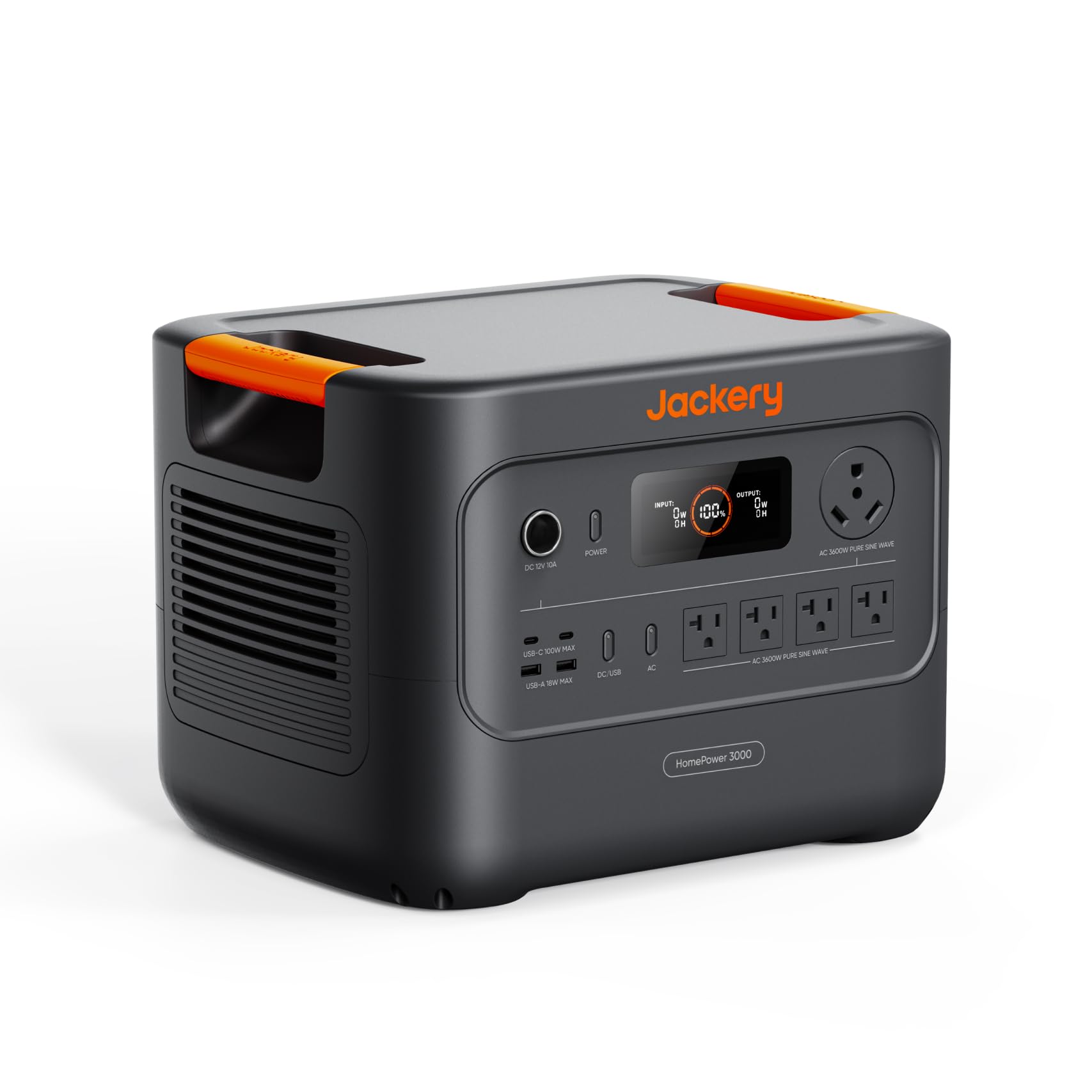
Whole-house muscle with a UL-certified UPS that keeps the router blinking through a storm.
This is the pick for the household that wants to keep the essentials humming — fridge, fan, router, lights — for up to 15 hours and the fridge specifically running for one to two days. Its 3072Wh capacity meets a 3600W output with a 7200W surge, a combination that handles heavy simultaneous loads without complaint. The UL-certified UPS switches within 20ms, so security cameras, a medical refrigerator, or a live video call ride straight through an outage instead of dropping.
What buyers rave about most is performance, and the RV crowd gets real value from the built-in TT-30 RV port and dual 100W PD ports for phone, tablet, and drone charging. Its LiFePO4 battery is rated for 4,000 cycles to 70% capacity, with ChargeShield 2.0 charge management. Recharging is flexible — 1.7 hours via hybrid AC and DC, 2.2 hours pure AC, or up to 80% in 9 hours with 2× 200W SolarSaga panels. Two real buyer stories stand out: one owner ran an entire 30-amp camper setup, and others report using the 30A outlet to plug a camper in directly without adapters.
Two honest trade-offs. First, weight draws clear negative notes — at 59.5 pounds this is a two-hand or wheel-it station, which is why Jackery engineered the honeycomb shell and the compact CTB design that is 47% smaller and 43% lighter than comparable 3kWh units. Second, value draws mixed feedback, so some buyers find the price steep next to cheaper rivals. The 4.4-star score across 200+ ratings reflects a lot of people who get genuine whole-house backup out of it.
The case for it: 3072Wh with 3600W output, a 7200W surge, a UL-certified ≤20ms UPS, and a useful TT-30 RV port make it a serious whole-home essentials bank.
One thing to know: at 59.5 pounds the weight is the recurring complaint, and value draws mixed notes at this tier.
Best matched to: families and RV owners who want big output and a certified UPS covering the essentials for a day or two.
Not for: anyone who plans to carry the bank around alone — this is a roll-or-two-hand unit.
6. BLUETTI Elite 300 Portable Power Station for RV & Home Backup 3014.4Wh
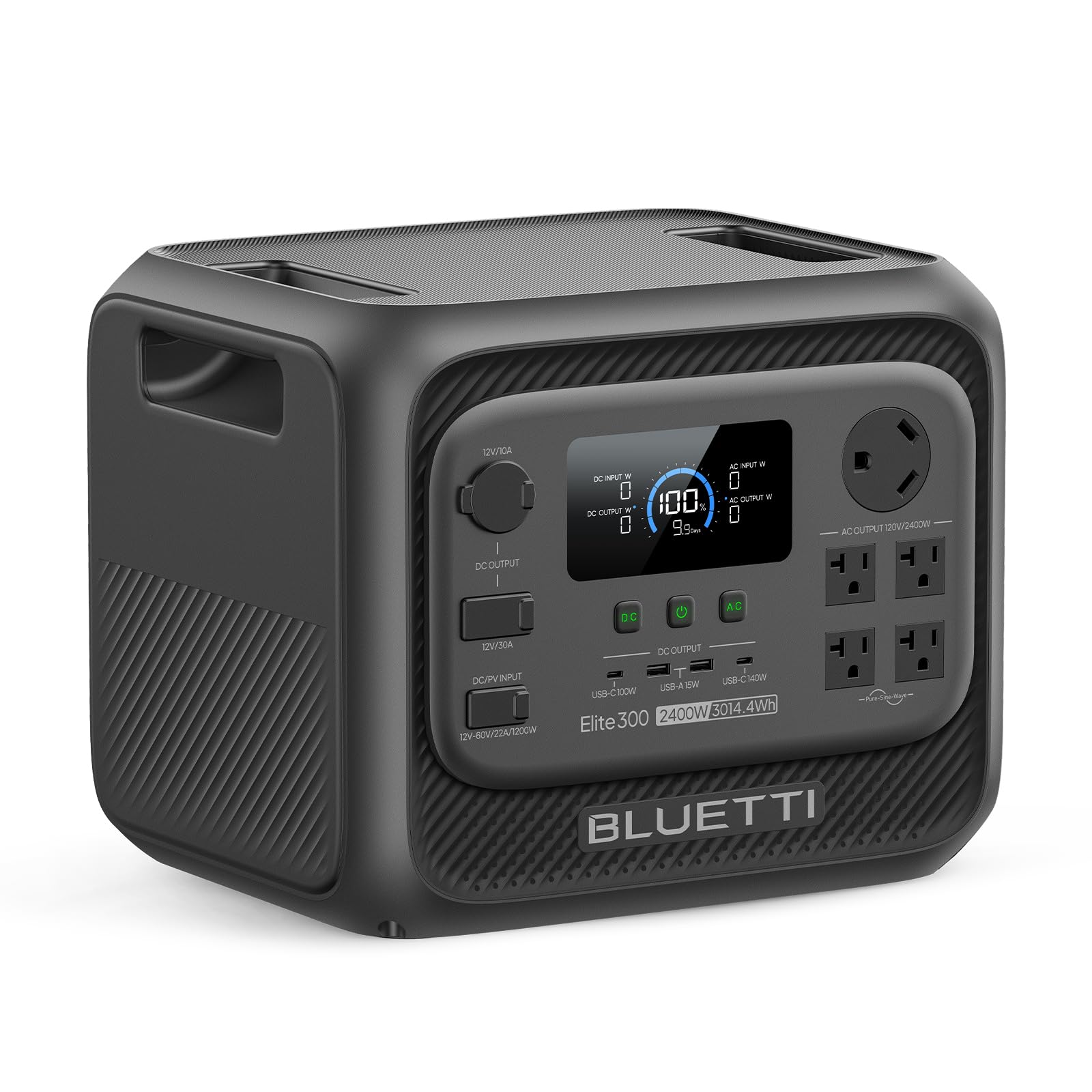
The 3kWh station that packs into a van and still runs the whole campsite.
For camper-van owners and off-grid travelers, the Elite 300 solves the space problem that plagues most 3kWh units. It holds a full 3014Wh in a design the maker calls nearly 59% smaller than traditional large stations, a compactness confirmed by Frost & Sullivan as the world’s smallest 3kWh portable power station. It delivers 2400W output with a 4800W surge, which handles resistive loads like kettles and runs fridges, routers, lights, TVs, and CPAP machines. RV-ready to the core, it includes a TT-30 RV outlet and a high-current 12V/30A DC output for 12V fridges, water pumps, and diesel heaters.
What buyers mention most is battery life and reliability, and the numbers back them up. The LiFePO4 cells are rated for 6000+ cycles, and the maker claims a fast 10ms UPS switch for computers and home-office gear. Recharging goes from 0 to 80% in as fast as 78 minutes, and you can charge via AC, solar, or a car charger. In the real world, reviewers point out using it as a bridge between the phone and a gas generator, one running high-wattage loads in a blackout and another using it for a weekend with no recharge needed.
The predictable trade-off is expandability. The unit is fixed at 3kWh — you cannot add battery packs to grow it the way you can with some rivals, so plan your capacity up front. Solar input is also capped lower than larger units, with the maker rating it at 1200W and one owner noting the voltage ceiling limits certain panel arrays. Weight draws mixed notes too. But for pure compactness plus RV power, the 4.7-star score across 100+ ratings says it delivers.
Where it shines
- 3014Wh in a body the maker calls nearly 59% smaller than traditional 3kWh stations
- TT-30 RV port and 12V/30A DC output for camper and vanlife gear
- 6000+ cycle LiFePO4 battery with 10ms UPS switchover
- 0 to 80% recharge in as fast as 78 minutes
What to plan around
- No battery expansion option — capacity is fixed at 3kWh
- Solar input is capped lower than larger competing units
- Heavy for its size, and the display can be dim in bright light
Reach for this if: you are kitting out a camper van or RV and need a full 3kWh that saves premium space.
Look elsewhere if: you want to add batteries later — this one is built as a fixed, self-contained bank.
7. Jackery HomePower 3600 Plus Power Station, 3584Wh, 3600W AC Output

Rolls like luggage, expands like a home system, and powers a three-person household.
What sets the HomePower 3600 Plus apart is the expansion path. It starts at 3584Wh and expands to 21kWh per unit or 43kWh across multiple units, which the maker sizes as enough to power a three-person household for over two weeks. It delivers 3600W output, 7200W in parallel, and dual 120V/240V voltage — so it can run heavy items like dryers and heaters that single-voltage stations cannot touch. That is genuine whole-home territory, not an appliance-by-appliance backup.
Reliability is the word buyers use most, and the engineering supports it. Its ceramic-membrane cells are tested at 302 °F, rated for 6,000 cycles and a 10-year lifespan, and claimed to run in -4 °F cold. It recharges from 0 to 100% in just 2 hours via hybrid AC and DC, or 2.5 hours AC, 4 hours solar, or 2.5 hours gas generator. Two owners summed it up: charging from 28% to 100% in under 2 hours and running a gas furnace, fridge, and freezer for up to 12 hours, with one rolling it easily from car to tent to RV.
The trade-off is size and mass. At 77.2 pounds this is a heavy unit, but the maker engineered it as the lightest 3.6kWh LFP station with a luggage-style design — wheels and a telescopic handle do the hauling for you. It is also 34% smaller and 29.3% lighter than other models in its class. The 4.6-star score across 200+ ratings reflects buyers who want growth room and are happy to roll it rather than lift it.
The growth argument: expandable to 21kWh per unit and dual 120V/240V output give you room to grow a household system without starting over.
The honest weight check: 77.2 pounds means you will use the wheels and telescopic handle, not your arms, to move it.
Made for: homeowners who want an expandable, wheelable backup that can grow toward whole-home coverage.
Reconsider if: you need something you can lift onto a shelf — this one is built to roll.
8. ECO-WORTHY Cubix100 48V 200Ah LiFePO4 Lithium Battery (2 Pack 48V 100AH) w/Bluetooth
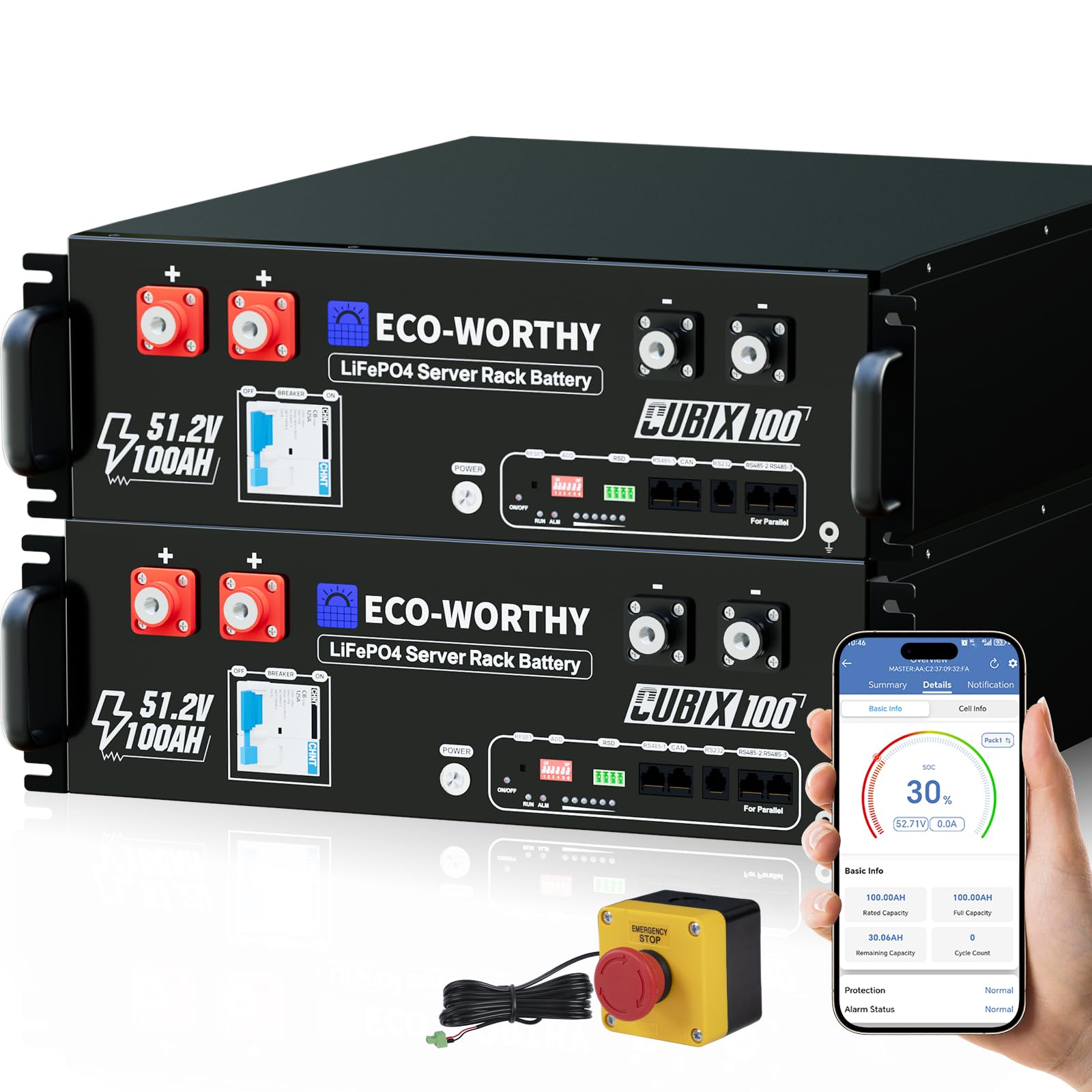
For the buyer wiring a permanent solar bank, this is the raw storage cell of the group.
This is not a portable station you wheel out for a storm — it is a server-rack battery built to sit in a permanent solar or backup system. Each 48V 100Ah unit stores 5.12kWh, and the kit ships as a 2-pack for 10.24kWh of storage, with the ability to parallel up to 32 units for a stated 163.8kWh. Grade A LiFePO4 cells deliver long cycle life, and the whole thing is built for server-rack use with vertical mounting support to save space. The pay-off here is scale, not grab-and-go convenience.
What earns the strongest praise is quality and reliability. It holds UL9540, UL1973, and CEC listings, tested by Intertek — the credentials that matter for permanent home installation. Integration is cleaner than the port count suggests: the unit has CAN/RS485 interfaces and multiple communication protocols for closed-loop talk with leading solar inverters, plus built-in Bluetooth and WiFi so you can watch battery status through the ECO-WORTHY app. The kit includes parallel cables, communication cables, grounding wires, terminal covers, and screws, so it goes from box to installed in minutes. Shoppers say putting it to work in off-grid homes and pairing it with matched-brand inverters for smooth compatibility.
Two things to understand up front. This battery is non-portable — the 2-pack weighs 200 pounds and needs a rack, so it belongs in a fixed location, not a camping kit. And because it is a bare storage battery, it produces no AC output on its own; you need an inverter and a system around it. For a buyer building a permanent solar bank who wants certified, app-monitored storage that scales, the 4.7-star score across 300+ ratings reflects a strong following.
Why off-grid builders choose it
- UL9540, UL1973, and CEC listed for permanent home installation
- 5.12kWh per unit, expandable up to a stated 163.8kWh
- CAN/RS485 closed-loop talk with leading solar inverters
- Built-in Bluetooth and WiFi for app monitoring of state of charge
What it is not
- Non-portable — 200 pounds for the 2-pack needs a fixed rack
- No AC output on its own; requires an inverter to build a system
- The companion app is basic, without time-to-full or time-left readouts
Built for: solar DIYers assembling a permanent, certified, app-monitored home storage bank that can grow.
Wrong pick if: you want a portable station to carry room to room — this is fixed-rack hardware.
9. EF ECOFLOW Portable Power Station 3600Wh DELTA Pro, 120V 3600W AC Output
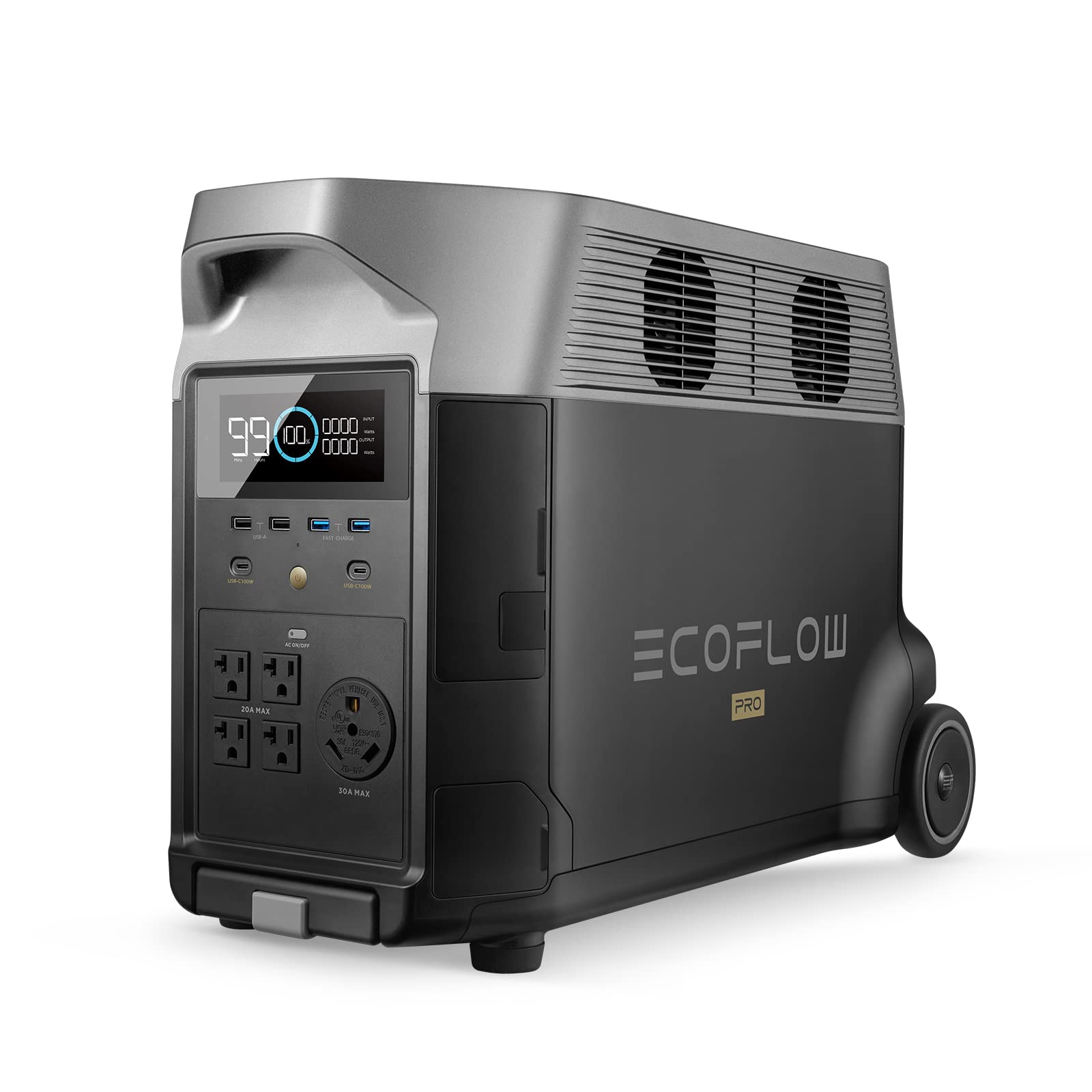
Start at 3.6kWh, grow toward 25kWh, and never start the system over.
For the buyer who wants a station today and a home system later, the DELTA Pro is the growth engine of this list. It launches with a 3600Wh LFP battery and expands from 3.6kWh to 25kWh with extra batteries or smart generators. Output is just as flexible — a single unit delivers 3600W AC, upgradable to 4500W with X-Boost, or 7200W when you pair two units together. With 15 output methods including 2 USB-A, 2 fast-charge USB-A, 2 USB-C at 100W, 5 AC outlets, 2 DC outlets, a car power output, and an Anderson port, it runs a genuinely mixed load at once.
The numbers that carry this unit are performance and reliability, both of which lead its owner feedback. Fast charging from a 240V outlet reaches full in 1.8 hours or 2.7 hours from a standard 1800W wall outlet, and solar charging tops up in 2.8 hours with 4× 400W panels using the maker’s claimed 23% conversion efficiency. Real-world, buyers report running a heat press at vendor markets with no voltage drops, and one owner relied on it to run a fridge and lights through an outage and still had 30% by morning. A single owner put it plainly: “It has handled all loads thrown at it and recharged quickly.”
The catch is weight. At 99 pounds this is a heavy stationary-class unit, so it belongs on the floor rather than a counter. Solar input is also limited to 15A, which caps how much panel power you can push in at once. It is a large investment aimed at buyers who value expandability. Across 600+ ratings it holds a 4.6-star score.
Why it holds its ground: expandable to 25kWh, 3600W output (4500W X-Boost), and 15 output methods give it rare headroom for a portable station.
Two real limits: at 99 pounds it is not a carry-anywhere unit, and solar input is capped at 15A.
Right for you when: you want a station you can grow into a 25kWh home system with a wide spread of ports.
Think again if: you expect to lift it — at 99 pounds it wants a permanent floor spot.
10. Anker SOLIX F3800 Portable Power Station, 3,840Wh

Dual voltage, six thousand watts, and enough ports to run the whole house.
The F3800 is the pick for someone who wants to power the major appliances, not just the essentials. Its 6,000W AC output runs everything in your home, with dual 120V/240V voltage so nothing is off-limits — dryers and heavy loads included. Add a second F3800 and you reach 12,000W max output. It starts at 3,840Wh and expands to 26.9kWh with up to six extra battery packs, pushing two units plus twelve packs toward enough power for two weeks. That kind of range puts it ahead of the 3kWh class on headline output.
What buyers praise most here is performance, and two features make it flexible. The NEMA 14-50 and L14-30 ports let you plug your RV straight into its power inlet — no adapters needed for popular RV models. You can also charge an EV at 6,000W using the same NEMA 14-50 port without extra grounding accessories. It recharges at up to 2,400W solar input, and Its EV-class LFP batteries carry a 5-year warranty and a 10-year lifespan.. The Anker app connects via WiFi or Bluetooth for remote monitoring and settings control, and families report getting three days of continuous power from the unit with two expansion batteries.
Two honest notes shaped by owner feedback. Solar charging is where the mixed reviews land — a 400W panel can underdeliver in real conditions, with one buyer seeing only 218W in full sun, and battery life draws mixed notes because heavy whole-home use drains it faster than expected. The answer is that this unit is built to be paired with expansion batteries and a generator rather than run alone. At 132.3 pounds, it is also the heaviest unit on this list by a wide margin. Across 300+ ratings, it holds a 4.4-star score as a serious modular backup system.
The whole-home strengths
- 6,000W AC output with dual 120V/240V voltage for major appliances
- NEMA 14-50 port charges an EV at 6,000W without extra accessories
- Plug RV models straight into the NEMA 14-50 or L14-30 ports
- Expandable to 26.9kWh with EV-class LFP batteries anda 5-year warranty
Where owners hit friction
- Solar charging underdelivers in real conditions, drawing mixed notes
- Heavy whole-home loads drain the 3,840Wh fast without expansion batteries
- At 132.3 pounds it is the heaviest station here by far
Anchors your setup when: you want dual-voltage whole-home power, EV charging, and an RV-ready system that grows with expansion batteries.
Steer clear if: you plan to run it solo as your only bank — heavy loads drain it, and it is built to pair with extra packs.
Understanding the Specs
Capacity in Watt-Hours (Wh)
This is the size of the tank — how much total energy the bank stores. A 1024Wh station like the BLUETTI Elite 100 V2 suits an essentials plan, while a 3584Wh unit such as the Jackery HomePower 3600 Plus is sized to carry a household through days of outage. Match capacity to the appliances you insist on running, not to the biggest number on the shelf, because a larger bank also means more weight to move.
Output and Peak Surge in Watts
Continuous watts is the steady power the bank supplies; peak surge is the short burst it handles when a compressor or motor first starts. Fridges and tools often demand two to three times their running watts at kick-on, so a higher surge rating — like the 7200W on the Jackery HomePower 3000 or the 4800W on the BLUETTI Elite 300 — is what keeps a motorized appliance from tripping the unit.
Battery Chemistry and Cycle Life
LiFePO4 (lithium iron phosphate) is the long-life lithium recipe used across this list. Cycle rating tells you how many full charges the battery survives before it fades; the BLUETTI Elite 300 is rated for 6000+ cycles and the Anker SOLIX S2000 uses LFP cells rated for 10,000. A higher cycle count means you replace the battery far less often over the years.
Transfer Time and UPS Function
Transfer time is the gap in milliseconds between the grid dropping and the battery taking over. Under 10ms — as on the DELTA 3 Max and BLUETTI Elite 300 — is fast enough that computers and routers never blink. A 20ms switch, like the UL-certified UPS on the Jackery HomePower 3000, is still quick enough for most home essentials and cameras.
FAQ
How long can a home battery bank actually run my fridge?
What is the difference between a portable power station and a server-rack battery?
Will a home battery bank keep my Wi-Fi router and computer running during a short outage?
How long does a LiFePO4 home battery bank last?
Can I charge a home battery bank with solar panels?
Is it safe to run a home battery bank indoors during a blackout?
Which home battery bank is best for RV or camper use?
Can higher-output stations power an EV or a whole house?
How fast can a home battery bank recharge between outages?
Is a larger capacity always the better choice for a home battery bank?
Final Thoughts: The Verdict
For most homes, the battery bank for home winner is the EF ECOFLOW DELTA 3 Max because it pairs a 2048Wh LiFePO4 battery with a 0–80% recharge in 1.13 hours and a 3400W X-Boost output that runs fridges, microwaves, and tools alike — the strongest all-round balance of capacity, speed, and durability on this list, at 4.7 stars across 500+ ratings. If you want whole-home output with a certified UPS, grab the Jackery HomePower 3000. And for a permanent, expandable solar bank, the BLUETTI Elite 300 is the one to reach for if space is tight. If you want the most room to grow, the expandable EF ECOFLOW DELTA Pro and the dual-voltage Anker SOLIX F3800 both reward buyers who plan to add batteries over time.
How We Picked
We do not accept paid placement. Every pick is matched to a real buyer and a real use-case; we do not hands-on test units.
Sources & Methodology
Specifications: manufacturer listings and product documentation. Review insights: verified customer reviews, as of September 2026. Pricing: not shown on this page (it changes often); check the current price via the retailer link.
As an Amazon Associate, KitchPrep earns from qualifying purchases. This does not affect which products we feature.
Related Guides
