
Specs are compiled from manufacturer listings and verified buyer reviews and can change over time — please confirm the key details on the product page before buying.
If you are shopping for a 3-ton air conditioner, the real question is not which brand looks best on paper — it is what kind of system your house can actually accept. A 3-ton unit delivers 36,000 BTU of cooling, which is the standard size for roughly 1,700 to 2,100 square feet of living space. Some of the picks below are condenser-only outdoor units that pair with a coil or air handler you install inside. One is a single all-in-one cabinet that sits entirely outside. One is a full condenser-and-air-handler combo. Getting the form factor right matters more than brand, because a packaged unit, a split condenser, and a condenser-only listing are not interchangeable.
I’m Mohammad Maruf — the founder and writer behind KitchPrep. This guide is built by comparing the manufacturers’ published specifications and the patterns across verified customer reviews, so you get each pick’s real strengths and trade-offs instead of marketing spin.
Below you will find five 3-ton systems compared on the specs that decide the job — refrigerant type, SEER2 efficiency rating, compressor style, and what has to be bought alongside them. This breakdown of the best 3-ton ac options compares five systems on form factor, refrigerant, and SEER2 so you can match one to your ductwork and climate.
Our Picks at a Glance

How To Choose The Best 3-Ton AC
A 3-ton air conditioner is a major, multi-year purchase, and the spec sheet is where most buyers get lost. The good news is that only a handful of numbers actually change what you buy. Start with the form factor, because that decision rules out half the market before you compare anything else.
Packaged, Split, or Condenser-Only
A packaged unit keeps the whole cooling system — compressor, coil, and blower — in one outdoor cabinet. That suits mobile and manufactured homes, and it frees up indoor space a split system would occupy. A split system separates the outdoor condenser from an indoor coil or air handler, which is what most houses with existing ductwork already run. A condenser-only listing is just the outdoor half, so you must buy the matching indoor coil or air handler separately or the system will not run. Read the listing carefully for which half you are actually getting.
SEER2 — The Number That Shows Up on Your Power Bill
SEER2 is the updated efficiency rating for air conditioners, and a higher number means the unit draws less electricity to move the same amount of cooling. A 13.4 SEER2 unit is built for buyers who care more about the up-front cost than the long-term energy bill. A 14.3 or 14.5 SEER2 unit steps up that efficiency. Senville’s system goes further with an inverter compressor that varies its speed instead of switching fully on and off, which is how it earns a Cold Climate Energy Star rating.
Refrigerant: R-32 vs R-410A
Refrigerant is the fluid that carries heat out of your home, and the type matters because it decides what else you must buy. R-32 is not backwards compatible with the older R-410A, so an R-32 condenser needs an R-32 coil, air handler, or furnace to go with it. If you are replacing an R-22 or R-410A system, plan on changing the line set and the coil too. The plus side is that R-32 systems are the current direction of the market, so you are buying into the newer standard rather than the outgoing one.
Compressor Style and What It Means at Night
The compressor is the heart of the outdoor unit and sets both durability and noise. A scroll compressor is the common modern design, and Goodman uses it across several of these units. A reciprocating compressor is an older mechanical design you will still see. An inverter compressor works differently — it slows down and speeds up to hold a steady temperature instead of cycling hard on and off, which is why those systems run quietly and keep the temperature flat. If you sleep near a window that faces the outdoor unit, this is the spec to weigh hardest.
Quick Comparison
| Model | Best For | Form Factor | Compressor Type | Efficiency Rating | Amazon |
|---|---|---|---|---|---|
| Goodman GPCH33631 Packaged Unit★ Best Overall | Mobile and manufactured homes | Packaged unit | Scroll | 13.4 SEER2 | Amazon |
| Goodman GLXS4BA3610 CondenserBest Value | Larger homes, tighter bills | Split system | Reciprocating | 14.3 SEER2 | Amazon |
| Senville Central Heat Pump | Year-round heating and cooling | Mini-split | Inverter | Cold Climate Energy Star | Amazon |
In‑Depth Reviews
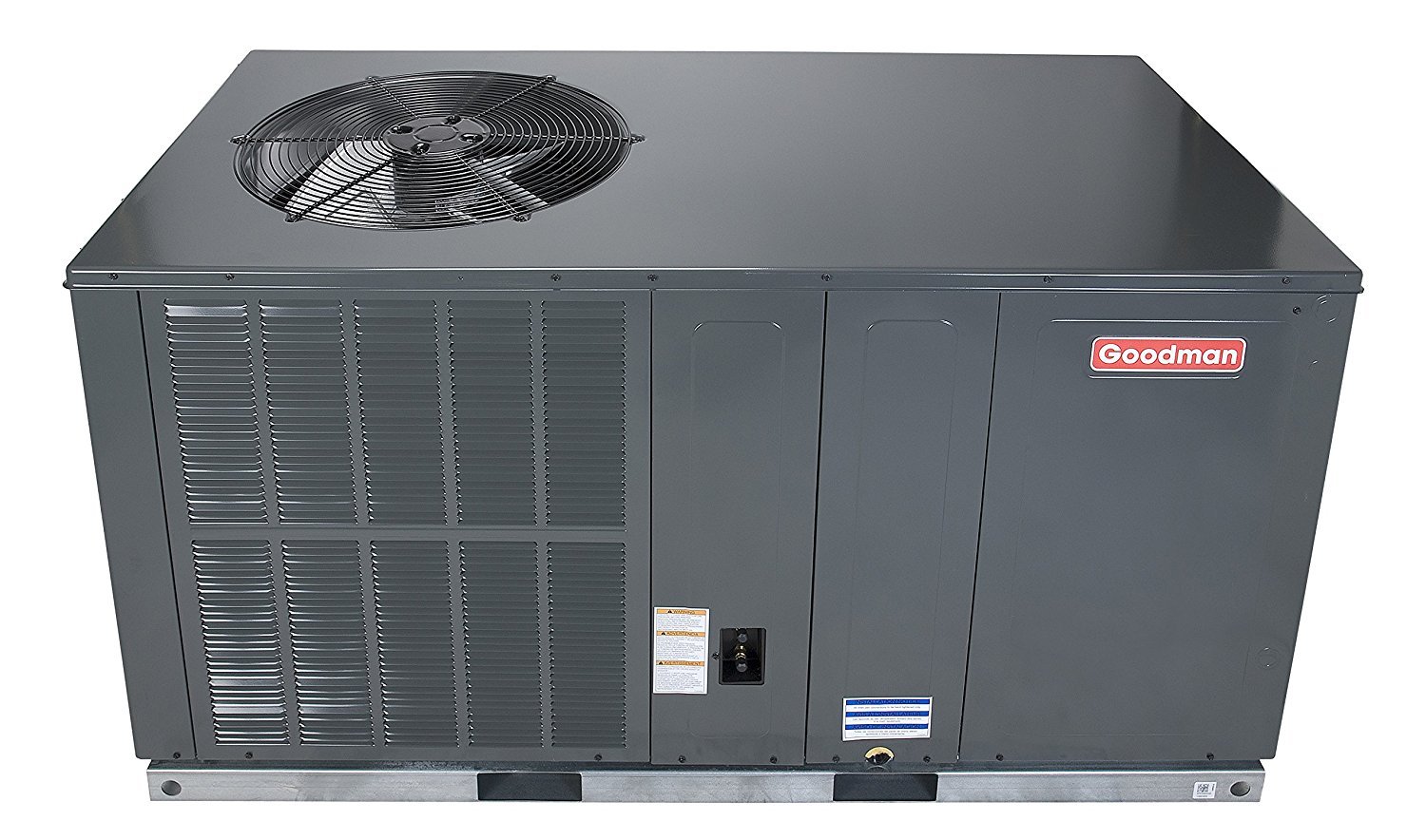
1. Goodman 3 TON 13.4 SEER2 Horizontal AC Only Packaged Unit (GPCH33631)
Our pick — over 4.5★ from 100+ verified ratings; the strongest balance of quality and price.
One outdoor cabinet holds the whole cooling system, so nothing bulky takes up closet space inside.
For a mobile or manufactured home — or any house where you simply do not have a spot for an indoor air handler — this is the pick that solves the problem instead of working around it. Everything you need for cooling sits in a single 35″ H x 66 1/2″ W x 34″ D cabinet outside, connected to your existing ductwork through horizontal discharge. It puts out 36,000 BTU, and the scroll compressor paired with an all-aluminum evaporator coil is built to hold up outdoors across years of weather. The heavy-duty powder-painted steel cabinet is the part that takes the sun and rain so the equipment underneath does not have to.
What wins people over here is performance in punishing heat. Buyers report it holds a house steady at 73 degrees with 35 to 38 percent indoor humidity, which is the kind of real number that tells you it is actually handling the load rather than just running. It arrives fully charged and tested, so a professional installer can connect it and go. Owners also single out the up-front value — it does not make you pay for efficiency you will not use in a home that only runs cooling part of the year. That is exactly what a 13.4 SEER2 rating is for: buyers who care more about the install-day cost than trimming the long-term energy bill.
The honest catch is weight, and it is worth planning around. This is a heavy cabinet, and getting it off the truck and into position is a two-person-or-machine job — plenty of buyers line up a tractor or a friend with a forklift before delivery day. A few units also show up with a minor dent or two, and none come with the ductwork adapters, so you may need to fabricate a transition. Maintenance stays simple, though: the service panels are built for easy access, so filter changes and routine checks are quick rather than a wrestling match.
What buyers keep raving about
- All-in-one design frees up indoor floor space — no separate air handler or furnace closet needed
- Held 73 degrees at 35 to 38 percent humidity in real homes during peak heat
- Arrives fully charged and tested for a faster professional install
- Heavy-duty powder-painted steel cabinet built for year-round outdoor exposure
Where it asks a little patience
- Genuinely heavy — line up equipment or extra hands before delivery day
- No ductwork adapters included, so some homes need a fabricated transition
- An occasional unit arrives with minor cosmetic dents from shipping
Built for: manufactured and mobile homes, or any house with nowhere to put an indoor air handler — this is the cleanest fit in the lineup for that situation.
Think twice if: you want a system that also heats, since heat kits for this unit are a separate purchase and are made for occasional use rather than daily heating.
2. Goodman 3 TON 13.4 SEER2 R-32 AC Condenser (GLXS3BN3610)
A step up the efficiency ladder for homes that run cooling hard through a long, hot season.
The gap between this condenser and the budget Goodman above is small on paper but real over a summer. This one carries a 14.3 SEER2 rating where the GLXS3BN3610 sits at 13.4 — a higher efficiency tier for the same 36,000 BTU of cooling. It is rated to cover 1,700 square feet, and it uses a reciprocating compressor rather than a scroll design, which is the older mechanical approach to the same job. Its 29″D x 29″W x 32.5″H cabinet is a compact footprint, worth knowing if your outdoor pad is tight. It replaces the GSXN403610 and GSX140361, and the 10-year parts limited warranty covers it when a qualified installer registers it within 60 days.
Owners who moved off an undersized 2.5-ton compressor describe the difference as night and day — the house actually gets cold instead of merely less warm. City-water scorchers roll off it, and the solid steel exterior takes the weather without complaint. The install story is mostly painless if you hire it out: get a licensed pro to set it and the service life stands up. Keep it clear of debris a couple of times a season and it holds its performance.
One recurring concern is worth flagging honestly: compressor longevity has been uneven for a small number of buyers, with a compressor failure reported years into ownership and a leaking condenser coil found during the repair. That is a fitting-and-installation story as much as anything — how well the line set is done and how the system is charged affects how long it lasts — but it is the one reason to make sure your installer is genuinely qualified rather than convenient. The R-32 compatibility rule applies here too, so confirm your indoor coil and air handler are R-32 ready before you commit.
Why owners stay happy
- 14.3 SEER2 rated, a clear efficiency tier above the budget condenser while covering the same 36,000 BTU
- Solid steel exterior and compact 29″D x 29″W x 32.5″H footprint
- Cools houses very well even on hot days, per long-term owners
- Rated to handle a 1,700 square foot living space
The honest cautions
- R-32 refrigerant means a new indoor coil or air handler may be needed — it is not backwards compatible with older R-410A equipment
- Install quality matters a lot; use a genuinely qualified installer to protect the 10-year parts warranty
- Reciprocating compressor design rather than the more modern scroll
The smart buy for: a 1,700 square foot home where the cooling runs long and heavy, and the extra efficiency will pay off in the monthly bill.
Pass it over if: you are already committed to R-410A indoor equipment, because the refrigerant mismatch forces a bigger project than you planned.
3. Senville Central Air Conditioning System, Heat Pump, Inverter, 3 Ton
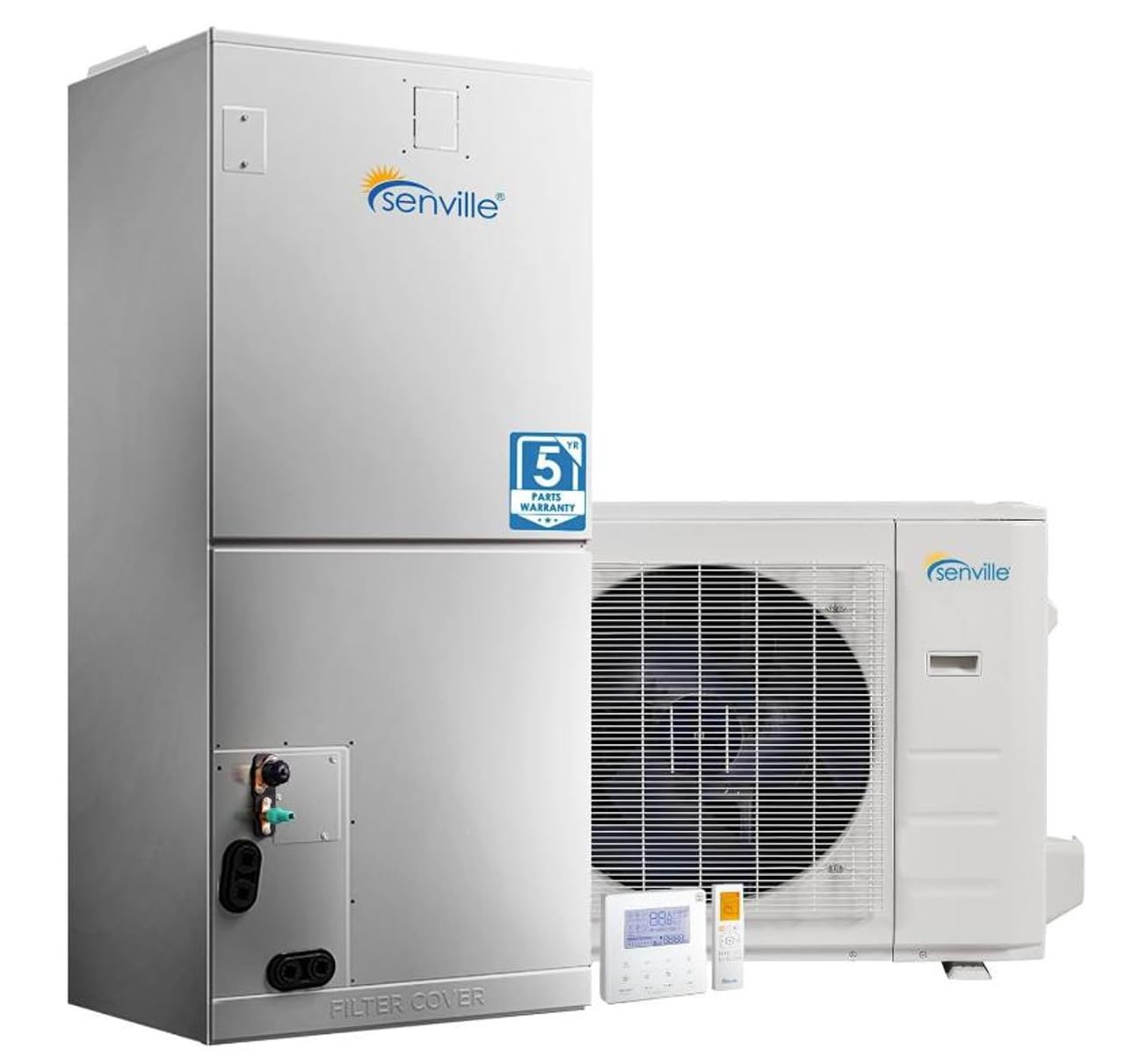
The only pick here that handles heating as well as cooling, down to -22F outside.
Every other unit on this list cools only. This Senville is a heat pump, which means it moves heat in both directions — it chills your home in summer and warms it in winter, and it keeps working in cold as low as -22F/-30C. It moves 36,000 BTU and is rated for up to 2,000 square feet, the largest coverage area in the lineup. The inverter compressor is the headline feature: instead of banging on and off, it slows down and speeds up to hold a steady temperature, which is why it runs quietly and keeps the whole house even rather than cycling hot and cold.
What owners love most is how quietly it runs and how thoroughly it cools. It sits in the background and holds the house temperature rather than announcing itself every cycle. The warranty is the most generous of the group — 10 years on the compressor and 5 years on parts. For anyone replacing a central system and also facing real winter, that dual-purpose capability is the reason to choose it over a cooling-only condenser. The annual energy draw is listed at 6,400 kilowatt hours per year, so you have a concrete number to weigh against your own usage.
Be realistic about the installation, because this is where the honest friction lives. Senville explicitly recommends a licensed professional, and owners back that up: some find it fairly simple, others hit real snags. Expect to pay for professional duct transitions, and know that commissioning the warranty requires a professional startup that can be hard to schedule in peak season. The 16-foot line set is on the short side for many homes, so measure before you order or budget for a longer one. Once it is dialed in, heat-pump owners consistently describe it cooling well even at 100°F. This is the pick for someone who wants one system to do two jobs and is willing to pay a pro to get it right.
The payoff on quiet: the inverter design is what separates this from the rest — it never slams on and off, it just eases up and down, so the temperature stays flat and the outdoor unit stays quiet enough to forget it is there.
Setup is not a weekend project: factor in a licensed installer, duct transitions, and a longer line set if your run exceeds 16 feet, and the total project looks very different from the sticker alone.
Choose it when: you want heating and cooling from a single system and your climate swings hard in both directions.
Move on if: you are set on a DIY install — this one is built around professional commissioning, and cutting corners there risks both the warranty and the performance.
Understanding the Specs
What SEER2 Actually Measures
SEER2 is the efficiency score of an air conditioner — the higher it climbs, the less electricity the unit uses to deliver the same cooling. A 13.4 SEER2 unit is the value-oriented choice, built for buyers who put up-front cost first. Step up to 14.3 or 14.5 SEER2 and you are paying a little more now for a system that works a little less hard over a long, hot summer. An inverter compressor takes a different route entirely: instead of running flat out and shutting off, it modulates its speed to hold the temperature steady, and that is how the Senville system earns its Cold Climate Energy Star rating.
Refrigerant and Why It Decides Your Whole Purchase
Refrigerant is the fluid that carries heat out of the house, and the type seated in your system decides what else you must buy. R-32, the current standard used across most of these units, is not backwards compatible with the older R-410A. That means an R-32 condenser has to match an R-32 coil, air handler, or furnace — mixing generations will not work. If you are replacing an R-22 or R-410A system, you will also change the line set and the coil. Confirm the pairing before you order, and the installation stays a straightforward job.
Scroll, Reciprocating, and Inverter Compressors
The compressor is the engine of the outdoor unit, and its design shapes both durability and noise. A scroll compressor is the modern standard, using two spiraling parts to squeeze refrigerant with fewer moving parts to wear. A reciprocating compressor is the older piston-style design you will still find. An inverter compressor does not shut off at all — it simply slows to match the load, which is why those systems run quietly and keep a room at one steady temperature. If noise near a bedroom window matters to you, this is the spec to weigh most.
Pairing the Outdoor Unit Correctly
A condenser on its own does not cool your house — it has to be connected to an indoor coil, air handler, or furnace that matches its capacity and refrigerant. A 3-ton condenser pairs with a 3-ton indoor coil, which is why the rated coverage areas here land between 1,700 and 2,100 square feet. Some listings bundle the pair so there is nothing to match; others sell only the outdoor half. Check the listing for whether it includes the indoor coil or air handler, because a condenser-only unit will not cool your house on its own.
FAQ
What size home does a 3-ton AC actually cool?
Can I replace just my old condenser with one of these?
Is R-32 refrigerant compatible with my old R-410A system?
How much does a 3-ton AC cost to install?
What is the difference between SEER2 and older SEER ratings?
Can I install a 3-ton AC myself?
How long should a 3-ton AC condenser last?
Does a heat pump cool as well as a straight AC?
What is an inverter compressor and do I need one?
Is a packaged unit better than a split system?
Final Thoughts: The Verdict
For most buyers, the 3-ton ac that earns its place is the Goodman GPCH33631 packaged unit — it solves the space problem that trips up so many installs, delivers 36,000 BTU, and holds a house steady in real summer heat. If your indoor coil is already good to go and you just need the outdoor half back in service, the Goodman GLXS3BN3610 condenser does that with the least fuss. And if you want one system to handle both winter and summer, the Senville inverter heat pump is the pick that cools and heats from a single outdoor unit, down to -22F. Whichever you choose, confirm the form factor and refrigerant match your existing ductwork and indoor equipment before you buy.
How We Picked
We do not accept paid placement. Every pick is matched to a real buyer and a real use-case; we do not hands-on test units.
Sources & Methodology
Specifications: manufacturer listings and product documentation. Review insights: verified customer reviews, as of September 2026. Pricing: not shown on this page (it changes often); check the current price via the retailer link.
As an Amazon Associate, KitchPrep earns from qualifying purchases. This does not affect which products we feature.
Related Guides
