
Specs are compiled from manufacturer listings and verified buyer reviews and can change over time — please confirm the key details on the product page before buying.
If you’ve ever lain on your back with your arm twisted up behind a sink, trying to loosen a faucet nut you can’t see, you already know the pain this tool solves. A basin wrench for tight spaces is the one plumbing tool that turns that miserable, contorted job into a simple one-handed turn. The real question is which design actually fits your specific nut and your specific cabinet.
I’m Mohammad Maruf — the founder and writer behind KitchPrep. This guide is built by comparing the manufacturers’ published specifications and the patterns across verified customer reviews, so you get each pick’s real strengths and trade-offs instead of marketing spin.
Find the right basin wrench for tight spaces with this breakdown of jaw reach, handle length, and head angle so you can finish the job without a second trip to the store.
Our Picks at a Glance


How To Choose The Right Basin Wrench for Tight Spaces
Before you pick, you need to know the size of the nut you’re turning and how far back it sits. A tool that’s perfect for a shallow pedestal sink can be useless for a deep double-basin kitchen cabinet.
Match the jaw to the nut you actually have
The most common faucet mounting nuts sit between 3/8-inch and 1-1/4-inch across the flats, which is why most telescoping basin wrenches cover that span. But if you’re dealing with a large plastic retaining nut on a kitchen faucet, some of those can measure up to 2-1/2 inches. Measure the nut with a ruler or caliper before you buy, and make sure the tool’s jaw capacity covers it.
Weigh reach, pivot, and one-hand use together
Reach matters only if the head can angle up to grab the nut, and the grip works only if you can turn it without re-positioning. Look for a head that pivots up to 180 degrees and a spring-loaded jaw that ratchets so you can work one-handed. A longer telescoping handle, often stretching from 10 inches to 17 inches, helps you reach deep into the cabinet, but it can also make the tool heavier and more awkward in a genuinely cramped space.
Quick Comparison
| Model | Best For | Jaw Capacity | Handle Range | Head Pivot | Amazon |
|---|---|---|---|---|---|
| RIDGID 31175★ Best Overall | Tough, reliable all-rounder | 3/8″ to 1-1/4″ | 10″ to 17″ | 90 degrees | Amazon |
| KUZIUA 14-in-1Budget Champion | Beginner-friendly multi-kit | 4 inserts up to 44mm | 14″ fixed | N/A | Amazon |
| HAUTMEC PL0025Top Performer | Value with pro feel | 3/8″ to 1-1/4″ | 10″ to 17″ | 180 degrees | Amazon |
| Holdly Angle Stop | Shut-off valve swaps | 15/16″ & 5/8″ | Compact | N/A | Amazon |
| DURATECH DTBWS-3 | Large 2″ drain nuts | 1-3/8″ to 2-1/2″ | 10″ to 17″ | 180 degrees | Amazon |
| ARES 33001 | Extra torque on stubborn nuts | Up to 1-3/8″ | 11″ to 16″ | 180 degrees | Amazon |
| Klein Tools 68232 | Pro-grade grip & leverage | Up to 1-1/4″ | 10″ to 17″ | Pivoting | Amazon |
| HAUTMEC HT0423 | Dual-jaw versatility | Two sets to 2-1/2″ | 11″ to 18″ | 180 degrees | Amazon |
| Rothenberger 70226 | Premium European build | 3/4″ to 1-7/8″ | 4 positions | Reversible jaw | Amazon |
In-Depth Reviews
1. RIDGID 31175 Model 1017 Fold Over Basin Adjustable Pipe Wrench
Our pick — over 4.5★ from 550+ verified ratings; the strongest balance of quality and price.
The tank-like favorite that pros and DIYers reach for when a cheap wrench has already failed.
This is the wrench buyers describe as “built like a tank,” and it earns that reputation with a forged alloy steel jaw that springs shut for fast, one-hand ratcheting. The head is held in position by a tension plug at any angle up to 90 degrees, so you can reach a nut that’s tucked sideways behind the faucet body. The telescopic shank snaps from 10 inches out to 17 inches, which gives you the extra reach you need without forcing you to store a long rigid bar.
You get a tool that grips where others slip: buyers report it tightened a plastic nut on a filtered water line where other tools had failed, and the review pages sum it up: “This is the one to get.” It is made in the USA and carries a lifetime warranty on material and workmanship, so you are covered for defects. It handles pipe from 3/8-inch to 1-1/4-inch, and at 0.9 kg it has reassuring heft. The jaws are precision-ground, meaning they are machined to a sharp edge, so they bite without slipping off a rounded nut.
The honest trade-off is cost — it sits at the premium end of the basin wrench spectrum, and buyers acknowledge it’s pricey but call it worth it because it finishes jobs in one go. That said, the tilt head only goes to 90 degrees rather than a full 180, so a nut pointing almost straight down at you might require a second approach from a different angle. For almost every under-sink faucet and supply-line nut, the versatility and durability here make it the default pick.
What wins people over
- Spring-loaded jaws ratchet one-handed, no re-fitting per turn
- Adjustable length from 10 inches to 17 inches reaches deep cabinets
- Made in the USA with a lifetime material and workmanship warranty
Fair caveats to know
- Head pivots to 90 degrees, not a full 180
- Pricier than most options in this roundup
Reach for it if: you want one rugged tool that will outlast every faucet you ever install and you’re happy to pay for it.
Look elsewhere if: you need a head that flips a full 180 degrees for a truly awkward access angle.
2. KUZIUA 14-in-1 Multi-functional Faucet and Sink Wrench
A 14-inch socket-style kit that swaps heads to fit whatever odd nut is hiding under your sink.
You match the head to the nut instead of wrestling a universal jaw into place: this tool gives you four stripping attachments sized at 28mm, 34mm, 40mm, and 44mm, plus a T-shaped attachment. That approach proved itself for a homeowner who used it to reach “the small space between the two sinks” and loosen a 1-1/2-inch nut they would otherwise have paid someone a hundred dollars to remove. The 14-inch extra-long body is built for turning hard-to-reach mounting nuts on faucets, sprayers, and ball valves, and it doubles as a spirit level (a bubble level built into the tool) for checking your work.
The honest limits are real: the body is made of engineering-grade ABS plastic and high-strength zinc alloy, not solid steel. The maker explicitly warns it cannot be compared with iron and needs proper use of strength. Owners mention it’s great for simple, newer plumbing but loses grip and leverage on old, stuck nuts, and the handle shows a tendency to twist or bend under heavy force. This is a friendly tool for a first-time DIYer, not a hobbyist’s brute-force weapon.
Where it genuinely shines is accessibility — a non-professional who’s never touched plumbing can pop on the right insert, slide it up to the nut, and turn. It’s the rare kit that removes the guesswork of jaw sizing entirely, at a price that undercuts every other option here.
Best for beginners: if you’re tackling your first faucet swap and want color-coded simplicity over raw torque, this saves you money and confusion.
Not built for: corroded or seized nuts that demand serious force — treat it gently and it will treat you well.
3. HAUTMEC Telescoping Basin Wrench PL0025
Half the price of the big-name rival, with a full 180-degree pivot and the same 10-to-17-inch reach.
This is the value pick that customers note delivers the essentials of the pricier RIDGID at roughly half the cost. The spring-loaded jaws self-adjust across nuts from 3/8-inch to 1-1/4-inch and ratchet continuously so you never re-fit after each turn — one-handed operation down a tight cabinet. Where it actually beats the RIDGID on paper is the head, which pivots and holds at any angle up to a full 180 degrees, giving you more ways to approach a nut that sits sideways or upside-down.
The chrome-plated telescoping shaft extends from 10 inches to 17 inches across four locked positions, and a sliding T-bar handle lets you shift your grip for the best leverage. There’s also a removable 8-inch handle so the whole thing stores flat in a drawer, plus a rear hanging hole for a tool board. Reviewers point out it fixed a four-year wobbly faucet by reaching up under the sink and avoiding the obstructions that blocked their arms entirely.
Weight lands at 1.7 pounds, and the metal build is sturdy enough that one owner clamped a crescent wrench onto the square steel shaft for extra torque on a stubborn 1-1/4-inch nut. The honest caveat: on severely tight or rusted nuts, some found the spring jaw slips and needed a dedicated breaker tool instead. For routine faucet swaps and supply-line work in awkward cabinets, this delivers nearly all the performance of the premium pick at a friendlier price.
Smart-money choice: get 180-degree maneuverability, four reach positions, and solid steel construction without paying the brand tax.
Its limit: a fully seized, rusted nut may defeat the spring jaw — keep a breaker bar nearby for the worst cases.
4. Holdly Angle Stop Wrench for 3/8- and 1/2-Inch Valves

The specialty wrench that makes swapping a shut-off valve a five-minute job instead of a contortion act.
This is not a general-purpose basin wrench — it’s a focused tool for one frustrating task: removing and installing compression angle stops and supply nuts. The head fits two specific nut sizes, 15/16-inch and 5/8-inch, and it’s compatible with 3/8-inch and 1/2-inch compression outlet threads. The defining trick is the dual-action mechanism that opens the wrench so you can slip it around a valve in a confined spot where an open-end wrench or a pair of pliers physically won’t fit.
Buyers who followed a plumbing video to replace a sink shut-off valve call it an “AWESOME tool,” praising how the metal rod holds the valve securely in place while they work. It also handled removing old toilet and faucet shut-off valves to install modern 1/4-turn valves, with the wrench making the job dramatically easier in tight spots. The corrosion-resistant finish and ergonomic dual-action grip are designed to reduce slippage, and at 0.6 kg it feels solid in the hand.
The main gripe to know about is stability — buyers repeatedly note the tool can feel unsteady on certain fittings, and one buyer felt they received a defective unit (the company offered a refund, which speaks to decent support). Value opinions split too, with some calling it a must-have and others questioning the price for such a narrow tool. If your project is specifically angle stops and supply nuts under a sink, this is the right specialist; if you need a do-everything wrench, look at the telescoping picks instead.
The specialist’s edge
- Opens around valves in spots too tight for standard wrenches
- Dual-action grip holds the valve steady while you turn
- Corrosion-resistant finish built for longevity
Know before you buy
- Only fits 15/16-inch and 5/8-inch nuts
- Some report instability on certain fittings
Pick this for: replacing shut-off valves or supply nuts quickly, where reach and access beat brute force.
skip it if: you need a versatile wrench for many different nut sizes under the sink.
5. DURATECH 10″-17″ Telescoping Basin Wrench

The oversized-jaw wrench that finally grips the 2-inch plastic retaining nut most others can’t reach.
Most basin wrenches top out around 1-1/4 inches of jaw capacity, which leaves you stranded the day you meet a large plastic nut holding a kitchen faucet to the countertop. This DURATECH opens its swivel jaw from 1-3/8 inches to a generous 2-1/2 inches, and it’s exactly that reach that saved one owner who had a two-inch plastic nut no other wrench would open wide enough to grab. It also ships with a tub drain remover wrench, a dual-ended tool that fits most bathtub drains so you can handle drain and faucet work in one kit.
The pivoting head is forged carbon steel with milled teeth, rotates a full 180 degrees, and sits on a telescoping square rod that extends from 10 inches to 17 inches. The aluminum alloy body keeps the overall weight down versus a zinc alloy build, which matters when you’re holding the tool up over your head under a sink for several minutes. Buyers describe it as rugged and note it works on lug nuts up to 2-1/2 inches across, which makes it handy for RV maintenance too.
The catch is directionally opposite to most tools here: some buyers find the head and jaw too big for tight, small-nut jobs — the maker itself warns it’s not suitable for small nuts or very limited spaces. A recurring note is that the single jaw design doesn’t grip as positively as a dual-jaw ratcheting head, and one owner called it awkward on a pedestal sink tailpiece even though it succeeded where other tools failed. Buy this specifically for big drain nuts and tub work, not as your only small-nut wrench.
Get it for: that oversized faucet retaining nut or tub drain work that standard basin wrenches simply can’t open wide enough to touch.
Keep in mind: the large head can feel clumsy in genuinely cramped cabinets with small nuts, so match the tool to the job.
6. ARES 33001 11-16-Inch Telescopic Basin Wrench

The steel-shanked wrench that survives the moment you need to add leverage with a second tool.
When a nut won’t budge, the instinct is to clamp a crescent wrench onto the shaft for more torque — and that’s exactly the abuse this ARES is built to survive. Its shaft is chrome vanadium steel with a forged steel jaw, and the head pivots up to 180 degrees so you can square up to a nut from any angle. The spring-loaded jaw automatically adjusts up to 1-3/8 inches and ratchets continuously, letting you work one-handed without re-fitting after every turn.
The telescoping shaft locks into four positions between 11 inches and 16 inches with a button push, and the handle detaches completely for compact storage in a drawer or toolbox. One owner reported putting a crescent wrench on the square shank and applying heavy force with zero failure, concluding there was no reason to buy a more expensive model. The 180-degree pivot plus the high-leverage handle makes under-sink work in tight, confined areas noticeably easier, and buyers specifically call it sturdy and solid for kitchen sink jobs.
It is manufactured in Korea and backed by a Performance Assurance Limited Lifetime Warranty, which adds confidence for a tool you will reach for only a few times a year. The shorter maximum of 16 inches versus the 17 inches on the RIDGID and HAUTMEC is a small difference that rarely matters, but a very deep cabinet might make you wish for that extra inch. For anyone who wants near-premium build quality without the premium badge, this is a strong middle-ground pick.
Built for the stubborn stuff
- Chrome vanadium steel shaft shrugs off added torque from a second wrench
- 180-degree pivoting head with continuous ratcheting action
- Handle removes for compact tool-box storage
Small trade-offs
- Max reach is 16 inches, an inch short of rivals
- Jaw tops out at 1-3/8 inches, so large drain nuts need the DURATECH
Choose it for: a balanced blend of pro-grade steel, full pivot range, and a warranty that backs the build.
Think twice if: you routinely face very deep cabinets or nuts larger than 1-3/8 inches.
7. Klein Tools 68232 Telescoping Basin Wrench
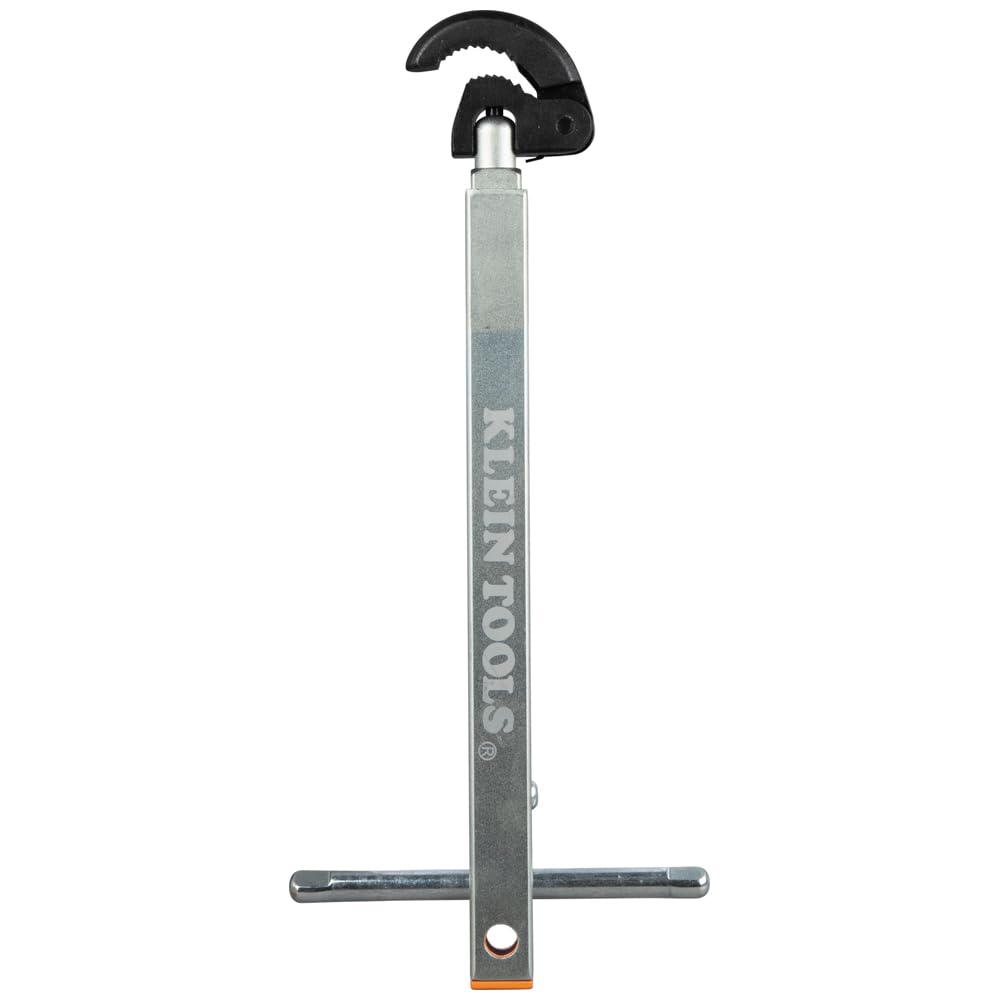
The pro’s choice with teeth sharp enough to bite a rounded nut and two ways to add leverage.
Anyone who has used cheap basin wrenches knows the frustration of rounded teeth that skate off the nut. Buyers of this Klein Tools model say that concern is answered — the forged jaw grabs hex nuts up to 1-1/4-inch with a bite you can trust, which matters when a nut is corroded and needs real grip to turn. The spring-action jaw snaps securely around faucet nuts, and the telescoping body adjusts from 10 inches to 17 inches to reach hard-to-find spots.
Where this one stands apart is leverage, offered two ways. The T-handle gives you a dual-grip surface for increased turning force, and the bottom opening is sized to fit 3/8-inch socket wrenches, so you can drive the tool with a ratchet when a nut is exceptionally tight. One owner needed to remove a very hard-to-reach nut and used a screwdriver through a hole in the handle for maximum leverage — a trick that worked perfectly. The alloy steel construction at 1.8 pounds feels purposeful in the hand, and buyers who trust Klein from electrical work say this maintains that same quality bar.
The trade-off is simply the premium price and a pivoting head that some find slightly awkward to angle in practice. It also has fewer total owner reviews than the category giants, so the long-term track record is less established even though the early verdict is strong. If you want a brand-name tool with genuine grip and clever leverage options for a difficult nut, this is a worthy upgrade.
The pro-grade strengths
- Sharp forged teeth grip hex nuts up to 1-1/4-inch without slipping
- T-handle plus 3/8-inch socket drive gives two leverage routes
- Alloy steel build with 10-to-17-inch telescoping reach
What to weigh
- Sits at the premium end of the price spectrum
- Pivot head can feel a touch awkward on some angles
Step up to it if: grip quality and clever leverage options matter more to you than saving a few dollars.
Save your money if: you only face easy-to-reach nuts and rarely need maximum bite on corroded fasteners.
8. HAUTMEC 11-18in Telescoping Basin Wrench HT0423

The rare wrench that carries two swappable jaws, bridging small faucet nuts and large drain nuts in one tool.
Most telescoping basin wrenches force you to choose between a small 1-1/4-inch jaw or a large 2-1/2-inch jaw. This HAUTMEC sidesteps that with two spring-loaded, self-adjusting gripping jaws — one spanning 3/8-inch to 1-1/4-inch and another covering 1-1/4-inch to 2-1/2-inch — so you can switch depending on the nut in front of you. That flexibility proved itself for owners who used it to remove a kitchen faucet from a really small space and to tighten a faucet on a kitchen sink, with the 180-degree pivoting head grasping nuts at different angles.
The handle extends via a quick-release latch from 11 inches up to 18 inches, giving this the longest maximum reach in the roundup for those extra-deep cabinets where every inch counts. The tempered carbon steel body is black-coated against corrosion and rust, and the sliding T-bar handle shifts to multiple positions for the best grip and leverage. There’s also a rear hanging hole that lets you thread a screwdriver through for break-away torque on a seized nut — the same trick the premium Klein offers.
Buyer feedback here is more divided than on the other HAUTMEC model. While most praise the quality and say it gets the job done, a notable group reports the jaws don’t always lock reliably onto nuts, and some find the fit isn’t right for their specific fastener. Grip strength draws disagreement too, with several saying it doesn’t hold as firmly as they’d like. If you like the dual-jaw concept, treat this as a solid value buy — just verify the jaw seating before you commit full force.
The versatility play
- Two jaw sets cover 3/8-inch through 2-1/2-inch nuts
- Longest reach here at 18 inches for deep cabinets
- Screwdriver-through-handle trick adds break-away torque
Mixed reports to weigh
- Some jaws don’t lock onto every nut reliably
- Fit and grip strength draw split opinions from owners
Pick it for: having one tool in the drawer that can handle both a small faucet nut and a big drain nut.
Be ready for: possible jaw-seating quirks on certain nuts, so check the bite before applying real force.
9. Rothenberger Telescopic Basin Wrench 70226

The European import with a reversible jaw that flips for tightening or loosening without moving your hand.
This Rothenberger brings a feature you won’t find on the American picks: a pivoted jaw that reverses direction, so you can switch from tightening to loosening by flipping the head instead of repositioning the whole tool. The chrome-plated body is designed specifically for working on nuts in confined spaces, which is the entire point of this category. Its telescopic action offers four length adjustments so you can dial in the reach rather than settling for fixed stops.
Buyers confirm it’s a very sturdy product that reaches “endroits les plus inaccessibles” — the most inaccessible spots — as one owner put it in French. Another praised the quality and said they’d buy the smaller version next, while a third noted it meets the brand’s standards at a much lower price than typical German-brand tools. The jaw capacity spans 3/4-inch to 1-7/8-inch, which covers standard faucet nuts but skips the very large drain nuts the DURATECH handles.
The biggest caution from owners is head size: two separate buyers found the head too large to fit under certain sinks or reach their specific faucet nut, leaving one to keep it as a spare for future jobs. It’s also the most expensive tool here by a wide margin, so you’re paying a real premium for the German-engineered design and reversible jaw. If your under-sink space is genuinely spacious and you want a precision-built import, this is a lovely tool; if you’re working in a cramped cabinet, the smaller head of the telescoping American picks may serve you better.
The premium appeal: reversible pivoting jaw and four-position telescopic adjustability in a chrome-plated, sturdy European build.
The honest catch: the head is large enough that it won’t fit every tight sink cavity — measure your space before spending this much.
Understanding the Specs
Jaw capacity and spring-loaded ratcheting
Jaw capacity is the range of nut sizes the tool can grip, usually stated in inches like “3/8-inch to 1-1/4-inch.” A spring-loaded jaw snaps shut around the nut automatically and ratchets, meaning it grips on the turn and releases on the back-stroke so you never lift and re-fit the tool. This is what makes true one-handed work possible in a space where you cannot fit both arms. A reversing or 180-degree pivoting head adds even more flexibility by letting you approach the nut from awkward angles.
Telescoping handle range and leverage
The handle range tells you how far the tool extends, commonly from around 10 inches up to 17 or 18 inches, which decides whether you can reach a nut buried deep in a cabinet. A sliding T-bar handle gives you multiple grip positions so you can choose the spot with the best leverage for your body position. Some designs add a hole through the handle or a socket opening at the base, letting you drive the tool with a screwdriver or a 3/8-inch socket wrench for extra break-away torque on a seized nut.
FAQ
Will a basin wrench for tight spaces fit my kitchen faucet nut?
What is the difference between a basin wrench and a regular pipe wrench?
How long does a telescoping basin wrench need to be?
Is the swivel or pivoting head important for tight spaces?
Can one tool handle faucet nuts and drain nuts?
How does a spring-loaded ratcheting jaw help me?
Is a metal basin wrench always better than a plastic one?
Can I add more force if a nut is stuck?
Final Thoughts: The Verdict
If you want one dependable pick, the basin wrench for tight spaces winner is the RIDGID 31175 because it pairs tank-like forged steel durability with a 10-to-17-inch telescopic reach and one-hand ratcheting jaws that owners say finish jobs other tools can’t. If you want the smarter value, grab the HAUTMEC PL0025 at roughly half the price — you get a full 180-degree pivot and the same 10-to-17-inch reach. And for a giant 2-inch drain nut that leaves standard wrenches helpless, the DURATECH is the one to reach for with its 1-3/8-to-2-1/2-inch jaw opening wide for the job.
How We Picked
We do not accept paid placement. Every pick is matched to a real buyer and a real use-case; we do not hands-on test units.
Sources & Methodology
Specifications: manufacturer listings and product documentation. Review insights: verified customer reviews, as of September 2026. Pricing: not shown on this page (it changes often); check the current price via the retailer link.
As an Amazon Associate, KitchPrep earns from qualifying purchases. This does not affect which products we feature.
Related Guides
