
Specs are compiled from manufacturer listings and verified buyer reviews and can change over time — please confirm the key details on the product page before buying.
If the power goes out tonight, the thing you actually want is a big battery that refills itself from the sun — no gas cans, no pull cord, no exhaust. That is exactly what a backup generator with solar panels gives you, and the picks below range from a mid-size unit that rolls like luggage to a heavy-duty tower that can sit in a basement and quietly run your fridge, freezer, and router for days. The short version: buy on capacity and solar-panel wattage first, and treat weight and outlet count as the details that decide whether it fits your life.
I’m Mohammad Maruf — the founder and writer behind KitchPrep. This guide is built by comparing the manufacturers’ published specifications and the patterns across verified customer reviews, so you get each pick’s real strengths and trade-offs instead of marketing spin.
Portable solar generators store power in a lithium battery and refill from bundled panels, so they replace a gas unit for fridge, router, and light duty. This narrows down the backup generator with solar panels picks that fit real outages.
Our Picks at a Glance
How To Choose The Best Backup Generator with Solar Panels
Most buyers walk in thinking wattage is the whole story. It is not. Watts decide what you can plug in at one time, but watt-hours decide how long it all keeps running — and on a solar generator, panel wattage decides how fast you get back to full. Get those three numbers straight and you can skip half the listings on the shelf.
Capacity in Wh tells you the runtime, not the wattage
A watt is a speed and a watt-hour is a tank size, so a 2,048Wh battery and a 519.48Wh battery can both run the same fridge at the same wattage — just for very different lengths of time. If your priority is riding out a two-day outage with a fridge and a freezer, aim for the bigger tank and stop worrying about peak watts. If you mostly want lights, a router, and phones charged, a smaller tank is lighter and cheaper to live with.
Solar wattage sets your refill clock
Bundled panels are usually the slow lane and the wall outlet is the fast lane. A genuinely large panel array shortens that gap. The thing beginners get wrong is expecting sticker wattage in real sun — panels routinely deliver well under their rating in cloud, shade, or a low winter sun, so pick a panel with extra headroom and an adjustable angle rather than trusting the box number.
Battery chemistry is where the years are won
LiFePO4 (lithium iron phosphate — a chemistry that resists heat and holds up over thousands of charge cycles) is what you want in a unit you plan to keep for a decade. Cheaper lithium-ion packs will still work, but the phosphate cells are the reason a modern solar generator can be a permanent household fixture rather than a five-year consumable.
Weight, wheels, and where it has to live
Anything above roughly 40 pounds stops being a carry and becomes a wheel. If the unit lives in a basement and only moves during a storm, mass is fine. If it goes camping or rides in an RV, the lighter 13.7-pound class with a grab handle will get used far more, while a 92-pound tower will mostly stay where you parked it.
Quick Comparison
| Model | Best For | Capacity | Rated Output | Bundled Solar | Amazon |
|---|---|---|---|---|---|
| Anker SOLIX C2000 Gen2 with 400W Panel★ Best Overall | Whole-home essentials in an outage | 2,048Wh | 2,400W (4,000W peak) | 400W panel | Amazon |
| DaranEner Cubus 600L with 100W PanelBest Battery Chemistry | Camping and light emergency use | 576Wh | 600W (1,200W peak) | 100W panel | Amazon |
| GRECELL EB500 with 100W PanelBest for Small Devices | Small devices on road trips | 519.48Wh | 500W (1,000W peak) | 100W panel | Amazon |
| BLUETTI AC180 with 200W Panel | Fast AC top-ups between trips | 1152Wh | 1800W (2700W boosted) | 200W panel | Amazon |
| EcoFlow DELTA 3 Classic with 220W Panel | Powering sensitive electronics cleanly | 1024Wh | 1800W (3600W surge) | 220W bifacial panel | Amazon |
| OUKITEL P2001 Pro with 2×400W Panels | Rapid recharge during a long outage | 2048Wh | 3200W (6400W peak) | 2×400W panels | Amazon |
| Jackery HomePower 3000 with 2×200W Panels | Homes that lose power often | 3072Wh | 3600W (7200W surge) | 2×200W panels | Amazon |
| ABOK Ark3600 with 2×400W Panels | Expandable whole-home backup | 3840Wh | 3600W | 2×400W panels | Amazon |
| Anker SOLIX F3000 with 400W Panel | RV and off-grid power | 3,072Wh | 3,600W pass-through | 400W panel | Amazon |
| Jackery HomePower 3600 Plus with 2×200W Panels | Multi-week household backup | 3584Wh | 3600W (7200W in parallel) | 2×200W panels | Amazon |
| EcoFlow DELTA Pro with 400W Panel | Heavy loads and expandability | 3600Wh | 3600W | 400W panel | Amazon |
In‑Depth Reviews
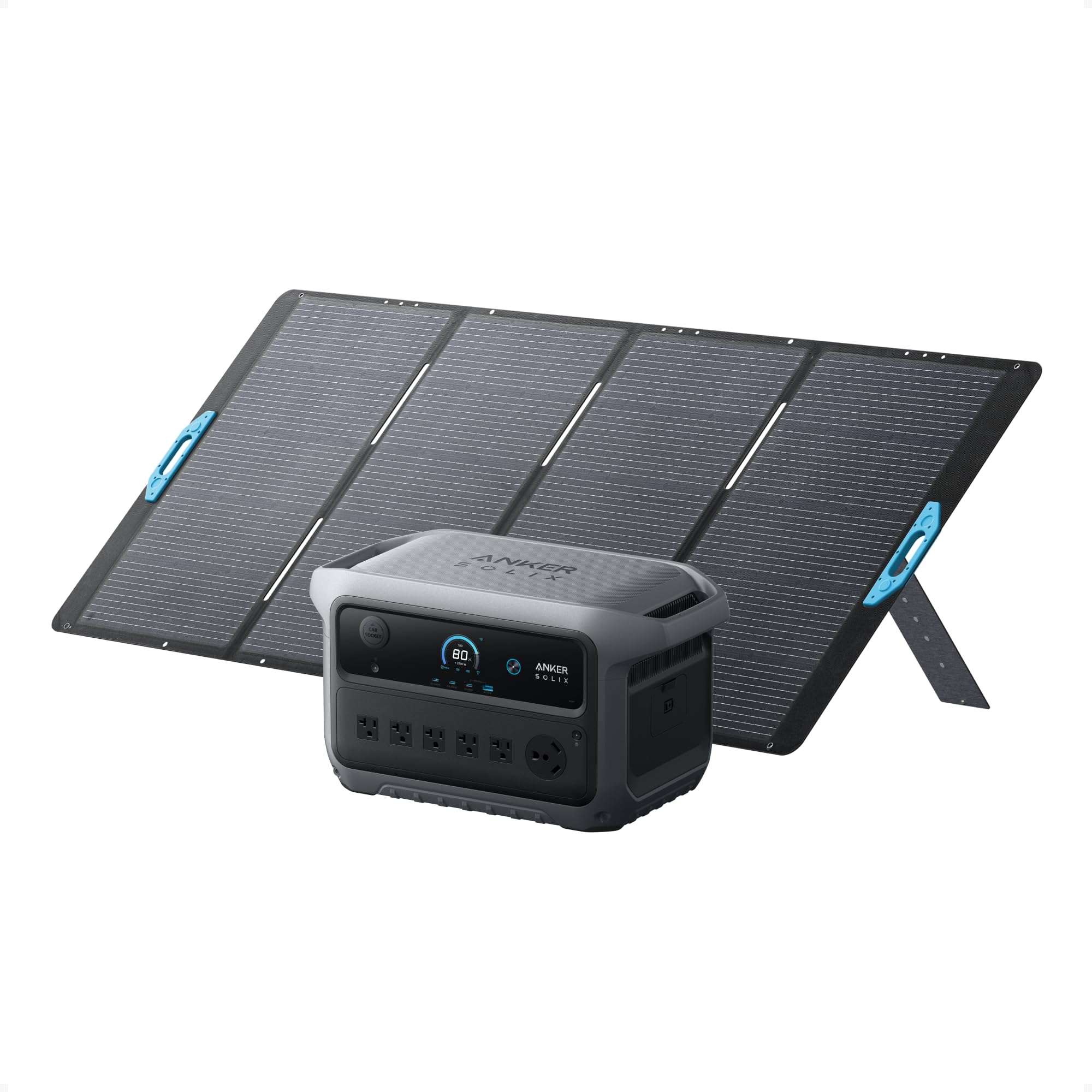
1. Anker SOLIX C2000 Gen2 Portable Power Station with 400W Solar Panel, 2048Wh
Our pick — over 4.5★ from 650+ verified ratings; the strongest balance of quality and price.
Big enough for a fridge, quick enough to refill before the next storm lands.
This is the pick for the household that wants one box to carry the whole outage — fridge, router, lights, and phones. The numbers behind it are 2,048Wh of LiFePO4 storage, 2,400W of steady output, and a 4,000W surge for the moment a compressor kicks on. Against the smallest pick here, the GRECELL at 500W rated, this one doesn’t just lead — it runs a different class of appliance entirely.
What sells it in daily use is the refill speed. Anker rates it at 80% in 45 minutes and 100% in 58 minutes on AC, and the bundled PS400 panel recharges from the sun through four adjustable tilt angles — 30°, 40°, 50°, or 80° — so you can chase the light as the sun moves. Idle draw is only 9W, which is why the maker can claim a dual-door fridge runs up to 32 hours, or 64 hours once you add an expansion battery toward 4kWh. The panels themselves carry an IP67 rating (dust-tight and safe in rain), and the PS400 arrives in a separate box from the station, with a QR code on the package to track the second delivery.
Where this really earns its place is the lived-in experience — several owners run it weekly for camping and outdoor events. It holds up over a three-day RV weekend and still shows charge left, and as one owner put it: “charges fast, needs dedicated 15A outlet, 27%→full in 1 hr 10 min; very quiet.” The honest trade-offs are weight and outlet shopping: 41.7 pounds means two hands, and a small air conditioner is a short-burst tool rather than an all-afternoon one. It’s a four-figure purchase, but it covers ground that the smaller mid-range units here simply cannot.
The case for the C2000
- 2,048Wh expandable to 4kWh, enough for a dual-door fridge
- 58-minute AC recharge and a 400W panel with four tilt angles
- 9W idle draw keeps more of your stored power usable
- IP67 panels handle rain without a scramble
Where it asks more of you
- 41.7 pounds is a two-hand lift, not a one-arm carry
- Station and panel ship in separate packages
- A small AC unit will only run in short bursts
Settle on this one if: you need fridge-level backup for multi-day outages and want the fastest wall recharge on the list.
Keep looking if: you plan to carry your generator by hand or want something light enough for a car trunk.
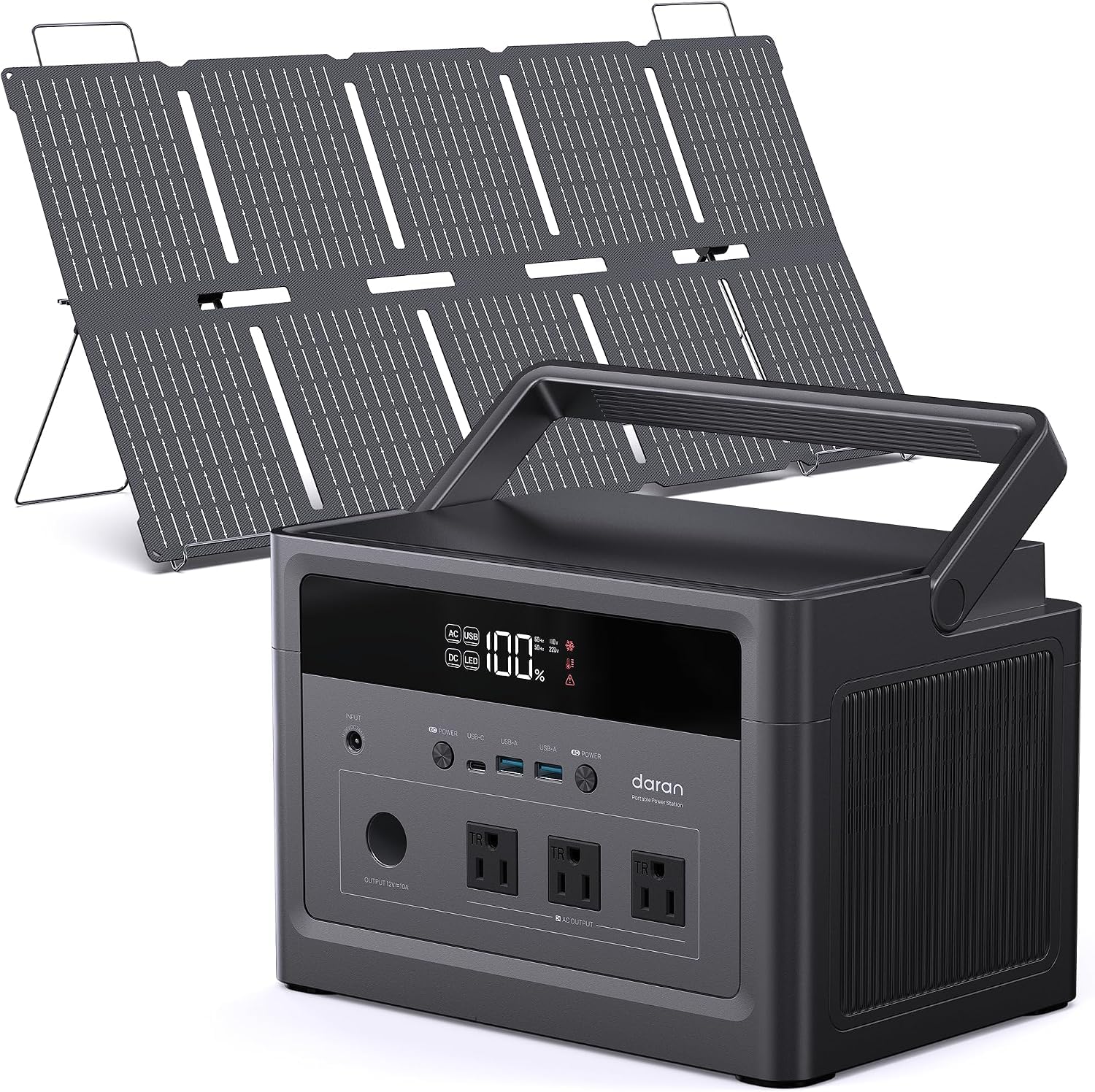
2. Solar Generator with Panels Included, Portable Power Station 1200W Peak
A camping-first station that punches at its weight class, with a chemistry story to match.
If you want a compact unit that chases the weather with you, the DaranEner Cubus 600L is the smallest footprint on this list — 13.7 pounds and about a foot wide. The declared battery is a 576Wh LiFePO4 pack, and the manufacturer rates it for 3000+ cycles to 80% capacity, which is the durability case for the phosphate chemistry. A rigid unit weighs nearly triple; this one rides in a hatchback without complaint.
Three of the seven ports are 110V pure sine wave AC outlets — pure sine wave here means the electricity coming out is shaped the same way your home wiring shapes it, so motors and sensitive electronics get a clean feed. There’s also a 100W PD USB-C port, two 18W USB-A ports, and a 120W car socket. The bundled 100W panel recharges via MPPT (maximum power point tracking — a method that squeezes more usable current out of a panel as light shifts), and you can also refuel from a wall outlet or a car. The station itself ships in one box with the panel, so you’re not waiting for a second delivery.
Owners are broadly positive on quality and reliability, and the pattern across reviews is that people are happy with the shape, port layout, and how easy it is to set up. The honest catch, echoed across review pages, is that the 100W panel is a top-up rather than a fast lane — don’t count on a full solar refill in one camp day if you’re powering anything substantial. Fine for fans, lights, laptops, and phones — not the answer for a hot plate or a coffee pot.
The solar reality check: you’ll lean on wall charging for full refills, and the panel covers slow daytime top-ups while you’re using the station — a fair trade for the small footprint and the LiFePO4 cell.
Built for: weekend campers, RV day-trippers, and anyone who wants a genuinely light station with a phosphate battery.
Look elsewhere if: your outage plan involves running a fridge for days — the Cubus can, but a 3kWh unit will do it without the math headaches.
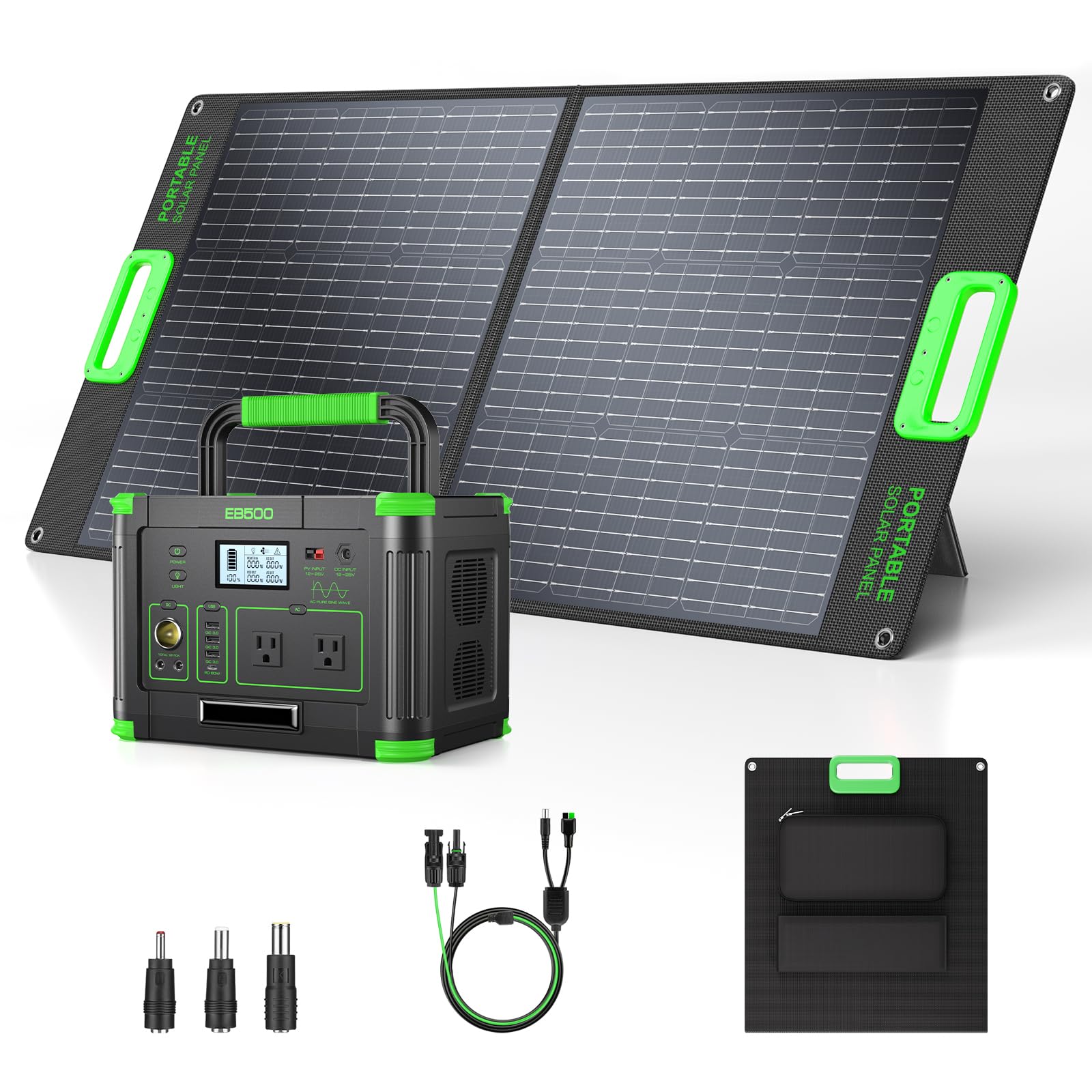
3. 500W Portable Power Station with 100W Solar Panel, 519.48Wh Solar Generator
Ten outlets and a charger that handles phones and laptops, no extension blocks required.
The GRECELL EB500 is the small-unit pick for people whose outage plan is phones, laptops, and a fan — not the whole kitchen. Inside is 519.48Wh of lithium storage feeding 500W of rated output and 1,000W of peak. With the Anker SOLIX C2000 Gen2 at 2,400W rated and 4,000W peak, the power gap is the story — that’s 4.8x on rated watts and 4.0x on peak, so a computer and lights fit comfortably while a microwave does not.
What you get for the size is unusually generous port count: ten outlets total, split as two 110V pure sine wave AC ports, three 18W USB-A QC3.0 ports, one 60W USB-C PD port, two DC 5.5/2.5 ports, a car outlet, and a wireless charging pad on top. The bundled 100W monocrystalline panel is rated to 18V with up to 23.5% conversion efficiency and ships with a bag of adapters, so it will plug into most stations you own, not just this one. Internal monitoring runs through a built-in battery management system that watches temperature and current to keep the cells in range.
Reviews show the shape works well for road trips and camping, and the built-in display is easy to read at a glance. The consistent reader complaint is solar charging pace: one buyer timed a slow solar trickle against a much faster wall refill, and a small group found the 100W panel underwhelming on cloudy days. It’s not a station you buy for solar-first charging; it’s one you buy for port count and a small footprint, with solar as a fair-weather top-up.
Cheapest way to get ten ports: this is the pick if you want to charge a whole table of devices without daisy-chaining USB hubs — the 60W USB-C PD port alone covers most modern laptops.
Your match if: you’re covering phones, tablets, a laptop, and a small fan on road trips or short outages.
Keep scrolling if: you need to run a fridge, a space heater, or anything with a heating element for more than a minute.
4. BLUETTI AC180 Solar Generator with 200W Solar Panel Included, 1152Wh 1800W

The mid-range pick that fills from empty in about an hour, then runs the whole campsite.
The AC180 is the balance for people who want real household coverage without the tower footprint. Its 1152Wh LiFePO4 pack feeds 1800W of continuous output with a 2700W lifting mode, so fridges, microwaves, and most power tools can ride along. And it isn’t a one-trick indoor unit — the bundled 200W solar panel is the package’s main selling point for off-grid use, refilling the pack in a stated 4.8–9.6 hours depending on sun. When you plug into a wall instead, 1440W of AC charging takes the 1152Wh pack to 100% in about an hour on a single cable.
Two owner patterns worth knowing: real solar output runs well below the sticker wattage in bad weather, so a full day of sunshine is the honest expectation; and the app open up features you can’t reach from the front panel, so if you skip the app you’re running a simpler machine. The UPS mode (uninterruptible power supply — the unit switches to battery the instant your wall power drops) makes it useful as a permanent fixture for a router or a desktop, not just an outage-day tool.
Weight is the recurring honest note. Between 35 and 40 pounds means this lives on the floor or in a cart rather than a shoulder bag, and the 200W panel is a separate shipment with a rigid frame — fine for parking in the sun, less fun to carry. On the plus side, that LiFePO4 pack is rated to 3000+ cycles, which is why this is the pick people keep for the long haul rather than replacing every couple of seasons.
Why it beats the small units: 1440W AC charging in ~1 hour versus the small stations’ multi-hour wall refills means it’s never out of commission for long.
Reach for it if: you need one box that handles both campsites and outages, and you want fast turnaround between them.
Skip if: a fixed location and wheels matter more than portability — the towers in the second half of this list will serve you better.
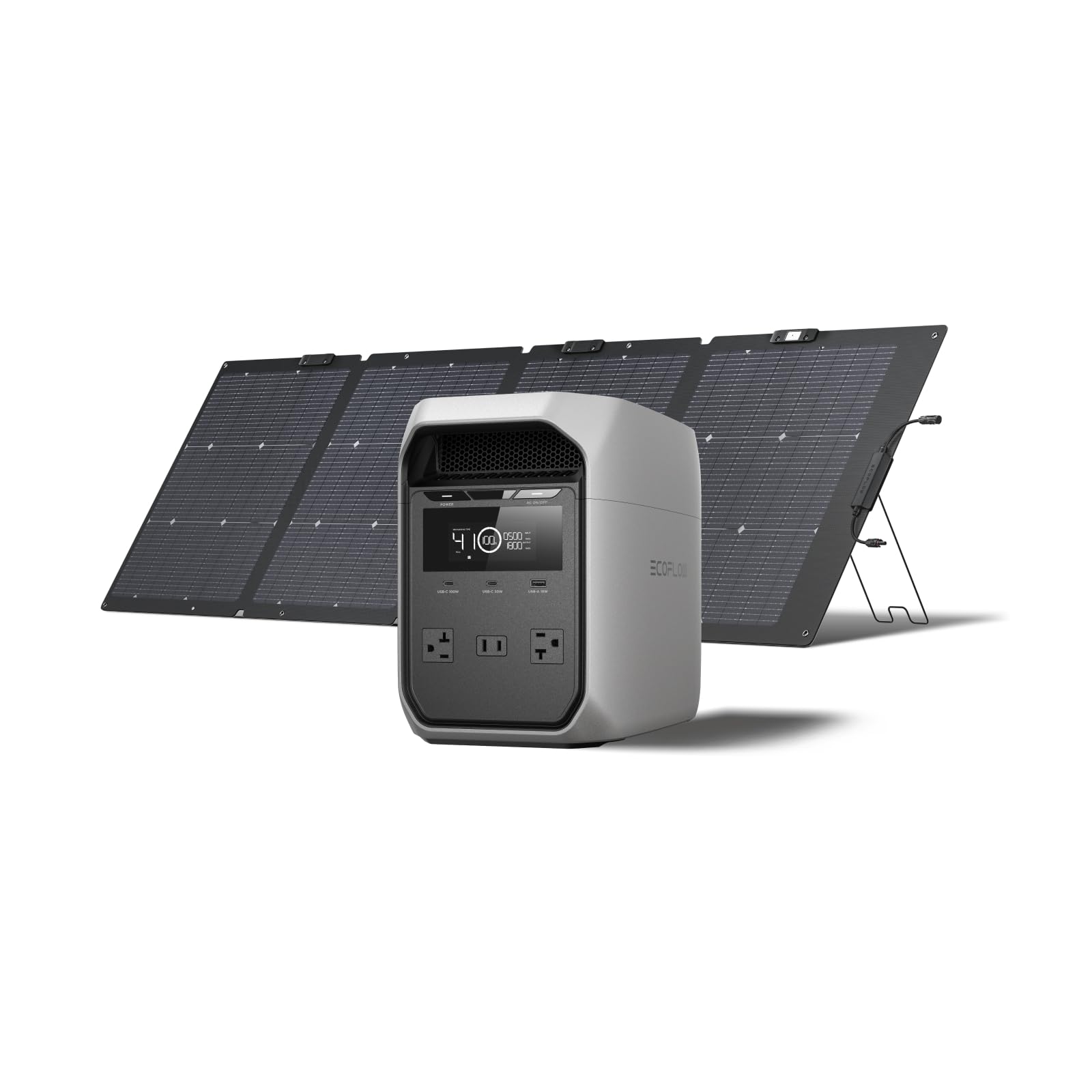
5. EF ECOFLOW Solar Generator Delta 3 Classic with 220W Solar Panel, 1024Wh
Bifacial solar plus instant UPS switchover, aimed at the desk instead of the campsite.
Delta 3 Classic is built for the person whose outage worry is a PC mid-save, a home server, or a CPAP running overnight — not a bar fridge in a camper. Inside is 1024Wh of LiFePO4, feeding 1800W of output with a 3600W surge, and X-Boost takes the ceiling up to 2600W for heavier loads without the fan spinning up the neighbors. The UPS spec is under 10ms, which is fast enough that most users won’t see a flicker on a monitor or router when the grid drops. That’s the headline feature the whole station is organized around.
The bundled 220W panel is the other half of the story. It’s bifacial, meaning the panel also catches light bouncing off the back side, and EcoFlow rates the cells to 25% conversion efficiency thanks to N-Type construction — faster recharge than the 100W panels bundled with the small picks. Full solar refill is stated at 5.8 hours, and AC charging goes 0–80% in 45 minutes on the fast lane. Ports cover three 110V AC outlets, USB-A and USB-C including a 100W PD port, and up to a 500W solar input over XT60 if you want to add more panels down the line.
The reviews read like an installed-appliance pattern: people run it for hours during outages, size it carefully to their loads, and there’s a running theme of it taking up residence as a permanent desk unit rather than something that gets carted out to the garage. Weight is manageable but noticeable, so moving it is a two-hand job rather than a plug-and-tote situation. If your outage plan is “PC and router must never blink,” this is the pick engineered for exactly that.
Why it fits a home office
- Sub-10ms UPS switchover for PCs, routers, and medical devices
- 220W bifacial panel with 25% cell efficiency for faster solar refills
- X-Boost pushes 1800W output up to 2600W on demand
- Expandable to 2600W working load via X-Boost
What to plan around
- 1024Wh tops out at a bit over a day of light loads
- Panel and station arrive in separate packages
- Premium mid-range pricing, not the entry-point tier
Made for: home offices, small servers, and anyone who needs continuous power rather than bright, brief bursts.
Not the pick if: your priority is running a fridge-and-freezer pair through multiple days of outage — a 3kWh unit covers that ground more comfortably.
6. OUKITEL P2001 Pro 3200W/2048Wh Power Station With 2 * 400W Solar Panels
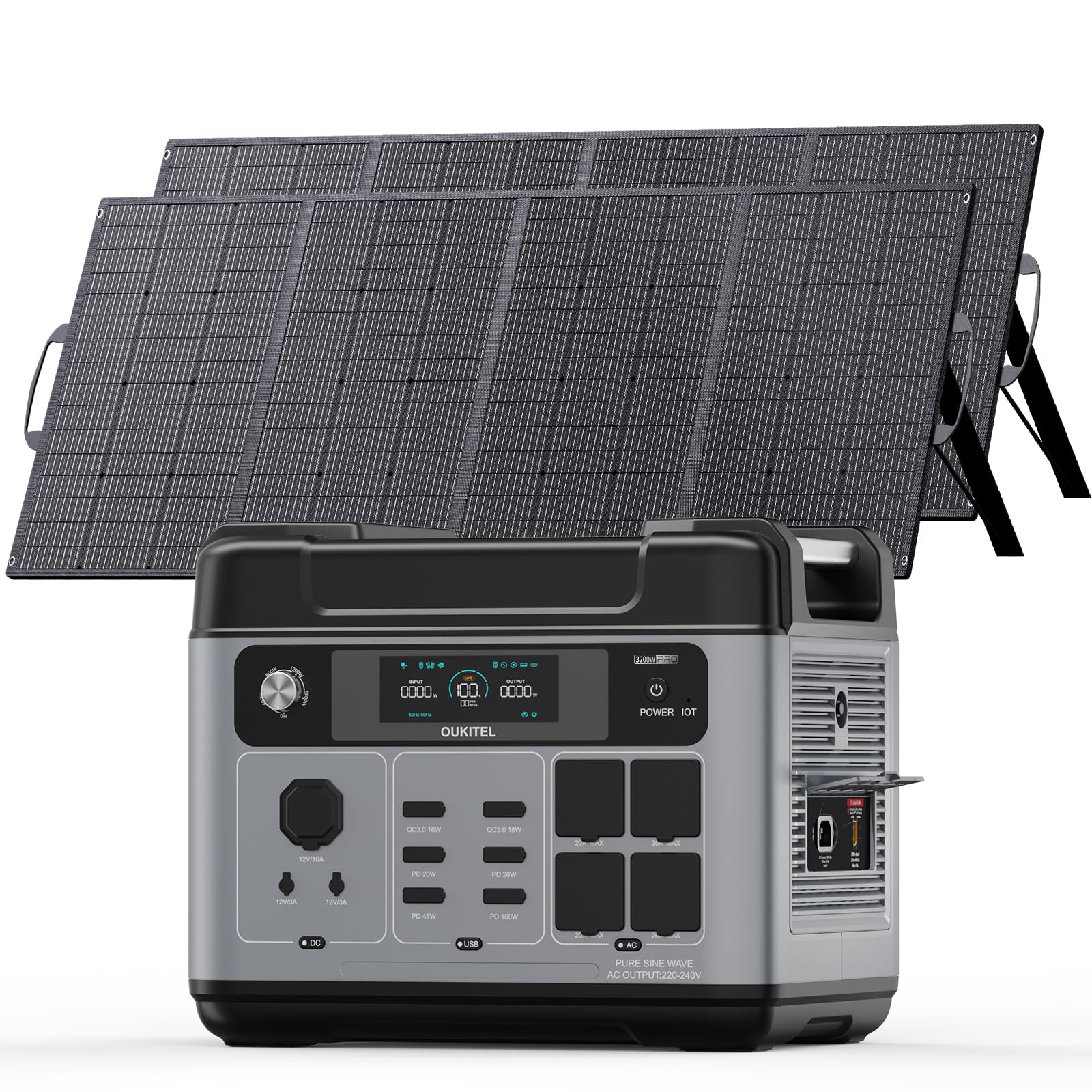
Rated to hit 80% in 50 minutes when AC and 800W of solar team up.
If your worry is “the storm is coming and I’m at zero percent,” the P2001 Pro was built for exactly that panic. Inside is 2048Wh of LiFePO4 rated to 4000+ cycles and — per the manufacturer — a 15-year service life. Output is 3200W across 13 ports including four AC outlets, four USB-C PD ports (one at 100W, one 45W, two 20W), and two USB-A quick-charge ports. Pairing the pack with 2×400W solar panels makes it one of the only stereo-panel mid-range units here — the low-priority picks in this list bundle 100W panels, and the power gap to those is staggering.
The recharge numbers are the pitch. AC alone hits 80% in an hour and 100% in 1.5 hours at 1800W input. Pair 800W of solar with AC and the maker claims 80% in 50 minutes. The intelligent current adjustment lets the unit throttle down to a lower AC input when the outlet can’t take the full load, which protects both the station and the wall circuit. The UPS feature switches in under 0.01 seconds, so anything plugged into it just keeps running through a grid blink. Owners flag one accessory caveat: the bundled panels are cloth-framed rather than rigid metal, and the instructions require dry conditions, so they’re fair-weather chargers rather than permanent rooftop installs.
Owner feedback is split by mood rather than by unit: happy owners praise the recharge speed and quiet operation, while the small number of critical reviews are mostly about customer service on defective units rather than the product itself. Setting the noise aside, the numbers speak for themselves — a 2048Wh pack that refills in under an hour is a different class of response time than anything else on this list at this capacity.
Speed over walkability: 50 pounds with no wheels means this is a stay-put station; the payoff is that massive 80%-in-50-minutes recharge window when AC and solar team up.
Worth the trade if: your outage strategy starts the moment the forecast turns and you need the fastest refill at this capacity.
Skip if: you’ll move the unit between rooms — 50 pounds without wheels is a two-person job or a permanent spot.
7. Jackery HomePower 3000 and 2x200W Solar Panels, 3072Wh, 3600W AC Output
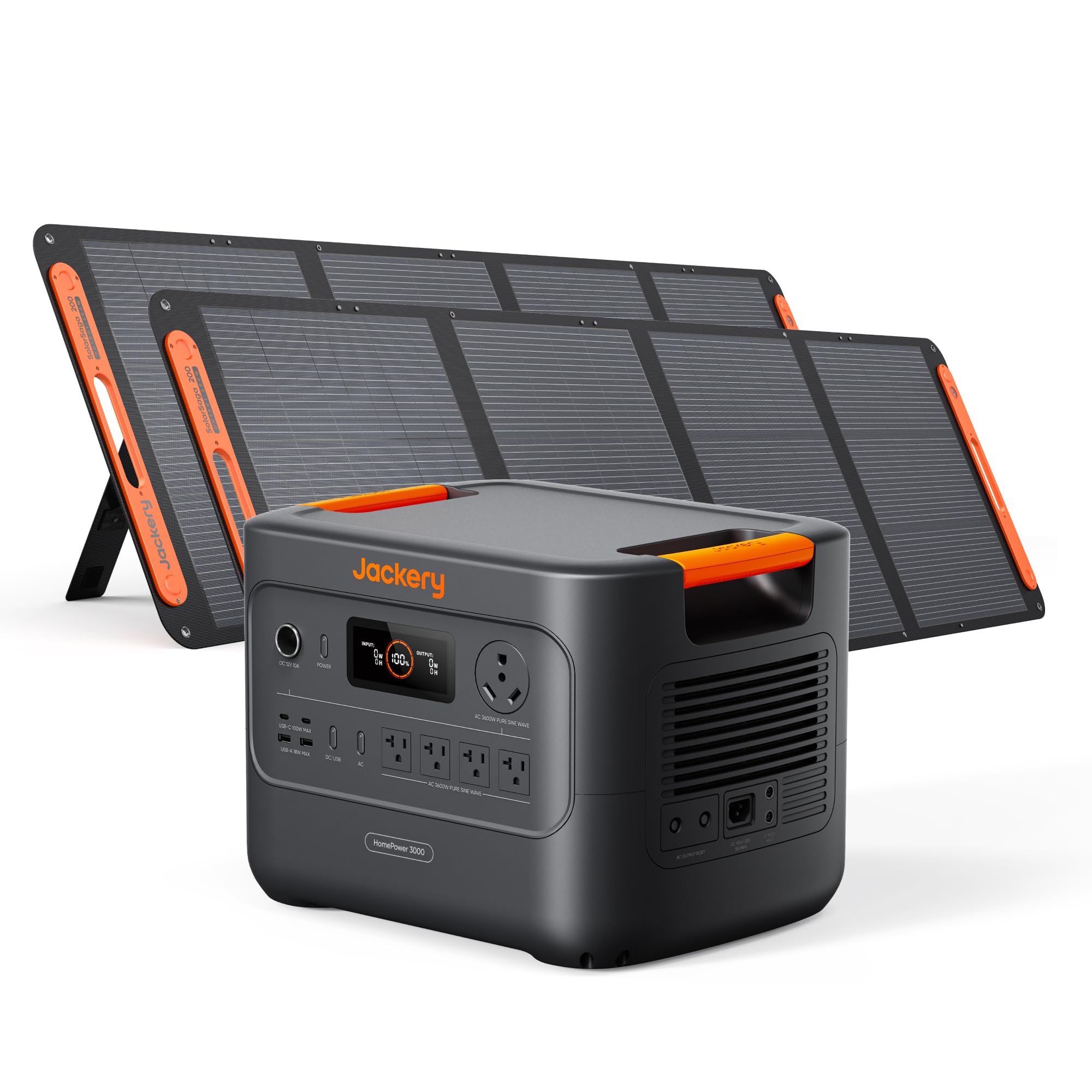
Three thousand watt-hours without the back-breaking form factor — 47% smaller than same-capacity rivals.
Jackery built this for the household that wants a 3kWh pack but doesn’t want to dedicate a corner of the garage to it. Output is 3600W with a 7200W surge across AC, USB-C, USB-A, DC, and a built-in TT-30 RV port. On capacity alone that’s the fridge-plus-router-plus-lights plan covered, and the maker rates the unit for a full household for up to 15 hours and a fridge for 1–2 days. The dual 100W PD ports cover fast phone and drone charging, and the TT-30 outlet makes this one of the very few picks here that’s genuinely RV-ready from the start.
The physical design is the standout. Jackery calls it the world’s first 3kWh portable power station with CTB tech (a compact cell-to-body architecture) — the payoff being 14% more space efficiency and a chassis that the maker says is 47% smaller and 43% lighter than comparable 3kWh units. It still weighs 59.5 pounds, but the reduction matters when you’re the person doing the moving. Charging runs on 4 wired paths: 1.7 hours via hybrid AC and DC, 2.2 hours via AC alone, or 80% in 9 hours on the bundled 2×200W solar array. The LiFePO4 cells are rated for 4000 cycles while retaining 70% capacity, which is Jackery’s headline argument for buying once and keeping it.
The trade-offs worth knowing are the physical and software edges. The 200W panels are heavy and awkward to orient — buyers report needing longer cabling to reach open sky — and on a winter day they deliver well under the sticker wattage. Some owners also report the unit shutting off unexpectedly under very light loads, which points to a minimum-draw quirk worth understanding before you park a trickle-charging phone on it. That said, the unit itself gets plenty of praise as a workhorse, and the UPS function makes it a legit medical fridge and security camera backup, not just a fair-weather toy.
The right call if: you want a real 3kWh home backup that doesn’t hog floor space and you want it to double as an RV power source.
Think again if: you plan to haul it around regularly — 59.5 pounds is still a two-person or leveraged move.
8. ABOK Ark3600 Portable Power Station with 2×400W Solar Panels
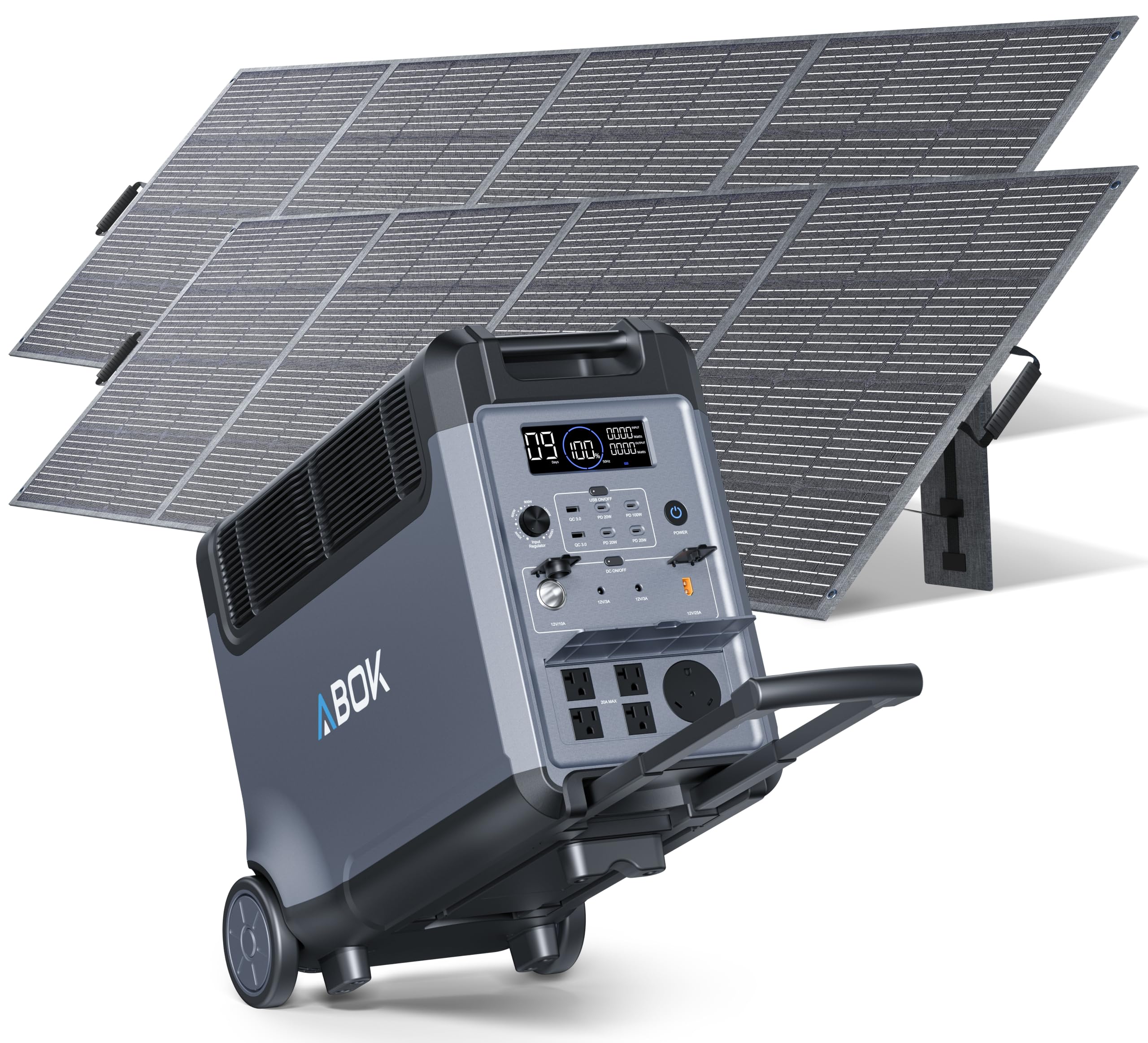
Starts at 3840Wh and stacks up to 11,520Wh — a serious hoard-the-sunlight tool.
The Ark3600 is the pick for someone who wants a system they can grow, not just a box. Base capacity is 3840Wh across EV-grade LiFePO4 cells rated for 4000+ cycles and up to 10 years of daily use, and ABOK says the platform stacks up to 11,520Wh with additional battery modules. Output is 3600W across 15 ports — including four 20A AC outlets, an AC 30A port for heavy draws, a 100W USB-C PD port, and a 12V XT60 slot. That’s a lot of plug options for a single station, and combined with the expansion capability it means you can start with the trailer and grow into a home setup.
Recharge speed is the second pitch. With 1500W AC input and up to 2000W PV input, the maker states a full recharge in as little as 1.29 hours when both are combined under ideal sun, or about 3 hours on AC alone. The included 2×400W panels are the same wattage class as the fast-refill mid-range pick above, so the solar side is genuinely substantial. ABOK also mentions a possible 30% Residential Clean Energy Credit for qualified solar property — worth checking with your utility before you buy.
Owner feedback leans practical and value-focused. Owners mention using it to run a trailer air conditioner through the night, powering dehumidifiers and heaters in a basement, and one who cut their winter electric bill by half says the worth was proven during a real outage. The critical reviews cluster around setup and unit consistency: a telescoping handle that didn’t fully deploy, stiff battery cables, and a first unit that arrived with an over-temp fault before a replacement worked correctly. It’s heavy at 92 pounds, so wheels and a permanent spot are the realistic plan.
Growth over gloss: most units here cap out at their sticker capacity; the Ark3600 is the pick that will still be useful in three years when you want more of a whole-home install.
Go here if: you’re planning a grown-up system that can add batteries as your needs grow and you have floor space for a 92-pound tower.
Pass if: you need something you’ll carry — this one is a permanent-install piece, not a grab-and-go.
9. Anker SOLIX F3000 Portable Power Station and 400W Solar Panel, 3,072Wh
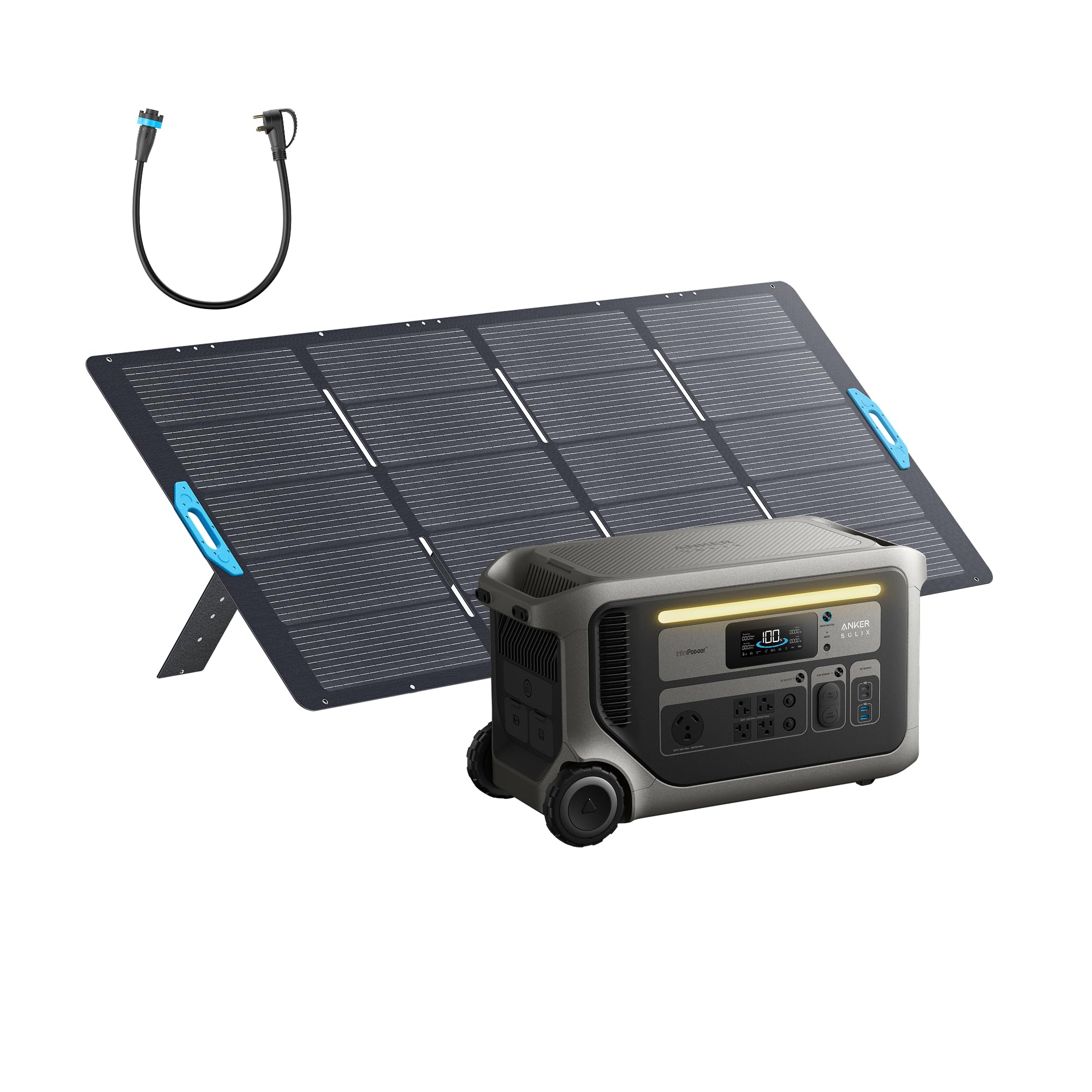
A 3kWh tower with wheels that keeps the RV powered and the fridge humming all weekend.
The F3000 is the pick for someone whose off-grid life has wheels on it — RVers, vanlifers, and anyone whose outages run longer than a weekend. Starting capacity is 3,072Wh of LiFePO4, expandable all the way to 24kWh if you add batteries. Continuous AC output runs at 120V with a 120/240V parallel mode when paired with another unit for the heavy appliances. Idle management is genuinely impressive: an ultra-low idle draw gives the unit a stated 125 hours of AC standby time, and Anker claims it can run a 190W fridge for 42 hours on a single charge — which is why owners are still happy six months in without constant monitoring.
The recharge side is what makes this an off-grid machine rather than a home backup. Solar input through the 165V or 60V ports takes up to 2,400W across compatible panels, and combining solar with a fuel generator lets the unit pull up to a stated 6,000W — that’s the emergency-speed refill when you can afford to burn fuel alongside the sun. The bundled PS400 folds down for travel, and the unit rolls on 6-inch wheels (about 100 pounds loaded) so moving it around a campsite or up a driveway doesn’t require a second set of hands.
Owner feedback is broadly positive on quality and reliability, with RVers reporting it running an air conditioner on low cool for hours and coping well with patio-style loads. The honest downside is the panel: some users find the bundled 400W rigid panel oversized and heavy for what it is, preferring two smaller panels for easier packing.
What makes it an RV pick
- 3,072Wh expandable to 24kWh across home and road use
- Up to 2,400W solar input through the 165V or 60V ports
- 6,000W combined recharge when pairing solar with a fuel generator
- 125-hour AC idle standby keeps the fridge on without babysitting
Where it leans heavy
- 91.5 pounds — wheels are the way to move it, not handles
- Bundled 400W rigid panel is bulky to pack and orient
- Parallel 240V mode requires a second F3000 unit
Built for: RV owners, off-grid dabblers, and households that want a model that doubles as a rolling home backup.
Look past it if: you’re strictly a homeowner with a fixed installation spot — the wheeled design pays off for movers more than for parked units.
10. Jackery HomePower 3600 Plus & 2x200W Solar Panels, 3584Wh, 3600W AC Output
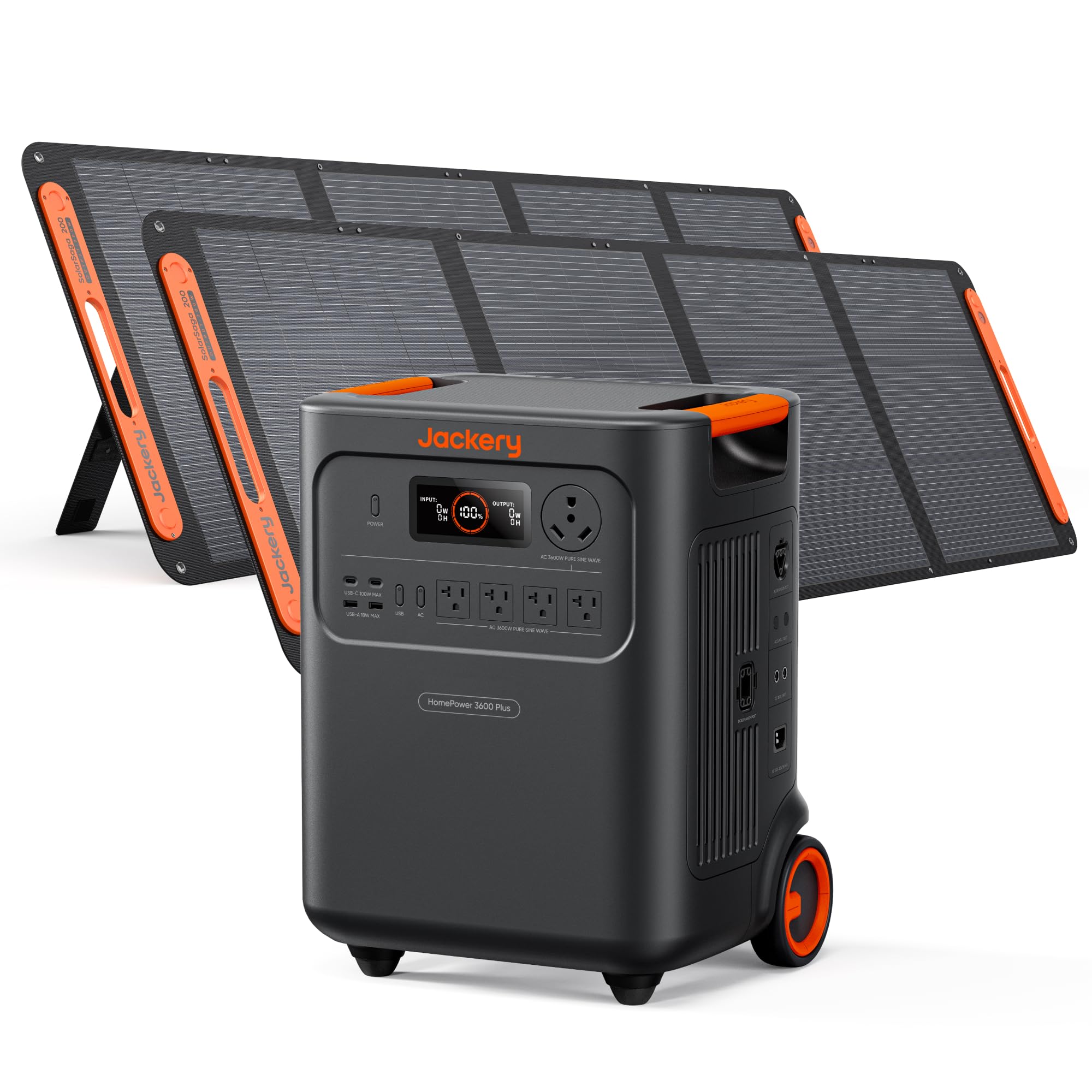
Rolls like a suitcase, powers a household for weeks, and folds flat enough to store.
The HomePower 3600 Plus is Jackery’s heavy-duty entry and the pick for the household that wants to keep living normally when the grid drops for days. Capacity starts at 3584Wh and expands per unit to 21kWh — or up to 43kWh across multiple units — which in the manufacturer’s framing means it can power a 3-person household for over 2 weeks. Output covers 3600W and 7200W in parallel, with dual voltage (120V and 240V) available when you parallel units, so higher-demand appliances like dryers and pumps can come into play. The UPS aspect switches over with the rest of the HomePower line, so kitchen and home-office loads keep humming.
Two features separate this from the other towers. The first is the ceramic-membrane battery cells, tested at 302 °F and rated to resist thermal runaway, with a stated operating window down to -4 °F — the honest answer to “will this work in a Midwest blizzard?” The second is the CTB architecture, which makes this the lightest 3.6kWh LFP power station per Jackery’s own claim, with a stated 34% smaller and 29.3% lighter profile than comparable models. That plus the luggage-style wheels and telescopic handle is why the physical form gets more consistent praise than on most of the heavy picks here. Charging hits 0–100% in 2 hours via hybrid AC plus DC, and it can also accept a gas generator input if you want the option.
Owner feedback is overwhelmingly about the practical wins: enough capacity to keep a fridge running for 4+ days with intermittent use, set up in minutes via the app, and a footprint that rolls around a kitchen. The solar array is the soft spot — customers note each 200W panel delivers well under the sticker wattage in cloudy or winter conditions, and the cabling and orientation take patience. That’s typical for bundled rigid panels, but worth knowing if the outage plan depends mostly on solar rather than AC.
Weeks, not days: capacity that starts at 3584Wh and expands to 43kWh makes this the pick for households that took a multi-day hit and never want to repeat it.
Right for: urban or suburban households with outage anxiety that’s already been tested once and homes where floor space is at a premium.
Think twice if: you’re counting on solar as the primary recharge path — the bundled panels deliver well under their sticker wattage in clouds.
11. EF ECOFLOW Solar Generator 3.6KWh DELTA Pro with 400W Portable Solar Panel

The 3.6kWh heavyweight with an induction-cooker-capable 3600W, wheels included.
The DELTA Pro is the pick for someone who wants a power station that can run real appliances — induction cooker, 1500W heater, refrigerator — not just phones and lights. Inside is 3600Wh rated to a full 3600W output, which is enough to run an induction cooker at 1800W and still keep the fridge on. The bundled 400W foldable panel is rated to a 22.4% conversion rate with an IP68 waterproof rating (dust-tight and water-tight), and a single panel recharges the 3600Wh pack in a stated 11 hours, or 3.5 hours with three panels stacked together.
The station itself offers 15 outputs, so you can run the kitchen, the office, and the trailer off the same unit without unplugging: 5 AC outlets, 4 USB-A ports, 2 USB-C ports, 2 DC ports, a car power outlet, and an Anderson port. Wheels and a pull handle make the 99-pound tower mobile despite the mass. Charging works through the EcoFlow app over Wi-Fi or Bluetooth, which lets you monitor charge level, temperature, and discharge times remotely — the sort of thing you appreciate when the unit is parked in a basement during a storm.
Reviews are honest about two things. First, that 98- to 100-pound frame is genuinely a two-person or wheeled move, not a lift. Second, the fan becomes audible once you’re pulling heavy loads — people running induction cookers or heaters mention hearing it. For most buyers the response to that is straightforward: either expand with an extra battery or size your loads conservatively.
Why power users gravitate here
- 3600Wh and 3600W of output heavy enough for induction cooking
- IP68 foldable 400W panel with 22.4% cell efficiency
- 15 outlets and ports, the widest mix on this list
- Wheels and pull handle make the 99-pound tower movable
What to size around
- The fan becomes audible under sustained heavy draw
- A single 400W panel takes 11 hours for a full refill
- Usable capacity runs under the rated 3600Wh, as with any unit
Choose this if: you want the biggest single-unit punch here and plan to run real cooking and heating appliances, not just lights.
Look further if: solar-only refilling at 11 hours isn’t workable for you — adding panels is the fix, and it raises the cost.
Understanding the Specs
What Wh (watt-hours) actually means
A watt-hour is the size of the tank your appliances drink from. Two units with the same watt rating can run the same fridge for very different lengths of time if their Wh counts differ — which is why a 2,048Wh pick handles a full freezer while a 519.48Wh pick is really a phone-and-laptop machine. When you compare picks, look at Wh first if you care about outage duration, and watts second if you care about running a specific appliance.
Why LiFePO4 vs lithium-ion matters
LiFePO4 (lithium iron phosphate) is the modern chemistry most of the top picks here use. The two reasons buyers care are charge cycles — quality phosphate cells are commonly rated for thousands of fill-and-empty rounds before they drop to 80% capacity — and heat tolerance, which keeps the pack stable in a hot garage or a car trunk. You’ll pay more for it upfront, but the chemistry change is what turned these from a five-year toy into a fixture you plan around for a decade.
Solar input wattage and panel angle
The panels bundled with these kits range from 100W up to 800W (2×400W). More wattage equals faster sunlight refills, and a panel that adjusts through multiple angles (like the pick with four tilt settings) squeezes more out of the same sun as the day goes on. But nobody gets the full sticker wattage in shade — so treat panel wattage as the optimistic ceiling and plan around hitting a fraction of it on average.
UPS switchover and peak power
UPS means uninterruptible power supply — the station takes over the instant the wall goes dark, with switch times here ranging from under 10ms to under 20ms. The smaller the switchover number, the less likely anything blinking-sensitive notices the change. Meanwhile peak (or surge) wattage is what covers the compressor kick on a fridge or the startup surge on a power tool; the rated wattage is what it can do all afternoon.
FAQ
Can a solar backup generator run a full-size refrigerator during an outage?
How long does it take to recharge a solar generator from just its bundled panels?
What is LiFePO4 and why do these units use it?
Will the solar generator work indoors, or does it need to go outside?
How much backup capacity do I actually need for a three-day outage?
Do these units work as an uninterruptible power supply for a computer or router?
Can I add more solar panels or batteries later?
Are the bundled solar panels weatherproof enough to leave outside?
Is a battery-and-solar setup better than a gas generator for an outage?
Final Thoughts: The Verdict
For most households, the best backup generator with solar panels is the Anker SOLIX C2000 Gen2 with 400W Panel — it covers a dual-door fridge, recharges to 100% in 58 minutes on AC, and holds up through repeat weekly use. If your outage plan is smaller and light matters, the DaranEner Cubus 600L is the only sub-15-pound pick here and still runs on LiFePO4. And if you’re provisioning for weeks, not days, the Jackery HomePower 3600 Plus rolls on wheels, expands to 43kWh across multiple units, and is the pick that turns a blackout into a non-event.
How We Picked
We do not accept paid placement. Every pick is matched to a real buyer and a real use-case; we do not hands-on test units.
Sources & Methodology
Specifications: manufacturer listings and product documentation. Review insights: verified customer reviews, as of September 2026. Pricing: not shown on this page (it changes often); check the current price via the retailer link.
As an Amazon Associate, KitchPrep earns from qualifying purchases. This does not affect which products we feature.
Related Guides
