
Specs are compiled from manufacturer listings and verified buyer reviews and can change over time — please confirm the key details on the product page before buying.
Rot in a window sill, a soft spot in a deck board, a chunk missing from a door frame — you want it gone for good, not patched with something that crumbles next season. The short answer: a two-part epoxy wood filler (a putty or paste you mix from a resin and a separate hardener, so it cures by chemical reaction rather than drying out) is the only filler that hardens firmer than the wood around it, survives water, and sands smooth enough to disappear under paint. Here is exactly which ones do that best, and which jobs each one is actually built for.
I’m Mohammad Maruf — the founder and writer behind KitchPrep. This guide is built by comparing the manufacturers’ published specifications and the patterns across verified customer reviews, so you get each pick’s real strengths and trade-offs instead of marketing spin.
The trick is matching the formula to the job — a stiff putty for deep voids, a creamy paste for hairline cracks — so scroll on for a complete rundown of the best 2-part epoxy wood filler.
Our Picks at a Glance

How To Choose The Best 2-Part Epoxy Wood Filler
Three numbers decide whether a repair lasts a decade or a season: the mix ratio, the working time, and the container size. Get those three right and any two-part epoxy on this list will handle the repair.
Mix Ratio And Working Time
Every product here is a two-part system, which means you blend a resin with a separate hardener before it will cure. Most of them mix 1:1, an easy equal-parts blend. Working time is how long you have to shape the mix before it stiffens — it runs from a quick-setting few minutes to roughly half an hour. A longer working time suits big, fussy rebuilds; a shorter one suits small touch-ups.
Putty Versus Paste
Thick putty packs into deep rot cavities and stays where you press it, even on a vertical surface. Creamy paste flows into hairline cracks and shallow dings. Many people keep both on the shelf: putty for the structural rebuild, paste for the fine surface finish.
Matching The Cured Color
Cured epoxy does not always take stain the way bare wood does, and several formulas dry to a lighter tone than their label suggests. If the repair will stay visible, plan on tinting the mix with a dry pigment, or paint over the finished patch.
Quick Comparison
| Model | Best For | Form | Full Cure | Container | Amazon |
|---|---|---|---|---|---|
| PC Products PC-Woody (12 oz)★ Best Overall | All-round exterior rot repair | Paste | 24 hours | Two 12 oz cans | Amazon |
| Abatron WoodEpox KitStructural Rebuild | Structural rebuilds and door and window trim | Putty | 120 minutes | Pail | Amazon |
| System Three SculpWood PuttyFine Crack Filler | Filling voids after a rot treatment | Putty | 24 hours | Tube | Amazon |
| System Three SculpWood Paste | Cracks, dings and screw holes | Paste | 8 hours | Cartridge | Amazon |
| Woodon Epoxy Wood Putty Kit | Big-value mixed-material repairs | Paste | 24 hours | Two 16 oz pails | Amazon |
| RTG Wood Repair Epoxy Putty | Fast bulk rebuilds of dry-rotted sections | Putty | 8 hours | Two-pint kit | Amazon |
| TotalBoat Fixwood | Marine and exterior wood restoration | Paste / Putty | 7 days | Can | Amazon |
| PC Products PC-Woody (48 oz) | Large multi-part rebuild jobs | Paste | 24 hours | Two 48 oz cans | Amazon |
In‑Depth Reviews
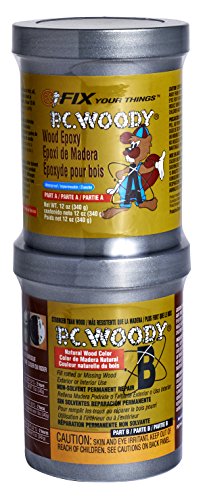
1. PC Products PC-Woody Wood Repair Epoxy Paste, Two-Part 12 oz in Two Cans, Tan
Our pick — over 4.5★ from 3,500+ verified ratings; the strongest balance of quality and price.
The high-tack paste that stays put on a sill while it hardens.
If you are patching rotted window sills, handrails or deck boards that see rain and sun all year, this is the one to start with. It mixes in equal volumes with a stiff putty knife on a flat board — the maker is blunt that you should not try to mix it wearing gloves. The paste is deliberately tacky, so it clings to the surface instead of sliding down the slope you just filled. Dry rot, UV light, fresh water and salt water resistance all come standard, and it holds up outdoors in heat. Mix time is short, but the working window is generous — around an hour of open time before it starts to stiffen, and it stays workable in the can for another session.
The dried color is a light tan, and this is the honest catch: it barely darkens when you brush stain over it. Owners who wanted to match a dark mahogany tone mixed in dry pigments such as burnt umber, roughly a tenth of the batch by their estimate, and found the tinting wasteful because batch-to-batch color varies. The manufacturer’s published window is wide — apply between 35 and 115 degrees F, and it keeps its service from -20 to 200 degrees F. Full cure is listed at 24 hours, and the crowd wisdom is to wait that full day before sanding, or you will clog your paper. It sands easily once there, taking a solid stain or latex exterior paint without cracking.
The sticky feel is what buyers notice most once they start working it, and it cuts both ways — it grips the hole, but it will also pull back out and grab your fingers. Denatured alcohol on your hands and a metal putty knife solve most of that frustration. You will find it under many brands of two-part filler, but the PC-Woody edge is the durability crowd — an owner of this 12 ounces size versus the Abatron WoodEpox at 6.4 ounces gets a markedly larger amount of material for repeat repairs, since this is the twin-can set versus the single small pail. Most will want the small can and a second order later rather than dumping a whole batch into one window. That is a normal pattern with epoxy repairs, not a defect.
Where It Wins
- A high-tack paste that resists drips and sags while it hardens, so vertical surfaces stay tidy
- Handles dry rot, UV light, and fresh and salt water after it cures
- Sands smooth and hides cleanly under solid stain or exterior paint
- Fast, easy equal-parts mixing on a flat surface with a putty knife
What To Plan Around
- Dried color is a light tan that barely darkens under stain; mixing in dry pigment adds a step
- Part B must be mixed equal-parts with Part A — the maker warns against wearing gloves for the mixing step
- Some users find the pasty, sticky consistency fiddly for the first attempt
Reach for it if: you want one versatile paste for outdoor rot with the widest published temperature range on this list.
Look elsewhere if: you need a stain-ready dark-tone match right out of the can — you’ll want a pigment or colorant.
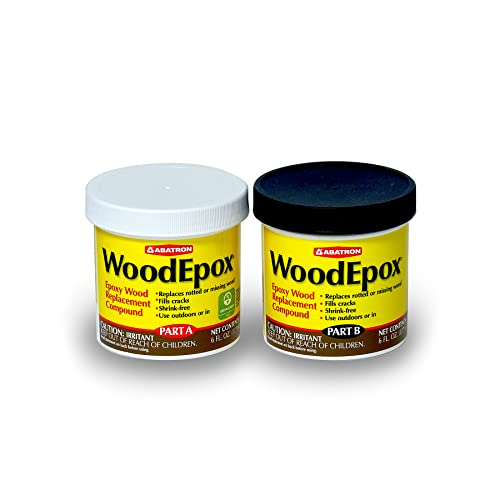
2. Abatron WoodEpox Kit – 12 oz – 2-Part Structural Epoxy Adhesive Filler – Wood Filler Putty
A putty you can carve, plane and nail like the wood it replaces.
This is the one for a rotted door frame, a chewed stair rail post or a missing chunk of window trim you plan to rebuild rather than just fill. The putty has a 20 to 30 minute pot life, meaning the clock starts the moment resin and hardener meet and you have that long before it stiffens. Once cured it mimics natural wood to a degree most fillers never reach — it can be painted, stained, drilled, carved, sawed, nailed, planed, sanded and routed. It is GREENGUARD certified, meaning it contains almost no VOCs (volatile organic compounds — the solvent fumes that give some repair products a heavy chemical smell), so it is low-odor indoors. Because it contains no water and no solvents, it makes structural, shrink-free repairs that bond to previously damaged wood and resist further attack by water, pests and UV.
Real-world users on tough exterior jobs are clear about its value. One case worth remembering: an owner reports repairing a 3/4 inch rotted patch on a header board behind fascia and says it was easier than cutting the rot out entirely. That’s the plain benefit — you may be able to avoid tearing out old framing by rebuilding it in place. Going head to head against the PC-Woody above, the Abatron is putty rather than paste, and it mixes and applies by hand, which suits people who find a drippy paste hard to control overhead. The trade-off is that it can also be worked by hand after a short cure window — but you still need to wait for full strength before sanding. And versus the Bondo alternative many first-timers grab, multiple reviews call this less messy and better on vertical surfaces.
The recurring honesty check is price. It is a premium option, and the review pages split on whether that price is justified for a casual one-off repair. For irreplaceable trim or historic restoration, the mixed sentiment swings toward worth it; for a small household ding, the same money buys the System Three paste below or the fuller Woodon kit. These are the people who choose it best: a restoration-minded DIYer who cares more about a lasting, sandable repair than about the smaller outlay.
Why The Price Is Justified
- 20-30 minute pot life leaves room to sculpt and shape a proper rebuild
- Machineable after curing — plane, route, drill, nail and carve it like real wood
- GREENGUARD certified with almost no VOCs, water or solvents, and low odor indoors
Where It Gets Priced Up
- Premium tier; the review pages split on whether that price is justified for small jobs
- The 6.4 ounce kit is a modest amount once you start on a large rebuild
- Not a full replacement for liquid wood hardener — this is the putty stage
Best for: a rebuild on a door, window trim or post that needs machining, not just filling.
Consider something else if: this is a quick one-off nick and you want the lowest outlay.
3. System Three SculpWood Putty Epoxy Wood Filler, 8 oz, Brown
A non-shrinking two-part putty that dries hard enough to drill.
Think of this as the partner piece in a one-two punch. System Three SculpWood Putty is meant to be packed into a cavity after RotFix has been brushed into the hollowed-out wood, so the putty does the bulk filling and the liquid epoxy does the consolidating. The 8 ounce brown putty is non-shrinking and solvent-free, which means clean-up is easiest when you reach for lacquer thinner, denatured alcohol or plain white vinegar while the mix is still uncured. Once set it sands like wood, machines easily, and takes most water- and solvent-based primers and paints. The paired kit approach — RotFix first, then putty — is exactly how many buyers use it on real rot.
The proof that it cures firm comes straight from the workshop: on a rotted rub rail on a 75 year old wooden boat, one owner mixed a 1:1 ratio, shaped it with alcohol-wet fingers and a putty knife, and reported sets in under an hour and a full cure in two days. That reviewer matched the surrounding mahogany well, and the set filler accepted stain. A different project found it sculpting ram horns over a wire armature — layer three or four times, half an hour between layers — then curing hard as rock. The same pattern shows up across jobs: strong and durable, easy to sand, and willing to hold its shape while you work it.
The color situation is the part to know about before you buy. The label reads brown, but mixing it out does not land on a deep brown — the outcome leans toward a tan or pale pink, which means a buyer who wants a true mahogany match may need to add a chocolate-brown colorant to darken it first. Others simply paint over the patch and move on. So this pick suits someone filling void after a rot treatment on a small, careful job where an organic brown tone is not critical.
Best for pairing up: deep holes where RotFix has already gone in and you need a putty to pack the cavity without gaps.
Sculptors and model makers will also like how it holds texture between layers.
Pick this when: you want a sandable putty that pairs naturally with a liquid wood consolidator.
Skip that if: you’re expecting a true deep brown right from the can — the cured tone runs far lighter.
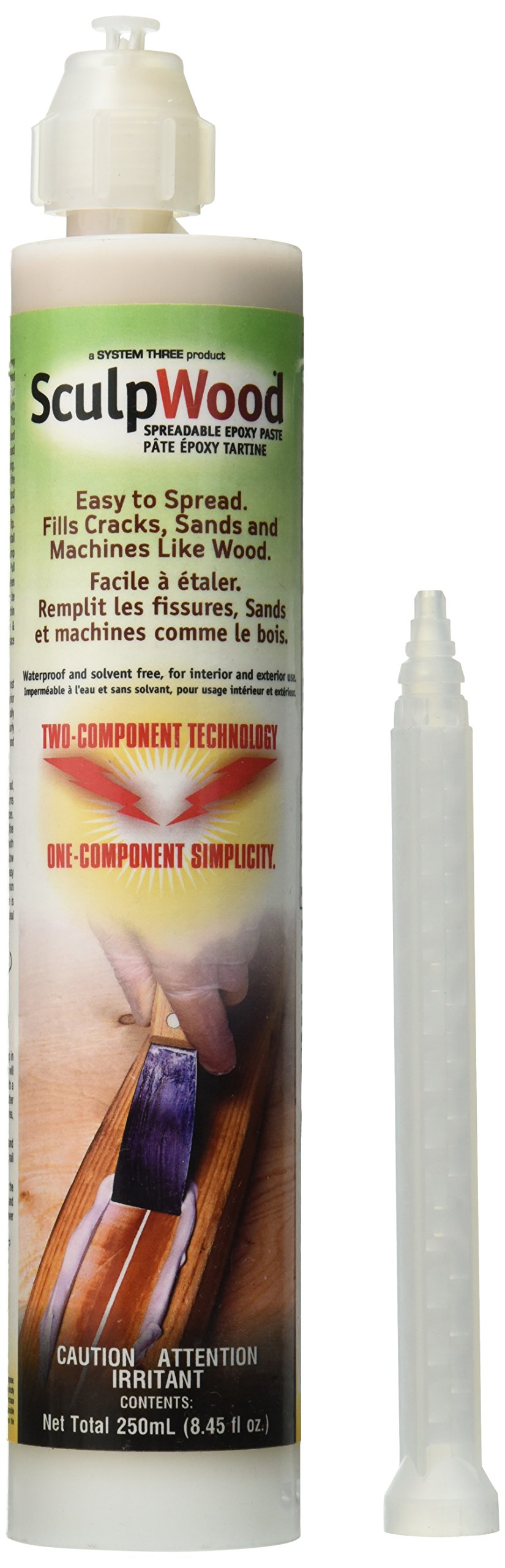
4. System Three SculpWood Paste Wood Epoxy Filler, UTAH Cartridge, 8.4oz
Fills hairline cracks and screw holes flush, back to a level plane.
Where the putty above packs voids, this paste smooths over the surface. It is a creamy 2-part epoxy finishing paste that spreads like spackle — compatible with most water- and solvent-based primers and paints, and strong enough for a lean exterior job all on its own. The published numbers are worth knowing: at 70 degrees F it reaches a sandable state in 6 to 8 hours, then takes primer and paint. Colder weather stretches the cure, and warmer weather shortens it, which is a useful thing to know if you are working in a garage in January. Working time is roughly 15 minutes, so a small batch at a time is the smart move. It is listed as crack-resistant and waterproof, and the compatible surfaces stretch well beyond wood — brick, ceramic, concrete, fiberglass and metal are all listed.
The bonding is the part that wins people over — 47 separate comments cluster around it, making adhesion the most-praised trait. A spread of it over any surface is thick enough to grab, yet it levels out nicely. One real project sums up the ceiling of this stuff: a restoration of a 1937 diamond-glass window with significant rot in Douglas fir, where the paste was worked with a 15-minute working window and shaped into ogee details before the primer went on. That is the whole pitch — a filler flexible enough to hold a decorative profile, not just a flat patch.
The common misunderstanding is right there in the reviews as well. It is PASTE, not putty — a buyer who reads bad reviews often finds the criticism traces back to someone trying to push it into a deep cavity. It is not built for that. It is also not elastic, so it is a poor choice for any gap between moving parts, like a joint where two boards flex against each other. So think of this as the surface specialist: crack-filler and detailer, not the structural patch.
It’s the one for you if: small cracks, dings and leveling over a primer-ready coat of paint is the job.
Leave it on the shelf if: you’re packing a deep rotted-out cavity — reach for a putty for that.
5. Woodon Epoxy Wood Putty Filler Kit, 32oz 2-Part Wood Putty Filler (Brown)

Two big pails, a scoop and gloves — enough epoxy for a whole project.
If you have more than one repair on the list and don’t want to re-order mid-job, this kit is the one to weigh. It arrives as two pails of 16 ounces each — Part A resin and Part B hardener — plus a scoop, a pair of gloves and two sanding blocks. You blend them 1:1 by hand for a 30 minute working time, then wait 24 hours for full cure. After that it can be sanded, drilled, painted, stained, sawed or carved just like natural wood. The temperature spread is the standout number: cured putty is rated from -58 degrees F to 302 degrees F, which is the widest on this list and suits both a hot deck and a cold workshop. It also handles cracks in metal, plastic, tiles, glass, ceramics and stone, not just wood. The only storage note from the maker: keep it in a cool, dry and sealed place between uses.
The honest bit is consistency. The most-discussed theme by a long way is how firm it sets, and reviewers split two ways on it — some call it a win because the repair is rock hard, and others find it makes sanding down a challenge. The workaround that buyers report is to use it sparingly on flatter repairs, or to flatten a proud ridge with a hand router before a light sanding pass from 60 grit up. Because it cures so hard, small amounts go much further than first-timers expect, and the instruction to not overmix keeps the batch manageable.
The value card is the pail count. You get far more material here than a single small can, and the tools are included, so it makes sense for homeowners working through several rotted spots in one weekend rather than one repair a year.
The value math: two 16-ounce pails, a scoop, gloves and two sanding blocks in one kit, with a spread of -58°F to 302°F
The one adjustment: curing time runs under 24 hours in the field, but it’s firm enough that a few owners flatten the proud bits with a router before sanding.
Pick it when: you have a weekend of mixed repairs — wood, plus a bit of metal or tile — and want one big kit to cover all of it.
Skip if: you only need a dab for a hairline crack — the volume and the hard cure are overkill for that tiny a job.
6. RTG Wood Repair Epoxy Putty (2-Pint Kit)

A pint of putty that hardens in 8 hours and holds screws like timber.
This putty is a fair match for anyone grinding through a dry-rot rebuild and needing volume fast. It’s a simple 1:1 mix, moldable, and — per the maker — it won’t sag, shrink or crack while it sets. Full cure is listed at 8 hours, the same figure the SculpWood Paste above gives. It’s declared 100% waterproof once cured and, per the maker, holds nails and screws about as well as real wood. The 2-pint kit arrives with equal parts resin and hardener. The cured patch can be sanded, painted and stained to blend into the surrounding finish, and it’s advertised for interior and exterior use.
Where RTG shines in the field is on larger rot. Owners mention it fills deep rot and hardens quickly, and a batch that sets hard within a day does not budge. A common win comes from window rebuilds — the filler lets you rebuild the original profile instead of swapping in a whole new unit. One use that turns up again and again is restoring dry-rotted awning windows that would otherwise need replacement. The other half of the story is the mix — do it carefully. Batch that was mixed unevenly stayed soft and pliable for days in one report, which is an annoyance, not a failure of the formula, but it is real. On a vertical spot, overfill slightly and sand back down; it sets hard enough to machine.
The honest caveat is texture. It works like a firm putty, so it can be sticky and resistant to smoothing with a putty knife — plan on nitrile gloves and a small batch, and it delivers a durable fix. It also wants a wood rot restorer applied first; the putty fills the gap and adheres, but it will not soak into and harden the wood fibers underneath. So the RTG suits the person with a whole window or fascia section to rebuild, where volume matters more than fingertip finesse.
Best Features
- Fast 8 hour full cure so you can sand and finish the same day in warm conditions
- Simple 1:1 mix ratio and a moldable feel that stays where you press it
- 100% waterproof when cured and holds fasteners at wood-like strength
Needs Attention
- Depends on an even measure and mix — uneven batches stay soft and runny for days
- Sticky to spread, so wear nitrile gloves and work small hand-kneaded amounts
- Not a wood-conditioner on its own — pair with a rotted-wood hardener for deep soft spots
Choose this if: dry-rot rebuilds on windows, fascia or posts are on your list and you want a fast set with screw-holding strength.
Look past it if: you’re smoothing a shallow surface ding — the putty’s sticky texture fights fine, flat work.
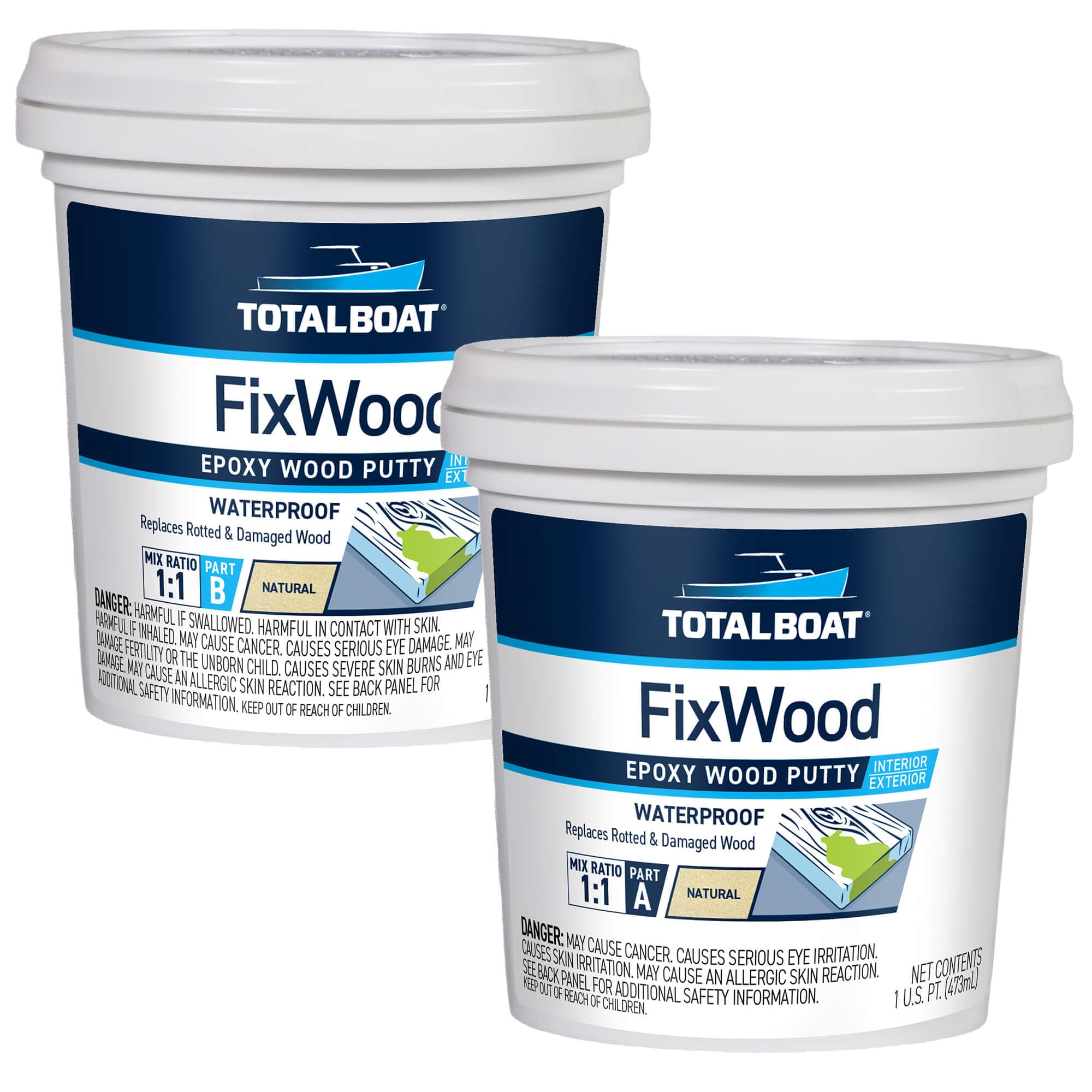
7. TotalBoat Fixwood | Marine Grade Epoxy Putty | Stainable Paste Filler for Damaged Wood Repair or Replacement
Marine-grade putty that stands up to pressure washing on a dock.
For boats, docks, exterior stairs and anything that gets hosed down or soaked, this 2-part marine-grade putty is the specialist pick. Mix equal parts of Part A and Part B, mold it to shape, and it stays put on a vertical surface without sagging, shrinking or cracking. Once fully cured it’s 100% waterproof, then ready to be sanded, carved, drilled, cut, painted or stained to match your wood. For deep rot, the maker recommends TotalBoat Penetrating Epoxy first, which consolidates the soft fibres before you cap the repair with Fixwood. The same full-strength hold carries over to fasteners, so a repaired step or rail can still take nails and screws. The full cure is 7 days, so plan the timeline if you’re working around weather.
Field reports back the waterproof promise. Owners describe repairs on 150-year-old window sashes and say the finished patch stands up to pressure washing, and the cured putty handles rotary-sander abuse without flaking off. Spread it thin and it mends scratches; leave it slightly proud and shape it back down with the sander. The message from the benches is consistent: it behaves like wood once it’s set, not like a plastic filler that stays gummy. Where it loses points is the spread itself — many find it fiddly to smooth and hard to level with a sock putty knife, so the trick is to pour enough in and sand back after cure rather than trying to level it wet.
The takeaway on price is a considered one — reviewers are split on value, acknowledging it costs more than hardware-store filler but delivers a genuinely marine-grade result for restoration work. So this one is for the boater, exterior-carpenter or preservation-minded restorer who needs a filler that can take weather, water and pressure, and doesn’t mind a 7 day wait to get there.
The standout number: 7 day full cure is the longest on this list — plan the project window around weather and nothing else.
Ideal owner: the boater or exterior-wood restorer who wants marine-grade toughness and can wait a week for full cure.
Hold off if: you’re fixing a crack this afternoon on a budget — this is overbuilt for a quick indoor touch-up.
8. PC Products PC-Woody Wood Repair Epoxy Paste, Two-Part 48 oz in Two Cans, Tan 643334

Same trusted paste as the pick above, scaled up for whole-property jobs.
This is the same PC-Woody paste you already know from first place, only in a pair of 48-ounce cans rather than 12-ounce tins. That is four times the material, which changes who it’s for: the person rebuilding multiple rotted windows, a whole set of deck boards or a repeated repair project that will burn through volume. The formula is unchanged — the tan paste mixes Part A and Part B in equal volumes, is resistant to dry rot, UV light, and fresh and salt water, and stays workable in temperatures of 35 to 115 degrees F. It keeps service between -20 and 200 degrees F, and full cure is listed at 24 hours. The high-tack body keeps it from sagging on vertical work, and it hardens into something you can chisel and sand.
Owners who reach for the big cans tend to be repeat users, and the pattern is consistent — the maker’s part B warning is the same as the smaller tin, so mix on a flat surface with a stiff putty knife and do not try to blend it on your hand. Batch size is the one place the larger volume demands respect: they specifically do not recommend mixing in teaspoon-size increments because the off-ratio risk rises at tiny scales. Published set numbers in the field run around 48 hours for large repairs or exterior work, though the maker lists 24 hours; either way, don’t rush the sand. The 3 pound two-can set is heavier to handle and best set up at a bench for flat mixing.
The honest trade-off is the outlay — this is a premium spend compared with the small tin, even though it drops the cost per ounce down for a serious project. The right buyer is someone who already knows the small version works and has the volume to justify buying large once rather than reordering repeatedly.
What You Get
- Two 48 oz cans — four times the volume of the 12 oz kit at a lower cost per use
- Handles dry rot, UV light, and both fresh and salt water after curing
- Published working range of 35 to 115 degrees F and service from -20 to 200 degrees F
Mix Caveats
- Not suitable for tiny teaspoon-size batches due to off-ratio mix risk
- Part B must not be mixed onto gloved hands — mix on a flat surface with a putty knife
- Large repairs can run to 48 hours before they’re ready to sand
Buy it for: multi-window or full-deck jobs where reordering mid-project is the real cost.
Pick the small tin instead if: you have a single repair to do — the volume will outlast its useful shelf life.
Understanding the Specs
Working Time (Pot Life)
The working time is the clock that starts the second your resin and hardener touch. It runs from a fast few minutes to around 30 minutes across these picks. A short working time suits small touch-ups you can shape in one pass. A longer one, like the 20 to 30 minute pot life on the Abatron WoodEpox, gives you room to sculpt a proper rebuild before the mix thickens. Match the working time to the job: a few minutes for a small touch-up, 20 to 30 minutes for a full rebuild.
Full Cure Time
Full cure is when the patch reaches its final hardness, and it always runs longer than the working time. It ranges here from 8 hours to a full week. Sanding or coating too early risks clogging your sandpaper or trapping soft material under the finish, so wait out the published number before you grind. Colder rooms stretch the cure; warmer rooms shorten it, which is worth remembering if your workshop is unheated.
Putty vs. Paste
Putty is thick and moldable, so it packs a deep cavity and stays where you press it — even overhead. Paste is smoother and creamier, so it flows into hairline cracks and screw holes and levels off flat. Some kits, like the System Three line, are designed as a team: a liquid consolidator first, putty for the bulk fill, then paste for the fine surface. Buy putty for deep cavities and paste for hairline cracks.
Water And Temperature Resistance
Once cured, every filler here is built to handle moisture, and several are rated for fresh and salt water outdoors. Check the published temperature range before you commit a filler to a hot deck or a boat hull.
FAQ
What is the difference between two-part epoxy wood filler and regular wood filler?
Can I mix two-part epoxy wood filler with my hands?
How long do I have to work with mixed epoxy before it sets?
Will cured epoxy wood filler take stain to match my wood?
Can I use two-part epoxy wood filler outdoors?
Is two-part epoxy wood filler stronger than wood putty or Bondo?
Do I need to remove all the rotted wood before filling?
How much epoxy wood filler do I need for one repair?
Final Thoughts: The Verdict
For the majority of shoppers, the best 2-part epoxy wood filler winner is the PC Products PC-Woody 12 oz because it mixes easily, resists dry rot, UV and both fresh and salt water, handles a wide working temperature range, and stays workable on vertical surfaces — the all-rounder for exterior wood repair. If your job is a structural rebuild where you plan to plane or nail the patch, grab the Abatron WoodEpox Kit. And for deep rot where you want a putty that cures hard enough to drill, the RTG Wood Repair Epoxy Putty is the one to reach for. The smart-buyer nudge here is simple: buy the form — putty for deep voids, paste for hairline cracks — that matches the damage, and don’t sand before the full cure.
How We Picked
We do not accept paid placement. Every pick is matched to a real buyer and a real use-case; we do not hands-on test units.
Sources & Methodology
Specifications: manufacturer listings and product documentation. Review insights: verified customer reviews, as of September 2026. Pricing: not shown on this page (it changes often); check the current price via the retailer link.
As an Amazon Associate, KitchPrep earns from qualifying purchases. This does not affect which products we feature.
Related Guides
