
Specs are compiled from manufacturer listings and verified buyer reviews and can change over time — please confirm the key details on the product page before buying.
If your upstairs shower trickles while the kitchen tap steals all the pressure, the fix is usually one automatic pump that starts and stops itself as water flows — and the best pick for most homes is the Lanchez 1.6HP Shallow Well Jet Pump, a stainless-steel booster with a built-in 5-gallon tank and a pressure switch that fires at 20 PSI and shuts off at 40 PSI. It carries a 4.3 rating from 400+ owners, the highest score and review count in this lineup. Below, every pick is ranked by what it actually does under your sink or in your utility room: how much water it moves per minute, how high it can lift that water, and whether it needs a separate tank to run smoothly.
I’m Mohammad Maruf — the founder and writer behind KitchPrep. This guide is built by comparing the manufacturers’ published specifications and the patterns across verified customer reviews, so you get each pick’s real strengths and trade-offs instead of marketing spin.
You will see how flow, head, tank size, and switch type separate a utility pump from a whole-house variable-speed booster. This breakdown covers the Best Automatic Water Pressure Pump for a Home.
Our Picks at a Glance

How To Choose The Best Automatic Water Pressure Pump for a Home
An automatic water pressure pump does one job: it watches the pressure inside your pipe and turns itself on when it drops. You never flip a switch. The wall outlet stays live, the pump senses the drop, and it pushes water until the line is back to its set pressure. Choosing the right one means matching four numbers to your plumbing — flow rate, maximum head, starting and stopping pressure, and whether a small pressure tank is built in.
Match flow rate to how many taps run at once
Flow rate is measured in GPM, or gallons per minute — how much water moves through the pump every 60 seconds. One shower uses roughly 2 to 3 GPM on its own. If you want a shower, a washing machine, and an outdoor hose to run together without a pressure drop, you want a pump moving 18 to 30 GPM with a buffer tank to absorb the surges. A pump rated too low for your house will still build pressure, but each extra open tap will pull the pressure back down.
Check maximum head for upstairs bathrooms
Maximum head is the highest a pump can lift water, measured in feet. Add the height from the pump to your topmost shower plus the friction loss of the pipe run. A pump rated around 130 to 150 feet handles most one- and two-storey homes comfortably, while the higher-head units in this list push 164 to 200 feet for tall houses or roof tanks. Undersize the head and the upstairs tap feels weak no matter how strong the pump looks on paper.
Pressure switch and tank stop short-cycling
The pressure switch is the brain — it starts the motor at a low set point and stops it at a high one. Many jet pumps in this lineup use a 20 PSI to 40 PSI range, a common household setting. A small pressure tank, often around 5 gallons, holds pressurized water so the pump is not flicking on and off every time a tap opens for a second. More taps and longer runs make a bigger tank worth it.
Quick Comparison
| Model | Best For | Flow Rate | Max Head | Horsepower | Amazon |
|---|---|---|---|---|---|
| Lanchez 1.6HP Shallow Well Jet Pump★ Best Overall | Whole-home boosting with a built-in tank | 23 gpm | 150 feet | 1.6 hp | Amazon |
| TDRRICH 3/4HP Booster PumpBudget Champion | Garden and pasture irrigation on a budget | 18 gpm | 131 feet | 0.75 hp | Amazon |
| TDRSUPER 1 HP Shallow Well Jet PumpEasiest Install | Simple install with a full fitting kit | 18 gpm | 150 feet | 1 hp | Amazon |
| Acquaer Shallow Well Jet Pump | Dual-voltage replacement for wells up to 25 ft | 18 gpm | 167 feet | 0.75 hp | Amazon |
| Aquastrong 1.6 HP Garden Pump | Rain-tank and garden irrigation | 22 gpm | 164 feet | 1.6 hp | Amazon |
| FCNP PM750S Whole House Booster | Quiet constant-pressure for multi-floor homes | 25.53 gpm | 164 feet | 1 hp | Amazon |
| MixBubole V3-45 PRO Booster Pump | App control in the tightest install spaces | 27 gpm | 180 feet | 1.35 hp | Amazon |
| Czobloik 80 PSI Whole House Pump | Showers and appliances on standard plumbing | — | — | — | Amazon |
| Gwanzi 800ULTRA Booster Pump | High-head houses and roof tanks | 30 gpm | 200 feet | 1.5 hp | Amazon |
In‑Depth Reviews
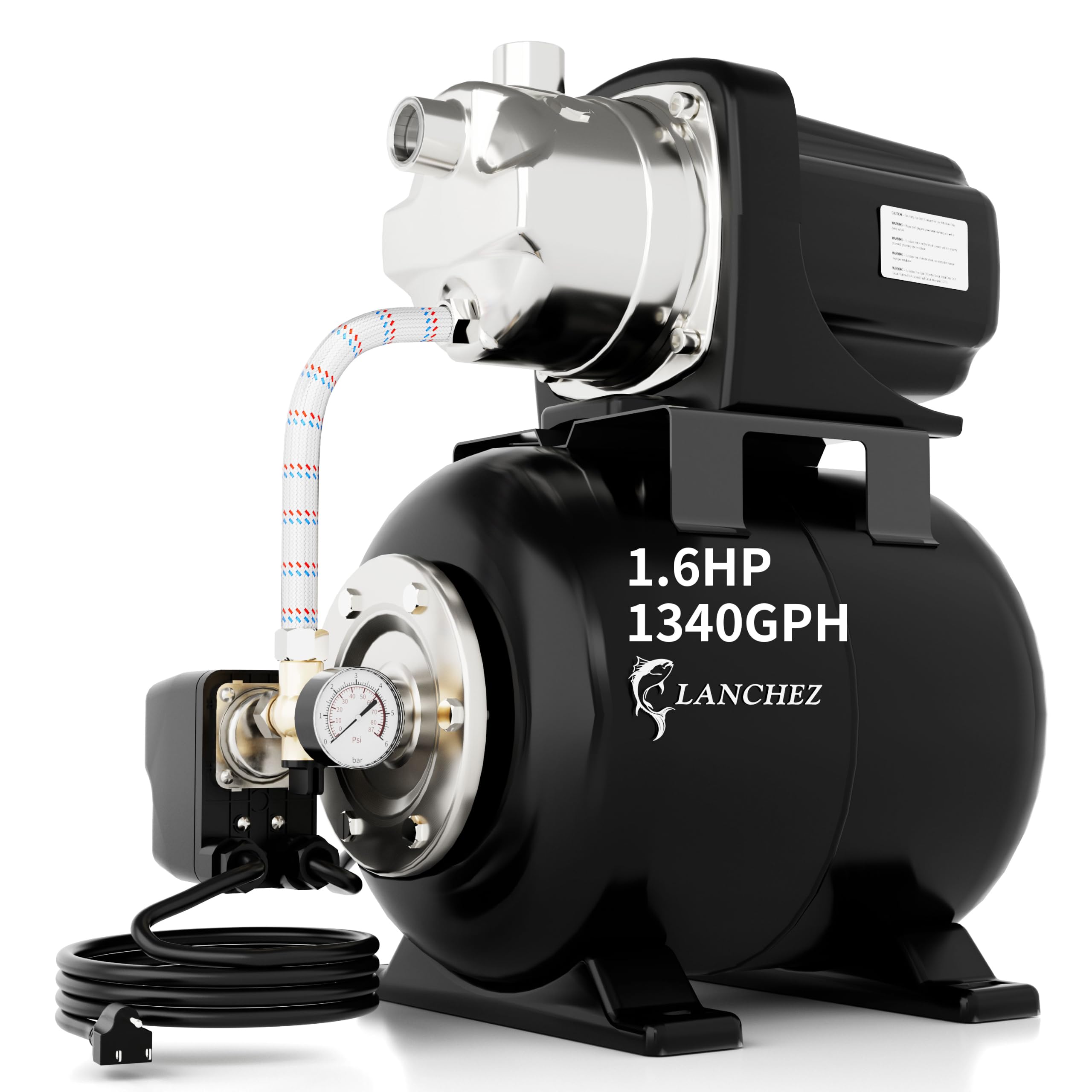
1. Lanchez 1.6HP Shallow Well Garden Pump, Stainless Steel Irrigation Pump, 1340 GPH, Automatic Water Booster Jet Pump for Home, Garden, Lawn,Irrigation, 115V, Glossy black
Our pick — over 4★ from 400+ verified ratings; the strongest balance of quality and price.
A stainless booster with a tank onboard that kicks in the moment a tap opens
The reason this one sits at the top is the package, not a single flashy number. It pairs a 1.6 hp motor with a 23 gpm flow rate — that is gallons per minute, the real measure of how many taps you can run at once — and a maximum head of 150 feet, enough to feed an upstairs bathroom. Compare that flow to the TDRRICH below at 18 gpm, and this Lanchez simply moves more water per minute. A compact 5-gallon pressure tank is built into the housing, so the pump holds pressure instead of hammering on and off every time someone rinses a plate.
Automatic operation is baked in. The pressure switch starts the motor at 20 PSI and shuts it off at 40 PSI, with an external gauge so you can watch the number rise and fall in real time. The stainless steel casing resists corrosion, and the 6.5-foot cord ends in a grounded plug for a standard outlet. What wins people over most is reliability — it is the most-praised trait in the feedback, and owners describe it running for hours at a stretch. The same body of reviews calls it a dependable booster for a supply that simply does not push hard enough on its own.
One honest catch: you must prime it before the first start, meaning you fill the pump body with water so it can build suction. It is not a hard step, but skipping it can burn the seal. And one reviewer noted that leakage shows up around the threaded connections on some units if they are not sealed and taped properly, so hand-tight plus sealing tape is non-negotiable. That stainless-and-tank build is the reason it tops a list where most rivals cost about the same.
Stainless steel body
- 23 gpm flow outruns the 18 gpm TDRRICH
- Built-in 5-gallon tank smooths short-cycling
- Stainless casing resists corrosion on outdoor installs
- Overload stop cuts the motor in a dry run
Shallow well only
- Must be primed before first use
- Noise level divides owners — some call it audible
- Seal the threads well or expect a drip
Small gardens: you want one pump to boost a whole house and still water the lawn, without adding a separate tank.
Deep wells: you need set-and-drink quiet — this is a moving-parts pump, not a whisperer.
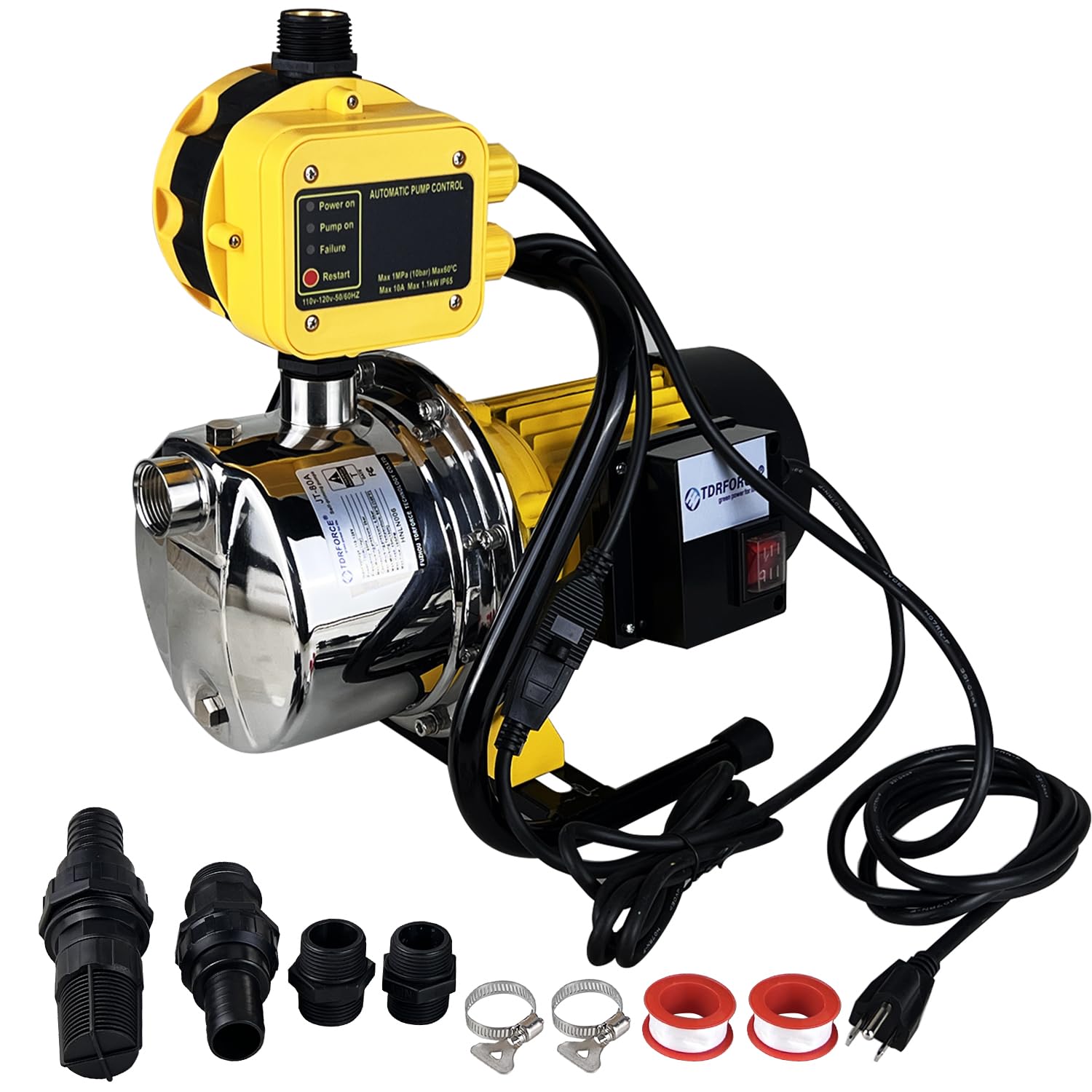
2. TDRRICH 3/4HP water pressure booster pump with Smart Controller for whole house,Self-priming Jet Transfer Pump Pressure Switch Automatic System 110v AC for Lawn Garden Sprinkler Irrigation
The self-priming workhorse built to run all day on a pasture or a big lawn
Where the Lanchez above leans on raw horsepower, this TDRRICH earns its place on continuous duty and versatility. It is rated to run 24 hours straight, self-primes whenever water flows, and manages it all on 0.75 hp — roughly half the Lanchez motor, paired with an 18 gpm flow and 131 feet of head. That gap is real: the Lanchez lifts water to 150 feet, this one to 131. Push it up a tall house and the top-floor tap is where you will feel the difference.
The controller is the selling point. Water pressure is the trait owners praise most, and reviews describe it boosting an outdoor spigot, running well-pump duty, and even draining a pool from a single unit. The auto-stop is a smart safety touch — if the water supply is cut, it shuts down within about ten seconds to protect the motor from running dry. That feature is why it holds up in demanding setups like a 16-hour-a-day irrigation loop on a solar generator.
The trade-off is durability, and it is worth naming plainly. The most-discussed buyer complaint is quality: one account describes a mechanical seal failing after months of use, while another says the stainless body finally killed a leak a plastic pump could not. Some units arrive with a broken fan cover or a leaking one-way valve that needs swapping. The pattern is clear: this is a strong performer when it works, but it is the pick to scrutinize on arrival, not to install blind.
Smart constant pressure: it runs long hours without complaint, which is exactly what a pasture or long sprinkler line needs — and the ~10-second dry-run cut keeps the motor protected when the well runs low.
Inspect on arrival: the recurring gripe is the fan cover and one-way valve shipping fragile — check both before you plumb it in, because a quick return is far easier than a mid-season repair.
Boosting pressure: irrigation and transfer jobs that run for hours, where raw flow matters more than whisper-quiet operation.
Well systems: you need whole-house lift on a two-storey home — 131 feet of head will fall short.
3. TDRSUPER 1 HP Shallow Well Jet Pump with Automatic Pump Control, Smart Pressure Switch System, Stainless Steel Water Pump for Home Garden Irrigation
Comes with every fitting so you are not hunting adapters on install day
This TDRSUPER is the one to grab when the last thing you want is a second trip to the hardware store. The full install kit includes the pump, the smart pressure switch, mounting hardware, pipe adapters, and sealing tape — everything for a leak-free hookup out of one box. A 1 hp motor gives it 150 feet of maximum head, putting it level with the Lanchez up top on lift, though it flows at 18 gpm against the Lanchez’s 23. That head is enough to feed a second-floor home, and owners confirm it running a whole house on the supply.
The smart controller is the clever part. Instead of a separate pressure tank, it screws directly onto the pump outlet and monitors the line itself, cutting power on a water shortage to block dry running. It even builds in overcurrent and thermal overload protection. For homes where floor space under the utility sink is tight, dropping the tank from the layout is a real convenience. The direct-connect design also means no conversion fittings to source.
The clear weak spot is the documentation, not the hardware — instructions are the recurring frustration, with owners calling them poor while noting the pump itself runs great. At least one unit arrived with a crushed fan guard and the blade pushed through the grill, so check the fan before you power it up. Expect a strong pump once you have it plumbed correctly, with installation clarity being the thing to plan for.
Basic setups: you want a tank-free setup and one box that covers the whole install.
High demand: you rely on printed instructions — the manual is thin, so bring your own plumbing expertise.
4. Acquaer Shallow Well Jet Pump,Cast Iron, Well Depth Up to 25ft, 115V/230V Dual Voltage, Automatic Pressure Switch
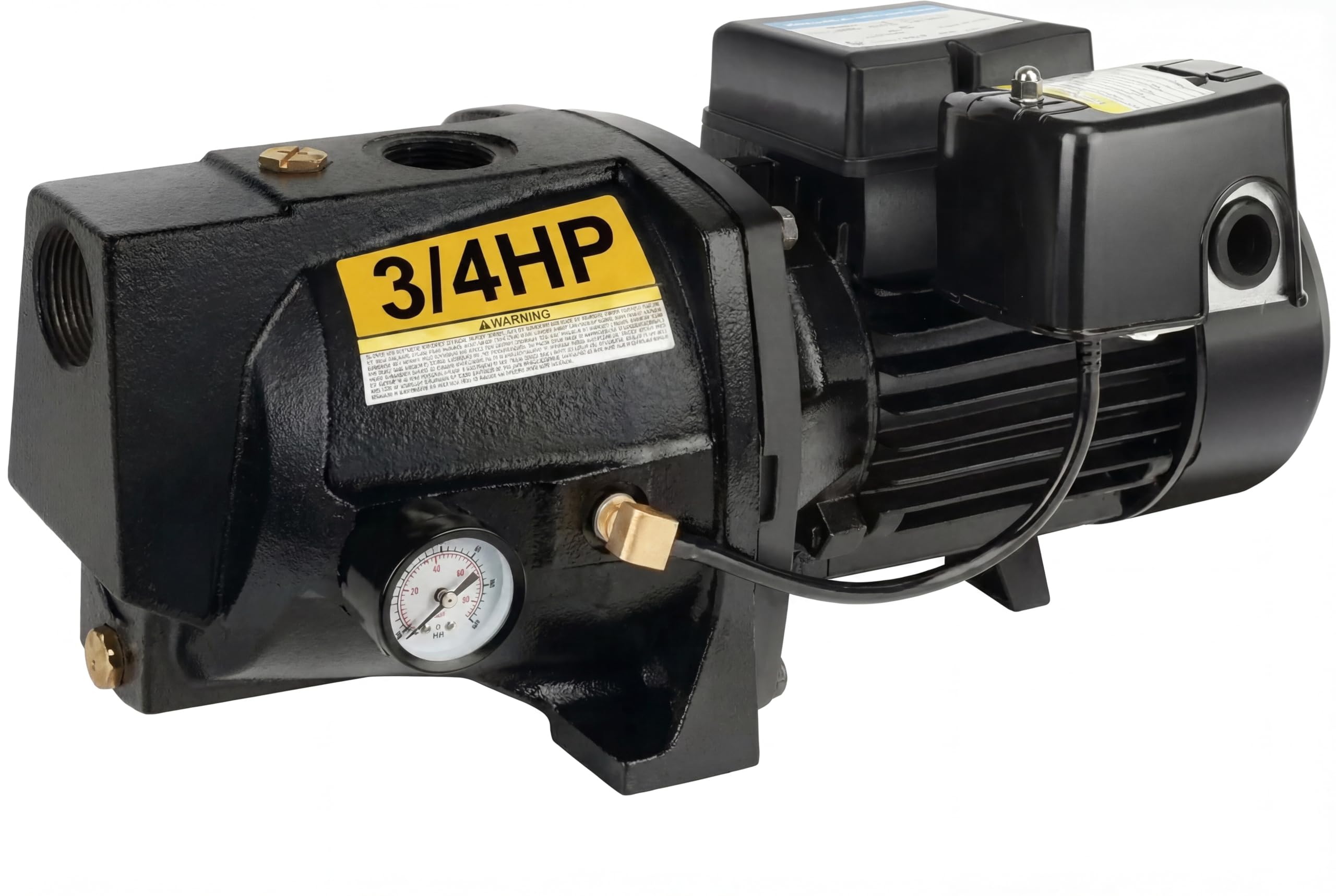
The cast-iron workhorse that switches between 115 and 230 volts to suit your wiring
What stands out here is the dual-voltage motor. It runs on either 115V or 230V — factory set for 230V — so you can match it to the circuit you already have instead of rewiring the shed. With 167 feet of maximum head, it lifts higher than the Lanchez and TDRSUPER above, and that matters for a deeper draw or a long uphill pipe run. It is built for wells up to 25 feet deep and flows at 18 gpm. The automatic pressure switch runs the same familiar 20 PSI to 40 PSI range.
Quality and easy installation are the two things this pump is loved for most, and both show up in the field. Owners describe swapping it in for a cracked irrigation pump and getting solid sprinkler pressure right away, with one noting the overload relay actually tripped and reset when the wiring was set to the wrong voltage — protection that worked as designed. The priming story is equally good: it drew water on the first try where the old pump needed babysitting every spring. The cast-iron volute (the pump’s water chamber) is what gives it that rugged, sealed feel.
The honest caveat is noise and reliability consistency. Some describe it as quiet while others call it loud, so placement matters — do not set it beside a bedroom. Match the voltage to your circuit and prime it properly.
Cast iron build: the cast-iron build reads as heavy-duty in the hand, and buyers repeatedly pair that with a sticker that undercuts the big-box equivalent — solid value for a pump meant to sit outdoors for years.
Heavy unit: because it self-primes and holds pressure through the 20-to-40 PSI switch, spring startup stops being an annual chore — the one chore that makes cast iron worth the weight.
Deep wells: anyone replacing a decades-old well pump who wants dual-voltage flexibility and extra lift without going to a high-end variable-speed unit.
Tight spaces: light sleepers who need the pump near a living space — noise is genuinely split in the feedback.
5. Aquastrong 115V Shallow Well Garden Pump, Stainless Steel, 1320 GPH, Automatic Water Booster Jet Pump for Home, Garden, Lawn,Irrigation,1.6 HP with Pressure Tank
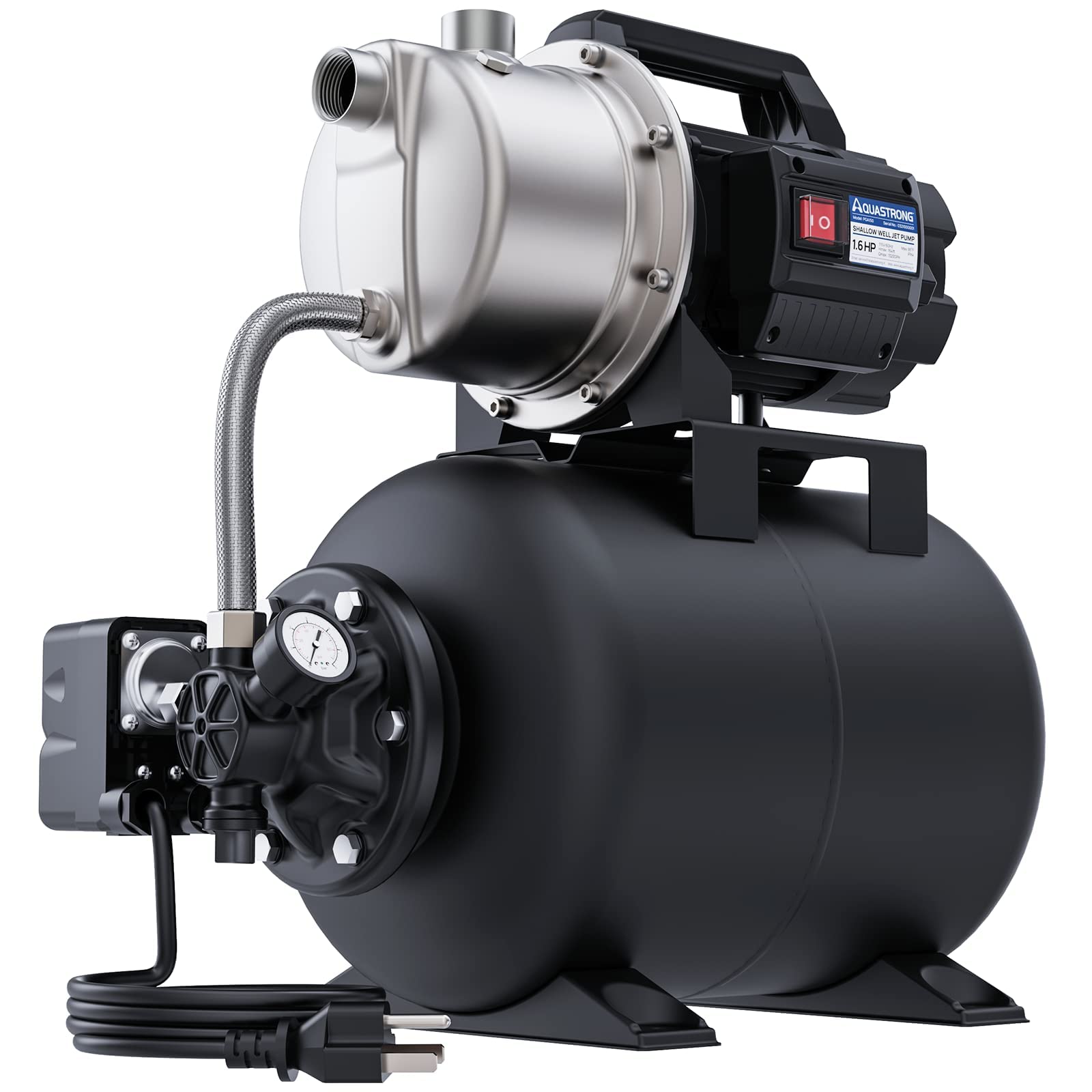
More lift than the Lanchez, with the same big tank and a beefier rain-water appetite
Aquastrong takes the Lanchez formula and pushes the head higher — 164 feet against 150 — while keeping the 1.6 hp motor and the built-in 5-gallon tank. Flow lands at 22 gpm, just under the Lanchez’s 23. The gap closes where it counts for a tall house or a roof tank: that extra 14 feet of lift gets water to a second-floor fixture the shorter-head pumps can fall short on. Suction reaches 26 feet, with a waterproof on/off switch and a pressure gauge sitting right on the tank so you can read the line at a glance.
Automatic operation runs on the same 20 PSI start and 40 PSI stop. The stainless housing handles corrosion, the carbon ceramic mechanical seal is built to resist drips, and the outlets ship pre-assembled with garden-hose adapters and sealing tape — so hooking up a sprinkler line is a same-day job. Easy install and strong pressure are the through-lines in the owner feedback, with one setup pushing two showers at once without a pressure drop. It self-primes too, which makes rain-tank duty simple.
Here is the part worth knowing before you commit: several owners do report the pump eventually failing — one at around eleven months, another at eighteen — but the standout story is that support replaced every one of them quickly under warranty, no fuss. It carries a two-year warranty, and buyers report fast replacements under it. So the real question is not whether it lasts forever, but whether you can count on being looked after if it does not — and on that front it delivers.
Garden watering: rain-tank and garden setups where the extra head clears a long run and the service reputation backs the purchase.
Whole house: you want a one-and-done install with no chance of a mid-life service call — some units do need that replacement.
6. Whole House Water Pressure Booster Pump for Home 80PSI 115V
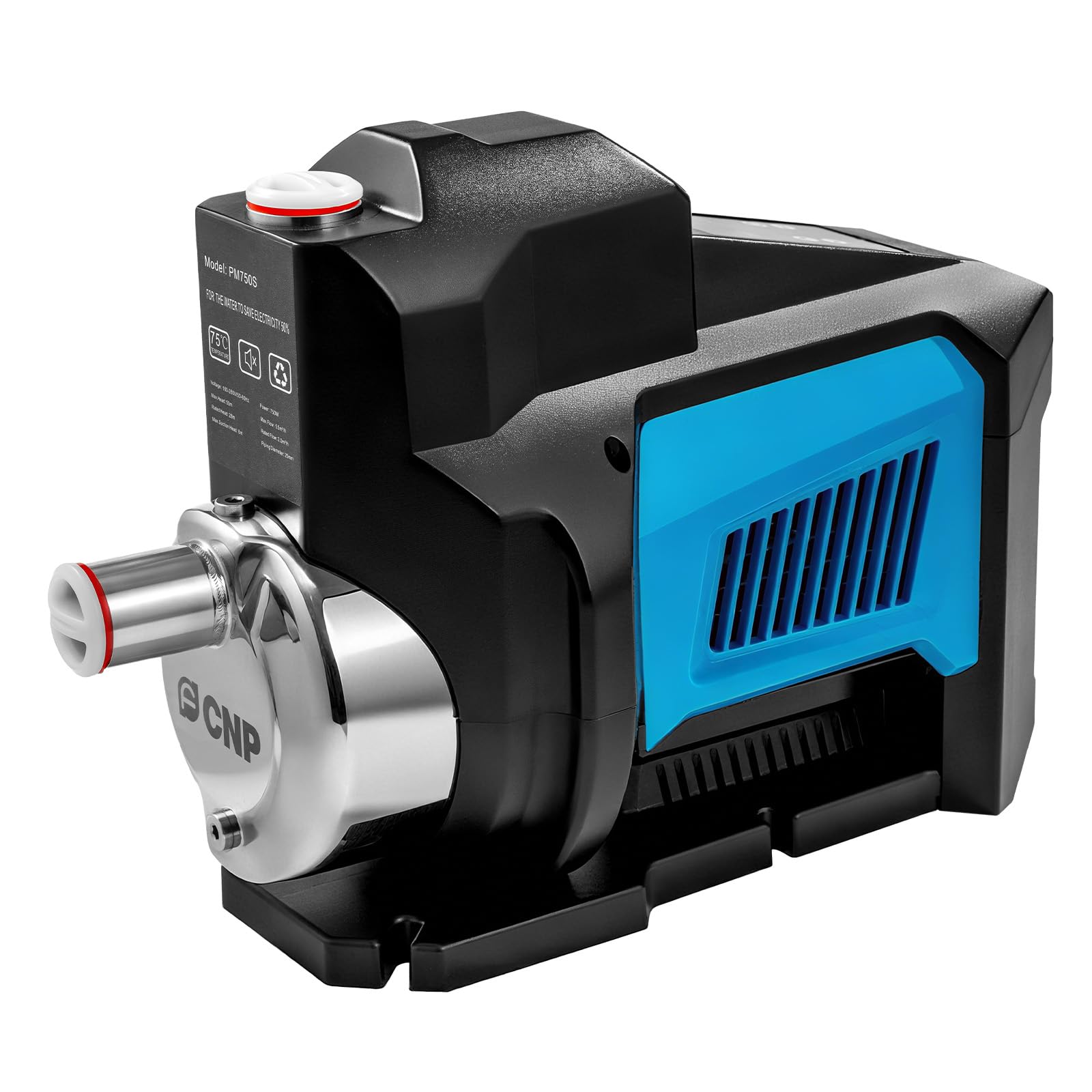
Variable speed and genuinely quiet — the whole-house answer when a plain jet pump is too loud
This FCNP unit is a different animal from the jet pumps above. Instead of a fixed-speed motor banging on and off, it uses a variable-frequency permanent-magnet motor that ramps up and down to hold 80 PSI steady — stated as 1.5 to 5.5 bar, or 22 to 80 PSI — and it claims coverage for ten faucets across three floors. Flow is rated at 25.53 gpm, above every jet pump on this list. The stainless pump head is also built to take hot water up to 167°F. For a home whose problem is pressure that drops the moment two taps open, constant pressure is the real feature here.
Quiet is the lead story from the people who own it — it is the most-praised trait in the feedback, with the motor rated 25 to 40 decibels, roughly a soft conversation. Owners talk about keeping the whole house pressurized for months of steady use, and the microcomputer control cuts the motor when water stops. Dry-run and power-failure protection are built into the control panel, and the self-priming design makes the first fill easy.
Two things to weigh honestly. First, one buyer measured the real flow far under the claim at low lift and found it better suited to boosting weak incoming pressure or running with a tank added — so if you expect the full gpm on every tap, add a tank or size your expectations down. Second, one account reports a motor failure inside two months, while others run perfectly for half a year. It is a low-review, new-listing pump, so it carries more unknowns than the veteran jet pumps — but it offers constant pressure and low noise no fixed-speed pump on this list matches.
80PSI output: the quiet. A 25-to-40 dB rating lands near a whisper, so an under-stair or garage install stops being a household annoyance — a real upgrade over the whine of a standard booster.
Noisy operation: one hands-on account put measured flow well under spec at low lift, so treat the headline gpm as a best case and pair it with a small pressure tank for a multi-outlet home.
Home pressure: silence and steady whole-house pressure are the priority and you want the technology upgrade a jet pump cannot offer.
Quiet settings: you need proven long-term field data — this is a newer listing with limited track record.
7. 1.35HP Whole House Water Pressure Booster Pump 90PSI 115V Automatic Variable Speed Penmanent Mangnet Motor Constant Pressure Wireless App Control Compact Design for Home House Villa Apartmen
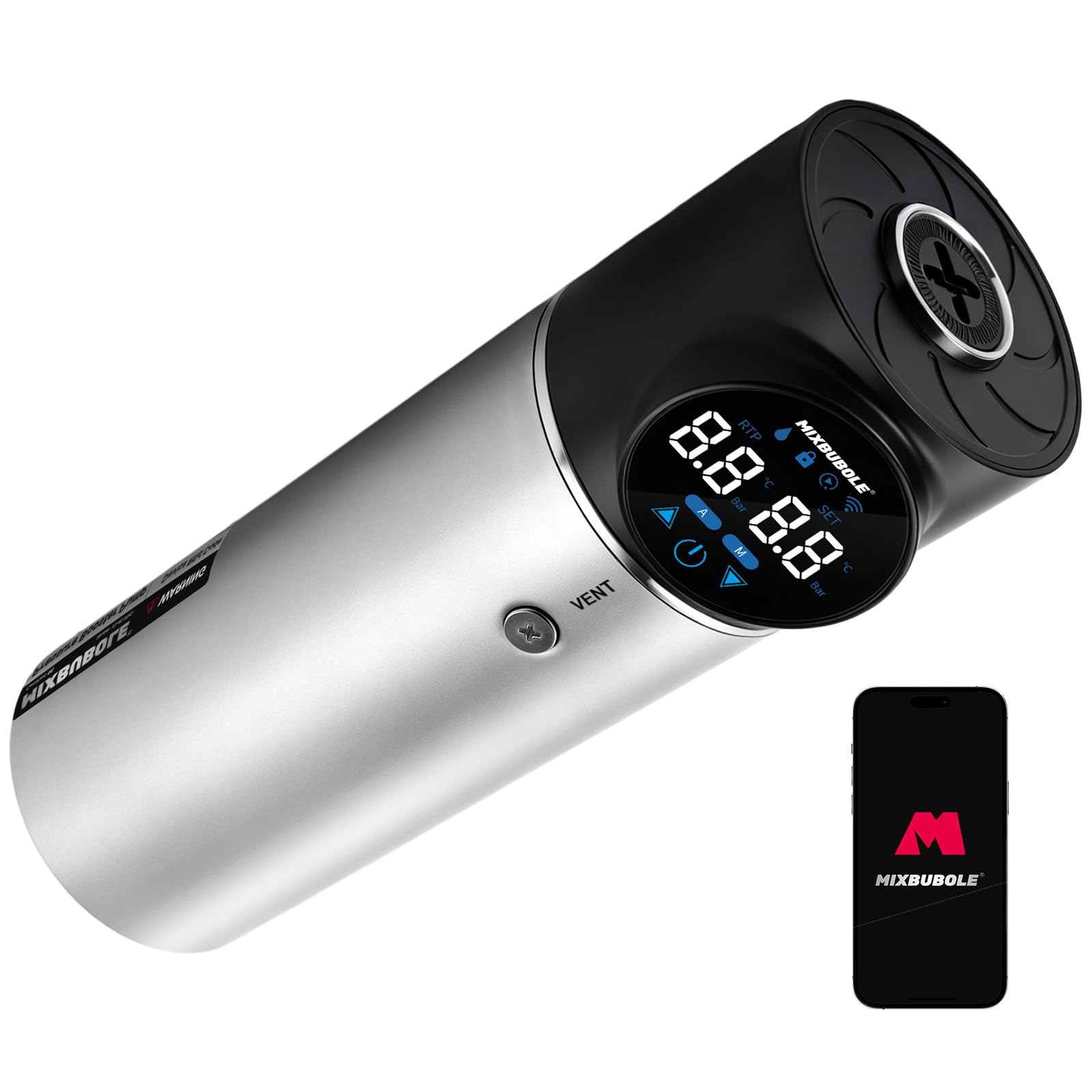
Slips into the narrowest crawlspace and still pushes water two floors up
The number that sells this MixBubole is its footprint: 11 inches long with a 1-inch inlet and outlet sharing one axis, so it needs no dedicated pump room at all. Even rarer, it runs on a wireless app you can reach from anywhere, which is a genuine help when the pump sits in a spot you cannot easily crouch into. Behind that compact body sits real power — a 1.35 hp motor with 180 feet of maximum head and an adjustable range of 1 to 6 bar, or 15 to 90 PSI. That head beats the Lanchez by 30 feet, so tall homes and roof tanks are well within reach. Flow is a strong 27 gpm.
Quiet is engineered in, not promised: instead of a noisy cooling fan it uses water flowing over the motor housing, holding noise near 30 decibels. The stainless shell and a 304 stainless interior resist the cloudy-water problem cast-iron pumps can bring. Owners who have installed it describe setup as straightforward, with clear instructions and helpful videos, and several round it up against the premium-name pumps they used before — plenty of pressure for a fraction of the fuss.
The app is not optional flavor, it is your maintenance dashboard. Firmware updates arrive over the air, and if a fault code appears you are expected to push the latest MCU firmware through the app, so this pump asks you to stay a little tech-savvy. At 1.35 hp it is not the biggest unit here — the 1.5 hp Gwanzi tops it on head — but for tight spaces the small footprint is the deciding trade.
Large homes: your install spot is cramped, your house is tall, and you want app-level control without a pump room.
Small cabins: you would rather never touch a smartphone to troubleshoot your plumbing.
8. 80 PSI 115V Whole House Water Pressure Booster Pump
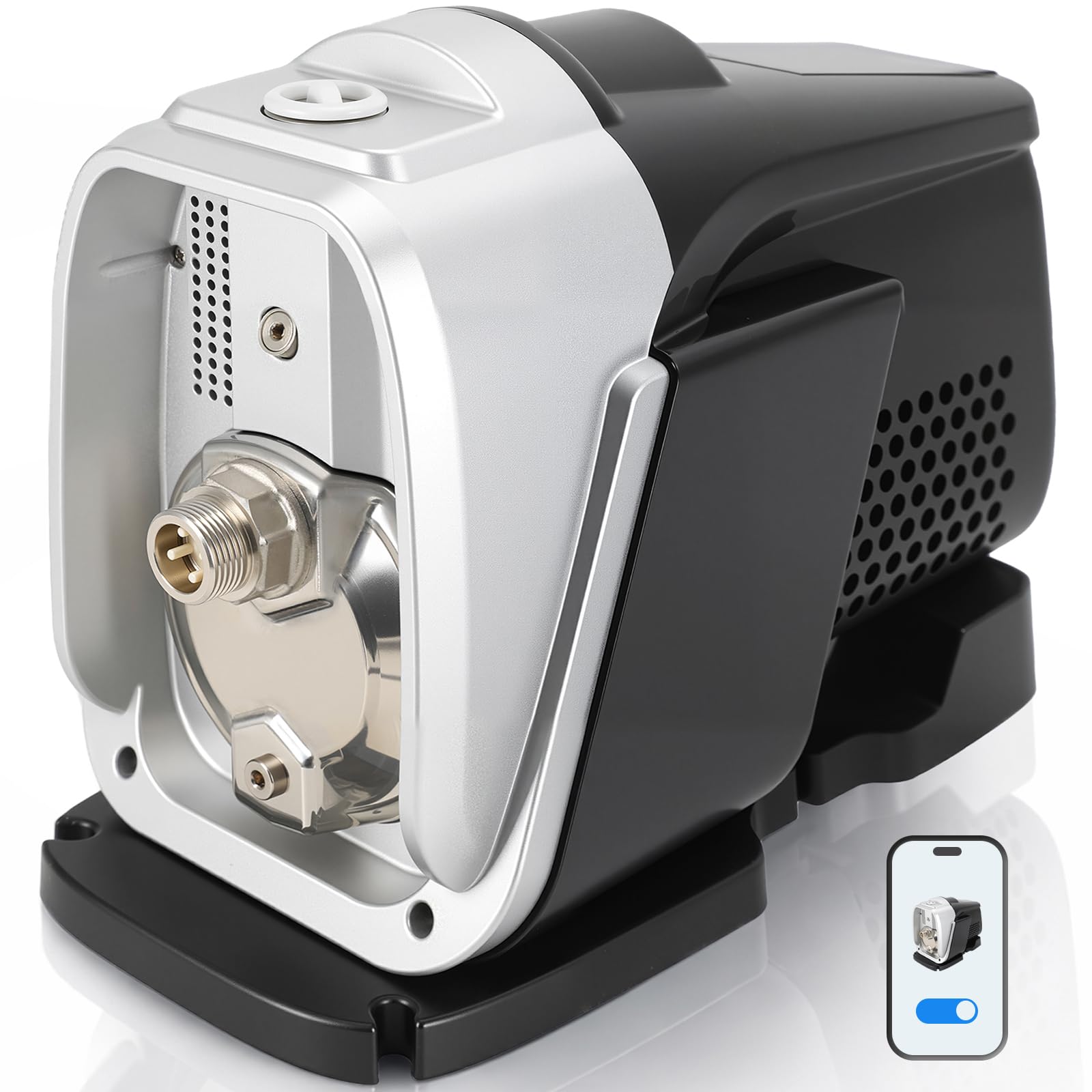
A plug-in booster for the tap that never quite had enough push
This Czobloik pump keeps the job simple: it is a self-priming booster with a built-in control panel for adjusting pressure to suit your home, aimed at standard systems where showers, faucets, and a washing machine could all use a nudge. There is no separate tank and no app to learn — the compact integrated body is meant to slot into a utility area or an indoor pump corner and just work. Owners describe the build as solid and the run as smooth and reliable.
The self-priming design is the practical win, because it draws water efficiently on startup and supports steadier flow through the house. Owners mention it fixing weak pressure up to an upstairs shower and giving garden irrigation a longer, more even reach. Installation is simple enough that reviews describe it going in without drama, running quietly, and being worth it for anyone fighting low pressure.
The caveat is scale: this is a straightforward booster, not a high-head variable-speed unit, so it suits standard residential plumbing and shallow-well or water-tank setups rather than a deep or sprawling system. Its specifications sheet lists no flow rate or maximum lift, so if you need to feed ten outlets across three floors, look to the Gwanzi or the FCNP above instead. For a single weak-pressure complaint in a normal house, it does the one job cleanly.
Standard homes: a standard home with weak incoming pressure that wants a quiet, no-frills booster with adjustable output.
Variable pressure: deep wells or long multi-floor runs that need a published flow and head figure before you buy.
9. 1.5HP Whole House Water Pressure Booster Pump 90PSI 115V Automatic Variable Speed Penmanent Mangnet Motor Constant Pressure Wireless App Control Compact Design for Home House Villa Apartmen
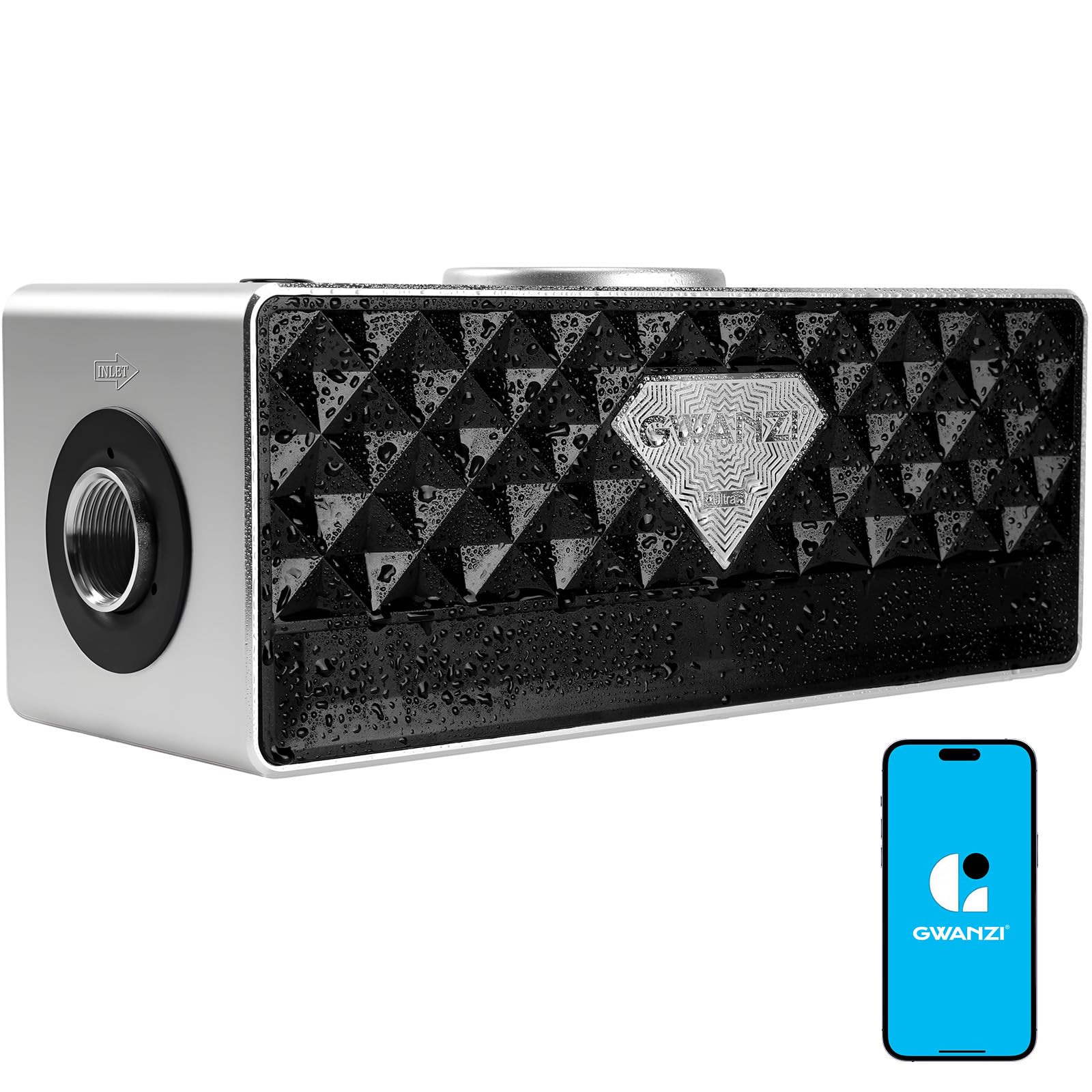
The strongest lift here — 200 feet of head and the biggest flow on the list
If your problem is height and volume at the same time, this Gwanzi tops the chart on both. It pairs a 1.5 hp motor with 30 gpm of flow — the highest here — and 200 feet of maximum head, the furthest lift of any pump in this lineup. The 1.35 hp MixBubole above reaches 180 feet, so this adds another 20 feet of climb for a tall home or a rooftop tank. Adjustable pressure runs the same 1 to 6 bar range as the MixBubole, or 15 to 90 PSI, and the max flow is stated at 1,800 GPH.
It uses the same water-cooling trick as the MixBubole to keep noise near 30 decibels instead of a fan’s whine, and the stainless shell wraps a 304 stainless interior for cleaner-feeling water. The SmartFarintl app gives you the operating status from your phone and pushes firmware updates over the air. A working plumber who has ordered several calls it a cool add-on to the catchment-filter systems common where he lives. Owners also note it holds pressure without juddering at low flow, a real quality-of-life detail.
The honest catch is the install itself. This is not a plug-in-and-go job: the wiring and plumbing are enough that one owner needed professional help and a new breaker and outlet, even though it saved money over guessing. And at 1.5 hp it costs the most of the three compact variable-speed units, so if your house is short and simple, the money is better spent on the jet pumps further up. Bring in a plumber if you are not confident with PEX clamps, sealing tape, and a dedicated circuit.
1.5HP power: a working plumber rates it among his go-to units for rain-catchment homes, which says more about real reliability than a spec sheet ever could.
Overkill for small: the plumbing and dedicated wiring ask for real prep — budget for a breaker, an outlet, and possibly a pro, and factor that into the decision before the box arrives.
High demand: tall houses and roof-tank systems that need the deepest lift and highest flow on tap, with app monitoring as a bonus.
Low usage: your run is short and low — the entry jet pumps deliver what you need for far less plumbing effort.
Understanding the Specs
Flow Rate (GPM)
Flow rate is the volume of water the pump moves each minute, written in gallons per minute. Reading it tells you how many outlets can run at once before a tap starts to feel weak. A pump moving 30 gpm has far more headroom than one at 18 gpm, but the tank and pipe size still cap what the house actually sees at the tap. Match this number to how many fixtures you run together, and remember that a bigger number is not always better — it is always paired with head.
Maximum Head (Feet)
Maximum head is the highest the pump can push water straight up, given in feet. It answers one question: can this pump reach my top-floor shower and still hold pressure? A unit rated around 130 feet handles a modest home, while 164 to 200 feet is what you want for tall houses or roof tanks. Undersize the head and no amount of horsepower rescues the weak upstairs tap, because gravity and pipe friction eat the lift before the water arrives.
FAQ
What does automatic actually mean on a water pressure pump?
How high can these pumps lift water for an upstairs bathroom?
Do I need a pressure tank with a booster pump?
Why do I have to prime a jet pump before first use?
Is a variable-speed booster better than a fixed-speed jet pump?
Can a booster pump raise pressure if my well is shallow?
Will these pumps work with garden sprinklers and hoses?
How loud are these pumps in a house?
What maintenance does an automatic water pump need?
Final Thoughts: The Verdict
For most people, the automatic water pressure pump for a home winner is the Lanchez 1.6HP Shallow Well Jet Pump because it blends a 23 gpm flow, 150 feet of head, a built-in 5-gallon tank, and a 4.3 rating across 400+ owners — more proven than any other pick that also moves serious water. If you want constant pressure and near-silent operation, grab the FCNP PM750S. And for tall houses that need the deepest lift, the Gwanzi 800ULTRA is the one to reach for, with 200 feet of head and the biggest flow on the list. Whichever you pick, prime it before the first start, seal the threads, and size the head to your topmost tap — get those right and the weak-shower problem ends for good.
How We Picked
We do not accept paid placement. Every pick is matched to a real buyer and a real use-case; we do not hands-on test units.
Sources & Methodology
Specifications: manufacturer listings and product documentation. Review insights: verified customer reviews, as of September 2026. Pricing: not shown on this page (it changes often); check the current price via the retailer link.
As an Amazon Associate, KitchPrep earns from qualifying purchases. This does not affect which products we feature.
Related Guides
