
Specs are compiled from manufacturer listings and verified buyer reviews and can change over time — please confirm the key details on the product page before buying.
A dull knife is the real reason dinner takes an hour longer than it should. You press harder, the tomato squashes, and you wonder whether hand-sharpening is worth the hassle. It usually is not — and that is where a motorized sharpener earns its spot on the counter. The picks below run diamond abrasives (tiny industrial diamonds that grind the edge) or flexible belts (sanding strips that move like a treadmill) through a guided slot, so the machine holds the angle and you just draw the blade through. Some finish a whole knife in about a minute; others give you adjustable angle control and seven speed settings for serious edge work. The list covers the budget end, the mid-range balance, and a couple of premium benchtop systems, so you can match the tool to your knives and your patience level.
I’m Mohammad Maruf — the founder and writer behind KitchPrep. This guide is built by comparing the manufacturers’ published specifications and the patterns across verified customer reviews, so you get each pick’s real strengths and trade-offs instead of marketing spin.
What separates a good buy from a countertop ornament is whether the machine suits the knives you already own. Steel type (the metal your blade is made of), edge angle (how steeply the blade tapers to the cutting edge), and how often you actually cook all decide which of these is worth your kitchen space. The breakdown below covers every one of those factors so you can pick the right auto knife sharpener on the first try.
Our Picks at a Glance


How To Choose The Best Auto Knife Sharpener
You do not need the fanciest machine on the shelf — you need one that matches your steel, your blade angles, and how often you actually cook. Three things decide that: the abrasive material, the number of sharpening stages, and whether the angle guides match the knives you own.
Match the abrasive to your blade material
Diamond abrasives are the hardest cutting surface used in home sharpeners, which is why they keep grinding effectively instead of glazing over. They handle steel and ceramic blades alike, while stone-style wheels tend to wear into a groove over repeated use. If you own ceramic knives, a diamond setup is close to mandatory — most stone wheels simply cannot cut ceramic cleanly. Four of the nine picks here run 100-percent diamond abrasives for exactly that reason.
Count your stages before you buy
A two-stage machine does two jobs: it grinds a new edge and then hones it. A three-stage machine adds a polishing or stropping pass that smooths the burr (the thin flap of metal left behind after grinding) into a cleaner finish. For most home cooks a two-stage unit is plenty. If you sharpen serrated or ceramic blades, though, the third stage starts earning its counter space because it can prolong the life of serrations rather than chewing them flat.
Angle guides save your knives
The single biggest cause of ruined edges is holding the blade at the wrong angle against the wheel. Precision angle guides solve that by fixing the blade in the correct position for you. Some machines lock a 20-degree edge — the standard German and American factory angle. Others convert that 20-degree edge down to a thinner 15-degree edge, which cuts more easily but needs a little more care on bone and frozen food. Know which knives you own before choosing: Japanese blades usually arrive at 15 degrees, most Western kitchen knives at 20.
Quick Comparison
| Model | Best For | Stages | Item Weight | Abrasive | Amazon |
|---|---|---|---|---|---|
| Chef’sChoice 15XV Professional★ Best Overall | All-round kitchen workhorse | 3-Stage EdgeSelect | 5 pounds | 100% Diamond | Amazon |
| Narcissus S867-2Best Value | Fast touch-ups on a budget | Dual slot (crude + fine) | 1.7 pounds | Diamond | Amazon |
| Presto 08800 EverSharpTop Performer | Beginners sharpening every knife they own | 2-Stage | 3 pounds | Sapphirite wheels | Amazon |
| VIDOME Professional 3-Stage | Converting 20-degree knives to 15-degree | 3-Stage | — | 100% Diamond | Amazon |
| Homly Professional Electric | Mixed knife blocks including serrated | 3-Stage EdgeSelect | 3 pounds | Diamond | Amazon |
| Chef’sChoice UltraHone 2-Stage | Keeping 20-degree edges sharp at home | 2-Stage | 16 ounces | 100% Diamond | Amazon |
| Work Sharp Ken Onion Mk.2 | Adaptable belt sharpening for the whole house | Flexible belt (speed control) | 2 pounds | Abrasive belts | Amazon |
| Wusthof Easy Edge | Owners of Wusthof knife sets | 3 Pre-programmed modes | 2 pounds | Replaceable belts | Amazon |
| Work Sharp Ken Onion Elite Mk.2 | Blade enthusiasts wanting full angle control | Belt + Blade Grinding Attachment | 2.1 pounds | Abrasive belts | Amazon |
In‑Depth Reviews
1. Chef’sChoice 15XV Professional Electric Knife Sharpener with Durable Metal Housing & 100-Percent Diamond Abrasives and Precision Angle Guides for Straight Edge and Serrated Knives, 3-Stage, Metallic
Our pick — over 4.5★ from 900+ verified ratings; the strongest balance of quality and price.
The three-stage diamond machine that turns a neglected kitchen drawer back into working knives
If your knife block has been quietly disappointing you for years, this is the pick that fixes it. The 15XV runs three stages: the first two carry 100-percent diamond abrasives that cut a fresh edge, and the third uses a patented flexible abrasive system that polishes and helps prolong the life of serrated knives. What that means in practice is you draw a blade through a couple of times and a dull edge that squashed tomatoes last week slices clean again. First-time sharpening takes roughly a minute; touching that edge back up afterward takes about 10 seconds, which is the part that keeps you actually doing it instead of putting it off.
The numbers here are the reason it sits at the top. The body is brushed metal, so it will not flex under a heavy-handed stroke, and the flexible spring guides handle the angle for you so you are not guessing. At 5 pounds and 12″ long, it takes noticeably more bench space than the 1.7-pound, 8.2″ Narcissus. That 5-pound heft is the trade-off and the point: it stays put under a firm stroke. Noise lands between 65 dB and 75 dB, roughly the volume of a normal conversation pushed a notch louder.
What wins owners over is the raw grinding power on genuinely abused blades. Buyers report a three-stage diamond run restoring a 4-year-old kitchen knife in 5 minutes, with a totally blunt butcher knife taking about 30 minutes. Owners also warn against leaning hard on the blade — let the machine do the work and practice on cheap knives first. A recurring note is that a heavy edge nick will not vanish entirely, just improve dramatically. There is also a small labeling quirk: some units arrive with a serial that reads “Model 15” instead of “15XV,” which Chef’sChoice confirms is correct for this sharpener.
Where this one leads the pack
- Three stages of 100-percent diamond abrasives handle straight and serrated blades alike
- Converts traditional 20-degree factory edges down to a thinner, easier-cutting 15-degree Trizor XV edge
- Flexible spring guides set the angle automatically — no hand-eye guesswork
- Brushed metal housing and 5-pound heft stay stable under a firm stroke
- About 1 minute for a first sharpening, roughly 10 seconds to touch up
Worth knowing before you commit
- The heaviest and longest unit here at 5 pounds and 12 inches — it wants a permanent counter or shelf spot
- Runs between 65 dB and 75 dB, so it is audible while working
- A deeply nicked edge improves substantially rather than coming back perfect
Reach for this if: you own a mixed drawer of straight and serrated kitchen knives and want one machine that covers the lot.
Look elsewhere if: counter space is tight — the compact Narcissus takes a fraction of the footprint.
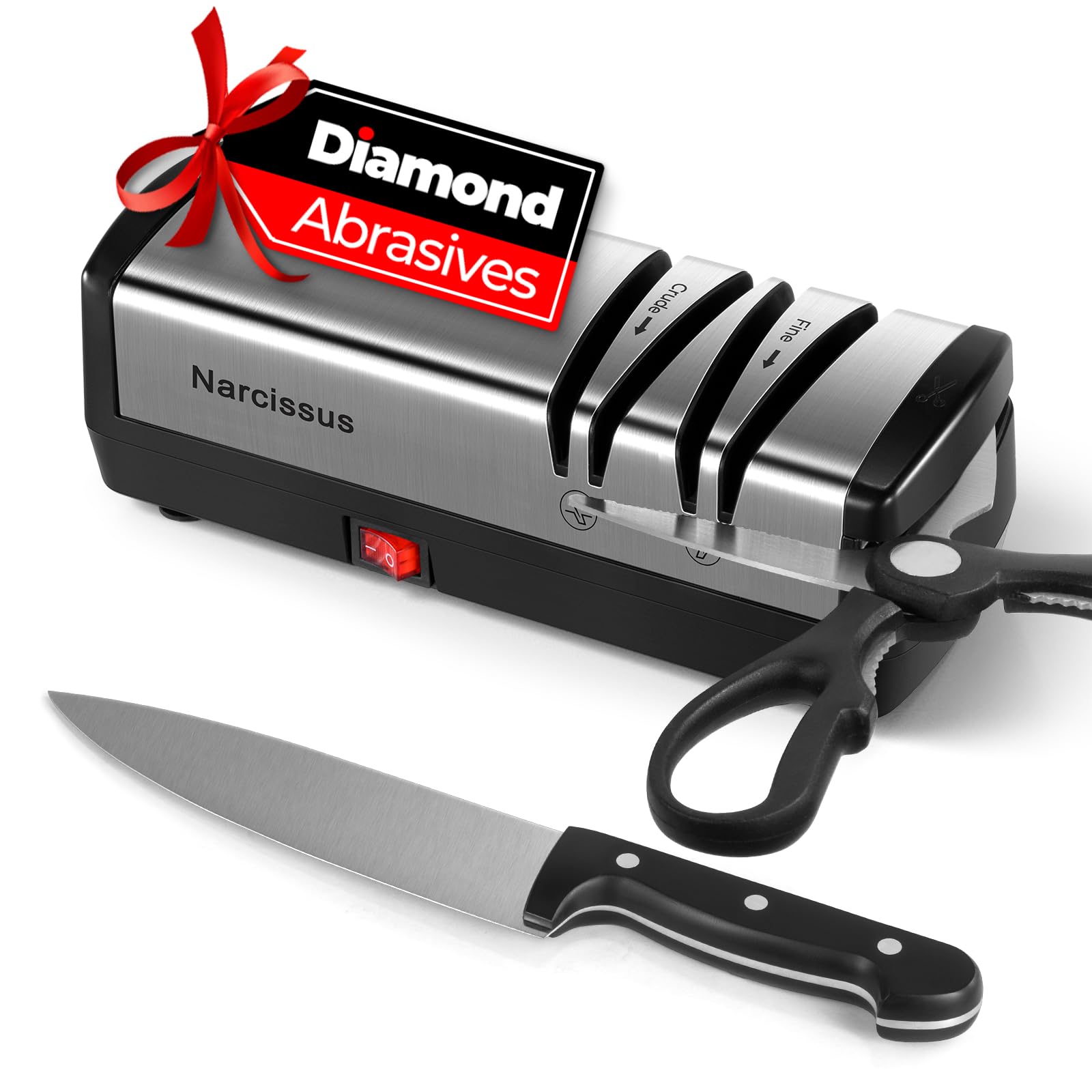
2. Narcissus Knife Sharpener, Diamond Abrasives Electric Knife Sharpener for Stainless Steel and Ceramic Knives, with Scissors Sharpener & Metal Dust Collection Box, Quick Sharpening & Polishing, Silver
A 1.7-pound countertop helper that handles knives and scissors without hogging space
Small kitchens and shared drawers get the most from this one. The Narcissus S867-2 squeezes a dual sharpening system into a body that measures 8.2″ long and 2.9″ wide, so it slides into a cabinet when you are done. The crude slot rapidly sharpens a dull blade and the fine slot polishes the edge to a burr-free finish — burr being the thin flap of metal left behind after grinding. It also takes scissors, which most sharpeners in this class simply will not.
Two specs carry this machine: the 30-watt DC motor and the 100-240V wide voltage design. Its 100-240V design runs on power systems worldwide, useful if you move often or travel with it. Four anti-slip foot pads and a lower center of gravity keep vibration down while you draw the blade from outside to inside, two to five passes per slot.
The recurring gripe is noise — this is not a quiet machine — and aggressive grinding on very thin blades, so keep light pressure on delicate knives. What owners consistently rate highly is the sheer speed of revival on old, dull steel and the metal dust collection box, which keeps the counter clean instead of dusted grey. Owners mention it handles knives and scissors well but needs a bit of force on heavy-duty clipper-type scissors. As owners put it: “It is not as good as my sharpener, but for the price it’s great.”
Small-footprint logic: if your sharpener has to earn its space every single time, the 8.2″ body and 1.7-pound weight make this the easiest one to live with.
One honest catch: the noise level and the aggressive bite on thin blades mean you should not treat it as a gentle polisher for delicate knives.
Suits you if: you want knives, scissors, and ceramic blades handled by one compact unit that fits in a drawer.
Give it a pass if: you sharpen expensive thin-bladed knives and want a softer touch.
3. Presto 08800 EverSharp Electric Knife Sharpener
The two-slot workhorse that has quietly sharpened thousands of kitchen drawers
This is the sharpener for anyone who has never owned one and does not want a learning curve. Two slots, one switch, no angle decisions. Stage 1 grinds a precisely angled edge and Stage 2 hones and polishes it, and the precision blade guides hold the knife at the correct angle so you cannot really get it wrong. Draw the blade through each slot a few times and you are finished.
The wheels are the interesting part: Sapphirite, described as the same ultra-hard material used in professional sharpening shops. That is why a machine this simple still cuts a genuinely keen edge rather than just roughing one up. Set-up takes about 2 minutes and a dull knife comes back in 1 to 2 minutes. It is a compact, lightweight unit at 3 pounds and 9.9″ long, so it sits on a counter without demanding a permanent spot. It runs on 120 volts and is built to North American electrical standards.
The honest limitation is edge geometry. This one is built around a fixed angle rather than a convertible one, and it is meant for non-serrated blades. One knife collector ran a set of 13- to 14-year-old Cuisinart knives and a Benchmade through it and found only minimal improvement — and the Benchmade actually came out worse. That is a fit mismatch, not a defect: this machine suits neglected everyday kitchen knives, not specialty or high-end blade steel. On those everyday knives, the results are remarkable — a heavy-use edge holding 6-plus months with only two sharpenings, still going strong at 4 years.
Beginner-proof by design: the two-slot layout removes every angle decision, which is exactly why it works so well for people who have never sharpened anything before.
The fit limit: treat it as an everyday kitchen-knife tool, not a precision instrument for collector blades.
Made for: homes with an ordinary drawer of steel kitchen knives that need regular, no-fuss reviving.
Not the one for: high-end collector knives where a fixed non-serrated angle is the wrong match.
4. VIDOME Professional 3-Stage Electric Knife Sharpener
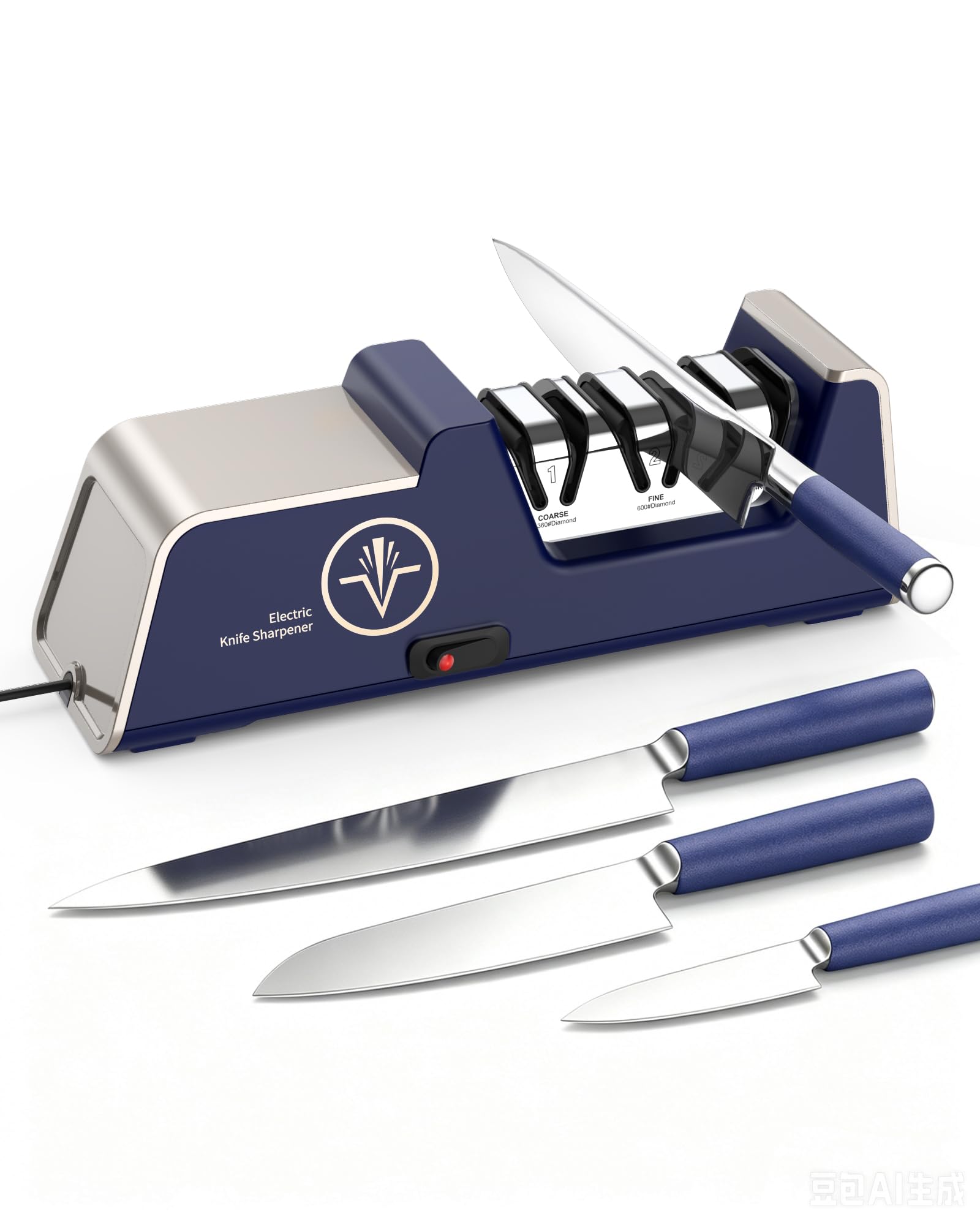
Three diamond stages that take a 20-degree Western blade down to a finer 15-degree cutter
If your knives came with the standard German 20-degree factory edge and you have always wondered why they feel slightly sticky through an onion, this is the machine that changes that. Stages 1 and 2 use 100-percent diamond abrasives to sharpen and hone, while Stage 3 runs safe stropping disks to polish the blade. It applies an ultra-sharp 15-degree edge directly, and it converts existing 20-degree knives down to that finer angle for noticeably easier cutting.
The mechanics are worth understanding because they explain the results. Flexible spring guides hold the blade at the correct angle through the full stroke, which produces an arch-shaped edge along the entire length of the blade rather than just near the heel. An elastic, constant-force design keeps the pressure uniform, and each blade rides a safety guide track that protects the surface from scratches. A German-imported motor drives it, described as strong but more energy efficient. First-time sharpening takes roughly 30 seconds; resharpening drops to about 10 seconds, with 4-8 seconds for metal knives and 6-10 seconds for ceramic. Noise sits between 60 dB and 80 dB.
It converts skeptics on speed: a dull steel knife back to near-razor sharp in about 60 seconds. Ceramic chef’s knives respond well too, though short ceramic paring knives are less effective. It also outperforms more than one Chef’sChoice model on effort — sharper edges in a few strokes per side rather than a full service run. One thing to watch: on long chef’s knives the handle can contact the frame in the outer slots, and the motor feels modest on some units, so read the directions and do not rush the blade.
Why the angle matters: a 15-degree edge glides through tomatoes and onions more easily than a 20-degree one, which is the practical reason to convert.
Honest note: the handle interference on long blades means technique matters more here than on a fixed-slot machine.
Pick this when: you want to push your kitchen knives from a factory 20-degree edge into a thinner, easier-cutting 15-degree one.
Think twice if: your knives are very long chef’s blades and you want a hands-free stroke.
5. Homly Professional Electric Knife Sharpeners for Kitchen Knives with Diamond Abrasives and Precision Angle Guides, Multifunctional 3-Stage Slots, Applicable to Straight Knife and Ceramic Knife

Three stages built to handle everything from a Santoku to a pocket knife from one slot set
Mixed knife collections are the ones that benefit most here. A wide compatibility list covers chef knives, slicing knives, ham knives, Santoku knives, fruit knives, boneless knives, butcher knives, fish slice knives and pocket knives. Stages 1 and 2 use 100-percent diamond abrasives to sharpen and hone, and Stage 3 polishes and finishes the blade. For the money, that is three jobs from one machine — which is why it sits in the mid-range rather than the budget pile.
The safety engineering is the standout. A flexible spring guide rod keeps the blade at the ideal angle through the stroke, producing a more durable arch edge along the full blade length, and the shell gets a double-layer treatment of paint and electroplating. It is rated at 120 volts with a 2-year manufacturer warranty and lifetime customer service within 15 hours. At 12.2″ long and 3 pounds, it is stable on the counter without being barge-like. Noise reduction is built into the motor design, which matters if your kitchen is open to the living room.
Where owners get the best results is exactly what the specs promise: control. A knife sharpens in under a minute, and the machine handles Cutco, Japanese, and ordinary knives alike. The one caution that repeats is pressure. Pushing too hard without moving the blade can carve a big indent into the steel near the handle, so the technique is steady movement, light contact. A couple of owners found certain knives only slightly improved, while fish fillet knives came out sharper than new, so results track the blade in front of you.
Broadest compatibility: the long compatible-knife list makes this the pick for a drawer holding Japanese, German, and budget knives side by side.
The technique catch: over-pressing without moving the blade can mar the steel near the bolster, so let the motor do the work.
You want this if: your block holds a jumble of blade styles and you want one slot set to cover all of them.
Be careful of: leaning on the blade instead of drawing it smoothly — that is where damage happens.
6. Chef’sChoice Professional Electric Knife Sharpeners UltraHone With 100-Percent Diamond Abrasives And Precision Angle Guides For 20-Degree Straight-Edge and Serrated Knives, 2-Stage, White

The kitchen-drawer-sized 2-stage that restores a 20-degree edge without the guesswork
Not everyone wants a three-stage machine with a polishing pass. The UltraHone keeps it to two stages, with 100-percent diamond abrasives in both, and uses advanced micron-size diamonds in Stage 2 for a finer hone. Precision angle control holds the blade at 20 degrees, which is the standard edge on most Western kitchen, carving, and fillet knives. It sharpens straight-edge and serrated blades to better than factory sharpness, and the whole machine weighs 16 ounces — light enough to pull out, use, and tuck away.
At 16 ounces, it is light enough to pull out and use monthly rather than annually. A sharpener that is easy to retrieve gets used monthly instead of annually, and that upkeep habit is what keeps a kitchen edge keen. The compact 2-stage format also makes it the right tool when you are maintaining an edge rather than rescuing a blade that has been neglected for years. It comes from the same brand as the 15XV above and leans on the same diamond-abrasive philosophy, just in a lighter, single-purpose package.
What buyers consistently praise is the edge itself — enough that a glass-like cutting edge gets mentioned, and the machine is judged more than adequate for ordinary home cooking. It works on kitchen knives, carving knives, fishing fillet knives, and pocketknives equally. There is also a mixed report around blade finish on some units, with a handful of owners noting scratches in use, so a steady hand and a light touch pay off.
Why 20 degrees matters: if your knives came factory-set at 20 degrees, this machine maintains that exact geometry instead of fighting it.
Honest sizing: this is a keeper-of-edges, not a resurrection service for long-abused blades.
Right for you if: your knives are already in decent shape and you want to keep them that way with a light, easy-to-store machine.
Wrong fit if: your drawer is full of badly neglected blades that need a full three-stage reset.
7. Work Sharp Ken Onion Knife Sharpener Tool – Adjustable Knife Sharpening System – For Knives, Scissors, Serrated Blades, & Tools

A belt-driven benchtop system that swaps from kitchen knives to scissors to tools without complaint
This is where sharpening stops being a kitchen chore and starts being a small craft. Instead of fixed slots, the Ken Onion Edition Mk.2 runs flexible abrasive belts with a precision sharpening guide and electronic speed control. It was designed with knife-making legend Ken Onion, and the intent shows in how much control the machine hands you.
Adjustability is the headline feature, and it is what separates this from every slot machine on the list. The angle guide is adjustable, so you can set the bevel to match the blade in front of you rather than accepting whatever angle the slot was cut for. Speed control means you can slow the belt down on thin or expensive steel. It weighs 2 pounds and measures 7.76″ long, compact for a belt machine, and carries a 3-year warranty with each unit designed, engineered, and calibrated at the Oregon facility.
The learning curve is real but short. Your first edge may come out slightly uneven — that evens out with practice, and the machine proves more controllable than a bench grinder for the same job. It handles longer, larger, oddly shaped blades and hard D2 steel to better-than-factory sharpness once you adapt. Do note that the extra-fine purple band mentioned in the manual is not included with the base kit, and the machine is loud and produces dust, and there is no case in the box. Since it draws on the same belt philosophy as the Elite Mk.2 further down, this is the value entry into that system.
The case for belt sharpening
- Adjustable angle guide lets you match the bevel to each individual blade
- Electronic speed control slows the belt down for thin or delicate steel
- Handles kitchen knives, pocket knives, scissors, serrated blades, and tools from one system
- 3-year warranty, designed and calibrated at the Oregon facility
- Compact at 2 pounds and 7.76″ — smaller than most belt machines
Where it asks more of you
- Not a slot machine — you learn the technique, and first edges may come out slightly uneven
- The extra-fine purple band referenced in the manual is not in the base kit
- Loud and dusty in use, and no case ships with it
Best for: the owner with knives, scissors, garden tools, and a few pocket knives who wants one machine that adapts to all of them.
skip it if: you want the fastest possible path from dull to sharp with zero technique required.
8. Wusthof Electric Knife Sharpener – Easy Edge Sharpener for Kitchen Knives – Black

A programmed three-button sharpener built specifically for a Wusthof knife block
Wusthof owners get the most from this one, and not much else comes close for that specific case. Three one-touch pre-programmed modes do the thinking for you. The Shape button handles a knife that is very dull or has damage to repair. The Sharpen button exposes a fresh cutting edge on a monthly schedule. And Refine maintains the edge weekly, so the knife never drifts into useless territory in the first place. No angle decisions, no stage counting — you press the button that matches the situation.
You get a machine that stays useful for years because it uses replaceable sanding belts instead of fixed abrasive wheels that wear into a groove. It is made in the USA with a 3-year warranty. It sits upright at 7″ long, 5″ wide and 4.5″ tall, and weighs 2 pounds. The build is polycarbonate (a tough plastic), and the whole package is a small, tidy presence on a counter — much easier to leave out permanently than a belt machine with exposed moving parts.
The honest note is a learning curve. It handles Wusthof, Chicago Cutlery, and even serrated bread knives better than a V-style pull-through. One practical catch: Asian-style knives need separate “Asian” guides because their edge angles differ, so this is not the universal answer for a mixed global knife set. Some owners still rank it as a must-have for Wusthof-specific care.
Built for one brand: the three programmed modes are tuned around Wusthof knife geometry, so those owners get the smoothest experience.
Not universal: a mixed drawer with Japanese blades will need additional guides this machine does not include.
Best match for you if: your kitchen is a Wusthof household and you want programmed monthly and weekly upkeep.
Skip if: your collection is a global mix — the lack of a universal angle guide leaves gaps.
9. Work Sharp Ken Onion Edition Knife & Tool Sharpener Elite Mk2 – Adjustable Knife Sharpening System with Blade Grinding Attachment

Two sharpening systems in one benchtop rig, for people who treat edges as a hobby
Blade enthusiasts ask for a machine that will let them control the grind, and this is the one on the list that answers that directly. The Elite Mk.2 is a benchtop system with two ways to sharpen built in. The Sharpening Guide Cassette delivers precise, repeatable sharpenings on knives, scissors, and tools. The Blade Grinding Attachment adds larger belts, a wider range of angles, and edge profile control for custom work. You can switch between the two modes without tools or a long setup.
Control is where this earns its premium position. The adjustable angle guide spans 15 to 30 degrees, and 15 is the ideal setting for double-bevel Japanese blades. A 7-speed motor prevents overheating thin steel, which matters on high-hardness Japanese knives that lose their temper when a belt runs too fast. The extra-fine belt lays down a mirror polish, and flexible belts naturally create a convex edge — a slightly rounded bevel that tends to hold its bite longer than a flat one. It weighs 2.1 pounds and runs at 7″L x 11.25″W x 6.5″H.
Compare this to the Ken Onion Mk.2 above and the upgrade is clear: same adjustable-angle philosophy, but with an extra grinding attachment and a wider working range for custom profiles rather than just maintenance. The honest catch is that speed cuts both ways. The machine removes material fast, so careless pressure will eat a blade quickly — use the lightest touch you can with a slow, steady draw. It is also loud in use and produces dust, and there is no case included. Once you learn it, though, hair-whittling edges become a routine result rather than an event.
Why blade nerds want it
- Two sharpening modes — guided cassette for repeatability, grinding attachment for custom profiles
- Adjustable 15 to 30 degree angle guide covers Western and Japanese edge geometry
- 7-speed motor protects thin steel from overheating
- Extra-fine belt delivers a mirror polish; flexible belts build a convex edge with good edge retention
- Mode changes without tools or complicated setup
Before you commit
- The belt removes material quickly — careless pressure can damage a blade
- Loud and dusty in use, and no storage case is included
- Earns its place in a serious kitchen or workshop, not a casual one
Made for: the cook or hobbyist with high-end Japanese steel, folding knives, and tools who wants full control over angle and profile.
A mismatch if: you just want a simple slot machine for an everyday knife block.
Understanding the Specs
Stage Count: 2 vs 3
A stage is one operation the machine performs. A two-stage sharpener grinds a fresh angled edge and then hones it — a two-step cycle that suits most home crowds. A three-stage sharpener adds a polishing or stropping pass that smooths the burr (the thin flap of metal left at the cutting edge) into a cleaner, more even finish. Three stages usually means a longer-lived, more consistent edge on difficult blades, including ceramic and serrated knives. Two stages usually means a smaller, lower-cost, simpler machine.
Edge Angle: 15 vs 20 Degrees
The edge angle is the measure of how thin the cutting bevel is. Most Western kitchen knives leave the factory around 20 degrees, which is durable and forgiving. Japanese knives typically arrive at 15 degrees, which cuts with less effort but needs slightly more care. Some machines here can convert a 20-degree knife down to 15 degrees, which is the main reason someone would choose them over a fixed-angle unit. If your knives are all Western and you are happy with them, a 20-degree machine covers your needs fine.
FAQ
Will an electric sharpener work on serrated bread knives?
Can an electric sharpener handle ceramic knives?
Is a belt sharpener better than a slot sharpener?
How long does an automatic knife sharpener last?
Can I sharpen a Japanese knife on a 20-degree machine?
Why does the blade need to be pulled through in only one direction?
Is the motor strong enough to sharpen a whole knife block in one sitting?
Do expensive knives need a different sharpener than cheap ones?
How often should I run my knives through the sharpener?
What does converting a 20-degree edge to 15 degrees actually do?
Final Thoughts: The Verdict
The auto knife sharpener worth starting with is the Chef’sChoice 15XV. It is the only pick here with three diamond stages, 15-degree conversion, straight and serrated support, and a 5-pound metal body that stays put mid-stroke. If you want that same diamond philosophy in a compact size for less counter drag, the Narcissus S867-2 at 1.7 pounds is the easy second look. And for anyone with a mixed drawer of folding knives, garden tools, and kitchen blades, the adjustable-angle Work Sharp Ken Onion Mk.2 gives you belt-format control that no slot machine can match.
How We Picked
We do not accept paid placement. Every pick is matched to a real buyer and a real use-case; we do not hands-on test units.
Sources & Methodology
Specifications: manufacturer listings and product documentation. Review insights: verified customer reviews, as of September 2026. Pricing: not shown on this page (it changes often); check the current price via the retailer link.
As an Amazon Associate, KitchPrep earns from qualifying purchases. This does not affect which products we feature.
Related Guides
