
Specs are compiled from manufacturer listings and verified buyer reviews and can change over time — please confirm the key details on the product page before buying.
If you want to catch rainwater or store a big reserve for your garden, the pick worth buying is the one that holds its shape when full and seals at the fittings — not the one with the biggest number on the box. A flexible 200 gallon water tank works differently from the rigid wooden or plastic barrel your neighbor owns. It ships folded into a box the size of a duffel bag, then stands up as a cylinder once you fill it, so it stores flat in winter instead of sitting empty on the patio. The trade-off is that everything depends on the seams, the valves, and how the walls behave under weight. Seams, valves, and wall stiffness decide whether a fabric tank stays dry all season or drips from the first fill. One note before we start: these picks use close matching, so the nearest same-type size stands in for an exact 200 gallon tank. A 265 gallon version does the same job, just with more water in it.
I’m Mohammad Maruf — the founder and writer behind KitchPrep. This guide is built by comparing the manufacturers’ published specifications and the patterns across verified customer reviews, so you get each pick’s real strengths and trade-offs instead of marketing spin.
The three tanks below split by build and use case: fabric barrel with legs, high-capacity PVC reservoir, and a fold-flat portable. Read on for the 200 gallon water tank picks that hold their shape and stay sealed outdoors.
Our Picks at a Glance
How To Choose The Best 200 Gallon Water Tank
A flexible tank is basically a heavy-duty bag that holds its shape under the weight of water. That means the material, the legs, and the valves matter far more than they would on a rigid barrel. Fabric weight, leg count, and fitting quality decide whether a soft tank lasts years or leaks within weeks.
Look at the fabric weight and coating first
Thin single-layer PVC punctures and fades fast. A tank built from 1000-denier Oxford fabric — that is a tightly woven, heavy cloth — with a triple-layer PVC coating on top resists UV light and temperature swings far better than a bare plastic bladder. UV resistance matters because the sun breaks down flexible plastic over a season of outdoor use.
Check how the tank holds its shape
A full tank of water pushes outward on every wall. Fiberglass support legs insert into sleeves to keep the walls upright, and more legs mean a more stable cylinder. A tank with no internal frame can bow or sag at the top once filled, which is where overflow and pooling start.
Inspect the fittings, not just the gallon count
Every spigot, valve, and outlet is a potential leak point, so rubber seals and snug threads decide how dry your setup stays. A 3/4-inch brass or plastic tap at the bottom lets gravity do the watering. Recessed quick-release valves can be awkward to reach when tightened fully, so test them before you fill.
Quick Comparison
| Model | Best For | Capacity | Material | Item Weight | Amazon |
|---|---|---|---|---|---|
| Curifurn 200 Gal Collapsible Rain Barrel★ Best Overall | Rainwater collection with a filter | 200 gallons | 1000D Oxford with PVC coating | 6 pounds | Amazon |
| FlexiTank Collapsible Reservoir | Extra-large reserve with marked fill lines | 265 gallons | PVC grade plastic | 17 pounds | Amazon |
| GROW1 Collapsible Reservoir Tank | Portable use and mobile setups | 200 gallons | Polyvinyl Chloride (PVC) | — | Amazon |
In‑Depth Reviews
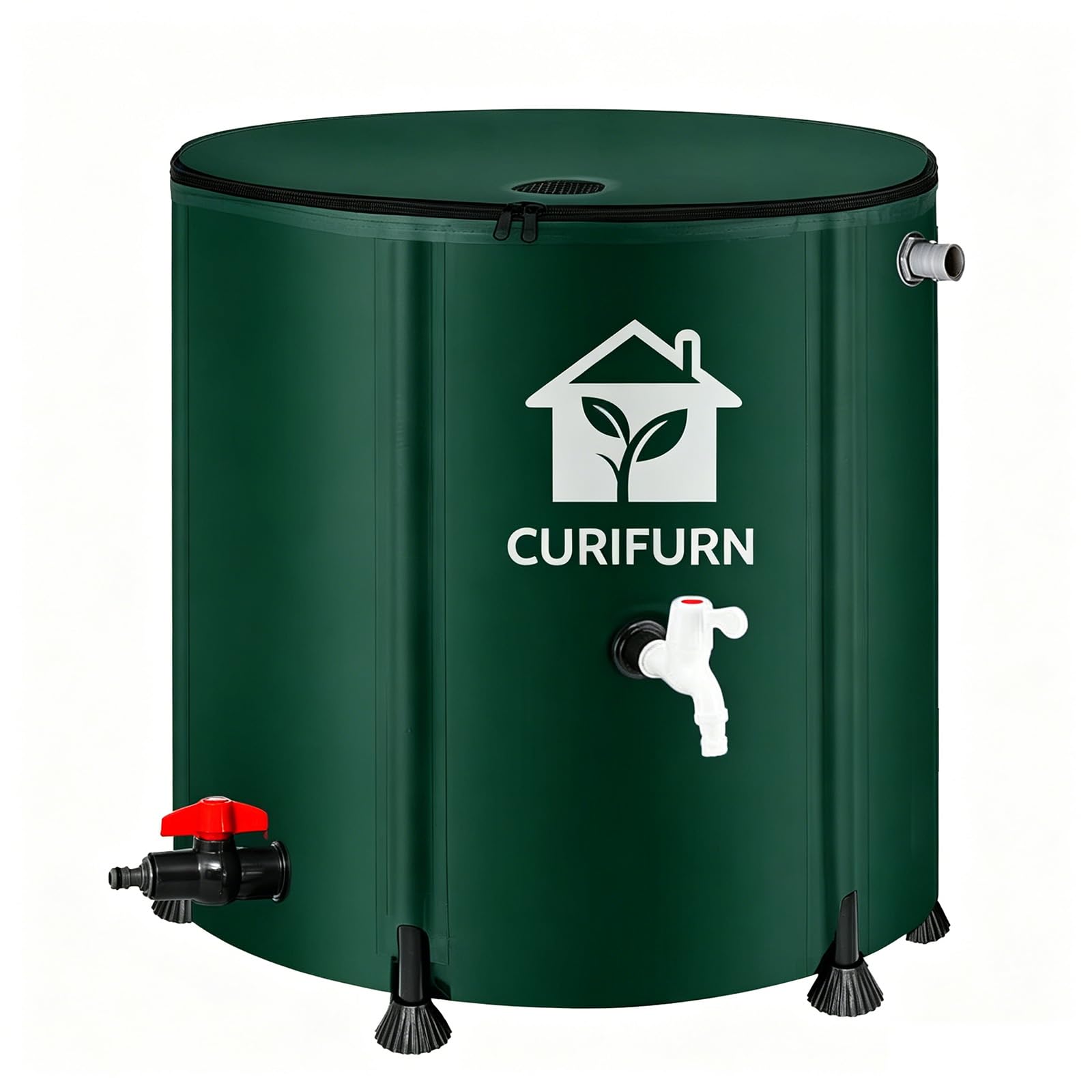
1. Curifurn 200 Gal Collapsible Rain Barrel with Spigot, Filter and Overflow Kit
Our pick — over 4★ from 30+ verified ratings; the strongest balance of quality and price.
The 6-pound fabric barrel that stands up like a rigid tank and folds to a shelf.
Start with the material, because that is what makes this the pick for most gardens. The Curifurn is built from 1000-denier Oxford fabric with a triple-layer PVC coating — a woven cloth shell with three layers of plastic sealing it — making it twice as thick as the earlier version of the same barrel. It keeps its footing through heat and cold too, rated to handle temperatures from -13°F to 113°F. That range covers a hard winter freeze and a hot summer afternoon without the fabric cracking.
Those eight fiberglass support legs are the second half of the story. They slide in to hold the cylinder upright, and there are eight here rather than the six thinner ones on the previous model, which is what keeps the walls from sagging at the top. At 6 pounds it is by far the lightest of the three here — the FlexiTank weighs 17 pounds, nearly three times as much. Its 40″L x 40″W x 40″H footprint is also the widest, which is worth knowing before you pick a spot.
The top mesh grid does double duty. It keeps leaves and debris out of your water and gives overflow somewhere to go. Every faucet and outlet carries a rubber seal, and the bottom connector hooks straight to a hose for gravity watering. What wins people over is the size and steadiness — it sits beside a chicken coop for animal water and plant watering without wobbling, and it collapses for winter storage. The recurring gripe is the hose connection: the snap-lock head does not match standard fittings, so daisy-chaining two barrels together is not straightforward, and the top can bow enough to pool a little water. One reviewer noted the fill fell short of the labeled capacity, so mark your own fill line on the first run rather than trusting the number alone.
Where it earns its keep
- 1000D Oxford fabric with triple-layer PVC coating, twice as thick as the prior model
- Eight fiberglass legs hold the cylinder upright instead of collapsing inward
- Handles -13°F to 113°F, so it stays usable across a full year outdoors
- 6 pounds — 11 pounds lighter than the FlexiTank
- Mesh top keeps leaves and debris out while giving overflow a path
What to plan around
- Snap-lock hose head will not connect to mismatched fittings, so daisy-chaining two barrels is awkward
- Support legs cannot be removed once installed, so it will not fold down quite as small as it shipped
- Top can bow and pool a little water when full
Buy it when: you want an outdoor rainwater barrel with a filter top, a hose hookup, and enough stability to leave in place all season.
Pass on it when: you need to chain multiple tanks into one line or fold the barrel completely flat for the off-season.
2. FlexiTank Collapsible Reservoir Water Tank (265 gallons)
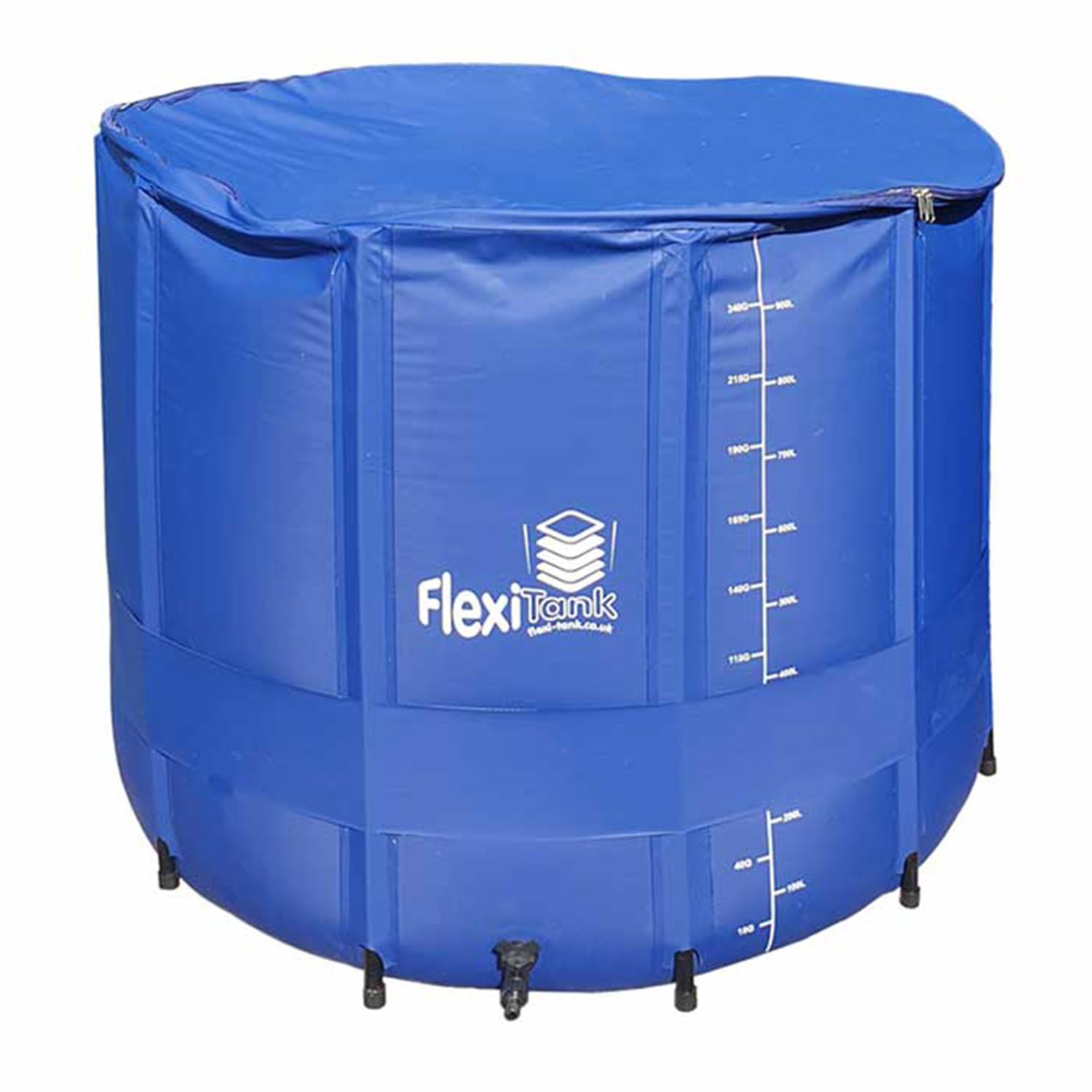
The biggest reservoir here, with marked fill lines you can actually read.
If raw volume is the goal, this 265-gallon reservoir delivers the most water in a single body. The FlexiTank holds 265 gallons against the 200 gallons of the Curifurn and the GROW1 — roughly a third more water in a single body, which matters when you are feeding a large greenhouse and do not want to top up every day. Assembly takes minutes and needs no tools at all, and the exterior is clearly marked with fill lines, so you can gauge how much water you have without guessing or measuring.
The weight difference is the honest caution here. At 17 pounds this tank is nearly three times the heft of the Curifurn’s 6 pounds, even before any water goes in. That extra material is premium-grade PVC plastic, which gives it a durable feel, but a tank this large needs a second set of hands to hold the walls during the first fill. It has to sit on higher ground than whatever it feeds if you want gravity to work, and once it is full you leave it where it stands — it is not meant to be moved with water inside. The included PVC tap comes with two rubber washers for a sealed hookup.
Here is the part that needs a straight answer: the two most-discussed things about this tank are its quality and whether it leaks, and both come back mixed. Setup earns genuine praise and several buyers report months of dry use, but a notable share describe seams weeping at the bottom once the tank is filled past a certain point. Owners mention: “i filled it up to 100 gallons for a couple of days and it was fine and once I filled it up to 160 gallons started to leak in the bottom.” Others point at the bulkhead fittings shipped with the tank as the weak link and swap in their own. One owner found the top has no ring to hold it upright, so it slumped and cracked. Filled to a comfortable level and left in place, it is a lot of water for the money — but budget for better fittings.
Plain verdict: the capacity and the marked fill lines are real advantages, and setup is genuinely tool-free. Nothing else here gives you 265 gallons in one body.
The catch: quality and leakage both come back mixed, with the bulkhead connections named as the usual culprit and the upper capacity range described as the trigger point.
Reach for this if: you run a large greenhouse and want the single biggest reserve with visible fill markings.
Look elsewhere if: you want a set-it-and-leave-it tank — the mixed reports on bulkhead leaks mean this one rewards a bit of tinkering.
3. GROW1 Collapsible Reservoir Water Tank 200 Gallon

The 200-gallon PVC tank built to travel flat and set up without tools.
The GROW1 is the pick if your tank needs to fold flat and travel. Made from long-lasting PVC, it folds flat for transport and compact storage, then stands up in a couple of minutes with no tools required. It carries a 3/4-inch tap, a valve fitting, and a 3/4-inch fill fitting, and the bottom faucet makes watering plants a simple matter of opening the valve. What earns it the strongest praise of the three is its build quality — it is the most-discussed positive in its reviews.
Some owners push it further than a garden. One dropped a fitting on top so the tank could be zipped shut, used it for mobile detailing, and got three car washes out of a single fill. Others park it under a downspout to catch rainwater. That portability is also where it separates from the Curifurn: the GROW1 folds flat and moves, while the Curifurn holds its shape on eight fiberglass legs and stays put. If you shift your setup around, that difference decides it.
The honest limit is durability. The two biggest talking points across its reviews are leakage and long-term wear, and neither reads as a strength. Pinhole leaks can appear after folding, and the bulkhead fittings are a known weak spot. Some owners have fixed early weeping just by drying the washers and greasing them with a non-petroleum grease, and others note the valve flow is slow enough that they swap it out. Worst case, a tank used continuously outdoors has leaked and been returned. Treat this as a dependable indoor or sheltered tank, or one you are willing to re-seal, rather than a forever fixture in the open weather.
Why it stands out: it is the only one here designed to fold flat and travel, and it comes with a 3/4″ tap, valve, and fill fitting from the start.
Be honest about: leakage and durability are its two most-discussed topics, with pinholes after folding and bulkhead fittings as the recurring points.
The short answer: ideal for mobile detailing, sheltered setups, or anyone who needs a tank that packs down and moves.
The trade-off: a full outdoor season is asking a lot — expect to reseal washers and watch the bulkhead fittings.
Understanding the Specs
Capacity in gallons
The gallon figure tells you how much water the tank holds, and it drives everything else — weight, footprint, and stability. A 200-gallon tank is a solid backyard reserve for gardens and animal watering, while a 265-gallon tank stretches longer between fills. Because these are soft-bodied, the labeled capacity is worth verifying once: mark your own fill line on the first run and compare it to the number on the box.
Material, coating, and UV resistance
Flexible tanks live or die by their shell. A 1000-denier Oxford fabric with a triple-layer PVC coating is a woven cloth backed by three plastic layers, which resists sun damage, punctures, and temperature swings. Plain PVC plastic is lighter and folds smaller but tends to develop pinholes where it creases. If the tank sits outdoors all summer, UV resistance is the spec that decides whether it lasts.
Support structure and stability
Water pushes outward hard, so a soft tank needs something to hold its shape. Fiberglass support legs insert into sleeves to keep the walls upright, and the more legs a tank has, the less the top bows when full. A tank with no internal frame can slump at the top, which is where overflow and pooling begin.
Fittings, taps, and leak points
Each spigot, valve, and outlet is a place water can escape. Rubber washers and snug threads do the sealing, and a 3/4-inch tap at the bottom lets gravity do the watering. Bulkhead connections are the most common failure point on soft tanks, so check whether the fittings feel substantial before you commit to a full fill.
FAQ
Do these collapsible water tanks really hold a full 200 gallons?
Will a collapsible tank freeze and crack in winter?
Why does my flexible tank leak at the bottom when it is full?
Do I need to put a collapsible tank on a stand or higher ground?
How long does a PVC collapsible water tank last outdoors?
Can I connect two collapsible water tanks together?
Is a fabric rain barrel better than a rigid plastic or wooden one?
Does the water from these tanks need filtering before I use it on plants?
How much space does a collapsible tank need when it is set up?
Can I use a collapsible water tank for mobile detailing?
Final Thoughts: The Verdict
For most gardens, the winning 200 gallon water tank is the Curifurn 200 Gal Collapsible Rain Barrel — its 1000D Oxford shell with a triple-layer PVC coating, eight fiberglass support legs, and mesh filter top make it the most stable of the three, and at 6 pounds it is the easiest to move and store. If you need the biggest possible reserve for a large greenhouse, the FlexiTank gives you 265 gallons with clear fill markings, provided you are willing to upgrade the bulkhead fittings. And for mobile detailing or a setup that travels, the GROW1 folds flat and sets up without tools, as long as you keep it sheltered and reseal the washers when needed. Whichever you choose, mark your own fill line on the first fill and keep the mesh top on to block leaves and debris.
How We Picked
We do not accept paid placement. Every pick is matched to a real buyer and a real use-case; we do not hands-on test units.
Sources & Methodology
Specifications: manufacturer listings and product documentation. Review insights: verified customer reviews, as of September 2026. Pricing: not shown on this page (it changes often); check the current price via the retailer link.
As an Amazon Associate, KitchPrep earns from qualifying purchases. This does not affect which products we feature.
Related Guides
