
Specs are compiled from manufacturer listings and verified buyer reviews and can change over time — please confirm the key details on the product page before buying.
Your 12-volt landscape lighting only shines as bright as the transformer feeding it. This box converts your home’s 120V power down to a safe 12V for path lights, spotlights, and deck lights, and it handles the automatic on/off timing. Match the wattage to your fixtures with enough room to spare, then pick the timer and sensor features that fit your routine.
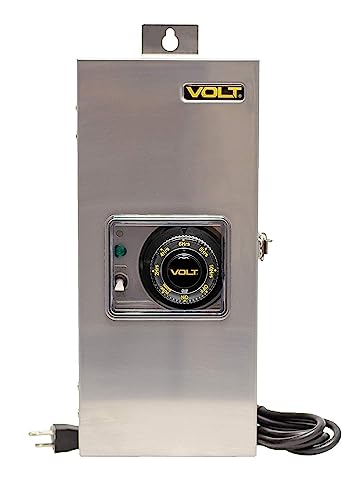
For most yards, the VOLT 300W Slim Line is the one worth buying. It delivers 300W of power, a 15V tap to beat dimming on long runs, and a toroidal core (a donut-shaped transformer that runs cooler and quieter than standard ones) for clean, stable LED operation. It costs more upfront, but you likely will not need another unit for years.
I’m Mohammad Maruf — the founder and writer behind KitchPrep. This guide is built by comparing the manufacturers’ published specifications and the patterns across verified customer reviews, so you get each pick’s real strengths and trade-offs instead of marketing spin.
Here is the breakdown of the best 12v landscape lighting transformer options by wattage, timer flexibility, and build quality.
Our Picks at a Glance
How To Choose The Best 12V Landscape Lighting Transformer
The specs on a transformer box can feel intimidating, but the core idea is simple. You need enough power to run your lights comfortably, the right control modes for your schedule, and a durable enclosure that survives being mounted outside.
Match the Wattage and Respect the 80% Rule
Add up the wattage of every bulb in your system. Your transformer should be rated for at least 125% of that total, which is the same as saying never load it past 80% of its capacity. The VOLT 300W, for instance, is designed so you never exceed 240W on it, and Malibu states you should cap your fixtures at 75% of its 200W rating. This headroom keeps the unit cooler and gives you space for future fixtures.
Pick the Timer Mode That Fits Your Lifestyle
Basic transformers use a photocell (a light sensor) to switch on at dusk and off at dawn. More useful are units with a built-in countdown that turns lights off 4, 6, or 8 hours after dusk, saving energy while you sleep. The most flexible models let you set specific on and off times, so your lights follow your schedule, not just the sun.
Decide if You Need Multi-Tap Voltage
On long cable runs, voltage drops and the lights at the far end look dimmer. Higher-end transformers offer multiple output taps, such as 12V, 13V, 14V, and 15V, or a dedicated 15V tap, letting you compensate for that loss. If your wiring run is short and simple, a basic 12V-only model will do the job.
Quick Comparison
| Model | Best For | Wattage | Output Taps | Sensor/Timer | Amazon |
|---|---|---|---|---|---|
| VOLT 300W Slim Line★ Best Overall | Whole-yard LED systems | 300W | 12V, 15V | Timer + Photocell | Amazon |
| GOODSMANN 120WSmart Timer Pick | Dusk-to-dawn automation | 120W | 12V | Clock Timer + Sensor | Amazon |
| WILAWELS 200WBudget Champion | Budget-friendly 12/14V | 200W | 12V, 14V | 6 Modes + Sensor | Amazon |
| SUNVIE 200W | Simplest setup experience | 200W | 12V, 14V | 5 Modes + Sensor | Amazon |
| Malibu 200W Power Pack | Reliable dusk scheduling | 200W | 12V | Sensor + Timer Modes | Amazon |
| Malibu 200W (6 Modes) | Versatile schedule control | 200W | 12V | 6 Modes + Sensor | Amazon |
| SUNVIE 300W 2-Zone | Running two independent zones | 300W | 12V, 14V | Dual Zone, 5 Modes | Amazon |
| Lightkiwi 300W Multi-Tap | Maximum voltage flexibility | 300W | 12V, 13V, 14V, 15V | No Timer (DIN Terminals) | Amazon |
In-Depth Reviews
1. VOLT 300W Slim Line Low Voltage Transformer
Our pick — over 4.5★ from 350+ verified ratings; the strongest balance of quality and price.
The premium pick that ends the guesswork with a huge 300W of power and easy clamp-style wiring.
The VOLT 300W handles whole-yard LED systems in one go. You get 300W of power, and the maker says never load it past 80 percent, so your fixtures should total 240W or less. The 15V tap (alongside the standard 12V) boosts power on long or heavily loaded wire runs, keeping the far-end lights bright.
Inside the slim 3.7″D x 5.5″W x 15.33″H stainless steel enclosure sits a toroidal core (a donut-shaped transformer), the type that runs cooler and quieter than standard EI laminated transformers and is more compatible with LED circuits. Installation is genuinely fast thanks to clamp-type terminal blocks — you strip the wire, insert it, and close the clamp, even with thick 10-gauge cable. Buyers report it’s easy to install and has been working perfectly so far. The built-in modular timer with visible photocell handles dusk-to-dawn or timed-off operation.
Build quality is the most-praised aspect here, with ease of use a close second. One reviewer noted it can be installed in 15 minutes, and it comes with five separate taps for running lines in different directions. The trade-off is the premium entry point — this is the spendy option on the list. For a lifetime warranty and the ability to add fixtures for years, owners consider it worth the outlay. It holds a 4.8-star average from 300+ owners, making it the crowd favorite.
Why Owners Praise It
- Toroidal core runs cool and quiet
- Clamp terminals make wiring a 2-minute job
- 12V and 15V taps handle long cable runs
- Stainless steel enclosure and lifetime warranty
The Real Cost
- Premium price tier compared to 200W rivals
- At 13 pounds and 15.33″H, it needs solid mounting space
Your best buy if: you have a large LED system or plan to expand, and you want a quiet, efficient unit that will outlast several cheaper models.
Reconsider if: you only run a handful of lights — at this power level you are paying for headroom you won’t use.
2. GOODSMANN 120W Low Voltage Transformer
A feature-packed 120W workhorse that lets you ditch the old mechanical timer for good.
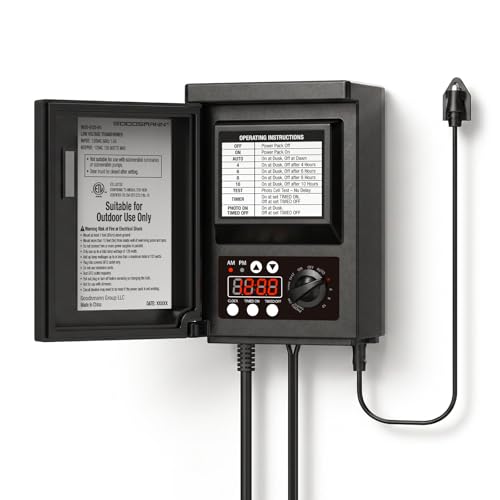
If you run a modest set of 10 or 12 LED fixtures, the GOODSMANN 120W converts 120V household AC to a safe 12V and is sized right for the job. One common setup is ten 2.3W lights, which owners mention draws roughly 30W at 120V — well within this unit’s 120W rating and leaving comfortable headroom.
The standout is the built-in clock and timer. You get three modes: set a specific on/off time, turn on at dusk and off at a time you choose, or turn on at dusk and auto-off after 4, 6, 8, or 10 hours for the standard countdown crowd. The photo sensor is replaceable rather than built-in, which matters because the sensor is often the first part to fail on cheaper units. A front door protects the control panel from sun, rain, and dust, and overheating and overload protection add confidence.
Buyers cite ease of use more than any other aspect — it’s the top-mentioned positive by a wide margin. The unit is marked with ANSI, CSA, and UL safety certifications. Buyers have noted that even when a unit arrived faulty, the after-sales support replaced it quickly without hassle. Compared to the bulky VOLT above at a 2.5x wattage gap, this is the sensible pick for a smaller garden, though some durability complaints do surface over the long haul, so it helps to install it in a sheltered spot.
Why it wins: The flexible clock timer is the star, combining a photocell for dusk-on with an optional timed-off that actually matches how people use lights.
Watch for: A handful of customers note timer or sensor issues down the line, so treat the warranty as a feature and keep your receipt.
3. WILAWELS 200W Low Voltage Transformer
Surprisingly full-featured for a budget entry, with six modes and a detachable sensor to position anywhere.
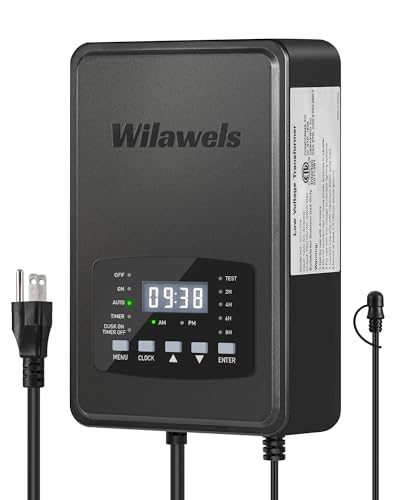
The WILAWELS 200W packs an unexpected depth of control for its price. It converts 120V AC to 12V or 14V AC and is ETL-certified (it has passed recognized safety standards). It runs LED and halogen path, spot, deck, and string lights. Six setting modes cover manual on/off, dusk-to-dawn auto, a countdown that turns off 2, 4, 6, or 8 hours after dusk, a set-time timer, a “dusk-on, timer-off” hybrid, and a test mode.
The detachable photocell sensor is a real convenience. Since it connects via a 6ft sensor cord, you can mount it in a spot that sees true darkness while the transformer itself stays tucked in a shaded corner — though the maker notes it is for outdoor installation only. The memory function retains your settings after a power outage. Buyers in storm-prone areas specifically called this out as a relief since they no longer have to reprogram after every flicker.
Functionality is the most-mentioned positive in reviews, with quality and easy installation close behind. Reviewers point out it withstood multiple storms without issue. The brick-wall mounting with included hardware makes setup straightforward. The main complaint from a few is that the MENU/ENTER programming cycle can be unintuitive — you have to read the instructions rather than guess. For a mid-range price with a 200W rating and 12/14V flexibility, it delivers more than its cost suggests.
The good: This crammed feature set plus a detachable sensor is rare at this price, and it comes in a compact 3.2″D x 5.7″W x 8.9″H body that is 16% slimmer than the 300W VOLT above.
The catch: Programming requires patience with the button sequence; plan to keep the manual handy for the first week.
4. SUNVIE 200W Low Voltage Transformer

The set-and-forget favorite that owners say they programmed without ever touching the manual.
Some transformers make you fight the controls; the SUNVIE 200W is the one owners describe as intuitive. It converts 120V AC to 12V or 14V AC for all standard LED and halogen landscape systems. The setup was so straightforward that multiple buyers said they never needed the instructions. It works with existing wiring too, which matters if you’re replacing a dead unit.
Control comes via five modes: manual on/off, auto dusk-to-dawn, photocell-on with timer-off, set-time timer, and test mode. The removable photocell sensor extends the flexibility — it ships with a 6ft UL-listed power cord and a 6.8ft UL-listed sensor cord. You can install the box indoors or outdoors and still place the sensor where it reads the sky properly. The memory function holds your last mode through power cuts.
Owners praise the quality and ease of installation in nearly equal measure — these are the two most-mentioned positives. There’s also a strong value-for-money sentiment and a 12-month replacement warranty plus lifetime after-sale support. The motor is the 12V and 14V circuit choice, which gives you the option to boost voltage on longer runs. A handful of shoppers say that without seasonal sunrise/sunset automation you’ll need to adjust schedules as days lengthen, but for most, the timer feature killing the twice-a-year mechanical adjustment is reason enough.
Setup Highlights
- Programming described as straightforward and intuitive
- Worked straight from the start for most
- Removable sensor cord reaches true darkness
- Retains settings through power outages
Limitations
- No smart seasonal sunrise/sunset tracking
- Lacks the premium toroidal core of the VOLT pick
Reach for it if: you want a dependable 200W unit that even a first-time buyer can program without frustration.
Look elsewhere if: your schedule demands automatic adjustment to seasonal daylight shifts.
5. Malibu 200 Watt Power Pack with Sensor

A long-running favorite for its simple hold-button setup and weatherproof front cover.
Malibu has powered backyard lights for decades, and this 200W Power Pack continues that tradition. It steps 120V AC down to a safe 12V AC output and is intended for landscape, spot, path, and in-ground lights — though the maker is explicit that it is not for submersible lights. It carries CE and UL safety marks, and built-in circuit overload protectors guard the system.
Timer flexibility is solid: dusk-to-dawn, dusk-on with a designated off time, always on or off, a 4/6/8/10-hour countdown, or a specific set time. Owners who have owned several transformers over the years described this as the easiest to program. That is thanks to a simple hold-button method rather than a multi-level menu. A front door covers the controls and protects the lettering from sun fade — a detail that keeps the settings legible for years.
Malibu’s guidance is to cap total fixture wattage at 75% of this unit’s 200W rating, so you should aim for a 150W ceiling on lights. It has been a workhorse for many. One household ran it for years before needing a simple reset, but honest durability feedback shows some units failing within a few seasons. At 11 pounds and 4.3″D x 5″W x 8.3″H, it’s a hefty, substantial box. Mount it away from high heat and humidity as instructed.
What makes it tick: The straightforward hold-to-set timer and the flip-up cover are the reasons owners keep coming back to Malibu.
What to weigh: The overall durability is the most-discussed negative across reviews, so plan for a potential mid-life replacement and consider the protection of a sheltered mount.
6. Malibu 200W with 6 Modes and Weatherproof Shield

The same trusted Malibu 200W power, now with six scheduling modes and a screw-template mount.
This newer Malibu 200W iteration offers a bit more control than the classic Power Pack. It steps 120V AC input down to 12V AC output and gives you six modes: dusk-to-dawn, dusk-on with a designated off time, stay on, stay off, a 4/6/8/10-hour countdown, a specific set time, and a photo sensor test mode. A built-in circuit overload protector sits between your fixtures and any surge.
Installation is geared toward the novice. Low-voltage cable connects directly to the output port at the bottom. Hanging holes and mounting screws are included for a direct wall mount, and a screw template simplifies getting the alignment right the first time. The 3-amp current rating and CE, FCC, and UL certifications speak to safe, standards-compliant operation. It comes with a one-year repair-or-replacement warranty.
In practice, buyers find the photocell reliable, clicking on only in full darkness. The dial-based time setting (like dusk plus 6 hours) removes menu-hunting from the equation. The recurring note in reviews is that the power cord is short, meaning the unit must sit close to an outlet — plan your mounting spot accordingly. Most buyers report flawless operation for months, though a subset saw failures within weeks, so test yours promptly within the return window. It weighs in at a sturdy 4.2″D x 5″W x 8.3″H and feels built to match the 20-year-old unit it often replaces.
Where it shines: The simple dial-and-sensor setup that beats the reprogramming hassle of smart timers after a power outage.
The fine print: Short power cord limits placement options, and a few units have shown early failures — start it up right away to confirm.
7. SUNVIE 300W 2-Zone Landscape Transformer

The 300W heavy hitter that lets two different light zones run on their own schedules at once.
Got a front yard that should glow all night and a back patio you want off by 11 p.m.? The SUNVIE 300W is built for exactly that. Its defining feature is two individually controlled terminal outputs — you connect one set of lights to Zone 1 and another to Zone 2, then set different modes for each using the dedicated ZONE 1 and ZONE 2 buttons. The combined load of both zones should stay under 80% of the 300W rating.
Each zone can run one of five modes: manual on/off, auto dusk-to-dawn, countdown (off 4, 6, or 8 hours after dusk), a set-time timer, or photocell-on with timer-off. The removable and replaceable photocell connects via a 6.8ft UL-listed sensor cord, so the box can live indoors or out while the sensor finds real darkness. A built-in circuit protector shuts things down on an abnormal load, and the memory function keeps your zone settings after a power cut.
Owners running koi ponds and larger properties specifically praise the dual-zone simplicity and the 14V option, which helps on longer cable runs where voltage sag would otherwise dim the far lights. The 300W class gives real room to grow. Reviews highlight easy installation and programming, straightforward dual-zone operation, and strong customer service when a rare unit failed within the first year. Think of it as two transformers in one enclosure, which also means checking both zones when troubleshooting any odd behavior.
The edge: Independent scheduling per zone is rare at this price, making it ideal for front-and-back or path-and-accent separation.
A consideration: Two zones mean two sets of wiring to manage — keep the load math for each zone separate and under the 80% ceiling.
8. Lightkiwi 300W Multi-Tap Transformer
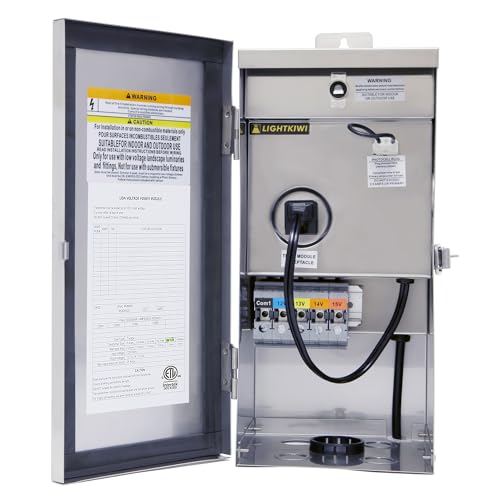
The industrial-grade stainless box with four output taps and the quietest toroidal hum in the lineup.
The Lightkiwi 300W earns its place with pure electrical flexibility. Where most transformers offer 12V and maybe 14V, this one steps 120V AC down to your choice of 12V, 13V, 14V, or 15V AC output. That range is the answer to voltage drop on extended wire runs — you can dial in exactly the tap that keeps lights at the far end of a 400-foot cable as bright as the ones by the house. Owners mention powering as many as 32 LED fixtures across varied wire lengths with no appreciable dimming.
Inside the 17.5-pound stainless steel housing is a toroidal core (a donut-shaped transformer), the same premium design used in the VOLT top pick. It offers quiet operation and efficient energy transfer. Protection is layered: a primary auto-reset thermal circuit breaker plus a secondary 25A magnetic circuit breaker. Wiring uses DIN terminals with one wire per connection, so multi-wire runs may need a small bus bar. The removable bottom plugs and secure latch make the cabinet genuinely serviceable.
Reviews consistently point to this unit’s quality and reliability — two of the top three most-mentioned aspects. Owners run it for years outdoors and note the stainless finish stays shiny. Installation is straightforward, though it ships without a timer or photocell, so you either add a separate sensor or control it via a smart plug or GFCI switch, as many buyers do. This is the builder’s choice: maximum voltage options and a tank-like build. It is higher priced than the 200W tier, but with the multi-tap capability the others simply can’t match.
Serious Capability
- Four output taps from 12V to 15V fix long-run dimming
- Quiet, efficient toroidal core
- Dual circuit breakers protect against surges
- Rugged stainless steel body rated for outdoor use
Plan Around It
- No built-in timer or photocell, so budget for extras
- One-wire-per-terminal design needs bus bars for multi-run setups
- Heaviest unit here at 17.5 pounds
Choose this if: you have a long, complex wiring layout and need precise voltage tuning more than you need an automatic schedule.
skip it if: you want an all-in-one unit with a timer and sensor ready to go from the start.
Understanding the Specs
Output Voltage and Multi-Taps
A 12V transformer converts your home’s 120V AC down to a safe low voltage. Basic units only output 12V, but multi-tap models let you select 13V, 14V, or 15V. Those extra taps compensate for voltage drop — the natural power loss that happens over long cable runs — so the lights at the end of the line stay as bright as the ones at the start.
Timer, Photocell, and Control Modes
A photocell (a light sensor) switches your lights on at dusk and off at dawn automatically. A countdown timer adds an off function 4, 6, 8, or 10 hours after dusk so you aren’t lighting an empty yard all night. The most capable units combine both: on at dusk via the sensor, then off at a time you set for full schedule control.
Wattage Capacity and the 80 Percent Rule
The wattage rating tells you the maximum load the transformer can feed. To run cool and last longer, you shouldn’t load it past 80% of that rating — on a 200W unit, that’s a 160W ceiling for your fixtures. Add up every bulb’s wattage in your system and pick a transformer with at least that much headroom.
Core Type and Enclosure
Toroidal-core transformers, like those in the premium VOLT and Lightkiwi units, run cooler, quieter, and more efficiently than standard EI laminated types, and they tend to play nicer with LED circuits. The enclosure matters too: a stainless steel or weatherproof housing keeps rain, sun, and dust off the electronics so the unit survives years of outdoor mounting.
FAQ
How do I know what wattage transformer I need?
What does the 80% rule actually mean for my transformer?
Should I buy a transformer with a 15V tap?
What is the difference between a photocell and a timer?
Can I install a landscape lighting transformer indoors?
Why do my lights at the end of the run look dim?
How long should a low voltage transformer last?
Is a higher wattage transformer always better?
Can I control my transformer with a smart plug?
Final Thoughts: The Verdict
For the majority of shoppers, the 12v landscape lighting transformer winner is the VOLT 300W Slim Line because its toroidal core, clamp terminals, and lifetime warranty make it the last transformer you’ll buy for a serious LED system. If you want flexible scheduling on a budget, grab the SUNVIE 200W for its intuitive setup. And for the builder tackling long wire runs with voltage drop, the Lightkiwi 300W Multi-Tap is the one to reach for, giving you four voltage options in a rugged stainless shell.
How We Picked
We do not accept paid placement. Every pick is matched to a real buyer and a real use-case; we do not hands-on test units.
Sources & Methodology
Specifications: manufacturer listings and product documentation. Review insights: verified customer reviews, as of September 2026. Pricing: not shown on this page (it changes often); check the current price via the retailer link.
As an Amazon Associate, KitchPrep earns from qualifying purchases. This does not affect which products we feature.
Related Guides
