Specs are compiled from manufacturer listings and verified buyer reviews and can change over time — please confirm the key details on the product page before buying.
Your main fuse blows, and suddenly the whole vehicle or battery bank is dead — so the fuse you buy next has to match what you already own. That match depends on one thing: the physical fuse body versus the fuse holder in front of you. Get the body type right and it bolts in and protects your circuit for years. Get it wrong and you are holding a paperweight. This guide walks you through six real 125-amp fuses — MEGA/AMG blocks, AMI/MIDI bolt-ons, and terminal-style fuses — so you can match body type, voltage rating, and mounting style to your setup before you order.
I’m Mohammad Maruf — the founder and writer behind KitchPrep. This guide is built by comparing the manufacturers’ published specifications and the patterns across verified customer reviews, so you get each pick’s real strengths and trade-offs instead of marketing spin.
A blown main fuse can take a whole vehicle down, so let’s match the right body and rating to your rig. This guide covers the best 125 amp fuse options.
Our Picks at a Glance

How To Choose The Best 125 Amp Fuse
A 125 amp fuse is not a universal part you can swap at the hardware store counter. Three things decide whether it works: the body type (which fuse holder it drops into), the amp rating stamp (it must match your circuit), and the voltage rating (it must meet or exceed your system voltage). Get those three right and the rest is simple.
Match The Body To Your Fuse Holder
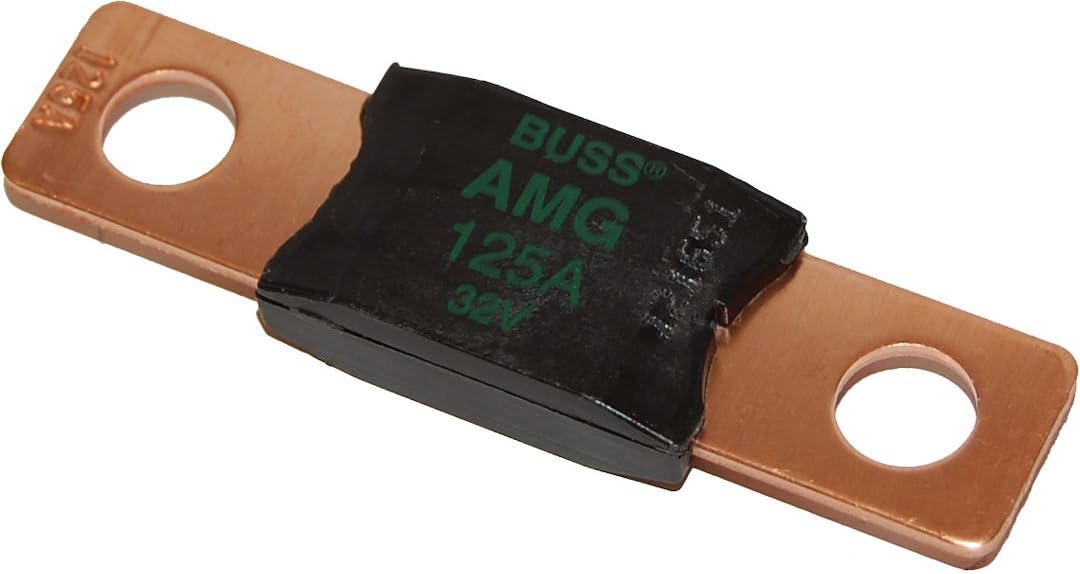
MEGA/AMG fuses are the long rectangular blocks (a wide fuse shape with two bolt holes) used in Blue Sea Systems’ MEGA/AMG fuse blocks and similar holders. AMI/MIDI fuses are shorter, narrower bolt-on tabs that fit midsize high-current mounts on cars, trucks, buses, and caravans. Terminal fuses mount directly to a battery terminal or fuse block stud. If you buy a MEGA body for a MIDI holder, it physically will not fit — the holes will not line up and the body will be too long for the trough.
Check The Amp Rating Stamp And Voltage
The 125 A stamp on the fuse is what makes it a 125 amp fuse. A 100 A or 150 A fuse is a different part that protects a different circuit — never substitute one and hope. Voltage rating tells you the maximum system voltage the fuse was built to interrupt safely. 32V DC (volts of direct current) is the common MEGA ceiling, while terminal fuses can run higher. Keep system voltage at or below that number.
Time-Delay Versus Fast-Blow
Time-delay fuses — sometimes called Slo-Blo — tolerate brief current spikes without blowing. A motor starting or an inverter drawing a surge is exactly that kind of spike. That prevents nuisance blowing that leaves you stranded. For alternator protection and battery-to-load feeds, a time-delay fuse is usually the smarter choice over a standard fast-blow, which pops the instant current spikes.
Quick Comparison
| Model | Best For | Body Style | Max Current | Voltage | Amazon |
|---|---|---|---|---|---|
| Blue Sea Systems MEGA/AMG Fuses★ Best Overall | MEGA/AMG block upgrades | MEGA/AMG bolt-down | 125 A | 32 V | Amazon |
| BOJACK AMI/MIDI 125A (Pack of 5)Best Value | Subaru main-fuse replacements | AMI/MIDI bolt-on | 125 A | 32 V | Amazon |
| Fastronix 125 Amp MEGA/AMG Bolt Down Fuse | Alternator and battery protection | MEGA/AMG bolt-down | 125 A | 32 V | Amazon |
| Littelfuse Fuse – Mega 32V, 125A | Heavy-gauge cable protection | MEGA/AMG through-hole | 125 A | 32 V | Amazon |
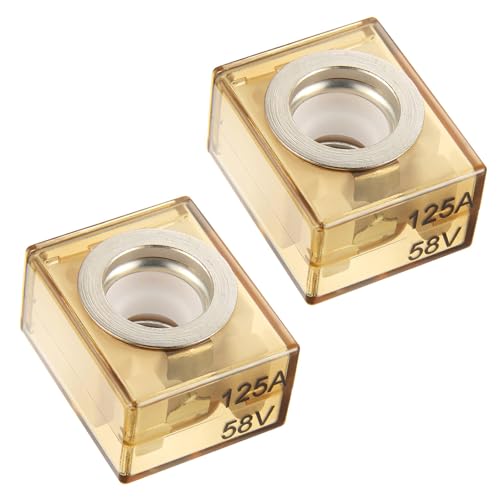
| BOJACK MRBF 125A Terminal Fuse (Pack of 2) | Parallel battery-bank protection | MRBF threaded stud | 125 A | 58 V | Amazon |
In‑Depth Reviews
1. Blue Sea Systems MEGA/AMG Fuses
Our pick — over 4.5★ from 90+ verified ratings; the strongest balance of quality and price.
The name-brand MEGA block fuse that quietly keeps 100 to 300 amp circuits alive.
This one takes the top spot because its 125 A rating sits square in the middle of the 100–300 A range the fuse is built to protect. If your vehicle or boat already runs a Blue Sea Systems MEGA/AMG fuse block, this is the fuse that block was built for. The 32 V DC rating covers standard 12 V and 24 V systems, and the through-hole MEGA/AMG footprint slots straight into blocks made for that shape — no adapter, no bending, no drilling. The body is 5 x 3 x 1 inches — the long rectangular MEGA block shape — and it weighs just 22.68 g, so it adds almost nothing to a harness.
What wins people over is how boring it is. It bolts in, the cover closes, the circuit is protected, and you move on. Blue Sea Systems designed it for use with their MEGA/AMG Fuse Block — the label specifically calls out part number 5006 — and the mounting type is through-hole, so it sits in the trough and bolts down the way the design intends.
The catch is body size. If you drive a smaller car with a narrower fuse bay, the MEGA footprint will feel oversized. Buyers report: “I was looking for this fuse but in a little bit smaller format for a 2011 Kia Rio.” That is not a flaw in the fuse — it is a mismatch between the MEGA body and a smaller OEM bay. If your vehicle takes an AMI/MIDI or a terminal-style fuse, the BOJACK AMI/MIDI 125A and the Blue Sea Systems Terminal Fuses are the shapes you want instead. This one is for MEGA/AMG blocks only.
Where it earns its place
- 125 A rating sits square in the 100–300 A range the fuse is designed to protect
- 32 V DC rating covers standard 12 V and 24 V systems
- Through-hole MEGA/AMG footprint bolts cleanly into the matching Blue Sea Systems block
- 22.68 g body adds virtually no weight to a harness
- Solid owner sentiment on easy installation into existing MEGA blocks
What to plan around
- MEGA/AMG body is longer than smaller OEM bays accept
- Not a fit for cars that use AMI/MIDI or terminal-style footprints
- Single fuse — no spare in the box
Reach for this if: you already run a Blue Sea Systems MEGA/AMG fuse block or its equivalent and want a proven 125 A fuse that drops in without fuss.
Look elsewhere if: your vehicle takes a shorter AMI/MIDI body or a terminal-mount fuse — the MEGA footprint will not squeeze into a smaller bay.
2. BOJACK AMI/MIDI Fuse 125A High Current Bolt-on (Pack of 5)
Five spare AMI/MIDI fuses — the pack that pays off when your main fuse goes pop.
Five AMI/MIDI fuses on one card — four more spares than the single-fuse MEGA pick above. The Blue Sea Systems MEGA/AMG pick above contains 1 fuse, so this is a 5.0x gap in how many backups you end up with. Blow one and you still have four in the glovebox. The 125 A AMI/MIDI body fits cars, trucks, construction vehicles, agricultural machinery, buses, and caravans, and the tin-plated zinc terminals are designed for quick, accurate contact.
Subaru owners who swap their own main fuse will recognize this exact scene. The main fuse blows because somebody hooked up a battery backwards. The dealer wants close to a week to order one. This pack shows up next-day and gets the car back on the road. The high-temperature resistant plastic body and reinforced hole material are there to resist deformation and sparking under load. The current spec is stamped on top with a color code, so you can tell your 125 A from your 80 A at a glance.
Be honest about the quantity issue: one owner reported a short shipment — “Order wasn’t complete, was suppose to receive 5 fuses only got 3.” That is a fulfillment hiccup, not a fuse defect, and it is rare. The AMI/MIDI body is also narrower than the MEGA block, so it will not drop into a Blue Sea Systems MEGA holder — this is a specific-fit part for the smaller bolt-on bay.
Multi-pack logic: Five fuses on one card means you install one and keep four as trail spares — four more backups than a single-fuse card. This is the substitution you make when a dealer quote feels slow and expensive.
Fit honesty: It is a 32 V, 125 A AMI/MIDI fuse. If your rig takes a MEGA/AMG or a terminal-mount fuse, this body will not work no matter how well the terminals are tinned.
Ideal when: your vehicle or rig uses an AMI/MIDI high-current bay and you want a small stack of spares at once.
Not the one for: MEGA/AMG block owners — the AMI/MIDI footprint is too narrow for that trough.
3. Fastronix 125 Amp MEGA/AMG Bolt Down Fuse

A green time-delay MEGA fuse that shrugs off brief high-current spikes.
Time-delay is the feature that earns this one its slot, because a starter kick or an inverter precharge should not blow a fuse. Buyers of this green fuse keep saying the same thing: “Good fit, quality and dependable.” That is a two-sentence review, but it tells you what you need — the bolt-down pattern fits the intended Fastronix 500-040 fuse holder, and the fuse holds. The 125 A rating pairs with a 32 V DC ceiling, and the manufacturer is listed as Littelfuse, so the fuse inside the body comes from a name the electrical trade knows.
Where this fuse shines is alternator and direct battery protection right at the source. High-current events that last a fraction of a second do not need to blow a fuse. The time-delay characteristic is there so a short spike does not trip the circuit and leave you chasing a phantom problem. It is the difference between a fuse that protects your wiring and one that nags you every time a motor spins up.
Compared with the BOJACK AMI/MIDI 5-pack, this is a single fuse in the card. If you want a spare in the toolbox, you will need to order a second Fastronix. And it is a MEGA/AMG body, so it will not fit a smaller AMI bay or a battery-terminal direct mount.
Time-delay edge: Rated to 32 V and built with time-delay characteristics, this is the fuse to use when brief current spikes are part of the normal duty cycle rather than a fault.
Single-fuse reality: One fuse per card. Buy a spare upfront if you are installing this in a rig you cannot easily replace parts on.
Built for: alternator feeds, direct battery-to-load protection, and any circuit that sees brief high-current surges.
skip it if: you need a multi-pack backup set or your rig takes a non-MEGA footprint.
4. Littelfuse Fuse – Mega 32V, 125A, 1 pc card

The largest MEGA body in this lineup — buy it only if you measured your bay first.
This is a Big-Block fuse, and it is the largest MEGA body of the six picks here — so measure your bay before you order. The manufacturer rates the family for high-current circuit protection up to 250 amperes, and the copper conductor is the reason it handles that load. On a real build, it restored interior power (windows, radio, lights, AC) on a 2002 Chevy Trailblazer after a bad jump, and the owner described the result as “sturdy” and “durable.” The fuse is 125 A MEGA with a Slo-Blo time-delay characteristic.
The Slo-Blo behavior is the underappreciated spec here. Temporary short-duration overloads — the kind you get on a battery-to-alternator connection or a heavy-gauge cable feed — briefly exceed the amp rating and then settle back down. A Slo-Blo fuse rides that out. A standard fast-blow fuse pops, and the “cure” is a trip to the parts counter. The color is a dark yellow for quick ID at the fuse block.
Two things to know before you buy. First, this body is bigger than a plain MEGA, so it will not fit every bay — one reviewer noted, “it was a bit too large for my install but i made it work.” Second, one report flagged a mix-up: “I ordered 125 amp fuses…I received 100 amp fuses.” That is a fulfillment error, not a design issue, but if you install fuses in a critical feed, verify the stamp before bolting it down. A 100 A fuse in a 125 A slot is under-protection.
Why buyers keep coming back
- Slo-Blo time-delay absorbs brief overloads without nuisance blowing
- Copper construction for the conductor path
- Restored full interior power on a real 2002 Chevy Trailblazer after a bad jump
- Built for high-current circuits up to 250 amperes
Fit caveats
- Physically larger than a standard MEGA body — measure your bay
- Single fuse per card
- Some units have shipped mislabeled — always verify the amp stamp
For the owner who: runs a generous MEGA/AMG bay and wants Slo-Blo protection on a heavy-gauge battery or alternator feed.
Not ideal if: your fuse block uses tight standard-MEGA clearances or you are shopping for a multi-pack spare set.
5. Blue Sea Systems Terminal Fuses

Built for large battery banks where the fuse meets the cable head-on.
Its 10,000 AIC rating at 14 V DC is the spec that separates it from every MEGA and AMI fuse here — and on a big battery bank, that is the number that keeps a short from turning into a fire. AIC means amperes interrupting capacity: how much available fault current the fuse can safely cut off if something goes short. 10,000 AIC satisfies ABYC requirements (the marine industry’s safety standard) for DC main circuit protection on large battery banks — loads like inverters and combined house/start feeds. Maximum current is 125 A, and the body dimensions are 4 x 4 x 1 inches, a square footprint typical of a terminal-style fuse rather than a MEGA trough.
Functionally, this is the fuse you install when the battery bank is the load and the fuse sits at the bank itself. One owner set up two of these side by side for two different loads and described the result as a “Super clean installation.” The point of the terminal footprint is exactly that — it puts the fuse right where the cables converge, which keeps the run tidy and keeps a fault as close to the source as possible. Owner sentiment on the fuse’s overall quality tracks high across the board.
The critical constraint: Blue Sea Systems specifically warns that this fuse requires a Terminal Fuse Block — part numbers 5191 or 2151 — and must not be mounted directly to the battery terminal. If you do not have one of those blocks, plan to buy one. This is not a MEGA/AMG body either, so do not try to slot it into a MEGA trough. It is a terminal-style fuse for a terminal-style job.
what separates it: A 10,000 AIC interrupting rating at 14 V DC makes this the fuse to pick when the job is protecting a large battery bank rather than a single conductor run.
Compatibility must-know: Requires a Terminal Fuse Block (PN 5191 or PN 2151). Direct-to-terminal mounting is not allowed on this part.
Pick this for: marine and solar battery-bank mains where the fuse belongs right at the bank, protected by the correct terminal block.
Think twice if: you want a drop-in MEGA/AMG replacement — this is a different body style and needs a matching block.