
Specs are compiled from manufacturer listings and verified buyer reviews and can change over time — please confirm the key details on the product page before buying.
You are plumbing an RV, keeping bait alive on a boat, or pulling water from a rain barrel. A 12 volt water pump (a pump that runs off a standard car or marine battery) lives or dies by two numbers: flow rate and pressure. Mismatched flow or pressure means weak showers or burst fittings.. This guide ranks nine pumps by flow, pressure, and owner feedback to match your job..
I’m Mohammad Maruf — the founder and writer behind KitchPrep. This guide is built by comparing the manufacturers’ published specifications and the patterns across verified customer reviews, so you get each pick’s real strengths and trade-offs instead of marketing spin.
Here is the short version: the definitive 12 volt water pump list below ranks nine submersible and diaphragm pumps by flow, pressure, and real-world owner feedback.
Our Picks at a Glance


How To Choose The Best 12 Volt Water Pump
Because a 12 volt water pump runs directly off your vehicle’s battery, you never need a wall outlet. Choose between a submersible pump that sits in water and a diaphragm pump that pulls from a tank.. Your tank and plumbing layout determine the right type..
Match the pump type to your tank
Submersible pumps drop straight into a bilge or livewell and push water out through an attached hose. Diaphragm pumps sit outside the tank, self-prime (draw water up through a suction line) and run on demand when you open a faucet. For an RV or camper with a fresh water tank, you almost always want a diaphragm pump.
Check flow rate and pressure together
Flow rate — given in gallons per minute (GPM) — tells you how fast water moves. Pressure — in PSI (pounds per square inch) — tells you how forcefully it comes out of the tap. A high-flow pump with low pressure will trickle from a shower head. Look for a balance: around 3 to 5 GPM for an RV, which handles a shower and sink at the same time.
Look for run-dry and thermal protection
If a pump runs with no water in the line, it can overheat the motor. The best options run dry safely for short periods and shut themselves off if the temperature climbs. That protection prevents motor burnout during dry runs on long trips..
Quick Comparison
| Model | Best For | Flow Rate | Pressure | Weight | Amazon |
|---|---|---|---|---|---|
| Rule 02 Bilge Pump 1500GPH★ Best Overall | Heavy-duty boat bilge clearing | 1500 GPH | — | 3.1 lbs | Amazon |
| SEAFLO 05 Series 800 GPH AngledBudget Marine Pick | Livewell and baitwell circulation | 800 GPH | Max head 8.85 ft | 1.3 lbs | Amazon |
| YOUNGTREE 3.5 GPM DiaphragmQuiet Budget Choice | Budget RV and camper plumbing | 3.5 GPM | 45 PSI | 4.8 lbs | Amazon |
| Whale High Flow Submersible | Tight-spot tank access | 4 GPM | — | 2.4 oz | Amazon |
| DICMIC 3.0 GPM Diaphragm | Direct OEM RV pump replacement | 3.0 GPM | 55 PSI | 2.17 kg | Amazon |
| Kohree 5.5 GPM Diaphragm | High-flow RV and marine use | 5.5 GPM | 55 PSI | 6.1 lbs | Amazon |
| Rule 25SA Automatic 500GPH | Automatic bilge monitoring | 500 GPH | — | 12.8 oz | Amazon |
| SEAFLO 55 Series + 2 Gal Tank | Whole-RV system with accumulator | 5.5 GPM | 60 PSI | 14 lbs | Amazon |
| PENTAIR SHURFLO 4048-153-E75 | Premium multi-fixture RV pressure | 4.0 GPM | 55 PSI | 5 lbs | Amazon |
In-Depth Reviews
1. Rule 02 Bilge Pump 1500GPH 12V
Our pick — over 4.5★ from 800+ verified ratings; the strongest balance of quality and price.
The heavy-lifter that boat owners trust across decades of saltwater duty.
The Rule 02 moves 1500 gallons per hour — the highest raw output on this list. That is roughly 428 times the rate of a typical 3.5 GPM RV diaphragm pump, so it clears a flooded bilge fast. It is a submersible bilge pump, meaning it sits in the lowest point of the boat and punts water overboard.
Its 4.7-star rating across 800+ owners highlights longevity over raw power.. Review pages sum it up: “Lasted 22 yrs/50k miles on sailboat; reliable.” One owners’ replacement came after a 20-year run of the same model. The plastic-and-stainless build (it weighs only 3.1 pounds) is easy to install, though the outlet exits the bottom, so plan on a hose and elbow to route water upward.
This is premium-tier, and it earns it. The honest trade-off is durability reports are mixed — some units last two decades, others fail sooner. That variance is the exception, not the rule, with this brand name trusted across marinas.
What wins people over
- Massive 1500 GPH flow clears bilges fast
- Buyers report 20-plus-year service life on sailboats and cruisers.
- Value for money is a top-mentioned plus
Things to know
- Bottom outlet needs hose and elbow for upward routing
- Durability reports run mixed across the long haul
- Not a pressure pump — no PSI for faucets
Grab it for: serious boat owners who want proven bilge-pumping muscle with an almost legendary lifespan.
Think twice if: you need pressurized faucet flow — this is a mover, not a pressure pump.
2. SEAFLO 05 Series 800 GPH Angled Baitwell Pump
The angled, low-profile aerator that keeps bait lively in tight hull spaces.
Anglers will immediately get why this SEAFLO stands out: the 90-degree angled outlet slips into hull-side spots where a straight pump cannot fit. It weighs just 1.3 pounds — nearly 3.7 times lighter than the YOUNGTREE diaphragm below. It is a submersible livewell pump that turns over 800 gallons per hour to keep oxygen levels up and bait healthy.
The defining feature is the push-button detachable motor cartridge. Pop the motor out for cleaning or replacement without disassembling the whole pump — no extra tools needed. The build is corrosion-resistant, with a high-impact ABS housing and fiberglass-reinforced nylon parts, built for both freshwater and harsh saltwater.
The word from owners is that it does its one job flawlessly: “Work just as it should and plenty of water pressure from it for the live well.” The recurring caveat is durability — some units have failed within hours, so keep the 4-year warranty card handy. It also draws up to 6.8A max, which is note for your boat’s wiring.
Smart design: The angled mount and tool-free motor release make install and upkeep the easiest in this lineup.
Fair warning: Quality is praised, but an occasional early failure means the warranty matters more than usual here.
Best suited to: boaters who need a compact, corrosion-resistant livewell pump in a cramped mounting spot.
Not for: anyone who expects low-maintenance years of service without ever touching the warranty card.
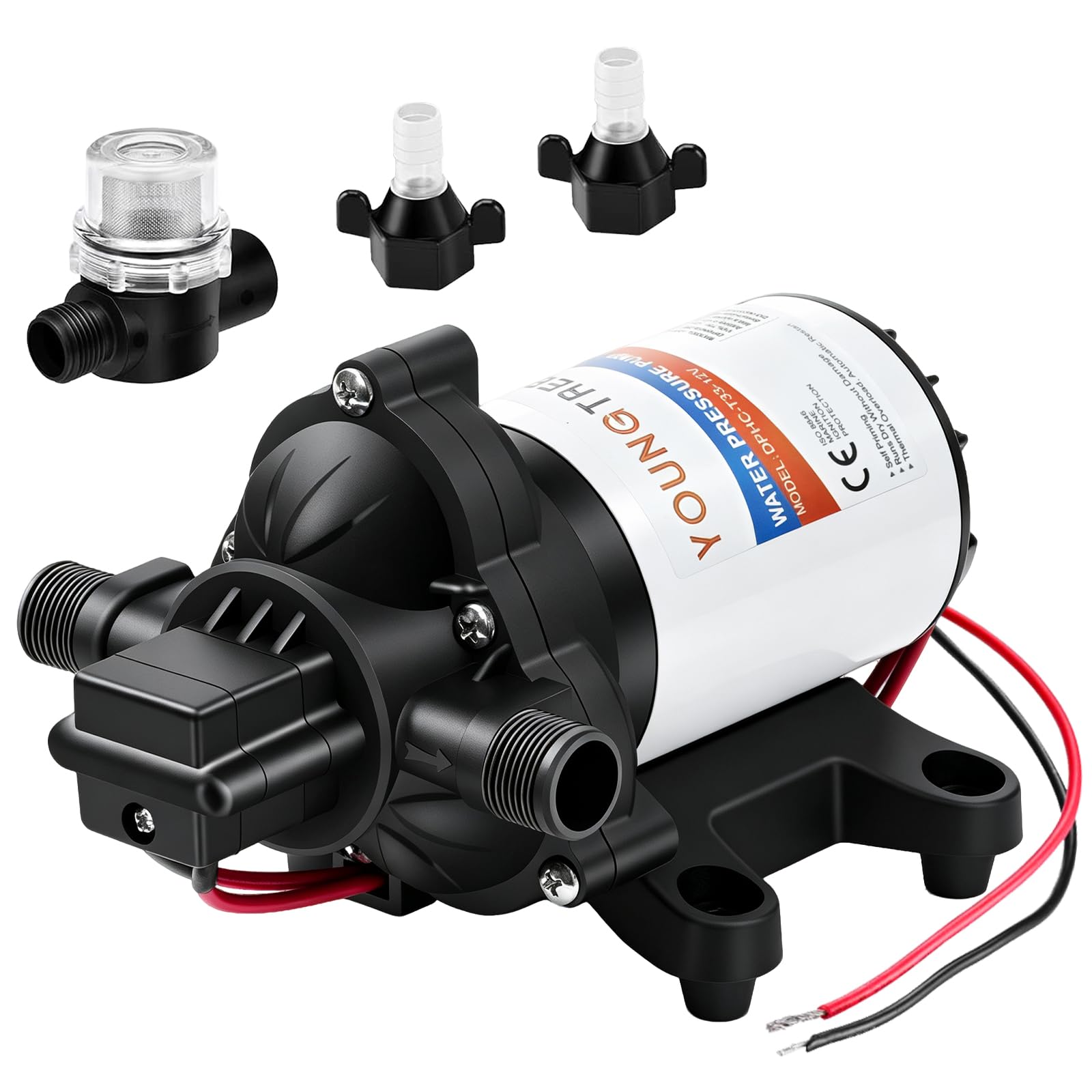
3. YOUNGTREE 12V RV Water Pump 3.5 GPM 45 PSI
The budget diaphragm pump that runs a shower and kitchen sink in unison.
This YOUNGTREE delivers a usable 3.5 GPM at 45 PSI — enough that owners mention it “keeps up with shower and water use in the kitchen at the same time with good pressure.” It is a self-priming diaphragm pump built for RVs, campers, food trucks, cabins, and irrigation work, weighing in at 4.8 pounds with a stainless steel build.
Quiet operation is its headline feature. A rubber base and pure copper motor cut noise compared to metal-base rivals, and the automatic pressure switch starts and stops the pump when you open or close a faucet — no manual fiddling. It runs dry safely and shuts off automatically if the temperature hits 70°C / 158°F.
At 8.86 inches long, 5.51 inches wide, and 5.12 inches tall, it is a fairly compact unit that fits most RV bays. The catch: noise is praised, but durability is the most-mentioned negative — some owners reported failures after just days. It self-primes up to an impressive 131 feet of lifting height on paper, though that matters more for unusual irrigation setups than typical RV use.
The good stuff
- Quiet rubber-base operation owners rave about
- 3.5 GPM at 45 PSI handles simultaneous fixtures
- On-demand pressure switch with overheat shutoff
The risk
- Durability is the top complaint — some units die fast
- Value and water pressure both get mixed feedback
Reach for this if: you need an affordable, genuinely quiet RV pump that keeps up with daily shower and sink use.
Look elsewhere if: long-term reliability is non-negotiable for a full-time rig.
4. Whale High Flow Submersible Pump GP1652 12V
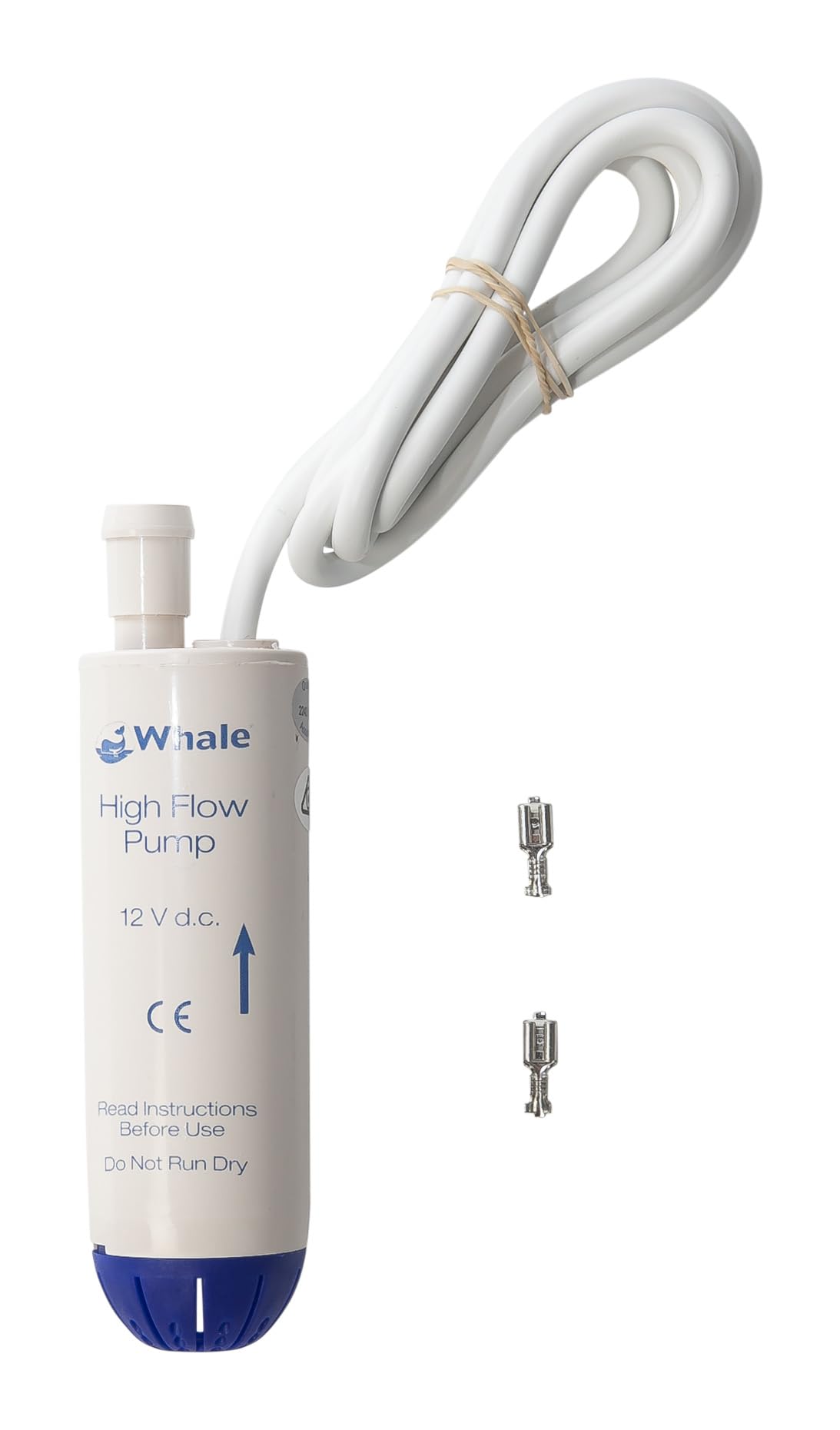
The featherweight submersible that squeezes into tight tank spots.
The Whale weighs just 2.4 ounces and measures 1.26 inches wide — barely wider than your thumb. That narrow profile drops straight into water tanks and tight bilge spots that bulkier pumps cannot reach. For a portable camping shower fed from a jerry can or a hard-to-access tank corner, this is the answer.
It flows a solid 4 GPM and handles more than just water — it is rated for freshwater, diesel, or kerosene transfer. Owners have pressed it into surprising service, like draining a bathtub through a two-month plumbing renovation with three daily showers and no failures. It handles soap, dirt, and hair without complaint, though the impeller is tricky to clean after such heavy use.
One buyer found it “seems better than Comet,” noting stronger pressure than a Comet pump that lost output over two years. It is CE certified and meets ISO 8849, ISO 15083, ISO 8846, and ISO 10133 standards with IP67 water resistance, backed by a 1-year warranty.
Why it wins: Tiny size plus versatile 4 GPM flow makes it the go-to for tight tanks and camp showers.
Keep in mind: A 2.4-ounce pump is not built for heavy continuous bilge duty — occasional units arrive damaged in shipping.
Perfect for: campers and small-boat owners who need a whisper-light pump that reaches awkward low spots.
skip it if: you need high-volume continuous pumping — that is a job for the Rule 02.
5. DICMIC RV Water Pump 3.0 GPM 55 PSI

The drop-in RV replacement that mounts exactly like the factory original.
If your RV’s pump has died and you want a painless swap, this DICMIC is built to replace part numbers 4008-101-A65 and 4008-101-E65. Owners confirm it “fit exactly like the original. Mounted exactly in the same holes.” It delivers 3.0 GPM at 55 PSI — higher pressure than the YOUNGTREE’s 45 PSI — drawing 7.5 amps from your 12V system.
It uses a one-piece diaphragm and built-in design aimed at long life, plus a built-in check valve to prevent water from backwashing into the tank. The motor runs dry without damage and has thermal protection, and owners consistently call it “super quiet” and easy to install with clear instructions. Quality tops the praise list, with noise level close behind.
At 10.39 inches long and 5.63 inches wide, it is a touch longer than the YOUNGTREE, so measure your bay before ordering. There is honest balance here: some owners swear it is still going strong, while a few report it failing within weeks. For a direct-fit replacement at a mid-range price, the mounting-hole accuracy is the real selling point.
Where it shines
- Exact fit for 4008-101-A65/E65 mounting holes
- Strong 55 PSI pressure with quiet running
- Run-dry safe with built-in thermal protection
Watch out for
- Durability is mixed — a few units fail early
- One owner found it louder than their old pump
Choose this when: you want a true bolt-in OEM-style replacement without re-drilling holes.
Pass if: you need higher flow than 3.0 GPM for large rigs with simultaneous heavy use.
6. Kohree 12V RV Water Pump 5.5 GPM 55 PSI
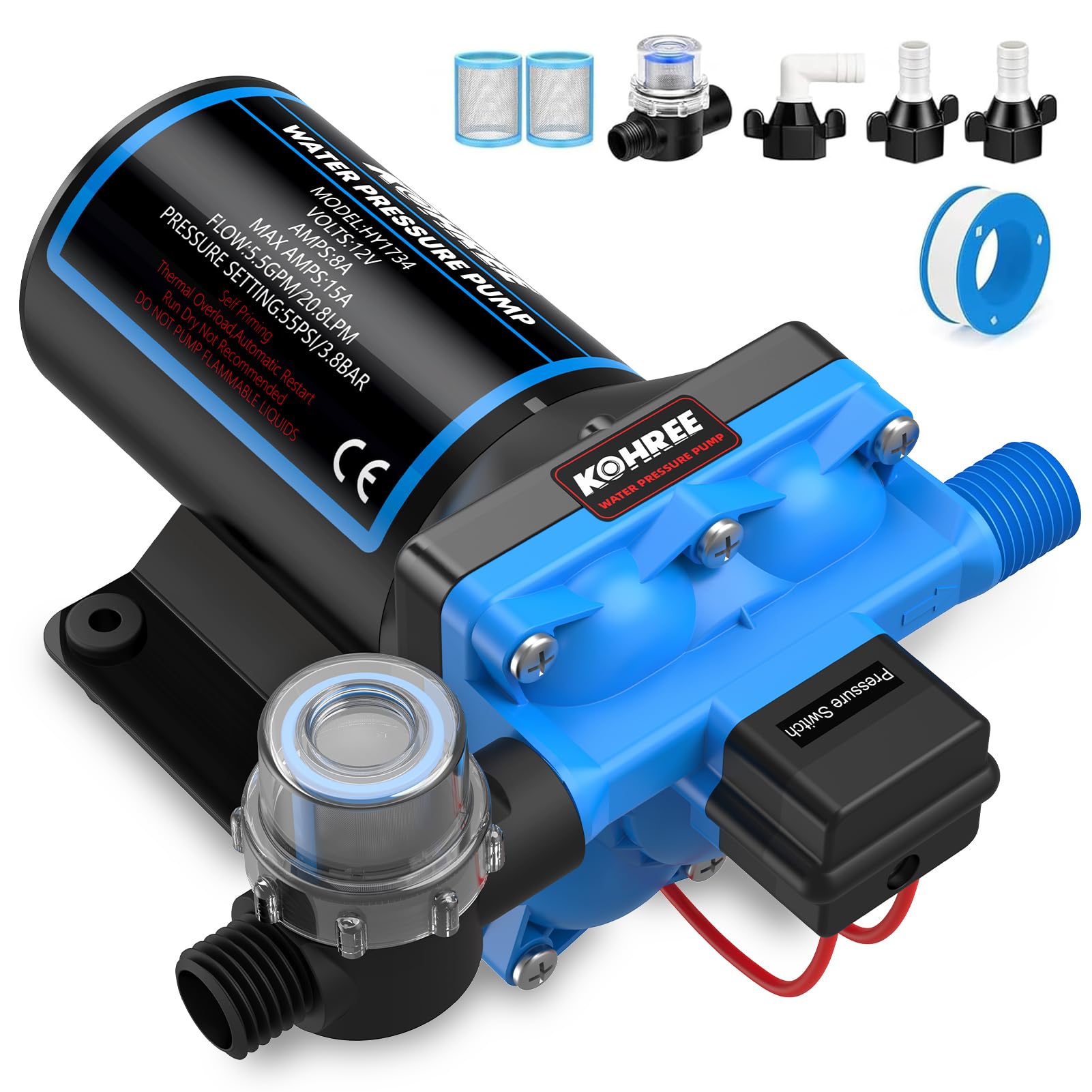
The high-volume powerhouse that runs a whole RV without strain.
For bigger rigs or boats with multiple fixtures running at once, this Kohree pushes 5.5 gallons per minute at 55 PSI — the same pressure as the DICMIC but nearly double the flow. It runs on a continuous cycle with a pressure switch set to 55 PSI, drawing 8.0 amps, and it is compatible with 4008-101-A65/E65 models as well as most marine systems.
Owners measure its quietness against the big names, with one noting it makes “about half the noise than a Flojet.” Another has used it every weekend for about a year and reports it “held up great… Pump stays cool even on long duty cycles.” The included kit has hose adapters, an inlet filter strainer, and teflon tape for leak-free sealing.
It self-primes up to 3 meters and runs dry safely with thermal overload protection that stops the motor if it overheats. The catch is that it is a heavier unit at 6.1 pounds and a bigger footprint at 12.01 inches long. One owner found it noisy enough to hear from the shower, possibly from a loose mount. It undercuts premium rivals while matching their flow.
The appeal
- Top-tier 5.5 GPM flow at a mid-range price
- Quiet enough to rival pumps costing twice as much
- Thermal protection and run-dry safety built in
Consider this
- Bulky 12-inch body needs generous mounting space
- One owner blew a 10A fuse and needed a bigger one
Go with this if: you run multiple fixtures or long hose runs and want premium flow without the premium price.
Reconsider if: your pump bay is tight — measure before you buy.
7. Rule 25SA Automatic Bilge Pump 500GPH

The hands-free bilge pump that senses water and runs itself.
This Rule uses electronic sensing instead of a mechanical float switch — it checks for water every 2.5 minutes, running for just a second to detect if pumping is needed. When it finds water, it pumps until the bilge is dry, then shuts off. No float switch to stick, no third wire to run, and an easy-clean strainer that pops off for maintenance.
Efficiency is the headline: it draws just 0.20 amps of daily power in standby, making it gentle on a boat battery. Owners have run it for three weeks on a small 12V 6Ah lithium battery with no drain, and one installed it in a 1956 wooden boat without issue. The auto-sense adds genuine confidence — a backup pump that watches the bilge while you sleep.
The trade-off is corrosion. Several customers note the shaft seal lets moisture in, causing the circuit to fail before the warranty ends. It flows 500 GPH, which is modest compared to the 1500 GPH of the manual Rule 02, but the automatic operation is the point here. Thermal cut-off protects against overheating.
What stands out
- Auto-sense runs itself with no float switch
- Tiny 0.20 amp standby draw saves battery
- Quick-release strainer for easy cleaning
Honest limits
- Corrosion can kill the circuit before warranty ends
- 500 GPH is light duty compared to manual models
Best for: boaters who want automatic, set-and-forget bilge protection with minimal battery drain.
Not ideal if: you need raw pumping volume — the manual Rule 02 moves three times the water.
8. SEAFLO 55 Series RV Pump with 2 Gallon Accumulator
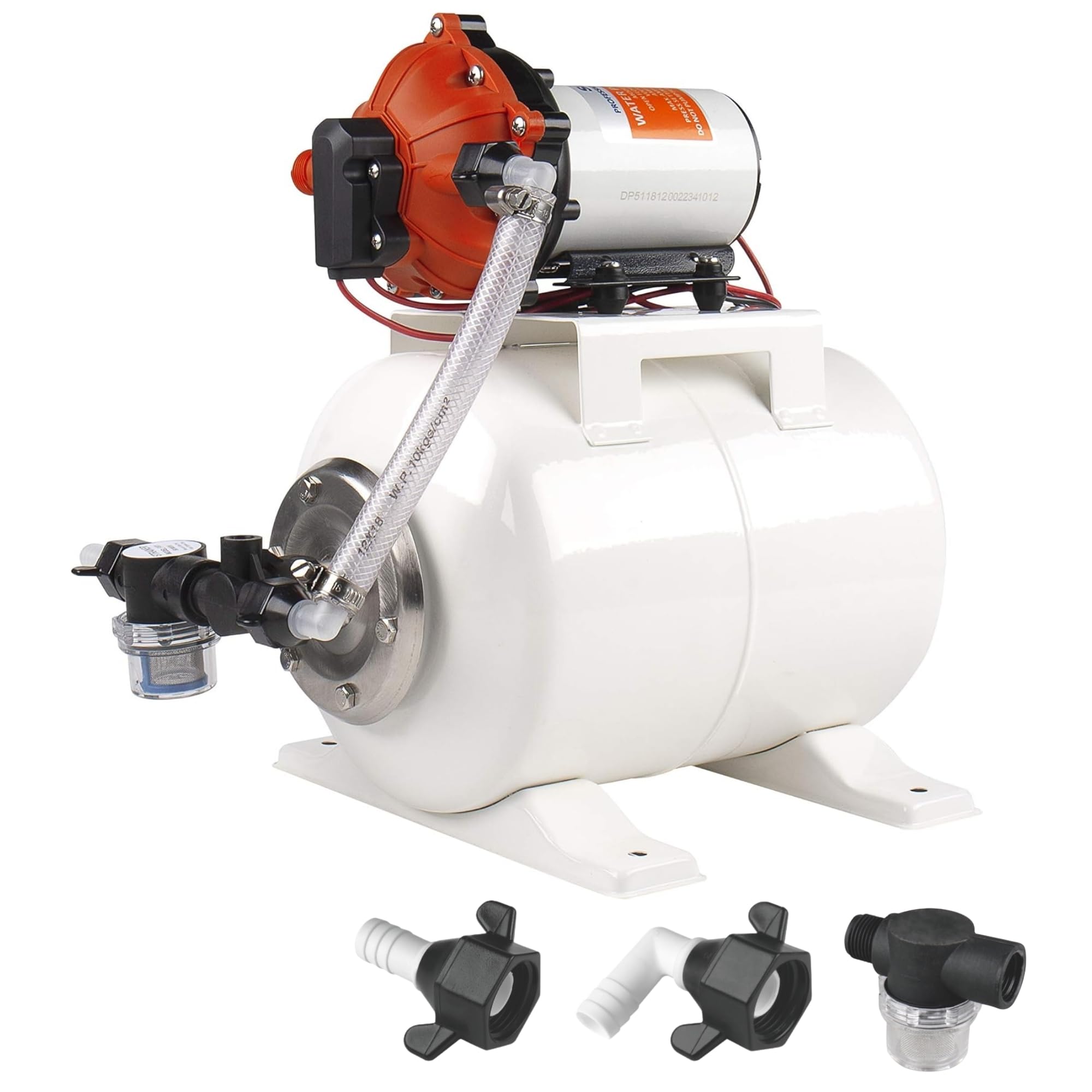
The complete pressurized system that runs a whole RV off solar power.
This is not just a pump — it is a full system. The integrated 2-gallon pre-pressurized accumulator tank works with the five-chamber diaphragm pump to reduce on-off cycling, eliminate water pulsation, and keep flow steady across multiple fixtures. It delivers 5.5 GPM at a shut-off pressure of 60 PSI, the highest shut-off on this list, and turns on at just 18 PSI to minimize cycling.
Owners with solar setups found it transformative. One had an expensive pump at a cabin that would only run on generator power, then installed this and reported it “works awesome on solar power.” Another said the lines don’t vibrate in the RV — a direct benefit of the accumulator smoothing flow. It carries NSF, UL, and CSA certifications for potable water, so it is safe for drinking systems.
It self-primes up to 6 feet and is built with Santoprene EPDM materials that resist chemicals and scaling. The main drawbacks are size and targeted durability concerns: at 14 pounds and 14.46 inches long, it needs real mounting space, and one owner reported the mounting base rusting on a saltwater boat. A separate review reported pump failure after three weeks, though the 4-year warranty is the strongest in this lineup.
The system advantage
- 2-gallon accumulator kills pulsation and cycling
- High 60 PSI shut-off for strong multi-fixture flow
- NSF-certified safe for potable drinking water
Before you commit
- Heavy 14-pound footprint needs a real mounting bay
- Occasional early failures reported despite warranty
Pick this for: a full fresh-water system in an RV, cabin, or off-grid home where steady pressure beats portability.
Skip if: you need a small pump for a camper van — this is overkill for tiny tanks.
9. PENTAIR SHURFLO 4048-153-E75 High Flow RV Pump

The premium workhorse that delivers near-city water pressure on the road.
Shurflo is a name RV owners know, and this 4048 model delivers up to 4.0 GPM at 55 PSI — enough that one owner running three sinks and two showers simultaneously found the pressure sufficient. The four-chamber diaphragm design provides smooth flow with reduced cycling, and owners compare the output to city water pressure: “almost as good as city pressure.”
It self-primes up to 6 feet and runs dry without damage, with a four-chamber design that keeps pressure consistent. The construction uses a Santoprene diaphragm, EPDM seals, polypropylene housing, and stainless steel hardware with an integrated check valve. The kit includes a 50 mesh strainer and two hose barb fittings for fast installation.
At 12.5 inches long and 5 pounds, it is comparable in size to the Kohree. The trade-off is noise, which draws the most mixed feedback — some find it quieter than their old pump, others call it “a little noisy.” Owners also note it needs a 10A controller and 12-gauge wire, and one had to adjust the bypass and pressure valves to get it to shut off cleanly. Durability runs mixed across the long haul, but the quality consensus is the strongest of any pick here.
Why it commands a premium
- Strong 55 PSI pressure with smooth four-chamber flow
- Handles three sinks plus two showers at once
- Complete kit with strainer and hose fittings included
The honest costs
- Noise is genuinely mixed — some find it loud
- May need valve adjustments to shut off cleanly
Worth it for: full-time RVers who demand strong, consistent pressure across multiple fixtures and have the budget for proven quality.
Look past it if: silence is your priority — the YOUNGTREE or Kohree run quieter for less.
Understanding the Specs
Flow Rate: GPH vs GPM
Bilge pumps are rated in gallons per hour (GPH) — think 1500 GPH moving 25 gallons a minute. Diaphragm pumps are rated in gallons per minute (GPM) — a 3.5 GPM pump fills a standard shower head comfortably. High GPH is for moving water out; high GPM is for pressurized delivery to faucets.
Pressure: PSI and What It Means
PSI measures how forcefully water pushes out of a tap. An RV shower needs roughly 40-55 PSI to feel strong. A 45 PSI pump like the YOUNGTREE works for basic RV use, while 55-60 PSI pumps like the DICMIC, Kohree, and SEAFLO system handle multiple fixtures at once.
Self-Priming and Run-Dry
Self-priming means the pump can pull water up a suction hose from an empty tank — measured in feet of lift. Run-dry safe means the pump survives short periods with no water without burning out its motor. Thermal protection takes it further by shutting the pump off if it overheats.
On-Demand vs Automatic Operation
Diaphragm pumps use a pressure switch that starts when you open a faucet and stops when you close it. Automatic bilge pumps sense water on their own and pump until dry. Submersible pumps for bilges usually run continuously or on a float switch, while pressure systems for RVs run on demand.
FAQ
What size 12V water pump do I need for an RV?
What is the difference between a submersible pump and a diaphragm pump?
Can a 12V water pump run dry without breaking?
How do I know what PSI my RV water system needs?
Will a 12V pump work with my solar setup?
What is the difference between GPH and GPM ratings?
How long does a 12V diaphragm pump last?
Can I use an RV water pump for garden irrigation from a rain barrel?
Final Thoughts: The Verdict
For most people, the 12 volt water pump winner is the Rule 02 Bilge Pump because it delivers class-leading 1500 GPH clearing power with a documented 20-year service life that outlasts most rivals here. If you want pressurized RV faucet flow with strong multi-fixture performance, grab the Kohree 5.5 GPM or, for a complete system with an accumulator tank, the SEAFLO 55 Series. And for a
Related Guides
