
Specs are compiled from manufacturer listings and verified buyer reviews and can change over time — please confirm the key details on the product page before buying.
If you want one straight answer: buy a 12 volt LiFePO4 battery when you are tired of hauling a back-breaking lead-acid brick, guessing how much charge is left, and replacing the thing every couple of years. A lithium iron phosphate battery of the same physical size weighs roughly a third as much, gives you almost all of its rated capacity instead of half, and holds up for thousands of charge cycles rather than a few hundred. Below you get eleven real options sorted by how you actually camp, troll, and live off-grid.
I’m Mohammad Maruf — the founder and writer behind KitchPrep. This guide is built by comparing the manufacturers’ published specifications and the patterns across verified customer reviews, so you get each pick’s real strengths and trade-offs instead of marketing spin.
Two numbers drive every pick here: amp-hours, which sets how long you can run a load, and the BMS rating, which sets how much current you can pull at once. That is why the best 12 Volt LiFePO4 Battery for most people is the Marsenergy 100Ah, the crowd favorite at 4.8 stars across 280+ ratings.
Our Picks at a Glance

How To Choose The Best 12 Volt LiFePO4 Battery
You do not need to understand battery chemistry to buy well. You need to answer three questions about your own setup, and the spec sheet stops being a puzzle. A 12 volt LiFePO4 battery is a rechargeable battery built on lithium iron phosphate chemistry, a safer and longer-lived version of lithium that puts out a steady 12.8 volts of nominal power. That steady 12.8-volt output is the whole reason people switch.
Match the amp-hours to what you run
Amp-hours are the fuel tank. A 100Ah battery stores roughly 100 amps of current for one hour, or 10 amps for ten hours, which is why it can run a small fridge and some lights through the night. If you are running a bigger inverter load, step up to a 150Ah or 160Ah model for the extra runtime.
Amp-hours tell you how long, and amps tell you how much at once. That second number is the BMS rating, and it caps your peak draw. A 100A BMS handles a coffee maker or a trolling motor, while a 300A BMS is what you want before you plug an air conditioner into an inverter.
Check the group size before you buy
Group size is the standard footprint and terminal layout of the battery box, and matching it saves you from cutting your rig apart. A BCI Group 24 (a common smaller case size carried in many trucks and trailers) drops into many factory boxes, while a Group 31 is slightly larger for bigger-capacity batteries. Measure your box first and confirm the model fits.
Weight is where lithium makes its case. The lead-acid battery you are replacing can weigh three times more, so moving to lithium frees up tongue weight and lets one person carry and install a unit alone.
Plan for cold and for growth
Lithium does not like charging in freezing weather, and every respectable model cuts charging off near or below freezing to protect the cells. Check each battery’s temperature limits if you camp in winter. Series and parallel wiring let you grow later — series raises voltage, parallel raises capacity — so buy the same model again if you expect to expand.
Quick Comparison
| Model | Best For | Capacity (Ah) | BMS Rating | Weight | Amazon |
|---|---|---|---|---|---|
| Marsenergy 12V 100Ah Group 24★ Best Overall | RV and trailer upgrades | 100 Ah | 100 A | 21 lb | Amazon |
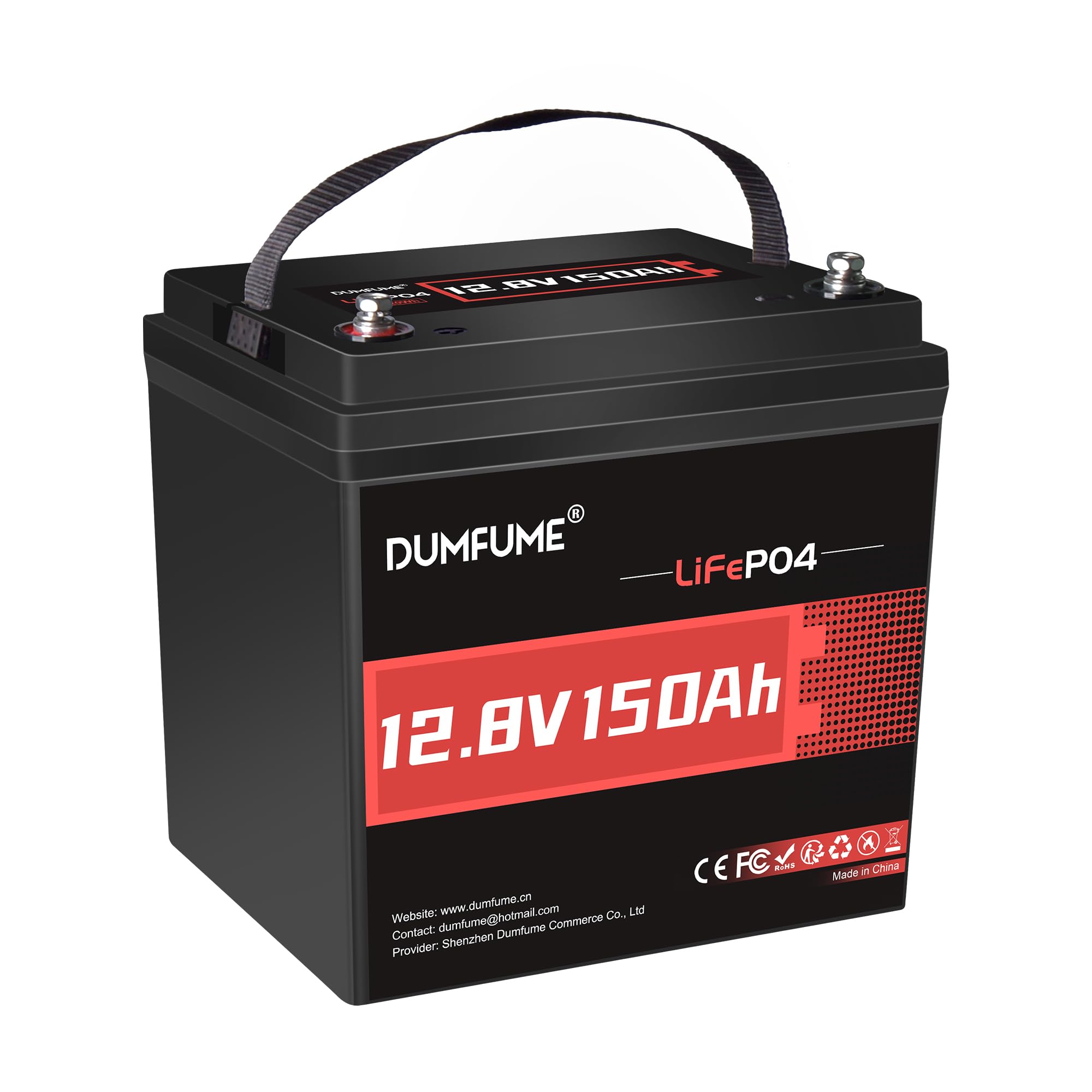
| DUMFUME 12V 150Ah MaxMost Amp-Hours Per Pound | Off-grid solar storage | 150 Ah | 100 A | 22.1 lb | Amazon |
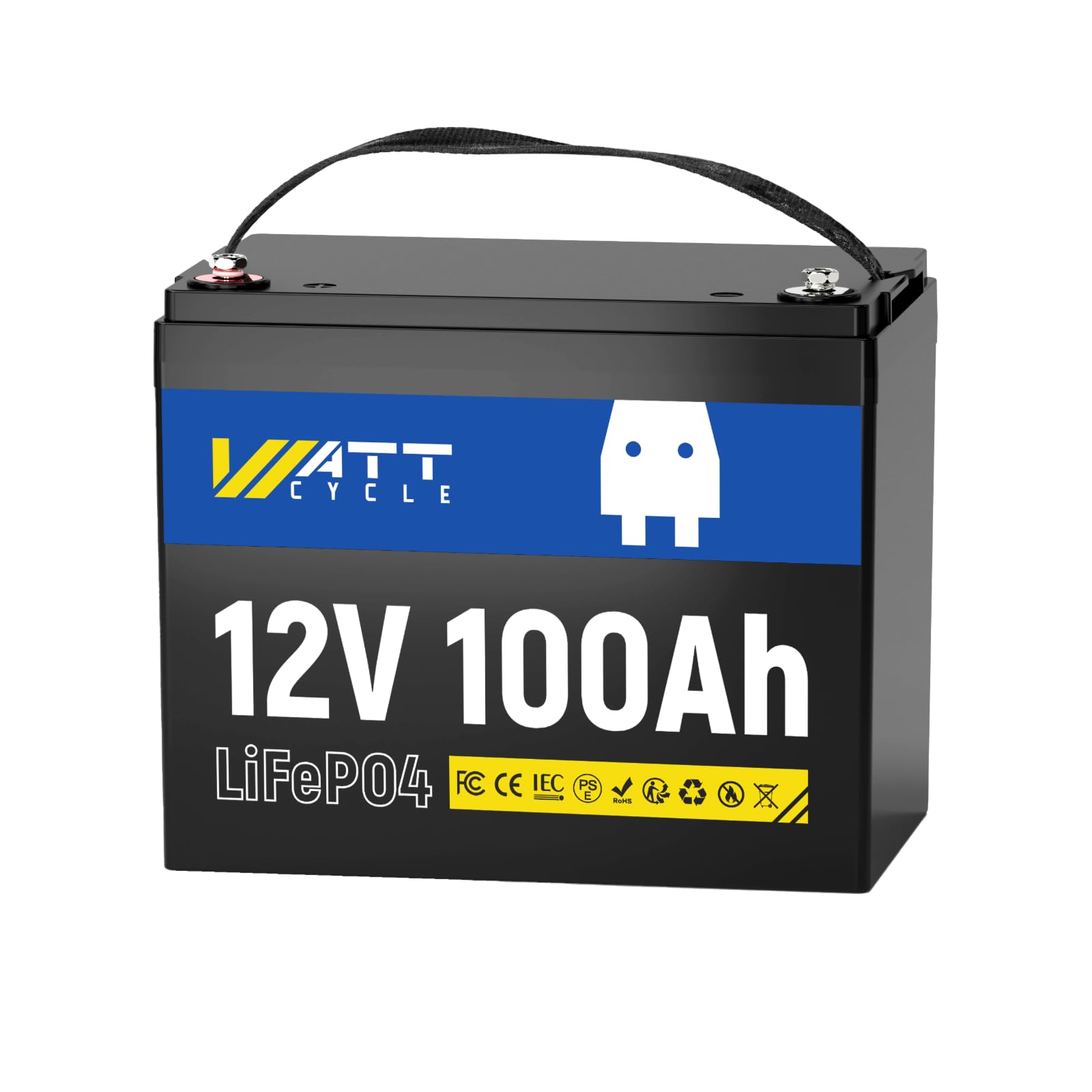
| WattCycle 12V 100Ah Group 24Entry-Level Price | Budget trolling motor setups | 100 Ah | 100 A | 23.2 lb | Amazon |
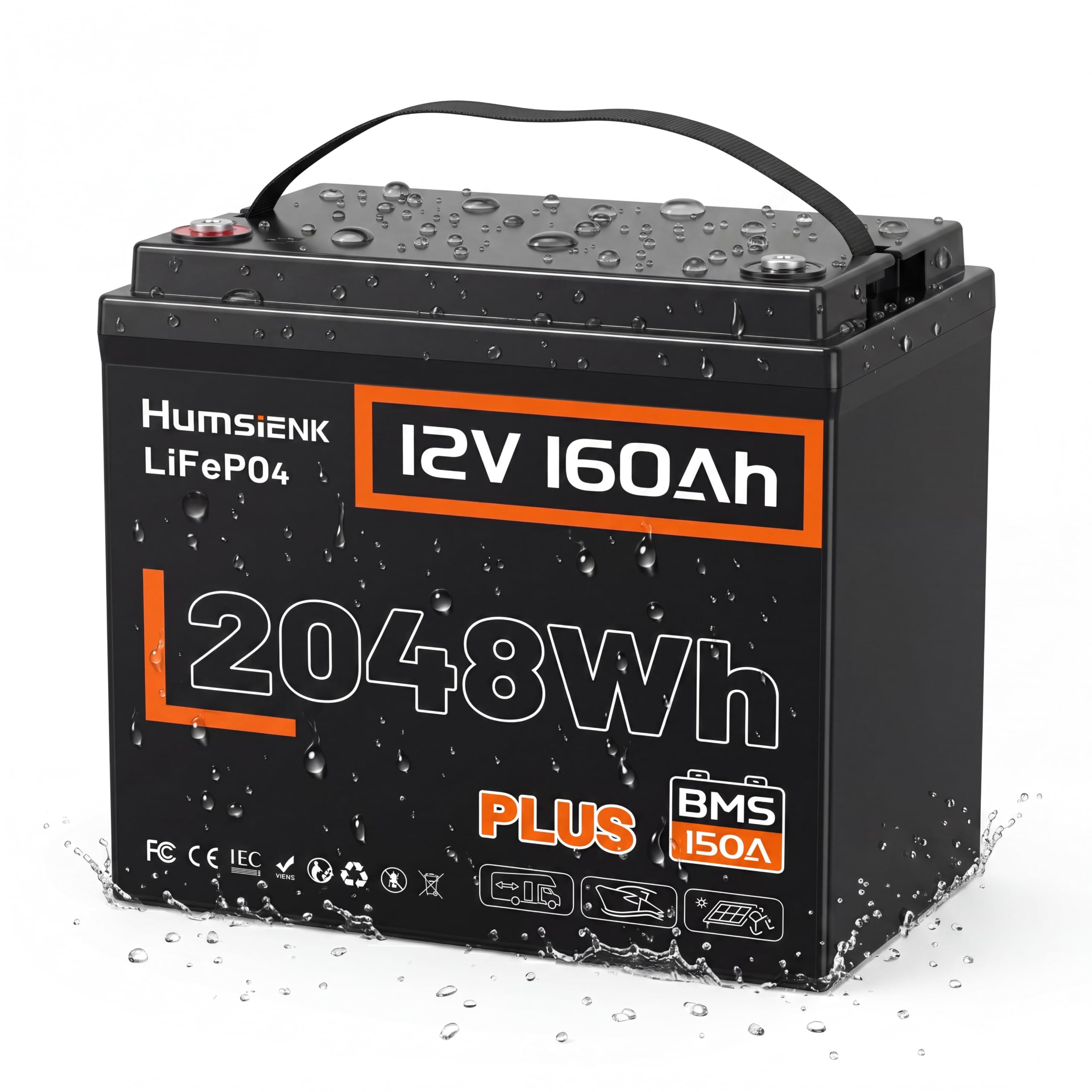
| HumsiENK 12V 160Ah Plus | High-draw appliance power | 160 Ah | 150 A | 41.2 lb | Amazon |
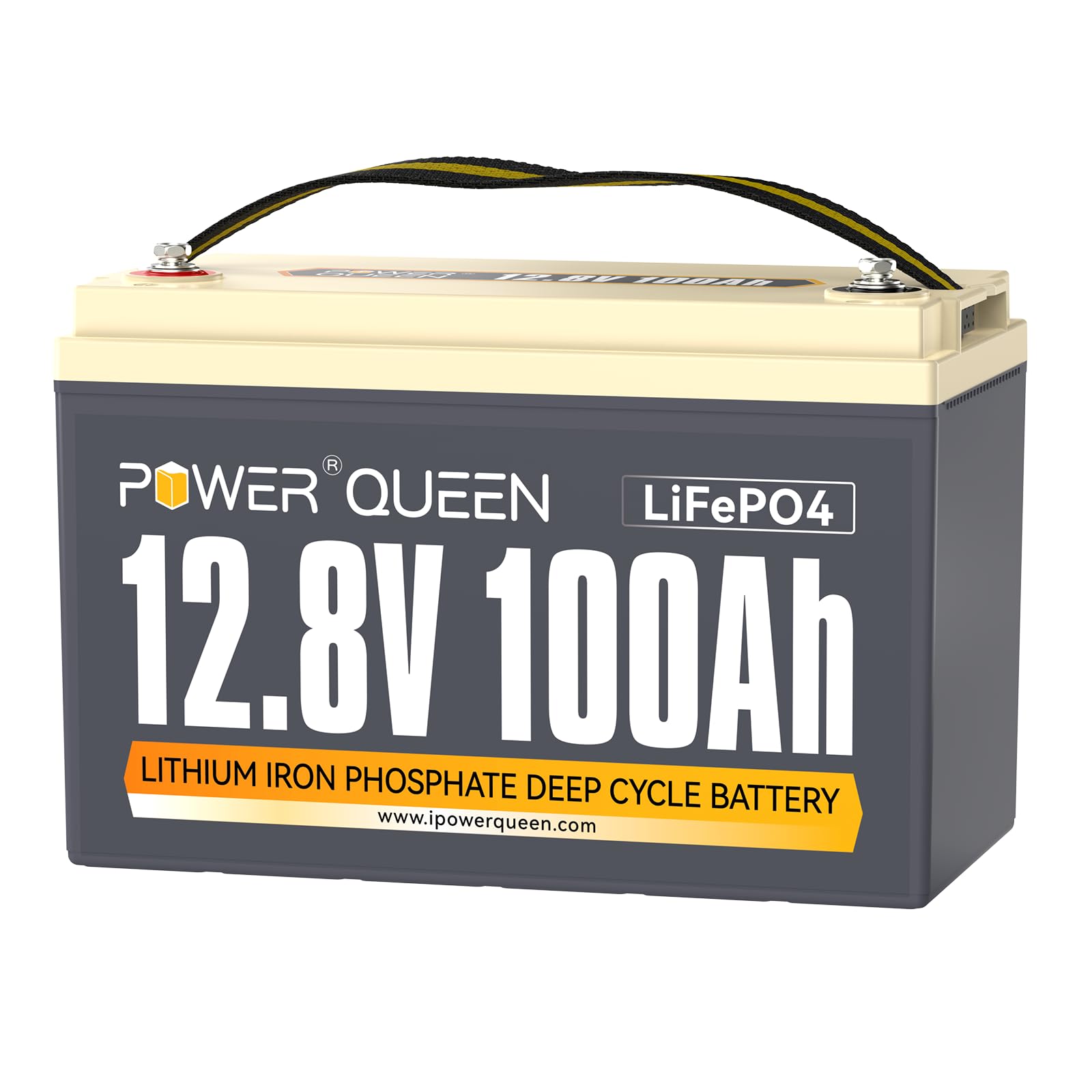
| Power Queen 12V 100Ah Group 31 | Long-life trolling motor power | 100 Ah | 100 A | 24 lb | Amazon |
| Power Queen 12V 125Ah Group 27 | Bluetooth monitoring fans | 125 Ah | 100 A | 25.1 lb | Amazon |
| Redodo 12V 100Ah Group 31 | All-day work loads | 100 Ah | 100 A | 22 lb | Amazon |
| LiTime 12V 100Ah Group 31 | Campers wanting app data | 100 Ah | 100 A | 22.2 lb | Amazon |
| ECO-WORTHY EnergyRock 280Ah | Campervans and bigger AC loads | 280 Ah | 200 A | 60 lb | Amazon |
| LiTime 12V 165Ah Group 31 | Big banks and four-season use | 165 Ah | 165 A | 32.2 lb | Amazon |
| VATRER POWER 12.8V 460Ah | Whole-RV off-grid living | 460 Ah | 300 A | 104.7 lb | Amazon |
In‑Depth Reviews
1. Marsenergy 12V 100Ah LiFePO4 Battery, BCI Group 24 Size, 100A BMS
Our pick — over 4.5★ from 250+ verified ratings; the strongest balance of quality and price.
The 21-pound drop-in that swaps straight into your old Group 24 box.
This is the pick for the owner whose trailer is already wired for a Group 24 battery box and who does not want to re-drill a single hole. You get 100 amp-hours of capacity, a steady 12.8 volts from the LiFePO4 chemistry, and a 100-amp BMS — the circuit board that shuts the battery down the instant it sees a short, an over-voltage, or a heat spike. Weighing 21 pounds, it takes a serious load off your trailer tongue compared with the lead-acid brick it replaces.
The numbers behind that lifespan are worth spelling out. At a full 100% depth of discharge — meaning you drain it flat every time — Marsenergy rates 4500 deep cycles. Ease off to 80% DOD and it claims 8000 cycles, and at a gentle 60% DOD it claims 15000. A lead-acid battery typically manages 300-500 cycles, so you are buying a battery you will likely never replace again.
Against the DUMFUME’s 150Ah, you give up 50Ah of capacity to save the weight and the space. If your loads are modest and your box is small, that trade is the right one. Just know it is an energy-storage battery, not a starter, and the BMS will cut charge at 32°F so cold-weather campers need a plan.
What earns it the top spot
- 100Ah of capacity and a 100A BMS, so it runs fridges, lights, and trolling motors without fuss — the thing buyers keep coming back to is simply the build quality
- 21 pounds with a 10.16 x 6.54 x 8.64-inch footprint, so it drops into an existing Group 24 box with no modification
- 4500 deep cycles at 100% DOD means the battery most owners will never replace again
- Sealed and waterproof, with BMS protection against short circuit, over-voltage, and abnormal temperature
What to weigh before you click
- The BMS cuts charging at 32°F, so it needs a warm place or a heated setup in a hard freeze
- Sleep mode after a fault needs a manual wake-up before the battery will run again
- It is an energy-storage unit only — it is not built to start an engine
Best for: anyone with a factory Group 24 battery box who wants a like-for-like lithium swap with zero fabrication.
The honest limit: if you need more than 100 amp-hours for a big inverter load, look further down this list.
2. DUMFUME 12V 150Ah Max LiFePO4 Battery, IP65 Waterproof 100A BMS
Double the usable energy over the Group 24 pick, at barely more weight.
Load up 1920Wh of stored energy — that is 150 amp-hours at 12.8 volts — and you have enough to run an RV fridge, a few lights, and a laptop all weekend without dragging out a generator. That is exactly the kind of leap that makes buyers confess they added two more after their first pair worked.
The IP65 rating is the detail worth knowing. IP65 means the case is sealed against dust and against water sprayed from a nozzle, so rain and road splash will not get inside — a real advantage for a battery living on an open trailer tongue. Inside, a 100A BMS guards against overcharge, over-discharge, short circuit, and overheating, and the unit is rated for over 4000 cycles to 80% capacity.
The honest catch is cold weather. DUMFUME states the battery needs temperatures of 5°C or higher for full performance, and low-temperature charging issues fall outside the return window. Expect to jump-start a stubborn new unit, too — a fresh pair arriving around 12.2 to 12.4 volts sometimes needs a nudge from a charged battery before the BMS will let it accept a charge. Size it for the mild months and it will pay you back in runtime.
Where it pulls ahead: at 150Ah it carries 50% more capacity than a 100Ah unit in a body only about an inch taller and wider, so you get the extra runtime without giving up floor space.
Plan for: a first charge that may fight you in the cold, and a full maintenance cycle every 6 months during long storage.
Reach for this if you are building a solar or off-grid bank and want the most amp-hours per pound on the list.
Look elsewhere if you camp through hard freezes — the 5°C charging floor is the trade-off here.
3. WattCycle 12V 100Ah LiFePO4 Battery, BCI Group 24
The cheapest way onto the lithium ladder — and the smallest case here.
If a trolling motor or a small camper is your whole load, WattCycle covers it for the least money on this page. The case measures just 10.2 by 6.6 by 8.2 inches and weighs 23.2 pounds, making it the most compact 100Ah unit here — so it fits boxes where the larger Group 31 bodies will not. It runs a steady 12.8 volts at 100 amp-hours and is rated for up to 15000 cycles.
Wiring flexibility is where it earns its keep. You can run four batteries in series or four packs in parallel, which stretches a single-battery buy into a 20.48kWh system down the road without changing brands. The built-in 100A BMS cuts the battery free if discharge current ever spikes past 300±50A, and the operating range stretches from -4°F to 158°F, so it is rated to keep working where a lead-acid would fade.
Set expectations on reliability. The unit’s Bluetooth app has drawn more mixed feedback than its battery hardware — the hardware itself is what most owners rate highest — and one real-world pack did suffer cold-weather BMS lockups, though WattCycle covered all three units under its 5-year warranty and paid the return shipping. For a low-draw weekend setup, that risk is small; for a critical system, spend up.
The case for the cheapest pick
- Smallest footprint here at 10.2 x 6.6 x 8.2 inches, so it squeezes into tight battery compartments
- 15000 cycle rating makes it a long-haul value buy, not a short-term one
- Up to 4 series and 4 parallel connections let you build a system incrementally
- Rated to operate from -4°F to 158°F for a wide range of climates
Where it gives ground
- Bluetooth app performance is the most-criticized part — the battery hardware carries the reputation, not the app
- Cold-shutdown behavior has tripped up some units, requiring a BMS wake-up
- The newer brand has less long-term track record than the bigger names here
Made for: a budget trolling motor rig or a light camper where every dollar and every inch of box space counts.
Think twice if: you want proven long-term reliability on a critical off-grid system — that is worth spending past this pick.
4. HumsiENK 12V 160Ah Plus LiFePO4 Lithium Battery, 2048Wh Energy 150A BMS
The pick that powers the air conditioner and the fridge at the same time.
One number separates this battery from most of the list: 1920 watts of continuous output. The 150A BMS (150 amps of allowable draw) is what makes that possible, and it is what lets you run a bigger inverter without the battery tripping offline. Add the 2048Wh of stored energy — that is 160 amp-hours at 12.8 volts — and it is clear this unit is built for people whose loads actually hurt, not just a fridge and a couple of fans.
HumsiENK also did the install math for you. At 41.2 pounds and measuring roughly 10.07 by 7.66 by 9.99 inches, it is rated 66% lighter and 50% smaller than two 12V 100Ah lead-acid batteries, which means one person can lift it into place in the time it takes to disconnect the old pair. If you want growth room, it supports up to 4 series and 4 parallel connections, stretching to a 32.76kWh bank.
Two things to sort before it lands. First, it needs an LFP charger — a standard lead-acid charger may not bring it up properly. Second, fresh-from-the-box units have arrived nearly depleted, so a slow top-off charge can take a couple of days before it behaves normally. The payoff is 10+ years of low-maintenance service on 6000+ cycles at 80% depth of discharge.
Why the extra amps matter: a 150A BMS is the difference between a battery that browns out when your coffee maker and microwave fire together and one that keeps running.
Set-up note: budget a couple of days for the initial charge if it arrives flat, and expect to need a lithium-specific charger.
Best match for an RV or van running high-draw appliances like an AC or a fridge through an inverter.
The caveat: you must pair it with an LFP charger — a standard one may leave it short.
5. Power Queen 12V 100Ah Group 31 LiFePO4 Lithium Battery for RV, Marine
The trolling-motor battery that keeps going long after the sun quits.
The spec that matters here is Group 31. That is a larger case standard than Group 24, and its shape aligns the terminals the way many boat decks and older RV trays are wired, so the swap is drop-in rather than re-drilled. Power Queen puts 100 amp-hours and a 100A BMS into that case at 24 pounds — roughly a third of what the lead-acid battery it replaces weighs — and rates it at a 3% self-discharge rate, meaning it will still be near full when you pull the cover off next season.
What wins the boat owners over is endurance on the water. Owners routinely credit it with a full day of trolling and often more, holding strong voltage at top speed and recharging fast on a standard charger. The 4S4P expansion path means a single battery becomes a 20.48kWh bank if you ever need one, so it is a size that stays useful.
The honest note is on the terminal hardware: the factory bolts are short and the threads can feel delicate when you stack multiple lugs, so buy slightly longer stainless hardware if you are running a big bank. A single report of a battery dying after four days of hard golf-cart use also exists in the mix — treated as a fit-and-load mismatch rather than a pattern. For typical trolling and camper duty, owners keep coming back for these.
What keeps owners coming back
- Group 31 footprint aligns with many factory boat and RV trays for a true drop-in swap
- 24 pounds replaces a lead-acid unit that can weigh three times as much, freeing space and tongue load
- 3% self-discharge rate means it holds its stored energy for months of storage
- Expands to 4S4P for up to 20.48kWh if your needs grow
Where to be careful
- Short factory terminal bolts can feel delicate with stacked lugs — upgrade them for bigger banks
- Heavy-duty golf-cart use has drawn isolated reports of early failure, so match capacity to your real draw
- Battery life has drawn mixed feedback at the extreme end of draw
Made for trolling-motor owners and RVers whose existing tray already uses the larger Group 31 case size.
Not the pick if you have a Group 24 box — the case is wider and will not slide in.
6. Power Queen 12V 125Ah LiFePO4 Lithium Battery Group 27 Bluetooth for RV
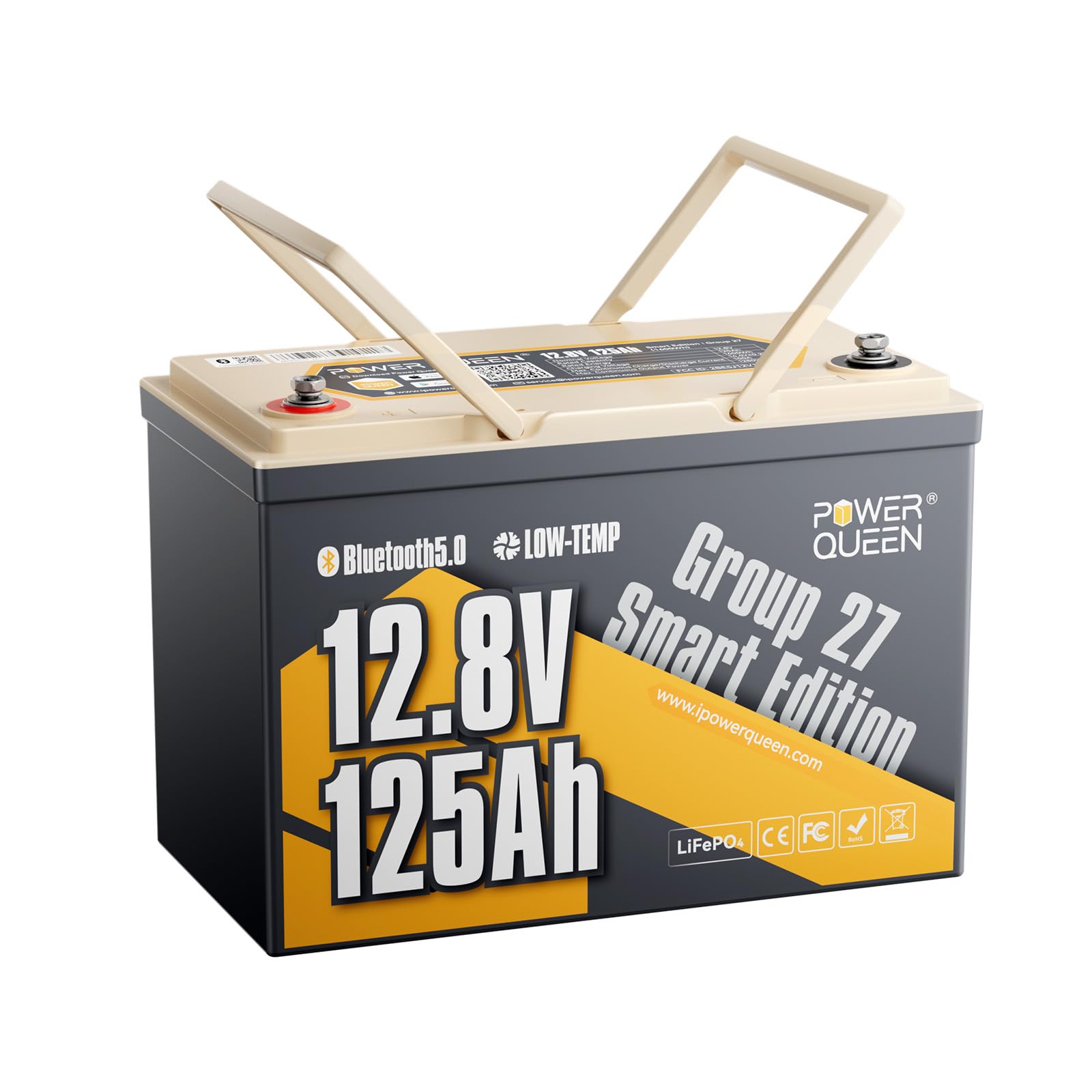
Watch every amp move on your phone, no wiring required.
Power Queen built the Bluetooth 5.0 module into the case, so you scan the QR code on top and immediately see state of charge, voltage, current, temperature, and protection status on your phone. At 1600Wh — 125 amp-hours at 12.8 volts — it delivers 320Wh more stored energy than a same-size 100Ah lithium battery, and Power Queen rates that extra runtime as about 32 hours more on a 10-watt light. That makes it the right pick if you want to stop guessing whether the fridge can run one more night.
The smart BMS carries 20+ protections, including the low-temperature cutoff that stops charging below 32°F and discharging below -4°F, so winter storage is safe without you thinking about it. A pre-charge function helps it talk to most inverters, and the unit automatically resumes power about 30 seconds after an overload trip — handy when you accidentally fire up too much at once.
The app is the honest trade-off. It does what you ask, but owners note it can be finicky about connecting, and it is not as polished as the battery underneath it. If you want a tool, not a gadget, this unit still wins on data alone; just know the app comes with a learning curve.
The standout: the built-in Bluetooth app shows charge and discharge in real time, so you see exactly how fast the fridge is draining you and how fast the panels are refilling it.
Expect: a Group 27 case that fits more trays than the smaller Group 24, and around 10 meters of Bluetooth range for monitoring.
Grab this if you want live data on your phone and a bit more runtime than a standard 100Ah unit.
skip it if you hate app-based gear — the app is a big part of the value here.
7. Redodo 12V 100Ah LiFePO4 Battery, Group 31, for RV, Marine
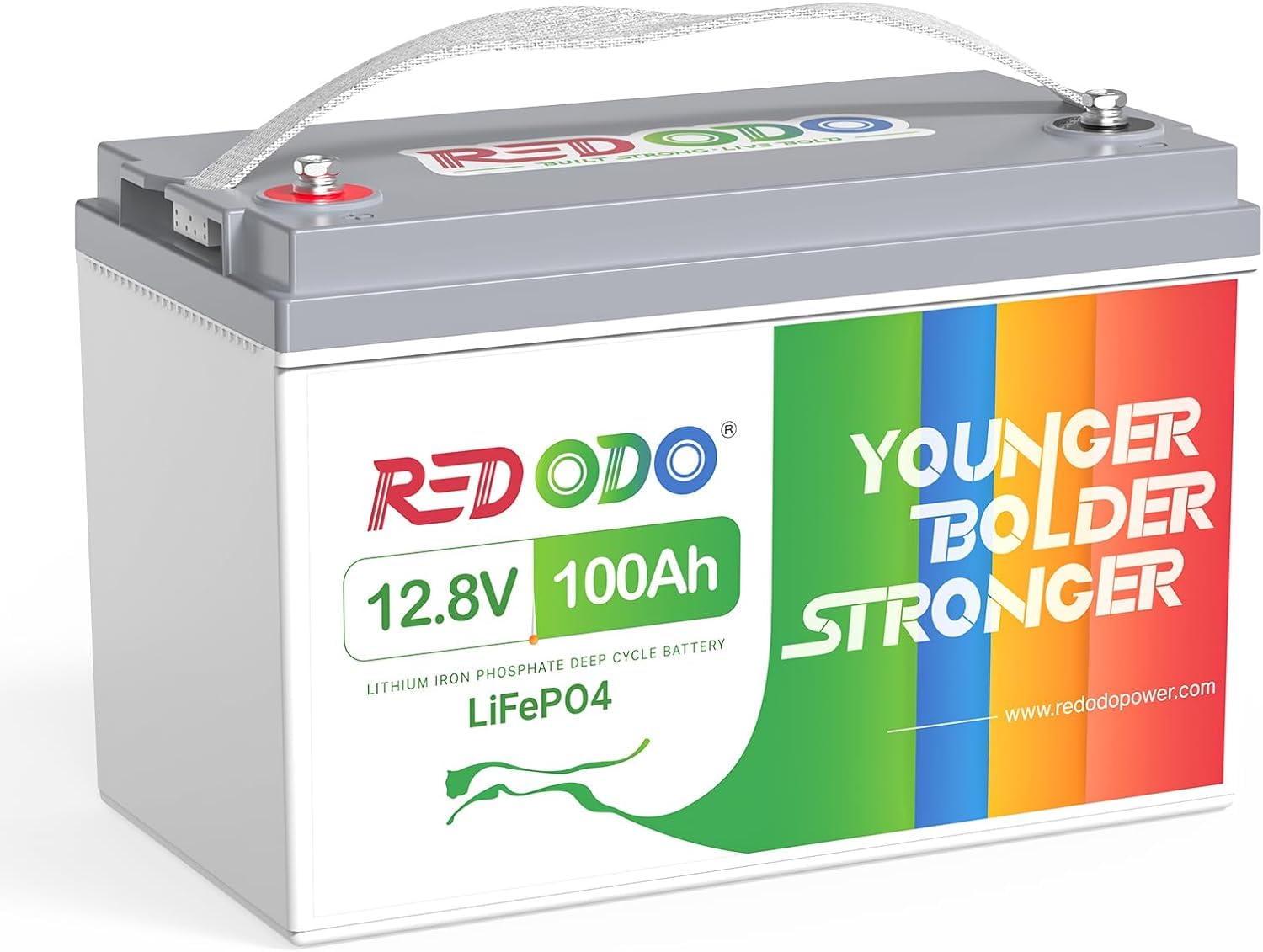
The high-turnover favorite for work fleets — cheap lithium that just runs.
You can tell a battery is working when pool companies switch their whole fleet to it. That is the Redodo story: it replaced lead-acid batteries that had been failing every three to four months in portable pool vacuums, and the crews found them lasting all day without the power sagging toward the end. What makes the case is the energy density — 58Wh per pound versus about 20Wh per pound for the typical lead-acid equivalent.
The specs back that up. Redodo rates 4000 cycles at 100% DOD, 6000 at 80% DOD, and 15000 at 60% DOD, for a stated 10-year lifetime, with a self-discharge rate of only 3% versus 15-30% for lead-acid. At 22 pounds and measuring 12.99 by 6.82 by 8.46 inches, it suits a BCI Group 31 box and offers 100Ah of capacity on a 100A BMS.
Fair warning about charging: it is a smart battery without Bluetooth, and independent reviewers report it prefers a proper lithium profile to charge fully. Charging from solar with the right MPPT controller works cleanly, but some factory RV converters need manual configuration. Buy it for the reliability and the price, and pick a good charger.
Where the value lands
- 58Wh per pound energy density beats the lead-acid equivalent’s 20Wh per pound, so you get far more usable power per pound you carry
- 3% self-discharge rate means it does not lose its charge sitting on the shelf
- Group 31 case fits standard trays and replaces a much heavier lead-acid unit
- Strong support reputation — buyers report fast warranty replacement when things go wrong
What to plan around
- No Bluetooth, so you need a separate shunt or monitor to see state of charge
- Some factory converters need setup for lithium charging, so a proper charger is worth the extra
- An occasional unit has failed inside warranty — but replacements arrive quickly
Best fit for work crews and long-haul trailer owners who want cheap lithium with a long warranty track record.
Only skip it if you specifically want app-based monitoring built in.
8. Litime 12V 100Ah LiFePO4 Battery, Group 31 Lithium Batteries for RV, Marine
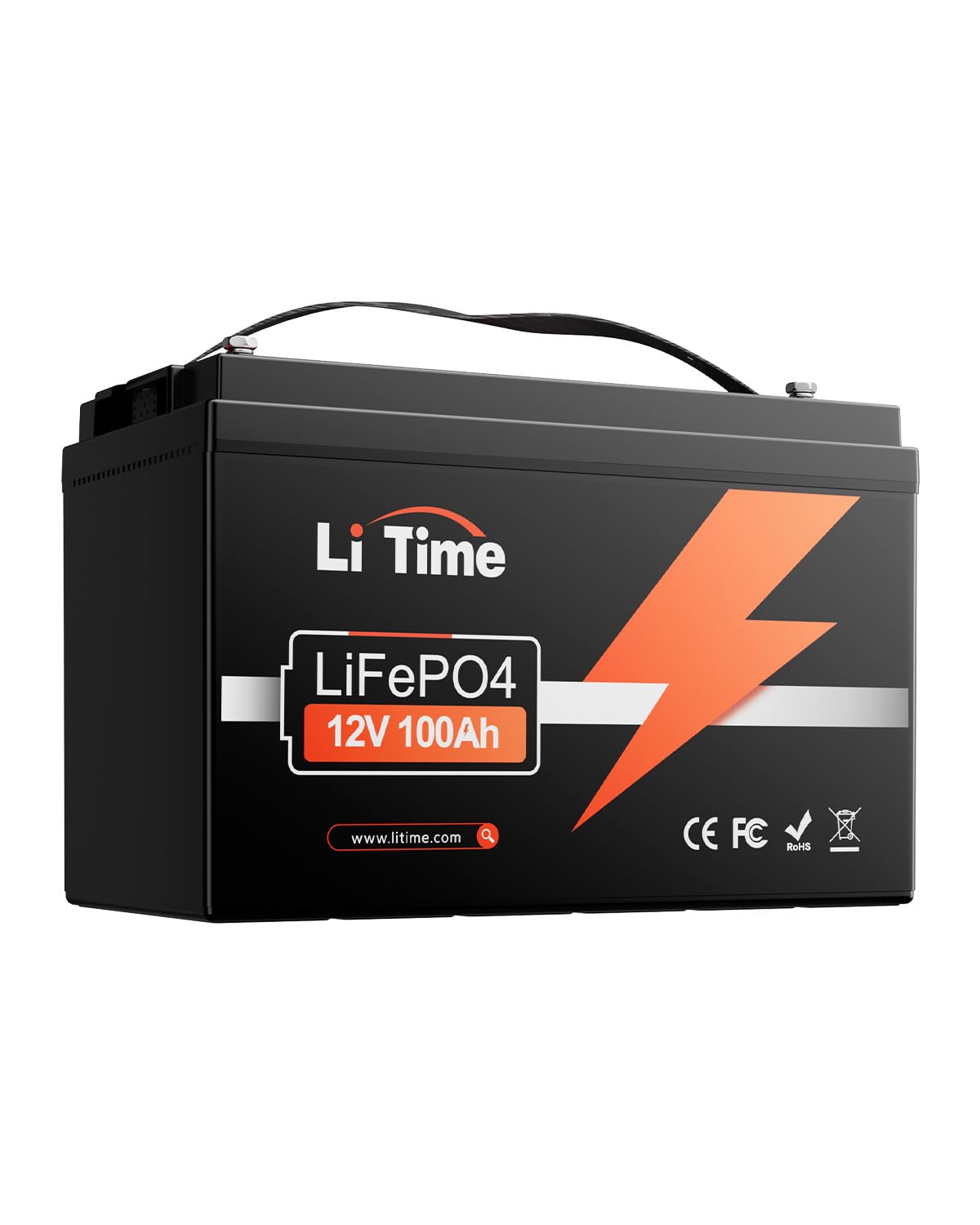
The premium-feeling battery with UL certification under the hood.
This is the one to buy when you want third-party documentation to back the safety story. The LiTime 12V 100Ah is built on A+ grade automotive cells and carries UL and FCC certifications — a level of testing few competitors on this list advertise. You still get 100Ah of energy in a Group 31 case, and 100A of BMS protection with 20+ safeguards against overcharge, over-discharge, over-current, and short circuits.
The BMS numbers are impressive when you dig in: 1280 watts of continuous output and a 500-amp peak for one second, enough to absorb the surge of a compressor starting. The case is IP65 sealed, meaning a water jet will not get past the gasket. At 22.2 pounds, the box is light enough for one-handed installation, and LiTime rates 4000 cycles at 100% DOD or 6000 at 80%.
The follow-up question owners ask is about the app: this specific model is a no-Bluetooth unit, so you will need a shunt if you want live data. LiTime also requires charging through a lithium-activation or MPPT charger to properly wake the battery on first use. Meet those two requirements and this battery delivers the calmest ownership experience in the price range.
Certifications to note: the UL and FCC external testing certification is the credibility signal buyers in this price bracket ask for.
Two things to know: there is no Bluetooth monitoring on this model, and first-time activation requires a lithium-specific charger.
Choose this for an RV or boat where third-party certification and clean, quiet reliability matter more than app features.
The caveat: grab a shunt monitor alongside it — there is no app to check your state of charge.
9. ECO-WORTHY EnergyRock 12V 280Ah Metal Case LiFePO4 Lithium Battery
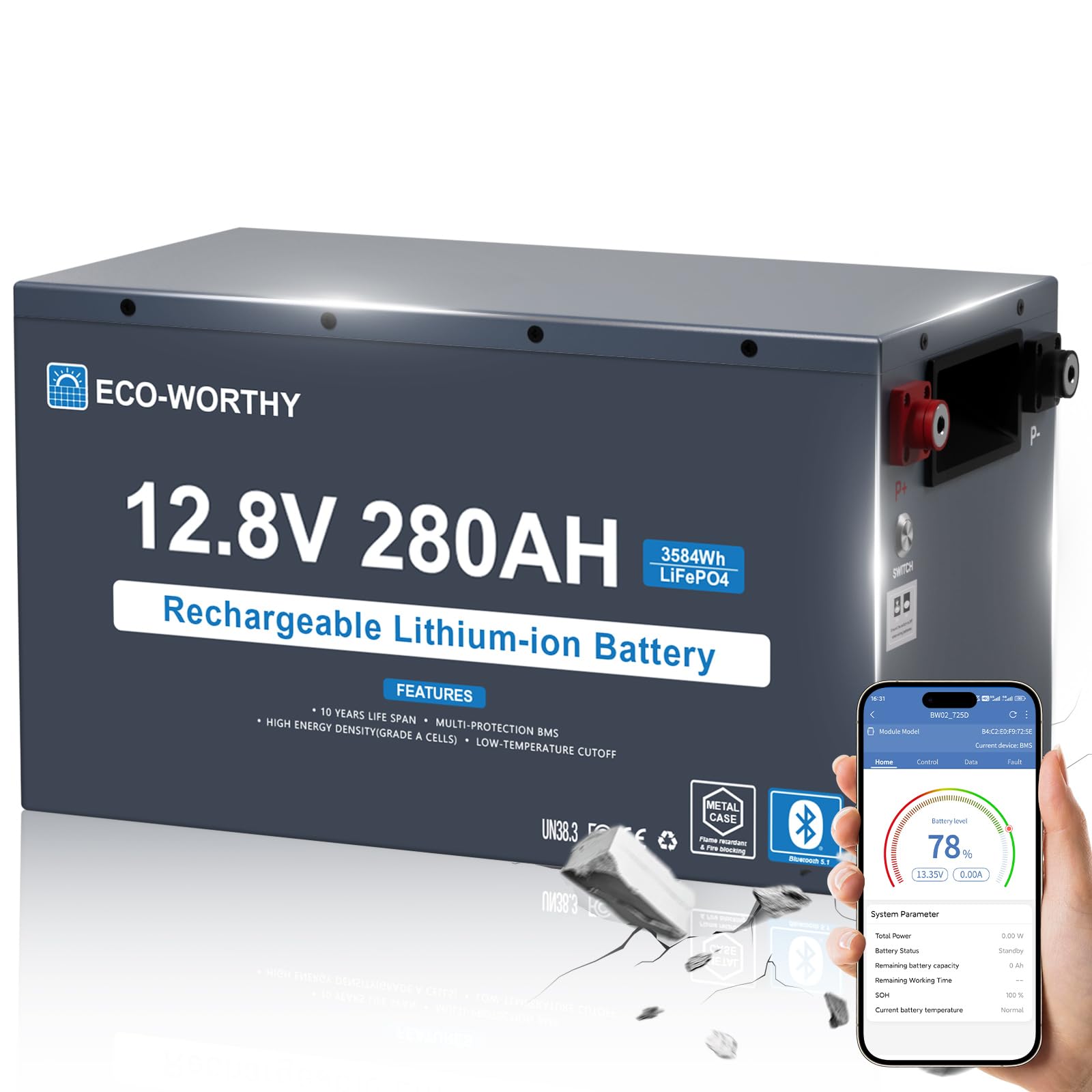
A 280-amp-hour powerhouse wrapped in a fire-resistant metal case.
If you are building a van and want one box that will run the air conditioner without flinching, this is the pick. The 280Ah capacity delivers 3584Wh of usable energy, and the 200A BMS gives enough continuous current to start a big inverter without tripping. The metal enclosure is the real design statement — it is the reason this battery tolerates heat, resists shock and vibration, and does not need an extra battery box strapped around it.
The conveniences stack up nicely. There is a one-touch safety switch that disconnects the output so you can work on the wiring without sparks, and four mounting feet let you bolt it straight to the floor of a van or camper. The Bluetooth app shows voltage, capacity, and charge/discharge status, and the 200A BMS includes low-temperature protection that cuts charging in the cold to protect the cells.
The trade-off is weight: at 60 pounds, this is a two-person lift and requires a vehicle that can carry it. The upside is that owners of campervan builds report it running a 12,000-BTU portable AC plus lights and dropping to 30% after two hours, and an RV owner who upgraded from 110Ah of AGM now runs two of these at 560Ah total at roughly the same weight as the old battery. For serious off-grid duty, that weight-for-capacity trade is fair.
What makes it the rugged pick
- Metal case resists heat, shock, and vibration, and does not need an extra box
- 200A BMS handles big inverter loads and startup surges without tripping
- Safety switch cuts output instantly for safer wiring and maintenance
- Mounting feet and a flat top allow permanent installation and stacking
The practical constraints
- 60 pounds is a two-person lift and demands space in your build
- Cold-weather charging still cuts off below freezing — plan for a heated compartment
- Shipping can arrive in multiple packages at different times
Right for: campervan and off-grid builders who need big capacity and want a battery that installs without a separate box.
Not for: anyone with a strict weight budget or a Group 24 slot — this needs proper real estate.
10. LiTime 12V 165Ah Group 31 LiFePO4 Lithium Battery for RV Marine Boat
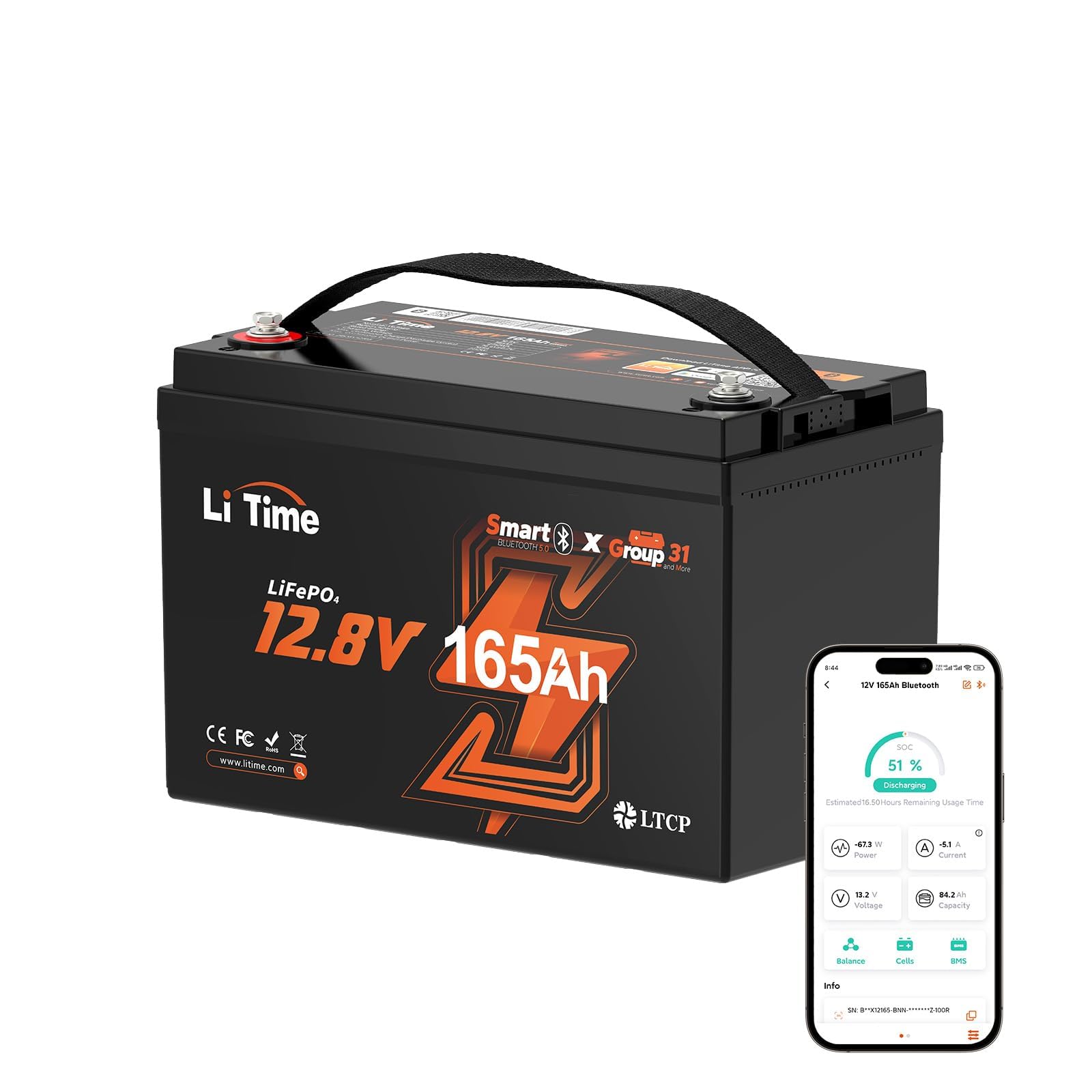
The all-season battery with the amp rating to match its capacity number.
LiTime named this battery after its two headline numbers: 165 amp-hours of capacity and a 165A BMS. That pairing is deliberate — most batteries pair a bigger capacity with a modest 100A BMS, which can leave you short on current when you want to run a big inverter. Here the BMS matches the capacity, so 2112Wh of stored energy is actually usable under real load.
The protection bundle is where this model earns its keep in colder climates. Low-temperature cutoff stops charging below 32°F and discharging below -4°F, and the case is rated IP65 waterproof and salt-fog resistant — a real advantage on a boat. Bluetooth 5.0 auto-connects so you can monitor and even shut off discharge from your phone, and 20+ BMS safeguards cover the usual overcharge, over-current, and over-temperature risks. Expandable to 33.79kWh if you want to grow.
Two practical quirks owners mention: the Bluetooth module may need a first charge with a lithium-activation or MPPT charger to come alive, and a fully charged unit fresh from the start sometimes needs one discharge cycle before it will accept a fresh charge. Also note this model is not built for engine starting — pair it with a proper charger and it will behave.
The defining value: a 165A BMS that matches the 165Ah capacity, giving you more usable current than a same-capacity unit limited to a 100A BMS.
Know before you buy: the Bluetooth needs a lithium-specific charger to activate, and a fully charged unit may need a discharge cycle before it charges again.
Worth having for a boat or RV where cold-weather protection, big current, and app monitoring all matter at once.
One caution: bring a lithium-rated charger — the app module will not wake to a standard one.
11. VATRER POWER 12.8V 460Ah Self-Heating LiFePO4 RV Battery, APP Monitoring
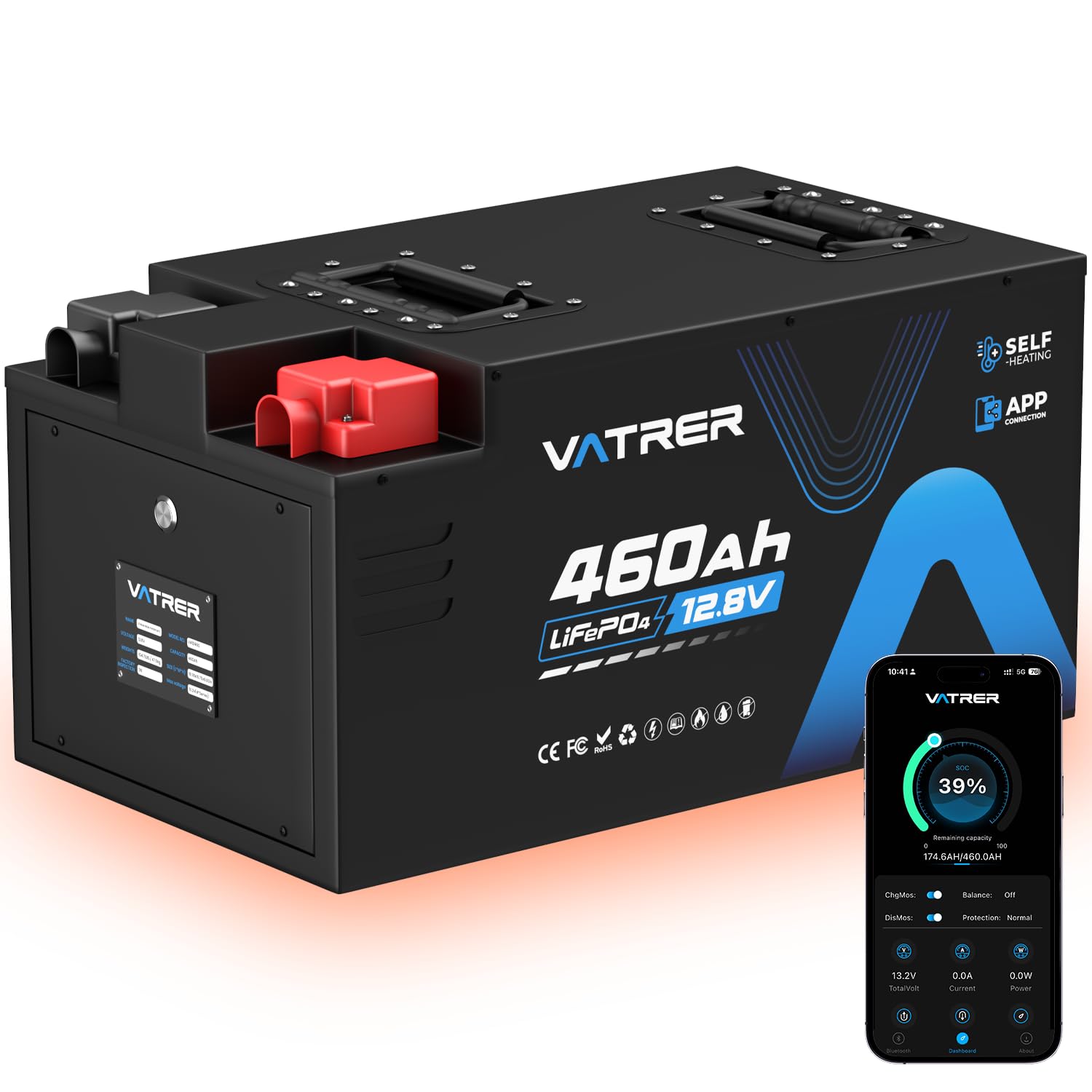
One battery doing the work of five, with heating for cold-morning starts.
Everything about the VATRER POWER is oversized for the people who want to stop thinking about power. Sitting under the hood of this unit is 460Ah of capacity in a case measuring 18.9 by 10.82 by 9.84 inches — the maker points out that is the equivalent of five 100Ah batteries packed into 1.1 cubic feet of space. The 300A BMS means the current is there when you want to fire up an air conditioner, a TV, or an oven without any hunting for headroom.
The self-heating function is the standout trick. When the battery is hooked to a charger in temperatures between -4°F and 41°F, the BMS kicks on a heating circuit — and once the cells hit 41°F, the heater stops and normal charging begins. That removes the single biggest headache of winter RVing: waking up to a battery that refuses to take a charge. The case is a heavy-duty SPCC metal enclosure with a main power switch on the front and a 5-year limited warranty from a manufacturer that offers 24-hour phone and online support.
The trade-off is physical. At 104.7 pounds, this is a serious installation that wants a helper, and Bluetooth range through the metal case is shorter than you would hope — some buyers find they need to be right next to it. Owners still describe the build quality and reliability as the standout, and one long-term user summed it up: “I’ve spend the last year putting this thing through the test.” For a whole-RV power center, that confidence is the point of the 460Ah capacity.
Why the big spenders pick this one
- 460Ah with a 300A BMS means you can run AC, coffee maker, and fridge together on one unit
- Self-heating raises cell temperature to 41°F before charging, so winter mornings do not stop you
- SPCC metal case with a main power switch supports a clean, permanent install
- 5-year warranty with 24-hour phone and online support for the long haul
What to plan for
- 104.7 pounds must be lifted into place witha second set of hands
- Bluetooth range through the metal case is short, so monitoring happens close to the battery
- It is an energy-storage battery only — never use it as a starter battery
Built for full-time RVers and off-grid builds that need one battery to power a whole coach year-round.
Think hard before buying if your rig cannot safely carry 104.7 pounds — this is not a grab-and-go unit.
Understanding the Specs
Amp-Hours — How Big the Tank Is
Amp-hours tell you how long the battery will run something before it needs a recharge. A 100Ah battery can supply 10 amps for ten hours, or 5 amps for twenty — the math scales with the load. Step up to a 150Ah or 280Ah unit and you get proportionally more runtime for the same load. Match the amp-hour rating to the draw of your appliances: a small fridge or a trolling motor runs comfortably on 100Ah, while an air conditioner or a big inverter load wants a 200Ah or higher unit. Amp-hours decide how long; a separate number, the BMS rating, decides how much current you can pull at once.
BMS Rating — The Current Ceiling
The BMS is the small circuit board built into every LiFePO4 battery that watches the cells and cuts power if anything goes wrong. The number after “BMS” is the continuous amp rating — for example, “100A BMS” means 100 amps of steady current can flow before the board trips. That number caps the biggest load you can run through one battery. A 100A unit powers a fridge or a small inverter comfortably; a 200A or 300A BMS is what you want before you plug a big AC unit into an inverter. Pair a low BMS rating with a big load and the battery will shut off to protect itself.
Weight and Case Size
Weight is the most obvious reason people switch to lithium. A 12V LiFePO4 battery typically weighs roughly a third of the equivalent lead-acid unit, so tongue weight, boat balance, and installation effort all improve. Case size matters just as much because it determines whether the battery drops into your existing box. Group 24 is the smaller standard case, and Group 31 is slightly larger for higher-capacity batteries. Check your current battery’s group size before you order and confirm the replacement matches. A drop-in fit saves you cutting holes in your trailer or RV tray.
Cycle Life and Cold-Weather Cutoff
Cycle life is the number of times you can drain and recharge the battery before it drops to 80% of its original capacity. Lead-acid manages a few hundred cycles; LiFePO4 chemistry typically reaches thousands, which is why one purchase often lasts the life of the vehicle. Depth of discharge matters too — draining to 100% every time wears the battery faster than stopping at 60%, and ratings reflect that difference. Cold weather is the other key number: lithium batteries cannot be charged below freezing without risking damage, so every quality model cuts charging off at or near 32°F. If you camp in winter, look for a unit with explicit low-temperature cutoff or self-heating.
FAQ
Will a 12V LiFePO4 battery drop into my existing battery box?
How many years does a LiFePO4 battery actually last?
Can I run two batteries in parallel to get more runtime?
Will a LiFePO4 battery work in freezing temperatures?
Do I need a special charger for a lithium battery?
Can I start my car or RV engine with a LiFePO4 battery?
What is a BMS and why does the amp rating matter?
How much lighter is a LiFePO4 battery compared to lead-acid?
Can I use my existing solar panels without changing the controller?
What happens if I leave a LiFePO4 battery stored for months?
Final Thoughts: The Verdict
If you want the one to buy without more research, the 12 volt lifepo4 battery that earns the most return for the most people is the Marsenergy 12V 100Ah Group 24 — it accepts the existing Group 24 box, drops 40-plus pounds of tongue weight, and delivers 4500 deep cycles. If you want a bigger tank without a bigger lift, grab the DUMFUME 150Ah, which packs 1920Wh into a 22.1-pound case. And for whole-coach off-grid living, the VATRER POWER 460Ah is the one to reach for — just plan for its 104.7 pounds.
How We Picked
We do not accept paid placement. Every pick is matched to a real buyer and a real use-case; we do not hands-on test units.
Sources & Methodology
Specifications: manufacturer listings and product documentation. Review insights: verified customer reviews, as of September 2026. Pricing: not shown on this page (it changes often); check the current price via the retailer link.
As an Amazon Associate, KitchPrep earns from qualifying purchases. This does not affect which products we feature.
Related Guides
