
Specs are compiled from manufacturer listings and verified buyer reviews and can change over time — please confirm the key details on the product page before buying.
If you want a small battery box that keeps your phone, laptop, and router alive when the wall socket dies, buy the biggest battery you can carry, not the biggest watt number on the box. A 100-watt class portable power station is a rechargeable battery with a built-in AC outlet. It runs lights, phones, laptops, fans, and small electronics during an outage or a camping trip. It will not run a space heater, a hair dryer, or a full-size fridge, and no pick here claims to. Note upfront: this list uses flexible matching for about 100-watt output, so it accepts same-type portable stations in the roughly 100 to 300 watt range rather than one exact number. The nearest same-type size serves the same purpose, and each pick below is labeled by what its listing states.
I’m Mohammad Maruf — the founder and writer behind KitchPrep. This guide is built by comparing the manufacturers’ published specifications and the patterns across verified customer reviews, so you get each pick’s real strengths and trade-offs instead of marketing spin.
Two numbers decide almost everything here. Battery capacity in watt-hours sets how long the box runs before it dies, and rated output in watts sets what it can safely plug in. Everything else — port count, charge time, battery chemistry — is a detail that makes one box easier to live with than another. The picks below are ordered by that reality, and here is the honest answer on the 100-watt generator.
Our Picks at a Glance


How To Choose The Best 100-Watt Generator
Start with capacity, not wattage. Capacity is the size of the tank, and wattage is the size of the tap. A box with more watt-hours runs your devices longer between charges, while the watt rating only tells you what it can safely handle at one moment. A laptop pulls far less than its charger’s rating, so a small box can run one for hours.
Capacity in watt-hours is the number that matters most
Watt-hours tells you the total energy in the battery. A 192Wh pack holds more than twice the energy of an 89.6Wh pack, so it runs the same fan or light for roughly double the time. Skip the milliamp-hour figure printed on the front of the box — watt-hours is the number that compares fairly across brands and voltages.
Battery chemistry sets how long the box lasts
LiFePO4 is a lithium battery formula known for a longer rated cycle count than standard lithium-ion cells. The trade-off is usually a slightly heavier box for the same capacity. If you plan to charge and drain the station regularly, this is where the extra weight buys you confidence.
Ports, charge time, and solar input
Count the ports you actually need: USB-C for a laptop, USB-A for phones, and an AC outlet for anything with a wall plug. Check the charge time from a wall outlet next, because a box that takes five hours to refill is harder to live with than one that fills in about an hour and a half. Solar input matters only if you plan to camp off-grid; a 100W solar input means you can pair a matching panel.
Quick Comparison
| Model | Best For | Capacity | Rated Output | Key Extra | Amazon |
|---|---|---|---|---|---|
| Anker SOLIX C200 DC★ Best Overall | All-round backup and camping | 192Wh | 200W | 140W two-way USB-C | Amazon |
| ZeroKor 120W Power StationFeatherweight Pick | Very light travel carry | 97.6Wh | 120W | 2.2 lb with handle | Amazon |
| MARBERO 88Wh M82Best for Emergencies | Long-running emergency light | 88Wh | 120W surge | 3-level LED, 68 hrs low | Amazon |
| DaranEner 89.6Wh (YOUYOR100) | Silent overnight backup | 89.6Wh | 100W | 500+ rated LiFePO4 cycles | Amazon |
| ZeroKor 100W R100 | Retail counters and outages | 146Wh | 100W | 7-day solar pairing | Amazon |
| Daran 89.6Wh LiFePO4 | Starlink and laptop duty | 89.6Wh | 100W (200W peak) | Dual AC + DC input | Amazon |
| DaranEner R101 Lite | Air travel carry-on | 89.6Wh | 100W (200W peak) | 65W two-way USB-C1 | Amazon |
| DaranEner NEOZ 192Wh | CPAP and home backup | 192Wh | 300W | Pure sine wave output | Amazon |
| Westinghouse iGen400s | Nine-port dock for the house | 183Wh | 200W running | 100W USB-C port | Amazon |
In‑Depth Reviews
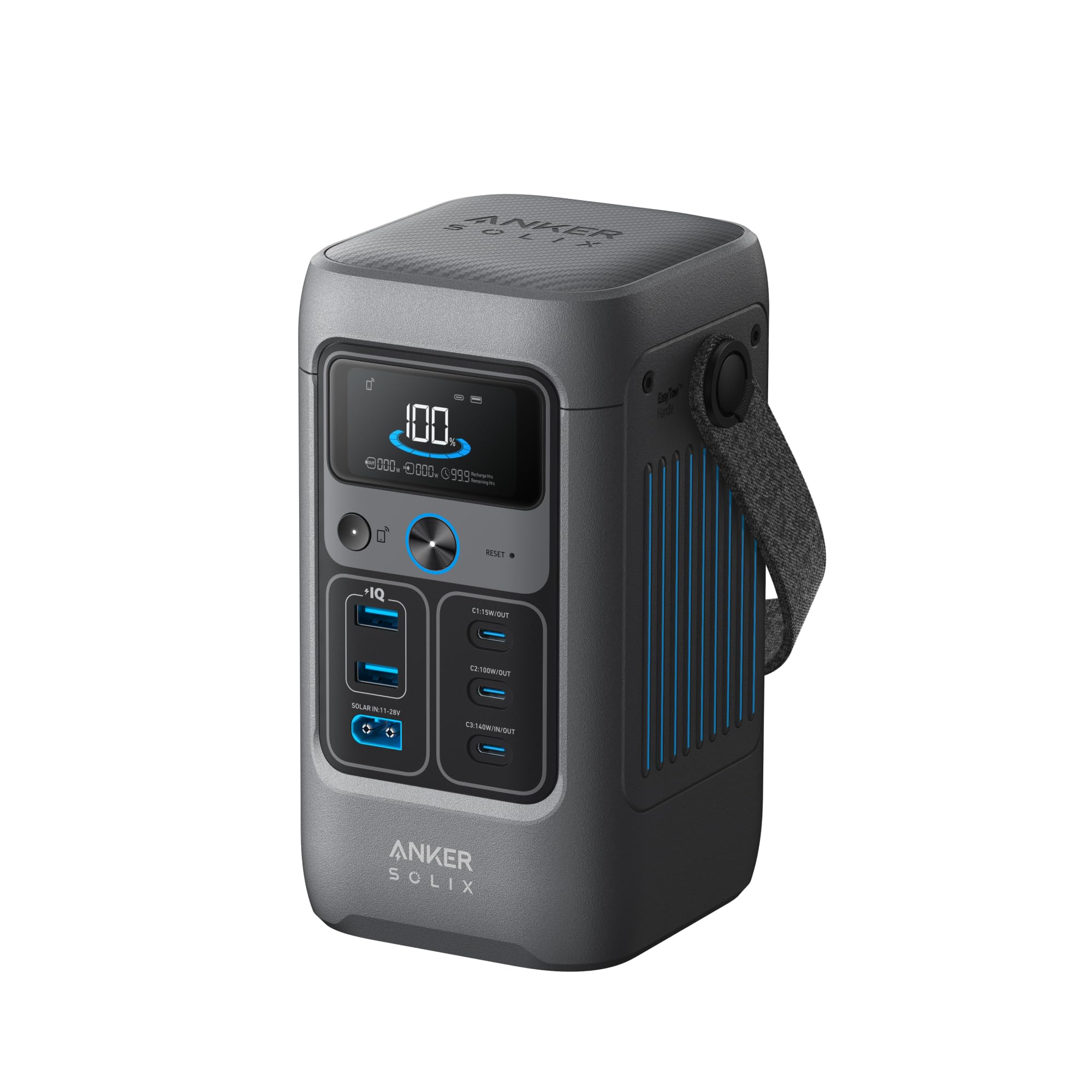
1. Anker SOLIX C200 DC Portable Power Station, 192Wh, 200W, Outdoor Camping
Our pick — over 4★ from 950+ verified ratings; the strongest balance of quality and price.
The biggest battery here that still tucks into a backpack pocket
This is the pick for the person who wants one box to cover a weekend campsite and a Tuesday night blackout. It carries a 192Wh battery — the largest tank on this list alongside the Westinghouse — and pushes that power through a 200W output. In plain terms, it runs a USB fan, a phone, and a Square card terminal all day without complaint, and it has enough on board to keep a laptop, tablet, and phone topped up at the same time. If only one station in this guide is meant to live behind your desk and also ride in your car, this is it.
Five ports sit on the front, and the standout is a 140W two-way USB-C port that charges your laptop or refills the station itself at high speed. The other four cover a 100W USB-C, a 15W USB-C, and two USB-A 12W ports, so there is always a spare socket for a watch or a drone battery. Refilling to 80% takes 1.3 hours over that 140W USB-C PD 3.1 port, or you can top it off from a 100W solar panel, though Anker’s own panels are sold separately. The LiFePO4 cells are rated for 3,000 cycles, and the station carries a 3-year warranty.
What wins people over is the length of the run. Buyers report multi-day stretches of heavy use where the box still shows three-quarters charge, and the portable box does it without getting hot. The honest catch is recharge speed when you are in a hurry — plug it into a modest wall charger and it crawls, and you need a separate 100W-or-better USB-C charger to hit that headline 1.3-hour figure. There is a lighter 89.6Wh Daran below that refills almost as fast while weighing a touch less, but it holds less than half the energy this one does. The other small gripe is a front button that can feel unresponsive when pressed, which is a minor annoyance rather than a flaw.
What owners lean on it for
- A 192Wh battery that runs a card terminal for hours without hitting empty
- Charges a laptop or itself over the 140W two-way USB-C port
- LiFePO4 cells rated for 3,000 cycles, backed by a 3-year warranty
- Stays cool under a multi-device load, according to buyer reports
Where it asks for patience
- Needs a separate 100W-or-better USB-C charger to hit the 1.3-hour refill
- A standard wall brick charges it slowly
- The front power button can need a firm, deliberate press
- The carrying strap is not in the box
The one to grab: anyone who wants a single battery box for camping trips and home outages and does not want to think about it again.
Who should look further: travelers who fly, since this station is not cleared for the cabin — the DaranEner R101 Lite is.
2. ZeroKor 120W Portable Power Station, 97.6Wh, 110V AC Outlet
At 2.2 pounds, it disappears into a backpack and pumps up air beds
The first thing you notice is the weight: 2.2 pounds with the handle, making it the lightest box in this roundup. That matters if the station has to ride on a motorcycle, in a daypack, or in a tent pocket. Behind the light shell sits a 97.6Wh battery — a step up from the 89.6Wh group, though well under the 192Wh Anker above — with a 120W AC rating and a 12V DC outlet rated 16.8V at 6A max. A DC port at that rating will run a car fridge or a small car vacuum in a pinch, which is more than most boxes this small offer.
On the port side you get two 120W AC outlets, the DC socket, a 5V/2.4A USB-A, a QC USB-A, and a USB-C rated up to 12V/1.5A. Three recharge paths keep it flexible: a solar panel (not included), a USB-C wall adapter, or a car USB port using the included USB-A to USB-C cable. A small screen shows remaining power plus the AC and DC status, so you are not guessing how much is left. There is also a built-in LED light with a reading mode and an SOS mode, and the station ships with a 12-month customer support window.
Owners put the light weight to work on real trips — a four-air-mattress weekend, a projector and speakers running for a movie, two phones charged several times over. The recurring note is that the charge itself takes a while: expect a multi-hour refill over a standard charger, and plan around it rather than expecting a quick top-up. It is also worth remembering the 120W ceiling is real — anything that heats up or runs a compressor is out of bounds here, as ZeroKor explicitly warns in the listing.
The carry-first case: if the box lives in a bag more than on a shelf, the 2.2 lb frame and DC outlet are the two details that earn this pick.
Reach for this when: portability outranks runtime and you mainly need phones, lights, and a small DC device.
Better to size up: if you want a laptop and an AC device running together for several hours, the 192Wh Anker covers it with far more headroom.
3. MARBERO Portable Power Station 88Wh, 120W Surge, 24,000mAh
Eight ports, a DSLR-sized frame, and a flashlight that outlasts the night
Picture a box the size of a basic DSLR camera — 6.5 by 4.6 by 3.1 inches in a 3.2 lb plastic shell with an ergonomic handle. That shell hides 88Wh of battery, a 120W surge rating, and eight output ports that can be used at once. The BMS — the battery management system that watches voltage and temperature inside the box — keeps things stable when several devices pull on it at the same time.
The feature nobody expects is the light. Three brightness levels turn the station into a large flashlight: 68 hours on the lowest setting to light a small room, 48 hours for walking at night, and 37 hours on high to illuminate a living room. There is also an SOS flashing mode that pulses at the international distress frequency. On the power side, phones top up in about an hour, tablets in 1.5 hours, and laptops in 2 hours, and the two AC outlets run small TVs, projectors, and inflatable beds. A car DC cable is in the box for emergency use.
What owners mention most is the camping upside: four air mattresses inflated on under one bar, three phones charged to full over three days for the cost of two bars of charge, and a handful of ports that let a laptop, phone, and lamp share the box at once. The one honest caveat is longevity — a station that refuses to hold a charge after a stretch of steady use is the recurring complaint on this model, so it suits the buyer who wants strong value and a long-running light rather than a box they plan to baby for a decade.
Strong points worth noting
- Eight ports usable simultaneously for phones, laptops, and a lamp
- Three-level LED rated 68 hours on its lowest setting
- Compact DSLR-sized shell at 3.2 lb with a built-in carry handle
- UL safety standard cylindrical cells and UL drop tested
Read before you commit
- Long-term durability is the recurring complaint when the box gets heavy daily use
- Runtime with a fan is short compared to phones and lights
- No solar panel in the box, though it is solar-ready
Suits you if: you want the strongest light-plus-power combo for camping and outages at an entry-level tier.
Look elsewhere if: you plan to lean on one box daily for years — the LiFePO4 picks in this list are built for exactly that.
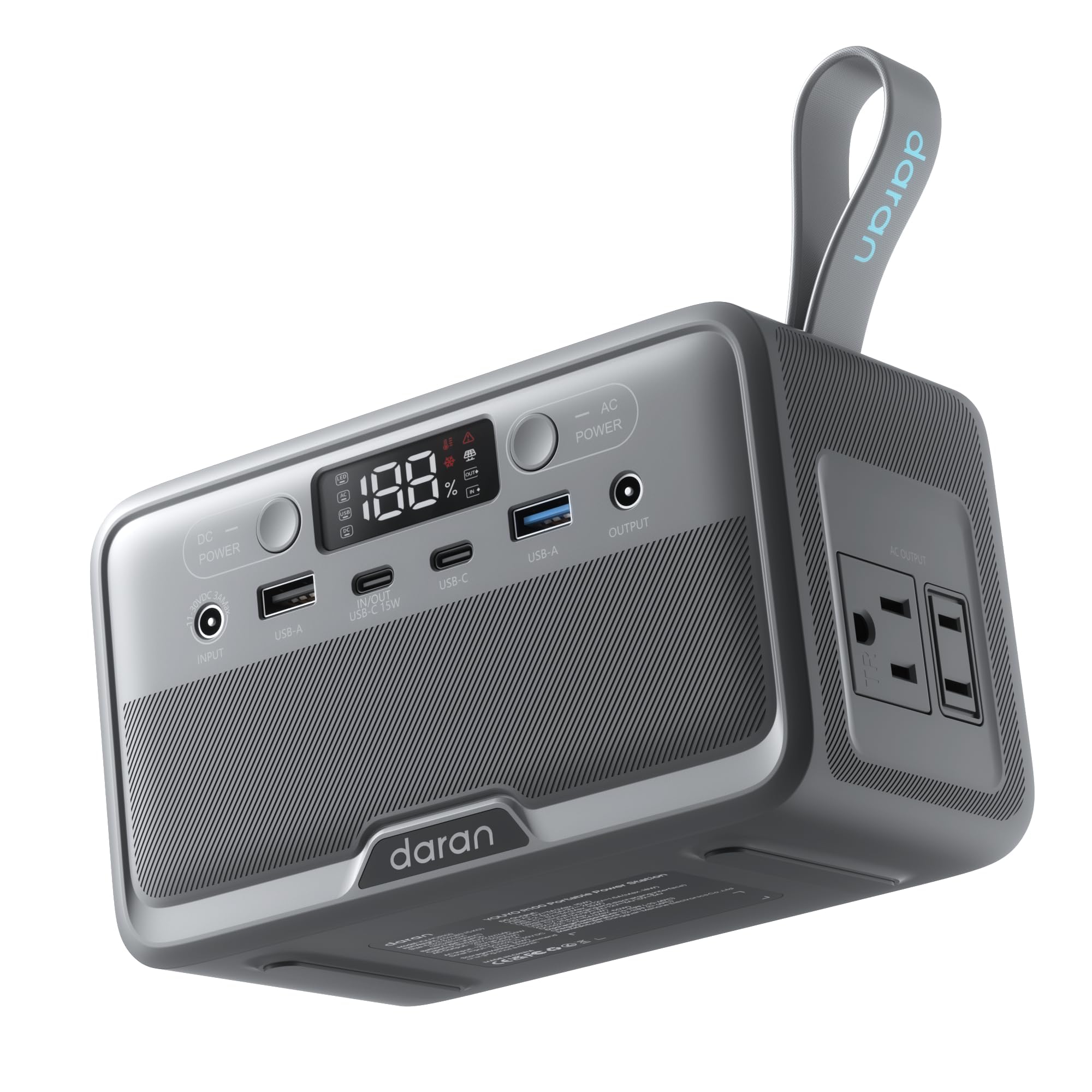
4. DaranEner Portable Power Station 100W, 89.6Wh LiFePO4 Solar Power Bank
Silent operation makes it a bedside companion, not just a camping box
Most battery stations whisper a small fan when they work hard. This one runs completely silently with zero fan noise, which turns it into a station you can leave on a nightstand while you sleep. It carries an 89.6Wh LiFePO4 battery, a 100W output, and a smart LED display that shows the real-time charge level. The LiFePO4 cells are rated for 500+ charge cycles, so the chemistry suits repeat top-ups over years rather than a single camping season.
Seven ports cover the essentials: two 100W AC outlets, a 45W PD fast-charging USB-C, dual USB-A ports, and a 60W DC port. Between them, the box will run a laptop, phone, tablet, drone, DSLR camera, and a mini fan at the same time. It’s also pocketable — 2.54 pounds with an ergonomic soft handle, and dimensions smaller than most laptops. Four recharge routes keep it topped up: a wall outlet, a car charger, USB-C PD, or a compatible solar panel. A 3-mode LED light (high, low, strobe) rides along on the back, and the whole unit carries a 3-year manufacturer warranty.
What customers note first is that it simply works: charging an electric scooter in the trunk, running small devices all day, and holding more than 40% charge after 24 hours of use. The trade-off worth knowing is that there is no automatic shutoff — if you leave a device plugged in with the station powered on, it will slowly drain, so you have to switch it off yourself when you are done. It’s a small habit to build, but it protects the battery and stretches the run time.
The silent edge: if you charge overnight near a bed or desk, fanless operation means no whirring noise to interrupt your rest.
Made for: overnight backup and quiet indoor use where fan noise would be unwelcome.
Downsides worth weighing: 89.6Wh is a modest tank, so plan for phone-and-tablet duty rather than a long camping weekend with heavy AC loads.
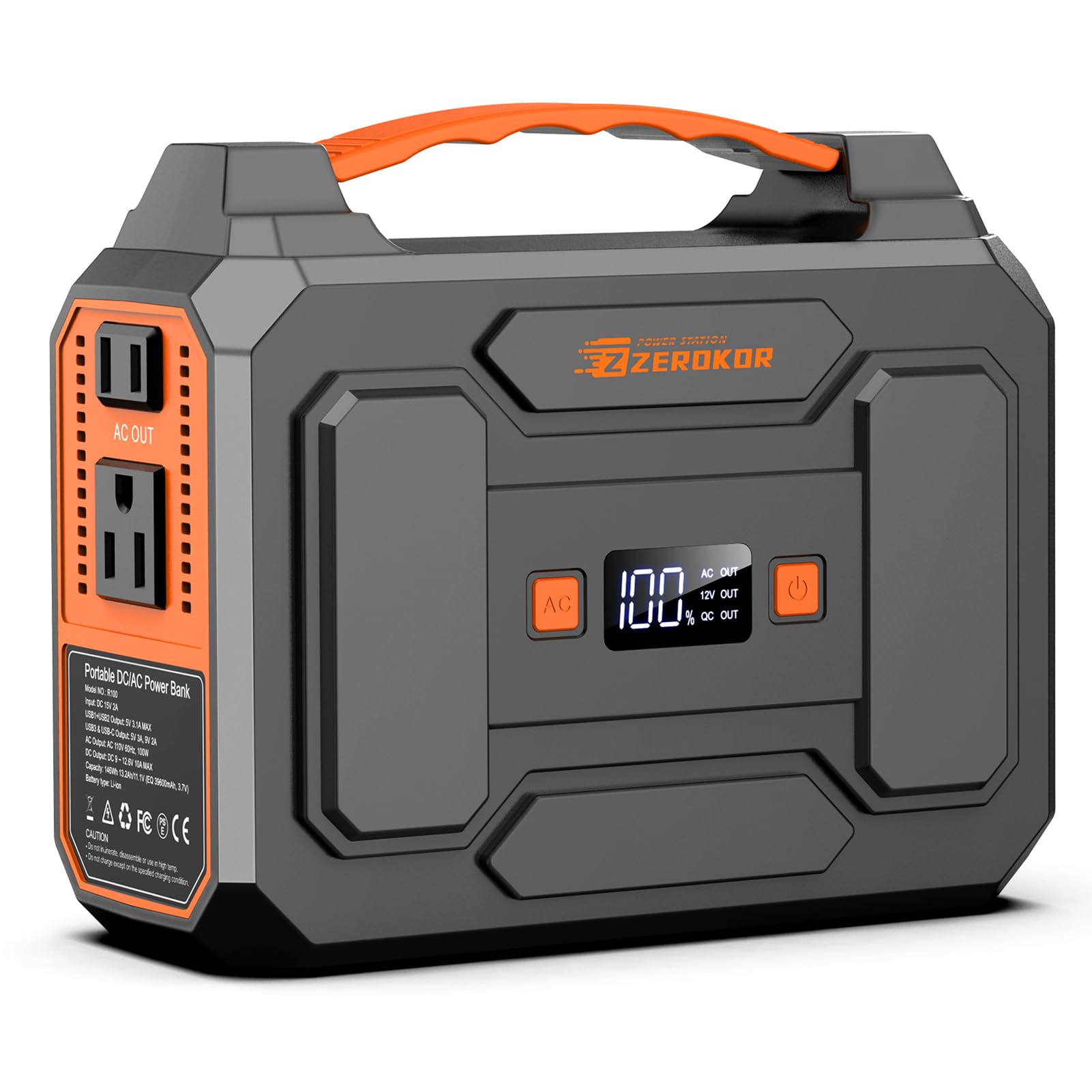
5. ZeroKor Portable Power Station 100W, 110V AC Outlet
Keeps a card reader, scanner, and cash drawer running ten hours straight
This ZeroKor steps the family recipe up to a 146Wh battery while keeping a 100W output, which is enough headroom for a retail countertop worth of small gear. Two AC outlets rated 100W each, a DC outlet, two USB-A sockets, a QC USB-A, and a USB-C round out the front. It also has a built-in screen that shows the charge level and whether the AC and DC outlets are live, plus a reading-mode LED and an SOS mode for blackouts.
At 3.3 pounds with a handle, it slips into a backpack without much thought. Recharging runs three ways: a solar panel (not included), a wall adapter, or a car port, and the same screen you use to check status shows the remaining power while it fills. ZeroKor also lives by a stricter power ceiling than any pick here — the manual advises using only devices under 100W, which rules out anything heat-based or compressor-driven. That is worth reading twice, because the 100W label is a hard limit, not a suggestion.
What reviewers point out most often is the plug-and-play reliability: powering a card reader, barcode scanner, and cash drawer through a full 10-hour workday with half the charge to spare, then running lights at an off-grid campsite while the solar panel keeps it topped up. The recurring note to size is around solar expectations — a modest solar panel will only trickle charge it, and it charges best in bright direct sunlight. Reliability data on the listing runs mixed, so treat this as a strong everyday companion rather than a machine you press hard daily.
Why it earns its place
- 146Wh battery with a 100W AC outlet rated for small business gear
- Screen shows charge level and AC / DC status at a glance
- Handles a full 10-hour retail shift with charge to spare, per buyer reports
- 3.3 lb with handle for grab-and-go carrying
Things to know before buying
- Hard 100W ceiling — anything heat-based or with a compressor is out of bounds
- Solar recharging trickles in slowly without bright sun
- No solar panel included in the box
Choose it for: a shop counter, market stall, or campsite where you need honest small-device power and a clear status screen.
Hold off if: your device list includes anything that heats up or pulls a compressor — this station will not run it, by design.
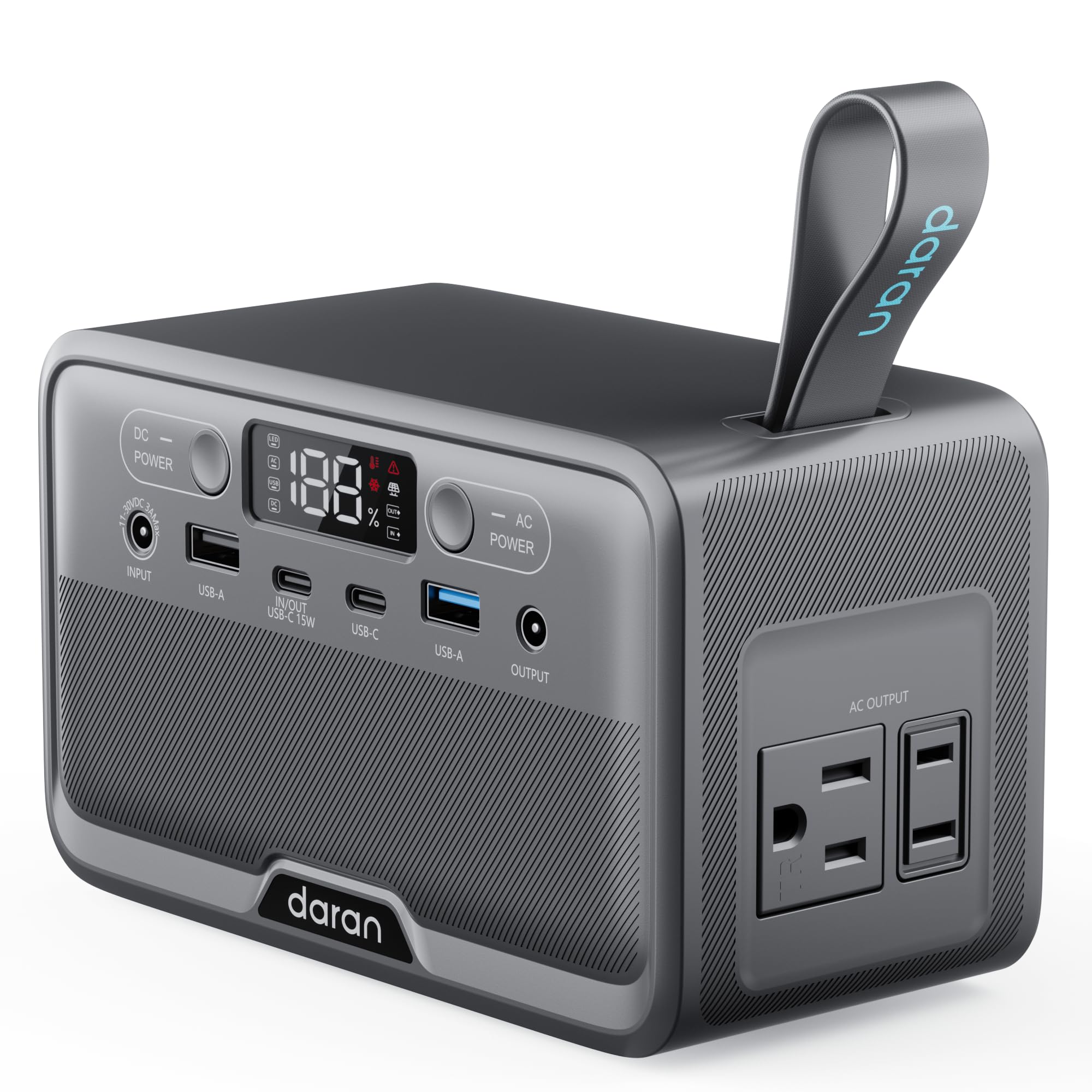
6. Daran Portable Power Station 89.6Wh LiFePO4, 100W (200W Peak)
The one that keeps a Starlink Mini alive two hours at a stretch
For anyone taking a satellite dish on the road, this is the pick that quietly does the job. It packs an 89.6Wh LiFePO4 battery with a 100W output that peaks at 200W, and it will run a Starlink Mini through its AC outlet without the dish rebooting mid-session. That is a specific use case most boxes this size struggle with, and it turns a small station into real gear rather than an emergency backup.
Seven outlets line the front: two AC sockets at 100W each, a 45W USB-C and a 15W USB-C, two USB-A ports, and a DC5521 port. The LED display shows working status and remaining power. The clever bit is the dual input: you can charge the box from both an AC adapter and USB-C at the same time, refilling it to 80% in about 1.5 hours. The whole thing weighs 2.54 pounds, has an ergonomic soft handle, and includes a 4-level LED flashlight with steady and SOS modes that needs a long press to switch on — a nice touch for a box that might live in a tent pocket.
Owners say the same thing: it is compact, well-built, and reliable for phones and small devices, and the AC and USB-C dual input means you are rarely waiting long to refill it. What it will not do is drive high-draw appliances, and some users note a fan running during AC charging that can be annoying if you sit next to it. The battery is LiFePO4 with a 12-layer BMS watching voltage, current, and temperature, and Daran rates the cells at 3500+ cycles.
The satellite-friendly touch: a stable AC outlet for a Starlink Mini, no reboots during a session, and only 2.54 lb to carry.
Reach for this if: you are running a satellite dish, a ham radio, or a laptop on the road and want AC plus fast USB-C in a light frame.
Not the box for: pulling a fridge or space heater, where a 100W ceiling simply will not keep up.
7. DaranEner Portable Power Station 89.6Wh 100W PD USB-C with AC Outlet
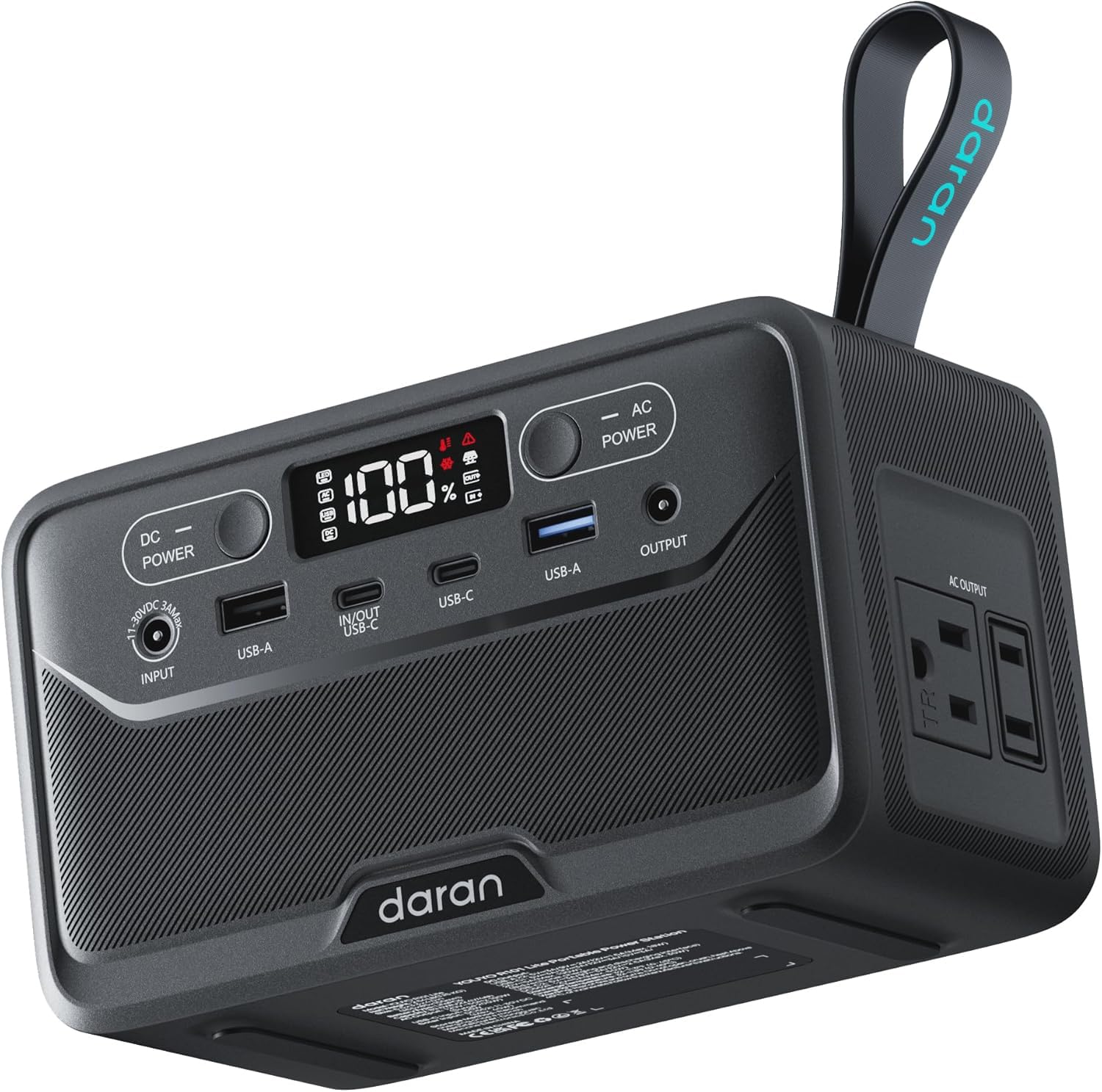
A venti-cup-sized powerhouse that clears the flight check
At 89.6Wh and 2.5 lbs, this station sits under the airline cabin battery limit and will carry through TSA screening as a portable power bank. That is the whole point: most stations on this list are quietly ruled out for air travel because they exceed the carry-on ceiling, and this one is specifically built to make the cut. Its frame is closer to a large coffee cup than a toolbox — roughly 1.5 soda bottles in weight.
Seven outlets sit across the front: dual 100W AC ports (200W peak), a 65W two-way USB-C1 that charges the station or your laptop, a 30W USB-C2, two 18W USB-A ports, and a 60W DC5521. That is enough for a laptop, phone, tablet, and drone charging at once. Four refill options keep it topped up — AC, DC, solar, or a car socket — and the fully-juiced state arrives in about 1.3 hours from a wall outlet. A 40W solar panel pushes it back to full in 2.2 hours if you are camping. The LiFePO4 cells and a 12-layer BMS handle safety, and the back carries an adjustable LED with SOS mode for outages.
The upside buyers hammer home is size-to-power. This little box will drive a full-size pedestal fan through a power outage while sitting in a backpack, and one buyer happily summed it up as a “powerhouse of a bank in a tiny package.” The trade-off is visible on the spec sheet: the AC output is a modified sine wave rather than the pure sine wave you get on the 192Wh DaranEner below, which is fine for most electronics but note if a sensitive device is your main load. Charging speed also draws a few mixed comments, and the station wants a bit of attention up front — an initial state-of-charge reading that sits at 99% is normal.
What makes it earn a slot
- 89.6Wh under the cabin battery limit and light enough for a go-bag at 2.5 lb
- 65W two-way USB-C1 can charge a laptop or the station itself
- Seven ports spanning dual AC, dual USB-C, dual USB-A, and DC
- LiFePO4 cells paired with 12-layer BMS monitoring
The details worth counting
- Modified sine wave AC, not the pure sine wave found on the bigger DaranEner
- Initial state-of-charge display can read 99% before fully cycling
- Solar panel not included, so off-grid pairing is an extra step
Built for: the traveler who needs a legal-in-cabin battery that still drives a laptop, drone, and desk fan.
Think twice if: you plan to run a sensitive AC device continuously — the pure sine wave output on the 192Wh DaranEner is the better fit there.
8. DaranEner Portable Power Station 192Wh LiFePO4, 300W AC Outlets
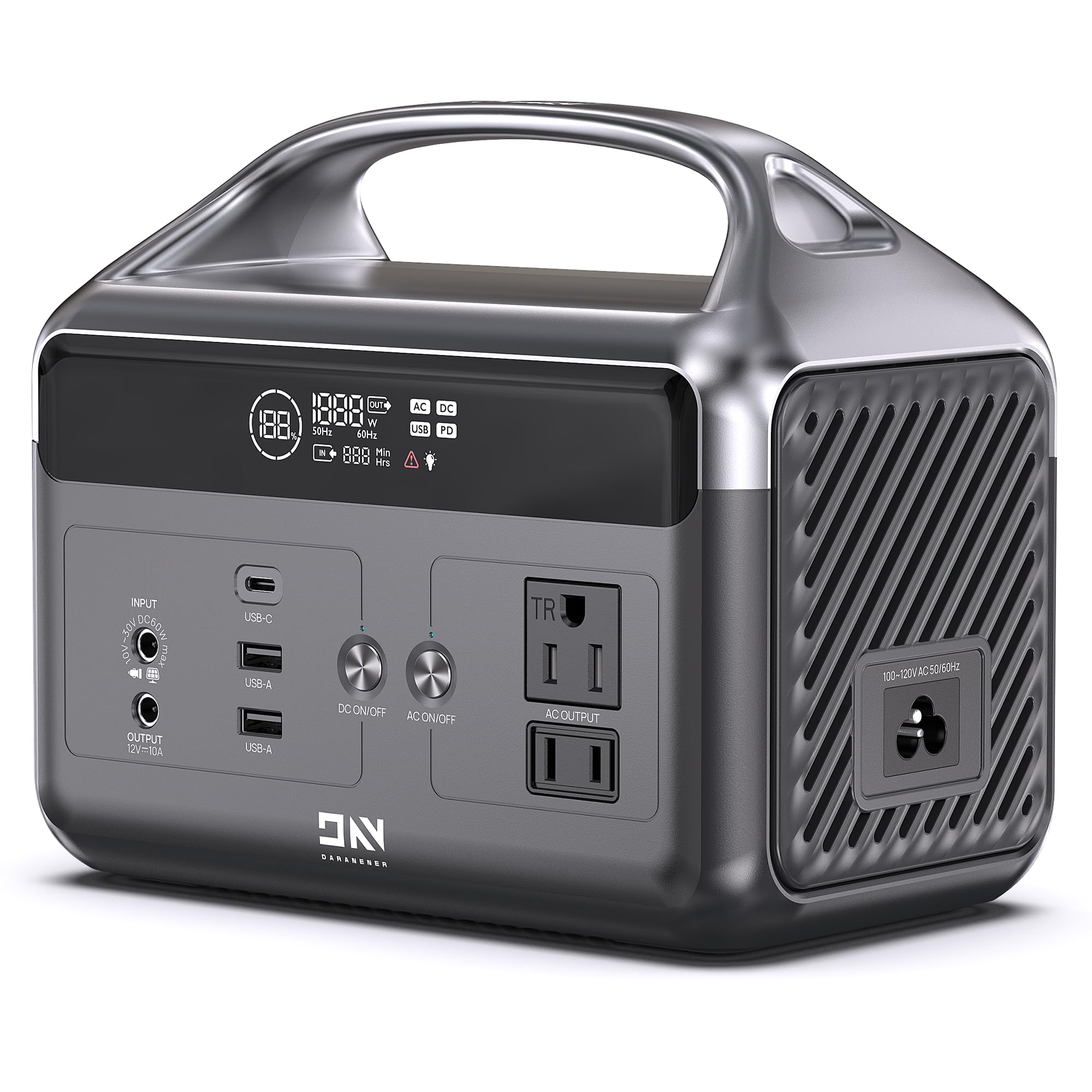
Pure sine wave output for sensitive gear and overnight CPAP duty
This is the station for the buyer who needs an AC outlet that behaves exactly like the wall. A pure sine wave output matches the smooth curve of household power, which matters for a CPAP machine, a sensitive laptop charger, or any electronics that dislike a rough waveform. The 192Wh LiFePO4 battery delivers 300W of steady output and 600W of surge — enough to start a small fan or a laptop charger without tripping the breaker, but explicitly not enough for a rice cooker, hair dryer, or mini-fridge with a heavy startup surge.
Six outlets work at once: two 300W AC ports, a 60W USB-C PD, two 18W USB-A QC3.0 ports, and a 12V DC output. The station accepts three charging routes — AC wall outlet up to 100W, a car charger, or a compatible solar panel up to 60W DC input — and a built-in MPPT controller gets the most out of whatever sun hits that panel. At 5.73 pounds it is the second-heaviest box here, but still smaller than a toaster and fitted with a 4-mode LED (including SOS). LiFePO4 cells are rated 3500+ cycles, and DaranEner recommends two full charge-and-discharge cycles after arrival plus a top-up every month or two.
Shoppers say two things consistently: the station charges everything to full in about two hours, and a CPAP on the AC adapter has shown 7 to 31 hours of runtime depending on breath cycles. In practice, an external DC cable for the CPAP would stretch that further. The honest limit is the size of the tank: with a heavy AC load, 192Wh runs out sooner than you might hope, so this is a plan-ahead station rather than one you fill on Friday and forget. That same limitation is what makes it so good at overnight, low-draw duty where its pure sine wave shines.
The CPAP tilt: pure sine wave output plus a 300W rated AC outlet turns this into serious overnight gear rather than a phone charger with an outlet bolted on.
Made for: CPAP users, sensitive electronics, and home-backup duty where a clean AC waveform is the deciding spec.
skip it if: your device list needs a hair dryer or a compressor appliance — the 300W ceiling rules those out even on surge.
9. Westinghouse iGen400s 400W Portable Power Station, 183Wh
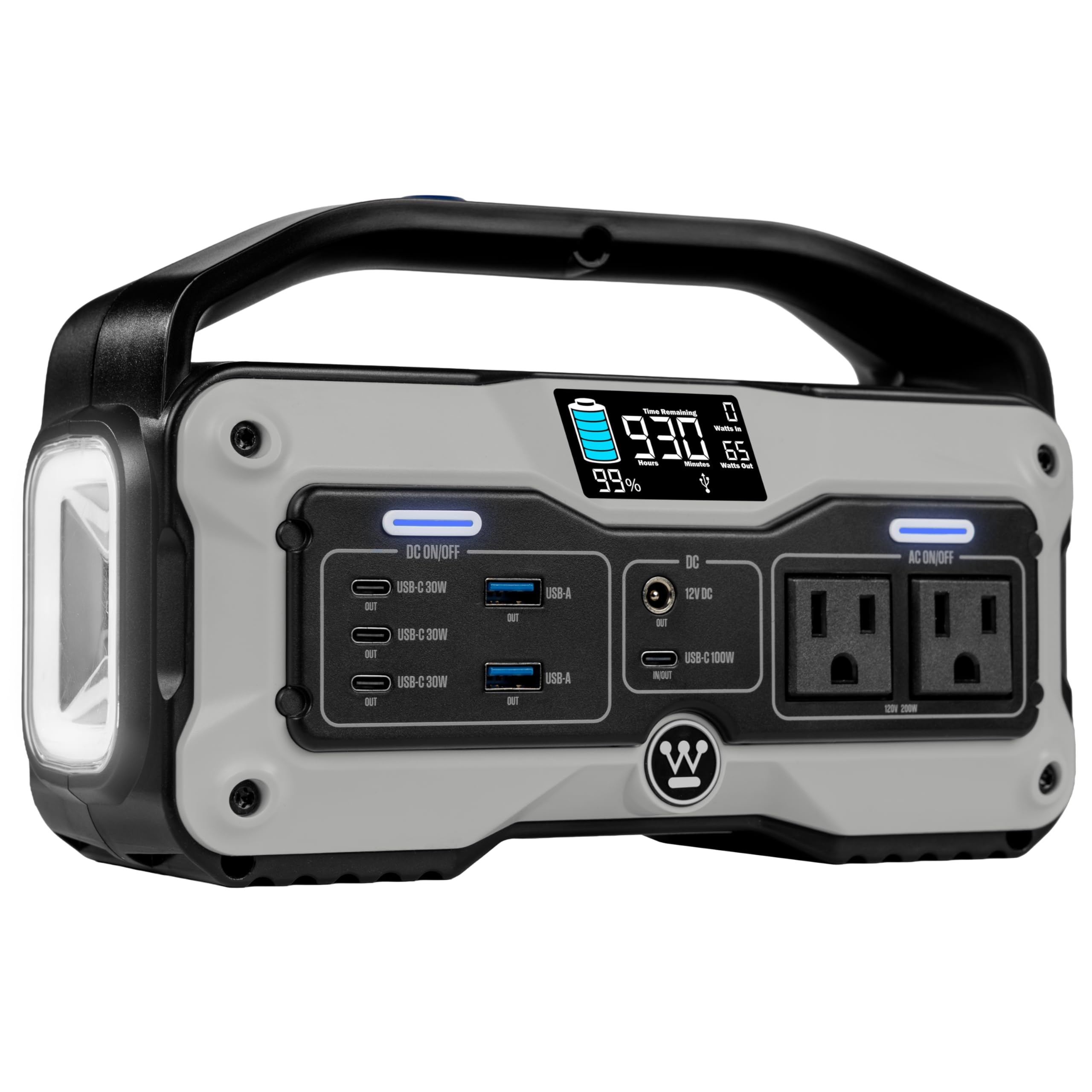
Nine outlets means one box replaces a drawer full of charging bricks
If the problem you are actually solving is a nest of charging bricks under the desk, this is the fix. Nine outlets cluster on the front: two 120V AC ports, three USB-C 30W ports, two USB-A ports, one 100W USB-C, and a 12V DC socket with a car charger adapter in the box. That is enough to power a phone, a tablet, a laptop, an iPad, an iWatch, and a small fan at the same time — which is why it earns its place as the household dock as much as a camping box.
Inside sits a 183Wh battery rated 200W running and 400W peak. Recharge runs from a 120V outlet to 80% in about two hours with the included USB-C cable and a 100W AC power adapter, though Westinghouse notes that faster charging needs that separate 100W adapter — none is included. The shell is a durable, weather-resistant frame with a top handle, and it weighs five pounds total. A tri-mode flashlight and a flasher handle emergencies, and the whole unit carries a 2-year limited warranty plus lifetime Westinghouse technical support. Solar panels are optional and sold separately.
What buyers report reads like a customer who has finally packed the right kit. The station holds a charge well, keeps an iPad, iPhone, and watch topped up across a three-day campout, and one mobile barber uses it as a tool charger for the trade — the review pages sum it up: “This was for my mobile barber station in case I need to charge my tools it’s perfect.” The honest caveat is charge speed: from a wall outlet it fills more slowly than the numbers on the box suggest, so budget the wall time and settle the adapter question before you rely on it in the field.
Where the nine ports pay off
- Nine outlets — dual AC, three USB-C 30W, one USB-C 100W, dual USB-A, and DC
- 183Wh battery rated 200W running and 400W peak
- Charges to 80% in about two hours from a 120V outlet with the right adapter
- 2-year limited warranty with lifetime Westinghouse technical support
Answers to common follow-ups
- No 100W AC power adapter included, so fast charging is a separate purchase
- Wall charging runs more slowly than expected in real use
- Solar panel not included with the station
Right for you if: your daily problem is too many wall plugs and too many bricks, and you want one box to dock them all.
Better to pass if: you need the station to refill fast in the field without buying a separate 100W adapter.
Understanding the Specs
Watt-hours (battery size)
Watt-hours is the total energy in the battery, and it is the single best predictor of runtime. A 192Wh battery holds more than a 89.6Wh battery, so it runs the same fan or lamp for much longer. In practice, a 192Wh station keeps a laptop and phone topped up for several days of camping, whereas an 89.6Wh box is built for a single overnight trip. Milliamp-hours can look bigger on the box, but watt-hours is the number to compare.
Rated watts (what you can plug in)
Rated watts is the ceiling on what your station can run at one moment. A 100W rating will power lights, phones, laptops, and small fans, but anything that heats up or pulls a compressor is out of bounds. A 200W or 300W rating opens the door to bigger fans, a small fridge, or a CPAP, though the surge rating matters just as much for motors that briefly pull more on startup.
LiFePO4 vs lithium-ion
LiFePO4 is a lithium battery formula with a longer rated cycle count than standard lithium-ion cells. Cycle count tells you how many full charge-and-drain passes the battery is rated for before its capacity starts dropping. If you plan to use the box daily or weekly, LiFePO4 is the quieter long-term bet; if it lives in a drawer between outages, standard lithium cells are lighter and perfectly fine.
Charge time and solar input
Charge time is how long the station takes to refill from a wall outlet, and a slow sheet number here means a slow box in everyday life. Solar input is a separate spec: a 100W solar input lets you pair a matching panel for off-grid refills, while a 60W input pairs with smaller panels. Solar panels are almost always sold separately, so plan for that extra purchase if you intend to charge in the wild.
FAQ
What can a 100-watt power station actually run?
How long will the battery last on a camping trip?
Is LiFePO4 worth paying more for over standard lithium?
Can these stations fly with me in a carry-on?
How fast can I recharge one from a wall outlet?
Do I need a solar panel to make these worth it?
What is the difference between rated watts and peak watts?
Can a 100-watt station charge a laptop reliably?
Why do some stations have loud fans and others run silent?
Final Thoughts: The Verdict
For most buyers, the 100-watt generator to grab is the Anker SOLIX C200 DC because its 192Wh LiFePO4 battery, 200W output, and 140W two-way USB-C cover both a weekend campsite and a sudden blackout in one box. If you fly with your gear and want something that clears cabin battery limits, the DaranEner R101 Lite is the pick. And for CPAP duty or any sensitive electronics that want a clean AC waveform, the DaranEner NEOZ 192Wh with its pure sine wave output is the one to reach for.
The last word on value: the MARBERO 88Wh punches far above its tier for camping trips and outages, and if you only need a light, quiet companion for overnight use, the DaranEner 89.6Wh does that job with no fan noise at all.
How We Picked
We do not accept paid placement. Every pick is matched to a real buyer and a real use-case; we do not hands-on test units.
Sources & Methodology
Specifications: manufacturer listings and product documentation. Review insights: verified customer reviews, as of September 2026. Pricing: not shown on this page (it changes often); check the current price via the retailer link.
As an Amazon Associate, KitchPrep earns from qualifying purchases. This does not affect which products we feature.
Related Guides
