
Coffee on the move sounds simple… until you’re actually doing it. You’re in a cold car at sunrise, the campsite is still sleeping, the hotel room has “that” tiny packet coffee, your office kitchen is out of filters again, and you’re standing there thinking: “I don’t need fancy. I need reliable. Right now.”
If you’re shopping for a battery operated coffee maker, you’re not chasing a gimmick. You’re trying to solve a very real, very specific problem: hot coffee without the permission of an outlet. And here’s the part most buying guides get wrong: they compare features like it’s a spreadsheet contest… instead of focusing on what actually determines whether you’ll love the thing after week two.
Because the truth is: the best travel brewers aren’t the ones with the longest bullet list. They’re the ones that behave well when your hands are cold, your water is lukewarm, your car cup holder is wobbling, and you just want a clean shot or a strong mug without grounds everywhere.
This guide is built around the real friction points that show up again and again in owner feedback—battery reality (not marketing), how messy grounds get in a micro chamber, whether “20 bar” actually tastes good with your pods, how long self-heating takes when the water is cold, and what happens after a month of hard-water scale, road dust, and daily rinsing.
Below, you’ll find 12 standouts—mostly true cordless espresso makers with self-heating, plus one vehicle-only drip brewer, one tool-battery jobsite legend, and one ultra-compact single-serve option that’s power-station friendly for tiny kitchens, RVs, and hotel rooms.
In this article
- How to choose the right travel brewer for your “real life” routine.
- Quick comparison table of 12 standout models.
- In-depth reviews of each coffee maker, with pros and cons.
- How self-heating and extraction really work (and why battery claims vary).
- FAQ + final buying tips so you can choose once and feel done.
How to Choose the Right Battery Operated Coffee Maker
The “best” portable brewer isn’t the one with the biggest number on the box. It’s the one that matches your coffee style, your water reality, and your cleanup tolerance. If those three align, the product feels like a cheat code. If they don’t… it becomes one more thing you regret shoving in a drawer.
1. Start with the three travel realities
Most buyers fall into one of these three categories. Figure out which one you are first, and you’ll instantly eliminate the wrong products.
- The “true off-grid” traveler: You’ll sometimes have cold water and no outlets. You need self-heating and a battery that can handle it.
- The “car-powered commuter”: You have a 12V socket and a flat surface, and you want coffee while driving or parked. A 12V-only brewer can be perfect.
- The “power-station / hotel-room” traveler: You have an inverter, portable power station, or wall power, and you want a tiny, fast single-serve solution.
2. Decide: espresso-style “shots” or drip-style “mugs”
A lot of people say they want “espresso” when they really want strong coffee. Here’s the difference that matters:
- Portable espresso machines (most of this list) create pressure and push water through a small coffee bed or capsule. You get a concentrated, punchy cup. Great for lattes, Americanos, and “I just need caffeine fast.”
- Portable drip machines brew more like a classic coffee maker. It’s comforting, familiar, and better for people who want a full mug without the “shot” ritual.
There’s no universal winner. But there is a universal mistake: buying an espresso-style device, then being annoyed it doesn’t make a huge mug unless you run multiple cycles. If you want one big mug every morning, pick a drip solution (or plan on making an Americano style: shot + hot water).
3. Understand the “battery math” behind every claim
Here’s why product descriptions can sound confusing: battery usage depends on whether you ask the machine to heat water or simply pump/extract. Heating is the expensive part.
- Cold-water mode (self-heating): Highest battery drain, longest cycle time, most valuable when you’re truly off-grid.
- Hot-water mode: Much lower battery drain. If you can preheat water (thermos, kettle, campsite stove), you get dramatically more brews per charge.
- “Extract only” mode: Some devices can pump without heating at all. This is why you’ll see claims like “100+ cups” when using already-hot water.
Practical takeaway: if you’re hiking or camping, you want a brewer that’s efficient in cold-water heating mode. If you’re in hotels or offices, the battery matters less than speed, mess control, and consistency.
4. Pods vs grounds: the convenience tax is cleanliness
Most portable brewers on this list support both capsules and ground coffee. That sounds like “best of both worlds.” But it’s really a trade:
- Capsules win on cleanliness and repeatability. You get predictable flavor and less sludge. On travel days, that matters more than coffee snob purity.
- Ground coffee wins on flexibility and cost per cup. But it requires grind discipline (too fine = clogs and mess; too coarse = watery extraction).
In real owner feedback, the most common complaint with portable espresso makers is not “it broke.” It’s: “Using grounds is messy in the tiny chamber.” So if you hate cleanup, you’ll be happier using pods most of the time, and saving grounds for slow mornings.
5. Watch for the sneaky “daily use” details
Here are the features that matter in the real world (the stuff you don’t notice until you’ve used the brewer 20 times):
- Water tank shape: Wide tanks are easier to fill; narrow tanks spill less but can be annoying in wind or in a moving car.
- Seal quality: A good seal means fewer leaks and better pressure stability. It also means less “mystery drips” in your bag.
- One-button logic: Devices that require a specific long-press/short-press rhythm are fine—until you’re half awake. The best ones feel obvious.
- Display usefulness: A battery percentage and heating countdown sounds small, but it changes your planning. You stop guessing.
- Cleanup path: If you can rinse everything in 30 seconds, you’ll use it constantly. If cleanup feels like a chore, you won’t.
6. Pick your “coffee station” strategy (this changes everything)
Portable coffee is easy when you treat it like a tiny system, not a single gadget. Decide how you’ll carry and use it:
- Hotel strategy: Machine + pods + collapsible cup + a small towel to catch drips.
- Car strategy: Flat tray or stable console + water bottle + quick wipe cloth.
- Campsite strategy: Insulated water bottle (hot) + pods for zero mess + a small rinse bottle.
- Jobsite strategy: Tool battery ecosystem + tough mug + a simple “rinse and drain” routine so the unit doesn’t sit with water inside.
This is also where durability matters. If you’re leaving it in a truck toolbox, look for sturdier housings and fewer fiddly parts. If it lives in a laptop bag, compact and leak control matters more.
Quick Comparison: 12 Battery Operated Coffee Maker Picks
Use this table to find the models that match your routine, then jump to the full reviews for the “real-life” details—like how messy ground coffee gets in a micro chamber, which ones feel best in the hand, and what owners say after the honeymoon phase.
On smaller screens, swipe or scroll sideways to see the full table.
| Model | Type | Travel strength | Best match | Amazon |
|---|---|---|---|---|
| Uiifuidy 3-in-1 Portable Espresso Maker Set | Self-heating espresso | Fast heat + full kit feel (stand + carry bag) for “grab and go” confidence | Most people who want one reliable cordless espresso solution | Amazon |
| Ceshu Portable Coffee Machine (2 Batteries) | Dual-battery espresso | Two removable batteries = best endurance mindset for trips and multi-cup days | Road trips, camping weekends, “I need multiple brews” families | Amazon |
| Zordin Portable Espresso (Removable Battery) | Swap-battery espresso | Removable battery + smart display = planning and flexibility without guesswork | Frequent travelers who want “charge one, use one” logic | Amazon |
| SENIX Portable Coffee Maker (Dual AC/DC) | Drip brewer | Cold-water heat + AC plug option + included mug = versatile “power outage” style | Off-grid cabins, RV life, emergency kits, drip coffee lovers | Amazon |
| Makita DCM501Z Cordless Coffee Maker | Tool-battery drip | Jobsite legend: uses Makita batteries, durable vibe, simple mug coffee anywhere | Makita battery owners, tradespeople, workshop setups | Amazon |
| KEJECTOR 3-in-1 Self-Heating Espresso Maker | Self-heating espresso | Easy assembly + cleaning mode + multiple adapters = very “user-friendly kit” feel | Car camping and hotel travelers who want a balanced option | Amazon |
| Zordin 3-in-1 Smart Display Mini Espresso (Black) | Self-heating espresso | Compact storage trick: parts pack neatly; great for suitcases and glove boxes | Work travel, hotel rooms, simple “pods or grounds” brewing | Amazon |
| avigator 12V Car Drip Coffee Machine | Car-only drip | Built for cigarette lighter use; thermal mug included; auto shut-off | Drivers, truck sleepers, off-grid commutes, long hauls | Amazon |
| Tastyle Single Serve (K-Cups + Grounds) | 120V single serve | Tiny footprint + fast brew + auto shut-off; great with power stations/inverters | RV/hotel/off-grid solar setups with a power source | Amazon |
| Yorenson 3-in-1 Portable Espresso Maker | Budget self-heating | LED display + strong value + clear notes on usage; good support reputation | Budget buyers who still want display + versatility | Amazon |
| Narcissus 2-in-1 Portable Electric Espresso Machine | Nespresso Original | Simple pod-and-go design with a quick charger included; straightforward workflow | Nespresso Original capsule fans who want simple travel espresso | Amazon |
| Citrigrain Hands-Free Portable Espresso Maker | Ultra-compact | Hands-free concept + quick hot-water extraction; lightweight “commute-friendly” | Short trips, commuter bags, quick espresso without pumping | Amazon |
In‑Depth Reviews: 12 Battery Operated Coffee Maker Picks That Feel Good to Use
Now we’ll go model by model. I’m going to talk like a real user, not a spec sheet: how each brewer behaves when you’re tired, what it’s like to clean in a sink that barely fits your hands, what owners consistently praise, and what the “annoying little issues” tend to be.
1. Uiifuidy 3-in-1 Portable Espresso Maker Set – Fast Heat + “Complete Kit” Confidence
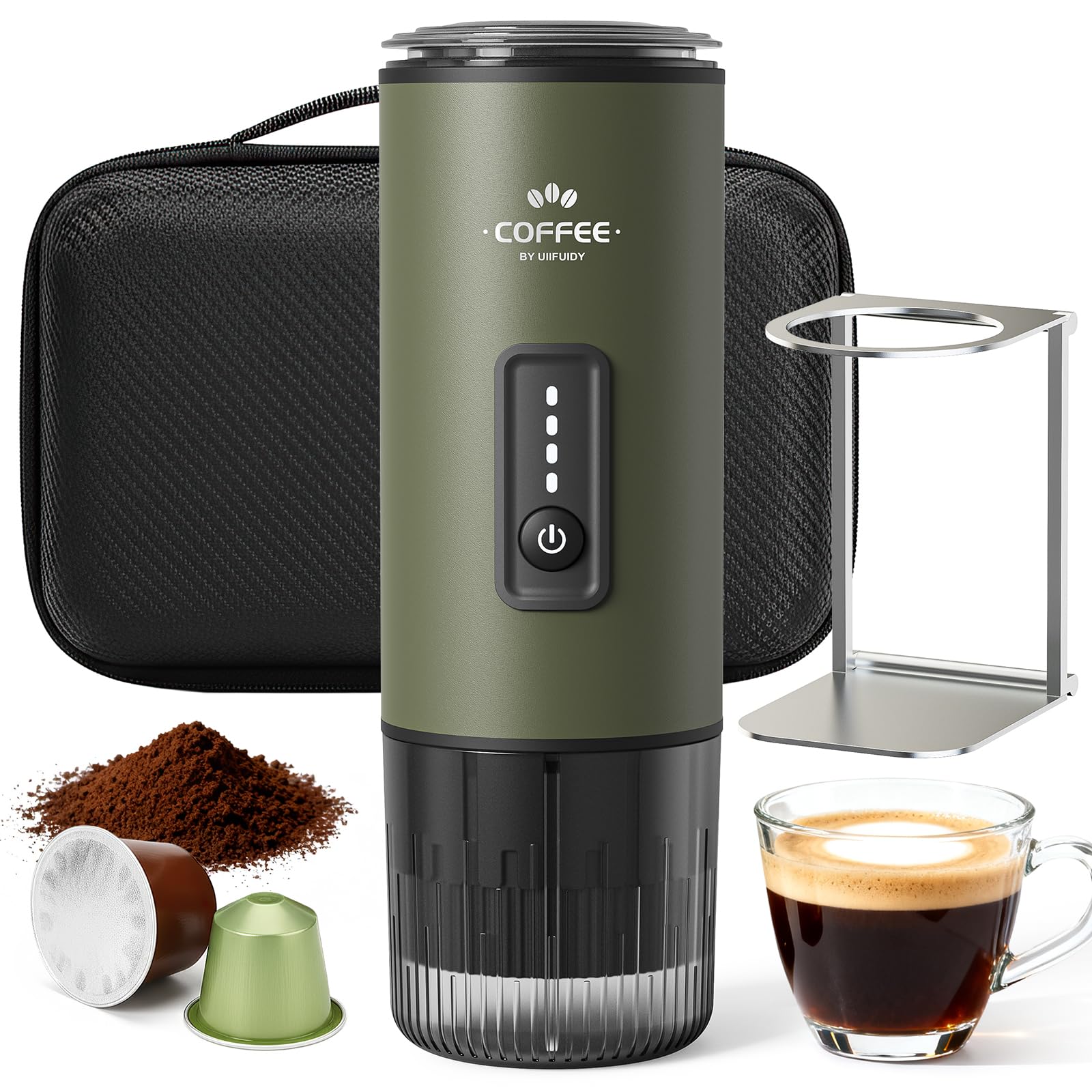
This is the kind of product that wins not by being “the fanciest,” but by feeling ready for real life. The included carrying bag and coffee stand sound like extras… until you’re actually traveling. Then they become the difference between “this is a neat gadget” and “this is my mobile coffee station.”
The big headline here is speed and simplicity. Owners regularly mention that it surprises them—fast heat, one-button brewing, and a shot that feels legitimately espresso-like when you use capsules. That “capsule consistency” matters because most travel frustration comes from variability. If you can get a predictable shot while you’re half awake, you’ll actually use the machine.
Where it gets interesting is how it handles three brew styles. Capsules are the clean, repeatable option. Grounds are the flexible, more “coffee nerd” option. And the real power move—especially off-grid—is using hot water when you can and letting the machine focus on extraction. That’s how you stretch battery life without feeling like you’re sacrificing the point of owning it.
A small but important real-world note from owner feedback: there are occasional complaints about durability quirks (like early rust spots near a water inlet area). That doesn’t automatically mean the product is “bad,” but it does tell you the maintenance routine matters: rinse, drain, and let it dry before you pack it away. Portable brewers live in humid environments (bags, cars, tents). A two-minute dry routine protects the investment.
Why you’ll like it
- Feels like a complete travel kit – The stand + padded case make it easier to brew cleanly anywhere.
- Fast self-heating mindset – Owners mention quick warm-up and easy, one-button workflow.
- Capsules are reliably good – Great crema and less mess when you want “no drama coffee.”
- Versatile brew styles – Grounds when you want control, pods when you want convenience.
Good to know
- Ground coffee can get messy if you overfill or use an ultra-fine grind; it’s a small chamber, so grind discipline matters.
- Some owners report durability quirks; treating it like a travel tool (rinse, drain, dry) helps avoid issues.
- If you want multiple big drinks back-to-back, plan on Americano style (shot + added water) instead of expecting a giant mug from one cycle.
Ideal for: most travelers who want a “one and done” cordless espresso solution that feels like a real kit, not a fragile gadget.
2. Ceshu Portable Coffee Machine (2 Batteries) – The Endurance Play for Multi-Cup Days
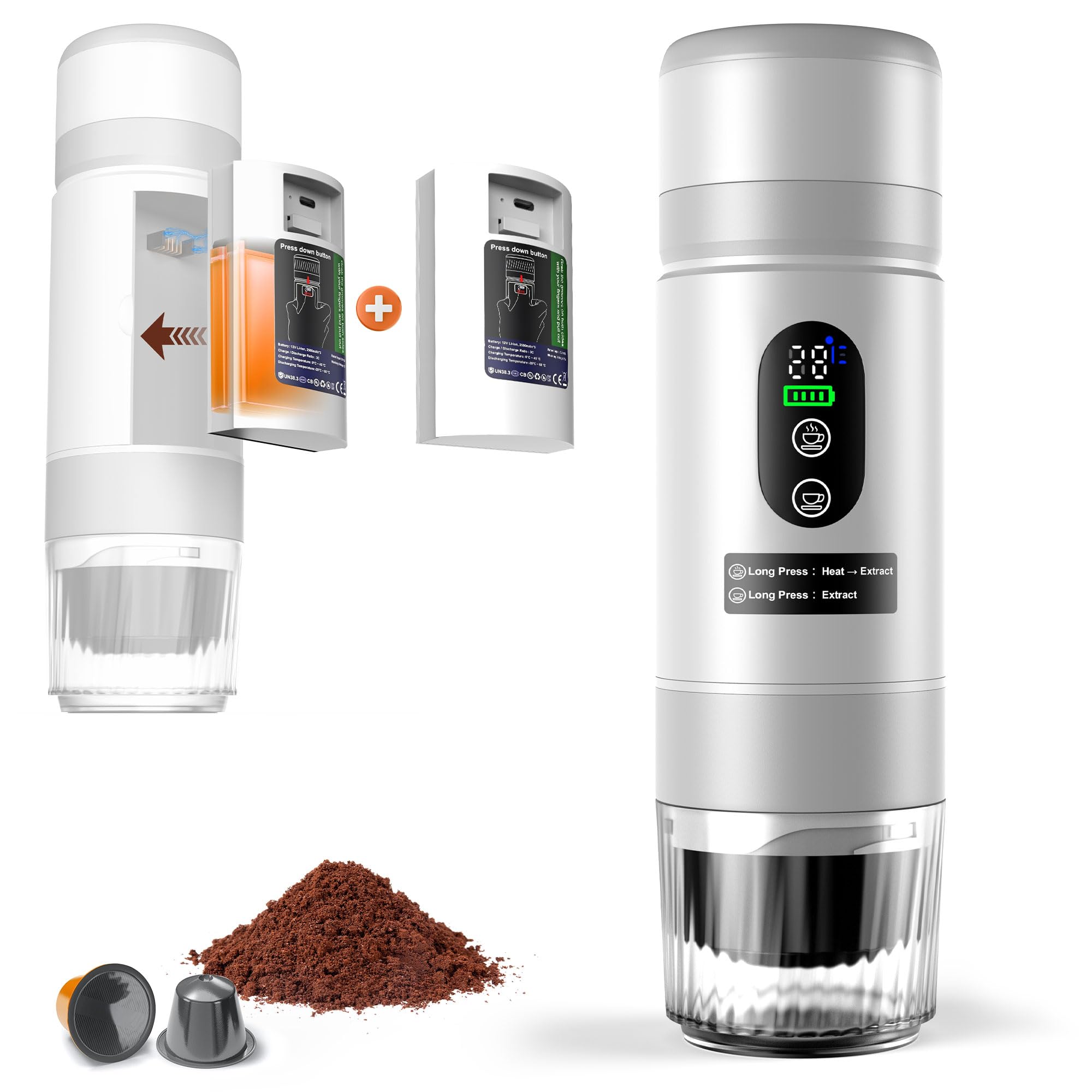
If you’ve ever bought a portable espresso maker, loved it for two days, and then hit the wall of “battery anxiety,” this is the antidote. The Ceshu approach is simple: give you two removable batteries so the product matches how humans actually travel. One battery is charging, one battery is working, and you’re not doing mental math at sunrise.
That dual-battery design also changes how you use the machine. Instead of treating it like a “special occasion” coffee maker, you can treat it like a daily tool: one shot for you, one shot for your partner, one later in the afternoon at the scenic overlook. The whole vibe becomes calmer.
Now let’s talk taste, because owner feedback is where the story gets real. Many buyers love the convenience and predictability—especially with capsules. But there are also occasional complaints about “off” taste (usually described as plasticky or lingering) and crema being weaker than higher-priced competitors. In my experience, that kind of feedback often comes down to two fixable things: rinse cycles and water choice. Run a few plain-water cycles before your first real brew, and use filtered water if your tap water is aggressive. It won’t turn a bad machine into a good one, but it can absolutely remove that “new device taste” that ruins first impressions.
Where this model really shines is in the travel workflow: it’s compact, it’s straightforward, it doesn’t demand a pumping ritual, and the battery situation makes it feel like a “real solution” rather than a toy. If your priority is practical coffee access over café perfection, Ceshu is a very smart pick.
Why it’s a travel win
- Two batteries = real endurance – This is the kind of feature that changes how often you actually use it.
- Great for road trips – Multiple brews without hunting for an outlet feels liberating.
- Capsule convenience – Cleaner, more predictable coffee with less cleanup on the move.
- Compact packing – Designed to live in a car, suitcase, or gear bin without fuss.
Good to know
- Some owners report taste/crema not matching premium machines; do rinse cycles and use good water to improve first impressions.
- Ground coffee still requires grind discipline; too fine can lead to mess or weaker extraction.
- If you want a “true big mug,” plan on Americano style rather than expecting drip volume.
Ideal for: travelers who want multiple coffees per trip day and hate the “one charge = one morning” feeling.
3. Zordin Portable Espresso (Removable Battery) – The “Plan Like a Pro” Coffee Maker
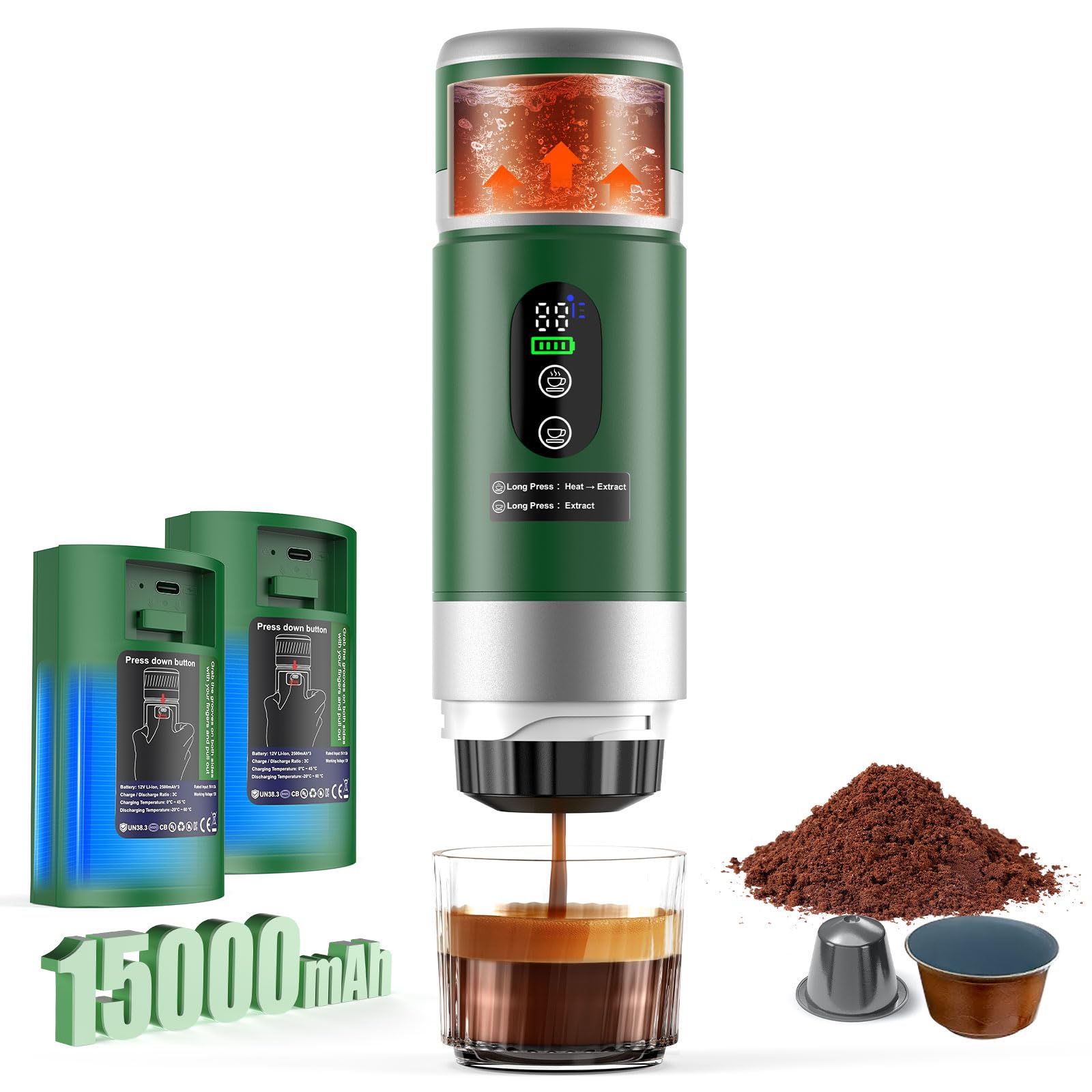
This is the pick for people who hate vague gadgets. If you like knowing what’s happening—battery level, temperature, progress— the smart display matters more than you’d expect. It turns brewing from “hope and wait” into “I can see exactly where we are.” That makes travel mornings calmer, especially when you’re juggling bags or trying not to wake someone up.
The removable battery is the real headline. It’s not just “nice.” It changes the entire ownership experience. A removable battery means:
- You can pack an extra battery for longer trips instead of packing an entire second brewer.
- You can keep one battery charging while the other is working (especially useful in cars and RVs).
- You don’t feel trapped by the device’s internal charging speed.
In owner feedback, the praise is consistent: it’s compact, it makes surprisingly rich espresso for the size, and USB-C charging fits modern travel life. People love using pods for convenience and keeping grounds as a “when I’m home” option. That’s a smart way to use these machines: pods for reliable travel flavor, grounds for flexibility when you have time to dial in.
My expert tip for this style of machine: don’t chase “maximum fill” in the chamber. Overfilling grounds is the fastest path to mess and clogging. Instead, use the correct dose, keep your grind medium-fine (not powder), and run a quick rinse cycle right after brewing. You’ll keep seals cleaner, pressure more stable, and flavor more consistent.
Why it stands out
- Removable battery flexibility – The biggest quality-of-life feature for frequent travel.
- Smart display clarity – Helps you plan, troubleshoot, and avoid “dead battery surprises.”
- Strong espresso-style output – Owners praise crema and flavor, especially with pods.
- Modern charging – USB-C makes it easier to integrate with car chargers and travel power banks.
Good to know
- Cold-water heating takes longer than hot-water extraction (that’s physics, not a flaw). Preheat water when you can.
- Like all compact espresso makers, grounds can be messy if you use ultra-fine grinds or overfill.
- If you want a “one-touch big mug,” consider a drip brewer instead of an espresso-style machine.
Ideal for: frequent travelers who want a clear, predictable workflow and the freedom to carry spare power.
4. SENIX Dual AC/DC Portable Coffee Maker – Drip Comfort for RVs, Outages, and Off-Grid Days
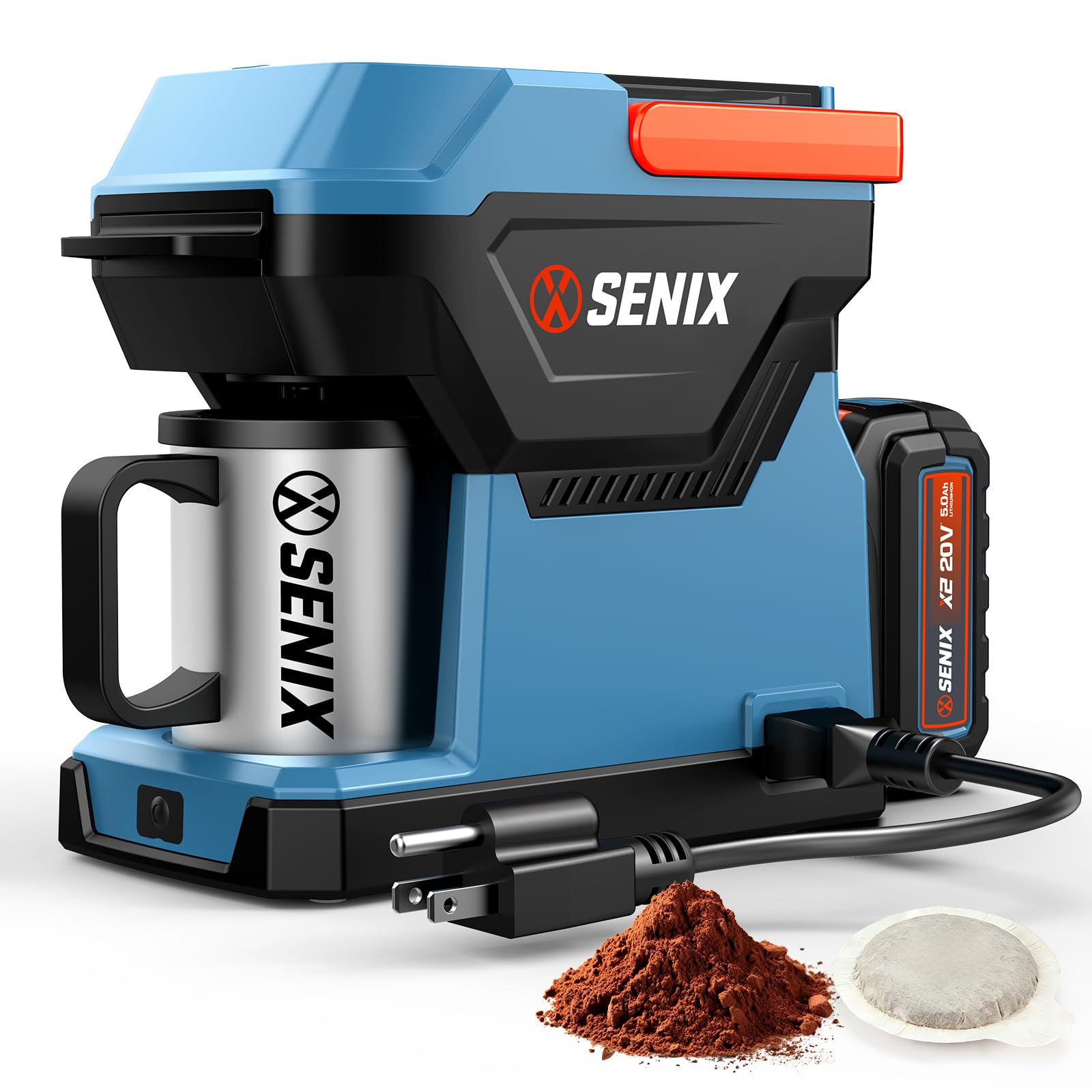
If espresso shots aren’t your thing—and you want a “real cup of coffee” with a familiar drip profile—this SENIX model is the standout. It’s designed like a compact coffee station: an integrated handle, an included insulated mug, and the flexibility to brew on battery or plug into AC power when you’ve got it.
That AC/DC flexibility is the real superpower. It means the machine isn’t pretending battery power replaces wall power. Instead, it gives you both. At home, in the office, or in an RV with shore power, you can plug in and brew continuously. Off-grid, you use battery mode to make a few cups when you truly need it. That’s exactly how most people use “emergency coffee” devices in reality.
Owner feedback also tells the truth about battery mode: heating water eats battery fast, especially in cold weather. Some users report they get only a couple cups per charge, while others squeeze out more by starting with warmer water or brewing when the unit is already warm. That’s not a contradiction—it’s just how heating works. If you want this kind of brewer for emergencies, the smartest strategy is to treat battery mode as a “bridge,” not an all-day café.
Taste-wise, drip brewing is often more forgiving than espresso brewing. You can use standard grounds and get a solid cup without obsessing over grind size. If you’re a “coffee should be easy” person, this is a big deal. And the included mug reduces mess and makes the setup feel tidy in small spaces.
Why it’s worth it
- Drip coffee comfort – More like a traditional cup than a tiny espresso shot.
- AC + battery flexibility – Practical for RVs, cabins, and outages.
- Lower mess mindset – Drip style is often easier to live with than micro espresso chambers.
- Included mug and accessories – Feels like a complete kit for travel or emergency storage.
Good to know
- Battery mode is limited because heating water takes serious energy; expect a few cups, not an endless pot.
- Drip brewing takes longer than espresso extraction; it’s a “slow comfort” style, not a 60-second shot.
- If you want true capsule convenience, note it uses ESE pods rather than the typical NS/DG capsule ecosystem.
Ideal for: drip coffee lovers who want a portable brewer for RV life, small spaces, job sites with AC access, or emergency “coffee during storms.”
5. Makita DCM501Z – The Jobsite Conversation Piece That Actually Delivers

Makita’s cordless coffee maker has a reputation that’s almost unfair: people buy it as a joke gift… and then keep using it daily. Why? Because it’s built with the same mindset as a power tool: simple, durable, and designed for environments where “fragile” gear dies quickly.
This isn’t an espresso machine. It’s a straightforward, single-cup drip coffee maker that uses Makita batteries. If you already own those batteries, the value is obvious: you’re using a power ecosystem you trust, with chargers you already have, and you’re turning a jobsite coffee problem into a solved problem.
Owner feedback tends to follow a pattern:
- People love it because it makes genuinely hot coffee anywhere, and it’s easy enough to use half-asleep.
- People complain about battery drain… but usually the complainers are new to the idea that heating water is power-hungry. If you have multiple batteries (like most Makita owners do), this becomes a non-issue.
- People underestimate it and then become loyal because it’s consistent and sturdy.
Here’s the expert angle: the Makita isn’t competing with travel espresso makers. It’s competing with bad gas station coffee and the misery of “no coffee until lunch.” For tradespeople, workshop owners, and anyone living in a tool-battery ecosystem, that’s a very real quality-of-life upgrade.
Why it’s iconic
- Built like a tool – Durable vibe for dusty, rough environments.
- Perfect for Makita owners – Uses the battery ecosystem you already have.
- Simple, consistent drip coffee – No finicky espresso chamber or grind obsession required.
- Genuinely fun – It’s a conversation piece that still earns its place.
Good to know
- This is a single-cup brewer; if you want multiple mugs fast, you’ll be brewing multiple cycles.
- Battery drain is real because it heats water; the solution is owning extra Makita batteries (most users already do).
- If your taste preference is “espresso shots,” look at the self-heating 20-bar machines instead.
Ideal for: Makita battery owners, jobsite crews, workshop life, and anyone who wants durable, no-drama coffee in rough environments.
6. KEJECTOR 3-in-1 Portable Espresso Maker – Easy Setup, Easy Cleaning, Easy Travel
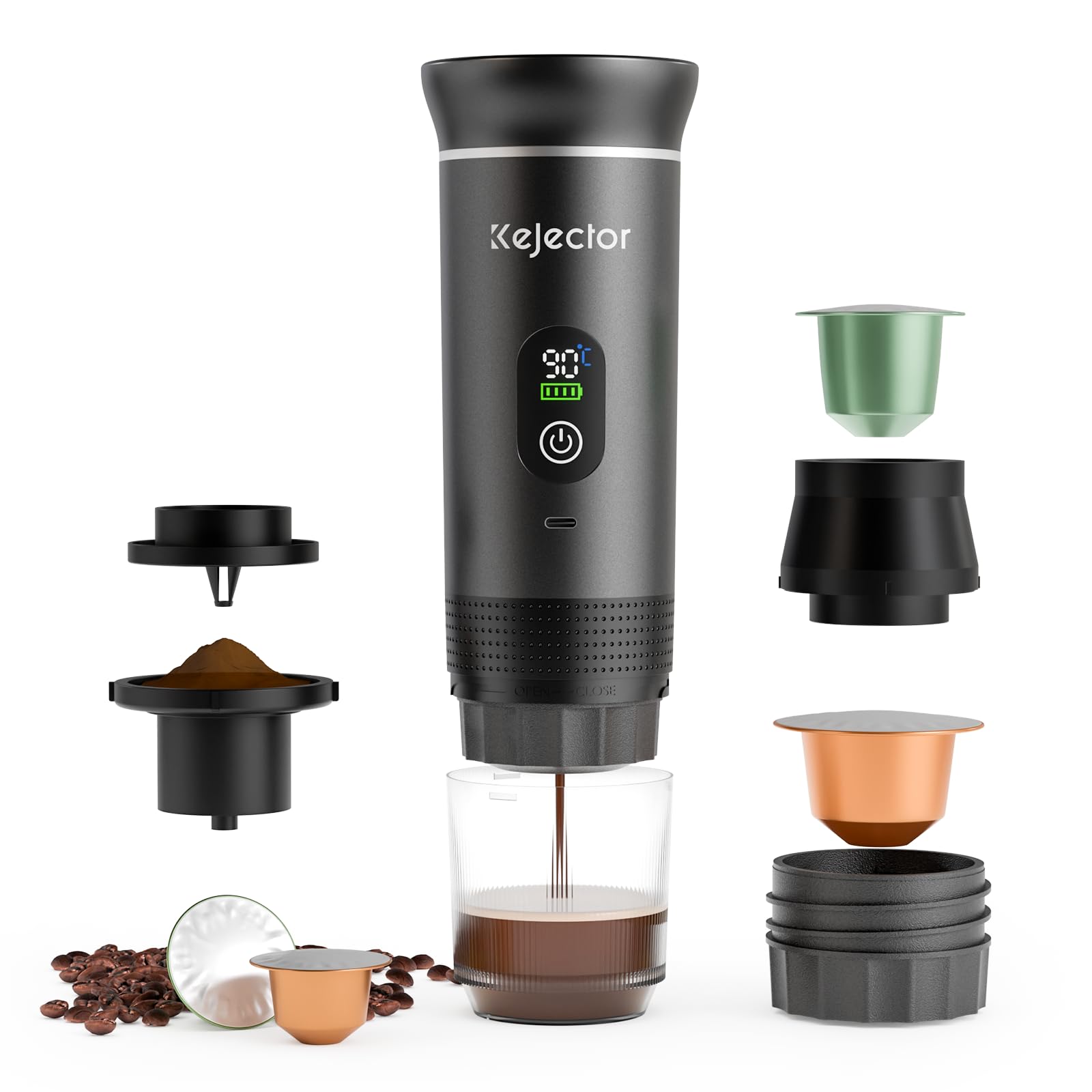
If you’re the type of person who appreciates “it just makes sense” design, this is a strong contender. Owner feedback highlights the same themes: intuitive assembly, multiple adapters, and a cleaning mode that makes it feel less like a fussy gadget. That matters because portable coffee fails at the same place every time: cleanup friction.
The KEJECTOR is also honest about its identity. It’s not trying to be a full-size espresso machine replacement. It’s trying to give you consistent travel espresso with minimal effort—and it succeeds best when you use it the way it wants to be used: pods for clean consistency, grounds for flexibility when you have time.
One thing owners mention that I love seeing: the machine is compact enough to pack easily, but not so tiny that it feels flimsy. That middle ground is a sweet spot for car camping and hotel travel. It’s not ultralight for backpacking, but it’s “throw it in a bag and go” friendly.
There is one common wish: more water capacity. That’s not unique to this brand—almost all portable espresso makers have small tanks. If you want a larger drink, the trick is to brew a shot and then top with hot water. That gives you a proper Americano without running three messy cycles.
Why it’s easy to live with
- Intuitive assembly – Less “instruction manual stress,” more use-it-right-away energy.
- Cleaning mode mindset – Reduces the chance of old coffee oils lingering and ruining flavor.
- Good travel size – Compact enough to pack, sturdy enough to not feel disposable.
- Flexible coffee options – Pods for convenience, grounds when you want control.
Good to know
- Not ideal for backpacking; some users describe it as a bit heavy for hiking-only loads.
- Water capacity is limited (common to this category), so plan Americano-style drinks if you want volume.
- Ground coffee results depend on grind size; if your first brew is messy, go slightly coarser and reduce dose.
Ideal for: travelers who want a balanced espresso maker that feels straightforward to use and maintain—especially for hotels and car camping.
7. Zordin 3-in-1 Smart Display Mini Espresso (Black) – Compact Storage, Big Convenience
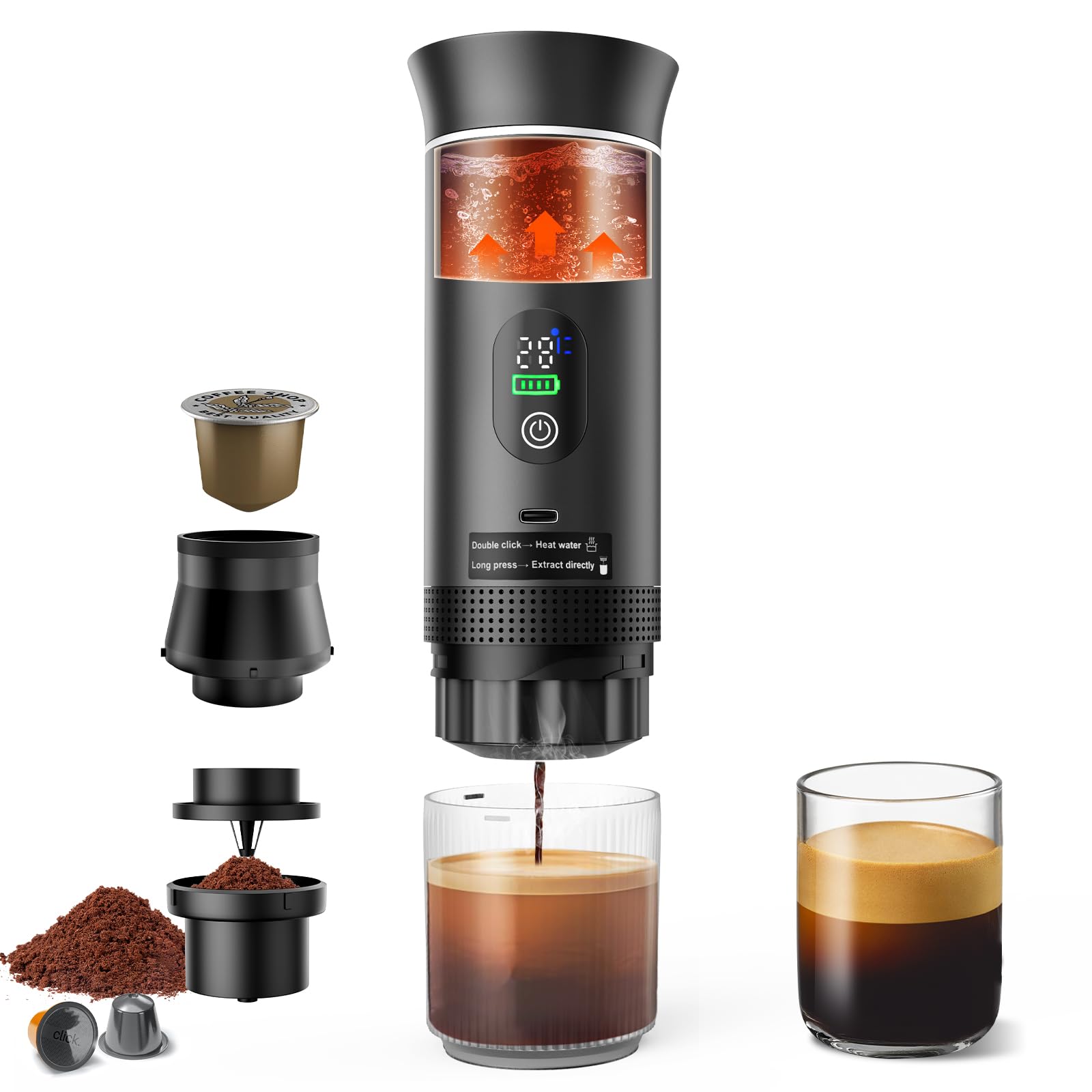
This Zordin model earns its spot for one simple reason: it’s designed for the way people actually pack. Owners love that the parts nest neatly and the whole kit feels “contained,” which matters when you’re tossing it into a suitcase, keeping it in a car, or storing it in a tiny RV drawer.
Performance-wise, it delivers what you want from this category: espresso-style extraction, compatibility with capsules and grounds, and the flexibility to brew hot or cold. In practice, hot-water extraction is where you’ll fall in love with it—fast cycle, less battery drain, and very consistent results. Cold-water heating is still useful, but you’ll use it most when you truly need it.
Owner feedback also gives you the honest limitations. Some people report that battery capacity feels modest if you’re heating cold water repeatedly, and some mention they wish it could brew while actively charging (many devices in this category don’t). That’s not a dealbreaker, but it informs how you plan: charge fully before travel days, and treat the machine as a “few great shots” tool rather than an all-day coffee bar.
I also love one practical user insight: because it’s compact, it’s perfect for “hotel coffee rescue.” If you travel for work and you care about coffee, this kind of device is a sanity saver. A couple pods, your own water, and you don’t have to settle.
Why it’s a smart travel pick
- Packs neatly – A genuinely useful “contained kit” design for luggage and glove boxes.
- Versatile brewing – Pods and grounds, hot and cold options.
- Great for hotels – Makes travel coffee feel personal and predictable.
- Easy to clean – Simpler cleanup when you mainly use pods.
Good to know
- Cold-water heating drains battery quickly; preheat water when possible to extend usage.
- Some owners note it can’t run a full heat+brew cycle while charging (plan charges ahead).
- Temperature display and controls may not be as “premium refined” as higher-priced models, but the coffee result is the real goal.
Ideal for: work travelers and road trippers who want a compact, packable espresso maker that doesn’t create a mess in tight spaces.
8. avigator 12V Car Coffee Maker – The “Drive, Park, Brew” Drip Setup

This one is not trying to be everything. It’s trying to be the car coffee maker. If your coffee problem is “I’m driving long distances and I want a real mug without stopping,” this style of brewer can feel life-changing.
Here’s the truth about 12V brewing: it’s slower than most people expect. That’s normal. A car socket has limits, and heating water under those limits takes time. Owners commonly report brew times that feel long—especially with cold water. But when it’s done, the coffee can be hot, strong, and satisfying. This is a “set it up, wait, enjoy” device—not a 2-minute espresso shot machine.
The most important real-world detail is electrical: the unit draws meaningful current and expects a vehicle setup that can handle it. Some users report blowing fuses in certain vehicles if the socket/fuse rating isn’t appropriate. That doesn’t mean the coffee maker is defective—it means you need to respect the reality of 12V power. If you’re using it in a truck sleeper or RV, check your setup once, and you’ll avoid frustration later.
Design-wise, it wins on the included insulated mug and auto shut-off safety. It feels like a practical travel kit for drivers. If you live in hurricane country or do off-grid camping with a small generator, it can also be a comfort upgrade: you’re not dependent on a café.
Why drivers love it
- Built for car life – Designed specifically around 12V travel reality.
- Real mug experience – Drip-style coffee that feels like a normal cup.
- Auto shut-off – Safety and energy sanity for vehicle use.
- Includes a travel mug – Reduces the “what cup fits?” hassle.
Good to know
- Brew time can be slow, especially with cold water; this is normal for 12V heating.
- Vehicle sockets vary—make sure your setup can support the brewer’s requirements to avoid blown fuses.
- This is grounds-only (no capsule system), so you’ll need to manage grounds and cleaning.
Ideal for: commuters, truck drivers, RV travelers, and anyone whose coffee routine lives in the vehicle.
9. Tastyle Single Serve (K-Cups + Grounds) – Small Footprint, Fast Brew, Easy Living

Let’s be clear: this one isn’t a self-heating cordless unit. It’s a tiny single-serve brewer designed for 120V use. So why is it in this guide? Because a huge number of “portable coffee” buyers actually use a power station, inverter, or hotel wall outlet. And in that world, this kind of brewer is often the most satisfying daily solution.
Owners love it for one reason: it’s simple and it works. One button, fast brew, small footprint. That sounds boring—until you’ve dealt with complicated devices that need a ritual. This is the “studio apartment / dorm / RV counter” hero that doesn’t steal space.
The real-world details that matter:
- Drips happen. That’s not unique to this brand. It’s the nature of small single-serve designs. A paper towel or small mat solves it.
- Your mug size matters. Small machines have clearance limits. If you use a giant travel mug, you may need to brew twice and pour.
- Using reusable pod filters can improve cleanliness. Many owners use simple paper filters to reduce sediment when using grounds.
If you’re running a small solar setup or a portable power station, single-serve brewers like this are often a sweet spot: power is used only during brewing, then the unit shuts off. For off-grid living, that “only draw power when needed” behavior can matter.
Why it’s so practical
- Very small footprint – Great for tiny counters and travel setups.
- Fast, one-button brewing – Low effort, high reward.
- K-cups or grounds – Convenient pods or flexible grounds depending on your routine.
- Auto shut-off + cleaning reminders – Small features that improve long-term reliability.
Good to know
- Not a cordless self-heating brewer; you’ll need a power source (wall outlet, inverter, or power station).
- Some dripping is normal; plan a small catch mat or towel.
- Single-serve means one cup at a time—perfect for some, annoying for others.
Ideal for: RV travelers, hotel stays, dorms, and off-grid/solar setups where you can provide 120V power but want a tiny, fast daily brewer.
10. Yorenson 3-in-1 Portable Espresso Maker – Budget-Friendly, Surprisingly Capable, But Know the Quirks
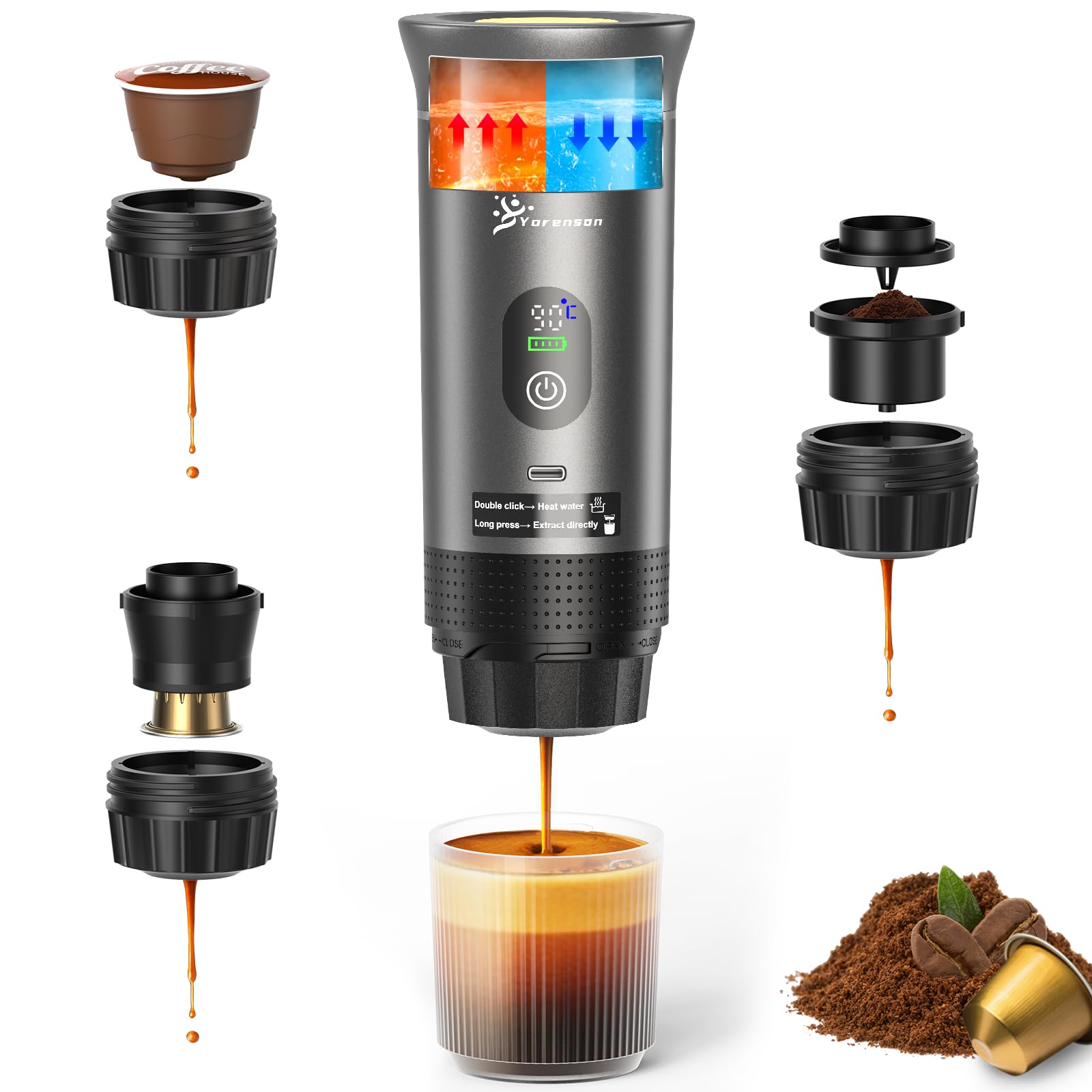
Yorenson is the kind of pick that makes sense when you want the core experience—self-heating espresso with capsule compatibility— without paying extra for brand prestige. Owners frequently describe it as “works great” and “super convenient,” especially when used with hot water or capsules (the clean and consistent route).
There are two reasons this model is worth spotlighting in the budget category:
- The LED display is genuinely useful. Seeing temperature, countdown, and battery level helps you avoid the “is it broken?” anxiety that ruins portable coffee.
- The brand openly mentions practical usage notes (like the transparent bottom not being leak-proof). That kind of honesty usually correlates with fewer surprises.
Now, the quirks. Owner feedback includes a few complaints that are very typical for budget portable espresso devices: slow heat in cold-water mode, mess when using ground coffee, and occasional QC issues (like parts arriving misassembled or display oddities). The good news is that responsive seller support can reduce the risk—but the best way to avoid frustration is to brew smart:
- Use pods when traveling (less mess).
- If using grounds, go medium-fine, don’t overfill, and rinse immediately.
- Pour into your real cup right away and don’t rely on a base container for leak-free storage.
One owner used it on an extreme travel scenario and reported excellent battery performance when using hot water. That aligns with the physics: heating is the battery killer. If you bring a thermos of hot water, this kind of device becomes dramatically more impressive.
Why it’s strong value
- LED display helps a lot – Reduces guesswork and makes the workflow feel “premium.”
- Great for pods – Cleaner and more consistent travel espresso.
- Budget-friendly entry – A practical way to get into self-heating espresso without overspending.
- Good when used with hot water – Makes travel brewing feel fast and efficient.
Good to know
- Ground coffee can be messy in the tiny chamber; use the right grind and don’t overfill.
- Cold-water heating may feel slow—preheat water when possible for a better experience.
- Some reports of QC quirks; check parts on arrival and do a rinse cycle before first real brew.
Ideal for: budget shoppers who want self-heating espresso with a display and capsule flexibility—especially if they’re willing to brew “smart” (pods + hot-water strategy).
11. Narcissus Portable Electric Espresso Machine – Simple, Capsule-First Travel Espresso
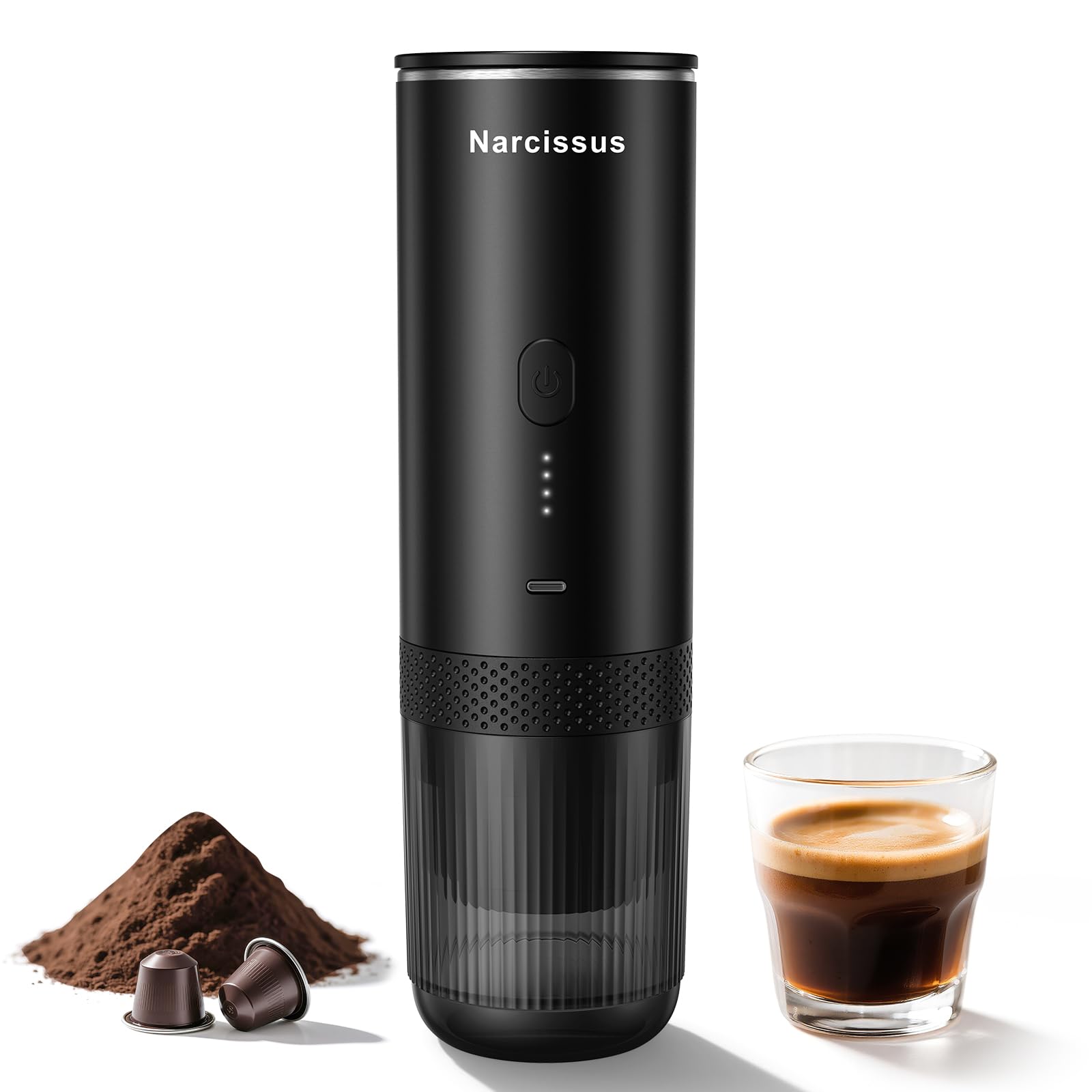
This is the “keep it simple” pick. If you already love Nespresso Original capsules, Narcissus is designed to lean into that convenience: pod in, water in, press the button, get espresso. That’s it. No pumping, no complicated multi-step flow.
Owner feedback tends to be very specific here: people are impressed by crema for a portable device, and they enjoy the espresso quality for the size. The most common criticism is also consistent: it may not get as hot as some people expect, and cold-water heating can take longer than ideal. That’s not a “dealbreaker,” but it tells you who it’s for. This is best for:
- People who want a clean pod-based travel espresso routine.
- People who prioritize convenience over maximum temperature obsession.
- People who are willing to use hot water when they want faster, hotter results.
A key usage detail many buyers miss: some portable espresso machines cannot be turned on while charging. That’s not unusual. It’s a safety and power-management decision. But it means you should charge intentionally before your travel day, rather than hoping to “top up while brewing” during the morning rush.
One more expert tip: this model includes a note about releasing pressure after brewing by opening the coffee powder chamber. That’s a practical design reality in compact machines—pressure and trapped gas can affect flow if you don’t reset between cycles. If you follow that routine, the machine behaves more consistently and you avoid frustrating “why isn’t it pumping?” moments.
Why it’s a clean choice
- Pod-first convenience – Nespresso Original workflow is simple and clean.
- Good crema for a portable unit – Many users are pleasantly surprised by the espresso feel.
- Quick charger included – Helps reduce downtime between travel days.
- Easy one-button operation – Great when you’re tired or in a hurry.
Good to know
- Some owners wish it brewed hotter; using preheated water can improve satisfaction.
- Cold-water heating can take longer than expected (common for compact self-heating devices).
- Follow the pressure-release routine after brewing to keep pumping consistent between cycles.
Ideal for: Nespresso Original capsule lovers who want a simple travel espresso routine with minimal cleanup and a straightforward learning curve.
12. Citrigrain Hands-Free Portable Espresso Maker – Lightweight Convenience (Best for Short Runs)
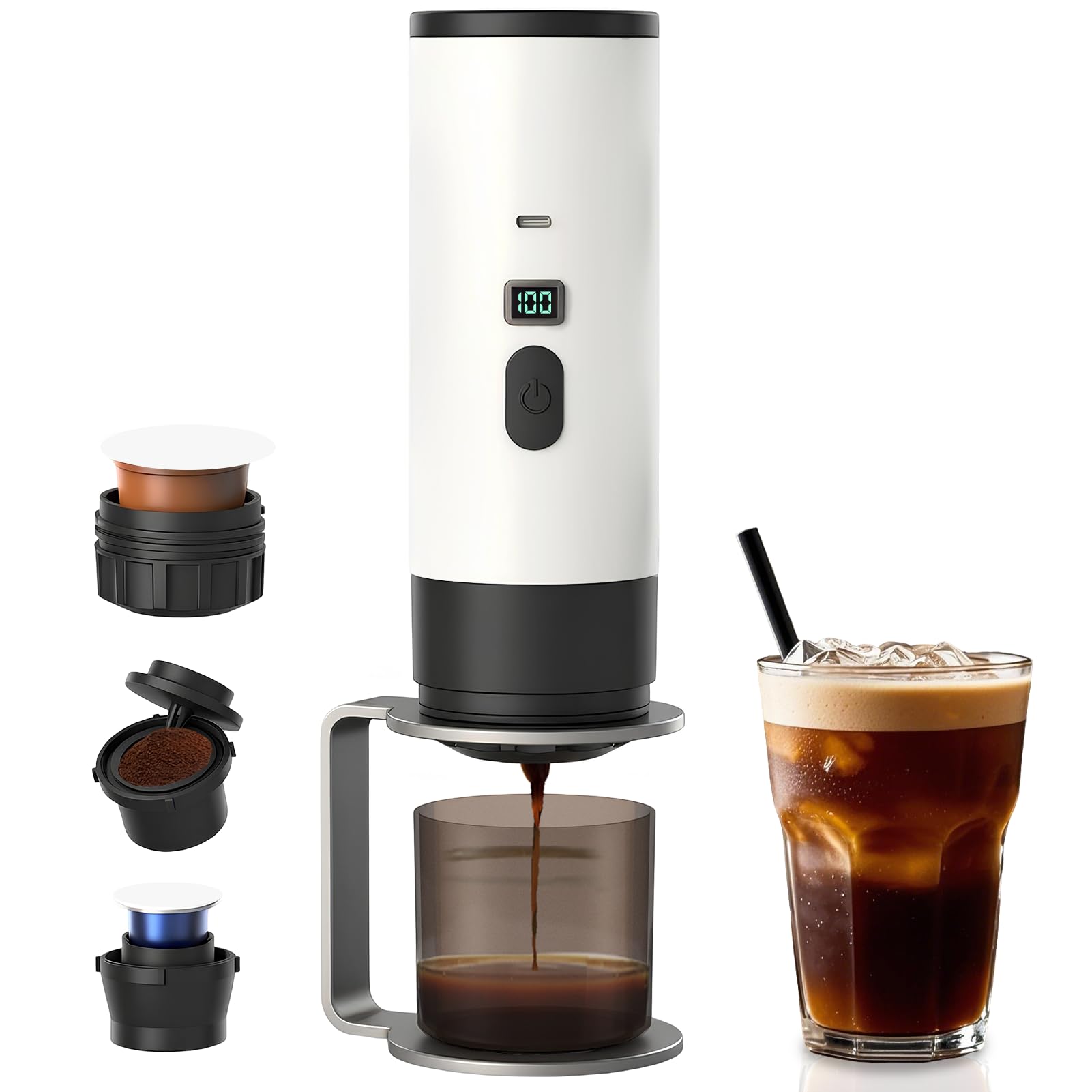
Citrigrain’s “hands-free” pitch is honestly refreshing: the goal is to reduce fuss. No pumping, no holding, brew directly into your cup, quick cleanup. And for many owners—especially commuters and weekend travelers—that’s exactly what they want.
When used with hot water, this style of device can feel wonderfully quick. That “80 seconds with hot water” kind of workflow is what makes portable espresso actually enjoyable. Because the real magic of portable coffee isn’t “it can do everything.” It’s “it can do one thing fast, reliably, without waking up the whole campground.”
The mixed reviews tend to highlight battery and temperature expectations. Some users report the battery feels short and the coffee may not be as hot as they prefer in certain situations. This usually comes down to how you’re using it:
- If you’re asking it to heat cold water repeatedly, you’ll drain battery quickly.
- If you’re using very fine ground coffee, you can create mess or sludge in the tiny chamber.
- If you want “scalding hot,” you’ll want to start with hotter water or look at a drip brewer that prioritizes mug heat.
So here’s my honest take: Citrigrain is best as a lightweight “espresso access” tool for short trips, commutes, and occasional travel. If you need multi-cup endurance for a full camping weekend, you’ll be happier with a dual-battery system or a removable-battery model.
Why it’s appealing
- Lightweight and compact – Easy to fit in commuter bags and travel kits.
- Hands-free workflow – Less fuss, less holding, more “press and move on.”
- Fast with hot water – Great for quick espresso when you can preheat water.
- Simple cleanup – Especially when using capsules and brewing directly into your cup.
Good to know
- Battery can feel limited if you rely on cold-water heating; it’s best for short runs.
- Ground coffee can be messy if grind is too fine; pods are cleaner for travel days.
- If “very hot coffee” is your top priority, drip-style brewers may satisfy you more.
Ideal for: commuters and light travelers who want a compact, low-effort espresso maker for quick coffee access (especially when using hot water).
How Portable Coffee Makers Actually Work (and Why Battery Claims Look “Wild”)
If you’ve ever read a listing that says “5 hot coffees per charge” and then another that says “300+ cups,” you’re not crazy. You’re just seeing two different realities being described with the same marketing voice. Once you understand what the machine is actually doing, the confusion disappears—and you’ll buy smarter.
Self-heating vs extraction: the one difference that explains everything
Portable espresso makers typically do two jobs:
- Heat the water (if you start with room-temperature water).
- Extract the coffee by pumping water through a capsule or coffee bed under pressure.
Heating water is the energy monster. Extraction is comparatively light. That’s why you’ll see claims like “4–6 hot coffees” (cold water start) and “100+ cups” (hot water start). They’re describing different scenarios.
So the smart question isn’t “how many cups per charge?” It’s:
- How many cold-water heats can it do when I’m truly off-grid?
- How consistent is extraction when I give it hot water?
- How messy is it when I use ground coffee instead of capsules?
If you can bring hot water (thermos, kettle, camp stove), you can transform a “battery-limited” machine into an all-weekend hero. If you can’t, you need a machine that’s honest and efficient in self-heating mode.
Why “20 bar” doesn’t automatically mean “better espresso”
A lot of portable machines advertise 20 bar pressure. That sounds impressive—and it can be. But great espresso flavor in real life comes from:
- Stable flow (not pulsing or sputtering).
- A good seal so pressure doesn’t leak and weaken extraction.
- Correct coffee resistance (capsule or properly dosed grounds).
- Temperature discipline (lukewarm water = flat flavor).
This is why pods are often the “best tasting” mode for travel espresso: they’re engineered for repeatability. With ground coffee, you become the engineer. And if your grind is too fine, you’ll get mess and frustration. Too coarse, and the shot tastes thin.
The portable espresso makers that earn long-term loyalty are the ones that make pods taste great and make grounds possible—not necessarily perfect. That’s a realistic standard, and it aligns with real owner satisfaction.
How to get better coffee from any portable brewer (without becoming a coffee scientist)
- Use filtered water – Better taste, less scale, fewer clogged passages over time.
- Do two rinse cycles on day one – Removes “factory taste” and makes the first real coffee less disappointing.
- Choose capsules for travel days – Less mess, more consistency, faster cleanup.
- Go medium-fine with grounds – Avoid powder-fine grinds that clog tiny baskets.
- Don’t overfill – In micro chambers, “a little less” usually means “a lot better.”
- Drain and dry – After brewing, don’t store the unit wet. Moisture in a bag or toolbox is how small corrosion and smell issues start.
- Preheat when possible – Hot water in, better coffee out, and your battery lasts longer.
This is also where your “station strategy” matters. A small towel or mat prevents drips from becoming stress. A collapsible cup makes hotel use clean. A rinse bottle at camp makes cleanup painless.
Most portable coffee disappointment isn’t about the machine being “bad.” It’s about the user expecting it to behave like a full-size countertop brewer. Once you treat it like what it is—a compact heat-and-extract tool—everything gets easier.
What “good” looks like (so you know when you picked right)
When you choose the right portable brewer, you’ll notice:
- You stop thinking about it. You just brew.
- You don’t dread cleanup.
- Your coffee tastes consistent enough that you stop buying “emergency coffee.”
- You feel calmer on travel mornings because one variable is solved.
That’s the real goal. Not “perfect espresso.” Just reliable, satisfying coffee where you need it.
FAQ: Portable Coffee Without the Confusion
How many cups can I realistically expect per charge?
Do these machines actually make “real espresso”?
What’s the cleanest way to use a portable espresso maker?
Why do some units brew lukewarm coffee for certain users?
Should I choose a 12V car coffee maker instead of a self-heating espresso maker?
I want one purchase and I want to feel DONE. What should I buy?
Final Thoughts: Pick the Brewer That Makes Your Mornings Feel Possible
A truly good portable coffee setup doesn’t just make coffee. It makes you feel calmer. It turns “Where am I going to get caffeine?” into “I’ve got this.”
Here’s the simplest way to choose without overthinking:
- Want the best overall balance of speed, portability, and “complete kit” confidence? Start with the Uiifuidy 3-in-1 Portable Espresso Maker Set. It’s the kind of pick most people can buy once, learn fast, and actually keep using.
- Want maximum endurance for road trips, camping weekends, and multi-cup days? Go with the Ceshu Portable Coffee Machine (2 Batteries). The dual-battery approach is the most “real life” solution if you hate power anxiety.
- Want removable-battery flexibility and a display that makes the workflow obvious? Choose the Zordin Portable Espresso (Removable Battery). It’s made for frequent travel and planning without guesswork.
- Prefer drip coffee and want something that works for RV life and power outages? Pick the SENIX Dual AC/DC Portable Coffee Maker. If mugs matter more than shots, this will feel more satisfying than forcing an espresso maker to become a drip machine.
- Already own Makita batteries and want a tough, jobsite-friendly brewer? The Makita DCM501Z is a niche legend for a reason.
- Want a user-friendly, balanced espresso kit with easy cleaning and multiple adapters? Look at the KEJECTOR 3-in-1 Portable Espresso Maker. It’s a strong middle-ground option for hotel and car-camping life.
- Need a car-only drip solution for long drives? The avigator 12V Car Coffee Maker is designed for that specific reality—just accept the slower brew time as the trade.
- Want a tiny single-serve option for small spaces (with a power source)? Try the Tastyle Single Serve for a compact, fast brew setup that works great in RVs, dorms, and hotel rooms.
- Want a budget self-heating espresso maker with a display? The Yorenson 3-in-1 Portable Espresso Maker is a solid value if you brew smart (pods + clean routine).
- Want capsule-first simplicity with Nespresso Original compatibility? Choose the Narcissus Portable Electric Espresso Machine. It’s built for clean travel espresso with minimal fuss.
- Want an ultralight, hands-free style brewer for short runs and commutes? The Citrigrain Hands-Free Portable Espresso Maker is a good “quick access” tool—especially if you often use hot water.
If you pick the battery operated coffee maker that matches how you actually travel—car, hotel, campsite, jobsite—you’ll stop researching, stop second-guessing, and start enjoying the one thing you were after in the first place: coffee that shows up when you do.
