
Specs are compiled from manufacturer listings and verified buyer reviews and can change over time — please confirm the key details on the product page before buying.
You bought a backyard umbrella for shade, not for chasing it across the yard after a gust of wind. The base is what keeps your umbrella planted exactly where you set it — pick the wrong one and you risk a toppled umbrella, a bent frame, or a cracked planter. Here are nine reliable options, from a budget-friendly slab to a sand-fillable fortress.
I’m Mohammad Maruf — the founder and writer behind KitchPrep. This guide is built by comparing the manufacturers’ published specifications and the patterns across verified customer reviews, so you get each pick’s real strengths and trade-offs instead of marketing spin.
Your shade setup stays secure when you choose the right backyard umbrella base for your pole size, patio surface, and local wind conditions — here is exactly how to decide.
Our Picks at a Glance


How To Choose The Best Backyard Umbrella Base
Buying a base sounds simple — put something heavy under the pole. But the right one depends on your umbrella’s size, your patio material, and if you want to move your setup around. Here are the three specs that separate a reliable base from a frustrating one.
Weight and Filling
The base’s weight (in pounds) directly determines how much wind your umbrella can shrug off. A solid 20-to-30-pound base is fine for a 6.5-foot umbrella tucked under a table. For a 9- to 11-foot market umbrella in open air, you typically want 50 pounds or more. Fillable bases let you add sand, water, or gravel on site — some hold up to 150 pounds — which is a major advantage if you have to haul the base empty to its spot before filling it.
Pole Diameter Compatibility
Most patio umbrella poles are either 1.5 inches or 1.9 inches in diameter. A base that includes removable rubber or plastic adapters can fit both sizes snugly. A sloppy fit lets the umbrella wobble inside the receiver tube, which accelerates wear on both the pole and the locking knob. Look for bases that list the exact pole diameters they accommodate — never assume a “universal” fit works without adapters.
Portability and Storage
Some bases are one solid chunk you drag into place; others have wheels, handles, or a fillable body you can empty and collapse. If you move your umbrella around the yard to chase the shade, a base with locking wheels and a handle saves your back. If the base stays under a dining table all season, a simple flat steel plate or concrete disc is all you need. Also consider winter storage — fillable plastic bases are lighter to drain and tuck away.
Quick Comparison
| Model | Best For | Base Weight | Pole Fit | Fillable? | Amazon |
|---|---|---|---|---|---|
| Best Choice Products 150 lb Planter Base★ Best Overall | Ultimate stability + greenery | 26 lbs (base) / 150 lbs (filled) | Up to 2″ | Yes (sand/gravel/soil) | Amazon |
| EliteShade USA 50 lb Steel + SandbagPremium Pick | Premium build, windy conditions | 50 lbs (base) / 130 lbs (with sandbag) | Up to 1.5″ | Yes (bonus sandbag) | Amazon |
| Yaheetech 27 lb Heavy DutyTop Performer | Mid-size umbrellas in wind | 26.34 lbs | 1.5″, 1.9″ | No | Amazon |
| Backyard Expressions 20 lb Stand | Budget-friendly, under-table use | 19.8 lbs | 1.5″–2″ | No | Amazon |
| Yaheetech 23 lb Woven-Style | Style + solid hold for 9′ umbrellas | 23.02 lbs | 1.5″, 1.9″ | No | Amazon |
| Giantex 43 lb Classic Round | Oversized umbrellas, commercial look | 43 lbs | 1.5″–1.9″ | No | Amazon |
| Maple99 Fillable Mobile Base | Moving your umbrella around the yard | 8 lbs (empty) / 125 lbs (filled) | 1.5″–1.9″ | Yes (sand/water) | Amazon |
| Best Choice Products 38.5 lb Steel | Low-profile under a dining table | 38.5 lbs | 1.5″–2″ | No | Amazon |
| California Umbrella 50 lb Concrete | Set-and-forget under-table stability | 50 lbs | Up to 1.5″ | No | Amazon |
In‑Depth Reviews
1. Best Choice Products 150lb Capacity Portable Steel Umbrella Base Stand
Our pick — over 4.5★ from 950+ verified ratings; the strongest balance of quality and price.
The planter-base hybrid that delivers the highest fillable weight in the roundup — and hides it in greenery.
This steel base doubles as a planter box you load with soil, gravel, or sand up to a full 150 pounds. The result is rock-solid stability that buyers report easily handles coastal gusts — one owner runs river pebbles and larger pots inside it and still trusts it with the umbrella up. A powder-coated finish protects against rust, and multiple drainage holes keep your plants from drowning while adding ballast at the same time. The base itself weighs 26 pounds empty, so you move it into position first, then fill.
Two adjustment knobs and a coupler that accepts poles up to 2 inches mean it accommodates market umbrellas from 7.5 to 11 feet without wobble. Built-in wheels help reposition it, though the consensus is clear: moving it while full is a chore, and tipping it to engage the wheels can spill contents. The trade-off is worth it for buyers who want the highest possible holding force without a separate ugly weight stack.
Why owners love it
- Fillable to 150 lbs — versus a typical non-fillable stand weighing around 26 lbs — so even an 11-foot umbrella stays put in wind.
- Planter design hides the weight and adds garden appeal; owners mention it “looks like it belongs” on the patio.
- Wheels and handle make it possible to shift the empty base into position before you fill it.
The honest caveats
- Moving it once filled is difficult — the wheels sit on one side, so you have to tip the planter, risking a spill.
- Assembly required; the steel panels come flat and need to be put together like a planter box.
Your pick if: You want the ultimate ballast — 150 pounds when filled — and like the idea of a base that doubles as a flower bed.
Look elsewhere if: You need to move your umbrella and base together as one unit every day; this one stays put once loaded.
2. EliteShade USA Up to 160 lbs Heavy Duty Square Umbrella Base
A hefty steel plate base that comes with an extra sandbag — totalling up to about 130 pounds of hold-down force.
The EliteShade base itself weighs 50 pounds, making it one of the heaviest pre-filled options here. what separates it is the included 18.5-inch weight sandbag (sand not included) that adds up to roughly 80 more pounds, bringing the total ballast close to 130 pounds. That is higher than the Maple99 fillable base at its filled weight of 125 pounds and avoids the hassle of hauling loose sand to the base’s fill hole — you fill the bag once and drape it over the base. Two manual tightening knobs secure the umbrella pole firmly, and the steel construction resists rust and UV damage.
The square footprint measures 18.9 inches on each side, and customers note it fits nicely under patio tables thanks to its 14.9-inch height. The main trade-off is the sandbag itself — a few owners mention the bag fabric tore after a season outdoors, so you may end up replacing it. The base’s steel plate is also a trip hazard if placed in a high-traffic walkway, so keep that in mind when positioning it.
Best for: The buyer who wants near-fillable weight levels without the chore of filling a planter — the bonus sandbag adds serious ballast, and the steel plate is elegant and low-profile.
Think twice if: You have uneven ground; the flat steel plate can rock on a bumpy surface. The sandbag also needs replacement after extended sun exposure.
Reach for it if: Your umbrella is 9 feet or larger and sees regular wind — the combined 130 pounds is genuine confidence.
skip it if: You want a single-piece, no-assembly-required base; the sandbag adds an extra step every time you set up.
3. Yaheetech 27 lbs Heavy Duty Outdoor Umbrella Base
Heavy, solid resin and iron — and the crowd favorite for keeping a 9-foot pole dead still.
At 27.1 pounds, this Yaheetech weighs 27.1 lb versus the Backyard Expressions stand at 20 lb, which makes a real difference when a gust hits a large umbrella. The resin and iron construction gives it heft without the maintenance of exposed steel, and the anti-skid bottom keeps it from sliding on deck or concrete. Rubber adapters let it fit both 1.5-inch and 1.9-inch poles — a universal setup that buyers confirm works with market-standard poles right from the start.
Owners are emphatic about the stability: “our 9 foot patio umbrella doesn’t wiggle or turn…at all!” is a common refrain. The round shape and 18-inch diameter mean it occupies a modest footprint, and the assembly is as simple as dropping in a rubber adapter and tightening a knob. A few note minor mold imperfections on the resin surface up close, and the nut that secures the umbrella pole can scratch the shaft — a wrap of electrical tape solves it. The top-verdict weight is 27.1 pounds, versus the 150-pound fillable of the Best Choice planter, so this is a solid midweight, not a heavy anchor.
Why it works
- 26.34 pounds is heavy enough for a 9-foot umbrella in moderate wind without needing sand or water.
- Anti-skid base ring keeps the stand planted on smooth surfaces.
- Rubber pole adapters accommodate both common pole diameters.
What to know
- Surface imperfections in the resin mold are visible up close.
- The tightening nut can scratch an umbrella pole — wrap the pole with tape if you’re concerned.
Best for: Anyone with a 7.5- to 9-foot patio umbrella who wants a no-fuss, no-fill base that just works from the start.
Not for: Very windy coastal areas or 11-foot umbrellas — consider the fillable Best Choice or EliteShade for those conditions.
4. Yaheetech 23 lbs Heavy Duty Outdoor Umbrella Base

A wicker-pattern resin base that balances price, stability, and looks — all at 23 pounds.
This Yaheetech weighs 23 pounds, sits on an 18-inch round footprint, and uses an embossed wicker pattern that blends into a garden or deck setting without screaming “utility.” The stability is the most-cited praise — reviewers point out the base holds a 9-foot umbrella securely without wobble, and the rotary knob locks the pole in place with no tools. Two rubber adapters cover 1.5-inch and 1.9-inch poles, and the resin-and-iron construction is UV-resistant to keep the color from fading over a season in the sun.
The key difference from the heavier Yaheetech (27 lb model) is a 4.1-pound weight gap and a more decorative woven pattern. Both deliver near-identical stability for 9-foot umbrellas, but this one costs less. The honest caveats: a small number of shoppers say rust developing on the iron components after a few months outdoors, and the base is not fillable, so you cannot add extra ballast if you need more hold.
Smart value pick: You get proven stability from a reliable brand, a nice wicker finish, and a 23-pound total that handles most 9-foot umbrellas — all at a lower weight tier than the 26.5 lb model.
Trade-off: Not enough mass for exposed coastal decks or 11-foot umbrellas; you will want the heavier options above.
Reach for this if: You want a good-looking, stable base for a 9-foot umbrella without spending extra on a fillable model.
Choose the 26.5 lb Yaheetech if: Your patio is especially windy or you have a larger umbrella — the extra few pounds make a difference.
5. Giantex 43 lbs Patio Market Umbrella Base

A 43-pound two-part base with a cast-iron holder and a resin shell — built for oversized umbrellas.
The Giantex pairs a heavy resin outer ring with a cast-iron center holder, giving you the visual of a classic stone base without the full stone cost. At 43 pounds, it is significantly heavier than the 22- and 26-pound Yaheetech stands, making it a better fit for larger market umbrellas. The 21.5-inch round footprint spreads that weight over a wide area, which improves stability on grass or decking. The pole receiver adjusts from 1.5 to 1.9 inches via a threaded insert, and the flower-and-bronze decorative pattern adds a traditional garden feel.
Weight is the most-praised feature — buyers report the 43 pounds feels “very heavy” and handles wind better than lighter stands. The honest note is that stability feedback is mixed: while many find it solid, a separate group reports it breaking apart within two seasons, particularly the resin base chipping at the edges when knocked. The cast-iron holder is durable, but the outer resin is less forgiving. Assembly requires attaching the base to the holder, which is straightforward but an extra step versus a one-piece design.
What stands out
- 43 pounds of heft is enough for most 9- to 10-foot umbrellas without needing extra weight.
- Cast-iron center offers long-term durability where it matters most — the pole connection.
- Decorative resin finish looks more polished than a plain black disc.
What gives us pause
- The resin outer ring is vulnerable to cracking if the base is bumped or dropped.
- Stability is great for normal use, but some owners mention wear after two seasons.
Pick it if: You want a heavy, good-looking base for a large market umbrella and are gentle with your patio furniture.
Consider the EliteShade instead if: You need a more impact-resistant base that can take occasional knocks from kids or garden tools.
6. Maple99 Umbrella Base – Fillable with Wheels
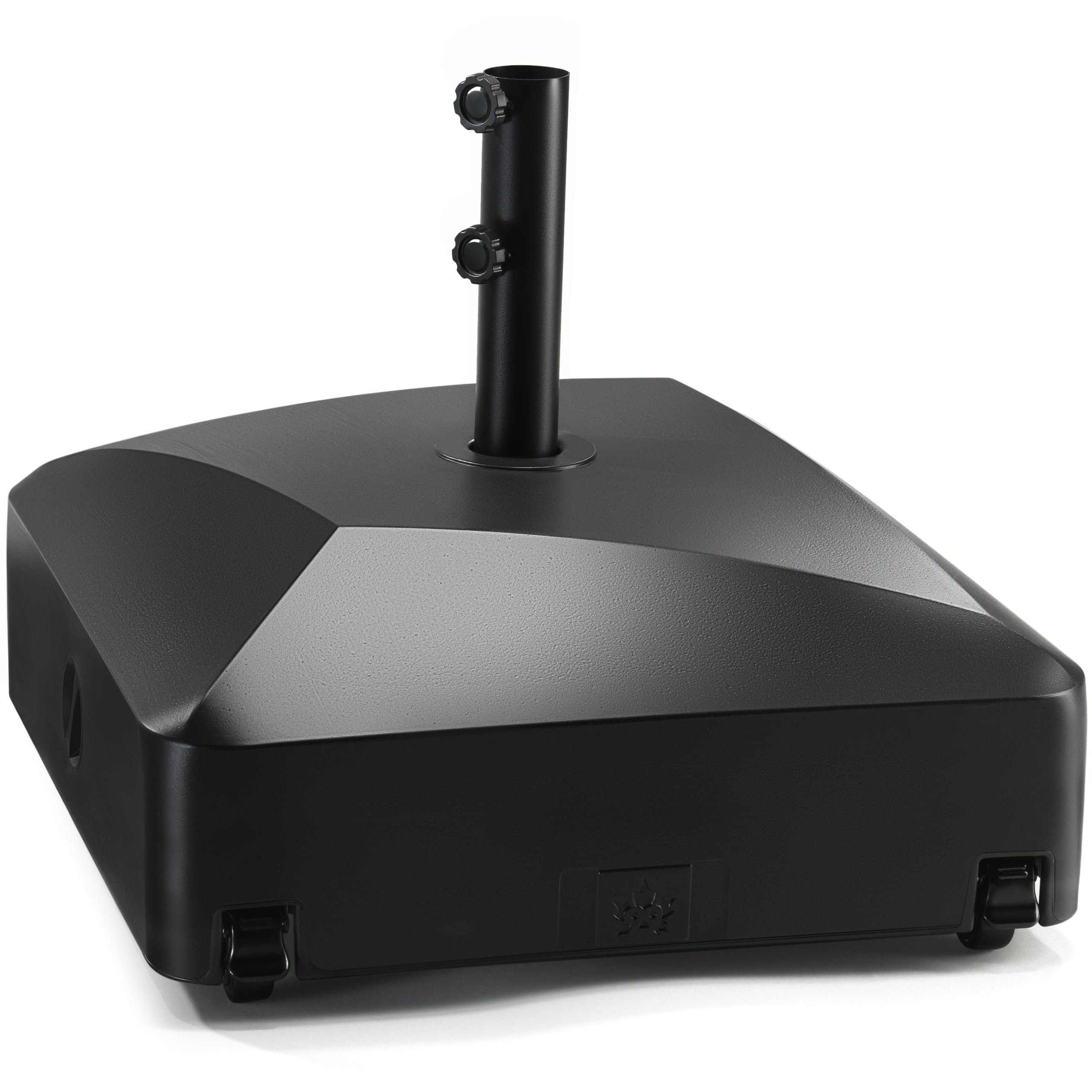
A fillable, wheeled base you roll into place — then fill with sand or water to lock it down.
The Maple99 is the only fillable base in this roundup built for mobility from the start. It ships empty at just 8 pounds, has four wheels (two lockable), and fits umbrella poles from 1.5 to 1.9 inches. Once you fill it with sand (up to 125 pounds) or water (up to 37 liters), it transforms into a serious wind anchor. Two tightening knobs and interconnecting metal pins hold the pole without wobble — customers note it keeps a 10-foot market umbrella “perfectly upright” even in gusty conditions.
The honest catch: filling it with sand is a bit messy, as the fill hole is small and requires a funnel. Water is easier but weighs less per gallon (sand is denser). The HDPE plastic body is rugged, but long-term UV exposure is a concern — some owners note the plastic may fade or become brittle after a few seasons in full sun. Still, the wheeled design is a standout for anyone who shifts their umbrella around to follow the sun or clear the deck for a party.
Best for: The buyer who rearranges their outdoor space often — the wheels let you move a fully loaded base across hard surfaces without breaking your back.
Think twice if: You plan to leave the base in one spot all season. The simpler, non-fillable bases above are cheaper and require no filling effort.
Reach for it if: You want the flexibility of a 125-pound ballast that you can roll across the patio.
pass on it if: You hate messing with sand or water — get the pre-weighted Yaheetech or EliteShade instead.
7. Best Choice Products 38.5lb Steel Umbrella Base

A flat, 38.5-pound steel plate that sits nearly flush under a table — no tripping hazard.
This Best Choice base is a solid steel slab with a powder-coated finish, measuring 24.5 inches square and only 14 inches tall. Its flat profile is the standout trait: it slides easily under most patio dining tables and stays out of legroom. The weight of 38.5 pounds comes from the solid steel construction, not from filling, so you get consistent ballast with nothing to maintain or drain. A twisting knob accepts poles between 1.5 and 2 inches, and anchor holes in each corner let you screw the base directly into a wood deck for extra security.
Assembly is minimal — attach a bolt, insert the metal plate, and screw in the knob. The key drawback is that the base can spin on uneven deck boards if not anchored, and a small number of units arrive with missing hardware or a wobbly connection. The powder-coated finish is thick and holds up to weather, but the steel surface can scratch if you slide heavy furniture over it.
Why choose it
- Flat, low profile means it barely protrudes from under a table, preserving legroom.
- Solid steel construction with no filling required — consistent weight forever.
- Pre-drilled anchor holes for permanent deck installation.
What to watch
- The steel plate can wobble or spin on uneven surfaces if not bolted down.
- Occasional quality issues with missing bolts or a wobbly pole receiver — check your unit on arrival.
Your pick if: You need a clean, low-clearance base that stays under a dining table year-round and you have a flat, even patio.
Look elsewhere if: Your deck has uneven boards — you will need a base with a wider footprint or rubber feet, like the Yaheetech anti-skid models.
8. Backyard Expressions 20 lb Round Patio Umbrella Base
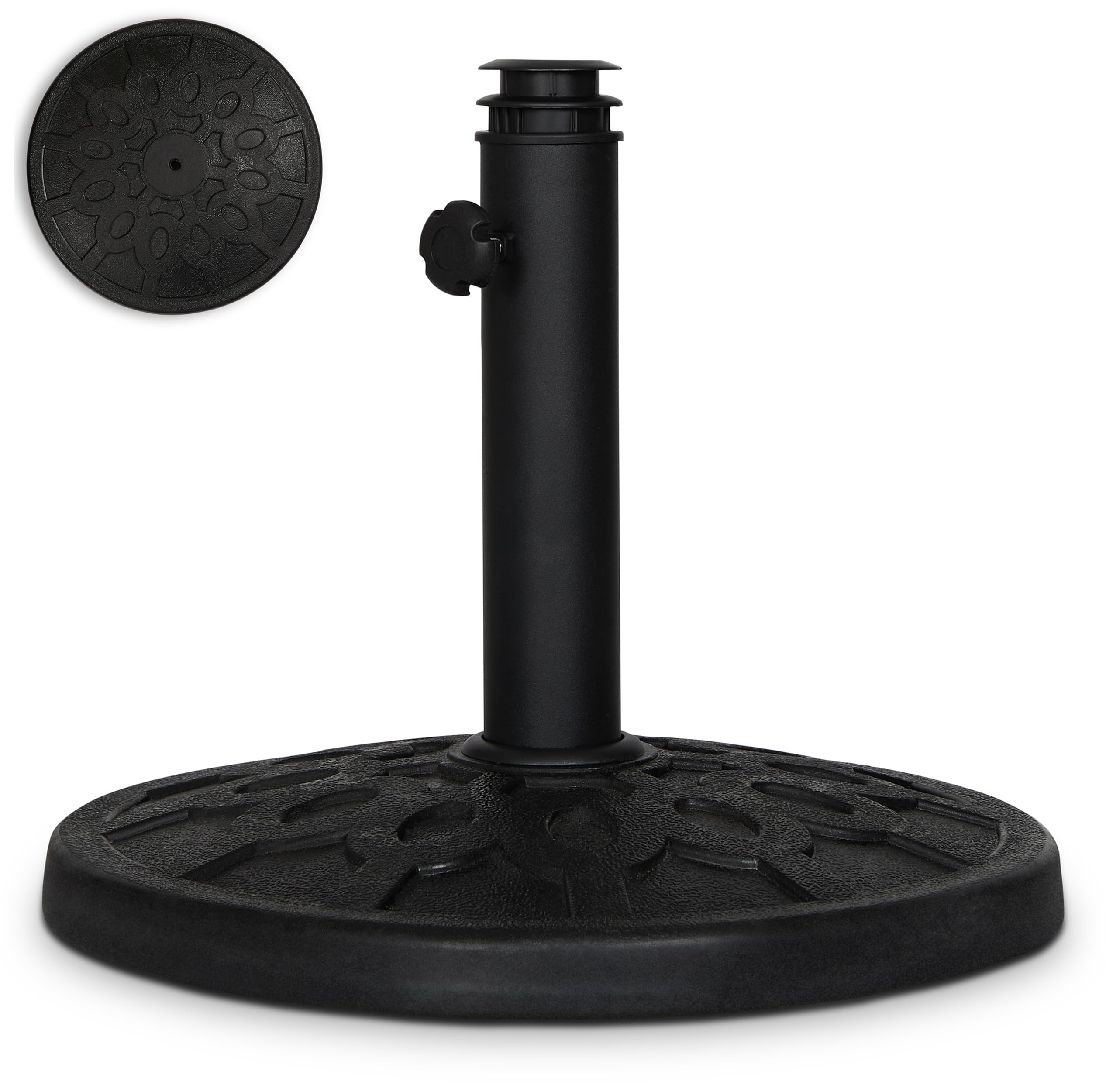
A budget-friendly 20-pound resin stand that punches above its weight for small umbrellas in protected spots.
At 20 pounds and a 16.5-inch diameter, this Backyard Expressions base is the lightest and smallest in the roundup — and it is priced accordingly. The solid calcium carbonate core is wrapped in a resin coating that resists rust and fading, and the included pole adapters fit diameters from 1.5 to 2 inches. One owner reports using it through an Illinois winter with no rust or chipping, which speaks to the weather resistance of the resin shell.
The honest limitation is weight. At 20 pounds, it is best for a 6.5- to 7.5-foot umbrella used under a wind-protected deck or table. In open air with a tilted umbrella acting as a sail, the base may not hold. A few owners also note that the bottom material is plastic, and prolonged outdoor exposure can cause cracking. The customer service is reportedly excellent — cracked units have been replaced free of charge — but the fragility is the trade-off for the low price.
Why it makes the list: For a small patio umbrella that lives under a table, this is a perfectly adequate, good-looking stand at a price that leaves room in your budget for a nicer umbrella.
The honest trade-off: It is too light for large or freestanding umbrellas in wind. The Yaheetech 26.5 lb model costs more but offers a 33% weight advantage.
Best for: A modest 6.5- to 7.5-foot umbrella tucked under a dining table on a sheltered deck or patio.
Not the choice for: Exposed, open-area use or any umbrella larger than 8 feet — upgrade to the 26.5 lb Yaheetech for a few dollars more.
9. California Umbrella 50 lbs. Round Concrete Weighted Base

A 50-pound concrete-and-steel base that never needs to be filled — just low-maintenance.
California Umbrella builds this base with a powder-coated steel frame around a solid concrete core, delivering 50 pounds of heft in a compact 17-inch round shape. The 16-inch receiver pole adds stability by raising the attachment point, and the tightening knob secures the umbrella pole. With a 19-inch clearance, it is designed to slide under most dining tables without interfering with knees. The concrete core and steel skin mean zero maintenance — no filling, no draining, no sand to spill.
At 50 pounds, it is the heaviest one-piece base in this roundup, and buyers confirm it holds large umbrellas firmly. The steel frame protects the concrete from chipping, though the base is difficult to move once placed — the instructions say not to lift it by the umbrella tube, so you end up propping and rolling it. The critical drawback is that the receiver ring is made of a brittle material; a few reviewers point out it snapping during installation or after a season, rendering the base unusable. The 90-day warranty covers manufacturer defects, but replacement parts are not sold separately.
What works
- 50 pounds of solid concrete — heavier than any non-fillable base under.
- Low clearance fits under standard patio tables, and the round shape blends in.
- No assembly beyond attaching the receiver; no sand or water needed.
What worries owners
- The threaded ring that holds the umbrella pole is fragile and can break, with no replacement part available.
- Very difficult to transport once placed; you essentially have to roll it on its edge.
Reach for it if: You want a no-maintenance, 50-pound anchor for a large umbrella under a table and can set it in its permanent spot.
Think twice if: You are rough with assembly or plan to move the base around — the receiver ring’s durability is the weak link. Consider the EliteShade steel base instead for a similar weight with a sturdier pole mount.
Understanding the Specs
Weight (lbs) and How It Ties to Wind
This is the single most important number on the box. A base’s weight in pounds resists the lifting force of wind on an umbrella. As a rough rule, a 7.5-foot umbrella in light breeze needs about 20 pounds; a 9-foot umbrella in moderate wind needs at least 30 to 40 pounds; and an 11-foot canopy exposed to coast breezes is safest with 50 pounds or a fillable base you can load up to 100-plus pounds. Bases with an empty weight listed (like the 26 pounds of the Best Choice planter) can be filled on site, letting you dial the ballast up as needed.
Pole Diameter (inches)
Umbrella poles come in two main diameters: 1.5 inches (standard for most market umbrellas) and 1.9 inches (common on larger or commercial-grade poles). A base that includes removable rubber adapters will fit both sizes snugly. If a base only lists one pole size, check your umbrella’s shaft diameter before buying — a loose fit means the umbrella will wobble in the wind and may wear down the locking mechanism. Most bases here cover both sizes via included adapters.
FAQ
How heavy does a backyard umbrella base need to be?
Will a 20-pound base hold a 9-foot umbrella?
Can I leave an umbrella base outside in winter?
What is the difference between a fillable and a non-fillable base?
How do I measure my umbrella pole diameter?
Can I use a base with a cantilever or offset umbrella?
How do I keep my umbrella base from scratching my deck?
Is a steel or a concrete base better?
Final Thoughts: The Verdict
For most people, the backyard umbrella base winner is the Best Choice Products 150 lb Planter Base because it offers the highest possible hold — 150 pounds when filled — while doubling as a planter that hides the weight. If you want a simpler, no-fill solution with top-tier build quality, grab the EliteShade USA 50 lb Steel Base with its bonus sandbag that pushes ballast close to 130 pounds. And for a lightweight, portable option you can roll into place, the Maple99 Fillable Mobile Base is the one to reach for. Whichever you pick, matching the base weight to your umbrella size is the shortcut to a shade setup that stays upright.
How We Picked
We do not accept paid placement. Every pick is matched to a real buyer and a real use-case; we do not hands-on test units.
Sources & Methodology
Specifications: manufacturer listings and product documentation. Review insights: verified customer reviews, as of July 2026. Pricing: not shown on this page (it changes often); check the current price via the retailer link.
As an Amazon Associate, KitchPrep earns from qualifying purchases. This does not affect which products we feature.
Related Guides
