
Specs are compiled from manufacturer listings and verified buyer reviews and can change over time — please confirm the key details on the product page before buying.
Quarter round molding is the little strip that hides the ugly gap where your floor meets the wall, your countertop meets the backsplash, or your tub meets the tile. The right strip bends around a curved tub base, presses on without nails, and leaves a clean edge that makes a rushed renovation look deliberate. The wrong strip lifts within a week and leaves a gummy adhesive trail on the wall. This guide covers six real options — flexible peel-and-stick rubber and silicone rolls plus one ceramic tile trim — so you can match the profile width to your measured gap instead of guessing.
I’m Mohammad Maruf — the founder and writer behind KitchPrep. This guide is built by comparing the manufacturers’ published specifications and the patterns across verified customer reviews, so you get each pick’s real strengths and trade-offs instead of marketing spin.
Most buyers walk into this category thinking all trim is the same until a roll refuses to lay flat on a wavy wall. Below you’ll find what actually holds, what bends, and which roll suits your exact gap, all gathered into one honest look at the best 1/4 round molding for real-world installations.
Our Picks at a Glance


How To Choose The Best 1/4 Round Molding
The single most common mistake here is ordering by color and length while ignoring the profile — the shape and thickness of the strip’s face. A quarter round that is too thin leaves a dark sliver of gap showing above it. One that is too thick sits proud of the wall and looks like a bump. Measure the gap and match the profile width first; pick the color and finish after.
Match the profile to the gap you are hiding
Quarter round gets its name from its cross-section: a square face with two flat edges meeting at a right angle, shaped roughly like a quarter of a circle. A 1/2-inch profile means the strip stands about half an inch tall and half an inch deep, which is enough to bridge the typical gap left where a floor meets baseboard. The 0.6-inch options cover slightly more. Measure the widest part of your gap, then pick a strip at least that tall, because the strip has to reach across and sit flat on both surfaces.
Flexible rubber and silicone versus ceramic tile trim
A flexible roll is the practical pick for anything curved — a garden tub base, a rounded stair, a wavy plaster wall. It bends by hand, cuts with a utility knife, and presses into place with no mortar. Ceramic quarter round is a different animal entirely: it is a real fired tile piece set with thinset mortar, so it needs a trowel, a wet saw, and drying time. Choose ceramic when you are already tiling a wall or floor and want the trim to match the field tile, and choose flexible when you are covering a seam over an existing finished surface.
Quick Comparison
| Model | Best For | Length | Profile Width | Material | Amazon |
|---|---|---|---|---|---|
| 1/2 in x 10 ft Peel and Stick Quarter Round Molding, White★ Best Overall | Straight countertop and vanity seams | 10 ft roll | 1/2 in | Silicone Rubber | Amazon |
| Flexible Quarter Round Molding, 393 Inch Silicone TrimBest Value | Long floor-edge runs on a budget | 32.75 ft (393 in) | 0.6 in | Soft Silicone | Amazon |
| 39.2′ Flexible Quarter Round Molding, Peel and Stick | Whole-room trim coverage | 39.2 ft | 0.6 in | Silicone | Amazon |
| uxcell Flexible Molding Trim, 98 Inch, Brown | Tight curves like stair surrounds | 98 in | 0.79 in | Silicone | Amazon |
| MYFAMIREA Flexible Quarter Round Molding 240 Inch | Shower corners and small curves | 20 ft (240 in) | 0.5 in | Polyvinyl Chloride (PVC) | Amazon |
| MSI Renzo Dove Ceramic Quarter Round Wall Tile Trim | Matching a ceramic tile installation | 11.75 in per piece | 0.75 in | Ceramic | Amazon |
In‑Depth Reviews
1. 1/2 in x 10 ft Peel and Stick Quarter Round Molding, White
Our pick — over 4★ from 650+ verified ratings; the strongest balance of quality and price.
The half-inch square that quietly finishes a countertop seam in under ten minutes
If your gap runs along a straight seam — the junction where a countertop meets a backsplash, or a built-in vanity meets the wall — this is the roll to reach for first. It measures 1/2 inch wide by 1/2 inch high, so the strip stands tall enough to bridge the typical gap left behind after a countertop install. It weighs 1.46 pounds, light enough that the roll hangs flat without fighting you during the press.
What sells it is the smooth finished look it delivers where caulk has already failed. Buyers report using it exactly at the countertop and backsplash junction, and the reaction was that “I cannot express how great this is on the countertop/backsplash junction – it fits perfectly.” The bright white brightens a tired edge instead of drawing attention to the gap. The soft silicone rubber construction means you can dry-fit the strip, trim it with a sharp utility knife, then peel the liner away gradually and press it down along the whole run — no nails, no caulk gun, no drying time.
The one honest limit here is the shape of the surface, not the strip itself. It is not recommended for dusty, oily, damp, heavily textured, peeling, or silicone-coated surfaces, because the adhesive needs something clean and stable to grip. It is also a decorative trim, not a structural molding and not a waterproof seal — so if you are trying to stop water rather than hide a seam, this is the wrong tool. And where the wall turns a sharp 90-degree corner, the flexible body does not fold tightly enough to sit flush; the straight runs are where this roll wins.
What this roll nails
- The 1/2 inch x 1/2 inch square profile covers the full height of a typical countertop gap on the first press
- Silicone rubber bends around gentle curves, so a bowed backsplash still lays flat
- The 1.46-pound roll stays manageable in hand and cuts cleanly with a sharp blade
- Bright white finish matches standard kitchen and bath tile without paint
Where it needs care
- Skip it on dusty, oily, damp, or heavily textured surfaces — the adhesive needs a clean, stable base
- Sharp 90-degree corners are a weak spot; the flexible body does not fold tight enough to sit flush
- It is decorative trim only, not a waterproof seal and not a replacement for caulk
Reach for this if: you are covering a straight seam on a smooth countertop, vanity, or backsplash and want the job done before the coffee gets cold.
Look elsewhere if: your gap sits on a damp, grimy, or peeling wall, or you need a piece that folds a razor-sharp 90-degree corner.
2. Flexible Quarter Round Molding, 393 Inch Silicone Molding Trim Peel and Stick
Nearly thirty-three feet of silicone that turns a whole floor edge into a finished surface
Here is the length math that matters: this roll runs 393 inches — 32.75 feet — against the 240 inches (20 feet) of the MYFAMIREA roll further down, so it carries 64% more trim in a single coil. If you are edging LVP flooring against a cabinet toe kick around a whole kitchen, that difference is the gap between one order and two. The profile is 0.6 inches wide by 0.6 inches tall, just a hair fuller than the half-inch strip on the top pick, and the soft silicone takes a cut from scissors or a blade without crumbling.
Buyers put the long roll to work on floor edges. One of them ran it along the gap between LVP flooring and a kitchen cabinet toe kick, and the payoff was that the white strip was unobtrusive enough to let them sweep and wash the floor right to the edges — the kind of detail that makes a room feel truly done. Functionality and appearance both land as the things owners call out most, with the easy installation following close behind. The silicone is waterproof, heat resistant, and corrosion resistant, so a bathroom or kitchen countertop is fair game.
The trade-off to plan around is the surface underneath, not the strip. It needs a clean, dry, smooth wall, and the maker notes it should not go onto wet, dirty, or peeling uneven surfaces — and warns that cold-weather adhesion can weaken, recommending a quick pass with a hair dryer to warm the back. The adhesive is also the split issue across buyers: some press it down and it stays for months, while others have watched it lift after a while, especially in a steamy bathroom. Sealing the edges with a silicone sealant is the maker’s own suggested insurance, and the package does not include that sealant.
Length you actually get: 32.75 feet in one continuous piece is enough for a full floor perimeter in most kitchens or baths, with room to spare.
Surface prep is the real job: warmth, a clean dry wall, and edge sealant extend how long the adhesive holds far more than any claim on the label can.
The smart buy when: you have a long, straight run of floor edge to trim and want the most linear feet for the least fuss.
Think twice when: you are covering a rounded bathtub base or a wavy surface — a shorter, more pliable cut is easier to control there.
3. 39.2′ Flexible Quarter Round Molding, Peel and Stick Shoe Molding Baseboard
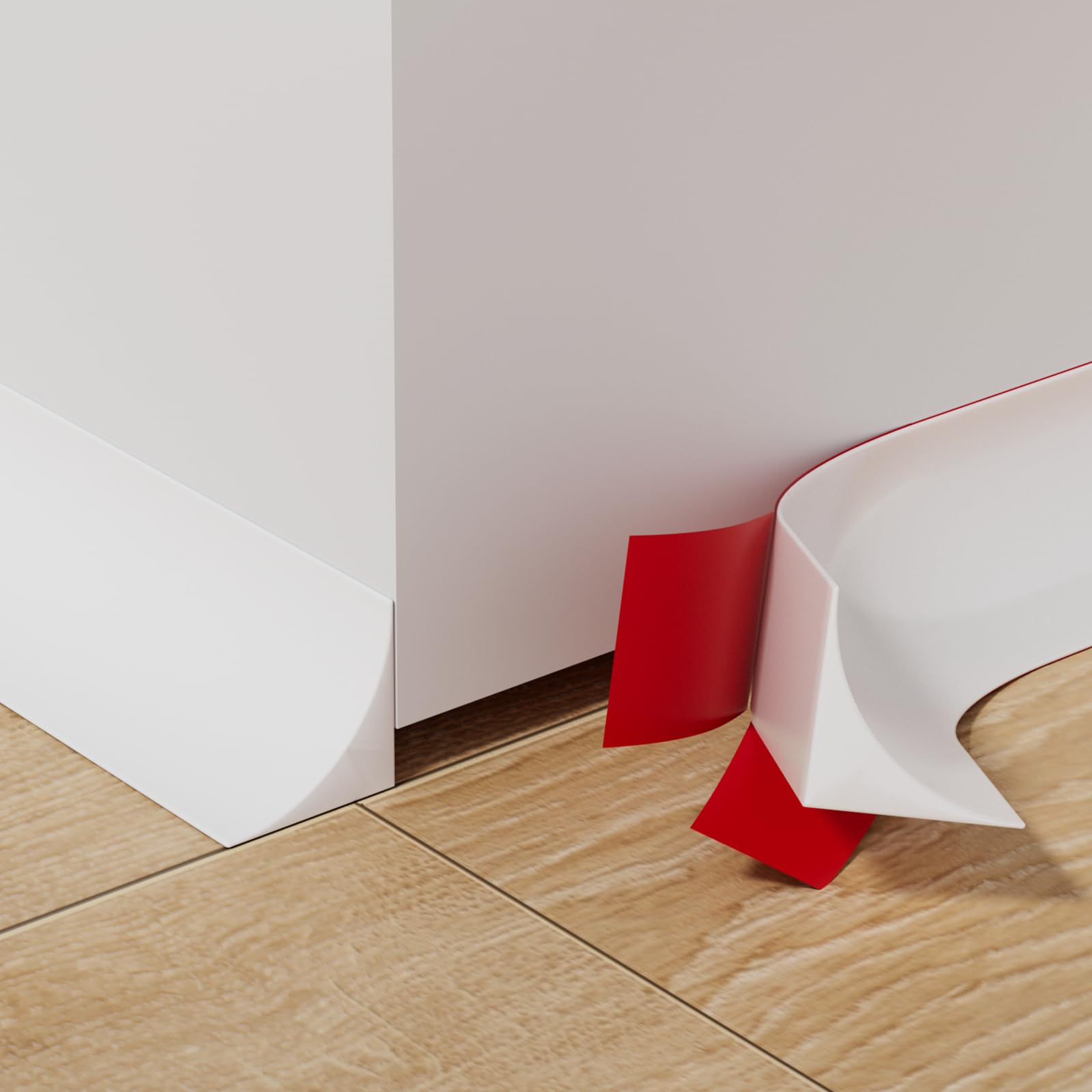
The longest roll here, built to finish a whole room without a single trip to the hardware store
At 39.2 feet, this is the biggest single coil on the list, and that is the pitch: enough trim to run baseboards around an entire living room or finish every edge in a full bathroom renovation without reordering. The profile is 0.6 inches wide by 0.6 inches tall, with two bottom edges that meet at a 90-degree angle, so it seats cleanly into right-angle inside corners where wall and floor join.
Silicone is the material story — bendable, waterproof, heat resistant, and corrosion resistant, which is exactly why it turns up in wet projects. The self-adhesive strips sit on both sides of the back, so once you peel and press you have coverage against both surfaces rather than one. Owners have used it on the curved base of a special bathroom tub, and the verdict was simply that it was an excellent idea, while the flexibility side gets the most positive mentions of any trait. If your surfaces have a bit of bow or curve, the soft silicone follows rather than fights.
The catch is the adhesive, and it is the one split issue across buyers. Some press it into place on a smooth surface and it holds, while others have found it did not stick as well as they hoped and had to reinforce with extra adhesive — the maker even suggests adding glue at the connection point for long-term hold and waterproofing. There are also mixed notes on value and long-term durability, so treat this as a clean, quick fix rather than a permanent architectural trim. Prep matters: an alcohol wipe on a dry wall before pressing is what tips the odds in your favor.
Where it wins
- 39.2 feet of trim covers a whole-room baseboard run or a full bath renovation in one purchase
- 0.6 inch x 0.6 inch profile with 90-degree bottom edges seats into standard inside corners
- Silicone body is bendable, waterproof, heat resistant, and corrosion resistant for wet areas
- Adhesive strips on both sides of the back give double the contact surface
- Easiest to control in a straight line, which keeps the finished edge looking sharp
What to expect
- Adhesive is the split issue — some surfaces hold, others need a glue boost at the joints
- Long-term durability and value get mixed feedback, so plan on reinforcing high-stress spots
- A few buyers find the smell of the primer on the top strip off-putting right after install
Ideal for: a whole-room renovation where you want one roll to cover every floor-to-wall seam from front door to back.
Look past it if: you only need a couple of feet around a sink and would rather keep the leftover small.
4. uxcell Flexible Molding Trim, 98 Inch, Brown

A brown silicone strip that reads like wood and bends around the tightest stair curve
Most trim rolls come in white because they are meant to disappear against a bright seam. This one goes the other way: it is a Brown silicone strip sized at 98 inches, and the color is the entire reason to pick it. Buyers describe it as looking like wood, which means it can finish a seam against a wood floor, a brown cabinet toe kick, or a warm-toned countertop without a bright white line cutting across the wood grain. The profile is 0.79 inches wide by 0.71 inches tall — the fullest face on this list — so it covers a wider gap in one pass than the half-inch strip at the top.
Curves are where the fan-shaped body earns its keep. The design lets the strip bend into varied shapes by hand, and it cuts to any length you need for a shower water barrier that keeps wet and dry zones apart. It weighs 2.07 pounds, the heaviest roll here, which gives it a solid, deliberate feel while you press it down. Quality is what earns the most praise, with appearance close behind.
The honest caveat is the tape. It is one-sided, and owners have found it weaker than they wanted — some added construction adhesive to both sides to get a tight bond, and one noted the ends may lift after a few weeks if the strip is stressed around a curve. There are also mixed notes on color, with a few buyers receiving a shade that did not quite match their floor. Sealing the bottom edge with glue is the maker’s own suggestion to boost both fixation and the waterproof effect, and that sealant is not in the box.
The color is the feature: a 98-inch brown strip that mimics wood is the fix when bright white would fight your floor instead of blending into it.
Plan on extra glue: the one-sided tape is the recurring weak point, so a tube of construction adhesive is worth having on hand for anything curved.
Pick this when: you have a wood floor or brown cabinetry and want the trim to disappear into the grain rather than mark it.
Pass if: your gap sits on a straight white surface — the fuller 0.79-inch profile and wood tone are wasted there.
5. MYFAMIREA Flexible Quarter Round Molding 240 Inch Peel and Stick PVC Trim, White

A short, flexible PVC roll for shower corners where precision matters more than footage
This roll gives you 240 inches — 20 feet — of soft PVC trim in a 0.5 inch x 0.5 inch quarter-round profile, which is the slimmest face on this list. It is the right pick when you need a strip to follow the curve of a shower or bathtub corner rather than run a long straight line. The PVC is formulated not to yellow, crack, or deform over time, it is water resistant, and it wipes clean with a damp cloth — properties that matter in a steam-heavy bathroom where a lesser strip would curl at the edges.
The backing is designed to be peeled with a smooth pull rather than a fight, and it does not grab your fingers on the way off, which sounds small until you have wrestled a stubborn liner on a stepladder. Installation needs no nails, glue, or special tools — peel, press, done — with the maker’s tip being to clean the surface to dry, flat, and dust free before you start, and to dab extra glue at the joints for a long-term hold.
Where this one asks more of you is straightness and adhesion. The flexibility that makes it hug a shower corner also means it will not lay perfectly flat on a long run — the recurring note is that it can go squiggly on the roll and sticks to itself once the adhesive is exposed, so you have to work quickly. Adhesion is the biggest split across buyers: one side presses it down and sees no chance of peeling, while the other watches it lift. The manufacturer quietly covers this by recommending you order shorter lengths to reduce the tight coiling that stresses the glue. Stick to corners and short runs and the material behaves.
Why it earns a spot
- 0.5 inch x 0.5 inch slimmest profile on the list, ideal for a tight shower or tub corner
- PVC will not yellow, crack, or deform, and wipes clean with a damp cloth
- Peel-and-stick backing comes off smoothly and does not stick to your hands
- No nails, glue, or special tools needed to install
Where it splits
- Adhesion is genuinely split across buyers — some corners hold, others lift
- Flexibility means it resists laying flat on long straight runs and can go squiggly off the roll
- Once the adhesive is exposed it sticks to itself, so you have to work fast
Best matched to: a shower or tub corner where a flexible 20-foot roll can bend into place and dry-time is unwanted.
Not for: a straight wall-to-floor run that needs to sit dead flat, or a project where you cannot afford to work quickly once the backing is off.
6. MSI Renzo Dove 0.6in. x 12in. Ceramic Quarter Round Wall Tile Trim

Real fired ceramic, not peel-and-stick — the trim you set with mortar to match your field tile
This is the odd one out, and deliberately so. Every other pick here is a flexible rubber or silicone roll you press on with your fingers. This is genuine ceramic quarter round tile in Dove, a taupe-tinged shade, sized 12 inches long by 0.6 inches wide with a 0.6-inch thickness, set with thinset mortar using a trowel rather than peeled off a liner. It is glossy, it carries high variation in tone from piece to piece, and it is GREENGUARD Certified for indoor air quality. If you are running a tile shower or floor and want the trim to match, this is the piece that belongs there — the flexible rolls simply cannot match fired ceramic’s finish.
What buyers like most is the look. Owners describe the variation across pieces as creating a sophisticated, handmade-modern feel, with the taupe shade praised for not reading too gray, and the color getting the same positive read. It cuts cleanly on a wet saw, requires no sealing, and cleans with a damp cloth or a mild detergent — low-maintenance for a ceramic piece. It is indoor-only, so it has no place on an exterior wall or a sunroom.
The practical headaches are worth knowing before you order. Pieces ship individually rather than as a full case in every scenario, and packaging has been the singular complaint — a few arrive cracked because the small pieces ride in a thin envelope rather than a padded box, while others arrive well packed and intact. There is also a note that the “bullnose” some buyers expected came through as a pillow edge instead, which is a design mismatch rather than a defect. It is a match piece for a ceramic install, not a quick stick-on fix, so bring the mortar and the wet saw to the job.
Matching the field tile: glossy Dove ceramic with high tone variation pairs with a ceramic wall or floor the way no flexible roll can.
Set expectations on packing: an occasional cracked tile in transit is the one recurring report, so inspect your shipment the day it lands.
Suit the tiler: you are mid-renovation with thinset and a wet saw already out, and want the trim to match your wall tile exactly.
Rule it out if: you want a no-tools fix over a finished surface — the flexible rolls above were built for exactly that job.
Understanding the Specs
Profile width and height
Think of quarter round’s profile as the shape of its cut face — the profile width is how tall and how deep the strip is in cross-section. A 1/2-inch profile stands about half an inch off the surface, while the 0.6-inch and 0.79-inch options stand marginally taller. Pick the profile based on the widest gap you are covering: too narrow and a sliver of the gap shows; too wide and the strip looks like a bump against a smooth wall. Most trim is sold as a pair of dimensions — the strip you see along a floor edge may read something like 393 inches long and 0.6 inches wide, and both numbers matter when you are matching it to a specific seam.
Backing, adhesion, and what holds it down
Peel-and-stick trim means an adhesive strip is pre-applied to the back. Some rolls carry adhesive on both rear surfaces for extra grip; others are one-sided. Either way, the back will only hold to a clean, dry, smooth surface — dust, oil, moisture, and texture are the enemies. Many maker guides recommend a wipe-down with a small amount of alcohol before pressing, and adding a dot of glue at the joints to reinforce. In cold rooms the backing can lose grip, and warming the strip slightly with a hair dryer is a common fix. Flexible rubber and silicone rolls are not structural moldings and not waterproof seals — they are decorative trims, so treat them accordingly.
FAQ
How do I measure my gap before ordering quarter round molding?
Will peel-and-stick quarter round molding stick to a textured or painted wall?
Can I bend flexible quarter round molding around a 90-degree corner?
What is the difference between flexible quarter round molding and ceramic trim tile?
Does peel-and-stick molding hold up in a wet bathroom or shower?
Can I paint the white quarter round molding to match my baseboard color?
How much quarter round molding do I need for one room?
What should I do if the adhesive fails after a few weeks?
Is quarter round molding good for hiding a large gap where caulk has failed?
Final Thoughts: The Verdict
For most buyers, the winner is the 1/2 in x 10 ft Peel and Stick Quarter Round Molding, because its half-inch profile covers the everyday countertop, vanity, and backsplash seam that sends people looking for trim in the first place — and the silicone rubber bends around a gentle curve while staying flat against a straight one. If your job is a long, straight floor edge and you want the most footage in a single roll, reach for the Flexible Quarter Round Molding, 393 Inch, which delivers 32.75 feet of silicone at a value price. And if you are mid-tile-install and want the trim to match your field tile, the MSI Renzo Dove Ceramic Quarter Round is the only real tile option of the group. For a shower corner or a tight curve, the MYFAMIREA 240 Inch roll bends where the longer rolls resist — nearly thirty feet of flexible PVC that handles the small stuff a whole-room roll cannot.
Whichever you choose, prep the surface first: clean, dry, and dust-free is the one step that separates a strip that stays put from one that peels up in a week. Order a little extra for corners, keep a utility knife and a bit of construction adhesive handy, and the gap stays covered.
How We Picked
We do not accept paid placement. Every pick is matched to a real buyer and a real use-case; we do not hands-on test units.
Sources & Methodology
Specifications: manufacturer listings and product documentation. Review insights: verified customer reviews, as of September 2026. Pricing: not shown on this page (it changes often); check the current price via the retailer link.
As an Amazon Associate, KitchPrep earns from qualifying purchases. This does not affect which products we feature.
Related Guides
