
Specs are compiled from manufacturer listings and verified buyer reviews and can change over time — please confirm the key details on the product page before buying.
Here is the short answer before you read anything else: the awning you want is the one that matches your wall type, your deck’s sun angle, and how much muscle you are willing to put into a crank handle. Most deck awning returns happen for three boring reasons — the frame was mounted to a wall that could not hold 50+ pounds, the instructions were too vague to follow, or the wind ripped a fully extended canopy because nobody rolled it up in time. None of those are about looks. All of them are about picking the right size, motor, and mount for your actual house.
I’m Mohammad Maruf — the founder and writer behind KitchPrep. This guide is built by comparing the manufacturers’ published specifications and the patterns across verified customer reviews, so you get each pick’s real strengths and trade-offs instead of marketing spin.
Deck awnings come in manual crank and motorized versions, and the difference in daily use is bigger than the spec sheet suggests. This breakdown of the best awnings for deck covers the sizes, wind ratings, and mounting realities that actually decide whether yours lasts.
Our Picks at a Glance

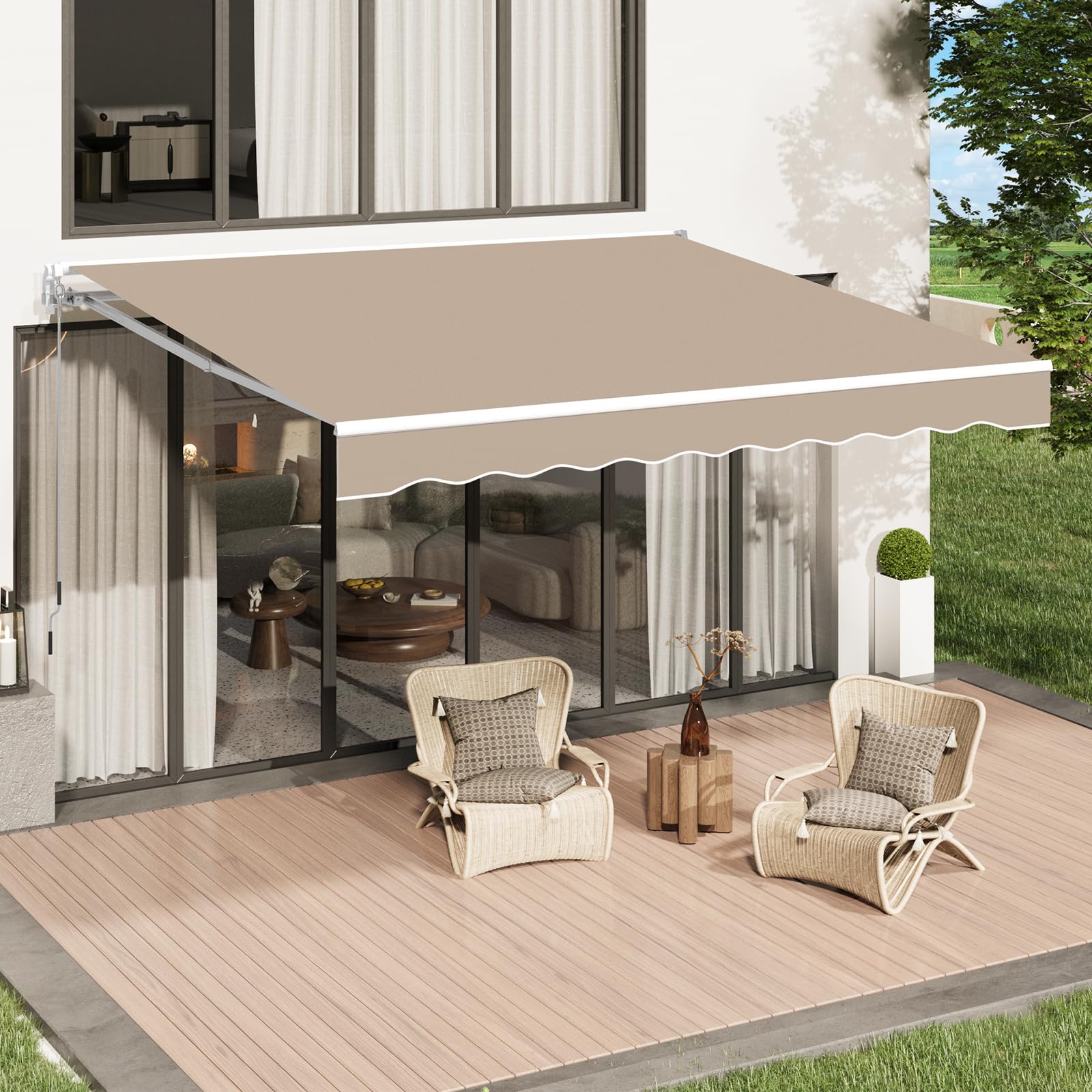

How To Choose The Best Awnings for Deck
An awning for a deck is not the same animal as a window awning. A deck awning has to cover a walking surface, survive a wind funnel between the house and the railing, and mount to a wall that may be siding, stucco, brick, or concrete block. Get the wall type wrong and the whole thing is coming down on a breezy Tuesday.
Measure projection first, width second
Projection distance is how far the fabric reaches out from the wall — that is the number that decides how much of your deck floor sits in shade at 3pm. A 10-foot projection covers a deep seating area; an 8-foot projection covers a table but leaves the chairs at the edge in sun. Width (the horizontal span) matters less, because most awnings are sized to match a door or patio opening rather than the full deck length. Diagonal sun in late afternoon is the hardest case, which is why an adjustable pitch angle (the tilt of the canopy) is worth paying for.
Check your wall before you check the awning
Every manual here recommends concrete wall, massive brickwork, or solid masonry — that is the honest answer for a 50 to 90 pound awning. Vinyl siding, wood siding, and hollow concrete block need either a wooden header board bolted to the studs or 4-inch lag screws run into framing. If you live in a stucco house with studs at wide spacing, plan on a lag board. This single step prevents the most common failure reported across the category: brackets pulling away from siding.
Manual crank or motorized
A hand crank costs less and never needs power. Its limit is you — retracting a large canopy takes steady effort, and you will do it every time the sky darkens or the forecast shifts. A motor with a remote closes it in seconds from inside the house, and almost every electric model here includes a manual crank as backup for outages. If you will genuinely close the awning whenever the weather turns, the motor is what keeps the fabric intact.
Quick Comparison
| Model | Best For | Size | Operation | Wind Rating | Amazon |
|---|---|---|---|---|---|
| ADVANING Luxury Series 12’x10′★ Best Overall | Motorized deck coverage | 12′ W x 10′ projection | Electric + crank | — | Amazon |
| U-MAX 13′ x 8′Budget Champion | Budget wide-span entry shade | 13′ W x 8′ projection | Manual crank | 30mph | Amazon |
| Tangkula 12 Ft × 10 FtBest Manual Value | Long-term manual value | 12′ W x 10′ projection | Manual crank | — | Amazon |
| Yardenaler 12×10 FT | Replacable-canopy flexibility | 12′ W x 10′ projection | Manual crank | 30MPH | Amazon |
| MUPATER 13′ x 8′ | Wide manual shade on a budget | 13′ W x 8′ projection | Manual crank | 30MPH | Amazon |
| ALEKO Caribbean 10×8 | Smaller decks, remote control | 10′ W x 8′ projection | Electric + crank backup | — | Amazon |
| Paramondo 9.8’x8.2′ | Compact pre-assembled manual | 9.8′ W x 8.2′ projection | Manual crank | Beaufort 4 | Amazon |
| ALEKO Caribbean 16×10 | Large deck motorized span | 16′ W x 10′ projection | Motor + crank | — | Amazon |
| PATISOL 10’x8′ | Small porch, simplest setup | 10′ W x 8′ projection | Manual crank | Beaufort 4, up to 30 mph | Amazon |
| Diensweek 12’x10′ | Commercial-grade manual coverage | 11.32′ x 9.84′ extended | Manual crank | Beaufort 4 | Amazon |
In‑Depth Reviews
1. ADVANING Luxury Series, 12’x10′ Electric Retractable Awning
Our pick — over 4.5★ from 250+ verified ratings; the strongest balance of quality and price.
Pre-assembled from the crate, so most of the install work is already done for you.
If you want a deck awning that arrives ready to bolt to the wall instead of a flat crate of parts, the Advaning Luxury Series is the one to beat. It ships 100% fully pre-assembled, and buyers report it takes under 45 minutes to get up and running. That is the single biggest difference between this and most cheaper awnings in this list. The at-a-glance numbers: 12 feet wide, 10 feet of projection, and a 90.4-pound frame that includes a 40×40 mm powder-coat steel torsion bar (the reinforcement bar that keeps the whole thing from sagging) and a 70 mm aluminum roller tube.
The 12 by 10 footprint gives you a shade zone roughly the size of a standard dining table plus chairs. Fully extended, that is 118 inches of depth and 142 inches of width — the deepest projection of any single-piece awning here, and one that pulls shade well past the edge of a typical sliding-door threshold. The fabric is European-made 100% solution-dyed acrylic with UV80+ protection, which is the fabric type that resists fading longer than the polyester blends used on cheaper alternatives. There is also a two-loop pitch adjustment that lets you tilt the canopy without tools.
Running it is the part people love most. Tap the remote, and the awning moves in or out and stops wherever you want to freeze it. If the power is out, drop the 63-inch hand crank into the fourth loop and move it the old way. Owners mention the operation is smooth and quiet, and the remote kit is included in the box. You also get 100% stainless steel hardware and dual-use wall and soffit brackets — the soffit option matters if your wall is brick or an awkward material.
What wins people over
- Fully assembled arrival — customers note roughly 45-minute installs from crate to working shade
- Electric operation with a 63-inch crank backup for outages
- UV80+ solution-dyed acrylic resists fading and traps less heat than polyester or vinyl
- 5-year limited warranty with a California-based service team
The weight reality
- 90.4-pound shipping weight makes a two-person lift genuinely helpful — reviewers point out a large 16-foot version needs three people
- No wind sensor, so you must close it manually when a storm rolls in
- No app control; open/close limits are set by hand
Reach for this one if: you want the closest thing to a hands-off deck awning and can mount to masonry or solid wood framing.
Look elsewhere if: you have lightweight siding and no plans to reinforce the wall first.
2. U-MAX Awnings for Outside, 13′ x 8′ Retractable Awning
Widest budget canopy on the list, and it makes you work for it.
The U-MAX is a 13-foot-wide, 8-foot-projection manual awning built around a 280g/m² polyester with PU coating — a mid-weight fabric that is splash-proof and rated 80UV+ against fading. The rust-resistant powder-coated aluminum roller and steel frame are lightweight but solid enough to handle a stated 30mph wind resistance level before damage. It fits recommended installation heights between 8 and 13 feet, which is a broader range than most awnings in this category offer.
What U-MAX does well is slot into awkward spots. It can go above a door, a window, a deck edge, or a balcony, and it works indoors or out. The 40° to 90° manual angle range gives you more pitch adjustment than several pricier awnings here, so you can dial in the shade for a late-afternoon deck without a tool. The crank handle is described as smooth in customer writeups. Where U-MAX slides down the rankings is the install. Shoppers say 6-hour assembly sessions with vague instructions, the biggest source of frustration across the review pages.
Coverage-wise, 13 feet of width means it works on a wide deck better than a narrow one. The 1-year warranty is on the short side, but the seller also says lifetime service is on the table. Read the setup guide carefully, and roll it up for storms and strong wind.
skip it if: you want a quick Saturday-afternoon install or a canopy that shrugs off a windy gust.
Buy it if: you need a wide, low-cost shade for a deck or window and are willing to spend a full afternoon on the build.
3. Tangkula 12 Ft × 10 Ft Retractable Awning
The proven manual awning at 750 ratings and years of real deck time.
Tangkula’s 12×10 manual awning holds more ratings than any other pick here, and buyers have been living with it long enough to know what holds up. Buyers report fraying at the edges after a year or more, but the awning still functions as new. That is the kind of track record a cheaper all-polyester awning cannot buy. The fabric is polyester with a PA coating — the coating is the layer that keeps rain from soaking through and slows sun fading — and the frame is rust-resistant aluminum that will not deform easily.
The hand crank is described as smooth and easy to work, with no reversing tool required. The 5° to 35° angle range is adjustable, though narrower than the 40-90° range on the U-MAX up above. Where the Tangkula separates itself from the U-MAX and MUPATER budget options is the fabric weight and the frame sturdiness. The 48-pound shipping weight is on the lighter side for a 12-by-10 unit, which means the aluminum arms are on the thin side but the overall package is more manageable than the 90-pound Advaning at the top of this list.
Installation needs two people. Owners mention the box is heavy and best handled with a helper, and there is a noted issue with mounting onto a horizontal soffit — it was designed for a vertical masonry wall. If you have brick or concrete, this is one of the smoother installs in the mid-range. The 12×10 size is also among the most useful dimensions for a standard deck, giving you depth and width together rather than one or the other.
The long-haul case
- Customers note 1+ year of steady use with only minor edge fraying.
- Thick, sturdy PA-coated polyester holds shade and resists sun exposure
- Smooth hand crank with no reversing tool needed
- 12×10 gives you both depth and width coverage
Where it strains
- Narrow 5 to 35-degree angle adjustment range
- Instructions are tiny and multilingual, which slows first-time installers
- Vertical masonry wall only — soffit mounting gets complicated
The short verdict: the best manual awning here for someone who wants reliability over features, at the price of an afternoon of DIY.
4. Yardenaler 12×10 FT Manual Retractable Patio Awning
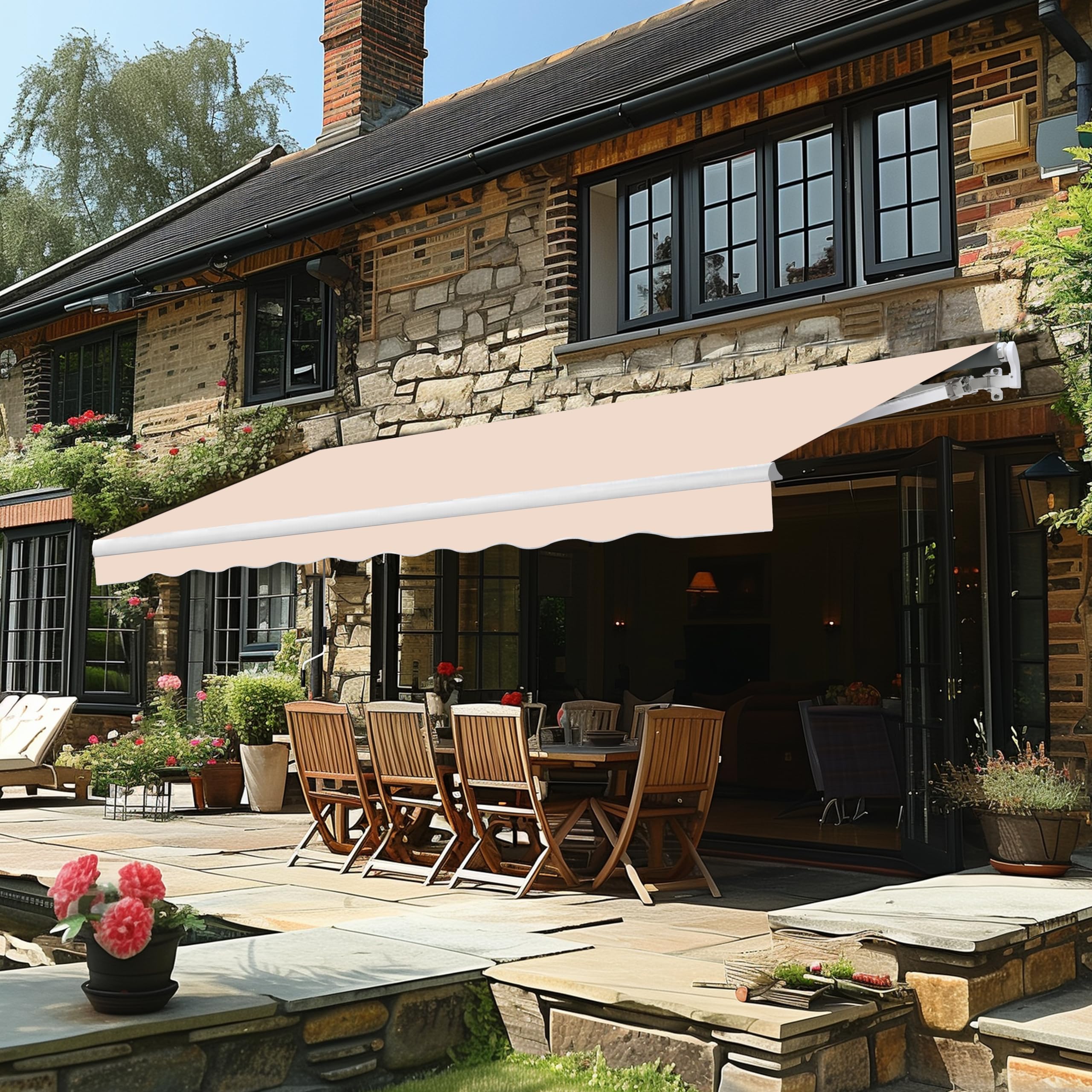
The canopy comes off, so you can replace the fabric instead of the whole awning.
Yardenaler’s 12×10 manual awning is built around a detachable canopy — a small detail that changes how you own it. When the polyester eventually fades after years of sun, you swap the fabric and keep the aluminum arms and mounting hardware. The angle adjustment range is 45° to 85°, the widest in this article alongside the MUPATER, and that matters on a deck where the sun moves across the sky from 11am to 6pm. A wider pitch range means you can tip the canopy down to block low afternoon sun without lowering the front bar to head height.
The canopy itself is water-resistant, UV-protected polyester, and the frame is heavy-duty aluminum. Wind rating is 30MPH, the same as the U-MAX and MUPATER. Mounting is restricted to vertical solid siding walls — the awning is not suited to a ceiling, an RV, or any inclined wall, so this is a deck-and-house pairing, not a camper accessory. Minimum clearance is 8 feet, which is the top of your door frame on most houses.
The one operational quirk to know: the crank handle installs on the left side only, so plan your layout before you drill. Buyers who own it call it sturdy, well-painted, and easy to operate. The recurring note on the review pages is a two-person install for the 12-by-10 size — it is bulky enough that solo lifting is a bad idea. The Angled bracket arm geometry also means your wall mounts need to clear the arms when the awning is fully retracted.
Standout spec: the 45-85° pitch window plus a replaceable canopy puts maintenance in your hands without a whole new awning.
Honest limit: left-side-only crank handle and a vertical-wall requirement narrow where this one installs cleanly.
Pick this if: the sun hits your deck from an awkward angle and you want to swap the fabric later without buying a new unit.
5. MUPATER 13′ x 8′ Retractable Patio Awning

13 feet of width for a long deck, with a 59-inch crank that reaches comfortably.
MUPATER’s 13-by-8 manual awning is aimed at wide installations — a long deck, a broad porch, or a storefront. The overall footprint runs 155.7 inches wide and 96.8 inches deep, which means the shade stripe it casts across your floor is the widest in this list. The canopy is polyester with a PU water-resistant coating, and the support arms are rust-proof aluminum. The 59-inch crank handle is one of the longer ones here, so if you can mount the awning above a standard door frame, you can reach the crank without a step stool.
Adjustment range is 45° to 85°, matching the Yardenaler above and beating the Tangkula’s tighter 5-35°. Recommended install height is anything over 8.2 feet, which is a slightly easier minimum than the Yardenaler’s 8-foot clearance. Wind rating is 30MPH. This MUPATER is best when you have the wall length to match — a 13-foot awning has to span a genuinely long opening, so measure once more before you commit.
The catch lives in the build-quality reviews. Reviewers point out it looks good and does its job, but the assembly process is long, and the mounting hardware is one area where buyers would like more. A few note sagging or pooling at the front bar after rain, which is a reminder to roll it up in bad weather rather than leave it out. For a wide deck behind a single-family home, this is good shade without a motor.
Coverage edge: at 155.7 inches wide and 96.8 inches deep, this is the broadest shade footprint in the article for a manual crank awning.
Real trade-off: the assembly is long and mounting hardware is a frequent owner note — plan two people and an afternoon.
Best fit: long decks and porches where you need the widest manual shade stripe without paying for a motor.
6. ALEKO Electric Patio Awning Caribbean Black Frame, 10×8 Forest Green
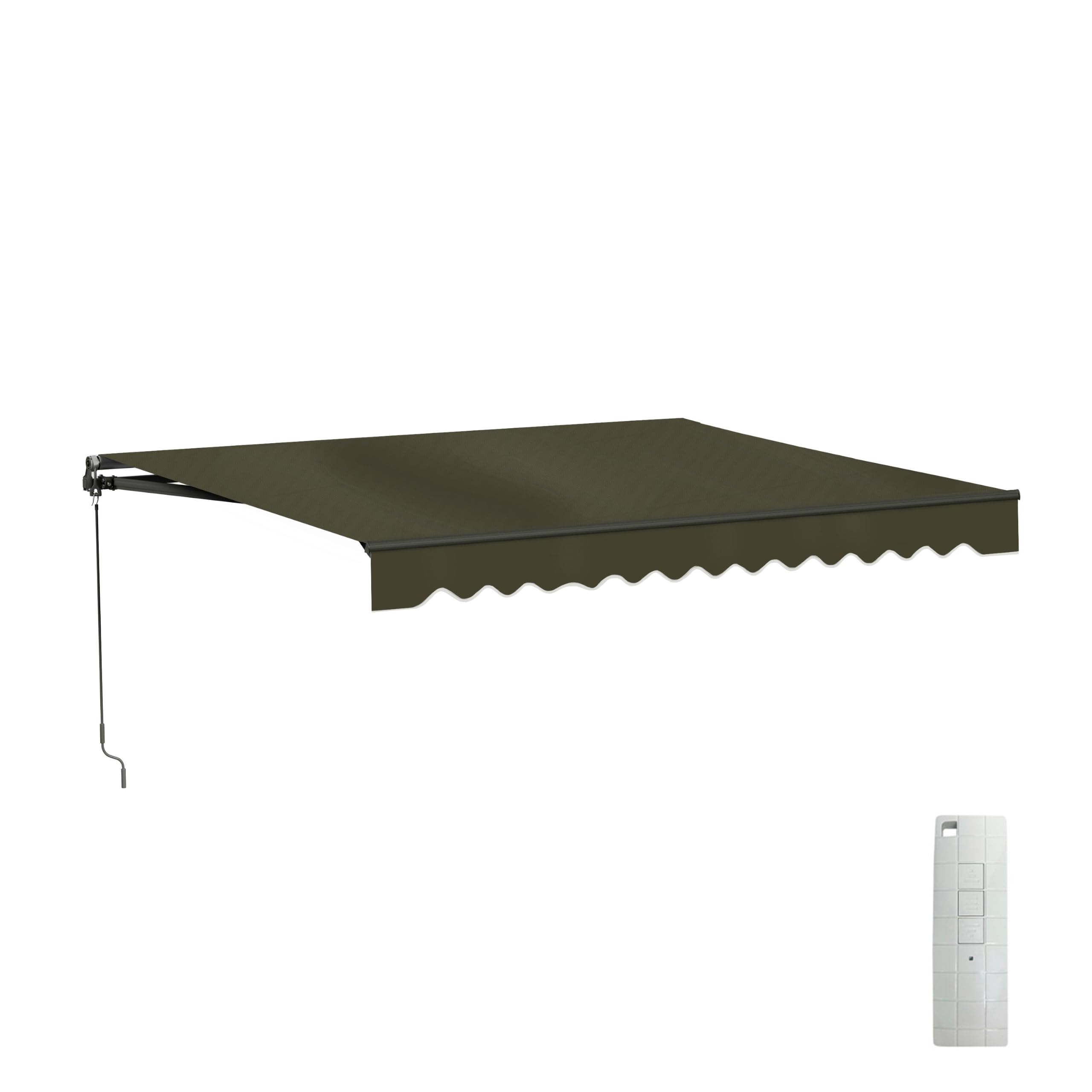
Motors small decks without the size penalty — a 10×8 footprint with a remote.
If your deck is cozy rather than sprawling, ALEKO’s 10-by-8 electric awning hits the balance between coverage and fit. A 64-pound shipping weight makes it the lightest awning in this list, and that is a meaningful advantage for a two-person install. You get the full electric package: pre-assembled frame, motor, remote control, and crank handle as a manual backup for power outages. The polyester fabric is water-resistant, and the frame is a rust-free aluminum build with a powder-coated finish and UV-resistant fabric.
The angle between this awning and the wall is adjustable, and the retract speed is described as quick. Coverage-wise, 10 feet of projection means it will cover an intimate seating area or a single door plus flanking chair, not a full patio. That makes it a better fit for a compact deck, an apartment balcony, or a deck that runs into railing before it runs into length. The remote also means you can close it fast when you see weather coming, which is exactly the scenario where a manual awning gets left out and gets torn.
Owners tell two stories: excellent shade and looks once it is up, and a genuinely challenging install. The instructions omit fine details, the left arm may arrive pre-installed loose and needs finessing before the awning will extend, and the hardware is worth upgrading to longer lag screws for wood. If you are handy or hiring a handyman, this is a very good compact electric awning. If you want it up solo in one afternoon with zero frustration, it will test your patience.
What’s genuinely good
- Remote control with manual crank backup for outages
- 64-pound shipping weight — the lightest awning in this article
- Rust-free aluminum frame with powder-coat finish
- Quick open/close means you actually retract it before storms
Worth knowing
- Instructions omit details and leave steps open to interpretation
- Left arm sometimes arrives pre-installed loose and hangs low before it extends cleanly
- Included concrete anchors only; wood beams need your own lag screws
Choose this for: a smaller deck or balcony where you want motorized convenience in the smallest practical package.
7. Paramondo 9.8’x8.2′ Patio Awning Retractable Fully Assembled
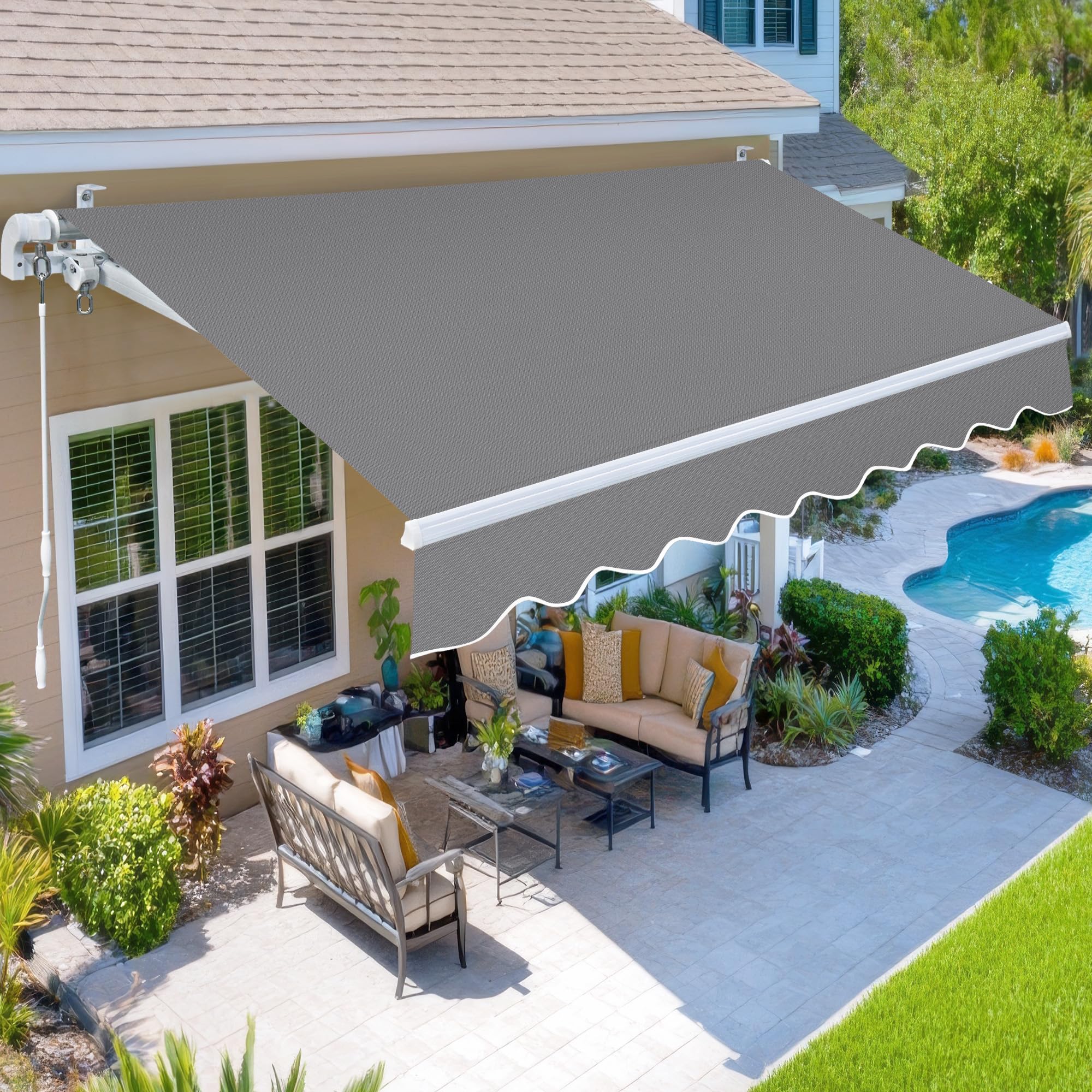
Shows up ready to bolt on — brackets, torsion bar, crank handle, done.
Paramondo’s 9.8-by-8.2 awning is one of a small group here that ships 100% fully assembled — the fabric and frame arrive as one unit, and the torsion bar is ready to bolt straight onto your wall. That is the whole pitch. Shoppers say a two-person install under 2 hours, which is the fastest real timeline in this article. The 52.9-pound shipping weight is lighter than expected for a 9.8-foot-wide awning, and the corrosion-resistant aluminum frame and arm are built to stay rust-free.
The fabric is 280g/m² polyester with PU coating, water-resistant and 50UV+ solar-rated, and it is tested to Beaufort scale 4 for wind resistance. The angle adjustment is somewhere between 45° and 90°, which gives you the full pitch range you would want in a partial-shade deck awning. Concrete and massive brickwork walls are the recommended mounting surfaces. The included kit has the awning, manual crank, two mounting brackets, and an owners manual — note that mounting screws are not included, so you will be buying the right anchors for your specific wall type separately.
This is a smaller awning, comfortably fit for a townhouse deck, a compact balcony, or a window-plus-sitting-spot setup. If you need 12-foot width coverage, the Tangkula or Yardenaler above are better fits. The honest note on owner feedback is that the crank effort is on the firm side — retracting the awning takes real arm work — and a small handful of units have been reported with brackets that did not hold under load on vinyl siding. If you are mounting to siding, get the wall reinforced first.
The simplicity angle: pre-assembled delivery and 2-hour installs make this the least fiddly awning in the group.
Factor in: mounting screws sold separately and firmer-than-average crank effort.
Suits: small decks and anyone who wants minimal assembly over maximum size.
8. ALEKO Electric Patio Awning Caribbean White Frame 16×10 Black
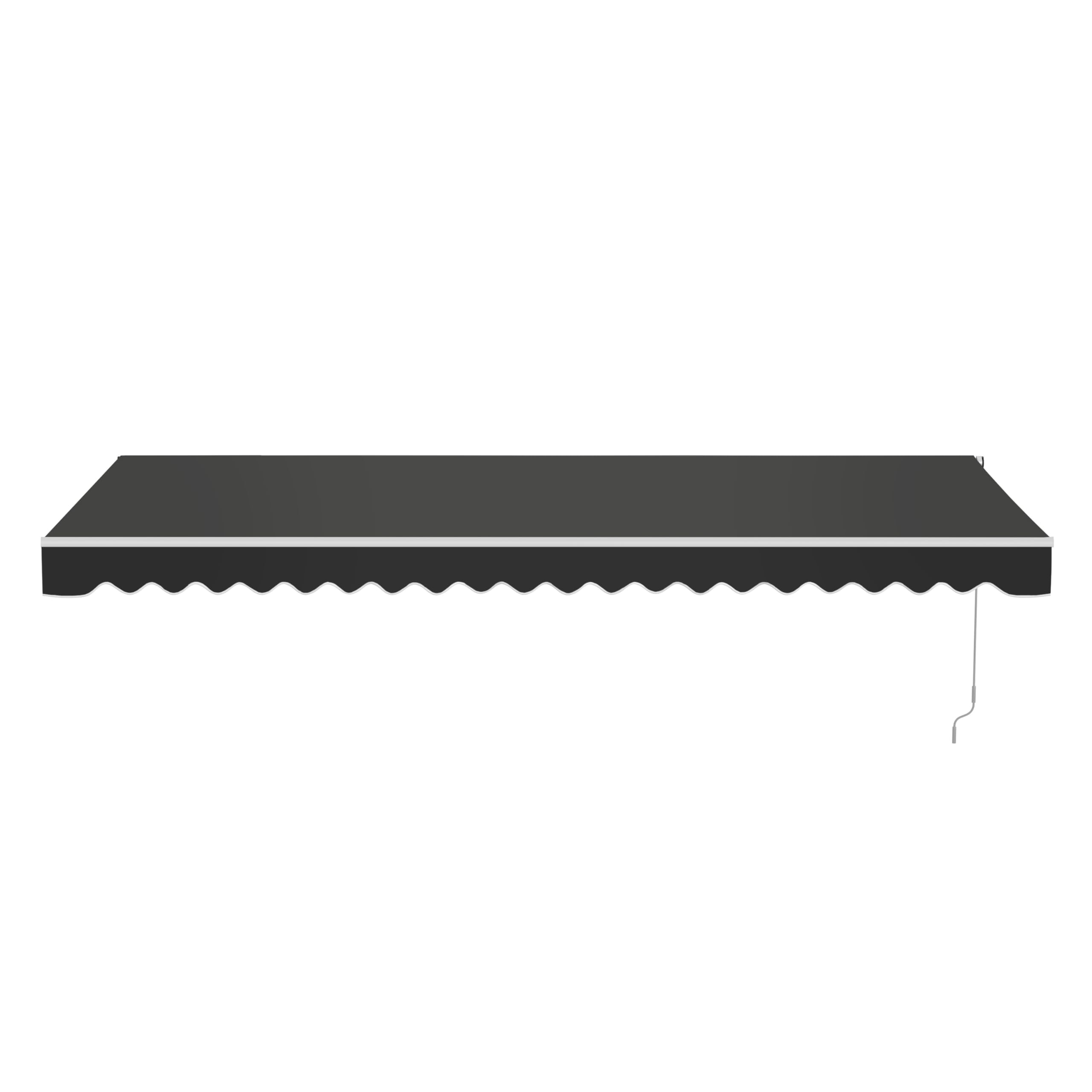
Sixteen feet of motorized shade — for when the deck is really the whole patio.
At 196.8 inches wide and 117.6 inches of projection, the ALEKO Caribbean 16×10 is the biggest awning in this article by a wide margin. It opens with the remote control and closes with the same, plus the manual crank backup is in the box for power outages. The aluminum frame is a rust-free build with powder-coated finish, the fabric is polyester, and the included hardware kit covers wood, concrete, brick, and stone walls. That hardware flexibility matters on a big unit — you do not want to be sourcing anchors for a 16-foot span after the fact.
When this awning is up and calibrated, buyers describe it as beautiful and very effective — a deck that was unusable at midday becomes a shaded living room. It is the right call for a wide pool deck, a large patio, or a wraparound setup where the shade zone needs to match the footprint. The included fabric is a thick polyester canopy, and owners highlight that it feels more substantial than expected. There is a one-year warranty on the unit.
The friction here is real: this is not an easy DIY product. ALEKO’s instructions are known to be thin, and buyers report that the motor is the least documented part of the assembly — calibration and initial programming take patience. Some buyers have received units with a bent part or missing bolts in the hardware box, which the seller typically replaces but the process adds a week to the timeline. The 16-foot width also means the retracted roller is a heavy lift for two people, so a helper is not optional.
What you get: the widest and deepest shade in the article, motorized, with a manual crank as backup and mounting hardware for essentially any wall type.
What to expect: thin instructions, a motor that needs careful calibration, and two people minimum for the mount. Buyers who put the time in love the result — buyers who expect plug-and-play will want a handyman.
Only pick this if: your deck is genuinely large and you are either hiring help or up for a full weekend install.
9. PATISOL 10’x8′ Patio Manual Retractable Awning Fully Assembled

Fully assembled from the crate, and easy enough for a two-person weekend install.
The PATISOL 10-by-8 manual awning is built around a T5-grade aluminum frame and arm — a stronger aluminum alloy than the standard grade used on cheaper awnings — with a 280g/m² polyester PU-coated canopy rated 50UV+ and water-resistant. It also carries CE, GS, and RoHS certifications, which are European compliance marks for electrical safety and material restrictions. The 49-pound shipping weight is one of the lightest here for a 10-foot-wide awning.
The angle adjustment range is 45° to 100°, the widest pitch window in this article — you can tilt the canopy further forward than most competitors, which helps block low afternoon sun on a southwest-facing deck. Wind resistance is Beaufort scale 4, up to 30 mph. The fabric also has a decorative edge, which is a small cosmetic touch owners mention positively. The recommended mounting surface is concrete or solid brick, with a consultation suggested for insulation, wood, or vinyl-facing walls.
What owners consistently report is that it arrives ready to use. There is no assembly, you bolt the brackets, fix the torsion bar, drop the crank handle in, and you are shading the porch. Customers describe it as nicely made with smooth retraction. The trade-off: a 1-star review on the page mentions a unit arriving bent in transit, which points to a packaging issue rather than a design flaw — inspect the box before you accept delivery, especially if the outer packaging is damaged.
Where it delivers
- Fully assembled — no bolt-by-bolt frame building on arrival
- 45-100° angle range is the widest in this article
- T5 aluminum frame and 50UV+ fabric are genuinely premium components
- Easy two-person install with clear instructions
Watch for
- Mounting recommended only for concrete or solid masonry walls
- A rare shipping-damage issue with a bent unit — inspect on delivery
- 10 by 8 coverage is small; not for wide or long decks
The verdict: the ideal pick for a smaller porch, townhouse deck, or seating nook where pre-assembly and reliability matter more than span.
10. Diensweek 12’x10′ Patio Awning Retractable, Fully Assembled Manual Commercial Grade

Built to commercial tolerances, and the longevity reviews back it up.
The Diensweek 12-by-10 manual awning is the heaviest-duty build in this article — 57 pounds of shipping weight, a corrosion-resistant T5-grade aluminum frame and arm, and a stated commercial-grade construction. Its actual extended footprint is 11.32 by 9.84 feet, which is slightly smaller than the nominal 12×10 but still a large deck cover. The fabric is 280g/m² polyester with a PU coating, water-resistant, 50UV+ sun-rated, and tested to Beaufort scale 4 for wind resistance. The unit carries CE, GS, and RoHS certifications.
What sets this apart from the cheaper awnings here is the durability profile. Owners mention the fabric holds color for years; a 6-year follow-up flags mildew as the eventual issue, not fading. One wood-deck buyer added a 12-foot 2×6 Douglas fir lead board to span 16-inch stud spacing and set the mount height to align with an 8-foot-2-inch patio entrance. That level of install precision is normal for a 12-foot awning and easier to solve with a lead board than with shorter screws.
Mounting is concrete wall or massive brickwork by recommendation, and the included hardware is definitely for solid concrete — hollow block and wood beams need your own anchors. The operation is manual crank only, no motor, and it opens easily. Rolling it back up takes slightly more effort than opening, based on how owners describe it. If you have a large deck and want a manual awning that will still be serviceable in a decade, this is the one to consider.
The longevity case: T5 aluminum, 280g/m² fabric, and CE/GS/RoHS certification stack up against the cheapest options in this article, and multi-year owner reports back it up.
Note before you buy: manual-only, so plan for the effort of closing it every time weather turns. Not mildew-proof over many years — owners clean it carefully.
Right for: a large deck and a buyer who wants a heavy-duty manual awning that balances 12-by-10 coverage with commercial-grade materials.
Understanding the Specs
Projection distance and pitch angle
Projection distance is how far the canopy reaches out from your wall when fully extended — 8 feet, 10 feet, 12 feet. It is the number that decides how much walkway or seating sits in shade. Pitch angle is the tilt of the canopy relative to the wall. A wider range (like 45-85° or 45-100°) lets you drop the front of the canopy lower to block a low sun without lowering the back bar to head-height. A narrow range (like 5-35°) limits you to steeper angles, which works for high sun but struggles on late-afternoon decks.
Wind ratings, Beaufort scale, and 30mph
Wind resistance specs are about surviving a gust, not sailing through one. “Beaufort scale 4” and “30mph wind rating” are the two descriptions you will see most in this category — both mean the awning tolerates a stiff breeze but is not designed to stay out in a storm. This is why every manufacturer here recommends retracting the awning during high wind, rain, or snow. A manual crank costs you a minute of arm work; leaving a canopy out in a real gust can cost you the whole awning.
FAQ
Can a deck awning be installed on vinyl siding or wood siding?
What is the difference between a manual crank and a motorized awning?
How long does a deck awning last?
Can I install a deck awning alone, or do I need two people?
Is a fabric awning waterproof enough for a rainy climate?
What wall types can a deck awning be mounted to?
Do I need a wind sensor on my deck awning?
Can I install a deck awning above a sliding glass door?
What does 280g/m² mean on awning fabric?
Which deck awning is best for a smaller balcony or townhouse deck?
How hard is a deck awning to install as a DIY project?
Is the crank handle always installed on the same side?
Do deck awnings come with all the mounting hardware?
Final Thoughts: The Verdict
For most decks, the awnings for deck winner is the ADVANING Luxury Series 12’x10′ because it arrives fully pre-assembled, covers a full 12-by-10 zone with a 10-foot projection, and runs on an electric motor with a 63-inch crank backup for outages. If you want the strongest manual awning value and can spare an afternoon on the install, grab the Tangkula 12 Ft × 10 Ft. And for a compact porch or balcony where assembly time matters more than span, the PATISOL 10’x8′ is the one to reach for.
How We Picked
We do not accept paid placement. Every pick is matched to a real buyer and a real use-case; we do not hands-on test units.
Sources & Methodology
Specifications: manufacturer listings and product documentation. Review insights: verified customer reviews, as of September 2026. Pricing: not shown on this page (it changes often); check the current price via the retailer link.
As an Amazon Associate, KitchPrep earns from qualifying purchases. This does not affect which products we feature.
Related Guides
