
Specs are compiled from manufacturer listings and verified buyer reviews and can change over time — please confirm the key details on the product page before buying.
If you are wiring a battery bank, a winch, or a trunk-mounted battery, the wire you pick decides whether the job stays cool and quiet or turns into a melted-jacket headache. This guide cuts straight to the six 2 AWG pure copper cables worth your money, explains what all those strand counts and volt ratings actually mean for your install, and tells you plainly which one fits your project.
I’m Mohammad Maruf — the founder and writer behind KitchPrep. This guide is built by comparing the manufacturers’ published specifications and the patterns across verified customer reviews, so you get each pick’s real strengths and trade-offs instead of marketing spin.
Not quite — strand count and jacket material change how a cable bends, routes, and holds up over years of heat and vibration. Everything below is sorted to help you pick the right 2 awg copper wire the first time.
Our Picks at a Glance

How To Choose The Best 2 AWG Copper Wire
Buying 2 AWG copper wire depends on four choices: how flexible you need the cable, how much heat and oil it will face, if you need red and black together, and whether lugs and heat shrink should arrive in the same box.
Strand count and flexibility
Flexibility comes from the number of thin copper strands twisted inside the jacket — not from how thick the cable looks. A cable with more, finer strands bends into tighter turns without fighting back, which matters when you are routing through a cramped engine bay or around a battery box corner. Lower strand counts feel stiffer but can hold a shape better on a straight run.
Jacket material: EPDM versus PVC
EPDM is a rubber-style jacket that resists oil, heat, and abrasion, and it usually strips cleanly when you are making your own lugs. PVC is a harder plastic jacket that resists gasoline, battery acid, and oxidation well — it tends to feel a little stiffer in cold weather but holds up fine in most automotive work.
Red and black pairing versus bulk single color
Kits that ship red and black together save you from ordering twice, and they usually include lugs and heat shrink. Single-color bulk cable is cheaper per foot and better when you are making multiple custom-length runs — just remember to keep your positive and ground runs clearly labeled.
Quick Comparison
| Model | Best For | Gauge | Strands | Jacket / Material | Amazon |
|---|---|---|---|---|---|
| WindyNation 2 AWG Kit (10ft + 10ft + Lugs)★ Best Overall | Complete first-time installs | 2 AWG | Multiple strands | EPDM rubber, pure copper | Amazon |
| Spartan Power 2 AWG Bulk Red (10ft)Custom Build Pick | Custom DIY cable builds | 2 AWG | 651 strands | EPDM jacket, pure copper | Amazon |
| Kimbluth 2 Gauge Battery Cable (3ft + 3ft) | Short automotive runs | 2 AWG | Multi strand, 0.256mm | PVC jacket, 99% OFC copper | Amazon |
| YDDECW 2 AWG Tinned Marine Wire (5ft + 5ft) | Boats and saltwater duty | 2 AWG | 665 strands, 0.254mm | PVC, tinned copper | Amazon |
| EWCS 2 AWG Welding Cable Red (25ft) | Long runs and heavy cycles | 2 AWG | 636 strands | Copper, sunlight & water resistant | Amazon |
| Shirbly 2/0 Gauge Battery Cable (10ft + 10ft) | Heavy-duty high-current systems | 2/0 AWG | 2147 strands, 0.2mm | EPDM rubber, pure copper OFC | Amazon |
In‑Depth Reviews
1. WindyNation 2 Gauge 2 AWG 10ft Red + 10ft Black Welding Battery Pure Copper Cable Kit
Our pick — over 4.5★ from 800+ verified ratings; the strongest balance of quality and price.
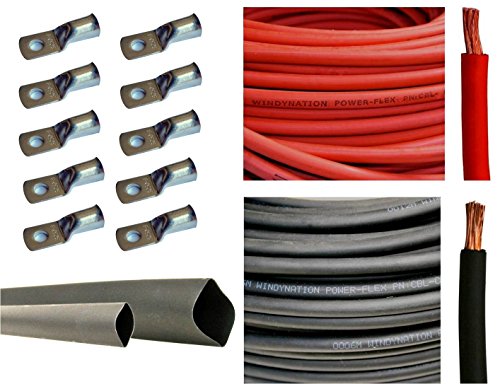
The one-box kit that turns a bare battery job into a finished install in a single afternoon. What you get is everything in one listing: 10 feet of red cable, 10 feet of black cable, 10 tinned copper lugs, and 3 feet of black heat shrink tubing.
The cable itself is fully annealed pure copper with a solvent-resistant EPDM jacket — the flexible rubber-style insulation that resists oil, heat, and abrasion. That matters when you are routing around an engine block or a battery box corner. The lugs are tinned for corrosion protection, which is exactly what you want for outdoor or marine work, and their flared barrel end makes slipping the cable in easier. The included heat shrink is rated to 600 volts and handles a -55 to +125 Celsius temperature range, resistant to most solvents and fire. In customer testing, the cable carried 2800A for six seconds before the jacket melted.
What wins people over here is the quality of the copper itself — buyers consistently say the conductor is genuine, flexible, and easier to route than auto-parts-store wire. The completeness angle is just as strong: the kit arrives with lugs and heat shrink already in the box, so nobody is stuck mid-install waiting on a second order. A couple of buyers noted the heat shrink runs around 26 inches rather than the 30 described, so if you have a long run, plan for a little extra. The 600-volt rating and pure copper build also make it suitable for marine and outdoor duty where corrosion eats lesser cables.
What earns it the top spot
- One-box kit: 10ft red + 10ft black cable, 10 tinned copper lugs, 3ft heat shrink
- Fully annealed pure copper conductor with solvent-resistant EPDM jacket
- Tinned lugs resist corrosion — suited to outdoor and marine installs
- 600V rated; heat shrink handles -55°C to +125°C
Where it falls short
- Included heat shrink runs about 26 inches rather than the 30 described
- Some buyers had to order additional lugs beyond the 10 included for larger jobs
Go with this kit: anyone who wants red and black cable plus the correct lugs and heat shrink delivered together without a second order.
Plan ahead if: your run needs more than 10 connectors, since you can only fit a limited number with the ten lugs in the box.
2. Spartan Power Welding Lead & Car Battery Cable — DIY Bulk 2 AWG 10 Foot Red
For anyone cutting and crimping their own cables, this 651-strand bulk red is the workhorse you want on the bench.
Spartan Power builds this with 651 strands of pure copper inside an ultra-flexible EPDM jacket with paper separators between the layers. Those paper separators make stripping the jacket far cleaner, which matters when you are making your own lugs. The 600-volt rating and a -58°F to +221°F temperature window cover just about anything a car, boat, RV, or golf cart will throw at it, and the manufacturer builds these in Reno, Nevada. What everyone notices is the quality of the conductor itself — it is stranded for high current, bends into shorter turns than stiffer cables, and the jacket strips clean enough that crimping and mounting a lug goes fast. One DIY buyer who usually ran the welder on stock cables ended up upgrading the welder too after installing Spartan wire in a car.
An honest note from the comments: several buyers mention the printed gauge can run a size small for their particular setup, so double-check the load you expect to carry before ordering. The size feedback is genuinely split — some say it is spot on, others say it reads generously. That is a fit question, not a quality problem. If your run is short and you already know your amp draw, this is some of the cleanest bulk copper going.
Tradeoff to know: the size marking is the one thing buyers flag as mixed — measure your planned current and lug size before you order, because this cable is heavier in person than the spec often implies.
Built for: anyone making their own battery or welding leads who wants a fine-stranded bulk cable with a jacket that strips clean.
Look elsewhere if: you need red and black in the same box — this listing ships red only, so plan for a second order.
3. YDDECW 2 Gauge Tinned Copper Marine Wire — 5ft Red + 5ft Black
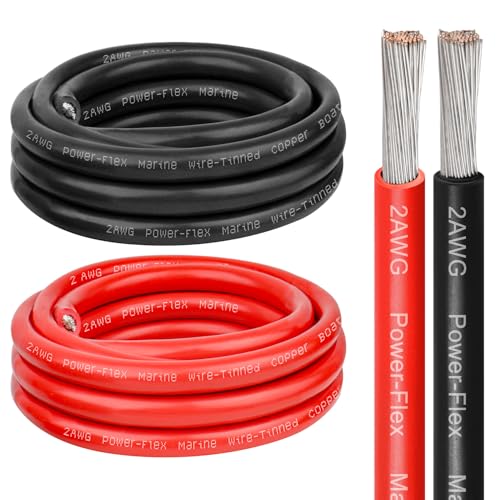
Salt, spray, and sun are what kill bare copper on a boat — this cable’s tin coating is the reason it belongs in your marine kit.
Each conductor here is made of 665 tinned copper strands at 0.254mm thick, wrapped in a 1.52mm thickened PVC jacket that handles -10°C to 105°C. Tin-plating is what keeps saltwater corrosion off the copper underneath, and the cable is rated to survive salt spray, oil, and vibration — and it is tested to 2000+ bend cycles without cracking. It ships as pre-cut 5ft red and 5ft black. Compatibility is broad: it is listed for 12V and 48V systems and covers marine (ABYC), automotive (SAE), and solar (NEC) use, with a 600V rating for dry conditions and 75°C for wet. People running solar builds especially like that they do not have to worry about it corroding the way bare copper can. It also bends more easily than the stiffer 6 AWG wire many builders start with, which helps in tight battery compartments.
The catch buyers mention most is the red jacket fading to pink quickly when it sits in direct sun on a boat, which is cosmetic but worth knowing. A workaround owners use is running the black cable in open areas with red heat shrink for identification. Otherwise the gauge stays accurate, It handles trolling motors and 110-watt CB radio setups, and the tin coating resists corrosion in saltwater.
What buyers highlight: the sheer pliability — reviewers describe it as soft and easy to work with, and the tinned copper is called out as the thing that gives them confidence against corrosion on solar and marine builds.
One thing to know: the red jacket will fade if it is left exposed to direct sunlight, so plan to cover or heat-shrink any sun-facing runs.
Ideal for: sailboat, jonboat, and RV installs where salt, moisture, and vibration are the daily reality.
Skip it for: long distance runs — the 5ft + 5ft cut is sized for short battery or trolling-motor links, not a full rewire.
4. Kimbluth 2 Gauge Battery Cable Copper Wire — 3ft Red + 3ft Black

Short, purpose-cut cable for the guy who just needs to hook up an amplifier or a quick battery link and get on with it.
Kimbluth builds this conductor from 99% pure OFC (oxygen-free copper) strands at 0.256mm thick, twisted so the cable stays flexible, and wraps it in a 90 mil PVC jacket. That PVC outer layer is the reason the wire resists oxidation, corrosion, gasoline, and battery acid — the everyday stuff under a hood. Working temperature is -40 to 105°C, and the cable is rated to 600 volts, so it is set up for welding, battery, car amplifier, solar, winch, and generator work. The 3ft + 3ft length is purpose-sized for short automotive runs — an aux power line, a ground block, or a head unit power feed. Buyers describe it as easy to cut and strip, and it has earned its reputation as a nice car audio power wire with clean conductivity.
The one honest caveat: a handful of reviewers measure the length and report it short of the advertised run, while many more say the length is exactly as listed. That is a length-batch issue rather than a quality one — measure your planned route before you cut and you will not come up short. For short battery and audio runs, this delivers the same 2 AWG pure copper conductivity at a low entry point.
What works
- 99% pure OFC copper strands at 0.256mm for clean conductivity
- 90 mil PVC jacket resists oxidation, corrosion, gasoline, and battery acid
- 600V rated; handles -40 to 105°C working temperatures
- Easy to cut and strip — described by buyers as a nice car audio power wire
Where it stumbles
- Length feedback is mixed — some say the cut runs shorter than advertised
- 3ft runs are short, so measure before assuming it covers a full route
Perfect for: amplifier power, aux power and ground blocks, and short battery links where a compact cut fits the job.
Not the right pick if: your run is longer than a few feet — order longer cable or plan to splice with matching gauge.
5. EWCS 2 Gauge Premium Extra Flexible Welding Cable — 600 Volt, Red, 25 Feet
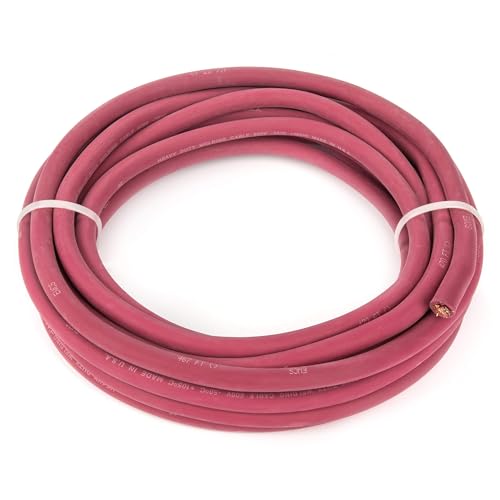
A 25-foot coil of fine-stranded 2 AWG for the project that will not fit on a 10-foot cut.
EWCS uses 636 strands of 30-gauge copper in this cable, which is what gives it that heavy-duty flexibility people describe. It ships as a coil and is listed as sunlight resistant and water resistant, so it holds up outdoors and in engine compartments. The build is designed to work with both soldered and crimped ends, which is a real advantage when you are setting up trunk-mounted batteries or long runs to a starter. Buyers who moved a battery to the trunk say it carries full starting current, and golf-cart owners who rewired with soldered or crimped ends saw steady performance after the swap. It is rated for high-current work and the fine strands make tight bends around chassis points easier than stiffer cable of the same gauge.
One thing to know before you buy: buyers report mixed feedback on thickness — some praise the insulation, while others find the shielding thinner than expected. EWCS labels this as 2 gauge, but one reviewer noted the conductor fit 4-gauge eyelets instead. That reflects a common reality: fine-stranded welding cable can measure differently than a rigid stranded conductor at the same nominal gauge. If you crimp with a fixed-size die, match it to the actual cable, not just the printed label.
Standout spec worth noting: the 25-foot length alone sets this apart from the shorter kits on this list — it is the right answer when your run needs real distance and you would rather not splice.
Honest caveat: expect some variance between the printed gauge and what actually fits your eyelets, so have the crimp die or lugs on hand before you cut.
Made for: trunk-mount battery relocations, golf-cart rewires, and any run where the distance demands more than ten feet.
Look elsewhere if: you want a matched red and black pair in one box — this is a red only coil.
6. Shirbly 2/0 Gauge Battery Cable — 10ft Red + 10ft Black Pure Copper Welding Wire

When 2 AWG is not enough cable for the load, this 2/0 monster is the next step up — and it earns that step with 2147 strands.
Shirbly builds this from 2147 strands of 0.2mm pure copper (OFC) under a solvent-resistant EPDM rubber jacket, so it is a fully annealed conductor rather than a rigid one. The 600-volt rating and a -58°F to +221°F working range mean it will hold up in engine compartments and outdoor installs alike, and the EPDM outer layer is called out for heat, wear, tear, moisture, and oil resistance. It is often used as a heavy-duty alternative to stock automotive cables for solar systems, generators, and any DC setup where pure copper matters — including LiFePO4 battery banks, bus-bar to shunt runs, and inverter feeds. The 10ft red + 10ft black pairing gives you room to cut custom lengths for tight spots without splicing.
What buyers consistently report is that the cable is easier to work with than the size suggests — one owner building out a mini bus expected cutting and lug placement to be hard and found it straightforward. Others use it for jumper cables and report it starts a vehicle every time. The flip side of the flexibility is that fine-stranded 2/0 copper needs lugs matched to the actual cable diameter for a solid crimp, so have 2/0 lugs ready before you start. The 10ft pairing is generous, but if your run doubles back through the vehicle, check the route length first.
what separates it
- 2/0 AWG with 2147 strands of 0.2mm pure copper for huge current capacity
- EPDM rubber jacket resists heat, tear, moisture, oil, and corrosion
- 600V rated; handles -58°F to +221°F
- 10ft red + 10ft black pairing lets you cut custom lengths without splicing
Where it demands care
- Fine strands require correctly sized 2/0 lugs to crimp reliably
- Not the right pick for a 2 AWG application — oversized cable can be harder to route through tight channels
Right choice if: your project is a solar bank, an inverter feed, or a high-current starter where 2 AWG would be undersized.
Think again if: you specifically need the 2 AWG gauge this article is about — step down to a true 2 AWG cable instead of over-sizing your run.
Understanding the Specs
Strand Count and Copper Type
Strand count is the number of individual thin copper wires twisted into the cable. More strands means a more flexible cable that bends tighter and handles vibration better — which is why welding cable and high-end battery cable usually show hundreds or thousands of fine strands. Bare copper (sometimes called OFC) conducts electricity cleanly but can oxidize over time, whereas tinned copper carries a thin tin coating that resists saltwater and corrosion. Which one is right for you depends on the environment: fresh-water auto and shop work is fine with bare copper, and salt-water marine work leans toward tinned.
Voltage Rating and Temperature Range
The 600-volt rating printed on most of these cables is a ceiling, not a requirement — your 12V or 48V automotive or solar system runs well below it, so the rating mainly signals insulation quality. The temperature range on the jacket tells you what the insulation tolerates. A -58°F to +221°F window, for example, covers everything from a cold-start morning to a hot engine bay. EPDM and PVC jackets (two common insulation materials) handle those extremes differently, so pick a cable whose range matches your real-world conditions to keep the insulation from cracking or softening over time.
FAQ
What is 2 AWG copper wire used for?
Is 2 AWG bigger than 4 AWG?
Can I mix 2 AWG copper with 2/0 gauge cable in the same system?
What is the difference between welding cable and battery cable?
Do I need tinned copper or bare copper for marine wiring?
How do I crimp a lug onto 2 AWG copper wire?
Does the jacket material matter for 2 AWG cable?
Is 2 AWG copper wire rated for outdoor use?
How much current can 2 AWG copper wire carry?
Final Thoughts: The Verdict
For most people wiring a battery, winch, or solar setup, the WindyNation 2 AWG Kit is the one to buy — pure copper conductors, tinned lugs, and heat shrink all arrive together, so you are not stuck mid-project waiting on a second order. If you cut your own lengths and need bulk cable, the Spartan Power bulk red and the EWCS 25-foot coil both deliver high strand counts and stripping-friendly jackets. And when you run near saltwater, the YDDECW tinned marina wire is the safest pick of the bunch because tin-plating resists the corrosion bare copper cannot.
How We Picked
We do not accept paid placement. Every pick is matched to a real buyer and a real use-case; we do not hands-on test units.
Sources & Methodology
Specifications: manufacturer listings and product documentation. Review insights: verified customer reviews, as of September 2026. Pricing: not shown on this page (it changes often); check the current price via the retailer link.
As an Amazon Associate, KitchPrep earns from qualifying purchases. This does not affect which products we feature.
Related Guides
