
Specs are compiled from manufacturer listings and verified buyer reviews and can change over time — please confirm the key details on the product page before buying.
If your table saw bogs down, your space heater cord feels warm to the touch, or your saw keeps tripping a breaker at the end of a long run, the weak link is almost always the cord — not the tool. A 12 AWG extension cord (12 AWG means the copper inside is about 2 mm thick per strand bundle, which is far thicker wire than the household-standard 16 or 14 gauge) carries heavy current with less voltage loss over distance. That means your tools start easier, run cooler, and your plugs stay put. This guide cuts through the listings and lines up the eight 12-gauge cords worth your money, sorted by how you’ll actually use them.
I’m Mohammad Maruf — the founder and writer behind KitchPrep. This guide is built by comparing the manufacturers’ published specifications and the patterns across verified customer reviews, so you get each pick’s real strengths and trade-offs instead of marketing spin.
Whether you’re running a miter saw across the driveway, powering holiday lights along a fence line, or keeping an air compressor live in a cold garage, the right cord makes all the difference — this breakdown of the best 12 awg extension cord picks shows which one fits your job.
Our Picks at a Glance

How To Choose The Best 12 AWG Extension Cord
Buying a 12-gauge cord is not complicated once you understand three things: how far the power has to travel, how much current the tool pulls, and what conditions the cord will sit in. Everything else is convenience.
Match the gauge to the load and distance
Gauge is the thickness of the copper wire inside the cord, and lower numbers mean thicker wire. A 12 AWG cord carries noticeably more current with less voltage drop than a 14 or 16 gauge cord. If you are running power tools, a space heater, or a compressor more than a few feet from the outlet, 12 gauge keeps the tool from starving for voltage. Undersized wire heats up, and heat is the enemy of every cord and every tool motor.
Amp rating and wattage ceiling
Most 12 AWG cords in this roundup are rated at 15 amps and 1875 watts. That is the same ceiling as a standard US wall circuit. Add up the running watts of everything you plan to plug in; if the total climbs past 1875 watts, split the load across circuits. A cord that is rated correctly runs cool; a cord that is overloaded runs hot and wears out fast.
Jacket type and weather ratings
SJTW is the jacket code you want outdoors. It signals a thermoplastic vinyl jacket that resists moisture, abrasion, and sunlight, and stays flexible in cold weather rather than turning stiff and cracking. Look for ETL or UL listing as an independent safety reference. Some cords are rated IP65, which means they are protected against dust and water spray, though no cord should sit submerged in standing water for long periods.
Outlets, lighted ends, and locking plugs
A single female end works for one tool. A triple-tap pigtail lets you leave several tools plugged in and just pick one up. A lighted female end glows when power is flowing so you can see at a glance whether the run is live. A locking connector physically snaps the plug into the outlet end so a hard yank will not disconnect you mid-cut — worth the extra money if you work where cords get dragged.
Quick Comparison
| Model | Best For | Length | Amp / Watt Rating | Outlets | Amazon |
|---|---|---|---|---|---|
| PLUGTUL 25Ft 12 Gauge Extension Cord with 3-Outlets★ Best Overall | Garage and garden all-rounder | 25 ft | 15 A / 1875 W | 3 | Amazon |
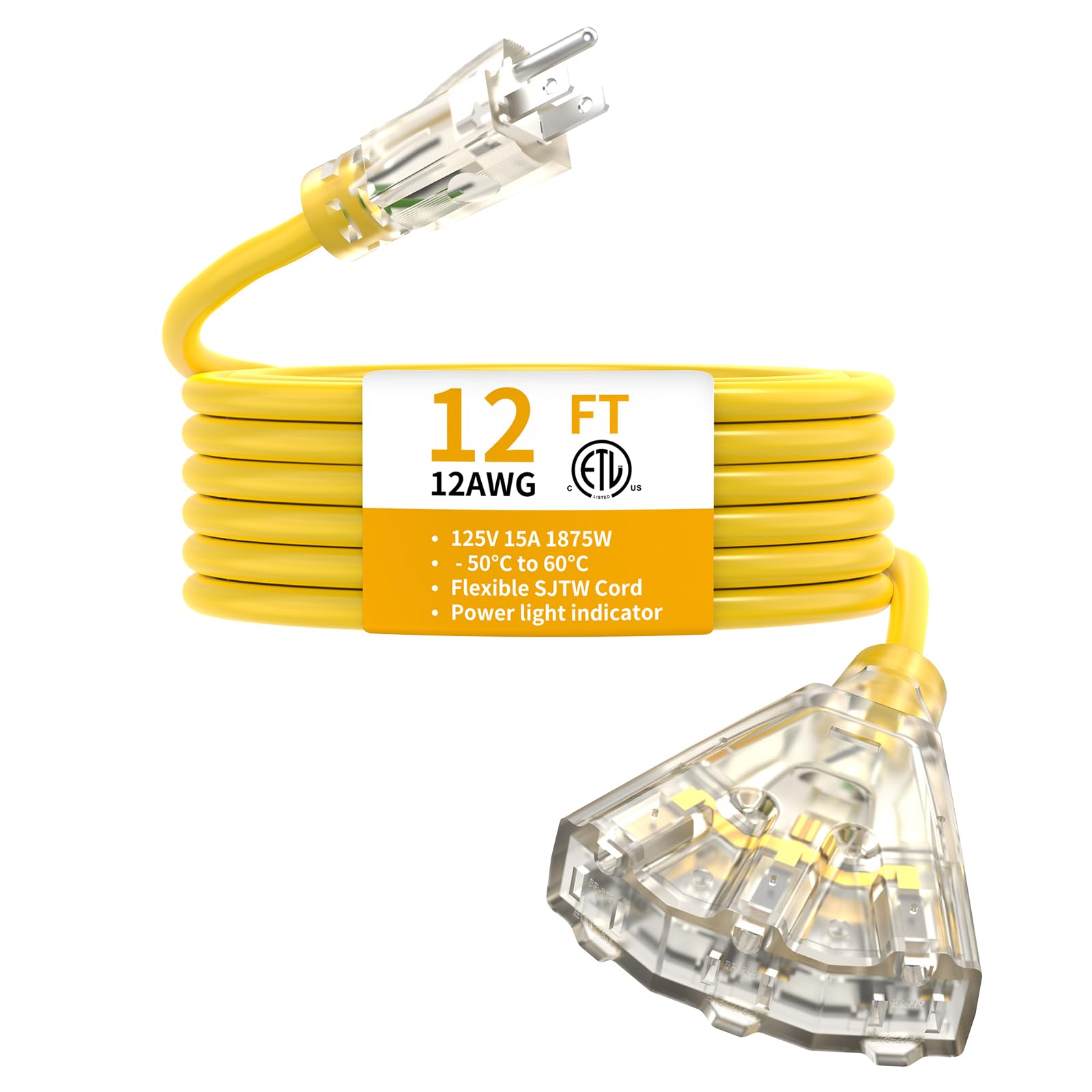
| PRIMOWIRE 12FT 12/3 Heavy Duty Outdoor Extension CordBest Short Run | Short-run jobsite and workshop tap | 12 ft | 15 A / 1875 W | 3 | Amazon |
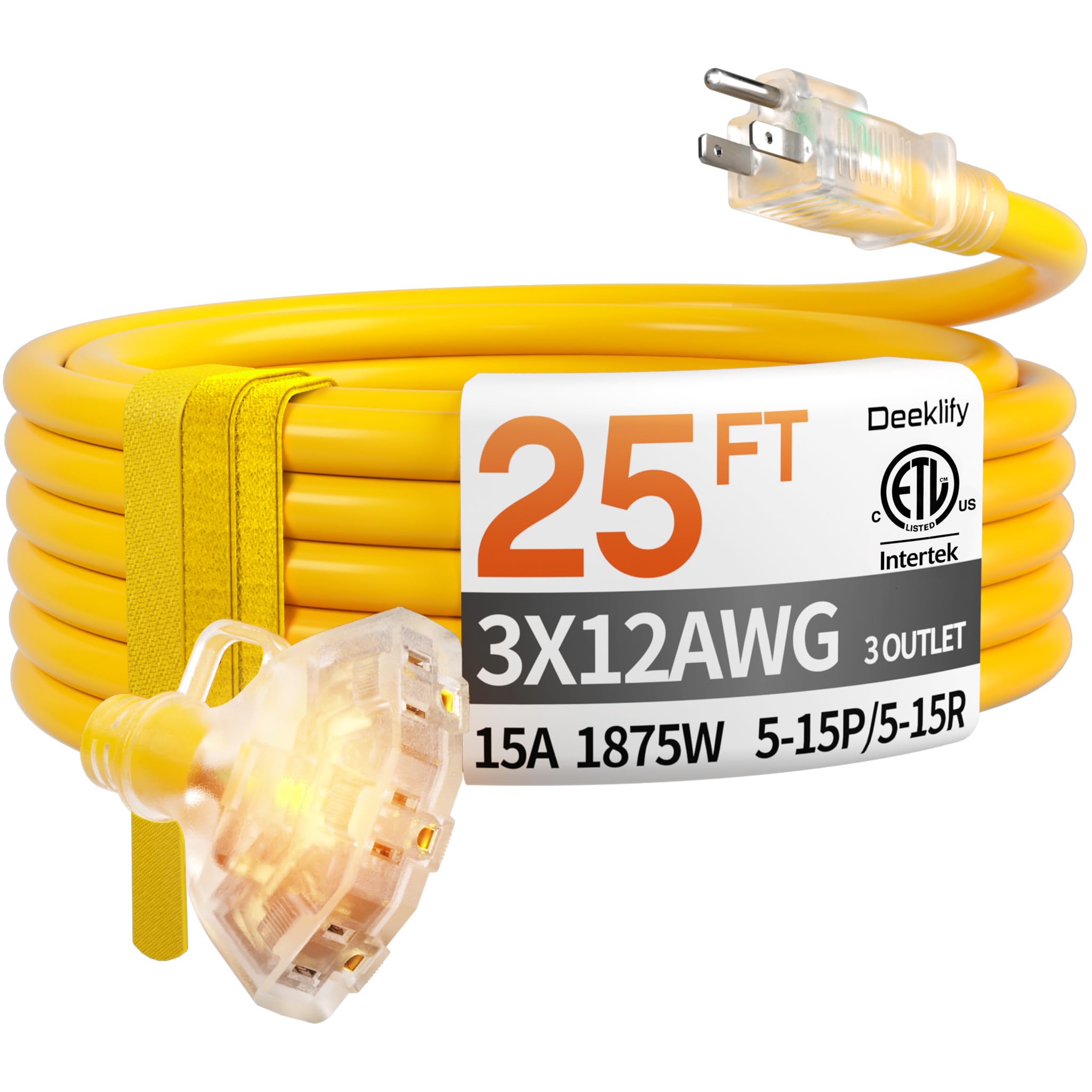
| Deeklify 25 FT 12 Gauge Heavy Duty Extension CordMost Versatile | Yard tools and generator runs | 25 ft | 15 A / 1875 W | 3 | Amazon |
| LifeSupplyUSA 50ft Heavy Duty Outdoor Extension Cord | Generator backup and long workshop reach | 50 ft | 15 A / 1875 W | 3 | Amazon |
| GREATIDE 50 Ft Lighted Outdoor Extension Cord | Cold-weather flexibility and outdoor lighting | 50 ft | 15 A / 1875 W | 3 | Amazon |
| GEARit 50 Ft 12 Gauge Extension Cord SJTW OFC Copper | Distance runs with warranty backup | 50 ft | 15 A / 125 V | 1 | Amazon |
| Southwire Outdoor Extension Cord 50 Ft | Heavy shop loads with a coolant-forged jacket | 50 ft | 15 A | 1 | Amazon |
| DEWALT 50 Foot 12/3 SJTW Click-to-Lock Lighted Extension Cord | Locking connection for drag-prone jobsites | 50 ft | 15 A / 1875 W | 1 | Amazon |
In‑Depth Reviews
1. PLUGTUL 25Ft 12 Gauge Extension Cord with 3-Outlets
Our pick — over 4.5★ from 900+ verified ratings; the strongest balance of quality and price.
The crowd favorite that makes a hybrid-car charge or a garage tool run look easy.
What earns this cord the top spot is simpler than any spec sheet line: it is built like it expects to be abused and it just keeps working. The wire is 12 gauge with three pure copper conductors — 3 conductors is the “with ground” configuration that lets a 3-prong tool draw safely — and the whole run is rated 15 amps, 125 volts, and 1875 watts. In plain terms, that is a full household circuit’s worth of power carried through one 25-foot run. The male plug is NEMA 5-15P and the female end is NEMA 5-15R, the standard shapes that fit every US wall outlet and tool. The thing owners point to first is how cool it stays: even drivers who push it hard on a hybrid car charger report the plugs and cord never get hot, which is exactly what you want from a cord handling that kind of continuous draw.
The 3-outlet design turns this from a plain extension into a small power hub. You can leave a shop light, a charger, and a drill all plugged in and switch between them without crawling around. Both plug ends are made of translucent plastic, and the female end has an LED indicator that lights up whenever power is flowing so you can see the run is live from across the garage. The jacket is water-resistant flexible PVC — good for rain, sun, and abrasion — though the maker is upfront that you should not let the plugs sit soaking in water for long stretches. The 25-foot length also fits the classic over-shoot: unlike the 12FT PRIMOWIRE cord above, which is a 2.1x shorter run, this one reaches further without needing a second cord. It is ETL listed, which is the independent safety check most buyers skip but should not.
Where the value really lands is durability over the long haul. Owners who run this thing regularly report the heat stays off the connection points and the cord holds up to repeated use. One real-world scene that keeps coming up: a wringer washer at a remote cabin, a job where the cord gets dragged, coiled, and left out — exactly the kind of punishment a cheap cord dies from. The cord also ships with a hook-and-loop strap for neat coiling.
What keeps power flowing
- 12 AWG copper wire rated 15 A / 1875 W — full-circuit capacity in a portable cord
- Runs cool under continuous load, including hybrid-car charging
- 3 outlets let you swap tools without unplugging
- Lighted female end confirms power at a glance
- ETL listed with a tough, water-resistant PVC jacket
Where it expects care
- Keep the plugs out of standing water — the jacket resists rain but the maker warns against long soaking
- 25 ft is plenty for a garage but short if your outlet is far from the yard
- Heavier than any 16-gauge cord you have owned — the copper is the point
Reach for this if: you want one 25-foot cord for the garage, garden, and home that handles tools and continuous charging without warming up.
Look elsewhere if: your outlet sits more than 25 feet from the work — a 50-footer suits you better.
2. PRIMOWIRE 12FT 12/3 Heavy Duty Outdoor Extension Cord
Twelve feet of contractor-grade cord for the tool that lives just out of outlet reach.
Not every job needs fifty feet. Sometimes the problem is that the drill press sits twelve feet from the wall, and a full-length cord is more nuisance than help. That is the exact gap this cord fills, and it does it with the same thick 12-gauge SJTW wire as the rest of this list. It runs three tools at once up to a shared 15 amps and 1875 watts, and it is rated for temperatures from -50°C to 60°C — so it stays flexible in a cold workshop and does not go limp or crack in summer heat. It is ETL listed with a 3-prong grounded design, which is the configuration that keeps a tool’s metal frame from carrying current if something goes wrong inside. Owners describe the wire as heavy duty in the way that matters: it does not overheat, the plugs hold firm, and the lighted connector makes it obvious you have power before you drag a tool over to it.
The standout is going to be that the durability is genuinely contractor-level, and the wire delivers full power without loss. One detail that comes up in review after review: plugging in a near-infrared sauna and finding the run perfectly stable. That is a serious continuous load, and this little cord shrugs it off. Buyers also report the cord handles heavy electrical draw without strain. And a real signal of end-use flexibility: one owner set it up in a dog house to run winter heat, choosing the shorter length so it stayed up and out of harm’s way rather than lying on the ground. The yellow jacket is bright enough to spot on the lawn so a mower does not eat it.
The one honest cramp is water exposure. The cord is weatherproof and rated for rain and frost, and it does get used in those conditions — but the housing is a dry-connection design; there are no rain covers or sealing strips around the plug, so standing water around the connection point is not its job. It also runs short; if twelve feet is not enough, you are shopping in the wrong row. Owners who bought the wrong gauge first — usually 14 or 16 — learned the hard way that undersized cords are exactly what cause flickering and heat.
Why shorter makes sense: a 12-foot cable in 12 gauge weighs roughly 2.1 pounds, so it is light enough to coil around one arm and carry back into the shop or back of the truck without the usual wrestling match a 50-foot 12-gauge cord requires.
The real warning: the one caveat that keeps coming up in owner reviews is water — the plug ends do not seal against immersion, so this cord belongs in damp jobsites and sheds, not in puddles or rain barrels.
The right fit: workshops, saunas, dog houses, and tool benches where the outlet is close but the tool is not.
Not your cord if: you need real outdoor length — twelve feet runs out fast on a fence line or a driveway job.
3. Deeklify 25 FT 12 Gauge Heavy Duty Extension Cord with Multiple Outlets
The one cord that handles a generator feed, a yard tool, and a wet patio outlet all in the same afternoon.
If you want a cord that covers all the bases, this is the one to beat. The jacket is rated IP65 — that is the IP (Ingress Protection) code, and an IP65 grade means the cord is protected against dust and against water sprayed from a nozzle. So a rainy jobsite is not going to bother it. The jacket is flexible SJTW vinyl and stays workable from -40°F to 140°F, so it does not stiffen into a rod in January. The cord is ETL listed, with three pure copper conductors and a 15 amp, 125 volt, 1875 watt ceiling. The bright yellow or orange jacket is the kind of color you can see across a yard before you trip over it, and it ships with hook-and-loop storage straps plus a built-in hook for hanging it neatly on a workshop nail.
The 3-outlet splitter is what most buyers actually love: plug in the miter saw, the sander, and the shop vac and just grab whichever one you need. The female end is a standard NEMA 5-15R pigtail, and the whole assembly has survived a claimed 5,000 bend cycles and a 1,500-volt test. Owners who have put real miles on it talk about the same thing: no voltage drop when they load it up, the yellow jacket lasting outdoors, the 3 outlets being handy enough that they can run power tools and lighting off a single run.
What is honest about this cord: it is heavy. That is an unavoidable side effect of 12-gauge copper, and it is the same reason it works so well. It also does not have individually switched outlets, so you will need to unplug what you are not using. Some owners who bought the shorter version report it was shorter than they expected — worth checking the run length against your actual job before you commit.
The trade-off to expect: the same thick copper that keeps voltage steady also makes the cord feel substantial when you coil it, and the outlets are live whenever the cord is plugged in — no individual on/off switches.
What makes it earn a slot: an IP65 weather rating at this gauge is rare, and it means one cord can do wet outdoor work and dry garage work without a second buy.
Buy this one if: you want a single 25-foot cord that can sit in the rain, run three tools off one outlet, and hang on a hook when you are done.
Consider something else if: you need individually switched outlets or a lighter cord to carry — those are not in the design.
4. LifeSupplyUSA 50ft Heavy Duty Outdoor Extension Cord, 12/3

Fifty feet of yellow cord built for the day the power goes out.
The defining spec here is simple: 50 feet of 12 AWG cable rated at 15 amps, 125 volts, and up to 1875 watts, with three grounded outlets at the end. That combination is what gas-generator owners want — enough reach to get from the generator out by the panel into the house, and enough outlets to plug in a fridge, a lamp, and a phone charger at once. The jacket is a sturdy vinyl that resists oil, grease, moisture, and abrasion, which matters when the cord gets dragged across a driveway or dropped on a shop floor. A lighted female end glows when power is present, so at a glance you know whether the run is live before you start moving appliances around.
Where this cord shines is the generator scenario. It is designed for exactly that kind of heavy-duty, intermittent, high-draw work. The yellow PVC jacket doubles as a safety marker — it refuses to hide among the tools, so tripping and accidental disconnections go down. The cord also holds up in cold, since the jacket stays flexible enough to bend around corners without cracking, something owners specifically call out. And it survives typical jobsite abuse: oil spills, wet concrete, scraped corners.
The one thing to size correctly is length against draw. Long runs drop voltage no matter the gauge, so if you are pushing 1875 watts of appliances all the way down a 50-foot cord, you will want to keep the tool loads reasonable. And though the jacket resists moisture, no extension cord should sit in standing water; keep the connections up off the ground when it rains.
Where it earns the price: 50 feet of 12-gauge cable with a lighted end and three outlets is hard to find at this build level, and the vinyl jacket is genuinely reinforced for abrasion.
What to watch: the plug and outlet ends are not immersion-sealed, so in heavy weather keep the connection point improve and covered rather than lying in a puddle.
Best match: generator backup, long jobsite runs, and anyone who wants 50 feet of thick copper with three outlets at the end.
Think twice if: you only ever work within arm’s reach of an outlet — a shorter, lighter cord will be easier to handle for that.
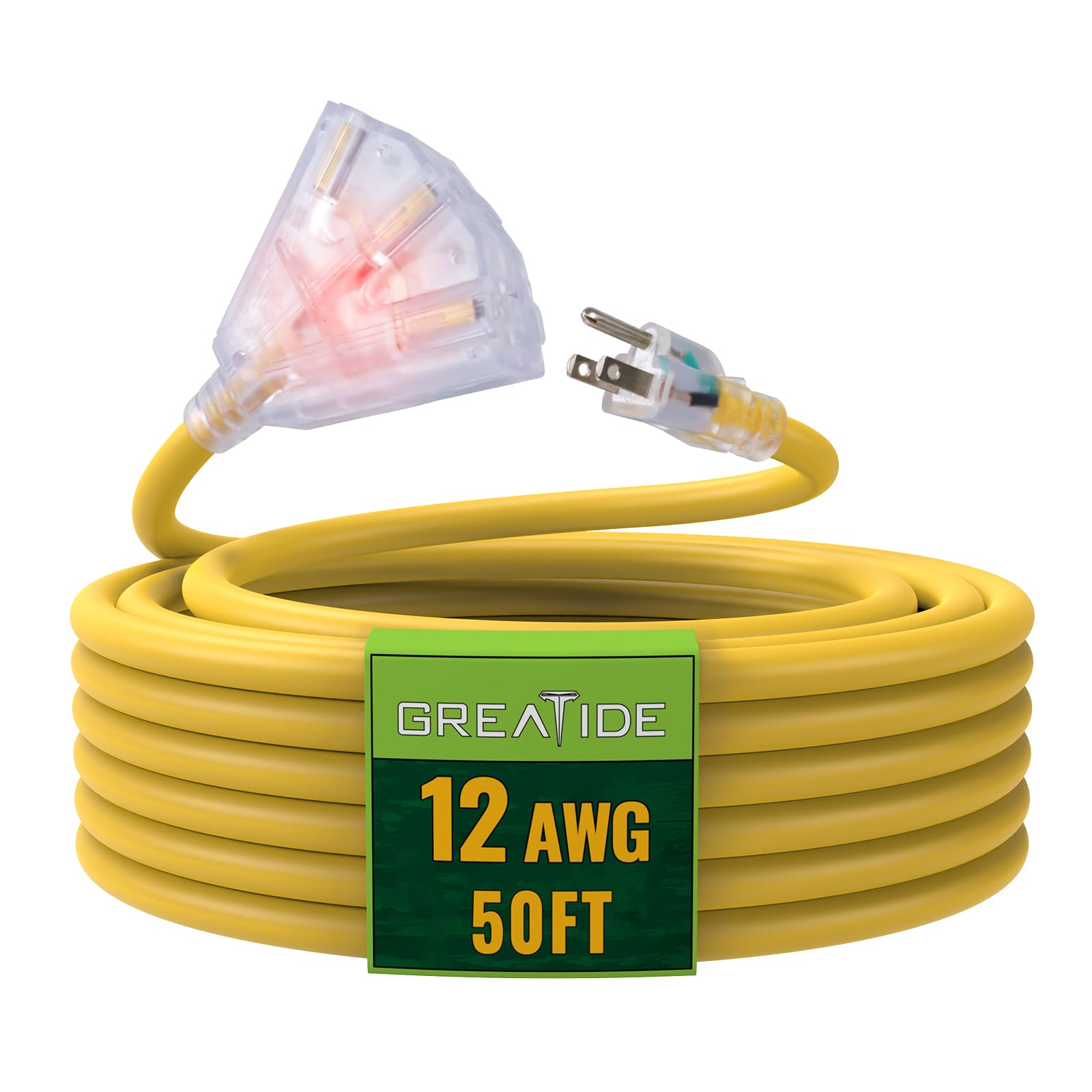
5. GREATIDE 50 Ft Lighted Outdoor Extension Cord with 3 Electrical Power Outlets
A cold-weather cord that stays limp and tangle-free even when the temperature drops below freezing.
The standout spec here is the cold rating. This cord is UL listed and rated for temperatures from -40°F to +140°F, which means the vinyl covering stays flexible instead of stiffening into an unmanageable rope in a Western winter. The gauge is 12, and the cord runs 15 amps, 125 volts, and 1875 watts — enough to run a shop tool or a space heater the length of a 50-foot run. The 3-outlet multi-plug end is a pigtail triple tap: three outlets you can use at once. The yellow jacket is bright and highly visible for safety. And the lighted end is straightforwardly useful outdoors — it glows whenever the cord is energized, so you can walk down a dark path and confirm the run is live without a second person or a flashlight.
The one nuance to plan for is water. The cord is rated for moisture and sunlight and is sold for indoor and outdoor use, but the manufacturer is explicit that the connections should not sit immersed in water — so the outer jacket resists rain while the connection point itself still needs to be off the ground. Owners who run power tools off this cord say the fit and current delivery are both right; it powers a tool with the same feel as plugging straight into the wall. A few have replaced older 16-gauge cords with this one after noticing the lighter cord warmed up under the same load. That is exactly the upgrade 12 AWG is designed to deliver.
What you give up at this price is a locking connector and a locking plug system. There is no mechanical latch holding the male plug into the female end, so if you drag the cord hard across a jobsite you can pull the connection loose. For lawn equipment, holiday lighting, camping, and power-tool runs on a deck, that is fine; for a cord you plan to yank around a construction site every day, a locking model makes more sense. And the storage situation is standard vinyl-cord bulk, not the stiffest thing out there but not featherweight either.
Why cold-weather users keep it
- Stays flexible to -40°F, so it does not turn into a stiff rod outdoors
- UL listed with a 15 A / 1875 W / 125 V rating
- 3-outlet pigtail lets you power several tools or lights from one run
- Lighted end shows the run is live in the dark
- Highly visible yellow jacket for jobsite safety
Where it stops short
- No locking connector — the plug can be yanked loose if you drag the cord hard
- Connections should not be submerged in standing water
- Vinyl bulk makes it less compact to store than a thinner-gauge cord
Built for: cold-climate yards, camping, holiday lighting, and anyone who wants a cord that does not fight them in winter.
Skip past this if: you need a locking connection for a heavy-use jobsite — you want a cord with a lock-to-plug design.
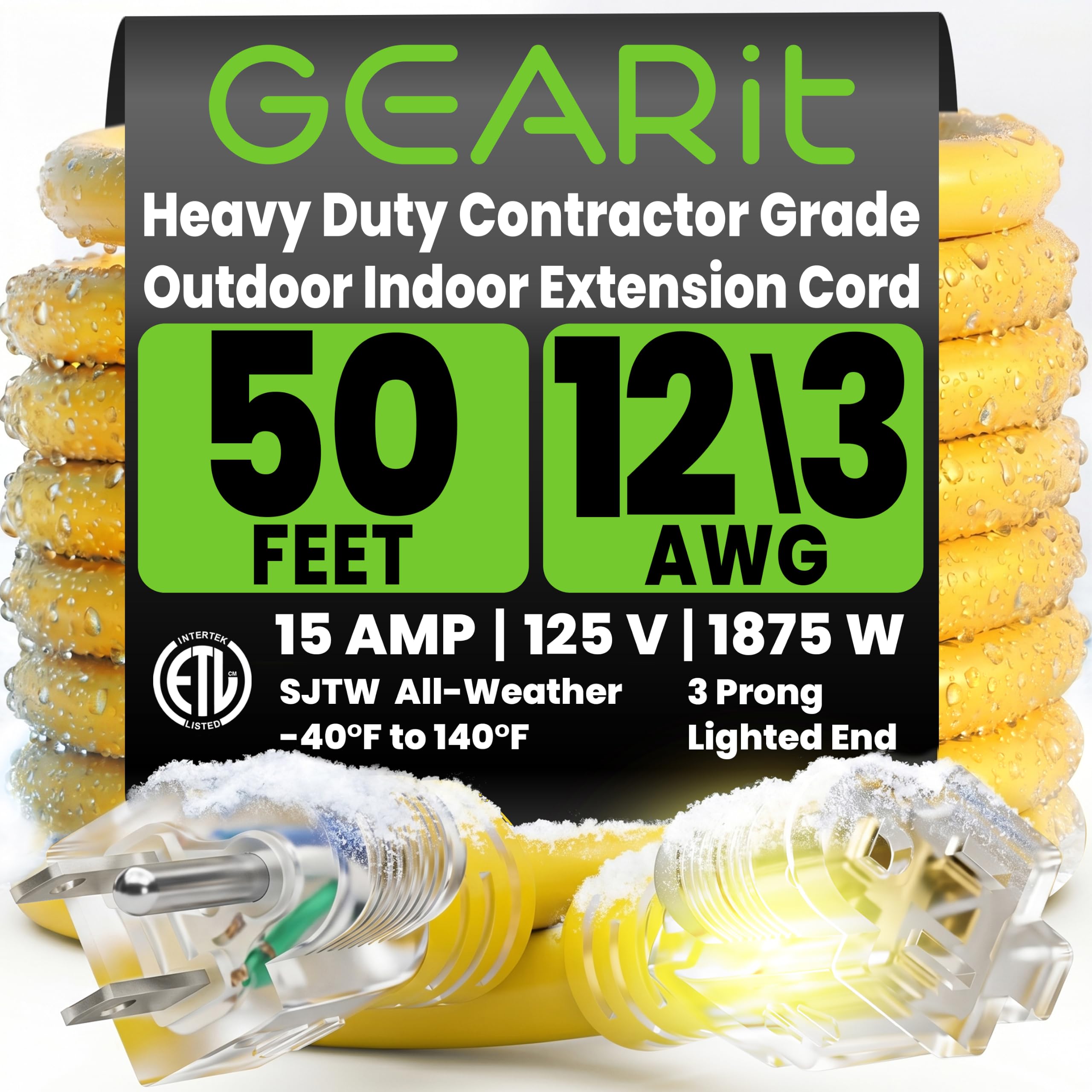
6. GEARit 50 Ft 12 Gauge Extension Cord SJTW OFC Copper
Fifty feet of oxygen-free copper built to keep voltage steady at the far end of a long run.
The detail worth paying for here is the conductor material. GEARit uses OFC — oxygen-free copper — which is the highest-purity copper type used in power cable. The claim is not marketing noise: purer copper carries current with lower resistance, and in a 50-foot run resistance is exactly what causes voltage drop. So this cord is engineered around a real, measurable problem — the longer the run, the more critical the wire quality. The build is 12-gauge SJTW with a 50-foot length rated at 15 amps, and the jacket handles -40°F to 130°F, so it takes cold storage and summer heat without complaint. There is a single female outlet and a lighted end. ETL listing is included, and the cord is backed by a Lifetime Warranty from GEARit — the kind of coverage that most extension cords simply do not carry.
The heaviest load users put on this thing is high-current tools — circular saws, miter saws, pressure washers, and leaf blowers. Buyers report it holds up to UV exposure when it lives outdoors, and that the lit-up plug ends work — you can walk the whole 50 feet and see whether power is live at the equipment without walking back. One practical benefit repeatedly noted: unlike thinner 14-gauge cords that fail under sustained high draw, this cable keeps the tool running at full speed. That is exactly the difference 12 AWG wire makes on a long run.
The trade-off is that oxygen-free 12-gauge copper at 50 feet has a real presence. The cord is heavy, stiff in cold weather, and awkward to wind when you are done — owners will tell you it is not a cord you casually loop over your shoulder. The price also reflects the copper quality, so this is a cord you buy for a fixed run and leave in place rather than one you haul back and forth.
Where the money goes: oxygen-free copper conductors and a Lifetime Warranty — this is a cord you buy once and keep for a long run you have already planned out.
The physical cost: thick copper at 50 feet weighs noticeably, and 12-gauge cable stiffens in cold — plan on a permanent route, not a daily coil-and-carry.
Ideal owner: someone with a permanent 50-foot run — a driveway-run circular saw, a pressure washer on a long fence line, or a leaf blower from a garage outlet to the back of the yard.
Wrong pick if: you want a light cord to toss in a bag — 50 feet of 12-gauge oxygen-free copper is not light, and it is not meant to be.
7. Southwire Outdoor Extension Cord, 50 Ft, 12 gauge 3 prong

The workhorse 50-footer with reinforced plug blades built to outlive its first shop.
Southwire is the name most electricians already know, and this cord earns the recognition. It is a 50-foot, 12-gauge, 3-prong SJTW cable with a flexible vinyl jacket that handles moisture, abrasion, and sunlight. The yellow jacket is highly visible and, more importantly for interior use, will not mark floors or walls, so it can live inside or out. The standout feature is the reinforced blades on the male plug — reinforced blades are exactly what they sound like, extra metal bracing around the prongs so they do not bend or snap off when the plug gets shoved, yanked, or dropped. The female end is a lighted outlet so you can see whether the run is live from a distance. The whole thing weighs 6.8 pounds, which tells you just how much copper is in there.
Where this cord really shines is real-world high draw. Owners mention running a 1,500-watt space heater, lights, two monitors, a PC, and a router simultaneously out in a shed office, and the cord never trips a breaker. Another report describes using it to feed a 1,500 W space heater after an older cord started warming up at the plug — this cord stays cool even after hours under full load. Once a lighter cord has heated up and shut down on you, you do not go back. One owner even runs it for a paint sprayer, and another drives an electric tiller off the far end without issue. And the reinforced plug ends are tough enough that people who are rough on gear keep coming back to Southwire for the next one.
The honest trade is straightforward. Fifty feet of 12-gauge copper weighs 6.8 pounds and is genuinely bulky to coil and store — one owner noted that stepping up to 100 feet would be more cord than most people want to handle. And if you only ever need to reach a workbench, this is more cord and more weight than the job requires. For anyone with an actual 50-foot run, though, this is the value benchmark for the category.
What earns trust here
- Reinforced blades protect the plug prongs from bending or breaking
- Handles a heavy continuous load — a shed office with a space heater, monitors, and a PC on one cord
- Stays cool under full power for hours, no warm plug
- Yellow jacket is visible outdoors and will not mark interior floors
- 50 feet in 12 gauge at a well-earned value position
Where it asks for patience
- 6.8 pounds of cord is genuinely bulky to coil and store
- Overkill for short-reach indoor jobs
- Single outlet at the end — no pigtail for multi-tool work
Who it is for: anyone with a fixed 50-foot run that powers serious equipment — a shed office, a workshop bench, a paint sprayer in the driveway.
Who should pass: someone who only needs six feet of reach inside a kitchen or a living room; a shorter, lighter cord handles that better.
8. DEWALT 50 Foot 12/3 SJTW Click-to-Lock Lighted Extension Cord

The cord that refuses to unplug itself mid-cut, even when you drag it across the site.
What sets this cord apart is a feature no other pick here has: a click-to-lock connector. The male end pushes in and the collar locks the two ends together, then a downward pull on the collar releases it. That means a hard drag or a yank will not separate the connection — the automatic locking design prevents end separation for an uninterrupted power supply. It is rated 15 amps, 125 volts, and 1875 watts, and it is UL listed plus cUL approved for Canada. It is rated for temperatures down to -58°F and holds up to 80 pounds of pull strength. That last figure is the stress test that explains why the connection stays put when you pull the cord instead of the tool.
The “lighted end” feature here is smarter than most. It has two indicator lights: an amber LED on the male plug that confirms power is reaching the cord from the outlet, and a green LED on the female end that confirms ground continuity in the cord and circuit. That is real diagnostic data — you can tell whether the outlet is dead, the cord is live, or the ground is compromised, without a tester. The contacts inside are made of nickel-coated blades and pins, which resist heat and corrosion, so the connection stays low-resistance even with moisture and time. And the 12 AWG wire safely handles the full 15 amp load of a heavy tool, the exact situation where thinner cords cause trouble.
Where this cord proves out is the drag-and-yank jobsite. Fans of heavy woodworking tools, air compressors, and compressors with hard starting loads report this as the cord the tool will actually start with, where cheaper cords stall the motor. The locking feature is the reason people buy it — one owner said it replaced years of tying cords into a knot to keep them together. That is the kind of story the locking and heat-management design is meant to prevent.
What the locking system buys you: the cord physically cannot disconnect under drag or vibration, so you can focus on the cut instead of the plug.
The honest weight: this is a heavy, industrial-strength cord, and it is the most expensive pick here — the money goes into the locking mechanism, the nickel-plated contacts, and the durability.
Best for: jobsites, shop floor, and anyone running heavy tools where an accidental unplug ruins a cut or a weld.
Overkill for: stringing holiday lights or running a phone charger — the locking design and industrial build are more than that job needs.
Understanding the Specs
AWG (American Wire Gauge)
AWG is the standard sizing system for wire, and the number works backwards from what instinct suggests: lower numbers mean thicker copper. A 12 AWG cord has a cross-sectional area of roughly 3.31 mm² per conductor, which is meaningfully thicker than 14 or 16 gauge. Thicker copper means lower resistance, which means less voltage drop over distance and less heat at the plug. That is why 12-gauge is the standard recommendation for high-draw tools and long runs — the wire is sized to carry the current without cooking itself.
SJTW Jacket Rating
SJTW is a code stamped on the cable jacket that tells you what the cord is built for. S means the cord is a stranded service cord; J means it is rated for junior hard service; T means the outer jacket is thermoplastic; W means it is weather and water resistant. In practice, SJTW is the outdoor-capable rating you want for a cord that will see rain, sun, and cold. A 12-gauge cord with an SJTW jacket stays flexible in low temperatures and resists abrasion and moisture, unlike a basic indoor lamp cord.
Amperage and Wattage
Amperage is how much electrical current the cord is rated to carry. Wattage is the total power drawn by whatever you plug in, and it equals volts times amps. So a 15 amp, 125 volt cord tops out at 1875 watts, which happens to match a standard US household circuit. The safe rule is to keep the total wattage of your connected tools under the cord’s rating. Exceeding it heats the wire, drops the voltage, and shortens the cord’s life — the exact reason a heavier 12 AWG cord exists.
Locking Connectors and Lighted Ends
A locking connector has a mechanical collar that snaps the male plug into the female end so a yank cannot disconnect the two. A lighted end uses a small LED to show when the cord is energized; some cords add a second light on the male plug to indicate ground continuity. Neither feature changes how much power the cord carries, but both change how you work: the light tells you at a glance where the problem is, and the lock keeps the run alive when you are mid-task and the cord is being dragged.
FAQ
What does 12 AWG mean on an extension cord?
How many watts can a 12 gauge extension cord handle?
Can I use a 12 gauge extension cord for a space heater?
What is SJTW on an extension cord?
Is a 12 gauge extension cord overkill for a drill?
Can a 12 gauge extension cord be used in the rain?
What is the difference between 12/3 and 12/2 extension cord?
How long can a 12 gauge extension cord be before losing power?
Do lighted end extension cords use power when nothing is plugged in?
Does a locking connector extension cord work with any plug?
Will a 12 gauge extension cord work with a generator?
Final Thoughts: The Verdict
The cord that wins the day depends entirely on how far you are running power and how much current your gear pulls. For most people, the PLUGTUL 25Ft 12 Gauge Extension Cord with 3-Outlets is the smart pick — 25 feet of 12-gauge pure copper, three outlets, a lighted end, and a construction that owners rely on for charging a hybrid car without the plugs getting warm. If you need real distance, the GEARit 50 Ft 12 Gauge Extension Cord is worth the step up for its oxygen-free copper conductors and Lifetime Warranty, which makes it a cord you buy once for a fixed run. And for the toughest drag-and-yank jobsite, the DEWALT 50 Foot 12/3 SJTW Click-to-Lock Lighted Extension Cord is the one to reach for, thanks to a locking connector that keeps your tools connected under load. Whichever you choose, verify the length matches your actual run, keep the connections dry, and stay under the cord’s 15 amp, 1875 watt ceiling — that is the durable way to run power anywhere you need it.
How We Picked
We do not accept paid placement. Every pick is matched to a real buyer and a real use-case; we do not hands-on test units.
Sources & Methodology
Specifications: manufacturer listings and product documentation. Review insights: verified customer reviews, as of September 2026. Pricing: not shown on this page (it changes often); check the current price via the retailer link.
As an Amazon Associate, KitchPrep earns from qualifying purchases. This does not affect which products we feature.
Related Guides
