
Specs are compiled from manufacturer listings and verified buyer reviews and can change over time — please confirm the key details on the product page before buying.
If you want one answer before anything else: the POXURIO 2450W inverter generator is the pick to start with. It runs a camper air conditioner overnight while staying quiet enough that neighbors barely notice it. Before you pick, know one thing about this list: it uses flexible matching for “about 2500 watts,” so a pick may sit at roughly 2200 to 2800 watts. That same-class size serves the identical job — running a fridge, a space heater, a few fans, and your charged-up electronics when the grid drops. Every pick below is a portable inverter generator, not a tiny mini unit and not a whole-home monster.
I’m Mohammad Maruf — the founder and writer behind KitchPrep. This guide is built by comparing the manufacturers’ published specifications and the patterns across verified customer reviews, so you get each pick’s real strengths and trade-offs instead of marketing spin.
Whole-house units are too big to haul; 1000W mini units can’t start a fridge compressor. The real target is a same-class portable inverter — and the crowd favorite here holds 4.6 stars across 100+ owners. This guide sorts the 2500 watt generator picks by what they actually run, how loud they get, and how you’ll refuel them.
Our Picks at a Glance
How To Choose The Best 2500 Watt Generator
A 2500-watt class generator is small enough to lift into a truck bed and strong enough to keep a fridge cold through an outage. The trick is matching three things to your life: what you need to run, how quietly you need it to run, and which fuel you can actually get your hands on.
Starting Watts vs. Running Watts
Running watts is the steady power a device draws once it’s on — a fridge’s compressor pulls its running watts the whole time it’s cooling. Starting watts (also called peak or surge watts) is the short burst needed to kick that compressor into motion, and it’s always the higher number on the label. If you only add up running watts, your generator will trip the moment the fridge cycles on. Match the highest starting watt of your single biggest device to the generator’s surge rating, then stack everything else against the running figure.
Noise and the Decibel Rating
Noise is measured in dBA (a weighted decibel, where the “A” accounts for how the human ear hears it), taken at a set distance — usually 23 feet in this class. A lower dBA means you can hold a conversation next to the unit without shouting. If you camp near other people, this is the spec that keeps the peace.
Inverter Output and THD
An inverter generator cleans the power it makes, and that cleanliness is measured as THD — total harmonic distortion, where a lower percentage means smoother, safer electricity. Low-THD output keeps laptops, TVs, and phones from receiving power spikes that can harm them.
Fuel Type and Runtime
Gasoline is easy to buy and store, while propane never goes stale and burns cleaner, so it’s the spec that decides whether you grab the can or the tank. Runtime figures in this class are quoted at partial loads — often 25% or 50% — so treat the label hours as a starting estimate and read your actual load to know your real number.
Quick Comparison
| Model | Best For | Surge / Running Watts | Weight | Fuel Options | Amazon |
|---|---|---|---|---|---|
| POXURIO 2450W Inverter★ Best Overall | Quiet camping and RV overnights | 3000W / 2450W | 43 lb | Gasoline | Amazon |
| Aceup Energy 2500WBudget Champion | Budget home backup on basic loads | 2500W / 1900W | 39.7 lb | Gasoline | Amazon |
| BILT HARD 2500WBest for Safety | CO protection plus parallel expansion | 2500W / 2000W | 42.6 lb | Gasoline | Amazon |
| PowerSmart 2500W | Quiet farmstand and hangout power | 2500W / 1900W | 42 lb | Gas | Amazon |
| AMERISUN 2500W | Long runtime on sensitive electronics | 2500W / 1900W | 39 lb | Gasoline | Amazon |
| WEN 56250i | Light carry with a fuel shutoff | 2500W / 1900W | 37.5 lb | Gasoline | Amazon |
| WEN DF280iX | Dual-fuel flexibility with CO Watchdog | 2800W / 2250W gas | — | Gasoline / Propane | Amazon |
| Champion 2500W Ultralight | Lightest carry for one-person setup | 2500W / 1850W | 39.7 lb | Gasoline | Amazon |
| Westinghouse iGen2550DF | RV outlet and dual-fuel emergency backup | 2550W / 1900W | 43.2 lb | Gasoline / Propane | Amazon |
| Cummins Onan P2500i | Frequent use with an LED data readout | 2500W / 2200W | 56 lb | Gasoline | Amazon |
In‑Depth Reviews
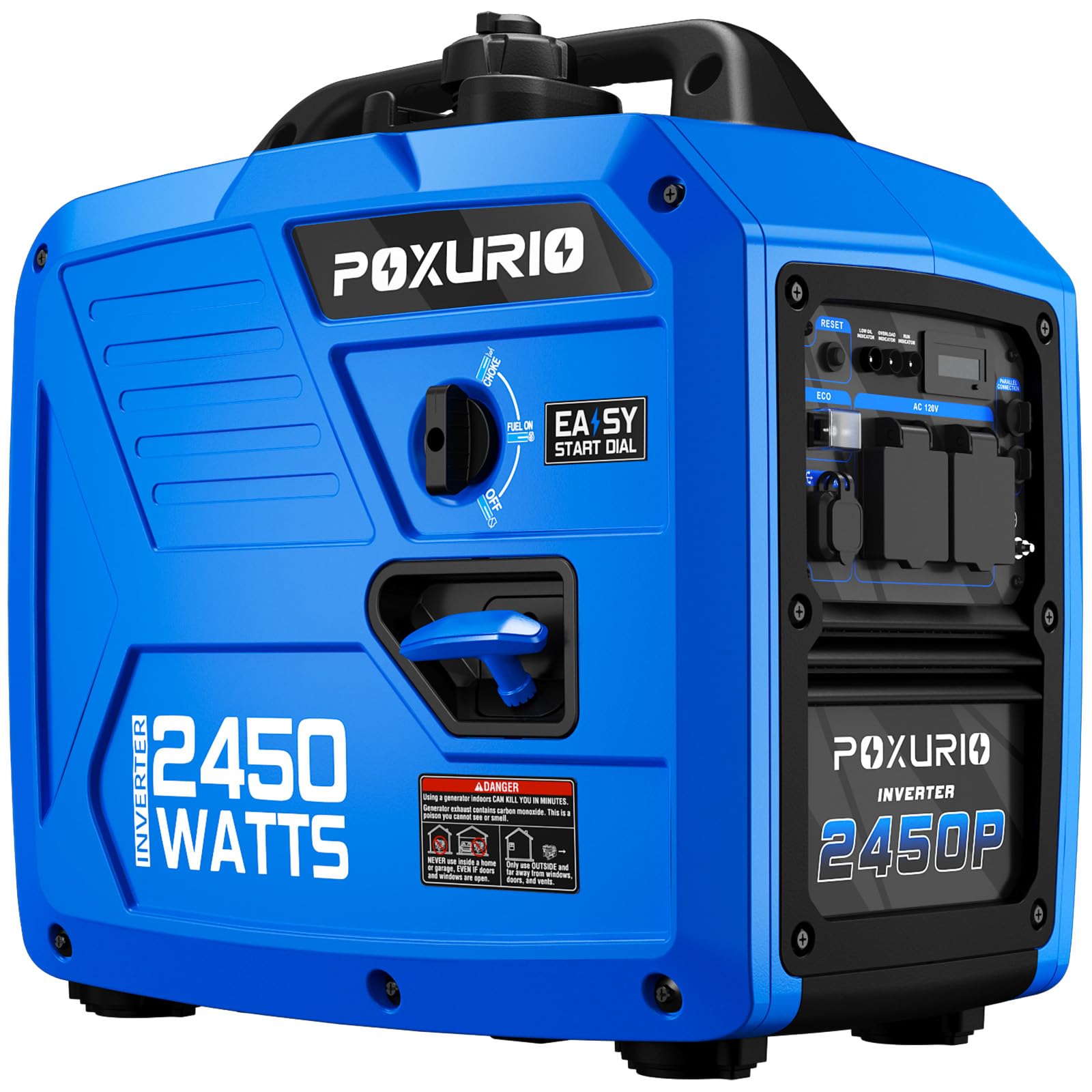
1. POXURIO 2450-Watt Portable Inverter Generator
Our pick — over 4.5★ from 100+ verified ratings; the strongest balance of quality and price.
The camper’s quiet companion that keeps an RV air conditioner humming till morning.
This is the pick for the family pulling into a campground at dusk, or the RV owner who wants cold air without waking the whole loop. Its inverter technology produces clean sine-wave power, so sensitive electronics get steady, stable electricity instead of the jittery kind that can shorten their life. The 3000W max engine gives it real headroom on startup, which is exactly what a camper AC needs when its compressor kicks in.
The number buyers talk about most is the quiet — it runs at a noise value of only 59 decibels, which sits well below a normal conversation. In the comparison table it undercuts the Aceup Energy on noise, though at 43 pounds it tips the scale 3.3 pounds heavier across the lineup. The 1.6-gallon gas tank is rated for 8.3 hours of use, and it ships with a 6L high-capacity fuel tank rated up to 10 hours at 25% load. It carries a 4.6-star rating across 100+ owner reviews, the strongest score on this list.
Buyers report pulling into a campground expecting hookups, finding the power down and the heat unbearable, then firing this up — it kept their camper AC running all night and stayed quiet enough that the neighbors never complained, as owners put it: “This is quiet and did not disturb the neighbors (I asked)”. Others praise its portability and fuel efficiency, noting it barely sipped gas overnight. The one recurring gripe: it can shut down on voltage spikes in ECON mode, so a high-surge tool like a 1200W circular saw may trip it — set that mode off for the big draw.
What Earns It The Top Spot
- 59 dB operation keeps campers and neighbors comfortable
- 3,000W max engine handles a camper AC’s startup surge
- Clean sine-wave inverter power protects sensitive gear
- Strongest owner score on the list at 4.6 stars
Where It Asks Patience
- 43 pounds is the heaviest single carry in the group
- ECON mode can shut down on big startup spikes
- Hard cold starts until the engine warms up
Reach for this if: you camp near others and need a camper AC to run all night without a noise complaint.
Look elsewhere if: you’ll run heavy power tools that spike hard on startup, since ECON mode cuts out on those surges.
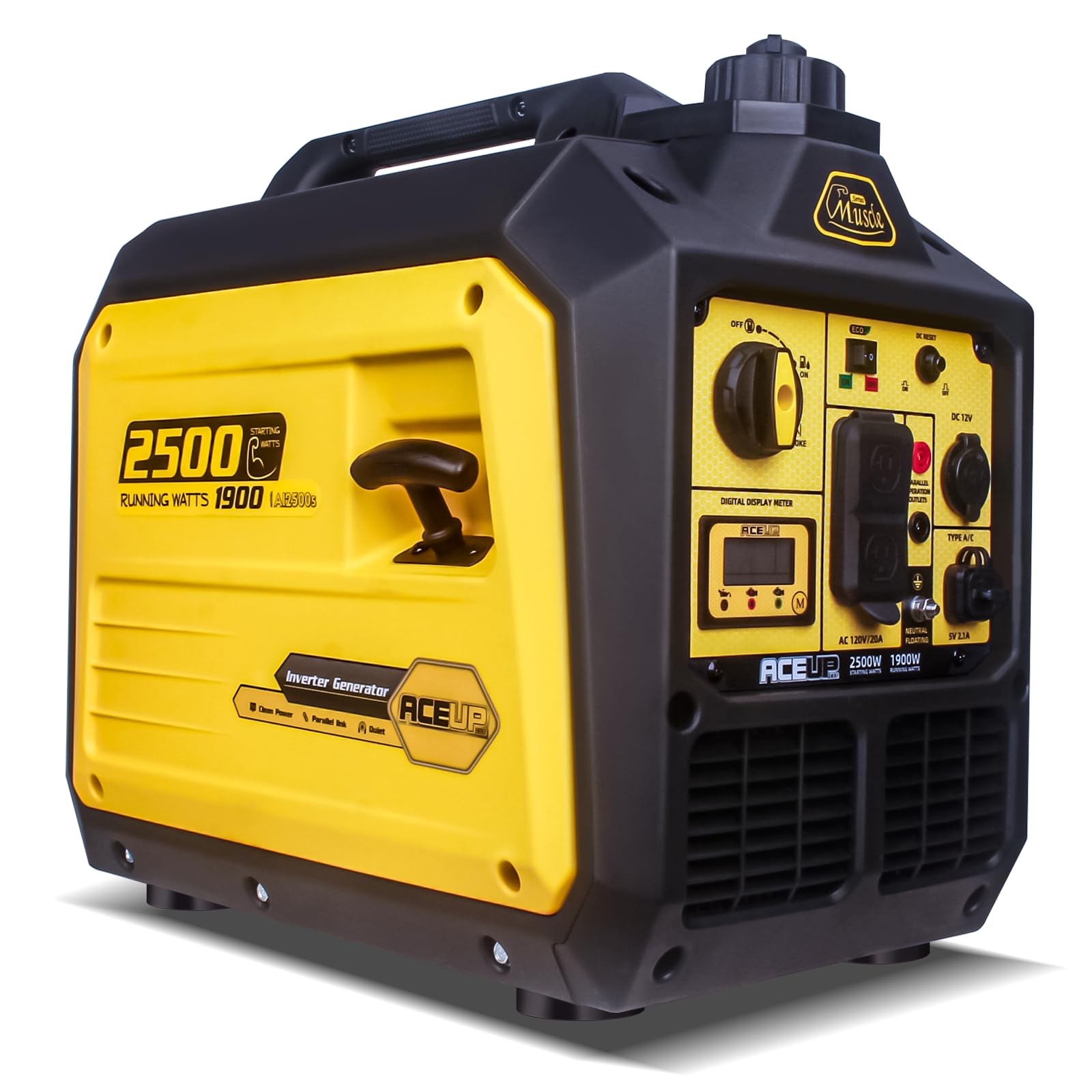
2. Aceup Energy 2500W Super Quiet Inverter Gas Generator
The lightest full-size option for basic home backup on a real budget.
If your plan is keeping the fridge and a few lights alive through a short outage, this entry-level pick does the job for the least money here. Inside is a 79.8cc 4-stroke OHV engine (overhead-valve, a simple design that’s easy to service) rated for 2500 peak watts and 1900 rated watts, started by a recoil pull cord. Its inverter holds distortion below 1.5% THD, clean enough to protect phones and a TV. At 39.7 pounds it’s noticeably lighter than the 43-pound POXURIO above and it’s one of the lightest units on the whole list.
Quiet is where it shines — about 53 decibels in Eco mode at 23 feet with a quarter load, so a morning run won’t turn heads. The 1.32-gallon tank runs up to 10 hours at quarter-load, and you get one 120V 5-20R outlet, a 12V 8.3A car-style outlet, and USB-A and USB-C ports. There’s an intelligent gauge tracking voltage, run time, fuel level, hertz, and power output, plus a low-oil light and an Eco mode to stretch fuel. It’s parallel-ready too, so two units can double output with a kit sold separately.
The honest catch is the power headroom. Owners split on whether it’s enough — several note it comfortably manages basic loads, while others find it struggles when you stack devices, and the practical ceiling sits fairly low for bigger appliances. On support, an occasional owner has hit a unit that won’t start and a warranty wrangle, but that’s rare against the broader run of solid experiences. Treat it as a clean, quiet backbone for fridge, lights, and fans, not a job-site generator.
Best-fit scenario: short outages where the fridge, a fan, and a charging station are the whole job, and you want to spend as little as possible.
The honest limit: its running wattage caps out below the bigger picks, so a large AC or several big appliances at once will overwhelm it — add loads gradually.
Pin this one down if: bargain price, low weight, and 53 dB quiet matter more to you than raw wattage.
Step up instead if: your outage list includes a big AC or multiple heavy appliances at once.
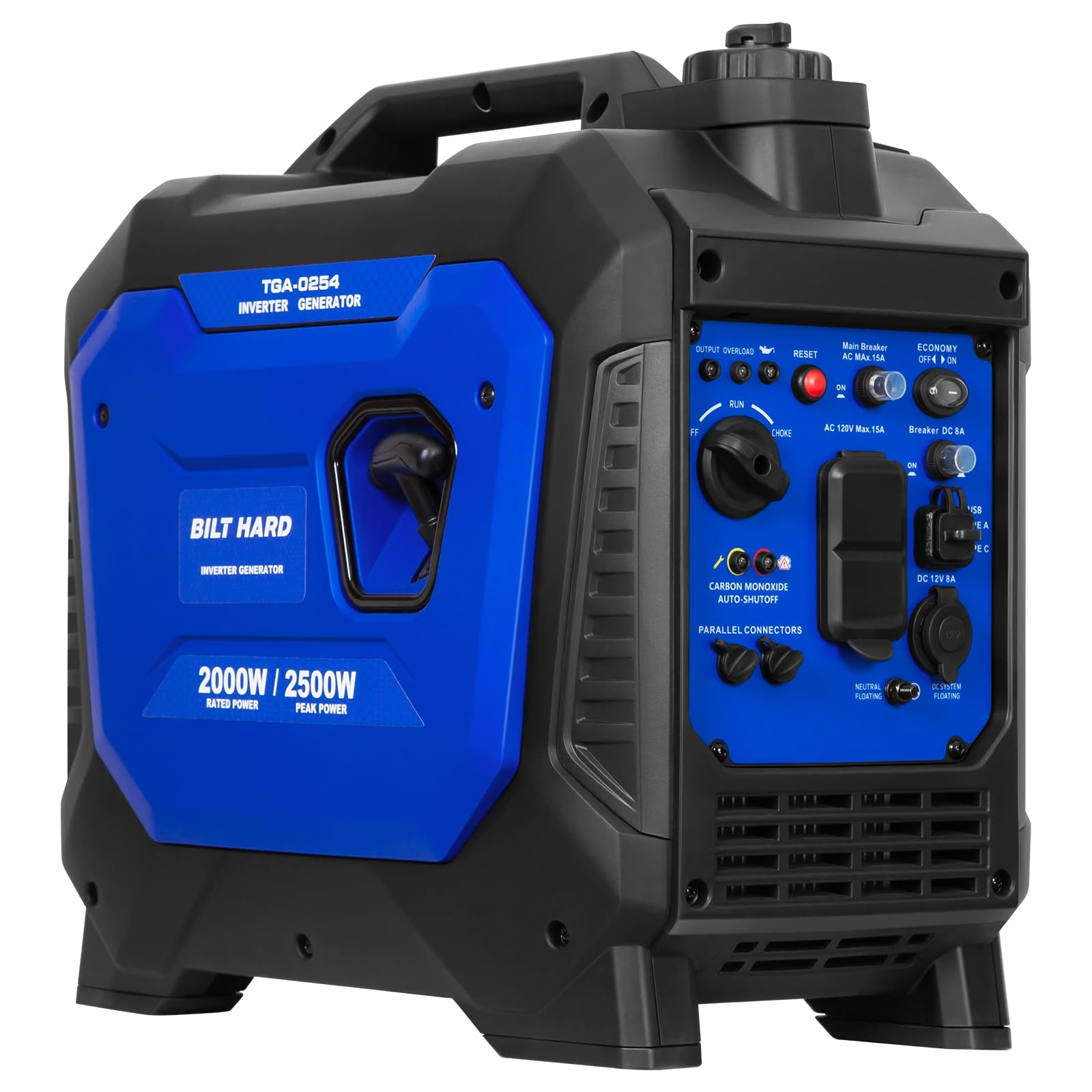
3. BILT HARD Gas Generator 2500W with CO Sensor
A middleweight with a carbon monoxide cut-off and a clean-power guarantee.
For the household that wants an extra guardrail around a running engine, this 4.5-star pick builds it in. Its integrated carbon monoxide (CO) sensor automatically shuts the engine down if the gas builds up to unsafe levels, so you get a built-in backstop. The 80cc 4-stroke air-cooled engine also runs behind an inverter that keeps distortion under 3% THD, delivering two 120V 15A AC outlets and one 12V 8A DC output, all protected by circuit breakers.
What wins people over is the power — it holds 2500 starting watts and 2000 running watts, and it’s the most-praised area among owners. Several report it running a 13,500 BTU RV air conditioner alongside other items without strain, and one RV owner had it power a 24-foot trailer’s fridge and AC through a heatwave, with a full tank lasting nearly the whole night. It’s also light enough to slide under a pickup tonneau cover, and it’s parallel-ready with a kit sold separately if you later want to double the output.
On runtime, the 1.11-gallon tank gives up to 5.5 hours at 50% load, and it wants 87+ octane unleaded gasoline with stabilizer and SAE 10W-30 oil. The mixed note is battery-style endurance — some owners measure long stretches, others shorter ones — so plan refuels around your actual load. It’s a fair middle-ground on weight at 42.6 pounds: lighter than the 43-pound POXURIO, heavier than the sub-40 group.
A quiet edge over louder rivals: owners consistently report it surprised them with how little noise it makes while running an RV setup.
Worth knowing: keep fresh stabilizer-treated gas and run it on a schedule, since the manual’s maintenance rhythm matters for warranty.
Pick it when: CO detection, clean inverter power, and RV-grade muscle all matter to you at once.
Consider another if: you want maximum runtime per tank for the heaviest sustained loads.
4. PowerSmart 2500 Watt Portable Inverter Generator

The farmstand favorite that whispers at 52 dBA on a light load.
Here’s the one for a hangout, a market stall, or a tailgate where the sound of a motor would wreck the mood. It runs at 52 dBA from 23 feet at 25% load and stays at 59 dBA at full load, making it a genuine quiet pick in the group. Power lands at 2500 starting watts and 1900 running watts with less than 3% THD, enough clean power to feed a mini fridge all day, run a 700-watt microwave, or keep a set of fans and a router alive. Support comes from two three-prong 120V 15A outlets, a 12V DC outlet, two 5V USB ports, and parallel ports.
At 39.7 pounds with a built-in handle it’s easy to carry one-handed, and it adds Eco mode, low-oil shutdown, overload protection, and Carbon Monoxide Auto Shutdown. Owners in the field report roughly 10 to 12 hours of slow runtime on Eco mode with light loads, some running six fans and charging phones across a ten-day trip. Several mention it started in a pull or two and held steady voltage, and the build quality ranks as the most-praised trait by owners.
The recurring caveat is reliability, which is the most-discussed area and reads as a mixed bag — most units run for the long haul, but a subset of owners hit issues, often traced to running premium higher-octane fuel and to pushing it like a heavier generator doing jobs it wasn’t sized for. Treat it as an inverter for fridge, lights, fans, and screens, not a high-surge tool. That’s a load ceiling, not a defect.
Who it suits: the buyer who needs the quiet numbers to be real — 52 dBA at a quarter load lets a conversation carry.
The fine print: use the higher-octane fuel it wants for clean econ-mode running, and keep loads modest; heavy-burst tools may trip the overload.
Go here if: quiet operation and light everyday loads are your top two priorities.
Skip the notion that it replaces a heavy job-site generator for high-surge power tools.
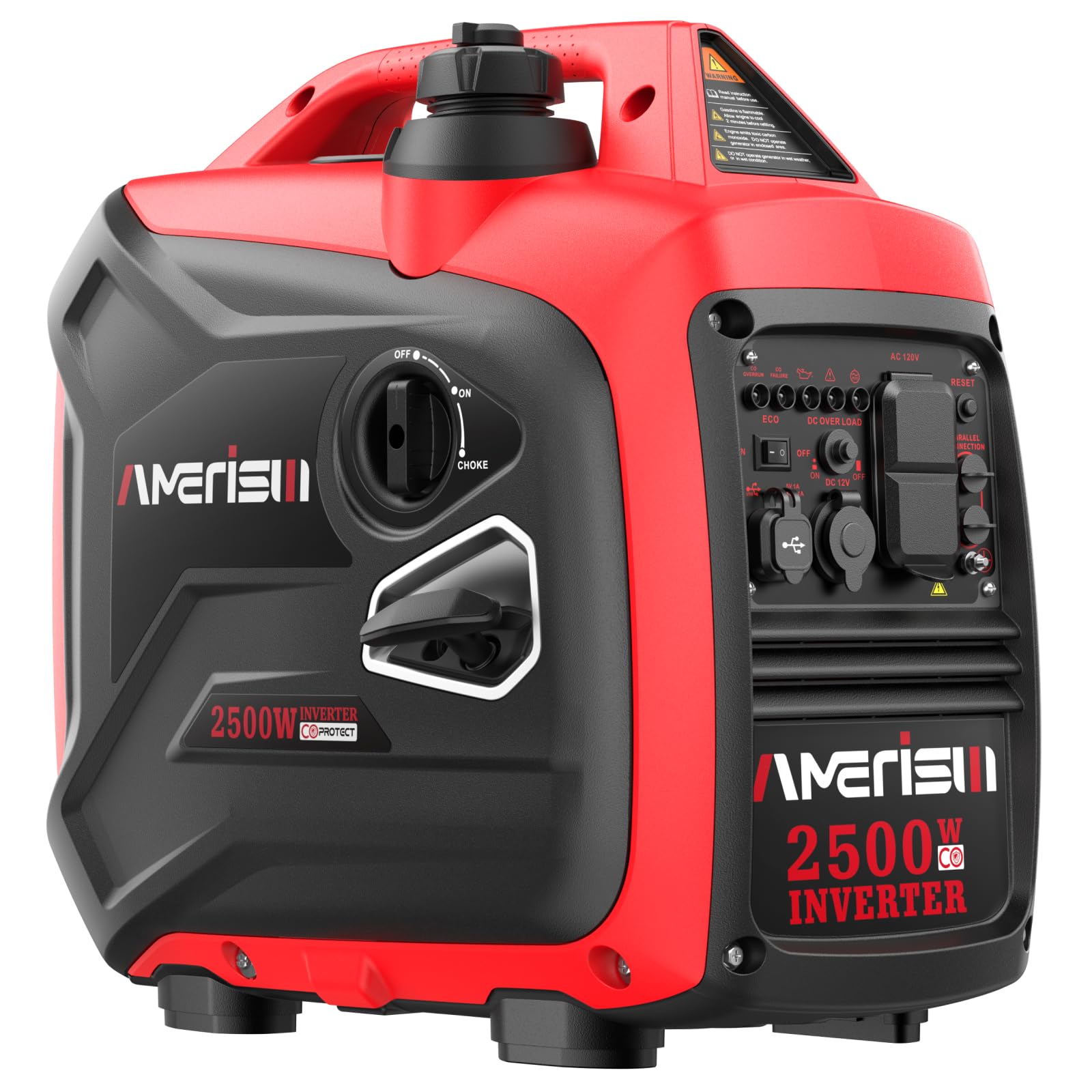
5. AMERISUN 2500W Gas Inverter Generator with CO Sensor
A featherweight that trades on sheer time between refuels.
If your frustration is topping off the tank every few hours, this one answers it. A 1.05-gallon tank stretches up to 11 hours of operation at 25% load — the longest quoted runtime in the group — and still runs 5.5 hours at a 50% load, with an Eco design the maker says can save up to 25% fuel. Output is 2500 peak watts and 1900 running watts in a compact 39-pound body with a carrying handle, so it slips into a truck bed without a fight.
Owners rave most about the performance it delivers for its size: one used it to drive eight bulbs, a fridge, a washer, a TV, a game console, two fans, and a CPAP machine all at once with no surges, and reported a full tank lasting 11+ hours under that load. Others note it starts easy after warm-up and runs quieter than expected, and the build quality reads as solid with a clean control panel. Outputs cover two 120V AC outlets, one 12V DC outlet, and two 5V USB ports for charging phones and tablets.
Two quirks to know going in. It ships without oil, so you’ll add SAE 10W-30 synthetic before the first start, and its power output divides opinion — some owners find the wattage short of the 2500W label for heavier draws. It’s also a cold-starter for the first few pulls until it’s been running. Both are routine, not defects.
Best headline number: 11 hours at a quarter load is the sort of overnight coverage few units in this class promise.
Check first: oil is not included, so budget for a 10W-30 jug and a few warm-up pulls on cold mornings.
Made for you if: you want the longest power window per tank and the lightest body to carry it.
Think twice if: you plan to lean on the top of its wattage range, where its output has drawn mixed feedback.
6. WEN 56250i 2500-Watt Inverter Generator

The v-nose trailer regular that empties its own carb before storage.
For someone hauling tools in an enclosed trailer or topping up a power station on cloudy days, this is a natural fit. Its 80cc engine makes 2500 surge watts and 1900 rated watts, and the inverter output prevents damage to sensitive electronics like smartphones, tablets, and laptops. The standout feature is a fuel shutoff that burns off remaining fuel in the carburetor before shutdown — the spec that keeps the unit healthy between uses and cuts the odds of a gummed-up carburetor next season. At 37.5 pounds, it’s the lightest pick in the whole comparison.
Owners find it easy to use and quiet, with a well-packaged unit that started on one slow pull after adding oil and fuel. It handles a 1500W heat gun without strain, and one owner uses it to charge a power station in an Aliner camper on cloudy days. The control set includes two three-prong 120V receptacles, two 5V USB ports, and an onboard hour meter, plus a three-year warranty. What earns it praise most is the build quality, and starting performance falls right behind it.
The nitpick is engine appetite — it burns a little oil and carries a stronger exhaust smell, so expect to top off the crankcase between runs. It also has no CO protection sensor, a deliberate call for owners wary of sensor shutdowns, but a choice to weigh if safety sensing matters to you.
The keeper feature: the carburetor fuel shutoff is the kind of detail that earns its keep on a generator stored between trips.
The trade: no carbon monoxide sensor, and it sips a little oil, so check the level before each run.
Good match when: you store a generator between trips and want it to fire cleanly each time.
Not ideal if: built-in CO sensing is on your must-have list — this model deliberately leaves it out.
7. WEN DF280iX 2800-Watt Dual Fuel Inverter Generator

Two fuels in one tank — and enough watts to catch the overloads.
For a household watching storm tracks, having a second fuel option is the whole point. This unit runs on gasoline at 2800 surge and 2250 rated watts, or on propane at 2800 surge and 2000 rated watts, and it’s the highest gasoline running-wattage pick here. Its 98cc 4-stroke engine pairs with a WEN Watchdog CO Shutdown Sensor that automatically turns the generator off if carbon monoxide builds up, plus a fuel shutoff that drains the carburetor before shutdown for longer storage life. It carries two three-prong 120V receptacles, one 12V DC receptacle, two 5V USB ports, and a three-year warranty.
What owners praise most is reliability, and the performance follows closely behind — it starts reliably around the third pull and holds steady power without fluctuation, and it earns its 4.2-star score. On propane it starts with a few prime pushes and runs about as quietly as an 80cc unit on gasoline. It keeps clean, low-THD power for phones and laptops so you’re not gambling with sensitive electronics. It’s light enough to move one-person and adds both fuel shutoff and the CO Watchdog.
Two caveats worth stating plainly. Setup is heavier than some expect — the carburetor access is tight if you ever need to jet it, and propane gear can be awkward to route. And a rare unit arrives as a gasoline-only body despite the dual-fuel labeling, so check that the propane hookup and selector switch are present on delivery and use the responsive customer service if anything’s missing. Those are rare incidents, not the norm.
Where it leads: at 2250 running watts on gasoline, it’s the most running power in this comparison — the reason it can catch loads the smaller units can’t.
Mind the setup: propane routing and carb access ask for patience, and a rare mislabeled unit needs a quick return.
Land here if: dual-fuel flexibility and the top running wattage in this group are what you’re after.
Rethink if: you want the fewest setup headaches and won’t miss the extra propane option.
8. Champion 2500-Watt Ultralight Portable Inverter Generator

Billed as one of the lightest 2500-watt inverters, with cold-start tech built in.
For the solo camper or the person who has to lift the unit alone, this one keeps carry weight down. At 39.7 pounds it’s among the lightest in its class, and it starts at 2500 starting watts and 1850 running watts with up to 11.5 hours of runtime on gasoline. It runs at 53 dBA from 23 feet, quiet enough for camping or tailgating, and includes a CO Shield carbon monoxide auto shutoff system. Clean power comes through a 120V 15.4A household duplex outlet (5-20R) at less than 3% THD, plus a 12V automotive-style outlet.
Owners find it powerful for its size — one ran multiple appliances across eight hours — and the ultra-light build and portability get consistent credit, especially for camping and emergency use. It carries Cold Start Technology, is parallel-ready (a kit sold separately lets two of these double the output), and includes a 3-year limited warranty with free lifetime technical support. It’s a strong 4.4-star pick in the lineup.
The one thing to plan around is the CO Shield sensor, which some owners find trips the shutdown more often than they’d like — even outdoors, and especially as the day cools. For a winter ambulance-runner or cold-weather user, that sensitivity can interrupt a run, so weigh whether aggressive CO sensing helps or hassles you. Otherwise the unit produces its rated power efficiently and starts with a pull or two.
Signature spec: at 39.7 pounds, the ultralight claim is the reason to buy — it’s genuinely manageable for one person.
Know the sensor: the CO Shield can cut the engine more eagerly than some owners want, so plan for occasional restarts in cool weather.
Buy it when: you carry the generator yourself and 39.7 pounds is the limit of what you want to lift.
Look at another if: a hair-trigger CO shutdown would frustrate you more than it would reassure you.
9. Westinghouse iGen2550DF Dual Fuel Inverter Generator

The RV-ready dual-fuel pick that keeps cold air moving through a heatwave.
Owners who want an RV-ready outlet and both fuels in one unit will find this the most versatile build here. It delivers 2550 peak watts and 1900 rated watts at less than 3% THD, with one RV-ready TT-30R outlet plus two 120V 20-amp outlets and two USB outlets — the TT-30R means it plugs straight into a travel trailer’s 30-amp inlet without an adapter. It runs on gasoline or propane, weighs 42 pounds, and is quiet as low as 52 dBA. A 1.16-gallon tank stretches up to 11 hours at 25% load, and Economy Mode trims fuel use further.
What owners rave about most is the sheer quality, with the quiet running a close second — one reports it stayed light and quiet enough to hold a conversation beside it. During an eight-day storm outage, one owner picked it precisely because it could switch between propane and gasoline while running, and found the manual exceptionally well written. It comes with engine oil, a funnel, a propane hose, a tool kit, and a user’s manual, needs only minimal assembly, and is backed by a 3-year limited warranty.
The build quality carries a couple of small nits: the included oil runs a touch short of the fill line, so add a little of your own, and the propane hose and regulator can feel awkward to route. Setup rewards reading the addendum page over the quick-start sheet. Neither nit affects the core: it starts easily on either fuel and holds steady power.
The RV edge: a TT-30R outlet plus dual fuel means it hooks straight into a camper and keeps running when one fuel gets scarce.
Setup tip: read the addendum before the quick-start guide, and top off the oil since the included jug comes up just shy of full.
Perfect for: RV owners who want a ready-made 30-amp hookup and the freedom to switch fuels mid-outage.
Less needed if: you don’t run an RV and a straight gasoline unit would suit just fine.
10. Cummins Onan P2500i Portable Digital Inverter Generator

The data-display unit that tells you exactly what’s left in the tank.
For someone who wants to know precisely how much runtime remains, this premium pick puts the numbers on a screen. Its 3.4 HP 98cc OHV 4-stroke engine makes 2500 peak watts and 2200 running watts, and an LED display reads out fuel level, power output, remaining run time, voltage, and lifetime run hours. It uses a pull-start recoil rope with a simple stop, run, and choke switch, and provides two 5V USB ports for charging phones or tablets. In this comparison it matches the WEN DF280iX on 2200 running watts, but keeps a single fuel — gasoline — and stays the heaviest body here at 56 pounds.
Owners describe it as quiet and easy to start, with one reporting it ran an entire home on 110 volts and sipped fuel, and another measuring 12 hours on a tank of fuel in Eco mode. The 4.4-star rating across a smaller pool of owners reflects a unit that gets the everyday job done without fuss, and the pull-start with choke makes the ritual predictable.
One caveat to size up: it isn’t dual-fuel, so you’re committed to gasoline here, and at 56 pounds it’s the least portable pick in the lineup. That makes it the better fit for a home or cabin location you don’t move often. The rest of the owner feedback is uneventful: it starts, runs, and quietly powers the essentials.
What you gain: the LED readout of fuel level, run time, and voltage removes guesswork from outage planning.
What you give up: dual-fuel option and easy carrying — this one weighs more than anything else here, so keep it where it lives.
It’s the one for you if: a clear readout and dependable quiet starting matter more than portability or a second fuel.
Pass over it if: you need to load the unit in and out of a vehicle often, given its 56-pound heft.
Understanding the Specs
Peak Watts vs. Running Watts
Running watts is the steady power a device pulls once it’s on, while peak watts is the brief burst that starts it. A fridge compressor, for example, needs its peak watts for a split second every time it kicks on, then settles to running watts. If you buy on running watts alone, the fridge may trip your generator the moment it cycles.
THD and Inverter Output
THD (total harmonic distortion) measures how clean the electrical waveform is, and lower is better for sensitive devices. An inverter generator holds distortion low, often below 3%, so laptops, TVs, and phones receive smooth power instead of spikes. When the label says low THD, it means the output can safely feed electronics, not just lamps and heaters.
Decibels at a Set Distance
Noise ratings in this class are quoted at a set distance, most often 23 feet, and in dBA units that reflect how the ear hears them. A mid-50s figure means you can talk beside the generator; a figure in the 60s means you’ll raise your voice. Match the number to your setting — a crowded campground rewards the lower reading.
Runtime and Fuel Type
Runtime is quoted at a fraction of load, so a tank that gives many hours at 25% load will empty faster when you pile on devices. Gasoline is easy to find and store, while propane never goes stale and gives you a fuel that keeps for years. Dual-fuel units let you pick whichever is on hand.
FAQ
Will a 2500 watt generator run a refrigerator and a freezer together?
Can a 2500 watt generator run an RV air conditioner?
What is the difference between starting watts and running watts?
Is propane or gasoline better for a portable inverter generator?
Do I need to add oil before the first start?
How long does a tank of fuel last on a 2500 watt inverter generator?
Can I connect two 2500 watt generators for more power?
What does a CO sensor on a generator actually do?
How do I store a portable inverter generator between uses?
Is a 2500 watt generator powerful enough to run a whole home?
Final Thoughts: The Verdict
For most buyers, the 2500 watt generator to start with is the POXURIO 2450W Inverter Generator — it pairs the strongest owner score on the list with a 59 dB whisper and enough surge to keep a camper AC running all night. If dual-fuel flexibility and the top running wattage matter most, the WEN DF280iX runs on gasoline or propane and switches between them mid-outage. And for the longest window between refuels on a light load, the AMERISUN 2500W stretches up to 11 hours at 25% load in a 39-pound body. Whichever you choose, match running watts to your loads, add devices one at a time, and add oil before the first pull.
How We Picked
We do not accept paid placement. Every pick is matched to a real buyer and a real use-case; we do not hands-on test units.
Sources & Methodology
Specifications: manufacturer listings and product documentation. Review insights: verified customer reviews, as of September 2026. Pricing: not shown on this page (it changes often); check the current price via the retailer link.
As an Amazon Associate, KitchPrep earns from qualifying purchases. This does not affect which products we feature.
Related Guides
