
Specs are compiled from manufacturer listings and verified buyer reviews and can change over time — please confirm the key details on the product page before buying.
If you want the honest answer first: the Renogy Bifacial Solar Panel 2360W N-Type 16BB is the strongest overall pick here, because it pairs a top 25% cell efficiency rating (how much sunlight each cell turns into electricity) with a proven build quality that owners keep confirming. A “2000 watt solar panel” is rarely one single panel — it is almost always a multi-panel array whose wattages add up to roughly 2000W. So before you buy, know this: the three picks below are matched by total array capacity, not by an identical panel count, and none of them is the exact same number you typed into the search bar.
I’m Mohammad Maruf — the founder and writer behind KitchPrep. This guide is built by comparing the manufacturers’ published specifications and the patterns across verified customer reviews, so you get each pick’s real strengths and trade-offs instead of marketing spin.
What follows is a straight look at three real 2000-watt-class arrays, from a UL-certified 10-panel set to a premium four-panel bifacial rig. Every number below is checked against the maker’s own spec sheet, so picking the right 2000 watt solar panel depends on matching total wattage to your roof space and your charge controller (the device that manages power flow into your battery).
Our Picks at a Glance
How To Choose The Best 2000 Watt Solar Panel
The first thing to unlearn is that you are shopping for a single 2000W panel. A single panel that size would be enormous and nearly impossible to mount. What you actually buy is an array — several panels wired together whose rated wattages total about 2000W, whether that is ten 200W panels or four 590W panels. So the real decision is not “which panel” but “which combination of panel count, cell efficiency, and physical size fits the roof or RV you own.”
Count the panels, then count the watts
Two arrays can both claim “2000W” and still be wildly different buys. A ten-panel kit spreads the weight and lets you angle panels around roof vents and skylights; a four-panel kit means fewer mounting points but each panel is heavier and larger, so you need a sturdier rack. Before ordering, measure your usable roof area and check whether you can physically carry a panel up a ladder — several of these panels weigh 35 pounds or more and take two people to lift safely.
Match the array to your charge controller
Voltage and amperage are the specs that decide whether your controller survives. If you wire panels in series, voltages add up and low-light output improves; wire in parallel and amperage adds instead, which keeps voltage low but demands thicker cable. Check the maximum voltage each panel lists and the amperage capacity of your connecting materials, because pushing past them overheats the wiring. A controller rated for the wrong voltage window will either underperform or shut down entirely.
Read the certifications, not just the wattage
For a permanent outdoor install, the safety paperwork matters as much as the output number. Look for independent certification to recognized photovoltaic standards, an IP68 junction box rating (the highest dust-and-water sealing level), and a corrosion-resistant aluminum frame rated for wind and snow loads. A claim of “25% efficiency” means little if the frame rusts in three winters or the junction box leaks during a storm.
Quick Comparison
| Model | Best For | Total Rated Power | Panel Count | Cell Efficiency | Amazon |
|---|---|---|---|---|---|
| Renogy Bifacial 2360W N-Type 16BB★ Best Overall | Maximum output per panel | 2360 watts | 4 panels | 25% | Amazon |
| ECOBOSS 2000W UL Certification, 10PC 200W N-Type | UL-certified value build | 2000 watts | 10 panels | 25.8% | Amazon |
| Renogy 320W N-Type 18BB, 10PCS | Large-scale off-grid arrays | 3200 watts | 10 panels | 25% | Amazon |
In‑Depth Reviews
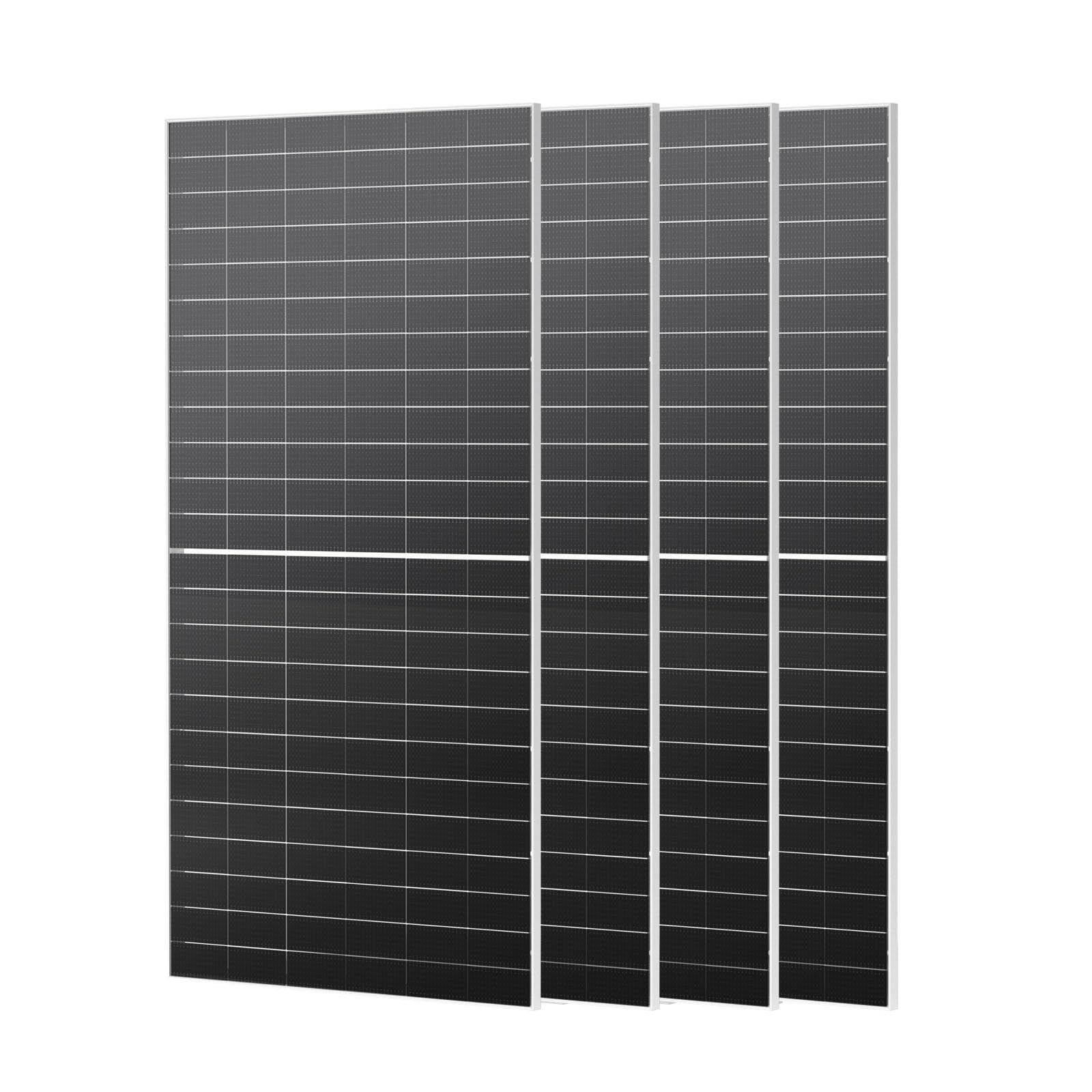
1. Renogy Bifacial Solar Panel 2360W N-Type 16BB
Our pick — over 4.5★ from 20+ verified ratings; the strongest balance of quality and price.
Four giant panels that pull light from both faces and top 2360 watts
This is the array to buy if your goal is raw wattage from as few panels as possible. Renogy builds the 2360W kit from just four 590W N-Type panels, each using 16BB technology (16 thin busbars per cell that carry current with less resistance). That combination pushes cell efficiency to 25%, so a smaller footprint generates the power a much larger old-style array would. The headline figure is 2360 watts — a step above the 2000 watts the ECOBOSS kit delivers — which is what gets this kit the top spot.
The bifacial design is the real differentiator for a fixed roof or ground mount. Because the back of each panel is transparent, it also absorbs sunlight bouncing off a white roof membrane, gravel, or snow, which Renogy rates at up to 30% more energy than a one-sided panel. Owners see it in practice, with buyers reporting up to ~1050W in peak sun Two things matter at install: the frame is rated for 2400Pa wind and 5400Pa snow loads (pressure ratings that tell you how much wind and snow the frame can take), and the junction box carries an IP68 rating — the top level of dust and water sealing, so rain and hose spray are not a concern.
What wins people over most is the build quality, and the panels earn a reputation for arriving intact and installing straight from the start. Performance follows close behind — these deliver the promised energy, and the connectors seat perfectly into common inverters. The honest trade-off is weight and size: at 233 pounds for the set and 89.7 inches long per panel, this is not a one-person job, and you will need a serious mounting structure. Plan cable runs carefully too, because the leads only reach the panel edge. Compared with the ECOBOSS ten-panel kit, this one produces 2360 watts from four panels rather than 2000 watts from ten — far less mounting hardware and far fewer roof penetrations for a bit more total power.
Where It Wins
- 2360 watts from only four panels cuts your mounting points and hardware
- 25% cell efficiency with 16BB design means more output per square foot of roof
- Bifacial transparent back adds rear-side pickup on white or reflective surfaces
- IP68 junction box and corrosion-resistant aluminum frame rated to 2400Pa wind and 5400Pa snow
What To Expect
- 233 pounds total — you need two people and a sturdy rack
- 89.7-inch panels demand real roof or ground space
- Leads stop at the panel edge, so extend cables for longer runs
Grab these if: you want the most watts per panel and have the roof space and muscle to mount four large bifacial panels.
Think twice if: you plan a solo install or a small van roof — the size and weight will fight you.
2. ECOBOSS 2000W UL Certification Solar Panel, 10PC 200W N-Type
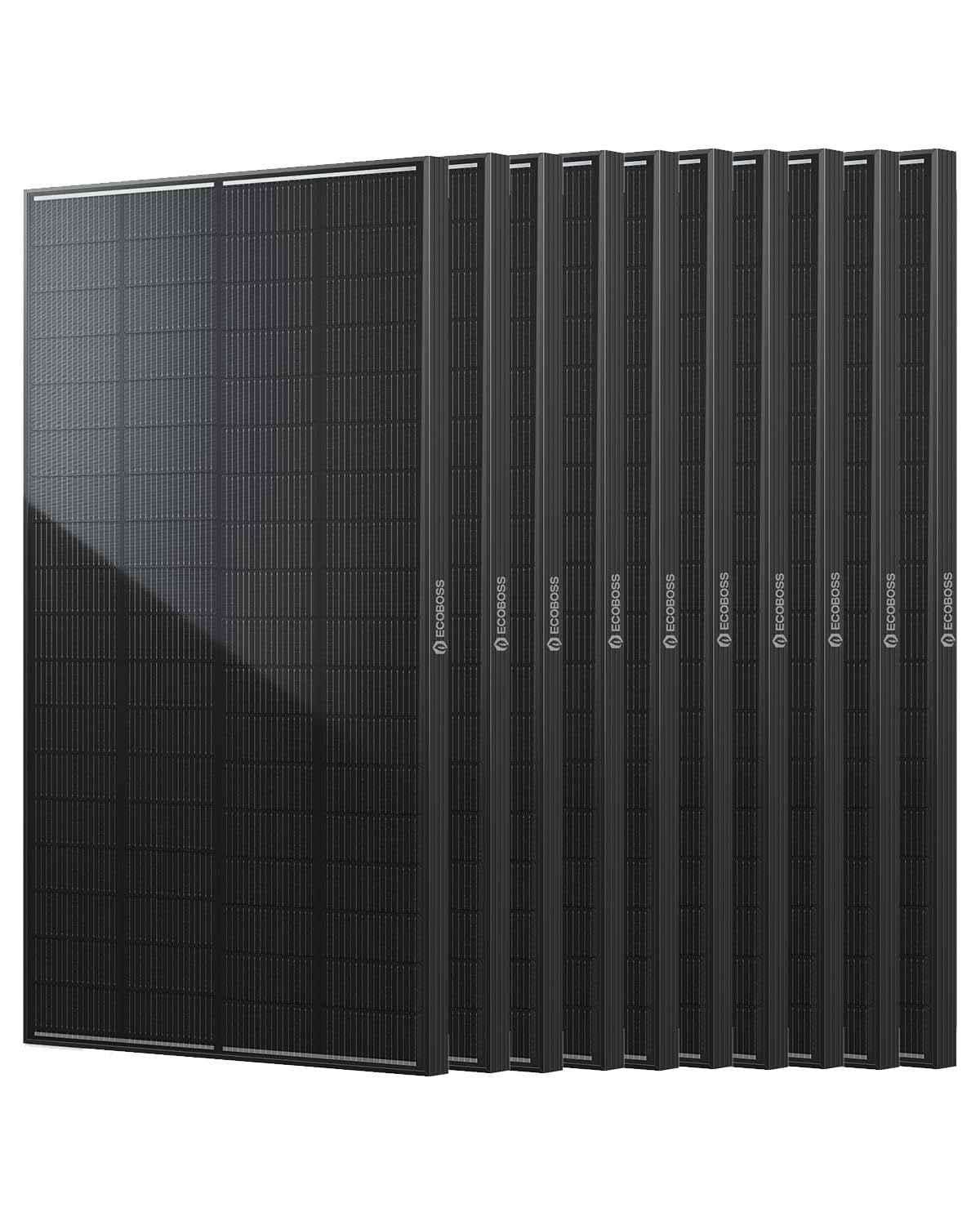
Ten slim 200W panels that spread a full 2000 watts across your whole roof
Here is the opposite strategy to the Renogy kit above, and it is a smart one. Instead of four heavy panels, ECOBOSS splits the load into ten 200W modules, each just 23.8 pounds and 52.8 x 30.3 x 1.18 inches. The total is 2000 watts, and at 25.8% efficiency these cells actually edge out Renogy’s 25% rating.
The safety paperwork is the standout. This kit is independently TÜV certified to IEC 61215, IEC 61730 and UL 61730 — the recognized photovoltaic module standards for durability, electrical safety, and mechanical safety. A series-parallel cell-string layout keeps unshaded sections producing even when part of a panel is shaded, and controlled testing showed up to 50% higher output than a three-string series design under partial shade. A low temperature coefficient of -0.3%/K limits power loss in summer heat, and a 25-year performance warranty plus 10-year technical support back the purchase.
Performance is what buyers praise most, especially in weak light, and the low-light behavior is a genuine strength on cloudy mornings. Build quality and affordability round out the positives. Be realistic about real-world output, though: buyers report four-in-series panels delivering 190W peak flat-mounted, with one measuring 225 watts at 4pm. That gap between the rated number and daily output is normal for any solar panel — heat, angle, wire length, and connections all trim the figure. For RV owners, the frame is a touch less stiff than some rivals, and handling each panel still takes two people on a ladder.
The certification edge: if you need a kit with documented UL and TÜV testing for a permitted or insurance-sensitive install, the ECOBOSS 10-panel set carries the standards paperwork the Renogy kits do not spell out here.
One wiring caution: the maker caps parallel connections at three panels and series connections at three panels, so a full 2000W build needs more than one string.
Reach for this if: you want a UL-certified array you can mount and handle one panel at a time, on a varied roof or a budget-conscious build.
Look elsewhere if: you insist on a stiffer frame for a rigid RV roof mount or expect full rated wattage on a flat, hot summer roof.
3. Renogy 320 Watt Solar Panels 10PCS N-Type 18BB
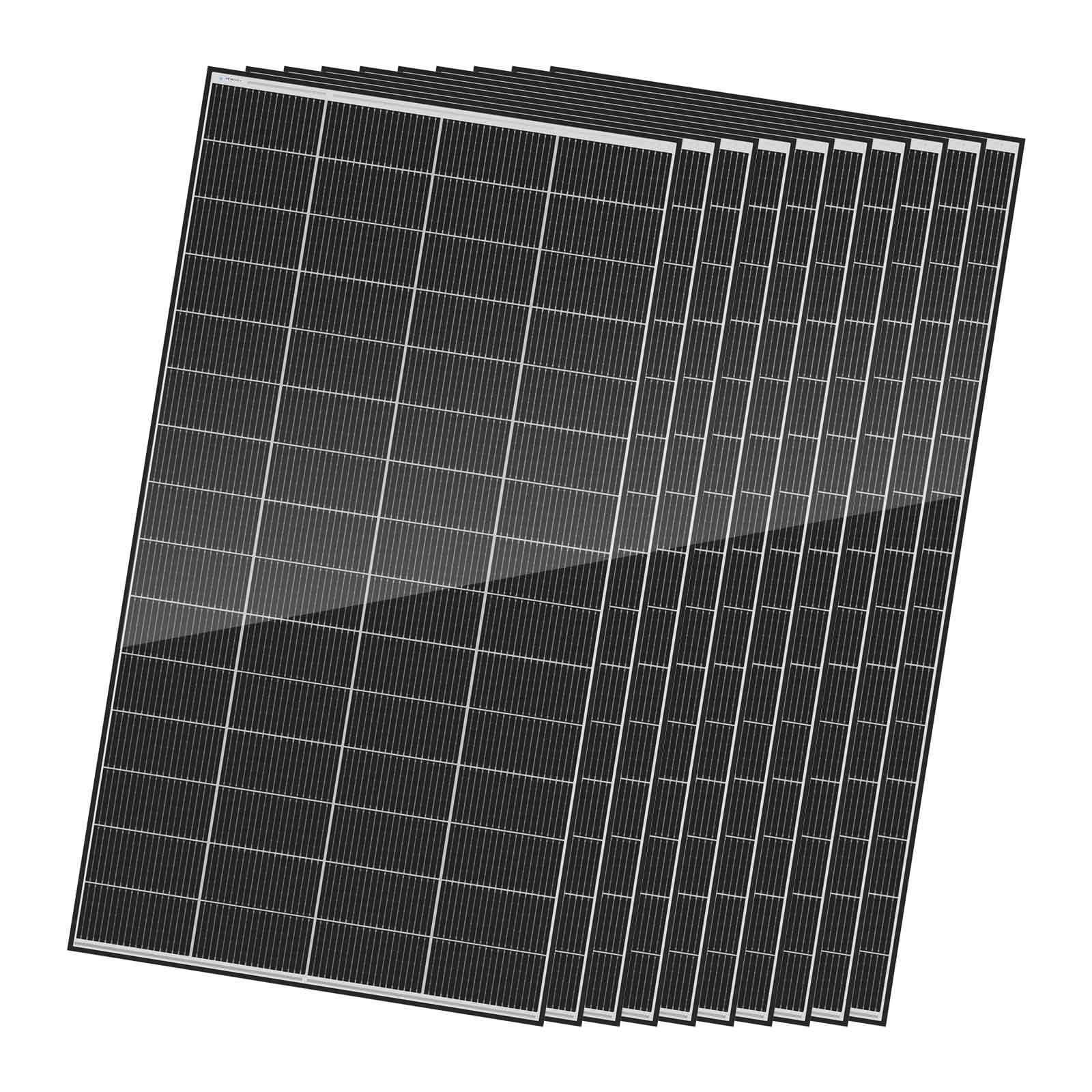
Ten 320W panels built to overshoot their rating when the sun cooperates
If your plan is a large off-grid or shed array and you would rather overbuild than squeeze, this ten-panel Renogy set is the one. Each panel is rated 320 watts, so the set totals well beyond the 2000W class — it is listed as a 3200W monocrystalline setup. That headroom means you can run fewer panels in full sun and still hit your target, or simply bank extra output on clear days. The panels use 18 busbars, a step up from 16BB designs, which spreads current across more conductive paths and cuts hot-spot risk in punishing weather. Cell efficiency sits at 25%.
The selling point owners keep returning to is output that beats the label. Buyers at 7,600 feet in Colorado report two 320W panels regularly producing above their rating, and long-time owners mention years of use with no panel failures. Each panel is rated up to 1600Wh per day, enough to run a small fridge, is EL certified (an electroluminescence test that checks cells for hidden microcracks), carries an IP68 rating, and ships with pre-drilled rear holes for Renogy’s Z-brackets and tilt mounts. A 24-volt maximum voltage keeps them compatible with common controllers.
The catch is consistency between units and deliveries. One owner found a box arrived in very bad shape while the panels inside still worked fine; another watched a courier drop a panel box during delivery, yet the packaging saved it. Because these are larger panels — 64.3 inches long and 35 pounds each — they take two people to move and reward careful handling. Note the wattage honestly: it is 320 watts per panel, so this is a bigger array than a strict 2000W build, and it costs more. You are paying for longevity and overdelivery, not for the smallest possible system.
The overdelivery factor: these panels tend to run above their rating in strong sun, which is why seasoned buyers keep coming back to them for permanent installs.
The shipping note: damaged boxes do happen in transit, but the multi-layer packaging is credited with protecting the glass inside.
Pick this set if: you are building a permanent, larger-than-2000W off-grid array on a home, cabin, or shed and want proven long-term durability.
Keep looking if: you want exactly 2000W or a lighter, more portable panel you can manage alone.
Understanding the Specs
Total Rated Power vs. Real Output
The wattage on the box — 2000 watts, 2360 watts, 3200 watts — is measured in a lab under perfect sun, at a set temperature, with no shading. On your roof, heat, panel angle, wire length, and connector quality all pull the number down, which is why buyers routinely report a four-in-series string of 200W panels delivering 190W flat-mounted. Treat the rating as a ceiling, and size your battery bank and controller around something lower so you are never short on cloudy days.
Cell Efficiency and Cell Type
Cell efficiency is the share of incoming sunlight a panel turns into electricity. Higher efficiency means more watts per square foot, so a 25.8% panel can generate more power from the same roof space than a lower-rated one. N-Type cells (a newer silicon build treated with phosphorus) resist light-induced degradation, tolerate heat better, and hold their output longer than older P-type designs. The busbar count — 16BB or 18BB — describes how many thin current-carrying strips cross each cell; more bars spread the load and reduce hot spots.
FAQ
Is a 2000W solar panel a single panel or a whole kit?
How many panels do I need to reach 2000 watts?
Will these panels work with my existing charge controller?
What does N-Type mean and does it matter for my install?
Can I really get the full rated watts out of these panels?
What is an IP68 junction box and why does it matter?
Do I need UL or TÜV certification for my solar installation?
How much does a 2000W solar array weigh and can I install it alone?
How do I maintain a rooftop solar array?
What warranty should I expect on a solar panel?
Final Thoughts: The Verdict
For most people building a real 2000-watt-class system, the 2000 watt solar panel winner is the Renogy Bifacial 2360W N-Type 16BB — the top-rated pick at 4.8 stars across owner reviews, because four bifacial panels give you more output with fewer mounting points and a build owners keep confirming. If documented UL and TÜV certification plus a stack of lighter panels suits your roof better, the ECOBOSS 2000W UL Certified set is the value play. And if you are overbuilding a permanent off-grid install on a cabin or shed, the Renogy 320W 10-panel set delivers the extra headroom and durability that heavy-duty arrays demand.
How We Picked
We do not accept paid placement. Every pick is matched to a real buyer and a real use-case; we do not hands-on test units.
Sources & Methodology
Specifications: manufacturer listings and product documentation. Review insights: verified customer reviews, as of September 2026. Pricing: not shown on this page (it changes often); check the current price via the retailer link.
As an Amazon Associate, KitchPrep earns from qualifying purchases. This does not affect which products we feature.
Related Guides
